CONSIDERATIONS REGARDING THE IMPORTANCE OF
ARTICHOKE CROP IN ORDER TO CAPITALIZE IT AS BIOMASS
MIRCEA C.1), SORICĂ E.1), DANCIU A.1), SORICĂ C.1), GRIGORE I.1), VISAN A.L.1),
CIUPERCA R.1), CIOBANU V.G.1)BRĂCĂCESCU C.1) 1)INMA Bucharest;
E-mail: [email protected]
Keywords: biomasa, plantă medicinală şi nutaceutică, plantă energetică
ABSTRACT
In this paper is presented a study in that are synthesized aspects concerning the extraordinary potential which it has the crop artichoke for sustainable capitalization as: energy source, medicinal plant, but also row material in pharmacological industry to extract active compounds from cardboard.
INTRODUCTION
The artichoke is a herbal plant with Mediterranean origin that in Romania is cultivated especially in the South regions. [7] In normal production conditions from the artichoke crop can be obtain 20,000 kg/hectare biomass roe material, without taking in to account the lives and other vegetal residues, that usually are used to enrich the soil through the so-called biological loss or, more accurately, by leaf falls. In time, through deterioration it turns into humus.
Having an developed ridiculer system, the artichoke, can breaks the hardpan in depth, leaving nutrients, water and air to penetrate into the depths, so microorganisms transforms the biomass into humus.
The crop life time is between 8 and 10 years [5], and requires minimum tillage agro technical works that are consisting in crop sowing and harvesting. The main requirement of this plant is the temperature; its resistance is low below 0 °C if the field is soil uncovered. In the first year, for the winter it is advisable to be made in billon and to do not harvest laves in autumn, for the oldest crops is recommended that the floral stem to be shorted at 15-20 cm from the ground.
The crop can be established after weeding fattened with manure. On the same soil can return only after 4-5 years. As structural shell work is recommended autumn plowing at 28-30 cm deep and the plant it leaved in cruel swath during the winter. During this operation it is incorporated in to the soil 60-70 kg/ha phosphorus and 50-60 kg/ha potassium, and the spring it is administrated 70-80 kg/ha nitrogen in the equal amounts in two stages, one before seeding and the second at 2-3 weeks after emergent. In the early spring the field is worked with cultivator in aggregate with disc harrow and from this point on it is maintained clean of weeds and the humidity till seeding. Before sowing pass with the roller.
Before one day or two the seeds are moisten at a temperature of 25-30 °C and after that are dried and seeded. The seeding process is usually made at the end of April when are out danger that the emerged plants are attacked by late hoar-frost.
The seeding is made with weeding plants seed drill in the range of 60-70 cm between rows. For a hectare is used 4-5 kg seeding material with high purity (95%), germination of 80% and maximum humidity of 12%. The average weight of 1000 seeds is about 48 g, and for 1 g are usually 21 seeds. For every percent of germination is proportionally increased the seed quantity per hectare. The seeding depth is 1.5 - 2 cm.
a b
Fig. 1 - Artichoke herb (a. – butonization stage; b. – flowering stage)[2]
The preliminary leaf production is made during the vegetation period, in different phases. The last evaluation is made before harvesting and it is at least one for each harvest period. In this way can be established the average green leaf weigh from 5-10 m2
from different places. The yield is one dry leave kg from 7-8 green leafs.
Usually it can be obtained 4 crops, from which can be reached the average productivity of about 2664 kg drayed leafs/hectare.
Leaf harvesting is a very important work as for ensuring the concentration of active principles, and to ensure the plant vegetation continuation of unhindered. The petiole and main stem have a small concentration of active principles when there are well developed. Resulting from this, crop leafs must be made in the moment when they reach 30-35 cm long, when petiole and main stem are still young. Leaf harvesting in this phase will allow 4-5 high quality crop leaf. This operation is made by cutting leafs with sickle or knife on the outside of the rosette, and 2-3 cm at the place of their intersection. The small leafs from the inner rosette represents the hart, this part it is not cut because they assure the plant development. The last harvest it is made at the late September and after that is formed the winter leafs rosette. For the first year, the last harvest is not recommended to be made because in this way it is increased the plant resistance during the winter and low temperatures.
In the first year, it is harvested 2500-2800 kg/ha of dray leafs and in the second year 3500 kg/ha. The seeds are harvest only for the most vigorous plants from the second year of cultivation, when they reach maturity by chopping flower heads. Then, the material is dried, in one thin layer, in dray rooms or bridges with ventilation or in sunny chambers, for a period of 10-15 days. The seeds are loosen by hitting them with a stick or threshed with smoothing tools. After that the seeds are conditioned and separated in accordance with quality conditions.
The artichoke (fig.1) is proven to be the only one energetic crop that ca capitalize at maximum efficiency the low productive fields, often unsuitable for farming. Also, the artichoke crop represent the optimum weed control method, this being carried out entirely naturally, in this way can be eliminated the chemical herbicidation from the crop management and a cost reduction with 40% per hectare.
equivalent of a liter of diesel fuel. At such point conversions the agriculture can provide gain total energy autonomy, and can be also considerate as equilibrium factor of the National Energy System.
MATERIAL AND METHOD
Establishment of artichoke cultures is made especially vegetative by stolons and rarely by seeds.
The seedling material, for stolons culture establishment is produced by another artichoke plantation, by detaching in spring the stolons from the mother-plants, from early March until April, also this work can be made in the autumn. The stolons are harvested using well sharp knifes after the mother-plants were released by the earth around them. In order to continue the vegetation period the mother-plant is left with tow by two shoots. The planted stolons must be: healthy, well-developed, with many roots and a root portion from parent plant. Before planting, the stolons are trimmed (shorted if they have too long roots and leaves).
The plantation it take place immediately after stolon harvesting, in the middle of mechanized open grooves (of 10-12 cm depth) at a distance of 96 cm between rows and 50-60 cm between plants. Mostly the stolons are planted with 6 – 8 cm deeper then the mother-plant. In case in which the soli hasn’t sufficient moisture to undertake plants must be applied watering with 250-300 cubic meters of water/ha.
During the vegetation period, shall be applyed 3-4 hoeing and must be irrigated so that soil moisture should not fall below 65%. Phasial fattening is applied twice yearly (spring, before starting the growing season and then during flowering), administering the dose of 100 kg/ha ammonium nitrate.
Establishment of artichoke using seeds is recomandated to be made at th end of April, after their where moistered at a temperature of 25 ... 30 ° C and dried, (fig. 2). In that period the threat that plants to be attacked by late brumele emerged is reduced. The seeds are harvested from most most vigorous plants in the second year of crop establishment when it reaches maturity [7].
At the present time are present two types of artichoke crops: - Cynara Cardunculus L., used as energetic biomass;
- Cynara Scolynmis L., used as medicinal plant and also for pharmacological extractions of cardon active compounds.[2]
As composition leaves contain: 0,2 – 0,3% acid 1-4-dicafeil-chinic or cynarin, chlorogenic acid (acid β-cafeilchinic), polyphenols, flavonosids (cinarozidă and scolimozidă), a bitter-cinaropicrina principle; glycosides A and B, mucilages, tanoizi, pectins, sugars, malic acid, lactic acid, glyceric and glycolic acid, triterpene derivatives, salts of potassium and magnesium, etc.
RESULTS AND DISCUSSIONS
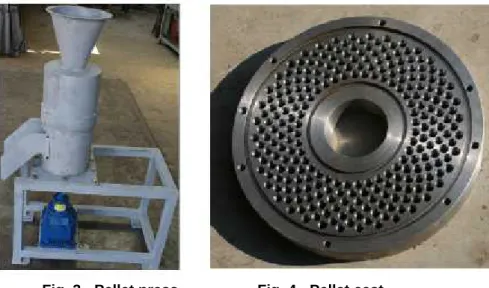
INMA Bucharest field it was established artichoke crop, and in the second and third year, manually harvesting leaves and seeds, that where dried in the shade. The vegetal product was processed in order to achieve pellet mixture that had different percentages of forest biomass. The pellets were made using a press designed by us (fig.3) that presents a special disc pellet casts (fig.4) with cylindrical openings (diameters between 4-8 mm) that are a special configuration to facilitate the material pressing. Also the press has in its components a cutting device that is placed at the exhaustion opening which has two cutting blades.
Fig. 3 - Pellet press Fig. 4 - Pellet cast
Regarding the artichoke use as a nutrient and medical products, it is a real natural storehouse of biological compounds with remarkable pharmacological properties (polifenolical, flavonoizial, sterolicial compounds and tanante substances). The quantitative content of those compounds depends on the region cropped, the plant age, the vegetative period, soil quality and temperature.[2]. The active substances total is proportional with the harvester period, that is influencing the physiological and therapeutic active principles extracted from the plants, fact that leads that the vegetable product to be used as: hepatoprotective [6], antioxidant [4], hypoglycemic [1], diuretic and antimicrobial [3].
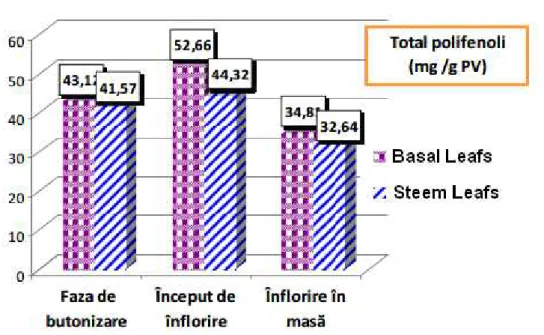
Fig. 6 - The accumulation dynamics of polifenolic components from artichoke leafs
The highest concentration of polifnoici compounds is established to be at the artichoke early flowering (52.66±1.93 mg/g in base leaves, 44,32±3,0 mg/g in steam leaves).
CONCLUSIONS
Artichoke can produce 20.000 kg of biomass per hectare, without taking in to account the leaf mass and other vegetable wastes that can enrich the soil in the same time, for this reasons this crop has the advantage that can be used in the same time as a biomass and nutraceutical plant (herbs that provide the nutrients and feeding supplements that are considerate to be benefic and are not medicinal products).
The highest concentration of polifenolic compounds is appreciated to be at the beginning of flowering (52,66±1,93 mg/g in base leaves, 44,32±3,0 mg/g in steam leaves).
The artichoke is a natural deposit of biologic compounds with remarkable pharmacological properties.
BIBLIOGRAPHY
1. Bombardelli, E, Carai, MA., 2011 - Evidence of glycemia lowering effect by a Cynara scolymus L. extract in normal and obese rats.In: Phytother. Res., vol. 25(3), p. 463–466; 2. Ciobanu, C., 2015 - „Cynara scolymus L. species – source of new pharmaceuticals”, Self essay of the PhD thesis in pharmaceutical sciences, CHIŞINĂU;
3. Kukić, J., 2008 -Antioxidant and antimicrobial activity of Cynara cardunculus extracts. In: Food Chem, vol. 107(2), p. 861–868;
4. Mileo, A. et al., 2012 - Artichoke polyphenols induce apoptosis and decrease the invasive potential of the human breast cancer cell line MDA-MB23. In: J. Cell Physiol., vol. 227(9), p. 3301– 3309. 25;
5. Poienaru, Şt., 2009 - general manager of Agrofam Holding Feteşti, VILLAGE WORLD MAGAZINE, No.6, 16-31 March;
6. Zapolska-Downar, D. et al., 2002 - Protective properties of artichoke (Cynara scolymus) against oxidative stress induced in cultured endothelial cells and monocytes. In: Life Sci., vol. 71(24), p. 2897–2908.
7.http://www.agrofm.ro/agro/anghinarea-cynara-scolymus/;
8.http://luirig.altervista.org/schedenam/fnam.php?taxon=Cynara+cardunculus;
![Fig. 1 - Artichoke herb (a. – butonization stage; b. – flowering stage) [2]](https://thumb-us.123doks.com/thumbv2/123dok_us/8070340.2137745/2.892.253.649.94.393/fig-artichoke-herb-butonization-stage-b-flowering-stage.webp)