322
DEVELOPMENT OF A NOVEL FOLIAR FERTILIZER WITH ZINC
A. GRIGORE, A.M. STĂNESCU, D. MIHALACHE, M. IANCU, N. MARIN, RUJOI B.
National Research and Development Institute for Soil Science, Agrochemistry and Environment (ICPA Bucharest); e-mail: [email protected]
Keywords: foliar fertilizer, zinc, humic acids, algae extracts.
ABSTRACT
Zinc deficiency, resulted from various stress factors, limits agricultural production worldwide. Therefore, research into developing sustainable methods to alleviate this type of deficiency should be a priority. This study presents the development of a new foliar fertlizer, focusing on its formulation, characterization, and testing. The fertilizer formula associates a classic NPK and micronutrients (Cu, Zn, Fe, Mn) matrix with organic substances having bio-stimulating effect: humic acids and algae extracts. The composition of the experimental fertilizer (8.2% N, 3.9% P, 3.6% K, 0.8% Zn) is formulated to prevent and correct imbalances in plant mineral nutrition, especially those caused by zinc deficiency. A set of field trials were conducted in order to assess the effect of the fertilizer on grapevine (cv Chasslas dore) and maize (DKC 4590). Experimental data indicated that application of the foliar fertilizer had signifficant contribution to the improvment of yield, leaf nutrient and chlorophyll content, and crop quality parameters.
INTRODUCTION
Zinc (Zn) is one of the 8 essential micro-nutrients involved in the normal development of plants. When the amount of available zinc is inadequate, metabolic dysfunctions of the enzyme systems in which it participates appear. Zinc is recognized as a constituent of over 70 metallo-enzymes, is involved in protein metabolism, in ribonucleic acid and
carbohydrate synthesis, and participate in the synthesis of growth phytohormones – low
content of auxins, and thus limited growth processes, is a specific symptom of zinc deficiency [8].
Zinc deficiency has been reported after War Word II on a wide range of soils throughout the world. In Romania, the phenomenon was observed in 1966 at corn cultivated on alkaline soils. Subsequently, the phenomenon spread to other soils, being favored by high doses of mineral fertilizers, especially phosphorus. In present, zinc deficiency occurs on an area of approximately 1.5 million ha in the east and south-east of the country [10].
323
Introduction of new technologies for a competitive agriculture and diversification of foliar fertilizers has led to an increase of the market share of this type of fertilizers up to 30-35%. The use of foliar fertilizers is in line with the current European Community political agenda: to reduce the use of conventional fertilizers and, implicitly, of soil and groundwater pollution.
Worldwide, there is an increasing trend for the production of fertilizers with natural biostimulators such as protein hydrolysates, algae extracts, as well as fulvic or humic acids. Applied to plants at low concentrations, sometimes even in the order of mg/kg, these substances favor the absorption of nutrients, as well as their protection under climate and/or technologic stress, and lead to the development of the root system, flowers and fruits [7].
MATERIAL AND METHOD
A. Experimental fertilizer
The process for obtaining the experimental fertilizer (at laboratory scale) consists of the following steps:
phosphoric acid 85% w/w is neutralized with potassium carbonate under continuous
stirring and at a constant temperature of 28-30°C. Urea - representing the amide nitrogen
source, then ammonium nitrate – as the source of ammoniacal and nitric nitrogen, are
gradually added, keeping the temperature at 28-30°C. Thus results the macronutrient solution (A), which is cooled to a temperature of 20-25°C;
meso- and micronutrients (Cu-EDTA, Zn-EDTA, Fe-EDTA, Mn-EDTA,
Mg(SO4)·7H2O, Na2B4O7·10H2O) are disolved in water at a temperature of 20-25°C, thus
resulting solution (B);
the macronutrient solution (A) and the meso- and micronutient solution (B) are
mixed under continuous stirring at 20-25°C;
the potassium humate and the algae extract are gradulally added, under continuous
stirrig for 1-1,5 hours, over the macro-, meso- and micronutrient solution.
demineralized water is added up to a final volume of 1000 ml, thus obtaining the
experimental fertilizer – Fertil Zinc Plus.
B. Field trials
In order to study the effect of Fertil Zinc Plus on grapevine and maize two experiments in factorial format based on randomized complete block design were conducted at:
experimental field from the V. Adamachi horticultural farm of the Faculty of
Horticulture - University of Agronomic Sciences and Veterinary Medicine of Iaşi - for the
tests on grapevine (cv Chasselas dore);
Ezereni experimental field of the Faculty of Agronomy – University of Agronomic
Sciences and Veterinary Medicine of Iaşi - in the case of tests on maize crop (DKC 4590).
In the agricultural year 2016-2017, the sum of precipitation was 504.9 mm, which was lower compared with the mean annual precipitation (517.8 mm) and the mean temperature
was 10.1oC, higher than the normal mean recorded in the region (9.6 oC).
The trial locations for grapevine and maize were on soils classified as hortic anthrosol and cambic chernozem respectively.
324
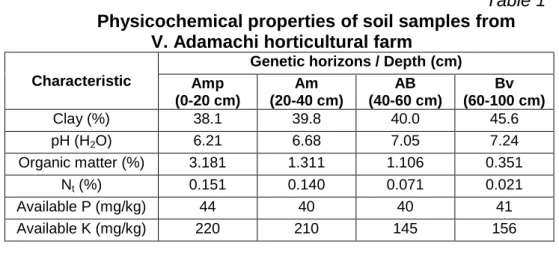
Table 1
Physicochemical properties of soil samples from V. Adamachi horticultural farm
Characteristic
Genetic horizons / Depth (cm) Amp
(0-20 cm)
Am (20-40 cm)
AB (40-60 cm)
Bv (60-100 cm)
Clay (%) 38.1 39.8 40.0 45.6
pH (H2O) 6.21 6.68 7.05 7.24
Organic matter (%) 3.181 1.311 1.106 0.351
Nt (%) 0.151 0.140 0.071 0.021
Available P (mg/kg) 44 40 40 41
Available K (mg/kg) 220 210 145 156
Table 2
Physicochemical properties of soil samples from Ezereni field farm
Characteristic
Genetic horizons / Depth (cm) Amp
(0-20 cm)
Am (20-40 cm)
AB (40-60 cm)
Bv (60-100 cm)
Clay (%) 36.1 38.8 39.9 43.8
pH (H2O) 6.24 6.31 7.15 7.31
Organic matter (%) 3.281 2.312 1.015 0.084
Nt (%) 0.135 0.142 0.131 0.071
Available P (mg/kg) 34 35 40 42
Available K (mg/kg) 222 211 178 142
The experiments were carried out on a soil without irrigation and fertilization
(N0P0K0). Three foliar treatments were performed during the vegetative season. Dilute
sprays (0.5% solution) of the fertilizer (dose of 2.5 l/ha) were applied using a manual pump. The spraying of the fertilizing solution was made in the morning, in a wind-free
atmosphere, at below 25oC.
In order to assess the influence of the experimental fertilizer on the photosynthesis indicators and plant mineral nutrition, mature fresh leaves were harvested one week after application of the last foliar treatment, at fruit developing stage.
The extraction of chlorophyll pigments was performed in the laboratory according to the method described by Lancaster et al (1994) [11] with 85% acetone and their concentration was determined by spectrophotometric method at different wavelengths: 645 nm for chlorophyll a and 663 nm respectively for chlorophyll b.
The extraction of carotenoid pigments was performed according to the method described by Bunea et al (2008) [4] and their concentration was determined by spectrophotometric method (450 nm).
C. Statistical analysis
The collected data were subject to statistical analysis using a randomised factorial design. Each experiment was designed with three replicates. The mean values were compared using the least significant difference (LSD) test.
RESULTS AND DISCUSSIONS
Composition of the experimental fertilizer
325
stimulating effect: humic acids and algae extracts.
Table 3
Chemical composition and physical characteristics of Fertil Zinc Plus
Component Value
Total nitrogen (N, %) 8.22
Phosphorus (P2O5, %) 3.85
Potassium (K2O, %) 3.59
Sulfur (S, %) 1.33
Copper (Cu, %) 0.023
Zinc (Zn, %) 0.814
Iron (Fe, %) 0.039
Manganese (Mn, %) 0.132
Magnesium (MgO, %) 0.052
Boron (B, %) 0.015
Organic matter (%) 13.71
pH 7.15
Density (g/cm3) 1.23
Effects of the experimental fertilizer on grapevine
The experimental data from table 4 shows that foliar fertilization has led to a significant increase in grape production (11239 kg/ha) as compared to unfertilized control (9179 kg/ha). The foliar treatments helped the plants to increase zinc acquisition, which may induce the indol acetic acid synthesis, a plant growth regulator responsible for pollen and berry formation. Also, the yield increase can be partially explained by the bio-stimulating effect of the humic acids and algae extracts present in the composition of the experimental fertilizer.
Table 4
Effect of Fertil Zinc Plus on grapevine (cv
Chasselas dore) yield
Variants
Yield (kg/ha)
Productive efficiency Dif.
kg/ha
Dif. %
Sign.
Control 9179 - 100 -
Fertil Zinc Plus 11239 2060 122.44 ***
LSD 5% - 865 kg/ha LSD 1% - 1213 kg/ha LSD 0.1% - 1759 kg/ha
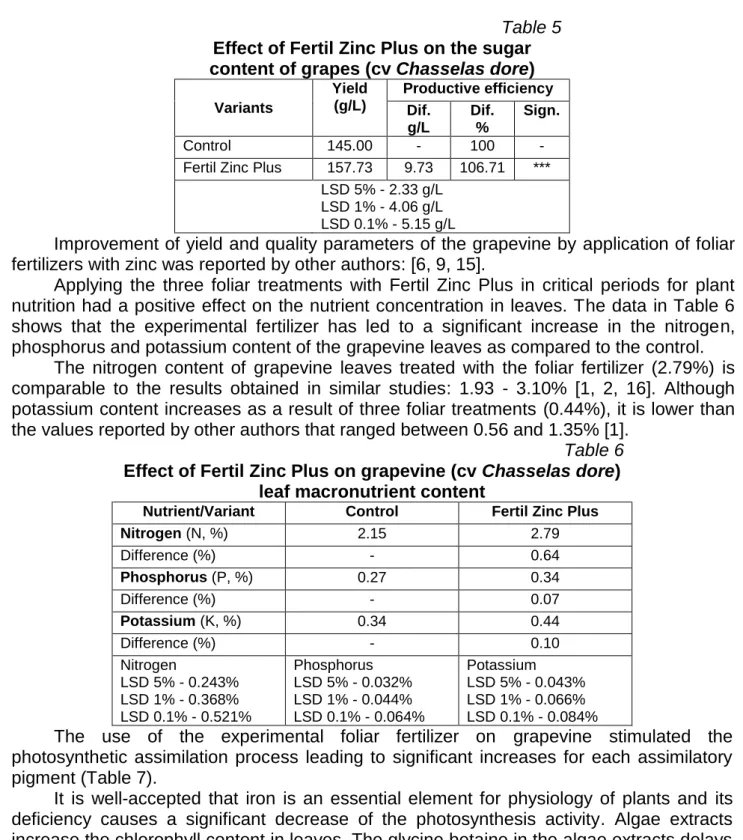
The sugar content in grape fruits had significantly increased with application of the experimental fertilizer Fertil Zinc Plus as shown in table 5. The increase in sugar content is possible as a result of the increase in the enzymatic activities of fructose-1 and 6- bis phosphatase. Also, the aldolase enzymes will increase along with sufficient availability of
326
Table 5
Effect of Fertil Zinc Plus on the sugar
content of grapes (cv Chasselas dore)
Variants
Yield (g/L)
Productive efficiency Dif.
g/L
Dif. %
Sign.
Control 145.00 - 100 -
Fertil Zinc Plus 157.73 9.73 106.71 ***
LSD 5% - 2.33 g/L LSD 1% - 4.06 g/L LSD 0.1% - 5.15 g/L
Improvement of yield and quality parameters of the grapevine by application of foliar fertilizers with zinc was reported by other authors: [6, 9, 15].
Applying the three foliar treatments with Fertil Zinc Plus in critical periods for plant nutrition had a positive effect on the nutrient concentration in leaves. The data in Table 6 shows that the experimental fertilizer has led to a significant increase in the nitrogen, phosphorus and potassium content of the grapevine leaves as compared to the control.
The nitrogen content of grapevine leaves treated with the foliar fertilizer (2.79%) is
comparable to the results obtained in similar studies: 1.93 - 3.10% [1, 2, 16]. Although
potassium content increases as a result of three foliar treatments (0.44%), it is lower than the values reported by other authors that ranged between 0.56 and 1.35% [1].
Table 6
Effect of Fertil Zinc Plus on grapevine (cv Chasselas dore)
leaf macronutrient content
Nutrient/Variant Control Fertil Zinc Plus
Nitrogen (N, %) 2.15 2.79
Difference (%) - 0.64
Phosphorus (P, %) 0.27 0.34
Difference (%) - 0.07
Potassium (K, %) 0.34 0.44
Difference (%) - 0.10
Nitrogen
LSD 5% - 0.243% LSD 1% - 0.368% LSD 0.1% - 0.521%
Phosphorus
LSD 5% - 0.032% LSD 1% - 0.044% LSD 0.1% - 0.064%
Potassium
LSD 5% - 0.043% LSD 1% - 0.066% LSD 0.1% - 0.084%
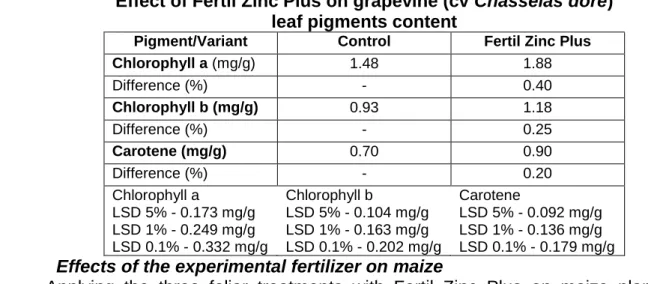
The use of the experimental foliar fertilizer on grapevine stimulated the photosynthetic assimilation process leading to significant increases for each assimilatory pigment (Table 7).
It is well-accepted that iron is an essential element for physiology of plants and its deficiency causes a significant decrease of the photosynthesis activity. Algae extracts increase the chlorophyll content in leaves. The glycine betaine in the algae extracts delays the loss of photosynthetic activity by inhibiting chlorophyll degradation [17].
327
Effect of Fertil Zinc Plus on grapevine (cv Chasselas dore)
leaf pigments content
Pigment/Variant Control Fertil Zinc Plus
Chlorophyll a (mg/g) 1.48 1.88
Difference (%) - 0.40
Chlorophyll b (mg/g) 0.93 1.18
Difference (%) - 0.25
Carotene (mg/g) 0.70 0.90
Difference (%) - 0.20
Chlorophyll a
LSD 5% - 0.173 mg/g LSD 1% - 0.249 mg/g LSD 0.1% - 0.332 mg/g
Chlorophyll b
LSD 5% - 0.104 mg/g LSD 1% - 0.163 mg/g LSD 0.1% - 0.202 mg/g
Carotene
LSD 5% - 0.092 mg/g LSD 1% - 0.136 mg/g LSD 0.1% - 0.179 mg/g
Effects of the experimental fertilizer on maize
Applying the three foliar treatments with Fertil Zinc Plus on maize plants had a positive effect on yield . Data in table 8 show a significant yield increase (1516 kg/ha) as compared to the unfertilized control.
Table 8
Effect of Fertil Zinc Plus on maize (DKC 4590) yield
Variants
Yield (kg/ha)
Productive efficiency Dif.
kg/ha
Dif. %
Sign.
Control 5148 - 100 -
Fertil Zinc Plus 6664 1516 129.45 ***
LSD 5% - 721 kg/ha LSD 1% - 989 kg/ha LSD 0.1% - 1427 kg/ha
The experimental data from table 9 show that the macronutrients content in maize leaves had significantly increased with application of the foliar fertilizer Fertil Zinc Plus.
Table 9
Effect of Fertil Zinc Plus on maize (DKC 4590) leaf macronutrient content
Nutrient/Variant Control Fertil Zinc Plus
Nitrogen (N, %) 0.88 1.20
Difference (%) - 0.32
Phosphorus (P, %) 0.24 0.32
Difference (%) - 0,08
Potassium (K, %) 0.56 0.78
Difference (%) - 0.22
Nitrogen
LSD 5% - 0.142% LSD 1% - 0.193% LSD 0.1% - 0.288%
Phosphorus
LSD 5% - 0.040% LSD 1% - 0.059% LSD 0.1% - 0.076%
Potassium
LSD 5% - 0.101% LSD 1% - 0.147% LSD 0.1% - 0.203%
328
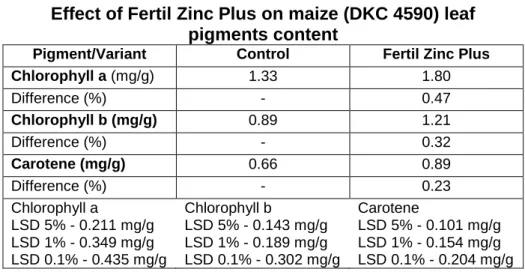
Table 10
Effect of Fertil Zinc Plus on maize (DKC 4590) leaf pigments content
Pigment/Variant Control Fertil Zinc Plus
Chlorophyll a (mg/g) 1.33 1.80
Difference (%) - 0.47
Chlorophyll b (mg/g) 0.89 1.21
Difference (%) - 0.32
Carotene (mg/g) 0.66 0.89
Difference (%) - 0.23
Chlorophyll a
LSD 5% - 0.211 mg/g LSD 1% - 0.349 mg/g LSD 0.1% - 0.435 mg/g
Chlorophyll b
LSD 5% - 0.143 mg/g LSD 1% - 0.189 mg/g LSD 0.1% - 0.302 mg/g
Carotene
LSD 5% - 0.101 mg/g LSD 1% - 0.154 mg/g LSD 0.1% - 0.204 mg/g
ACKNOWLEGMENTS
The researches carried out for the elaboration of the present paper were financed by ANCSI in PN 16 07 (02 04), GRISGSOL, Contract No. 16N/10.03.2016.
CONCLUSIONS
The fertilizer developed in this study contains, besides zinc, macronutrients, micronutrients, and organic substances. They all act synergistically and lead to the stimultation of plant physiological processes, e.g. increase of fotosynthesis activity in
leaves. Overall investigations revealed that experimental fertilizer Fertil Zinc Plus had
significant contribution to the improvement of yield, leaf nutrient and pigment content in the tested crops, i.e. grapevine (cv Chasselas dore) and maize (DCK 4590 hybrid). Therefore, this product can be used to treat zinc deficiencies but also to optimize the mineral nutrition of plants, especially then when soil available nutrients present a low level.
BIBLIOGRAPHY
1. Akin, A., 2011 - Effects of some growth regulating applications on leaf yield, raw
cellulose and nutrient element content of the Muskule table grape variety. Afr. J.
Biotechnol. 10(29), 5601-5607.
2. Ashoori, M., L. Abolfazl, Ershadi, A., Kolhar, M., Rasoli, A., 2013 - Effects of N,
Fe and Zn on vegetative and reproductive growth and fruit quality of grapevine (Vitis
Vinifera), Journal of Ornamental and Horticultural Plants. 3(1), 49-58.
3. Blunden, G., Jenkins, T., Liu, Y., 1997 – Enhanced leaf chlorophyll levels in plants
treated with seaweed extract, J. Appl. Phycol. 8, 535-543.
4. Bunea, A., Mirjana, A., Socaciu, C., Bobis O., Neacsu M., Verhe, R., Camp J.V.,
2008 - Total and individual carotenoids and phenolic acids content in fresh, refrigerated
and processed spinach (Spinaciaoleracea L.). Food Chemistry, 649–656.
5. Bybordi, A., Shabanov, A., 2010 - Effects of foliar application of magnesium and
zinc on the yield and quality of three grape cultivars grown in the calcareous soils in Iran.
Not. Sci. Biol., 2 (1), 81 – 86.
6. Christensen, P., Jensen, F.L.,1978 - Grapevine response to concentrate and to
dilute application of two zinc compounds. Am. J. Enol. Vitic., 29 (3), 213 – 216.
7. Cioroianu, T., S.E. Sîrbu. 2011 - Îngrășăminte neconvenționale – Fertilizanți
extraradiculari cu substanțe proteice. Editura Estfalia, București.
8. Fageria, N.K., Baligar, V.C., Clark, R.B., 2002 - Micronutrients in crop production.
329
implicații în nutriția plantelor, Editura Sitech, Craiova.
10. Hera, C., Oancea, I., 2002 - Folosirea raţională şi conservarea solurilor româneşti.
Ed. Academiei Române, Bucureşti.
11. Lancaster, J., E. Jan, E. Grant, C. E. Lister, 1994 - Skin Color in Apples—
Influence of Copigmentation and Plastid Pigments on Shadeand Darkness of Red Color in
Five Genotypes, J. Amer. Soc. Hort. Sci. 119:1, 63-69.
12. Lăcătuşu, R., 2006 – Agrochimie, Editura Terra Nostra, Iaşi.
13. Lindsay, W. L., 1979 - Chemical equilibria in soils. John Willey and sons, New
York.
14. Mengel, K., Kirkby E. A., 1987 - Principles of plant nutrition. International Potash Institute, Bern.
15. Prabu, C.P., Singaram, P., 2002 - Alleviation of root zone constrains through foliar
application of yinc and boron for grapes, 17th World Congress of Soil Science, 14 -21
August, Thailand, paper no 1262.
16. Shaaban, M.M., Loehnertz O., El-Fouly M.M., 2007 - Grapevine genotypic
tolerance to lime and possibility of chlorosis recovery through micronutrients foliar
application, Int. J. of Bot. 3(2), 179-187.
17. Sabir, A., Yazar, K., Sabir, F., Kara, Z., Yazici, M. A., Goksu, N., 2014 – Vine
growth, yield, berry quality attributes and leaf nutrient content of grapevine as influenced
by seaweed extract (Ascophyllum nodosum) and nanosize fertilizer pulverizations, Scientia
Horticulturae, 175, 1-8.
18. Rusu, M., Mărghiraş M., Mihăiescu T., Oroian I., Dumitraş A., 2005 - Tratat de