25
THE EVOLUTION OF SENSORY AND CHROMATIC ATTRIBUTES OF
RED WINES OBTAINED IN GALICEA MARE VITICULTURAL AREA
BĂDUCĂ CÎMPEANU C1
., STOICA FELICIA1, MUNTEAN CAMELIA1 1University of Craiova, Faculty of Horticulture, Department Horticulture & Food Science Corresponding author e-mail:[email protected]
Key words: red wines, color, evolution, monovarietal wine
ABSTRACT
The red wines obtained in 2014 in the Galicea Mare wine-growing area were analyzed chromatically and organoleptically at the age of 6 months and after another two years. During the two years, chromatic characteristics and sensory evolution was positive in all wines. Although the intensity of color has decreased during this time, its nuance has improved significantly due to the change in the relationship between red and yellow pigments. The results show that these wines are intended for maturing and aging because they are not suitable for consumption as young wines.
INTRODUCTION
Red wine is an important source of dietary intake of phenolic compounds with antioxidant activity that are related to the prevention of cardiovascular diseases and cancer. However, information concerning their specific release from this food matrix, although necessary to predict their bioavailability along the digestive tract, is still not clear (GonçalvesF. e.a., 2012). Wine is an ancient beverage and has been prized throughout time for its unique and pleasing flavor. Wine flavor arises from a mixture of hundreds of chemical components interacting with our sense organs, producing a neural response that is processed in the brain and resulting in a psychophysical percept that we readily describe as “wine.” The chemical components of wine are derived from multiple sources; during fermentation grape flavor components are extracted into the wine and new compounds are formed by numerous chemical and biochemical processes (Robinson A.L. e.a., 2014). Nowadays, consumers demand red wines with deep colour, soft tannins and fruit scents, but these wines can only be obtained from grapes with complete phenolic maturity. Diverse methods have been proposed for measuring phenolic maturity (Kontoudakis N. e.a., 2011). The phenolic composition of red wine impacts upon the color and mouthfeel and thus quality of the wine. Both of these characteristics differ depending on the age of a wine, with the purple of young wines changing to brick red and the
puckering or aggressive astringency softening in older wines (McRae J. e.a., 2012).
Pedoclimatic conditions affect grape and wine quality. In particular, the relationship between soil and grape quality is at the core of the terroir definition (De Santis Diana e.a., 2017).
26
the skin may be enhanced by reducing the skin particle size (Sparrow Angela e.a., 2016). Anthocyanin degradation has been proposed as one of the primary causes for reduced
colour and quality in red wine grapes grown in a warm climate (Chassy A.W. e.a., 2015).
Copigmentation of anthocyanins accounts for over 30% of fresh red wine color, while during storage, the color of polymeric pigments formed between anthocyanins and
proanthocyanidins predominates (Bimpilas A. e.a., 2016).
MATERIAL AND METHOD
The red wines obtained by industrial winemaking under the conditions of the simultaneous harvesting of grapes and the application of identical winemaking schemes in 2014 from the 5 varieties cultivated in the Galicea Mare viticultural area in Dolj county were analyzed spectrophotometrically and organoleptically. The 5 varieties (Cabernet Sauvignon, Merlot, Pinot noir, Syrah and Fetească neagră) are part of the range recommended by zoning of viticulture to be cultivated in the mentioned wine-growing area.
The wines were examined by spectrophotometric methods for the determination of chromatic properties and by organoleptic methods. Spectrophotometric analyzes were performed at a specialized laboratory of the Institute of Research for Viticulture and Winegrowing, where the absorbance values (optimal densities) were determined at 3 different wavelengths (420 nm - yellow pigment specific wavelength, 520 nm - length of the red pigment specific gravity, 620 nm - the blue pigment specific wavelength). Based on these determinations it was determined the two values that characterize the structure of the wine color: color intensity and hue or tint of color. The analyzes were performed when the wines were 6 months old and repeated over 2 years, as well as those on organoleptic properties.
RESULTS AND DISCUSSIONS
The results of the chromatic studies of the wines under study show that all are high-quality wines, which best value by maturing and aging due to the richness of color and phenolic compounds, on the one hand, and the visual, olfactory and tasting characters in barrel and glass before being fit for consumption.
RESULTS OF WINECHROMATIC CHARACTERISTICS
The 6 analyzed red wines, of which 5 are the pure varieties and one is a combination of all pure varieties in equal proportions are very intensively colored wines, in the combinations where the vineyard Galicea Mare has a climate that allows the varieties to accumulate the proportions large anthocyanins in the skin.
To characterize the chromatic structure of wines, two main indicators were taken into account: the intensity of color and its hue, known as tonal or tint. Both chromatic structure characteristics were calculated on the basis of the absorbance values of the wines, read by the spectrophotometer, for the wavelengths characteristic of the three types of pigments present in the red wines: yellow pigments, red pigments, blue pigments.
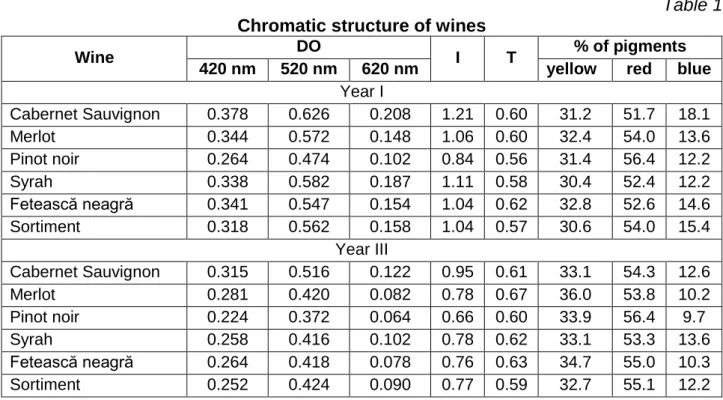
The analysis of data and results on the chromatic structure of wines (Table 1) shows that Cabernet Sauvignon wine is the most colorful wine. The color intensity of wine is an important parameter that indicates the color richness of wine, which is in close relationship with two groups of factors: natural and technological.
27
Table 1 Chromatic structure of wines
Wine DO I T % of pigments
420 nm 520 nm 620 nm yellow red blue
Year I
Cabernet Sauvignon 0.378 0.626 0.208 1.21 0.60 31.2 51.7 18.1
Merlot 0.344 0.572 0.148 1.06 0.60 32.4 54.0 13.6
Pinot noir 0.264 0.474 0.102 0.84 0.56 31.4 56.4 12.2
Syrah 0.338 0.582 0.187 1.11 0.58 30.4 52.4 12.2
Fetească neagră 0.341 0.547 0.154 1.04 0.62 32.8 52.6 14.6
Sortiment 0.318 0.562 0.158 1.04 0.57 30.6 54.0 15.4
Year III
Cabernet Sauvignon 0.315 0.516 0.122 0.95 0.61 33.1 54.3 12.6
Merlot 0.281 0.420 0.082 0.78 0.67 36.0 53.8 10.2
Pinot noir 0.224 0.372 0.064 0.66 0.60 33.9 56.4 9.7
Syrah 0.258 0.416 0.102 0.78 0.62 33.1 53.3 13.6
Fetească neagră 0.264 0.418 0.078 0.76 0.63 34.7 55.0 10.3
Sortiment 0.252 0.424 0.090 0.77 0.59 32.7 55.1 12.2
The first determination of the chromatic properties of the wines was done in the first months after their obtaining. The results show that the most colorful wine was obtained from Cabernet Sauvignon (1.21) followed closely by Syrah wine (1.11), which exceeded Merlot wines (1.86) and Fetească neagra (1.04). Of the 5 pure varieties, only Pinot Noir wine had a much lower color intensity than 1.00 (084). Multivariate wine had a value of intermediate color intensity (1.04), just like the Fetească neagra wine.
The second indicator is the structure of wine color tint or tone, directly related to the relationship between the categories of pigments, which give the wine color. The value of this parameter is determined as the ratio between the two main types of yellow and red pigments, the ratio DO 420 nm / DO 520 nm. The analysis of wine tonality values by Galicea Mare shows that for all 6 wines, the tonal values oscillate around an average value of 0.6, with a variation range of 0.56 (the smallest value found in Pinot noir wine) and 0 , 62 (the highest value, found in the Feteasca neagra wine). The assortment wine has a ton value of 0.57 close to the lower limit.
From these data, the main category of pigments that participate in the color scheme of the 6 pigments participating in the color scheme of the 6 wines is the category of red pigments, which is absolutely normal at the current stage of wine evolution. The percentage of red pigments in the color intensity of wines fluctuates between 51.7% (Cabernet Sauvignon) and 56.4% (Pinot noir). These limits are somewhat surprising in that the most colorful wine (Cabernet Sauvignon) has the smallest percentage of red pigments, the main category of pigments in wine, in the color intensity, while the least colored wine (Pinot noir) high proportion of red pigments in the color structure. In Pinot Noir wine, this is very well related to the fact that it has the lowest tonality.
After red pigments, the next category of pigments as weight in the color structure is the yellow pigment category. The chromatic data of the six wines shows that the weight of yellow pigments in the color structure is between 30.4% (for the Syrah variety) and 30.4% (for the variety of Fetească neagră). For wine-type assortment, the proportion of yellow pigments in the color intensity is 30.6%, very close to the lower limit.
28
has the smallest percentage of red pigments and why Pinot Noir wine has the highest percentage of red pigments. For wine of the assortment type, the proportion is 15,4%, an average value between wines obtained from pure varieties, which is absolutely normal.
Regarding to this last category of pigments, it is worth mentioning that it is desirable that their share in the total color is as small as the visual examination of the wine gives them a less pleasant appearance, they are upsetting and are the main reason why red wines have to go through a certain evolution until they are consumed, while their chromatic structure changes, in the direction of decreasing the contribution of red and blue pigments and the increase in the weight of yellow pigments in color intensity.
The repetition of the analyzes over two years led to the finding that the wine evolution in this interval was favorable, which produced a significant improvement of the chromatic properties of the wines, materialized in the decrease of the color intensity and the tonality increase in all the wines. Also, the proportions of the three types of pigments in each wine have changed.
These changes in the values of the chromatic structure indicators were not uniform but presented the same meanings for all wines. So if the first few months after obtaining the wine, the most colorful wine was Cabernet Sauvignon, and after two years the same wine remained the first in terms of color intensity (0.95). On the 2nd place as the value of the color intensity, the first was Syrah wine with 1.11, and third place was Merlot wine with 1.06 but after two years of evolution, both wines reached the same color intensity (0.78), which means that the decrease was higher for Syrah wine. The Feteasca neagra wine and multivarietal wine, which had the same color intensity at the first determination, over two years had very close decreases, so they had values of 0.77 and 0.76. The wine which had the lowest color intensity at the first determination (Pinot noir) remained after the two least colored (0,66), although it is the wine with the least decrease in the color intensity.
And the second parameter of the chromatic structure, the tone, made changes to all wines, but this time the change was in the sense of increasing values, which varied from one wine to another. The smallest increase in tonality was in Cabernet Sauvignon wine (from 0.60 to 0.61) and in Fetească neagră (0.62 to 0.63), and the highest ones were Merlot wines (from 0.60 to 0.67) and Syrah (from 0.58 to 0.62).
These differences in the evolution of the chromatic structure indicator values were accompanied by changes in the relationship between the pigment categories. Thus, yellow pigments recorded increases in their weight in all wines, signaling that their decrease was less than that of the other pigments. The most significant increase in the weight of yellow pigments in the color intensity of the wine was in Merlot wine (from 32.4 to 36%), followed by Pinot noir (from 32.4 to 36%) and Syrah (from 30,4 to 33.1%), and the lowest was Cabernet Sauvignon wine, below 2% (from 31.2 to 33.1%).
Regarding red pigments, they had very different developments. Thus, for Cabernet Sauvignon wines, Syrah, Feteasca neagra and Sortiment recorded increases; Pinor noir wine remained at the same level and in Merlot wine recorded a slight decrease.
29
RESULTS ON ORGANOLEPTIC CHARACTERISTICS OF WINES
The organoleptic analysis of the 6 vines, of which 5 monovarietal and one multivariate, show very interesting features, even if the scores obtained by all wines are not very high. This is not a matter of concern because it is very young wines, at the beginning of their evolution, during the first 6 months of production, which are not suitable for consumption but which will evolve favorably and will improve significantly from the point of view visual and olfacto-gustative if they are kept under proper conditions and will go through the normal stages of evolution.
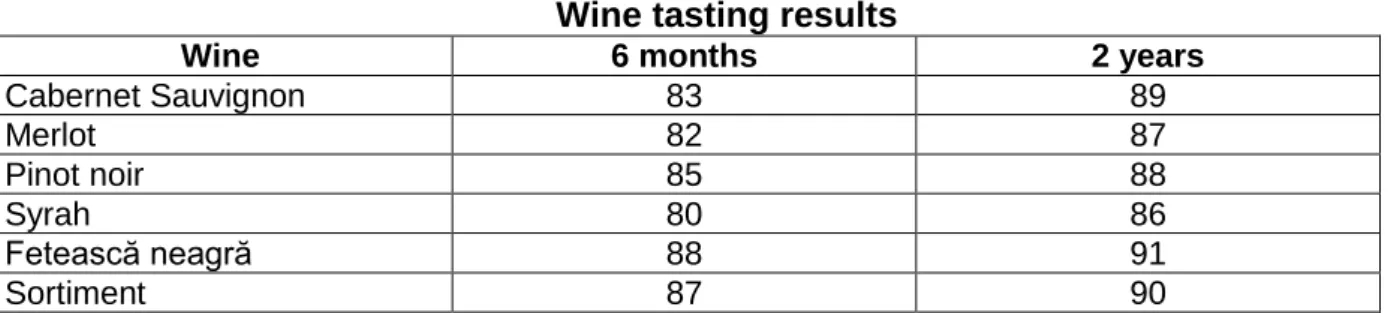
Table 2 shows the results of the two tastings on the basis of the scores given by the tasters and it is noted that these scores range from 80 to 88 points, which is very normal for very young wines, since they do not meet any wine major flaws but only normal features for this stage of evolution, even if they are less agreeable sensory.
Table 2 Wine tasting results
Wine 6 months 2 years
Cabernet Sauvignon 83 89
Merlot 82 87
Pinot noir 85 88
Syrah 80 86
Fetească neagră 88 91
Sortiment 87 90
The most pleasant surprise of tasting wines from pure varieties comes from the fact
that the most appreciated wine was the Fetească neagra, which received 86 points from
the tasters. The smallest scores between pure varieties were obtained by Merlot (82 points) and Syrah (80 points). Also, a very important observation is that the assortment type wine is better appreciated than most wines obtained from the same varieties but separately vinified.
CONCLUSIONS
The analysis of chromatic structure and sensory characteristics of the 6 red wines obtained in 2014 in the Galicea Mare viticultural area, of which 5 were monovarietal wines, leads to the following conclusions:
- The chromatic characteristics of wines obtained from the 5 varieties are characterized by very high color intensity with a net weight of red pigments in the color of wines, normal situation for a wine-growing area situated in a warm area such as the southern area of Romania, with a lot of heat, light and little precipitation during the summer months and early autumn.
- After two years of development, chromatic characteristics of all wines have seen significant improvements, consisting in decreasing the intensity of blue coloring and share color pigments wines, while improving tone values and contribution to the color yellow pigment wines.
- The analysis of organoleptic characteristics of wines obtained from pure varieties has shown that all five wines are of high quality but are not suitable for consumption at this stage of evolution, being too colorless, lacking in transparency, with abundant proportions of blue pigments creates visual discomfort. Among the 5 wines, the best was the wine of Fetească neagră, the only local variety in the assortment.
30
- The multivariate wine was better appreciated compared to the monovarietal wines and promises to represent an important solution to be taken into account for the diversification of the range of wines produced at Galicea Mare.
BIBLIOGRAPHY
1. Bimpilas A., PanagopoulouMarilena,Tsimogiannis D.,Oreopoulou V., 2016.
Anthocyanin copigmentation and color of wine: The effect of naturally obtained hydroxycinnamic acids as cofactors. Food Chemistry, vol. 197, pag. 39–46
2. Chassy A.W., BueschlC., Lee H., Lerno L., Oberholster Anita, Barile Daniela, Schuhmacher R., Waterhouse A.L., 2015. Tracing flavonoid degradation in grapes by MS filtering with stable isotopes. Food Chemistry, vol. 166, pag. 448–455
3. De Santis Diana, Frangipane Maria Teresa, Brunori Elena, Cirigliano P., Biasi Rita,
2017. Biochemical Markers for Enological Potentiality in a Grapevine Aromatic Variety
under Different Soil Types. American Journal of Enology and Viticulture, vol. 68, nr. 1, pag. 100-111
4. Downey M.O., Harvey J.S., Robinson S.P., 2003. Synthesis of flavonols and expression of flavonol synthase genes in the developing grape berries of Shiraz and Chardonnay (Vitis vinifera L.). Australian Journal of Grape and Wine Research, vol. 9, nr. 2, pag. 110–121
5. Gonçalves F., RochaSílvia, Coimbra M., 2012. Study of the retention capacity of anthocyanins by wine polymeric material. Food Chemistry, vol. 134, nr. 2, pag. 957–963
6. Kontoudakis N., Esteruelas M., Fort Fr., Canals J.M., De Freitas V., Zamora F., 2011.
Influence of the heterogeneity of grape phenolic maturity on wine composition and quality. Food Chemistry, vol. 124, nr. 3, pag. 767–774.
7. Lund S.T., Bohlmann J., 2006. The molecular basis for wine grape quality – a volatile
subject. Science, vol. 311, pag. 804–805.
8. McRae J., Dambergs R., Kassara Stella, Parker M., Jeffery D., Herderich M., Smith
P., 2012. Phenolic Compositions of 50 and 30 Year Sequences of Australian Red Wines:
The Impact of Wine Age. Journal of Agriculture and Food Chemistry, vol. 60, nr. 40, pag.
10093–10102
9. Musingo M., James N., Wang L., 2005. Influence of grape maturity on pH, color and
total phenolics of red muscadine wine from grapes grown at Florida A&M University Vineyard. European Journal of Scientific Research, vol. 11, pag. 206–217.
10. Robinson A.L., Boss P.K., Solomon P.S., Trengove R.D., Heymann Hildegarde, Ebeler Susan, 2014. Origins of Grape and Wine Aroma. Part 1. Chemical Components and Viticultural Impacts. American Journal of Enology and Viticulture, vol. 65, nr. 1, pag. 1-24.