10 Abstract—The present study is to observe settling characteristics of magnetite ore suspensions in aqueous Carboxy Methyl Cellulose (CMC) solutions of varying concentrations and to develop CD – NRep relationship for the
same. The suspensions having varied average particle size of 50 to 74.8 μm and concentration of 10 to 30 % (by weight) were considered. GALAI-CIS-I particle size analyzer was used to determine the average particle size and viscosity of the suspending medium was determined by using Brookfield DV-III+ programmable rheometer. Settling tests were carried out in 50 cc graduated glass cylinder of internal diameter 2.3 cm. Effects of concentrations of dispersant and solid and average particle size of the solids were carefully investigated. It has been observed that, with increase in concentration of dispersant and solids in the suspension it’s settling speed decreases. With increase in average particle size of the solids the velocity of suspension settling increases rapidly. Finally the CD – NRep
relationship was derived for all the suspension studied by curve fitting of the experimental data and was found well in line with the well known Stoke`s Law.
Index Terms— dispersant, suspension, terminal settling velocity, drag coefficient
I. INTRODUCTION
Suspension or slurry flow is convenient mode of transportation of solid particles; it has wide application in process industries. Because the deposition condition represents the lower limit to operating velocities, for most slurries transport systems, prediction of deposition velocities is an essential step in pipeline design. The increasing scale of mining operations has lead to use of larger pipe diameters and higher solid concentrations for tailing transportation. Settling slurries are composed of fine particles and are usually flocculated. The floc interaction, which generates the internal structure that prevents settling, is also responsible for non-Newtonian behaviour, which is commonly observed with these slurries. Slurries of particles, which are too coarse to flocculate usually, approximate Newtonian behavior, so that the ratio of slurry viscosity to that of the carrier fluid can
Manuscript received October 26, 2009. This work was supported in part by the BCUD, University of Pune, India under research grant.
Manik P. Deosarkar is with the Chemical Engineering Department of Vishwakarma Institute of Technology, Pune, India (phone: 91-20-24202206; fax: 91-20-555-5555; e-mail: mpdeosarkar@ yahoo.com).
Vivek S. Sathe is with the Chemical Engineering Department, Dr. Babasaheb Ambedkar Technological University Lonere-Raigad, India, (e-mail: [email protected]).
Kartik Chandra Ghanta is with the Chemical Engineering Department, National Institute of Technology, Durgapur, India (e-mail: [email protected])
be considered as a function of particle shape and solid concentration. Slurry transport has remained an active field of study since the late 1910’s. Recent studies have been largely focussed on the transportability of the solids through pipeline resulting minimum pressure drop [1-3]
For most of the slurry transport systems, prediction of deposition velocities and rheological properties is an essential step. There is delegate balance between fluidity, viscosity and settlement of solid particles. Determination of conditions for stable suspension is the major problem in dynamics of solid-liquid two phase flow. The important parameters having direct impact on these are physical characteristics of solid and its concentration, particle size and particle size distribution (PSD), density and viscosity of suspending medium, type and concentration of additives, temperature and pH of the suspension system etc.[4]
Gravity sedimentation is a widely used method of separating solid liquid mixtures (slurries) and has diverse applications such as those in classifiers, pipelines, filters and thickeners. Detailed information on particle settling behaviour i.e. setting velocity is often required for design of industrial processors such as thickness, clarifiers and flotation cells. Laboratory characterization of particle setting is mostly carried out manually. The conventional method to measure setting velocity is to fill a measuring cylindrical with slurry mix the slurry well so that particles are completely dispersed and then locate and measure the descent of the solid-liquid interface as a function of time.
Although this method is simple and direct it could introduce large errors due to the possible misinterpretation of the interface and the errors may vary from person to person. The situation may be worse when flocculants solution is added to speed up the settling process. At higher flocculants dosage, the setting time is very short. Therefore, it is very hard to follow the movement of the interface. On the other hand, for very slow settling processes, manual reading is very tedious since settling some times lasts for hours or even days. There are number of other methods which have been used for measuring particle settling, which include: X-ray radiation, ultrasound, radioactive and magnetic resonance imaging etc. However, these techniques are generally expensive and complicated. Some of the techniques cannot perform on line measurements. Here we use manual method for the settling behaviour of slurry of different particle size consisting of different concentration of suspending medium. Settling studies are required in order to get stable suspension. Suspension stability is important for transportation of solid particles with reduced pressure drop and with less power consumption. The fluid drag governs the
C
D
- N
Rep
Relationship for Solid-Liquid
Suspensions
11 settling of solid particles in the slurries. Fluid drag on the moving particle is sum of two components; the viscous drag due to viscous friction and the form drag due to boundary layer separation in the wake of the particle movement. The fluid drag is expressed by the drag co-efficient CD from its relation ship with particle Reynolds number NRep, one can determine the influence of rheology on fluid drag and the terminal velocity of particle [4]. Thus the CD – NRep relationship is an important block of information of particle motion in suspending liquid, hence it is very useful in pipeline design for slurry transport.[5-6]
II. EXPERIMENTAL
A. Material Characteristics and Material Preparation The magnetite ore from the Ispat Industries Limited, Geetapuram, Dolvi, District-Raigad, Maharashtra was used in the present settling and rheological studies of the slurries. The properties of this magnetite ore are shown in the table 1 and 2 as follows:
TABLE: 1 PARTICLE SIZE DISTRIBUTION OF MAGNETITE ORE Particle Size Percent
> 6mm 4.50 4 - 6 mm 16.00 1 - 4 mm 25.50 0.5 - 1 32.00 < 0.5 mm 22.00
TABLE: 2 COMPOSITION OF MAGNETITE ORE Constituent Percent Total Iron 67.00
SiO2 01.92
Al2O3 00.95
S 00.54 FeO 00.11 Moisture 00.11 Inerts Rest
High viscosity powder of sodium salt of Carboxymethyl Cellulose (CMC) was used as dispersant. The magnetite ore suspensions were prepared in aqueous CMC solutions. The material preparation is outlined in the steps below:
• The magnetite ore was crushed and sieved thoroughly using 100, 150, 200 and 240 standard mesh screens. Four samples –100+150, –150+200, –200+240 and –240 mesh sizes were collected in sufficient amount and stored in plastic bags.
• Particle size distribution, and average particle sizes for the collected samples were obtained, using particle size analyzer (Galai CIS- I) .The particles were ranging from 50 to 150 μm and the average sizes of –100+150, –150+200, –200+240 and –240 mesh sizes solids were 74.8, 58.4 , 52.3 and50 μm respectively.
• The CMC powder was added to distilled water to obtain 0.5, 0.7, 0.9 and 1.1 weight % aqueous solutions. • Slurry samples were made of 10, 20 and 30 % (by wt.)
solids concentrations of 50, 52.3, 58.4 and 74.8 μm size particles.
B. Experimental Set-Up
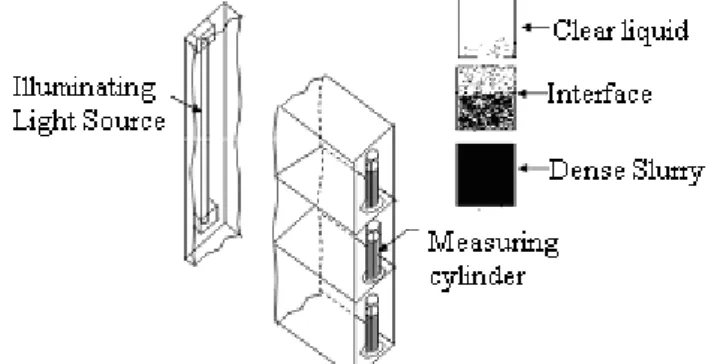
For sedimentation study, we designed a special wooden box instrument, as shown in figure 1. The design of the instrument is based on principle of optical technique. The graduated measuring cylinders of 50 cc volume with internal diameter 2.3 cm were used. The box allows keeping three cylinders at a time.
In the area where particles are rare, the light intensity is high, where as for the area where slurry is dense (i.e. particle concentration is high) the light intensity is low due to blockage of light by particles. Slurry image shows variation from the free surface to the bottom of the cylinder. The largest variation occurs around the solid-liquid interface. Thus by observing the image the interface location can be determined. The whole settling curves can be obtained by taking series of readings at different time intervals.
Figure 1: Experimental Set-up for Settling Studies
C. Experimental Procedure
Initially the suspension of 10 % solids concentration is prepared in 0.5 % aqueous CMC solution. The measuring cylinder was filled with this suspension up to 50 ml mark. This suspension was then shaken thoroughly to get uniform distribution of solid particle. The initial suspension height in the cylinder was 12.1 cm.
The height of the descending interface between the suspension and the clear liquid was recorded as a function of time for 24 hours. Velocity of settling of the solids in the suspension was calculated from the height vs. time readings recorded. The same procedure was repeated for settling tests of suspensions with 20 and 30 % solids concentration containing solids of 50, 52.3, 58.4 and 74.8 μm particle sizes to observe the effects of changing solids concentrations and particle size. The entire procedure is repeated for the suspensions prepared in aqueous CMC solutions of other concentrations mentioned above to observe the effects of CMC concentration on the settling of the suspensions.
III. MATHEMATICAL FORMULATION
12 NRep is calculated with the corrected velocity. While calculating the drag coefficient, CD both frictional drag and form drag took into account. From the obtained data for CD-NRep we proposed the correlation of the following form:
Re
(
)
bD p
C
=
a N
(1) The constants a and b are obtained by curve fitting of the experimental dataIV. RESULTS AND DISCUSSION
A. Effect of CMC Concentration on Suspension Settling For the solid particle immersed in a liquid, three forces acting on it are; drag force, buoyant force and the gravity force. When these three forces are counterbalanced, the net force acting on the particle is zero. This condition favours the stable suspension which is observed at 1.1 % (by wt.) dispersant’s concentration. The viscosity of the suspending medium increases with increase in dispersant’s concentration. The increase in the suspending medium viscosity increases the drag force acting on the particle that ultimately increases the total force opposing the gravity force on the particle and hence retards the downfall of the particle. It is depicted by a typical figure 2 for 10 % (by Weight) concentration, the same type of behaviour has been observed for other solids concentrations studied. 0 0.05 0.1 0.15 0.2 0.25
0 500 1000 1500
Time (min) Su sp en si on s ettling ve loc ity ( cm /m in ) 0.5%cmc 07%cmc 0.9%cmc 1.1%cmc Partcle size = 50 μm
Solids conc. = 10 % ( by wt.)
Figure 2: Effect of CMC Concentration on Settling of Suspensions
B. Effect of Solids Concentration on Suspension Settling The figure 3 presents a typical plot showing the effect of solids concentration on the suspension settling for 74.8 μm average size particles with 1.1 wt. % suspending medium concentration. In the present study it has been found that as the solids concentration in slurry increases the suspension settling rate decreases. The retardation of the settling of particles has been observed because settling rate in multiparticle systems are influenced by particle interaction effects consists of collisions among the particles and the hydrodynamic and non hydrodynamic reactions.
The presence of container wall at finite distance also exerts retarding effect on the falling velocity. Thus, the hindered
settling due to solids concentration and wall effects, combine result in retardation of falling velocity of the particles with increasing solids concentrations. For other particle sizes at different dispersant’s concentrations the identical results have been observed.
0 0.01 0.02 0.03 0.04 0.05 0.06
0 500 1000 1500
Time (min) S us pe ns io n s ett eling V el oc ity ( cm /m in 10%solid 20%solid 30%solid Particle size = 74.8 μm
CMC conc = 1.1 %
Figure 3: Effect of Solids Concentration on the Suspension Settling
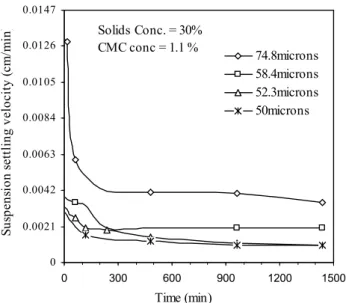
C. Effect of Solids Particle Size on Suspension Settling Figure 4 shows typical settling rate curves at 1.1 % dispersant concentration. The settling rate curve for 74.8 μm weight average diameter particles indicate that constant rate sedimentation is established faster as compared to other small particles. The constant rate sedimentation persists until all particles have settled. The settling rate curves for slurries made of the next three smaller particle size solids i.e.58.4, 52.3 and 50 μm size particles were found to be qualitatively identical with regard to the rapidity and certainty of establishment of constant rate sedimentation, as well as its persistence to the end of the settling. Of course, the rates of descent of these smaller particles were smaller.
0 0.0021 0.0042 0.0063 0.0084 0.0105 0.0126 0.0147
0 300 600 900 1200 1500 Time (min) Su sp en si on s ett lin g v elo ci ty (c m /m in ) 74.8microns 58.4microns 52.3microns 50microns Solids Conc. = 30%
CMC conc = 1.1 %
Figure 4: Effect of Solids Particle Size on the Suspension Settling
D. CD-NRep Relationship
13 in CMC solution by settling study. The solids concentrations were varied from 10 to 30 %( by wt). The relative velocities between the settling solid and the suspending liquid were calculated using continuity equation. The single particle terminal settling velocity calculated by using Richardson and Zaki`s correlation The values of hindered settling concentration coefficients we obtained are 4.6924, 4.6943, 4.6995 and 4.7134 for 50, 52.3, 58.4 and 74.8 μm particle sizes respectively. The scheme of maintaining n=4.68 is an alternative practice by many researchers. Values of n obtained clearly signify the strong concentration effects. The terminal settling velocities obtained were then corrected for wall effects. The corrected terminal settling velocity then was used for Reynolds number and drag co-efficient calculations. The general relationship between drag coefficient CD and particle Reynolds number NRep can be expressed as,
Re
(
)
bD p
C
=
a N
(2)In the Stoke’s region of NRep, for spherical particles, the Stoke’s equation for CD - NRep relationship is,
1 Re
24(
)
D p
C
=
N
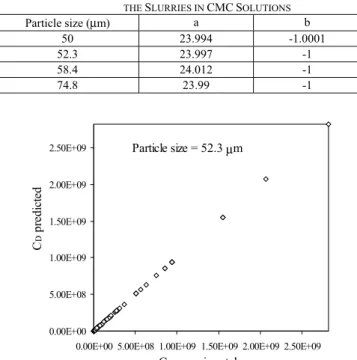
− (3)Thus values of constant a and b in equation 1 are 24 and –1 respectively for Stoke’s law. The values we obtained for these constants are almost same as that of Stoke's equation. The a and b values obtained as a result of curve fitting of CD- NRep data for all particles are listed in the following table 3. We obtained the CD- NRep relationships for very low Reynolds numbers from experimental data of settling studies of all four particle sizes. The CD- NRep data obtained experimentally is almost exactly same as that of predicted, using the Stoke’s equation. Figure 5 is the typical plot of experimental CD and predicted CD which clearly indicates the closeness of experimental and predicted values of CD.
TABLE 3: CONSTANTS A AND B FOR CD-NREP RELATIONSHIP FOR THE SLURRIES IN CMC SOLUTIONS
Particle size (μm) a b
50 23.994 -1.0001
52.3 23.997 -1
58.4 24.012 -1
74.8 23.99 -1
0.00E+00 5.00E+08 1.00E+09 1.50E+09 2.00E+09 2.50E+09
0.00E+00 5.00E+08 1.00E+09 1.50E+09 2.00E+09 2.50E+09 CD experimental
C
D
p
re
dic
te
d
Particle size = 52.3 μm
Figure 5: Comparison between CD Predicted and CD Experimental
V. CONCLUSION
• Settling velocity of the magnetite ore solids (50 to 150 mμ particle sizes) in aqueous CMC solution decreases with increase in CMC concentration of solution.
• Aqueous CMC (high viscosity) solution of concentration 1.1% and above favors the condition for suspension stability.
• The suspension settling is retarded with increase in solid concentration of slurry.
• In the aqueous CMC solution, solids of larger particle sizes settle at faster rate compared to the low particle size solids.
• At the very low range of Reynolds number i.e.0 to 1x 10⁻⁴, for the magnetite ore slurry, the CD-NRep relationship is well agreed with Stoke`s Law ie. CD = 24/ NRep.
ACKNOWLEDGMENT
Manik P Deosarkar thanks BCUD,University of Pune, India for providing financial assistance to carry out this research work.
REFERENCES
[1] Edward J. Wasp, John P. Kenny and Ramesh L. Gandhi, “ Solid-Liqud Flow Slurry Pipeline Transportation”, Series on Bulk Material Handling 1(4), Trans Tech Publication, (1977).
[2] Randall G. Gillies, Jason Schaan, Robert J. Summner, Melissa J. McKibben and Clifton A. Shook, “ Deposition Velocities For Newtonian Slurries in Turbulent Flow”, The Canadian Journal of Chemical Engineering 78, 2000, 709
[3] Shijie Liu, “Suspension Flow In Pipelines”, Recent Research Development in Chemical Engineering 4, 2000, 161
[4] Tsubaki J., Kato M., Miyazawa M., Kuma T. and Mori H., “The Effect of Concentration of Polymer Dispersant on Appearent Viscosity and Sedimentation Behavior of Dense Slurries”, Chemical Engineering Science 56, 2001, 2901
[5] K. G. Tsakalakis and G. A. Stamboltzis, “Prediction of The Settling Velocity of Irregularly Shaped Particles”, Minerals Engineering 14(3), 2001, 349
[6] Raffi M. Turian, Feng-Lung Hsu, Kostas S. Avramidis, Dong-Jin Sung and Robert K. Allendorfer, “Settling and Rheology of Suspensions of Narrow Sized Coal Particles”, American Institute of Chemical Engineering Journal 38(7), 1992, 969
[7] Turrian R. M., Ma T. W. “Characterization, settling and rheology of concentrated fine particles mineral slurries”, Powder Technology, 93, 1997, 219
[8] Richardson J. F., Chhabra R. P. and Khan A. R., “Multiphase flow of non-Newtonian fluids in horizontal pipes”, BHR Group Hydrotransport, 14, 1999, 283
[9] Y. B. He, J. S. Laskowski and B. Klien, “ Particle Movement in Non-Newtonian Slurries: The Effect of Yield Stress on Dense Medium Separation”, Chemical Engineering Science 56, 2001, 2991
14 Vivek S Sathe has received B. E. degree in Chemical Engineering from Pravara Rural Engineering College, Pravaranagar-India in 1991, M.Tech. degree in Chemical Engineering from Indian Institute of Technology, Bombay-India in 1994 and PhD degree from Indian Institute of Technology Madras in 2006. He is currently working at Dr.Babasaheb Ambedkar Technological University, Lonere-India as an Associate Professor in Chemical Engineering Department.
Kartik Chandra Ghanta has received B. Tech. from Culcatta University and M.Tech. and PhD degree from Indian Institute of Technology Kharagpur. He is currently working at National Institute of Technology, Durgapur-India, as a Professor in the Chemical Engineering Department.