314
STEEL SLAG, A SUBSTITUTE OF LIMING MATERIALS IN
AGRICULTURE
EUGENIA GAMENT1, MARIANA MARINESCU1, VERA CARABULEA1, GEORGIANA PLOPEANU1
1
National Research Institute for Soil Science, Agrochemistry and Environmental Protection, Bucharest, Romania, Email: [email protected]
Keywords: steel slag, amendment, agriculture.
ABSTRACT
Regular application of amendments and fertilizers in required doses causes significant and lasting chemical changes in the soil, in relation with the degree of success of crop production. Steel slag is a highly alkaline material considered a by-product of the steelmaking process. This material is used in many different applications including the amendment for acid soils. Amendment is a practice commonly used for rapid elimination of problems of soil acidification. As a product applied in agriculture, the steel slag has been studied in many parts of the world somewhat with satisfactory results. In some European countries, researches have shown an improvement in acid soil properties. The ability of the steel slag to improve the acidity of the soil can be explained by the high content of
CaO and MgO and Al2O3 low. When a liming material such as limestone or steel slag is
evaluated, it is compare to calcium carbonate, and its neutralizing value is called the Calcium Carbonate Equivalent (CCE) value. Application of amendments, including by-products such as steel slag can restore soil quality by balancing the pH value, organic matter intake, increasing water retention capacity, reducing compaction, etc. For reasons of environmental protection, steel slag properties should always be tested given the wide variety in terms of their physical and chemical indicators.
INTRODUCTION
Soil acidity is among the most important environmental factors that can influence plant growth and can seriously limit crop production. Therefore, acid soil amendment is the very important for good management of soil and production.
In recent years, the direct effort increased regarding the application of industrial residues for remediation of degraded soils taking into account the reduction of costs associated with waste disposal.
Steel slag is a highly alkaline material considered a by-product of the steelmaking process. This material has been used in many different applications including the amendment for acid soils (Mack and Gutta, 2009).
MATERIAL AND METHOD. RESULTS. 1. SOIL ACIDITY
Soil acidity is caused by H+ ions (H3O+) resulting by ion exchange, ionic dissociation
or after hydrolysis process. In mineral soils, Al3+ and hidroxialuminium polymers, after
hydrolysis, H+ are together with carboxyl groups derived from organic matter, the most
important source of acidity in the soil (Metodologie, 1981).
Acid soils cause problems in production by limiting the accessibility of nutrients essential for plants increasing the levels of toxic elements in the soil solution, such as aluminum and manganese, the major cause of poor production in acid soils (Ball, 1999).
315
manganese interfere with the normal growth processes of the aerial part of the plant, stagnant growth and development and cause poor yields (Ball, 1999).
There are four major reasons for becoming acidic soils - rainfall and leaching, acid parent material, reducing the amount of organic matter and high-yielding crop harvesting. Wet climate has a greater potential for acid soils. In time, excessive precipitations cause leaching in the soil profile of the basic elements (calcium, magnesium, sodium and potassium), these elements prevent the acidity of the soil.
The decrease of organic matter content influences hydrogen ions (H+) amount that
are responsible for acidity. As at the precipitation phenomenon, the development of the acidity by lowering the soil organic matter content is insignificant in the short term (Ball, 1999).
Harvesting crops with high yield has the most significant role in increasing soil acidity. During growth, crops absorb basic elements such as calcium, magnesium and potassium for their nutritional needs.
Nitrogen fertilizers can be held liable on issues of increasing soil acidity. When ammonia fertilizers are applied to the soil it produce hydrogen ions, but the form of nitrogen removed from the culture is similar to that found in the fertilizer. In fact, nitrogen fertilizers increase the acidity of the soil by increasing the crop yield, thus increasing the amount of basic elements which are removed from the soil.
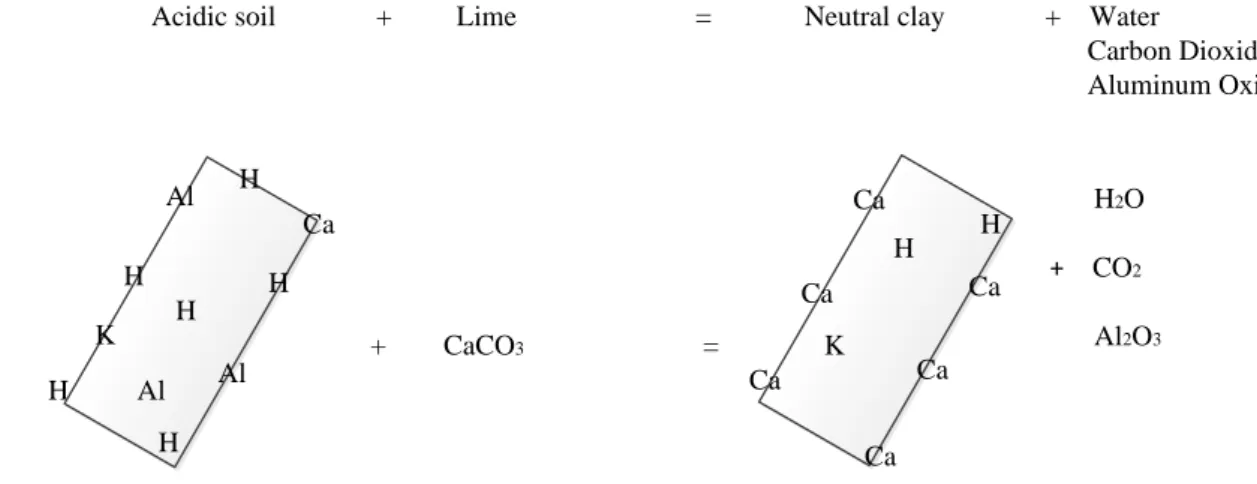
Soil acidity can be easily corrected by amending or adding liming materials to neutralize the present acidity. Acidified soil is neutralized with the addition of limestone. The most common material is aglime (agrolime) amendment. Limestone is not very soluble in water which makes it easier to handle. The reaction of limestone or calcium carbonate with an acid soil is described in Figure 1 and shows acidity on the surface of soil particles (Ball, 1999).
H
+ CaCO3 = Ca
Acidic soil + Lime = Neutral clay + Water
Carbon Dioxide Aluminum Oxide
H2O
+ CO2
Al2O3
Ca Ca
Ca
Ca Ca
Ca Al
H H
H
H
H
Al K
H
K H
Al
Figure 1. How lime neutralizes acidic soil (Ball, 1999)
Soil acidity is composed of two components: active acidity and exchangeable acidity. (Douglas et al., 1995)
The active acidity is the H+ ions concentration in the soil solution expressed as pH
but it is not a measure of the total acidity of the soil. pH of the soil is a general indicator showing whether limestone amendment is necessary to reduce the acidity.
Exchangeable acidity refers to the amount of H+ ions in exchangeable cations sites
of negatively charged clay and in soil organic matter fractions.
316
other various factors which, over time, cause changes in the pH of the soil (Douglas et al., 1995).
Leaching, erosion, and absorption by the plant of basic cations (Ca2+, Mg2+, K+),
deposition and decomposition of plants residues and exudates through the roots of the plants are means by which the acidity of the soil may increase. However, a common
source of acidity stands for H+ ions which are released when high contents of aluminum
(Al3+) in the soil reacted with the water molecules. Acid residues occur also from certain
fertilizers.
2. EFFECTS ON PLANT SOIL ACIDITY
For most crops, soil pH between 6.0 and 7.0 is ideal, however, the tolerance range of pH can vary for different crops. (Figure 2) (Douglas et al., 1995)
Figure 2. Favorable pH ranges for common crops (Douglas et al., 1995)
If the pH drops below 5.5 the availability of aluminum and manganese increases and
can touch point of toxicity for plants. The excess of aluminum (Al3+) in the soil solution
affects root growth and function and also restrict absorption of nutrients in plants such as
Ca2+ and Mg2+. Acid soils amendment reduces the activity of Al and Mn.
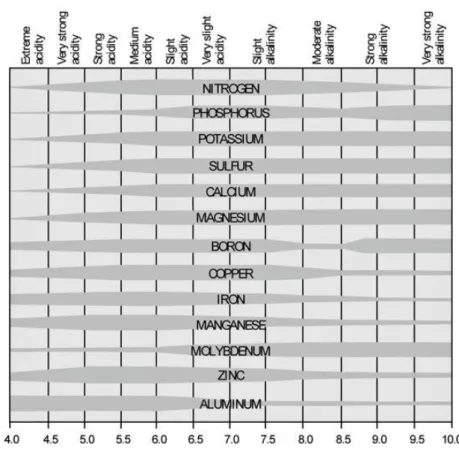
Availability of micronutrients increases as the pH of the soil decreases, except the molybdenum. While the micronutrients are required to plants in small amounts, the toxicity for plants, among other effects, are manifested at excessive amounts. This is shown in Fig. 3 explaining the relationship between pH and nutrients availability.
317
Figure 3. How soil pH affects availability of plant nutrients and aluminum (Douglas et al., 1995)
3. AMENDMENTS. STEEL SLAG
Application of amendments restores soil quality by balancing pH, contribution of organic matter, increase water retention capacity, restore the microbial community and reduce compaction. (www.epa.gov)
There are several types of problems addressed to amendments for soils such as low soil health and slow ecosystem functioning problems.
Aglime (agricultural liming material) is composed of calcium carbonate, magnesium carbonate, and other minerals which neutralize the soil acidity and provides calcium and magnesium for the growth of plants. Limestone is composed primarily of calcium carbonate. Dolomitic limestone is composed primarily of magnesium carbonate. Dolomitic limestone is preferable of calcitic limestone because it works more slowly and contains magnesium, an essential element for plant growth. Dolomitic limestone and calcitic limestone are available in powder form. The rates of application for aglime are shown in Table 1. (Ducklow and Peterson, 2006)
Table 1 Quantity of calcitic or dolomitic lime needed to raise soil pH to 6.5
(Ducklow and Peterson, 2006)
Soil pH ………Soil Type………. Sand Loam Clay
t/ha t/ha t/ha
318
A good amendment program is based on a soil test that determines the degree of acidity of the soil and the right amount of material necessary to neutralize this acidity. Once this quantity determined, a material amendment has to be selected and it will have to satisfy economically speaking the recommendations and results of the soil test to the maximum, with efficient production. However, before taking into account the necessary amount of the amendment it is helpful a correct knowledge of the material amendment, its quality and knowledge of legislation.
STEEL SLAG
There are different types of steel slag produced in the steelmaking process. These include oven slag or exhaust (Furnace Slag or Tap), scraping slag (Slag Raker) and synthetic slag (Ladle Slag).
The most important physical characteristic of the steel slag is the particle size distribution. The finer the particle, the material will be more reactive neutralizing soil acidity. (www.nationalslag.org)
The steel slags have high specific weight (3.2 - 3.6 g/cm3) and bulk density also large
(1.6 - 1.9 g/cm3) compare to agriculture lime material (2, 7 to 2.9 and, respectively 1.4 to
1.5 g/cm3). This is a consequence of the residual metals from slag. (www.nationalslag.org)
The steel slag contains from 35% to 45% calcium oxide which makes it a conditioned product of soil in terms of restoring the natural balance of acid soils. [13]
Steel slags contain many chemicals; they contain calcium silicate, CaO and MgO free. Part of the slag chemical composition (Portland, USA) is given in Table 2.
(knowing the fact that the slags contain different chemical compounds, in different amounts and from the various steel mills). (www.nationalslag.org)
Table 2
Chemical characteristics of steel slag (www.nationalslag.org)
Constituent % by wt. CaO 40 – 52 SiO2 10 – 19
Al2O3 1 – 3
MgO 5 – 10 Fe (FeO or Fe2O3) 10 – 40
MnO 5 – 8 TiO2 0,5
P2O5 0,5 – 1
CaO free 2,1 Fe metallic 0,5 – 1,0
The amendment value of an alkaline material as limestone or steel slag is the total amount of neutralizing material. This is determined by reaction of material with a strong
acid followed by titration of the excess acid remaining. (Agricultural liming materials) The
total amount of neutralization is expressed in terms of equivalent to pure limestone
(CaCO3) and is defined Calcium Carbonate Equivalent (CCE). When a liming material
such as limestone or steel slag is evaluated, it is compare to calcium carbonate, and its neutralizing value is called the Calcium Carbonate Equivalent (CCE) value.
319
The buffering capacity of the soil can be determined by titrating a sample of the soil to a desired pH but there are more rapid tests used in the laboratory. The necessary amendment of a calcareous soil amendment in tons of agricultural lime per acre (0.405 ha = 1acre) is based on pH-buffering and pH of the soil desired. To convert the lime requirement based on limestone to that of steel slag, the CCE of the slag would be divided into 95. For example, if necessary of a ground limestone was 2 tons / acre and the CCE of the steel slag was 25%, the application rate of steel slag will be 2×95: 25 = 7.6 tons / acre (18, 76 tons / ha). (www.nationalslag.org)
CCE limestone value is obtained directly by dissolving the material in acid sample. However, the analysis of agricultural limestone material is often reported in various ways, such as calcium oxide (CaO) and magnesium oxide (MgO) or in the form of calcium carbonate (CaCO3) and magnesium carbonate (MgCO3). CCE can be easily calculated using the conversion factors listed in Table 3 (Douglas et al., 1995).
Table 3
Conversion factors for liming materials (Douglas et al., 1995) Ca × 2,50 = CaCO3
Mg × 4,17 = CaCO3
CaO × 1,79 = CaCO3
MgO × 2,50 = CaCO3
MgCO3 × 1,19 = CaCO3
Ca(OH)2 × 1,36 = CaCO3
Example:
Ca 35% × 2,50 = 87,50% Mg 2% × 4,17 = 8,34%
CCE = 95,84%
The Neutralization Potential (NP) of steel slags can vary between 45 and
78%. Most of the residues are in the form of iron oxides and
aluminosilicates. (Ziemkiewiecz and Skousen, 1998) The leaching studies were carried out (removal of the alkalinity content of the slag) with columns of different thicknesses and different types of slags. Alkalinity is given as mg / L CaCO3 equivalent; pH of the solution can reach values over 11.7. (Ziemkiewiecz and Skousen, 1998)
Since most steel slags contain heavy metals, many tests were conducted to study about heavy metals in slag. It is important to remember that not all steel slags are the same, they vary in composition, quality and fineness. (Table 4), (Ziemkiewiecz and Skousen, 1998)
The leaching studies were carried out on a column with different thicknesses of slag. Leachate samples were analyzed for pH, electrical conductivity, content of alkalinity and metals. The concentration of metals in the leachate was compared with standards for the U.S. Environmental Protection Agency's Toxicity Characteristics Leaching Procedures (TCLP) and EPA standards for drinking water. The results indicated that slag has not released any element in larger quantities than TCLP limits. (Ziemkiewiecz and Skousen, 1998)
320
Table 4
The concentrations of metal of the percolate when steel slag Mingo Junction was percolated with deionized water, compared with the standards USEPA TCLP (US Environmental Protection Agency's Toxicity Characteristics leaching procedures)
and EPA standards for drinking water (Environmental Protection Agency). (Ziemkiewiecz and Skousen, 1998)
Mingo Junction Slag TCLP EPA drinking
water
Limit Limit
pH Cond. Alcalinity As Se Ba Cd Cr Cu Pb Ni Zn V Tl Be Ti Sb Mc Ag Hg SO4 11,7 4780 µS/m 1450 mg/L <0,05 mg/L 0,05 mg/L 0,02 mg/L <0,001 mg/L 0,03 mg/L 0,058 mg/L 0,1 mg/L 0,041 mg/L <0,002 mg/L <0,05 mg/L <0,05 mg/L 0,0013 mg/L <0,05 mg/L 0,08 mg/L 0,008 mg/L <0,005 mg/L <0,0003 mg/L 1,6 mg/L 5 mg/L 1 mg/L 100 mg/L 1 mg/L 5 mg/L 5 mg/L 70 mg/L 1 mg/L 7 mg/L 0,007 mg/L 5 mg/L 0,2 mg/L 50 µg/L 50 µg/L 2000 µg/L 5 µg/L 100 µg/L 15 µg/L 10 µg/L 6 µg/L 2 µg/L 4 µg/L 2 µg/L CONCLUSIONS
Although recycling byproduct has been made already as a commitment by the steel industry, increased production of steel in recent years has pressed the industry to increase its use in a more efficient manner in order to achieve a steel production sustainable. Even if the slag obtained in the production of steel are continuously studied in order to improve their recycling, there are some limiting factors for their use.
In particular, a small quantity of slag is used as fertilizer in agriculture and the use depends on the market conditions. Because of the low market value of fertilizers, long distance transportation is a limiting factor. In addition, natural calcareous fertilizers are competing with the use of the slag. Therefore, development of new markets of slag in order to ensure its future use is required. With this in mind, the steel industry has undertaken to reduce the amount of slag which must be deposited and to improve its use by increasing its ability to amend. (Drissen, P. et all, 2009)
Steel slag can be used as a substitute for lime to neutralize the acidity of the soil; for many years research has shown that using slag is comparable or superior limestone in some cases. In addition to its benefits to amend, the slag contains the necessary nutrients which can increase plant yields. Slag also contains silica which has been shown that increases production of crops such as rice and sugarcane and also helps as a treatment against diseases in crops. (www.nationalslag.org)
While steel slags contain different concentrations of trace elements, such as Cr (III) and Zn, the bioavailability of these metals is very low.
As a byproduct of industrial products, steel slag provides significant advantages such as costs compared to limestone commercial.
321
or smaller quantities of metals will be released over a period of time? (Mack and Gutta, 2009)
All the above conclusions, transferred to the situation in which steel slag is used as an amendment in agriculture can put a series of questions about the transformations occurring in acidic soils treated with steel slag.
ACKNOWLEDGMENT
The financial support provided by ANCSI – project no. PN 16 07 03 03 – Corectarea rectiei solurilor acide prin amendarea cu zgura de otelarie si impactul folosirii acesteia asupra solului.
BIBLIOGRAPHY
1. Ball, Jeff, 1999 - Understanding and Correcting Soil Acidity, Noble Foundation Soil
Publication, Samuel Roberts Noble Foundation, Inc.
2. Beegle, Douglas B., Lingenfelter, Dwight D., 1995 - Soil Acidity and Aglime,
College of Agricultural Sciences, Cooperative Extension, Agronomy Facts 3,
Pennsylvania State University
3. Drissen, P., Ehrenberg, A., Kuhn, M., Mudersbach, D., 2009 - Recent
Development in Slag Tratment and Dust Recycling, Steel Research International, Vol. 80, No. 10, oct. 2009, pp. 737-745, ISSN 1869-344X
4. Ducklow, Laura, Peterson, Daniel, 2006 - Modifying Soil pH, Sustainable Urban
Landscape Information Series, University of Minnesota, 2006, Implementation
Report
5. Mack, Ben, Gutta, Brady, 2009 - An Analysis of Steel Slag and its Use in Acid
Mine Drainage (AMD) Treatment, The 2009 National Meeting of the American
Society of Mining and Reclamation, Billings, MT Revitalizing the Environment; Proven Solutions and Innovative Approaches May 30-june 5, 2009, R.I. Barnhisel (Ed.) Published by ASMR, 3134 Montavesta Rd. Lexington, KY 40502
6. Ziemkiewiecz, P., Skousen, J., 1998 - The Use of Steel Slag in Acid Mine
Drainage, Treatment and Control, Proceedings 19th Annual West Virginia Surface
Mine Drainage Task Force Symposium, Morgantown, West Virginia, April 7-8
7. ***AOAC, Agricultural liming materials, Pg. 1-8, Official Methods of Analysis of the
Association of Official Agriculture Chemists. Washington, DC
8. ***www.epa.gov 2007- The Use of Soil Amendments for Remediation, Revitalization
and Reuse, EPA 542-R-07-013, Solid Waste and Emergency Response (5203P)
December
9. **** Metodologie de analiză agrochimică a solurilor în vederea stabilirii necesarului
de amendamente şi de îngrăşăminte, Vol. 1 – Parea I, Buc. 1981, Nr. 13, Metode.
Rapoarte. Îndrumări
10. *** www.nationalslag.org Ghide for the Use of Steel Slag in Agriculture and for
Reclamation of Acidic Land, NSA – National Slag Association , P.O. Box 1197,