INCREASING THE EFFICIENCY OF HEATING SYSTEMS BY USING HEAT
PUMPS
POP F., MARIAN M., MIRCEA C., GANEA I. 1)INMA Bucharest / Romania;
E-mail: [email protected] Keywords: renewable resources, heat pumps
ABSTRACT
The problem of making heating systems more efficient was imposed due to the trend of increasing the demand for energy correlated in the same time with the increase of energy costs. Out of the various forms of energy used, in the current trend of developing the technique, the heat energy has the largest share in the energy balance of a country. EU policy in this field, expressed by the White Paper and the European Directive 2001/77/EC on energy production from renewable sources, states that, by 2020, the European Union will need to provide the necessary energy in a ratio of about 15 % by harnessing renewable sources. A solution of recovering the important heat quantities from the environment is the use of heat pumps which offers a real alternative to classic fuels, while contributing to reducing CO2 emissions up to 50% compared to using conventional
boilers. They get about three quarters of the energy required for heating from the environment, and for the rest, they use electricity as driving energy.
INTRODUCTION
The need to ensure a sustainable energy development, while achieving effective protection of the environment has led to intensifying concerns regarding the promotion of renewable sources of energy and supporting industrial technologies. By burning classic fossil fuels, even the lower ones, heat energy is obtained at high heat potential corresponding to temperatures of 1500 ... 2000° C. At this level, heat exergy - the maximum part that can be converted into mechanical work - has significant value, and using it for purposes such as heating water in a hot water boiler leads to significant energy losses and to the reduction of the efficiency of the installation.
In these circumstances, the rational solution consists mainly in harnessing the huge amounts of heat that can be taken from the environment. Such a solution is the use of heat pumps for heating and for preparing hot water. There are a variety of technical solutions capable of ensuring efficient classic heat systems, in this article we approached the solution of using heat pumps. Heat pumps – as energy conversion systems - are heat machines that can raise the quantity of heat from a low level of temperature to a high level of temperature. They can typically supply heat to a temperature of up to 60-70 ° C. [1]
The operation of any heat installation produces polluting emissions. For example, the boiler using classic fuel from an installation for heating and producing domestic hot water produces soot, sulfuric acid, carbon monoxide, nitrogen oxide and carbon dioxide. All these substances are themselves a threat to the environment, while contributing to increasing the greenhouse effect. In the case of using electricity and district heating for heating, emissions of harmful substances are moving towards the thermo-electrical plants or towards the centers of heating so that at the site where heat is produced, no noxious pollutants are released, helping to decrease air pollution in densely populated area, especially during winter.
reduce emissions depends on the technology that these pumps replace and on the energy source used for driving. [2, 3]
MATERIAL AND METHOD
In order to obtain energy efficiency for the heating systems used, there are systems that allow after an investment that is initially higher, in exploitation, energy costs or fuel consumption are minimized and on the medium and long term to represent a viable but especially "eco" solution because it reduces CO2 emissions by over 50% due to their
operation. The solution in this case is the use of heat pumps that use (extract) the heat from the ground for heating the inside of buildings.
RESULTS AND DISCUSSIONS The operation of a heat pump
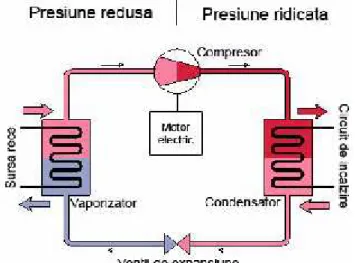
The heat pump with vapor compression works according to the reversed Carnot cycle. Its mode of operation is similar to the operation of a refrigerator. In the case of the refrigerator, the cooling agent removes the heat using an evaporator and by the means of the machine’s condenser, it is transferred into the room. If the case of heat pumps, heat is extracted from the environment (soil, water, air) and is lead to the heating system. The working agent, a liquid that reaches the boiling at a low temperature is guided into a circuit and consequently it evaporates, is compressed and expands. In the evaporator there is a liquid working agent at reduced pressure. The temperature level of organic heat in the evaporator is higher than the domain of boiling temperature corresponding to the working pressure. This difference in temperature leads to the transmission of the ecological heat to the agent and the working agent boils and vaporizes.
The vapors resulting from the working agent are continuously suctioned from the evaporator by the compressor and are compressed. During compression, the pressure and temperature of the vapor increase. The vapors of the working agent reach from the compressor into the condenser which is surrounded by thermal agent. The temperature of the working agent is more reduced than the pressure of condensing the working agent, so that the vapors cools and liquefy again. The energy taken up in the evaporator and the additional energy transferred by compression shall be released in the condenser by condensation and will be transferred to the thermal agent. Further, the working agent is returned through an expansion valve into the evaporator. The working agent moves due to the low pressure of the evaporator. Upon entering the evaporator, the initial pressure and temperature are reached, thus closing the circuit.
The 4 phases of the process of thermal transfer (fig. 1) that take place inside the heat pump are:
- The liquid cooling agent at T=-2ºC and p= about 1.7 bar enters the vaporized (heat
exchanger) where the heat transfer from the energy source to the thermal agent occurs (water from underground sources enters in the vaporizer at T= about 11ºC and exists at T=about 8ºC). When existing the vaporizer, the cooling agent is in a cool vapors state (T=about 3ºC and p=about 1.7 bar).
- Cold refrigerant vapors enter the compressor, where by means of electrical energy,
- Refrigerant agent enters the expansion valve, where its temperature decreases to
-2oC, and its pressure drops at 1.7 bar. From this moment, the cycle repeats. [3, 4].
Fig. 1 – The functional diagram of a heat pump
Classification of heat pumps
Heat pumps can be of three types, namely:
- The air – water heat pump: although the air-water heat pump has the lowest efficiency
of all types to which we refer, it is, along with soil-water heat pump, one of the most sold in Europe. Air-water system is a relatively simple system to install and requires no special fitting work (excavation, drilling, etc.). The major drawback of the system is that it cannot operate univalent at very low temperatures (from approx.-15ºC).
- The water – water heat pump: groundwater is a good accumulator for solar heat. Due
to the constant level of temperature of the heat source, the performance factor of the heat pump is maintained constantly high throughout the year. Unfortunately, ground water in found in sufficient quantities in all areas and does not have sufficient quality, but where conditions allow it, it is worth using this system.
- Soil- water heat pumps are widespread compared to the water-water heat pump and
has as "source" the solar heat accumulated in the upper layers of the Earth. From a certain distance into the ground (approx. 15m), the temperature remains relatively constant, with every 30 m in depth, the temperature increasing only with approx. one degree Celsius.
The heat from the soil determinant for taking the heat is represented by the accumulated solar energy which through direct radiation by heat transfer from the air or from precipitations is transmitted to the soil. This is the source of heat which is responsible for the relatively rapid regeneration of the cooled soil after a heating period.
Systems for capturing from the soils are also called systems with “closed loop” [1].
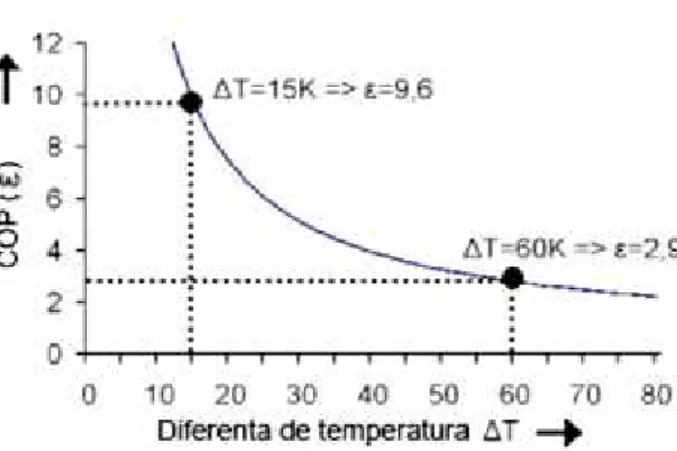
Changes in energy efficiency of a heat pump according to the temperature difference
Fig. 2– The variation of energy efficiency of the heat pump depending on the temperature difference
When we say that a heat pump has COP = 5 (stating the temperature difference), we say that it produces 5 kW heat output of 1kW electric power. We can even say - that it would be the "yield" of the heat pump - but that is higher than one would mislead and therefore it was agreed to be called coefficient of performance. The value of COP is a momentary value. In order to establish a COP as close to reality it is taken into account a longer operating period (eg. a year) and is established a yearly COP, which is obviously different from the momentarily one (usually when calculating it, one takes into account all auxiliary consumption, such as extraction pumps, recirculation, etc.). Suppliers of heat pumps indicate this COP in the technical specifications, automatic specifying the temperature difference. The coefficient of performance of the heat pump for cooling mode is also called EEC - energy efficiency of cooling. EEC value is particularly important when designing reversible heat pumps because the cooling requirement is greater than the need for heating and for this reason the power of the compressor will be given by the cooling needs. At this moment, very efficient heat pumps have a COP generally situated between 3.5 and 5.5. [2, 3]
Choosing the heat pump
Establishing the heating necessary will be done in accordance with the technical rules in force of the European Union.
Required thermal load calculation will be reported in square meters of area, taking into account the average height of the room H = 2.5m (typical height for most rooms). This system applies throughout the European Union, the rules and regulations in the field only using this system.
Compared to the alternative of heating using gas, at the current price of natural gas in Romania (370euro / 1000m3of gas) is recommended to use HP with a high as possible
COP (coefficient of performance), so that its operation will more economical than a gas installation and the investment in a PDC to be profitable. [3, 4]
We performed a compared analysis of different types of heat pumps depending on the nature of the energy source used (Table 1).
Table 1 Comparative analysis of different types of heat pumps
Type Air-Water Water-Water Ground-Water
It is easy to observe that air - water heat pumps have all performance parameters significantly inferior compared to other constructive types. Only regarding the costs of installing, this type of equipment is more advantageous. Water-water and ground-water heat pumps have almost all the performance indices with close values, with the observation that soil-water ones require high installation costs that exceed the costs of drilling water wells.
The correct sizing of heat pump is essential for its length of service. An oversized pump, besides the fact it's more expensive, has an incorrect operating system with frequent starts and stops. An undersized HP works more with small breaks. It is preferable to undersize (within limits) than to oversize a heat pump. Due to the relatively high price of a heat pump, it is uneconomical to heat poorly insulated areas, requiring high thermal power. It is preferable to better insulate the building than to increase the power of the heating source. [1]
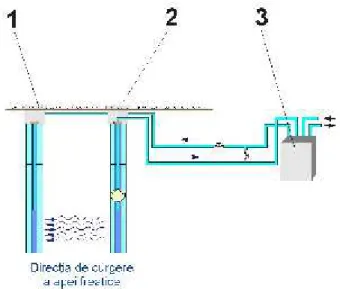
The operating diagram of such an installation of the type water-water pump in presented in figure 3.
Fig. 3 – Water-water heat pump
1 – absorbing water well; 2 – well with pump; 3 – heat pump
The water-water system is also called open loop capture system. The flow rate of water through the evaporator should not exceed 0.8 m / s.
This type of heat pump can achieve the highest COP of all. Such water-water system can easily reach a COP = 5 and even exceed it if done properly and correctly sized. It can also deliver impressive power reaching thousands of kW on a single unit or by coupling multiple units of lower power.
Because in the EU there are very strict regulations on drillings, this type of heat pump, with all the advantages it has (reliability, high COP and high EER) is less widespread, at least in Europe.
Table 2
Electric conductivity
(micro Siemens/cm) >600
-Chlorides (mg/l) <10 10-100 100-200 >200 + + 0 -Sulphates (mg/l) <50 50-100 >100 + 0
-Carbonic acid (mg/l)
<5 5-20 >20 + 0 -Oxygen (mg/l) <1 1-8 >8 + 0 -Ammonium (mg/l) <2 2-20 >20 + 0
-Iron with manganese (mg/l) >0.2
-Sulphides (mg/l) <5
-Chlorine (mg/l) <0.5 +
+ components of the installation are stable;
0 corrosion can appear, if several factors have the value 0;
Not recommended (for example, increased iron and manganese values affect the heat exchanger).
Because of constant temperature level of the heat source, the performance factor of the heat pump remains high throughout the year. Unfortunately, groundwater is not found in sufficient quantities in all areas and does not have adequate quality, but where conditions allow, it is worth to use this system. In the case of ground water that is free of oxygen, but has high iron and manganese content, wells turn yellow. In this case, water should not come into contact with air or should be treated accordingly. To reduce corrosion of evaporators they must be made of stainless steel. The use of groundwater must be approved by the competent authorities (Directorate of Waters). It is recommended that groundwater should not be pumped from depths greater than 15 m, because drilling costs would be too high. [2, 3, 4]
CONCLUSIONS
At economic level and from the functional point of view, by applying the solution for of using heat pumps instead of conventional heating systems, a cost reduction of 50-80% for heating costs will be achieved. Below we have listed some of the benefits of using heat pumps:
- Big savings compared to any other classic system;
- Protecting natural resources and the environment (does not pollute); - Silent equipment;
- Does not require to use chimneys; - Use ecological refrigerant agents;
- Do not require exploiting personnel, operating completely automated; - High reliability;
- Operating period is 25 years.
BIBLIOGRAPHY