There are two basic categories of antioxidants: Synthetic and natural. The use of synthetic antioxidants is being restricted because of their carcinogenicity. Hence, herbs which have been reported to possess antioxidant properties, are being used for antioxidant formulations.[1]
Phenols and polyphenols including ß avanoids in wine, fruits, and vegetables have been reported to exhibit a wide range of biological activities and their effects are mainly attributed to antioxidant properties that prevent free radical-mediated cytotoxicity, lipid peroxidation, and oxidation of low-density lipoproteins. The ability of these compounds to scavenge ROS is well documented.
INTRODUCTION
Antioxidants are molecules that can neutralize free radicals by accepting or donating an electron to eliminate the unpaired condition of these free radical species. They act in low concentrations relative to the oxidizable substrate and protect other chemicals of the body from damaging oxidation reactions by reacting with free radicals, mainly reactive oxygen species (ROS), the most dangerous byproduct of the aerobic environment. During these reactions, as the beneÞ cial antioxidant molecule sacriÞ ces itself by becoming oxidized, there is a constant need to replenish antioxidant sources, either endogenously or through supplementation.
ABSTRACT
Cellular damage arising from free radicals is one of the fundamental mechanisms underlying a number of human neurodegenerative disorders like diabetes, inß ammation, Alzheimer’s disease, autoimmune pathologies, and digestive system disorders. Thus, antioxidants play an important role in the treatment of such diseases. Natural sources of antioxidants, free of carcinogenicity unlike synthetic ones, are being tapped for antioxidant formulations. The present study aims at a comparative evaluation of hexane, alcoholic, and aqueous extracts of fresh lemon peel for antioxidant activity. All extracts were subjected to phenolic content estimation by the Folin-Ciocalteau method and ß avonoid content estimation by the aluminium chloride colorimetric method. Results revealed that the alcoholic extract had the maximaml content of both phenolics and ß avanoids. Antioxidant activity was evaluated by using the beta-carotene bleaching method, the nitric oxide radical scavenging and the hydrogen peroxide scavenging assays. The alcoholic extract was found to have good free radical inhibitory property as well as nitric oxide radical scavenging activity. The hexane extract, however, showed only good hydrogen peroxide scavenging activity. Thus, the higher antioxidant activity of the alcoholic and hexane extracts of Citrus limon
peel could have wide therapeutic utility against various diseases.
Key words: Antioxidant activity, Citrus limon, ß avonoids, phenolics
DOI: 10.4103/0975-1483.55746
Comparative Evaluation of Extracts of Citrus limon Burm Peel for
Antioxidant Activity
Akhila S, Bindu AR
1, Bindu K
1, Aleykutty NA
1Nazareth College of Pharmacy, Othera P.O, Thiruvalla, Kerala-689 546, 1Department of Pharmaceutical
Sciences, Cheruvandoor Campus, M.G University, Ettumanoor, Kottayam-686 631, India
In addition, they are reported to be nontoxic and nonmutagenic. Among the fruits, citrus fruits are the most common dietary sources of phenolics, ß avanones, and ß avones. Thus, extracts from these fruits could prove to be beneÞ cial for the prevention and treatment of many neurodegenerative disorders. [2] In the present work, we intend to evaluate various extracts of fresh peels of Citrus limon for their antioxidant property.
MATERIALS AND METHODS
Plant source
Fresh lemon fruits used in the present study were collected from the local market at Ettumanoor, Kottayam (dist) and authentiÞ ed by the botanist, Mr. Joby Paul, Department of Environmental sciences, M.G University as Citrus limon Burm. The voucher specimens are deposited in the herbarium of the Dept. of Pharmaceutical Sciences, M.G. University, Kottayam. Lemon fruits were peeled off and the fresh peels were subjected to extraction for further studies.
Apparatus and chemicals
Our study involved the use of a UV-VIS spectrophotometer (Shimadzu UV-1601 UV-VIS spectrophotometer). All reagents used were of analytical grade. Gallic acid (Nice Chemical Private Ltd, New Delhi), rutin and ascorbic acid (Loba Chemie Private Ltd, Mumbai), propyl gallate (Merck Speciality Private Ltd, Mumbai), beta-carotene and linoleic acid (Research Lab Fine Chem. Industries, Mumbai) and quercetin (Chemika-Biochemika-reagents, Mumbai) were procured and used for the studies.
Extraction
Extraction of lemon peel was carried out by using solvents of increasing polarity: n-hexane, alcohol, and water. Extraction of lemon peel with n-hexane was carried out by using a simple maceration technique: 500 g of C. limon peel (80 fruits) was taken, size-reduced, and extracted with 2 L of n-hexane in an amber-colored bottle with intermittent shaking for five days. After five days, the extract was decanted off and allowed to evaporate at room temperature in an evaporating dish. The residue obtained was weighed and kept closed in a desiccator for further studies. Extraction of 125 g of lemon peel marc (left after n-hexane extraction) using alcohol was carried out by a hot continuous extraction method in a Soxhlet apparatus. Extraction was carried out for nine hours with the lemon peel marc packed in the extractor and 300 mL of alcohol in a round bottom ß ask.
The extract obtained was collected and concentrated by gentle heating. The concentrated extract was then weighed and stored in the desiccator for further studies. Aqueous extraction was carried out by the reß ux method with the marc left over after Soxhlet extraction using 50 g of the marc packed in a round bottom ß ask and reß uxed for two hours. The extract obtained was then concentrated to a dry residue by heating and the dry residue obtained was weighed and used for further studies.[3,4]
Total phenolic estimation
Total phenolic estimation was carried out by using the standard Folin-Ciocalteau method.[5] The extracts and the standard, gallic acid, were dissolved in methanol separately for the total phenolic estimation. One milliliter of each extract was mixed with 5 mL of Folin-Ciocalteau reagent, and 4 mL of sodium carbonate solution added after 5 min and kept at room temperature for two hours. Absorbance values were measured at 750 nm and a standard curve was prepared using gallic acid. The absorbance values obtained for the extracts were interpreted from the standard curve to get the total phenolic content expressed as milligram equivalents of gallic acid.
Total ß avonoid content
Estimation of ß avonoids was carried out by the aluminium chloride colorimetric method.[6] The extracts and the standard, rutin, were dissolved in methanol separately for the total ß avonoid estimation. To each extract (1 mL), 4 mL of water followed by 0.3 mL of sodium nitrate were added. After 5 min, 0.3 mL of 10% aluminium chloride solution was added and at the 6th minute, 2 mL of 1 M sodium hydroxide were added. After proper mixing, absorbance was measured at 510 nm and a standard curve was prepared using rutin. The absorbance values obtained for the extracts were interpreted from the standard curve to get the total ß avonoid content expressed as milligram equivalents of rutin.
In vitro antioxidant activity
Beta-carotene bleaching method
The antioxidant activity of extracts and the standard were assessed on the basis of free radical scavenging using the beta-carotene bleaching model.[3] Both the sample solutions (extracts) and the standard solution (propylgallate) were prepared in methanol and 0.2 mL of each solution was placed in different test tubes. To each test tube, 5 mL of the β-carotene emulsion was transferred and gently shaken before being placed at 45°C in a water bath for 60 min. The absorbance of the samples, the standard, and the control were measured at 470 nm against a blank consisting of an emulsion without β-carotene. The measurements were carried out initially (t = 0) and at 30 and 60 min. All samples were assayed in triplicate and averaged; the antioxidant activity was measured using the formulae:
AA A A
A A
o t
o o
= − −
− ×
1 ° ° 100
Where, Ao and A°t: Are the absorbance values measured at the initial incubation time for sample/standard and control respectively
At and A°t: Are the absorbance values at time t (t = 30 min and t = 60 min) for the sample/standard and control respectively.
Nitric oxide radical scavenging assay
NO is an important bioregulatory molecule that has a number of physiological effects, including control of blood pressure, neural signal transduction, platelet function, as well as antimicrobial and antitumor activities. Low concentrations of NO are sufÞ cient, in most cases, to effect these beneÞ cial functions. However, during infections and inß ammations, the formation of NO is elevated and may bring about some undesired deleterious effects. NO does not interact with bioorganic macromolecules such as DNA or proteins directly. However, the NO molecule is very unstable in aerobic conditions and reacts with oxygen to produce intermediates such as NO2, N2O4 and N3O4. The stable products of these reactions, nitrate, nitrite, and peroxynitrite, react with superoxide and these products are highly genotoxic. The deamination of guanine, cytosine, and adenine is mediated primarily by N2O3. In addition to the formation of nitrosoamines and deamination of the DNA bases, NO may also act by affecting the enzymatic activities of several thiol-rich DNA repair proteins like DNA alkyl transferase, formamopyrimidine-DNA glycosalase, and also carcinogenesis in general. As excess generation of NO is deleterious to human health, extracts should be screened for their capacity to scavenge nitric oxide in vitro.[7]
The antioxidant activity of extracts and the standard were assessed on the basis of their nitric oxide scavenging ability. [8] The standard, quercetin, and the extracts were prepared in phosphate-buffered saline at 50, 100, 150 and
200 μg/mL concentrations. The assay reaction mixture
(3 mL) was prepared by mixing 2 mL of 10 mM sodium nitroprusside solution, 0.5 mL of phosphate-buffered saline, and 0.5 mL of the sample or standard solution. These were then incubated at 25°C for 2.5 hours. After incubation, 0.5 mal of the reaction mixture was pipetted out and mixed with 1 mL of sulphanilic acid reagent (Þ nal concentration of 0.33% in 20% glacial acetic acid) and allowed to stand for 5 min for complete diazotization. Then, 1 mL of 1-naphthylamine solution (5%) was added, mixed, and allowed to stand for 30 min to form pink chromophores. The absorbance was then measured at 540 nm against the corresponding blank solution. All samples were prepared and assayed in triplicate and averaged. The antioxidant activity was measured using the formulae:
%Inhibition A A
A
c s
c
= − ×100
Where, Ac- is the absorbance of the control; As- is the absorbance of sample/standard.
Hydrogen peroxide scavenging assay
Hydrogen peroxide is the most stable ROS and may be generated directly by divalent reduction of O2 or indirectly by univalent reduction of O2 by numerous oxidases, such as xanthine oxidase, uricase, and α-hydroxy acid oxidase localized in the peroxisome. H2O2 is decomposed to H2O and O which can induce cell injury and cause DNA damage in the form of chromosomal aberrations rather than superoxide ions.[9]
Table 2: Comparative evaluation of extracts of Citrus limon burm peel for antioxidant activity using the beta-carotene bleaching model
Extracts Absorbance (nm) at % antioxidant activity* at 0 time 30th min 60th min 30th min 60th min
Control 0.143 ± 0.002 0.128 ± 0.0026 0.119 ± 0.001
Hexane extract 0.4 ± 0.0017 0.395 ± 0.0034 0.391 ± 0.0028 66.67 62.5
Alcoholicextract 0.295 ± 0.001 0.291 ± 0.001 0.288 ± 0.0026 73.34 70.84
Aqueous extract 0.397 ± 0.002 0.390 ± 0.002 0.385 ± 0.0036 53.34 50
Standard drug 0.205 ± 0.0026 0.202 ± 0.0026 0.200 ± 0.001 80.4 79.17
* Average of three determinations; standard drug: Propylgallate
%Inhibition A A
A
c s
c
= − ×100
Where, Ac- is the absorbance of the control; As-is the absorbance of sample/standard; 50% Inhibitory Concentration (IC50).
The concentration (μg/mL) of the various extracts required to scavenge 50% of the radicals was obtained for both the nitric oxide radical-scavenging assay and hydrogen peroxide scavenging assay by extrapolating their graphs of concentration vs % scavenging ability.
Data and statistical analysis
Data obtained for extracts were statistically analyzed with the standard using two-way ANOVA in GraphPad® IV software.
RESULTS
Yield
The alcoholic extract was found to have the highest yield, followed by the aqueous extract, and Þ nally the hexane extract [Table 1].
Estimations
The total phenolic and ß avonoid content of the alcoholic extract was found to be the highest, followed by the hexane extract and Þ nally, the aqueous extract [Table 1].
Antioxidant study
Antioxidant studies by the beta-carotene bleaching
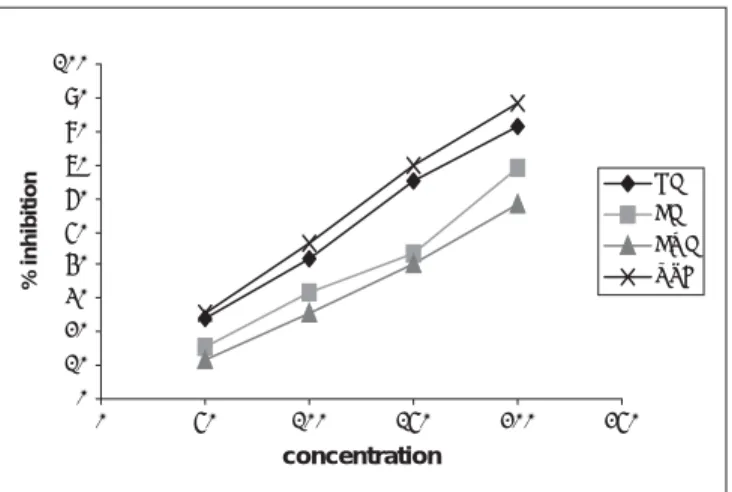
method showed that all the extracts were comparable to the standard drug, propylgallate, with the alcoholic extract having the best activity [Table 2]. The % inhibition obtained in the presence of different concentrations of the extracts (Hexane extract (HE), Alcoholic extract (AE), Aqueous extract (AQE) and Standard (STD)) were calculated and depicted in Figure 1 and the IC50 values calculated. Antioxidant studies by the nitric oxide radical scavenging assay showed that all the extracts have IC50 values comparable to that of the standard, with the alcoholic extract having the best activity [Table 3]. The % inhibition of hydrogen peroxide obtained in the presence of different concentrations of the extracts (Hexane extract (HE), Alcoholic extract (AE), Aqueous extract (AQE) and Standard (STD)) were calculated and depicted in Figure 2 and the IC50 values calculated. Antioxidant studies by using the hydrogen peroxide scavenging assay showed that all the extracts have IC50 values comparable to that of the standard, with the hexane extract having the best activity [Table 3]. The isolation of therapeutically active constituent(s) from these extracts will probably give better antioxidant activity than even the standard at lower concentrations.
The percentage inhibition obtained for each extract was statistically compared with that of the standard and found to have P < 0.001 signiÞ cance.
DISCUSSION
Citrus fruits are considered to be common, rich, dietary sources of phenolics and are hence, considered to be beneÞ cial for many neurodegenerative disorders. The present study estimated the phenolic and ß avonoid contents of extracts of C. limon peels and evaluated their antioxidant activity. The alcoholic extract was found to have a good yield for both phenolics and ß avonoids compared to the hexane and aqueous extracts. Phenols and polyphenols, including ß avanoids in wine, fruits, and vegetables, have been reported to exhibit a wide range of biological activities, and their effects are mainly attributed to their antioxidant property that prevents free radical-mediated cytotoxicity, lipid peroxidation, and oxidation of low-density lipoproteins.
Table 1: Comparative evaluation of extracts for its phenolic and ß avonoid content
Extracts Percentage yield (%)
Total phenolic content* (μg/ mL)
Total ß avonoid content* (μg/mL)
Hexane extract 0.4 35.00 27.5
Alcoholic extract
5.87 51.25 38.75
Aqueousextract 2.8 13.75 6.25
Our antioxidant studies revealed that the alcoholic extract with the higher concentrations of phenolics and ß avonoids did have signiÞ cant free radical-scavenging and nitric oxide radical-scavenging activities. The hexane extract that was rich in citrus terpenoids, was found to have signiÞ cant hydrogen peroxide-scavenging activity.
CONCLUSION
The alcoholic and hexane extracts of Citrus limon peel showed signiÞ cant antioxidant activity in all the three antioxidant models when compared to the respective standards. Further phytochemical studies can be done for
the isolation of compound(s) from these alcoholic and hexane extracts, which could have wide therapeutic utility against various diseases.
REFERENCES
1. Narasimhan S, Shobana R, Sathya TN. Antioxidants – Natural rejuvenators that heal, detoxify and provide nourishment. In: Rakesh KS, Rajesh A, editors. Herbal Drugs: A Twenty First Century Prospective. New Delhi: JP brothers Medical Publishers; 2006. p. 548-57.
2. Guiseppe G, Davide B, Claudia G, Ugo L and Corrado C. Flavanoid composition of citrus juices. Molecules 2007;12:1641-73.
3. Filomena C, Giancarlo AS, Rosa T, Monica RL and Farnesco M. in vitro
activities of Citrus medica diamante relevant to treatment of diabetes and alzheimer’s disease. Phytother Res 2007;21:427-33.
4. Pulok KM. Quality control of herbal drugs. 2nd ed. New Delhi: Business
Horizons; 2007. p. 380-1.
5. Badami S, Manju MC, Dongre SH. Comparitive evaluation of Conventional and Microwave extraction of Plant phenolics from Þ ve plants. Indian J Pharm Educ Res 2007;41:248-52.
6. Dae OK, Seumg W, Chang YL. Antioxidant capacity of phenolic phytochemicals from various cultivars of plums. Food Chem 2003;81:321-6.
7. Ganesh CJ, Shaival KR, Manjeshwar SB, Kiran SB. The Evaluation of Nitric Oxide Scavenging Activity of certain Herbal Formulations in vitro: A Preliminary study. Phytother Res 2004;18:561-5.
8. Mahesh KG, Rekha L, Dhirendra KS, Sharma PK, Ramesh S, Ansari HS. Antioxidant capacity of the successive extracts of Grewia asiatica leaves. Asian J chem 2007;19:3417-20.
9. Gulcin I, Oktay M, Kufrevioglu I, Aslan I. Determination of antioxidant activity lichen Cetraria islandica (L) Ach. J Ethnopharmacol 2002;79:325-9.
Source of Support: Nil, Confl ict of Interest: None declared. Table 3: Comparative evaluation of extracts of
Citrus limon Burm peel for antioxidant activity using the Nitric oxide radical-scavenging and hydrogen peroxide- scavenging models
Extracts IC50 values Nitric
oxide-scavenging assay* (μg/mL)
Hydrogen peroxide-scavenging assay*
(μg/mL)
Hexane extract
142.5 117.5
Alcoholic extract
127.5 165
Aqueous extract
157.5 180
Quercetin 112.5
Tocopherol 110
* Average of three determinations
0 10 20 30 40 50 60 70 80 90 100
0 50 100 150 200 250
Concentration (mcg/ml)
% inhibition
HE AE AQE STD
Figure 1: Calculation of IC50 for the extracts of C. limon peel and the standard drug (quercetin) using the Nitric oxide scavenging model; HE: Hexane extract etc
Figure 2: Calculation of IC50 for the extracts of C. limon peel and the standard drug (ascorbic acid) using the Hydrogen peroxide- scavenging model; HE: Hexane extract etc
0 10 20 30 40 50 60 70 80 90 100
0 50 100 150 200 250
concentration
% inhibition