Increased competition and tightening of resources on the labour market has brought on more unpredictable working conditions for employees. Downsizing and restructuring have become more common means for organizations to handle budget restrictions and meet the demands of flexibility in staffing. It appears that such strategies are followed by experiences of increased uncertainty among many employees, and employees in the industrialised countries report that they are no longer certain of keeping their job for as long as they would like (OECD, 1997). This uncertainty has resulted in perceptions of job insecurity, that is, the worry about imminent and undesired job loss.
The experience of job insecurit y has been empirically related to reports of strain such as lower well-being, somatic complaints, decreased satisfaction and a willingness to leave the organization (for meta-analysis results, see Sverke, Hellgren, & Näswall, 2002). Because of these negative reactions, research has begun to focus on factors that may alleviate the negative impact of job insecurity, for instance, personality (Näswall, Sverke, & Hellgren, 2005) and union membership (Sverke, Hellgren, Näswall, Chirumbolo, De Witte, & Goslinga, 2004). Another potential moderating factor is social support. It has been proposed that the negative impact of work stressors can be buffered by the availability of social support (LaRocco, House, & French, 1980). Whereas social support has received considerable attention in general stress research, and has been found to have a strong positive main effect on well-being, as well as to moderate the effect of work stressors on well-being (see the meta-analysis by Viswesvaran, Sanchez, & Fisher, 1999), only a few studies have investigated the role of social support in relation to job insecurity and its outcomes (e.g., Dekker & Schaufeli, 1995; Frese, 1999). Moreover, since the
results of these few st udies are conf licting, additional studies are needed in order to shed light on the potential moderating effect of social support on the relation between job insecurity and strain.
Job insecurity
Job insecurity has been rather extensively researched during the last few decades, and has been described as a work stressor (Barling & Kelloway, 1996). A more formal definition of job insecurity describes it as the worry experienced by an individual in relation to the continuation of the present job (De Witte, 1999; Sverke & Hellgren, 2002). Job insecurity is thus conceptualised as a perceived threat of loss of the present employment (Greenhalgh & Rosenblatt, 1984).
The component of uncertainty inherent in job insecurity makes it a potent work stressor. It is intuitive that the lack of predictability or knowledge of what is to come in reference to the present job would give rise to distress in the individual. The definition of job insecurity utilised in this and other studies (e.g. Dav y, Kinicki, & Scheck, 1997; Heaney, Israel, & House, 1994; Hellgren, Sverke, & Isaksson, 1999; Sverke et al., 2002) implies that the individual perceives a threat (the threat of losing one’s job), the consequences of which may be unknown, which means that the individual is not able to predict how the realisation of this threat would affect her. Based on stress theories, where uncertaint y in itself constitutes an important stressor, job insecurity is here described as a stressor, in that the lack of predictability prevents the individual from evaluating how severe the situation is, and what could or should be done about the threat (Lazarus & Folkman, 1984).
Several studies have suggested that job insecurity should be related to various negative outcomes, due to its characteristics as a stressor (e.g., Barling & Kelloway, 1996; Heaney et al., 1994;
K NÄSWALL
M SVERKE
J HELLGREN
Department of Psychology,Stockholm University
ABSTRACT
Job insecurity is a stressor empirically linked to various negative outcomes, such as impaired work attitudes and adverse health symptoms. Less is known about how these negative consequences can be buffered. The present study investigates whether work-based and non-work based social support moderate the relation between job insecurity and subsequent strain. The results, based on Swedish longitudinal questionnaire data, show that job insecurity predicted strain, even after controlling for demographic variables and baseline levels. Non-work based support moderated the negative effect of job insecurity on mental health complaints and somatic complaints after controlling for baseline levels. The results suggest that employees can benefit from their support network during times of turbulence.
OPSOMMING
Werksonsekerheid is ’n stressor wat emperies verband hou met verskeie negatiewe uitkomste soos verlaagde werksgesindhede en nadelige gesondheidssimptome. Minder is bekend oor hoe hierdie negatiewe gevolge gebuffer kan word. Die huidige studie ondersoek of werks gebaseerde en nie-werks gebaseerde sosiale ondersteuning die verhouding tussen werksonsekerheid en daaropvolgende spanning modereer. Die resultate, gebaseer op Sweedse longitudinale vraelysdata, toon dat werksonsekerheid spanning voorpsel het, selfs na die kontrolering vir demografiese veranderlikes en basislyn veranderlikes. Nie-werks gebaseerde ondersteuning het die negatiewe effek van werksonsekerheid op psigiese ongesteldhede en somatiese simptome gemodereer nadat gekontroleer vir basislyn veranderlikes is. Die resultate stel voor dat werknemers voordeel kan trek uit hulle ondersteunings netwerk gedurende tye van turbulensie.
THE MODERATING EFFECTS OF WORK-BASED AND
NON-WORK BASED SUPPORT ON THE RELATION BETWEEN
JOB INSECURITY AND SUBSEQUENT STRAIN
Requests for copies should be addressed to: K Näswall, [email protected]
Hellgren & Sverke, 2003) and job insecurit y has been empirically related to a number of different negative outcomes (Sverke et al., 2002). These outcomes may be roughly categorised as attitudinal, health-related, and behavioural (Jex & Beehr, 1991; Näswall, 2004). Attitudinal outcomes such as decreased job satisfaction and impaired organisational commitment have been associated with perceptions of job insecurity (Ashford, Lee, & Bobko, 1989; Davy et al., 1997). In terms of health-related consequences, a consistent association between perceptions of job insecurity and mental health complaints has been documented (Barling & Kelloway, 1996; De Witte, 1999; Hellgren et al., 1999). There is also some indication that somatic complaints like high blood pressure and muscle tension are more common when persons experience job insecurity (Ferrie, Shipley, Marmot, Stansfield & Smith, 1998; Fried & Tiegs, 1993). As for behavioural outcomes, job insecurity has been found to predict lower performance (Armstrong-Stassen, 1993) as well as stronger intentions to leave the organisation (Ashford et al., 1989).
Moderating effect of social support
Since job insecurity is associated with various types of negative outcomes, it becomes the task of research to identif y factors that may alleviate the negative reactions. Social support has been cited as one such potential alleviating factor in the context of stress appraisals and stress reactions, and it has been suggested that those who perceive their access to social support to be satisfactory also are better equipped to deal with stressors (Quick, Quick, Nelson & Hurrell, 1997; see also the meta-analysis by Viswesvaran et al., 1999). Social support is expected to interact with the stressor so that those who perceive that they have strong social support may react less negatively to stressors than those who do not perceive strong support (Fenlason & Beehr, 1994; LaRocco et al., 1980). Social support has been described as a coping resource (Lazarus & Folkman, 1984), in that the access to a social network may help individuals utilise coping strategies more effectively (such as information seeking or looking for other jobs; Heaney, Price & Rafferty, 1995).
Social support may take on different forms; it may for example be emotional, instrumental, or informative (Fenlason & Beehr, 1994; House, 1981; Scheck, Kinicki & Dav y, 1997). These different forms of support clarif y by what mechanisms social support may function as moderator of the relation between stressor and stress outcomes. Emotional support entails having someone to talk to, to vent about a stressful situation or frustrating daily events, and serves to build self-confidence (Heaney et al., 1995). Such support is useful in combating everyday stress. Instrumental support supplies the individual with assistance to resist a threat in some way, helping the individual to deal with the demands she is faced with (Billings & Moos, 1981; Lazarus & Folkman, 1984). The third type of support, informative, works to decrease uncertainty. By communicating with others and being part of a social network, the individual obtains information that can serve to decrease situational ambiguity (Jackson, 1992; Lazarus & Folkman, 1984).
Social support may also originate from different sources, such as the individual’s work situation (e.g., colleagues, supervisors, or the union) as well as the individual’s social sphere outside of work (e.g., family and friends) (Billings & Moos, 1981; Jackson, 1992). Following Lim (1996), the present study differentiates work-based support from non-work based support, since it is reasonable to believe that support from the non-work sources may alleviate the impact of job insecurity in different ways than support that originates from the working situation. For example, non-work support may allow the individual to discuss work issues and gain different perspective on threats against the job, whereas work-based support may assist the individual in dealing with
overwhelming work tasks and provide information regarding the fut ure of the employment (Lim, 1996). There is some evidence from previous research that the two different types of social support indeed may moderate the relation between the stressor job insecurity and certain outcomes (Kinnunen & Nätti, 1994; Lim, 1996). For example, one study showed that work-based support affected the relation between job insecurity and job dissatisfaction – there was a weaker relation bet ween job insecurit y and job dissatisfaction among those experiencing high levels of work-based support (Lim, 1997). However, other research studies have failed to identif y any interaction effect between job insecurit y and work-based social support (Dekker & Schaufeli, 1995) or job insecurit y and non-work based support (Mohr, 2000).
The present study
The evidence of how perceived social support – from either work or outside work – serves to decrease the impact of job insecurity on certain outcomes remains somewhat inconclusive. Hence, the purpose of the present study is to investigate the moderating effect of social support on the relation between job insecurity and three types of strain outcomes (mental health complaints, somatic complaints, and carry-over effects). We expect that job insecurity is positively associated with strain symptoms, and that social support is related to fewer strain symptoms. Moreover, we also expect that perceptions of social support interacts with job insecurity perceptions, so that those experiencing strong social support react less negatively to job insecurity in terms of strain, as compared to those experiencing weak social support.
In order to take temporal aspects in the relation between job insecurity, social support and strain into account, we utilise a longitudinal design, where job insecurity and social support at Time 1 are used to predict strain at Time 2. This design allows us not only to investigate the relative impact of job insecurity, social support, and the interaction effect between job insecurity and support, but also to control for demographic characteristics as well as initial levels of the strain outcomes, in order not to overestimate the impact of job insecurity and support on subsequent strain. More specifically, the design allows us to test the following hypotheses:
H1: Job insecurity is positively related to, and social support is negatively related to subsequent strain in terms of mental health complaints, somatic complaints, and carry-over effects.
H2: Work-based and non-work based social support moderate the relation between job insecurity and subsequent strain. More specifically, those who report high support react less negatively to job insecurity in terms of strain than those reporting low support.
METHOD
Participants and setting
Questionnaire data were collected at two time points among the staff of a large Swedish retail organisation. The organisation was undergoing major restructuring, and layoffs had just been conducted when the data collection began. At both waves of data collection questionnaires were sent to the home addresses of the employees, accompanied with a cover letter explaining the purpose of the st udy, ensuring confidential treatment of the responses, as well as declaring that participation was voluntary.
out to the employees who participated in the first wave, and who were still employed by the organisation (62 individuals had lost their jobs between data collections). Thus, 493 individuals received the questionnaires, of which 375 returned their filled-out forms for a response rate of 80%. The longit udinal response rate, including only individuals responding to the questionnaire at both times, was 55%. After listwise deletion of missing data in the study variables, the effective sample was 236. The mean age was 48 years (SD = 9) and 54% were women; this reflects the average age and gender distribution of the total staff of the organisation (see Hellgren & Sverke, 2003 for an analysis of the representativity of the sample). The employees were white-collar workers, with an average tenure of 21 years (SD = 11), and most respondents worked full-time. One third of the respondents had finished compulsory school, while another third hade completed the equivalent of high-school and approximately one fifth had a university degree. The majority of the respondents were married or cohabitating, but less than a third had children living at home. A fifth of the respondents had some managerial function.
Measures
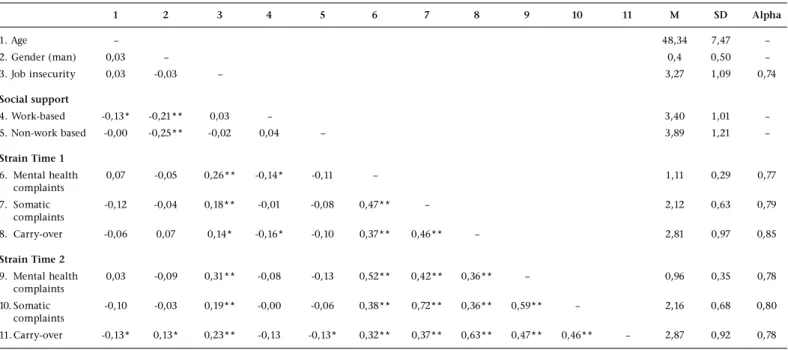
Table 1 displays means, standard deviations, and inter-correlations between the study variables, as well as the reliabilities of the scales used. The reliability coefficients ranged between 0,74 and 0,85, which was deemed satisfactory.
Job insecurity was assessed at Time 1 with a three-item scale developed by Hellgren et al. (1999). A sample item is “I am worried about having to leave my job before I would like to”. The responses were given on a five-point scale where 1 represented strongly disagree and 5 represented strongly agree.
The two types of support were measured at Time 1 with one item each, both developed for the purposes of the
present study. Work-based support was assessed by “Do you usually get support in your work when you encounter problems?” and non-work based support by “Is there anyone outside your work with whom you can talk when you are troubled with difficulties and problems at your
work?” The responses to both support items were given on a five point scale where 1 represented almost never and 5 represented almost always.
The three strain outcomes (mental health complaints, somatic complaints, and carry-over effects) were measured using the same scales at both measurement points. Mental health complaints were measured by the 12-item General Health Questionnaire (GHQ; Goldberg, 1972). Each item inquires about the presence of a negative symptom in the recent weeks (e.g., “Difficulty sleeping due to worry”) with the response alternatives ranging between 0 (never) and 3 (always). Somatic complaints were assessed by 10 items asking how often during the past 12 months the respondents had experienced symptoms like headaches, muscle tension etc. The items, based on Andersson (1986), were scored on a five-point scale ranging from 1 (never) to 5 (always or almost always). Carry-over was measured by four items such as “When the workday is over, I often continue worrying about job related problems” (Hovmark, Frisk Wollberg & Nordqvist, 1996). Responses were obtained on a five-point response scale (1 = strongly disagree, 5 = strongly agree).
Statistical analysis
To test for the relative importance of main and interactive effects of job insecurity and the two types of social support on the outcomes, three hierarchical multiple regression analyses were performed, one for each outcome. Multiple regression analysis is a useful tool in investigating the relative impact of several predictors on outcomes, both when analysing cross-sectional and longit udinal data (Cohen, Cohen, West & Aiken, 2003). Job insecurity and the two social support variables (work-based and non-work based) were entered in the first hierarchical step in order to study the unique contribution of these main effects on strain. Age and gender (0=woman, 1=man), which served as control variables, were also entered in this step. The interaction terms of job insecurity with each of the two support variables were then entered in the second step to test for the potential moderating effect of social support on the relation between job insecurity and the outcomes. The interaction terms were created according to the procedure described by Aiken and West
TABLE1
INTERCORRELATIONS, MEANS, STANDARD DEVIATIONS ANDALPHA COEFFICIENTS FOR STUDY VARIABLES
1 2 3 4 5 6 7 8 9 10 11 M SD Alpha
1. Age – 48,34 7,47 –
2. Gender (man) 0,03 – 0,4 0,50 –
3. Job insecurity 0,03 -0,03 – 3,27 1,09 0,74
Social support
4. Work-based -0,13* -0,21** 0,03 – 3,40 1,01 –
5. Non-work based -0,00 -0,25** -0,02 0,04 – 3,89 1,21 –
Strain Time 1
6. Mental health 0,07 -0,05 0,26** -0,14* -0,11 – 1,11 0,29 0,77
complaints
7. Somatic -0,12 -0,04 0,18** -0,01 -0,08 0,47** – 2,12 0,63 0,79
complaints
8. Carry-over -0,06 0,07 0,14* -0,16* -0,10 0,37** 0,46** – 2,81 0,97 0,85
Strain Time 2
9. Mental health 0,03 -0,09 0,31** -0,08 -0,13 0,52** 0,42** 0,36** – 0,96 0,35 0,78
complaints
10. Somatic -0,10 -0,03 0,19** -0,00 -0,06 0,38** 0,72** 0,36** 0,59** – 2,16 0,68 0,80
complaints
11. Carry-over -0,13* 0,13* 0,23** -0,13 -0,13* 0,32** 0,37** 0,63** 0,47** 0,46** – 2,87 0,92 0,78
n = 236
(1991), where the predictors are first centred (the mean is set to zero, and the standard deviations are kept intact), and then multiplied to form the interaction terms. An increase in the variance explained between step 1 and 2 of 1 percent or more, along with a significant regression coefficient for the individual interaction term, indicates the presence of an interaction effect. Finally, in order not to overestimate the effects of job insecurity, social support, or the moderating effect of social support, Time 1 levels of the outcome variables were entered in the last step.
RESULTS
The results of the regression analyses are displayed in Table 2.
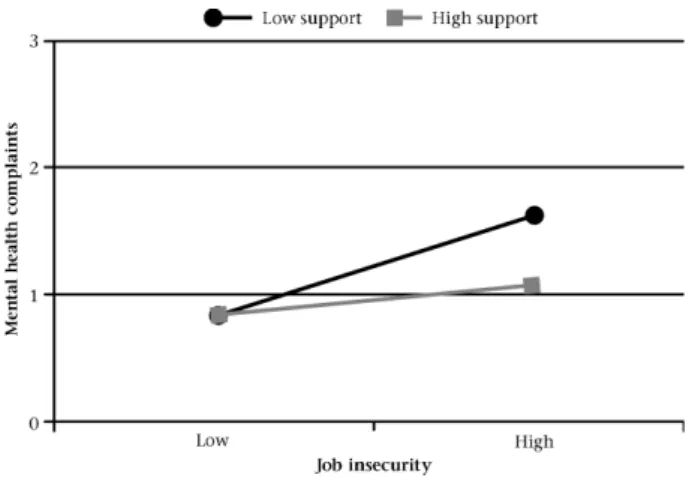
Mental health complaints. In the first step of the analysis, where demographics, job insecurity, and the two social support factors were entered, job insecurity predicted mental health complaints, whereas gender and non-work based support were negatively related to the criterion (DR2=0,12). When the interaction terms were entered in the second step, the variance explained increased (DR2 =0,01), indicating the presence of a significant interaction effect. Follow-up analyses of the interaction effect showed that those experiencing high job insecurity in combination with high non-work based support at Time 1 reported fewer mental health complaints at Time 2 compared to those reporting low levels of support in combination with high levels of job insecurity (see Figure 1). In the third step, the baseline level of mental health complaints contributed substantially to the variance explained (DR2 =0,20), and the main effects of gender and non-work based support were no longer significant. Still, the main effect of job insecurity and the interaction effect between job insecurity and non-work based support remained significant, thus indicating that they are predictive of subsequent mental health complaints.
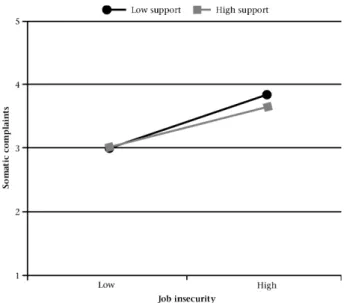
Somatic complaints. In Step 1, when demographics, job insecurity and social support were entered, there was a main effect of job insecurity on somatic complaints, but there was no main effect of either type of social support (DR2=0,03). In step 2, when the interaction terms were entered, the variance explained increased (DR2 =0,01), indicating the presence of a
significant interaction effect. Figure 2 depicts the interaction effect, which indicated that those who reported high levels of non-work based support and high job insecurity at Time 1 reported fewer somatic complaints at Time 2 than those experiencing low levels of support at the same high levels of job insecurity. There was no difference between those reporting high or low support when job insecurity levels were low. In the last step, when initial levels of somatic complaints were entered, the variance explained increased sharply (DR2=0,48), and the main effect of job insecurity, as well as the interaction effect between job insecurity and non-work based support remained significant.
Figure 1: Interaction between job insecurity and work-based support on mental health complaints
Carry-over effects. Carry-over effects were predicted by age, job insecurity, and low work-based support in Step 1 (DR2=0,10). When the interaction terms were entered in the second step, age, job insecurity, and work-based social support were still related to carry-over, and the variance explained increased (DR2 =0,02), indicating the presence of an interaction effect. On closer examination, work-based support moderated the relation between job insecurity and carry-over effects. As shown in Figure 3, when job insecurity was high those with low support reported more carry-over effects than those experiencing high
TABLE2
HIERARCHICAL REGRESSION ANALYSES OF MAIN AND INTERACTION EFFECTS OF JOB INSECURITY AND SUPPORT,
WITH TIME1 LEVELS TAKEN INTO ACCOUNT: STANDARDISED REGRESSION COEFFICIENTS(b)
Mental health complaints Somatic complaints Carry-over effects
1 2 3 1 2 3 1 2 3
Step 1
Age ,01 ,02 ,00 -,11 -,10 -,01 -,16* -,15* -,11
Gender (man) -,15* -,16* -,11 -,05 -,05 -,01 ,09 ,09 ,08
Job insecurity (JIS) ,31** ,30** ,19** ,19** ,18** ,06 ,24** ,23** ,14**
Work-based support (WS) -,12 -,10 ,02 -,03 ,02 ,02 -,13* -,15* -,04
Non-work based support (NWS) -,15* -,16* -,10 -,07 -,06 -,02 -,10 -,08 -,04
Step 2
JIS * WS -,02 ,04 -,04 ,08 -,17** -,04
JIS * NWS -,15* -,16** -,12* -,10* -,02 -,02
Step 3
Time 1 levels ,46** ,72** ,58**
R2adjusted 0,12** 0,13** 0,33** 0,03* 0,04* 0,52** 0,10** 0,12** 0,42**
DR2 0,12** 0,01* 0,20* 0,03* 0,01* 0,48** 0,10** 0,02** 0,30**
n = 236
support. In step 3, when the initial levels of carry-over were added to the equation, the proportion of explained variance increased (DR2 =0,31), whereas job insecurity was still related to carry-over effects. However, the impact of age and the interaction effect between job insecurity and work-based support were no longer significant.
Figure 2: Interaction between job insecurity and non-work based support on somatic complaints
Figure 3: Interaction between job insecurity and work-based support on carry-over effects
DISCUSSION
The present study tested the main and interaction effects of job insecurity and two types of social support (work-based and non-work based) on three different strains (mental health complaints, somatic complaints, and carry-over effects). Job insecurity was defined as a work stressor, and it was expected to be associated with subsequent strain when demographics, Time 1 levels of the strain, and perceptions of social support were taken into account. In accordance with previous research (Ashford et al., 1989; Hellgren et al., 1999; Sverke et al., 2002), job insecurity was associated with more frequent mental health complaints as well as stronger carry-over effects, supporting Hypothesis 1. However, contrary to expectations, job insecurit y was not associated with subsequent somatic complaints when Time 1 levels of the
outcome were controlled for. Albeit contrary to expectations, the latter finding is partly consistent with previous research indicating that job insecurity is more strongly related to mental health complaints than to somatic complaints, and the fact that some studies even fail to find a relation between job insecurity and somatic complaints (Sverke et al., 2002). Hypothesis 1 also stated that a main effect of social support on strain could be expected, however, the results failed to identif y any main effect of either type of social support on subsequent strain. This is contrary to several previous studies, which have documented the beneficial effects of social support on indicators of health and well-being (e.g., Jackson, 1992; Viwesvaran et al., 1999).
Even if we did not receive support for the expectation of the main effects of social support, Hypothesis 2, which stated that social support would act as a buffer between job insecurit y and the negative outcomes, received partial support. Following previous research (Billings & Moos, 1982), social support was categorised as either work-based or non-work based. The results indicated that there were significant moderating effects of non-work based social support on mental health complaints and somatic complaints, when demographics, job insecurity perceptions, and Time 1 levels of the outcomes were controlled for. The difference between high or low support was most clearly visible at high levels of job insecurity, where those with higher levels of non-work based support reported fewer mental health complaints, and fewer somatic complaints. These results are in line with research conducted by Jackson (1992), whose findings pointed to a buffering effect of family support on the relation between stressors and several different types of strain. However, there was no moderating effect of non-work based support on the relation between job insecurity and carry-over effects.
In contrast to the non-work based support, work-based support was not found to act as a consistent buffer against the negative effects of job insecurity. Support obtained at work failed to moderate the effects of job insecurity on mental and somatic complaints. However, the results showed that work-based social support moderated the impact of job insecurit y on carry-over effects before Time 1 levels of carry-over were entered into the analysis. This moderating effect indicated that those experiencing high job insecurity in combination with lower levels of work-based support reported higher levels of carry-over effects, i.e., that their job affected their life outside work negatively. This result indicates that work-based support may have an alleviating effect for persons experiencing higher levels of job insecurity, which is consistent with previous research (Lim, 1997). However, it shall be recalled that the interaction effect was no longer significant when Time 1 levels of carry-over were taken into account, thus suggesting that the potential buffering effect of work-based support may be overestimated in research that does not control for prior levels of strain.
Glazer, Gudanowski, & Nair, 2003; Fenlason & Beehr, 1994). This implies that if work is the origin of the stressor, work-based support may actually increase the strain related to the stressor. However, neither the results of the present study, nor those found by Beehr et al. (2003), are consistent with this explanation. Rather, it appears that sources of support that are not congruent with the source of the stressor are more effective in alleviating strain related to this stressor, given the fact that the present study found non-work based support to have more buffering effects on strain outcomes of job insecurity, a typical work-related stressor.
Methodological considerations
While the present study made a distinction between different sources of support (work-based vs. non-work based), it did not take different types of support into account, that is, there was no distinction between what needs the different sources of support satisfied. It has been suggested that social support may serve different purposes, such as emotional, instrumental, or informative (Fenlason & Beehr, 1994; House, 1982). It is possible that such a distinction between different types of support may supply a more detailed and accurate view of the social support that may be provided at the workplace as well as outside of work. A related limitation concerns the measures of support used in the present study. It is conceivable that the single-item measures were not capable of making a full account of the support provided at work as well as by other persons. Despite research stating that single-item measures may be satisfactory (see Wanous, Reichers, & Hudy, 1997 for a meta-analysis on single-item and multiple item measures of job satisfaction), the reliability of single-items is unknown (Gorsuch, 1997) and single-item measures may contribute to an underestimation of effect sizes (Sverke et al., 2002). Nevertheless, at present only single item measures were available for the analyses, and the results may still be taken as an indication of the relation bet ween social support and strain outcomes, as well as of the moderating effect of social support. Measures capt uring a broader conceptualisation of both work-based and non-work based support, and using multiple item scales, would prove useful for future research.
The magnitude of the impact of the interaction terms on the outcome variables may appear small since they only contributed small portions to the total variance explained. The test for interaction effects may be considered somewhat conservative, since the magnit ude of interaction effect represents variance explained in addition to that explained by the main effects, and is usually quite low (Cohen et al., 2003; Pierce, Gardner, Dunham, & Cummings, 1993). However, it has also been argued that even small interaction effects are important, as they indicate the presence of a moderating effect (Lim, 1997), and explain additional variance. Following Lim (1997), the present study utilised the criterion of a one percent increase in the total variance explained, as the interaction terms were entered into the analysis. Despite the rather conservative tests conducted, the results may be considered a dependable indication of the effect of non-work based social support on the relation between job insecurity and somatic and mental health complaints, even after initial levels of strain were taken into account.
The data utilised in this study were collected among Swedish retail employees at t wo time points using self-report questionnaires. The use of questionnaire data to collect information on all variables under study may introduce a common method bias (e.g., Campbell & Fiske, 1959). There is some support in previous research, however, that job insecurity is related to objective measures of physiological indicators of health (e.g., Mattiasson, Lindgärde, Nilsson, & Theorell, 1990), suggesting that the relations obtained are not only due to common method variance. Also, the replication of the study in a different sample would provide additional
information regarding the applicability of the results to a broader population.
CONCLUSION
The use of longitudinal data provides the opportunity to investigate temporal precedence of job insecurity to strain outcomes. The hypotheses that job insecurity as well as the interaction bet ween job insecurit y and non-work based support predicted subsequent strain were sustained. Even if causalit y cannot be proven, our results are consistent with previous research showing it to be plausible to assume that job insecurit y is related to subsequent negative reactions, rather than the other way around (Heaney et al., 1994; Hellgren, et al., 1999; Hellgren & Sverke, 2003). Like many other research studies, the results found in the present study are in need of replication in other contexts all the same, and with utilisation of different types of measures of the outcomes (e.g., objective health indicators). The longitudinal design, however, adds strength to the conclusion that job insecurity gives rise to subsequent strain symptoms, and that social support may alleviate strain reactions to job insecurity.
Our results add to previous research that has found that job insecurit y is related to negative outcomes. Even more importantly, the results sustain suggestions in the present study and previous research (e.g., LaRocco et al., 1980; Viswesvaran et al., 1999) that social support, at least non-work based support, may act as a moderator of the relation between stressors and strain, and specifically the relation between job insecurity and its health-related outcomes. This finding was evident even after initial levels of the health outcomes had been taken into account, and is in line with previous research on job insecurity (e.g., Kinnunen & Nätti, 1994; Lim, 1997). This has encouraging implications for intervention programs aimed at alleviating negative effects of work stressors, but also for the prevention of these negative consequences. It is possible that social support may be manipulated in intervention programs. The manipulation of non-work based support may prove more difficult, but research has shown that employees can be taught to utilise their existing social networks more efficiently, so as to benefit from the potential alleviating effects (e.g., Heaney et al., 1995), which applies to non-work based support as well as work-based. Teaching individuals the importance of utilising this coping resource appears to be an important strategy for intervention programs.
The results have interesting theoretical implications as well. Social support has been suggested as a coping resource, and functions so as to reduce individuals’ perceptions of stressors (Lazarus & Folkman, 1984). Social support helps individuals cope with perceived demands, for example threats of job loss, and may make the demands seem less difficult to face up to. However, the result of the present study also allow for the interpretation that the utilisation of social support actually constitutes a coping strategy, which implies that social support is a more central part of coping than previously discussed, and that the individual can be an active agent in seeking out this support rather than a passive receiver of support from others. The conceptualisation of social support as a coping strategy rather than a resource constitutes an additional theoretical rationale for the importance of teaching individuals to utilise their existing support networks more efficiently, and proposes an area of research where social support and coping are studied simultaneously.
(e.g., Ashford, 1988; Dekker & Schaufeli, 1995; Kaufmann & Beehr, 1986). The present findings indeed sustain the argument that the negative outcomes associated with job insecurity, one important work stressor, may be alleviated by social support.
AUTHOR’S NOTE
Acknowledgement: The research reported here was conducted within the framework of a project financed by the National Institute of Working Life, through the Joint Programme for Working Life Research in Europe (SALTSA) and Alecta. The data were collected with the financial support from the Swedish Council for Work Life Research, the KF Group, the Salaried Employees’ Union, and the Cooperative Employees’ Association.
REFERENCES
Aiken, L. S. & West, S. G. (1991).Multiple regression: Testing and interpreting interactions. Newbury Park, CA: Sage Publications.
Andersson, K. (1986). Utveckling och prövning av ett frågeformulärsystem rörande arbetsmiljö och hälsotillstånd [Development and test of a questionnaire concerning work
environment and health] (Rapport 2). Örebro:
Yrkesmedicinska kliniken.
Armstrong-Stassen, M. (1993). Production workers reactions to a plant closing: The role of transfer, stress and support. Anxiety, Stress and Coping: An International Journal, 6, 201-214.
Ashford, S. J. (1988). Individual strategies for coping with stress during organizational transitions. Journal of Applied Behavioral Science, 24, 19-36.
Ashford, S. J., Lee, C. & Bobko, P. (1989). Content, cause, and consequences of job insecurity: A theory-based measure and substantive test. Academy of Management Journal, 32, 803-829.
Barling, J. & Kelloway, E. K. (1996). Job insecurity and health: The moderating role of workplace control. Stress Medicine, 12, 253-259.
Beehr, T. A., Farmer, S. J., Glazer, S., Gudanowski, D. M. & Nair, V. N. (2003). The enigma of social support and occupational stress: Source congruence and gender role effets. Journal of Occupational Health Behavior, 8, 220-231.
Billings, A. G. & Moos, R. F. (1981). Work stress and the stress-buffering roles of work and family resources. Journal of Occupational Behaviour, 3, 215-232.
Campbell, D. T. & Fiske, D. W. (1959). Convergent and discriminant validation by the multitrait-multimetod matrix. Psychological Bulletin, 56, 81-105.
Cohen, J., Cohen, P., West, S. G. & Aiken, L. S. (2003). Applied multiple regression/correlation analysis for the behavioral sciences. Mahwah, NJ: Lawrence Erlbaum Associates, Inc. Davy, J. A., Kinicki, A. J. & Scheck, C. L. (1997). A test of
job security’s direct and mediated effects on with-drawal cognitions. Journal of Organizational Behavior, 18, 323-349.
De Witte, H. (1999). Job insecurity and psychological well-being: Review of the literature and exploration of some unresolved issues. European Journal of Work and Organizational Psychology, 8, 155-177.
Dekker, S. W. A. & Schaufeli, W. B. (1995). The effects of job insecurity on psychological health and withdrawal: A longitudinal study. Australian Psychologist, 30, 57-63. Fenlason, K. J. & Beehr, T. A. (1994). Social support and
occupational stress: Effects of talking to others. Journal of Organizational Behavior, 15, 157-175.
Ferrie, J. E., Shipley, M. J., Marmot, M. G., Stansfeld, S. A. & Smith, G. D. (1998). An uncertain future: The health effects
of threats to employment security in white-collar men and women. American Journal of Public Health, 88, 1030-1036. Frese, M. (1999). Social support as a moderator of the
relationship between work stressors and psychological dysfunctioning: A longitudinal study with objective measures. Journal of Occupational Health Psychology, 4, 179-192.
Fried, Y. & Tiegs, R. B. (1993). The main effect model versus buffering model of shop steward social support: A study of rank-and-file auto workers in the USA. Journal of Organizational Behavior, 14, 481-493.
Goldberg, D. (1972). The detection of psychiatric illness by questionnaire. London: Oxford University Press.
Gorsuch, R. L. (1997). Explanatory factor analysis: Its role in item analysis.Journal of Personality Assessment, 68, 532-560. Greenhalgh, L. & Rosenblatt, Z. (1984). Job insecurity:
Toward conceptual clarity. Academy of Management Review, 9, 438-448.
Heaney, C. A., Israel, B. A. & House, J. S. (1994). Chronic job insecurity among automobile workers: Effects on job satisfaction and health. Social Science and Medicine, 38, 1431-1437.
Heaney, C. A., Price, R. H. & Rafferty, J. (1995). Increasing coping resources at work: A field experiment to increase social support, improve work team functioning, and enhance employee mental health. Journal of Organizational Behavior, 16, 335-352.
Hellgren, J. & Sverke, M. (2003). Does job insecurity lead to impaired well-being or vice versa? Estimation of cross-lagged effects using latent variable modeling. Journal of Organizational Behavior, 24, 215-236.
Hellgren, J., Sverke, M. & Isaksson, K. (1999). A two-dimensional approach to job insecurity: Consequences for employee attidtudes and well-being. European Journal of Work and Organizational Psychology, 8, 179-195.
House, J. S. (1981). Work stress and social support. Reading, MA: Addison-Wesley.
Hovmark, S., Frisk Wollberg, E. & Nordqvist, S. (1996). A longitudinal study of health complaints in professional computer work: Effects of computer-aided design. International Journal of Human-Computer Interaction, 4, 401-420.
Jackson, P. B. (1992). Specifying the buffering hypothesis: Support, strain, and depression. Social Psychology Quarterly, 55, 363-378.
Kaufmann, G. M. & Beehr, T. A. (1986). Interactions between job stressors and social support: Some counterintuitive results. Journal of Applied Psychology, 71, 522-526.
Kinnunen, U. & Natti, J. (1994). Job insecurity in Finland: Antecedents and consequences. The European work and organizational psychologist, 4, 297-321.
LaRocco, J. M., House, J. S. & French, J. R. P. (1980). Social support, occupational stress, and health. Journal of Health and Social Behavior, 21, 202-218.
Lazarus, R. S. & Folkman, S. (1984). Stress, appraisal, and coping. New York: Springer Publishing Company, Inc.
Lim, V. K. G. (1996). Job insecurity and its ocutcomes: Moderating effects of work-based and nonwork-based social support. Human Relations, 49, 171-194.
Lim, V. K. G. (1997). Moderating effects of work-based support on the relationship between job insecurity and its consequences. Work & Stress, 11, 251-266.
Mattiasson, I., Lindgärde, F., Nilsson, J. A. & Theorell, T. (1990). Threat of unemployment and cardiovascular risk factors: Longitudinal study of quality of sleep and serum cholesterol concentration in men threatened with redundancy. British Journal of Medicine, 301, 461-466.
Näswall, K. (2004). Job insecurity from a stress perspective: Antecedents, consequences, and moderators. Doctoral thesis, Department of Psychology, Stockholm University.
Näswall, K., Sverke, M. & Hellgren, J. (2005). The moderating role of personality characteristics on the relation between job insecurity and strain. Work & Stress, 19, 37-49.
OECD. (1997). Is job insecurity on the increase in OECD countries?, OECD Employment Outlook July (pp. 129-153). Paris: Office for Economic Cooperation and Development. Pierce, J. L., Gardner, D. G., Dunham, R. B. & Cummings, L. L.
(1993). Moderation by organization-based self-esteem of role condition-employee response relationships. Academy of Management Journal, 36, 271-288.
Quick, J. C., Quick, J. D., Nelson, D. L. & Hurrell, J. J. (Eds.). (1997). Preventive Stress Management in Organizations. Washington, DC: American Psychological Association.
Scheck, C. L., Kinicki, A. J. & Davy, J. A. (1997). Testing the mediating processes between work stressors and subjective well-being. Journal of Vocational Behavior, 50, 96-123. Sverke, M. & Hellgren, J. (2002). The nature of job insecurity:
Understanding employment uncertainty on the brink of a new millennium. Applied Psychology: An International Review, 51, 23-42.
Sverke, M., Hellgren, J. & Näswall, K. (2002). No security: A meta-analysis and review of job insecurity and its consequences. Journal of Occupational Health Psychology, 7, 242-264. Wanous, J.P., Reichers, A.E. & Hudy, M.J. (1997). Overall job
satisfaction: How good are single-item measures? Journal of Applied Psychology, 82, 247-252.