Volume 1, Issue 1, 2019
ISSN: 2688-7061 (Online)
16
Relationship between Analytical Thinking Skill and Scientific
Argumentation Using PBL with Interactive CK 12 Simulation
Riki Perdana
Yogyakarta State University, Indonesia, [email protected]
Jumadi Jumadi
Yogyakarta State University, Indonesia
Dadan Rosana
Yogyakarta State University, Indonesia
Abstract: This study was conducted in order to analyze the relation between analytical thinking skill and
scientific argumentation in physics learning. The study was conducted with the interactive CK 12 simulation about optics. The sample of the study consists of 28 randomly selected students in Yogyakarta, Indonesia. The data was collected using pre and post-test after learning in the class. Data was analyzed with descriptive statistic instruments along with t-test, MANOVA test and Correlation Analysis. Research findings show that analytical thinking skill and scientific argumentation of the students are rather low. Problem based learning with web based simulation can enhance student’s scientific argumentation and analytical thinking skill. Also, the correlation analysis conducted to determine the relationship between analyses analytical thinking skill and scientific argumentation. The results indicate that there is a statistical significant relationship between the analytical thinking skill and scientific argumentation.Keywords: Analytical thinking, Scientific argumentation
Introduction
The thinking ability of students in Indonesia is still in the low category. Based on the results of the 2012 PISA survey Indonesian students were only in 64 positions from 65 countries in terms of mathematical and scientific abilities (OECD, 2012). Results that were not much different in 2015, Indonesian students were in 60th position from 74 countries (OECD, 2015). These results indicate that the ability of Indonesian students in the field of mathematics and science is currently lacking.
There are several factors that cause student achievements are still low. Haiti conducted a meta-analysis to find out the biggest causes that affect student achievement. From the findings, it can be concluded that the biggest factor that influences student achievement is the teacher's ability with effect size 1.62 (Haiti, 2017). But at this time many found that the ability of teachers in Indonesia to manage classes was not good. Even, Perdana, Sutrisno and Mahmuda (2016) found that all teachers who were participants experienced misconceptions and were didaktogenic in understanding physics. Based on interviews with several physics teachers, it was found that the application of technology in learning is still rarely applied.
Using technology in learning has given positive impact for the students and teachers.. The students’ conceptual understanding as well as interest was increased, the c ollege mentors earned valuable teaching and mentoring experience and the teacher enjoyed more one-on-one time as well as assistance with students when study using online physics lab (Gryczka, Klementowicz, Sharrock, & Montclare, 2016). Using technology such videos is very useful for establishing concepts, understanding course content and increasing general knowledge in physics learning (Chen, Wei, & Li2016). Beside that, learning with game environment can increase student’s motivation and willingness to learn (Borrego, Fernández, Blanes, & Robles, 2017). Technology in learning can be effective in supporting student inquiry learning ( Williams, Nguyen, & Mangan, 2017). So, using technology in this era must be done by all the school.
Century Skills can be fostered (Sourmelis, Ioannou, & Zaphiris, 2017). But, although teachers see the impact of technology for teaching and learning, they require more guidance on what constitutes 21st-century skills and how to effectively integrate technology (O'Neal, Gibson, & Cotten, 2017). In this paper, we only discussed about two 21st-century skills, there are scientific argumentation and analytical thinking skill student after study using physics on line learning.
To support applying technology in 21st century learning, there are several learning model that can be used effectively such as PjBl, PBL, and Inquiry Learning Model. Project-Based Learning (PjBL) is an innovative approach to learning that teaches a multitude of strategies critical for success in the twenty-first century (Bell, 2010). Learning in the online PBL had a significant effect on increasing the critical thinking skills whereas this is one of the 21st-century skills. Inquiry-based learning activities using social network and cloud computing is appropriate for application to real practice and helps student to develop the knowledge and skills that they will require to achieve success in the information age (Thaiposri & Wannapiroon, 2015). In this paper, we use problem based learning using online simulation to increase student ability in scientific argumentation and analytical thinking skill. The relationship between these skills was discussed.
Literature Review
Analytical Thinking Skill
Analytical thinking skill was very necessary to be used in working as well as daily life in the 21st century by students (Paziotopoulos & Kroll, 2004). Analytical thinking involves a further element of inquiry and situations with less well-defined parameters and outcomes and its necessary when an ambiguous situation requires the learner to identify or create a problem to solve (Robbins, 2011). It is a part of the problem solving process, considered essential for providing the skills required to prepare children for a more complex life and work environment in 21st century (Thaneerananon, Triampo, & Nokkaew, 2016). Analytical thinking involves abilities to (1) take apart a problem and understand its parts, (2) explain the functioning of a system, the reasons why something happens, or the procedures of solving a problem, (3) compare and contrast two or more things, or (4) evaluate and critique the characteristics of something (Sternberg, 2006).
Scientific Argumentation
One important practice that helps shape the nature of scientific knowledge, is argumentation (Sampson, & Blanchard, 2012). Students’ poor argumentation has become a concern in science education (Acar, Turkmen, & Roychoudhury, 2010). So as a learning goal, argumentation is viewed as an essential scientific practice (Mc Neill, & Knight, 2013). Research on students’ scientific argumentation has thus shifted in focus from identifying and teaching decontextualized skills of argument that students ‘‘lack,’’ to exploring the contexts in which students do and do not engage in argumentation (Berland, & Hammer, 2012). The quality of scientific argumentation is given in Table 1.
Table 1. Quality of Scientific Argumentation (Erduran, Simon, & Osborne, 2004) Quality Characteristic of argumentation
Level 1 Argumentation consists of arguments that are a simple claim versus a counter-claim or a claim versus a claim
Level 2 Argumentation has arguments consisting of a claim versus a claim with either data, warrants or backings but do not contain any rebuttals
Level 3 Argumentation has arguments with a series of claims or counter-claims with either data, warrants or backings with the occasional weak rebuttal
Level 4 Argumentation shows arguments with a claim with a clearly identifiable rebuttal. Such an argument may have several claims and counter-claims Level 5 Argumentation displays an extended argument with more than one rebuttal
Toulmin (1958) specify the components in scientific argumentation from data to a conclusion or knowledge claim. The main components identified are:
Data: these are the facts that those involved in the argument appeal to in support of their claim. Claim: this is the conclusion whose merits are to be established.
Backing: these are basic assumptions, usually taken to be commonly agreed that provide the justification for particular warrants.
Qualifiers: these specify the conditions under which the claim can be taken as true; they represent limitations on the claim.
Rebuttals: these specify the conditions when the claim will not be true.
Problem Based Learning
Problem based learning is an instructional (and curricular) learner-centered approach that empowers learners to conduct research, integrate theory and practice and apply knowledge and skills to develop a viable solution to define problem (Savery, 2015). PBL is a pedagogical approach that enables students to learn while engaging actively with meaningful problems (Yew & Goh, 2016). It is a student-centered approach in which problems are the stimulus for learning and it is characterized by: (1) learning through problems, (2) small group sessions, (3) group learning facilitated by a teacher, and (4) learning through self-study (Hmelo-Silver, 2004). PBL has several common characteristic such as real world situations, collaborative work, co-constructed solutions, multiple outcomes, and digital tools vary (Barber, King, & Buchanan, 2015).
Web Based Simulations and CK 12 Simulations
A web based simulation system make the educational process more interactive, which in turn will make the student gain knowledge and experience (Gunawan, Fiarni, & Lawalata, 2015). Web-based simulation is highly acceptable to students and appears to provide learning benefits that align with other simulation approaches (Cant & Cooper, 2017). In this study, the web site used is at https://interactives.ck12.org/simulations/physics.html. The web site provides many simulations about physics and in this research we choose about optics.
Methodology
Sample of Research
This study was conducted with a senior high school students studying in Yogyakarta City, Indonesia. Of the participants, 28 students were all aged from 14-16. The class grade is XI MIA 4. For this study, which was designed with simple random sampling was preferred in determining the samples in order to increase generalizability and to ensure an equal chance of being selected (Buyukozturk, Cakmak, Kilic, Ozcan, Karadeniz, & Demirel, 2010).
Instrument and Procedure
The process of collecting data began with a pretest to the students. The question is about concept eyes and glasses base on the aspects of scientific argumentation and analytical thinking skill. After give the pretest, then students were studying using PBL with web simulation in two times, each time was 90 minutes. After studying, they were given posttest. The question of pre and posttest are same, so it can be seen the difference in results after being given the learning by PBL with web simulation. Data was analyzed with descriptive statistic instruments along with t-test, MANOVA test and Correlation Analysis.
Result
Reliability of the scales were examined; Cronbach Alpha Coefficient of the test was α = 0. 742. These results show that the scale can be accepted as being reliable assessment instruments. The level of scientific argumentation students is shown in Table 2.
Table 2. Scientific Argumentation Skill
Nearsightedness Farsightedness Power of Lens (Farsightedness)
Power of Lens Nearsightedness
Eye
Accommodation
Level 1 28 44 16 28 60
Level 2 44 32 64 40 24
Level 3 28 24 8 8 16
Level 4 0 0 0 0 0
Level 5 0 0 0 0 0
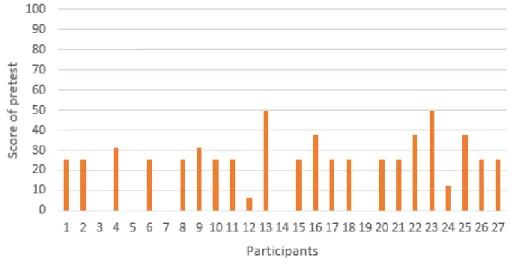
According to Table 2, most participant scientific argumentation skill is in optics. This shows that the students had low level or quality about this scientific argumentation skill. Data indicates that there are no students in level 4 and 5, so all the students only in level 1, 2 and 3 about scientific argumentation in topics eyes and glasses. Data on the average score of pretest and posttest scientific argumentation and analytical thinking skill are shown in Figure 1.
Figure 1. Analytical Thinking Skill
When these data are examined, it is evident that the most of participants (100%) have score below 60.These findings suggest that student achievement was also not good. T-test was conducted in order to determine whether or not using PBL with web based simulations addiction score posttest of analytical thinking skill in Table 3.
Table 3. t-test Analytical Thinking Skill
Model Mean t df Sig (2-tailed)
Pretest-posttest -23.148 -7.089 26 <.001
According to Table 3, there is statistically significant difference pretest and posttest score with PBL using web based simulation (p=0.000<0.05). The score of posttest are higher than pretest. Similarly, the test result, which was conducted to determine whether or not PBL with web based simulations addiction score posttest of scientific argumentation skill were statistically significant (p=0.000<0.05) are shown in Table 4. The descriptive statistics of the average score the participants from scientific argumentation skills are show in Table 5.
Table 4. t-test Scientific Argumentation Skill
Model Mean t df Sig (2-tailed)
Pretest-posttest -33.519 -11.985 26 <.001
Table 5. Average Score Gained from the Scientific Argumentation Variable
Model Mean N Std Deviation Std. Error Mean
Pretest 12.96 27 6.830 1.314
Posttest 46.48 27 13.288 2.557
Table 6. Average Score Gained from the Analytical Thinking Skill Variable
Model Mean N Std Deviation Std. Error Mean
Pretest 22.92 27 14.294 2.751
Posttest 46.06 27 19.775 3.806
According to Table 6, the average score of the participants are all below 50. According to the scale, in order to claim using PBL with web based simulation was effective (medium significantly) to increase analytical thinking skills students. A Multivariate Analysis of Variance was conducted in order to determine whether or not there is a significant difference between scientific argumentations level and analytical thinking skill, the results of which are shown in Table 7, Table 8 and Table 9.
Table 7. Levene’s Test of Equality of Error Variances
Model F df1 df2 Sig
Pretest 6.963 2 78 .002
Posttest 4.431 2 78 .015
According to Table 7, there is statistically significant difference between pretest and posttest scores of student achievements (scientific argumentation and analytical thinking). For posttest, using PBL with web based simulation p=0.015<0.05 and pretest with p=0.002<0.05. Table 8 shows the significant difference between pretest and posttest PBL with web based simulation.
Table 8. Multivariate Test
Effect F dF Sig
Intercept Pillai’s Trace 3.366E2a 77.000 <.001
Wilks Lambda 3.366E2a 77.000 <.001
Hotelling’s Trace 3.366E2a 77.000 <.001 Roy’s largest Root 3.366E2a 77.000 <.001
Variable Pillai’s Trace 7.033 156.000 <.001
Wilks Lambda 7.699a 154.000 <.001
Hotelling’s Trace 8.358 152.000 <.001
Roy’s largest Root 17.152b 78.000 <.001
According to Table 8, there is statistically significant difference pretest and posttest score with PBL using web based simulation (p<0.05) about scientific argumentation, analytical thinking and student achievement. Based on the results, the most significant variable are described it shown in Table 9.
Table 9. The Most Significant Variable
Model Variable 1 Variable 2 Mean difference
Pretest Analytical thinking Scientific argumentation 9.95
Posttest
(PBL with web based simulation)
Scientific argumentation
Analytical thinking 0.42
According Table 9, mean difference score of analytical thinking skill to scientific argumentation is 9.95. It shows that pretest of analytical thinking skill is better than scientific argumentation. PBL with web based simulation can effectively to increase student scientific argumentation skill more than analytical thinking skill (Mean difference=0.42). The relationship between scientific argumentation and analytical thinking skills of the participants was examined. Correlation analysis is shown in Table 10. According to Table 10, there is significant relationship between scientific argumentation level and analytical thinking skills (p=0.029<0.05).
Table 10. Relationship between Scientific Argumentation Level and Analytical Thinking Skills
Variable n r p
scientific argumentation level 27
0.421 0.029
analytical thinking skills 27
This study, which aimed at determining the relationship between analytical thinking skill and scientific argumentation level of high school students, was conducted with the pretest and posttest score. One of the most important research findings suggest that scientific argumentation levels of participants that are in the sample are rather low. This finding is in line with other research results which analyze scientific argumentation level. Aydeniz and Ozdilek (2015) showed that majority of participants (teachers) lacked an adequate understanding of science and scientific argumentation. Many of participants that did not provide any genuine support for an explanation when give scientific argumentation (Sampson, & Blanchard, 2012). It can be happen because teacher had difficulty applying the reasoning component of argumentation to classroom practice, and found designing argumentation questions to be challenging (Mc Neill, & Knight, 2013).
Findings show that using PBL with web based simulation is effective to enhance student’s scientific argumentation and analytical thinking skill. This finding is similar with the study results of Wang (2014) Iordanou and Constantinou (2015), Acar and Patton (2016), Akpinar, Ardac, and Amuce (2015), Spires (2015) indicate that web base learning effective to enhance student’s scientific argumentation and analytical thinking skill. The Correlation Analysis conducted to determine relationship between scientific argumentation skill and analytical thinking skill students. Research findings suggest that there is a significant relationship between scientific argumentation skill and analytical thinking skill students. This finding is in line with the study results of Sourmelis, Ioannou, and Zaphiris (2017), Lundström, Hamfelt, and Nilsson (2005) Weng, Lin, and She (2017), Andersson (2016), Van Eemeren, de Glopper, Grootendorst, and Oostdam (2015), Wagemans (2016), Kuhar and Jeznik (2018) indicate that there is a significant relationship between scientific argumentation and analytical thinking skill.
Finally, according to the findings, it can be asserted that the scientific argumentation levels and analytical thinking skill the participants are rather low. To enhance these skills, teachers can use PBL with web based simulations in the classroom. In addition, the relationship between scientific argumentation skill and analytical thinking skill can be found in web based simulation learning environment as 21st century skills.
Recommendations
For the future research, can use others model and web site simulation to enhance 21st century skills and examine the relationship between them.
Acknowledgements
This study was supported by Physics Education, Graduate School Program, Yogyakarta State University.
References
Acar, O., Turkmen, L., & Roychoudhury, A. (2010). Student difficulties in socio‐scientific argumentation and decision‐making research findings: Crossing the borders of two research lines. International Journal of Science Education, 32(9), 1191-1206.
Acar, O., & Patton, B. R. (2016). Examination of learning equity among prospective science teachers who are concrete, formal and postformal reasoners after an argumentation-based inquiry course. Australian Journal of Teacher Education (Online), 41(2), 69.
Akpinar, Y., Ardac, D., & Amuce, N. E. (2015). Computer versus computer and human support in an
argumentation-based science learning environment. Journal of Online Learning Research, 1(2), 137-161. Andersson, E. (2016). Producing and Consuming the Controversial–A Social Media Perspective on Political Conversations in the Social Science Classroom. JSSE-Journal of Social Science Education, 15(1), 6-16. Aydeniz, M., & Ozdilek, Z. (2015). Assessing Pre-Service Science Teachers' Understanding of Scientific
Argumentation: What Do They Know about Argumentation after Four Years of College Science?. Science Education International, 26(2), 217-239.
Barber, W., King, S., & Buchanan, S. (2015). Problem Based Learning and Authentic Assessment in Digital Pedagogy: Embracing the Role of Collaborative Communities. Electronic Journal of e-Learning, 13(2), 59-67.
Berland, L. K., & Hammer, D. (2012). Framing for scientific argumentation. Journal of Research in Science Teaching, 49(1), 68-94.
Borrego, C., Fernández, C., Blanes, I., & Robles, S. (2017). Room escape at class: Escape games activities to facilitate the motivation and learning in computer science. JOTSE, 7(2), 162-171.
Buyukozturk, S., Cakmak, E., Kilic, A., Ozcan, E., Karadeniz, S. & Demirel, F. (2010). Scientific Research Methods. Ankara: Pegem Publications.
Cant, R. P., & Cooper, S. J. (2017). Use of simulation-based learning in undergraduate nurse education: An umbrella systematic review. Nurse Education Today, 49, 63-71.
Chen, B., Wei, L., & Li, H. (2016). Teaching complicated conceptual knowledge with simulation videos in foundational electrical engineering courses. Journal of Technology and Science Education, 6(3). Erduran, S., Simon, S., & Osborne, J. (2004). TAPping into argumentation: Developments in the application of
Toulmin's argument pattern for studying science discourse. Science education, 88(6), 915-933.
Gryczka, P., Klementowicz, E., Sharrock, C., & Montclare, J. K. (2016). Interactive online physics labs increase high school students’ interest. JOTSE, 6(3), 166-187.
Gunawan, A., Fiarni, C., & Lawalata, G. (2015). Business Process Learning System With Real-time Simulation Approach.
Hattie, J. (2017). Hattie’s 2017 Updated List of Factors Insfluencing Student Achievement. Available at: http://www.evidencebasedteaching.org.au/hatties-2017-updated-list/
Hmelo-Silver CE. (2004). Problem-based learning: What and how do students learn? Educ Psychol Rev 16(3):235–266.
Iordanou, K., & Constantinou, C. P. (2015). Supporting use of evidence in argumentation through practice in argumentation and reflection in the context of SOCRATES learning environment. Science Education, 99(2), 282-311.
Kuhar, M., & Jeznik, K. (2018). Effects of Group Discussion Attachment Styles and Facilitation on the Quality of Deliberation. Social Research: Journal of General Social Issues, 27(2), 281-303.
Lundström, J. E., Hamfelt, A., & Nilsson, J. F. (2005). Argumentation as a Metacognitive Skill of Passing Acceptance-A Case Study from a Scientific Dispute.
Mc Neill, K. L., & Knight, A. M. (2013). Teachers’ pedagogical content knowledge of scientific argumentation: The impact of professional development on K–12 teachers. Science Education, 97(6), 936-972.
O'Neal, L. J., Gibson, P., & Cotten, S. R. (2017). Elementary school teachers' beliefs about the role of technology in 21st-century teaching and learning. Computers in the Schools, 34(3), 192-206.
Paziotopoulos, A. and Kroll, M. (2004). Hooked on thinking. Journal of The Reading Teacher. 57 (7), 672-677.
Perdana, R., Sutrisno, L., & Mahmuda, D. (2016). Describing Physics Teachers Didaktogenic Deskripsi about Force and Motion. Jurnal Pendidikan dan Pembelajaran, 5(9).
Qian, M., & Clark, K. R. (2016). Game-based Learning and 21st century skills: A review of recent research. Computers in Human Behavior, 63, 50-58.
Robbins, J. K. (2011). Problem solving, reasoning, and analytical thinking in a classroom environment. The Behavior Analyst Today, 12(1), 41.
Sampson, V., & Blanchard, M. R. (2012). Science teachers and scientific argumentation: Trends in views and practice. Journal of Research in Science Teaching, 49(9), 1122-1148.
Savery, J. R. (2015). Overview of problem-based learning: Definitions and distinctions. Essential readings in problem-based learning: Exploring and extending the legacy of Howard S. Barrows, 9, 5-15.
Sourmelis, T., Ioannou, A., & Zaphiris, P. (2017). Massively Multiplayer Online Role Playing Games (MMORPGs) and the 21st century skills: A comprehensive research review from 2010 to 2016. Computers in Human Behavior, 67, 41-48.
Spires, H. A. (2015). Digital Game‐Based Learning. Journal of Adolescent & Adult Literacy, 59(2), 125-130. Sternberg, R. J. (2006). The rainbow project: Enhancing the SAT through assessments of analytical, practical,
and creative skills. Intelligence, 34, 321–350.
Sundström, M., & Sigrell, A. (2011). The doughnut fallacy as deliberative failure. Cogency: Journal of reasoning and argumentation, 3(1), 147-171.
Thaneerananon, T., Triampo, W., & Nokkaew, A. (2016). Development of a Test to Evaluate Students' Analytical Thinking Based on Fact versus Opinion Differentiation. International Journal of Instruction, 9(2), 123-138.
Thaiposri, P., & Wannapiroon, P. (2015). Enhancing students’ critical thinking skills through teaching and learning by inquiry-based learning activities using social network and cloud computing. Procedia-Social and Behavioral Sciences, 174, 2137-2144.
Van Eemeren, F. H., de Glopper, K., Grootendorst, R., & Oostdam, R. (2015). Student performance in identifying unexpressed premisses and argumentation schemes. In Reasonableness and Effectiveness in Argumentative Discourse (pp. 743-757). Springer, Cham.
Wagemans, J. (2016). Analyzing metaphor in argumentative discourse. Rivista italiana di filosofia del linguaggio, 10(2).
Wang, T. H. (2014). Implementation of W eb‐based argumentation in facilitating elementary school students to learn environmental issues. Journal of Computer Assisted Learning, 30(5), 479-496.
Weng, W. Y., Lin, Y. R., & She, H. C. (2017). Scaffolding for argumentation in hypothetical and theoretical biology concepts. International Journal of Science Education, 39(7), 877-897.
Williams, P. J., Nguyen, N., & Mangan, J. (2017). Using technology to support science inquiry learning. JOTSE, 7(1), 26-57.