ORIGINAL RESEARCH ARTICLE
Strengthening Health Systems to Accelerate Achievement of
Millennium Development Goals 4 and 5: A Case Study of Ketu
South and Keta Municipalities in Ghana.
Farouk Adam Iddrisu
1, Sarita Dhakal
2,3and Eun Woo Nam
2,3*Ghana Health Service, Ketu South District Hospital, Ghana1; Institute of Poverty Alleviation and Development, Yonsei
University, Korea2; Department of Health Administration, Graduate School, Yonsei University, Korea3.
*For Correspondence: E-mail: [email protected]; +82337602413
Abstract
This study aims to determine means of strengthening the health system to accelerate achievement of MDGs 4 and 5 in the Volta Region of Ghana, with a particular emphasis in the Ketu South and Keta municipalities. Secondary data have been used in this study. High maternal and infant mortality is a crucial issue in Ghana. Maternal and infant mortality is high in rural area compared to urban area due to unavailability of the service facilities. A community based health planning and services programs have been established to improve access and quality of health care in Ghana. Our study suggests that health system strengthening with community health care programs improved access to quality health care and resulted in a decrease of maternal and child mortality in Ketu South and Keta Municipalities in Ghana. (Afr J Reprod Health 2015; 19[2]: 101-107).
Keywords: Maternal and infant mortality, MDGs 4 and 5, Ghana
Résumé
Cette étude vise à déterminer les moyens de renforcer le système de santé pour accélérer la réalisation des OMD 4 et 5 dans la région de la Volta au Ghana, avec un accent particulier sur les municipalités Ketu Sud et Keta. Les données secondaires ont été utilisées dans cette étude. La mortalité maternelle et infantile élevée est un problème crucial au Ghana. La mortalité maternelle et infantile est élevée dans les milieux ruraux par rapport aux milieux urbains en raison de l'indisponibilité des installations de service. Des programmes de planification et de services de santé à base communautaire ont été mis en place pour améliorer l'accès et la qualité des soins de santé au Ghana. Notre étude suggère que le renforcement du système de santé avec les programmes de soins de santé communautaires ont amélioré l'accès aux soins de santé de qualité et a entraîné une diminution de la mortalité maternelle et infantile dans Ketu Sud et dans les municipalités de Keta au Ghana. (Afr J Reprod Health 2015; 19[2]: 101-107).
Mots-clés: la mortalité maternelle et infantile, OMD 4 et 5, Ghana
Introduction
Maternal and infant mortality rates are critical indicators of development. Pregnancy-related deaths claim one woman every minute and approximately 536,000 women each year1. Over 99% of maternal deaths occur in developing countries, with nearly half of these taking place in Sub-Saharan Africa2.In recognition of the severity of the problem, international organizations and individual governments have committed to achieving Millennium Development Goal (MDG) 5, which calls for a reduction in national maternal
mortality ratios by three-quarters between 1990 and 20153.
rate stands at 74 deaths per 1,000 live births, as compared to a regional average of 119 and global average of 574.
This study aims to determine means of strengthening the health system to accelerate achievement of MDGs 4 and 5 in the Volta Region of Ghana, with a particular emphasis in the Ketu South and Keta municipalities.
Method
The study was conducted based on secondary data. A wide range of documents related with maternal and child health from national, regional, district and community level health policies are reviewed.
Results
Ketu South and Keta municipalities have a population of 168,894 and 158,968, respectively5,6. HIV/AIDS, CVA, malaria and anemia have been the dominant causes of death in the Ketu South Municipality in the last three years. The picture is slightly different in the Keta Municipality, since HIV/AIDS is not a dominant cause of death, but CVA, Immunosuppression, malaria, septicemia, pneumonia, anemia are the leading causes of the death7,8.
Table 1 illustrates antenatal service indicators for the Ketu South Municipality. Maternal Mortality Ratios (MMR) for 2009 (87.9/100,000), 2010 (29.6/100,000), 2011 (no any maternal death) and 2012 (48.9/100,000) are far below the national average of 350/100,000, the regional average of 480/100,000 and a global average of 210/100,000. The maternal mortality ratios in Keta Municipality for 2010 (74.7/100,000), 2011 (172.9/100,000) and 2012 (118.9/100,000) are compared to national averages of 350/100,000, regional average of 480/100,000 and global average of 210/100,000 (Table 2).
Causes of Maternal Mortality
One frequently used mortality risk classification system divides the specific causes of maternal deaths into direct and indirect causes. Direct causes, estimated to be responsible for 75 to
80% of all maternal deaths, result directly from pregnancy complications9.
A summary of recent data from a range of low- and middle-income countries points to key direct causes of maternal mortality, including hemorrhage (25%), infection/sepsis (15%), eclampsia/high blood pressure (12%), abortion related complications (13%), obstructed and/or prolonged labor (8%) and other (8%)10. Hemorrhaging during or just after delivery is more likely to be fatal for women who were severely anemic before or during pregnancy11. Eclampsia (severe high blood pressure associated with prolonged seizures) in late pregnancy can be fatal to both mother and fetus if not treated rapidly through intravenous medication. Eclampsia reportedly occurs more frequently among adolescents12 and obese women13 than older women and normal weight people.
Indirect causes are responsible for 20 to 25% of all maternal deaths, and include diseases or conditions unassociated with pregnancy (e.g. HIV/AIDS, hepatitis, diabetes, malaria, anemia related to deficiencies of iron, hookworm infection, and vitamin A deficiency) that aggravate, or are aggravated by, the physiologic effects of pregnancy such as changes in body weight, blood volume, hormone balance and immune system function. Although such changes occur and are considered normal, in virtually all pregnancies, they can reduce the body’s reserve capacity to successfully withstand the stresses of certain diseases14.
Most maternal deaths are preventable through adequate emergency obstetric care (EmOC). A useful classification scheme focuses on the logistical and operational causes of the delay(s) experienced in receiving such care.
These causes are categorized into three types: Type 1 involves delays in the decision to seek care made by the pregnant women themselves, their husbands or other family members; Type 2 involves delays in reaching health facilities after this decision is made; and Type 3 involves delays in receiving appropriate care after arrival at the facility15.
Table 1: Reproductive Health Indicators for Ketu South Municipality from 2009 to 2012
*Source: Annual Report (2012) of Ketu Municipal Health Directorate [6-8]
Table 2: Reproductive Health Indicators for Keta Municipality from 2010 to 2012
*Source: Annual Report (2012) of Keta Municipal Health Directorate
[5]
challenges in ensuring women’s access to emergency prenatal care. These include, for example:I. The limited ability of some pregnant women and their family members to recognize pregnancy-related emergencies; II. Culturally-determined gender norms that
impede women’s ability to decide when and where to seek care, without permission from husbands or other family members;
III. Health facilities that are difficult to reach; IV. The absence of vehicles for emergency
transport, and/or a lack of money to pay for emergency transport, medicines and other supplies after reaching a health facility and
V. Weak health systems evidenced by the inadequate staffing, training, equipment, medications or other commodities at many health facilities.
Maternal deaths in the Ketu South Municipality from 2009 to 2012 are recorded and all deaths have been audited. Annual report 2012 of Ketu South Municipal Health Directorate show that in 2009, one death was caused by septicemia shock chorioamnionitis, one by septicemia shock intra-abdominal abscess and another one by cardiac failure, hypertension; in 2010, one death was caused by septic incomplete abortion with septicemia and another one by severe anemia; in 2011, no death was recorded, and in 2012 one death was caused by hemorrhagic shock ruptured ectopic pregnancy and another one by pulmonary embolism. Similarly, according to Annual report 2010, 2011 and 2012 of Keta Municipal Health Directorate, in 2010 one death was by eclampsia, one by acute cardiac arrest to total spinal anesthesia, and several deaths by pre- eclampsia with acute renal failure and labor pneumonia; in 2011, two death was by severe PPH disseminated intravascular coagulation and each one death was
Indicator 2009 2010 2011 2012
Target population 7213 7350 7490 7632
ANC registrants 6166 (85.4%) 6224 (84.6%) 6775 (90.5%) 7072 (92.6%)
Antenatal visits 20848 22639 24697 27425
Total deliveries 3411 (47.2%) 3378 (45.9%) 3602 (48%) 4084 (53%) Livebirths 3339 (46.2%) 3340 (45.4%) 3554 (47.4%) 4022 (52.6%)
Stillbirth 72 (2.1%) 38 (1.1%) 48 (1.3%) 62(1.5%)
Skilleddeliveries 3207 (94.0%) 3226 (95.5%) 3533 (98.1%) 4022 (98.4%)
Infantdeaths 21 (0.6%) 6 (0.1%) 7 (0.1%) 7 (0.1%)
Maternaldeaths 3 1 0 2
MMR 87.9/100,000 29.6/100,000 0 48.9/100,000
Indicator 2010 2011 2012
Target Achieved Skilled deliveries 3650 (56.5%) 4154 (63.2%) 4300 4451 (71.3%) Live births 3556 (97.4%) 4037 (97.2%) 4200 4359 (69.8%)
Stillbirths 94 (2.5%) 117 (2.8%) 0 96 (2.1%)
Fresh still births 33 49 0 44
Macerated still births 61 68 0 52
Caesarian sections 455 (9.3%) 524 (9.9%) 500 727 (16.3%) TBA deliveries 1247 (25.5%) 1104 (20.9%) 600 706 (13.7%)
Maternal deaths 4 10 0 7
Maternal audits 4 10 0 7
due to Hemorrhagic shock caused by ruptured abdominal aortic embolism, cardiopulmonary arrest amniotic fluid embolism, cardiopulmonary arrest high spinal anesthesia and acute left ventricular failure with pulmonary edema, acute renal failure, and in 2012 each one death was by acute cardiac arrest, eclampsia, thromboembolism, acute renal failure, PPH (ruptured uterus), eclampsia with amniotic embolism and irreversible hemorrhagic intravascular coagulation (DIC) 5,6,15-17
.
Progress Toward Achieving MDGs 4 and 5
Low maternal mortality rates in Ketu South and Keta Municipalities from 2010 to 2012 indicate significant progress has been made towards achievement of MDGs 4 and 5.
It is evident that these achievements were as a result of critical efforts initiated by health system management, and are worth sharing as good practice examples for the benefit of other health systems around the world. Conscious efforts have been made to increase both financial and geographical access to health care to help Ghana meet MDGs 4 and 5, including the introduction of free maternal care in 200818.
In 2007, the Government of Ghana conducted first survey on maternal morbidity and mortality. The Ghana Maternal Health Survey calculated the maternal mortality ratio for the five preceding years and was reported as 580 (per 100,000 live births)19. Although this was the last survey conducted by the Government, estimates from other sources indicate that the ratio for 2008 stood at 409 a substantial reduction from the average ratio between 2001 and 2006 (580) and the ratio in 2000 (538), as reported recently by the Lancet20.
Community-Based Health Planning and Services (CHPS) Program
Efforts to increase geographical access to health care have been executed through the Community-based Health Planning and Services (CHPS) program, a national health policy initiative aiming to accelerate progress toward achieving MDGs 4 and 521. CHPS aims to accelerate responses to medical complications and maintain effective referral systems in order to minimize
mortality22,23. This is accomplished through improved community decision-making processes, including strengthened local partnerships between households, community leaders and social groups. CHPS is regarded as a primary strategy for reaching underserved populations. With an initial focus on deprived and remote areas of rural districts, the program endeavors to transform the primary health care system by shifting to mobile community-based care provided by a resident nurse, as opposed to conventional facility-based and “outreach” services24
.Its core strategy entails deploying trained and salaried nurses, known as Community Health Officers (CHOs) to villages in order to provide basic preventive, curative and promotional health services in homes or community clinics. CHOs are supported by community organizational activities including the recruitment, training and deployment of volunteer workers. Critically important to CHPS is the effective provision of family planning information and services, which include doorstep provision of oral, injectable, and barrier contraception; referral for IUDs and other long-acting methods; and promotional services targeted to the needs of men and organized by male volunteers25,26.
The CHPs program was adopted nationally as a result of the Navrongo experiment, which indicated that re-engineering the Community Health Nurse (CHN) program (by retraining, renaming and recertifying CHNs as Community Health Officers (CHOs) to serve as resident community health care providers) could do much to reduce mortality and fertility rates24. Pence et al. (2001) reported that, accessible nursing care reduced childhood mortality by a third. There is also evidence that with the introduction of this experiment, the fertility rate has declined by one birth per woman27CHPs program will be good evident for other country too. As well as maternal and child health can be improved through community mobilization28.
CHPS Activities in Ketu South Municipality
training, develop functioning zones and develop CHPS compounds. Annual Report 2012 of Ketu south Municipality Health Directorate shows that 5, 5 and 8 numbers of CHOs trainings was conducted in 2010, 2011 and 2012, respectively. Three, 13 and 18, functioning zones was created in 2010, 2011 and 2012, respectively, and 3, 6 and 6 CHPS compounds were created in 2010, 2011 and
2012, respectively.
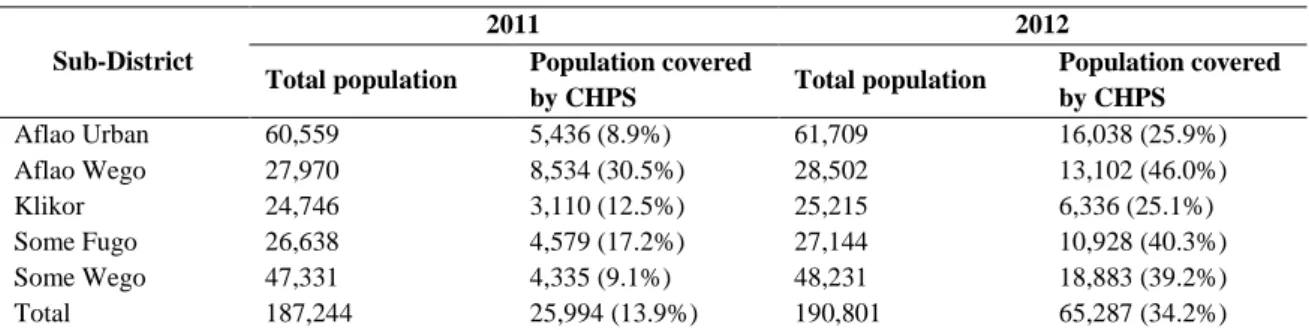
The Table 3 outlines the population of the Ketu South Municipality covered by CHPS in 2011 and 2012. Total coverage has increased from 13.9% in 2011 to 34.2% in 2012. Although coverage has more than doubled, further efforts are required to intensity CHPS coverage in the Ketu south.
Table 3: Population Covered by CHPS in Ketu South Municipality in 2011 and 2012
Sub-District
2011 2012
Total population Population covered
by CHPS Total population
Population covered by CHPS
Aflao Urban 60,559 5,436 (8.9%) 61,709 16,038 (25.9%) Aflao Wego 27,970 8,534 (30.5%) 28,502 13,102 (46.0%)
Klikor 24,746 3,110 (12.5%) 25,215 6,336 (25.1%)
Some Fugo 26,638 4,579 (17.2%) 27,144 10,928 (40.3%) Some Wego 47,331 4,335 (9.1%) 48,231 18,883 (39.2%) Total 187,244 25,994 (13.9%) 190,801 65,287 (34.2%)
*Source: Annual Report 2012, Ketu Municipal Health Directorate [6]
CHPS Activities in Keta Municipality
Maternal mortality rates are generally lower in Ketu South Municipality than in Keta Municipality, and the CHPS program is highly functional in Ketu South. Debpuur et al., (2002) has stated that the program could reduce total fertility, and by association, decrease maternal deaths: Pence et al., (2001) suggest that accessible nursing care can reduce childhood mortality. Therefore, one may assume that the intense nature of CHPS activities in the Ketu South Municipality provides an advantage over Keta Municipality with regard to maternal mortality rates. Annual Report 2010, 2011 and 2012 of Keta Municipal Health Directorate shows that the number of CHPS activities conducted in the Ketu Municipality in 2010, 2011 and 2012 in the functional CHPS zones were 3, 5 and 5, respectively, and 4, 2 and 2 numbers of CHPS zones were newly created in 2010, 2011 and 2012, respectively (Table 4).
Table 4: CHPS Activities in Ketu South
Municipality from 2010 to 2012
Indicator 2010 2011 2012
CHOs trained 5 5 8
Functioning zones 3 13 18
CHPS compounds 3 6 6
Conclusion
The Ketu South and Keta Municipal Health Directorates have made considerable efforts in recent years towards strengthening the region’s health care delivery system, which have resulted in a decline of maternal mortality rates.
Improved access to quality health care has largely been achieved through expansion of the CHPS program. However, this has not been without challenges, such as inadequate logistics, high attrition of community health workers and inadequate funding for training activities around the CHPS concept. Any additional support for program development
should be directed toward logistical support and training/motivation of community health workers.
Another area that requires attention is supervised/skilled birth attendance. There has been a reduction in the number of deliveries conducted by midwives in Keta Municipality, which compromises the quality of maternal and child health and therefore hinders efforts towards attaining MDGs 4 and 5.
motivation of community health workers and midwife training.
Acknowledgement
The authors gratefully acknowledge the support provided by the Korea International Cooperation Agency (KOICA) and National Research Foundation of Korea Grant by Korean Government (NRF-2013S1A01055336) for the support of this study.
Contribution
of
Author
Eun Woo Nam and Farouk Adam Iddrisu was involve the conceptualization and Farouk Adam Iddrisu collect data and wrote the first version of the manuscript. Eun Woo Nam and Sarita Dhakal contributing to the writing and revision of the manuscript. All authors perform literature review, commented on and helped with manuscript revision. All authors have read and approved the final version.
References
1. World Health Organization. Maternal Mortality in 2005: Estimates developed by WHO, UNICEF, UNFPA, and The World Bank. 2007.
2. United Nations Children’s Fund. State of the World’s Children 2009: Maternal and Newborn Health. New York. 2008. 3. Africa Progress Panel Policy Brief. Maternal
Health: Investing in the Lifeline of Healthy Societies and Economies. African Union. 2010.
4. World Health Organization. Health Profile. Ghana. 2010.
5. Annual Report. Keta Municipal Health Directorate. Unpublished. 2012.
6. Annual Report. Ketu South Municipal Health Directorate. Unpublished. 2012. 7. Annual Report. Ketu South Municipal Health
Directorate. Unpublished. 2010. 8. Annual Report. Ketu South Municipal Health
Directorate. Unpublished. 2011.
9. Phillip N. Improving Maternal Mortality and other aspects of women’s health. A Report of CSIS Global Health Policy Centre. 2012.
10. Omar Rahman Jane Menken M. Reproductive health in Global health: diseases, programs, systems and policies. 3rd ed. Edited by Michael H. Merson, Robert E. Black, Anne J. Mills (Burlington, MA: Jones and Bartlett) 2012; 115-175.
11. Phillip N. Improving maternal mortality and other aspects of women’s health. A Report of the CSIS, Global Health Policy Center 2012; page 9.
12. Pierre MT et al. Risk factors for eclampsia among patients with pregnancy related hypertension at Marona Regional Hospital. International Journal of Gynaecology and Obstetrics 2012;118 ( 3), 254-256.
13. Mbah AK et al. Super-obesity and risk for early and Late pre-eclampsia. British Journal of Obstetrics and Gynaecology 2010;117:997-1004
14. Divya AP, Nancy MB, and Kathryn MC. Maternal Health Epidemiology (Module 2 in the Reproductive Health Epidemiology Series), Atlanta, Centers of Disease Control and Prevention 2003.
15. Sereen T and Debora M. Too far to walk: maternal mortality in context. Social Science and Medicine 1994; 38 (8): 1091-1110.
16. Annual Report. Keta Municipal Health Directorate. Unpublished. 2010.
17. Annual Report. Keta Municipal Health Directorate. Unpublished. 2011.
18. Annual Report. National Health Insurance
Authority. Growing healthier and stronger. 2010.
19. Ghana Health Service. Maternal Health Survey 2007.
20. Margaret C, et al., Maternal mortality for 181 Countries, 1980-2008, Lancet. 2010.
21. Frank K, et al., The Ghana community-based health planning and services initiative for scaling-up service delivery innovation. Health Policy and Planning 2005; 25-34.
22. Binka FN, Nazzar A.K, Phillips J.F. The Navrongo Community Health and Family Planning Project. Stud FamPlann 1995;26 (3) : 121-139. Medline.
23. Nazzar AK, Adongo PB, Binka FN, Phillips JF, and Debpuur C. Developing a culturally appropriate family planning program for the Navrongo experiment. Stud. FamPlann, Medline, 1995;26 (6):307-324.
24. Pence B, Nyarko P, Binka FN, Phillip JF, Debpuur C, The impact of the Navrongo Community Health and Family Planning Project on Child Mortality. 1993-2000. Paper presented at the Global Conference of International Union for the Scientific Study of Population, Salvador, Brazil. 2001.
25. Debpuur C, Phillips JF, Jackso EF et al., The impact of the Navrongo Project on Contraceptive Knowledge and use, reproductive preferences, and fertility. Studies in Family Planning. 2002;33, 141-63.
Innovation, Health policy and planning. 2005; 20 (1),25-34
27. In-depth review of the community–based Health planning services (CHPS) program, A report of the annual health sector review, Final Report, Accra.2009.
28. Altman L, Kuhlmann AKS and Galavotti C,