Department of Electrical and Computer Engineering and the CAIP Center, Rutgers University, Piscataway, USA
With the proliferation of mobile computing devices there is an increasing demand for applications supporting collaboration among users working in the field and in the office. A key component for collaboration in this domain is sharing and manipulation of information using very different devices and communications. We propose a novel, data-centric collaboration paradigm, where each user can obtain a subset of the shared data and the data may be visualized differently for different users. The data amount and the visualization technique reflect the user’s interests and/or computing and communication
capabilities. The users collaborate on and exchange data, and the data is dynamically transformed to adapt to the particular computing/network platform. The resulting
design is simple yet very powerful and scalable. It is implemented and tested by developing several complex groupware applications.
Keywords: software frameworks, groupware, heteroge-neous computing, adaptive applications.
1. Introduction
With the recent proliferation of connectivity for small mobile computing devices, using cellular links, wireless LAN, Bluetooth and other radio-based technologies, the door has been opened for development of systems for ubiquitous col-laboration with wide range of applications, such as mobile commerce, in-time training and main-tenance, law enforcement, medical emergency and disaster relief services. The major chal-lenge with wireless connections is that they are, by nature, very dynamic, with the avail-able bandwidth and the latency changing rapidly over time. Another issue is that users need to seamlessly move between different computing devices and use the ones that best suit their cur-rent needs, all during an ongoing collaborative session. Awareness of network, as well as com-puting and input/output resources is essential
for optimizing the performance of collaboration systems in such contexts. The aim for collab-orative applications is to adapt to the changes in the environment to best utilize the resources available. The following scenario illustrates the need for such applications.
An airport maintenance worker needs to check airplanes. The worker was recently hired and still needs training. He is using a handheld or a wearable computer with a wireless link while performing his task. A senior technician is located at the help desk and possesses an expert knowledge about airplane maintenance. He uses a desktop workstation in his work and may simultaneously assist multiple filed work-ers. He also needs sporadically to consult an expert engineer at an airplane factory who is us-ing a virtual reality workstation. They are con-nected over a high-speed wired Internet link. All three types of users share the same engi-neering drawings, but they need to display them on unlike devices and they interact over unlike communication links. The data also need to be customized to meet the communication link constraints(available bandwidth)or computing
constraints of the user’s device(available
mem-ory). Due to their different roles and expertise,
the users are also interested in different aspects or subsets of the data.
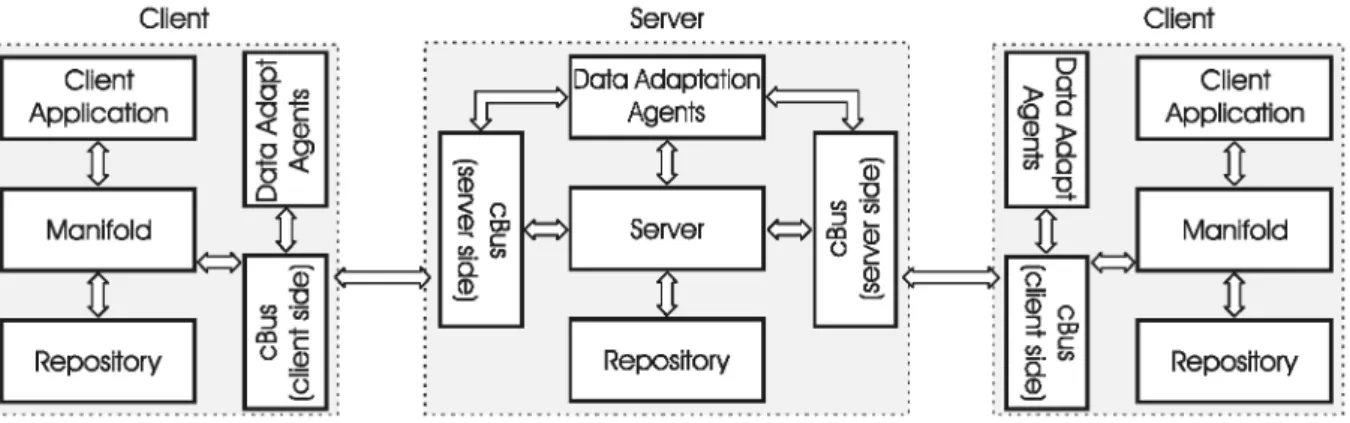
Fig. 1.Overview of the system architecture.
2. Related work
Collaboration in heterogeneous environments is a new research area and only few papers have been published. Among these1],3],5],6]
are included. Heterogeneity is defined here in terms of platform capabilities, rather than oper-ating system or programming language.
The MASH project1]introduced
application-level proxies for adaptation between hetero-geneous clients communicating over heteroge-neous networks. The authors applied their ar-chitecture to PDA-based Web browsing and to collaboration between desktop and PDA clients. In their system, a PDA essentially acts as a re-mote display for a proxy that maintains shared application state, making support difficult for disconnected client operations.
It is important that client devices are not just remote displays, i.e. the client should main-tain application state, since a key requirement is that the system supports disconnected opera-tion. Wireless links often provide only intermit-tent connectivity, so it is desirable to maintain a local state to enable the user to continue the work while disconnected, and to re-synchronize when the client gets opportunity to reconnect. The XWeb project5]addressed the problem of
interacting with services employing a variety of interactive platforms. Since multiple users can simultaneously interact with a service, XWeb also supports collaboration. The key to the sup-port for heterogeneity is that service and client implementations are independent of each other and of the particular mode of interaction that any user might chose, provided that they conform to
the XWeb Transport Protocol(XTP). XWeb
re-quires one-to-one correspondence between the data representations at the collaborating sites. This requirement prohibits the use of data com-pression and abstraction, which may be nec-essary for a scalable support of heterogeneous platforms. XWeb also does not support data adaptation for quality of service (QoS)
man-agement.
The research reported here is a continuation of our prior work3]. It extends and refines the
ideas presented therein.
3. System architecture
The system comprises four main components
(Fig. 2): the repository, the collaboration bus
with the data adaptation agents, the Manifold framework for developing collaborative appli-cations and the task-specific application. The design of the server is relatively simple in the case where we have a single central server. It
user and allow offline work. They are syn-chronized with the global repository when the connection between the client and the server is
(re-)established2]. In this way the same
sys-tem can simultaneously support both synchro-nous and asynchrosynchro-nous collaboration. This is important when the collaborators work in dif-ferent time zones or for other reasons cannot participate in synchronous sessions(e.g.,
unre-liable wireless connections).
Manifold Framework and Applications
To facilitate the development of collaborative applications for heterogeneous computing envi-ronments, we have defined the Manifold frame-work3]. The framework is based on the
Model-View-Controller design pattern and consists of the base package with Java interfaces for the basic structure of an application. Default im-plementations for some of these interfaces have also been provided to help develop applications using the framework.
4. Data representation and adaptation
We believe that in most collaborative scenarios the users are mainly interested in data. The user wants to share data, whether synchronously with collaborators or asynchronously and alone from a different platform. Consequently, the problem of interoperating device-tailored appli-cations is reduced to the problem of managing consistency of the data structures (application
state)across different devices.
We use eXtensible Markup Language(XML)as
a generic means for information representation and exchange. We expect that most of the Web data will be exchanged in XML and most of
interests and priorities; (ii) fidelity is dictated
by computing platform’s capabilities; and(iii) timelinessis determined by the requirements of the task. Other dimensions include modality, reliability, and security of data, but our focus here is on the above three.
In our framework, the user provides the rele-vance information to state his interests, the de-vice and the application determine the fidelity of the data, and timeliness issues time constraints to data delivery, set by the requirements of the tasks. Logical evaluation of data with respect to the three dimensions results in a priority. This priority represents the relevance of data to the user in a certain environmental state. The more relevant the data is, the higher its priority will be, and the more certain it is to be sent. With different priorities for levels of details we can select at what level of detail the data should be sent. Sorting data by priority before sending addresses the timeliness: high priority data is sent immediately and low priority data is sent later when network conditions improve. The rules can also be set up to aggregate the data to send only updates about higher-level objects in a hierarchical data structure.
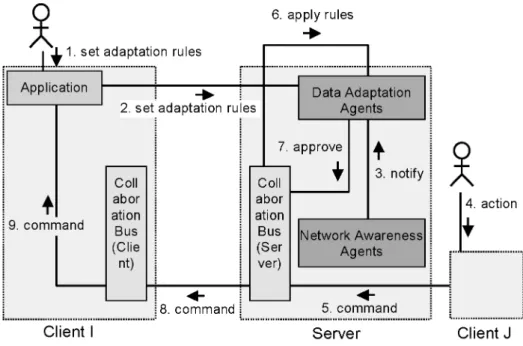
Interactions between the client and server com-ponents in the process of data adaptation can be seen in Fig. 3. When a user wants to modify a data object, an update command is sent from the client application to the server to update the global repository. A command will then notify other users who are subscribed to changes to the global repository and they will update their lo-cal repository. Adata adaptation agentdecides on what changes to notify the subscribing users about.
We introduce a selective and prioritized replica-tion algorithm with dynamic filtering7]. The
Fig. 3.The interactions between the framework components in the process of data adaptation to the context.
When these variables change, the selection cri-teria have to adapt to the situation. Fig. 4 shows the measured overhead of prioritized (
condi-tional)data replication.
Fig. 4.Overhead of conditional replication.
4.2. Maintaining state consistency
The application state consists of all applica-tion’s data structures that are relevant for the process of sharing. An example of application state is what is usually called scene graph in two-dimensional and three-dimensional graph-ics applications. It is a hierarchical description
of scene objects, with scene objects, their parts, and parts of their parts represented at different levels of abstraction. Other examples include conceptual knowledge representation using re-lationships such as inheritance, spatial or tem-poral proximity, etc.
Suppose that two remote sites run an applica-tion tailored to each site’s computer platform. As the users interact with the application, the application state transitions must be consistent to provide meaningful collaboration. The fol-lowing diagram represents the problem. Let us assume that the application states at the two sites are consistent at a timet. The mapping between them is denoted as “map1”.
site1 state(t)] map1
;!site2 state(t)]
#op1 #op2
site1 state(t+1)] map2
;!site2 state(t+1)]
At the time t + 1, the user interacts with the
application at site 1(“op1”) and it transitions
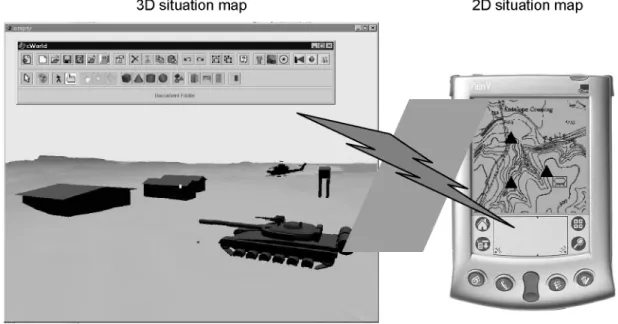
Fig. 5.Example application of mission planning on a situation map. The user on the left employs a high-end virtual reality workstation and the user on the right employs a Palm PDA.
1 and send it to site 2, rather than to compute the new state of site 2 using “map2” and then transmit the entire new state to site 2. This may not always be true, but the solution can easily be generalized.
If the platforms were homogeneous, the opera-tions “op1” and “op2” would be identical and could be directly distributed across the colla-borative applications. Due to platform-specific differences in state representations, “op1” first needs to be transformed to adjust to different domains. This transformation allows the inter-operation of the applications.
Another important issue is how the mapping “map1” is determined, i.e., the issue ofdefining
and/orcheckingsemantic consistency. For this
we are running human factors investigations to determine the rules for tailoring the data rep-resentation to fit platform capabilities. The set of rules generates “map1” mappings and needs to be checked for consistency. Once the rules are determined, the system needs to maintain
semantic consistency. We derived an algorithm which guarantees that the state consistency will be maintainedassuming that the rules are con-sistent4]. Given the mapping “map1” and the
operation “op1”, the algorithm derives the map-ping “map2” or the operation “op2” such that the application states remain consistent as they transition in response to users interactions.
5. Example Application
We developed two versions of a mission plan-ning application: one that renders 2D graphics and the other that renders 3D graphics. The 3D version runs on a high-end workstation with Window VR virtual reality display. The 2D ver-sion runs on a PalmPilot V handheld connected to the Internet via an OmniSky cellular modem. Both versions support operations such as view a map, zoom in and out, place, move, rotate and delete objects (icons), freehand drawing,
object property modification, etc. Rendering on Palmscape is monochromatic, as the J2ME Con-nected Limited Device Configuration(CLDC)
does not support color displays yet.
The architecture shows significant reusability. More importantly, there is a great degree of de-sign reusability. The basic infrastructure and application logic(design) are the same across
6. Conclusions
Computing platforms are rapidly becoming more heterogeneous. Our work provides a scal-able architecture for the development of col-laborative applications adapted to disparities in computing and communication capabilities of the collaborative participants. Collaborators share the same or semantically equivalent data, but view very different displays depending on their computing capabilities. The main charac-teristic of the framework presented here is ex-treme scalability allowing use on a wide spec-trum of platforms, ranging from handheld ac-cess devices to high-end graphics workstations. It scales to support application logic with vary-ing complexities of behaviors and visualizations with varying degrees of realism and media rich-ness.
Acknowledgements
The research reported here is supported in part by NSF Grant No. ANI-01-23910, US Army CECOM Contract No. DAAB07-02-C-P301 and by the Rutgers Center for Advanced In-formation Processing(CAIP).
References
1] FOX, A., GRIBBLE, S. D., CHAWATHE, Y., AND
BREWER, E. A. Adapting to Network and Client
Variation Using Active Proxies: Lessons and Per-spectives.IEEE Personal Communications (Special Issue on Adapting to Network and Client Variabil-ity), 5(4), Aug. 1998.
2] IONESCU, M., KREBS, A. M.,ANDMARSIC, I.
Dy-namic Content and Offline Collaboration in Syn-chronous Groupware.Proc. 3rdInt’l Symp. on
Col-laborative Technologies and Systems (CTS 2002), San Antonio, TX, Jan. 2002, pp. 201–206.
3] MARSIC, I. An Architecture for Heterogeneous
Groupware Applications. Proc. 23rd IEEE/ACM
Int’l Conf. Software Engineering (ICSE 2001), Toronto, Canada, May 2001, pp. 475–484.
4] MARSIC, I., SUN, X.,ANDCORREA, C. Maintaining
State Consistency Across Heterogeneous Collabo-rative Applications. Submitted for publication.
5] OLSEN, D. R., JEFFERIES, S., NIELSEN, T., MOYES,
W.,ANDFREDRICKSON, P. Cross-Modal Interaction Using XWeb.Proc. ACM User Interface Software Technologies (UIST’00), San Diego, CA, USA, Nov. 2000, pp. 191–200.
6] TANDLER, P. Software Infrastructure for
Ubiqui-tous Computing Environments: Supporting Syn-chronous Collaboration with Heterogeneous De-vices. In: G.D. Abowd, B. Brumitt, S. Shafer(Eds.)
Proc. Ubicomp 2001: Ubiquitous Computing, Third Int’l Conf., Atlanta, GA, USA, Springer-Verlag LNCS-2201, Sep./Oct., 2001, pp. 96–115.
7] VAN DER POEL, B., TAN, Y., KREBS, A. M., AND
MARSIC, I. Prioritized Replication With Dynamic
Selection For Mobile Environments. Submitted for publication.
Received:June, 2002
Accepted:September, 2002
Contact address:
Ivan Marsi´cˇ
Department of Electrical and Computer Engineering and the CAIP Center Rutgers University Piscataway, NJ 08854-8058 USA e-mail:[email protected]
IVANMARSI´ˇCis Assistant Professor of electrical and computer engi-neering at Rutgers University. He received the B.S. and M.S. degrees in computer engineering from the University of Zagreb, Croatia, in 1982 and 1987 respectively, and Ph.D. degree in biomedical engineering from Rutgers University, New Brunswick, NJ, in 1994.
Prof. Marsi´c’s research interests are in mobile computing, groupware,ˇ
computer networks, and multimodal human-computer interfaces. His research in these areas is supported by grants from NSF, DoD, and Industry. He has authored over 80 journal and conference papers, one book and 3 book chapters. He is a member of IEEE, ACM, IFIP WG2.7/13.4, and International Academy for Advanced Decision