Fast Heuristics for Large Instances of the Euclidean Bounded Diameter
Minimum Spanning Tree Problem
C. Patvardhan and V. Prem Prakash
Faculty of Engineering, Dayalbagh Educational Institute, Agra - 282005, India E-mail: [email protected], [email protected]
A. Srivastav
Institut für Informatik, Christian-Albrechts-Universität zu Kiel, Kiel, Germany E-mail: [email protected]
Keywords:heuristic, euclidean, bounded diameter minimum spanning tree, constrained diameter, greedy
Received:January 29, 2015
Given a connected, undirected graph G = (V, E) on n =|V|vertices, an integer bound D≥2 and non-zero edge weights associated with each edge e∈E, a bounded diameter minimum spanning tree (BDMST) on G is defined as a spanning tree T⊆E on G of minimum edge cost w(T) =P
w(e),∀e∈T and tree diameter no greater than D. The Euclidean BDMST Problem aims to find the minimum cost BDMST on graphs whose vertices are points in Euclidean space and whose edge weights are the Euclidean distances between the corresponding vertices. The problem of computing BDMSTs is known to be NP-Hard for 4≤D< n−1, where D the diameter bound. Furthermore, the problem is known to be hard to approximate. Heuristics are extant in the literature which build low cost, diameter-constrained spanning trees in O(n3) time. This paper presents some fast and effective heuristic strategies for the Euclidean BDMST Problem and compares their performance with that of the best known existing heuristics. Two of the proposed heuristics run in O(n2√n) time and another faster heuristic runs in O(n2), thereby allowing them to quickly build low cost BDSTs on larger sized problems than have been attempted hitherto. The proposed heuristics are shown to perform better over a wide range of benchmark instances used in the literature for the Euclidean BDMST Problem. Further, a new test suite of much larger problem sizes than attempted hitherto in the literature is designed and results presented.
Povzetek: Podan je hevristiˇcni postopek za hitro gradnjo minimalnega prekrivnega drevesa.
1
Introduction
Given a connected, weighted, undirected graph G and a positive integer D, the Bounded-Diameter Minimum Span-ning Tree (BDMST) problem seeks a low cost spanSpan-ning tree from amongst all spanning trees of G containing paths with no more than D edges. Formally, a bounded-diameter spanning tree (BDST) is a spanning tree T ⊆E on G = (V, E), whose diameter is no greater than D. The BDMST problem aims to find a bounded diameter spanning tree of minimum cost w(T) =P
w(e),∀e ∈ T. Restricting the problem to Euclidean graphs (where vertices are points in Euclidean space and edge weights are the Euclidean dis-tances between pairs of vertices) gives rise to the Euclidean BDMST Problem [1]. The problem finds application in several domains, ranging from distributed mutual exclu-sion [2] to wire-based communication network design [3] and data compression for information retrieval [4]. An im-portant application also occurs in reducing the source-sink delays and total wire length in VLSI routing. Barring the special cases of D = 2, D = 3, D = n−1, and all edge weights being the same, the BDMST Problem is known to be NP-Hard [5]. Furthermore, the problem is also known
to be hard to approximate; it has been shown that no poly-nomial time approximation algorithm can be guaranteed to find a solution whose cost is within log (n) of the optimum [6].
An exact algorithm for the BDMST Problem is given by Achuthan and Caccetta in [7]. This is improved by Achutan et al. [8], wherein a branch and bound framework is given which utilizes different branching rules and simple heuristics. Gouveia and Magnanti [9], give several vari-ants of multi-commodity flow (MCF) formulations for the BDMST problem which achieve extremely tight LP bounds (within 1% of the optimal solution for almost all bench-marks tested). However, this approach has been able to solve BDMST instances of up to only 60 node graphs to optimality. In general, the exponential time complexity of exact algorithms allows them to solve only very small prob-lem instances; this motivates the search for fast heuristics and meta-heuristic techniques which can approximate low cost BDSTs on much larger problem sizes within reason-able time.
[20],[21],[22] and a recent learning automata-based algo-rithm [23].
Many of the best known existing heuristics for the BDMST problem are based on a greedy, Prim’s [19] algorithm-like strategy. Each of these heuristics works well under certain conditions in the Euclidean BDMST case, for instance when the range of diameter bounds is restricted to a small range or when the diameter bound is very small. Further, none of the existing heuristics is suitable for work-ing on very large sized problems, as they require too much computation time for building BDSTs on large problem in-stances. A key goal of the research presented in this pa-per has thus been to develop fast and robust heuristics that would build low cost BDSTs on very large problem sizes. The extant heuristics in the literature are briefly discussed as follows.
Ayman Abdalla and Narsing Deo describe in [10], sev-eral construction heuristics for the BDMST problem, in-cluding a Prim’s [19] algorithm–based heuristic called the one-time tree construction (OTTC) heuristic that runs in O(n4) time and produces low cost BDSTs when the diame-ter bound D is small. Abdalla and Deo also give two idiame-tera- itera-tive refinement algorithms that start with an unconstrained MST and iteratively decrease the length of long paths until the diameter constraint is satisfied. The center-based tree construction (CBTC) heuristic given by Julstrom in [11] performs better than OTTC both in terms of solution qual-ity and running time (it requires O(n) time less than OTTC) by constructing the BDST as a height-restricted tree rooted at a central node (or two nodes if the diameter is odd). A randomized tree construction heuristic (RTC) is also given in [11] wherein each next node to be appended to the BDST is chosen at random and appended greedily.
The RTC and CBTC heuristics are improved further by Singh and Gupta [12] and Singh and Saxena [13]. The improved heuristics given in [12] are called RGH-I and CBTC-I, which try to improve RTC and CBTC in terms of both speed and solution quality. In particular, for each ver-tex v (excluding the root and vertices adjacent to the root) the heuristics search for tree vertices of lower depth than v to which v can be appended at lesser cost. Singh and Sax-ena [13] improve these heuristics further and demonstrate their effectiveness on a standard set of problem instances used widely in the literature.
A hierarchical clustering-based heuristic for the Eu-clidean BDMST problem is given by Gruber and Raidl [14], which obtains low cost BDSTs when the diameter constraint is very small.
The Center-based Least Sum-of-Costs (CBLSoC) heuristic given by Patvardhan et al.[15] builds a low cost BDST by repeatedly appending the non-tree vertex with the lowest mean cost to all the remaining non-tree vertices in the graph. This heuristic is run starting from every graph vertex and returns the lowest cost BDST obtained. It has a running time of O(n3) and performs competitively vis-a-vis the other heuristics. Parallel versions of the CBTC, RTC and CBLSoC heuristics are given in Patvardhan et al.[16]
and their performance compared over a comprehensive set of Euclidean and random benchmark graphs.
This paper presents some fast heuristics for the Eu-clidean BDMST problem. The first of these is a vari-ant of the CBLSoC heuristic [15]. This heuristic, called CBLSoC-lite, produces BDSTs with comparable/better (lower) costs as compared to existing heuristics on a wide range of benchmarks. Two other “Quadrant-Centers based” heuristics try to construct an effective backbone of a small number of low height nodes appended to the tree via rela-tively longer edges, and then build the rest of the BDST. The heuristics presented in this work typically take less time to build a low cost BDST vis-à-vis extant heuristics. This allows them to handle much larger problem sizes than attempted hitherto by any other heuristic. Their perfor-mance is demonstrated on a test suite of completely con-nected Euclidean graphs having up to 10,000 vertices.
Subsequent sections of the paper are organized as fol-lows: section 2 discusses three well known heuristics for the problem (OTTC, CBTC and RTC), section 3 de-scribes CBLSoC and the proposed CBLSoC-lite heuristic, and Section 4 presents the proposed “Quadrant centers-based” heuristic strategy. Computational results obtained on benchmark problem instances and other larger randomly generated graphs are presented and summarized in section 5, and concluding remarks are made in section 6.
2
Some well known heuristics
This section presents several well known heuristics for the BDMST Problem and summarizes their key characteristics.
2.1
One-time Tree Construction (OTTC)
Heuristic
Listing 1:OTTC heuristic
1 V[.]←set of graph vertices
2 S[.]←set of tree vertices, initially empty
3 foreach v∈Vdo
4 T←{}
5 S←{}
6 S←S∪{v}
7 while|T| 6= (n−1)do
8 Choose x∈V\S and u∈S such that
cost(u, x)is minimal∀u∈S and diameter constraint D is not violated
9 T ←T∪(u, x)
10 S←S∪{x}
11 ifcost(T)<cost(bestTree)then
12 bestTree←T
13 returnbestTree
2.2
Center-based tree construction (CBTC)
heuristic
In a tree with diameter D, no vertex is more than D/2 hops or edges from the root vertex of the tree [17]. This motivates a faster Prim’s algorithm-based heuristic called Center-Based Tree Construction (CBTC) heuristic [11], which improves OTTC by building the BDST from the tree’s center, keeping track of the depth of each tree node and ensuring that no node depth exceeds bD/2c. This heuristic avoids the task of repeatedly computing the tree diameter before appending each node, and returns the low-est cost BDST obtained over n runs, each starting from a different graph vertex, thereby bringing down the total run-ning time to O(n3). Pseudo-code for the CBTC heuristic is given in listing 2.
2.3
Randomized tree construction (RTC)
heuristic
In the Randomized Tree Construction Heuristic (RTC), the center of the spanning tree is chosen at the outset as one vertex (if D is even) or two connected vertices (if D is odd) randomly selected from the set of graph nodes. Each next vertex is then chosen at random and connected to the tree greedily such that the inclusion does not yield a tree of diameter greater than the diameter bound D. Building the BDST requires repeating this process throughn−1 iter-ations. As before, this process is repeated n times, and the lowest cost BDST is returned. Hence the total running time of this heuristic is O(n3). Pseudo-code for this heuristic is given in listing 3.
2.4
Some Other Heuristics
Singh and Gupta [12] improve the CBTC and RTC heuris-tics in two ways. Firstly, after building a BDST using either construction heuristic, it is checked for each vertex v∈V in
Listing 2:CBTC heuristic
1 U[.]←set of unconnected graph vertices
2 C[.]←set of tree nodes with depth<bD/2cforeach vertexv0∈Vdo
3 Setv0as root 4 U←U\{v0} 5 C←{v0} 6 depth[v0] = 0 7 ifD is oddthen
8 Choose vertexv1∈U such that cost(v0,v1) is minimal
9 U←U\{v1}
10 C←{v1}
11 depth[v1] = 0 12 T←T∪(v0,v1)
13 whileU6={}do
14 Find u∈C and v∈U such that cost(u,v) is
minimal
15 T←T∪(u, v)
16 U←U\{v}
17 depth[v]←depth[u] + 1 18 if(depth[v]<bD/2c)then
19 C←C∪{v}
20 returnthe tree with lowest cost out of all trees
generated above
the BDST whose depth is greater than 1 (essentially cov-ering all vertices that are not either the root(s) or the ver-tices immediately connected to the root(s)) whether it can be reattached to a BDST vertex of depth less than depth[v] via a lower cost edge. Secondly, the heuristics maintain a sorted cost matrix and searching for a low cost edge to ap-pend a vertex v to the BDST in then/10elements of the cost matrix row entry for the vertex v. These two heuris-tics are further improved in Singh and Saxena [13], where they are called RGH+HT and CBTC+HT respectively, by allowing a sub-tree rooted at v to be connected to any ver-tex of the tree irrespective of its depth, provided the cost is reduced and the feasibility of the resulting BDST is re-tained. Gruber and Raidl [14] use agglomerative hierar-chical clustering to guide the creation of an effective BDST backbone and transform the resulting dendogram structure into a height-restricted clustering that satisfies the diameter constraint. The heuristic then uses either a greedy heuris-tic or one of two dynamic programming (DP) approaches to identify a good root node within each cluster. The first DP approach restricts the search space of root nodes of a cluster to the root nodes of sub-clusters, while the second approximates optimal cluster roots using a correction value for estimating the cost of connecting each graph vertex as a leaf node of the BDST. The dynamic programming ap-proaches takeO(H.|V|2)andO(
re-Listing 3:RTC heuristic
1 U[.]←set of unconnected graph vertices
2 C[.]←set of tree nodes with depth<bD/2cforn timesdo
3 Set as root, a random vertexv0∈U 4 U←U\{v0}
5 C←{v0} 6 depth[v0] = 0 7 ifD is oddthen
8 Choose another random vertexv1∈U
9 U←U\{v1}
10 C←C∪{v1}
11 depth[v1] = 0 12 T←T∪(v0,v1)
13 whileU6={}do
14 Choose a random vertex v∈U
15 Find u∈C such that cost(u,v) is minimal 16 T←T∪(u, v)
17 U←U\{v}
18 depth[v]←depth[u] + 1 19 if(depth[v]<bD/2c)then
20 C←C∪{v}
21 returnthe tree with lowest cost out of all trees
generated above
sults of the heuristic are further improved using a variable neighborhood descent (VND) given in [18].
2.5
Discussion
A major drawback of the OTTC and CBTC heuristics is that they always use low cost edges to build the tree, thus necessitating the later vertices to be appended to the tree through higher cost edges. This often results in BDSTs with larger costs, especially when the diameter bound is small. One way to overcome this is to select each node randomly and then append it to the tree greedily, as is done by the RTC heuristic. Possibly due to the random nature of node selection, the initial “backbone” of the BDST of-ten turns out better in RTC than in the OTTC and CBTC heuristics, leading to lower cost BDSTs when the diameter bounds are small. However, the performance of the RTC heuristic rapidly deteriorates as the diameter bound is in-creased, as discussed in section 5. The heuristics of Singh and Saxena [13] produce lower cost BDSTs than CBTC and RTC. The Hierarchical Clustering-based heuristic pro-duces very low cost BDSTs, but is seen to be effective only when diameter bounds are small.
3
The CBLSoC-lite and CBLSoC
Heuristics
The Center-based Least Sum-of-CostsLite(CBLSoC-lite) heuristic starts by selecting as root the vertex (or two ver-tices, in case of odd diameter) with lowest mean cost to all other graph vertices. Thereafter, each new graph vertex se-lected has the lowest sum of costs to all the remaining graph vertices. This vertex is then appended to the tree greedily via the lowest cost edge that does not violate the diam-eter bound. The heuristic uses a center-based approach, building the BDST from the tree’s center, keeping track of the depth of each tree node and ensuring that no node depth exceedsbD/2c. This preempts the need for dynam-ically computing the spanning tree’s diameter at each step and results in a total computational time ofO(n2)for the heuristic. Pseudo-code for the heuristic is given in listing 4. The CBLSoC heuristic iteratively builds BDSTs
start-Listing 4:CBLSOC-LITEheuristic
1 U[.]←Adjacency matrix containing edge weights of
the graph G
2 C[.]←Set of unconnected graph vertices
3 Choose u∈V such that sum of entries in row u of adj.
matrix A is minimal
4 U←U\{u} 5 ifD is oddthen
6 choose v∈V\{u} such that sum of entries in row
v of A is minimal
7 T←T∪(u,v) U←U\{v}
8 whileU6={}do
9 Choose x∈V\T such thatPcost(x,y) is minimal
∀y∈V\T,y6=x and diameter constraint is not violated
10 Choose u such that cost (u, x) is minimal,∀u∈T 11 T←T∪(u, x)
12 U←U\{x}
13 returnT
ing once from each graph vertex and returns the lowest cost BDST thus obtained. This results in further improvements in BDST costs, but incurs an additional overhead of O(n), and hence a total running time of O(n3) for the heuristic.
The CBLoC-lite and CBLSoC heuristics produce better (lower) cost BDSTs in comparison to the OTTC, CBTC and RTC heuristics, as shown in section 5 on a large num-ber of benchmark problems.
4
Quadrant Centers-based Heuristics
greedy, center-based LSoC heuristics discussed in section 3 mitigate this problem to some extent, as shown in the ex-perimental results presented in section 5.
Another group of heuristics is proposed which start by empirically fixing the tree center and adding a few graph vertices to the tree, thereby building a backbone compris-ing of a small number of nodes connected to the tree via relatively longer edges. The remaining nodes are then appended to the BDST either greedily or by using the CBLSoC heuristic.
Listing 5:QCH-GREEDYheuristic
1 Choosev0∈V|{Pcost(v0, x) is minimal∀x∈V, x
6
=v0}
2 U←{v0} 3 ifD is oddthen
4 Choosev1∈U|{cost(v0,v1) is minimal,∀v1∈ U }
5 T←T∪(v0,v1)
6 U←U∪{v1}
7 forqsize = 2to√ndo 8 fori = 1toqsizedo
9 Choose p∈quadrant i|{Pcost(p,j) is
minimal, where p, j∈U, j∈quadrant iand j
6
=p }
10 T←T∪(k, p), where cost(k, p) is minimal of
all tree vertices k
11 U←U\{p}
12 Append each remaining node x∈U to T greedily
via the lowest cost edge such that depth[x]≤ b
D/2c
13 foreach vertex i∈Tdo
14 ∀j∈T such that depth[j]<bD/2c, if
cost(i,j)<cost (i, parent[i]), replace (i,parent[i]) with (i,j) in the BDST
15 bestT←lowest cost BDST found so far
16 returnbestT
The Euclidean problem domain is widely modeled in the literature as a set of real points normally distributed in the unit square. Using this model, the proposed heuristics build a tree “backbone” by first choosing the root node of the BDST using the CBLSoC heuristic. Specifically, the node with the lowest mean cost to all other graph nodes is added to the BDST and chosen as the central, or root vertex. If (the diameter) D is even, then this single node serves as the root of the BDST. If D is odd, then the non-tree node with the lowest mean cost to the remaining graph vertices is also selected and added to the tree via the lowest cost edge; the sub-graph comprising these two nodes and the edge joining them is now considered as the center of the BDST. The re-maining graph vertices are segregated into the “quadrants” of a uniform MxM matrix in the unit square, 2≤M≤√N
(each element of this matrix is termed a quadrant, for want of a more suitable expression). Within each quadrant, the
node with lowest mean cost to all other nodes within the same quadrant is set as a tree backbone node of depth 1. The remaining vertices are then appended to the tree ei-ther greedily (this is called the QCH-Greedy heuristic) or using the CBLSoC heuristic in selecting each next vertex to append to the tree (this is called QCH-LSoC heuristic), while ensuring that the diameter constraint is not violated.
Listing 6:QCH-LSOC heuristic
1 Choosev0∈V|{Pcost(v0, x) is minimal∀x∈V, x
6
=v0}
2 U←{v0} 3 ifD is oddthen
4 Choosev1∈U|{cost(v0,v1) is minimal,∀v1∈ U}
5 T←T∪(v0,v1) 6 U←U∪{v1} 7 forqsize = 2to√ndo 8 fori = 1toqsizedo
9 Choose p∈quadrant i|{Pcost(p,j) is
minimal, where p, j∈U, j∈quadrant iand j
6
=p }
10 T←T∪(k, p), where cost(k, p) is minimal of
all tree vertices k
11 U←U\{p}
12 forremaining vertices in Udo
13 Choose k∈U|{Pcost(k,j)∀j∈U, j6=k} is
minimal
14 T←T∪(k,x), where (k,x) is the lowest cost
edge s.t. depth[k]≤ bD/2c
15 U←U\{p}
16 foreach vertex i∈Tdo
17 ∀j∈T such that depth[j]<bD/2c, if cost(i,j)<cost (i, parent[i]), replace (i,parent[i]) with (i,j) in the BDST
18 bestT←lowest cost BDST found so far
19 returnbestT
Pseudo-code for these two heuristics is given in listings 5 and 6 respectively.
Both the heuristics attempt to find an effective backbone by varying the number of quadrants up to n (where n is the input size) and building the backbone accordingly. The heuristics return the lowest cost BDST obtained by this pro-cedure.
Setting up the backbone of the BDST requires O(n) time in the greedy QCH heuristic (QCH-Greedy) and O(n2) time in the CBLSoC-based variant (QCH-LSoC). In the greedy variant, the process of greedily appending each node to the BDST requires O(n) time, resulting in a to-tal running time of O(n2). Running the heuristic up to √ntimes in the worst case gives a total running time of
O(n2√n).
be achieved in O(n) time when we keep track of the mean costs from each such node to all other such nodes and up-date in linear time, and appending it greedily to the BDST would also require linear time. Thus the total running time for the LSoC-based QCH heuristic is also O(n2√n). In practice, the heuristics terminate when there is no further improvement in cost as compared to the previous itera-tion. Both heuristics attempt to reattach each node of the BDST (excepting the root nodes) at a lower cost, if pos-sible, in a simple post-processing step that requires O(n2) time, which does not result in any change in the overall time complexity, and slightly improves the tree cost in sev-eral cases.
5
Comparison of performance on
benchmarks
The Euclidean Steiner Problem data sets given in Beasley’s OR-Library1 have been used extensively in the
litera-ture for benchmarking heuristics and algorithms for the BDMST Problem. These instances comprise of vertices placed at random in the unit square, fifteen instances of each size for graphs of up to 1000 vertices. Julstrom [9] uses an enhanced test suite of Euclidean problem instances that augments the OR-Library instances with randomly generated Euclidean graphs, fifteen each of 100, 250, 500 and 1000 vertices, whose edge weights are, as before, the Euclidean distances between (randomly generated) points in the unit square. Another test suite of larger Euclidean problem instances comprising of thirty randomly generated Euclidean graphs of 1500, 2500, 5000 and 10,000 vertices was developed by the authors for comparing the perfor-mance of the heuristics presented in this work on larger problem instances. These problems are referred to in this paper as large problem instances, to differentiate from the enhanced test suite of standard sized problems given by Jul-strom [9].
The heuristics presented in this paper were tested on the thirty “standard” problem instances of 100, 250, 500 and 1000 vertex graphs provided in the enhanced bench-mark suite of [9], totaling 120 completely connected Eu-clidean graphs, and the mean (X) and standard deviation (SD) of tree costs, and mean CPU times (tavg) were ob-tained for each node size. The results obob-tained on the en-hanced benchmark suite of standard problem instances for the OTTC, CBTC, RTC, CBLSoC-lite, CBLSoC and pro-posed QCH heuristics are given in table 1.
The heuristics were also tested on the thirty “large” problem instances of 1500, 2500, 5000 and 10000 vertex graphs; the mean and standard deviation of tree costs and mean CPU times obtained for all the heuristics are given in table 2. Results for the OTTC heuristic were not com-puted for larger sized problems because it takes too much computational time, as is obvious from the times given in
1Maintained by J.E. Beasley, Department of Mathematical Sciences,
Brunel University, UK. (http://people.brunel.ac.uk/ mastjjb/orlib/files)
table 1 for 1000 vertex graphs. In any case OTTC always performs worse than the CBTC heuristic.
The values used for D (the diameter bound) in all the tests were always less than the smallest diameter of an un-constrained MST on each set of graphs. The mean CPU times quoted in table 1 for the OTTC heuristic were ob-tained in [9] on a Pentium IV, 2.53 GHz processor with 1 GB memory. All the other heuristics were implemented in C on a Dell Precision T-5500 Workstation with 12 In-tel Xeon 2.4-Gigahertz processor cores and 11 GB RAM running Red Hat Enterprise Linux 6.
The proposed heuristics were compared in terms of low-est and mean BDST costs obtained and computation time vis-a-vis the improved heuristics of Singh et al. [13] on Euclidean problem instances in table 3 and the hierarchical clustering-based heuristics of Gruber and Raidl [1] in table 4.
The mean BDST costs for the CBTC, RTC, CBLSOC-lite and CBLSoC heuristics given in table 1 show that the CBLSoC-lite and CBLSoC heuristics outperform OTTC on all problem instances and produce lower mean costs vis-à-vis the CBTC heuristic on most instances.
The RTC heuristic produces relatively lower cost trees, but this is only when the diameter bound is very small; as the diameter bound is increased the lowest cost BDSTs are the ones produced by CBLSoC-lite and CBLSoC. In order to understand this behavior, we observe that the OTTC and CBTC heuristics always greedily append to the tree, the node with the lowest cost to the tree. As a result the tree backbone ends up comprising of a small number of rel-atively short edges, forcing many of the remaining graph vertices to be appended via longer edges in order to main-tain the diameter bound, resulting in higher tree costs. In a sense, the inherent greediness of the heuristic adversely affects its performance.
The RTC heuristic, possibly due to its randomized node selection approach, has a much better chance of building a tree backbone close to clusters of nodes, several of which might then be appended to the backbone using short edges. When D is small, it usually returns trees with lower costs than any of the other heuristics (OTTC, CBTC or CBLSoC-lite). However, as the diameter bound is increased, the RTC policy of always choosing the next node to append in a random manner leads to several poor choices, thereby con-tributing adversely to the overall BDST cost. The heuristic fails to produce any improvements in BDST costs with as the diameter bound is relaxed and is eventually surpassed in performance by the other heuristics.
the CBLSoC-lite heuristic takes about 0.03 seconds on av-erage for problems of the same size, and computes BDM-STs with mean costs that are usually better. The CBLSoC heuristic takes O(n3) time but produces lower cost BDSTs than CBLSoC-lite.
The QCH heuristics start by trying to fix up a “good” backbone for the BDST. The greedy variant, QCH-greedy incorporates the greedy selection strategy used by OTTC, CBTC and RTC; the other proposed variant use the node selection strategy followed by the CBLSoC heuristic. The QCH heuristics produce low cost BDSTs in general, as can be seen from the mean tree costs given in table 1.
The two QCH variants obtain competitive mean tree costs, with the QCH-greedy heuristic producing slightly better BDSTs on larger diameter bounds. The BDST costs obtained by the QCH heuristics are lower than that ob-tained by the RTC heuristic on all problem instances, more so when the diameter bounds are small. Both heuristics produce significantly lower cost BDSTs vis-à-vis CBLSoC and CBLSoC-lite when the diameter is small, and give competitive results on larger diameter bounds; the QCH variants perform better than OTTC and CBTC on all prob-lem instances and for almost all diameter constraints.
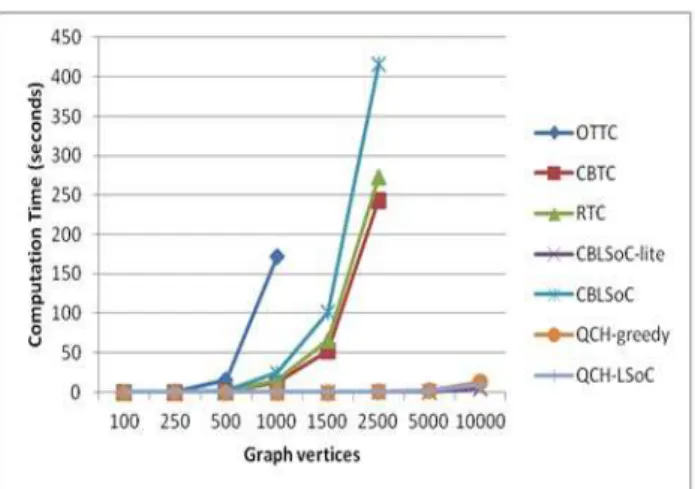
On the large Euclidean problem instances, the com-putational time requirements of OTTC, CBTC, RTC and CBLSoC heuristics rapidly become prohibitively high (ta-ble 2), whereas the CBLSoC-lite and QCH heuristics are still able to quickly compute low cost BDSTs.
On 2500 vertex graphs for example, CBLSoC-lite com-putes lower cost BDSTs than CBTC on all except the small-est diameter bound, in less than 1/1000th of the time taken by CBTC (0.22 seconds for CBLSoC-lite versus 257.29 seconds for CBTC on the third 2500 vertex instance in table 2). On the same instance, the QCH-greedy heuristic com-putes the lowest cost BDST of all the heuristics in about 0.42 seconds.
RTC produces the lowest cost BDST of all the heuristics in instance each of 1500 and 2500 vertex graphs, and that too only on the smallest diameter bound. Furthermore it fails to improve tree costs as the diameter constraint is pro-gressively increased. By contrast, CBLSoC-lite takes less than one second to build low cost BDSTs on benchmark graphs of the same size and outperforms CBTC and RTC as D is increased. Even on completely connected graphs of 10,000 vertices, the heuristic computes BDSTs in less than 5 seconds on average (thetavgcolumn in table 2).
As already observed with the standard sized Euclidean problems, the QCH heuristics obtain the lowest cost among the heuristics being compared. In particular, the QCH-LSoC heuristics almost always produce the lowest cost trees on smaller diameter bounds, with the QCH-greedy heuristic obtaining the lowest costs BDSTs on larger di-ameter constraints for most of the large problem instances. It is worth noting that the CBLSoC-lite and the two QCH heuristics compute low cost BDSTs in a fraction of the computation time taken by the other heuristics. This is il-lustrated in figure 1.
Figure 1:Comparison of computational time taken by the
heuris-tics
The proposed heuristics are also compared with the im-proved heuristics of Singh and Saxena [13] in table 3 and with Gruber and Raidl’s hierarchical clustering-based heuristic strategy in table 4. Both works provide compu-tational results for small diameter bounds only on problem instances of up to 1000 vertex graphs.
Singh and Saxena [13] give the results obtained by their improved heuristics on the first five instances of the Beasley Euclidean Steiner Problem data sets for 50, 100, 250, 500 and 1000 vertex graphs, with diameter bounds of 5, 10, 15, 20 and 25 respectively.
The QCH heuristics produce low cost BDSTs when the diameter bound is small, giving results that are competitive with RTC+HT. For example, on the results obtained for up to 1000 vertex graphs in table 3, the lower cost BDST of the two QCH Heuristics is no worse than 3.25% on aver-age, with the QCH-Greedy and QCH-LSoC heuristics pro-ducing slightly lower cost BDSTs than RGH+HT on three instances. The QCH heuristics also do well when D is in-creased, cf. tables 1 and 2.
Gruber and Raidl [1] present the results obtained for their hierarchical clustering based heuristic on very small diameter bounds, averaged over all fifteen instances of 1000 vertex graphs from Beasley’s Euclidean Steiner data set. Table 4 gives the results obtained by the proposed heuristics for the same set of diameter bounds and prob-lem instances.
The maximum running times mentioned in the table for Gruber et al.’s heuristic are given in [1] and are as such not directly comparable with the mean computational time quoted for the proposed heuristics, as they were obtained on systems with different configurations.
The mean BDST costs given for CBTC, RTC and the two variants of the Hierarchical Clustering heuristic (CdAand CdB) were obtained over thirty independent runs on the
fifteen 1000 vertex Euclidean graph instances. The param-eterstmaxand [s] represent the average and corresponding standard deviation (SD) over all instances, of the maximum running time ofCdAandCdB.
The mean BDST costs and SD given for the two QCH heuristics represent the mean and SD obtained from a sin-gle run of the heuristics on each instance. Gruber et al. [1] also use a variable neighborhood descent strategy to further improve the results obtained by the hierarchical clustering-based heuristic; this is shown to work well only on low val-ues of D (for instance when D is less than 14 on the 1000 vertex graphs).
The Hierarchical Clustering heuristic outperforms the CBTC and RTC heuristics by a wide margin; with increas-ing D, this margin is seen to narrow down. The CBLSoC heuristic returns higher cost BDSTs as compared to the RTC heuristic on small diameter bounds (tables 1 and 2), and is hence not tested in this case. The QCH heuristics, on the other hand, still give good results, performing much better than CBTC and RTC, and, as the value of D is in-creased further, outperformingCdB on the last five
diam-eter bounds considered in the tests (table 4). Even on very tight diameter bounds, the QCH heuristics perform well: for example, the gap in solution quality for the smallest diameter bound considered in the test (D=4) is less than 0.5%.
6
Conclusions
The Euclidean Bounded Diameter Minimum Spanning Tree problem is to find a minimum spanning tree whose diameter does not exceed a specified number of edges,
in the domain of graphs whose vertices are points in two dimensional space and edges are the Euclidean distances between vertices. The problem is known to be NP-hard, and hard to approximate, which motivates the search for effective heuristic strategies that are able to quickly find low cost BDSTs. This paper presents some simple fast and effective heuristic strategies and compares their perfor-mance with that of several extant heuristics for this prob-lem over a wide range of benchmark probprob-lems, including a test suite of very large Euclidean dense graphs. One of the proposed heuristic approaches, called CBLSoC-lite, uses a less greedy node selection policy as compared to the OTTC and CBTC heuristics and builds low cost BDSTs in time that is atleast O(n) faster than any of the extant heuris-tics. Running this heuristic starting from each graph node and returning the lowest cost BDST so obtained requires O(n3) time but leads to better BDSTs. The other heuristic strategy starts with an empirically fixed tree “backbone” and appends the remaining nodes using either a greedy or CBLSoC-based node selection policy.
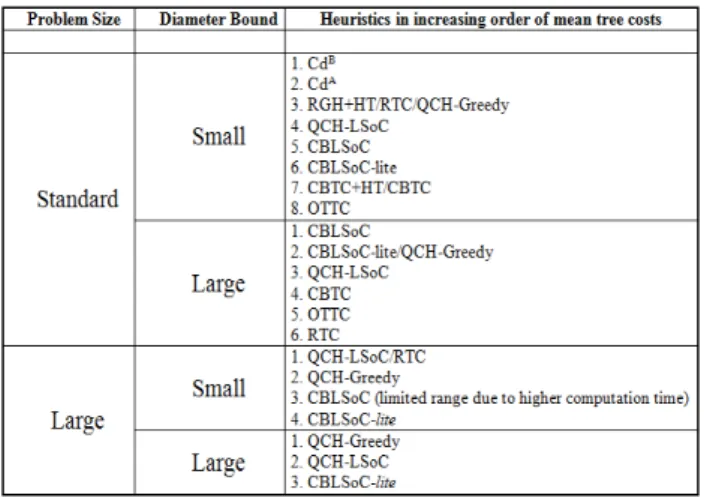
The heuristics presented in this work are classified in fig-ure 2 into two categories, those that work on “standard” sized problems and those that are also able to solve large problem instances in reasonable time, and then ranked in increasing order of mean tree costs obtained as the diame-ter bounds go from small/tight to large/relaxed. Heuristics that perform competitively in a particular range share the same rank.
Figure 2:Performance-based ranking of the heuristics
The OTTC heuristic produces spanning trees with larger costs, because it always uses low cost edges to build the tree, thus necessitating the later vertices to be appended to the tree through higher cost edges. As computational re-sults show, this drawback is especially obvious when the diameter bound is small. The CBTC heuristic is faster and obtains lower cost BDSTs, but it also uses the same greedy premise as OTTC and hence suffers from the same draw-backs.
has a running time of O(n2), outperforms OTTC on ev-ery instance and produces lower mean costs vis-à-vis the CBTC heuristic on several instances. On problem instances with small diameter bounds, the randomized heuristic RTC outperforms the other extant heuristics, but this does not hold true when the diameter bound is increased. The proved RGH+HT and CBTC+HT heuristics are able to im-prove the solution quality as compared to RTC and CBTC, but they retain the drawbacks inherent in both these heuris-tics, thus rendering the RTC variant unsuitable for larger diameter bounds, and the CBTC variant unsuitable for low diameter bounds. The hierarchical clustering-based heuris-tic returns the lowest cost BDSTs on standard problems for very small diameter bounds, but its performance worsens with increasing diameter bound.
The proposed QCH heuristics compare favorably with RTC on low diameter bounds, and generally do better than all the other heuristics as the diameter constraint is relaxed. Furthermore, the lower running time requirements of the CBLSoC-lite heuristic and the QCH heuristics means that they can be used effectively for solving much larger prob-lems than have been hitherto attempted.
Acknowledgements
The authors are extremely grateful to the Revered Chair-man, Advisory Committee on Education, Dayalbagh for the continuous guidance in all their endeavors. The authors also thank Prof. Bryant A. Julstrom, St. Cloud State Uni-versity, Minnesota, USA for providing the extended suite of problem instances for the BDMST problem.
References
[1] Gruber, M. and Raidl, G.R. (2009) Solving the Eu-clidean Bounded Diameter Minimum Spanning Tree Problem by Clustering-Based (Meta-) heuristics.In: R. Moreno-Diaz et al., (Eds.), EUROCAST 2009, LNCS 5717, Springer, pp. 665-672.
[2] Raymond, K. (1989) A tree-based algorithm for distributed mutual exclusion,ACM Transactions on Computer Systems, ACM, Vol. 7 (1), pp. 61-77.
[3] Bala, K., Petropoulos, K., Stern, T.E. (1993) Multi-casting in a linear lightwave network, IEEE INFO-COM’93, IEEE Press, pp. 1350-1358.
[4] Bookstein, A., Klein, S.T. (1996) Compression of correlated bit-vectors,Information Systems, Elsevier, Vol. 16(4), pp. 110-118.
[5] Garey, M.R, Johnson, D. S. (1979) Computers and Intractibility: A Guide to the Theory of NP-Completeness, W.H. Freeman, New York.
[6] Kortsarz, G., Peleg, D. (1997) Approximating shallow-light trees,Eighth ACM-SIAM Symposium on Discrete Algorithms, pp. 103-110.
[7] Achuthan N.R. and Caccetta L. (1992) Minimum weight spanning trees with bounded diameter, Aus-tralasian Journal of Combinatorics, University of Queensland Press, Vol. 5, pp. 261–276.
[8] Achuthan N. R., Caccetta L., Caccetta P., and Geelen J. F. (1994) Computational methods for the diame-ter restricted minimum weight spanning tree problem, Australasian Journal of Combinatorics, University of Queensland Press, vol. 10, pp. 51-71.
[9] Gouveia L. and Magnanti T.L. (2003) Network flow models for designing diameter constrained minimum spanning and Steiner trees,Networks, Wiley, Vol. 41, no. 3, pp. 159–173.
[10] Deo N., and Abdalla A. (2000) Computing a Diameter-Constrained Minimum Spanning Tree in Parallel,Italian Conference on Algorithms and Com-plexity, CIAC-2000, Springer, LNCS1767, pp. 17–31.
[11] Julstrom B.A. (2009) Greedy heuristics for the bounded diameter minimum spanning tree problem, Journal of Experimental Algorithmics, ACM, vol. 14, no. 1, pp. 1-14, February 2009.
[12] Singh A. and Gupta A.K. (2007) Improved heuris-tics for the bounded-diameter minimum spanning tree problem,Soft Computing – A Fusion of Foundations, Methodologies and Applications, Springer, vol. 11, no. 10, pp. 911–921.
[13] Singh A. and Saxena R. (2009) Solving bounded diameter minimum spanning tree problem with im-proved heuristics,ADCOM 2009, pp. 90-95.
[14] Gruber M. and Raidl G.R. (2009) Exploiting hierar-chical clustering for finding bounded diameter mini-mum spanning trees on Euclidean instances,Genetic and Evolutionary Computation Conference, Springer, Montreal, Canada, pp. 263-270.
[15] Patvardhan C. and Prakash V. P. (2009) Novel Deter-ministic Heuristics for Building Minimum Spanning Trees with Constrained Diameter, Pattern Recog-nition and Machine Intelligence, Springer-Verlag, LNCS 5909, pp. 68-73, December 2009.
[16] Patvardhan, C.; Prakash, V.P.; Srivastav, A. (2014) Parallel heuristics for the bounded diameter mini-mum spanning tree problem,India Conference (INDI-CON), 2014 Annual IEEE, IEEE Press, pp.1-5, 11-13 Dec. 2014. (doi: 10.1109/INDICON.2014.7030575)
[17] Handler, G. Y. (1978) Minimax location of a facility in an undirected graph, Transportation Science, IN-FORMS, pp. 287–293, 7, 1978.
EA, and ACO,M. Keijzer et al., Eds., Proceedings of Genetic and Evolutionary Computation Conference 2006, Springer-Verlag, vol. 2, pp. 1187-1194.
[19] Prim, R.C. (year) Shortest connection networks and some generalizations,Bell System Technical Journal, vol. 36, pp. 1389-1401.
[20] Raidl G.R. and Julstrom B.A. (2003) Greedy heuris-tics and an evolutionary algorithm for the bounded di-ameter minimum spanning tree problem,ACM Sym-posium on Applied Computing, ACM Press, pp. 747-752.
[21] Julstrom B.A. and Raidl G.R. (2003) A permutation-coded evolutionary algorithm for the bounded-diameter minimum spanning tree problem, Genetic and Evolutionary Computation Conference’s Work-shops Proceedings, Workshop on Analysis and De-sign of Representations, pp. 2–7.
[22] Binh H. and Nghia N. (2009) New multiparent recom-bination in genetic algorithm for solving bounded di-ameter minimum spanning tree problem,First Asian Conference on Intelligent Information and Database Systems, pp. 283-288.