Affirmative action in procurement for open
standards and FLOSS
Mathieu Paapst
a(a) Teacher/researcher, Center for Law and IT, University of Groningen, the Netherlands.
DOI: 10.5033/ifosslr.v2i2.41
Abstract
The Dutch action plan Netherlands Open in Connection intends to give a direction for public sector buyers to adopt a positive policy and strategy towards open standards and Free/Libre Open Source Software (“FLOSS”). This policy seems to indicate a preferred position on open source products, however it actually gives no guarantee that providers of FLOSS will get the opportunity to make a competitive offer. For this to be the case there ought to be a 'level playing field' for the FLOSS suppliers and closed source suppliers. However an empirical study carried out between January and June 2010 shows that despite the desired affirmative action for open source products, in almost half (47.5%) of the tenders there is still a preference for closed source vendors or products. This preference inevitably results in not giving vendors of FLOSS a fair chance to win the bid.
Keywords
Public procurement; information technology; Free/Libre and Open Source Software
Info
This item is part of the Articles section of IFOSS L. Rev. For more information, please consult the relevant section policies statement. This article has been independently peer-reviewed.
In December 2007 the Dutch government agreed on the action plan Netherlands Open in Connection, hereafter called NOiV, the Dutch acronym. The objectives of this action plan are the following:
2. reduction of supplier-dependence through a faster introduction of open source software and open standards;
3. promotion of a level playing field in the software market, promotion of innovation and of the economy by forceful stimulation of the use of open source software, and by giving preference to open source software during the process of IT acquisition.
To reach these goals the action plan described a number of policies for open standards and open source software. A vast number of these policies directly affected the process of IT procurement within government organisations. A central question for research has been selected: How and under what circumstances does a policy like the action plan NOiV influence behaviour regarding the practice of public tenders?
A subsidiary question is: “Does European procurement law give a fair chance to vendors of FLOSS software or do we need a affirmative action in order to guarantee fair competition?”
Dutch principles and policies
The action plan NOiV describes three principles for the acquisition of FLOSS by organisations in the (semi) public sector.
Principle 1: Open source is not mandatory, but its use should be strongly encouraged.
This principle primarily intends to give a direction for politicians and civil servants to adopt a positive policy and strategy towards open source software. It means that organisations in the (semi) public sector, although not required to choose open source software in all cases, are expected to promote the use of open source software within their organisation. By January 2010 they had to develop an implementation strategy for the procurement, purchase and use of open source software. The political administrative preference for open source software then needed to be translated into that strategy.
Principle 2: Open source software should be preferred if it is equally suitable.
This principle intends to give a direction for government buyers to adopt a positive policy and strategy towards open source software. A possible way to do this is to prescribe weighted award criteria that create a preference for vendor independent solutions. Award criteria in a tender shall be clear and unambiguous and the assessment method must be verifiable, transparent and objective.1 It is therefore important for public sector buyers to clarify the conditions required for
the IT solution in advance in order that suppliers will be put in a position to submit their strongest bids ans obtain the highest number of points they can. As long as they relate to the object of the tender the tendering organisation is free to apply various criteria to determine the most economically advantageous offer, including so-called vendor independent award criteria.
The following are examples of vendor independent award criteria:
• The software is database independent and works with databases of several suppliers, including open source databases.
• The user interfaces are browser independent.
• The software can run on more than one operating system (eg. Windows, Linux or Apple).
• Support for the software can be delivered by several (independent) suppliers.
• There are one or more independent user groups or free accessible communities involved in the further development of the software.
• The software uses open specifications and standards.
• The legal terms of use refer to aspects such as availability of the source code and the conditions for modification and distribution of the software.
Determining the weight of such award criteria in terms of percentage could also be included in the implementation strategy document. If an organisation actually prefers supplier independent software they can use a high weighting for these criteria. Although the criteria do not exclude closed source proprietary solutions, they can value a bid using FLOSS and open standards more than an equivalent and equally suitable bid using closed source proprietary software.
Principle 3: Providers of open source software should have the same opportunities as providers of closed source software.
Although the two principles discussed above seem to indicate a preferred position for Free and Open source software at first glance, they actually give no guarantee whatsoever that providers of FLOSS will get the opportunity to make a competitive offer. For this to be the case there ought to be a 'level playing field' for the Free and open source software providers and the closed source software suppliers. The action plan mentions this in the following way:
“The Cabinet wants procurement and purchasing processes of software to give the same opportunities to providers of open source software (...).” 2
This is a surprising admission by the Dutch government: that the current European procurement laws and procedures have not yet accomplished the creation of this level playing field in the software market and are therefore, one could argue, not realizing their initial goal which is stimulating competition in order to complete the European single market.
Dutch vendors of proprietary closed source software however argued that the preference of the Dutch government for Free and Open source software is in fact a violation of European procurement laws.3
2 Actionplan Netherlands Open in Connection, p.17
http://www.whitehouse.gov/files/documents/ostp/opengov_inbox/nl-in-open-connection.pdf
Research
To see if European procurement law does give a fair chance to vendors of FLOSS empirical quantitative research was carried out which asked for the data of 94 Dutch calls for tender, published between January and June 2010, that followed the open procedure and that consisted of the delivery of software of some kind.4 Out of the total sample of 94 calls, data relating to 80
tenders was received, a response rate of 85,1%.
All these tender documents were examined on 25 different aspects, such as the needs or wants for open standards, vendor independent award criteria, the possibility to use ODF (a document format based on an open standard) for the bid and the possible preference for open or closed source products.
Results
The following results emerged:
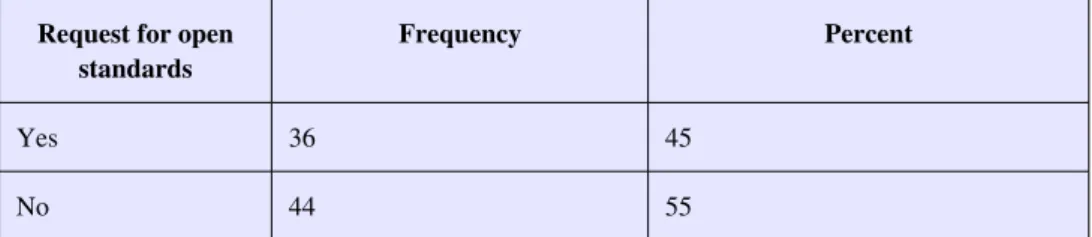
In 36 cases (45%) the tender documents mentioned a need or want for open standards in general. In the remaining 44 cases open standards were not requested. This is not a very positive result considering the fact that it has been Dutch policy to ask for open standards since 2002 when the Dutch Parliament adopted the motion “Vendrik.” 5 Under that motion the government was asked to
ensure that by 2006 all public sector software used open standards. To reach this ambitious goal it would seem necessary to ask for open standards in all public sector tenders.
Request for open standards
Frequency Percent
Yes 36 45
No 44 55
Table 1: Frequency of needs and wants for open standards
The possibility of a vendor using the odt (ODF) format for his bid was considered. According to the action plan all the ministries and subsidiary government bodies should be able to receive documents in the ODF open standard by January 2009 at the latest.6
In almost half of the cases (45%) the use of ODF was possible. In the other 46.2% it was not
4 The tenders that asked for Voice over IP technologies or printer hardware with printer drivers were not included in the sample of 95 tenders due to technical expertise limitations.
5 Lower Chamber, 2002/2003, 28 600 XIII, nr. 30 (Dutch) The motion, named after its initiator Kees Vendrik,who is a former member of Dutch parliament, also asked for ambitious steps to ensure the preference and stimulation of FLOSS.
possible, however this was mainly caused because the tendering organisation demanded the use of the PDF format. Only in one case both PDF and ODF were not possible because a vendor was obliged to use a Microsoft Word and excel format suitable for Windows XP.
In the 7 remaining cases (8.8%) a digital bid was not requested by the tendering organisation.
Possibility of using ODF
Frequency Percent
Yes 36 45
No 37 46.2
n/a 7 8.8
Table 2: Frequency of possibilities to deliver the bid in ODF
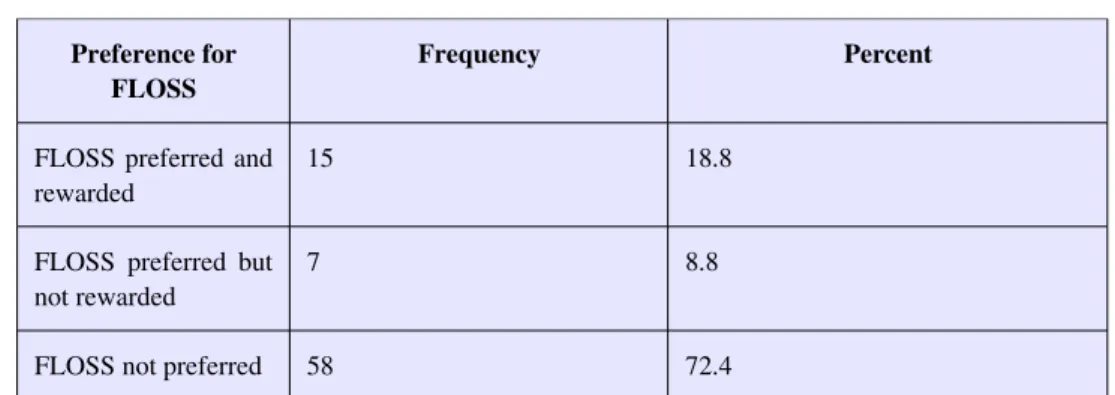
Preference for FLOSS
Frequency Percent
FLOSS preferred and rewarded
15 18.8
FLOSS preferred but not rewarded
7 8.8
FLOSS not preferred 58 72.4
Table 3: Preference for FLOSS
The tender documents were examined for a preference for closed source software, and in particular a preference for a named closed source product or vendor. The mere use of a trademark or product name in public procurement (which is actually a widespread practice)7 was not, by itself,
considered sufficient to demonstrate such a preference. In lots of cases trademarks and product names are used to describe both the current architecture and the software the new solution has to integrate with.8 For the purpose of this study, such a use of trademarks and product names was not
taken to have established a clear preference for a product or vendor, although one could argue that it becomes a discriminating preference the moment compatibility is required with previously purchased proprietary software, especially if the technical specifications needed for that compatibility are not publicly available and freely usable.9
For the purposes of this study, actual discriminatory use of trademarks, patents, types, and legal and technical conditions in relation to the vendor or product which was the subject of the procurement needed to be present in order to establish a preference for closed source vendors or products. In 29 cases (36.2%) a clear preference for a named closed source product or a closed source vendor was found. Accordingly in these 29 cases other vendors than the preferred one did not have a fair chance to win a bid.
7 See e.g. OpenForum Europe, 2008. “OFE Monitoring Report: Discrimination in Public Procurement Procedures for Computer Software in the EU Member States”, where 34 out of 136 tender notices mention trademarks in procurement documents. http://www.openforumeurope.org/press-room/press-releases/procurement-study-release.pdf
8 According to Rishab Gosh et al, “Guidelines on Public Procurement of Open Source Software”, this might not be a legitimate functional requirement according to article 23 (8) of the Directive 2004/18/EC since software can usually be described in terms of standards and functionality.
9 In decision T-345/03 of 12/03/2008 the Court of first instance of the European Community considers that the Commission infringed the principle of equal treatment as between tenderers by failing to make available to all the prospective tenderers from the beginning of the tendering procedure the documentation relating to the technical architecture and source code and that that infringement could thus have affected the award of the contested contract.
Preference for closed source vendor or product
Frequency Percent
Yes 29 36.3
No 51 63.7
Table 4: Preference closed source vendor or product
In practice there are many examples of discriminatory criteria used to give a preferred position to named closed source proprietary software or vendors, including:
1. Asking for a named product or licence of a named product (eg. tender for Windows licenses)
2. Asking for a reseller of either licences of the closed source installed base or new named closed source software.
3. The vendor must be a certified and recognised partner of a named closed source product.
4. The vendor must have an agreement with Microsoft for technical support on the product.
5. The product must be certified by a named closed source vendor.
6. The vendor must deliver a new product and have permission to expand the closed source installed base.
7. The vendor must employ Microsoft certified employees.
8. Asking for an operating system that can be downgraded to Windows XP.
9. Asking for an operating system that can be used together with the Microsoft Campus Agreement.
10. Tendering for hardware (e.g. laptops) while also asking for named software (in most cases Microsoft) to be installed on that hardware.
In two of these 29 cases the tendering organisations actually mentioned that they had a preference for a named closed source product and vendor.
Finally some of the other criteria that could prevent vendors, and in particular FLOSS vendors, from making a bid and having a fair chance of winning were considered. In 9 other cases restrictions were found that made it very difficult or impossible for vendors to offer a FLOSS product.
Some examples of these criteria are the following:
2. The vendor has to be the copyright owner.
3. Extra points are to be awarded if interoperability with a named closed source product is already integrated within the offered product.
4. Not allowing licences to be offered for a “zero-price”.
5. Demanding that offered applications must be certified by Microsoft, are Oracle 10 compliant and use the official Microsoft style guide as much as possible.
Restrictions preventing fair
competition
Frequency Percent
Yes 38 47.5
No 42 52.5
Table 5: Frequencies of restrictions for FLOSS vendors
This shows that despite the desired affirmative action for Free/Libre and Open Source Software in almost half (47.5%) of the sampled tenders there was still a preference for closed source vendors or products. This preference inevitably results in vendors of FLOSS products not receiving a fair chance to win the bid.
The last question to be considered was whether or not it would make any difference to the prevalence of these restrictions if a tender was organised completely by the tendering organisation itself or if the procurement process was “outsourced” to an external advisor or company. A reasonable hypothesis would be that the external advisors, who are presumably all experts in the field of procurement, would do better in following the EU directives. After comparing the numbers this hypothesis proves to be wrong. In 36.7% of the sixty internally guided procedures there were restrictions on FLOSS vendors or products. In the twenty externally guided procedures however, these restrictions were found in 80% of the cases.
Restrictions preventing fair
competition
Internal (N=60) External (N=20)
Yes 22 (36.7%) 16 (80%)
No 38 (63.3%) 4 (20%)
Conclusion
About the author
Mathieu Paapst holds a masters degree in Law and IT and works as a lecturer and PhD-researcher at the Center for Law and IT, University of Groningen. He is interested in legal and social aspects of IT procurement, copyright licensing and e-Health, and has been publishing about open standards and free software since 2005.
Licence and Attribution
This paper was published in the International Free and Open Source Software Law Review, Volume 2, Issue 2 (December 2010). It originally appeared online at
http://www.ifosslr.org. This article should be cited as follows:
Paapst, Mathieu (2010) 'Affirmative action in procurement for open standards and FLOSS', IFOSS L. Rev., 2(2), pp 181 – 190
DOI: 10.5033/ifosslr.v2i2.41
Copyright © 2010 Mathieu Paapst.
This article is licensed under a Creative Commons UK (England and Wales) 2.0 licence, no derivative works, attribution, CCBYND.
As a special exception, the author expressly permits faithful translations of the entire document into any language, provided that the resulting translation (which may include an attribution to the translator) is shared alike. This paragraph is part of the