From Composition Filters to AspectJ:
A Platform Speci
fi
c Model
Transformation
Djamel Meslati
1, Mohamed T. Kimour
1and Sa¨
ı
d Ghoul
2 1Laboratory of Research on Computer Science (LRI), University of Annaba, Algeria 2Computer Science Department, Philadelphia University, Amman, JordanBoth model-driven architecture (MDA) and aspect-oriented programming(AOP)are promising paradigms that are very attractive for the software engineering com-munity. While the former is an approach to application design and implementation using models as first class entities, the latter advocates the separation of concerns as an approach to tackle most software development and maintenance problems. MDA and AOP can be related in various ways and their combination seems to be a promising issue. In this article, we focus on the transformation of two AOP approaches, composition filters(CF)and ASPECTJ, considered as platform specific metamodels within the MDA context. We propose a transformation of CF models into ASPECTJ models using a syntax-directed translation and a set of transformation templates. In addition to being easy to implement, our transformation approach covers the most important concepts of CF.
Keywords: aspect-oriented programming,ASPECTJ,
com-position filters, model-driven architecture, model trans-formation.
1. Introduction
Model-driven architecture is an approach to sys-tem development that provides means for us-ing models to direct the course of systems un-derstanding, design, construction, deployment, operation, maintenance and modification 18].
The core concepts of MDA are models, meta-models and transformations. A model is a rep-resentation of a part of the function, structure and/or behavior of a system. A model
spec-ification can be formal when it is based on a language that has a well defined syntax, seman-tics and possibly rules to analyze its constructs 17]. Under this definition, a source code is a
model that has the salient characteristic that it can be executed by a machine 7, 16, 17].
A metamodel is a special kind of model that specifies the abstract syntax of a modeling lan-guage. In the MDA context, each model is an instance of a metamodel that is described
us-ing the OMG MOF(Object Management Group
Meta Objet Facility) 19]. A transformation is
the process that converts one model to another model of the same system according to some description which, in turn, is a model and an instance of some metamodel 14, 18].
Broadly speaking, MDA is an approach where models are first class entities 8, 14]. A software
system can be seen as a collection of models of various abstraction levels where each describes the system from some viewpoint and, conse-quently, most engineering tasks can be consid-ered as modeling and transforming models. In order to promote interoperability and porta-bility, the MDA approach puts the emphasis on two kinds of models with respect to specific platforms: the platform independent models
(PIM)and the platform specific models(PSM).
Within each of these abstractions, there can be a number of refinements(for example, many
lev-els of platform independent modlev-els) 14]. For
JAVAmodel which is specific to a JAVAplatform
(i. e. the JAVA virtual machine). Notice that a
“platform specific” is meaningful only relative to a particular point of view 8]. For example,
the JAVAprogram is a PSM when considering a specific JAVA platform, while it is a PIM when considering the specific operating systems on which the JAVAvirtual machine is implemented. In the MDA approach, transformations can be of various types such as merging or composing models, but usually they convert models offer-ing a particular view from one level of abstrac-tion to a less abstract one(e.g. PIM to PSM or
PIM to PIM), by adding more details supplied
by the transformation rules 14].
Transforma-tions between models are needed because: Metamodels use various modeling concepts and notations to highlight one or more views within a model, depending on what is rele-vant at any point in time 18].
Metamodels influence the modeling task and the perception we have of the real world. Thus it is beneficial to use various metamod-els to capture the real world subtle situations during the engineering tasks 8].
According to “divide and conquer” princi-ple, the engineering tasks can be simpli-fied if complex system models are com-posed or merged from less complex models using transformations that supply necessary details.
In this article, we focus on the transformation of two AOP approaches, CF and ASPECTJ, by considering them as two platform specific meta-models within the MDA context. This work is a part of an ongoing one that aims to construct an MDA environment where software developers can use multiple AOP metamodels, during the engineering tasks, and freely switch from one another, using automated tools that preserve the concerns’ traceability.
AOP is a particular separation of concerns ap-proach(SOC), where a system can be seen as
composed of business logic and concerns such as synchronization, security, persistence, etc. It is now commonly admitted that an appropri-ate separation of concerns have an influence on the development and maintenance processes. It reduces the software complexity and code tan-gling, facilitates reuse, improves
comprehen-sibility, simplifies component integration and decreases invasive changes 2, 12, 20].
Today, a large amount of literature is devoted to three SOC approaches: composition filters
(CF) 5], ASPECTJ 12] and hyperspace
ap-proach 20]. They aim at providing better
con-cepts and mechanisms to appropriately sepa-rate the software concerns from the business logic. Unfortunately, each approach has its own philosophy and concepts. An approach might be suitable from some point of view, but in-appropriate from another. Consequently, pro-viding an environment where multiple AOP ap-proaches can be used simultaneously is a worthy goal. This article is an attempt towards this goal that focuses only on the transformation of CF models to ASPECTJ models. Our interest in CF and ASPECTJ results from the fact that they are both AOP approaches.
The remainder of this article is composed of six sections. Sections 2 and 3 describe, re-spectively CF and ASPECTJ metamodels in an intuitive way. In section 4 we give the motiva-tions of the work and in section 5 we present CF to ASPECTJ transformation. Section 6 dis-cusses related work, and section 7 conclusion and future work.
2. The Composition Filters Metamodel
2.1. Principle and Goals
CF considers a system as a set of objects that interact with each other to achieve a common task. Most interactions are done by sending and receiving messages and CF intervenes during these interactions 3, 6]. It provides an object
with an interface containing filters that inter-cept and manipulate messages in various forms, modifying their scope and expected behavior. The former consists of delegating messages to other objects (i. e. changing the target object
to which the message is sent), whereas the
lat-ter consists of substituting a message selector with another (i. e. replacing the name of the
method to be called with the name of another one to be called instead). By controlling
mes-sages(changing their targets and/or selectors)
and through a well-constructed interface, CF provides suitable solutions to many problems
Dynamic inheritance by enabling and dis-abling inheritance relation between classes at runtime
Modeling of state dependent behaviors where the behavior of an object changes according to its state
History sensitivity where the behavior of an object depends on its previous behaviors Providing multiple views of the same object
(see example in 2.3)
Behavior coordination and synchronization Tracing of programs during the development One of the CF strengths is the use of a uniform filtration mechanism to resolve the above prob-lems. From this point of view, CF is easy to understand and work with as it only adds few concepts to the object metamodel.
2.2. Basic Concepts
CF adds to an object a wrapping layer called
interface that traps incoming and outgoing
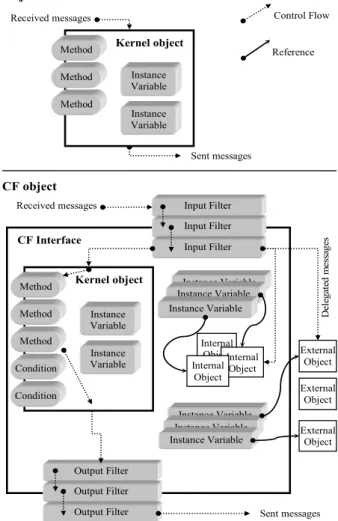
messages. Figure 1 depicts the contents of an interface added to a kernel object. We refer to object or class with a CF interface by CF object
(respectively CF class).
A CF interface is composed of the following parts:
Internal objectsare objects whose methods are used to compose the behavior of the CF object. Messages received by a CF object can be delegated to internal objects instead of the kernel object. Internal objects are en-capsulated in the CF object and cease to exist when the CF object is garbage collected. External objectare almost like internal ob-jects. However, they are supposed to exist on their own and their references are passed on to the CF class constructor during instan-tiation. These references are assigned to the corresponding CF instance variables. Methods: Contains all the public methods of the kernel class.
Conditions: Conditions are specific meth-ods without parameters that supply informa-tion about the context of a call and the kernel state without changing them 6].
Inputfilters: A set of declarative specifica-tions that handle the incoming messages. Outputfilters: A set of declarative specifi-cations that handle the outgoing messages.
Received messages
Sent messages
Object without filters
Kernel object
Instance Variable Method
Method Method
Instance Variable
CF Interface
Internal Object I t Internal Object Internal
Object
External Object
External Object
External Object Input Filter
Input Filter
Input Filter
Output Filter
Output Filter
Output Filter
Instance Variable Instance Variable Instance Variable
Instance Variable Instance Variable
CF object
Kernel object
Instance Variable Method
Method Method
Condition
Condition
Instance Variable Received messages
Sent messages Instance Variable Delega
te
d m
essa
ge
s
Control Flow
Reference
Fig. 1.An object before and after adding a CF interface.
The signature of a CF object is the set of pub-lic methods that it responds to. This includes public methods of the kernel class and public methods of the internal/external objects. In the
case where two methods have the same name, that of the kernel or the internal/external
ob-ject declared first in the interface, hides the other. Within a CF object, the kernel and in-ternal/external objects are called targets. The
target of a message is determined by the CF object itself when a message is received and becomes a data accessible to filters.
is first reified(i. e. the method selector becomes
accessible and target determined), then passes
each filter in the set until it is discarded or dis-patched. Discarding a call raises an exception, whereas dispatching consists of:
Activating the corresponding method in the kernel or internal/external objects, or
Substituting it with a call to another method in the kernel or internal/external objects and
activating it.
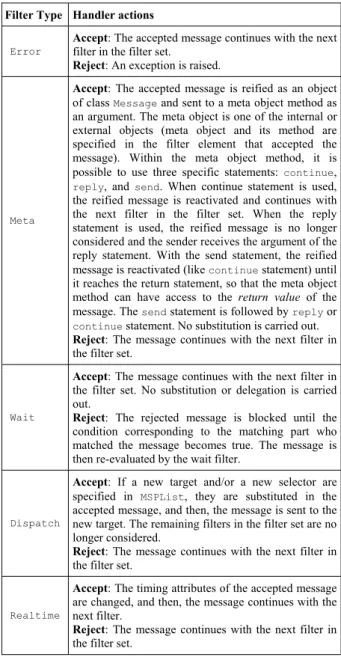
Each filter can accept or reject a call with an effect depending on the semantic of its type. Accept may imply dispatching or simply ig-noring the message which, then, passes to the next filter. Reject may imply that a message is discarded, queued as long as the filter expres-sion results in a rejection, or merely ignored(i.
e. the message continues with the next filter,
(see Table 1). There are five commonly used
filter type: Error, Dispatch,Wait, Meta, and
RealTime 5]. Each type deals with a certain
category of concerns, but in general a filter set contains more than one type. Wait is used to
model synchronization concerns, Meta allows
the reification of a message so that access to its arguments, sender, receiver, return value, be-comes possible andRealtimedeals with timing
constraints. ErrorandDispatchare used alone
or in combination with other filter types to al-low the modeling of various concerns. All filter types can be used in input and output filters,
ex-ceptDispatchwhich is used only in input filters.
In many CF articles, authors consider that out-put filters operate almost like inout-put filters and do not require specific treatment. Moreover, the object-oriented paradigm tends to adopt a client/server model where the server
respon-sibility is prevalent. Therefore, concerns are usually related to servers rather than scattered among several clients(i. e. modeled in an
in-put filter set rather than in several outin-put ones 4]). For these reasons, output filters are not
considered in this article.
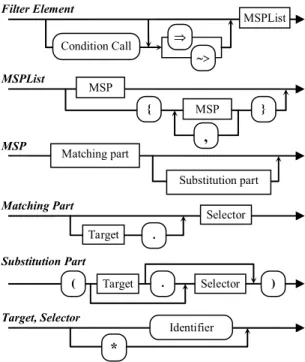
To enhance the descriptive power of CF, each filter is composed of several elements calledfi l-ter element(FE)that have the following form:
Filtername : Type = fFilterElement,
FilterElement, :::g
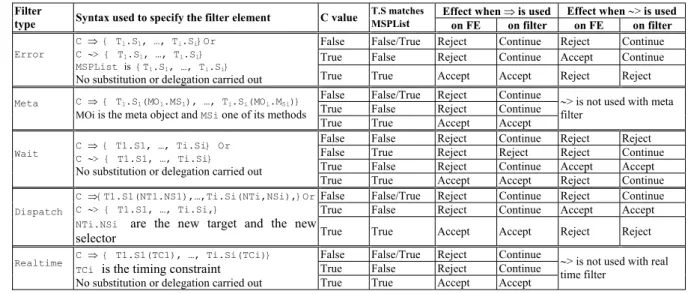
An incoming message passes through each fil-ter element which accepts or rejects it. Again, reject or accept meaning depends on the filter
type (see Table 2). Each filter element
speci-fies a condition Cand a list of pairs(matching
part, substitution part). We call it MSPListfor
short. A FE accepts a call if the condition is true and if the call matches the MSPList. Figure 2
depicts the syntactic diagrams corresponding to different forms of filter elements.
To simplify the filter set specification, CF pro-poses two operators )and >called
respec-tively inclusion and exclusion operators. C)
MSPListmeans that when the conditionCis true,
any message that matches MSPListwill be
ac-cepted. C > MSPList means that when the
condition Cis true, all messages, except those
inMSPList, will be accepted.
In the following, we use two filter examples to illustrate the syntactic diagrams of Figure 2.
Matching part MSP
Substitution part
) Selector Target
( .
Substitution Part
Selector Target .
Matching Part MSP
MSP
{ }
,
MSPList Filter Element
a!
Condition Call
MSPList
Target, Selector
*
Identifier
Fig. 2.Syntactic diagrams of filter elements.
As an example, let err be an Error filter
de-fined in the CF interface of a class called Ker. FEstands for filter element,Cfor condition and Sfor message selector.
err : Error = { c1 { s1, s2 }, c2a>{s4}, c3a> *, a> s5 }
FE1 FE2 FE3 FE4
FE1 specifies that whenC1 is true, only calls to
is true, only the call S4 is rejected. FE3 has a “*” as a selector to specify that any message is rejected whenC3 is true. FE4 rejects all calls to
S5.
Now, let us consider a dispatch filterdistr
de-fined in the CF interface of classKer. ntstands
for a new target.
distr : Dispatch = { c1 { s1(nt1.ns1), s2 }, {s3},
c2 { s4(nt2.*) , *(nt3.ns2) }, c3 *(nt4.*) }
FE2 FE1
FE4 FE3
FE1is a filter element with two parts. The first one can be writtenC1)S1(nt1.ns1). It has all
the needed information(i. e. condition, selector,
new target and new selector) and specifies that
whenC1is true, messages having selectorS1are delegated to methodns1of objectnt1, which is an internal or external object. The second part can be writtenC1 )S2, it means that messages
having selectorS2are accepted and executed by the kernel object itself. FE2 lacks a condition and an operator. In this case, default valueTrue
and inclusion operator are assumed instead. FE3 has a “*” as message selector. In the beginning “*” means accept any message and instead of the new selector it indicates that selectorS4will remain unchanged (i. e. the new selector is S4
itself).FE4specifies that when the conditionC3
is true, any call to any methods is delegated to
nt4 using the same selector. nt1,nt2,nt3 and
nt4must be internal or external objects. Table 1 summarizes the acceptance and rejection mean-ing for a filter accordmean-ing to its type. Table 2, shows when a filter element accepts or rejects a message and the effect on the filter level(see
4]for more details).
In Table 2, we consider that an incoming mes-sage hasTas the target object andSas selector.
According to the value of condition C, and if
there is a matching with MSPList, the effect
on the filter element will be to accept/reject a
call and, in turn, this will have an effect on the whole filter, which may accept or reject the call or merely let the message continue with the next FE.
2.3. Example
As an illustration, let us consider an Email sys-tem example. The syssys-tem is composed of four classesSender,Recipient,DeliveryAgent, and the main class called Email which is partially
shown in listing 1.
Filter Type Handler actions
Error
Accept: The accepted message continues with the next filter in the filter set.
Reject: An exception is raised.
Meta
Accept: The accepted message is reified as an object of class Message and sent to a meta object method as an argument. The meta object is one of the internal or external objects (meta object and its method are specified in the filter element that accepted the message). Within the meta object method, it is possible to use three specific statements: continue,
reply, and send. When continue statement is used, the reified message is reactivated and continues with the next filter in the filter set. When the reply statement is used, the reified message is no longer considered and the sender receives the argument of the reply statement. With the send statement, the reified message is reactivated (like continue statement) until it reaches the return statement, so that the meta object method can have access to the return value of the message. The send statement is followed by reply or
continue statement. No substitution is carried out. Reject: The message continues with the next filter in the filter set.
Wait
Accept: The message continues with the next filter in the filter set. No substitution or delegation is carried out.
Reject: The rejected message is blocked until the condition corresponding to the matching part who matched the message becomes true. The message is then re-evaluated by the wait filter.
Dispatch
Accept: If a new target and/or a new selector are specified in MSPList, they are substituted in the accepted message, and then, the message is sent to the new target. The remaining filters in the filter set are no longer considered.
Reject: The message continues with the next filter in the filter set.
Realtime
Accept: The timing attributes of the accepted message are changed, and then, the message continues with the next filter.
Reject: The message continues with the next filter in the filter set.
Table 1.The filter handler actions.
Sender, Recipient and DeliveryAgent are
threads that coordinate their behavior using a
bounded buffer synchronization schema. A
Sender thread creates an Email object, fills in
the content, indicates the address and puts it in
Effect when is used Effect when a> is used Filter
type Syntax used to specify the filter element C value
T.S matches
MSPList on FE on filter on FE on filter
False False/True Reject Continue Reject Continue
True False Reject Continue Accept Continue
Error
C { T1.S1, …, Ti.Si}Or
C a> { T1.S1, …, Ti.Si}
MSPList is {T1.S1, …, Ti.Si}
No substitution or delegation carried out True True Accept Accept Reject Reject False False/True Reject Continue
True False Reject Continue
Meta C { T1.S1(MO1.MS1), …, Ti.Si(MOi.MSi)}
MOi is the meta object and MSi one of its methods
True True Accept Accept
a> is not used with meta filter
False False Reject Continue Reject Reject
False True Reject Reject Reject Continue
True False Reject Continue Accept Accept
Wait CC a> { T1.S1, …, Ti.Si} { T1.S1, …, Ti.Si} Or
No substitution or delegation carried out
True True Accept Accept Reject Continue
False False/True Reject Continue Reject Continue
True False Reject Continue Accept Accept
Dispatch
C {T1.S1(NT1.NS1),…,Ti.Si(NTi,NSi),}Or C a> { T1.S1, …, Ti.Si,}
NTi.NSi are the new target and the new
selector True True Accept Accept Reject Reject
False False/True Reject Continue True False Reject Continue
Realtime C { T1.S1(TC1), …, Ti.Si(TCi)} TCi is the timing constraint
No substitution or delegation carried out True True Accept Accept
a> is not used with real time filter
Table 2.Filter elements acceptance or rejection and their effect on the containing filter.
Emailobject, then delivers it to theRecipient
buffer.
Threads that hold a reference on an Email object can invoke all its methods. Thus, the delivery agent can read the email content; the recipient can stamp the email itself etc. These manipu-lations do not correspond to a correct use of an email in the real world. An Email object should provide multiple views depending on the client type, i. e. the object issuing the call. For ex-ample,readContent()should not be available
to the delivery agent,stamp(:::)should not be
available to recipient and sender, etc.
public class Email {
public void modifyContent(String text){…}
// Modifies the content of the Email with a field of type String public String readContent(){…}
// Returns the Email content
public Boolean deleteContent(){…}
// Deletes the Email content and returns a boolean as an indicator public void setRecipientAddress(Address C){…}
// Address in C becomes the recipient’s address public Address readRecipientAddress(){…} // Returns the recipient’s address
public void setSenderAddress(Address C){…} // Address in C becomes the sender’s address
public Address readSenderAddress(){…} // Returns the sender’s address
public Boolean modifyAttributes(Attributes A){...} // A contains new attributes (urgency mark, number of tries, …)
public void stamp(Date d, Time t){…} }
// Adds the date and time when t he Email was first processed
Listing 1.The Email class.
Multiple views problem has a suitable answer in CF by adding to class Email a CF
inter-face which contains a set of filters enforcing the views.
Threads may invoke anyEmailmethod, but
in-put filters reject or accept the message according to the sender type. Details of the CF interface are given in listing 2.
class Emailinterface {
internals // No internals or externals needed in this case externals
conditions
private Boolean deliveryAgentView() {…}
// Returns true if the client object is of type DeliveryAgent private recipientView() {…}
// Returns true if the client object is of type Recipient private Boolean senderView () {…}
// Returns true if the client object is of type Sender inputfilters
err : Error = {
deliveryAgentView() {readRecipientAddress, readSenderAddress, stamp}, recipientView() { readContent, deleteContent,
readSenderAddress, readRecipientAddress }, senderView() a! { stamp } }
delegate : Dispatch = {true => *(inner.*)} /* All messages that pass errare delegated to the kernel which is called inner */ }
Listing 2.A CF interface for class Email.
In this CF interface, filter err specifies that if the client is of type DeliveryAgent, only
methodsreadRecipientAddress,
readSender-Address and stamp are allowed to pass to the
of the filtererrconsists of only a list of
selec-tors. If the client is of typeSender, all methods
are accepted exceptstamp. Notice that this FE
can be expressed using the inclusion operator and when ignoring inherited methods of class
Email, as follows:
senderView())fmodifyContent,
readCon-tent, deleteConreadCon-tent, setSenderAddress, setRecipientAddress,readRecipientAddress,
readSenderAddress, modifyAttributesg
Thedelegatefilter specifies that all messages,
i. e. those having passed filter err, go to the kernel without changing their selectors.
3. The AspectJ Metamodel
3.1. Principle and Goals
Authors of this approach consider that the code of a given software system contains a base code part (i. e. the business logic) and a concerns
part. The former consists of objects that achieve functionalities of the system, whereas concerns are made of code that crosscut functionalities, like transaction management and synchroniza-tion. In the object-oriented paradigm, concerns are scattered throughout the source code, con-sequently a tangling arises 12].
The AOP approach of ASPECTJ 13]proposes:
To remove this tangling by separating the two parts of a software system: base objects and concerns which are calledaspects.
To weave the two parts by a tool called Weaver to get the executable code. The weaving is done using principled points of the code execution.
Hence, the vision motivating AOP is that one could provide independent specifications for each concern and functionality, and then weave them together to build the resulting system. The AOP approach is appropriate for a wide range of applications. It presents undeniable advan-tages in all applications where security, syn-chronization, transactions management, distri-bution, logging, etc, are considered as concerns and separated from the system base code. AS-PECTJ aims at better modeling real world appli-cations: code is smaller, less tangled and closer to our perception of the real world, and therefore enhances reuse, evolution and maintenance.
3.2. Basic Concepts
ASPECTJ is a general-purpose AOP extension to JAVA. It uses four new concepts: Aspect,
Pointcut, Advice and static crosscutting.
An aspect is an entity that looks like a class, but models a concern that crosscuts several object classes. To understand ASPECTJ approach, let us consider a system during its execution. At each moment, the system evolves toward new states while generating new facts and events like an access to, or change of a variable value, a method call, execution or return, etc. All these observable points calledJoin pointsrepresent
a base code breaking points where aspects can get involved. Everything happens as if the ex-ecution of the base code was interrupted in the join points, giving a way to the aspect code to execute and enforce the concern purposes. Among all join points, only a subset may inter-est a given aspect. The aspect source code speci-fies its meaningful join points usingPointcuts.
Pointcuts are particular forms of predicates that use boolean operators and specific primitives to capture join points and dynamic contextual information.
Several aspects can exist in the same software system and be concerned by the same join points and the same pointcuts. In this case, aspect must be composed using some precedence rules.
The aspect code is divided into blocks called
advices. They are method-like mechanisms
used to declare that a certain code should exe-cute when join points in some pointcut are cap-tured. Three possible relationships, that deter-mine the advice type, bind advices to pointcuts:
before,afterandaround. Thus, if a pointcut
is a call to a method m(), then concerned
as-pects must specify a pointcut that captures the call join point and an advice that executes be-fore or after the call ofm()and even around it.
The around advice can replace the call of m(),
as it can specify instructions that execute before and others that execute after the call. This last possibility is specified by using a special state-ment calledproceed()available only within the
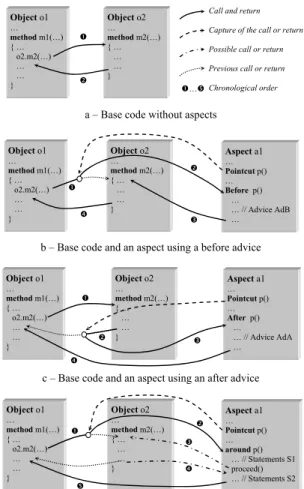
example of two objects where the methodm1()
of objecto1calls the methodm2()of objecto2.
Object o1
… method m1(…) { … o2.m2(…) … … }
Object o2
… method m2(…) { … … … }
Call and return
Capture of the call or return
Possible call or return
Previous call or return
Chronological order n…r
n
o
a – Base code without aspects
Object o1
… method m1(…) { … o2.m2(…) … … }
Object o2
… method m2(…) { … … … }
Aspect a1
… Pointcut p() … Before p() …
… // Advice AdB …
n
o
p q
b – Base code and an aspect using a before advice
Aspect a1
… Pointcut p() … After p() …
… // Advice AdA …
Object o1
… method m1(…) { … o2.m2(…) … … }
Object o2
… method m2(…) { … … … } o p q n
c – Base code and an aspect using an after advice
Object o1
… method m1(…) { … o2.m2(…) … … }
Object o2
… method m2(…) { … … … } Aspecta1 … Pointcut p() … around p() … // Statements S1 proceed() … // Statements S2
n o
p
q
r
d – Base code and an aspect using an around advice
Fig. 3. Alteration of the control flow by an advice.
Figure 3b introduces an aspecta1that intercepts
the call tom2()and executes some adviceAdB
and then resumes the call. Figure 3c shows an aspect that intercepts the control flow after the call tom2()is achieved and executes some ad-viceAdA. In figure 3d, the aspect intercepts the call to m2(), executes some statementsS1,
re-sumes the call to m2()(using proceed())and
before returning tom1(), it executes some other
statementsS2.
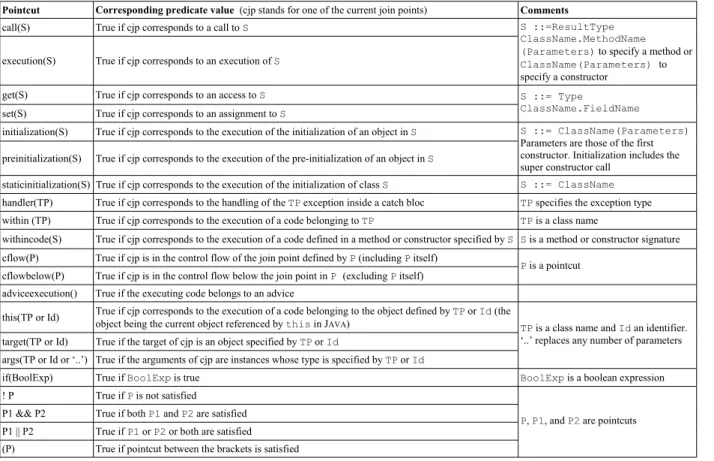
ASPECTJ provides a rich set of primitive point-cuts to specify join points within an aspect. Ta-ble 3 summarizes the predicate meaning of those primitives and their composition.
One of the strengths of advices is that they can access the dynamic contextual information ex-posed by join points(this is calledcontext
ex-posure). For example, pointcuts can capture
the parameters and the target object of a call. For this purpose, we can specify along with advices and pointcuts, parameters that will be bound to values of the current join points. More-over, pointcuts can have an important descrip-tive power by using the wildcard “*” instead of a type, a method, a parameter or as a part of a name. In the same way, “..” is used to spec-ify one or more parameters and “+” to include
subtypes of a class within a specification.
Program Comments public class ComputeFactorial {
public static long factorial(int n) { if (n==0) return 1;
else return n*factorial(n-1);} }
Class ComputeFactorial uses the factorial()method to compute recursively the factorial of an integer n.
public aspect Optimizer { pointcut factOp(int n) :
call(* *.factorial(int)) && args(n);
The first pointcut of this aspect captures calls of factorial() along with its integer argument.
pointcut firstCall(int n) : factOp (n)
&& !cflowbelow(factOp (int)); Captures only non-recursive calls ofIgnoring recursive calls using !cflowbelow() factorial()allows us to cache only the final result. among those of pointcut factOp(). private Cache fCache = new Cache();
/* fCache is private, only this aspect have access to it */
fCache is an object of class Cache that consists of a list of pairs (int,long). The method
get(int) returns a cached value and put(int,long) puts a value in the cache at a position corresponding to the first argument. To save space, this class is not shown.
before(int n) : firstCall (n) { if (n >50) bigValue();}
This before advice checks if the argument of the call is bigger than 50 then calls
bigValue() which raises an exception. For short, this method is not shown. long around(int n) : factOp (n) {
long val = fCache.get(n); if (val != null) return val; return proceed(n); }
This around advice captures the call then checks the cache for the result value and return it if found. When not found, proceed(n) resumes the normal computation flow. Notice that whenproceed() is not executed, the following advice (i.e. after returning) is ignored.
after(int n) returning(long result) : firstCall (n) { fCache.put(n, result); }}
This after returning advice captures the value returned at the end of the execution of
factorial(). It specifies an argument to collect the return value in the returning() part. Then, it uses the context collected from the join point to update the cache.
The last concept of ASPECTJ is the static
crosscuttingwhich modifies a model at
com-pile time. For example, ASPECTJ allows spec-ifying new members that are associated with other classes, as well as specifying what a class extends or implements. The former is called
introduction or inter-type member
decla-ration. Introductions allow an aspect to
spec-ify the concerned classes by using a prefix in the member declaration statement. When present, the prefix indicates one or more classes; other-wise the declared member is local to the aspect.
3.3. Example
Listing 3 shows an example of an aspect, adapted from 15], that optimizes the factorial
compu-tation. First, we have a simple class with a method calledfactorial()which computes re-cursively the factorial of an integer passed as an argument. Second, the aspect captures calls
to factorial()and caches the computed
val-ues for latter use. Now, each time we want to compute a factorial by callingfactorial(), the
aspect captures the call and checks the cache for
the result value and returns it if found. When the result is not in the cache, the normal com-putation flow is resumed. Notice that we can do the same thing by adding optimization code in the classComputeFactorial, but such an im-plementation will tangle the optimization logic with factorial computation logic. By using an aspect, the optimization code is completely separated from the factorial computation code. This allows us to change the caching strategy without affecting theComputeFactorialclass.
4. Motivations
Aspect orientation and MDA can be related in various ways: such as considering aspects and business logic as two kinds of models or con-sidering that a model is made up of aspects and some business logic, and so on 21]. The intent
of this article is not to specify the aspect ori-entation/MDA relationship, but rather to focus
on the transformation of two AOP approaches within the MDA context.
Pointcut Corresponding predicate value (cjp stands for one of the current join points) Comments
call(S) True if cjp corresponds to a call to S
execution(S) True if cjp corresponds to an execution of S
S ::=ResultType ClassName.MethodName (Parameters) to specify a method or ClassName(Parameters) to specify a constructor
get(S) True if cjp corresponds to an access to S set(S) True if cjp corresponds to an assignment to S
S ::= Type
ClassName.FieldName
initialization(S) True if cjp corresponds to the execution of the initialization of an object in S
preinitialization(S) True if cjp corresponds to the execution of the pre-initialization of an object in S
S ::= ClassName(Parameters) Parameters are those of the first constructor. Initialization includes the super constructor call
staticinitialization(S) True if cjp corresponds to the execution of the initialization of class S S ::= ClassName handler(TP) True if cjp corresponds to the handling of the TP exception inside a catch bloc TP specifies the exception type within (TP) True if cjp corresponds to the execution of a code belonging to TP TP is a class name
withincode(S) True if cjp corresponds to the execution of a code defined in a method or constructor specified by S S is a method or constructor signature cflow(P) True if cjp is in the control flow of the join point defined by P (including P itself)
cflowbelow(P) True if cjp is in the control flow below the join point in P (excluding P itself) P is a pointcut adviceexecution() True if the executing code belongs to an advice
this(TP or Id) True if cjp corresponds to the execution of a code belonging to the object defined by object being the current object referenced by TP or Id (the this in JAVA)
target(TP or Id) True if the target of cjp is an object specified by TP or Id
args(TP or Id or ‘..’) True if the arguments of cjp are instances whose type is specified by TP or Id
TP is a class name and Id an identifier. ‘..’ replaces any number of parameters
if(BoolExp) True if BoolExp is true BoolExp is a boolean expression ! P True if P is not satisfied
P1 && P2 True if both P1 and P2 are satisfied P1 || P2 True if P1 or P2 or both are satisfied (P) True if pointcut between the brackets is satisfied
P,P1, and P2 are pointcuts
Although CF and ASPECTJ are grouped within a same category (i. e. AOP approaches) they
are different and both have strengths and weak-nesses. We summarize some of their features in the following.
Description style. The CF allows expression of filters using a declarative style that is easy to understand and work with. In contrast, ASPECTJ has a procedural style, like JAVA, that is based on several new constructs to express concerns. The CF style is useful when dealing with dele-gation of messages and substitution. However, when more complex computations are needed, the ASPECTJ advices are better than the CF meta filter since they have a direct access to the dy-namic contextual information.
Separation among concerns. In CF each filter in the filter set describes one concern. However, in some cases, two or more filters are combined to describe one concern. Consequently, a CF interface tends to describe concerns from the class point of view, i. e. the filter set gives all the concerns where the class is involved. In contrast, an aspect in ASPECTJ may describe a concern that involves several classes(i. e. a
con-cern point of view). When modeling a system,
we need the two points of view since sometimes we may focus on an isolated concern and some-times we may focus on how concerns compose for a given class.
The join point model. ASPECTJ, is provided with a wealthy join point model that allows as-pects to capture calls, access or modification of fields, exception handling and to specify con-cerns in various ways. On the opposite, CF intercepts only the incoming and outgoing calls. The synchronization. While ASPECTJ adopts the JAVAsynchronization mechanism, the CF of-fers a specific filter that allows the description of various synchronization concerns without deal-ing explicitly with the wait and the notify of threads.
According to the previous, concerns that are better expressed in CF are security, synchro-nization and timing constraints, while concerns that are better expressed in ASPECTJ are opti-mization and general control of computations, and control of access operations to object fields. Broadly speaking, CF is more appropriate for real time and concurrent applications since it
deals well with timing constraints and concur-rency using wait and real time filters 2]. In
contrast, ASPECTJ is better when dealing with applications that need optimizing some com-putations, handling exceptions and field access control which are concerns we usually find in financial transaction systems, distributed sys-tems, etc 9, 15]. However, in many cases
ap-plications have several kinds of aspects which justify the use of multiple AOP approaches. Since CF and ASPECTJ are different and since metamodels influence the modeling task and the perception we have of the real world 8], it
be-comes advantageous to use them both to capture the real world subtle situations. This conclusion is the starting point of an ongoing work that aims to construct an MDA environment where software developers can use multiple AOP ap-proaches at the same time and freely switch from one to another using automated tools that preserve the concerns’ traceability.
PIM
CFC Business logic AC PIM
…
ASM1 CFSM1
Transformation model (CF platform model, rules, templates, …)
Transformation model (AspectJ platform model, rules, …)
CF-To-AspectJ
Transformation model Transformation modelAspectJ-To-CF
ASM2
AC CFSM2 CFC
CF Concerns integration model AspectJ Concerns
integration model
ASM3 CFSM3
Fig. 4.Software development scenario.
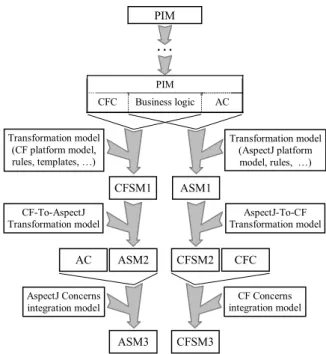
transformed(likely through a cascade of
trans-formations)to extract objects, classes and
con-cerns and get a PIM that expresses some busi-ness logic along with concerns that are platform independent. These concerns can be divided into two sets: concerns that are better expressed in CF (CFC) and concerns that are better
ex-pressed in ASPECTJ(AC).
In the next step, we get a CF specific model
(CFSM1)or an ASPECTJ specific model(ASM1)
by transforming the PIM using CF(resp.
AS-PECTJ)platform model, a set of rules, templates,
etc. When the first CFSM(resp. ASM) is
ob-tained, one can transform it to get ASM2(resp.
CFSM2)using the CF-To-ASPECTJ
transforma-tion(resp. ASPECTJ-To-CF transformation)and
then add concerns that are better expressed in ASPECTJ (resp. in CF) to get the final PSM
ASM3(resp. CFSM3).
For example, consider an Email server system consisting of several services; one thread per user and a database where each user emails are stored. In this type of application we can describe the synchronization concern between threads using CF and the exception handling concern(transmission errors, timeouts, etc)
us-ing ASPECTJ.
Obviously, using the most suitable metamodel each time means that developing a whole sys-tem will involve several metamodels and trans-formations to get the final PSM. This drawback can be reduced by using automated tools and by preserving the traceability. In our context, pre-serving traceability is a challenging task since it means preserving a one to one correspon-dence between the CF concerns and ASPECTJ concerns. To achieve this goal, we need to convert concerns in CF models using as much as possible only concepts dedicated to express concerns in ASPECTJ and vice versa.
Allowing the use of CF and ASPECTJ metamod-els during the development of a system is the first and the main motivation of this work. As a first step towards this ideal, this article is lim-ited to only one way transformation of the CF models into ASPECTJ.
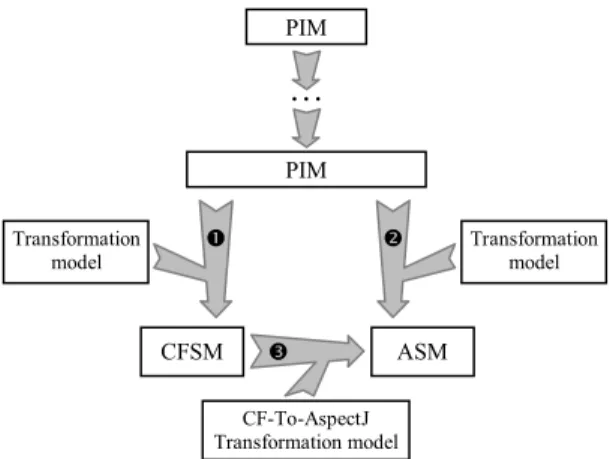
The second motivation arises from the fact that a transformation between two PSMs of the same abstraction level is useful in some cases. To understand this, let us consider the scenario of Figure 5.
… PIM
PIM
ASM CFSM
Transformation
model n o
p
CF-To-AspectJ Transformation model
Transformation model
Fig. 5.Example of development scenario.
According to Figure 5, one can get the ASM using the transformation labeled 2 or through transformation 1 followed by transformation 3 . This last, which is our concern, is useful in the following cases:
We have the CFSM and want to get the ASM, unfortunately there is no PIM from which it can be generated. This situation is still fre-quent today. Indeed, the MDA well-defined style is not always followed and software developers still take a PSM-only approach where platform specificities are considered from the early development phases, and sep-arately defined models are not used (i. e. PIM and PSM) 8]. Notice, in this case, that concerns are directly described in the PSM
(CFSM or ASM).
We would like to change the AOP platform
(e. g. ASPECTJ instead of CF), but at the same time we do not want to spend an impor-tant effort in developing the transformation from the PIM to the new PSM. Since the two PSMs are relatively close, the PIM becomes useless and the ASM is advantageously gen-erated from the CFSM.
5. CF to AspectJ Transformation
5.1. Overview
In the MDA context, the transformations can be from PIM to PIM, PIM to PSM, PSM to PSM or PSM to PIM, and several approaches can be used for transforming models such as the mark-ing, the model transformation, or the
meta-model transformation, etc (see 14, 18] for
more details).
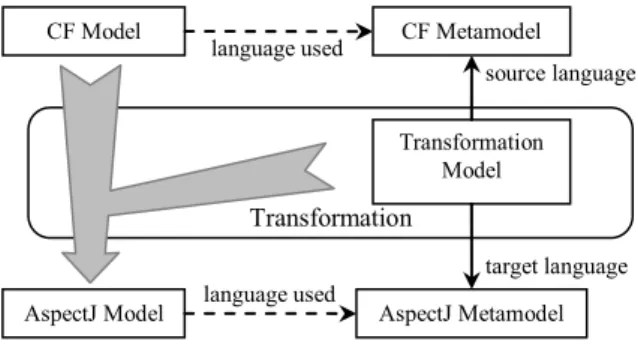
In this work, we propose a PSM to PSM meta-model transformation which can be illustrated using the MDA transformation representation of Figure 6. The transformation model consists of a set of normalizing rules and transformation templates(see Figure 7).
Since CF and ASPECTJ are both extensions of JAVA, the transformation can be done by con-verting the CF concepts using the JAVApart of ASPECTJ. But, when doing so, we achieve a sim-ple weaving that does not preserve the traceabil-ity of concerns. In order to preserve the trace-ability, we need to use, as much as possible, only concepts dedicated to express concerns in
Transformation
CF Model
AspectJ Model
CF Metamodel
AspectJ Metamodel Transformation
Model language used
language used
source language
target language
Fig. 6.PSM to PSM metamodel transformation.
Syntax directed translation Normalization
CF Model
AspectJ Model
Normalizing rules
Normalized CF Model
Transformation templates
Fig. 7. Overview of the transformation.
ASPECTJ. For this sake, we keep the base code classes of the CF model unchanged and trans-form the CF interfaces using aspects, advices, pointcuts and static crosscutting.
The transformation we propose consists of two processes(Figure 7):
A normalization that aims to put the filters in a canonical form which facilitates the trans-formation.
A translation using a syntax-directed ap-proach and transformation templates. It con-sists of generating a set of aspects using a syntax-directed approach guided by a set of templates that preserve the CF semantics. Notice that some concepts of CF like realtime filter are currently outside the proposed trans-formation. The reasons motivating this restric-tion are given in subsecrestric-tion 5.5.
In the remainder of this section, we will illus-trate the transformation using the example of listing 4, which includes four filter types and al-most all different forms of filter elements. Some comments are given in the same listing.
5.2. Normalization
The goal of this process is to determine all the accessible methods of a CF class and to put its filter elements in a canonical form that facili-tates the transformation. A CF interface adds the public methods of internal/external objects
to the set of kernel class methods. In case where two or more methods have the same name, the one belonging to the kernel class (may be
in-herited)or the internal/external object declared
first hides the others. Hence, the signatureσC of an object C(or a class C) can be defined as
the set of all methods accessible for incoming messages. Notice that incoming messages do not specify internal/external objects as targets.
But their specifications in filters impose to the CF object to deduce which target will execute the message.
In the example of listing 4,σA= finner.m1(),
inner.m2(), int1.mb1(), int1.mb2(), int3.mc1(), int3.mc2(), int3.mc3(),
ext1.md1()g. Methodsint2.mb1()and
int2.mb2()are masked byint1since it is
de-clared first. In the same way ext1.m1() and
According to the previous, normalizing the meth-ods’ part in the example consists of replacing the list of declared methods with its complement to σA (i. e. σA-finner.m1(), inner.m2()g, see
listing 5).
To put filter elements in a canonical form we apply a set of normalizing rules so that:
The dispatch or meta filter elements have the form:
C ) selector(NewTarget.NewSelector)
The wait filter elements have the form:
C ) SelectorwhereC is a condition or a
conjunction of conditions
The error filter elements have the form:C )
f Selector1, Selector2,:::, Selectorig
orC ) Selector
Filters’ normalizing rules can be grouped in seven categories:
– Eliminating * within aMSPList: T.*(NT.NS)is equivalent to
T.S1(NT.NS), :::, T.Si(NT.NS)ifσT=fS1, :::, Sig T.S(*.NS)is equivalent toT.S(inner.NS)
T.*(NT.*)is equivalent toT.S1(NT.S1),:::, T.Si(NT.Si)
ifσT=fS1, :::, SigandσT σNT T.*without a substitution part, is equivalent to
T.S1, :::, T.SiifσT=fS1, :::, Sig
– Eliminating exclusion operator:
C>fT1.S1, :::, Ti.Sigis equivalent to C)σinner - fT1.S1, :::, Ti.Sig
– Adding inclusion operator and condition:
fT1.S1, :::, Ti.Sigis equivalent to)fT1.S1, :::, Ti.Sig )f T1.S1, :::, Ti.Sigis equivalent to
True)fT1.S1, :::, Ti.Sig
– Adding substitution part in dispatch filter elements: Sis equivalent toS(NT.S)ifNT.S 2σinner S(NS)is equivalent toS(NT.NS)ifNT.NS 2σinner
– Decomposition(does not apply to error filters)
C)fT1.S1(NT1.NS1), :::, Ti.Si(NTi,NSi)gis equivalent to C)T1.S1(NT1.NS1), :::, C)Ti.Si(NTi,NSi) C)fT1.S1, :::, Ti.Sigis equivalent to
C)T1.S1, :::, C)Ti.Si
– Ignoring target in the matching part. Also applies whenT=inner T.S(NT.NS)is equivalent toS.(NT.NS)ifT.S 2σinner T.Sis equivalent toSifT.S 2σinner
– Grouping wait filter elements having the same matching part C1)S, C2)S, :::, Ci)Sis equivalent to
fC1,C2,:::,Cig)S
public class A { public void m1(); public void m2(); … }
Inputfilters
err : error = { cd1() {int1. cd2() a! {m2},
{int3.mc1} }
*,int3.*
act : meta = { cd3() {m1(ext1.md sync : wait = { cd4() {m2, int cd3() m2 }
2), int1.m .* .*(int2.
.*(ext
}, // err1
// err2 // err3 1),in
public class B { public void mb1();
t1.*(ext1.md1)} } // act1 // sync1 3.*},
public void mb2();
… } deleg : dispatch ={ cd1(){m1(m // sync2
cd2()a!{ext1
cd3(){int1
cd4(){inner
}
b1(int3.mc2)}, // deleg1 public class BB {
public void mb1(); public void mb2(); … }
public class C { public void mc1(); public void mc2(); public void mc3(); … }
public class D { public void m1(); public void m2(); public void md1(); … }
class A interface { //A is the kernel internals
public B int1; public BB int2;
}, // deleg2
*)}, // deleg3
1.*)} } // deleg4
Comments
err1: When cd1 is true, calls t
act.
err2: When cd2 is true, all messa
err3: Calls of mc1 in int3 ar
act1: When cd3 is true, the cal
ext1, and when cd3 is true, cal
sync1: Causes the calls to m2 in of all methods in int3 are also bloc
deleg1: When cd1 is true, cal
int1 are substituted by mc2 and d
deleg2: When cd2 is true, a
o the m filter
ges are e uncondit ls o ls t the ke ke ls elegate ll substitution. This means that calls to md
s A.
ls to methods of int1 are delegated to int2 without any
alls to the kernel methods (m1 and m2) are dispatched to the external object ext1 without substitution.
ethods of int1 and int3 are accepted and pass to
accepted except m2 of the kernel ionally accepted
f m1
o methods of int are reified and passed as argument to md1.
in the kernel are reified and passed as argument to md1 in
1
rnel to be blocked until cd4 and c 3 d become true. The calls til becomes true.
d un cd4
of m1 in the kernel are dispatched to m2 and calls of mb1 in d to object int3.
calls except those where target is ext1 are dispatched without
1 are not dispatched. The other methods, m1 and m2 in ext1, es, since they are hidden by m1 and m2 of the kernel clas are not in the scope of incoming messag
deleg3: When cd3 is true, the cal substitution.
deleg4: When cd4 is true, all the c public C int3;
externals
public D ext1; conditions
private boolean cd1(){…} private boolean cd2(){…} private boolean cd3(){…} private boolean cd4(){…} methods
Remarks: For brevity, methods do not return values and only the public methods are shown
The wild card ‘*’ always matches the target or selector in the matching part and does not modify the target or the selector when specified in the substitution part.
When the target is omitted, the kernel object is considered instead. When a condition is missing, true is assumed instead.
void m1(); void m2();
When applying the normalizing rules to the ex-ample in listing 4, we get the results shown in listing 5.
methods void mb1(); void mb2(); void mc1(); void mc2(); void mc3(); void md1(); Inputfilters
err : error= {
cd1() {mb1, mb2, mc1, mc2, mc3}, // err_1 cd2() {m1, mb1, mb2, mc1, mc2, mc3, md1}, // err_2
true mc1 } // err_3
act : meta = {
cd3() m1(ext1.md1), // act_1
cd3() mb1(ext1.md1), // act_2 cd3() mb2(ext1.md1) } // act_3 sync : wait = {
{cd4(), cd3()} m2, // sync_1
cd4() mc1, // sync_2
cd4() mc2, // sync_3
cd4() mc3 } // sync_4
deleg : dispatch={
cd1() m1(inner.m2), // deleg_1 cd1() mb1(int3.mc2), // deleg_2 cd2() m1(inner.m1), // deleg_3 cd2() m2(inner.m2), // deleg_4 cd2() mb1(int1.mb), // deleg_5 cd2() mb2(int1.mb2), // deleg_6 cd2() mc1(int3.mc1), // deleg_7 cd2() mc2(int3.mc2), // deleg_8 cd2() mc3(int3.mc3), // deleg_9 cd3() mb1(int2.mb1), // deleg_10 cd3() mb2(int2.mb2), // deleg_11
cd4() m1(ext1.m1), // deleg_12
cd4() m2(ext1.m2) } // deleg_13
Listing 5.Normalized methods and input filters parts.
5.3. Transformation Templates
Valid transformation changes the structure of the original model, but preserves its behavior
(i. e. its semantics). Recall that a CF model is a
set of ordinary JAVAinterfaces and JAVAclasses where some are provided with CF interfaces. Therefore, the overall structure transformation of the CF model is to keep unchanged ordinary JAVAclasses and JAVAinterfaces while translat-ing CF interfaces into aspects. Consequently, the main transformation task is to find what corresponds to each CF interface.
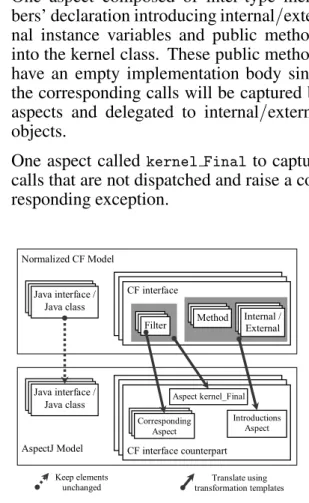
Since the CF interface represents several con-cerns, it translates to several aspects. We pro-pose the structure transformation schema of Fig-ure 8.
According to Figure 8, the JAVA interfaces and classes are kept unchanged in the ASPECTJ model while each CF interface has a counterpart con-sisting of:
One aspect for each filter in the input filter set.
One aspect composed of inter-type mem-bers’ declaration introducing internal/
exter-nal instance variables and public methods into the kernel class. These public methods have an empty implementation body since the corresponding calls will be captured by aspects and delegated to internal/external
objects.
One aspect called kernel Finalto capture
calls that are not dispatched and raise a cor-responding exception.
Normalized CF Model
Java interface / Java class
CF interface
AspectJ Model CF interface counterpart
Introductions Aspect Aspect kernel_Final
Corresponding Aspect
Method Internal / External Filter
Java interface / Java class
Keep elements
unchanged transformation templates Translate using
Fig. 8.The structure transformation schema.
The content of these aspects is determined using the transformation templates given in the rest of this subsection. Listing 6 shows the resulting model when applying the structure transforma-tion schema to the example of listing 5.
Aspects that correspond to filters are composed of advices. For example, a normalized FE
C)S(NT.NS) in a filter maps to an advice in
the corresponding aspect. This advice is of
type around and has three anonymous
point-cuts (i. e. unnamed pointcuts directly declared
in the advice). The first pointcut is call(*
* inner.S()) which captures calls to method
S in the inner class (the first wildcard means
any access modifier and the second any return value type). The second and third pointcuts are
target(obj)andargs(parameterList). They
public class A { public void m1(); public void m2(); … } public class B { public void mb1();
public void mb2(); … } public class BB { public void mb1();
public void mb2(); … } public class C { public void mc1();
public void mc2(); public void mc3(); … } public class D { public void m1();
public void m2(); public void md1(); … } privileged aspect A_Introd {
declare precedence A_err, A_act, A_sync, A_deleg, A_final; public B A.int1;
public BB A.int2; public C A.int3; public D A.ext1;
public boolean A.cd1(){…}; public boolean A.cd2(){…}; public boolean A.cd3(){…}; public boolean A.cd4(){…}; public void A.mb1(){}; public void A.mb2(){}; public void A.mc1(){}; public void A.mc2(){}; public void A.mc3(){}; public void A.md1(){}; }
privileged aspect A_err { …} // See listing 7 privileged aspect A_act { …} // See listing 8 privileged aspect A_sync { …} // See listing 9 privileged aspect A_deleg { …} // See listing 10 aspectA_final { …} // See listing 11
Listing 6.Transforming the structure of the CF model.
Preserving the CF semantics is a challenging task. If we consider a filter setFS where each
filter F is composed of filter elements FElem,
then preserving the CF semantics means: im-plementing the accept and reject effects of each
FElemon messages and on the filterF, and
im-plementing the accept and reject effects of each filterFon messages and filter setFS.
Particularly, the following constraints must be satisfied:
1 A message passes once through each filter in the filters set and each FE in an order that corresponds to their declaration. Up-down for filter set and from left to right for filter elements.
2 According to the filter type, the filter ele-ment handler action may affect the message flow. After a dispatch, a final reject or reifi-cation, the remaining FE and filters are no longer considered. In the case of a wait fil-ter, each time the message is blocked by a filter element, it passes the filter again.
3 A message must be dispatched by the filter set.
These constraints can be expressed in terms of filter element accept or reject effects on the con-trol flow of a message according to the filter type, the position of the filter element within the filter and the position of the filter within the filter set(see Table 4).
handler Action
cur
last F the fil
essage flow ithin a normalized input filter Filter CurrentFE IsFE the filter the last Effect on the m
Type E in filter in the w rent Is current
ter? filter set? set
No Pass to next filter Accept No/Yes
Yes Raise an exception No No/Yes Pass to next filter element
Error Reject
Yes No/Yes Raise an exception
If m() executes Continue or
send, then pass to next filter
m() is the method to which the reified message is sent No
Accept No/Yes
Yes If m() executes then raise an exception Continueor send,
No No/Yes Pass to next filter element No
Meta
Pass to next filter Reject
Yes
Yes Raise an exception No No/Yes Pass to next filter element
No Pass to next filter Accept
Yes
Yes Raise an exception
No current filter agaBlock the message then pass thein
Wait
Reject No/Yes
Yes Raise an exception
Accept No/Yes No/Yes Dispatch the message. Ignore remaining filter elements and filters
No No/Yes Pass to next filter element No Pass to next filter
Dispatch Reject Yes
Yes Raise an exception
Table 4.Effect of filter element handler actions on the message flow.
To enforce constraint 1 in ASPECTJ, we
de-clare precedence between aspects. The aspect corresponding to the first filter will dominate the aspect corresponding to the second that will dominate the aspect corresponding to the third and so on. The FEs’ order is enforced by declar-ing the corresponddeclar-ing advices in the same order of the FEs in the filter.
elements which consist of a join point identifier, a target object identifier and a string that spec-ifies if the inhibition concerns the whole input filter set or only a given filter.
When processing a filter element, CFE, which
causes the filterFto accept a message and skip
the remaining FEs inF, the advice
correspond-ing to CFE inserts an element (joinpoint id,
target id, ``filterName'')in the inhibition
list. In the case of a dispatch or reification with
reply, the inserted element is(joinpoint id,
target id,``filterSet'') which inhibits all
the remaining advices and aspects correspond-ing to the filter set. All advices must check
for the absence of inhibiting elements before proceeding.
Advice handles the inhibition list by three
meth-ods,inhibit(),removeInhibition()and
in-hibited(), which respectively inserts, removes
elements, and tests for the existence of elements in the list. The reflexive features of JAVA and ASPECTJ allow us to know, at any time, the cur-rent join point and curcur-rent object unique identi-fiers by usingthisJoinPoint.
Notice that a form of inhibition already exists in ASPECTJ for advices of type around. In-deed, when an around advice executes, it pre-cludes the execution of all other advices of lower
Aspect corresponding to Error filter err Comments
privileged aspect A_err {
object around (): … { …} // corresponds to err_1 object around (A obj): // corresponds to err_2 (call(* * A.m1(..)) || call(* * A.mb1(..)) ||
call(* * A.mb2(..)) || call(* * A.mc1(..)) ||call(* * A.mc2(..)) || call(* * A.mc3(..)) ||call(* * A.md1(..))) &&target(obj) {
if ((! list.inhibited(tjp, obj, “filterset”)&& (! list.inhibited(tjp, obj, “A_err”)) && cd2()){ list.inhibit(tjp, obj, “A_err”); }
return proceed(); }
object around (): … { …} // corresponds to err_3 object around (A obj): call(* * A.*(..)) && target(obj) {
if (!list.inhibited(tjp, obj, “A_err”)) raiseException(); else { list.removeInhibition(tjp, obj, “A_err”);
return proceed();} } }
The aspect name is composed of the kernel class name and the filter name.
Anonymous point cuts corresponding to the matching part.
This around advice tests if all the aspects corresponding to the filter set have not been inhibited by a previous aspect, that advices of A_err
have not been inhibited by a previous advice and that cd2() is true. If so, the call is accepted and the remaining advices in A_err are inhibited. The proceed() allows the call to pass to other advices. tjp
stands for thisJoinPoint.
At the end of the aspect, an advice is added to raise an exception if the call has not been accepted by the previous advices in A_err. If the call has been accepted, the inhibition element of this aspect is removed from the list. The proceed() allows the call to pass to advices of next aspect.
Listing 7.Error filter transformation template.
Aspect corresponding to Meta filter act Comments
privileged aspect A_act {
object around(): … { …} // corresponds to act_1 object around(A obj, paramDecl): // corresponds to act_2 (call(* * A.mb1(..)) && target(obj) &&
args(paramList) {
if ((! list.inhibited(tjp, obj, “filterset”)&& (! list.inhibited(tjp, obj, “A_act”))) && cd3(){
list.inhibit(tjp, obj, “filterset”); list.inhibit(tjp, obj, “A_act”); …
… // inline here instruction of md1() } else return proceed();
} }
object around(): … { …} // corresponds to act_3 }
/* paramDecl stands for a parameter declaration list and paramList for a list of parameters */
The second advice tests if A_act and aspects corresponding to the filter set have not been inhibited and if cd3() is true. If so, aspects corresponding to this filter and filter set are inhibited.
During the transformation, statements of the meta object method md1() are changed and inlined within the advice body. Recall that there are three special statements send,reply and continue that can be applied to a reified message
mes within meta object method. Occurrences of ‘mes.continue()’ statement are replaced with :
List.removeInhibition(tjp, obj,”filterset”); return proceed(paramList);
Occurrences of ‘mes.reply(expression)’ are replaced with:
return expression
Occurences of ‘variable = mes.send()’ are replaced with:
List.removeInhibition(tjp, obj,”filterset”); variable = proceed(paramList)
Notice that access to the arguments paramList can be done directly since they are not reified. Removing the filter set inhibition allows the call to pass through aspects corresponding to the remaining filters.
Within the advice, any reference to a field or a method of the meta object is prefixed by ‘this.ext1.’
Aspect corresponding to Wait filter sync Comments
privileged aspect A_sync { private Lock A.l_cd4_cd3; private Lock A.l_cd4;
object around (A obj): // corresponds to sync_1 call(* * A.m2(..))&& target(obj) {
if ((! list.inhibited(tjp, obj, “filterset”) { while (!(cd4() && cd3())) l_cd4_cd3.block(); }
return proceed(); }
object around (): … { …}// corresponds to sync_2 …
after (): set(* A.field1) || set(* A.field2) …{ l_cd4_cd3.wakeup();
}
after (): set(* A.field2) || set(* A.field4) …{ l_cd4.wakeup();
} }
The overall tran synchronized me threads using the statement. We attach a lock Each call to a m condition and blo At each iteration on any of the v condition again. allows the advice
Notice that no f in each advice concern
different calls (see grouping wait filter elements normalization rule).
In the same way, the filter set is not inhibited since wait filters do not alter the message flow but just delay it.
field1, field2, etc are assumed to be the fields that appear in the method bodies of cd4() and cd3(). Notice that these fields can be determined by parsing cd4 and cd3 condition methods.
sformation consists of adding a new class called Lock, having two thods block() and wakeup() whose role is respectively to block JAVA wait() statement and resume them using the JAVAnotifyAll()
to each condition or conjunction of conditions in a filter element. essage that matches a FE in MSPList causes the thread to test the ck repeatedly unltil the condition becomes true.
, the thread is resumed by an after advice that captures set join point ariables composing the condition. Then the thread evaluates the When a thread leaves the while loop, it executes proceed() which s in the remaining aspects to alter the message flow.
ilter inhibition is necessary since pointcuts
l l
Listing 9.Wait filter transformation template.
Aspect corresponding to Dispatch filter deleg Comments
privileged aspect A_deleg {
// corresponds to d am // corresponds to deleg_2
object around(): … { …} eleg_1
object around(A obj, par Decl):
call(* * A.mb1(..)) && target(obj) && args(paramList){
;
bje ramDecl): // corresponds to deleg_4 if ((! list.inhibited(tjp, obj, “filterset”) && cd1()) {
list.removeInhibition(tjp, obj, “filterset”); return this.int3.mc2(paramList) }else return proceed();
} …
o ct around(A obj, pa
call(* * A.m2(..)) && target(obj) && args(paramList){
ist.inhibit(tjp, obj, ilterset”);
An around advice inhibits all the remaining around advices unless proceed is used. Thus two cases are e is to be
d case, when message is dispatched with a new selector, we remove the inhibition element which is no longer needed and then delegate the message. The if ((! list.inhibited(tjp, obj, “filterset”) && cd2()) l “f
return proceed(); }… }
possible. In the first, when the messag
dispatched to the kernel object with the same selector, we use proceed() to let the message continue but, at the same time we need to inhibit all the remaining advices, that’s why we use list.inhibit(tjp, obj, “filterset”).
In the secon to
internal/external objects or the kernel class
remaining advices are implicitly inhibited since we do not use proceed().
l l
Listing 10.Dispatch filter transformation template.
precedence concerned by the same join points, except whenproceed() is used. In this case, the next advice with the highest precedence is executed. In our transformation, we rely on the ASPECTJ inhibition whenever possible and
use proceed() whenever we want to avoid it.
In listings 7 to 10, we take a closer look to the transformation templates of each filter type. For clarity sake, we use the normalized filter exam-ples of listing 5 rather than a specific formal template language.
Finally, to enforce constraint 3, we add a spe-cial aspect calledkernel Final with only one advice that captures any call to the kernel class and raises an exception unless it is inhibited(see
listing 11).
aspect A_Final {
object around(A obj): call(* * A.*(..)) && target(obj) { if ((! list.inhibited(tjp, obj, “filterset”) raiseException(); else { list.removeInhibition(tjp, obj, “filterset”); return proceed(); }
}} /* raiseException is a method that throws a
NotDispatched exception */
Listing 11.Contents of the kernel final aspect.
5.4. The Syntax-directed Transformation