An Efficient Cross-Layer Scheduling with Partial Channel State
Information
Indumathi Ganesan
Mepco Schlenk Engineering College Sivakasi, TamilNadu, India E-mail: [email protected]
Murugesan Karuppasamy
Bharathiyar Institute of Engineering for Women Chinna Salem, Villupuram Dist., TamilNadu, India
Keywords:cross-layer scheduling, heterogeneous applications, orthogonal frequency division multiple access
(OFDMA), adaptive modulation and coding (AMC)
Received:April 28, 2010
The proposed Cross-Layer scheduling can boost the spectral efficiency of multi-user OFDMA wireless systems with heterogeneous delay requirements. The existing designs usually have two important assumptions that the users are delay insensitive and Channel State Information at the Transmitter (CSIT) is perfect. In practice, users have heterogeneous delay requirements and CSIT usually becomes outdated in time varying channel, which in turn leads to systematic packet errors and hence results in significant degradation on the throughput. The Adaptive Modulation and Coding (AMC) is a promising tool for increasing the spectral efficiency of time varying channel, while maintaining the target Bit Error Rate (BER) and the Packet Error Rate (PER). In this paper, a novel design problem is formulated which combines AMC and CSI at the physical layer and scheduling using queuing theory at the Medium Access Control (MAC) layer, in order to maximize the throughput and spectral efficiency under the heterogeneous delay constraints. For the above proposed work, transmissions on Rayleigh fading channel including Additive White Gaussian Noise (AWGN) are employed. Simulation results show that the proposed scheduler provides robust system performance enhancement over conventional cross-layer scheduler with perfect CSIT.
Povzetek: Opisana je metoda razporejanja za OFDMA sisteme s poudarkom na odpravljanju zamud.
1
Introduction
There are quite a large number of existing works on cross-layer scheduling design for OFDMA such as [1]-[4] and the optimal sub carrier allocation and the transmitter power adaptation in an OFDMA system having users with fixed data rate requirements have been studied in [1] & [2] respectively. The authors in [4] & [5] provided a general theoretical frame work as well as practical algorithm implementation schemes addressing the cross-layer optimization problem of OFDMA systems.
These cross-layer designs achieve throughput gain by exploiting spatial diversity as well as multiuser diversity. But these designs were only based on a decoupled approach where source statistics and queue dynamics were ignored from the physical layer information theoretical models. To provide diverse QoS requirements in terms of delay performance, some cross-layer designs were proposed in [6, 7, 8 & 9] to incorporate both source statistics and queue dynamics. In [6], a simple on-off physical layer model was assumed in [6] and multiple access channel model with homogeneous users was studied in [7] & [8] through combined information theory and queuing theory. In [9],
a heuristic scheduler design maximizes the system throughput while providing fairness between users in an OFDMA system was proposed. All of these cross-layer designs were targeted for system with homogeneous uses only. Also they rely on two important assumptions: users are delay sensitive and Channel State Information (CSI) at the transmitter is perfect. These assumptions are usually impractical since next generation networks are expected to contain real time users of heterogeneous classes with different delay requirements.
few works considered the outdated CSI at the transmitter [10, 11, 12] considering single user OFDM systems. In [10, 11], the authors had addressed the issue of outdated CSI at the transmitter and those designs were applicable to delay-insensitive applications. In [12], the authors proposed a delay sensitive sub carrier allocation strategy which obtains a substantial throughput gain.
In this paper, our objective is to design a cross-layer scheduler for OFDMA systems consisting of users with mixed traffics and heterogeneous delay requirements. To achieve this objective, priority levels are assigned at the MAC layer using the partial knowledge of the CSI obtained from the physical layer and also by using the Queue State Information (QSI) at the MAC layer. Then based on the priority levels sub carrier allocation is made. To improve spectral efficiency, adaptive Modulation and Coding (AMC) mode of transmission is considered at the physical layer. By including the link adaptation procedure along with the methodology proposed in [12] in our work, we are able to achieve the enhanced spectral efficiency.
The rest of the paper is organized as follows. Channel model which includes downlink channel model and CSI at the transmitter estimation model is explained in Section 2. Multiuser Physical layer model for OFDMA systems with AMC is discussed in Section 3. In Section 4, Scheduler design at the MAC layer model is described. The simulation results are presented in Section 5. Finally concluding remarks are given in section 6.Text of the introduction.
2
Channel model
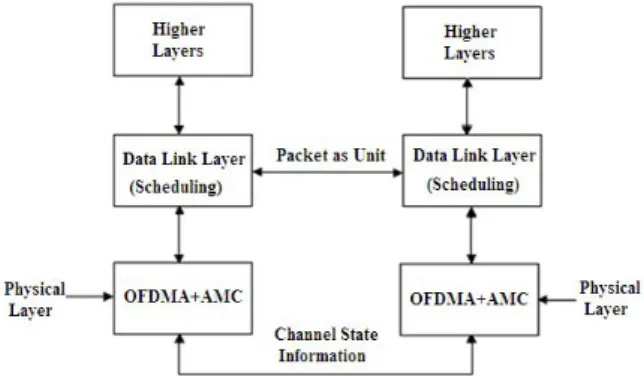
The cross-layer system model considered for multiuser wireless systems is shown in Fig. 1. Before the scheduling operation is performed, the cross-layer resource scheduler first collects the QoS (delay) requirements of all users. In the beginning of each scheduling interval, the scheduler obtains the partial CSI and QSI by observing the number of backlogged packets in all these user’s buffers. The resource scheduler then makes a scheduling decision based on this information and passes the resource allocation scheme to the OFDMA transmitter. The updates of scheduling decision process are made once for every time slot.
Figure 1: Cross-Layer System Model.
2.1
Downlink channel model
An OFDMA system containing K users with frequency
selective channel model consisting of L
BW/fc
i.e.,[Signal Bandwidth/Coherent Bandwidth] resolvable paths is considered. For simplicity, uniform power delay profile is adopted, i.e. each path has normalized power given by 1/L. Thus the channel impulse response
between the transmitter and the j-thuser at the time slot
m, hj(m), can be modeled through a L-tap delay line
channel model, i.e.
1
0 , /
L l jl
j m h m m l w
h
, where
hj,l are modeled as independent identically distributed(i.i.d.) circularly symmetric complex Gaussian random
variables with distribution CN (0, 1/L). The channel is
assumed to be quasi-static within each time slot m, but
slowly time varying across time slots according to Jakes’
model where the scheduling slot duration tswill be very
much less than the doppler spread fd of the channel. The
scheduling duration is considered within 2 ms. It is reasonable assumption for users with pedestrian mobility where the coherence time of the channel is around 20 ms or more.
With NF point IFFT and FFT in the OFDMA system,
equivalent discrete channel model in the frequency domain (after the length-L cyclic prefix removal) is
ij ij ij
ij
H
U
Z
Y
(1)
where (i denotes subcarrier index and j denotes user
index) Yijis the received symbol, Uijis the data symbol
from the transmitter / BS to user j on sub carrier i, Zij is
the noise distributed with
L l
N li j l j ij
z H h e F
CN 0 2 /
, 2 ,
,
0
is the complex channel gain of the ithsub carrier for the jthuser. Z
ij is a zero mean
complex Gaussian noise with unit variance i.e. i.i.d. for
different users but correlated within user j. The
transmitter power allocated to user j through the
subcarrier i is given by
2
] ] ij ij EU
P
. We define
subcarrier allocation strategy as SNFxK
Sij , wheresij =1 when user jis selected for subcarrier i, otherwise
sij =0. The average total transmitter power is constrained
by Ptot, i.e. PPTot, where
K
j N i ij ij F
F P S N
E
P 1/ 1 1 and PTot is the available
average power in the transmitter.
2.2
CSIT estimation
Hˆ for all users over all subcarriers at the transmitter ijaccounting the outdatedness can be modeled as:
ij ij
ij H H
Hˆ
(2)
where
Hˆij is the CSI error at the transmitter with zeromean noise distribution.
3
Multi-user physical layer model
for OFDMA systems with AMC
We consider the information theoretical capacity [7] as the abstraction of the multi-user physical layer to decouple from specific implementation of coding and modulation schemes. In general, packet error is contributed by two factors, namely the “channel noise” and the “channel outage”. In channel outage case, the effect is systematic and cannot be eliminated, because the instantaneous mutual information between transmitter
and user j in ith subcarrier
ij ij z
ij
p
H
c
2 22
1
/
log
is contributed by twofactors, namely the “channel noise” and the “channel outage.” In channel outage case, the effect is systematic and cannot be eliminated, because the instantaneous
mutual information between transmitter and user j in ith
subcarrier cij
pij Hij z
2 2
21 /
log
is a function of actual CSI Hij, which is unknown to the transmitter. So packets will be corrupted whenever scheduled data rate exceeds instantaneous mutual information. To take account of the packet error due to channel outage, the
instantaneous goodput of the jthuser (which measures the
instantaneous data bits/s/Hz successfully delivered to user j) as
gj=
FN
i ij ij ij
c
r
I
r
1],
[
(3)where
ij ij ij ij ij ijc
r
if
c
r
if
c
r
I
,
0
,
1
is an indicator
function, and rij is the scheduled data rate of the jthuser
on the ithsubcarrier.
3.1
Design of AMC at the physical layer
The Adaptive Modulation and Coding (AMC) is the technique to maximize the data rate and to utilize the bandwidth efficiently under a prescribed Packet Error Rate (PER) performance at the Physical layer. This AMC scheme matches the transmission parameters to the time-varying wireless channel conditions adaptively [13] and has been used by many standard wireless network specifications, such as IEEE 802.11/15/16 [14].
Let N denote the total number of transmission modes
available at the wireless link between transmitter and receiver (say N=6 for IEEE 802.16). As in [15], fixed power transmission is assumed and partition the entire
Signal-to-Noise Ratio (SNR) range in N+ 1
non-overlapping consecutive interval, with boundary points
denoted as
1 0 N n n
. The transmission mode n is chosen
when,
n,n1
for n = 1, 2, . . . , N (4) To avoid deep-channel fades, no data are sentwhen0 1 which corresponds to the mode n = 0,
with rate R0=0 bit/symbol. The design objective of AMC
is to determine the boundary points
1 0 N n n .
To simplify the AMC design, the PER expression for AWGN channels is approximated to give
pn n n pn if g a if PER exp 0 ,
1 (5)
where n is the mode index and γis the received SNR.
Exact closed-form expressions for PER and BER are
not available for transmission modes with
convolutionally coded modulations. Hence, the exact PER and BER is obtained through Monte Carlo
simulations [15]. From that the mode parameters an, gn,
and
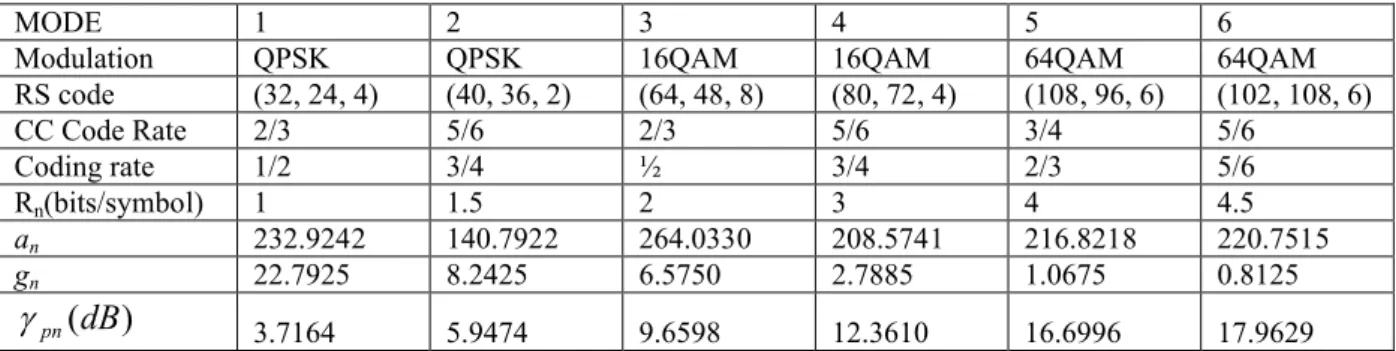
pn in (5) are obtained by fitting (5) to the exactPER via Monte Carlo simulations. Using the approximate yet simple expression (5) facilitates the mode selection. The mode fitting parameters for each transmission modes are provided in Table 1.
The region boundary (switching threshold) n is set
for the transmission mode n which is the minimum SNR
required to guarantee Ptarget. With the boundaries
10 N n n
specified by (6), one can verify that the AMCin (4) guarantees that the PER is less than or equal to Po.
To obtain the region boundaries the general PER expression is inverted as in (5),
, , . . . , 2 , 1 , ln 1 , 0 arg 0 N n P a g t et
n n (6) and N1
Based on CSI acquired at the receiver, the AMC selector determines the modulation coding pair (mode), which is sent back to the transmitter through the feedback channel. The AMC controller at the transmitter
then updates the transmission mode. Coherent
demodulation and maximum-likelihood (ML) decoding are used at the receiver. The decoded bits are mapped to packets, which are pushed upwards to the data link layer.
When mode nis used, each transmitted symbol will carry
n cn R M
R log2 information bits for the mode adhering
to a Mn-QAM constellation, and a rate Rc FEC code.
Therefore, the average spectral efficiency (bit rate per bandwidth) achieved at the physical layer without considering possible packet retransmission is
Nn n r Physical
e R P n
where Pr(n) is the probability of choosing the
transmission mode n.
4
Scheduler design at the MAC
layer model
The system dynamics are characterized by system state
χ =(HˆNFK, γ, QK) , which composed of channel state
the HNFxK[hij 2] and SNR value from physical Layer
and Queue State Information (QSI) QKfrom MAC Layer
User’s buffer, where Qk=[qj] is a K x 1 vector with the
jthcomponent denotes the number of packets remains in
user j’s buffer. The MAC Layer is responsible for
scheduling at every fading block on the current system state χ. Based on CSIT and QSI obtained, the scheduler determines the subcarrier allocation from the policy
H QPNFK ˆ, for the selected users (ie.,) the users having
the scheduling rate less than the mutual information rate.
5
Simulation results
In the simulation an OFDMA system with total system bandwidth of 5 MHz with carrier frequency of 2 GHz consisting of 192 data subcarriers and 5 pilot subcarriers and 5 users, is considered(users are specified by arrival rate and delay requirements). Each user is having different information field size. Results are obtained with the frame duration of 2.5 milliseconds. The channel model is constructed to simulate the multipath fading channel. The multipath fading is modelled as a tapped delay-line with 8 taps with non uniform delays. The gain associated with each tap is characterized by a distribution Rayleigh with a K-factor=0 and the maximum Doppler frequency of 25 Hz. For each tap, a method of filtered noise is employed to generate coefficient with the specified distribution and spectral power density. For our simulation, Matlab and the simulink models are considered.
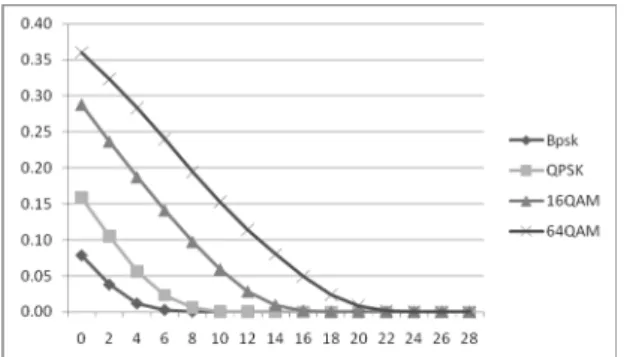
The main function of the AMC design is to adopt the transmission modes according to the channel conditions. The transmission mode selection is based on the obtained SNR values by fitting them into the estimated SNR boundaries or thresholds. The corresponding mode is selected for the next transmission. As per IEEE 802.16 fixed Wimax standard, six transmission modes along with new modulation of BPSK are considered. From the Fig 2, we depict that in a low SNR regime (below 4 dB) the throughput achieved is lower when the user requirement is more stringent. This is because more urgent users with heavy traffic loading will have higher chances of seizing subcarriers, causing losses in degree of freedom in exploiting throughput maximization by other users with better CSI at the transmitter. In a high SNR regime, (above 4 dB), the throughput performance is the same regardless of the value of the imposed delay requirement of that user thi is because in a high SNR regime, the service provision are the same for all users and thus the optimal subcarrier allocation reduces to the
conventional scheduling. Also when we see the effect of transmission modes in AMC, Mn-ary QAM modulations are providing high throughput.
Figure 2: Performance in terms of Throughput for various modes
From Figs. 3 & 4, it is understand that the Bit Error Rate (BER) and Frame Error Rate (FER) measures obtained from the simulations are verifying the throughput achieved shown by Fig.2.
Figure 3: Performance in terms of Bit Error Rate for various modes
MODE 1 2 3 4 5 6
Modulation QPSK QPSK 16QAM 16QAM 64QAM 64QAM
RS code (32, 24, 4) (40, 36, 2) (64, 48, 8) (80, 72, 4) (108, 96, 6) (102, 108, 6)
CC Code Rate 2/3 5/6 2/3 5/6 3/4 5/6
Coding rate 1/2 3/4 ½ 3/4 2/3 5/6
Rn(bits/symbol) 1 1.5 2 3 4 4.5
an 232.9242 140.7922 264.0330 208.5741 216.8218 220.7515
gn 22.7925 8.2425 6.5750 2.7885 1.0675 0.8125
)
(
dB
pn
3.7164 5.9474 9.6598 12.3610 16.6996 17.9629Table 1: Transmission modes Specified in IEEE 802.16 standard From the above all figures, the truth of achieving
high throughput or low BER /FER at high SNR regime or when the active channel condition is proved.
When we consider only AMC at the physical layer without the inclusion of queue state information from the MAC layer for scheduling (conventional method), the spectral efficiency gain achieved seems to be slightly lower than cross-layer design with combination of AMC and queue state information. This shows the significance of cross-layer approach of scheduling. The corresponding average packet error rate is tabulated and given in Table 2.
Table 2: Analytical Results
6
Conclusion
In this paper, we presented a delay sensitive cross-layer scheduler for OFDMA systems with heterogeneous delay requirements and outdated CSI at the transmitter. The cross-layer design problem is formulated by taking into account ot the outdated CSI
at the transmitter, source statistics with
implementation of AMC and queue dynamics of the OFDMA systems. The optimal delay sensitive subcarrier allocation is obtained and the proposed scheduler gives a very good balance of maximizing the throughput and providing QoS (delay) differentiation of the mixed heterogeneous users. Further the work may be extended by including retransmission procedures to reduce the error rate which in turn to increase the throughput.
References
[1] C.Y. Wong, R.S. Cheng, K.B. Letaief, and R.D. Murch, “Multiuser OFDM with adaptive
subcarrier, bit amd power allocation, ” IEEE J.
Select. Areas Commun., vol.17, no.10, pp.1747-1758, Oct.1999.
[2] M.Ergen, S.Coleri, and P.Varaiya, “QoS awre adaptive resource allocation techniques for fair scheduling in OFDMA based broadband wireless
access systems, ” IEEE Trans. Broadcasting,
vol.49, no.4, pp 362-370, Dec.2003.
[3] J.Jang and K.B.Lee, “Transmit power adaptation
for multiuser OFDM sytems,” IEEE J.Select.
Areas Commun., vol.21, no.2, pp.71-178, Feb.2003.
[4] G.Song and Y.(G.) Li, ”Cross-layer optimization for OFDM wireless network – Part-I: Theoretical
framework, ” IEEE Trans. Wireless Commun.,
vol.4, no.2, pp 614-624, Mar.2005.
[5] G.Song and Y.(G.) Li, “Cross-layer optimization for OFDM wireless network – Part-I: Algorithm
development,” IEEE Trans. Wireless Commun.,
vol.4, no.2, pp 65-634, Mar.2005.
[6] S.Kittipiyakul and T.Javidi, “Resource allocation in OFDMA: How load balncing maximizes
throughput when water-filling fails,” UW Tech.
Report, UWEETR-2004-0007, 2004.
[7] E.M.Yeh and A.S.Cohen, “Information theory, queueing, and resource allocation in multi-user
fading communications, ” in Proc. Information
Sciences Syst. Conf , Mar.2004, pp.1396-1401. [8] E.M.Yeh, “Multiaccess and Fading in
Communication Networks, ” Ph.D. Thesis,
Department of Electircal Engineering and Computer Scienec, MIT, 2001.
[9] P.Parag, S.Bhashyam, and R.Aravind, “ A sub carrier allocation algorithm for OFDM using
buffer and channel state information, ” in Proc.
IEEE VTC-Fall, Sep. 2005, pp.622-625.
[10] Y.W.Yao and G.B.Giannakis,
“Rate-maximizing power allocation in OFDM based on
Partial channel knowledge,” IEEE Trans.
Wireless Commun., vol.4, no.3, pp.1073-1083, May 2005.
[11] A.Leke and J.M.Cioffi, “Multicarrier systems
with imperfect channel knowledge, ” in Proc.
IEEE International Symposium PIMRC, Set.1998, vol.2, pp.549-553.
[12] D.S.W. Hui and V.K.N.Lau, “Design and analysis of Delay-sensitive Cross-layer OFDMA
systems with Outdated CSIT,” IEEE Trans. On
Wireless Commn., vol.8, no.7, pp. 3484-3491, July 2009.
[13] Xin Wang, Georgis B.Giannakis, and Antonio G.Marques, ”A Unified Approach to
QoS-Parameters Conventional Scheduling
Proposed Cross-layer scheduling using CSI at
the transmitter Spectral
efficiency (b/s)/Hz
3.6219 3.8769
Average packet error
rate
8.56x10⁻²
Guarenteed Scheduling for Channel-Adaptive
Wireless Networks,” Proceedings of IEEE,
vol.95, no. 12, pp 2410-2413, Dec 2007.
[14] IEEE Standard 802.16 Working Group, IEEE
standard for local and metropolitan area networks part 16: air interface for fixed Broadband Wireless Access Systems, 2002.
[15] Qingwen Liu, Shengli Zhou and Georgios B. Giannakis, “Cross-Layer Combining of Adaptive Modulation and Coding with Truncated ARQ
over Wireless Links,” IEEE Transactions on