VOLUME 15 ISSUE 1 (2017), Page 117 - 128
APPRECIATION OF VERTICAL GREENERY IN A CITY AS PUBLIC ART
Mazlina Mansor1, Khalilah Zakariya2, Nor Zalina Harun3, & Nur Izzah Abu Bakar4
1,2,3,4 Kulliyyah of Architecture and Environmental Design
INTERNATIONAL ISLAMIC UNIVERSITY MALAYSIA
Abstract
Vertical greenery (VG) is greenery where plants can be grown on, up, or against internal or external walls of buildings or as freestanding structures. Whereas, public art (PA) is a structure or form that contains an artistic expression. It is placed in public spaces. VG has gained tremendous popularity in recent years, and this offers an opportunity to integrate it as a part of public art in cities. A place with a combination of art and aesthetics with environmental principles would become a new urban art that will help extend VG’s survivability and human security in the future. Most research in VG focuses on an environmental and technical aspect that consider its benefits, technical issues, feasibility, acoustic impact, sustainability, system and maintenance. On the other hand, creative methods to approach VG are seldom researched upon especially in Malaysia. Hence, this study explores this possibility from the public’s perspectives. The objectives were to identify public’s familiarity and values of VG as PA, and VG attributes to be as a PA. An online survey was used to obtain public’s perspectives on the integration of VG as PA. The target respondents were the public, whereby the link to the survey was sent out to 400 potential respondents. The survey obtained 117 responses, and they were gathered automatically in an Excel spreadsheet. The data were converted into the themes to generate results. Findings yield positive outcomes in terms of the public’s familiarity of the terminologies (i.e. VG and PA), people’s awareness of VG in an urban environment, and the possibilities and potentials of VG to become a PA in Malaysian cities. It means that VG has extended beyond the environmental benefits to also become an art form for people in a city.
Keyword: Vertical greenery, public art, integration, sustainability
Date Received: 30th April 2016
INTRODUCTION
This research focuses on the potential of vertical greenery (VG) to be appreciated as public art (PA) in a city. VG is greenery where plants can be grown on, up, or against internal or external walls of buildings or acts as freestanding structures. PA is a structure or form that contains an artistic expression. It is placed in a freely accessible public space for people to view. In the 80’s, there was a growing interest in environmental issues. The scenario has triggered a vision of bringing nature into cities, environmentally and aesthetically. VG is suitable in urban places, as there is insufficient urban green spaces. VG is increasingly being implemented in the city’s public spaces and buildings to improve the urban life quality and ecosystems, as well as to upgrade urban realm. VG can modify temperature, improves air quality and increases biodiversity. Contact with greenery in city is also said to improve people’s physiology and mental health. Hence, VG has gained tremendous popularity in recent years to be erected in public spaces. This popularity offers a great opportunity for it to be appreciated as a part of public art in city spaces. It is implied that a place with a combination of art, aesthetics and environmental principles would become a new urban art that helps to extend the survivability of VG. The interest will not be just a passing trend for one time only (Séguin, 2012).
Furthermore, most researches on VG were centred on the environmental and technical aspects, such as on the benefits, technical issues, feasibility, acoustic, sustainability, system and maintenance of VG (Peck et al., 1999; Watts, 2009). However, the creative methods to approach VG were seldom researched upon especially in Malaysia. Hence, this paper explores the views and acceptance of city residents on the creative methods to appreciate VG in public spaces. Recent increase in the popularity of VG has created the possibility to incorporate VG as ‘green public art’ into city spaces. The aim is to identify the possible ways VG can be appreciated as public art (PA).
LITERATURE REVIEW
There is a growing trend of using the VG system to green urban public spaces. There is also a definite need to improve the selection and appearance of PA in Malaysia (Shunmugam, 2006; Mohd Fabian et al., 2012). PA in Malaysia is claimed only typically to decorate and fill empty spaces of a public area. It lacks art quality, unable to command people’s attention or evoke deeper feelings to the public. Hence, VG is seen as a new way to creatively attract the public to appreciate PA.
garden city movement, Stanley Hart White, a professor in Landscape Architecture field had patented a vertical greenery system for environmental benefits, known as Vegetation-Bearing Architectonic Structure and System (Hindle, 2012). However, due to the public’s concern about the strength of the structure, the concept was not popular at the time.
To understand VG’s association with PA, a history of PA also needs to be considered. The term ‘public art’ was first coined in 1959 when the first Percent-for-Public Art ordinance in the United States was adopted by the city of Philadelphia, Pennsylvania (Cartiere & Willis, 2008). However, PA was only used for its aesthetic value during the time. In 1967, PA started to be used for environmental, aesthetic and social values. Concurrently, from the 1960’s to 1980’s, PA started to be adopted in Malaysia. Nonetheless, most of the artworks at this time were influenced by the post-formalist approach. However, in the late 70’s, as Islamic consciousness increased, more artists began to align themselves with abstract-expressionist style, as well as Islamic centred art (Sarena, 2011). PA during this time was designed for its social, environmental and aesthetic benefits. The awareness of Land Art has also started to emerge parallel to this event as artists becoming more concern about environmental issues (Irons, 2012). This led to more interest in environmental issues, resulting in the vision of bringing nature into cities was conceived in the 80’s. At the same time in Malaysia the artworks were began to be influenced by environmental awareness, social democracy and human rights (Sarena, 2011) and they began to use recycled materials in their artworks and diverse art techniques.
Figure 1 Three Types of Public Art (PA)
the VG system into the limelight whereby it was appreciated for its environmental and aesthetical utilisation.
Over the years, both VG and PA have gone through many stages of development. What can be determined from this is that the integration of both produces many benefits to city spaces. Their application and usage could be explored in many other creative ways. The sustainability of urban landscape can be generated when the site, art and people are integrated. Buildings around the world have embraced VG for its environmental, aesthetic and economic values. The application of green concepts for urban design cityscapes is made obligatory in some parts of the world. These have popularised the installation of vegetation on external street walls. For instance, a piece of garden wall art can enhance the experiential quality of the adjacent space by providing an aesthetically pleasing, calming and the environment that is closer to nature (Chin, 2010). VG as PA is an urban greening project, which creates an environment for people to be comfortable shopping, working or living, and their community’s character is expressed (Watts, 2009). Hence, successful urban greening projects will be worthwhile and rewarding in the long term for the community. Currently, VG has often showcased beautiful patterns and becoming a new urban art in a city (Séguin, 2012).
Figure 2 (a) vertical garden (VGr); (b) bio façade wall (BW); (c) green wall (GW); (d) green façade (GF); (e) vertical greenery system (VGS); (f) green scaffolding (SG); (g)
green space wall (GSW); (h) living wall (LW)
groundcovers trained to cover designed supporting structures (Badrulzaman, 2011). Vertical greenery system (VGS) is a way in which plants can be grown on, up, or against a façade of a building or feature walls (Wong et al., 2010). Green scaffolding (GS) applies mainly to eco-retrofitting, essentially wraps a lightweight structure around the exterior of existing buildings. Green space wall (GSW) is an eco-sphere that doubles as an exterior wall or mixed interior/exterior spaces in new development (Birkeland, 2008). Living wall (LW) consists of pre-vegetated panels, vertical modules or planted blankets that are fixed vertically to a structural wall or structure (Chin, 2010).
METHODOLOGY
An online survey was used to identify public’s familiarity and responses on the integration of VG as PA. Electronic survey is becoming increasingly common because it provides strong advantages such as speedy distribution and response cycles, the ability to conduct large-scale distribution of a questionnaire to prospective respondents, and cost less compared to postal mail survey (Yun & Trumbo, 2000; Lazar & Preece, 1999). The questionnaire consisted of three
sections. The first section recorded the respondent’s background. The second
section dealt with familiarity with the terms VG and PA. The third section explored public’s views on the integration between VG and PA. The survey questions consisted of mainly closed-ended question, supported by pictorial questions and open-ended questions.
A link to the survey was sent online to potential respondents, where the respondents were automatically directed to the Google Form survey. The survey was pre-tested and fine-tuned before being distributed to the respondents. The target respondents were the Malaysian public, and the link to the survey was sent out to almost 400 potential respondents. The survey was opened for two months to allow potential respondents ample time to answer. All in all, the survey managed to gather 117 responses.
FINDINGS
Respondents’ Profile
The minimum age of the respondents was limited to 18 years or older to ensure that the respondents were adults. 64% of the respondents are within the age of 18-30 years old. 24% are within the age of 31-40 years old, 8% within 41-50 years old, and 4% within 51-60 years old. More than half of the respondents were female (62%). Almost half of the respondents are professionals (43%). 21% of them are academicians, 19% students and the rest (17%) consisted of various groups of professions. Regarding the place of residence, 50% of the respondents reside in Selangor, 21% in Kuala Lumpur and the others (28%) live in other states in Malaysia. 57% of the respondents have degree qualification and 32% have postgraduate qualification. 8% of the respondents are diploma holder and 3% only have secondary school education.
Familiarity with Vertical Greenery and Public Art
Concerning familiarity, less than half of the respondents (48%) are familiar with the term vertical greenery (VG). It is because VG is a new term among
Malaysians, and it is associated with terms that are closer to it such as vertical
wall and green wall. The public might have encountered it before, but unsure of
the terms used to describe it.
Eight types of VG, as in described in Figure 2, were shown to the respondents using images in pictorial questions. As shown in Table 1, most of the respondents are familiar with the VGS (71%), followed by GF (69%), LW (67%) and BW (56%). Less than half of the respondents are familiar with the GW (48%), VGr (45%), GS (39%) and the GSW (34%). 56% of the respondents have seen the VGS in the public spaces. The results suggest that even though the respondents are not very familiar with the term VG, they do recognised the types of VG images that were shown in the survey. Some have also seen it personally. Overall, the results suggest that even though VG is a new term of landscape approach in Malaysia, the public is quite familiar with it.
Table 1 Familiarity with Types of VG
Variables VGr BW GW GF VGS GS GSW LW
Familiarity on types of VG (%) 45 56 48 69 71 39 34 67 The types of VG that respondents
have seen in a public area (%) 26 40 22 49 56 26 21 48 Location of
VG being displayed
Selangor 3 13 11 16 8 10 3 12
Kuala Lumpur 9 3 6 9 18 7 12 24
Others 7 4 3 4 4 4 6 15
In terms of familiarity with the PA term, majority (78%) of the respondents is familiar with the term. Three types of PA, namely the integrated art (integrated walls-IW, integrated fence-IF), environmental art (EA) and stand-alone art (SAA) were shown to the respondents to identify their familiarity and preference of PA in the urban public space. The finding is necessary to understand the public’s knowledge about PA. Results on the familiarity of different types of PA are shown in Table 2.
Table 2 Familiarity with Types of PA and the Preferred PA
Variables IA EA SAA
IW IF
Familiarity with types of PA (%) 93 79 73 92
Preferred PA (%) 20 46 34
Note. Highlighted figures are the highest frequency (%)
The respondents are most familiar with IW (93%) followed by stand-alone art SAA (92%), IF (79%) and EA (73%). The result shows that the Malaysian public is more familiar with the term PA as compared to the term VG. Regarding preference in types of PA, the result shows that the respondents preferred EA out of all types of PA (46%). It is followed by SAA (34%) and IA (20%). The result suggests that even though the respondents are more familiar with IW (integrated wall), they prefer EA (environmental art) and would like to see more EA being implemented in the urban spaces. Also, these findings reveal that the public is aware of the importance of having more environmental-friendly PA in urban public spaces.
Integration of Vertical Greenery as Public Art
To assess respondents’ familiarity and views whether VG can be appreciated as PA, they were asked to identify four types of VG that can act also as a PA. These are VG as IW, VG as IF, VG as EA and VG as SAA. To assist the respondents, pictorial questions with the image of the abovementioned VG were provided in the survey. Results are shown in Table 3.
Table 3 Familiarity of VG as PA
Variables Detail VG as
IW
VG as IF
VG as EA
VG as SAA Familiarity with VG as PA
(%)
Yes 42 23 43 23
No 57 76 54 72
Familiarity of VG as PA being displayed in urban public space in Malaysia (%)
Yes 80 84 74 85
No 16 15 23 10
Location of VG as PA (%) Selangor 3 3 10 1
Kuala
Lumpur 6 12 - 1
Other
states 1 4 4 4
Note. Highlighted figures are the highest frequency (%)
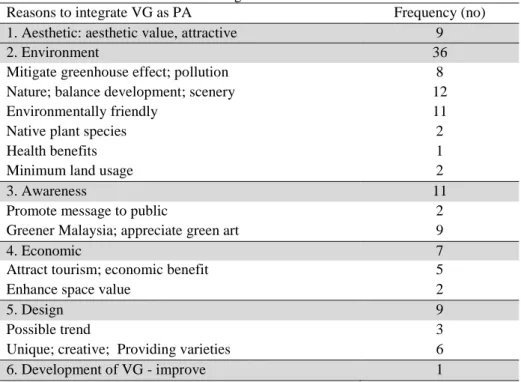
On the idea to integrate VG as PA, 92% of the respondents agreed with the idea to integrate VG as PA. It shows that the public is very interested in the idea to implement VG as PA. An analysis of the survey data found seven dimensions or reasons for their agreement for the appreciation of VG as PA (Table 4).
Table 4 Integration of VG as PA
Reasons to integrate VG as PA Frequency (no)
1. Aesthetic: aesthetic value, attractive 9
2. Environment 36
Mitigate greenhouse effect; pollution 8
Nature; balance development; scenery 12
Environmentally friendly 11
Native plant species 2
Health benefits 1
Minimum land usage 2
3. Awareness 11
Promote message to public 2
Greener Malaysia; appreciate green art 9
4. Economic 7
Attract tourism; economic benefit 5
Enhance space value 2
5. Design 9
Possible trend 3
Unique; creative; Providing varieties 6
7. Development of PA 6
Promote green art; awareness on PA 3
Quality PA; artistic; diversity of PA 3
Support social needs 1
The most cited reason by respondents is that VG is good to be appreciated as PA for the care of the environment (36 times). The respondents suggest that it can mitigate the greenhouse effect, bring nature in cities, environmentally friendly, improve the scenery, produce environmental benefits, utilise many plant species in Malaysia, mitigate pollution problems, balance between development and nature, health benefits, and minimum land usage. Among the respondents’
insights on this is “...The development always concerns on the buildings and the
facilities. Everything is made up of concrete and metal. It is a good idea to implement the greenery in the area for the aesthetic value of the area, landmarks, and most importantly the environment, such as cooling down the area, cleans the air, etc..’. The response shows that the idea to integrate VG as PA is well accepted by the public and the idea would have a bright future to be realised.
The Attributes of Vertical Greenery as Public Art
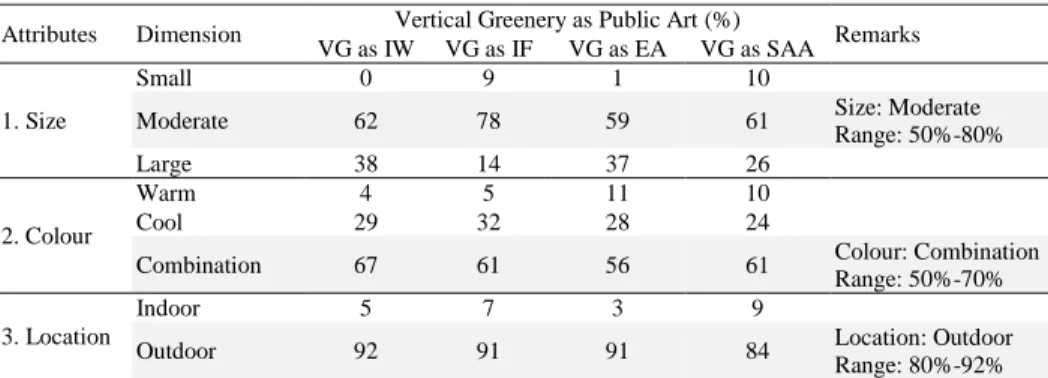
Questions on the attributes of VG as PA preferred for city spaces in Malaysia were also included in the survey. Table 5 shows the respondents’ answers, where 59% - 78% of the respondents preferred all types of VG to be moderate in size. In terms of colour, 56% - 67% preferred it to be a combination of warm and cool colour. 56% - 67% agreed for the VG to be located outdoor rather than indoor. For the design attribute, 84% - 92% favoured the VG to be a combination of natural and formal design. Finally, 45% - 56% prefer the material to be a combination of natural, recycled and new materials. These responses would help designers to have ideas on the attributes that should be taken into consideration when designing VG as PA.
Table 5 Preferred Attributes of the Implementation of VG as PA
Attributes Dimension Vertical Greenery as Public Art (%) Remarks VG as IW VG as IF VG as EA VG as SAA
1. Size
Small 0 9 1 10
Moderate 62 78 59 61 Size: Moderate Range: 50%-80%
Large 38 14 37 26
2. Colour
Warm 4 5 11 10
Cool 29 32 28 24
Combination 67 61 56 61 Colour: Combination Range: 50%-70%
3. Location
Indoor 5 7 3 9
Outdoor 92 91 91 84 Location: Outdoor
Note. Highlighted figures are the highest percentage (%)
Most importantly, the open-ended question on the preference of attributes also produced many valuable suggestions. 27 responses were obtained from the respondents, which can be categorised into 14 dimensions as shown in Table 6. The highest frequency of the attribute is in the choice of plants. The public suggests the consideration of Malaysian native plants, the plants’ habitat, aromatic plants and medicinal plants. The result implies that the public can accept the idea to integrate VG as PA and is very keen on it.
Table 6 Additional Attributes Derived from Respondents’ Responses
Attributes Frequency
(nos.) 1. Maintenance - proper and easy maintenance; low 5 2. Function – shade; health benefits; good for LA Profession 3
3. Education - appreciate nature 1
4. Islamic Values 1
5. Location 1
6. Public acceptance 1
7. Types of plants – species; native plants; habitat; aromatic; medicinal 6
8. Supporting elements – recreational element 1
9. Irrigation system 1
10. Locality - cultural heritage elements; building facade’s character 1
11. Awareness - message 1
12. Safety – no vandalism; safe 2
13. Design - retaining wall along the highways; green standing structures
2
14. Cost - management 1
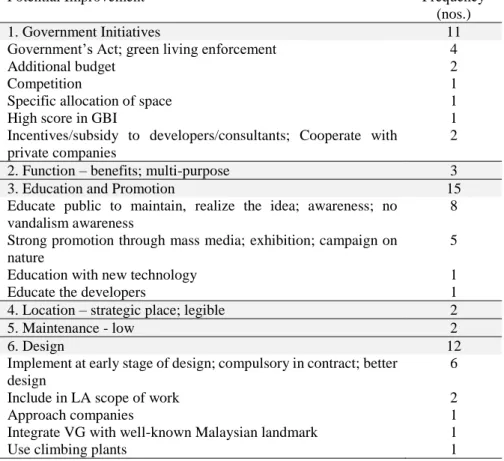
Recommendation for Vertical Greenery to Be Integrated As Public Art In terms of recommendations, 46 respondents provided ideas which were classified into seven categories (Table 7). Education and promotion (15 times) are the utmost importance to improve the integration. It is vital to educate the public to care for effort in the maintenance of the VG and to educate public to realize the idea. Awareness, strong promotion through mass media, promotion through expo and exhibits, ‘bring back nature campaign’, no vandalism
4. Design
Natural 27 27 29 22
Formal 5 10 8 10
Combination 66 57 57 62 Design: Combination
Range: 50%-70%
5. Materials
Natural 23 24 25 23
Recycle 18 17 15 15
New 3 5 9 8
Combination 56 45 45 50
awareness, education using new technology and to educate the developers on the benefits of VG are among the suggestions.
Table 7 Recommendations to improve VG as PA in Malaysia
Potential Improvement Frequency
(nos.)
1. Government Initiatives 11
Government’s Act; green living enforcement 4
Additional budget 2
Competition 1
Specific allocation of space 1
High score in GBI 1
Incentives/subsidy to developers/consultants; Cooperate with private companies
2
2. Function – benefits; multi-purpose 3
3. Education and Promotion 15
Educate public to maintain, realize the idea; awareness; no vandalism awareness
8
Strong promotion through mass media; exhibition; campaign on nature
5
Education with new technology 1
Educate the developers 1
4. Location – strategic place; legible 2
5. Maintenance - low 2
6. Design 12
Implement at early stage of design; compulsory in contract; better design
6
Include in LA scope of work 2
Approach companies 1
Integrate VG with well-known Malaysian landmark 1
Use climbing plants 1
CONCLUSION
of VG as PA. This exploratory study provides the stimulus for designers to rethink approaches to the functions, content and strategies for VG as PA.
REFERENCES
Badrulzaman J., Ismail S., & Mohd Hisyam, R. (2011). Evaluating the impact of vertical greenery system on cooling effect on high rise buildings and surroundings: A review. SENVAR, Johor: Skudai. www.epublication. fab.utm.my/180/1/SENVAR1201
Baskaran, B. (2003). Evaluating rooftop and vertical gardens as an adaptation strategy for urban areas. Ottawa from http://lib.fo.am/_media/
Birkeland, J. (2008). Space frame walls: facilitating positive development. In G. Foliente, T. Luetzkendorf, P.Newton, & P. Paevere (Eds.) The World Sustainable Building Conference (pp. 21-25). Victoria, Melbourne, Australia.
Cartiere C., & Willis, S. (2008). The practice of public art (Eds.), New York: Taylor & Francis.
Chin, M. Y. (2010, September). Wrapped in life-giving green.The Star Online. Retrieved from http://thestar.com.my/lifestyle/
Green Public Art (2010). Urban landscaping: green walls. Retrieved from http://greenpublicart.com/
Hindle, R. L. (2012). A vertical garden: origins of the Vegetation-Bearing Architectonic Structure and System (1938). An International Quarterly, 32(2), 99-110. doi: 10.1080/14601176.2011.653535
Irons, K. (2012). The purpose and value of public art. eHOW. Retrieved from http://www.ehow.com/
Lazar, J., & Preece, J. (1999). Designing and implementing web-based surveys.Journal of Computer Information Systems, 39(4), 63-67.
Mohd Fabian, H., Osman, M. T., & Mohd Nasir, B. (2012). Towards integrating public art in Malaysian urban landscape. Pertanika, Journal of Social Sciences & Humanities, 20(2), 251–263.
Peck, S. W., & Callaghan, C. (1999). Greenbacks from green roofs: forging a new industry in Canada.Status report, Canada Mortgage and Housing Corporation, March 1999.
Sarena, A. (2011). Thematic approaches in Malaysian art since the 1990s. Jati, 16, 97-113.
Séguin, M. L. (2012). Green walls. Architecture Posts. Retrieved from http:// http://inhabitat.com/tag/green-wall/
Shunmugam, V. (2010, September). By the artists, for the people.The Star. Retrieved from http://thestar.com.my/lifestyle/
Watts, P. (2009). Ecoartspaceblog.Report from Seattle Public Art Conference; 2009. Retrieved from http://ecoartspace.blogspot.com/