The Asian Journal of Technology Management Vol. 10 No. 1 (2017): 19-28
*Corresponding author. Email: [email protected]
Received: May 10th, 2017; Revised: July 19th, 2017; Accepted: August 8th, 2017 Doi: http://dx.doi.org/10.12695/ajtm.2017.10.1.3
Business Model of Jamu as Indonesian Traditional Herbal Medicine
in New Economy
Fatya Alty Amalia* and Atik Aprianingsih
School of Business and Management, Institut Teknologi Bandung, Indonesia
Abstract. Many firms in New Economy tend to depend more on intangible resources (i.e. knowledge and information) than tangible resources as in Old Economy. This shifting has made many firms favour the information technology for their daily business conducts today. The fast spreading of information leads to the fiercer competition than before. The great recognition of intangible assets somewhat calls for the notion of a new business model. Some enterprises and researchers expect this effort may generate more value for today’s competition through combining all assets in proper judgments. Jamu, Indonesian traditional herbal medicine, also cannot avoid the impact of New Economy competition. Jamu enterprises need to preserve the traditional value in the midst of the modern lifestyle. Then, the urgency to maintain Jamu competitive advantage is felt necessary. To provide the new business model of Jamu that is deemed as appropriate in New Economy’s competition is the aim of this study. Through analysing various literature, the authors heavily consider Product Service System (PSS), specifically the product-oriented type to construct a new business model for Jamu.
Keyword: Jamu, new economy, PSS, product-oriented, business model
1. Introduction
The term of New Economy is created to depict the condition of economy activities relying on intangible assets, not solely on tangible assets as previous days. Due to the globalization and high technology, tangible assets are deemed not enough to obtain competitive advantage for the firms. Hayes (2002) held that intangible assets (e.g. knowledge, information) played as a key for having business more productively in New Economy. Thus, the seen outcome is that the development of information technology is growing rapidly (e.g. internet, software development, media of telecommunication, etc.). Realizing the necessity to adjust with New Economy’s competition environment, many enterprises and researchers put their concerns to have new business model. In the late 1990s, these new business models were highly found in IT business sector, known as e-business (Amit & Zott, 2001).
As result, this situation created the impression that New Economy was somewhat more related with IT which offering value in service sectors. However, the authors carry other concern of New Economy’s impact related with information technology usage in product sectors.
Jamu is Indonesian traditional herbal medicine has been used for many centuries in Indonesia to treat disease and maintain good health (Elfahmi, Woerdenbag & Kayser,
2014). Today, the technology of
pharmaceutical is far more developed than previous days, such as biopharmaceutical, chemical-based drugs, etc. However, Jamu is struggling to survive in today’s business while preserving the traditional value in the midst of the modern lifestyle. Business of Jamu is counted as product sector since it mainly provides physical product, Jamu, so that the customers can gain the value by consuming
Jamu. Recognizing the fierce competition of New Economy, the authors posit that Jamu
proposing new business model. However, the existing researches have not studied this issue yet. The authors find it as the research gap that is deserved to be examined further. In constructing new business model for Jamu,
the authors heavily consider Product Service System (PSS) concept. At first, the reasons for facing the environmental issue and meeting the customer’s value existed to develop PSS. Apparently, both reasons further lead to sustainability issues (Roy, 2000; Isaksson, Larsson & Rönnbäck, 2009; Tukker & Tischner, 2006). Basically, this concept combines between product and service as elements of system that interact each other in pursuing to meet the customers’ final needs (Goedkoop, van Halen, te Riele & Rommens, 1999). Customers can perceive PSS as system solutions, while the enterprises find PSS as a higher degree of responsibility to customers Mont (2001). Looking at the idea of PSS, the authors adopt PSS to propose new business model for Jamu.
Introducing new business model of Jamu by adopting PSS concept to deal with the New Economy competition environment is what this paper is aiming for. To provide better explanations, this paper is set up in five sections. The second section mainly talks about literature reviews about New Economy, business model, and PSS. The detail of the method of this study is disclosed in the third section. The propositions related with new business model of Jamu are explored in the fourth section. The fifth section, the authors discuss the difference between this study and the previous researches. Meanwhile, the last section summarizes some highlights of this study.
2. Literature Study
New Economy
Many enterprises and researchers have agreed no unanimous definition of New Economy until today. Tapscott (1997) did plausible attempt to present the idea of New Economy by delineating 12 themes considered to be relevant. Some themes that may be relevant with this study are:
knowledge, digitization, integration/
internetworking, disintermediation, innovation, immediacy and globalization.
Meanwhile, Hayes (2002) argued similar opinion about New Economy with Tapscott. He found that New Economy made the intellectual (i.e. information and knowledge) gains more acknowledgements as the important asset in business than the physical as before. In addition, Boulton, Libert, and Samek (2000) believed that the intangible assets (e.g. relationship, people, brand, etc.) were the main assets to create value in today business. As some researchers noticed that intangible assets in business valuation gained more weight over the tangible, the authors stand on more specific belief. Information is the intangible asset should be highlighted in this study. This belief is supported by Agatstein, Rieley & Khan (2000). Agatstein et al. (2000) noted that today the decision making process is faster, yet the demand of accountability is increasing. Thus, holding feedback process in decision making will help the firm to be closer with the success in New Environment’s competition. In other words, today business is becoming more info-centric.
Business Model
Then, it will help the firm to take decisions in a more organized way and support the implementation of strategy. In addition, some researchers had presented the details of a business model must have, though they had different terms one to other. Teece (2010) posited that business model is about what value we will offer to customer, how to deliver it, and how to make profit from making value for customers. The recent notable business model is Business Model Canvas. Many people use this business model template since it provides specific points as making a business model.
Osterwalder & Pigneur (2010) established nine important aspects of Business Model Canvas to ease devising the business model. These aspects are mainly divided into two big parts: part related providers (key partners, key activities, key resources, and value proposition) and part related customers (customer relationships, channels, customer segments, cost structure and revenue streams). A little different from the work of Osterwalder and Pigneur (2010), Johnson et al. (2008) had four interlinked elements might be existed in business model, namely: (1) Customer value proposition (CVP), (2) Profit formula, (3) Key resources and (4) Key processes. However, CVP stands as the foundation of business model since the rest of elements should be designed following it. The more accurate the firm by capturing the customer’s problem, the better solution the firm possibly to offer, the greater the CVP.
The necessity to adjust the business model with the business environment will emerge in order to preserve the firm’s competitive advantage (Boulton et. al, 2000; Voelpel, Leibold & Tekie, 2004). As dealing with the high uncertainty in New Economy’s competition, many enterprises felt uneasiness feelings for being confident to conduct their businesses. In 1990s, the emergence of internet made the business model gained great development, called as e-business (Osterwalder, Pigneur & Tucci, 2005; Magretta, 2002). At that time, using internet in daily business could be counted as the recent innovation.
They expected for gaining more profit due to the decreasing of Transaction Cost Economies by having internet usage (Amit and Zott, 2001; Osterwalder et al., 2005). In this study, we keep in mind about the role of business model by covering the logic of how to conduct a business. Still we assume this concept is not enough since it only serves as generic template or guideline to conduct a business. Therefore, we decide to adopt certain perspective, Product Service System, which should be useful to enrich the business model in New Economy’s competition.
Product Service System (PSS)
PSS lately comes into business conduct with some varied drivers. First driver is that the environmental issue which encourages people to act more wisely in providing and choosing a product or service (Roy, 2000; Goedkoop et al., 1999). The urgency to meet the customer value while optimizing the resources has shifted the firm’s orientation toward function is the second driver of PSS (Isaksson et al., 2009). Nonetheless, both drivers actually end to the bigger issue, sustainability (Tukker & Tischner, 2006). Beuren, Ferreira and Miguel (2013) stated that the objective of PSS is that offering other way in product use beyond acquiring it in order to curtail the consumption of products. Car sharing concept that is discussed by Kang and Wimmer (2008) is the instance of PSS. Furthermore, Geng, Chu, Xue and Zhang (2010) believed PSS enables a firm to increase its competitiveness and gain more profits.
means greater responsibility for the life cycle of product, involve the customers in designing the PSS and devising the losed-loop system (Mont, 2001). Further, Tukker (2004) developed the business models from PSS concept. He argued that PSS business models can bring good impacts on
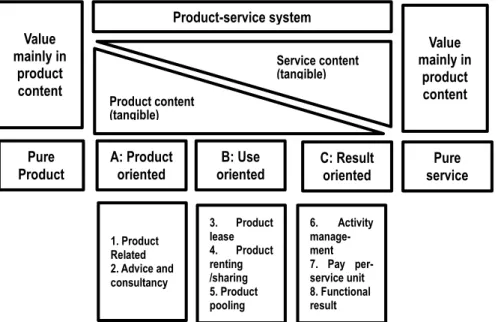
competitiveness because it offers more integrated solution for customer, allow the firm to strengthen the relationship with customer, and firm can innovate faster. Figure 1 depicted the business models in PSS:
Figure 1. Categories of PSS Business Models (Tukker, 2004)
The below descriptions of previous business models mainly refer to the works of Tukker (2004) and Reim, Parida & Ortqvist (2015):
Product-Oriented
This business model still places selling products as their core business, but it is also attached with extra services. For the instances are the services offered by the provider to customers throughout the lifecycle of the product (Sundin and Bras, 2005). The firm will gain more revenue for the services taken by customers. Tukker (2004) divided this type into two more specific types: (1) Product related service (2) Advice and consultancy. Though those two types are originated form the same business model (i.e. product oriented), the difference still underlies between those. The service in product-related service is more associated with its use throughout its lifecycle, as the instances: the maintenance, the supply, take-back of product, etc. Meanwhile, the advice and consultancy type puts more concern about the efficiency use of product for customers.
Use-Oriented
The character for this category is the provider holds the ownership of the product, yet the customers can still use the product through sharing with other customers. In other words, the physical product is not sold to customers and the responsibility of the product is bore by provider. Furthermore, Mont, Dalhammar, and Jacobsson (2006) conducted a study relating this. This type may be categorized further into (1) product lease (2) product renting or sharing (3) product pooling (Tukker, 2004). The existence of unlimited access for customers in product lease cannot be found in product renting or sharing. Meanwhile, in product renting or sharing, the sequential uses among customers happened. The product pooling is similar with product renting or sharing in terms of the limited access, yet the use is feasible to be done simultaneously among customers.
Result-oriented
The provider will be paid over the results the customers gain for. In the beginning, both
Value mainly in
product content
Product-service system
Service content (tangible)
Product content (tangible)
Value mainly in
product content
Pure Product
A: Product oriented
B: Use
oriented C: Result oriented
Pure service
1. Product Related 2. Advice and consultancy
3. Product lease 4. Product renting /sharing 5. Product pooling
parties agree upon the results preferred by customers. Then, the provider is free to determine what specific products are used to achieve the results. Meanwhile, the customers will pay only based on the results. Reim et al. (2015) provided an instance of cleaning service for this business model. The further categories in result-oriented determined by Tukker (2004) are: (1) outsourcing (2) pay per service unit (3) functional result. The
common example of activity
management/outsourcing is the outsourcing of cleaning or catering activity in a company. For the pay per service unit type, the
customers do not purchase the product but only the output of product (i.e. pay per print business). The functional result is similar with activity management, but the provider has high freedom in defining the means to deliver the results to customers. There will be no pre-determined specified means between provider and customers. For example: the provider offers the ‘pleasant climate’ than offering only cooling equipment to customers.
Comparing the business models in PSS to distinguish them easier, it was shown at the work of Reim et al. (2015) as table 1 below:
Table 1.
Comparisons of Business Model in PSS (Reim et al., 2015)
Product-oriented Use-oriented Result-oriented
Value
creation Provider takes responsibility
for the
contracted services
The
responsibility of provider lies on the usability of the product or service
Transferring the results to consumer is the
responsibility of provider
Value
delivery Provider trades and services the sold product and service
Provider makes certain the usability
of the
physical
product as
well as service
The result
delivered by the provider
Value capturing
Consumer purchase the physical product and
for the
services being carried out
Repeated payments by customer (e.g. leasing)
Consumers pay for the result
delivered by provider
Jamu
Indonesia is a country with diversified plant species which around 2500 species are potentials for medicinal plants (Elfahmi et al., 2014). In herbal medicines, Indonesia classifies it into three types: (1) Jamu, (2)
Standardized herbal medicine and (3)
Fitofarmaka. The characteristic of each type is
Table 2.
Indonesian Herbal Medicines Characteristics
Indonesian
Herbal Medicine Characteristics
Jamu Traditional natural medicine whose effects are proven through empirically
based, not scientific based Standardized
Herbal Medicine Natural medicine whose effects and safety are proven by scientific based (preclinical test) as well as the raw material is standardized
Fitofarmaka Natural medicine whose effects and safety are proven by scientific based
(preclinical and clinical test) as well as the raw material is standardized
According to Regulation of Ministry of Health no. 6 issued in 2012, Jamu is allowed to be sold by industry level (i.e. Industri Obat
Tradisional) or SME level (i.e. Usaha Kecil Obat
Tradisional, Usaha Menengah Obat Tradisional,
Usaha Jamu Racikan and Usaha Jamu Gendong).
Those jamu enterprises level differ from one to another in term of types of allowed dosage forms to be produced for. Jamu has been practised for longer time though it has not carried out the preclinical or clinical test as other Indonesian herbal medicines. Still many Indonesians are willing to consume
jamu for their daily consumptions (Torri,
2013).
Recognizing this situation, Indonesian governments put their interests to increase Indonesia’s GDP through herbal medicines, including Jamu. For instance, the turnover of
jamu in domestic market in 2013 achieved
IDR 13 trillion. Then, the increase about IDR 2 trillion was also expected in the late of 2014 (Ministry of Trade, n.d.). On the other hand, the trend of back to nature will encourage people to consume herbal medicines, including jamu (Ditjen PEN, 2014).
Nonetheless, the case of additional of chemical substances in jamu deliberately (BPOM, 2006; KOTRANAS, 2007) may ruin the safety aspect of jamu. This contradicts with the branding of jamu for being recognized as natural herbal medicine. Somehow, this issue indirectly impacts on market’s perception that jamu is not safe to be consumed as expected. Besides that, the competition in medicine sector (i.e. Traditional Chinese Medicine, Kampo, chemical-based medicine) becomes fiercer due to the development of technology today.
Confronting the today’s unpredictable competition environments, we believe as jamu
enterprise has innovation then it may be survived. In dealing with this issue, this study provides the new business model of jamu
enterprise using PSS concept.
3. Methodology
The authors used online searching to collect the literatures for this paper. The process of collecting the literatures was conducted about five weeks, in March-May 2017. We examined Google Scholar, Proquest, Elsevier, Web of Science and Science Direct to obtain the literatures. In order to gain the relevant literatures, the authors used some keywords, such as: New Economy, Information
Technology, Product Service System,
Business Model, Jamu and Jamu business model.
4. Finding and Discussion
perspective, though the level of necessity and impact may be varied in each sector.
Proposition 1: New Economy encourages the Jamu enterprise for taking up information aspect as new perspective in its business model.
Only figuring out the notion of business
model does not accommodate Jamu
enterprise in confronting the changing of New Economy. Redesigning the business model by including the presence of information can be met as adopting the PSS. The seeking of sustainability for a firm is the main reason to develop PSS. PSS establishes the product and service both to interact as the elements of a system for offering a set of solution to customers. The element of service can accommodate the process of giving information from the firm to customers and getting feedbacks from customers to firm.
Meanwhile, this approach cannot be done while in the past the Jamu firm only selling a product of Jamu. PSS creates the direct interaction process between customers and firm, then enabling the process of information exchanges. For customers, they may gain deeper beneficial information regarding Jamu and health. On the other hand, the firm may access the customers’ information such as: the ailment the customer is troubling with, the feedbacks for its product, etc.
Proposition 2: To develop new business model of Jamu, the PSS concept can facilitate the exchange of information between firm and customers.
Reflecting on PSS business model as Tukker (2004) portrayed, Jamu enterprise is suitable to adopt the Product-oriented business model. Principally, as the customers obtain the solution over their health problems is what has become the objective of consuming
jamu. It means the full ownership of jamu
product is the customer’s in order to enable the customer experiences the benefit of jamu. The firm does not hold any ownership of
jamu after the transaction between firm and
customer has been done. Furthermore, the
jamu enterprise originates from product
sector. As previously stated, the service element of PSS in Jamu business model may account in the information exchange between firm and customer.
We propose two possible forms of service in PSS which may jamu enterprise offer: (1) the health information for customers regarding
jamu and (2) comfortable place for customers
as consuming jamu. Giving the customers more knowledge of jamu consumptions relating with their health issues may offer something valuable for the customers beyond consuming jamu only. In addition, jamu
enterprise may explore the customers’ information to keep updating the most common ailments of customers. Thus, the firm indirectly may gain more access of information to develop the existing jamu or have new kind of jamu to be offered to customers. In other words, the firm may freely access the feedbacks from customers regarding the products.
This idea is aligned with Agatstein et al. (2000) who believed the feedback in business process is somewhat crucial in conducting business in New Economy. As for the comfortable place, it may help the customers to feel more relaxed while consuming jamu. The customers may take longer time for staying in jamu outlet. This thing aims to increase the attachment of customers to jamu
Table 3.
Product-Oriented PSS Business Model for Jamu
Definition (Reim et al., 2015)
Example
Value creation
Provider takes responsibility
for the contracted
services
Jamu firm provides jamu which meets the
customers’ needs (e.g. attractive package design, better taste, quality of jamu, etc.)
Value
delivery trades and Provider services the sold product
and service
Jamu is sold directly by the firm in a café which is
equipped with modern facilities, pleasant ambiances; The firm educates the customers
about jamu
Value
capturing purchase the Consumer physical product and
for the services being
carried out
The willingness of customer to pay more (e.g. due to the quality of product, the comfortable place). The increasing frequency of customers’
visits
Realizing the number of researches examining specifically about jamu and New Economy are low, this study attempts to fill in that research gap. This study differs with the previous researches since it provides more detailed idea of jamu enterprise to run the business in New Economy. Having a new perspective of information implemented in new business model of Jamu brings different color than other previous researches. In addition, to accommodate the new perspective (i.e. information) we choose to adopt PSS concept which towards the sustainability of firm.
5. Conclusion
New Economy has provoked the key assets from tangible to intangible assets. Being aware of varied intangible assets, this study perceives information aspect as the basis of intangible assets. By having more information, the decision making process in daily business practices may be done faster and more accountable. This assumption not only applies in service sector, but also the product sector, including jamu enterprise. Therefore,
the new perspective of information’s role in business conduct should be modified as the new business model. PSS concept may accommodate the implementation of adopting information in new business model
of jamu. After considering the characteristics
of jamu enterprise, product-oriented business
model in PSS is the appropriate business model for jamu.
The managerial implication of this study is mainly to offer the idea for jamu enterprise for being survived in the competition of New Economy. By the mean of adopting PSS as a set of solution for customers, the firm may move closer towards sustainability. Meanwhile, this study provides theoretical implication in a fashion of expanding the researches of business model of jamu
enterprise while considering New Economy background. However, this study still has some limitations for not providing the tests
of propositions offered and low
generalizability of findings since it only
covers jamu business. Therefore, we
References
Aditama, T. Y. (2014). Jamu & kesehatan. Jakarta: Lembaga Penerbit Balitbangkes.
Retrieved from: Litbang database Agatstein, K., Rieley, J. B. & Khan, O. (2000).
Managing in the new economy: how to make better business decisions. National
Productivity Review, 9(3), 53-58.
Amit, R. & C. Zott. (2001). Value creation in e-business. Strategic Management Journal,
22(6-7), 493-520.
Baden-Fuller, C. & Mangematin, V. (2013). Business models: a challenging agenda.
Strategic Organizations, 11(4), 418-427.
Barquet, A. P. B., de Oliveira, M. G., Amigo, C. R., Cunha, V. P. & Rozenfeld, H. (2013). Employing the business model concept to support the adoption of
product-service systems (PSS).
Industrial Marketing Management, 42,
693-704.
Beuren, F. H., Ferreira, M. G. G. & Miguel, P. A., C. (2013). Product-service systems: a literature review on integrated products and services. Journal of Cleaner
Production, 47, 222-231.
Boulton, R. E. S., Libert, B. D. & Samek, S. M. (2000). A business model for the new economy. Journal of Business Strategy,
21(4), 29 – 35.
Departemen Kesehatan Republik Indonesia. (2007). Kebijakan obat tradisional nasional
Tahun 2007. Retrieved from: Binfar
Depkes database
Ditjen PEN. (2014). Warta Ekspor: Obat herbal
tradisional. Retrieved from: Ministry of
Trade database
Elfahmi, Woerdenbag, H. J. & Kayser, O. (2014). Jamu: Indonesian traditional herbal medicine toward rational phytopharmacological use. Journal of
Herbal Medicine, XXX, 1-23.
Geng, X., Chu, X., Xue, D. & Zhang, Z. (2010). An integrated approach for rating engineering characteristics’ final Importance in product-service system development. Computers & Industrial
Engineering, 59, 585 – 594.
Goedkoop, M. J., Van Halen, C. J., Te Riele, H. R., & Rommens, P. J. (1999). Product service systems, ecological and economic basics.
Report for Dutch Ministries of environment (VROM) and economic affairs (EZ) 36(1), 1-122.
Gordijn, J., Akkermans, H., & Van Vliet, J. (2001). Designing and evaluating e-business models. IEEE intelligent Systems,
16(4), 11-17.
Hayes, R. H. (2002). Challenges posed to operations management by the “new economy”. Production and Operations
Management, 11(1), 21-32.
Isaksson, O., Larsson, T. C. & Rönnbäck, A. Ö. (2009). Development of product-service systems: challenges and opportunities for the manufacturing firm. Journal of Engineering Design, 20 (4), 329- 348.
Johnson, M. W., Christensen, C. M., & Kagermann, H. (2008). Reinventing your business model. Harvard Business
Review, 86(12), 57-68.
Kang, M.J. & Wimmer, R. (2008). Product service systems as systemic cures for obese consumption and production.
Journal of Cleaner Production, 16(11),
1146-1152.
Magretta, J. (2002). Why business models matter. Harvard Business Review, 80(5), 86-92. Retrieved from: Binus database. Mittermeyer, S. A., Njuguna, J. A. & Alcock, J.
R. (2011). Product service systems in health care: case study of a drug-device combination. International Journal of
Advanced Manufacturing Technology,
52(9-12), 1209-1221.
Mont, O.K. (2001). Clarifying the concept of product-service system. Journal of
Cleaner Production, 10(3), 237-245.
Mont, O., Dalhammar, C. & Jacobsson, N. (2006). A new business model for baby prams based on leasing and product remanufacturing. Journal of Cleaner
Production, 14(17), 1509-1518.
Morris, M., Schindehutte, M. & Alleen, J. (2005). The entrepreneur’s business model: toward a unified perspective.
Journal of Business Research, 58, 726– 735.
Osterwalder, A., Pigneur, Y., & Tucci, C. L. (2005). Clarifying business models: Origins, present, and future of the concept. Communications of the association
Osterwalder, A., & Pigneur, Y. (2010). Business model generation: a handbook for visionaries,
game changers, and challengers. John Wiley
& Sons.
Reim, W., Parida, V. & Ortqvist, D. (2015). Product-service systems (PSS) business models and tactics-a systematic literature review. Journal of Cleaner
Production, 97, 61-75.
Roy, R. (2000). Sustainable product-service systems. Futures, 32, 289-299.
Sundin, E. & Bras, B. (2005). Making functional sales environmentally and
economically beneficial through
product remanufacturing. Journal of
Cleaner Production, 13(9), 913-925.
Tapscott, D. (1997). Strategy in the new economy. Strategy & Leadership, 25(6), 8–14.
Teece, D. J. (2010). Business model, business strategy and innovation. Long Range
Planning, 43, 172-194.
Torri, M. C. (2013). Traditional jamu versus industrial jamu: perceptions and beliefs of customers in the city of Yogyakarta: what future for traditional herbal
medicine in urban Indonesia?
International Journal Entrepreneurship and
Small Business, 19(1), 1-20.
Tukker, A. (2004). Eight types of product-service system: eight ways to sustainability? Experiences from suspronet. Business Strategy and the
Environment, 13, 246-260.
Tukker, A. & Tischner, U. (2006). Product-services as a research field: past, present and future. Reflections from a decade of research. Journal of Cleaner
Production, 14, 1552-1556.
Voelpel, S. C., Leibold, M., & Tekie, E. B. (2004). The wheel of business model reinvention: how to reshape your business model to leapfrog competitors.
Journal of Change Management, 4(3), 259–