VOLUME 18 ISSUE 2 (2020), Page 206 – 218
IMAGE AND IDENTITY OF MALAY ROYAL TOWN IN MALAYSIA
Puteri Sharina Ismail1, Mastura Adam2
1,2Department of Architecture, Faculty of Built Environment UNIVERSITY OF MALAYA, MALAYSIA
Abstract
The Malay Royal towns in Malaysia are typically the location for the royal administrative district. The history for these royal town’s ties back to the Malay Royal Institution.Unfortunately, some towns are slowly threatened. Therefore,
this paper aims to investigate the town’s unique character that shapes its image
and identity intending to identify the attributes and how the people perceived them. The study adopts the case study research approach with the use of multiple sources of evidence which involved the convenience sampling method of the local people in the Royal Town of Kuala Kangsar, and Pekan. The finding shows that the royal town’s preservation should include both tangible and intangible characters such as historical buildings, historical stories, and cultural events to support the identity of the place.
INTRODUCTION
Malay dynasties in the Peninsular inherited their status, directly or indirectly, from the Sultanate of Malacca, which was the dominant power in the Strait of Malacca in the 14thcentury. Members of the Malacca’s ruling dynasty fled to
Perak and Johor after and re-established themselves around the Peninsular and these results in the formation of Malay towns called the Royal towns. There are several royal towns exist in Malaysia, namely; Arau in Perlis, Klang in Selangor, Seri Menanti in Negeri Sembilan, Anak Bukit in Kedah and Muar in Johor (Harun et al., 2015). The Royal towns in Malaysia had significant influence from the early Malay Sultanate that sets the old establishment for the urban setting in Peninsular Malaysia. The development of civilization of a Malay Royal town and inhabitants can be seen from the physical form that still exists nowadays. The town is the ultimate destination and memory of the struggle and glory of human civilization (Heryanto, 2011).
Furthermore, the Royal town is an embodiment of culture, not only in the physical environment and morphological are rarely accommodates the diversity of structures socio-cultural that have been formed in the area (Harun et al., 2015). Each of these Royal towns has its own historical and cultural characteristics that help to distinguish between these towns through the alignment of minor or significant building fabrics, forming the area into valuable urban masterpieces (Vernières & Kluijver, 2012). These towns are known as Malaysia’s
heritage that needs to be preserved.
RESEARCH BACKGROUND
A royal town is defined as a town that has a high value in terms of historical and cultural significance and shows a strong relationship between the growth of the community and the development of the urban landscape, especially in terms of the built elements (Royal City Comprehensive Plan, 2009). Formally, it is believed that the concept of the Royal town was introduced in the late 18th century
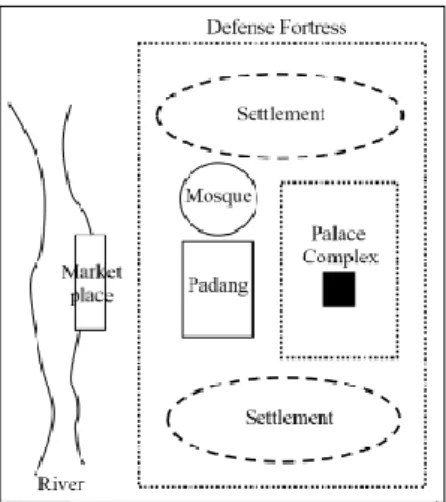
to segregate the authority between a local ruler and colonial dictatorship (Samsudin et al., 2018). Syed Zainol Abidin (1995) stated that a historical and old town or a city needs to integrate the existing intangible and tangible values in its local planning and development. The place must portray its outstanding local identities such as diversity of cultural and local activities, customs and local heritage and be able to highlight its distinctive urban form features. The Malay royal town is an excellent example of a Malay traditional town which is based on the presence of all eight components of a Malay traditional town (Fig.1), namely; the palaces, field, marketplace, mosque, village, river, gateway and fortress elements (Mohmad Shukri et al., 2018).
Figure 1: The physical components of Malay Royal Town Source: Mohmad Shukri et al. (2018)
Image and identity attributes of an urban heritage area
efficacy: the need to feel safe and comfortable. These four aspects of place identity must be equivalent to support place identity (Breakwell, 1993). Ginting (2016) had further developed the theory and came out with the attributes that help to shape the image and identity of an urban heritage district (Table 1). Hence, those attributes were adopted in this study based on the local context. Her findings also suggested that two (2) of the main characteristics that shape the identity of a heritage district are the nostalgia elements and historical buildings.
Table 1: Attributes of Place Identity in Urban Heritage Area Distinctiveness Continuity Self-Esteem Self-Efficacy Accessibilities Historic buildings Historic buildings Signage
Historic buildings Historic stories Public transport
Local product Cultural activities Parking
Cultural activity Pedestrian Pedestrian
Nostalgia Facilities
Source: Ginting (2016)
METHODOLOGY
The method for this study employed a case study approach to determine the local
people’s perception of the town’s attributes that help to shape the town’s place
identity with the use of multi-sources of evidence. A case study approach is used to generate an understanding of a complicated issue in its real-life context (Robert, 1986). This research was conducted in the Royal Town of Kuala Kangsar, Perak and Pekan, Pahang where both royal families are the direct descendant from the old kingdom of Malacca Sultanate (Ahmad Fawzi et. Al., 2002). This factor gives an exciting idea to conduct a study on the town’s identity
to see if there are any similarities in the ideologies behind the unique character of both towns. The selection of participants for this study was based on the convenience sampling, and according to the sample size method by Miles & Shevlin (2015), the sample size derived for this research stands 120 per case study. Thus, two hundred forty respondents (240) which include adult local people were involved with the questionnaire survey. The survey questions were adopted from the previous study by Ginting (2016) where the author managed to come out with the attributes that shape the identity of a heritage district based on the four aspects of place identity (Table 1). The survey also had been conducted using 5-point Likert scale from 1 (strongly disagree) to 5 (strongly agree). Other than that, site observation, semi-structured interview and archival research
method had been conducted to develop a deeper understanding of the town’s
FINDINGS AND DISCUSSION
The data were analyzed through descriptive statistical measurements using SPSS. A comparative data analyses later were undertaken to identify the similarities between two case study in a way to generalize the overall picture of the unique character of Malay royal town in Malaysia. The results of the analysis show that several tangible and intangible elements defined the image and identity of the royal towns. The physical component comprises the aspects of the natural landscape, the urban structure and architectural features (Harun et al., 2015). Meanwhile, the intangible includes the social background and cultural significance of human activities in the study area.
Malay traditional town components
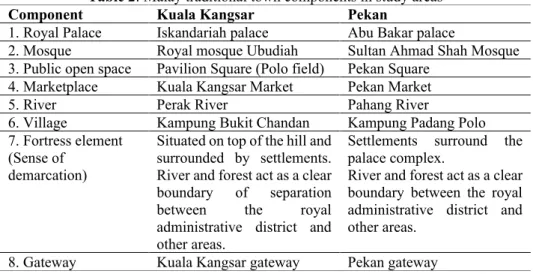
According to Mohmad Shukri et al. (2018), the royal town is an example of a Malay traditional town based on the presence of its eight (8) components; palaces, field, the marketplace, mosque, village, river, gateway and fortress elements (Fig.1). From the findings, the data shows that both study areas are consisting of the Malay traditional town components as follows;
Table 2: Malay traditional town components in study areas
Component Kuala Kangsar Pekan
1. Royal Palace Iskandariah palace Abu Bakar palace
2. Mosque Royal mosque Ubudiah Sultan Ahmad Shah Mosque
3. Public open space Pavilion Square (Polo field) Pekan Square
4. Marketplace Kuala Kangsar Market Pekan Market
5. River Perak River Pahang River
6. Village Kampung Bukit Chandan Kampung Padang Polo
7. Fortress element (Sense of
demarcation)
Situated on top of the hill and surrounded by settlements. River and forest act as a clear boundary of separation
between the royal
administrative district and other areas.
Settlements surround the palace complex.
River and forest act as a clear boundary between the royal administrative district and other areas.
8. Gateway Kuala Kangsar gateway Pekan gateway
Source: Author (2019)
The place identity aspects in the royal town
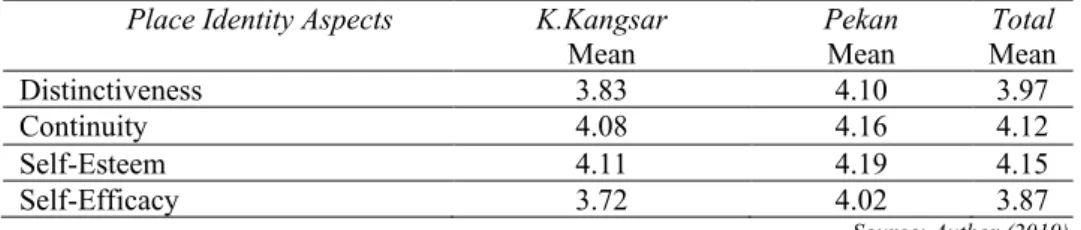
Table 3 shows the overall analyses between the two study areas. The highest
mean score collected is under the element ‘self-esteem’ with rating 4.15. Followed by 4.12 for the ‘continuity’ aspect, 3.97 for distinctiveness and 3.87 for
Table 3: Overall Comparative analyses between two studied areas
Place Identity Aspects K.Kangsar
Mean
Pekan Mean
Total Mean
Distinctiveness 3.83 4.10 3.97
Continuity 4.08 4.16 4.12
Self-Esteem 4.11 4.19 4.15
Self-Efficacy 3.72 4.02 3.87
Source: Author (2019)
Table 4 shows the respondents’ perception of self-esteem aspect in research areas. Three research elements are involved, namely;evaluation, pride, and attachment which are labelled as EV, PR and AT respectively. The highest mean score is 4.38, and the lowest is 3.54, and both are under EV element for
Pekan research area. The complete tabulations of mean scores are as follow;
Table 4: Respondents' perception of Self Esteem Aspect in Research Areas
EV = Evaluation PR = Pride AT = Attachment, Value Format: 1 = strongly disagree, 5 = strongly agree
Source: Author (2019)
Based on data in Table 4, majority of the respondents feel that the overall quality of public amenities, facilities and the living cost are quite good, and this was supporting the elements of overall evaluation that shapes the self-esteem aspect Statements K.Kangsar Pekan Total
Mean Mean Mean
EV Good public amenities. Living cost is affordable. 3.54 3.73 3.78 3.68 3.66 3.70
Enough public facilities. 3.99 4.38 4.18
PR
Ability to feel the Royal sovereignty when seeing;
Buildings with grandeur architectural. 4.10 4.19 4.15
Malay traditional design, state’s symbols, King’s
images & the use of yellow and golden colours. 3.88 4.12 4.00
Formal landscape. 3.78 4.04 3.91
The Royal customs ceremonies. 3.87 4.07 3.97
Festive lighting arrangement. 3.78 3.88 3.83
AT
Feel part of this town & willing to contribute. 3.91 3.99 3.95 Feel sad if this component demolished:
Palaces 4.56 4.34 4.45
Royal Mosque 4.54 4.41 4.48
Royal Mausoleum 4.48 4.37 4.43
Historical buildings 4.46 4.43 4.45
Jetty and River valley 4.31 4.35 4.33
Public square/field 4.20 4.31 4.25
Traditional Villages 4.43 4.40 4.42
Market 4.11 4.28 4.19