FACTORS AFFECTING CONSUMER ATTITUDE TOWARDS
INTERNET BANKING IN INDIA
Neetu Jain*
Dr. Pooja Malhotra**
ABSTRACT
The objective of the present study is to find out the factors affecting adoption of Internet
banking in India. The data for this study is based upon a survey of bank customers using a
convenience sampling technique with the aid of a structured self-administered questionnaire.
The survey was conducted during the period of April 2012. Chi square test and Principal
component factor analysis is employed to explore the factors affecting the adoption of
Internet banking in India. The results show that the demographic factors particularly age;
qualification, profession, income and no. of banks dealing with are the significant variables
affecting usage of internet banking. Factor analysis results show that prior computer
experience, prior technology experience, personal banking experience, and reference group
influence, affect attitude towards online banking as well as online banking usage. The
purpose of this study is to help fill significant gaps in knowledge about the inhibitors of
Internet banking in India. The findings of this study are expected to be of great use to the
bank marketers. An understanding of the factors identified in this study allows bank managers to direct efforts and resources in the most effective and efficient way to increase bank business in the long run and encourage their bank customers’ to adopt Internet banking.
*Research Scholar, CMJ University, Shillong, Meghalaya
1.
INTRODUCTION
Internet is increasingly used by ba nks as a channel for receiving instructions and delivering their products and services to their customers. The motivation for this study arose out of the rapid de velopment of I nternet ba nking i n I ndia. S ince 19 97, a fter t he l aunch of t he f irst Internet ba sed ba nking service, the number of I nternet ba nkers h as g rown a t a n e normous pace. A n i nhibiting f actor i s c oncern w hether t here i s d emand f or s uch s ervices, based on concerns a bout l evels of c omputer ow nership, I nternet u sage and consumer acceptanc e. Although the number of users of the Internet has increased significantly over the past decade, only a small fraction of those users have made actual purchases over the Internet. The failure of the In ternet a s a retail di stribution c hannel ha s b een attributed t o t he lack of t rust consumers have in the electronic channel and in the Web merchants.
In br oad t erms, t he pr esent s tudy aims, a s t he t itle “ Factors af fecting consumer a ttitude towards Internet B anking in I ndia” i ndicates, to e xplore t he w orld of e lectronic ba nking through t he eyes of t he consumer, a nd by s o doi ng s eeks to i ncrease the unde rstanding of consumer a ttitude f ormation a nd b ehaviour. T he i dentification of pe rsonal c haracteristics related to the adoption of internet banking is critical for market targeting and can help banks in pr oduct design a nd in f ormulating c ampaigns t hat w ill e ncourage the a doption of t he service. In this study these are related to adoption intention, which is defined as an individual decision to try Internet banking service within a specified period of time.
The pr imary objective of thi s pa per is to determine t hose f actors that i nfluence on the formation of attitude towards Internet banking. This paper also looks at individual differences in online banking in an effort to better understand the adoption of remote banking channels. While this paper focuses on attitude development in particular, it also investigates individual differences in demographics and perceptions. Thus, the Theory of Reasoned Action (TRA) (Ajzen and Fishbein, 1 980) a nd t he T echnology Acceptance Mode l (TAM) ( Davis et al.,
2.
LITERATURE REVIEW
The current study explores how different factors influence attitude towards Internet banking and the use of Internet banking in India. Attitudes are said to develop over time through a learning process af fected by reference group influences, past exp erience and pe rsonality (Assael, 1981, p. 183). The next sections outline these different components in detail.
Individual differences in consumer behaviour have been theorized and found to be associated with the acceptance of ne w information t echnology, s uch a s I nternet banking ( e.g. Zmud, 1979; N elson, 1990) . A ssael (1981, p. 234) , f or i nstance, argues that c onsumer behaviour should be studied through demographics, beliefs and attitudes. In this paper, one central point under s crutiny w ill be demographic cha racteristics, be cause t hey are sai d t o be eas ier t o measure and study due t o t heir objective, standardized nature. Our review of the literature concerning a typical online banking user revealed that a typical user can be classified as a highly educated, r elatively young a nd wealthy person w ith good know ledge of c omputers and, especially, the Internet. It has been widely recognized that demographic factors have a great i mpact on consumer at titudes and be haviour regarding onl ine b ankin (Daniel, 1999; Sathye, 1999; Jayawardhena and Foley, 2000; Mattila, 2001; Karjaluoto, 2002; Karjaluoto et al., 2002) . M oreover, a typical Internet banking us er ha s be en identified as a h igh
involvement person belonging to the upper middle class or in parts as a member of the career-orientated upper middle class (Jayawardhena and Foley, 2000).
The t echnology a cceptance literature suggests a s trong r elationship be tween a ge and t he acceptance of new technologies ( e.g. Gattiker, 1992; H arrison a nd Rainer, 199 2). Older consumers are found to have problem with new technologies and, hence, are expected to have negative a ttitudes t owards innovations. T rocchia a nd J anda ( 2000), f or instance, f ind t hat many older consumers have a m ore negative attitude to change. However, they argue that a person’s ov erall perception of t echnology h as a gr eater e ffect than a ge. S imilarly, JaÈrvenpaÈaÈ and Todd (1997) found that age had a relatively weak impact on attitude and intention towards the acceptance of new technology.
Literature s uggests t hat pr ior e xperience of technologies, e specially p rior e xperience of computers, impacts on consumer beliefs and attitudes towards related systems and technology (Arndt et al., 1985; D eLone, 1988; Levin a nd G ordon, 1989; I gbaria et al., 1995) . These
studies suggest not only that prior experience is the essential factor underlying attitudes, but also t hat pr ior e xperience of computers ha s gr eater ef fect on attitudes than de mographic characteristics (Levin and Gordon, 1989). Similarly, Au and Enderwick (2000) continue that the more experience a consumer has about technology, the better understanding the consumer will ha ve a bout new t echnologies. T hus, a be tter understanding of t echnology a llows t he consumer to better appreciate the added value brought by new technological improvements. In this pa per, while p rior experience of t echnology r efers t o consumers’ expe riences associated with the use of different technologies such as ATMs, automates in general, electric IDs, and teletext, prior computer experience is associated with the use of PCs, the Internet, and e-mail, to mention a few.
Fishbein and Ajzen (1975, p. 14) , for example, argue that the more positive a person’s past experience about an object i s, the more pos itive be liefs he or s he w ill hol d about i t. A s a result, the more positive beliefs a person has, the more positive attitude this will create. It has been argued t hat i n t oday’s computerized information t echnology w orld consumers ha ve become more aw are of computers a nd r elated technologies, a re more educ ated and ha ve a higher spending as well as purchasing power. Therefore, information technology skills have also emerged as a priority (Zineldin, 2000). This trend predicts the emergence of new Internet technologies. Trocchia and Janda (2000) argue that the tendency of consumers to accept or reject c hange di stinguishes Internet us ers f rom non -users. Specifically, non-users’ negative experiences of technology seem to have a great impact on their attitude towards technological developments in general.
poor customer service have been impacting the consumer movement from branch banking to electronic delivery.
Consumers with positive past experience of banking are more l ikely t o keep up w ith their current ba nking c hannel. F or i nstance, online banking users ar e m ore sat isfied with their banking now than at the time of branch banking. To sum it up, s atisfied consumers seem to hold more positive beliefs and have more positive attitudes towards online banking and, thus, are more likely to use Internet banking as their primary banking delivery channel. It is vital for banks to create a po sitive banking experience for their customers in order to guarantee satisfaction (see for example, Foreman, 2000) . Another important aspect is that consumers tend to resist change, referring to the tendency to make a habit of behaviour. In this sense, the importance of personal banking experience increases.
Consumer be haviour literature sug gests t hat reference gr oup of ten i mpacts on c onsumer behaviour (Fishbein and Ajzen, 1975, p. 495; Kotler et al., 1999, p. 452) . However, banking
is c laimed t o be e xtremely pe rsonal i n t he sense t hat i t i s seen as i ndependent f rom other people’s example or influence. Although family influences on the adoption of online banking tend t o be strong, the impact of other reference gr oups is relatively an uncharted territory. Prior studies have identified two competing influences on the relationship between reference group a nd behaviour: c onformity a nd di ssension (Snyder a nd F romkin, 1 977; B aumeister, 1982; Guerin, 1986; S imonson a nd N owlis, 2000) . The f ormer c oncerns a pproval a nd t he avoidance o f cr iticism and rejection by others. In ot her w ords, pe ople try t o c onform to a subjective norm. However, as Simonson and Nowlis (2000) note, in promoting conformity, ``social interactions may stimulate dissension from norms, which fulfill a positive function in one’s se lf- and public image.’’ T he la tter id ea c oncerns t he consumer’s i ndependence of subjective norms, i.e. it reflects the consumer’s strong sense of self-respect and autonomy. In addition, a consumer c an be c onsidered unique, s pecial, and s eparable f rom t he masses (Snyder, 1992). Similarly, as Bagozzi (2000) has shown with empirical data, social factors and forces are strong determinants of consumer behaviour. Taylor (1991, p. 55), for example, argues that most people try to surround themselves with people and things that are consistent with their o wn identities. In this p aper, the te rm re ference gr oup is seen as an extensive construct, referring to all the people who influence on consumer behaviour.
explains most literally consumers’ banking behaviour. In other words, attitude towards online banking is expected to divide consumers into nonusers, light users and heavy users of online banking. The theoretical background presented different factors that impact on attitude and behaviour t owards onl ine ba nking. T he purpose of t he di scussion w as t o pa ve t he way to better unde rstand t he f ormation of attitude t owards onl ine ba nking a nd i ts relationship to usage. The next part of the paper presents the findings of the survey data concerning these issues.
3.
RESEARCH METHODOLOGY
The data were collected by means of a questionnaire from 1160 individual bank customers in India. Respondents were chosen from ICICI and HDFC Bank’s customer database throughout north I ndia t hat i ncludes r egions of H aryana, P unjab, H imachal P radesh a nd D elhi. The response rate was 38.9 percent, which was well above our expectations. The items used to measure the di fferent f actors w ere constructed on t he basis of t he literature. Our sam ple consisted of three equal-sized consumer segments that were selected in terms of their online banking experience. The segments were nonusers of the service, new users (had the required user ID and password list; not necessarily in use), and old users (longstanding users; had used online banking services since 1997).
As sugge sted in the l iterature ( see, f or example, F ishbein a nd A jzen, 1975) , be liefs and attitudes were measured using Likert scales (Likert, 1932) and semantic differentials (Osgood
et al., 1957). The data were analyzed using factor analysis and correlations (SPSS 18).
4.
RESULTS
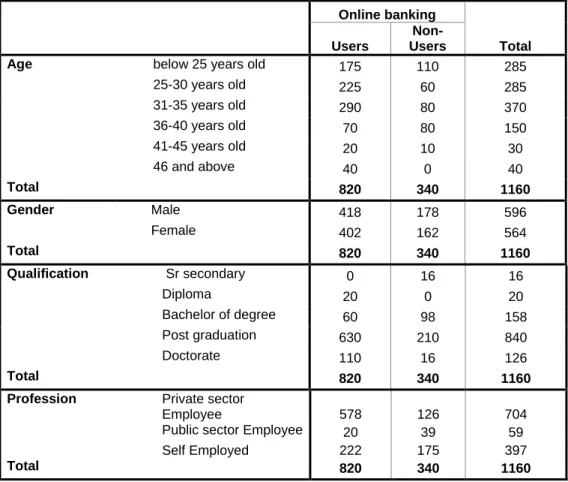
Table 1: Profile of the respondents
Online banking
Total Users
Non-Users
Age below 25 years old 175 110 285
25-30 years old 225 60 285
31-35 years old 290 80 370
36-40 years old 70 80 150
41-45 years old 20 10 30
46 and above 40 0 40
Total 820 340 1160
Gender Male 418 178 596
Female 402 162 564
Total 820 340 1160
Qualification Sr secondary 0 16 16
Diploma 20 0 20
Bachelor of degree 60 98 158
Post graduation 630 210 840
Doctorate 110 16 126
Total 820 340 1160
Profession Private sector
Employee 578 126 704
Public sector Employee 20 39 59
Self Employed 222 175 397
Total 820 340 1160
Table 2
Technology usage
Percent
Do not use mobile phone in banking (%) 96.8
Uses mobile phone in banking (%) 3.2
WAP 25.0
Text message 11.1
Call-center 63.8
Standard deviation 0.45
No computer (%) 36.5
Has a computer (%) 63.5
At home 83.0
At work 40.8
Other 4.6
Standard deviation 0.81
With no Internet access (%) 42.2
With Internet access 57.8
Accessing Internet from:
Home 51.3
Office 45.5
Other 3.2
Factor analysis
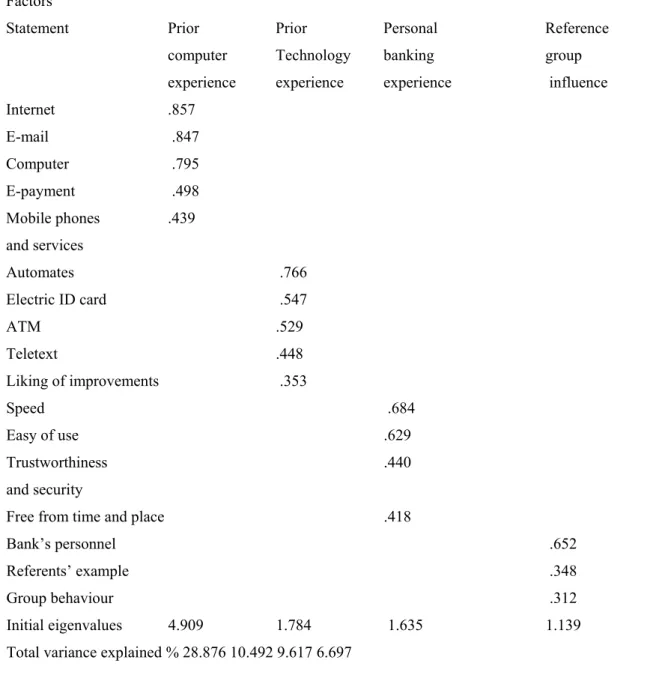
A factor analysis was conducted in order to develop factors that help in explaining the role of experience and reference group in online banking. As suggested by H air et al. (1995), four
factors w ere i dentified f or t he factor a nalysis us ing t he e igenvalue c riteria that s uggest extracting factors with an eigenvalue of greater than 1.0. In conducting the factor analysis we followed Hair et al. (1995) a nd A lfansi a nd S argeant ( 2000). T he rotated factor matrix is
displayed in Table 3.
Table 3 Factor analysis of Internet banking adoption
Factors
Statement Prior Prior Personal Reference
computer Technology banking group
experience experience experience influence
Internet .857
E-mail .847
Computer .795
E-payment .498
Mobile phones .439
and services
Automates .766
Electric ID card .547
ATM .529
Teletext .448
Liking of improvements .353
Speed .684
Easy of use .629
Trustworthiness .440
and security
Free from time and place .418
Bank’s personnel .652
Referents’ example .348
Group behaviour .312
Initial eigenvalues 4.909 1.784 1.635 1.139
Total variance explained % 28.876 10.492 9.617 6.697
Notes: Extraction method: Principal Axis Factoring
The f our f actors identified explained 55.7 percent of t he t otal v ariance. T he e xtraction method us ed w as pr incipal a xis f actoring with V arimax r otation. T his m ethod h as been widely accepted as a r eliable m ethod of factor ana lysis ( see, for exa mple, Alexander and Colgate, 20 00). I n our s urvey, t he K aiser- Meyer-Olkin (KMO) m easure of sam pling adequacy s core ( 0.853) was well above t he recommended 0.5 l evel ( Malhotra, 1999). Moreover, t he B artlett’s t est of sphe ricity indicated that there w as adequate co rrelation among the chosen variables ( X2
(136)= 3,452.6, p < 0.01).
The f irst f actor, prior c omputer experience, e xhibited he avy l oadings f or five variables pertaining to the consumer perception of computer-related technologies. We expected non-users to score low and old non-users to score high on this factor. Thus, as we show in our results, this factor had a strong relationship with attitude and behaviour. Factor two, prior technology experience exhibits l oadings f or f ive va riables concerning c onsumer pe rceptions of technology in general. The third factor, personal banking experience, exhibits high loadings for f our va riables c oncerning e ase of use an d speed. The l ast f actor, reference group influence, exhibits high loadings for three variables pertaining to the consumer reaction of the surrounding subjective nor m. On the ba sis of the literature r eview an d this f actor ana lysis suggests that four factors: prior computer experience, prior technology experience, personal banking experience, and reference group influence, affect attitude towards online banking as well as online banking usage.
5.
CONCLUSIONS
addition, positive personal banking experience seemed to have an effect on both attitude and usage. T his i s t o s ay t ha satisfied c ustomers t end t o ke ep up w ith t heir current de livery channel. F urthermore, t he results i ndicate t hat r eferents w ould have a negative i mpact on online banking usage.
REFERENCES
1. Ajzen, I . a nd F ishbein, M. ( 1980) , Understanding Attitudes and Predicting Social Behavior,Prentice-Hall, New York, NY.
2. Alexander, N. a nd C olgate, M . ( 2000), ` `Retail f inancial services: transaction t o relationship marketing’’, European Journal of Marketing, Vol. 34 No. 8, pp. 938-53.
3. Alfansi, L. and Sargeant, A. (2000), ``Market segmentation in the Indonesian banking sector: the r elationship between demographics and desired customer be nefits’’,
International Journal of BankMarketing, Vol. 18 No. 2, pp. 64-74.
4. Arndt, S ., Clavenger, J. a nd M eiskey, L . ( 1985), ` `Students’ a ttitudes t owards computers’’, Computers and the Social Sciences, Vol. 1, pp. 181-90.
5. Assael, H . ( 1981) , Consumer Behavior and Marketing Action, 3r d e d., P WS-Kent
Publishing Company, Boston, MA.
6. Au, A .K. a nd E nderwick, P . (2000), ``A c ognitive model on a ttitude t owards technology adoption’’, Journal of Managerial Psychology, Vol. 15 No. 4, pp. 266-82.
7. Bagozzi, R .P. ( 2000) , ` `On t he c oncept of i ntentional social a ction i n c onsumer behaviour’’, Journal of Consumer Research, Vol. 27, December, pp. 388-96.
8. Baumeister, R .F. (1982), ``A s elf-presentational view of soc ial phe nomena’’,
PsychologicalBulletin, Vol. 91 No. 1, p. 326.
9. Burstein, D. and Kline, D. (1995) , Road Warriors, Dutton Books, New York, NY.
10.Daniel, E. (1999), ``Provision of electronic banking in the UK and the Republic of Ireland’’, International Journal of Bank Marketing, Vol. 17 No. 2, pp. 72-82.
11.Davis, F.D., Bagozzi, R.P. and Warshaw, P.R. (1989) , ``User acceptance of computer technology: a comparison of two theoretical models’’, Management Science, Vol. 35,
pp. 982-1003.
12.DeLone, W.H. ( 1988), ` `Determinants of s uccess f or c omputer us age i n s mall business’’, MISQuarterly, Vol. 12 No. 1, pp. 51-61.
14.Foreman, S .K. ( 2000), ``Customer satisfaction g uaranteed’’, Manager Update, V ol.
11 No. 3, pp. 11-20.
15.Gattiker, V .E. ( Ed.) ( 1992), Technology-mediated Communication, W . de G ruyter,
New York,NY.
16.Guerin, B. ( 1986), ` `Mere p resence ef fects i n humans: a r eview’’, Journal of ExperimentalSocial Psychology, Vol 22 No. 1, pp. 38-77.
17.Hair, J.F., Anderson, R.E., Tatham, R.L. and Black, W.C. (1995) , Multivariate Data Analysiswith Readings, Prentice-Hall, Englewood Cliffs, NJ.
18.Harrison, A.W. and Rainer, R.K. (1992), ``The influence of individual differences on skill in end-user c omputing’’, Journal of Management Information Systems, Vol. 9
No. 1, pp. 93-111.
19.Igbaria, M ., G uimaraes, T . a nd D avis, G .B. ( 1995), “Testing t he de terminants of microcomputer usage v ia a s tructural e quation model’’, Journal of Management Information Systems, Vol. 11 No. 4, pp. 87-114.
20.JaÈrvenpaÈaÈ , S .L. a nd T odd, P .A. ( 1997), ` `Consumer reactions to electronic shopping on the World Wide Web’’, International Journal of Electronic Commerce,
Vol. 1 No. 2, pp. 59-88.
21.Jayawardhena, C. and Foley, P. (2000), ``Changes in the banking sector : the case of Internet banking in the UK’’, Internet Research:Electronic Networking Applications andPolicy, Vol. 10 No. 1, pp. 19-30.
22.Karjaluoto, H . ( 2002), ``Electronic ba nking i n Finland: c onsumer be liefs, a ttitudes, intentions, and behaviours’’, Jyvaeskylae Studies in Business and Economics, No. 18,
University of Jyvaeskylae , Jyvaeskylae , Finland.
23.Karjaluoto, H., Mattila, M. and Pento, T. (2002), ``Electronic banking in Finland – consumer beliefs and r eactions t o a ne w de livery channel’’, Journal of Financial ServicesMarketing, Vol. 6 No. 4, pp. 346-61.
24.Kotler, P., Armstrong, G., Saunders, J. and Wong, V. (1999), Principles of Marketing,
2nd European ed., Rotolito Lombarda, Milan.
25.Levin, T . a nd G ordon, C . ( 1989), ` `Effect of ge nder and c omputer experience o n attitudes towards c omputers’’, Journal of Educational Computing Research, Vol. 5
No. 1, pp. 69-88.
27.Malhotra, N. (1999), Marketing Research: An Applied Orientation, 3rd ed.,
Prentice-Hall,Sydney.
28.Mattila, M. (2001) , ``Essays on customers in the dawn of interactive banking’’, Jyvae skylae Studies in Business and Economics, N o. 9, University of Jyvaeskylae ,
Jyvaeskylae , Finland.
29.Nelson, D .L. ( 1990) , ` `Individual adjustment t o information-driven t echnologies: a critical review’’, MIS Quarterly, Vol. 14 No. 1, pp. 79-100.
30.Peter, P.J. and Olson, J.C. (1990), Consumer Behavior and Marketing Strategy, 2nd
ed.,R.R. Donnelley, Chicago, IL.
31.Sathye, M . (1999) , ``Adoption of I nternet ba nking by Australian co nsumers: an empirical investigation’’, International Journal of BankMarketing, Vol. 17 No. 7, pp.
324-34.
32.Simonson, I . a nd N owlis, S .M. ( 2000), ` `The r ole of explanations a nd need f or uniqueness in consumer decision making: unconventional choices based on reasons’’,
Journal ofConsumer Research, Vol. 27, July, pp. 49-68.
33.Snyder, C .R. ( 1992), ` `Product s carcity by need f or uniqueness i nteraction: a consumer catch-22 carousel?’’, Basic and Applied Social Psychology, Vol. 13 No. 3,
pp. 9-24.
34.Snyder, C.R. and Fromkin, H.L. (1977), ``Abnormality as a positive characteristic: the development a nd v alidation of a s cale measuring ne ed f or uni queness’’, Journal of Abnormal Psychology, Vol. 86 No. 5, pp. 518-27.
35.Taylor, M. ( 1991), The Fanatics. A Behavioural Approach to Political Violence,
Brassey’s, Sydney.
36.Trocchia, P.J. and Janda, S. (2000) , ``A phenomenological investigation of Internet usage among older individuals’’, Journal of Consumer Marketing, Vol. 17 No. 7, pp.
605-16.
37.Zineldin, M. (2000), ``Beyond relationship marketing: technologicalship marketing’’,
Marketing Intelligence & Planning, Vol. 18 No. 1, pp. 9-23.