Alden C. Adrion
A dissertation submitted to the faculty at the University of North Carolina at Chapel Hill in partial fulfillment of the requirements for the degree of Doctor of Philosophy in the Department
of Environmental Sciences and Engineering in the Gillings School of Global Public Health.
Chapel Hill 2015
ABSTRACT
Alden C. Adrion: Improving PAH Biodegradation in Contaminated Soil by Adding Surfactant After Conventional Biological Treatment
(Under the direction of Michael D. Aitken)
Polycyclic aromatic hydrocarbons (PAHs) are a class of compounds which occur frequently at polluted sites and are known or suspected to be toxic and genotoxic.
Bioremediation is one option for the treatment of PAH-contaminated soil, but PAHs are often strongly bound to soil and may be unavailable to degrading microorganisms. Limited PAH desorption can be particularly problematic for weathered soils or soils which have undergone treatment but fail to meet cleanup goals. Additionally, bioremediation does not always lead to a reduction in soil (geno)toxicity. This dissertation addresses these limitations by screening
nonionic surfactants enhanced desorption and biodegradation of residual PAHs remaining in soil after conventional slurry-phase bioreactor-treatment. Surfactant doses were chosen to be below the critical micelle concentration in the soil-slurry system. The effect of surfactant-amended treatment on soil (geno)toxicity was also evaluated. The best performing surfactant was selected for use in a second-stage bioreactor to evaluate the reproducibility of surfactant-amended
treatment and to investigate the effect of varying residence time.
Environmental Protection Agency (individual PAH removals up to 80%). Further treatment without surfactant significantly reduced the genotoxicity of the soil, while treatment with
surfactant had varying effects. Increased PAH removal, however, did not always coincide with a reduction in soil toxicity and genotoxicity.
For the two-stage bioreactor system using polyoxyethylene sorbitol hexaoleate surfactant, substantial amounts of the PAHs and oxygenated-PAHs remaining after conventional bioreactor-treatment were removed in the second stage, including more than 80% of residual 4-ring PAHs. The most substantial PAH removal in the second stage occurred within the first week of
ACKNOWLEDGEMENTS
I thank and acknowledge my advisor and committee for their guidance. Specifically, I acknowledge Mike Aitken for reviewing my data, interpretations, and written work. I
TABLE OF CONTENTS
LIST OF TABLES ... x
LIST OF FIGURES ... xii
CHAPTER 1: INTRODUCTION ... 1
1.1 Specific aims and rationale ... 2
1.2 Dissertation organization ... 4
CHAPTER 2: BACKGROUND ... 5
2.1 PAH-contaminated sites ... 5
2.1.1 Distribution of hydrophobic organic contaminants in geosorbents ... 6
2.1.2 Specific geosorbent domains relevant to PAH-contaminated soil ... 10
2.2 Bioavailability and bioaccessibility ... 12
2.2.1 Measurements of bioavailability and bioaccessibility ... 13
2.2.2 Effect of bioavailability/accessibility on bioremediation of PAH-contaminated soil ... 14
2.3 Surfactants ... 15
2.3.1 The critical micelle concentration ... 16
2.3.2 Sorption of surfactant to geosorbent ... 17
2.3.3 Effect of surfactant on PAH desorption... 17
2.3.4 Effect of surfactant on bioremediation of PAH-contaminated field soil ... 20
2.4 Microbial degradation of PAHs ... 25
2.5 (Geno)toxicity of PAHs ... 27
2.5.2 Incomplete PAH metabolism during biodegradation and its effect on soil
(geno)toxicity ... 33
CHAPTER 3: EFFECT OF CONVENTIONAL BIOREACTOR TREATMENT ON THE REMOVAL AND BIOAVAILABILITY OF OXY-PAHS IN CONTAMINATED SOIL ... 38
3.1 Introduction ... 38
3.2 Methods ... 39
3.2.1 Bioreactor operation ... 39
3.2.2 LC-MS/MS method ... 39
3.2.3 Spike and recovery validation ... 40
3.2.4 Solubility of oxy-PAHs in phosphate buffer ... 41
3.2.5 Chromatographic method improvement ... 41
3.3 Results and discussion ... 42
CHAPTER 4: SCREENING NONIONIC SURFACTANTS FOR ENHANCED BIODEGRADATION OF POLYCYCLIC AROMATIC HYDROCARBONS REMAINING IN SOIL AFTER CONVENTIONAL BIOLOGICAL TREATMENT ... 45
4.1 Introduction ... 45
4.2 Materials and methods ... 47
4.2.1 Materials ... 47
4.2.2 Bioreactor operation ... 48
4.2.3 Surfactant dose selection ... 48
4.2.4 PAH desorption ... 50
4.2.5 PAH biodegradation ... 52
4.2.6 Soil extraction and PAH analysis ... 53
4.2.7 (Geno)toxicity ... 54
4.3.1 PAH desorption ... 56
4.3.2 PAH biodegradation ... 58
4.3.3 (Geno)toxicity ... 63
4.4 Discussion ... 66
CHAPTER 5: IMPROVING PAH BIODEGRADATION IN CONTAMINATED SOIL THROUGH SECOND-STAGE TREATMENT IN A SURFACTANT-AMENDED BIOREACTOR ... 71
5.1 Introduction ... 71
5.2 Materials and methods ... 73
5.2.1 Experimental design ... 73
5.2.2 Chemicals ... 74
5.2.3 First-stage treatment ... 74
5.2.4 Preliminary experiments ... 75
5.2.5 Second-stage treatment ... 75
5.2.6 Slurry extraction and analysis ... 76
5.2.7 (Geno)toxicity analysis ... 77
5.2.8 Data analysis ... 78
5.3 Results ... 78
5.3.1 Preliminary experiments ... 78
5.3.2 PAH and oxy-PAH removal ... 79
5.3.3 (Geno)toxicity ... 82
5.4 Discussion ... 83
CHAPTER 6: CONCLUSIONS AND RECOMMENDATIONS ... 89
6.1 Conclusions ... 89
LIST OF TABLES
Table 3.1 Concentration of oxy-PAHs in feed and treated soils and
corresponding removals. ... 43
Table 3.2 Measured solubility of oxy-PAHs and reported values in the literature. ... 44
Table 4.1 Properties of surfactants tested and doses used... 50
Table 5.1 Aqueous-phase surfactant and pyrene concentrations after 48 hours ... 79
Table A.1 Concentrations of Priority PAHs in feed soil. ... 95
Table A.2 Concentrations of other PAHs in feed soil. ... 96
Table A.3 Concentrations of PAHs in the bioreactor-treated soil samples used in the preliminary biodegradation and followup (geno)toxicity experiments. ... 97
Table A.4 PAH mass desorbed for incubations with Brij 30 and concentration of PAHs in bioreactor-treated soil used to prepare desorption incubations. ... 98
Table A.5 PAH mass desorbed for incubations with Span 20 and POESH and concentration of PAHs in bioreactor-treated soil used to prepare desorption incubations. ... 99
Table A.6 PAH mass desorbed for incubations with R-95 and EH-3 and concentration of PAHs in bioreactor-treated soil used to prepare desorption incubations. ... 100
Table A.7 PAH mass recovered from higher-dose surfactant desorption incubations. ... 101
Table A.8 Concentrations of PAHs in followup biodegradation experiment. ... 102
Table A.9 Overall removal of PAHs in treatments relative to feed soil. ... 104
Table B.1 Concentrations of PAHs and Oxy-PAHs measured in untreated bioreactor feed soil. ... 111
Table B.2 Concentrations of PAHs and Oxy-PAHs after first-stage treatment and 7-day second-stage treatment. ... 112
Table B.3 Concentrations of PAHs and Oxy-PAHs after first-stage treatment and 12-day second-stage treatment. ... 113
Table B.5 Removal of PAHs and oxy-PAHs during first-stage and 12-day
LIST OF FIGURES
Figure 2.1 Two-domain kinetic model of HOC desorption. ... 9
Figure 2.2 Idealized PAH desorption curve. ... 14
Figure 2.3 Representative surfactant molecule (Brij 30). ... 16
Figure 2.4 Cross section of surfactant micelle. ... 17
Figure 2.5 Rollback of NAPL. ... 19
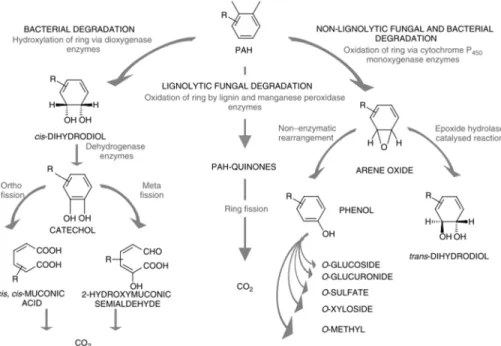
Figure 2.6 Biodegradation pathway of PAHs ... 26
Figure 2.7 Diol epoxide metabolic activation of benzo[a]pyrene ... 29
Figure 3.1 Portion of chromatogram during which PQ elutes ... 42
Figure 3.2 Effect of bioremediation on desorption of oxy-PAH from contaminated soil ... 43
Figure 4.1 Structures of tested surfactants ... 50
Figure 4.2 Cumulative desorption of total PAH mass from bioreactor-treated soil after seven days in the absence of surfactant or in the presence of five different surfactants ... 57
Figure 4.3 Cumulative desorption of PAHs from bioreactor-treated soil after seven days in the absence of surfactant or in the presence Brij 30. ... 57
Figure 4.4 Effect of surfactants on residual total PAH from bioreactor-treated soil ... 59
Figure 4.5 Effect of Brij 30 on biodegradation of residual PAHs ... 59
Figure 4.6 Effect of Span 20 on biodegradation of residual PAHs... 60
Figure 4.7 Effect of POESH on biodegradation of residual PAHs ... 60
Figure 4.8 Effect of EH-3 on biodegradation of residual PAHs ... 61
Figure 4.9 Effect of R-95 on biodegradation of residual PAHs... 61
Figure 4.10 Effect of Brij 30, POESH, and Span 20 on residual 4- and 5-ring PAHs from bioreactor-treated soil ... 62
Figure 4.12 Effect of incubation of bioreactor-treated soil with selected
surfactants in the followup PAH biodegradation experiment on (geno)toxicity. ... 64 Figure 4.13 (Geno)toxicity of soil from the initial and followup (geno)toxicity
experiments as evaluated a second time ... 65 Figure 5.1 Effect of second-stage treatment on residual PAHs and oxy-PAHs ... 81 Figure 5.2 Effect of second-stage residence time on the removal of selected
5-ring PAHs... 82 Figure 5.3 Effect of first- and second-stage treatment on (geno)toxicity. ... 83 Figure A.1 Aqueous-phase surfactant concentration (○) and corresponding
percent total pyrene mass in liquid phase as a function (●) of surfactant dose ... 106 Figure A.2 Data from Figure A.1 in the low range of surfactant dose only. ... 107 Figure A.3 Effect of Brij 30, POESH, and Span 20 in followup
biodegradation experiment on residual alkylated 2- and 3-ring PAHs ... 108 Figure A.4 Effect of anaerobic incubation with POESH on the biodegradation
of residual PAHs ... 109 Figure A.5 Effect of anaerobic incubation with POESH on (geno)toxicity of
bioreactor treated soil ... 109 Figure B.1 Effect of incubation with POESH over time on PAHs remaining
after first-stage bioreactor treatment. ... 110 Figure B.2 Effect of incubation of first-stage treated soil with POESH over
CHAPTER 1:INTRODUCTION
Polycyclic aromatic hydrocarbons (PAHs) are a class of compounds of environmental and public health concern because of their known or suspected toxicity and genotoxicity and frequent occurrence at contaminated sites (ATSDR 1995). The Agency for Toxic Substances and Disease Registry (ATSDR) and the United States Environmental Protection Agency (US EPA) have consistently ranked PAHs among the top ten contaminants of concern at sites on the National Priorities List (NPL). This ranking takes into account not only toxicity, but also
frequency and potential for human exposure at NPL sites (ATSDR 2011). Over 600 current NPL sites are contaminated with PAHs, of which over 400 contain PAH-contaminated soil (EPA 2015). PAH-contaminated soil poses a human health risk because of the potential for direct human exposure to the soil, leaching of PAHs into surface- or groundwater, volatilization of PAH, and the transport of PAH-contaminated particles through the air (ATSDR 1995).
Bioremediation is a “process whereby organic wastes are biologically degraded under controlled conditions to an innocuous state, or to levels below concentration limits established by regulatory authorities” (Mueller 1996). A 2007 EPA report on treatment technologies states that as of 2005, out of 145 remediation projects treating PAH contaminated source material, 37 utilized bioremediation (EPA 2007). Bioremediation of contaminated soil can be conducted in-situ by stimulating biological degradation in the intact soil, or ex-in-situ by stimulating
Between 2009 and 2011 at least three additional NPL sites having PAH-contaminated soil selected ex-situ bioremediation as a cleanup method (EPA 2013).
Although ex-situ bioremediation can be utilized as a cleanup strategy, it is not without limitations. Two fundamental limitations of bioremediation include incomplete removal of the target PAH (Aitken and Long 2004) and the potential to increase soil (geno)toxicity (Hughes et al. 1998; Gillespie et al. 2007; Lemieux et al. 2009; Hu et al. 2012). One factor limiting removal can be the slow desorption of PAHs from soil compartments, reducing the availability of PAH to degrading microorganisms. The addition of surfactants during bioremediation can enhance the bioavailability of PAHs to degrading microorganisms, as reviewed in Makkar and Rockne (2003), Li and Chen (2009), Elliot et al. (2011) and in Section 2.3 of this dissertation. The purpose of the research described in this dissertation was to investigate the effect of low-dose surfactant addition on the ex-situ bioremediation of PAH-contaminated soil from a former manufactured-gas plant (MGP) site which had already undergone conventional bioreactor treatment. The effects of second-stage surfactant-amended treatment on PAH removal and soil (geno)toxicity were evaluated.
1.1 Specific aims and rationale
Aim 1: Evaluate the effect of conventional bioreactor treatment on the removal and bioavailability of oxy-PAHs in contaminated soil.
the removal and desorbable fractions of oxy-PAHs during bioreactor treatment. The LC-MS method was also used to evaluate the effect of surfactant-amended treatment on the removal of oxy-PAHs in Aim 3. The desorbable fraction of oxy-PAHs remaining after conventional bioreactor treatment measured in Aim 1 was compared with the fraction of oxy-PAHs removed during second-stage treatment in Aim 3.
Aim 2: Screen nonionic surfactants for enhanced biodegradation of PAHs remaining in soil after conventional bioreactor treatment.
The efficacy of bioremediation for soil contaminated with PAHs may be limited by the fractions of soil-bound PAHs that are less accessible to PAH-degrading microorganisms. Although surfactant addition to contaminated soil has been suggested as a means of enhancing the biodegradation of hydrophobic contaminants such as PAHs, most studies do not articulate that the concept is most relevant to the fraction of a given compound that is relatively non-desorbable or non-bioaccessible. This would be the case for the PAHs remaining after
conventional bioreactor treatment has removed the most bioaccessible fraction. Aim 2 was to screen nonionic surfactants at the test-tube scale for their ability to enhance desorption and biodegradation of PAHs remaining after conventional slurry-phase bioreactor treatment. Five surfactants of similar hydrophobicity but with different chemical structures were selected for screening. Surfactant doses (mg surfactant/g dry soil) were selected to correspond to
(geno)toxicity was also evaluated using the DT40 DNA damage response assay (reviewed in Section 2.5.1).
Aim 3: Implement second-stage treatment of PAH-contaminated soil in a surfactant-amended bioreactor and evaluate its performance.
As a step towards demonstrating the feasibility of surfactant-amended ex-situ
bioremediation in the field, based on the results of Aim 2, one surfactant was selected for use during second-stage treatment of soil in a bench-scale bioreactor. Second-stage reactors were operated for a total of six cycles to evaluate the reproducibility of surfactant-amended treatment and the effects of residence time on PAH and oxy-PAH removal and on soil (geno)toxicity. 1.2 Dissertation organization
CHAPTER 2:BACKGROUND 2.1 PAH-contaminated sites
PAHs are a class of compounds made up of two or more fused benzene rings and/or pentacyclic moieties in linear, angular and cluster arrangements (Mueller 1996). This structure affords thermodynamic stability due to electron delocalization (resonance). PAHs are
hydrophobic, characterized by low aqueous solubilities, and typically associated with particles or surfaces in the environment. These properties can make PAHs resistant to natural attenuation processes such as volatilization, photolysis and biodegradation (Mueller 1996). Although there are natural sources of PAH, as well as diffuse deposition of atmospheric anthropogenic PAHs, Mueller et al. (1996) point out that contamination of soil, sediment, and groundwater are primarily the result of four point source materials: coal tar, creosote, petroleum, and industrial effluents. The primary anthropogenic source of coal tar is the gasification of coal, which has historically occurred at manufactured-gas plants. Creosote is distilled from coal tar and used as a wood preservative at wood-preserving sites. These contaminated sites are often also
2.1.1 Distribution of hydrophobic organic contaminants in geosorbents
Hydrophobic organic contaminants (HOC) such as PAHs are capable of interacting with environmental materials such as soil and sediment. Luthy et al. (1997) refer to such materials as geosorbents, which comprise discrete domains. Domains are defined based on their more specific and homogeneous properties. HOC interaction with geosorbents can include partitioning of HOCs into the bulk geosorbent or its pores, or onto the external surface of a geosorbent.
Thermodynamic and kinetic properties can be assigned to each interaction between an HOC and a given geosorbent. Thermodynamic properties describe the extent to which these interactions occur at equilibrium, while kinetic properties describe the rate at which the interactions occur under non-equilibrium conditions.
The simplest model derived from thermodynamic considerations is linear partitioning, expressed as a partition constant (K′HOC12) as defined in equation 1. The ideal partition constant
describes the equilibrium distribution of an HOC between any two thermodynamically uniform phases (typically the aqueous phase and geosorbent).
= = ∆ (1)
Where xHOC1 and xHOC2 are the mole fractions of HOC in phase 1 and in phase 2 respectively.
∆GHOC12 is the free energy of transfer of HOC from phase 1 to phase 2, R is the universal gas
constant, and T is the absolute temperature in Kelvin. The major assumption underlying equation 1 is the existence of a single ∆GHOC12 of constant value which applies to the system. Very often
interactions, each having its own free energy of transfer. Under these non-ideal conditions, K’HOC12 is instead referred to as a partition coefficient (Schwarzenbach et al. 2005).
Replacing mole fractions with more environmentally relevant units, equation 1 can be represented as a linear sorption isotherm.
= (2)
Where Cs is the concentration of HOC associated with the geosorbent (typically in mass
HOC/mass geosorbent), Cw is the aqueous phase HOC concentration, and Kp is a
geosorbent-water partition coefficient (whose units depend on the units used for the other variables). Assuming constant Kp, equation 2 describes a linear relationship between the concentration of
HOC partitioned into and onto the soil and the concentration in the aqueous phase. Very often the relationship is non-linear because the geosorbent comprises numerous phases and the system is not well characterized by a constant free energy of transfer.
In order to account for this non-linearity, a model incorporating multiple geosorbent domains is employed. The total equilibrium concentration of HOC in the geosorbent can be represented by equation 3.
= ∑ (3)
Where ms is the total mass of geosorbent and mj is the mass of domain j. Individual mjCj can be
modeled using linear and non-linear equations, but mj, which usually cannot be determined
The Freundlich isotherm, equation 4, accounts for the theory that the free energy of transfer from aqueous phase to geosorbent can be a function of equilibrium aqueous phase HOC concentration (Schwarzenbach et al. 2005).
= (4)
The Freundlich constant, Kf, and the Freundlich exponent, n, are determined by fitting
experimental data.
The Langmuir isotherm, equation 5, accounts for the theory that there can be a limited number of geosorbent surface sites onto which an HOC can sorb (Schwarzenbach et al. 2005).
= !"# $
%# $ (5)
S0 represents the total number of surface sites per mass geosorbent and b is a Langmuir constant. Both S0 and b are determined by fitting experimental data.
The dual-mode sorption model, equation 6, states that the equilibrium geosorbent concentration is the sum of HOC in a domain modeled by a linear isotherm and a domain modeled by a Langmuir isotherm (Xing et al. 1996).
= +!"# $
%# $ (6)
This model reflects the theory discussed later that the sorptive behavior of soil and sediment is dominated by two hypothetical domains.
'() =( (* = ∑ ( (* + (7)
Where mHOC is the total mass HOC in the geosorbent, mHOCj is the mass of HOC in the jth
domain of the geosorbent, and n is the number of domains to be included in the model. Researchers have proposed or applied models limited to two geosorbent domains and water (Schrap et al. 1994). The HOC desorbs quickly from one domain and slowly from the other domain as depicted in Figure 2.1 and equation 8.
Figure 2.1 Two-domain kinetic model of HOC desorption.
(
(* =
(,--./0 1
(* +
(2--./034
(* =
(
(* +
( 3
(* (8)
Where CHOC is the concentration of HOC in the geosorbent, mHOCs is the mass of HOC in the
slow domain, mHOCf is the mass of HOC in the fast domain, and mgeo is the total mass of
geosorbent. If one assumes that desorption is characterized by first order rate constants and that transfer between the two domains is negligible, then equation 8 can be expressed as equation 9.
(
(* = −6 7 + 68 − 6979 + 689 (9) Where Fs and Ff are the fractions of total geosorbent-bound HOC in the slow and fast domains,
respectively and ks, k-s, kf, and k-f are the rate constants for adsorption and desorption as
described in Figure 2.1. Furthermore, assuming that desorption is irreversible or that Cw is kept
at or near zero and assuming Fs and Ff are constant and equal to their initial values, after
Water
Fast Domain Slow
kf
k-f
ks
k-s
separating variables and integrating, equation 10 describes the fraction of HOC remaining in the geosorbent after a certain amount of time (Cornelissen et al. 1997).
: " = 7
8; *+ 79 8;3* (10)
Where CHOC0 is the initial concentration of HOC in the geosorbent.
2.1.2 Specific geosorbent domains relevant to PAH-contaminated soil
The domains comprising a geosorbent can be divided into two general categories, organic and inorganic. Organic material is derived from living matter typically containing high amounts of carbon, while inorganic material comprises metals, minerals and rocks, typically containing much less carbon. Organic material can be further divided into soil organic matter and organic material of anthropogenic origin. The relative importance of these materials with respect to PAH distribution and desorption rates will depend on factors such as the source of PAH
contamination, geographic location, and “age” of contaminated soil (duration of contamination). Partitioning of hydrophobic compounds such as PAH onto water-wet mineral surfaces will be characterized by fast sorption/desorption kinetics and low mineral/water partition coefficients; therefore, sorption of hydrophobic compounds in soil is dominated by organic domains (Luthy et al. 1997).
Luthy et al. (1997) describe the three major components in PAH-contaminated soil as soil organic matter (SOM), combustion residue, and non-aqueous-phase liquids (NAPL). Soil organic matter is material derived from biomolecules. Through diagenesis the biomolecules are degraded and cross-linked to form humic material. Humic material is further transformed through
been shown to increase with increasing SOM aromaticity and decreasing polarity (Liu et al. 2002). A series of papers by Weber et al. (1992) and work by Xia and Pignatello (2001) suggest that SOM can be described as having two domains, soft (or “rubbery”) and hard (or “glassy”), with which HOC interact. As an approximation, the soft domain is primarily represented by the linear portion of the dual-mode sorption model, while the hard domain is represented by the Langmuir portion (Luthy et al. 1997; Mechlińska et al. 2009). Similarly, desorption of PAH from the soft domain is represented by the fast-desorbing fraction, while desorption of PAH from the hard domain is represented by the slow-desorbing fraction (Luthy et al. 1997).
Besides SOM, the organic fraction of PAH-contaminated soil, especially soil directly impacted with source materials (e.g., MGP sites, petroleum spills, wood-preserving plants), often contains combustion residue and NAPL with which PAH are associated (Aitken and Long 2004). Combustion residue is solid material remaining after the incomplete combustion of organic material. One type of combustion residue is soot or black carbon, resulting from the combustion of hydrocarbons. There is evidence that models including a separate black carbon domain more accurately predict PAH geosorbent/water partition coefficients than do models only including a total organic carbon domain (Accardi-Dey and Gschwend 2003; Cornelissen et al. 2005). Hawthorne et al. (2007), however, evaluating 114 historically contaminated sediments, found that sediment/water partition coefficients were not better predicted by black carbon content than by total organic carbon alone. Although an effort was made to account for the presence of NAPL in sediment samples (visual inspection of samples), material other than black carbon (such as NAPL) was implicated in PAH partitioning.
as a mixture of a large number of mostly (>90% by mass) organic aromatic compounds, some containing as many as 210 rings. Haeseler et al. (1999) profiled the total organic matter of soil from former MPG sites and compared it to that of coal tar. They concluded that the
contamination at MGP sites originated from coal tar, with nearly all PAH mass associated with a heavy fraction of the organic matter which could not be dissolved in organic solvent. PAH-containing NAPL has also been observed coating the surfaces of soil particles from aged creosote- and petroleum-contaminated sites (Karimi-Lotfabad and Gray 2000).
Luthy et al. (1997) liken the differences between the sorptive behavior of soft and hard SOM to the differences between the sorptive behavior of NAPL and combustion residue. As an approximation, the NAPL is primarily represented by the linear portion of the dual-mode sorption model, while the combustion residue is represented by the Langmuir portion (Luthy et al. 1997; Mechlińska et al. 2009). Similarly, desorption of PAH from the NAPL domain is represented by the fast-desorbing fraction, while desorption of PAH from the combustion residue is represented by the slow-desorbing fraction (Luthy et al. 1997).
2.2 Bioavailability and bioaccessibility
Bioavailability and bioaccessibility are terms defining the extent to which a chemical is in a state permitting interaction with living organisms. For the purpose of this review,
in a soil/water system are either attached to soil particles or suspended in the aqueous phase. Experiments designed to measure bioaccessibility assume that bacteria are only capable of degrading HOC which desorb from the soil into the aqueous phase which, as described in Section 2.2.2, might not be a reasonable assumption. Under this scenario the bioavailable fraction of PAH is the fraction of PAH mass in a soil-water system which is in the aqueous phase, while bioaccessible fraction of PAH mass in a soil-water system is the mass which has the potential to enter the aqueous phase under given a set of conditions.
2.2.1 Measurements of bioavailability and bioaccessibility
The bioavailable fraction of a PAH can be determined by measuring the instantaneous aqueous-phase PAH concentration. This concentration, however, may be exceedingly small and methods such as passive sampling have been developed to determine the time-averaged
bioavailable concentration (Cachada et al. 2014). The bioaccessible fraction, sometimes considered to be the desorbable or fast-desorbing fraction, can be determined using solid phase extraction (SPE) from soil water (Cachada et al. 2014). An SPE resin such as Tenax® or XAD® added to the system is capable of rapidly and quantitatively adsorbing all PAHs that desorb from the soil to the aqueous phase (serving as an “infinite sink” for desorbed compounds), keeping aqueous-phase PAH concentration near zero. The mass of PAH sorbed to the resin after a certain time is the bioaccessible mass for that time period under the experimental conditions
(particularly aqueous-phase PAH concentration near zero). The fast-desorbing fraction, Ff, can
be determined by non-linear regression of equation 10 (Zhu et al. 2008). A less kinetically rigorous estimate of the desorbable fraction can be made by visual inspection of the asymptote in an empirically produced graph such as that represented in Figure 2.2 (Hu et al. 2014). An
In this way, the ideal desorption rate can be determined and compared to the actual (often non-ideal) rate of biodegradation. Other methods have been used to approximate the bioaccessible fraction, including mild solvent extraction, subcritical water extraction, supercritical fluid extraction, solubilizing agents, and persulfate oxidation (Cachada et al. 2014) . These methods, however, do not directly measure desorption to the aqueous phase under conditions similar to bioremediation.
Figure 2.2 Idealized PAH desorption curve.
2.2.2 Effect of bioavailability/accessibility on bioremediation of PAH-contaminated soil Although there are biological factors which can limit the extent of microbial
biodegradation, it has been hypothesized that bioavailability can limit biodegradation under certain conditions. During biological treatment of PAH-contaminated soil it has been observed that at times biodegradation rates are nearly equal to ideal desorption rates, suggesting that under those circumstances the rate of biodegradation may be limited to the rate of desorption
(Cornelissen et al. 1998; Huesemann et al. 2004). Under such a scenario, the microbial
community of the system maintains an underutilized ability to degrade PAHs and desorption is believed to be the rate-limiting step of PAH removal.
2014), although the mechanisms by which this can occur are not well understood. Evidence suggests that bacteria can enhance PAH desorption by adhering to hydrophobic contaminant matrices or through the production of biosurfactants (Mukherji and Ghosh 2012). The rate of PAH mass transfer from geosorbent to adherent cells or biofilm may be faster than the rate of PAH mass transfer into the bulk aqueous phase. It is also possible that the smaller distances between bacteria and geosorbent or the ability of bacteria to enter small soil pores may cause a steeper concentration gradient than can be created with SPE resins.
2.3 Surfactants
Surfactants are amphiphilic molecules comprising a polar (hydrophilic) “head” and non-polar (hydrophobic) “tail” as depicted in Figure 2.3. This amphiphilic nature causes surfactants to accumulate at the interface of polar and non-polar materials, such as the interface between aqueous phase and air or between aqueous phase and a non-polar geosorbent. Surfactants are often classified based on the charge of the hydrophilic “head”: cationic, anionic, zwitterionic, or nonionic. Surfactants can also be classified based on origin: synthetic or biogenic. The
hydrophile-lipophile balance (HLB) is a number assigned to a surfactant based on its chemical structure. Surfactants having higher HLB numbers are more hydrophilic while surfactants with low HLB numbers are more hydrophobic (Rosen 1989). Hydrophobic “tails” are typically branched or straight-chain alkanes. In order to maximize energetically favorable hydrogen bond interactions, water excludes the hydrophobic tails of surfactant molecules, which tend to
aggregate on the surface of relatively non-polar geosorbent particles. An important result of this accumulation at the interface is the lowering of the free energy of the two-phase system,
interfacial surface area and lower energetic barriers to dispersion, two important factors which may enhance the rate of HOC desorption from geosorbents.
Figure 2.3 Representative surfactant molecule (Brij 30). 2.3.1 The critical micelle concentration
Above a certain aqueous-phase surfactant concentration, known as the critical micelle concentration (CMC), the vast majority of additional surfactant added to the system will form micelles and the concentration of surfactant monomers will remain relatively constant. Micelles in water are aggregates of surfactant in which the hydrophobic tails face inward and the
hydrophilic heads face outward as depicted in Figure 2.4. Mukerjee and Mysels (1971), however, note “the expression critical micelle concentration… is slightly misleading because of the use of the singular noun ‘concentration’”. The actual onset of micelle formation will occur over a concentration range, the width of which depends on factors such as polydispersivity (formation of micelles comprising a variable number of monomers) and purity. Especially for commercial surfactants, which are often mixtures of molecules having different tail or head lengths,
Figure 2.4 Cross section of surfactant micelle. 2.3.2 Sorption of surfactant to geosorbent
Surfactants can interact with geosorbents in much the same way as HOC interact with geosorbent. Equilibrium distribution of surfactant monomer between aqueous phase and geosorbent has been described by both the Langmuir and Freundlich isotherms (Laha et al. 2009). Since geosorbents can comprise many domains, the kinetics of surfactant sorption will be geosorbent-specific. Equilibrium, based on approximately constant aqueous-phase surfactant concentration, appears to be reached on the order of hours to days (Liu et al. 1992). For a well-mixed aqueous slurry of MGP soil, sorption equilibrium of a nonionic surfactant was determined to be reached after 48 hours (Aitken et al. 1998; Zhu and Aitken 2010). It is possible, however, that continued sorption into domains characterized by much smaller rate constants went
unobserved due to experimental design or analytical limitations. 2.3.3 Effect of surfactant on PAH desorption
surfactant micelles. Micellar solubilization enhances the rate of desorption in much the same way SPE can be said to enhance desorption rates (Section 2.2.1), by maximizing the concentration gradient at the soil water interface. Through solubilization, surfactants have been shown to increase the apparent solubility of PAHs in soil-free systems at concentrations above the CMC (Edwards et al. 1991). In addition to maximizing the concentration gradient, if there is a direct interface between micelle and soil, then partitioning directly from soil into micelle may occur. Grimberg et al. (1995) described the direct transfer of phenanthrene from a solid phase into micelles that form at the solid-aqueous interface.
Two hypothesized effects of surfactants on the contaminant matrix include increased PAH diffusivity and increased geosorbent-aqueous phase interfacial surface area. Diffusivity is a bulk property of the geosorbent, which is directly proportional to the rate of HOC diffusion within the geosorbent. Yeom et al. (1996) suggested that for PAH-contaminated MGP soil, surfactants can sorb to and penetrate the coal tar matrix, causing swelling and an increase in PAH diffusivity. The hydrocarbon tail, in particular, may intercalate between coal tar aromatic groups to cause swelling of the coal tar.
Increased geosorbent-aqueous phase interfacial surface area can result from the dispersion of geosorbent. Dispersion as it applies to soil and its components refers to the breaking-up of particles and the distribution of the finer particles in the aqueous medium. The dispersion of non-polar solids and liquids such as black carbon and NAPL requires the creation of interfacial area, which is made more energetically favorable by the sorption of surfactant at the interface. Increased particle surface area could increase the rate of PAH desorption.
Zhang and Miller 1992; Churchill et al. 1995). Kile and Chiou (1989), however, attribute the increased dispersion to the successive micellization below the reported CMC.
Addition of surfactant can modify the wetting behavior of geosorbent domains.
Wettability describes the tendency of a liquid to spread over a surface and is often described by the contact angle, θ, as depicted in Figure 2.5. Sorption of surfactant to a NAPL droplet may reduce the wetting of the soil or mineral surface by the NAPL. Dong et al. (2003) showed that the contact angle between coal tar and quartz under aqueous phase could be increased by the addition of surfactant. Once the contact angle is sufficiency increased, adhesive forces are weak enough that the NAPL droplet can be dislodged by the abrasive forces of convective currents, a process known as rollback (Deshpande et al. 1999). The dislodged droplet has a greater NAPL-aqueous phase interfacial surface area through which PAH may desorb.
Figure 2.5 Rollback of NAPL.
mineral surfaces increases the organic carbon content of the mineral domain, increasing PAH sorption to the surface. The soil/water partition coefficient may begin to decrease only after the CMC is reached and PAH begin partitioning into micelles.
2.3.4 Effect of surfactant on bioremediation of PAH-contaminated field soil
Review articles on the subject of surfactant-enhanced bioremediation indicate that the effects of surfactant on PAH biodegradation in aqueous solutions, spiked soil systems, and field-contaminated soil systems are mixed (Makkar and Rockne 2003; Li and Chen 2009; Elliot et al. 2011). Systems of pure PAH in aqueous solution or even spiked PAH in clean soil may provide more conclusive explanations of experimental results because there are fewer unknown variables than in experiments using field-contaminated soil. Experiments using aged, contaminated field soil, however, provide direct information on the applicability of surfactant-enhanced
bioremediation in a complex system.
the biodegradation of three-ring PAHs, but had a significant negative effect on degradation of four-ring PAHs during the treatment of creosote-contaminated soil. Surfactant was added at a high and low dose, but the corresponding aqueous-phase surfactant concentration in the
soil/water system was not reported. The researchers determined that neither surfactant inhibited global microbial activity during incubation, that the anionic surfactant was readily biodegraded, and cited previous evidence of biosurfactant biodegradation. The authors attributed the negative effect to competitive utilization of the surfactant as a carbon source instead of PAHs. This competitive effect was not overcome during the course of the incubation. It should be noted that competition between the use of a surfactant and PAHs as carbon sources makes sense only if the same microorganisms degrade both types of compounds. Otherwise, competition for other nutrients or for oxygen could explain the inhibitory effects of surfactants. The removal of 3-ring PAHs for both surfactant-amended and surfactant-free incubations reached near 100% removal. Removal of 4-ring PAHs in surfactant-free systems was near 90%, while incubations at the high surfactant doses had removals as low as 10%.
Kim and Weber (2005) found that addition of a nonionic surfactant (Tween 80) did not enhance phenanthrene biodegradation in creosote-contaminated field soil. Surfactant was added at doses corresponding to aqueous-phase surfactant concentrations both above and below the CMC. At concentrations above the CMC, apparent liquid-phase phenanthrene concentration increased linearly with surfactant dose, suggesting the occurrence of solubilization-induced desorption. Similar to results obtained by Lei et al. (2005), a lag period was observed in surfactant-containing incubations, after which PAH degradation commenced at a rate independent of surfactant dose. The duration of the lag period was found to increase with increasing surfactant dose and was attributed to preferential utilization of the surfactant.
Biodegradation of surfactant was confirmed to occur in soil-free incubations containing microbes isolated from the creosote-contaminated soil. Near-complete phenanthrene removal (>99%) was achieved for both surfactant-free and surfactant-amended incubations, suggesting that
bioaccessibility was not a major limiting factor.
Tiehm et al. (1997) found that addition of nonionic surfactants (Arkopal N-300 and Saponegat T-300) enhanced the biodegradation of both high- and low-molecular-weight PAHs in MGP soil during column studies. Only one dose sufficient to enhance PAH desorption by
solubilization was evaluated. Treatment with Saponegat T-300 resulted in greater final PAH removal than did treatment with Arkopal N-300. The authors attributed this to the rapid
Di Gennaro et al. (2008) found that the addition of Tween 80 enhanced the
biodegradation of both high- and low-molecular-weight PAHs during the treatment of PAH-contaminated landfill soil. Only one dose above the CMC, sufficient to enhance PAH desorption by solubilization, was evaluated. The authors attributed the enhanced PAH biodegradation to improved bioavailability due to solubilization. Surfactant-free incubations were characterized by low PAH removal, less than 20% removal for 3-ring PAHs and less than 10% for most four and five-ring PAHs.
Zhu and Aitken (2010) found that addition of nonionic surfactant (Brij 30) enhanced PAH removal during the treatment of MGP soil which had previously undergone biological treatment. Addition of surfactant to untreated MGP soil, however, did not enhance PAH
removal. Unlike previously mentioned studies, the bioaccessible (desorbable) PAH fraction was specifically measured using SPE resin. In surfactant-free controls < 5% of total measured PAH mass was desorbed from the previously treated soil, demonstrating that the bioaccessibility of the PAHs remaining in the treated soil was low. At a dose below that corresponding to the apparent CMC in the soil-slurry system, Brij 30 enhanced desorption of most PAHs and significantly increased removal of 3- and 4-ring PAHs. Addition of a more hydrophilic surfactant, C12E8,
however, reduced desorption and did not improve PAH removal at any dose. Poor performance of C12E8 was attributed to its higher HLB value and hypothesized tendency to sorb to clay
minerals rather than organic domains. The authors concluded that surfactant-enhanced bioremediation is likely to be most effective for systems in which bioaccessibility would otherwise be a limiting factor.
previously undergone biological treatment and a creosote soil which had not been previously treated. For the creosote-contaminated soil, roughly 95% of total measured PAH was in the fast-desorbing fraction, whereas for the previously remediated MGP soil only 15% of total PAH was in the fast-desorbing fraction. One dose corresponding to an aqueous-phase surfactant
concentration of approximately 25 times the aqueous-phase CMC and sufficient to enhance PAH solubilization was employed. The effect on PAH removal was more marked for the MGP soil, characterized by low bioaccessibility. For the MGP soil, less than 10% of total measured PAH was removed in surfactant-free controls, while over 60% of total measured PAH was removed in incubations containing Brij 35. For the creosote-contaminated soil, surfactant enhancement was not substantial. Surfactant-free controls experienced PAH removal of 96%, while surfactant-amended incubations experienced removal of 97%.
2.4 Microbial degradation of PAHs
Given the aims of this proposal, the background is concerned primarily with aerobic PAH degradation by bacteria, although there is evidence of anaerobic biodegradation as well as
biodegradation by fungi (Haritash and Kaushik 2009). Reviews by Sutherland et al. (1995) and Elliot et al. (2011) suggest that the major mechanism of PAH biodegradation by bacteria begins with the oxidation of an aromatic ring by the dioxygenase enzyme to form cis-dihydrodiols (Figure 2.6). The dihydrodiols are dehydrogenated by dehydrogenase enzymes to form
Figure 2.6 Biodegradation pathway of PAHs (Bamforth and Singleton 2005).
2.5 (Geno)toxicity of PAHs
Non-genotoxic cytotoxic effects of PAHs are caused by direct perturbation of cellular membranes by PAH (Sikkema et al. 1995; Schirmer et al. 1998). Given the limited
bioavailability to vertebrates and relatively high LD50 for PAHs, the primary threat posed to
human health by PAH-contaminated soil is chronic exposure to genotoxic compounds. A chemical or mixture is considered genotoxic if exposure to the chemical or mixture results in DNA damage in the observed biological system. A chemical or mixture is considered mutagenic if exposure to the chemical or mixture results in genetic mutations in the observed biological system. Since genetic mutations are typically the result of unrepaired DNA damage, genotoxicity precedes mutagenicity, and experimental evidence of mutagenicity is taken as evidence of
genotoxicity. The phrase “in the observed biological system” is used to caution the reader that whether a chemical or mixture causes a genotoxic effect in a biological system depends on properties of the system itself such as complexity (free DNA, prokaryote, eukaryote,
multicellular, vertebrate, mammal, etc.), the metabolic capabilities of the system, and available exposure pathways. PAHs and HACs are indirect-acting genotoxicants which require metabolic activation in order to cause DNA damage. The following summary of PAH activation pathways is based on reviews by Penning (2010) and Xue and Warshawsky (2005). Three activation pathways include the radical cation pathway, the diol epoxide pathway, and the PAH o-quinone pathway.
form apurinic sites. The tendency of a PAH to form DNA adducts through the radical cation pathway depends on its molecular structure, which affects properties such as ionization potential and formation of a strongly localized positive charge on a carbon positioned to react with a nucleophilic DNA center. If the resulting abasic site is left unrepaired, then replicative
polymerases will insert an adenine opposite an abasic site, resulting in a transversion mutation. The diol epoxide pathway involves the formation of reactive diol epoxides on bay region-containing PAH through reactions catalyzed by CYP and epoxide hydrolase (EH).
Benzo[a]pyrene, for example, is transformed into benzo[a]pyrene diol epoxide (BPDE), which reacts with nucleophilic centers of DNA, particularly the exocyclic amino groups of guanine and adenine, to form bulky stable adducts. Figure 2.7 depicts the diol epoxide activation pathway and resultant DNA damage with the major pathway indicated by bold arrows (Xue and Warshawsky 2005). Other bay region PAHs include chrysene, 5-methylchrysene, phenanthrene,
benzo[c]phenanthrene, benz[a]anthracene, 7,12-dimethylbenz[a]anthracene, and
which pairs with adenosine rather than cytosine, resulting in a transversion mutation. The hydroxyl radicals can also cause DNA stand breaks by abstraction of sugar hydrogens. 2.5.1 Methods for measuring (geno)toxicity of PAH-contaminated soil
Several methods have been utilized to evaluate (geno)toxicity of PAH-contaminated soil before and after bioremediation. Studies typically analyze soil organic-solvent extracts (whole or fractionated), organic compounds desorbed during SPE (bioaccessible/desorbable fraction), or aqueous soil leachates (bioavailable fraction). These methods have the general aim of assessing the extent to which the soil is a risk to higher organisms in the environment, particularly humans. Positive results of an assay are taken as evidence of potential genotoxicity in higher organisms. Additionally, the assays described below are quantitative and an assessment of the effect of bioremediation on soil (geno)toxicity can be made. It has been argued, however, that methods evaluating whole soil extracts overestimate the potential impact on higher organisms due to the limited bioavailability of contaminants (Alexander 2000). Also, when components of a mixture extracted from contaminated soil are fractionated, they may exhibit different genotoxic effects (Park et al. 2008). This effect can make attributing whole extract genotoxicity to particular components difficult.
Traditional bacterial reverse mutation assays, such as the Ames assay, utilize auxotrophs which have been genetically engineered (mutated) to be unable to synthesize an essential amino acid such as tryptophan or histidine. As a result of exposure to genotoxicants, reverse mutations may occur which have the effect of restoring the ability of the bacteria to synthesize the amino acid. Formation and growth of these revertants in a medium not supplemented with the amino acid is taken as evidence of genotoxicity. Particular auxotroph strains can be engineered to be reverted by either frameshift or base substitution mutations. The mutatoxTM assay is also a reverse mutation assay. It utilizes a bioluminescent marine bacterium with a mutation that eliminates bioluminesce. Genotoxic compounds can cause a reverse mutation, restoring bioluminescence (Ulitzur 1982). Kwan et al. (1990) cite the manual provided by the
manufacturer of the assay, writing that the assay is sensitive to (a) DNA damaging agents, (b) DNA intercalating agents, (c) direct mutagens which either cause base substitution or are frame-shift agents, and (d) DNA synthesis inhibitors.
SOS chromotest is a bacterial functional-assay that detects the bacterial SOS response to genotoxic chemicals. DNA damage which causes exposure of single-stranded DNA during attempted replication is believed to induce the bacterial SOS response (Friedberg 2006). The assay utilizes bacteria in which induction of the SOS response also causes expression of genes that affect some measurable property such as β-galactosidase activity (Quillardet and Hofnung 1985).
The micronucleus test evaluates the ability of a chemical or mixture to cause the
micronuclei (Timbrell 2009). The comet assay evaluates the ability of a chemical or mixture to cause single and double DNA strand breaks in eukaryotic cells (Burlinson 2012).
In a reverse genetic approach, the DT40 assay utilizes a eukaryotic chicken B
lymphocyte-cell line and isogenic mutants. Cell lines engineered to be deficient in a particular DNA repair- or damage-tolerance protein are exposed to the chemical or mixture of interest. The parental cell line, not deficient in any proteins, is also exposed to the chemical or mixture. The LC50 is the concentration of a substance that, after incubation with cells, results in final viable
cell count equal to half the viable cell count observed in a substance-free control. A protein-deficient cell line may be more sensitive (lower LC50) to a chemical or mixture than the parental
cell line. This is taken as evidence that the chemical or mixture is capable of causing DNA damage that would otherwise be repaired or tolerated by pathways in which the protein is involved. Two proteins with particular relevance to PAH-induced genotoxicity are the Rad54 and Rev1 proteins. Rad54 facilitates strand exchange during homologous recombination repair, which is used to repair double strand breaks (Sonoda et al. 2006). These double-stand breaks can be formed when a replication fork “collapses” upon encountering a single-strand break. Single-strand breaks could be the result of either direct oxidative damage to the sugar-phosphate
benzo[a]pyrene (Hu et al. 2012) and methods using S9 fractions for activation can also be applied (Hashimoto et al. 2015).
Two common methods to assess the cytotoxicity of PAH-contaminated soil are the Microtox assay and seed germination assay. Microtox uses a bioluminescent strain of the Vibrio fischeri bacterium. The reduction in bioluminescence upon exposure to a chemical mixture diluted into aqueous solution is taken as evidence of toxicity (Johnson 2005). The seed germination assay involves directly planting seeds in a contaminated soil sample and then counting the number of seedlings (Banks and Schultz 2005). Also, the DT40 assay using the parental cell line can be used as an indicator of cytotoxicity.
2.5.2 Incomplete PAH metabolism during biodegradation and its effect on soil (geno)toxicity Given all the variables involved in bioremediation (source material, bioremediation method and duration, etc.), the residual contaminant levels and (geno)toxicity of the treated soil vary from case to case. It can be said with confidence, however, that the reduction of measured parent PAH compound in contaminated soil does not always correspond to an observed
reduction in soil (geno)toxicity (Hughes et al. 1998; Gillespie et al. 2007; Lemieux et al. 2009; Hu et al. 2012; Chibwe et al. 2015). The genotoxicity of contaminated field soil is not explained to a major extent by the level of 16 EPA PAH (Larsson et al. 2013) The (geno)toxicity of
remediated soil will depend on the remaining parent compounds (including other classes of contaminants) and the products of incomplete metabolism. Both removal of chemicals mitigating (geno)toxicity and formation of (geno)toxic chemicals in greater amount or potency may impact the (geno)toxicity of the treated soil. Even aged soils that have not been the target of a concerted bioremediation effort will contain PAHs as well PAH transformation products, which
(Lundstedt et al. 2003). Addition of surfactant during bioremediation may alter the distribution of end products and have an effect on the resultant soil (geno)toxicity.
There is evidence supporting the genotoxicity of select PAH bacterial transformation products. Zielinska-Park et al. (2004) found that PAH o-quinones, pyrene-(4,5)-quinone and fluoranthene-(2,3)-quinone, bacterial metabolites of pyrene and fluoranthene respectively (Kazunga and Aitken 2000; Kazunga et al. 2001), caused oxidative DNA damage in vitro. The transformation products were assayed using calf thymus DNA and HeLa S3 cells. The
researchers speculated that during biodegradation, bacteria may metabolically activate PAHs, such as pyrene, which might not otherwise be activated to an appreciable extent by mammalian metabolic systems. This bacterial activation transforms relatively non-genotoxic PAHs such as pyrene into redox active o-quinones.
Studies measuring the (geno)toxicity of PAH-contaminated soil before and after bioremediation have demonstrated varying effects. Most studies reporting a reduction in
(geno)toxicity of soil involved soil treatment by land-farming (Baudgrasset et al. 1993; Sayles et al. 1999; Mendonca and Picado 2002) or composting (Sasek et al. 2003; Gandolfi et al. 2010). Hu et al. (2012) found a reduction of toxicity and genotoxicity of solvent extracts from soil in a laboratory column simulating long-term in situ bioremediation. It is possible that long-term treatment is needed to achieve reductions in (geno)toxicity.
Haeseler et al. (1999) treated soil from a former manufactured-gas plant in a slurry-phase bioreactor. Treatment reduced the leaching capacity of the soil and leachate from treated soil was less toxic and genotoxic than leachate from untreated soil. Toxicity was evaluated using
Microtox and genotoxicity using SOS chromotest with and without S9 activation.
Hu et al. (2014) found that slurry-phase bioreactor treatment of MGP soil, although unable to significantly reduce the toxicity or genotoxicity of whole-soil-solvent extracts, was able to reduce the toxicity and genotoxicity of the desorbable fraction. Toxicity and genotoxicity were evaluated using the DT40 assay with the Rad54-/- DNA-repair-deficient mutant. The slight
increase in whole soil genotoxicity was attributed to the formation of non-desorbable genotoxic compounds. Addition of surfactant to slurry-phase treatment may enhance desorption of these otherwise non-desorbable genotoxic compounds, potentially increasing their rate of
biodegradation.
increased whole-soil genotoxicity and substantially increased the genotoxicity of the more polar fractions. The authors attributed the increase in genotoxicity to the formation of unidentified hydroxylated and carboxylate transformation products of 3- and 4-ring PAHs, which would likely be present in the more polar fractions.
Other studies reporting an increase or no change in the (geno)toxicity of soil undergoing bioremediation include creosote-contaminated soil treated by land-farming (Gillespie et al. 2007) and creosote-contaminated soil undergoing several bioremediation techniques including
bioslurry, biopile, compost, and land-farming (Hughes et al. 1998). In a companion study
toHughes et al. (1998), Brooks et al. (1998) evaluated the genotoxicity of fractionated extracts of the treated soil using a bacterial reversion assay with and without S9 activation. The 19 PAHs investigated were detected in only three of the 16 mutagenic fractions. Other compounds identified in the mutagenic fractions were mainly nitrogen heterocycles (azaarenes) as well as some sulfur and oxygen heterocycles.
Perhaps the most informative studies are those that evaluate temporal changes in
after bioremediation, suggesting the formation of direct-acting genotoxicants capable of causing frameshift mutations. The mutagenicity of the semipolar aromatic fraction with and without S9 activation was greater after bioremediation. In a companion study, Lundstedt et al. (2003) performed a thorough chemical analysis of the soil undergoing bioremediation and observed the accumulation of two oxy-PAH metabolites, 1-acenapthone and 4-oxypyrene-5-one. Although Lemieux et al. (2009) found no evidence of the genotoxicity of 4-oxypyrene-5-one, it is
conceivable that other compounds which are genotoxic may accumulate during bioremediation. Using the DT40 assay, Hu et al. (2012) found that toxicity and genotoxicity of whole-soil-extracts initially decreased, but then increased during bioslurry treatment. They also found that after controlling for the total concentration of extractable organic mass, the relationship between soil toxicity and PAH concentration was no longer significant. This suggests that other chemicals in addition to the selection of EPA priority PAH measured in the study contributed to soil toxicity.
Other studies have observed the accumulation of PAH transformation products,
CHAPTER 3: EFFECT OF CONVENTIONAL BIOREACTOR TREATMENT ON THE REMOVAL AND BIOAVAILABILITY OF OXY-PAHS IN CONTAMINATED SOIL 3.1 Introduction
As part of a broader study to evaluate the bioavailability and biodegradability of genotoxic constituents in contaminated soil (Hu et al. 2014), I determined the effect of bioremediation on the removal and bioavailability of four selected oxygenated polycyclic aromatic hydrocarbons (oxy-PAHs) in contaminated soil. Oxy-PAHs are of concern because some are known to exhibit toxic or genotoxic effects (Bolton et al. 2000; Zielinska-Park et al. 2004; Luo et al. 2011), and may also inhibit the biodegradation of parent PAHs (Kazunga and Aitken 2000; Kazunga et al. 2001). The sources of oxy-PAH in contaminated soil could be the same as the parent PAHs, such as coal tar, although they could also be formed in-situ by microbial or photochemical oxidation of the parent compounds (Lundstedt et al. 2007). Net increases of some oxy-PAHs have been observed during bioremediation (Lundstedt et al. 2003) and others have inferred the formation of oxy-PAH based on ratios of oxy-PAH to parent PAH (Wilcke et al. 2014). In this study, contaminated soil from a former manufactured-gas plant site in Salisbury, NC was treated in an aerobic, slurry-phase bioreactor. A former student in our lab, Jing Hu, used sorptive resins to evaluate desorption from the soil as an estimate of bioavailability (Hu et al. 2014). I developed a liquid chromatography-mass spectrometry (LC-MS/MS) method to quantify four oxy-PAHs: 9-fluorenone (FLO), phenanthrenequinone (PQ),
in contaminated soils and sediments and on their commercial availability. Additionally, the solubilities of the oxy-PAHs in phosphate buffer were determined.
3.2 Methods
3.2.1 Bioreactor operation
Bioreactor operation is described in greater detail in Hu et al. (2014). Contaminated soil from a former manufactured gas plant site (feed soil) was treated in a continuously stirred, semi-continuous, laboratory-scale aerobic bioreactor. Every seven days, 20% of the treated slurry was replaced with a slurry of feed soil. Soil was sampled at several time points throughout this 7-day cycle. Soil extraction and sorptive resin methods are presented in Hu et al. (2014).
3.2.2 LC-MS/MS method
Soil solvent-extracts and extracts of the sorptive resins provided by Jing Hu were analyzed by LC-MS/MS. LC-MS/MS analysis was performed using a Thermo Scientific TSQ Quantum Ultra Triple Quadrupole Mass Spectrometer (Thermo Fisher Scientific, Waltham, MA, USA) with a Thermo Scientific Atmospheric Pressure Chemical Ionization (APCI) source, a Waters Acquity UPLC system (Waters Corporation, Milford, MA, USA), and a Waters BEH C18
UPLC Column (1.7 µm, 2.1 x 50 mm).
Finally, at a flow rate of 0.294 mL/min, the mobile phase was decreased linearly to 30% methanol over 0.20 minutes and held at 30% methanol for 2.8 minutes.
Both electrospray ionization (ESI) and positive and negative APCI chemical ionization were tested on AQ. Similar to observations by Delhomme et al. (2008), APCI negative
ionization was the most effective ionization method for AQ and BAQ, while APCI positive ionization was most effective for PQ. Although ESI was determined to be the most effective ionization method for FLO by Grosse and Letzel (2007), APCI positive was used to ionize FLO so that it could be quantified in the same chromatographic run as the other analytes.
Ultimately, AQ and BAQ were quantified in APCI negative ionization mode using the molecular ions m/z=208 and m/z=258, respectively. PQ and FLO were quantified in APCI positive ionization mode using the precursor to fragment ion transition m/z= 209 > 152 and m/z= 181 > 153, respectively. Quantification of each compound was performed according to the corresponding standard curve constructed form external standards.
3.2.3 Spike and recovery validation
Preliminary spike/recovery validation experiments were completed using AQ. Triplicate 3-g aliquots of feed soil were spiked with AQ dissolved in acetone (89.7 µg in 500 µL) and extracted as described in Hu et al. (2014); the mass of spiked AQ was approximately equal to the mass of AQ present in the original feed soil. An additional 3 replicates were extracted without spiking AQ. The total mass of AQ in the samples was quantified and a recovery of the spiked mass was determined. The average recovery was 81% ± 7%.
Anthraquinone-D8 (AQ-D8) was demonstrated to be a useful recovery surrogate for the
preliminary experiments, triplicate 3-g wet weight aliquots of feed and treated soil were spiked with 52 µg of AQ-D8 delivered in 500 µL of acetone immediately before extraction. Average
recovery of AQ-D8 spiked into feed and treated soil was 90% ± 2% and 84% ± 2% respectively. 3.2.4 Solubility of oxy-PAHs in phosphate buffer
Approximately 10 mg of one of the oxy-PAHs was added to a 25-mL glass vial with PTFE-lined screwcap; for each oxy-PAH, triplicate vials were prepared. Phosphate buffer (20 mL, 5-mM total phosphate, pH 7.5) was then added to each vial. The buffer consisted of the following salts dissolved in deionized water: potassium phosphate monobasic, potassium phosphate dibasic, sodium phosphate monobasic, sodium phosphate dibasic and had a final concentration of 5-mM phosphate, 2.5-mM sodium, and 2.5-mM potassium. The vials were put on a wrist-action shaker in the dark at a constant temperature of 25°C. At 24 and 48 hours the tubes were taken off the shaker and the solids allowed to settle. Approximately 5-mL aliquots were removed from each tube and filtered using a glass syringe and stainless steel filter housing fitted with a 0.02 µm alumina membrane filter (Whatman Anodisc). Filtrates were then diluted into methanol for LC-MS/MS analysis.
3.2.5 Chromatographic method improvement
Chromatographic methods can be adjusted to provide better peak separation for specific sample matrices. In the case of the soil solvent-extracts, background interference was substantial. Separation of analyte peaks from background was improved by using a longer column and a less steep elution gradient. The effect is illustrated in Figure 3.1.
The updated chromatographic method used a BEH C18 1.7µm (2.1x100mm) column. The
minutes. Methanol was then increased linearly to 100% over 1 minute and held at a flow rate of 0.4 mL/min for 4 minutes. Finally mobile phase was decreased linearly to initial conditions and held for 3 minutes before the next injection. This updated LC method was used to quantify the four oxy-PAHs in soil samples described in Chapter 5 of this dissertation.
Figure 3.1 Portion of chromatogram during which PQ elutes in (a) the original chromatographic method and (b) the updated chromatographic method. Shaded portion is PQ peak.
3.3 Results and discussion
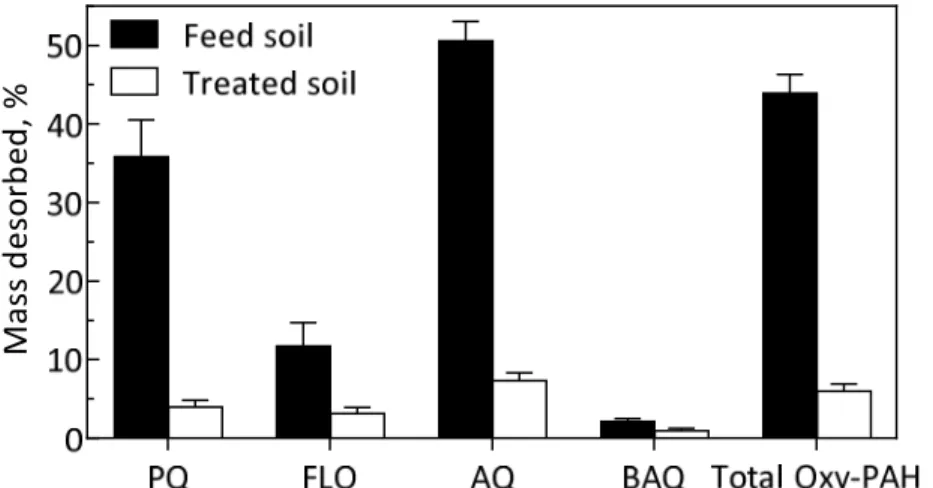
microbially-enhanced desorption through the secretion of biosurfactants or through direct uptake of PAH by bacteria attached to the contaminant matrix (Mukherji and Ghosh 2012), or it could be a result of differences between bacteria and sorptive resins in the physical accessibility to PAHs in micropores of soil aggregates.
Table 3.1 Concentration of oxy-PAHs in feed and treated soils and corresponding removals.a
Oxy-PAH Feed (µg/g) Treated (µg/g) Removal (%) PQ 0.858 ± 0.054 0.282 ± 0.014 67.2 ± 2.6
FLO 1.43 ± 0.11 0.577 ± 0.062 59.6 ± 5.3
AQ 18.3 ± 0.4 4.71 ± 0.08 74.3 ± 0.8
BAQ 1.70 ± 0.09 0.752 ± 0.006 55.9 ± 2.3
Total oxy-PAH 22.3 ± 0.5 6.32 ± 0.16 71.6 ± 1.0
a Values represent means and standard deviation of triplicates.
Figure 3.2 Effect of bioremediation on desorption of oxy-PAH from contaminated soil . Data from Hu et al. (2014).
M
a
ss
d
e
so
rb
e
d
,
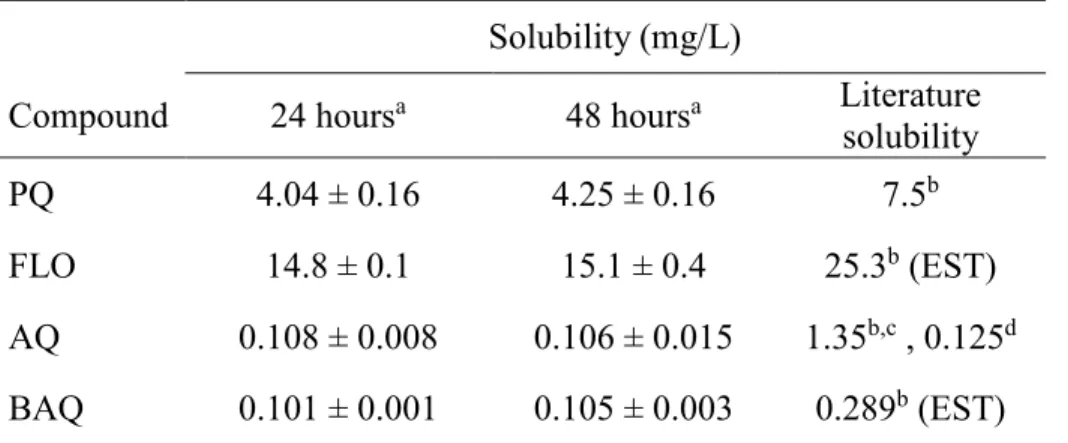
The solubilities of the oxy-PAHs in phosphate buffer are presented in Table 3.2. In general, measured solubilities agreed within an order of magnitude with values found in the literature. There is limited information on the aqueous solubility of oxy-PAHs. The Handbook of Aqueous Solubilities (Yalkowsky 2003) listed only AQ, with a reference to Eik-Nes et al.
(1954). The Reaxys (2015) database reported the solubility of PQ to be 7.5 mg/L but references Knox and Will (1919), which does not appear to discuss PQ. The NIH database ChemIDplus (2015) also reports 7.5 mg/L, but the link to the source was broken as of this writing (date accessed: 07/02/2015).
Table 3.2 Measured solubility of oxy-PAHs and reported values in the literature.
Solubility (mg/L)
Compound 24 hoursa 48 hoursa Literature solubility
PQ 4.04 ± 0.16 4.25 ± 0.16 7.5b
FLO 14.8 ± 0.1 15.1 ± 0.4 25.3b (EST)
AQ 0.108 ± 0.008 0.106 ± 0.015 1.35b,c , 0.125d
BAQ 0.101 ± 0.001 0.105 ± 0.003 0.289b (EST)
a Values represent means and standard deviations of triplicates. b ChemIDplus (2015),c Eik-Nes
CHAPTER 4: SCREENING NONIONIC SURFACTANTS FOR ENHANCED BIODEGRADATION OF POLYCYCLIC AROMATIC HYDROCARBONS REMAINING IN SOIL AFTER CONVENTIONAL BIOLOGICAL TREATMENT 4.1 Introduction
Polycyclic aromatic hydrocarbons (PAHs) are a class of compounds that are of environmental and public health concern because of their known or suspected toxicity and genotoxicity and their frequent occurrence at contaminated sites (ATSDR 1995). Bioremediation is one option for the treatment of PAH-contaminated systems such as soil and sediment, but its efficacy may be limited by incomplete removal of the target PAHs (Aitken and Long 2004).
Due to their hydrophobicity, PAHs are often strongly associated with non-polar soil domains such as soil organic matter, combustion residue, and non-aqueous-phase liquids, and therefore may be unavailable to degrading microorganisms. Studies measuring PAH desorption from soil into the aqueous phase suggest that the fast-desorbing or bioaccessible fraction of a PAH can be a qualitative, if not quantitative, indicator of biodegradation potential in field-contaminated soil (Cornelissen et al. 1998; Huesemann et al. 2004; Richardson and Aitken 2011). The addition of surfactants has been proposed as a means of enhancing the bioavailability of PAHs to degrading microorganisms as reviewed in Makkar and Rockne (2003), Li and Chen (2009), and Elliot et al. (2011) ,but previous studies have led to conflicting conclusions on the effects of surfactants on the biodegradation of PAHs in field-contaminated soils or in spiked soils.
![Figure 2.7 Diol epoxide metabolic activation of benzo[a]pyrene (Xue and Warshawsky 2005)](https://thumb-us.123doks.com/thumbv2/123dok_us/8254259.2186947/42.918.132.800.104.566/figure-diol-epoxide-metabolic-activation-benzo-pyrene-warshawsky.webp)