Common Planning and the Flexible Schedule: A Case Study of Change
Gregory Little
A dissertation submitted to the faculty of the University of North Carolina at Chapel Hill in partial fulfillment of the requirements for the degree of Doctorate of Education in the School of Education (Curriculum and Instruction).
Chapel Hill 2007
Approved by Advisor: Dr. Barbara Day
ABSTRACT
GREGORY LITTLE: Common Planning and the Flexible Schedule: A Case Study of Change
(Under the direction of Dr. Barbara Day)
The purpose of this study was to explore the participation of core middle school teachers in the change process as their schools adopted common planning structures. The study followed Oakwood Middle School and Mountain Creek Middle School throughout the initiation and implementation of required common planning times for core content area teachers. The change process was a complex and multi-faceted operation that required school leaders to build the local capacity of organizations involved.
TABLE OF CONTENTS
Page
LIST OF FIGURES……….ix
Chapter I. INTRODUCTION……….1
Background………1
Definitions………..3
Purpose………...4
Research Questions……….4
II. REVIEW OF THE LITERATURE………...5
Educational Change in Schools……….5
Effective Change Components………10
The Change Process……….14
Flexible Scheduling: An Overview………..19
Flexible Scheduling and Middle School Philosophy………...21
Effects of Common Planning………...27
Impact of Collaboration on Teachers………...32
Conceptual Framework………37
III. METHODS………..41
Role of the Researcher………46
Data Collection………...46
Analysis………48
Trustworthiness………48
IV. FINDINGS………...50
The District………..50
Oakwood Middle School……….53
The Need to Change Schedules………...53
Changing the Schedule………54
The New Schedule………...57
Initial Challenges……….58
Changes in Common Planning……….59
The Shellfish Team……….….61
The Minutes of the Meetings………...64
Collaborative Relationships and Practice………65
The Yellow Jacket Team.………....68
Successful Collaborative Experiences……….69
Frustrations with Common Planning………...71
The Eagles Team……….….75
Defining Team Roles………...76
Meeting Instead of Planning………77
Planning for the Future………79
Flexible Scheduling……….80
The Need for Common Planning……….82
The Move to Common Planning………..83
The Trail Blazer Team……….84
Growing Pains……….86
Clarity of Purpose………88
The Turning Point………90
The Forest Floor Team…...………..92
Collaborative Practice………..94
Streamlined Meetings..………95
The Riverbed Team………..96
Lack of Ownership………...98
Differentiation and Goal Clarity………101
First Steps………..104
V. DISCUSSION………105
Involvement of Core Middle School Teachers at a High Implementation School………..106
Ownership and Choice………...107
Goal Clarity………108
Involvement of Core Middle School Teachers at a Low Implementation School………..109
Factors Impacting Implementation………110
Goal Clarity………112
Structures that Hindered or Encouraged Teacher Involvement…….115
Influence on Instructional Practice and Collegiality………..118
Recommendations………..119
Making Meaning………120
Focusing Staff Development………..122
Preparing for the Role of Data………...124
Developing Team Leadership………125
Selecting Team Members………..126
Taking Small Teaming Steps……….127
Changing Leadership……….128
Limitations……….130
Recommendations for Future Research……….132
APPENDIX A: INITIAL INTERVIEW PROTOCOL……….….135
Teachers……….135
Principals………136
Central Office Personnel………137
APPENDIX B: FOLLOW-UP INTERVIEW PROTOCOL………..138
Teachers……….138
Principals………139
APPENDIX C: OBSERVATION PROTOCOL………140
LIST OF FIGURES Figure
2.1. The Change Process……….15
CHAPTER ONE INTRODUCTION
Change is a constant reality of schools and organizations throughout the nation. Throughout my educational career, I have worked for organizations seeking to improve and lead change efforts. As an educational leader, I am constantly looking for the most effective strategies to create productive instructional environments for both students and teachers. These efforts often include changing instructional or professional approaches to teaching in order to impact student achievement and student learning. In previous years, middle school students across a large southeastern district did not meet the expected/high achievement growth goals mandated by the state on reading assessments. Implementing common planning structures is one of the district’s attempts to improve instructional practices and student performance.
planning time. These opportunities allow the team to “address the unique learning needs of students and to create a sense of community and totality within the curriculum”
(Merenbloom, 1996, p. 45). Middle schools are moving increasingly to common planning structures to create and promote developmentally appropriate practices and to support collaboration that encourages interdisciplinary teaming and increased individual attention (Kasak, 1998). It is the hope that these common planning structures create opportunities for both students and teachers to learn and develop within the confines of the school day.
The problem embedded in the use of the flexible scheduling structures is a shift in the role of the teacher. Teachers move from the isolation of their individual classrooms to a collaborative structure where they are expected to “capitalize on their collective knowledge, expertise, and effort” (Pounder, 1999, p. 319). In order to capitalize on their collective strengths, Merenbloom (1996) describes that teachers should integrate curriculum and talk about teaching strategies on a regular and on-going basis to be successful in a teaming environment. Common planning is the key element in flexible scheduling, because this provides the vehicle for teachers to address the learning needs of their students through their collective collaboration. Collaboration is a skill that must be learned and developed over time (Flowers, 2000), and teachers need ample opportunity to come together to hone the skills necessary to collaborate. Kasak (1998) suggests that teachers should come together for at least 160 minutes per week in order to witness the benefits of collaboration in student performance and classroom practice. This shift in a teacher’s role is drastically different from the traditional, isolated model where teachers work independently with little
concepts from all subject areas as well as to learn new instructional strategies that may make a better match between the learning needs of their students and their instruction. Teachers are challenged to work together to identify goals for their team, monitor those goals over time, assess their effectiveness, and redefine those goals in the face of an ever-changing school context (Fleming & Monda-Amaya, 2001). In order for students to gain the perceived benefits of these smaller learning communities and flexible scheduling structures, teachers must embrace these new collaborative roles and learn the skills needed to work within a team structure. Without these skills, the benefits of the collaborative time will not come to
fruition, as teachers may be ill equipped to handle the anxiety and stress often associated with teaming. They must balance how to incorporate these new demands on their time with previously expected responsibilities while working with the different and complex personalities of their teammates.
The study explored teachers’ roles in the change process in order to determine how the schools moved to the smaller learning communities that incorporated the structures of common planning. Teachers’ roles in the change process were examined as the study
examined how the level of implementation and use of the common planning structures was or was not influenced by the level of participation of the teacher in the change process.
Definitions
For the purposes of this study, a high implementation school was defined by having longer class periods and at least 160 minutes per week of common planning. A low
instructional week, the distinction was in how the time was encumbered and dedicated to the utilization of teachers coming together in common planning activities such as evaluating and analyzing instructional practice and adapting instructional practice to the individual needs of the students.
Purpose
The purpose of this study was to investigate the involvement of middle school core teachers in the development of common planning structures through the flexible schedule at one high implementation and one low implementation school.
Research Questions:
The research questions that guided the process of inquiry were:
(1 What is the involvement of core middle school teachers at a high implementation school? (2 What is the involvement of core middle school teachers at a low implementation school? (3 How is teacher participation related to the level of implementation at the school?
CHAPTER TWO LITERATURE REVIEW Educational Change in Schools
The purpose of educational change in schools is to “help schools accomplish their goals more effectively by replacing some structures, programs, and/or practices with better ones” (Fullan, 1991, p. 15). Fullan’s definition of change appears simple on the surface. However, educational change is a complex process that is faceted and
multi-dimensional. Innovation in an educational organization can involve the possible changes in new or revised materials, new teaching approaches, and/or change in beliefs along with changes in the structure of the organization (Fullan, 1991).
There are many challenges facing educators who attempt to change an educational organization. Educational change can be quite difficult for educators because the “human dimension of change is both intellectual and emotional” (Hargreaves, Earl, Moore &
While culture may hinder change efforts, the importance of culture within the change context cannot be ignored. Kotter (1996) highlights that unless the innovation becomes embedded in the culture, the change will always be subjected to degradation as soon as the pressure to change is removed from the organization. In this way, an organization will self-correct after the initial clamor to change ceases.
“require experiments, new discoveries, and adjustments from numerous places in the
organization or community” (p. 13). Adaptive challenges are generally much more difficult for participants, because new values, new attitudes, and new behaviors are adopted as a part of learning new instructional approaches. Adaptive challenges begin to re-shape the culture of the school. As noted above, changing the culture includes changing how the participants view the world. This type of change represents a moving away from the old and comfortable to something new and unknown. These “zones of uncertainty” can produce great levels of stress and anxiety for participants. Marris (1986) notes that regardless of how miserable a current state is for one in an organization, change is still a difficult and often times painful process because of the uncertainty associated with feelings of incompetence and a lack of self-efficacy surrounding shifts in practice. Instructional change can involve much more than simply learning a new skill set if the organization must re-define or re-examine core beliefs in order to implement the innovation.
To further complicate the change process, changes are difficult to transfer from one site of innovation to another. Transferability of change is difficult because each site is so unique (Fullan, 1999), even if they appear to be similar. The culture of the organization, the leadership, the participants, timing of the innovation, other innovations currently
implemented, and political climate can all impact the ultimate implementation and
vary so greatly between and among organizations. Innovations cannot be simply packaged from one school to the next or from one classroom. The forces that surround the change and define the context in which the change occurs are much too complex for a one-size fits all mentality. Fullan (1999) states, “Innovation is not a pill, a widget, or a silver bullet” (p. 64). When an organization fails to take into account that transferability is not a given in the change process, the innovation becomes much more difficult to implement. Change agents must recognize the significance of an organization’s uniqueness in the light of educational innovation.
The day-to-day operations and responsibilities of a school can be the source of tremendous obstacles to successful implementation of an innovation. Classroom press (Fullan, 2001) relates to the daily influences and decisions that a teacher faces related to the classroom. Hubermann (1983) summarizes that classroom press is marked by the immediacy and concreteness of the classroom experience where teachers must balance a range of
simultaneous operations in environments that are defined by uncertainty and unpredictability and revolve around the personal involvement with students. Rather than energize and replenish teachers, these daily influences, operations, and decisions often move teachers away from professional growth and continuous improvement. Fullan (2001) states, “The circumstances of teaching in terms of daily maintenance and student accountability . . . give back little in the time needed for planning . . . thinking and just plain . . . time for composure” (p. 118). For example, grading papers, individualized education plan meetings, and
energy needed to change because classroom pressure represents a teacher’s most immediate concerns, while change can be viewed as something that is distant and far removed from the classroom. Classroom press draws more and more attention to the short-term and what is most important now. “Teachers and other school personnel have inordinate difficulty in thinking other than in terms of covering X amount of material in X amount of time”
(Sarason, 1996, p. 188). As teachers focus on the here and now, it becomes more difficult to clearly conceptualize change initiatives, because there is little time and energy left to do so. As a result, classroom press may also lead to a false sense of clarity. Teachers may believe that they have changed. In reality they have only adopted the most superficial aspects of an educational reform (Fullan, 1991), because they may lack the time or energy to fully develop the skills required of them to internalize the deepest or most adaptive challenges presented by the innovation or initiative.
Educators may face many obstacles as they approach change because any of the challenges above can derail the change process. Without proper support from leadership and the organization as a whole, change can drain teachers instead of sustaining them and helping them grow as professionals.
Effective Change Components
relation to the purposes as a “key factor” in whether the improvement will succeed in the long-term. As stated above, change is a complex, challenging, and stressful prospect. By having a strong understanding, participants adopting the innovation may be able to overcome some of the innate challenges of the change process.
The change process also entails technical aspects that take time and energy to master. Real change is often defined by long-term approaches that ensure lasting impact on both students and teachers. Fullan (2000) states that it takes up to six years to successfully change student performance in a secondary school and that large-scale changes can take even longer to implement. Teachers may be asked to learn new instructional techniques as well as use new curricular materials, and in doing so they may struggle with the unfamiliar aspects of the innovation as they adopt these new skill sets. Fullan (2001) identifies this struggle to learn new approaches as the “implementation dip.” “Things get worse before they get better . . . as people grapple with the meaning and skills of change” (p. 92). An implementation dip provides challenges in and of itself because participants are not guaranteed to experience immediate returns on their efforts to adopt an initiative and may be tempted to move back to norms or techniques that are more comfortable and less threatening. Positive change then involves continuous learning on the part of both school leaders and teachers and takes place over time. Hargreaves et al note, “Successful implementation requires opportunities to clarify policy initiatives and understand reforms, opportunities to develop procedural
implement change, social learning contexts are needed so that teachers can fully
conceptualize and overcome challenges associated with both the technical and emotional aspects of the change process.
Collaboration is a critical element of how teachers can master the technical and emotional aspects of change. One of the leading strategies of school reform is the creation of a community that interacts with one another regarding issues of practice (Fullan, 2001). Hargreaves et al (2001) indicate the process of “deciphering and sense making [is] best undertaken collaboratively with other colleagues” (p. 126). The researchers state that collaboration helps to make the change process “sensible, practical, and real.” When teachers come together, they engage in problem-solving, joint planning, and begin to pool their expertise in order to work more effectively in the face of new initiatives and the challenges associated with change. Rosenholtz (1989) explains that learning to teach or teach better is possible in environments in which teachers collaborate instead of
environments marked by isolation. Fullan (2001) finds that collaboration defined by the frequency of communication and degree of support is a strong indicator of the success of the implementation. It appears that collaboration creates a favorable environment for teachers to make meaning of the change being proposed, because teachers are able to pull together their collective expertise, knowledge, and experience. Fullan states, “Significant educational change consists of changes in beliefs, teaching style, and materials, which can come only through a process of personal development in a social context” (p. 124). Through
effectives of a particular change. DuFour and Eaker (1998) agree that collaboration is an essential element for learning to change. They note that learning to change is at its essence a collaborative task. “People who engage in collaborative team learning are able to learn from one another, thus creating momentum to fuel continued improvement” (p. 27). The
momentum gained from the collaborative experience prepares and equips participants with the skills necessary to communicate, experiment, and seek answers to difficult questions. Collaboration is the central component in helping teachers learn to change and tackling the challenges associated with the change process.
The Change Process
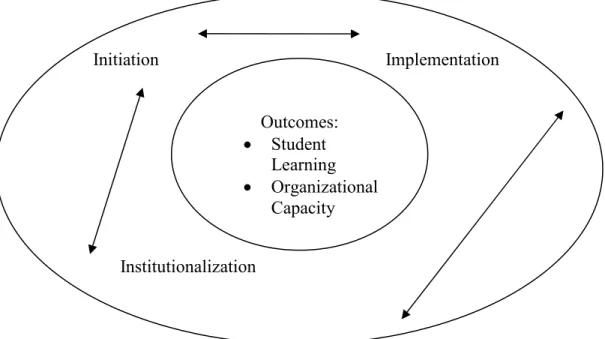
Fullan (2001) highlights the complexity of the change process in an educational setting. The three phases of the change process are defined as initiation, implementation, and institutionalization. Figure 2.1 presents a general picture of how these processes interact during the change process. It is important to note the two-way relationships of interaction between initiation, implementation, and institutionalization. The process of change is not linear in nature. The decisions made at one stage can “feed back” to alter the decisions made at previous stages. DuFour and Eaker (1998) note a common misperception associated with innovations is that change will proceed smoothly if only it is managed well. The
Figure 2.1 The Change Process
Initiation is the first stage of Fullan’s change process. Initiation includes the process leading up to the implementation of an initiative. Fullan (2001) indicates that initiation can happen for a large number of reasons. School leaders, community support and / or pressure, new state or federal policies, external change agents, etc. can all influence whether or not a change is initiated. Successful initiation involves processes such as the building of local capacity or assertive leadership. Fullan highlights that local capacity is the ideal because schools are able to sort through and act on a wide number of improvements when local capacity is developed, ideally through collaborative and social structures. However, assertive leadership is also effective when the idea is sound and ownership and choices are given to teachers as the process continues. The initiation process can generate “meaning or
confusion, commitment or alienation, or simply ignorance on the parts of participants and other affected by the change” (Fullan, 2001, p. 67). The researcher also notes, however, that poor initiation does not doom the change, nor does successful initiation guarantee a
Initiation Implementation
Institutionalization
Outcomes:
• Student Learning
successful change process. It is important to restate the two-way nature of the change process and its impact on the successful integration of an innovation. The changes made later on in the process will ultimately determine whether or not change implementation is successful.
Implementation is the second stage in the change process. Implementation “consists of the process of putting into practice an idea, program, or set of activities and structures new to the people attempting or expected to change” (Fullan, 2001, p. 69). Implementation is the means to accomplish the desired objectives of an educational change. Fullan (2001) outlines four factors that influence the implementation stage. The first factor influencing
implementation is need. Do the teachers see a need for the change? Is the school’s
improvement agenda overloaded? While it appears obvious, unless a leader creates a sense of urgency associated with the implementation of an innovation, teachers may feel complacent and fail to see that there is any “real” need to change. The second factor is the clarity of the features of the change. Without goal clarity, teachers may misunderstand the educational change or only implement the most superficial changes associated with the initiative. Goal clarity outlines for participants what they are expected to do differently in light of the innovation and provides a clear expression of the goals that assists teachers in aligning their own personal beliefs and values with those of the proposed change. The third factor involves the complexity of the change, because it will determine the extent to which the participants are asked to change. As the complexity increases so does the possibility that participants will encounter feelings of anxiety, frustration, or even incompetence. As a result, complex
of learning new skills or adopting new instructional approaches. Finally, the quality and practicality of the program influences its implementation. When greater attention is paid to front-end quality, a change is more likely to be implemented, because it allows teachers to view the change initially as something that can positively impact their professional lives. Practicality also plays an important role because structures have to be in place to provide an environment where the innovation can be successfully implemented. If a change lacks practicality for an organization, it is doomed to fail even if the change is of high quality.
Figure 2.2 Elements Necessary for Change
Wasley (1997) provides a “simple and straightforward” approach to the change process that appears to follow the patterns of both Erb (2000) and Fullan (2001). She outlines a four-step process that involves investigating, planning, acting, and investigating again. Her stages appear to highlight Fullan’s conditions necessary for successful
implementation. Investigating involves thoroughly analyzing the current conditions to determine the areas of greatest need and includes the assurance of the quality and practicality. Planning includes determining “central objectives” that one wishes to
accomplish and being sure that those objectives and goals are clear to all participants. Acting involves putting the change into place and ironing out any unforeseen challenges or issues. Finally, investigating again explores what the innovation has accomplished and its impact on student achievement and on other outcomes. This final stage allows for feedback and
alterations to be made to the initiative to match the change initiatives to the needs of the 1. Structural Features: Do we have the opportunity to do it?
2. Normative / Attitudinal Features: Do we want to do this because it is better for students or better for us?
3. Skill and Professional Preparation Features: Do we know how to do this? 4. Climate and Interactive Processes: Do we have an environment that enables us and supports us doing it?
participants within the educational organization, which reinforces the idea that change reflects a two-way relationship between and among the stages.
Institutionalization is the third stage of the change process and very often difficult to accomplish. The change must be deeply embedded in the organization’s culture and become a part of how the organization does business. In essence, when an innovation is
institutionalized it becomes part of the very fabric of the organization. As noted earlier, the school’s culture represents the shared values and beliefs within an organization that are constantly transmitted between and among its members. In order for a change to become institutionalized, successful initiation and implementation must lay the foundation for the integration into a school’s culture.
Change is a complex process that entails the development of meaning for all participants in all stages. Fullan (2001) states, “If we constantly remind ourselves that
educational change is a learning experience for the adults involved as well as for children, we will be going a long way in understanding . . . change (p. 70). The learning process involves high levels of communication and collaboration for successful implementation and
institutionalization to occur.
Flexible Scheduling: An Overview
within an educational organization (Keefe & Jenkins, 2002). The culture of the school underlies the structures that are put into place that define the organization’s values and beliefs. For instance, a daily schedule that provides time for teachers to plan together may indicate a school’s desire to have faculty working closely in a collaborative environment. A schedule may also hinder or enhance instructional decisions made in the classroom.
Teachers who want to provide in-depth, hands-on activities may struggle in classes that are shorter in length, whereas these activities may be more easily accomplished in longer class periods. Wasley (1997) states, “Schedules are instruments that can be used to accomplish curricular, pedagogical, and assessment goals to derive improvements in student
accomplishments” (p. 46). Often major changes in a school structure such as a schedule is mirrored by the need to change cultural elements of the school simultaneously.
small or large as the schedule can accommodate. In a flexible schedule context, teachers base the length of class periods on their instructional needs of the day or the week. For example, a science teacher may need a longer class period so that students can complete experiments and write up a lab assignment. The team of teachers can make the appropriate adjustments to the schedule to allow the science teacher this time. Most traditional
Flexible Scheduling and Middle School Philosophy
A school’s schedule is a reflection of its philosophy and beliefs. It is important to elucidate the parallels between the middle school philosophy and flexible scheduling and to note how flexible scheduling supports the philosophy in a myriad of ways. However, middle school practices can only be understood within the context of the middle grades student.
As a result of the unique needs of the early adolescent, middle schools generally “emphasize overall well-being and self-esteem, stimulate and facilitate student
involvement…[and] try to address young adolescents’ personal and social problems” (Manning & Bucher, 2000, p. 41). Middle schools also stress opportunities for increased student success and enhanced self-concept (Mills & Pollak, J, 1993) as students try and deal with the many changes they face. The literature on middle grades students indicates that middle schools use developmentally appropriate classrooms that use “theme-based, multi-level and integrated units” (Osuch, 1997, p. 282). Furthermore, Osuch (1997) states that developmentally appropriate classrooms foster a “student’s abilities to direct learning, while [developing] their critical thinking skills,” and activities should “reflect an experiential emphasis and begin the transition from concrete to symbolic representations” (p.283). These practices help to guide middle grades students through this tumultuous developmental period.
for a “collaborative culture” between students and faculty. The researchers highlight a school’s need for “time and opportunity for reflective dialogue” (p. 444). Teachers are then free to create learning communities that can support dynamic, hands-on instruction. Without time allotted to collaborative practices, the complexity of the middle school student may be unable to be addressed in instruction. While all teachers need collaborative time, middle grade teachers especially need this time to ensure developmentally appropriate instruction. There are strong connections between the middle grades students’ developmental needs and the effective uses of time to create an effective schedule. Flexible scheduling is used as a structure to help create, and support smaller learning communities that are reflective and responsive to the emotional, social, and developmental needs of early adolescents (Kasak, 1998). The structural support of the flexible schedule allows for other innovations such as teaming and common planning to enhance the learning environment for the middle school student.
on their collective knowledge, expertise, and effort” (Pounder, 1999, p. 319). A common metaphor used in teaching is that of teaching skills described as a toolbox. The tools that teachers use can be greatly impacted through collaboration, as the collective knowledge of a team or its tools is greater than any one individual’s knowledge or tools. Teams use the flexible schedule to coordinate instruction, coordinate student assignments, and involve parents as well as other building staff (Kasak, 1998). Merenbloom (1996) defines four domains of the team process. He indicates that teams should be responsive to students’ individual needs, integrate the curriculum, talk about teaching strategies, and be able to flexibly schedule their day. It appears that flexible scheduling may play a major role across the other these domains because when teachers move to a flexible schedule, a common planning is created for teachers. They have time to integrate the curriculum, talk about teacher strategies, and plan for instruction that is responsive to students’ needs as well as coordinate how the schedule can be changed to meet instructional needs. Jackson and Davis (2000) highlight the importance of ensuring structures are provided that allow teachers to collaborate. They advise schools to pay close attention to the “quality and nature” of a team’s interactions and to provide enough time for team planning.
Common planning is essential for successful teaming and a successful flexible
schedule. As stated above, common planning time provides the vehicle through which much of the curriculum integration and collaboration can take place. According to Erb (2000), common planning time is non-negotiable for successful teaming and greater student
another’s personal growth and professional development. Students directly and positively benefit from constant collaboration between and among teachers. Flowers, Mertens, and Mulhall (2003) present findings that show schools with high levels of common planning time make greater gains on standardized tests. However, in order for the benefits of collaboration to impact student achievement, teachers must work with their colleagues consistently over time. Kasak (1998) for instance suggests that sufficient common planning time for teams is 160 minutes per week. Integrated instruction and close collaboration can be difficult and challenging for a team, especially in the early stages of team formation. Teachers are generally moving away from environments of isolation and learning how to work with one another in an environment defined by collaboration, consensus and compromise.
semester. The researchers also state that discipline referrals are reduced when longer class periods are implemented. They conclude that when time is used effectively the climate of the school can enhance and improve opportunities to learn for all students. Black (1998) also notes that teaching fewer classes affords teachers with more opportunities to help all
students, because teachers are able to focus on the specific needs of the few instead of trying to spread their efforts over a large number of students. Krajewski, Bonthuis, Kluznik, and Miller (1997) examine three high schools in the Minneapolis area. The three high schools implemented longer class periods as a part of their overall reform efforts. All three high schools attribute part of their improvement to the implementation of longer class periods. The schools indicate that the longer class periods help to create a better learning environment for both students and teachers. The responses from the schools seem to echo that of Shortt and Thayer (1997). One principal states, “Teachers have more time to plan, can better individualize teaching to encourage more active participation from students, and have more opportunities to team” (p. 33). The researchers also note that the schools are moving to flexible time structures as well. Again, the National Middle School Association details that positive relationships with adults is an essential developmental need for middle school students. Longer periods of time may help to facilitate this relationship by strengthening and deepening the bonds between the students and teachers within the school and creating a sense of community that is integral in the lives of the middle grades student.
Effects of Common Planning
The results of flexible schedule appear to be mixed (Brown, 2001). Results do not seem to directly correlate flexible scheduling specifically with increased student
planning periods, which are structures that represent by-products of the flexible schedule. Perhaps the research does not separate the practices because they are so closely intertwined. For example, a school may move to flexible scheduling so that interdisciplinary teaming and common planning take place. It also may represent that changing a structure in and of itself is not sufficient in impacting student achievement or teacher satisfaction (DuFour & Eaker, 1998), if the culture of the school does not change as well. However, when teams begin to work together in collaboration, the culture of these schools may change to reflect the positive influence of teaming and common planning. The following examines research that is related to flexible scheduling, common planning time, and teaming on both teachers and students.
Smith, Pitkin, and Retting (1998) study the impact of flexible scheduling on Glasgow Middle School in Northern Virginia. They report that Glasgow is one of the most diverse student populations in the area and many of the students qualify for free and reduced lunch. Glasgow is described as having a poor school climate with high rates of in-school and out-of-school suspensions. One of the reasons Glasgow chose to switch to a flexible schedule was to reduce the number of transitions that students made during the day. The administrative team implemented a flexible schedule in addition to “pure teams.” Pure teams consisted of groups of teachers with common students and common planning time. As stated earlier, Glasgow also included non-traditional core subjects such as foreign language on their teams. Teams were afforded blocks of time with which they had instructional discretion.
dropped “dramatically.” Seventh grade retentions dropped from 29 to 13, and eighth grade retention rates dropped from 21 to 9. The researchers do not include data from standardized test results. However, they do conclude that students no longer run the school because of the reduction in student disciplinary problems and that teacher morale has increased.
High schools have also incorporated a flexible schedule to help create smaller learning communities (Jenkins & Keefe, 2002). Thomas Haney Secondary Centre and Francis W. Parker Charter School implemented a flexible schedule as a part of a reform effort that included a change in the teacher’s role to coach and advisor, diagnosis of student learning styles, a collegial school culture, an interactive learning environment, and authentic assessment. At Thomas Haney, students built their schedules on a weekly basis and allowed teachers to schedule group activities when needed. At Francis W. Parker, the flexible schedule allowed for collaborative work among students and faculty. Students at Thomas Haney report that they are working harder in these individualized learning communities than they ever did in the past. In a local newspaper’s ranking of the top high schools in the
district, Thomas Haney topped the list. Students at Francis Parker achieved higher than 22 of the 25 schools in its district on the Massachusetts Comprehensive Assessment System. These opportunities to move flexibly appeared to allow a better match between the instructional needs of the students and the content delivered by the teachers.
Felner, Jackson, Kasak, Mulhall, Brand, and Flowers (1997) studied the longitudinal effects of a Turning Points- based comprehensive reform effort. The Turning Points
and adults as well as the professional relationships among teachers. The researchers wanted to discover what impact these recommendations of creating smaller communities had on the schools and students. The specific practices highlighted by the research were teaming and common planning. The study categorized schools into three levels. The highest level of implementation group completed many of the structural changes at a high level. However, these schools also demonstrated significant changes in instructional practices as well. The partial group may have incorporated some structural changes but had yet to make significant instructional changes. The low implementation group had made little change on the
implementation of structure or instruction.
The schools in the Felner et al (1997) study represented a diverse array of students. Researchers selected schools across the state of Illinois who are apart of the Illinois Middle Grade Network (IMGN). The results appear to favor high implementation of the Turning Points suggestions. Test scores in math, language, and reading indicated that students in the highly implemented category achieved at “much higher levels” than those in the
low-implementation category and significantly better than those students in the
schools that increased their implementation from partial or low over time found that their scores improved as well.
Other studies support the implementation of common planning time and inter-disciplinary teaming. Flowers, Mertens, and Mulhall (1999) and Flowers (2000) studied schools that participated in the Middle Start Initiative in Michigan. Flowers, Mertens, and Mulhall found that both structures significantly impacted student achievement. Teaming in this study was associated with higher levels of student success on the Michigan Educational Assessment Program. Schools that used teaming also had the greatest two-year gains in the study. The researchers also found that common planning time was an important factor to student success, because teachers were working closely together in order to address the needs of their students. Schools with high levels of common planning time, at least four meetings a week for a minimum of 120 minutes, had the highest levels of student achievement. Flowers (2000) explored the relationship between teaming and classroom practice. She found that common planning time played a significant role in the classroom practice that involved curriculum coordination and interdisciplinary instruction that took place on a team. Common planning time enabled teams to “introduce, develop, and refine team and classroom practice at a deeper level” (p. 3). Teachers were able to tap their collective knowledge and expertise and assisted each other in growing professionally.
Keefe, 2002). Teachers that work closely together are better equipped to address the individual needs of each learner and to utilize a greater variety of instructional techniques that they learn from their peers.
Impact of Collaboration on Teachers
While greater student achievement is associated with greater levels of collaboration, students are not the only ones affected by the implementation of common planning times and teaming. These structures have a direct impact on how teachers view their professional work and roles within the school. The change to teaming and common planning structures is a complex shift from isolation to collaboration.
Erb and Doda (1989) state, “Team organization is far more than an instructional innovation. [Teaming] changes the professional and interpersonal dynamics of schools for everyone involved” (13). Although Pounder (1999) also states that teams have a profound, positive impact on teachers, there are challenges associated with teaming. Teaming
represents a “change from the security of…isolated classrooms to a setting that requires collaboration, teamwork, and ongoing communication with other teachers” (Flowers, et al, 1999, p. 53). As teachers change to collaborative structures, they must also learn new skills in order to work effectively with their colleagues. Rottier (2002) notes that teams will often fail to reach their full potential because of the complexity interwoven in the change to teaming. This change requires teachers to “re-think” their instructional practice to fully integrate instruction and collaborate with their peers.
In a case study of five teachers who moved from subject-centered classrooms to interdisciplinary teams, Meister and Nolan (2001) described the “intense feelings of
themselves as “being out on a limb on [their] own.” Lack of administrative support and lack of professional development were major reasons for the struggle. However, there were other issues such as subject loyalty vs. team allegiance. The teachers struggled to find a balance between fulfilling content requirements and remaining true to the team’s interdisciplinary goals. The teachers struggled in their efforts to define exactly what an interdisciplinary team meant and what it should ultimately look like. The teachers needed more assistance and guidance through the process and demonstrated a unique set of needs that were much different from teachers in subject-centered classrooms. This example highlighted the
challenge associated with teaming and illustrated that although teams might be constructed in name, working collaboratively is a very complex operation.
The challenges associated with the Meister and Nolan (2001) case study are indicative of the complexity surrounding the move from isolation to collaboration. When teachers move to teaming, they must learn new sets of skills associated with working so closely with their colleagues. In The Five Dysfunctions of a Team, Lencioni (2002) examines the critical attributes of both highly successful and unsuccessful teams. He defines high successful teams as being comprised of individuals who trust one another, engage in unfiltered conflict around ideas, commit to decisions and take decisive action, hold one another accountable for taking action, and focus on collective achievement instead of individual results. Rottier (2002) notes that teams must learn to set goals, implement actions in order to accomplish those goals, and establish monitoring systems to assess the
structures that assist them in making decisions as well as problem solving. Skills such as problem solving and decision-making can be difficult for even the most skilled individual. However, they become even more complex when the various personalities, beliefs, values, and opinions of the team are taken into account. Individuals can no longer make decisions in isolation and have to be able to work within the confines of a collaborative environment. Fleming and Monda-Amaya (2001) indicate that teachers must learn new roles in order to function on a team and allow the team to function efficiently and effectively. They highlight the importance of role clarity for the team. When roles are clearly defined for teacher teams, they exhibit a greater sense of cohesion and greater levels of effectiveness. In addition to learning new roles, teachers must also learn to effectively communicate with their colleagues and continue productive professional relationships even in the midst of disagreement and conflict. Learning these new skills is more than just a technical challenge. Teachers are faced with adaptive challenges as they learn to re-think their work and learn new roles in order to impact student learning.
Even though learning collaborative structures can be quite challenging for
with their working environment. Schools that did not use teaming structures reported much lower scores in terms of staff commitment, staff recognition, and clarity of expectations. Arhar and Irvin’s findings (1995) indicated that collaborative organizations had a significant effect on a teacher’s sense of efficacy, sense of autonomy, and sense of overall
professionalism. “Team work has the potential to create new roles and relationships for teachers that enhance their professional stature” (Arhar & Irvin, 1995, p. 66). It appeared that collaborative work experiences allowed teachers to understand that they were not alone in their struggles and could utilize their colleagues as resources to help overcome problems.
changes brought about by teaming practices identified by Flower, Mertens, and Mulhall (1999). It appeared that teachers became more satisfied with their jobs because they were able to take responsibility for what happened to them during the school day.
DiRocco (1999) outlines a study of an alternating day schedule at Lewisburg Area Middle School in Pennsylvania. The schedule was flexible in the sense that the classes rotated and did not meet at the same time each day and that teams of teachers were allowed to make instructional decisions on how to best use the time. Time was also allotted for teachers to create integrated instructional units and work closely together to make
instructional decisions about how the time was to be used. Two conclusions were made in this study. The first was that teachers were empowered by the flexible schedule used by the school, because they were in charge of making instructional decisions based on student needs and the instructional demands of the material. The teachers were making decisions that truly had an impact on students, instruction, and learning. The second was that students who used the alternating block schedule compared favorably on achievement tests to students who had received most of their instruction on the 40-minute class period. The author indicated that the longer class periods allowed for more in-depth instruction and the teaming allowed for more powerful and dynamic instruction.
efforts may be challenging for teachers as they adopt new roles, these new roles appear to be vital for teachers to be successful in the face of ever-changing and ever-increasing challenges associated with schooling.
Conceptual Framework
Collaborative Culture
Meaning Figure 2.3. An Overview of Successful Change Processes
Fullan (2001) highlights three stages of the change process: initiation, implementation and institutionalization or continuation. The stages of the change process are not linear in nature. As indicated by the two-way arrows, these stages interact, as changes at one level may influence the decisions and structures made at previous stages or in the later stages of the change process. A decision made at the initiation phase may be significantly altered during the implementation phase when unforeseen challenges or obstacles appear. Change is
Initiation Implementation
Institutionalization
Outcomes:
• Student Learning
a multi-faceted and complex operation that is laden with conflicts and challenges throughout the entire process.
The inner circle represents the desired outcomes of the change. The fact that the circle is in the center highlights the importance of the outcomes, because they are the focus of the change. Organizational capacity relates to the organizations ability to work through challenges and issues that reveal themselves throughout the change process and beyond. Organizational capacity represents the cultivation of the participants to help them grow as professionals who can proactively address myriad challenges as they arise regardless of their nature. Hargreaves et al (2001) notes, “Teachers as learners are at the center of educational change” (p. 131) and successful change ultimately increases the teachers’ ability to learn in order to face the many challenges and obstacles that derive from change. DuFour and Eaker (1998) note the regularity in which conflict and pain are associated with change. As the organization develops capacity, its members are able to use the conflict as a learning experience and to embed the innovation more deeply within the culture. Student outcomes refer to the ultimate success of a change because the goal of any innovation or initiative is to improve some aspect of the learning environment whether it is academic or otherwise for students. In all cases, educational change is about fostering an environment that is more conducive to greater student learning and achievement.
notes the importance of creating meaning in both the initiation as well as the implementation phases for an innovation to be successfully adopted by an organization. When participants lack meaning of what the change is or what they are expected to do differently then
confusion is often the result. He states, “The crux of change involves the development of meaning in relation to a new idea, program, reform, or set of activities” (p. 92). As noted earlier, change often requires teachers to question and challenge their core values and beliefs. When change leaders cultivate meaning, they assist participants in bridging the gaps between the teachers’ own personal beliefs and values and the innovation. Without clarity or
meaning, participants may only make the most superficial changes and avoid implementing the most critical aspects of the initiative. Hargreaves et al (2001) indicate that successful implementation “requires” opportunities to clarify the change and develop knowledge about the innovation. The construction and development of meaning throughout the change
process provide a change context that sets the stage for long-term success and integration into the culture of the organization.
correlation between social construction of knowledge and the building of culture. Culture is socially transmitted and reinforced through the interaction of its members. If participants are unable to come together to create meaning, then the culture of the school is unlikely to change. Secondly, collaboration may assist in building the organizational capacity of a school to cope and handle change during all phases of the change process. Hargreaves et al (2001) state, “Collaborative work cultures help teachers make sense together of the reform initiatives they [are] expected to implement” (p. 166). The ultimate success or failure of an innovation may lie in how teachers create meaning through rich collaborative efforts. Fullan states, “Within the school, collegiality among teachers, as measured by the frequency of communication, mutual support, help, and so forth, [is] a strong indicator of implementation success” (p. 124). A collaborative culture may in and of itself be a change innovation within a school, especially considering that traditional models of education are deeply engrained in isolated structures. However, without a collaborative culture, long-term major changes may not be possible, because teachers may be unable to construct the meaning necessary to confront the adaptive and technical challenges associated with change.
CHAPTER THREE METHODS
The purpose of this study was to investigate core middle school teachers’ (language arts, science, social studies, and math) involvement in the creation of common planning structures through the use of flexible scheduling at a high implementation and a low implementation school. The degree of implementation in the schools was defined by a review of the research that highlighted the essential elements of common planning associated with the frequency and duration of collaborative efforts within the school. While research surrounding common planning varied as to the length of time that teachers must meet to impact student learning, Kasak’s (1998) guideline of 160 minutes was the standard by which high implementation and low implementation was determined for this study. Research questions guiding the study explored the change process, the role of teachers in the process and effects that the common planning change process had on teachers as professionals. The research questions included: (1 What is the involvement of core middle school teachers at a high implementation school? (2 What is the involvement of core middle school teachers at a low implementation school? (3 What are the structures that are in place that hindered or encouraged teacher involvement? (4 How is teacher participation related to the level of implementation at the school? (5 How did the change process and teachers’ participation influence instructional practice and collegiality?
The study incorporated qualitative research methodology to gather data and
purpose of the study was to explore middle school core teachers’ involvement in the change process, in order to “make sense of or interpret phenomena in terms of the meanings people bring to them” (Creswell, 1998, p. 15). This study provided an in-depth examination of the participants as the incorporation of common planning structures impacted the school
organization through the flexible schedule. The research painted a picture of the many ways that teachers encounter the change process in their roles at the school and how teachers made meaning or failed to make meaning of the innovation. The study also explored ways in which leaders within the school facilitated that meaning making process for the teachers involved. The focus was not on whether or not common planning or the flexible schedule was a positive change or a “good” change, but rather the degree of participation that teachers undertook in high implementation and low implementation schools. To that end, the
researcher used a case study approach by following Lincoln and Guba’s (In Creswell, 1998) case study structure. The study outlines the structure of the problem: the implementation of common planning; the context: middle schools and core middle school teachers’ classrooms; and lessons learned: how the change process was initiated and implemented.
Site Selection and Participants
amount of common planning time each day/week for the teachers to engage in collaborative activities. Mountain Creek Middle School (MCMS) served as the high implementation school. MCMS’s schedule allowed for longer instructional time in core content areas and utilized at least 160 minutes of common planning time dedicated for interdisciplinary, subject area, or grade level teams to collaborate with one another each week. Oakwood Middle School (OMS) served as the low implementation school. OMS’s schedule also increased instructional time in core content areas, but failed to utilize common planning structures so that interdisciplinary, subject area, or grade level teams could meet at least 160 minutes per week.
themes were fundamental to the reasons that teachers needed the time to come together and collaborate. Each magnet theme outlined different purposes for the teachers to come together and collaborate, but those purposes drove much of the action for the teachers at both sites. According to the district’s website, the schools’ racial demographics were similar in regards to minority students as well as for students with economical disadvantages. Both schools were seeking to use the common planning times to directly impact student achievement. Student performance on state mandated assessments in reading, mathematics as well as writing for each school were among the lowest in the district at the time of the study. Student performance at each school was similar as overall performance composites for all three grades levels fell within three points of each other. Even though the schools’ change contexts were unique to their sites and culture, these similarities allow for comparisons to be drawn between the experiences at the two schools.
The study selected middle school core teachers at each of the research sites whose classrooms had been impacted by common planning through the use of the flexible schedule. This sample of teachers was used to “describe [this] particular sub-group in depth” ( Patton, M. 2002, p. 235). Middle school core teachers were selected for participation because their subjects were strongly impacted by the common planning and because of the strong ties to the state mandated tests administered to all middle school students in reading and
mathematics. Their experiences and instructional results played a significant role in whether a school was considered successful based on the state mandated test results. Schools
Principals of the two schools were contacted initially via telephone and the researcher read from a telephone script to inform them of the research. After gaining the consent of the principals, the researcher met with individual teams to inquire as to their level of interest in regards to participation. While it was the hope that whole teams would participate, teacher turnover and team reconfiguration at both sites did not allow for whole teams to be
Role of the Researcher
My role as researcher was most completely defined as that of an observer. I observed how the common planning change impacted and influenced the teachers. In this way, I was able to examine the instructional efforts of the teachers in the context of the flexible schedule as well as how the participants utilized the common planning periods that were designed to further instructional efforts.
As a central office employee at the time of the study and proponent of middle school reform, my natural bias was to favor common planning structures as well as the flexible schedule as productive innovations. I believed that flexible scheduling could provide the structure to facilitate successful student achievement through greater frequency and duration of teacher collaboration. My teaching and leadership background also led me to believe that consensus building among teachers created meaningful change. However, by comparing my observations and interviews with the body of change research I was able to immerse my biases in the body of literature associated with successful initiation and implementation of innovations.
Data Collection
The study utilized a number of qualitative data collection techniques throughout the duration of the research. Observations of common planning time provided greater insight into how the teachers on the teams were using the time provided to help instructional efforts. Common planning was significant because of its importance to the overall success of middle school teaming (Flowers, Mertens, & Mulhall, 2003) and its impact on how teachers
and made meaning of the innovation and moved beyond cultures of isolation. Observations were recorded for each team during various times during the school year. The observations were based on Patton’s (2002) observation themes of participation / decision-making as well as success and failure messages given during these times.
Semi-structured interviews with all participants in the study were conducted through the use of a general interview guide approach (Patton, 2002). The general interview guide ensured that relevant topics about the change process were addressed, while providing room for divergent topics. Two interviews were scheduled for each teacher and each interview lasted approximately 45 minutes. Principals were also interviewed twice to help capture the how the school was progressing and evolving with the common planning structure. These interviews also lasted approximately 45 minutes. The gap in time allowed for more
interaction and development of the innovation within the change process to occur. Only one interview with the central office personnel was given in that the purpose of the interview was to gain greater background information in regards to the initiation of the innovation and to provide a global view that is less likely to change over the course of the year.
Analysis
Transcribed interviews, observations, and documents were coded into emerging themes related to the change process. Stages of the change process, such as initiation and implementation were identified and coded in order to clarify actions done at each stage of the change process and to see how actions and decisions at one stage impacted previous or future considerations. Issues involving collaboration and the construction of meaning were central themes noted in the conceptual framework guiding the study and emerged from interviews and observations as critical components that drove how teachers viewed the innovation and their internalization of the innovation. Issues surrounding teaming in general were also noted because of its overall importance in creating a collaborative culture and the construction of meaning. Finally, teachers’ attitudes about the change and the impact of the change were identified because these attitudes were directly related to their degree of meaning making for many of the participants involved. These codes assisted in identifying the degree to which teachers conceptualized, practiced, and internalized their new collaborative roles and responsibilities.
Trustworthiness
CHAPTER FOUR FINDINGS The District
Changing schedules and the adoption of common planning structures began with a car ride around the district as Kristin introduced herself to the middle school principals. Cedar County Public School System (CCPSS) is a large southeastern school district that serves a diverse group of students from both urban and rural areas. The district boasts a history of high student performance and is considered one of the top school districts in the Southeast. When Kristin arrived in CCPSS as the executive director of middle grades education, she found that while the school district was successful many of the practices defining middle schools for the district were not middle school practices beyond the 6 through 8 grade
configurations. It alarmed her that many of the middle schools incorporated high school-like structures that appeared to be quite departmentalized with little interdisciplinary teaming and collaboration. In an attempt to become more familiar with the needs of the district, she interviewed every middle school principal in the district over a two-month span. She asked them all about issues that schools faced and issues that faced the district as a whole. What struck her about these conversations was the number of principals stating the importance of scheduling when they could have chosen any other issue or topic to discuss. She
Kristin that while many principals identified concerns with their seven-period-a-day
schedules, they were also were concerned about changing schedules. They perceived that in order to change the schedule they needed to do so without the addition of personnel because of budgetary concerns. When principals had examined possible scheduling changes in the past, additional personnel had been a major roadblock in altering or revising school schedules. However, these conversations with principal initiated the beginning of schools moving to flexible scheduling and common planning.
Kristin orchestrated meetings with national scheduling experts in which principals, assistant principals, and other school staff met and worked together to devise myriad scheduling options. The schools also met with “like schools” in which the similar magnet-themed schools or traditional schools worked together to brainstorm schedules and
well as the creation of common planning for the teachers. As a result of the hard work of the schools, schools were able to revise their schedules without needing to add personnel.
While the schedules were beginning to spread across the district, Kristin understood that flexible scheduling and common planning structures were far from institutionalized. She described the process as “mid-course” because the change was no longer fragile, yet schools were still in the beginning stages of implementation; many schools were still in their first or second year of implementing a new schedule. Even though it was still new, she saw that many schools were beginning to value their common planning time and their work together. She noted a number of schools that were attempting to deeply embed collaboration into their culture, but many schools were still defining what collaboration meant to their community. It was her hope that over the course of the next four or five years that flexible scheduling would be engrained in the schools’ culture.
relative to the rest of the district. The schools also lagged behind the district averages in terms of student performance on state assessments and both schools strongly encouraged teachers to use the district’s new formative assessment program in an attempt to improve student achievement. These similarities were important because the context of change, while not identical, was consistent in both schools.
Oakwood Middle School
Oakwood Middle School was a magnet school that served approximately 850
students. The school’s population was drawn primarily from a town in the southeastern part of the district as well as surrounding rural areas. Because many of the students came from minority and /or economically disadvantaged backgrounds, the school adopted AVID, a college-preparatory program, to encourage students to take high-level classes so that they would be on track to attend a four-year university. The magnet theme of the school was central to the educational experiences of the students. Students throughout the school engaged in foreign language as well as the arts and technology and teachers throughout the school attempted to integrate these subjects into their daily classroom instruction. It was the hope of the school that they could provide their students with a global awareness and help develop a sense that the students were members of a global society. Oakwood began the implementation of a new schedule when James became the principal.
The Need to Change Schedules
attention was the schedule utilized at the school. When he arrived, the schedule consisted of seven classes a day plus an eighth class during which students would receive enrichment. Planning times for teachers were not scheduled strategically and isolated many teachers who taught the same grade or subject area. The enrichment class frustrated him the most because it was inconsistent from teacher to teacher. Some teachers were utilizing the time to engage and challenge students. Other teachers were using it primarily as a study hall. There was no organization or structure as to how the enrichment was being used and he raised concerns about the practices’ overall effectiveness and impact on students. As a result of his concerns over the enrichment period, the schedule was modified slightly so that the time that was dedicated to enrichment was then distributed to the other classes. James also wanted to provide greatly flexibility so that his staff could work more collaboratively within the
confines of the school day. Even after facilitating these changes, James knew that he wanted to make more dramatic changes to the schedule.
Changing the Schedule