doi:10.1093/ntr/ntw178 Original investigation Advance Access publication July 14, 2016
© The Author 2016. Published by Oxford University Press on behalf of the Society for Research on Nicotine and Tobacco. All rights reserved. For permissions, please e-mail: [email protected].
222
Introduction
With the passage of the 2009 Family Smoking Prevention and Tobacco Control Act (FSPTCA) in the United States, the US Food and Drug Administration (FDA) gained the authority to regulate the manufacture, marketing, and distribution of tobacco products in the
United States in order to protect public health.1 The FDA established its Center for Tobacco Products (CTP) to oversee the implementa-tion of the Act.2 The FDA also partnered with the National Institutes of Health (NIH) in establishing the Tobacco Regulatory Science Program (TRSP), which works closely with the CTP to coordinate
Original investigation
Defining Tobacco Regulatory Science
Competencies
Heather L. Wipfli PhD
1, Micah Berman JD
2, Kacey Hanson MPH
3,
Steven Kelder PhD
4, Amy Solis BS
5, Andrea C. Villanti PhD, MPH
6,
Carla M. P. Ribeiro PhD
7, Helen I. Meissner ScM, PhD
8, Roger Anderson PhD
91Department of Preventive Medicine, University of Southern California, Los Angeles, CA; 2Ohio State University,
College of Public Health & Moritz College of Law, Columbus, OH; 3The University of Texas Health Science Center at Houston, Austin, TX; 4The University of Texas Health Science Center at Houston, Austin, TX; 5Westat Inc., Rockville, MD; 6Schroeder Institute for Tobacco Research and Policy Studies at Truth Initiative, Washington, DC; 7Department of Medicine/Pulmonary Division, Marsico Lung Institute and Cystic Fibrosis Center; Department of Cell Biology and Physiology, University of North Carolina at Chapel Hill, Chapel Hill, NC; 8Office of Disease Prevention, National Institutes of Health, Bethesda, MD; 9University of Virginia School of Medicine, Charlottesville, VA
Corresponding Author: Heather Wipfli, PhD, Department of Preventive Medicine, University of Southern California, 2001 N. Soto Street, Los Angeles, CA 90089-9239, USA. Telephone: 323-865-0411, Fax: 323-865-0103; E-mail: [email protected]
Abstract
Introduction: In 2013, the National Institutes of Health and the Food and Drug Administration
funded a network of 14 Tobacco Centers of Regulatory Science (TCORS) with a mission that included research and training. A cross-TCORS Panel was established to define tobacco regulatory science (TRS) competencies to help harmonize and guide their emerging educational programs. The pur-pose of this paper is to describe the Panel’s work to develop core TRS domains and competencies.
Methods: The Panel developed the list of domains and competencies using a semistructured Delphi
method divided into four phases occurring between November 2013 and August 2015.
Results: The final proposed list included a total of 51 competencies across six core domains and 28
competencies across five specialized domains.
Conclusions: There is a need for continued discussion to establish the utility of the proposed set of
competencies for emerging TRS curricula and to identify the best strategies for incorporating these competencies into TRS training programs. Given the field’s broad multidisciplinary nature, further experience is needed to refine the core domains that should be covered in TRS training programs versus knowledge obtained in more specialized programs.
Implications: Regulatory science to inform the regulation of tobacco products is an emerging field.
tobacco regulatory science (TRS) research activities.3 The TRSP aims to inform FDA’s regulatory authorities and capitalizes on NIH’s infrastructure to support tobacco-related research and funding.
In September 2013, the TRSP funded 14 US-based Tobacco Centers of Regulatory Science (TCORS) with a broad range of sci-entific expertise (eg, epidemiology, economics, toxicology, addiction, and marketing). Funded for an initial period of 5 years and a pro-jected investment of more than $273 million,4 the TCORS grant-ees aim to increase knowledge across the full spectrum of basic and applied research on tobacco and addiction, providing evidence that the FDA will use to develop meaningful product regulation. A hall-mark of the TCORS program is that each center is required to provide predoctoral and/or postdoctoral training and education to produce the next generation of tobacco regulatory scientists. Overall, the reach of the emerging trainee programs is not insignificant; over 150 trainees received training through these programs during the 2013 through 2015 academic years, and the programs continue to grow.
TRS is “the scientific discipline that supports the evaluation of the risks and benefits of tobacco regulatory decisions and provides a robust scientific foundation for regulatory policies.”5 As used in this paper, TRS refers to research intended to inform the FDA’s regulation of tobacco. Notably, some important tobacco regulatory activities— such as enacting tobacco taxes or clean indoor air laws—are out-side the authority of the FDA and are left to Congress or state and local governments. Thus, TRS might be defined more expansively for other purposes. It also in important to understand the goals of TRS (ie, scientific inquiry specifically intended to inform regula-tion) in the context of what may be considered the broader field of tobacco control research (ie, scientific inquiry intended to advance knowledge about prevention or treatment of tobacco-related dis-ease). Scientific research priorities for tobacco control research may be significantly broader than the TRS funding priorities identified by the FDA and NIH.
Given its applied nature, TRS not only requires understanding of the scientific questions related to tobacco use and impacts on population health, but also insight into FDA’s regulatory authority, the regulatory process, and how research evidence can both inform FDA’s work and withstand potential judicial challenges.6 Since the FDA’s authority includes regulation of tobacco product manufactur-ing; regulation of tobacco product advertising, marketing, promo-tion, distribupromo-tion, and sales; enforcement of regulations; and public education,7 a particular challenge for the TCORS grantees has been defining the key competencies of this new scientific discipline to inform the development of their training programs.
In response to this challenge, and in recognition that TRS required different training than has previously been offered to inves-tigators working in traditional tobacco control, a TRS Competency Panel (the Panel) was formed with representation across TCORS grantees to conduct a needs assessment and establish a standard-ized set of TRS core domains and competencies. The goal of this effort was to ensure a shared knowledge base that could be dem-onstrated by future tobacco regulatory scientists, regardless of dis-ciplinary background. The purpose of this article is to describe the work of the Panel to develop core and specialized TRS domains and competencies.
Methods
The Panel was composed of faculty and staff—directing/coordinat-ing the TCORS trainstaff—directing/coordinat-ing programs, NIH and FDA scientists, and
members of the Center for Evaluation and Coordination of Training and Research (CECTR) in TRS. CECTR is a TRSP-funded joint project of the Schroeder Institute for Tobacco Research and Policy Studies at Truth Initiative and Westat, Inc. The Panel represented a broad range of TRS expertise reflective of the diverse centers includ-ing epidemiology, toxicology, health behavior, communications, law, and policymaking. The Panel developed the list of domains and com-petencies using a semistructured Delphi method divided into four phases occurring between November 2013 and August 2015.
Phase I
The process began with the collection of TCORS TRS Training Program Descriptions and Course Syllabi from each TCORS grantee. Next, the Panel conducted a brainstorming session and developed a list of proposed TRS domains. Each TCORS Training Program was then asked to compare their list of existing TRS training competen-cies to the proposed list of TRS domains, organizing the list using Bloom’s taxonomy8 which is a set of three hierarchical models used to classify educational learning objectives into levels of complex-ity and specificcomplex-ity. The three models cover cognitive, affective, and sensory domains, and the cognitive domain is frequently used to structure curriculum learning objectives, assessments, and activi-ties. Following Bloom’s taxonomy ensured the promotion of higher level thinking such as analyzing and evaluating concepts, processes, procedures, and principles, rather than just remembering facts (rote learning). These data were compiled into one draft list of all poten-tial competencies according to the original domains identified
Phase II
During the second phase, the Panel conducted a stepwise review of the draft list of domains and competencies. During the first step, the Panel compared the draft list to the data collected in phase I to ensure that there were no gaps. The second step consisted of collaps-ing and reviscollaps-ing competencies to improve clarity and limit redun-dancy. During the final step of phase II, the revised list of domains and competencies was shared with all TCORS grantees, and each site was asked to review the list with their training teams and provide feedback to the Panel related to both content and its utility in plans for program/course development. It was noted at this time that the domains and competencies were not intended for use as an evalua-tion tool. Phase II’s stepwise review revealed the need to distinguish between core TRS domains (set of competencies that are considered basic and essential for all TRS trainees) and specialized domains (competencies related to TRS with a very specific area of emphasis).
Phase III
in any additional competencies considered still missing from the list. The Panel analyzed the results of the online ranking to determine whether there was consensus around if, and how, to distinguish between core and specialized domains and competencies.
Phase IV
The fourth and final phase of the project consisted of disseminat-ing the list of core and specialized domains and competencies to all TCORS grantees and soliciting further comment. All feedback was collected through email and regular conference calls. The final list of domains and competencies was proposed and accepted by the TCORS training programs in August 2015.
Results
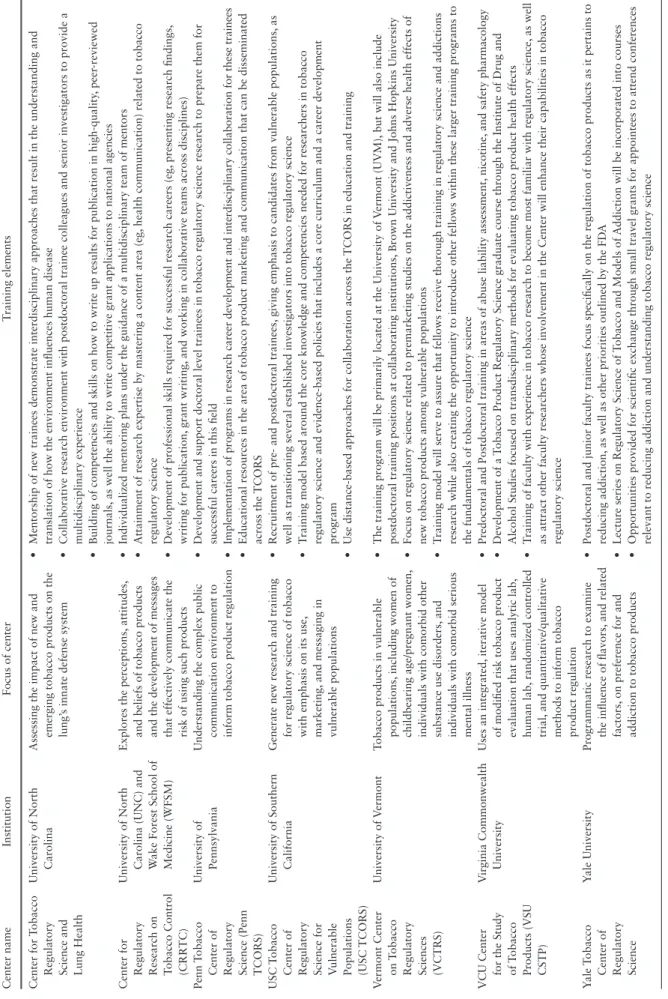
The compilation of TCORS TRS Training Program Descriptions and Course Syllabi in phase I revealed variation in the size, focus, and maturity of these new TRS trainee programs (Table 1). In addi-tion to programmatic differences in approach across the different trainee programs, TRS-related aggregate courses of study, or cur-ricula, varied greatly across TCORS sites. There was a lack of con-sensus regarding general skill areas (referred to as domains), and corresponding abilities and knowledge to produce a learning out-come (referred to as competencies), required by emerging tobacco regulatory scientists.
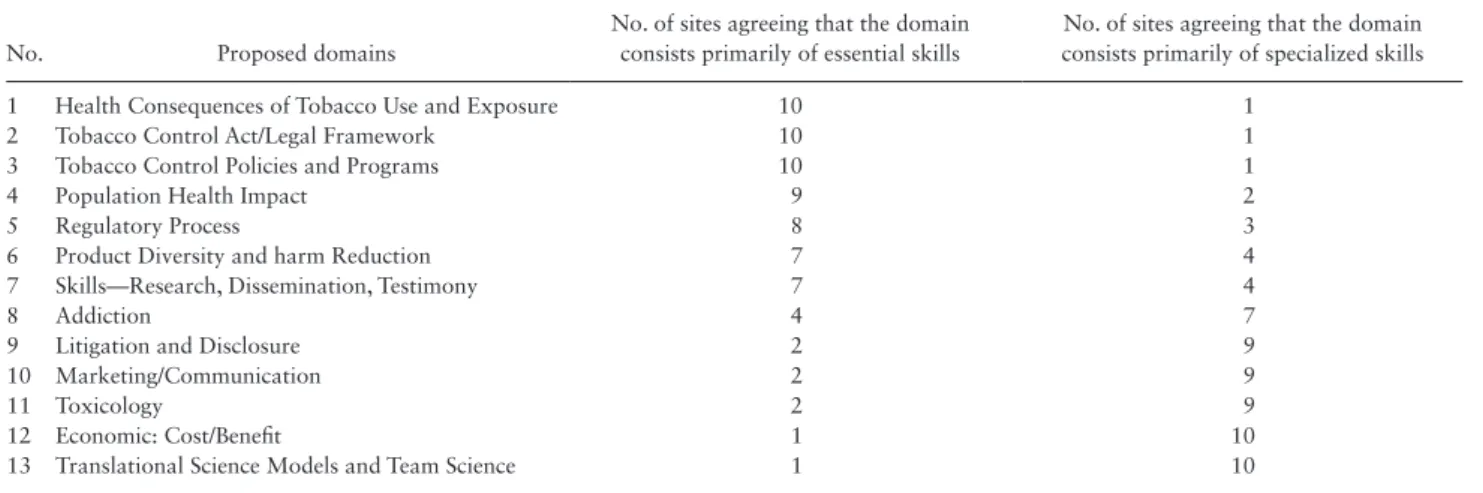
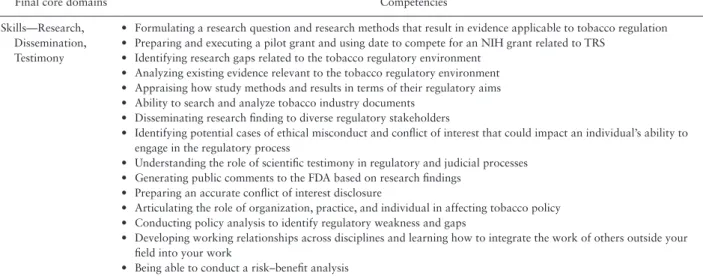
After phase I, an initial list of 234 competencies was provided by nine TRS training programs pertaining to the 13 original domains that were developed through the initial brainstorming session. After the Panel’s phase II discussion and review, a revised list of 85 com-petencies across 14 domains was shared with the TCORS training programs for feedback. The feedback reflected a lack of consensus around the fundamental value of all the listed domains. Specifically, different TCORS training programs’ course syllabi placed more weight or focus on some of the domains than others. Additionally, overlap across some of the domains was detected, which resulted in a recommendation for consolidation. The results of the phase III online ranking instrument developed to analyze the value different training programs placed on the draft domains and competencies found that seven domains had support from seven or more TCORS as essen-tial elements of TRS training while four or fewer TCORS found the remaining six domains as essential for all trainees (Table 2). The panel agreed to use this divide in the results (score of ≥7) as the cutoff to split the domains into core and specialized training components. Based on further feedback and discussion, a final list of domains and competencies was developed in phase IV, approved by the Panel, and adopted by the TCORS programs. As a result of merging domains to eliminate redundancy, the final list includes total of 51 competencies across six core domains and 28 competencies across five specialized domains (Tables 3 and 4). The final six core domains were: Health Consequences of Tobacco Use and Population Health Impact; Tobacco Control Act/FDA Regulatory Framework; Tobacco Control Policies and Programs; Tobacco and Nicotine Product Diversity; Vulnerable Populations; and Skills—Research, Dissemination, Testimony. The five specialized domains were: Addiction; Toxicology; Litigation and Disclosure; Marketing/Communication; and Economic: Cost/Benefit.
Discussion
In this article, we propose core and specialized domains and compe-tencies to be used in developing curricula for TRS training programs.
These competencies are intended as a starting place for discussions among those involved in TRS training programs. Established TRS training programs can use these domains and competencies to clas-sify training materials and resources as well as to identify any poten-tial curricular gaps in a systematic way. Emerging training programs can use them to guide the development of new curricula. The TRS domains and competencies are also designed to methodically charac-terize content knowledge and general skill levels typically needed for TRS-related research and policy activities and to facilitate harmoni-zation across TRS programs. Notably, the list is not meant to serve as the basis for trainee evaluation or certification by TCORS programs; instead, it reflects a general consensus among programs currently designed to prepare future tobacco regulatory scientists.
As is clear from the list of competencies produced by the Panel, TRS as defined for the purposed of this paper is distinct from both (1) tobacco control research and (2) other types of regulatory sci-ence. TRS is both narrower and broader than tobacco control research, as traditionally understood. It is narrower in the sense that it is focused on research that directly or indirectly informs the FDA’s regulation of tobacco. Thus, topics such as smoke-free laws and tobacco taxes, which have been the subject of considerable tobacco control research, are not the primary focus areas because the FDA does not have the authority to regulate where smoking occurs or to impose taxes. While these subjects are still relevant to TRS (included in Domain 3) as they inform the context in which the FDA oper-ates and may directly impact areas in which FDA does operate, they are not central topics as in traditional tobacco control research. At the same time, TRS introduces the consideration of new topics, such as tobacco product standards and restrictions on “modified risk” claims, which were not major areas of tobacco control research before FDA was granted the authority to impose these types of regu-lations (Domain 4).
It is also important to emphasize that TRS is distinct from other types of regulatory science. TRS requires a detailed understanding of the FDA’s regulatory authority and processes (and legal limitations), so that research can be developed that is relevant and useful to the FDA (included in Domain 2). The legal and regulatory framework governing tobacco regulation is very different than for any other regulated products. For example, the “safe and effective” standard applied by the FDA to many other regulated products is not appro-priate for tobacco products, which are inherently unsafe. Therefore, the Tobacco Control Act sets forth a novel “public health standard” for regulatory actions, which requires taking into consideration the health of the population as a whole, including users and nonusers of tobacco products (included in Domain 1). This standard presumes that although tobacco products are inherently unsafe, the FDA can take effective regulatory action to reduce tobacco-related disease and death. Differences in the evidence needed to evaluate the poten-tial impact of regulatory actions using the public health standard mean that materials designed for regulatory science courses in other contexts (eg, pharmaceutical, medical device, or food and dietary supplement) are of limited utility in preparing researchers to engage in TRS. Likewise, an understanding of the history of tobacco control efforts (and industry efforts to oppose and undermine regulations) is indispensable to TRS, although such training may not be needed in other regulatory science contexts.
Table 1
.
Tobacco Center
s of R
egulatory S cience: L ocation, F ocus, and Training P rogram Descriptions Center name Institution
Focus of center
T
raining elements
American Heart
Association Tobacco Regulation and Addiction Center (A-TRA
C)
American Heart
Association
The adverse consequences of
cardiovascular disease from diverse tobacco uses
•
Mentorship of the next generation of investigators with expert health education,
health advocacy
, and
translational tobacco-related cardiovascular research to inform FD
A tobacco-related regulation
•
Development of a formal,
competency-based education and mentored training program with a unique core of
experiential training modules in interactive courses and seminars—specifically designed to nurture talents of postdoctoral trainees,
clinical cardiology Fellows,
and early career Faculty
•
Teach
“academic survival skills”—include strategies for effective literature searching and reference managing,
scientific and grant-writing skills,
effective scientific communication,
and responsible conduct of research
GSU Center for
the Study of T
obacco
Products (GSU CSTP)
Georgia State University Social, behavioral, economic, and
legal forces that shape the actions of individuals with a regard to traditional tobacco products,
as
well as novel and alternate products
•
Three-tiered training program that recruits postdoctoral fellows,
provides specialty training for established
faculty
, introduces predoctoral and doctoral students to tobacco regulatory science
•
Ensemble of education modalities (traditional,
online,
and blended instruction; practicum experiences;
symposium and colloquium exchanges; apprenticeship; and mentoring)
•
Fellows work with an individual mentor from the department or discipline in which he/she wishes to focus
Pennsylvania
State University Tobacco Center of Regulatory Science (PSU TCOR
S)
Penn State University
Specialty-focused education and
research ranging from biobehavioral models of addiction,
pharmacology
to public health models of tobacco-related harm and policy
,
tobacco control interventions,
and
community engagement
•
T
raining predoctoral students,
postdoctoral fellows/junior faculty and professionals using a stepwise
individualized program in the field of tobacco regulatory science
•
Career development with a full-range of college and university-wide relationships,
resources,
and experiences
with individually mentored research or training project for selected fellows
•
Online
W
orld Campus that bridges both PSU campuses (Hershey and University Park) and available to all
TCOR
S sites
Tobacco Center
of Regulatory Science
on Y outh and Y oung Adults (TCOR S Y aY A) University of T exas
Health Sciences Center
Y
outh and young adult use of nicotine and tobacco products and marketing methods targeted to this population
•
Enrollment and matriculation of two master’
s level and two predoctoral level student appointees in which
students attend weekly seminars,
conduct projects,
and present on new tobacco products
•
Recruitment of two postdoctoral appointees to conduct research in the regulatory science arena
•
Continued education for professionals using webinars,
short courses, online classes, social media, continuing education units, and TCOR
S cross-site training opportunities
OSU Center of
Excellence in Regulatory Tobacco Science (OSU-CER
TS)
The Ohio State
University
The reasons for underlying
tobacco-product preferences,
especially
dual and poly-use,
and how these
reasons influence use,
toxic exposure,
and dependence/cessation,
in an
environment of ever
-changing diverse
types of tobacco products
•
Development of a postdoctoral multidisciplinary training program in tobacco regulatory science research that includes a specialized curriculum of instruction,
mentored research experiences,
and development of an NIH
grant proposal
•
Creation of opportunities for predoctoral trainees and junior faculty at OSU to participate in OSU-CER
TS
research projects and special program initiatives
Center
for T
obacco
Control Research and Education (CTCRE)
University of
California– San Francisco
The development of improved
models to inform tobacco product regulatory strategies
•
Interdisciplinary coursework related to health policy
, biostatistics,
tobacco control policy
, tobacco-related addiction,
tobacco-induced disease (including secondhand smoke),
smoking cessation,
and cancer prevention and control
•
Fellows with backgrounds in medical,
biological,
social,
behavioral,
and policy sciences pursue interdisciplinary
research projects directed by mentors from two different disciplines drawn from 30 participating faculty members with active research programs in tobacco control regulatory science
•
Fellows will be taught how to prepare,
submit,
and review grant proposals in order to possibly secure third year
funding
University of
Maryland Tobacco Center of Regulatory Science (UMD TCOR
S)
University of Maryland
Testing new and modified tobacco
products using approaches that examine health risks from the molecular to the whole human level
•
Expansion of a trans disciplinary research focused training program at the University of Maryland College Park to postdoctoral appointees
•
Cross-disciplinary collaborations that facilitate exposure to different theories,
methods,
approaches,
and
research traditions,
which will result in increased innovation and the acceleration of the evidence translated into
science-based regulation of nicotine/tobacco products
•
Facilitation in the continued production of trainees that are comfortable working across disciplines,
to become
Center
for T
obacco
Regulatory Science and Lung Health
University of North
Carolina
Assessing the impact of new and
emerging tobacco products on the lung’
s innate defense system
•
Mentorship of new trainees demonstrate interdisciplinary approaches that result in the understanding and translation of how the environment influences human disease
•
Collaborative research environment with postdoctoral trainee colleagues and senior investigators to provide a multidisciplinary experience
•
Building of competencies and skills on how to write up results for publication in high-quality
, peer
-reviewed
journals,
as well the ability to write competitive grant applications to national agencies
Center for
Regulatory Research on Tobacco Control (CRR
TC)
University of North
Carolina (UNC) and Wake Forest School of Medicine (WFSM)
Explores the perceptions,
attitudes,
and beliefs of tobacco products and the development of messages that effectively communicate the risk of using such products
•
Individualized mentoring plans under the guidance of a multidisciplinary team of mentors
•
Attainment of research expertise by mastering a content area (eg,
health communication) related to tobacco
regulatory science
•
Development of professional skills required for successful research careers (eg,
presenting research findings,
writing for publication,
grant writing,
and working in collaborative teams across disciplines)
Penn T
obacco
Center of Regulatory Science (Penn TCOR
S)
University of
Pennsylvania
Understanding the complex public
communication environment to inform tobacco product regulation
•
Development and support doctoral level trainees in tobacco regulatory science research to prepare them for successful careers in this field
•
Implementation of programs in research career development and interdisciplinary collaboration for these trainees
•
Educational resources in the area of tobacco product marketing and communication that can be disseminated across
the TCOR
S
USC T
obacco
Center of Regulatory Science for Vulnerable Populations (USC TCOR
S)
University of Southern
California
Generate new research and training
for regulatory science of tobacco with emphasis on its use, marketing,
and messaging in
vulnerable populations
•
Recruitment of pre- and postdoctoral trainees,
giving emphasis to candidates from vulnerable populations,
as
well as transitioning several established investigators into tobacco regulatory science
•
T
raining model based around the core knowledge and competencies needed for researchers in tobacco regulatory science and evidence-based policies that includes a core curriculum and a career development program
•
Use distance-based approaches for collaboration across the
TCOR
S in education and training
V
ermont Center on T
obacco
Regulatory Sciences (VCTR
S)
University
of V
ermont
Tobacco products in vulnerable
populations,
including women of
childbearing age/pregnant women, individuals with comorbid other substance use disorders,
and
individuals with comorbid serious mental illness
•
The training program will be primarily located at the University of
V
ermont (UVM),
but will also include
postdoctoral training positions at collaborating institutions,
Brown University and Johns Hopkins University
•
Focus on regulatory science related to premarketing studies on the addictiveness and adverse health effects of new tobacco products among vulnerable populations
•
T
raining model will serve to assure that fellows receive thorough training in regulatory science and addictions research while also creating the opportunity to introduce other fellows within these larger training programs to the fundamentals of tobacco regulatory science
VCU Center
for the Study of T
obacco
Products (VSU CSTP)
V
irginia Commonwealth University
Uses an integrated,
iterative model
of modified risk tobacco product evaluation that uses analytic lab, human lab,
randomized controlled
trial,
and quantitative/qualitative
methods to inform tobacco product regulation
•
Predoctoral and Postdoctoral training in areas of abuse liability assessment,
nicotine,
and safety pharmacology
•
Development of a
Tobacco Product Regulatory Science graduate course through the Institute of Drug and
Alcohol Studies focused on transdisciplinary methods for evaluating tobacco product health effects
•
T
raining of faculty with experience in tobacco research to become most familiar with regulatory science,
as well
as attract other faculty researchers whose involvement in the Center will enhance their capabilities in tobacco regulatory science
Y
ale T
obacco
Center of Regulatory Science
Y
ale University
Programmatic research to examine
the influence of flavors,
and related
factors,
on preference for and
addiction to tobacco products
•
Postdoctoral and junior faculty trainees focus specifically on the regulation of tobacco products as it pertains to reducing addiction,
as well as other priorities outlined by the FD
A
•
Lecture series on Regulatory Science of
Tobacco and Models of
Addiction will be incorporated into courses
•
Opportunities provided for scientific exchange through small travel grants for appointees to attend conferences relevant to reducing addiction and understanding tobacco regulatory science
Table 1
.
Continued
Center name
Institution
Focus of center
T
Table 2. Survey Results on the Essential Nature of Domains
No. Proposed domains
No. of sites agreeing that the domain consists primarily of essential skills
No. of sites agreeing that the domain consists primarily of specialized skills
1 Health Consequences of Tobacco Use and Exposure 10 1
2 Tobacco Control Act/Legal Framework 10 1
3 Tobacco Control Policies and Programs 10 1
4 Population Health Impact 9 2
5 Regulatory Process 8 3
6 Product Diversity and harm Reduction 7 4
7 Skills—Research, Dissemination, Testimony 7 4
8 Addiction 4 7
9 Litigation and Disclosure 2 9
10 Marketing/Communication 2 9
11 Toxicology 2 9
12 Economic: Cost/Benefit 1 10
13 Translational Science Models and Team Science 1 10
Table 3. Final Core Domains and Competencies
No. Final core domains Competencies
1 Health Consequences
of Tobacco Use and Population Health Impact
• Identifying the health consequences of active and passive smoking
• Epidemiology of health consequences of tobacco and nicotine use and exposure: person, place, and time
• Recounting the history of tobacco industry efforts to discredit the scientific evidence base linking tobacco use to death and disease
• Communicating the health consequences of tobacco use to diverse groups
• Applying findings of scientific analyses addressing the public health impact of regulatory measures • Applying health impact assessment tools to understand potential regulatory effects on population health
2 Tobacco Control Act/
FDA Regulatory Framework
• Describing the roles of the various regulatory agencies in the context of public health • Understanding the basics of FDA regulatory science, including safety and efficacy principles • History of FDA regulation, regulatory science, and the regulatory process
• Defining the scope of the FSPTCA, the key elements of the final text, and specifically what is not covered through the federal law
• Recalling the core mission and responsibilities of the FDA’s Center for Tobacco Products • Outlining major regulatory decisions made by the FDA since the FSPTCA came into effect • Describe how scientists can engage in regulatory decision making
• Describing how the tobacco industry engages with the FDA and in the regulatory process
• Offering effective tobacco specific rules and guidelines relevant to public health standards within the legal context • Identifying the points (from production to product use) at which regulatory interventions can be implemented to
impact tobacco use
• Summarizing how nontobacco nicotine products are regulated differently than tobacco products • Understanding the process of submitting comments to the FDA docket
3 Tobacco Control
Policies and Programs
• Identifying and differentiating tobacco regulatory science from the broader field of tobacco control
• Providing examples of successful tobacco control initiatives including legislative, policy, media, community, and partnership building
• Justifying the public health response to tobacco use and exposure to tobacco smoke domestically and abroad • Providing examples of efforts by the tobacco industry to defeat, delay, or co-opt tobacco control policies • Identifying the diverse organizations that have engaged in tobacco control programs beyond traditional tobacco
control agencies
• Analyzing the economics of tobacco control
• Describe the major policies and programs known to impact tobacco use in the United States
4 Tobacco and Nicotine
Product Diversity
• Contrasting the factors to consider when regulating diverse products to benefit the public health • Synthesizing how products differ in term of health effects
• Describing the process through which a product can make a harm reduction claim
• Describing how diverse products are used in isolation and in combination to retain tobacco dependence • Preparing a map of the range of tobacco products on the market and their regulatory status
• Differentiating between cognitive and affective factors associated with new and emerging nicotine products versus traditional cigarettes among youth and young adults
• Analyzing the history of industry-sponsored research on tobacco products
• Describe the youth tobacco and nicotine adoption process and how it varies by diversity of products and subgroups
5 Vulnerable Populations • Defining the characteristics of a vulnerable population in regards to tobacco use
• Summarizing where vulnerable populations are mentioned within the FSPTCA and FDA’s priorities
No. Final core domains Competencies
6 Skills—Research,
Dissemination, Testimony
• Formulating a research question and research methods that result in evidence applicable to tobacco regulation • Preparing and executing a pilot grant and using date to compete for an NIH grant related to TRS
• Identifying research gaps related to the tobacco regulatory environment • Analyzing existing evidence relevant to the tobacco regulatory environment • Appraising how study methods and results in terms of their regulatory aims • Ability to search and analyze tobacco industry documents
• Disseminating research finding to diverse regulatory stakeholders
• Identifying potential cases of ethical misconduct and conflict of interest that could impact an individual’s ability to engage in the regulatory process
• Understanding the role of scientific testimony in regulatory and judicial processes • Generating public comments to the FDA based on research findings
• Preparing an accurate conflict of interest disclosure
• Articulating the role of organization, practice, and individual in affecting tobacco policy • Conducting policy analysis to identify regulatory weakness and gaps
• Developing working relationships across disciplines and learning how to integrate the work of others outside your field into your work
• Being able to conduct a risk–benefit analysis
Table 3. Continued
Table 4. Final Specialized Domains and Competencies
No. Domain Competencies
1 Addiction • Identifying the physical and psychological effects of substance dependence
• Understanding methods of product manipulation to enhance addictive properties in tobacco products • Understanding the basis of addiction in biology, learning, and culture
• Using medical literature, highlighting human vulnerability to quick onset of addiction from tobacco use • Proposing regulatory policies and standards to counter manipulation of products that enhance addiction • Describing the neural pathways that are involved with addiction in the brain, brain reward system, and
mechanisms of addiction
• Understanding the cognitive, physical, social, and brain development of addiction throughout the lifespan youth
• Describe tobacco industry tactics to fight classification of tobacco (and nicotine) as addictive in the past and present
2 Toxicology • Describing the general mechanisms through which exposure to tobacco products elicit a toxic response
• Characterizing the utility of biomarkers of toxicity for regulation
• Creating a toxicological risk assessment of tobacco products by applying the principles used to manage risks associated with the exposure to tobacco products
• Understanding the legal and regulatory basis for determining constituent “safety limits” or “generally recognized as safe”
3 Litigation and Disclosure • Recommending approaches that the FDA could use to help ensure that its regulations withstand legal
review
• Predicting potential scenarios that could result in legal challenges
• Outlining the process through which a regulation can be challenged in federal court • Recounting past court decision resulting from legal challenges to regulatory measures • Knowing the history of tobacco-related litigation
4 Marketing/Communication • Discussing the beneficial effect of marketing regulation
• Describing how technology and social media is shifting the delivery of tobacco product marketing • Providing examples of marketing practices that influence risk perception and use behavior among
diverse populations
• Explaining how point-of-sale marketing affects the sale of tobacco, including how economics and policies affect tobacco product use
• Proposing a communication strategy to combat tobacco industry marketing
• Conducting content analyses of current marketing techniques aimed at youth, young adults, and other vulnerable populations
• Developing research studies to demonstrate how communication and marketing tools can be used to reduce tobacco use
• Understanding how to tailor and target campaigns that will improve the well-being of tobacco users
5 Economic: Cost/Benefit • Explaining how assumptions from traditional economic theory apply/do not apply to the analysis of
tobacco products
• Discussing and estimate the economic cost of tobacco use
to best inform FDA, the history of the tobacco industry’s tactics and involvement in tobacco-related research and policy debates and the process of public comment to inform FDA regulatory action illus-trates the need for a unique focus on these aspects in TRS train-ing efforts. The TRS research community and tobacco companies are—with many others—stakeholders in FDA’s implementation of the Tobacco Control Act and are likely to engage in scientific debate through FDA’s public comments and public workshops. Training in the conduct of rigorous research and dissemination of research findings, beyond traditional academic routes are necessary to inform FDA’s evidence-based regulatory actions.
The FDA’s regulation of tobacco is not static. In May 2016, after this list of competencies was completed, the FDA finalized its “deeming rule,” extending its oversight to products including electronic cigarettes, cigars, pipe tobacco, and hookah tobacco that were previously unregulated by the FDA.9 The FDA will soon need to make regulatory decisions relating to these new products, and the TCORS centers have already engaged in a considerable amount of research that will help to inform these regulatory judgments. As this example suggests, the scope of the focus of FDA regula-tory activities is likely to continue to change over time. Thus, those engaged in TRS must have a broad enough training to anticipate and contribute to future FDA regulatory needs. The competencies are designed to be broad and flexible enough to fulfill this purpose. In addition, it is important that TRS research should not be arti-ficially constrained by the boundaries of FDA authority in a man-ner that would render the research unsystematic or unscientific. For instance, even though the FDA does not have the authority to impose tobacco excise taxes, it is impossible to study the FDA’s potential regulation of marketing or sales restrictions without tak-ing the role of taxes into account.
The TRS domains and competencies presented here reflect the multidisciplinary nature of TRS and the diversity of the TCORS institutions. No single TCORS has the expertise to fully train trainees in all of the TRS-relevant areas. The split between core and specialized domains emphasizes the need for diverse trainees who share a common foundation but bring specific technical skills and perspectives critical to future tobacco regulation. The Panel recognized the essential contributions that addiction, toxicology, litigation, communication, and economics (included in the five spe-cialized domains) play in advancing TRS but also recognized that it was likely beyond the capacity for programs to ensure compe-tency within each of these subject areas among all TRS trainees. Key to the development of well-rounded TRS trainees will be cross-institutional collaboration and resource sharing and acknowledge-ment of the need for team-based research approaches. Reflective of this environment, TRS trainees need specific training in how to partner with professionals in vastly different fields than their own (included in Domain 6).
Resource sharing is already taking place through internal TCORS platforms. For researchers involved in TCORS-funded research. A coordinating center compiles TRS training materials, develops novel trainings to meet core needs, and facilitates training opportu-nities. Some resources are publically available on the TRSP Web site and there is ongoing discussion regarding how to make TRS training materials available to non-TCORS affiliates, non–CTP funded train-ees who request them.
Although developed in the context of US-focused TRS efforts, these domains and competencies may help to inform educational efforts in other countries as well. Influenced by the Framework
Convention on Tobacco Control, many other countries have taken major steps in the past decade to bring tobacco products under regu-latory supervision. Coordinated by the World Health Organization, there is an emerging network of international tobacco regulators, leading to opportunities for TRS efforts (including training efforts) to be coordinated, and results disseminated, across national bounda-ries.10 In addition, legal challenges to tobacco control measures are common worldwide and are vulnerable to negative outcomes unless researchers anticipate and answer the doctrinal questions the courts are likely to ask. Recent trade-related litigation in the United States, Australia, and Uruguay serves as a reminder that policy mak-ers and scientists need to directly connect science to the applicable legal standards being considered by courts and dispute settlement bodies worldwide. Consequently, TRS training programs need to be expanded well beyond the current TCORS network, and these ini-tial competencies can serve as a guide for programs well beyond the United States.
The process of developing the competencies included outreach to representatives of all TCORS grantees, as well input from staff at NIH and CECTR. However, not all TCORS programs par-ticipated equally in the process and some did not respond to the request for initial competencies to be reviewed. Greater participa-tion and engagement in the competencies development process may have resulted in missed competencies and changed the outcome of the rankings. While effort was made to reduce redundancy between the Domains, there is overlap and classification of some competen-cies could potentially fall under a different domain. There is a need for continued debate and dialogue to validate the proposed set of competencies and to identify the best strategies for incorporat-ing these competencies into TRS educational programs. Given the field’s broad multidisciplinary nature, further experience is needed to delineate the core competences that should be covered in general educational programs verses subcompetencies obtained in special-ized programs.
Regulatory science to inform the regulation of tobacco products, as well as associated public education efforts, is an area that is ripe for exploration. To enable this critical research, a new cohort of sci-entists needs to be trained in the emerging field of TRS. Key to any new discipline is the determination of core competencies to guide training programs. The domains and competencies derived by con-sensus among the initial TCORS grantees serve as basis for the exist-ing and emergexist-ing TRS trainexist-ing programs to assess their program offerings, and identify potential gaps, and engage other TCORS training programs to ensure that all trainees have the opportunity to gain core and specialized TRS knowledge.
Funding
Research reported in this publication was supported by grant num-bers P50-HL-120163-01, P50-CA-180523-01, P50-DA-036105-01, P50-DA-036128-01, P50-CA-180890-01, P50-DA-036114-01, P50-CA-179546-01, P50-DA-036151-01, P50-DA-036107-01, P50-CA-180905-01, P50-CA-180906-01, P50-CA-180907-01, P50-CA-180908-01, P50-HL-120100–01, and U54-CA-189222-01 from the NIH and FDA Center for Tobacco Products (CTP). The content of this paper is solely the responsibility of the authors and does not necessarily represent the official views of the NIH or the Food and Drug Administration.
Declaration of Interests
Acknowledgments
The complete TRS Competency Panel consisted of: Lilit Aladadyan (USC), Roger Anderson (UVA), Bob Balster (VCU), Micah Berman (OSU), Bob Feldman (UMD), Kacey Hanson (UT), Glenn Hirsch (Louisville), Steve Kelder (UT), Rachel Lawley (GSU), Pam Ling (UCSF), Carla Ribeiro (UNC-SOM), Amy Solis (CECTR-Westat), Andrea Villanti (CECTR-Schroeder Institute), Jessica Wals (CECTR-Westat), Stacey Sigmon (UVM), Mary Garcia-Cazarin (NIH), Dana van Bemmel (FDA), Ami Bahde (FDA), Helen I. Meissner (NIH), and Heather Wipfli (USC).
References
1. U.S. Congress. Family Smoking Prevention and Tobacco Control Act. H.R. 1256. Ed. 111th Congress 2009.
2. Center for Tobacco Products Overview. U.S. Department of Health and
Human Services. www.fda.gov/TobaccoProducts/AboutCTP/ucm383225.
htm. Updated November 2015. Accessed December 21, 2015.
3. FDA Center for Tobacco Products Research Program: Expanding the Research Base for Tobacco Product Regulation—FDA-NIH Resources for Tobacco Regulatory Science. U.S. Department of Health and Human Services, NIH Office of Disease Prevention (ODP). https://prevention.nih. gov/tobacco-regulatory-science-program/resources. Updated December 17, 2015. Accessed January 12, 2016.
4. FDA and NIH Create First-of-Kind Tobacco Centers of Regulatory Science. U.S. Department of Health and Human Services. National Institutes of Health.
www.nih.gov/news-events/news-releases/fda-nih-create-first-kind-tobacco- centers-regulatory-science. Updated 2013. Accessed December 18, 2015. 5. Ashley DL, Backinger CL, van Bemmel DM, Neveleff DJ. Tobacco
reg-ulatory science: research to inform regreg-ulatory action at the Food and
Drug Administration’s Center for Tobacco Products. Nicotine Tob Res.
2014;16(8):1045–1049.
6. Berman ML, Kim AE. Bridging the gap between science and law: the exam-ple of tobacco regulatory science. J Law Med Ethics. 2015;43(suppl 1): 95–98. doi:10.1111/jlme.12227.
7. Husten, CG, Deyton LR. Understanding the Tobacco Control Act: efforts by the US Food and Drug Administration to make tobacco-related morbidity and mortality part of the USA’s past, not its future. Lancet. 2013;381(9877):1570–1580. doi:10.1016/S0140-6736(13)60735–7.
8. Bloom BS, Englehart MB, Furst EJ, Hill WH, Krathwohl DR. Taxonomy of
Educational Objectives, the Classification of Educational Goals—Handbook I: Cognitive Domain. First British ed. New York: David McKay; 1956. 9. U.S. Department of Health and Human Services, Food and Drug
Administration. Deeming tobacco products to be subject to the Federal Food, Drug, and Cosmetic Act, as amended by the Family Smoking Prevention and Tobacco Control Act; restrictions on the sale and distribu-tion of tobacco products and required warning statements for tobacco products. Final rule. Fed Regist. 2016;81(90):28973–29106.
10. The International Tobacco Regulators’ Conference: The Beginning of a Long-Term Collaboration to Combat the Public Health Impact of Tobacco Use. World Health Organization, U.S. Food and Drug Administration.