LEARNING TO LOVE: OXTR AND CD38 POLYMORPHISMS MODERATE THE DAILY POSITIVE EMOTION YIELD OF LOVING-KINDNESS TRAINING
Suzannah F. Isgett
A thesis submitted to the faculty at the University of North Carolina at Chapel Hill in partial fulfillment of the requirements for the degree of Master of Arts in the Department of Psychology
(Social Psychology Program).
Chapel Hill 2014
Approved by:
Barbara L. Fredrickson Sara B. Algoe
ABSTRACT
SUZANNAH F. ISGETT: Learning to Love: OXTR and CD38 Polymorphisms Moderate the Daily Positive Emotion Yield of Loving-kindness Training
(Under the direction of Barbara L. Fredrickson)
The oxytocin system, which is implicated in social cognition and behavior, is one
potential biological pathway that influences an individual’s capacity to extract positive emotions in social contexts. We tested whether several SNPs in two genes related to oxytocin reception (OXTR) and secretion (CD38) moderated positive emotion growth during a socially-focused intervention. For six weeks, a sample of mid-life adults participated in either loving-kindness or mindfulness training, and daily positive emotions were measured. DNA from blood was
extracted to assess a set of SNPs within OXTR and CD38. Cumulative risk for OXTR and CD38 genes moderated positive emotion change during loving-kindness training. Lower-risk
ACKNOWLEDGEMENTS
Funding for the study was provided by the National Institute of Nursing Research, Grant No. 1R01NR012899. This material is based upon work supported by the National Science
TABLE OF CONTENTS
LIST OF TABLES………...vi
LIST OF FIGURES………...vii
INTRODUCTION………...1
Oxytocin……….………..3
OXTR……….………...5
CD38……….………...6
Overview of Empirical Approach……….………...7
METHOD………9
Participants……….……..9
Study Design……….……...9
Measures………10
Procedure………...11
Analytic Strategy………...12
RESULTS………..14
Preliminary Analyses……….14
Hypothesis Testing……….16
Interaction Probing……….17
DISCUSSION………19
LIST OF TABLES
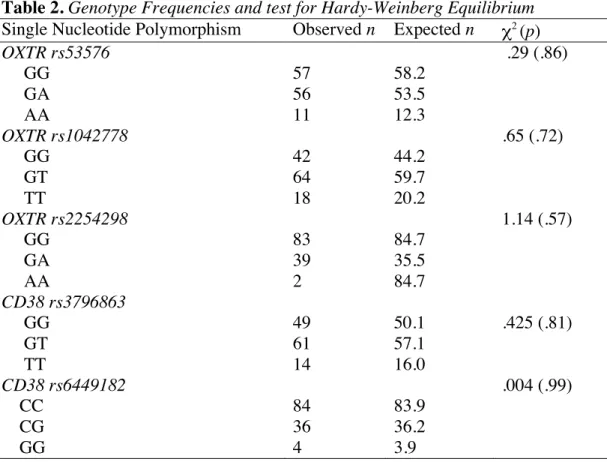
Table 1 – Participant Characteristics……….26 Table 2 – Genotype Frequencies and Test for Hardy-Weinberg Equilibrium………...27 Table 3 – Fixed Effects Estimates for Models of the Predictors
LIST OF FIGURES
Introduction
Positive emotions are a key ingredient in broadening awareness and building resources (Fredrickson, 2013), important processes for psychological well-being and physical health. Because positive social connections are so tightly linked to positive emotionality (Kok et al., 2013), the ability to experience positive emotions through social connection with others appears crucial to achieving, sustaining, and increasing one’s overall well-being. However, underlying individual differences in certain biological pathways, such as oxytocin signaling, may affect a person’s capacity to enjoy social connection. In this study, we used a candidate gene and cumulative risk approach to explore to what extent polymorphisms in genes critical to oxytocin release and reception impact the positive emotions (PEs) extracted from socially-focused loving-kindness training.
While typically characterized as less salient and more diffuse than negative emotions (Baumeister, Bratslavsky, Finkenauer, & Vohs, 2001: Ellsworth & Smith, 1988), research suggests that positive emotions do not exist solely because they are ontologically pleasant. Studies over the past two decades have shown that positive affective states momentarily alter cognition by expanding the scope of attention (Wadlinger & Isaacowitz, 2006) and broadening thought-action repertoires (Fredrickson & Branigan, 2005). Importantly, these cognition-broadening effects extend into the social domain. For instance, positive emotional states also expand people’s inclusive social categories (Dovidio, Gaertner, Isen, & Lowrance, 1995),
and compassion for dissimilar others (Nelson, 2009), and even reduce the effects of categories, such as race, that people typically use to divide social groups (Johnson & Fredrickson, 2005).
Beyond its psychosocial benefits, positive emotion experience has also been related to health outcomes. In fact, positive affect may be the critical ingredient whose absence was shown to predict mortality (Blazer & Hybels, 2004) and stroke (Ostir, Markides, Peek, & Goodwin, 2001) in the elderly, above and beyond greater levels of negative affect. While the mechanisms are not entirely understood, positive emotions may influence health at the cellular level by building up personal resources, such as social support and purpose in life (Fredrickson et al., 2008). Specifically, these particular markers of psychological wellness, also known as eudaimonic well-being, have been associated with lower levels of daily cortisol and pro-inflammatory cytokines (Ryff, Singer, & Love, 2004), as well as with gene expression profiles that suggest lower inflammation and stronger immune function (Fredrickson et al., 2013). Importantly, even positive emotions on a daily level have been associated with lower levels of cortisol and fibrinogen stress response – neuroendocrine and inflammatory markers of stress (Steptoe, Wardle, & Marmot, 2005).
relationships were a robust predictor of mortality, and this finding was consistent regardless of age, sex, or initial health status (Holt-Lundstad, Smith, & Layton, 2010). Positive social connections, like positive emotions, thus appear important to health. In fact, these two facets of well-being were found to be reciprocally connected in predicting changes in cardiac vagal tone, a proxy index of health (Kok & Fredrickson, 2010). When given the opportunity to reflect on their social connections each day, people who reported greater changes in PEs and social
connectedness experienced greater increases in cardiac vagal tone. Additionally, those with higher initial levels of cardiac vagal tone had the largest boosts in PEs and social connection. Later work that used socially-focused loving-kindness training confirmed that, indeed, social connectedness mediated the increases in cardiac vagal tone as a result of gains in daily positive emotions (Kok et al., 2013). Because perceived social connection and positive emotions work together in an upward spiral dynamic, examining the biological systems related to social bonding may reveal insights into how individuals are able to achieve and sustain psychological well-being.
Oxytocin
One of the key neuroendocrine components implicated in sociality is the neuropeptide oxytocin (OT). Beyond its role in parturition and lactation, OT has been associated with a myriad of psychological and social functions. OT may regulate social behavior in the brain by
influences a variety of social psychological processes, such as pair bonding (Young & Wang, 2004; Donaldson & Young, 2008), parenting behaviors (Feldman et al., 2012), empathy (Domes et al., 2007; Bartz et al., 2010), and prosociality (Zak, Stanton, & Ahmadi, 2007), as well as disorders such as autism (Modahl et al., 1998; Hollander et al., 2007).
OT has been used as a pharmacological experimental manipulation to test how exogenous OT affects cognition and behavior in humans. Administered intranasally, OT exhibits effects on social cognition (e.g. social memory, emotion recognition, emotion detection, self-reported affect) and prosociality (e.g. trust behavior, socioemotional responding, in-group favoritism, social motivation) (for a review, see Bartz, Zaki, Bolger, & Ochsner, 2011). Frequently,
endogenous levels of OT in humans are measured through saliva, plasma or urine (MacDonald & MacDonald, 2010). Because OT ostensibly exerts its influence on behavior through the brain, the role of peripheral OT on behavior is not clear, although measures obtained from these peripheral bodily fluids have nonetheless been correlated with various aspects of social behavior, such as nonverbal displays of romantic love (Gonzaga et al., 2006), parent-to-infant touching (Feldman et al., 2012), and general positive affect (Schneiderman, Zagoory-Sharon, Leckman, & Feldman, 2012).
have smaller amygdalar volume, which suggests that the differences in gene expression play a role in neurodevelopment (Kobiella et al., 2011). In the case of oxytocin, functional variants have not been as widely studied. Nevertheless, polymorphisms within genes related to oxytocin signaling may suggest differences in underlying neurology that ultimately affects cognition and behavior (but see Tansey et al., 2010). In the present study, single nucleotide polymorphisms (SNPs) within two different genes important to OT function (OXTR and CD38) were studied to test whether genetic differences in these genes are related to benefits gained from socially-focused loving-kindness training.
OXTR
The human oxytocin receptor gene, OXTR, is located on the short arm of chromosome 3 and codes for a receptor protein for the neuropeptide oxytocin. OXTR is expressed early in neurodevelopment (Shapiro & Insel, 1989), such that OXTR proteins are found most densely concentrated in brain areas involved in social behaviors. OXTR knock-out mice, relative to wild-type controls, exhibit social behavioral deficits, such as reduced vocalizations during social isolation and greater aggressive behavior (Takayanagi et al., 2005). Because of oxytocin’s role in social bonding, human polymorphisms in OXTR have been linked to a variety of
psychological traits and disorders, from autism and depression to social sensitivity, parenting styles, and empathy (for a review, see Kumsta & Heinrichs, 2013).
interact with the cultural environment, such that GG individuals are better at different emotional regulation strategies, depending on what is normative within their culture (Kim et al., 2011). However, because rs53576 resides in an intronic region that is excised during
post-transcriptional modification, its functionality is still unknown.
Other SNPs within OXTR have been linked to neurological and psychological
differences. Several studies have shown that the SNP rs2254298 is associated with amygdalar volume and stronger functional coupling among the amygdala, dACC, and hypothalamus during emotional face processing (see Kumsta and Heinrichs, 2013). The SNP rs1042778 has been linked to plasma OT levels, with “risk” alleles being associated with lower plasma OT and less parent-to-child touch (Feldman et al., 2012). However, a recent meta-analysis on OXTR effects in humans examined the combined effect sizes across 82 samples (for rs53576 and rs2254298) and failed to explain a significant part of human social behavior, personality, or psychological dysfunction (Bakermans-Kranenburg & van IJzendoorn, 2013). The authors note, however, that gene-by-environment interaction effects were not taken into account.
CD38
CD38 is a transmembrane protein involved in formation of Ca2+
signaling molecules, and has recently been discovered to be a key protein in the secretion of OT within hypothalamic neurons. A study with CD38 knockout mice showed that these mice displayed deficits in plasma OT, as well as impairments in social behavior (Jin et al., 2007). Several SNPs within CD38 have been linked with Autism Spectrum Disorder; risk alleles of these SNPs (including CD38
decreased behavioral expressions of gratitude towards romantic partners. Thus, there is a small but growing body of evidence that CD38 also plays a role in psychological processes involving social bonding.
Overview of Empirical Approach
Method Participants
A total of 124 healthy mid-life adults (73% female; M age = 49 years, SD = 9) were recruited from the counties surrounding Chapel Hill and Durham, North Carolina1
. Seventy-nine percent of participants self-identified as Caucasian, 13% as African-American, 7% as Asian, and 1% as another race. 6 participants self-identified as being Hispanic or Latino. Flyers were posted and email advertisements were sent to people within the community, with a subject line asking for people interested in learning how to meditate, explaining that “science has shown that meditation improves people’s health and well-being.” Everybody received up to $244 in compensation for completing various aspects of the study, which included three 60-minute lab sessions to provide urine and blood samples, participation in a six-week meditation workshop, and completion of daily questionnaires before, during, and after the meditation workshop. All potential participants were first screened with a phone call to assess if they were eligible: within the age range or 35 to 64 years old, able to write and speak English, the absence of chronic illness or disability, and not currently engaged in regular meditation practice. Then, those who met the initial selection criteria were formally enrolled in the study.
Study Design
The study implemented a randomized longitudinal design, and the current analyses examine 7 out of 12 weeks of the study. After the initial lab session, participants completed two
weeks of daily questionnaires before being randomly assigned to one of two different
workshops: Loving-kindness Training (LKT) (n = 62) or Mindfulness Training (MT) (n = 62). Throughout the training period, they continued to complete daily questionnaires. The training workshops were both taught by experienced meditation instructors. For Loving-kindness Training (LKT), loving-kindness meditation was used, which draws from ancient Buddhist techniques of meditation. Throughout the workshop, participants were taught how to develop positive mental states, including friendliness and compassion. Mindfulness meditation was used for Mindfulness Training (MT), which also draws from Buddhist contemplative techniques. Both meditative practices instructed participants to sit quietly, usually with eyes closed and an initial focus on the breath. During mindfulness meditation, people are trained to pay attention to the present moment in a nonjudgmental, open-minded way. In contrast, loving-kindness
meditation trains people to direct attention toward their emotions, particularly warm feelings about the self and others. First, individuals are trained to focus on the heart and contemplate a person for whom they currently have warm and tender feelings (e.g. a child or spouse). Then, they are trained to gradually extend these warm feelings to others, in an ever-increasing circle of social connections. Using these techniques, we were able to train people to cultivate heightened levels of other-focus, while utilizing mindfulness meditation as an active control to account for other potential effects of a training intervention.
Measures
love, pride, and serenity) are measured. People were asked to rate the greatest degree that they experienced a particular emotion in the past 24 hours on a 5-point Likert-type scale (0 = Not at all, 4 = Extremely). Participants completed this measure daily. Average positive emotion and negative emotion scores were calculated for each day.
Genomic DNA. Blood samples from each participant were obtained via venipuncture during the initial lab session. DNA extracted from peripheral-blood leukocytes was assayed for genotypes using a commercial TaqMan Genotyping Assay (Applied Biosystems, Foster City, CA) and iCycler real-time polymerase chain reaction instrument (BioRad, Hercules, CA)
following protocols provided by the manufacturer described previously (Bower et al., 2013). The specific genotypes included five different SNPs: OXTR rs53576, OXTR rs1042778, OXTR rs2254298, CD38 rs3796863, and CD38 rs6449182.
Procedure
Once informed consent was obtained, participants first completed a laboratory session, in which several biological measures were taken, including a blood draw (see “Genomic DNA” above). Then, for the following two weeks, they completed daily questionnaires online from home. Other than measuring emotions, participants completed numerous other measures that are beyond the scope of the study (see Fredrickson et al., 2008 for similar measures). Next,
participants who were randomly assigned to either loving-kindness training or mindfulness training met weekly, in small groups, with an instructor experienced with that particular
Analytic Strategy
A conditional longitudinal growth model was used to assess how training type and genotype differentially predicted positive emotions, using restricted maximum likelihood (REML) for parameter estimates. To adjust for how the day in week affects positive emotions (i.e. weekend reports generally higher), we used Week-in-Study as a continuous measure of time, with the intercept coded as the week before training began. Because the initial measurement of daily emotions may have an effect on self-report behavior, the first week of daily PEs was
excluded from all analyses. Participant gender was used as a covariate in the full model, because estrogen has been shown to up-regulate OT processing (Lim & Young, 2006). When testing individual SNPs, genotypes were coded into two categories: carriers of the minor allele
(homozygous or heterozygous), and homozygous carriers of the major allele. Then, depending on the existing empirical literature, these two categories were individually classified as indicative of “risk” or “non-risk” status; that is, the genotypes described in past research to be associated with lower plasma OT, autism, or social deficits were considered to indicate “risk.” We note, however, that for OXTR rs1042778, the TT homozygous genotype has been considered “risk” (Feldman et al., 2012; Israel et al., 2009), whereas G carriers are considered “non-risk.” Yet with T being the minor allele (q = .40), only 18 homozygous individuals were present in the sample, and these individuals were further randomly subdivided into LKT or MT conditions. Because of the allele’s unknown functionality and the size of our sample, we retained our coding scheme for this SNP as major allele homozygotes (GG; “non-risk”) and minor allele carriers (TT or TG; “risk”).
Kabat-Maymon, Ebstein & Feldman, 2013), a cumulative score for genetic predisposition for social and communication deficits was determined for each participant. This was calculated by summing up the number of risk alleles for each SNP, which included OXTR rs53576 A allele (Saphire-Berstein et al., 2011), OXTR rs1042778 T allele (Israel et al., 2009), OXTR rs2254298 G allele (Lerer et al., 2008), CD38 rs3796863 C allele (Munesue et al., 2010), and CD38
rs6449182 G allele (Algoe & Way, 2014). Thus, for each SNP, a person could have zero, one, or two copies of the risk allele. Taken together, this resulted in a risk score that ranged from 0 (no risk alleles) to 10 (risk allele homozygote for all SNPs under investigation). SPSS statistical software (IBM Corp., version 22) was used to run all models. Our specific predictions for the model were as follows:
i) There will be a significant cross-level interaction of week and training
condition, such that people would show greater boosts in Positive Emotions (PEs) over time in the LKT condition relative to the MT condition.
ii) There will not be significant main effects of genotype or interaction between
week and genotype, since we do not expect variation in OT-relevant genes to affect positive emotions generally.
iii) There will be a significant three-way interaction between week, genotype, and
Results Preliminary Analyses
Out of 124 participants, all genotypes were successfully assayed, so no participants were excluded from subsequent analyses. Comparing the Loving-kindness Training (LKT) group to the Mindfulness Training (MT) group, a series of difference tests were conducted to determine if the two subsets significantly differed in demographic characteristics or baseline positive
emotions (Table 1). LKT and MT groups did not differ significantly by age, sex make-up, percent Hispanic ethnicity, or percent identified as White. Importantly, the two conditions did not differ significantly in baseline levels of positive emotions (assessed before random
assignment), although we note that people in LKT trended toward having a higher baseline than those in MT.
Five Single Nucleotide Polymorphisms (SNPs), three within OXTR (rs53576, rs1042778, rs2254298) and two within CD38 (rs3796863, rs6449182) were assayed for all individuals. All SNPs were found to be in Hardy-Weinberg Equilibrium (Table 2). All SNP genotypes were evenly distributed between genders. Descriptive statistics for this cumulative risk score indicate that the sample ranged from scores of 1 risk allele to 8 risk alleles, and the distribution was approximately normal, with indices of skewness (.11; SE = .22) and kurtosis (-.04; SE = .43) not exceeding twice their standard errors.
(PEs) can be explained by between-person differences, and that people’s PEs are highly
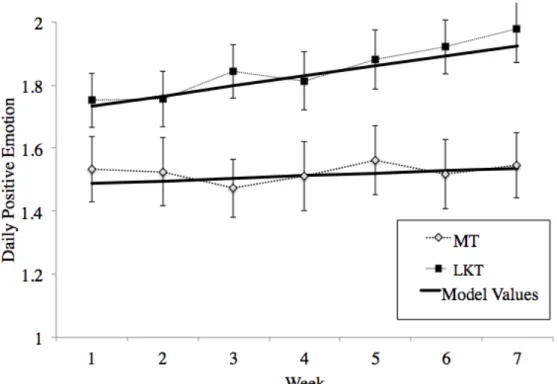
correlated over time. Next, we plotted person-averaged means of PEs by condition across weeks to observe if a linear model would fit best. Indeed, the weekly means showed a linear trend (Figure 1). Therefore, we conducted a Likelihood Ratio Test to compare the original
RE-ANOVA with an unconditional linear growth model with Week-in-Study as the time component. Indeed, the second model led to a significant increase in model fit (p < .0001). Building from this, several time-invariant covariates were added for the full model: gender, condition (LKT vs. MT) and genotype (lower-risk vs. higher-risk); interactions between Condition*Genotype, the cross-level interactions of Week*Condition and Week*Genotype; and the three-way cross-level interaction of Week*Condition*Genotype. Although adding condition (LKT vs. MT) and
genotype did not lead to a better fitting model, we retained this full model to test our hypotheses. We compared the null model and the full model to compute the variance explained (R2
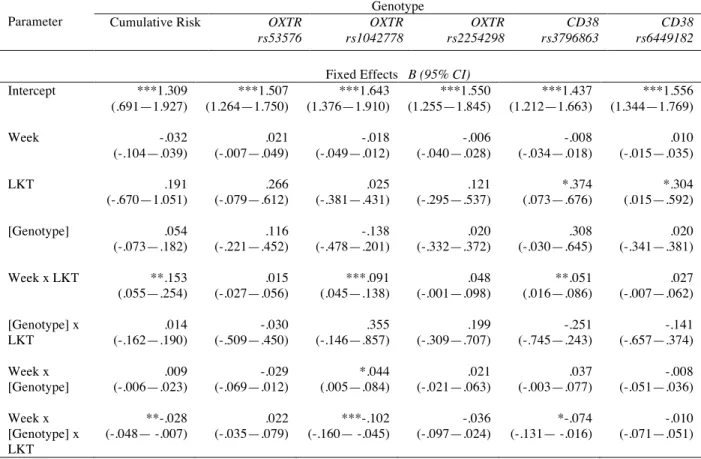
). This model was run for each of the five SNPs and cumulative risk (Table 3). In 5 out of 6 of these models, gender was a significant predictor of PEs, such that men had significantly lower levels of PEs at baseline; the exception was OXTR 1042778, for which gender was not significant (p = .054). In alternative models, gender did not significantly interact with condition or genotype, and so is not discussed further.
Hypothesis Testing
Hypothesis I: Loving-kindness training increases positive emotions over time. Regarding our first prediction (i), the expected week by condition interaction was significant in three of the six models (Table 3). Specifically, being in the LKT condition lead to significantly greater increases in positive emotions per week in the Cumulative Risk model (B = .13; p < .001). Among the single SNP models, this same significant interaction emerged for models that tested OXTR rs1042778 (B = .09; p < .001) and CD38 rs3796863 (B = .05; p = .004).
Hypothesis II: Effect of genotype is conditional. Because OT genes are not presumed to directly influence global positive emotions, we predicted that the only effects of genotype would be conditional on which type of training the participant received. In other words, we predicted (ii) no main effects of genotype or interaction of genotype by week. This hypothesis was also supported.
Hypothesis III: Change in positive emotions depends on condition and genotype. Because LKT is socially oriented, we predicted that people at a genetically higher risk for social deficits would gain the positive emotions boost associated with loving-kindness training.
below mean) or medium (mean) cumulative risk appear to increase in PEs over time. High cumulative risk individuals show no changes in PEs during loving-kindness training. Within the single SNP models, for two of the five SNPs this same predicted three-way interaction was also significant: OXTR rs1042778 (B = -.10; p = .001) and CD38 rs3796863 (B = -.07; p = .013). Interaction Probing
For the cumulative risk model and models of single SNPs that revealed significant three-way interactions, the three-three-way interaction was probed to compare the slopes within groups. In the cumulative risk model, low-risk individuals in the LKT condition showed significant increases in PEs over time (p = .0036), while neither low-risk individuals in MT nor high-risk individuals showed any significant changes in their PE growth trajectories.
For OXTR rs1042778, non-risk individuals in the LKT condition showed significant increases in PEs, and a contrast revealed that this trajectory was significantly different from non-risk individuals in the MT condition (p = .0003), who did not show increases in PEs (Figure 3a). The pattern is consistent with the overall finding that has emerged in past research, that people who learn loving-kindness training show greater boosts in PEs (Kok et al., 2013). However, people with the risk genotype of OXTR rs1042778 did not exhibit this same pattern.
Interestingly, while model trajectories for risk individuals in LKT did not change, there was a small but significant increase in PEs for risk individuals in the MT condition (p = .045) (Figure 3b). A similar analysis was conducted for risk and non-risk individuals for the CD38 rs3796863 SNP. Non-risk individuals in LKT show a significant increase in PEs, and a contrast revealed that this trajectory is significantly greater than that of their non-risk non-risk counterparts in MT (p = .008; Figure 3c). Conversely, risk individuals did not show PE increases in the LKT
Discussion
Previous studies have found associations between these genetic variants and differences in adeptness at social processes such as emotion recognition (Lucht et al., 2012; Rodrigues et al., 2009), emotional face processing (Sauer et al., 2012), empathy (Wu, Li, & Su, 2012), sensitive parenting (Feldman et al., 2012), and emotional expression within romantic relationships (Algoe & Way, 2014). Because of oxytocin’s role in human social processes, we sought to extend our investigation into how a genetic predisposition for social and communicative deficits could hinder the ability to experience emotional benefits during a socially-focused intervention. We assessed the role of genetic variation in 5 SNPs within CD38 and OXTR, two genes necessary for OT signaling, which have been associated with deficits in social emotional processing. While gender was a significant covariate in our models, with women reporting more positive emotions at baseline, it did not significantly interact with genotype. Our hypotheses that risk alleles of CD38 and OXTR would be negatively associated with increases in positive emotion during Loving-kindness Training (but not Mindfulness Training) were confirmed. In addition, because LKT is known to influence positive but not negative emotions, we did not expect genotype to influence negative emotions, and our model supported that prediction. However, we
unexpectedly found that, for risk carriers of OXTR rs1042778, MT actually led to an increase in PEs. Overall, the current findings suggest that underlying differences in the OT system may influence the positive emotion yield from a socially-focused intervention.
interactions in the predicted direction, only two SNPs were significantly associated with changes over time in positive emotions. The cumulative risk approach may therefore reveal the smaller contributions of each SNP that were not detectable individually. Alternatively, it is possible that the cumulative risk score added more statistical variance to the model, relative to testing
individual SNPs. Yet noting that the hypothesized three-way interaction also emerged for the measure of cumulative risk, this suggests that our findings, at least for OXTR rs1042778 and CD38 rs3796863 may be particularly robust.
These findings provide evidence for one of the biological systems that underpins positive affectivity in sociality. Because oxytocin has been shown to regulate the release of dopamine in the mesocorticolimbic dopamine system in rodents during instances of maternal bonding (Shahrokh et al., 2010), our findings also support the idea that oxytocin plays a role in the inherently rewarding nature of social interaction. While oxytocin, either administered intranasally or measured peripherally, has been implicated in social processes that involve positive affect, such as attentional bias towards positively-valenced faces (Domes et al., 2012) and positive behaviors during conflict discussion (Ditzen et al., 2009). The present study,
however, is one of the first studies to tie the OT system to positive emotions after experimentally inducing a heightened other-focus. Thus, oxytocin most likely does not affect global positive emotionality, but rather the positive emotional benefit from being other-focused.
capital is an important resource for its buffering effects against stress (Cohen & Wills, 1985), mental illness (DeSilva, McKenzie, Harpham, & Huttly, 2005), physical illness (Cohen, Gottlieb, & Underwood, 2000), and even mortality (Holt-Lunstad, Smith, & Layton, 2010). In this way, feelings of social connection are bolstered by positive emotions, and in turn positive emotions cultivate greater feelings of social connection – a reciprocal relationship that can help foster greater well-being (Fredrickson, 2013). However, like many types of interventions, loving-kindness training is not as effective for some people as for others. In particular, the results of this study point to potential biological mechanisms that may underlie individuals’ abilities to extract the emotional benefit from this socially-oriented intervention. Expanding on this, it follows that individuals with genotypes associated with social cognitive deficits may not be as adept at learning loving-kindness training and would subsequently not reap the emotional benefits from this training. In fact, our unexpected finding in which risk carriers of OXTR rs1042778 showed PE increases during mindfulness training suggests that non-social interventions may actually be more effective in eliciting positive emotions for individuals who are not as adept at social processing.
This research has potential implications for understanding and tailoring interventions for fostering optimal mental health. Because insofar as perceived social connection increases positive emotions, it is important to understand how cultivating feelings of compassion may be more difficult for certain individuals. Our study implies that the oxytocinergic system may be one of the underlying mechanisms that helps or hinders this process and may direct future interventions and triaging strategies, or pinpoint potential pharmaceutical targets.
effects of loving-kindness training on positive emotions, we note that the genetic data are
correlational, so causal inferences cannot be made as to how underlying genetic variation affects positive emotions in this context. Specifically, genetic variation might be responsible for an unmeasured variable that in turn might account for the patterns of emotionality that emerged here. Additionally, the sample size is modest by genetic standards, and we encourage replication of these data in future studies. A critical next step will be to investigate whether these genetic variants are also associated with lower circulating levels of OT, which has not yet been
determined in our sample. Although risk variants of CD38 rs3796863 have been associated with lower circulating levels of plasma OT in humans (Feldman et al., 2012; Munesue et al., 2010), replicating this finding is key to determining whether, indeed, the genotypes targeted here also have observable endocrinological phenotypes. Additionally, individuals who were randomly assigned to the Loving-kindness Training condition happened to start out with higher levels of positive emotions than their Mindfulness Training counterparts. Although the difference was not statistically significant, these baseline differences may have influenced later positive emotion growth. Nevertheless, this study represents an important advance in understanding the
underlying biological mechanisms that tie sociality to positive affect.
variation. For these individuals, other targeted interventions should be explored. Potentially, a person’s cumulative risk for OT-related social deficits could be used to implement a more personalized approach to selecting behavioral training to improve health and well-being. While participants in this study were not diagnosed with Autism Spectrum Disorder (ASD), this finding may help shed light on developing more targeted therapies and interventions that improve the well-being of individuals with Autism Spectrum Disorder, some of whom show abnormal levels of endogenous OT (Green et al., 2001).
Genetic variation in the CD38-OXTR-OT axis remains poorly understood, especially as to how it influences socioemotional processes. Future research should aim to uncover how natural variants in these genes actually alter gene expression and/or the molecular function of proteins critical to OT signaling, which is a critical step in explaining behavioral outcomes related to these polymorphisms. Additionally, more research is necessary to determine the psychological mechanisms within individuals with risk variants of these two OT genes that impedes their growth in positive emotions when given the opportunity to receive loving-kindness training or other socially-focused practices. In light of the current findings that suggest oxytocin is one of the molecular substrates involved, intranasal OT administration during loving-kindness training may be one avenue to pharmacologically manipulate biological support for social orientation and possible subsequent changes in positive emotions. Finally, the complexity of human sociality suggests that there are likely biological pathways at multiple levels that influence the emotional benefits of social interaction, and these other measures should also be investigated to gain a deeper understanding of the biological basis of sociality.
intervention. Existing genetic variability in our sample was used to test how a biological predisposition for deficits in social cognition may be a factor that impedes the ability to extract positive emotions from sociality. Indices of genetic risk within OXTR and CD38 were
Table 1. Participant Characteristics
Measure LKT (n = 62) MT (n = 62)
M SD % M SD % Test
statistic
df p
Age (years) 48.68 8.46 48.68 9.34 t < .01 122 > .99
Sex (female) 69 76 χ2
= .65 1 .55
Race White Black Asian
Pacific Islander Hispanic Ethnicity
76 19 5 0 3
81 6 10
2 6
χ2 = .78
χ2 = .70
1
1
.38
.68
Baseline PEs 1.71 .64 1.50 .78 t = 1.62 122 .11
Table 2. Genotype Frequencies and test for Hardy-Weinberg Equilibrium Single Nucleotide Polymorphism Observed n Expected n χ2
Table 3. Fixed Effects Estimates for Models of the Predictors of Daily Positive Emotion
Note: * p < .05; ** p < .01; *** p < .001. Genotype was coded to positively indicate risk allele status. Gender was a covariate in all models and a significant predictor (p < .05) in models for cumulative risk, rs53576, rs2254298, rs3796863, and rs6449182.
Parameter
Genotype Cumulative Risk OXTR
rs53576 OXTR rs1042778 OXTR rs2254298 CD38 rs3796863 CD38 rs6449182
Fixed Effects B (95% CI) Intercept ***1.309
(.691—1.927) ***1.507 (1.264—1.750) ***1.643 (1.376—1.910) ***1.550 (1.255—1.845) ***1.437 (1.212—1.663) ***1.556 (1.344—1.769)
Week -.032
(-.104—.039) .021 (-.007—.049) -.018 (-.049—.012) -.006 (-.040—.028) -.008 (-.034—.018) .010 (-.015—.035)
LKT .191
(-.670—1.051) .266 (-.079—.612) .025 (-.381—.431) .121 (-.295—.537) *.374 (.073—.676) *.304 (.015—.592)
[Genotype] .054 (-.073—.182) .116 (-.221—.452) -.138 (-.478—.201) .020 (-.332—.372) .308 (-.030—.645) .020 (-.341—.381)
Figure 2. Daily positive emotion change by condition and cumulative risk score. MT =
Mindfulness Training; LKT = Loving-kindness Training. Lo = low cumulative risk (1 SD below mean); Med = medium cumulative risk (mean); Hi = high cumulative risk (1 SD above mean).
1! 1.2! 1.4! 1.6! 1.8! 2! 2.2!
1! 2! 3! 4! 5! 6! 7!
D
ai
ly P
os
it
ive
E
m
ot
ions
!
Week!
Lo, MT! Lo, LKT!
Med, MT! Med, LKT!
REFERENCES
Algoe, S.B., & Way, B. (2014). Evidence for a role of the oxytocin system, indexed by genetic variation in CD38, in the social bonding effects of expressed gratitude. Social Cognitive and Affective Neuroscience. doi:10.1093/scan/nst182
Bakermans-Kranenburg, M. J., & van IJzendoorn, M. H. (2013). A sociability gene? Meta-analysis of oxytocin receptor genotype effects in humans. Psychiatric Genetics. doi: 10.1097/YPG.0b013e3283643684.
Baumeister, R. F., Bratslavsky, E., Finkenauer, C., & Vohs, K. D. (2001). Bad is stronger than good. Review of General Psychology, 5: 323-370.
Bartz, J. A., Zaki, J., Bolger, N., Hollander, E., Ludwig, N. N., Kolevzon, A., & Ochsner, K. N.
(2010). Oxytocin selectively improves empathic accuracy. Psychological Science, 21
(10), 1426-1428.
Belsky, J., Jonassaint, C., Pluess, M., Stanton, M., Brummett, B., Williams, R. (2009).
Vulnerability genes or plasticity genes? Molecular Psychiatry, 14, 746–54.
Blazer, D. G., & Hybels, C. F. (2004). What symptoms of depression predict mortality in
community-dwelling elders? Journal of the American Geriatrics Society, 52(12),
2052-2056.
Brown, S. L., & Brown, R. M. (2006). Selective investment theory: Recasting the functional
significance of close relationships. Psychological Inquiry, 71(4), 796-809.
Cacioppo, J.T., Hawkley, L.C., & Berntson, G.G. (2003). The anatomy of loneliness. Current
directions in psychological science, 12(3), 71-74.
Carter, S. (1998). Neuroendocrine perspectives on social attachment and love.
Psychoneuroendocrinology, 23, 779-818.
Carter, S. (2007). Oxytocin and the neurobiology of social support. Applied Psychophysiology
and Biofeedback, 32(3-4), 211-211.
Carter, C. S., Grippo, A. J., Pournajafi-Nazarloo, H., Ruscio, M. G., & Porges, S. W. (2008).
Oxytocin, vasopressin, and sociality. In I. D. Neumann & R. Landgraf (Eds.) Progress in
Brain Research, 170, 331-336.
Cohen, S., & Wills, T. A. (1985). Stress, social support, and the buffering hypothesis.
Psychological Bulletin, 98(2), 310-357.
Cole, S.W. (2013). Social regulation of human gene expression: Mechanisms and implications
Cole, S.W., Hawkley, L.C., Arevalo, J.M., Sung, C.Y., Rose, R.M., & Cacioppo, J.T. (2007). Social regulation of gene expression in human leukocytes. Genome Biology, 8(9), R189.
DeSilva, M. J., McKenzie, K., Harpham, T., & Huttly, S. R. A. (2005). Social capital and mental illness: a systematic review. Journal of Epidemiology & Community Health, 59, 619-627.
Domes, G., Heinrichs, M., Michel, A., Berger, C., & Herpertz, S.C. (2007). Oxytocin improves “mind-reading” in humans. Biological Psychiatry, 61(6), 731-733.
Donaldson, Z. R., & Young, L. J. (2008). Oxytocin, vasopressin, and the neurogenetics of sociality. Science, 33(5903), 900-904.
Dovidio, J. F., Gaertner, S. L., Isen, A. M., & Lowrance, R. (1995). Group representations and intergroup bias: Positive affect, similarity, and group size. Personality and Social Psychology Bulletin, 21, 856-865.
Ditzen, B., Schaer, M., Gabriel, B., Bodenmann, G., Ehlert, U., & Heinrichs, M. (2009).
Intranasal oxytocin increases positive communication and reduces cortisol levels during couple conflict. Biological Psychiatry, 65, 728-731.
Ellsworth, P. C., & Smith, C. A. (1988). Shades of joy: Patterns of appraisal differentiating pleasant emotions. Cognitions and Emotion, 2, 301-331.
Feldman, R., Zagoory-Sharon, O., Weisman, O., Schneiderman, I., Gordon, I., Maoz, R., Shalev, I., & Ebstein, R. P. (2012). Sensitive parenting is associated with plasma oxytocin and polymorphisms in the OXTR and CD38 genes. Biological Psychiatry, 72 (3), 175-181.
Fredrickson, B. L. (2013). Positive emotions broaden and build. In P. Devine & A. Plant (Eds.), Advances in Experimental Social Psychology, 47. (1-53). doi: 10.1016/B978-0-12-407236-7.00001-2.
Fredrickson, B. L., & Branigan, C. (2005). Positive emotions broaden the scope of attention and thought-action repertoires. Cognition and Emotion, 19(3), 313-332.
Fredrickson, B.L., Cohn, M. A., Coffey, K. A., Pek, J., Finkel, S. M. (2008). Open hearts build lives: Positive emotions, induced through loving-kindness meditation, build
consequential personal resources. Journal of Personality and Social Psychology, 95(5), 1045-1062.
Fredrickson, B. L., Grewen, K. M., Coffey, K. A., Algoe, S. B., Firestine, A. M., Arevalo, J. M. G., Ma, J., & Cole, S. W. (2013). A functional genomic perspective on human well-being. PNAS, 110(33), 13684-13689. doi: 10.1073/pnas.1305419110
Gauderman, W.J., Murcray, C., Gilliland, F., Conti, D.V. (2007). Testing association be- tween disease and multiple SNPs in a candidate gene. Genetic Epidemiology, 31, 383–95.
Gonzaga, G. C., Turner, R. A., Keltner, D., Campos, B., & Altemus, M. (2006). Romantic love and sexual desire in close relationships. Emotion, 6(2), 163-179. doi: 10.1037/1528-3542.6.2.163
Green, L., Fein, D., Modhal, C., Feinstein, C., Waterhouse, L., & Morris, M. (2001). Oxytocin and autistic disorder: Alteration in peptide form. Biological Psychiatry, 50(8), 609-613.
Hofmann, S. G., Sawyer, A. T., Witt, A. T., & Oh, D. (2010). The effect of mindfulness-based therapy on anxiety and depression: A meta-analytic review. Journal of Consulting and Clinical Psychology, 78(2), 169-183.
Hollander, E., Bartz, J., Chaplin, W., Phillips, A., Sumner, J., Soorya, L., Anagnostou, E., & Wasserman, S. (2007). Oxytocin increases retention of social cognition in autism. Biological Psychiatry, 61(4), 498-503.
Holt-Lunstad, J., Smith, T. B., & Layton, J. B. (2010). Social relationships and mortality risk: A meta-analytic review. PLoS Med, 7(7): e1000316. doi:10.1371/journal.pmed.1000316
Inoue H., Yamasue H., Tochigi M., Abe O., Liu X., Kawamura Y., et al. (2010). Association between the oxytocin receptor gene and amygdalar volume in healthy adults. Biological Psychiatry, 68, 1066–1072 10.1016/j.biopsych.2010.07.019
Israel, S., Lerer, E., Shalev, I., Uzefovsky, F., Riebold, M., Laiba, E., Bachner-Melman, R., Maril, A., Bornstein, G., Knafo, A., & Ebstein, R. P. (2009). The oxytocin receptor (OXTR) contributes to prosocial fund allocations in the dictator game and the social value orientations task. PLoS ONE, 4(5), e5535. doi: 10.1371/journal.pone.0005535
Jin, D., Liu, H. X., Hirai, H., Torashima, T., Nagai, T., Lopatina, O., et al. (2007). CD38 is critical for social behaviour by regulating oxytocin secretion. Nature, 446, 41-45.
Johnson, K. J., & Fredrickson, B. L. (2005). “We all look the same to me”: Positive emotions eliminate the own-race in face recognition. Psychological Science, 16(11), 875-881.
Kim, H. S., Sherman, D. K., Mojaverian, T., Sasaki, J. Y., Park, J., Suh, E. M., & Taylor, S. E. (2011). Gene-culture interaction: Oxytocin receptor polymorphism (OXTR) and emotion regulation. Social Psychological and Personality Science, 2(6), 665-672.
Kobiella, A., Reimold, M., Ulshöfer, D. E., Ikonomidou, V. N., Vollmert, C., Vollstädt-Klein, S., Rietschel, M., Reischl, G., Heinz, A., & Smolka, M. N. (2011). How the serotonin
Kok, B.E., Coffey, K.A., Cohn, M.A., Catalino, L.I., Vacharkulksemsuk, T., Algoe, S.B., Brantley, M., & Fredrickson, B.L. (2013). How positive emotions build physical health: Perceived positive social connections account for the upward spiral between positive emotions and vagal tone. Psychological Science, 24(7), 1123-1132.
Kok, B. E., & Fredrickson, B. L. (2010). Upward spirals of the heart: Autonomic flexibility, as indexed by vagal tone, reciprocally and prospectively predicts positive emotions and social connectedness. Biological Psychology, 85(3), 432-436.
Kumsta, R., & Heinrichs, M. (2013). Oxytocin, stress and social behavior: Neurogenetics of the human oxytocin system. Current Opinion in Neurobiology, 23, 11-16.
Landgraf, R., & Neumann, I. D. (2004). Vasopressin and oxytocin release within the brain: a dynamic concept of multiple and variable modes of neuropeptide communication. Frontiers in Neuroendocrinology, 25(3-4), 150-176.
Lerer, E., Levi, S., Salomon, S., Darvasi, A., Yirmiya, N., & Ebstein, R. P. (2008). Association between the oxytocin receptor (OXTR) and autism: relationship to Vineland Adaptive Behavior Scales and cognition. Molecular Psychiatry, 13, 980-988. doi:
10.1038/sj.mp.4002087
Lim, M. M., & Young, L. J. (2006). Neuropeptide regulation of affiliative behavior and social bonding in animals. Hormones and Behavior, 50, 506-517.
Lucht M. J., Barnow S., Sonnenfeld C., Ulrich I., Grabe H. J., Schroeder W., et al.
(2012). Associations between the oxytocin receptor gene (OXTR) and “mind-reading” in humans-an exploratory study. Nordic Journal of Psychiatry, 67, 15–21
doi:10.3109/08039488.2012.700731
MacDonald, K., & MacDonald, T. M. (2010). The peptide that binds: A systematic review of oxytocin and its prosocial effects in humans. Harvard Review of Psychiatry,
January/February, 1-21.
Modhal, C., Green, L. A., Fein, D., Morris, M., Waterhouse, L., Feinstein, C., & Levin, H. (1998). Plasma oxytocin levels in autistic children. Biological Psychiatry, 43(4), 270-277.
Munesue, T., et al. (2010). Two genetic variants of CD38 in subjects with autism spectrum disorder and controls. Neuroscience Research, 67(2), 181-191.
Nelson, D. W. (2009). Feeling good and open-minded: The impact of positive affect on cross cultural empathic responding. The Journal of Positive Psychology, 4(1), 53-63.
Rodrigues S. M., Saslow L. R., Garcia N., John O. P., & Keltner D. (2009). Oxytocin receptor genetic variation relates to empathy and stress reactivity in humans. Proceedings of the National Academy of Sciences USA 106, 21437–21441. doi:10.1073/pnas.0909579106
Ryff, C. D., Singer, B. H., & Love, G. D. (2004). Positive health: Connecting well-being with biology. Philosophical Transactions of the Royal Society B, 359. doi:
10.1098/rstb.2004.1521
Saphire-Bernstein, S., Way, B. M., Kim, H. S., Sherman, D. K., & Taylor, S. E. (2011). Oxytocin receptor gene (OXTR) is related to psychological resources. PNAS, 108(37), 15118-15122. doi: 10.1073/pnas.1113137108
Sauer, C., Montag, C., Wörner, C., Kirsch, P., & Reuter, M. (2012). Effects of a common variant in the CD38 gene on social processing in an oxytocin challenge study: Possible links to autism. Neuropsychopharmacology, 37(6), 1474-1482.
Schneiderman, I., Kanat-Maymon, Y., Ebstein, R. P., & Feldman, R. (2013). Cumulative risk on the oxytocin receptor gene (OXTR) underpins empathic communication difficulties at the first stages of romantic love. Social Cognitive and Affective Neuroscience. doi:
10.1093/scan/nst142
Schneiderman, I., Zagoory-Sharon, O., Leckman, J. F., & Feldman, R. (2012). Oxytocin during the initial stages of romantic attachment: relations to couples' interactive reciprocity.
Psychoneuroendocrinology, 37(8), 1277-1285. doi: 10.1016/j.psyneuen.2011.12.021
Shahrokh, D. K., Zhang, T., Diorio, J., Gratton, A., & Meaney, M. J. (2010). Oxytocin-dopamine interactions mediate variations in maternal behavior in the rat. Endocrinology, 151(5), 2276-2286.
Shapiro, L. E., & Insel, T. R. Ontogeny of oxytocin receptors in rat forebrain: a quantitative study. Synapse, 4, 259-266.
Steptoe, A., Wardle, J., & Marmot, M. (2005). Positive affect and health-related neuroendocrine, cardiovascular, and inflammatory processes. PNAS, 102(18), 6508-6512.
Tansey, K. E., Brookes, K. J., Hill, M. J., Cochrane, L. E., Gill, M., Skuse, D., Correia, C., Vicente, A., Kent, L., Gallagher, L., & Anney, R. J. L. (2010). Oxytocin receptor (OXTR) does not play a major role in the aetiology of autism: Genetic and molecular studies. Neuroscience Letters, 474, 3(3), 163-167.
Tost H., Kolachana B., Hakimi S., Lemaitre H., Verchinski B. A., Mattay V. S., et al. (2010). A common allele in the oxytocin receptor gene (OXTR) impacts prosocial temperament and
human hypothalamic-limbic structure and function. PNAS,107, 13936–13941
10.1073/pnas.1003296107
Wadlinger, H. A. & Isaacowitz, D. M. (2006). Positive mood broadens visual attention to
positive stimuli. Motivation and Emotion, 30(1), 87-99.
Wallace, B. A., & Shapiro, S. L. (2006). Mental balance and well-being: Building bridges
between Buddhism and Western Psychology. American Psychologist, 61: 690-701.
Waugh, C. E., & Fredrickson, B. L. (2006). Nice to know you: Positive emotions, self-other
overlap, and complex understanding in the formation of a new relationship. The Journal
of Positive Psychology, 1(2), 93-106.
Wu, N., Li Z., & Su, Y. (2012). The association between oxytocin receptor gene polymorphism
(OXTR) and trait empathy. Journal of Affective Disorders,138, 468–472
doi:10.1016/j.jad.2012.01.009
Young, L. J., & Wang, Z. (2004). The neurobiology of pair bonding. Nature Neuroscience, 7,
1048-1054.
Zak, P. J., Stanton, A. A., & Ahmadi, S. (2007). Oxytocin increases generosity in humans. PLoS