IN VIVO EXAMINATION OF THE MOLECULAR MECHANICS UNDERLYING APICAL CONSTRICTION’S INITIATION IN C. ELEGANS GASTRULATION
Timothy Dennison Cupp
A thesis submitted to the faculty of the University of North Carolina at Chapel Hill in partial fulfillments of the requirements for the degree of a Master in Science in the
Department of Cell Biology and Physiology in the School of Medicine.
Chapel Hill 2016
Approved by: Bob Goldstein Keith Burridge Richard Cheney
© 2016
ABSTRACT
Timothy Dennison Cupp: In vivo examination of the molecular mechanics underlying apical constriction’s initiation in C. elegans gastrulation
(Under the direction of Bob Goldstein)
One remarkable finding from research in developmental biology is that
TABLE OF CONTENTS
LIST OF TABLES...………...………..vi
LIST OF FIGURES………..………...……..vii
LIST OF ABBREVIATIONS...viii
CHAPTER 1: IN VIVO EXAMINATION OF APICAL CONSTRICTION...1
INTRODUCTION………...………....1
EXPERIMENTAL APPROACH and METHODS ………..………..6
RESULTS...8
DISCUSSION………..13
Future Directions...……….15
APPENDIX 1: TABLE 1 – RESULTS OF RNAi SCREEN………...19
APPENDIX 2: FIGURES……….………..……22
Figure 1………22
Figure 2………23
Figure 3………24
Figure 4………25
Figure 5………26
Figure 6………....27
Figure 7………28
LIST OF TABLES
LIST OF FIGURES Figure 1 – Apical constriction is a conserved process in
C. elegans gastrulation as well as vertebrate
neural tube formation……….…………22 Figure 2 – C. elegans embryos achieve gastrulation via
apical constriction………..….23 Figure 3 – Pseudo-kymograph of apical myosin (green) and
membrane (red) dynamics during apical constriction………...24 Figure 4 – The temporally-regulated link between adherens
junctions and F-actin………..25 Figure 5 – Choosing candidates based on expression profile in
the early embryo……….…26 Figure 6 – Results of RNAi Screen……….27 Figure 7 – E cells divide at ventral surface in Gad embryos………..28 Figure 8 – Slippage Rate remains abnormally high after zyxin
LIST OF ABBREVIATIONS
C. elegans Caenorhabditis elegans
CCC Cadherin-Catenin Complex
dsRNAs Double-stranded ribonucleic acids E cell Endodermal Precursor Cell
Focal Adhesions FAs
Focal Adherens Junctions FAJs
GFP Green Fluorescent Protein
Gad Gastrulation defective
MS cell Mesodermal Precurosor Cell
TagRFP Tag Red Fluorescent Protien
RacGEF Guanine Exchange Factor for Rac (GTPase) RNAi Ribonucleic Acid Interference
CHAPTER 1: IN VIVO EXAMINATION OF APICAL CONSTRICTION. INTRODUCTION
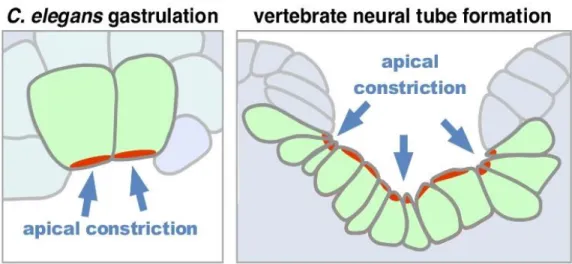
Apical constriction is a cell shape change that can drive tissue morphogenesis in nearly all metazoans3. Vertebrates utilize apical constriction to direct neural tube closure (Figure 1) and roughly 300,000 newborns suffer from neural tube closure defects
worldwide annually14. During this developmentally regulated event, the tension arising from contractions within the actomyosin cortex is transmitted across cell junctions to pull on neighboring cells. The resulting change in cell shape ultimately drives tissue folding and invagination3,4. Identifying the key molecules involved and discerning how they behave during apical constriction is crucial to our understanding of this morphogenetic event. Our lab has identified a number of genes involved in apical constriction during C. elegans gastrulation, but the precise details of the mechanism are still murky8,17,21. The adhesive cadherin-catenin complex (CCC), containing alpha-catenin, beta-catenin, and E-cadherin, becomes apically enriched in E cells upon myosin activation and is required for apical constriction to proceed, somehow dynamically connecting to the tensile
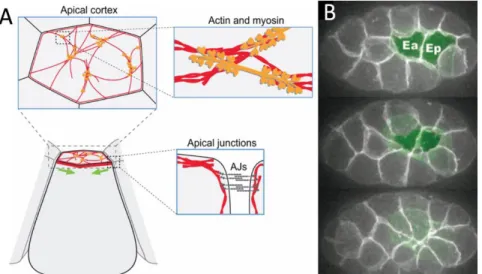
In C. elegans, two endodermalprecursor cells (E cells) originate at the surface of the embryo when the E cell progenitor divides. Gastrulation begins at the 26- to 28-cell stage as the E cells apically constrict and internalize (Figure 1, Figure 2B). C. elegans
is well-suited for identifying and understanding the complex roles of candidate molecular triggers for apical constriction in vivo. Several factors make C. elegans an attractive candidate for this type of in vivo morphogenesis research. The organism’s genetic
tractability allows for direct edits to the genome, making direct, specific mutagenesis and fluorescent protein fusions a relatively straightforward task15,16. C. elegans embryos are also transparent, permitting direct observation of fluorescently-tagged protein
dynamics throughout development. Because of the animal’s short generation time, we can identify, tag, and image any protein of interest all within the span of a month. Since apical constriction progresses in such a spatiotemporally-stereotyped manner and because our model provides many in vivo experimental advantages, C. elegans is valuable for studying morphogenesis.
Developmental patterning is integrated with spatial information in E cells, instructing their decision to undergo apical constriction at the 26-28 cell stage in the early C. elegans embryo with precise timing. Expression of the end-3 transcription factor confers an endodermal fate to these cells, which promotes the production and apical recruitment of the myosin light-chain kinase, MRCK-1, to apical contact-free cell surfaces17.
requires to proceed. Previous hypotheses posited that this sudden increase in tension within cells would alone be sufficient to initiate constriction. While the activation and apical localization of myosin is absolutely required for constriction to proceed11,12, our lab has shown that these events are not themselves the immediate trigger of apical constriction in either Drosophila or C. elegans5. In fact, myosin’s apical enrichment and activation precede the initiation of constriction by several minutes. Myosin activity seems to stabilize the adhesive structures at apical surfaces of cell-cell junctions by preventing the sequestration/internalization of cadherin-catenin complexes, but does not directly initiate tissue rearrangement19,26.
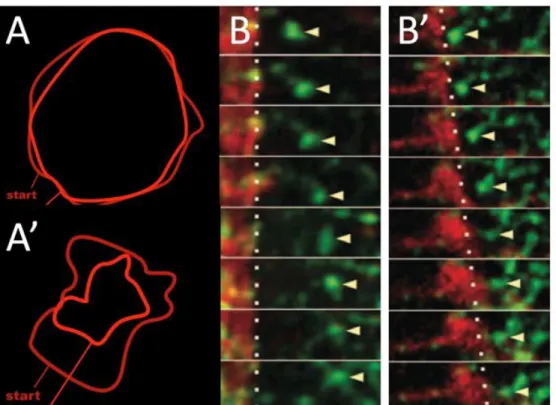
During this period of increased tension within E cells’ apical surfaces before the onset of apical constriction5,17 myosin puncta flow centripetally along the cell’s apical cortex without accompanying movement of associated cell membranes (Figure 3). We refer to this phenomenon as “slippage.” With precise timing, these myosin movements “couple” with the cell-cell junctions and apical constriction proceeds, suggesting that tension is transmitted through cell junctions to cytoskeleta of neighboring cells. During coupling, slippage is almost entirely eliminated. The precise mechanism of how myosin and membrane structures achieve this coupling with temporal accuracy remains a mystery.
otherwise made available to interface between the actomyosin cortex and adherens junctions. The formation of this linkage results in force transmission between
neighboring cells and constriction can occur.
To test this hypothesis and determine which proteins might be involved in
forming this developmentally-regulated linkage, we decided to perform an RNAi screen. A single-cell transcriptomic analysis of the early C. elegans embryo provided the basis of our candidate list9. In this analysis, expression levels of each transcript were
measured in each individual cell through the 16-cell stage of development. With this information, we constructed a candidate list of genes most highly enriched in E cells (16 cell stage) and their progenitor (8 cell stage). We hypothesized that at least one of the candidates in this list will be involved in forming a connection between adherens junctions and the contractile actomyosin network.
To determine which proteins from our candidate list might be involved in apical constriction, we designed the screen to seek defects in C. elegans gastrulation
to this phenotype and zyxin’s mRNA enrichment in E cells around the time of gastrulation, we sought to consider zyxin’s role in apical constriction.
By filming embryos expressing fluorescently-tagged proteins, we were able to track the movements of myosin puncta in relation to cellular borders during apical constriction. We depleted these embryos of zyxin mRNAs to scrutinize these molecular dynamics. In constricting cells, myosin puncta flow centripetally along the apical
surface, apparently supplying tension to the cortical network3,19,20. As shown in Figure 3, wild-type E cells experience several minutes of slippage during which myosin flows without accompanying movement of the cell junctions. These cells then initiate
constriction with precise timing and coupling occurs. After targeting zyxin for
knockdown, we found that the slippage rate erroneously remained high during the latter stages of gastrulation. We speculate that this sustained slippage explains the Gad phenotype in zyxin-depleted embryos.
EXPERIMENTAL APPROACH and METHODS
RNA interference
We injected 1 µg/µL of dsRNA in TE Buffer into the gonads of young adult worms. Each dsRNA construct was designed to target the first kilobase of each candidate gene’s exonic code. After 36 hours incubation at 20°C, we dissected out dsRNA-treated embryos and mounted them laterally on glass coverslips no later than the 8-cell stage.
DIC and fluorescence microscopy
We filmed each embryo under DIC illumination at one minute intervals for 1.5 hours to measure its progression through gastrulation. In typical wild-type embryos, E cells don’t divide until they have internalized entirely into the blastocoel and are fully covered by their neighbors. We consider an embryo to be Gad if this division occurs before the completion of E cell internalization.
Candidates with an apparent effect on gastrulation were further tested to
high temporal resolution (1 image every 3 seconds for 5 minutes), in order to measure the slippage rate during early and late stages of gastrulation. The MTrackJ plugin in ImageJ was used to track myosin and membrane movements and calculate their velocities.
Strains and worm maintenance
Nematodes with cultured and handled as described28. The following reporter and mutant strains were used: MT4417 ced-5(n1812); SU348 sax-7(eq1); LP54
RESULTS
Determining Candidate List for RNAi Screen
From the dozens of enriched transcripts in the E cells and the E cell progenitor, we considered three classes of genes: (1) genes whose predicted products are well-characterized and might serve a mechanical purpose; (2) genes with only a few predicted domains; and (3) genes whose products are likely not involved in apical constriction at all. We predict that products in the first class will either interact with the cytoskeleton directly or otherwise sense and transduce force via stretch-induced binding (perhaps revealing cryptic domains as in vinculin, talin) and signaling.
The second class of products only have a few domains listed, merely hinting at prospective functions. Their conceivable involvements in apical constriction range from cell-cell adhesion (e.g. C-type lectin fold protein encoded by F25D7.2) to cell signaling (e.g. tyrosine kinase and phosphatase domains are common features among
candidates). Though these proteins aren’t well-characterized, we can still offer simple hypotheses positing roles in gastrulation.
The final class of genes encoded lysosomal proteins, glycosylation proteins, Argonaut proteins, etc. and will likely have little direct involvement in the progression of apical constriction since they do not have any proposed mechanical function. We decided to exclude this set of genes was excluded from the screen. The final non-comprehensive list includes 28 candidate genes.
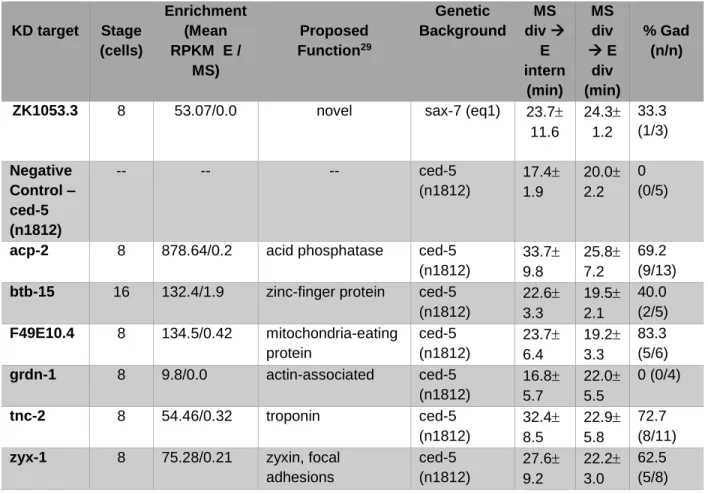
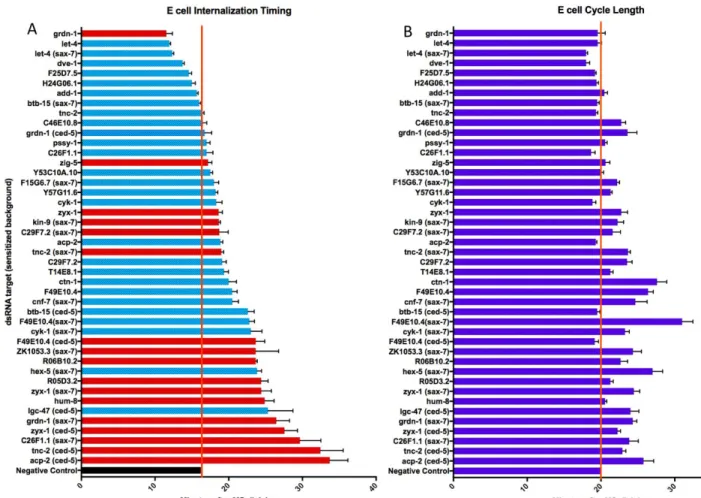
MS cells (mesodermal precursor cells) are born within one minute of each other. These MS cells divide into four daughters 25 minutes following their birth, followed shortly thereafter by E cell apical constriction and internalization. In untreated wild-type embryos, E cells fully internalized in 16.2 (+/- 2.0) minutes following MS cell divisions (Table 1, Figure 6). After completing internalization (when no part of either E cell is exposed to the embryo’s ventral surface), each E cell divided in 3.7 (+/- 1.7) minutes. We found that targeting certain genes for knockdown often led to delays in
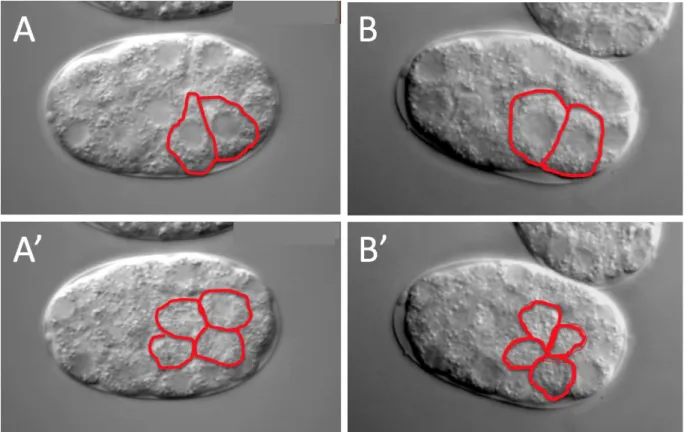
internalization. In some cases, E cells failed to completely internalize before undergoing division (Figure 7). This is nearly always due to a delay in internalization rather than a defect in cell division timing (Table 1, Figure 6).
From the candidates tested, we isolated several genes which have an effect on gastrulation in the wild-type background. In addition to severely delaying E cell
internalization, treating early embryos with dsRNAs also led to a > 25% incidence of the Gad phenotype for 9/23 candidates tested in the wild-type background (See Table 1, Figure 6). To overcome potential genetic redundancies, we also targeted some candidates for knockdown in sensitized genetic backgrounds (See Experimental Approaches and Methods). Ced-5, which encodes a RacGEF38, acts redundantly with
hmr-1 (encoding cadherin) during C. elegans gastrulation21. Treatment of dsRNAs in the
function in a pathway with cadherin to allow its physical linkage to cytoskeletal elements.
In comparison to earlier screening methods21, our screen yielded in a high number of promising candidates with highly penetrant effects on gastrulation. Since these genes have an apparent effect on gastrulation, we wanted to uncover any direct roles in apical constriction. One promising candidate has been chosen for further analysis so far.
Determining zyxin’s role in promoting completion of gastrulation
Knockdown of zyxin resulted in a noticeable phenotype in both wild-type and sensitized backgrounds. It has also been previously shown to have a role in mechano-sensitive actions. Zyxin is mainly appreciated for its role in biomechanical feedback during focal adhesion maturation10,12, though recent evidence suggests it can also work at cell-cell contacts24.
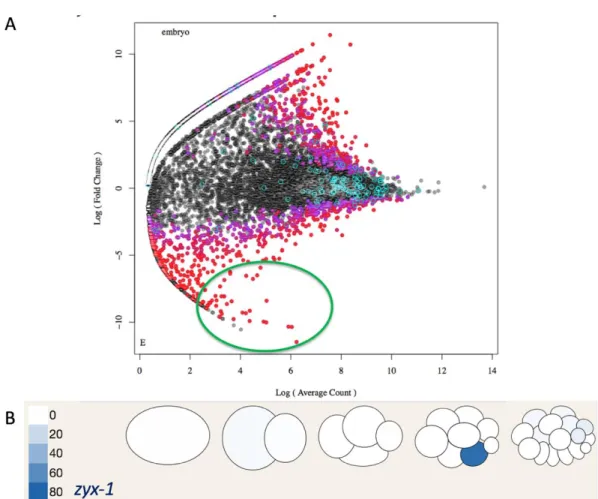
Zyxin is an attractive candidate for additional study for a number of reasons. For one, zyxin’s expression pattern is among the most striking of all the candidates in terms of its E cell enrichment. These transcripts are 358 times more enriched in the E cell progenitor than in its neighbors (Table 1, Figure 5B). Additionally, the effect of zyxin targeting on the early embryo is among the strongest that we observed for
well-characterized proteins (Table 1). Zyxin’s known biomechanical function also offered a clear set of hypotheses detailing how it might function to initiate apical constriction. For these reasons, we predict that zyxin contributes to a developmentally-regulated
this connection, thereby preventing membranes from moving in tangent with myosin puncta.
Our gastrulation data raise the possibility that zyxin operates in apical constriction, but the screening method does not allow direct detection of this phenomenon. In our screen, we filmed laterally mounted embryos under DIC
illumination. The apical surfaces of E cells face the embryo’s ventral surface, so lateral mounts, while quick and technically easy to perform, are good for screens but do not allow for direct observation of constricting apical membranes.
High-speed fluorescent movies of ventrally mounted embryos allow us to measure myosin’s rate of flow as well the adjacent cell membrane’s rate of centripetal movement simultaneously. We define the difference in speeds as “slippage” between myosin and membrane. As in previous analyses, we define two stages of apical constriction for convenience: The early stage, a period spanning the 10 minutes following MS daughter division; and the subsequent late stage, when E cell apical surfaces actually constrict5. During the early stage, apical myosin flows centripetally without accompanying movement of associated membranes. In short, there is a high degree of slippage. As constriction begins, the membrane slowly begins to move at a similar rate as myosin. During this late stage, the slippage rate gradually falls to under 0.5 µm/min in control embryos.
remained significantly high (Figure 8). We conclude that depletion of zyxin in the early
DISCUSSION
C. elegans embryos employ a basic cellular behavior to drive gastrulation. This behavior, apical constriction, drives tissue rearrangement in many different biological systems4,5. During apical constriction, myosin contractions elicit tension within the actomyosin cortex. In a constricting cell, this tensile network somehow becomes mechanically connected to cellular junctions, and neighboring cells are pulled over its apical surface, inducing its internalization. The progression of this event is highly stereotypical and appears to be under tight developmental regulation in worms4,6,17. However, we can disrupt this process if we deplete early embryos of certain genetic factors. One such gene which appears to be vital to the progression of apical
constriction is zyxin.
Direct injection of dsRNAs into adult gonads (in favor of feeding, where knockdown is less effective) and the unique construction of the RNAi candidate list yielded more penetrant effects on gastrulation than previous screening efforts21. After targeting zyxin for knockdown with dsRNAs for 36 hours, many embryos demonstrated a Gad phenotype. These defects arose in both sensitized (sax-7 null, ced-5 null) and wild-type backgrounds. Knockdown of other cytoskeleton-related transcripts, including alpha-Catulin (ctn-1), girdin (grdn-1), and formin (cyk-1), also led to an increased incidence of Gad embryos (Table 1, Figure 6). Subsequent high temporal resolution imaging has allowed us to directly observe the molecular dynamics at play within constricting cells. These movies reveal that the Gad phenotype detected in
movements remain high abnormally late in the process. That is, myosin contractile movements do not efficiently couple with the cellular junctions during the late stages of gastrulation as they should. We hypothesize that zyxin’s involvement in apical
constriction is at the interface between the contractile cytoskeleton and components within adherens junctions at the apical surface.
The classic literature on zyxin presents this protein as a mechano-sensitive element that is chiefly involved in tension sensing at integrin-based focal adhesions during cellular migration10,12. Its stretch-induced recruitment to focal adhesions is
required for the subsequent recruitment of other cytoskeleton-associated proteins, such as Ena/VASP and testin11. The ultimate consequence of stretch and thus zyxin
recruitment appears to be the strengthening actin cables’ attachment to adhesive structures on a rigid substrate. Recent evidence suggests that zyxin not only has a role in focal adhesions, but can also be found at the interface between two cells24.
In a set of in vitro experiments24, Oldenberg et al. pharmacologically induced stretch and used super resolution microscopy to view several members of the focal adhesion complex. They found that stretch induction results in the formation of “Focal Adherens Junctions (FAJs)” between cell neighbors. These FAJs contain zyxin, which is only recruited to cell borders in response to increased cellular tension. Furthermore, Ena/VASP and testin are only recruited to these structures in cells that have not been depleted of zyxin. In control cells, the stretch-induced recruitment of zyxin (and thus Ena/VASP and testin), leads to cytoskeletal strengthening, wherein stress fibers
testin are not completely required for cytoskeletal strengthening to occur, but may make the network slightly more robust or mediate an indirect interaction between actin, zyxin, and alpha-catenin. We hypothesize that this in vitro zyxin-dependent actin stabilization is also at play in vivo during the initiation of apical constriction.
We have previously shown that E cells receive developmental patterning information from cell intrinsic cues as well as signals from their neighbors. E cells integrate this information to prompt an increase in tension via MRCK-1 signaling at the apical surface17. Around this time, these cells also specifically expressing high levels of zyxin9. We believe that these events must align to properly regulate the timing of apical constriction initiation during C. elegans gastrulation.
In our model (Figure 9), zyxin transcripts begin accumulating within E cells while MRCK-1 becomes apically enriched and begins activating myosin. While myosin
activation produces tension within the apical cortex before constriction begins, zyxin is being translated and folded. The tensile cortex can then recruit folded zyxin to apical junctions. Once sufficient levels of zyxin have accumulated and integrated themselves into FAJs along with binding partners Ena/VASP and testin, apical constriction will begin. We believe this model can help explain the observed increase in slippage rate after zyxin for depletion in gastrulating embryos.
Future Directions
The following proposed experiments will help address specific questions
contacts, and form connections between components of clutch complex? We also aim to address the crucial question of how developmental regulation guides the progression of this event with temporal precision.
In ascertaining the role of zyxin in apical constriction, we will rely on the CRISPR/Cas system to genetically mutate zyxin, add fluorescent tags, alter cell fate, and change expression pattern to test our model. By attaching a fluorescent tag to zyxin, we will be able to measure its levels while also tracking its movement throughout the embryo. Our expectation is that the timing of zyxin accumulation and junctional recruitment in E cells will be coordinated with the onset of apical constriction. Below we list several experiments that will test the hypotheses stemming from our model (Figure 9).
Genetic truncations and point mutations will reveal which domains are crucial to zyxin’s function. Zyxin’s N-terminus has been shown to interact with actin, while its C-terminal LIM domains bind with partners like Ena/VASP and testin25. An N-terminal truncation should keep zyxin from interacting with tensile actin, thus preventing it from sensing stretch or strengthening the apical cortical meshwork. A C-terminal truncation would prevent binding with other cytoskeletal interactors, but likely has only a marginal effect on cytoskeletal strengthening. If these hypotheses hold true, embryos with zyxin N-terminal truncations will experience abnormally high myosin/membrane slippage during late stages of apical constriction, while embryos with the C-terminal truncation will look relatively normal.
A crucial component of our model is that zyxin’s action, under strict
timing of its expression. To test this hypothesis, we will genetically encode zyxin’s expression to be under control of the med-1 promoter), resulting in premature zyxin expression. In this scenario, zyxin will accumulate in E cells several minutes before MRCK-1 is able to activate myosin at the apical surface. Once myosin activation occurs, however, we would expect the increase in apical tension to result in near-immediate recruitment of zyxin to cell junctions. In short, apical constriction would initiate several minutes early. These experiments will be crucial to explain how developmental
regulation instructs the precise timing of gastrulation in C. elegans.
Our model proposes a system in which we are able to comprehensively establish a connection between developmental patterning and the physical mechanics of early tissue morphogenesis. Forming this connection requires a set of experiments that will alter cell fates within the developing embryo. These experiments will utilize the CRISPR system to make MS cells express the E cell fate, for example. We hypothesize that these “ectopic E cells” will express zyxin around the time of gastrulation while also experiencing increased surface tension, ultimately undergoing apical constriction. These data would provide support to the idea that zyxin and its developmental regulation are the keystone to the initiation of apical constriction. It is alternatively possible that end-3
expression is absolutely required to link spatial information and force generation and inform cells to constrict. If this is true, early expression of zyxin would not lead to premature apical constriction.
Since alpha-catenin is an integral part of CCCs30 and vinculin has been implicated in FAJ formation33, this is an intriguing candidate for future study. HUM-8 is an
unconventional myosin that resembles human Myosin 6. This motor protein is involved in epithelial morphogenesis via its interaction with vinculin at cell borders and allows cells to form cohesive contacts39. A formin-related protein, CYK-1, can assemble actin filaments34 and is directly involved in cytokinesis35,36. This direct mechanical action on the cytoskeleton makes it an attractive candidate. For many of our candidates, we only can distinguish a few protein domains. Proteins with kinase or phosphatase domains seem important, though their involvement in apical constriction, if any, is likely to be more indirect.
There is no doubt that a number of experiments are still necessary to fully
demonstrate how tensile cortical actin can mechanically effect a cell shape change with precise developmental timing in a living organism. Our data have begun to unravel the linkage between development and biomechanics at the cellular level in vivo. With single-cell transcriptomic data informing a genetic screen, and with the ability to watch molecular dynamics in vivo, we have provided evidence suggesting an important role for zyxin in apical constriction. We believe the experiments proposed above will further illuminate its role in connecting contractile actomyosin to adhesive structures at cell junctions. Zyxin likely acts with one or more partners throughout this process, and the results from our genetic screen will be a valuable source of information when
APPENDIX 1: TABLE 1 – RESULTS OF RNAi SCREEN RESULTS
KD target Stage (cells)
Enrichment (Mean RPKM in E
over MS Proposed Function29 Genetic Background MS div
E intern
(min)
MS div
E div (min) % Gad (n/n) Negative Control
-- -- -- N2
(wild-type) 16.2 2.0 19.9 1.7 0 (20/20)
acp-2 16 878.64/0.2 acid phosphatase N2
(wild-type) 18.8 3.4 19.3 1.6 12.5 (2/16)
add-1 8 8.2/0.0 alpha-adducin:
cytoskeleton signaling N2 (wild-type) 15.7 2.2 20.5 3.8 7.7 (1/13)
C46E10.8 8 108.94/0.0 zinc-finger protein N2 (wild-type) 16.5 5.7 22.8 4.8 50.0 (6/12)
C29F7.2 16 955.98/0.45 kinase-like domains N2 (wild-type) 19.1 4.8 23.5 4.8 27.3 (3/11)
C26F1.1 16 699.64/0.57 novel N2
(wild-type) 17.0 7.7 18.7 4.8 0 (0/9)
ctn-1 8 48.48/0.05 alpha-catulin:
cytoskeleton, adhesions N2 (wild-type) 20.0 8.4 27.6 7.7 20.0 (2/10)
cyk-1 8 1.08/12.3 formin, actin
polymerization N2 (wild-type) 18.3 7.9 18.8 4.5 23.1 (3/13)
dve-1 16 857.9/0.0 CMP domain, RAS
signaling N2 (wild-type) 13.8 1.7 18.0 2.6 0 (0/4)
F25D7.5 8 40.93/0.07 C-type lectin fold N2 (wild-type) 14.6 2.9 19.2 0.8 0 (0/5)
F49E10.4 8 134.5/0.42 mitochondria-eating protein N2 (wild-type) 20.5 4.5 26.4 3.6 0 (0/13)
grdn-1 8 9.8/0.0 actin-associated N2
(wild-type) 11.6 10.8 19.6 7.0 33.3 (3/9)
H24G06.1 8 45.86/0.0 mitogen-activated protein kinase binding protein N2 (wild-type) 15.0 3.6 20.3 .7 20.0 (2/5)
hum-8 16 26.48/0.0 unconventional
myosin N2 (wild-type) 24.8 7.9 20.6 1.7 66.7 (6/9)
let-4 8 25.06/0.0 organizes ECM N2
(wild-type) 11.9 2.3 19.6 4.0 0 (0/17)
pssy-1 8 137.97/1.94 phosphatidylserine synthase N2 (wild-type) 17.0 5.2 23.6 2.4 7.1 (1/14)
R05D3.2 16 32.49/0.2 LMBR1 human
KD target Stage (cells)
Enrichment (Mean RPKM E /
MS) Proposed Function29 Genetic Background MS div
E intern
(min)
MS div
E div (min)
% Gad (n/n)
R06B10.2 8 6.19/.16 tyrosine
phosphatase N2 (wild-type) 23.7 1.2 22.6 5.6 71.4 (5/7)
T14E8.1 8 13.7/0.0 tyrosine kinase N2
(wild-type) 19.4 5.3 21.3 1.6 18.2 (2/12)
tnc-2 8 54.46/0.32 troponoin N2
(wild-type) 16.3 2.9 19.3 1.0 0 (0/9) Y53C10A. 10
8 19.16/0.0 novel N2 (wild-type) 17.5 3.1 22.4 2.1 8.3 (2/12) Y57G11C. 6
8 32.48/0.18 tyrosine phosphatase N2 (wild-type) 18.2 2.6 23.1 1.1 30 (3/10)
zig-5 8 27.05/0.0 secreted
immunoglobulin N2 (wild-type) 17.2 4.3 23.0 4.1 37.5 (3/8)
zyx-1 8 75.28/0.21 zyxin, focal
adhesions N2 (wild-type) 18.6 4.0 22.8 5.4 25 (5/20) Negative Control – sax-7 (eq1)
-- -- -- sax-7 (eq1) 16.7
2.3
21.3 1.8
0 (0/7)
btb-15 16 132.4/1.9 zinc-finger protein sax-7 (eq1) 16.0 1.4
19.5 1.3
0
C29F7.2 16 955.98/0.45 kinase-like domains sax-7 (eq1) 18.7 18.8
21.6 6.7
28.6 (2/7)
C26F1.1 16 699.64/0.57 novel sax-7 (eq1) 29.7
12.0
23.8 66.7 (4/6)
cyk-1 8 1.08/12.3 formin, actin
polymerization
sax-7 (eq1) 23.0 12.8
24.3 5.6
73.3 (11/15)
acp-6 16 72.27/0.0 acid phosphatase sax-7 (eq1) 18.0
4.1
22.2 1.6
20.0 (1/5)
F49E10.4 8 134.5/0.42 mitochondria-eating protein
sax-7 (eq1) 234 317 9.1 (1/11)
grdn-1 8 9.8/0.0 actin-associated sax-7 (eq1) 26.5
16.6
24.3 5.6
56.5 (13/23)
hex-5 16 220.17/0.0 hexosaminidase sax-7 (eq1) 23.9
3.4
27.0 6.8
33.3 (3/9)
kin-9 8 45.82/0.12 tyrosine kinase sax-7 (eq1) 18.7
1.2
22.3 3.7
50.0 (2/4)
let-4 8 25.06/0.0 organizes ECM sax-7 (eq1) 12.4
1.5
18.0 1.0
0 (0/4)
tnc-2 8 54.46/0.32 troponin sax-7 (eq1) 20.5
3.5
23.7 1.2
33.3 (1/3)
KD target Stage (cells)
Enrichment (Mean RPKM E /
MS) Proposed Function29 Genetic Background MS div
E intern
(min)
MS div
E div (min)
% Gad (n/n)
ZK1053.3 8 53.07/0.0 novel sax-7 (eq1) 23.7
11.6 24.3 1.2 33.3 (1/3) Negative Control – ced-5 (n1812)
-- -- -- ced-5
(n1812) 17.4 1.9 20.0 2.2 0 (0/5)
acp-2 8 878.64/0.2 acid phosphatase ced-5
(n1812) 33.7 9.8 25.8 7.2 69.2 (9/13)
btb-15 16 132.4/1.9 zinc-finger protein ced-5 (n1812) 22.6 3.3 19.5 2.1 40.0 (2/5)
F49E10.4 8 134.5/0.42 mitochondria-eating protein ced-5 (n1812) 23.7 6.4 19.2 3.3 83.3 (5/6)
grdn-1 8 9.8/0.0 actin-associated ced-5
(n1812) 16.8 5.7 22.0 5.5 0 (0/4)
tnc-2 8 54.46/0.32 troponin ced-5
(n1812) 32.4 8.5 22.9 5.8 72.7 (8/11)
zyx-1 8 75.28/0.21 zyxin, focal
adhesions ced-5 (n1812) 27.6 9.2 22.2 3.0 62.5 (5/8)
Table 1 – Results of RNAi screen. “KD target” column gives gene name or Cosmid ID for each targeted gene. “Enrichment” and “Stage” columns show data from Tintori et al9, comparing Reads Per Kilobase per Million (RPKM) between an E cell precursor/MS cell precursor pair (8 cell stage of embryogenesis) or an E cell/MS cell pair (16 cell stage). Three genetic backgrounds were used to avoid potential redundancies in the system. Sax-7 (eq1) is a null allele of a Cell Adhesion Molecule and Ced-5 (n1812) is a null allele of a cell engulfment protein involved in Ras signaling. The column “MS division
APPENDIX 2: FIGURES
Figure 1. Apical constriction is a conserved process in C. elegans gastrulation as well as vertebrate neural tube formation. The cells highlighted in green are E cells in C. elegans and neural plate cells in vertebrates and undergo apical
Figure 2. C. elegans embryos achieve gastrulation via apical constriction. (A) Apical constriction initiates when the tensile actomyosin network physically connects to apical adherens junctions. This connection appears to form with precise timing in gastrulating C. elegans embryos. (B) shows a ventral view of a gastrulation-stage embryo, with E cells (Ea, anterior; Ep, posterior)
Figure 4: The temporally-regulated link between adherens junctions and F-actin. The molecular link between the cadherin-catenin complex and F-actin in apically constricting cells remains a mystery, and continues to be a source of controversy.
Figure 7. E cells divide at ventral surface in Gad embryos. Lateral mounted
Figure 8. Slippage Rate remains abnormally high after zyxin depletion. (A,B) Snapshot of ventrally mounted wild-type embryos in Early and Late stage, respectively. Yellow arrows represent myosin puncta movements in E cells. Red arrows represent movement of associated membrane. (C) Myosin’s rate of centripetal flow does not change from Early to Late stage. The dsRNA treatment targeting zyxin does also not cause a change in myosin flow rate. (D) In both wild-type (blue circiles) and zyxin-depleted (red squares) embryos, there is a high degree of slippage between myosin and membrane in Early Stage E cells. The slippage rate in Late Stage E cells zyxin-depleted embryos remains high abnormally. (E) The same embryos analyzed by kymography in C and D were independently measured using the ImageJ mTrackJ plugin in a double-blind study (credit: Terrance Wong). (C,D,E) n = 5 wild-type and 6
REFERENCES
1. Keller R, Davidson LA, Shook DR.How we are shaped: the biomechanics of Gastrulation.
Differentiation. 2003;71(3):171-205.
2. Lecuit T, Lenne PF, Munro E. Force generation, transmission, and integration during cell and tissue morphogenesis. Annu Rev Cell Dev Biol. 2011;27:157-84
3. Martin AC, Goldstein B. Apical constriction: themes and variations on a cellular mechanism driving morphogenesis. Development. 2014 May; 141(10): 1987–1998.
4. Sawyer JM, Harrell JR, Shemer G, Sullivan-Brown J, Roh-Johnson M, Goldstein B. Apical Constriction: a cell shape change that can drive morphogenesis Dev Biol. 2010;341(1):5-19.
5. Roh-Johnson M, Shemer G, Higgins CD, McClellan JH, Werts AD, Tulu US, Gao L, Betzig E, Kiehart DP, Goldstein B. Triggering a Cell Shape Change by Exploiting Preexisting Actomyosin Contractions Science. 2012;335(6073):1232-5.
6. Lee JY, Marston DJ, Walston T, Hardin J, Halberstadt A, Goldstein B. Wnt/Frizzled Signaling Controls C. elegans Gastrulation by Activating Actomyosin Contractility. Curr Biol. 2006 Oct 24; 16(20): 1986–1997.
7. Lee JY, Goldstein B. Mechanisms of cell positioning during C. elegans gastrulation.
Development. 2003 Jan; 130(2): 307–320.
8. Sullivan-Brown JL, Tandon PD, Bird KE, Dickinson DJ, Tintori SC, Heppert JK, Trogden KP, Orlowski SK, Conlon FL, Goldstein B. Identifying regulators of morphogenesis common to vertebrate neural tube closure and Caenorhabditis elegans gastrulation.
Genetics. 2016;202(1):123-39.
9. Tintori SC, Nishimura EO, Golden P, Lieb JD, Goldstein B. A Transcriptional Lineage of the Early C. elegans Embryo. Dev Cell. 2016 Aug 22; 38(4): 430–444.
10. Yoshigi M, Hoffman LM, Jensen CC, Yost HJ, Beckerle MC. Mechanical Force mobilizes zyxin from focal adhesions to actin filaments and regulates cytoskeletal reinforcement. J Cell Biol. 2005;171(2):209-15.
11. Smith MA, Blankman A, Deakin NO, Hoffman LM, Jense CC, Turner CE, Beckerle MC. LIM domains target actin regulators paxilin and zyxin to sites of stress fiber strain. PLoS
One. 2013;8(8):e69378
12. Hoffman LM, Jensen CC, Chaturvedi A, Yoshigi M, Beckerle MC.Stretch-induced actin
remodeling requires targeting of zyxin to stress fibers and recruitment of actin regulators. Mol Biol
Cell. 2012;(10):1846-59.
13. Swaminathan V, Waterman CM. The molecular clutch model for mechanotransduction evolves. Nat Cell Biol 2016 Apr 27;18(5):459-61.
14. Botto LD, May K, Fernhoff PM, Correa A, Coleman K, Rasmussen SA, Merritt RK, O'Leary LA, Wong LY, Elixson EM, Mahle WT, Campbell RM. Trends of selected malformations in realtion to folic acid recommendations and fortification: an international assessment. Pediatrics.
2003;112:101-7.
16. Dickinson DJ, Pani AM, Heppert JK, Higgins CD, Goldstein B. Stream-lined genome engineering with a self-excising drug selection cassette. Genetics. 2015;200(4):1035-49
17. Marston DJ, Higgins CD, Peters KA, Cupp TD, Dickinson DJ, Pani AM, Moore RP, Cox AH, Kiehart DP, Goldstein B. MRCK-1 Drives Apical Constriction in C. elegans by Linking Developmental
18. Patterning to Force Generation. Curr Biol. 2016 Aug 22;26(16):2079-89.
19. Smith MA, Hoffman LM, Beckerle MC. LIM proteins in actin cytoskeleton mechanoresponse.
Trends Cell Biol. 2014;24(10):575-83.
20. Martin AC, Kaschube M, Wieschaus EF. Pulsed actin-myosin network contractions drive apical constriction. Nature. 2009 Jan 22; 457(7228): 495.
21. Dawes-Hoang RE, Parmar KM, Christiansen AE, Phelps CB, Brand AH, Wieschaus EF. Folded gastrulation, cell shape change, and the control of myosin localization. Development.
22. 2005;132(18):4165-78.
23. Sawyer JM, Glass S, Li T, et al. Overcoming Redundancy: An RNAi Enhancer Screen for Morphogenesis Genes in Caenorhabditis elegans. Genetics. 2011;188(3):549-564. doi:10.1534/genetics.111.129486.
24. Nance J, Munro EM, Priess JR.Cortical flows powered by asymmetrical contraction transport PAR proteins to establish and maintain anterior-posterior polarity in the early C. elegans embryo.
Dev Cell. 2004;7(3):413-24.
25. Nishimura T, Takeichi M.Shroom3-mediated recruitment of Rho kinases to the apical cell junctions regulates epithelial and neuroepithelial planar remodeling.
Development. 2008;135(8):1493-502.
26. Oldenburg J, van der Krogt G, Twiss F, Bongaarts A, Habani Y, Slotman JA, Houtsmuller A, Huveneers S, de Rooij J.VASP, zyxin and TES are tension-dependent members of Focal Adherens Junctions independent of the α-catenin-vinculin module. Sci Rep. 2015;5:17225.
27. Stachiowak MR, Smith MA, Blankman E, Chapin LM, Balcioglu HE, Wang S, Beckerle MC, O’Shaughnessey B. A mechanical-biochemical feedback loop regulates remodeling of the actin cytoskeleton. Proc Nat. Acad. 2014:111(49):17528-33
28. Martin AC, Gelbart M, Fernandez-Gonzalez R, Kaschube M, Wieschaus EF. Integration of contractile forces during tissue invagination. J Cell Biol. 2010. 188(5):735-49
29. Kamath RS, Martinez-Campos M, Zipperlen P, Fraser AG, Ahringer J. Effectiveness of specific RNA-mediated interference through ingested double-stranded RNA in Caenorhabditis elegans.
Genome Biol. 2001. 2(1);2001
30. S. Brenner, The genetics of Caenorhabditis elegans. Genetics 77, 71 (1974)
31. WormBase web site, http://www.wormbase.org, version WS255, August 1, 2016.
33. Abu Taha A, Schnittler H-J. Dynamics between actin and the VE-cadherin/catenin complex: Novel aspects of the ARP2/3 complex in regulation of endothelial junctions. Cell Adhesion & Migration. 2014;8(2):125-135.
34. Craig D. Buckley, Jiongyi Tan, Karen L. Anderson, Dorit Hanein, Niels Volkmann, William I. Weis, W. James Nelson, Alexander R. Dunn. The minimal cadherin-catenin complex binds to actin filaments under force. Science. 2014 Oct 31; 346(6209): 1254211
35. Huveneers S, Oldenburg J, Spanjaard E, et al. Vinculin associates with endothelial VE-cadherin junctions to control force-dependent remodeling. The Journal of Cell Biology. 2012;196(5):641-652. doi:10.1083/jcb.201108120.
36. Neidt EM, Skau CT, Kovar DR. The Cytokinesis Formins from the Nematode Worm and Fission Yeast Differentially Mediate Actin Filament Assembly. The Journal of Biological Chemistry. 2008;283(35):23872-23883.
37. Gönczy P, Schnabel H, Kaletta T, Amores AD, Hyman T, Schnabel R. Dissection of Cell Division Processes in the One Cell Stage Caenorhabditis elegans Embryo by Mutational Analysis . The
Journal of Cell Biology. 1999;144(5):927-946.
38. Jordan SN, Davies T, Zhuravlev Y, Dumont J, Shirasu-Hiza M, Canman JC. Cortical PAR polarity proteins promote robust cytokinesis during asymmetric cell division. The Journal of Cell Biology. 2016;212(1):39-49. doi:10.1083/jcb.201510063.
39. Grana TM, Cox EA, Lynch AM, Hardin J. SAX-7/L1CAM and HMR-1/cadherin function redundantly in blastomere compaction and non-muscle myosin accumulation during C.
elegans gastrulation. Developmental biology. 2010;344(2):731-744.
40. Wu YC, Horvitz HR. C. elegans phagocytosis and cell-migration protein CED-5 is similar to human DOCK180. Nature. 1998 392: 501–504