A LONGITUDINAL STUDY OF THE DOMAIN-SPECIFICITY OF
ABILITY AND EFFORT ATTRIBUTIONS IN AFRICAN AMERICAN STUDENTS
Heidi A. Vuletich
A thesis submitted to the faculty at the University of North Carolina at Chapel Hill in partial fulfillment of the requirements for the degree of Master of Science in the Department of
Psychology and Neuroscience in the Graduate School of Arts and Sciences.
Chapel Hill 2016
Approved by:
Beth E. Kurtz-Costes
B. Keith Payne
iii ABSTRACT
Heidi A. Vuletich: A Longitudinal Study of the Domain-Specificity of Ability and Effort Attributions in African American Students
(Under the direction Beth E. Kurtz-Costes)
Students’ causal attributions about the reasons underlying their academic successes and
failures influence their academic motivation and subsequent achievement. We investigated whether students’ attributions vary across academic subjects, and whether such
domain-generality or specificity changes with development. African American students (N = 565)
reported their causal attributions for math, science, and English successes longitudinally from
elementary to high school. Structural equation modeling showed that individual differences in
students’ tendencies to attribute successes to ability and effort were domain-general, not
differing across academic content areas. The lack of domain-specificity in attributions suggests
that African American students may view academic outcomes as a single achievement domain
rather than differentiating among school subjects. Students may cope with race related stresses,
such as discrimination and negative stereotypes, by uniformly making adaptive attributions about
iv
TABLE OF CONTENTS
LIST OF TABLES………..vi
LIST OF FIGURES………...vii
CHAPTER 1: INTRODUCTION.………...…...………..1
Attribution Theory………...2
Are Youth’s Attributions Specific to Academic Domains?...4
African American Students’ Attributions for Academic Outcomes………7
Developmental Changes in Attributions………10
Current Study……….12
CHAPTER 2: METHOD.………..13
Participants……….13
Procedure………...14
Measures………15
Student Attribution Scale………...15
Demographic Information………..15
Data Analysis……….16
v
Identification………..18
CHAPTER 3: RESULTS……….……….……….19
Success Ability Attributions………..20
Fit indices………...…20
Measurement model………...………21
SEM model………22
Success Effort Attributions………22
Fit indices………...…22
Measurement model………...………22
SEM model………23
CHAPTER 4: DISCUSSION……….………24
Ability Attributions………24
Effort Attributions………..26
Educational Implications………...…26
Limitations……….27
APPENDIX A: Tables………...………29
APPENDIX B: Figures……….……...………..34
vi
LIST OF TABLES
Table 1 - Means and Standard Deviations for Success Ability Attributions
and Success Effort Attributions at Times 1-4………...………29
Table 2 - Pearson Correlations for Ability Attributions in Math, Science and
English Across Four Time Points………..30
Table 3 - Pearson Correlations for Effort Attributions in Math, Science and English
Across Four Time Points………...30
Table 4 - Fit Indices for Success Ability Attribution Models; Model 4 Shows the
Best Fit for These Data………..31
Table 5- Fit Indices for Two-Subject, Quasi-Simplex Attribution Models for Success Ability Attributions; The Domain-General Models (4 & 6) Show
the Best Fit for These Data………....32
Table 6 - Fit Indices for Success Effort Attribution Models; Model 1 Shows the
vii
LIST OF FIGURES
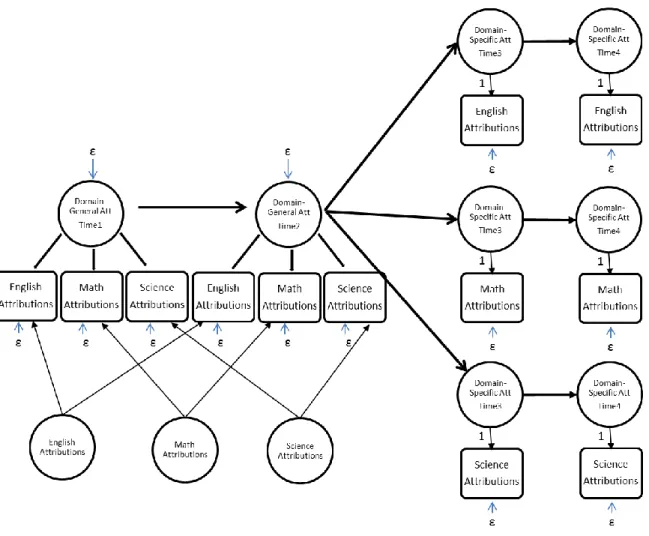
Figure 1 - Domain-general model for success ability attributions
and success effort attributions………...……….34
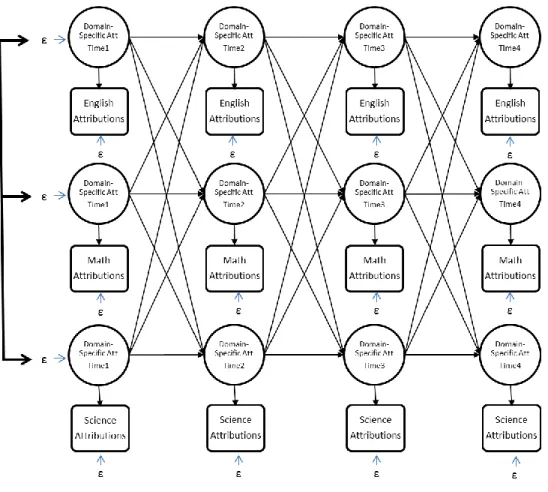
Figure 2 - Domain-specific model for success ability attributions
and success effort attributions with cross-lagged paths………...…………..34
Figure 3 - Developmental model for success ability attributions and
success effort attributions………..………...35
Figure 4-Domain-general model with correlated errors for success
ability attributions and success effort attributions……….36
Figure 5 -Developmental model with correlated errors for success
ability attributions and success effort attributions……….37
Figure 6-Domain-general model with a unique factor for each academic subject: Success ability attributions and success effort
attributions……….…………38
Figure 7-Developmental model with a unique factor for each academic subject: Success ability attributions and success effort
attributions……….………39
Figure 8 - Simultaneous equations with a quasi-simplex model representing each academic subject..………..40
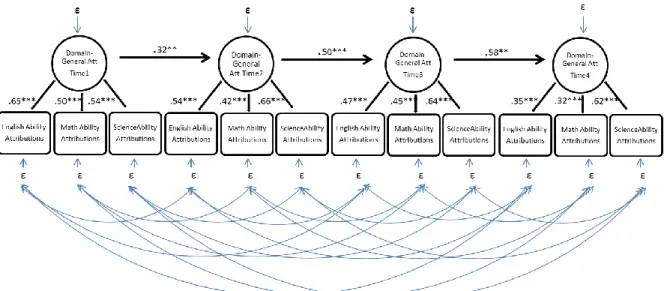
Figure 9-Domain-general attributions with correlated errors
model: Theoretical model with standardized coefficients………..………...41
Figure 10 - Domain-general effort attributions model: Theoretical
1
CHAPTER 1: INTRODUCTION
The way students respond to their academic successes such as getting a good grade on a
test often depends on why they believe they succeeded. A student may believe that the exam was
easy and that anyone could have done well. Another student may attribute success to studying
hard for the exam. Alternatively, a student could believe that he or she is particularly talented in that domain. These causal attributions are important because they can shape students’
expectations about their future performance, inform their academic self-concept, and influence
their motivation and classroom engagement (Costes & Schneider, 1994; Swinton,
Kurtz-Costes, Rowley, & Okeke-Adeyanju, 2011; Wolters, Fan, & Daugherty, 2013). For instance, a
student who believes that she did well in a math exam because she is particularly talented in that
domain is more likely to expect future success in other math examinations, have a high math
self-concept, and be more motivated and engaged in the classroom.
The antecedents and consequences of attributions have been investigated in detail, but
less is known about their cross-domain generality versus specificity. Knowing whether students
develop an attributional style within academic subjects is important for three reasons. First, given
the nontrivial consequences of causal attributions, interventions aimed at attributional retraining
are important, and a key question that may inform the scope of efficient, successful interventions
is whether or not causal attributions generalize across academic domains. Second, having a better
understanding of the generalizability of school-related causal attributions is important for
2
attributions to causes that generalize across success situations predict higher levels of academic
performance, whereas those that do not are related to poorer performance (Houston, 2016).
Third, analyzing the stability or change in the extent to which attributions generalize across
academic domains is informative for understanding children’s developing beliefs about
intelligence and effort.
In this study, we sought to test whether ability and effort success attributions are
domain-general or domain-specific. Other studies have explored similar questions (Boekaerts, Otten, &
Voeten, 2003; Bong, 2004; Vispoel & Austin, 1995), but none with African American students.
Findings based on other samples may not generalize to African American students due to the
unique racial experiences that often characterize the educational environment in which these
youth form attributions.
Our longitudinal design also allowed us to test the possibility that students’ attributions
are more general only when students are younger, but become more specific over time. Thus, we
tested three models—one specifying cross-domain generality, another specifying cross-domain
specificity, and the third specifying developmental change. As discussed below, these models
have different theoretical implications that could inform our understanding of achievement
motivation in African American students.
Attribution Theory
According to attribution theory (Weiner, 1979, 1985, 2012), students attempt to explain
the causes of their academic successes and failures, and these causal attributions influence their
subsequent motivation. Causes can vary by locus (whether it is external or internal to the
3
future success or failure (Weiner, 1979). For example, if a student attributes his good score on an
essay to an external cause, such as an easy test, he may expect that he will do less well in the
future. However, if he attributes his good score to an internal cause, such as having high ability,
he is more likely to expect future successes. The theory predicts that students who attribute their
success to internal causes, such as ability and effort, have better academic outcomes than
students who attribute their success to external causes, such as ease of the task (Sandra Graham
& Williams, 2009; Weiner, 1985, 2012).
The relevance of causal attributions for achievement motivation has been well-supported
by empirical evidence (for a review, see Graham & Williams, 2009). The findings are especially
clear for situations of success. Students’ beliefs about the role of their academic abilities and
effort in shaping their successes are important determinants of achievement striving and
educational performance (Sandra Graham, 2014; Sandra Graham & Williams, 2009; Swinton et
al., 2011). More specifically, attributing successful academic outcomes to ability and effort is
positively associated with better academic skills and greater persistence in the face of failure
(Salanova, Martinez, & Llorens, 2012; Swinton et al., 2011). These internal attributions also
result in more positive self-esteem and pride compared to attributing success to external causes
such as the teacher or luck (Weiner, 2012).
In this study, we were interested in investigating the generality or domain-specificity of
adaptive attributions for success outcomes. Therefore, we focused on analyzing ability and effort
attributions. In addition to being adaptive, ability and effort are among the most common
4
Are Youth’s Attributions Specific to Academic Domains?
A key question that researchers have asked is whether attributions about success
generalize across domains. In Frieze and Snyder’s classical study (1980), children’s attributions
for performing well on a school test differed from their causal attributions for successfully
catching frogs. However, when asked only about academic domains, children might be more
likely to show consistent attributional styles. If a child does well on a math test and attributes it
to studying hard, does she attribute, to the same extent, her good grade in an English essay to
how much effort she put forth in her writing? Or does her tendency to attribute success to effort
differ across academic subjects?
Findings from several studies seem to favor the hypothesis that ability attributions are
domain-specific. Yet, methodological and analytical limitations in these studies preclude strong
conclusions and leave open the question of whether we should expect attributions to be
domain-general or domain-specific, especially in African American students. For example, in one study,
students in their first year of secondary education in the Netherlands (12- to 13-year-olds)
attributed their success in history primarily to effort, whereas they attributed their success in
language and math primarily to easiness of the task (Boekaerts et al., 2003). These results were based on students’ attributions of their performance in examinations and were assessed using
open-ended questions. However, the data were analyzed using aggregate trends, focusing on
school subjects rather than individual differences. Therefore, it is unclear whether students who
rated ability as most important to their history performance were also more likely than students
with other history attributions (e.g., effort) to rate ability as important for math and language
5
of various structural equation models, and we were not limited to comparing mean group
differences.
Subject-area differences in ability success attributions were also found in a sample of
U.S. middle school students. Students were more likely to attribute their success in English and
general music to their high ability than they were to make the same attribution for their success
in math and physical education (Vispoel & Austin, 1995). In that study, students were asked to
think of a situation in which they had done particularly well or poorly, and then they rated how
important several causes were to their success, including internal causes such as ability and
effort, and external causes such as task difficulty and teacher influence. The authors assessed the
dimensionality of attributions using factor analysis. They found that internal attributions
clustered in factors that represented specific subject areas. On the other hand, external
attributions clustered in factors by attribution (i.e., teacher influence versus task difficulty),
regardless of the academic area. Vispoel and Austin (1995) concluded that internal attributions
were domain-specific, whereas external attributions were domain-general. In other words,
internal attributions such as ability and effort were similar to each other within academic
domains (English or Math), but different across domains (English versus Math), whereas
external attributions were similar between academic domains (task difficulty attributions were
similar for Math and English), but differed across attribution category (task difficulty versus
teacher influence). However, these findings should be interpreted with caution. Attributions
regarding critical events in which participants performed particularly well or poorly may not
reflect the attributions that students would commonly make about their performance. Our study
6
do well or get a good grade, without invoking specific past instances that may have been uncharacteristic of the student’s performance.
Other evidence for the domain-specificity of attributions comes from a study of 9th grade
Korean students (Bong, 2004). Bong (2004) found that ability attributions in three different
academic subjects (Korean, English, and mathematics) were mostly independent from each
other, whereas effort attributions were somewhat more strongly correlated across domains. For
instance, students’ tendencies to attribute outcomes to ability were not significantly correlated
for English and Korean classes, or between mathematics and Korean, and only a small,
significant correlation was found between English and mathematics ability attributions. In
contrast, the correlations between all three pairs of academic domains were significant for effort
attributions, albeit the correlations were fairly small. That is, a student who attributed an
outcome in one of those classes to effort was likely to attribute outcomes in the other classes to
effort. These findings can be interpreted as meaning that ability attributions are domain-specific,
whereas effort attributions are somewhat more domain-general. One important limitation of this
study, however, was that both success and failure attribution items were used as indicators of a
single attribution factor (i.e., ability or effort). However, success and failure outcomes have been
shown to elicit different patterns of attributions and should therefore be analyzed separately (e.g.,
Houston, 2016; Swinton et al., 2011). It is possible that results would have differed had success
and failure attributions been analyzed individually.
In sum, although previous research has shown some support for the hypothesis that
success attributions are specific, none of the studies provide a strong test of the
domain-specific versus domain-general question. Moreover, the findings from previous studies may not
7
samples analyzed in previous research. In the next section, we discuss the social factors that may
play a role in the attributions that African American students make regarding their successes in
school, and how these may lead to domain-specific or domain-general attributions.
African American Students’ Causal Attributions for Academic Outcomes
Some theoretical frameworks suggest that attributions can be informed by contextual
information such as cultural norms and stereotypes (Brandt & Reyna, 2010; Reyna, 2000). Thus,
though it is possible that the findings regarding the cross-domain specificity of causal
attributions generalize to African American students, it is also possible that race-related factors
may limit the generalizability of those findings. For example, a pervasive cultural norm in the
United States is that effort is a viable means for success. Cross-cultural research has shown that
cultural norms such as these can influence the attributions and beliefs of teachers and students.
Compared to German teachers, U.S. teachers are more likely to show effort-related attributions,
and U.S. children are more likely than German children to believe that high effort indicates
intelligence (Kurtz-Costes, McCall, Kinlaw, Wiesen, & Holland Joyner, 2005; Kurtz, Schneider,
Carr, Borkowski, & Rellinger, 1990). In turn, some Asian cultures emphasize effort more than
the mainstream U.S. culture, resulting in even greater endorsement of effort attributions. For
instance, Chinese-American mothers endorse effort more highly than European-American
mothers (Kinlaw, Kurtz-Costes, & Goldman-Fraser, 2001).
In a similar manner, the attributions that African American students make may be
informed by the social context in which they form those attributions. In particular, perceptions of
discrimination in the classroom or at school could impact the way that African American youth
ascribe causality for their performance. Race-related experiences could lead youth to believe
8
more effort and be more intelligent than the average person in all domains of their life (Rowley,
Helaire, & Banerjee, 2010). Consequently, African American youth may be more inclined to
form domain-general attributions for success outcomes because their social context emphasizes
system-level biases that they must overcome in order to succeed, as opposed to specific academic
content.
In line with this view, Boekaerts (2003) suggested that students can make causal
attributions at different levels of situational description, from superordinate, defined as the most
abstract level and encompassing all situations of success or failure, to momentary, defined as the
immediate realistic situation. Between these two levels is the middle level, which she theorized
represents the school subject. Boekaerts (2003) proposed that, after repeatedly encountering
similar learning situations, students form an internal model from which they quasi-automatically
infer causality when they encounter another equivalent learning situation. However, the
situational level at which students form this activated internal model is not determined. What we
propose here is that different social contexts may highlight different situational levels. For most
students, the most salient level may be the level of the school subject because schools are
organized such that they emphasize subject differences, especially in secondary school. For
example, as Boekaerts (2003) points out, different school subjects are taught by different
teachers, using different methods, and requiring different examination procedures. However, this
middle level may not necessarily be the most salient for all groups. African American youth
perceive increasing levels of discrimination with age (Greene, Way, & Pahl, 2006). These
perceptions may lead African American youth to form internal models that are focused on the
superordinate level, in which their tendency to attribute academic success to ability or effort is
9
Racial stereotypes could also contribute to the generality or specificity of African American students’ attributions. The attributional model of stereotypes, for example, posits that
cultural stereotypes serve as readily available sources of information about the causes of
outcomes, thus informing causal attributions (Brandt & Reyna, 2010; Reyna, 2008). Evidence
supporting this model has shown that members of negatively stereotyped groups who experience
more stereotype vulnerability underestimate their ability (Aronson & Inzlicht, 2004), may
sometimes be reluctant to take credit for their successes (Crocker, Major, & Steele, 1998), or
may experience self-doubt and loss of confidence in their environment (Graham & Taylor,
2002). If students use stereotypes as a source of information about the causes of their academic
outcomes, their attributions may be more domain-general, as race-related academic stereotypes
tend to be cross-domain. Stereotypes may also play a role in the domain-generality of students’
attributions if students reject the negative stereotypes about their group and uniformly make
adaptive attributions about their school successes. Indeed, despite evidencing lower performance
than Whites in large national data sets, African American students have similar or higher
self-esteem (Gray-Little & Hafdahl, 2000). Van Laar (2000) proposed that African American
students maintain positive self-esteem despite low achievement because they attribute low
achievement to external causes rooted in discrimination, but maintain internal attributions for
success. Support for this model was found in a comparative study of White and Black college
students (van Laar, 2000). Compared to White students, Black students’ expectations of future
economic success declined after one year in college, but their self-esteem remained high. Black
students who made external attributions for failure, but internal attributions for success, were
10
regardless of whether students are susceptible to them or reject them, could potentially lead to
domain-general attributions.
Analyzing whether the attributions of African American students are domain-general or
domain-specific would contribute to our understanding of academic motivation by elucidating
the situational level informing students’ internal models and the possible role of social context in
shaping attributions of success. If African American students’ attributions are domain-general, it
would suggest that they are making attributions at the superordinate level and that students may
cope with social factors such as discrimination and stereotypes by making generalized
attributions about their academic successes. However, if attributions are domain-specific, it
would suggest that these students’ attributions are organized at the middle level, or school
subject.
One caveat to the literature analyzed above is that it does not account for the possibility of developmental changes in students’ attributions. Children’s developing theories of intelligence
and their increasing self-complexity may lead to changes in their attributional styles. In this
study, we seek to address this gap in the literature by testing a developmental model of
attributions in addition to the domain-general and domain-specific models.
Developmental Changes in Attributions
As children age, their understanding of the nature of ability and effort changes. Early
evidence of this developmental change was documented by Nicholls (1984) and has more
recently been replicated by Folmer and colleagues (2008). Their basic finding was that younger
children do not differentiate between effort and ability, believing that to work hard means to be
smart. Older children, on the other hand, see a reciprocal relation between ability and effort such
11
ages 5-6 conflate the meaning of ability and effort; children 7- to 9-years-old attribute outcome
primarily to effort; children ages 10-11 inconsistently attribute outcome to one or the other; and
youth 12 and older see ability as a factor that limits the effects of effort (Folmer et al., 2008).
Although these developmental changes are not directly related to the domain-generality versus specificity of attributions, they indicate that children’s understanding about the role that ability
and effort play in their successes changes across development. As children develop their theories
of intelligence through concept acquisition (Kinlaw & Kurtz-Costes, 2003), their organizational
frameworks about ability and effort may change while simultaneously guiding their explanations
of new learning situations. Therefore, youth’s more complex understanding of intelligence and
effort may lead to more complex causal inferences, resulting in more specialized attributions that
differ across academic subjects. For example, a student might perceive that she receives high
math grades because she is talented in math, whereas she must work hard to receive good grades
in English. This high degree of specificity would be expected only in adolescence, when youth
have a more stable and complex understanding of effort and ability. Evidence of this
developmental pattern can be found in children’s motivational beliefs. Motivational beliefs (i.e.,
self-efficacy, task value, and achievement goals) are more generalized in middle-school,
becoming more differentiated by academic subject in high school (Bong, 1997, 2001).
Not only do students develop a more complex understanding of ability and effort with
age, but they are also increasingly exposed to highly specialized classes as compared to the more
domain-integrated classrooms in the early years of education. These structural changes in their
learning environments could also prompt domain-specificity in attributions as youth advance to
12
Developmental changes indicating that high school is a time when students’ attributions
become more specialized would have important implications for achievement motivation, as high
school is a time when students have more freedom to forge their own career path through their
course selections and choice of extracurricular activities. Moreover, from middle school to high
school, youth undergo other global changes in motivation. For example, from Grades 7 to 11,
youth show declines in school participation, sense of belonging to school, and self-regulated
learning (Wang & Eccles, 2011). Engagement also declines, and these changes are similar across
race and gender (Upadyaya & Salmela-Aro, 2013). As attributions are important for all these
motivational factors, understanding how attributions change across development is critical. One particular strength of our study is that it assesses students’ attributions starting in elementary
school, which other studies investigating domain-specificity have not done.
Current Study
In this longitudinal study, we investigated the nature of African American students’
attributions regarding their successes in math, science and English to ability and effort. More
specifically, we used youth’s attribution responses as given in Grades 5, 7, 10, and 12 to test
three models. These models represented students’ attributions for their successes in math,
English, and science as domain-general, domain-specific, or changing in specificity over time.
Although we did not have a specific hypothesis favoring specificity over generality, we
hypothesized that if African American students’ attributions changed in specificity over time, the
direction of change would be from more general in elementary school and middle school, to
more specific in high school. The hypothesis is based on the idea that as students develop more
complex theories regarding ability and effort, develop a more complex self-concept, and are
13
CHAPTER 2: METHOD Participants
Participants were 565 African American children and adolescents (314 girls; 251 boys) in
the Youth Identity Project, a longitudinal study of academic motivation and achievement. Youth
were originally recruited in three cohorts of fifth graders. They were drawn from seven
elementary schools in an urban school district in the southeastern region of the United States.
The schools were selected based on their racial composition, which was predominantly Black,
with 61% or more of the student body being African American in each school. Cohort 1 fifth
grade data were collected in 2002-2003, Cohort 2 in 2003-2004, and Cohort 3 in 2004-2005.
During original recruitment, 78% of African American 5th graders who were invited to
participate returned signed consent forms. Of those, 97% (N = 382) agreed to participate.
Attribution data were available for 375 of these students. The average age in Grade 5 was 11.1
years (SD = 0.73).
Subsequent waves of data collection for the original sample occurred when youth were in
Grades 7, 10, and 12. Students had enrolled in 17 different middle schools and 22 different high
schools. When youth were in Grade 10, additional participants were recruited from the three high
schools with the largest number of participants from the original three cohorts. These new
participants were in the same English and mathematics classes as students who had been
recruited as fifth graders. The new sample included youth from other races, but only data from
14
Grade 12. Data for the present study were drawn from the four time points (Grades 5 and 7 if
available, and Grades 10 and 12).
The sample retention rate for youth with attribution data was 80% from Wave 1 to Wave
2 (N = 301), 86% from Wave 2 to Wave 3 (N = 259; plus the new recruits, N = 434), and 75%
from Wave 3 to Wave 4 (N = 325; including the new recruits added at Wave 3). Youth who were
lost to attrition came from households with lower household income and lower parent education
than that of youth who remained in the study, F(1, 336) = 14.1 and 19.1, p’s = .001. Participants
who remained in the study across the seven years did not differ from those who were lost on
Grade 5 attribution measures, all F’s < 1.0.
The sample was largely low income, with approximately 39% of the children’s families
reporting yearly incomes less than $30,000 during the third wave of data collection, 35%
reporting yearly incomes between $30,000 and $60,000, and 26% reporting incomes greater than
$60,000 per year. About 8% of parents or caregivers had not completed high school, 57% had
earned a high school diploma, 11% had earned an associate’s degree, and 24% had completed a bachelor’s degree or higher.
Procedure
Letters requesting informed consent from parents and assent from children were
distributed at the selected schools. Children with consent completed a questionnaire in small
groups at school and received a small gift as compensation. All questionnaires included
attribution items and other measures that are not included in this report. Re-consent of children
15 Measures
Student Attribution Scale. Youth completed a 24-item measure of causal attributions for success and failure in four academic domains: English, math, writing, and science. For each
domain, students rated how likely it was that their success or failure was due to ability, effort, or
the teacher. Only the 4 items attributing success to ability and the 4 items attributing success to
effort were analyzed here. The items were (ability/effort): “When I do exceptionally well in
English, it is because I am very smart in verbal areas/ I worked really hard”; “When I do well in
math, it is because I am really good at math/ I studied hard for the test.”; “When I get an
excellent grade on a science project, it is because I am talented in science/ I worked very hard at
it”; and, “When I do very well on a writing assignment, it is because I write well/ I have worked
very hard on the assignment”. The English and writing items were averaged to make a single
verbal attribution score, and the math and science items were used as individual item indicators
of math success attributions and science success attributions, respectively, to ability or effort.
In early years of the study (i.e., 2002 through 2010), children responded to items using a
4-point Likert scale (1 = not at all likely; 4 = extremely likely). All responses on this 4-point
scale were later converted to values on a 7-point scale (i.e., 1 = 1, 1.5 = 2, 2 = 3, 2.5 = 4, 3 = 5,
3.5 = 6, 4 = 7). This conversion was done because some students used the spaces between
numbers to indicate their response or they circled two adjacent numbers. After 2010, students
responded to each item using a 7-point Likert scale (1 = not at all likely; 7 = extremely likely).
Demographic Information. Parental educational attainment was measured on a 10-point scale with responses ranging from “less than high school” to “doctoral or professional degree.”
16 Data Analysis
We planned to compare the fit of three structural equation models (SEM’s), each
assessing a different theoretical perspective on how African American students make success
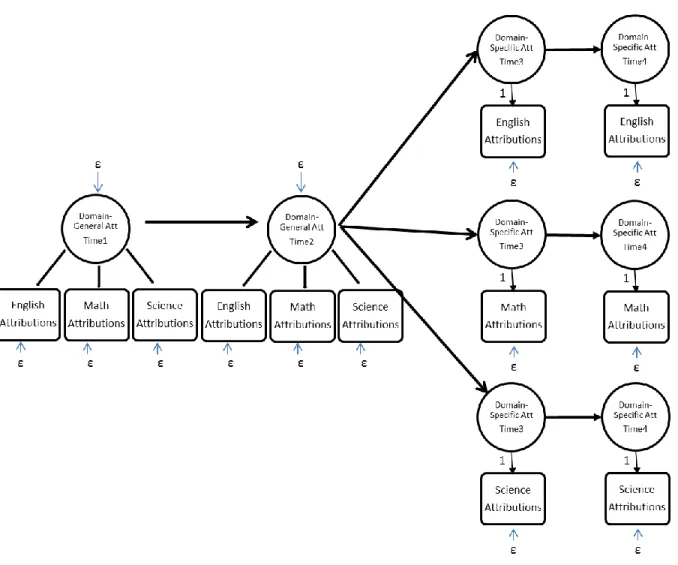
attributions to ability or effort. The first model was a Domain-General Attribution Model,
whereby success attributions for math, science and English are indicators of a single latent
variable (domain-general attribution style for ability or effort) at times 1, 2, 3, and 4 (see Figure
1). The ovals in the diagram represent the latent variables and the rectangles are the observed indicator variables. Each latent variable represents the student’s domain-general attribution style
at each time point, and each time point influences the subsequent one. The second model was a
simultaneous equation model with no latent variables. This model was the Domain-Specific
Attributions Model, whereby attributions of success to ability or effort are entered separately for
each academic subject and each time point is regressed on the previous one for each subject (see
Figure 2). Cross-lagged paths allowing each academic subject to influence the other academic
subjects were included in order to test the least constrained model. The third model was a Developmental Attribution Model, whereby students’ attributions about their success in math,
science, and English were indicators of a latent variable (i.e., domain-general attribution style) in
the 5th and 7th grade, but then they were domain-specific in 10th and 12th grade (see Figure 3).
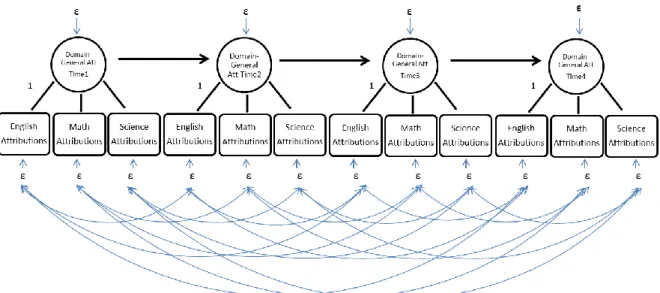
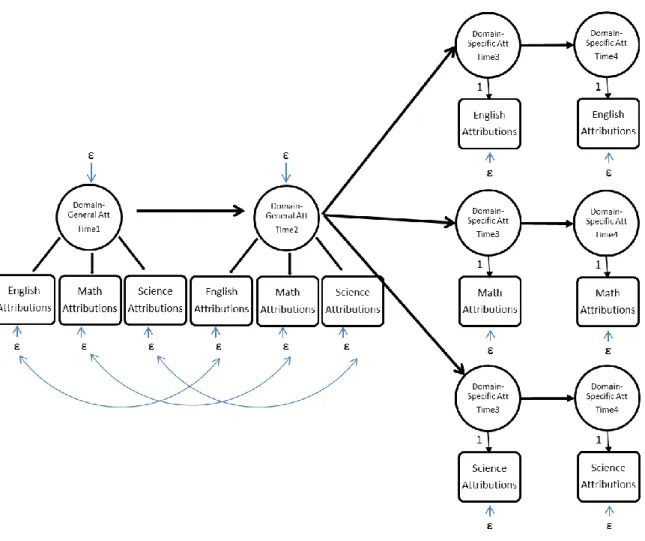
In the event that the theorized models did not fit the data, we planned to correlate the
errors of the indicator variables by academic subject in an attempt to improve model fit. These
correlations would represent relations within each academic subject across time that were not
captured by the domain-general attribution latent variables. We planned on modifying Models 1
and 3 with correlated errors (see Figures 4 & 5, respectively), but not Model 2, as Model 2
17
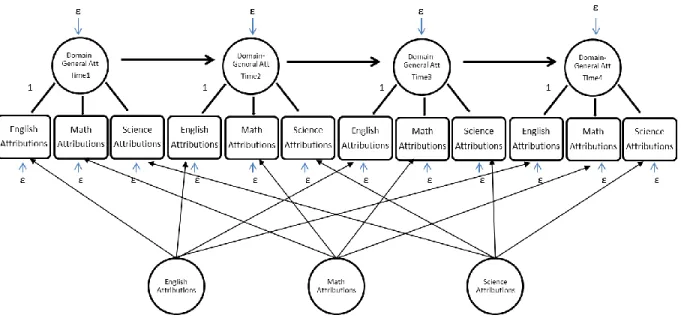
errors would suggest that there is some degree of specificity by academic subject once the
influence of the latent variables is accounted. For this reason, we also planned on modifying
Models 1 and 3 to include a unique factor for each academic subject and comparing these models
to the models with correlated errors (see Figures 6 & 7, respectively).
Finally, as a more robust test of the domain-specific hypothesis, we planned to fit a
simultaneous equations quasi-simplex model, with one quasi-simplex model for each academic
subject (see Figure 8). Quasi-simplex models are longitudinal, latent variable models with single
indicators for each time point (Heise, 1969; Wiley & Wiley, 1970). These models require the
assumption of constant error variance over time in order to be identified. The model we fit is
conceptually similar to Model 2, but unlike Model 2, it allows for measurement error to be
accounted. Cross-lagged paths allowing each academic subject to influence the other academic
subjects were included in order to test the least constrained model.
Other modifications made in order for the models to converge are addressed in the
Results section.
Missing data. Due to attrition and to the addition of new cohorts in Grade 10, we had a significant amount of missing data. We used Full Information Maximum Likelihood (FIML) to
address this issue. FIML provides good estimates under conditions of data missing completely at
random (MCAR) and data missing at random (MAR). A substantial amount of our missing data
was by design (MCAR). The rest was assumed to be MAR because students of low SES were
more likely than higher SES students to have missing data by attrition. Given that there are many
reasons contributing to absenteeism for low SES students, we did not have a strong reason to
18
Identification. The models were identified under the 2-step rule of identification, which requires a transformation of the model into a measurement model in the first step in order to
establish that all variances and covariances of the latent variables and factor loadings are
identified (Bollen, 1989b). The second step is used to show that the latent variable model would
be identified if all the latent variables were perfectly measured. Model 1 is identified under the
three-indicator rule (Step 1) and the fully recursive rule with no correlated errors (Step 2). Model
2 is identified under the fully recursive rule with no correlated errors. Model 3 is identified under
the three-indicator rule (Step 1) and the fully recursive rule with no correlated errors (Step 2).
The remaining models are identified under the rank rule (Step 1) and the fully recursive rule with
19
CHAPTER 3: RESULTS
Means and standard deviations for all variables appear in Table 1. Correlations for ability
attributions appear in Table 2 and for effort attributions in Table 3. To test the
domain-generality, domain-specificity and developmental change of attributions, we estimated all the
models using a distributionally robust maximum likelihood estimator (MLR) that accounts for
possible non-normality of the error distributions. We conducted all analyses in RStudio using
lavaan 0.5-20. All the variables were treated as continuous (Rhemtulla, Brosseau-Liard, &
Savalei, 2012). To assess model fit, we used the Chi-square test, the Incremental Fit Index (IFI)
(Bollen, 1989a), a modified root mean square error of approximation (1-RMSEA) (Steiger &
Lind, 1980), the Tucker-Lewis Index (TLI) (Tucker & Lewis, 1973), and the new Bayesian
Information Criterion (BIC) (Raftery, 1995; Schwarz, 1978). The Chi-square test allows us to
reject or retain the null hypothesis that the implied moment matrices derived from the parameters
in our model equal those in the population. When a model is specified correctly, the Chi-square
should not be significant. Values approximating 1 are indicative of excellent model fit by IFI,
1-RMSEA and TLI. BIC approximates whether the saturated model is better than the hypothesized
model. Scores less than 0 favor the hypothesized model.
In the following sections, we report the results for success ability and success effort
attribution models. First, we present the fit indices for all the models that were tested. Then we
20 Success Ability Attributions
Fit indices. Table 4 displays the fit statistics for each success ability attribution model. The theorized models (Models 1-3) did not provide a good fit. Therefore, the Domain-General
and Developmental Attribution Models were modified to include correlated errors by academic
subject (Models 4 and 5; Figures 4 and 5, respectively) and to include unique factors by
academic subject (Models 6 and 7; Figures 6 and 7, respectively). The Domain-Specific
Attribution Model was also modified such that it was transformed into a simultaneous
simplex model with single-indicator latent variables (Model 8; Figure 8). However, the
quasi-simplex model did not converge, even after constraining the autoregressive paths and the
cross-lagged paths to be equal. Therefore, we simplified the model by only fitting two academic
subjects at a time (Math and English, Science and English, Math and Science) and comparing
these models to the corresponding two-subject domain-general model. A quasi-simplex model
accounts for measurement error, and is therefore a more robust test of the domain-specific
hypothesis, providing further evidence of whether a domain-specific model describes these data.
The resulting fit indices for these modified, two-subject models are displayed in Table 5.
All the fit indices favored the Domain-General Attribution Model with Correlated Errors
(Model 4). The Domain-General Attribution Model with Unique Factors (Model 6) also provided
an adequate fit, especially evidenced by the highly negative BIC statistic. However, this model
had a significant Chi-square test and lower IFI, TLI and 1-RMSEA fit indices than the
Domain-General Model. Based on these results, we selected Model 4 as the best model to describe these
data.
The model suggests that students make similar ability attributions about their success in
21
ability as contributing to their success are stable across academic subjects, and this
domain-generality is stable across time. However, the correlated errors also indicate that there is a
relation between attributions within each academic subject across time that is not accounted for
by the latent variable, signifying a small degree of specificity above and beyond the
domain-generality. We analyze and interpret the coefficients for the Domain-General Attribution Model
with Correlated Errors in the next section.
Measurement model. The coefficient estimates for the measurement model were all significant and suggest that attributions about success in math, English and science to ability are
all indicators of a single latent variable: a domain-general attribution style. Figure 9 displays the
conceptual model with coefficients and standard errors. Though the model predicts a single latent variable at each time point, a student’s ability attribution style is expected to have a greater effect
on success ability attributions for science than for math or English (except at Time 1), with math
having the weakest relation with the latent variable. More specifically, for every unit increase in a student’s ability attribution style at any of the four time points, our model predicts that success
ability attributions for science will increase by more than half a standard deviation, whereas
success ability attributions for math and English will be consistently lower. We should note that
the coefficient for success ability attributions for science at Time 4 (12th grade) has a much larger
standard error than that of any of the other coefficients, warning us to interpret the estimate with
caution. One possibility for the high measurement uncertainty in this coefficient is that some
students no longer take science courses later in high school, yet they may have still provided
responses because the measurement items are phrased hypothetically (e.g., “When I do well in a science test, it’s because…”). This procedure may have introduced more measurement error to
22
SEM model. The regression coefficients for the latent variables suggest that a student’s ability attribution style at an earlier time point will have a significant positive effect on that student’s ability attribution style at a subsequent time point, with these effects getting stronger
over time. More specifically, a standard deviation increase in general ability attribution style at
Time 1 predicts a .32 standard deviation increase at Time 2, but a standard deviation increase at
Time 2 predicts a .50 standard deviation increase at Time 3 (see Figure 9). Finally, a standard
deviation increase at Time 3 predicts a .58 standard deviation increase at Time 4. All these
coefficients are statistically significant. Each of our latent variables accounts for a good portion
of the variability in our data (ranging from 10.5% to 33.5%).
Success Effort Attributions
Fit indices. Table 6 displays the fit statistics for each success effort attribution model. Overall, the fit indices suggest that the Domain-General Attribution Model corresponds best to
the data (Model 1). The fit indices approximated their optimal value of 1 under the robust
estimator. The Chi-square test was non-significant and the BIC was highly negative. The
Developmental Attributions Model had a moderately good fit according to the supplemental fit
indices, but the Chi-square test was significant. Therefore, we selected Model 1 as the best model
to describe these data and did not fit any additional modified models. The model suggests that
students make similar effort attributions about their success in math, science, and English. In
other words, students view effort as contributing equally to their success across academic
subjects, across time. We analyze and interpret the coefficients for the Domain-General
Attribution Model in the next section.
23
indicators of a single latent variable: a domain-general effort attribution style. Figure 10 displays
the conceptual model with coefficients and standard errors. Success effort attributions for science
were not as strongly associated with the latent variable in 5th and 7th grade compared to math and
English effort attributions. However, they became more closely related to the latent variable in
10th grade.
SEM model. The regression coefficients for the latent variables suggest that a student’s general effort attribution style at an earlier time point will have a significant positive effect on his
or her effort attribution style at a subsequent time point, with these effects getting stronger over
time. More specifically, a standard deviation increase in effort attribution style at Time 1 predicts
a .45 standard deviation increase at Time 2, whereas a standard deviation increase at Time 2
predicts a .71 standard deviation increase at Time 3. Finally, a standard deviation increase at
Time 3 predicts a .98 standard deviation increase at Time 4. All these coefficients are
statistically significant. Each of our latent variables accounts for a modest to good portion of the
24
CHAPTER 4: DISCUSSION
The goal of this study was to examine whether ability and effort success attributions are
domain-general, domain-specific, or change in specificity over time among African American
students. Our results supported the domain-general model of attributions, whereby students
endorse ability and effort attributions to the same extent for math, English, and science. In the
following sections we discuss the implications of our results.
Ability Attributions
The model that best described students’ success ability attributions was the
domain-general model. This model suggests that students view ability as contributing equally to their
success across academic subjects. Our results differ from those of other research studies, which
have found evidence in European, White American, and Asian samples that success ability
attributions are domain-specific (Boekaerts et al., 2003; Bong, 2004; Vispoel & Austin, 1995).
Certain methodological and analytical differences between those studies and the current project
could be responsible for the differences in findings. However, another explanation is that students’ attributions are informed by the social context in which they form those attributions,
and that African American students experience a unique social context. Boekaerts (2003)
proposed that, after repeatedly encountering learning situations, students form an internal model
from which they quasi-automatically infer causality when they encounter another similar
learning situation. Importantly, the “situation” may be understood at different levels:
25
task-based). For most students, especially those in secondary school, the most salient situational
level may be the level of the academic subject. Students’ focus on the middle level in secondary
school may be a reflection of their more complex understanding of ability and intelligence. It
could also reflect the increasing specialization of school subjects. However, other levels may be
more significant under specific social circumstances. For African American students, the more
salient situational level may be the superordinate level if they experience discrimination at
school, which emphasizes system-level biases. Students who perceive system-level biases may be
inclined to believe that their successes are in spite of social barriers, and thus attributable to their
ability equally across domains.
Stereotype awareness may also contribute to the domain-generality of students’ ability
attributions. For example, a Black boy entering high school may be aware that Black boys are
stereotyped as being particularly low-achieving compared to other racial groups. When he
receives a good grade in math and attributes it to his high ability, he may view this as evidence
that the stereotype does not apply to him. Rejecting the broader stereotype may then lead him to
attribute his success in other classes to his high ability as well. On the other hand, a student who
is more susceptible to internalizing stereotypes may be reluctant to attribute success to her ability
across all subjects.
We want to note, however, that the domain-general model only provided a good fit for
the data when measurement errors were correlated within academic domains across time. These
correlated errors represent a degree of specificity within attributions for each academic subject
that was not accounted for by the latent variable. The degree of domain-specificity is weak,
however. When we incorporated a unique factor representing each school subject to replace the
26
Other findings from this model were that science is a stronger indicator of students’
ability attribution style than math or English. Although the mechanism driving this effect is
unclear, it could imply that students’ attributions regarding science should be targeted in
attributional retraining interventions with African American youth.
Effort Attributions
In contrast to ability attributions, effort attributions were best characterized by a
domain-general model without the need to specify correlated errors. The implications of the model are
similar to those outlined for ability attributions. Yet, the lack of correlated errors is consistent
with the idea that effort attributions are more strongly associated with situational descriptions at
the superordinate level, whereas ability attributions draw from both the superordinate and middle
levels. In practical terms, this could mean that experiences of discrimination lead students to
believe that, regardless of the academic subject, they must exert greater effort than other youth in
order to succeed (Sanders, 1997). On the other hand, their beliefs about ability, though still
following the same guiding principle, also depend to some extent on the academic subject.
Similarly, experiences of discrimination may lead to low effort attributions across
academic subjects if students believe in a reciprocal relation between ability and effort, whereby
overcoming barriers signals high ability, and thus low effort. Although the mechanisms driving
high-effort and low-effort attributions may be different depending on students’ interpretations of
their environments, the results lead to the same outcome: domain-generality.
Educational Implications
Our results suggest that, for success outcomes, African American students have a general
attribution style whereby their tendency to endorse ability and effort attributions is similar across
27
and educators may choose to focus on retraining students’ attributions in a particular subject-area
as their resources allow, and expect to see changes in ability and effort attributions in other
academic domains.
Limitations
Although we found evidence of domain-generality for effort and ability success
attributions, it is important to note that we only analyzed attributions regarding closely related
traditional academic subjects. It is possible that attributional responses become more
content-specific as academic domains become increasingly different. For example, English, math and
science may be viewed as core academic classes and thus lumped into one category characterized
by similar ability and effort requirements. In contrast, art, music and physical education classes
may be categorized differently. Indeed, Vispoel and Austin (1995) found that the only subject
area differences in attributions in their study distinguished physical education and general music
from the other subject areas as well as from each other.
Another limitation to our data was that we only had a single indicator for math and
science attributions. Having multiple indicators would have allowed us to test a simpler
domain-specific model with latent variables that took into account measurement error.
Despite these limitations, our study highlights the importance of investigating attributions
across different social groups. It also contributes to our understanding of achievement motivation
in African American students. Having domain-general attributions suggests that African
American students may be more attuned to system-level factors rather than situations at the level
of the school subject, and that they may cope with race related stresses at the system-level, such
as discrimination and negative stereotypes, by uniformly making adaptive attributions about their
29
APPENDIX A: TABLES
Table 1
Means and Standard Deviations for Success Ability Attributions and Success Effort Attributions at Times 1-4
Math Science English
Attribution Time Point M (SD) N M (SD) N M (SD) N
Ability
Time 1 5.54 (1.68) 375 4.88 (1.94) 366 5.36 (1.50) 373 Time 2 5.04 (1.71) 301 4.24 (1.84) 299 4.82 (1.53) 300 Time 3 4.79 (1.59) 434 4.28 (1.80) 431 4.81 (1.33) 433 Time 4 4.72 (1.57) 325 4.46 (1.68) 323 5.07 (1.25) 324 Effort
30 Table 2
Pearson Correlations for Ability Attributions in Math, Science and English Across Four Time Points
1 2 3 4 5 6 7 8 9 10 11 12
1. Time 1 Math Ability 1
2. Time 2 Math Ability .239** 1
3. Time 3 Math Ability .211** .427** 1
4. Time 4 Math Ability .275** .401** .454** 1
5. Time 1 Sci Ability .270** .042 .020 .035 1
6. Time 2 Sci Ability .157** .259** .108 .094 .125* 1
7. Time 3 Sci Ability .081 .100 .311** .148* .194** .267** 1
8. Time 4 Sci Ability .019 .099 .184** .198** .166* .285** .507** 1
9. Time 1 Eng Ability .302** .104 -.001 .019 .354** .163** .060 .124 1
10. Time 2 Eng Ability -.001 .232** .061 .071 .110 .368** .121 .189* .219** 1
11. Time 3 Eng Ability -.053 .131* .201** .071 -.026 .165* .286** .111 .125* .367** 1
12. Time 4 Eng Ability .015 .077 -.079 .103 .009 .157* .098 .229** .125 .299** .361** 1
Table 3
Pearson Correlations for Effort Attributions in Math, Science and English Across Four Time Points
1 2 3 4 5 6 7 8 9 10 11 12
1. Time 1 Math Effort 1
2. Time 2 Math Effort .174** 1
3. Time 3 Math Effort .145* .301** 1
4. Time 4 Math Effort .116 .281** .424** 1
5. Time 1 Sci Effort .317** .151** .117 .022 1
6. Time 2 Sci Effort .148* .294** .126 .218** .117* 1
7. Time 3 Sci Effort .199** .273** .375** .255** .177** .262** 1
8. Time 4 Sci Effort .145* .163* .230** .359** -.014 .214** .299** 1
9. Time 1 Eng Effort .494** .202** .142* .135 .447** .226** .179** .217** 1
10. Time 2 Eng Effort .216** .420** .267** .168* .196** .484** .331** .145* .254** 1
11. Time 3 Eng Effort .097 .151* .266** .107 .017 .237** .349** .218** .077 .282** 1
31
Table 4
Fit Indices for Success Ability Attribution Models; Model 4 Shows the Best Fit for These Data
Model Chi-sq df IFI TLI 1-RMSEA BIC
1- General Ability Attributions
263.94*** 51 .667 .559 .913 (.903, .924) -58.509
2- Specific Ability Attributions
207.09*** 45 .705 .573 .920 (.908, .930) -77.429
3- Developmental Attributions
162.52*** 47 .821 .741 .934 (.922, .946) -134.645
4- General Ability Att. w/ Correlated Errors
35.21 33 .997 .993 .989 (.996, 1) -173.430
5- Developmental Attributions with Correlated Errors
144.34 *** 44 .845 .759 .936 (.924, .947) -133.852
6- General Ability Att. w/ Unique Factors
82.99*** 42 .937 .897 .958 (.945, .972) -182.561
7- Developmental Attributions with Unique Factors
125.60*** 38 .867 .757 .936 (.923, .948) -114.656
8- Specific Ability
Attributions Quasi Simplex Model
N/A N/A N/A N/A N/A N/A
Note. When a model is specified correctly, the Chi-square should not be significant. Values
approximating 1 are indicative of excellent model fit by the Incremental Fit Index (IFI), the modified root mean square error of approximation (1-RMSEA) and the Tucker-Lewis Index (TLI). New Bayesian Information Criterion (BIC) scores less than 0 favor the hypothesized model.
32 Table 5
Fit Indices for Two-Subject, Quasi-Simplex Attribution Models for Success Ability Attributions; The
Domain-General Models (4 & 6) Show the Best Fit for These Data
Model Chi-sq df IFI TLI 1-RMSEA BIC
1- Math and English Quasi-Simplex Model
79.455*** 22 .828 .776 .932 (.915, .947) -59.642
2- Math and English Domain-General
w/Correlated Errors Model
N/A N/A N/A N/A N/A N/A
3- Math and Science Quasi-Simplex Model
84.991 *** 22 .827 .776 .928 (.912, .944) -54.105
4- Math and Science Domain-General Model w/Correlated Errors Model
2.130 5 1.00 1.04 1.00 (.965, 1.00) -29.483
5- English and Science Quasi-Simplex Model
95.638*** 22 .787 .724 .922 (.906, .938) -43.459
6- English and Science Domain-General Model w/Correlated Errors Model
6.736 5 . 995 . 971 .975 (.932, 1.00) -24.877
Note. When a model is specified correctly, the Chi-square should not be significant. Values
approximating 1 are indicative of excellent model fit by the Incremental Fit Index (IFI), the modified root mean square error of approximation (1-RMSEA) and the Tucker-Lewis Index (TLI). New Bayesian Information Criterion (BIC) scores less than 0 favor the hypothesized model.
33
Table 6
Fit Indices for Success Effort Attribution Models; Model 1 shows the best fit for these data
Model Chi-sq df IFI TLI 1-RMSEA BIC
1- General Effort Attributions
58.58 51 .988 .984 .984 (.967, 1.00) -236.240
2- Specific Effort Attributions
236.35*** 45 .692 .556 .913 (.902, .923) -96.126
3- Developmental Effort Attributions
66.993* 47 .975 .965 .972 (.958, .991) -230.167
Note. When a model is specified correctly, the Chi-square should not be significant. Values
approximating 1 are indicative of excellent model fit by the Incremental Fit Index (IFI), the modified root mean square error of approximation (1-RMSEA) and the Tucker-Lewis Index (TLI). New Bayesian Information Criterion (BIC) scores less than 0 favor the hypothesized model.
34
APPENDIX B: FIGURES
Figure 1. Domain-general model for success ability attributions and success effort attributions.
Figure 2. Domain-specific model for success ability attributions and success effort attributions
with cross-lagged paths. The cross-lagged paths were included in order to test the least
35
36
Figure 4. Domain-general model with correlated errors for success ability attributions and
37
Figure 5. Developmental model with correlated errors for success ability attributions and success
38
Figure 6. Domain-general model with a unique factor for each academic subject: success ability
39
Figure 7. Developmental model with a unique factor for each academic subject: success ability
40
Figure 8. Simultaneous equations with a quasi-simplex model representing each academic
subject. This model assumes equality of error variance across time. The cross-lagged paths were
included in order to test the least constrained model. All exogenous latent variables are
41
Figure 9. Domain-general attributions with correlated errors model: theoretical model with
standardized coefficients. **p < .01, ***p < .001.
Figure 10. Domain-general effort attributions model: theoretical model with standardized
42
REFERENCES
Aronson, J., & Inzlicht, M. (2004). The ups and downs of attributional ambiguity of African American college students. Pyschological Science, 15(12), 829–836.
Boekaerts, M., Otten, R., & Voeten, R. (2003). Examination performance: Are student’s causal attributions school-subject specific? Anxiety, Stress & Coping, 16(3), 331–342. doi: 10.1080/1061580031000095470
Bollen, K. A. (1989a). A new incremental fit index for general structural equation models. Sociological Methods & Research, 17, 303–316.
Bollen, K. A. (1989b). Structural equation models with latent variables. New York, NY: John Wiley & Sons Inc.
Bong, M. (1997). Generality of academic self-efficacy judgments: Evidence of hierarchical relations. Journal of Educational Psychology, 89, 696–709.
Bong, M. (2001). Between-and within-domain relations of academic motivation among middle and high school students: Self-efficacy, task-value, and achievement goals. Journal of Educational Psychology, 93, 23–34. doi: 10.I037//0022-0663.93.1.23
Bong, M. (2004). Academic motivation in self-efficacy, task value, achievement goal
orientations, and attributional beliefs. The Journal of Educational Research, 97, 287–298. doi: 10.3200/JOER.97.6.287-298
Brandt, M. J., & Reyna, C. (2010). Stereotypes as attributions. In Eleanor L. Simon (Ed.), Psychology of stereotypes. Nova Science Publishers.
Crocker, J., Major, B., & Steele, C. (1998). Social stigma. In D. M. Gilbert, S. T. Fiske, & G. Lindzey (Eds.), Handbook of social psychology. New York: McGraw Hill.
Folmer, A. S., Cole, D. A., Sigal, A. B., Benbow, L. D., Satterwhite, L. F., Swygert, K. E., & Ciesla, J. A. (2008). Age-related changes in children’s understanding effort and ability: Implications for attribution theory and motivation. Journal of Experimental Child Psychology, 99, 114–134. Retrieved from
https://www.ncbi.nlm.nih.gov/pmc/articles/PMC2268096/pdf/nihms40900.pdf
43
in school settings. Journal of Educational Psychology, 72(2), 186–196. doi: 10.1037/0022-0663.72.2.186
Graham, S. (2014). Communicating low ability in the classroom: Bad things good teachers sometimes do. In S. Graham & V. S. Folkes (Eds.), Attribution theory: Applications to achievement, mental health, and interpersonal conflict (pp. 17–36). New York, NY: Taylor & Francis.
Graham, S., & Taylor, A. Z. (2002). Ethnicity, gender, and the development of achievement values. In A. Wigfiled & J. S. Eccles (Eds.), Educational psychology: Development of achievement motivation (pp. 121–146). San Diego, CA: Academic Press.
Graham, S., & Williams, C. (2009). An attributional approach to motivation in school. In K. R. Wenzel & A. Wigfield (Eds.), Handbook of motivation at school (pp. 11–34). New York, NY: Routledge/Taylor & Francis Group.
Gray-Little, B., & Hafdahl, A. R. (2000). Factors influencing racial comparisons of self-esteem: A quantitative review. Psychological Bulletin, 126, 26–54. doi:
10.1037/0033-2909.126.1.26
Greene, M. L., Way, N., & Pahl, K. (2006). Trajectories of perceived adult and peer discrimination among Black, Latino, and Asian American adolescents: Patterns and psychological correlates. Developmental Psychology, 42(2), 218–236. doi: 10.1037/0012-1649.42.2.218
Heise, D. R. (1969). Separating reliability and stability in test-retest correlation. American Sociological Review, 34, 93–101.
Houston, D. M. (2016). Revisiting the relationship between attributional style and academic performance. Journal of Applied Social Psychology, 46(3), 192–200. doi:
10.1111/jasp.12356
Kinlaw, C. R., & Kurtz-Costes, B. (2003). The development of children’s beliefs about
intelligence. Developmental Review, 23(2), 125–161. doi: 10.1016/S0273-2297(03)00010-8
Kinlaw, C. R., Kurtz-Costes, B., & Goldman-Fraser, J. (2001). Mothers’ achievement beliefs and behaviors and their children’s school readiness: A cultural comparison. Applied