LAND AND TERRITORY IN THE COLOMBIAN CARIBBEAN
Eloisa Berman-Arévalo
A dissertation submitted to the faculty at the University of North Carolina at Chapel Hill in partial fulfillment of the requirements for the degree of Doctor of Philosophy in the Department
of Geography.
Chapel Hill 2017
iii
Eloisa Berman-Arevalo: Making Space in the ‘Territorial Cracks’: Afro-Campesino Politics of Land and Territory in the Colombian Caribbean
(Under the direction of Gabriela Valdivia)
In the Caribbean mountains of Montes de María, Colombia’s ‘post-conflict’ is a particularly contested political conjuncture. Dominant narratives construct the present as a moment of dramatic transition from a past of violence, statelessness, and victim’s invisibility, to a future of peace, development, or rural justice. Conjunctural agrarian politics, in turn, are frequently framed as peasant ‘resistance’ that reflects the ‘re-emergence’ of peasant struggle after decades of violent silencing. This dissertation provides an alternative account of post-conflict campesino politics in Montes de María. Based on ethnographic fieldwork in Paloaltico, a village of black campesinos in the region’s predominantly afro-descendant north-western
piedmont, it inquires about the politics of land and territory that unfold “below the surface” of what is legible through a simplified understanding of post-conflict’s geographies, temporalities, and politics.
relations, intimate life events, and everyday practices of social reproduction shape political positions and practices. Rather than organized resistance that confronts and attempts to transform power relations, the ways of making and claiming land and territory revealed by this dissertation are subtle, unexpected, and often clandestine political practices that emerge “in the cracks” of dominant territorializations (De Certeau 1984). Hence, a politics of seeking continuity, exercising everyday refusals, and collectively making and sharing knowledge, unfolds in an ambiguous location both within and against dominant spatial and political regimes, neither openly resisting nor acquiescing to the dominant power orders.
v
An acknowledgements section is far from sufficient to express my deep gratitude to all of those who walked by my side throughout the process of conceiving and giving life to this
dissertation. First and foremost, I thank the people from Paloaltico. Thanks to Sofía, my friend, hostess and sister for her generosity and encouragement, her insight and collaboration. To the Carrasquilla family for taking me in as one of their own: Eloisa, Leder, Mercedes, Marisela, Dermis, Julia, Julio, Uti, tío Juancito, and all the kids. To tía Celia, Chichío, Rubén, Mayo Enrique for endless conversations with tears and laughter. To those who died during the course of this research: La Mella, Piro, and Alberto. To Duván for such quality research assistance and friendship. To Paloaltico’s parceleros Chago, Danielito, Santos, Santana and Mane for those Sunday afternoons of rum and cigarettes sharing the uncomfortable truths of Paloaltico’s recent history. To the community as a whole: thank you for trusting me to tell your stories.
My deep gratitude to the staff of the Corporación Desarrollo Solidario who opened doors and provided spaces for collaboration with regional youth and campesino organizations. To Gabriel Urbano for his openness and generosity and to Nyria Ramírez for being a friend and teacher in youth pedagogies and socially-responsible research. I thank the network of campesino organizations- OPDs- for letting me be a friend and collaborator, and inviting me into the
fascinating world of Montes de María’s regional movements.
theoretical challenges, “trust the process” and find my voice in this journey of academic research and writing. I thank Arturo for not letting me forget what it’s all really about: love, life, music, friendship, a grain of sand towards a saner and more just world. I am grateful to Betsy and Banu for their perspectives as feminist geographers and for being a living example of feminist praxis in academia. To Christian, my fellow “agrarianista” in the Geography Department, I owe my engagements with agrarian studies; thank you for guidance and insight. Thank you all for your friendship, encouragement and generosity.
I want to acknowledge my fellow graduate students at UNC- Chapel Hill, an amazing group of people committed to creating spaces of care and mutual support within the
ever-demanding US academia. Scott Sellwood, Aron Sandell, Amy Braun, Ahsan Kamal, Jim Kuras, Katie Akin, Haruna Suzuki, Yousuf Al-Bulushi, Adam Bledsoe, Pavithra Vasudevan, Mike Dimpfl, Priscila Vaz, Chris Courtheyn, Diana Gomez, Marwa Youssuf, Saydia Gulrukh, Willie Wright, Rachel Cotterman, Mabel Gergan, Sertanya Reddy, Ben Rubin, Mike Hawkins, and Stevie Larson. To Dayuma, for your friendship and support. We did this together!
I would have not been able to write this dissertation without the endless support of my mother Carmen, my partner Sergio and my dear friend Karin. Thank you mom for being always willing to listen to fieldwork stories, theoretical explanations and writing dilemmas, and for so lovingly being (or seeming) as excited as I am for this project. Thank you Sergio for your hope and strength in times I most needed them, and for reminding me that this is only the beginning of a lifelong relationship with Marialabaja- the place that brought us together and where our hearts and dreams meet. Thank you Karin for always standing by my side.
vii
babysitters: Ercilia, Marlene, mom, Vilma, Karin; a caring committee; and a loving and supportive partner.
Thank you Nicolás. My infinite love for you was my fuel and inspiration.
LIST OF FIGURES ... xi
LIST OF ABBREVIATIONS ... xiii
CHAPTER ONE: INTRODUCTION. A FRAMEWORK FOR NAVIGATING THE CONJUNCTURE OF POST-CONFLICT ... 1
Liberal Peace in Montes de María ... 5
Peasant politics beyond ‘resistance’ ... 7
Story-ing the everyday spaces of post-conflict ... 9
CHAPTER TWO: A WINDOW INTO PLACE ... 20
Agrarian struggle in Montes de María ... 25
The Black Piedmont of Montes de María ... 28
Agrarian reform in Marialabaja and Piedmont villages ... 31
Armed conflict in Marialabaja and Playón ... 35
Life in an ocean of oil palm plantations ... 46
‘Post-conflict’ in Marialabaja ... 52
CHAPTER THREE: FROM REFUSAL TO REGRET: LAND TITLING, RECOGNITION AND THE POLITICS OF AGRARIAN REFORM IN PALOALTICO ... 56
Introduction ... 56
State encounters: deceit, recognition and the disavowal of blackness... 61
Lleras’ ‘radical’ reform and peasant recognition ... 65
INCORA # 1 in Marialabaja ... 68
ix
Becoming “parceleros”: a politics of everyday life in the spaces of
agrarian reform... 82
Conclusion ... 86
CHAPTER FOUR: ORDINARY GEOGRAPHIES OF ARMED CONFLICT ... 90
Theoretical discussion ... 94
The everyday geographies of armed conflict: resistente’s accounts ... 99
Guerrillas in Aguasblancas: fear and plot abandonment ... 100
Restrictions on spatial mobility and the spatial tactics of “vendedoras” ... 107
Territorializing the home ... 113
Conclusion ... 119
CHAPTER FIVE: MAPPING THE MORAL-EMOTIONAL ECONOMIES OF LAND STRUGGLES ... 122
Introduction. Mapping the land... 122
The moral-emotional economies of land politics... 128
Armed conflict and land occupations in Marialabaja ... 132
Negotiating occupation and dispossession in Paloaltico ... 143
Future anxieties and “apparent quiescence” ... 156
Conclusion ... 164
CHAPTER SIX: STORY-ING TERRITORY. WOMEN’S STORYTELLING AND THE EVERYDAY MAKING OF TERRITORY IN SPACES OF AGRO-CAPITALISM... 168
Leticia ... 168
Story-ing territory ... 174
Eloisa’s story of rice harvesting ... 179
Leticia’s demise: storytelling as political practice ... 184
Politics “below the surface” ... 190
The politics of this text ... 193
Emergences and moving threads ... 194
xi
Figure 1. Reservoir of Arroyogrande and north-western mountains.. ... 21
Figure 2. Map of north-western Piedmont and Irrigation District lowlands ... 22
Figure 3. Women in Paloaltico carrying water from the reservoir. ... 24
Figure 4. Martín combines wage labor and moto-taxi driving ... 25
Figure 5. Map of Montes de María in the Colombian Caribbean.. ... 26
Figure 6. Front cover of INCORA publication on Project INCORA #1.. ... 33
Figure 7. Construction of the Reservoir of Arroyogrande. ... 34
Figure 8. Map of armed actors in Marialabaja (1989-2005). ... 38
Figure 9. The 1999 killings in Playón reported by Cartagena newspaper El Universal. ... 43
Figure 10. Playón’s displacement, reported by Cartagena newspaper El Universal. ... 44
Figure 11. Map of vegetation coverage. ... 47
Figure 12. Oil palm plantations surround the village of La Suprema. ... 48
Figure 13. House lying between a district canal and an oil palm plantation in the corregimiento of Matuya... 50
Figure 14. Elementary school surrounded by oil palm. ... 51
Figure 15. Front page of Cartagena newspaper El Universal, August 18th, 1969. ... 57
Figure 16. Irrigation District of Marialabaja. ... 69
Figure 17. Campesino receiving technical assistance through INCORA #1. ... 73
Figure 18. . Campesinos from Marialabaja being instructed in the technologies of mechanized agriculture. ... 73
Figure 19. Rice crop in parcela. ... 105
Figure 20. Edwin, 22, and Yoiner, 19, harvesting manioc in el monte. ... 106
Figure 21. Motorcycle on canal path. ... 109
Figure 24. Map of land tenure in 1985 made in participatory mapping session. ... 138
Figure 25. Map of land tenure in 1985, digitalized version. ... 139
Figure 26. Map of land tenure in 1995 made in participatory mapping session. ... 144
Figure 27. Map of land tenure in 1995, digitalized version. ... 145
Figure 28. Map of land tenure in 2015 made in participatory mapping session. ... 158
Figure 29. Map of land tenure in 2015, digitalized version. ... 159
Figure 30. Women in Leticia. ... 169
xiii
ACCU Autodefensas Campesinas de Córdoba y Urabá
AUC United Colombian Self-defense Groups (Autodefensas Unidas de Colombia) ELN National Liberation Army (Ejército de Liberación Nacional)
FARC Revolutionary Colombian Armed Forces (Fuerzas Armadas Revolucionarias de Colombia)
INCORA Colombian Institute of Agrarian Reform (Instituto Colombiano de Reforma Agraria)
UNHCR United Nations High Commissioner for Refugees
UNICE United Nations International Children’s Emergency Fund IOM International Organization for Migration
CHAPTER ONE: INTRODUCTION. A FRAMEWORK FOR NAVIGATING THE CONJUNCTURE OF POST-CONFLICT
The agrarian past continues to affect the agrarian present, but what does the future hold for resource productions, agrarian relations, and the smallholder slot…? It is hard to say, as unexpected outcomes and contingent complexities abound.
(Peluso 2017: 865) On January 19th 2015, over 200 people gathered in Cartagena’s luxurious Convention Center to discuss the prospects and possibilities of “post-conflict rural development” in the agricultural region of Montes de María. Just 90 miles away from the coastal state capital, these mountains are one of the Colombia’s most emblematic sites for the tragic effects of the country’s armed political conflict on campesino1 lives and livelihoods (Centro Nacional de Memoria Histórica 2010). The uniquely diverse group of attendees included CEOs of agri-business corporations, representatives of international aid agencies, regional and national state officials (including the peace commissioner, the vice minister of rural development, and the director of the regional Victim’s Unit), NGO representatives, and more than 50 community leaders from the 15 municipalities in Montes de María.
Organized by the Semana Foundation, a corporate-funded NGO, and by the US Agency for International Development (USAID), the event’s aim was to present the results of a
participatory exercise of development planning, the ‘Roadmap’ for Montes de María
2
(http://www.rutamontesdemaria.com/), and to secure institutional alliances between private corporations, state, donors and NGOs for the Roadmap’s implementation. In a seemingly
anxious quest to make sense of the initiative and ensure its viability, event organizers insisted on the need to define present-day Montes de María as a region “in post-conflict.” Sustaining this purported new reality was the idea of a conjuncture of dramatic historic shift: a ‘new beginning’ that would leave behind a violent past and offer unprecedented opportunities for communities to be agents of peace and development. ‘Post-conflict,’ in this script, not only evoked a horizon of post-war that would reverse histories of violence and marginality but, more importantly,
promised prosperity to local communities by way of agricultural modernization, capital
investment, and democratic participation (Kirsch and Flint 2011).2 Such promises were further upheld by a particular imaginary of post-conflict rural space. Defined by an immediate past of chaos, statelessness, and population displacement, Montes de María was rendered ‘empty,’ ‘unproductive,’ and open to being re-made through institutional interventions, capital investment, and community development (Ojeda et al. 2014; Grajales 2011).
I attended the event both as a PhD student and researcher, and as collaborator with NGOs and peasant organizations in the region. My position as the former allowed me to participate in the rumors and gossip that originated in reaction to the post-conflict narrative described before. The shared sentiment among campesino leaders and NGO collaborators, myself included, was of generalized outrage. We were appalled at the event’s concealment of the ongoing reverberations of violence on the ground, its denial of the structural constraints that prevent this purported historic renewal and the cynical endorsement of ‘peace’ and ‘community participation’ in order
legitimize a capitalist re-ordering of agrarian space in the aftermath of war (Kirsch and Flint 2011).
For most rural communities in Montes de María, hopeful narratives of change are a mirage. After more than 10 years of institutional interventions, broadly framed as “peace and development” initiatives (PODEC 2011), levels of poverty continue to be among the nation’s highest (Aguilera 2013). Moreover, although confrontations between armed groups have diminished since paramilitary demobilization in 2005, smaller “post-demobilization” groups continue to operate in the region, participating in local cocaine micro-traffic and exercising intermittent acts of symbolic or physical violence against community leaders (ILSA 2012; SAT-Defensoría del Pueblo 2015). Locals suspect that these groups protect the interests of the
region’s nascent agro-industrial economy, which expands over lands that were abandoned or dispossessed during armed conflict and which continue to be purchased from campesinos through a combination of force and economic coercion (Li 2009).
This dissertation is about the everyday spatial politics- the ways of claiming and making land and territory through everyday life- exercised by men and women in a village of black campesinos in Montes de María. This Introduction situates the analytical framework through which I examine such politics and connect them to the the ordinary spaces of post-conflict politics. An ethnographic exploration of everyday spatial politics in the village of Paoaltico in the north-western piedmont of Montes de María pushed me to depart from narratives of post-conflict development. I depart also from narratives that consider a ‘re-emergence’ of agrarian struggle in Montes de María in the aftermath of violence (MIC-OPD 2014), based on the
4
spatial categories, and visible instances of ‘politics’ through ‘participation’ or ‘resistance’. This gaze enables a particular construction of a post-conflict conjuncture as a dramatic transition from a past of violence, statelessness, and victim’s invisibility, to a future of peace, development, or rural justice. It not only allows institutions like the Semana Foundation to construct a post-conflict present that occludes the continuation of armed violence and structural inequalities in agrarian spaces, but also conceals alternative conjunctural politics that operate through different temporalities and spatialities beyond those that are readily legible through a detached gaze.
Instead, I propose an alternative analytic frame that allows me to situate this
dissertation’s ethnographic present within the entangled temporalities, geographies and politics of a post-conflict conjuncture, while capturing the nuances and complexities of communities’ political practices and subjectivities. The project’s temporal scope not only extends beyond the last decade of peace interventions and diminished violence, but in fact privileges a selective revisiting of moments of the past over an exploration of everyday life in the present. Focusing on the past allows me to tease out the politics of space that unfolded in past moments of intense and violent change. More importantly, this engagement with the past reflects an epistemological, methodological, and theoretical concern with the role of stories as an exercise in politics.
a conjuncture of complex and contingent transformations, the future of agrarian worlds is uncertain. Exploring campesino’s practices of storytelling is a politically relevant endeavor that sheds light on how communities inhabit this uncertainty and how the past “haunts” present struggles and shapes imaginations of the future (Valdivia 2012).
Liberal Peace in Montes de María
The integration of post-conflict, capital investment, community participation, and
6
Spain, Canada, Japan, Sweden, the Netherlands, Italy, and Belgium (PODEC 2011). More recently, Montes de Maria was one of Colombia’s five regions selected for USAID’s USD $67, 500,000 Land and Rural Development Project, implemented between 2013 and 2018 (USAID 2017). Together, these ‘peace-making’ projects and institutions aim at reversing the effects of armed violence among victimized rural communities and generating conditions for longstanding peace in formerly conflict-ridden regions.
Alongside these forms of victims-centered development, state and private actors are promoting a model of rural development that favors export-oriented industrial agriculture, land concentration, and capital-intensive production (Haugaard et al. 2013; Castillo 2016; Ojeda et al. 2015). The state has explicitly attributed a strategic role to agro-industry in the implementation of victim’s restitution and reparation policies (Government of Colombia-DNP 2010, 154), calling on agri-business entrepreneurs to participate in the formerly conflict-ridden region’s post-conflict era through private-community partnerships and the generation of jobs (Portafolio 2016).
In Montes de María, official plans and policies include support to both large-scale plantations and to individually titled peasant lands, collective titles for afro-descendant communities, and a collective Campesino Reserve Zone (Zona de Reserva Campesina).
However, agribusiness are the most influential actors in Montes de María’s post-conflict spatial ordering. This is evidenced, for instance, in unprecedented rates of oil palm expansion (CINEP 2012), the presence of three of Colombia’s most prominent agro-food conglomerates, and a dramatic process of land grabbing by mid-range agro-industrial firms 2007 (ILSA 2012).
Accord. Its negotiated Policy for Agrarian Development promises to reverse the effects of armed conflict in rural areas and generate structural transformations towards greater justice and equality (Gobierno de Colombia- FARC-EP 2016). It includes a massive land titling scheme and the implementation of campesino-centered participatory Rural Development Plans, among others. At the same time, the Agreement promotes a vision of rural space based on capitalist modernization and fails to question the parallel policies that promote export-oriented agribusiness (Latorre 2017). Montes de María is one of the country’s 16 priority regions for the Accord’s
implementation and one in which the viability of the integrating pro-peasant policies, agri-business and a generalized vision of modernizing development for rural spaces will be tested. Peasant politics beyond ‘resistance’
As suggested by community leader’s reaction in the Convention Center, the
entanglements between peace, post-conflict, and agrarian capitalism3 in Montes de María have not gone uncontested. Organizations of peasants, victims and afro-descendants focus on the defense of land, territory and smallholder economies, articulating a vision of ‘peace’ that can only be attained through the subversion of structural inequalities in agrarian society. By failing to support small holder agriculture and territorial autonomy, they argue, certain forms of peace-making enable the continuation of dispossession, which now occurs not through massive displacements or direct armed force, but by economic coercion, subtler forms of violence, and the erosion of peasant modes of production (MIC-OPD 2014). Such critiques are becoming
8
increasingly visible in regional and national-level media, influencing public opinion on the role of corporate interests in post-conflict rural space.4
The growing visibility of agrarian and territorial claims after decades of violent silencing has led academics and movements to consider a ‘re-emergence’ of agrarian struggle in Montes de María (MIC-OPD 2014), focusing on the agrarian and territorial claims put forward by movements and community organizations (Avila 2015; Rodríguez 2016; Herrera et al. 2016). Indeed, over the past fifteen years, diminishing levels of armed confrontation and increased presence of state and NGOs, have opened spaces for the configuration of a diverse and numerous mosaic of organized political initiatives. Some of these build on longer traditions of peasant struggles, for which the region is emblematic and whose trajectories had been truncated by political violence. Engaging this ‘re-emergence’ re-considers peace and post-conflict not only as imposed discourses that conceal capitalist entanglements but also as political scenarios that open opportunities for the recognition of rural subjects as political actors with territorial, economic and cultural projects that are fundamental for the construction of long- term peace in the country (CNA-CINEP 2014).
While useful for understanding the contested politics of post-conflict in the region, narratives that underscore the ‘re-emergence’ of agrarian struggle are limited by a narrow
understanding of “peasant politics” that foregrounds organized forms of political mobilization or ‘resistance’ (Borras et al. 2008; McMichael 2006). Recent literature in agrarian studies highlights the importance of widening the spectrum of possible forms of resistance to contemporary
agrarian change (Wolford 2009; Hall et al. 2015). Moving beyond ‘resistance’ as the only or most likely response of rural people to agro-industrial expansion or increasing land concentration
(Hall et al. 2015: 470) and questioning the assumption that peasants have a coherent ideology regarding a “peasant way of life” (470), scholars now envision an ample repertoire of peasant political responses to agrarian change. A perceived romantization of peasant social movements, based on their purported rejection of agrarian capitalism has been countered in recent
ethnographies of agrarian change (Li 2014) and peasant politics (Wolford 2010). These works reveal, on the one hand, the emergence of complex subjectivities and ambiguous positionings as communities encounter capitalist agrarian relations (Li 2014); and on the other, the importance of individual and collective experiences of agrarian relations in shaping particular perceptions of space and power, moral economies, spatial practices, and particular ways of exercising politics (Wolford 2010).
This dissertation draws on these insights in order to engage afro-campesino’s responses to past and present perceived injustices, situating them in ‘shadowy continuum’ between open rebellion and quiescence or enrollment (Edelman 2005: 332; Scott 1985). Similar to James Scott’s “everyday forms of resistance” (1985), I am interested in widening the spectrum of what is considered ‘political,’ considering a diversity of ways of becoming political in concrete historical moments and in the context of the concrete socio- cultural and geographic conditions of a black peasant society in Montes de María (Secor 2004).
Story-ing the everyday spaces of post-conflict
10
of a “particular set of elements, processes, and relations” that come together in a particular time and place (Li 2014: 4). The specific configurations that constitute this conjuncture are not structurally determined, nor are its futures predictable (Hall 1986). Instead, conjunctural constellations are contingent, creating a complex, multi-faceted, and always unstable political terrain (Moore 2005; Gramsci 1971). Conjunctures, moreover, are also spatial, not only because they are historically and geographically specific but because their politics often involve
and attempts to transform power relations, politics exist in an ambiguous location both within and against dominant spatial and political regimes.
My interest in stories and alternative forms of politics emerged through a fieldwork trajectory marked by disillusionment, doubt, and ethical-political conundrums. A brief
recounting of this trajectory helps understand how a project of ‘post conflict agrarian politics’ resulted in a selection of stories of land, territory, and politics in different moments of
Paloaltico’s past, which attends to the ways in which they are reanimated in the present.
This project was originally conceived as a multi-scalar and multi-actor exploration of the contested politics and geographies of post-conflict in Montes de María. I was interested in understanding the tensions, conflicts, and articulations between liberal peace, agro-industrial expansion, and the re-emergence of agrarian struggle in the region. I would combine institutional ethnography, collaborative research with regional moments, and village-level ethnography. Paloaltico, a village of 500 black campesinos in the municipality of Marialabaja, in
north-western Montes de María, seemed like an ideal place to study the everyday experiences of liberal peace and agrarian capitalism, and to explore the revival of peasant politics as it unfolded on the ground. Its inhabitants had experienced a recent history of violence and massive dispossession. In the present, oil palm plantations surrounded the village, limiting spatial mobility and access to land and resources. Like many other villages in the municipality, Paloaltico had a history of land struggle and violent silencing of peasant claims during paramilitary violence. Asopaloaltico, its recently created community organization was surely an indication of vibrant community politics in the aftermath of war.
12
the complex operations of power, politics, memory, and space as they unfolded in everyday life. Material conditions in Paloaltico were extremely precarious. Oil palm plantations encroached on spaces of everyday use and limited access to common resources such as water, fruit, or animal feeding grounds. Land for cultivation was increasingly scarce, and peasant economies were clearly under threat. Families could no longer sustain themselves through local
commercialization of crops; non-monetized exchanges were insufficient to ensure livelihoods; and neighboring plantations enrolled most men in precarious wage labor. Youth grew
increasingly frustrated with the lack of opportunities for college education or formal labor. Many migrated temporarily to cities to work in construction or commerce. Some joined urban gangs in Cartagena. Drug abuse, alcoholism, and teenage pregnancy in the village were ever-present social concerns. Mothers spent sleepless nights worrying about how to pay for school supplies, tuitions, or graduation attires. Every year, families waited anxiously to receive their
“humanitarian aids,” state cash transfers for registered victims aimed to alleviate the economic effects of armed conflict. People spoke about armed conflict as part of the past. However, I heard rumors about nightmares or nervous conditions, which people attributed to the fear that they had endured.
Organized resistance to state or agro capitalism was nowhere to be found. The village Association was hardly operative. Critical voices in the community complained that collective endeavors, such as building a community water well or organizing village saints festivities were threatened by preoccupations with individual gain or simple skepticism of the benefits of
had “grown accustomed” to injustice, marginality, and being “run over” by power. Sofía, a 36-year old community leader, suggested that agro-industrial entrepreneurs purposefully
de-politicized their work force through hiring practices that discriminated against “those who spoke up” or by making them work on Sundays- the community organization’s meeting day.
I could hardly refute these explanations. However, I could not take for granted the assumption of an absence of politics, based on an expectation that ‘politics’ should take particular forms and unfold in particular ways. I knew intuitively that Paloaltico’s men and women were far from powerless. I refused to think of them as lacking agency. The following excerpt from my field notes after months in the village captures my reflections:
It seems like throughout its history, Paloaltico has always lost. It has never been favored by the state, nor by local clientelist networks, nor by the economic system. Nothing has acted in their favor. This reality materializes in concrete ways and also seems to permeate the collective sentiment. My friends in Paloaltico have been like family. Their reality hurts. It hurts that the force and intelligence of women, the creativity and skill of men, the wisdom that comes from patience, are slowly corroded by injustices. Sexual abuse in the schools, frauds in the municipal administration’s distribution of humanitarian aids, six months with no water supply because the water is taken up by the plantations.
And why would we denounce? If nothing ever changes? These questions are common answers at my indignation. Is it possible to simply ‘get used’ to injustice and accept it? Or could it be that the soul becomes scarred, ever deeper and hardened? Violence: physical, symbolic, institutional, psychological, it always leaves scars. It can become ordinary, perhaps, but it never goes unrecognized. Even Mrs. Eloisa, a 59-year old grandmother with the sweetest smile, lost her temper one morning because the neighbor complained that the kids were stealing his tamarind, even though the fruit fell on Eloisa’s yard. She was furious. She even let out the most improper curse words in regional slang. That morning she had woken up with her cables crossed, she later explained. She spent the night thinking about how her daughter had called her to asked her for 100,000
thousand pesos (approximately UDS$ 35) for tuition and she had no money to give her. It broke her heart.
….
14
a neighbor gave us. This collective endeavor took all afternoon and into the night, to the rhythm of urban African music, the most beautiful music in the world. Many listen to it to bring joy to the heart. So do I. Although who knows if my own sufferings are
comparable.
(Personal field notes, January 31, 2015) My field questions around the political emerged through the intimacy of vital encounters like these and were haunted by the embodied perception of the power and agency of the
ordinary. Suffering and vitality, passivity and sudden rage, individualism and collective work, beauty, power, the conscious realization of injustice, all ran through the fabric of everyday life. I was faced with a methodological and ethical dilemma. Was I to set on the task of finding politics in unexpected places? Could I detach myself from the intimate space of the ordinary to which I had been welcomed and ‘read’ politics through an ethnographer’s gaze?
What led me out of this tangle was, again, intuition. Haunted by these questions, I let myself be carried away by the rhythms and contingencies of everyday life. Despite the anxieties about the future and the experience of present vulnerabilities, everyday life continued and in this realm, people were powerful. They posed critiques, found ways to make ends meet, subverted state rationales and capitalist logics in small and imperceptible ways, and sometimes they
engaged in actual protest, individually or collectively. What I realized by continuing to partake in the ordinary was that there was nothing to look for. I simply had to listen. And what emerged were stories.
circumstances, what stood out were not extraordinary events or narratives of “violence,” “state,” “land,” “territory” or “resistance,” but the ordinary ways in which men and women continued to “stich together” life- and worlds- through everyday social and spatial relationships (Das 2007: 161). Watching crops grow after enduring the hardships of landlessness; the birth of a child as a reason to stay in place during violence; abandoning a plot after countless nights of hearing the sound of guerrilla’s boots; fighting with paramilitaries over where they left their dirty uniforms; perceiving a ‘good’ landowner on the basis of friendly conversation; keeping one’s word as the foundation for a successful land occupation; being able to ‘let yourself go’ as you harvest rice; or women gathering to tell stories by the water well- these embodied experiences, common sense interpretations, everyday activities and moral negotiations revealed the agency required to maintain relations of everyday life throughout times in which taken-for granted worlds were under threat (Das 2015, 71).
By engaging the ordinary as a site of knowledge production, the stories presented in this dissertation suggest an afro-campesino spatial politics that is often subtle, ambiguous, indirect, and anonymous, but which has allowed the people from Paloaltico to continue to create spaces and relations of life - or to “make worlds” (De la Cadena 2015: 4)- throughout spatial-temporal conjunctures of state, armed groups, or agro-capitalist territorialization. In the present, men and women’s storytelling in Paloaltico itself constitutes a spatial-political practice that re-inscribes people’s lived experiences onto contemporary spaces of exclusion and re-tells history through a register in which ordinary men and women are active protagonists- subjects of power and
16
The following chapters aim at opening the register through which we read the conjuncture of post-conflict in Colombia’s agrarian spaces and its political challenges- and thereby how we understand rural spaces, subjects, and politics more broadly. The consequence of this opening, I hope, is not that more guests are invited to Cartagena’s Convention Center and locals have an opportunity to speak at the podium. Rather, my hope is to successfully join the voices of Paloaltico’s storytellers by offering the reader the possibility of an intimate connection with the ways in which Paloaltico’s men and women read the world, make life and exercise power.
Outline of chapters
I have divided the dissertation’s structure into six chapters plus my conclusion. Following this Introduction, Chapter Two offers a descriptive narrative of geographies and histories that come together to form the present in Paloaltico. It is an intentional selection of spatial, economic, political, and cultural moments- Agrarian Struggle, the Black Piedmont, Agrarian Reform, Armed Conflict, and Oil Palm Plantations- intended to contextualize the ‘post-conflict’ moment in which the subsequent chapters unfold. Unlike the following chapters, the historical narrative of this chapter emphasizes actors, events, and linear trajectories of change. Similarly, village, municipal and regional geographies are viewed from a “window”- a metaphor intended to signal a particular epistemic perspective that differs from grounded accounts of the ordinary, lived, and embodied geographies of Paloaltico’s inhabitants, but which nonetheless connects the reader with the social and spatial textures of place and history.
its residents’ were resettled in the lowlands. At the same time, it marked Paloaltero’s first
encounter with a form of state territorialization that offered opportunities for black campesinos to be enrolled in the logics and practices of agricultural modernization and development. The chapter untangles the negotiations around Paloalteros’ enrolment in parcelaciones- government schemes of land titling and campesino recognition. Thus far relatively autonomous and recently uprooted and tricked by the state, the experience of people of Paloaltico reveals the contested and incomplete character of state territorialization in the context of modernizing agrarian reform. It further shows the complex political responses of black campesinos to state recognition and agrarian change. Campesinos navigated the state’s disavowal of afro- peasant practices and histories through the overt refusal of titles; attempts at inclusion; and subtle re-appropriations of the meaning of parcela and parcelero, which ultimately allowed them to re-create social and cultural practices of traditional agrarian life within the spaces of agrarian modernization.
Chapter Four offers an ethnographic account of the ordinary geographies of political violence as they were experienced, perceived and actively shaped by the people of Paloaltico- a community that resisted displacement and remained “in place” during armed conflict. The voices of “those who stayed” question the widely accepted narrative that armed actors conquered
18
the micro- territorial struggles over the “homeplace” (hooks 1991), the chapter shows how the spaces of village, homes, paths, and parcelas in their material and imaginative configurations became arenas for the exercise of politics.
Chapter Five continues to discuss the spatial politics of political violence. However, rather than focusing on ordinary territorial struggles, it engages the relationship between land, violence, and politics by analyzing the transformations of Marialabaja’s land orders produced by armed conflict. Almost 20 years of political violence not only produced land dispossession, but also created favorable conditions for a wave of unprecedented land occupations enabled by guerrilla intimidation to landowning elites. I use a moral economy framework to understand the strategies that shaped land occupations in the context of armed conflict and to situate land politics in the morally-mediated web of personal and social relations of agrarian society. Based on an ethnography of collaborative mapping, I offer a textured analysis of land occupations in the early 1990s and of the dispossessions that followed. This analysis not only disentangles the complex and ambiguous politics that emerged as campesinos attempted to gain greater access to land through and within traditional power relations, but also sheds light on the moral and
emotional dimensions of land dispossession and how they continue to shape political responses to post-conflict agro- capitalism in the present. The chapter reveals how the tragic lessons of war underlie campesino’s refusal to openly challenge the current order of land and power. At the same time, it suggests that contemporary political positions and actions constitute intermittent and silent refusals to this order.
knowledges and public narratives of “territory,” women’s stories are profoundly territorial. On the one hand, stories reveal the many ways in which women’s bodies and social practices formed and operationalized “alternative territories” (Gieseking 2016) by inhabiting places through everyday movements and sociality. These practices symbolically and materially transformed spaces where dominant territorial regimes inhibited local spatial agencies. On the other hand, stories themselves produce territory: storytelling is an emplaced and embodied activity that responds to the conditions of agro-capitalist expansion. Through stories, women claim their role as “knowers of the land” and inscribe personal experiences and ordinary practices of care and reproduction onto contemporary spaces of exclusion. The chapter adds to current theoretical debates around “territory.” Drawing on Latin American intellectual-activist understandings of territory, it emphasizes the creative potential of everyday socio-spatial practices in nurturing and protecting territories of collective afro-campesino life (Escobar 2008; Porto Goncalves 2012). However, rather than emphasizing the use of “territory” as a claim to rights based on cultural difference, it draws of feminist geographies and geographies of storytelling to discusses the territorial agency of bodies and stories in everyday life.
20
CHAPTER TWO: A WINDOW INTO PLACE
This chapter describes the geographies, and histories that come together to form the present in Paloaltico, a village of approximately 500 people located in the north-western flanks of the Caribbean mountains of Montes de María, where I conducted the majority of my study. The chapter situates “the present” as relations between village, municipal, and regional
geographies, as well in relation to histories that date back to colonial times and include periods of intense violence. It is not a comprehensive history nor a detailed account of the physical and social geographies of Marialabaja and the north-western piedmont. Rather, it is an intentional selection of spatial, economic, political, and cultural moments -Agrarian Struggle, the Black Piedmont, Agrarian Reform, Armed Conflict, and Oil Palm Plantations- intended to
contextualize the ‘post-conflict’ moment in which the subsequent chapters unfold, and to situate Paloaltero´s memories, experiences, and spatial politics in place and history. Unlike the
following chapters, the historical narrative of this chapter emphasizes actors, events, and linear trajectories of change. Similarly, as its title suggests, its geographies are viewed from a
“window”- a metaphor intended to signal a particular epistemic perspective that differs from grounded accounts of the ordinary, lived and embodied geographies of Paloaltico’s inhabitants, but which nonetheless connects the reader with the social and spatial textures of place and history.
downward flowing streams of the north-western piedmont, flooding Palo Alto and 1, 200 hectares of cultivated lands (INCORA 1968). Elders in Paloaltico remember seeing how water slowly covered plots of plantain, rice and yam. Today, when reservoir waters are low, they can sometimes see the tombs of the old town’s cemetery standing out above the surface.
Figure 1. Reservoir of Arroyogrande and north-western mountains. Source: Author photo.
2
2
Paloaltico is close enough to lowland roads, paths, and canals to be integrated to social, commercial, and political networks of lowland Marialabaja, an area that in turn connects Montes de María to the Caribbean coastline and the state capital Cartagena. It belongs to the lowland county or corregimiento of San José del Playón and neighbors the county’s main town (Figure 2). For many ‘playoneros,’ Paloaltico is merely a neighborhood of Playón. But the people of Paloaltico have a different opinion. The story of Paloaltico’s origin is alive in the collective imagination of its inhabitants, old and young. This story shapes the village’s distinct identity as well as its imagined and material geographies. Paloaltico is a ‘piedmont’ village. Its inhabitants frequently cross reservoir waters to cultivate in the mountains; exchanges of people and goods with highland villages are frequent; and the memories of life in the highlands are alive in everyday stories.
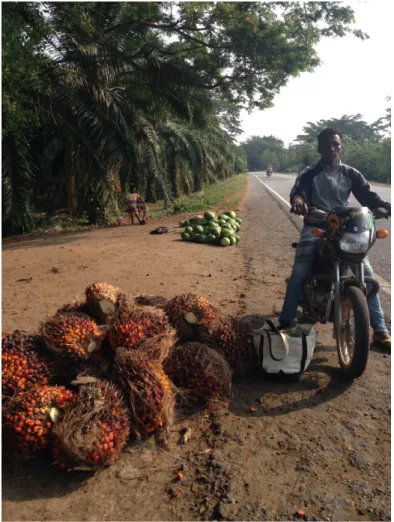
Social, economic, and material conditions in Paloaltico are similar to most lowland villages in Marialabaja. This predominantly Afro-descendant municipality5 is amongst the poorest in Colombia’s Caribbean region. 87% of its inhabitants live below the multidimensional poverty line, 59, 9% have unmet basic needs and 93% have no access to potable water (DANE 2005). Whereas in highland and piedmont areas, economies are predominantly agrarian, lowland family economies are mixed, labor is intermittent and people move permanently between urban and rural worlds. Men combine temporary agricultural wage labor with autonomous production for subsistence and commercial purposes; male youth help in family plots and also work as “mototaxi” drivers or wage laborers. Women engage in petty commerce of fish or agricultural products, in addition to activities for the family’s social reproduction. Motorcycles flow
24
constantly from villages to the municipal center, which offers markets, health services, municipal state offices, and higher education institutes. Buses leave every half hour from the town center to the state capital, Cartagena. Most families have close relatives in Cartagena, visit the city
regularly and sometimes stay for months or years for temporary work in businesses or domestic labor.
Figure 4. Martín combines wage labor and moto-taxi driving. Source: Author photo.
Agrarian struggle in Montes de María
26
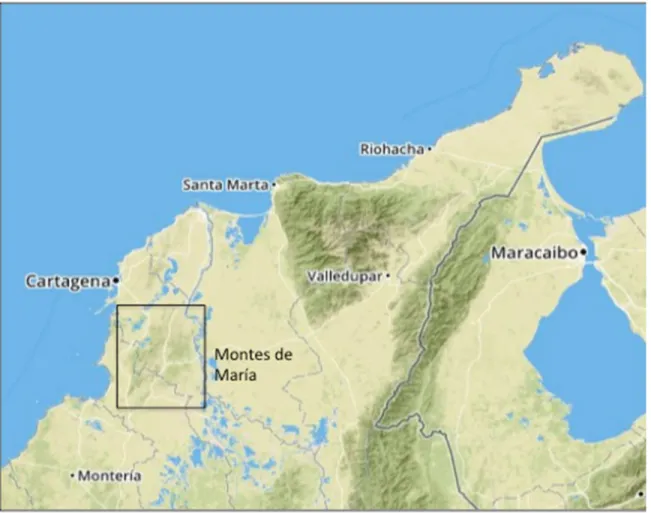
Figure 5. Map of Montes de María in the Colombian Caribbean. Source: Made by author.
Three interacting elements condition political- territorial dynamics in Montes de María: an agrarian structure historically biased towards land concentration; a political elite that holds on to a semi-feudal political patronage system based on hacienda labor; and a class of small holders whose political claims have been violently silenced either by landowning elites or armed groups (Centro Nacional de Memoria Histórica 2010). An agrarian history marked by the inequalities and oppressions of hacienda economies established since the 18th century (Van Ausdal 2009; Reyes Posada 1978; Fajardo 2002) set the conditions for recurrent peasant uprisings since the
1930s and made the region the epicenter of the Colombian peasant movement -ANUC6- in the second half of the 20th century (Zamosc 1986; Fals Borda 1986). Between 1971 and 1973 more than 400 haciendas were taken over by ANUC and as a result, over 300 titles were allocated to peasants, along with loans that aimed to intensify small-scale production and export-oriented cash crop production (Reyes Posada 1978). This scheme was followed by the backlash of landed elites, who attempted to reverse land allocations and ensure the economic and political
subordination of the peasantry through the combined application of violent force, political patronage, and legal means for land appropriation (Centro Nacional de Memoria Histórica 2010; Zamosc 1986). Land politics between the 1970s and early 2000s were intertwined with armed conflict between left-wing guerrillas supportive of peasant claims, right-wing paramilitaries protecting elite interests, and the Colombian Army. However, as occurred in other parts of the country, the territorial dynamics of armed conflict in the region did not only follow ideological motives, but also geo-strategic and economic ones. The latter were particularly important for creating different sub-regional and municipal trajectories of conflict, as will be discussed further in this chapter. Similarly, the relationship between armed actors and local populations was
28
ambiguous and complex. Not only did armed groups´ territorializing strategies differ greatly between each other, but strategies shifted in time and each group was internally heterogeneous. The Black Piedmont of Montes de María
The north-western piedmont and its adjacent lowlands, while sharing elements with the regional-level account above, are also quite distinct. Inhabited by a predominantly
afro-descendant population, they constitute a ‘black’ Montes de María that resulted from histories of marroonage and spontaneous settlement of free blacks during colonial times, which made this part of the region a “frontier of resistance” to the colonial authorities’ attempts at ordering space and rural peoples (Helg 2004).
The term “Black Piedmont” is not one of official academic or institutional usage. It is also not an informal local toponym. I suggest this term based on my own research into the region’s ethno-cultural and racial dynamics, its histories of settlement and the memories of its inhabitants. On the other hand, the term signals a political gesture aimed at acknowledging this area’s distinctiveness, in contrast to institutional imaginaries of Montes de Maria that
homogenize its population as simply “campesino”- a class-based category traditionally
associated with mestizo populations. Below, I offer a brief description of the Black Piedmont´s unique history and geography.
lowlands connect rural Montes de María to the roads, canals, and marshes that connect this rural space to Cartagena, the coastal state capital.
During colonial times, Marialabaja´s waterways constituted natural escape routes for runaway slaves or “maroons” from the 16th to the late 18th century (Navarrete 2003). During that time, maroons formed fortified settlements, palenques, in lowland and piedmont areas, creating a regional network of autonomous black settlements (Cassiani 2014). Upon recurrent attacks and eventual destruction of palenques by the Spanish military, maroon families and individuals continued to populate the fertile and forested mountains, this time through smaller, disperse communities, rochelas, where blacks, mestizos, and mulattoes refused to be incorporated into colonial settlement schemes (Conde 1999: 45).
After the abolition of slavery in 1851, such population patterns continued, with communities now joined by free blacks and mestizos coming from central and eastern areas. Hence, through centuries of maroon and post-emancipation settlement, this sub-region was characterized by the presence of relatively autonomous black peasantry, which engaged in intermittent and selective relations of labor and commerce with lowland haciendas in the state of Bolivar and the broader Caribbean region (Conde 1999).
30
This was unlike southern and eastern mestizo-indigenous areas of Montes de María, where the Spanish crown´s campaigns of forced resettlement between the 1740s and the 1780s effectively concentrated dispersed indigenous and mestizo population into towns and villages (Conde 1999). In those areas, colonial control over agrarian space and populations enabled the later expansion of agricultural and cattle-ranching estates since the early 19th century
(Hernandez 2008).
According to oral accounts obtained in participatory mapping sessions in Paloaltico, by the mid-20th century, piedmont villages such as Palo Alto Hicotea, Paraíso, and San Cristóbal, were relatively dynamic agricultural, commercial, and cultural centers where flows of people and goods from the broader afro-descendant area of piedmont and lowlands came together. Although not all inhabitants owned land, access through different social arrangements was relatively widespread, and landownership was distributed among a relatively large group of local families.
Small and mid-scale agricultural production co-existed with intermittent wage labor through seasonal migrations to different parts of the Caribbean. In addition, intra-regional
movements were particularly dynamic. Indeed, it was the flow of people and goods that made the Black Piedmont, as people from different afro-descendant villages came together for baseball games and village festivities; seasonal workers came from the lowlands to harvest rice; and women walked the land and gathered to prepare traditional foods.
capital from large scale sugar production in the first half of the 20th century (Meisel 1980).7 This differentiation also operated with respect to mestizo, indigenous, and white populations lying to the east. Although commercial and political relations with predominantly ‘white’ towns lying to the east were relatively dynamic, and despite the existence of inter-racial marriages, the
population remained distinctly afro-descendant and identities as black villages were recreated through cultural practices that differed from neighboring non-black populations. In this way, the Piedmont remained part of a broader cultural and demographic afro-descendant network that extended from the coastal city of Cartagena all the way to this precise area of Montes de María. Agrarian reform in Marialabaja and Piedmont villages
The arrival of the Colombian Institute for Agrarian Reform (INCORA) in 1965 marked the beginning of a drastic shift in the Piedmont’s agrarian history, marked by intense state presence and a dramatic re-ordering of space for agrarian modernization. INCORA was a
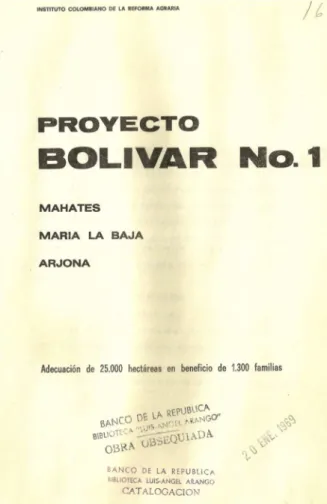
national level entity in charge of implementing the 1961 Law of Agrarian Reform. Its presence in Marialabaja and Piedmont villages was related to the implementation of Project INCORA # 1, the first large-scale state intervention for agrarian reform in the country. The Project entailed a massive modernization scheme which involved the construction of a 25, 000 hectare irrigation district8 for small-scale rice production and cattle grazing, as well as land titling, credits, technology, and the creation of peasant cooperatives (INCORA 1968). INCORA # 1 embodied the failed promises of mid-20th century rural development in the global South (Shiva 1993). Between the early 1970s and mid-1980s, hundreds of campesinos received land titles, credits and
7 See Chapter Five for a more detailed description of Hacienda Sincerín.
32
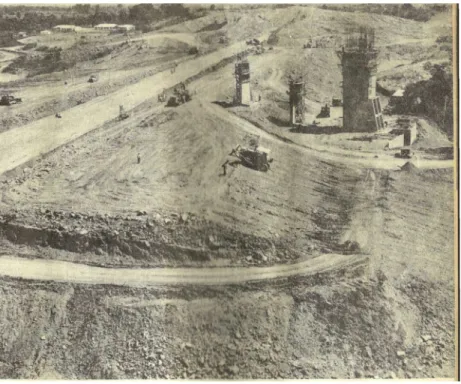
technological inputs, turning this region into a ‘successful case’ of land reform (CINEP 2012).9 But despite its promises to improve campesino livelihoods, agrarian modernization also led to social and spatial fragmentation, class differentiations among the peasantry, and credit-induced debt (Centro Nacional de Memoria Histórica 2010). The piedmont landscape was drastically transformed, as the construction of two massive reservoirs for the lowland irrigation district repressed downward flowing streams, flooding several towns and entire agrarian landscapes. The two reservoirs created a physical border between the highland municipalities of Carmen de Bolívar and San Jacinto, and the lowland municipality of Marialabaja, which was now traversed by a network of lowland district canals.
34
Figure 7. Construction of the Reservoir of Arroyogrande. Source: INCORA #1 (INCORA 1968).
The irrigation district displaced several villages and disrupted traditional patterns of afro-descendant settlement along the piedmont streams. Re-located to the lowlands, locals were partially enrolled in land titling and agricultural production schemes that underscored productivity and efficiency, and disregarded traditional afro-campesino agrarian practices, a topic explored in Chapter Three. Despite short periods of economic success, commercial rice-growing projects failed with the difficulties of imposed cooperative schemes and the opening of the agrarian economy to the global market in the early 1990s.
The history of Paloaltico is exemplary of modernizing development’s “collateral
disruption of what is today imagined as ‘the good life’ in the mountains. Landlessness became widespread and without an established network of social relations with lowland landowners, Paloalteros’ access to land became almost exclusively dependent on state recognition and the possibility of land titling. Of the more than fifty families, only seven obtained titles in 1973. This occurred after a process in which most families refused to be enrolled in titling schemes.
According to popular knowledge, refusal was based on the perception that titling entailed bondage to the state, a position informed by a complex coalescence between cultural memories of enslavement and discourses that linked agrarian reform to communist state totalitarianism put forward by local agrarian elites. After some years Paloalteros came to regret this decision, but land was no longer available for all.
Since then, Paloalteros have engaged in continuous attempts to search out land within dominant spatial orders from which they were, and continue to be, recurrently excluded. Armed conflict in Marialabaja and Playón
In the1980s, the arrival of Colombia’s armed political conflict to the municipality of Marialabaja again drastically changed agrarian life for black peasants in Montes de María. Although insurgent groups existed in Montes de María since the early 1980s, local accounts date the first direct experiences of guerrilla presence in the municipality of Marialabaja to 1989. Armed forces included several different actors with shifting territorial strategies and spaces of operation. In Marialabaja, two guerrilla groups were protagonists: the Ejército de Liberación Nacional (ELN) and the Fuerzas Armadas Revolucionarias de Colombia- Ejercito Popular (FARC-EP). 10 Their operations were followed by counter-insurgency efforts on the part of the
36
Colombian Army the paramilitary group Autodefensas Unidas de Colombia (AUC), positioning locals in the middle of violent territorializing strategies (Figure 8).
In 1989, the ELN, with strong influences from the Cuban Revolution and liberation theology, installed mobile campsites in lowland corregimientos, including San José del Playón. The ELN dominated lowlands adjacent to the northwestern Piedmont from 1989 to 1999. Through a strategy that emphasized social and ideological elements over militaristic territorial control, this guerrilla group was able to operate as a social and political force, exerting pressure over large land-owners and enjoying relative support from the local campesino population, albeit one that was limited by local rejection of their use of arms and fear of landowners retaliation.
ELN’s presence had important implications for local land relations. In the early 1990s, it influenced a second wave of land titling by INCORA. Contrary to the state-led titling schemes of the late 1960s and early 1970s, these were a consequence of landowners’ abandonment of lands due to guerrilla harassment, which was followed by campesino occupations. ELN not only pressured landowners but mediated negotiations between campesinos and INCORA, leading to the redistribution of over 2000 hectares of occupied lands.11
In the late 1990s, the ELN started retreating from the Marialabaja lowlands, due in part to the appearance in 1999 of the organized paramilitary forces Autodefensas Unidas de Colombia, described below, and to divisions in their national-level organization. After its retreat, the Marxist FARC-EP (from now on, FARC), a campesino-based guerrilla created since 1967 in the country’s interior, advanced over the lowlands of Marialabaja. Until then, FARC’s presence in
groups demobilized in the late 1980s and had little military capacity. It was FARC- EP and ELN that had most influence in the region and would become protagonists of armed struggle in Marialabaja.
3
8
As the ELN gave way to FARC, social and political involvement of guerrillas in lowland agrarian relations in shifted dramatically. While in the highlands FARC had attempted
communities’ ideological enrollment and influenced community organizing since the mid 1980s, in Marialabaja, by contrast, FARC prioritized military strategies of intelligence, defense, and procurement of basic goods. This difference was due in part to Marialabaja’s location, closer to main roads and coastal cities, making it a strategic site for provisioning. It also obeyed the shifting context of armed conflict: while in the mid 1980s, FARC had little military opposition, by the late 1990s, the paramilitary threat was imminent and the defense of highland refuge sites a priority.
Today, campesinos, state officials, and agrarian elites all agree that FARC was more interested in the self-procurement of goods and finances than in land redistribution and social justice.12 FARC was not involved in community-level affairs and did not attempt a political mediation with INCORA or local government in favor of campesinos. At the same time, FARC continued to harass landowners through cattle robberies, extortions, and kidnappings, which resulted in the abandonment of landholdings.
For middle- and large- scale landowners, political and commercial elites in the region, guerrilla presence was experienced as a physical, economic, and political threat. Some responded with fear-based acquiescence and flight. Others supported an armed counter-insurgency strategy, which not only targeted guerrilla members but also campesino and civic leaders (Millán 2015). First accounts of hitmen (sicarios) and private armed forces date from the early 1990s, when elites hired sicarios for selective assassinations of civic leaders and individuals perceived as
40
possible guerrilla collaborators.13 Landowners also used armed security guards to threaten land occupiers, often acting in collaboration with local police.
In 1997 a national-level federate paramilitary group, the Autodefensas Unidas de Colombia (AUC), first appeared in Montes de María, responding to a national-level strategy of organization and intensification of paramilitary violence. Operating through Front Héroes de Montes de María, AUC not only had the military objective of defeating FARC Fronts 35 and 37. Rather, like in other areas of the country, paramilitaries sought to create a long-term social, economic, and political regime. This regime was based on the repression of social protest, the installation of conservative social values, and the defense of agrarian social hierarchies (Bolívar 2005; Romero 2000). In regions like Montes de María, the latter included the appropriation of land and resources by new agrarian elites coming from the country’s interior (ILSA 2012; Gutiérrez Sanín 2014).
Marialabaja was a center for paramilitary operations in Montes de María. Its location, the support of economic and political elites, and the potential productive value of the district’s irrigated, fertile lands, made it a strategic space for integrating military, social, and economic goals. The mountainous north-western piedmont and ‘hinge’ sites neighboring the reservoir, such as the corregimiento of San José del Playón, were part of a geostrategic corridor between the central highlands of Montes de María and lowlands of Marialabaja (Figure 8). Controlling the reservoir meant controlling the flow of arms and goods between low- and highlands and was therefore a military priority for all armed actors. Paramilitary interests in the area were also economic. Marialabaja was important for paramilitaries’ participation in narco- trafficking
economies, their most important source of funding (Duncan 2006). Its position along the main roads of communication between the country’s interior and the Caribbean coast made it a strategic corridor for illicit drugs coming from the interior of the country and exported through the coastline of the Gulf of Morrosquillo, south of Cartagena. In addition, arms flowed in the opposite direction coming from the coastline ports, and the entire region constituted a
commercial corridor of agro industrial products and cattle (ILSA 2012; Borja Paladini 2009). Marialabaja also was a potentially profitable reservoir of irrigated agrarian lands. Paramilitary control over irrigation district lands not only helped reverse the process of peasant land occupations and state titling, enabled by guerrilla presence. It also enabled an “agrarian counter-reform” (Grajales 2011), a nation-wide massive process of illegal land transactions whereby thousands of peasants were forced to sell their lands (Centro Nacional de Memoria Histórica 2010). In midst of paramilitary violence in Marialabaja, lands acquired through land reform, many of them carrying decades-long debts, became an easy target for dispossession by economic or physical coercion. By threatening and murdering peasant leaders, de-mobilizing peasant organizations, and creating a generalized regime of terror among Marialabaja’s rural communities, paramilitaries enabled the rapid appropriation of lands by a new agrarian elite suspected by local campesinos to be linked to narco-trafficking economies. Hence, paramilitaries not only protected the interests of traditional landowners, but supported the establishment of a new elite of “faceless landowners”- an expression used locally by campesinos- whose identities remained largely unknown.
42
rapid legalization of land transactions and the titling of newly acquired lands through the illegal actions of local and regional Notary and Public Registry offices (Ministerio de Agricultura de Colombia et al. 2011). The integration of these lands into the market set the conditions for a second wave of purchases between 2005 and 2010 that ultimately allowed the establishment of large scale agri-business (Ojeda et al. 2014). In Marialabaja, most of the lands acquired forcibly during paramilitary domination have been sold ‘legally’ to oil palm entrepreneurs from regional capitals and cities in Colombia’s interior (ILSA 2012).
Paramilitary incursions to Marialabaja’s counties and villages started in the early months of 1999, with the arrival of men of the Bloque Canal del Dique belonging to the national-level confederation AUC. Groups of armed blocs followed an east-west route from municipal centers of San Juan, San Jacinto and El Carmen to the lowlands of Marialabaja via the highlands of the Serranía de San Jacinto, an area historically dominated by FARC (Figure 8). Upon their arrival to the piedmont, paramilitary groups typically joined larger headquarters in Marialabaja and participated in surveillance circuits, diverse criminal actions, and routine incursions into villages for the purpose of social control by terrorizing the population. Through a combination of
symbolic assertions of terror, brutal acts of physical violence such as massacres and selective assassinations, and the permanent occupation of villages, by 2005 paramilitaries had achieved almost absolute territorial control of the district’s lowlands and piedmont areas.
With the arrival of paramilitaries, the county of Playón reached its highest levels of violence, serving as a site of bloody territorial disputes between paramilitaries, guerrillas, and the Colombian national army. A key event in the collective memory of its inhabitants is the burning of the two wholesale bodegas that belonged to the town’s ‘cachacos’14 on August 17th, 1999.
After burning the stores, paramilitaries brutally killed the owner, his brother, and his pregnant sister-in-law by cutting them into pieces with machetes. The following day, paramilitaries burnt three trucks and a bus loaded with agricultural products. These events are exemplary of a
widespread strategy used by paramilitaries in points of purported guerrilla provisioning, where a common military tactic of blocking the enemy’s procurement of food and basic goods was combined with a strategy of terrorizing local populations through brutal and arbitrary acts of violence.
Figure 9. The 1999 killings in Playón reported by Cartagena newspaper El Universal. Source: San José del Playón Collective Reparation Committee.
44
brothers accused of being the ‘snitches’ behind the burnings were assassinated by FARC. This occurred by the reservoir shores while men, women, and children, many from Paloaltico, were washing clothes or selling produce and prepared foods. As an immediate consequence of this series of bloody events, 95% of the population abandoned the central town of the county of Playón and headed towards the municipal center of Marialabaja, Cartagena, or Barranquilla.
Figure 10. Playón’s displacement, reported by Cartagena newspaper El Universal. Source: San José del Playón Collective Reparation Committee.
extreme violence, e.g., massacres, individual assassinations,15 the burning of commercial boats and trucks,16 and forced community gatherings used to threaten locals, occurred intermittently in a context of everyday terrorizing through surveillance, threats, physical abuse, and the
occupation of spaces of family and community life. This violence intensified between 2002 and 2003, when approximately 100 men belonging to AUC settled permanently in the village, and residents of Paloaltico were forced to live through eleven months of paramilitary occupation, a topic explored in Chapter Four.
Between 1996 and 2005, the entire region of Montes de María had one of the country’s highest victimization indexes, with over 215, 000 individual forced displacements, 82, 000 hectares of abandoned and dispossessed lands, 6,000 selective murders and 56 massacres (Acción Social 2009; Centro Nacional de Memoria Histórica 2010). Marialabaja was one of the region’s most affected municipalities, with 117 selective homicides (Vicepresidencia de
Colombia-ODDHH 2010), 18,000 displaced persons (CINEP 2012), and 18,000 hectares of dispossessed land (RUPTA 2005).
Armed conflict in Marialabaja had devastating effects on campesino lives and livelihoods (Centro Nacional de Memoria Histórica 2010; 2015). As mentioned above, paramilitaries in particular enabled a process of massive land dispossession, which was rapidly followed by the legalization of purchased lands and the start of dynamic land transactions that resulted in the
15 Between 1998 and 2002, paramilitary groups committed six massacres in Marialabaja, including three in San José del Playón (Noche y Niebla-CINEP, 2008). The neighboring highlands of the municipalities of El Carmen and San Juan Nepomuceno were the stage for some the countries’ most atrocious massacres by the AUC between 1999 and 2002. Sixty women and men were massacred in the corregimiento of El Salado (El Carmen) in 2000 and between February 16-21 of 2000 12 campesino men were massacred in Las Brisas-San Cayetano on March 11th, 2003 (San Juan Nepomuceno).