THE ROLE OF RAPID DOPAMINE SIGNALING WITHIN THE NUCLEUS ACCUMBENS IN NATURAL AND DRUG REWARD-SEEKING BEHAVIORS
Courtney Marie Cameron
A dissertation submitted to the faculty of the University of North Carolina at Chapel Hill in partial fulfillment of the requirements for the degree of Doctor of Philosophy in the
Department of Psychology.
Chapel Hill 2014
ii © 2014
iii ABSTRACT
COURTNEY MARIE CAMERON: The role of rapid dopamine signaling within the nucleus accumbens in natural and drug reward-seeking behaviors
(Under the direction of Regina M. Carelli)
iv
vi
ACKNOWLEDGEMENTS
vii PREFACE
viii
TABLE OF CONTENTS
LIST OF FIGURES ... xiii
LIST OF ABBREVIATIONS ...xv
CHAPTER 1: GENERAL INTRODUCTION ...1
Addiction: A disorder of reward processing ...1
Associative reward learning ...2
Animal model of cocaine-taking: drug self-administration and abstinence ...5
The nucleus accumbens is a key neural substrate of reward learning ...6
Nucleus accumbens structure and connectivity ...6
The role of the NAc in goal-directed behavior ...8
NAc neurons encode aspects of motivated behavior: Evidence from electrophysiological studies ...9
Rapid dopamine signaling in the nucleus accumbens...11
Dopamine acts as a neuromodulator on nucleus accumbens cell firing ...13
Fast-scan cyclic voltammetry provides an ideal technique for measuring rapid chemical signaling in the NAc ...14
Goals of the dissertation...15
Specific aims ...16
CHAPTER 2: RAPID DOPAMINE RELEASE ENCODES GOAL-DIRECTED BEHAVIORS FOR BOTH NATURAL AND COCAINE REWARDS WITHIN THE SAME NUCLEUS ACCUMBENS LOCATION ...19
Introduction ...19
ix
Animals ...21
Surgery and Behavioral Training ...21
Data Analysis ...25
Histology ...28
Results ...29
Behavioral responding during the multiple schedules ...29
Dopamine release during performance of the sucrose/cocaine multiple schedule ...30
Dopamine release during performance of the sucrose/food multiple schedule ...34
Reinforcer order influences peak DA concentration during performance of the sucrose/cocaine but not the sucrose/food multiple schedule ...37
Time to peak DA concentration during the sucrose/cocaine and sucrose/food multiple schedule ...42
Histology ...43
Discussion ...45
Rapid DA release is not reinforcer specific during goal-directed behavior for cocaine versus a natural reward ...45
Rapid DA release is not reinforcer specific during goal-directed behavior for two natural rewards ...47
Insights into the role of rapid DA signaling in the functional organization of the NAc ...50
Conclusions ...52
CHAPTER 3: EXTRACELLULAR pH INCREASES ARE GREATER RELATIVE TO RESPONDING FOR COCAINE THAN RESPONDING FOR THE NATURAL REINFORCER SUCROSE ...53
x
Materials and Methods ...55
Animals ...55
Surgery and Behavioral Training ...55
Fast Scan Cyclic Voltammetry ...57
Data Analysis ...58
Histology ...60
Results ...61
Behavioral responding during the multiple schedule ...61
Basic pH shifts during performance of the sucrose/cocaine multiple schedule ...61
Peak pH during performance of the sucrose/cocaine multiple schedule is influenced by the type of reinforcer, but not the order of reinforcer presentation ...65
Peak pH is correlated with peak [DA] during cocaine self-administration, but not during sucrose self-administration ...66
Peak pH decreases over the course of cocaine self-administration, but not sucrose self-administration ...68
Histology ...69
Discussion ...71
Basic pH shifts were higher relative to cocaine-responding than to sucrose-responding ...71
Implications for the detection of DA using electrochemical techniques ...73
Relationship of pH to neural activity, brain blood flow, and oxygen ...74
Conclusions ...75
CHAPTER4: ONE MONTH OF COCAINE ABSTINENCE POTENTIATES RAPID DOPAMINE SIGNALING IN THE NUCLEUS ACCUMBENS CORE ...76
xi
Materials and Methods ...78
Animals ...78
Behavioral Training ...78
Surgery and Electrochemistry ...79
Data Analysis ...81
Histology ...84
Results ...85
Behavioral responding during cocaine self-administration and extinction ...85
[DA]max is potentiated following an acute cocaine injection, and this potentiation is greater following 30 days of abstinence ...87
Potentiated [DA]max following 30 days of cocaine abstinence appears related to facilitation of release ...90
Correlation between extinction behavior and changes in stimulated DA responses...92
Histology ...93
Discussion ...94
Increased [DA]max following a month of abstinence is due to a sensitized response to cocaine ...94
The role of DA release and uptake dynamics following cocaine abstinence ...96
A greater potentiation in DA release following abstinence is correlated with a reduction in extinction responding ...98
Conclusions ...101
CHAPTER 5: GENERAL DISCUSSION ...102
Summary of experiments ...102
xii
pH shifts measured by FSCV during responding for sucrose versus cocaine ...103 Rapid DA signaling in the NAc following 30 days of cocaine abstinence ...104 General discussion and relevance of findings ...104
The relationship between mesolimbic DA release and
NAc cell firing during responding for natural versus drug rewards ...105
Integrating rapid DA signaling, NAc cell-firing,
reward type, and cocaine abstinence ...106 Future directions ...111
Simultaneous recording of NAc cell-firing and rapid
DA release during performance of a sucrose/cocaine multiple schedule ...111 Establishing a causal role for rapid DA signaling in
xiii
LIST OF FIGURES
Figure
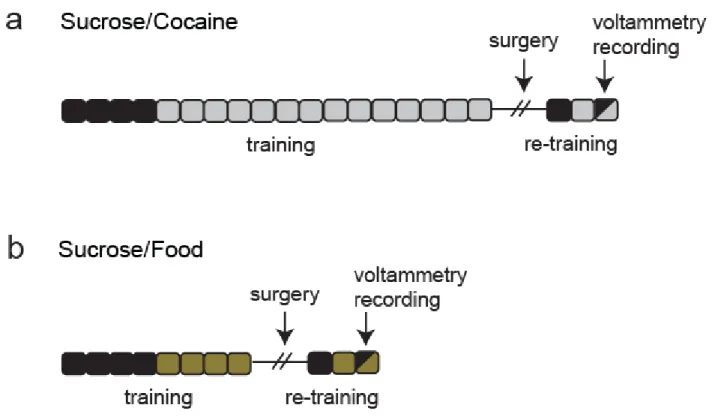
2.1 Experimental timeline for sucrose/cocaine
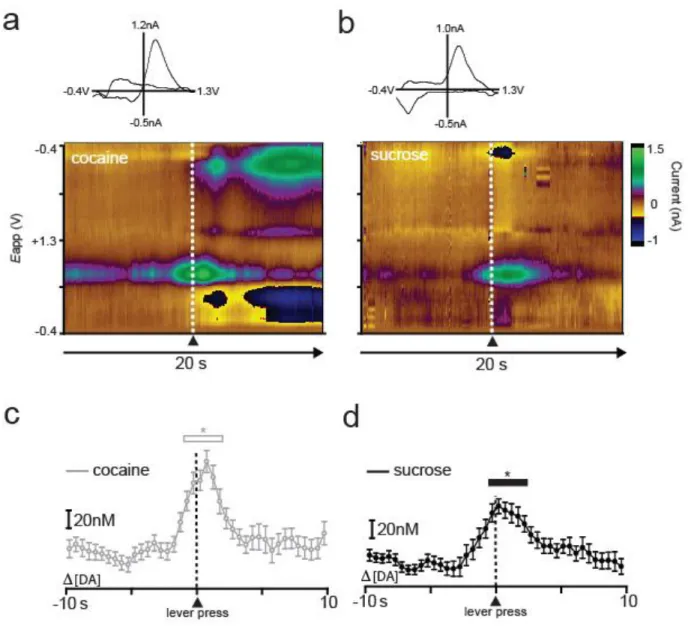
and sucrose/food multiple schedules ...22 2.2 Example of dopamine release for one animal during
performance of the sucrose/cocaine multiple schedule ...31 2.3 Sucrose and cocaine self-administration evoke rapid
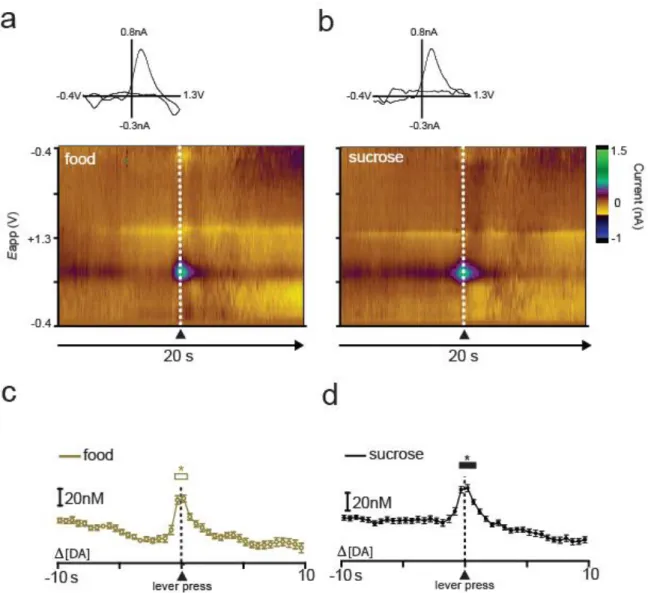
DA release in the NAc core ...33 2.4 Example of dopamine release for one animal during
performance of the sucrose/food multiple schedule ...35 2.5 Sucrose and food self-administration evoke rapid DA
release in the NAc core ...37 2.6 DA traces divided by order of sucrose/cocaine multiple
schedule...38 2.7 DA traces divided by order of sucrose/food multiple
schedule...40 2.8 The influence of reinforcer order and reinforcer type
on peak DA concentration ...42 2.9 The influence of reinforcer type on time to peak ...43 2.10 Schematic representation of electrode tip placements
in the NAc core ...44 3.1 Example of basic pH shifts for one animal during
performance of the sucrose/cocaine multiple schedule ...62 3.2 Changes in pH in the NAc core during sucrose and
cocaine self-administration ...64 3.3 The influence of reinforcer type and reinforcer order
on peak pH ...66 3.4 Linear regression analyses correlating peak pH with
peak [DA] during cocaine or sucrose self-administration session ...67 3.5 Linear regression analyses correlating peak pH or peak
xiv
4.1 DA release and uptake parameters ...83 4.2 Behavioral responding during cocaine self-administration
and extinction ...86 4.3 Electrically evoked DA release in the NAc core ...88 4.4 [DA]max is potentiated following 30 days of cocaine
abstinence ...88 4.5 [DA]max percent of pre-drug baseline ...89
4.6 Analysis of release and uptake parameters for the
10Hz stimulation frequency ...91 4.7 Linear regression analyses correlating [DA]max percent
of pre-drug baseline with number of extinction presses ...92 4.8 Schematic representation of electrode tip placements
in the NAc core ...93 4.9 Proposed model for the interaction between glutamatergic
and dopaminergic signaling in the NAc...100 5.1 Glutamate and DA signaling in sucrose-selective versus
cocaine-selective populations of NAc medium spiny neurons,
xv
LIST OF ABBREVIATIONS
ANOVA AUC BLA CR CS CV DA [DA]max FR FSCV MSN NAc OFC PFC sem t1/2 US VTA
analysis of variance area under the curve basolateral amygdala conditioned response conditioned stimulus cyclic voltammogram dopamine
peak evoked concentration of dopamine fixed ratio
fast-scan cyclic voltammetry medium spiny neuron
nucleus accumbens orbitofrontal cortex prefrontal cortex
standard error of the mean
decay time between peak and half-maximal amplitude unconditioned stimulus
1
CHAPTER 1: GENERAL INTRODUCTION
Addiction: A disorder of reward processing
Drug addiction is a complex disorder that results in a multitude of physical, psychological, and interpersonal problems for addicted individuals, as well as wide-ranging societal harms. Despite the complexity of addiction, it is almost universally agreed that this disease is defined by a loss of control over drug-taking and drug-seeking behaviors and the persistence of these behaviors despite their negative consequences (American Psychiatric Association, 1994). Thus, addiction differs in important ways from casual drug use, and the escalation from initial use, to abuse, to addiction produces neuroadaptations that are fundamentally different from those associated with casual use (Sinha, 2013). A better understanding of these addiction-related neuroadaptations is critical for the prevention and treatment of addiction.
2
1991). The propensity to relapse, even after extended periods of abstinence, contributes to the difficulty in treating cocaine addiction.
Cocaine is highly rewarding, and the biological mechanisms underlying cocaine reinforcement have been extensively studied. The primary pharmacological action of cocaine in the brain is blockade of the dopamine, norepinephrine, and serotonin transporters which remove their respective neurotransmitters from the synapse after they have been released (Heikkila et al., 1975; White, 1998). Thus, cocaine increases the levels of dopamine, norepinephrine, and serotonin in the synapse through reuptake inhibition. It has long been hypothesized that the rewarding effects of cocaine are primarily mediated by increases in dopamine neurotransmission (De Wit & Wise, 1977; Roberts et al., 1977).
However, organisms likely did not evolve to process information about drugs such as cocaine. Instead, drugs of abuse likely act on a brain reward circuit that normally processes biologically relevant rewards such as food, water, or sex. Repeated drug use can lead to the dysregulation of reward processes that are highly adaptive under most other circumstances. Therefore, drug addiction can be thought of as a disorder of reward processing. Given the concept of addiction as aberrant reward learning, a clearer understanding of how organisms learn about rewards under normal circumstances can improve our understanding of addiction.
Associative reward learning
3
have evolved associative learning mechanisms. Associative learning is typically divided into two categories: stimulus-outcome and action-outcome.
In stimulus-outcome learning (also called Pavlovian or classical conditioning), an organism learns to associate a previously neutral stimulus (the conditioned stimulus, CS) with a biologically salient outcome (the unconditioned stimulus, US). With multiple CS-US pairings, the CS comes to gain biological salience and can influence behavior in the absence of the US (Pavlov, 1927). During stimulus-outcome learning, presentation of stimuli does not depend on the behavioral actions of the organism; however, Pavlovian stimuli can come to exert control over behavior. This is often adaptive, such as when an animal learns to associate a particular sound with food delivery and subsequent presentation of the sound elicits approach to the area where food was delivered. Pavlovian cue-outcome associations can also become maladaptive. For example, when drug-related stimuli gain salience through conditioning, they can become powerful motivators and overtake the influence of other environmental stimuli, thus driving maladaptive seeking of drug rewards (Robinson & Berridge, 1993; Berridge & Robinson, 1998).
4
learning, action-outcome learning is typically adaptive but can become maladaptive under certain conditions such as addiction (Belin et al., 2013).
Associative learning processes can be influenced by many factors, but of particular interest for this dissertation is the role of reward type (i.e., natural reinforcers such as food or water versus drug reinforcers such as cocaine). Both natural and drug rewards are reinforcing as they support robust operant behavior. However, drugs rewards differ from natural rewards in important ways. Because drugs do not satisfy any inherent physiological need such as hunger or thirst, they must exert their reinforcing properties through some other means. This has led to the hypothesis that drugs “tap into” a brain reward circuit that evolved to process information about
natural reinforcers (Wise, 1997). However, it is also possible that the brain processes natural and drug rewards in fundamentally different ways. While we are far from a consensus on this issue, it is clear that the processing of natural versus drug rewards is intimately linked.
Human cocaine addicts often report anhedonia, dysphoria, and an inability to perceive of anything other than cocaine as potentially pleasurable (Gawin & Kleber, 1986). Additionally, cocaine addicts going through withdrawal have a reduction in striatal dopamine D2 receptor
5
natural rewards. The importance of a valid animal model for studying cocaine abuse is discussed in detail below.
Animal model of cocaine-taking: drug self-administration and abstinence
Complex human disorders such as addiction can never be fully replicated in an animal model; however, these models provide an invaluable tool for studying specific aspects of the addiction cycle. As described above, cocaine addiction in humans is characterized by a cycle of drug use, abstinence, and relapse (Gawin, 1991). Perhaps the most valid model for assessing the first phase of this cycle, drug-taking, is operant self-administration (Weeks, 1962; Deneau et al., 1969). This behavioral paradigm allows animals to voluntarily consume drugs or other reinforcing substances, such as food or sucrose, thus eliminating the confound of experimenter-induced substance dependence. Furthermore, operant responding is goal-directed, giving a behavioral readout of an animal’s motivation to work for a particular outcome. The
self-administration model is well-suited for investigating the processing of natural rewards versus drug rewards. In this laboratory, we have used a multiple schedule self-administration design in which rats respond for a natural reinforcer (e.g., sucrose) versus intravenous cocaine, allowing us to directly compare neural responses, such as cell-firing, across the two reinforcer types.
6
behavior could provide important insights into improving treatment. In fact, research with animal models has consistently shown that drug-seeking behavior (measured by operant responding in the absence of the primary reinforcer) progressively increases with the amount of abstinence from cocaine self-administration (Tran-Nguyen et al., 1998; Grimm et al., 2001; Lu et al., 2004). Thus, this “incubation of craving” phenomenon appears to model the high rates of relapse observed in the human population. Finally, a number of studies (Toda et al., 2002; Kalivas et al., 2003; Lu et al., 2003; Xi et al., 2003) have shown that abstinence-induced changes in behavior are correlated with neuroadaptations in brain areas important for reward processing.
The nucleus accumbens is a key neural substrate of reward learning
As described above, reward learning is a complex process that involves the integration of a variety of external and internal stimuli. As such, this process is subserved by a distributed network of brain nuclei. However, the nucleus accumbens (NAc) is of particular interest because its central location within this network means it is uniquely situated to integrate salient reward-related information and select an appropriate behavioral response. This section will briefly describe the basic structure of the NAc and its afferent/efferent projections before reviewing evidence supporting its role in reward learning.
Nucleus accumbens structure and connectivity
7
population is composed of both cholinergic and GABAergic interneurons (Gerfen, 1988). Cholinergic interneurons synapse onto MSNs and other cholinergic interneurons (Aosaki et al., 1994; Graybiel et al., 1994; Morris et al., 2004) , while GABAergic interneurons form inhibitory synapses onto MSNs (Kreitzer & Malenka, 2008). The connectivity of interneurons allows for precise regulation of discrete subsets of neurons in the NAc.
The NAc receives convergent glutamatergic input from limbic areas including the prefrontal (PFC) cortex, orbitofrontal cortex (OFC), hippocampus, and basolateral amygdala (BLA) (Zahm & Brog, 1992; Brog et al., 1993). It also receives a dense dopaminergic (DA) input projection from the ventral tegmental area (VTA) (Zahm & Brog, 1992; Brog et al., 1993). In turn, the NAc sends efferent projections to motor areas including the ventral pallidum and lateral hypothalamus (Zahm, 1999). This anatomical organization supports the classical view of the NAc as a limbic-motor integrator that translates incoming reward-related information into motivated behavior through its connections to motor regions (Mogenson et al., 1980).
However, it is unlikely that the NAc as a whole sends a single integrated output to its target structures in order to initiate behavior. Theories of basal ganglia function suggest that the NAc is embedded in a larger system that is organized into several structurally and functionally discrete circuits that are essentially parallel in nature (Alexander et al., 1986; Alexander & Crutcher, 1990). Additionally, it was proposed that the NAc is composed of a collection of functionally heterogeneous “neuronal ensembles” that are characterized by distinct
8 The role of the NAc in goal-directed behavior
Given the functional connectivity of the NAc as a corticolimbic motor integrator described above, many studies have targeted this brain region to better understand its particular role in reward learning. Pharmacological and lesion studies have repeatedly demonstrated that the NAc plays a direct role in both the appetitive and consummatory phases of goal-directed behaviors (Stratford, 1997; Stratford & Kelley, 1997; Berridge & Robinson, 1998; Kelley, 2004). Furthermore, lesions to the NAc or blockade of dopamine within the NAc disrupt the acquisition and expression of Pavlovian conditioned responses (Di Ciano et al., 2001; Di Chiara, 2002; Dalley et al., 2005), impair the acquisition and expression of learned associations (Balleine, 1994; Di Ciano & Everitt, 2001; Cardinal, 2002; Dalley, 2002; Schoenbaum & Setlow, 2003; Dalley et al., 2005), and alter behavioral responses to reward-paired cues (Nicola et al., 2005). Thus, the NAc is critical for both operant and Pavlovian aspects of reward-related learning.
9
2004; McFarland et al., 2004; Peters & Kalivas, 2006; Bäckström & Hyytiä, 2007; Fuchs et al., 2008). Finally, the NAc likely mediates many of the motivational changes associated with cocaine abstinence, including the persistence in drug-seeking seen following extended abstinence (Kalivas, 2009). Overall, it is clear that the NAc is necessary for normal reward processing and may very well be a critical brain region in the development of aberrant reward processing that characterizes drug addiction.
NAc neurons encode aspects of motivated behavior: Evidence from electrophysiological studies In vivo electrophysiological methods provide a unique perspective of neural function because they illuminate the precise correlation of neuronal activity and behavioral events. These methods have been employed to study the cellular mechanisms underlying natural reward and drug-seeking behaviors. Studies have repeatedly demonstrated that NAc neurons exhibit patterned changes in activity (excitations and inhibitions) before, during, and after operant responses for natural or drug rewards (Carelli & Deadwyler, 1994; Pennartz et al., 1994; Nicola & Deadwyler, 2000; Carelli, 2002; Nicola et al., 2004). This patterned firing activity is not limited to operant responding for reinforcers. NAc neurons also exhibit distinct patterned changes in firing rate to Pavlovian conditioned cues that that predict sucrose delivery (Roitman et al., 2005) or that predict sucrose availability and elicit approach behaviors (Day et al., 2006). However, cue-evoked activation of NAc neurons is not unique to sucrose or natural rewards. Several studies demonstrate that NAc neurons are also activated by stimuli associated with the intravenous delivery of cocaine (Carelli, 2000; Hollander & Carelli, 2007).
10
2003; Carelli & Wondolowski, 2006; Cameron & Carelli, 2012). Thus, in contradiction to the notion that abused substances ‘tap into’ a natural reward circuit, these findings suggest that
goal-directed behaviors for natural or drug rewards are largely guided by separate neural circuits in the NAc. Furthermore, only neurons that encode goal-directed behaviors for cocaine are activated by cocaine-associated stimuli (Carelli & Ijames, 2001). Additionally, distinct populations of NAc cells are differentially activated during intra-oral infusion of rewarding (sucrose) versus aversive (quinine) tastants (Roitman et al., 2005). Together these findings suggest that the NAc is composed of distinct microcircuits that include groups of cells with different functional properties.
11
however, the percentage of cells that selectively encode cocaine-related information is increased (Cameron & Carelli, 2012). Together these studies suggest that the increased encoding of cocaine-seeking behaviors in the NAc following abstinence may perturb the normal balance between encoding of natural and drug reinforcers, perhaps representing a neural correlate of the transition to drug dependence.
Rapid dopamine signaling in the nucleus accumbens
The mesolimbic DA projection from the ventral tegmental area (VTA) to the NAc has been extensively studied as a neural substrate of reward, but the specific function of DA transmission within the NAc remains controversial. A common feature of natural rewards as well as many abused substances, including cocaine, is to increase mesolimbic DA (Di Chiara & Imperato, 1988), and a traditional hypothesis posits that NAc DA mediates the hedonic impact of food and drug rewards (Wise & Bozarth, 1982; Wise & Rompre, 1989). However, numerous findings challenge the validity of this hypothesis. NAc DA levels are increased during operant responding to avoid an aversive stimulus (Salamone, 1994), and depletion or antagonism of DA or NAc activity impairs behavioral performance on tasks motivated by aversion rather than reward (Salamone, 1994; Di Chiara, 2002; Huang & Hsiao, 2002; Schoenbaum & Setlow, 2003). The importance of mesolimbic DA in learning about aversive events clearly demonstrates that DA does not mediate the pleasurable hedonic aspects of natural or drug reinforcers as proposed in the original “anhedonia” hypothesis.
12
exhibit brief increases in activity when rewards are delivered unexpectedly (Mirenowicz & Schultz, 1994; Hollerman & Schultz, 1998; Pan et al., 2005). However, when a cue comes to fully predict reward delivery, DA neurons exhibit transient increases in firing rate during the presentation of the cue rather than during delivery and consumption of the reward (Schultz et al., 1997). Thus in direct contradiction to the “anhedonia” hypothesis, midbrain DA neurons do not fire upon receipt of reinforcer, but rather during presentation of a cue that predicts its arrival. The current hypothesis based on these observations proposes that DA neurons provide a “prediction error” signal. According to this hypothesis, as conditioned stimuli become valid reward
predictors, reward delivery does not constitute a violation of expectancy and therefore does not produce phasic dopamine cell firing as an unexpected reward would.
13
transmission is only required for learning about CSs if they have been attributed with incentive salience (Flagel et al., 2011). This theory of DA function may have particular relevance to the type of aberrant learning that takes place in addiction. Thus, the normal attribution of incentive salience is adaptive under most circumstances, but because almost all abused drugs increase mesolimbic DA, they also increase the salience attributed to drug-related stimuli. Eventually these stimuli become powerful motivators, overtaking the influence of other environmental stimuli and driving maladaptive seeking of drug rewards
Dopamine acts as a neuromodulator on nucleus accumbens cell firing
As discussed in detail above, MSNs in the NAc receive glutamatergic input from cortical and limbic regions. Dopamine neurons projecting from the VTA synapse onto the necks and spines of MSNs and are located adjacent to glutamatergic synapses (Voorn et al., 1986; Groves et al., 1994). This synaptic organization suggests a critical role for DA in modulating glutamatergic input from other brain regions. Studies have shown that DA release does not have direct excitatory or inhibitory actions on MSNs, but instead acts as a neuromodulator, differentially influencing the activity of glutamatergic afferents rather than exerting global actions across all NAc neurons (O'Donnell et al., 1999; Nicola et al., 2000).
Several properties of NAc MSNs also support the role of DA as a neuromodulator. First, a vast majority of MSNs in the NAc express only one subtype of DA receptor (Bertran-Gonzalez et al., 2008). DA receptors are G-protein coupled receptors and are classified as either “D1-like”
(D1 and D5) or “D2-like” (D2, D3, and D4) (Kebabian & Calne, 1979). D1 and D2 receptors are
coupled to different G-proteins and result in divergent intracellular signaling cascades (Girault & Greengard, 2004; Snyder, 2011). Importantly, in the NAc core 53% of MSNs express D1
14
D1 and D2 receptors (Valjent et al., 2009). This organization of DA receptors on MSNs allows
DA release in the NAc to function in a highly dynamic manner.
MSNs are also unique because they exhibit a bistable membrane potential. In the “down state” the resting membrane potential is approximately -77mV, while in the “up state” the resting
membrane potential is approximately -54mV (O'Donnell & Grace, 1993; Wilson & Kawaguchi, 1996). Activation of D1 receptors maintains MSNs in their up state, thus increasing the
probability that they will fire an action potential. In contrast, activation of D2 receptors on MSNs
tends to inhibit cell firing (Belle et al., 2013). Thus, DA release in the NAc interacts with postsynaptic MSNs in a complicated manner to best promote appropriate behavior.
Fast-scan cyclic voltammetry provides an ideal technique for measuring rapid chemical signaling in the NAc
Electrochemical techniques combine chemical selectivity with high temporal resolution to measure chemical compounds, including DA, in the brain. These techniques include constant-potential amperometry, high-speed chronoamperometry, and fast-scan cyclic voltammetry (FSCV) (Kawagoe & Wightman, 1994; Michael & Wightman, 1999; Gerhardt & Hoffman, 2001). Among these techniques, FSCV provides the best combination of temporal and chemical sensitivity for measuring rapid changes in extracellular DA (Phillips et al., 2003a).
15
The temporal resolution of FSCV (~100 msec) makes it ideal for recording rapid changes in DA timelocked to behavior in freely moving animals. Additionally, FSCV allows analytes to be easily distinguished from ionic changes (such as pH). These ionic changes can also be separated from other analytes using principal component regression (Heien et al., 2004; Keithley et al., 2010). Therefore, DA and pH signals can be isolated and analyzed separately.
Finally, a particular advantage of FSCV is the ability to probe the kinetics involved in rapid DA signaling in an intact brain circuit. The concentration of DA available in the synapse is determined by two opposing processes: release and uptake. Because of the temporal resolution available with FSCV, these two processes can be distinguished and their relative influences on neurotransmission determined (Wightman et al., 1988; Wightman & Zimmerman, 1990).
Goals of the dissertation
16
investigate the role of rapid DA signaling and pH shifts in responding for natural and drug rewards, as well as the influence of cocaine abstinence on DA release and uptake dynamics. Specific Aims:
1. To examine whether rapid DA release in the NAc core is reinforcer specific during performance of a sucrose/cocaine or sucrose/food multiple schedule. As previously described, the NAc is a key brain area underlying the processing of both natural and drug rewards. Electrophysiological studies in behaving animals have demonstrated that NAc neurons encode information about goal-directed actions for both natural and drug rewards as well as cues associated with those rewards (Carelli & Deadwyler, 1994; Carelli, 2000; Nicola & Deadwyler, 2000; Carelli, 2002; Nicola et al., 2004; Peoples et al., 2004; Roitman et al., 2005; Day et al., 2006; Hollander & Carelli, 2007). Importantly, studies from this laboratory have repeatedly shown that NAc neurons exhibit differential, nonoverlapping firing patterns during operant responding for natural rewards (food, water, or sucrose) versus cocaine (Carelli et al., 2000; Carelli, 2002; Carelli & Wondolowski, 2003; Carelli & Wondolowski, 2006; Cameron & Carelli, 2012). In contrast, two natural reinforcers (food versus water) activate largely the same population of neurons in the NAc (Carelli et al., 2000). This pattern holds true even when one of the natural reinforcers is highly palatable sucrose (Roop et al., 2002). These findings indicate that the NAc is composed of distinct neural circuits that process information about natural reinforcers largely separate from information about cocaine.
17
locations in the NAc in a manner similar to the pattern of NAc cell firing observed in our previous studies. Therefore, in this study we will use FSCV to record rapid DA release in the core of the NAc during performance of a sucrose/cocaine multiple schedule. This design will allow us the record DA release in a single NAc location during responding for both reinforcers during the same behavioral session. As a control, we will record rapid DA release in another group of animals as they perform a sucrose/food multiple schedule. This will allow us to compare the pattern of NAc DA release seen during responding for two natural reinforcers to that seen during responding for one natural and one drug reinforcer.
2. To investigate basic pH shifts in the NAc core associated with goal-directed responding for a natural (sucrose) versus drug (cocaine) reinforcer. While FSCV studies examining DA release have provided unprecedented insight into the role of this neurotransmitter in reward processing and addiction, electrochemical recordings with carbon-fiber microelectrodes also allow for the detection of pH with similar (subsecond) temporal resolution (Venton et al., 2003; Takmakov et al., 2010). In fact, fluctuations in pH have been observed relative to electrical stimulation ((Venton et al., 2003; Cheer et al., 2006) as well as reward-related events in awake animals (Ariansen et al., 2012). These shifts in pH are delayed several seconds from the immediate release and reuptake of DA (Venton et al., 2003). Thus, examining changes in pH related to goal-directed actions offers a way to probe dynamic changes in neural activity that occur in combination with changes in DA.
18
study will compare basic shifts in pH in discrete locations in the NAc core and determine if aspects of this signaling differs during each phase of a sucrose/cocaine multiple schedule.
19
CHAPTER 2: RAPID DOPAMINE RELEASE ENCODES GOAL-DIRECTED BEHAVIORS FOR BOTH NATURAL AND COCAINE REWARDS WITHIN THE
SAME NUCLEUS ACCUMBENS LOCATION
Introduction
Learning about rewards and appropriately directing behavior to obtain them is critical for survival. These processes are subserved by a distributed network of brain nuclei including the NAc and its dopaminergic input. The NAc receives convergent glutamatergic afferents from limbic areas including the prefrontal cortex, hippocampus, and basolateral amygdala (Zahm & Brog, 1992; Brog et al., 1993) and impacts behavior through its projections to motor-related regions such as the ventral pallidum (Zahm, 1999). Further, dopamine is considered to function as a neuromodulator within the NAc, influencing the activity of the glutamatergic afferents onto NAc neurons that ultimately alters output to motor structures (O'Donnell et al., 1999; Nicola et al., 2000). This connectivity supports the classic view of the NAc as a “limbic-motor integrator” that translates motivation into goal-directed actions (Mogenson et al., 1980)
20
NAc neurons exhibit largely differential, nonoverlapping firing patterns during operant responding for natural rewards (food, water, or sucrose) versus intravenous cocaine (Carelli et al., 2000; Carelli, 2002; Carelli & Wondolowski, 2003; Carelli & Wondolowski, 2006; Cameron & Carelli, 2012). In contrast, NAc neurons exhibit similar types of neuronal firing patterns during responding for two natural reinforcers (food versus water) (Carelli et al., 2000). This pattern holds true even when one of the natural reinforcers is highly palatable sucrose (Roop et al., 2002). Collectively, these findings support the contention that the NAc is comprised of discrete, functionally segregated ‘microcircuits’ that process particular types of
reinforcement-related information to influence goal-directed actions (Alexander et al., 1986; Pennartz et al., 1994; Groenewegen et al., 1996; Carelli & Wightman, 2004).
21 Materials and Methods
Animals
Male Sprague-Dawley rats (Harlan Sprague Dawley, Indianapolis, IN, USA; n = 14) aged
90-120 days and weighing 260–350 g were used as subjects and individually housed with a 12/12 h light/dark cycle. Body weights were maintained at no < 85% of pre-experimental levels by food restriction (10–15 g of Purina laboratory chow each day). Water was available ad
libitum. This regimen was in place for the duration of the experiment, except during the
post-operative recovery period when food was given ad libitum. Animal procedures were conducted
in accordance with the National Institutes of Health Guidelines for the Care and Use of Laboratory Animals, and were approved by the University of North Carolina at Chapel Hill Institutional Animal Care and Use Committee (IACUC).
Surgery and Behavioral Training
All training was conducted in custom-made experimental chambers that consisted of a 43 × 43 × 53 cm Plexiglass chamber housed within a commercial sound-attenuated cubicle (Med Associates Inc., St Albans, VT, USA). One side of the chamber was equipped with two retractable levers (Coulbourn Instruments, Allentown, Pennsylvania) 17 cm apart, corresponding cue lights positioned 6 cm above each lever, and a reward receptacle located equidistantly between the levers.
22
Figure 2.1. Experimental timeline. (a) Timeline for the sucrose/cocaine multiple schedule. Each box represents one day of behavioral training. Black boxes indicate days of sucrose self-administration. Gray boxes indicate days of cocaine self-self-administration. On the recording day, animals completed a multiple schedule for sucrose and cocaine. (b) Timeline for the sucrose/food multiple schedule. Each box represents one day of behavioral training. Black boxes indicate days of sucrose self-administration. Gold boxes indicate days of sucrose self-administration. On the recording day, animals completed a multiple schedule for sucrose and food.
23
during sucrose training. Lever depression resulted in intravenous cocaine delivery (0.33 mg/infusion, approximately 1 mg/kg/infusion, 6 s) via a computer-controlled syringe pump, onset of a different tone (65 dB, 800 Hz, 20 s), and retraction of the lever (20 s). The tones and levers (left or right) associated with cocaine vs. sucrose were counterbalanced across animals.
Following 14 days of cocaine self-administration, rats were surgically prepared for voltammetric recording in the NAc core as previously described (Phillips et al., 2003a). Animals were anesthetized with a ketamine hydrochloride (100 mg/kg) and xylazine hydrochloride (10 mg/kg) mixture (intramuscular) and placed in a stereotaxic frame. A guide cannula (Bioanalytical Systems, West Lafayette, IN) was positioned dorsally to the NAc core (+1.3 mm anterior, -1.3mm lateral from bregma). An Ag/AgCl reference electrode was placed contralateral to the stimulating electrode in the left forebrain. The bipolar stimulating electrode (Plastics 1 Inc., Roanoake, VA) was placed dorsally to the VTA (-5.2 mm posterior, -1.0 mm lateral from bregma and -7 mm ventral from brain surface). Stainless steel skull screws and dental cement were used to secure all items. The bipolar stimulating electrode was lowered in 0.2 mm increments until physical responses to electrical stimulation diminished, indicative of proper electrode placement. The stimulating electrode was then fixed with dental cement.
24
followed by a 20 s time-out period (no lever extended; dark chamber) and extension of the second cocaine-reinforced lever (fixed-ratio 1; 2 h). Illumination of a cue light above each lever signaled the phase (sucrose or cocaine) of the multiple schedule. The order of reinforcer availability was varied across animals such that 4 animals self-administered sucrose followed by cocaine while 4 other animals self-administered cocaine followed by sucrose. Importantly, rats only received both reinforcers in the multiple schedule during the test day. Therefore, one reinforcer never came to predict access to the other.
In a second experiment (sucrose/food multiple schedule; Fig 2.1b), another set of rats (n = 6) were trained in a similar manner; however, food (45 mg pellet) was substituted for cocaine in the training and during the multiple schedule. Following acquisition of sucrose administration, these animals underwent at least two additional days of training on food self-administration. On test day, the rats performed a sucrose/food multiple schedule that consisted of two 15 minute periods of self-administration separated by a brief 20 s time-out. All other aspects of the multiple schedule (reward delivery, tone, lever retraction) were as described above. As in the sucrose/cocaine multiple schedule, the lever and tone associated with each reinforcer was counterbalanced across animals, and the order of reinforcer availability was varied across animals. Specifically, the order of reinforcer availability was varied such that 4 recordings were obtained in which sucrose was self-administered followed by food, and 5 recordings in which food was self-administered followed by sucrose.
Surgery and Behavioral Training
25
μm length) was inserted into the guide cannula and lowered into the NAc core. The carbon-fiber
and Ag/AgCl reference electrodes were connected to a head-mounted voltammetric amplifier attached to a commutator (Med-Associates, St. Albans, VT) at the top of the test chamber. Voltammetric recordings were made every 100 msec by applying a triangular waveform (-0.4 to +1.3 V, 400 V/sec). Data were digitized and stored to a computer using software written in LabVIEW (National Instruments, Austin, TX). Dopamine release within the NAc core was electrically evoked by stimulating the VTA (24 biphasic pulses, 60 Hz, 120 μA, 2 msec per phase) to ensure that carbon-fiber electrodes were in close proximity to dopamine release sites. The electrode position was optimized at a location with maximal dopamine release. To create a training set for principal component analysis for the detection of DA and pH changes during the behavioral session, additional stimulations at various parameters were performed (2-24 biphasic pulses, 20-60 Hz, 120 μA, 2 msec/phase). After the session, electrical stimulation was repeated to ensure that the site could still support DA release. A second computer and software system (Med Associates) controlled behavioral events and sent digital outputs for each event to the voltammetry recording computer to be time-stamped along with the electrochemical data. In some cases (two animals that performed the sucrose/food multiple schedule), a second or third recording session was completed on another day in which an electrode was lowered to a new location in the NAc core.
Data Analysis
All lever press events were recorded during performance of the multiple schedule.
Number of lever presses as well as inter-response interval (INT) were calculated for each
reinforcer during each behavioral session. Number of lever presses and INT were compared for
26
(reinforcer type, within subjects factor x reinforcer order, between subjects factor). To eliminate any effect of an uneven number of responses for one reinforcer (sucrose, cocaine or food) over another, lever press responses were randomly selected to allow for an equal number of trials within a recording session. The number of random trials that were selected from each session were equivalent to the number of trials of the reinforcer for which the animal responded less. Thus, if an animal responded 40 times for sucrose and 20 times for cocaine during a sucrose/cocaine multiple schedule, we selected 20 trials each for sucrose and cocaine. This procedure was used for all analyses described below.
DA signals from FSCV were identified as previously described (Roitman et al., 2004). For analyte identification, current during a voltammetric scan is plotted against applied potential to yield a cyclic voltammogram (the chemical signature of the analyte; see examples in Figures 2.2a,b and 2.4a,b insets). Cyclic voltammetric data were analyzed on stimulation trials before and after each experiment, and ±10 s relative to the important behavioral events (lever press). A background signal from 1 voltammetric scan (100 msec time bin) before a stimulation or behavioral trial was subtracted from the remainder of the scans to reveal changes in DA concentration (rather than absolute values).
27
Changes in extracellular DA concentration during behavior were assessed by aligning DA concentration traces to lever press events. Data were averaged into 500 msec bins, and analyzed 10 s before to 10 s after lever press. Changes in NAc DA concentration from baseline in response to lever presses were evaluated independently for each reinforcer (sucrose, cocaine, or food) using a one-way repeated measures ANOVA with Newman-Keuls post hoc tests. This analysis compared the baseline bin (-10 to -9.5 s) to each subsequent 500 msec bin.
The pattern of rapid DA release during self-administration of sucrose versus cocaine (or sucrose versus food) during the multiple schedule was compared with a two-way repeated measures ANOVA (reinforcer x time) followed by Newman-Keuls post hoc tests of significant effects. For this analysis, data were averaged into 500 msec bins, and analyzed 10 s before to 10 s after lever press.
Next, we examined peak DA concentration elicited by operant responding for sucrose, cocaine, or food. Peak was defined as the highest DA concentration within a 3 s window surrounding a lever press (100 msec bins), and was determined for each sucrose, cocaine, or food trial within a behavioral recording session. These values were then averaged across trials for each animal to obtain the peak DA concentration for each reinforcer within a recording. Average peak DA concentrations across rats were then compared across reinforcer types (sucrose/cocaine or sucrose/food) using paired t tests. The influence of reinforcer order and reinforcer type on peak DA concentration was analyzed with a two-way mixed design ANOVA.
28
window was noted and the corresponding time relative to the lever press considered the “time to peak.” For this analysis, time zero corresponded to lever press. Thus, negative values represent a
peak that occurred prior to a response, while positive values represent a peak that occurred after a response. Time to peak was compared across reinforcer types using paired t tests. The influence of reinforcer order and reinforcer type on time to peak was analyzed with a two-way mixed design ANOVA.
For all analyses, the alpha level for significance was 0.05. All statistics were performed with commercially available software (Statistica, Tulsa, Oklahoma; GraphPad Software, La Jolla, CA).
Histology
29 Results
Behavioral responding during the multiple schedules
Behavioral data was obtained from 8 recordings (n = 8 rats) during performance of the sucrose/cocaine multiple schedule and from 9 recordings (n = 6 rats) during the sucrose/food multiple schedule. Independent of reinforcer order, during the sucrose portion of the sucrose/cocaine multiple schedule, rats completed an average of 39.75 ± 3.18 lever presses with an average inter-response interval (INT) of 30.14 ± 6.23 s. During the cocaine portion of the multiple schedule, rats completed an average of 23.00 ± 1.75 lever presses with an average INT of 5.40 ± 0.39 min. A two-way mixed design ANOVA with a within-subjects factor of reinforcer type and a between-subject factor of reinforcer order conducted on the number of lever presses revealed a main effect of reinforcer type (F(1,6) = 37.935, p < 0.001), but no main effect of reinforcer order (F(1,6) = 0.072, p > 0.05) and no reinforcer type x order interaction (F(1,6) = 1.023, p > 0.05). Further, a two-way mixed design ANOVA (reinforcer type x reinforcer order) conducted on INT revealed a main effect of reinforcer type (F(1,6) = 166.023, p < 0.0001), but no main effect of order (F(1,6) = 0.005, p > 0.05) and no reinforcer type x order interaction (F(1,6) = 0.474, p > 0.05). Thus, rats pressed more often and faster for sucrose than cocaine, and this pattern held regardless of order of reinforcer presentation in the multiple schedule. These data reflect typical self-administration patterns previously observed in this lab (e.g., Cameron & Carelli, 2012).
30
(reinforcer type x reinforcer order) conducted on number of lever presses revealed no main effect of reinforcer type (F(1,7) = 2.221, p > 0.05) or order (F(1,7) = 0.002, p > 0.05), and no reinforcer type x order interaction (F(1,7) = 4.403, p > 0.05). Further, a two-way mixed design ANOVA (reinforcer type x reinforcer order) conducted on INT revealed no main effect of reinforcer type (F(1,7) = 2.780, p < 0.05) or order (F(1,7) = 1.389, p > 0.05), but a significant reinforcer type x order interaction (F(1,7) = 6.836, p > 0.05). Newman-Keuls post hoc tests on the reinforcer type x order interaction revealed that rats had a slightly longer INT for sucrose when it was presented in phase 2 of the multiple schedule compared to when sucrose was presented in phase 1. Collectively, these data indicate that rats pressed a similar number of times for sucrose and food regardless of order of presentation, but order of presentation did influence the rate of responding for sucrose.
Dopamine release during performance of the sucrose/cocaine multiple schedule
31
32
DA release from baseline beginning 1 s before lever press and ending 2 s after the lever press (p < 0.05). Likewise, a one-way repeated measures ANOVA revealed that DA concentration was also increased from baseline during responding for sucrose (F(39,1092) = 9.501, p < 0.0001; Fig 2.2d). Newman-Keuls post hoc tests revealed significant increases in DA release events that began 0.5 s before the press and ended 2 s after response completion (p < 0.05). These findings are consistent with our previous electrochemistry reports showing increased DA concentrations relative to lever pressing behavior when animals responded for either sucrose (Roitman et al., 2004) or cocaine (Phillips et al., 2003b).
This pattern of increased DA release relative to responding for both types of reinforcers in the multiple schedule was observed across all animals. Separate one-way repeated measure ANOVAs were performed to examine when [DA] increased from baseline during responding for cocaine versus sucrose. These statistics revealed that DA concentration increased relative to baseline during both the cocaine (F(39,273) = 5.152, P < 0.0001) and sucrose (F(39,273) = 8.864, P < 0.0001) portions of the multiple schedule. Newman-Keuls post hoc tests revealed that for the cocaine portion of the multiple schedule DA concentration increased beginning at lever press, or time 0, and ending 1.5 s after response completion (p < 0.05). Likewise, during the sucrose portion of the multiple schedule, Newman-Keuls post hoc tests revealed that DA concentration was significantly elevated beginning 1 s before the response and returned to baseline levels 1.5 s after the lever press (p < 0.05).
33
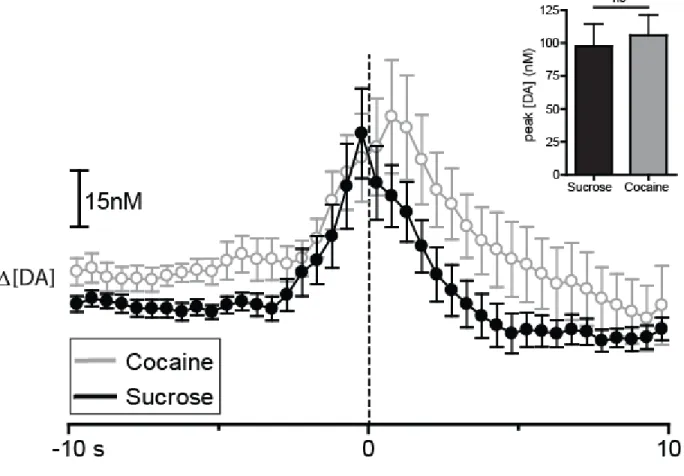
type (F(1,7) = 3.185, p > 0.05) and no reinforcer type x time interaction (F(39,273) = 0.846, p > 0.05). Thus, DA concentration increased from baseline during responding for both sucrose and cocaine, but there were no significant differences in [DA] between the two types of reinforcers.
Figure 2.3. Sucrose and cocaine self-administration evoke rapid DA release in the NAc core. DA concentration is averaged into 500 msec bins (mean ± sem) and aligned to lever press (dotted line, time 0 s) for cocaine (gray) and sucrose (black). Data represent all animals (n = 8) that completed the sucrose/cocaine multiple schedule. Inset: comparison of peak [DA] within a 3 sec window surrounding lever press for sucrose (black) versus cocaine (gray). Peak [DA] is calculated with 100 msec bins.
34
previous electrophysiology studies that examined NAc cell firing during food/cocaine multiple schedules (Carelli et al., 2000; Carelli, 2002; Carelli & Wondolowski, 2003; Carelli & Wondolowski, 2006; Cameron & Carelli, 2012), rapid DA release does not occur selectively to one component of the sucrose/cocaine multiple schedule, but instead increases to the same extent during responding for both types of reinforcers.
Dopamine release during performance of the sucrose/food multiple schedule
35
36
responding for sucrose (F(39,1482) = 25.389, p < 0.0001; Newman-Keuls post hoc tests, p < 0.05; Fig 2.4d).
This pattern of increased DA release relative to responding for both types of reinforcers was observed in all animals that completed the sucrose/food multiple schedule. Separate one-way repeated measures ANOVAs were performed to examine when [DA] increased from baseline during responding for sucrose versus food. These statistics revealed that DA concentrations increased relative to baseline during both the food (F(39,312) = 2.159, P < 0.001) and sucrose (F(39,312) = 5.047, P < 0.0001) portions of the multiple schedule. Newman-Keuls post hoc tests revealed that for the food portion of the multiple schedule DA concentration increased beginning 0.5 s before lever press and ending at lever press, or time 0 (p < 0.05). Likewise, during the sucrose portion of the multiple schedule, Newman-Keuls post hoc tests revealed that DA concentration was significantly elevated beginning 0.5 s before the response and returned to baseline levels 0.5 s after the lever press (p < 0.05).
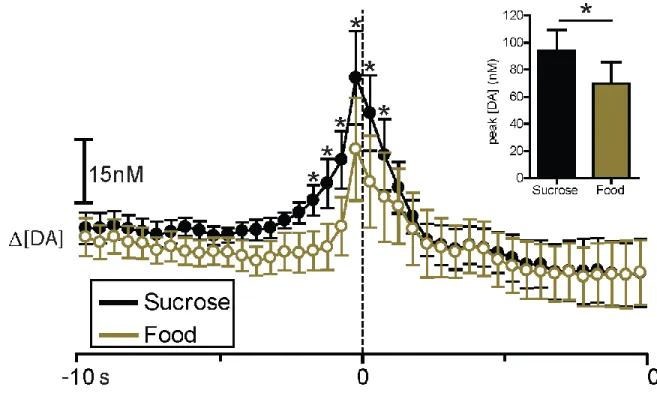
To compare DA release dynamics across the two reinforcer conditions (Fig. 2.5), a two-way repeated measures ANOVA (reinforcer type x time) was conducted on DA concentration. There was no main effect of reinforcer type (F(1,8) = 3.223, p > 0.05); however, there was a main effect of time (F(39,312) = 3.856, p < 0.0001) and a significant reinforcer type x time interaction (F(39,312) = 2.552, p < 0.0001). Newman-Keuls post hoc tests on the significant reinforcer type x time interaction revealed that [DA] was higher during responding for sucrose than during responding for food beginning 2 s before lever press and ending 1 s following lever press (p < 0.05).
37
window surrounding lever press. In this case, our analysis revealed that lever pressing for sucrose increased DA concentrations significantly more than lever pressing for food (t8 = 2.759;
p < 0.05; Fig 2.5, inset).
Figure 2.5. Sucrose and food self-administration evoke rapid DA release in the NAc core. DA concentration is averaged into 500 msec bins (mean ± sem) and aligned to lever press (dotted line, time 0s) for food (gold) and sucrose (black). Data represent all animals (n = 6) that completed the sucrose/food multiple schedule. Asterisks above closed circles indicate significant differences in DA concentration between the two reinforcer types within the indicated 500 msec bins, p < 0.05. Inset: comparison of peak [DA] within a 3sec window surrounding lever press for sucrose (black) versus food (gold). Peak [DA] is calculated with 100 msec bins, *p < 0.05.
Reinforcer order influences peak DA concentration during performance of the sucrose/cocaine but not the sucrose/food multiple schedule
38
phase 2. In contrast, 4 recordings (n = 4 rats) were completed during sessions where cocaine was available in phase 1, followed by sucrose in phase 2.
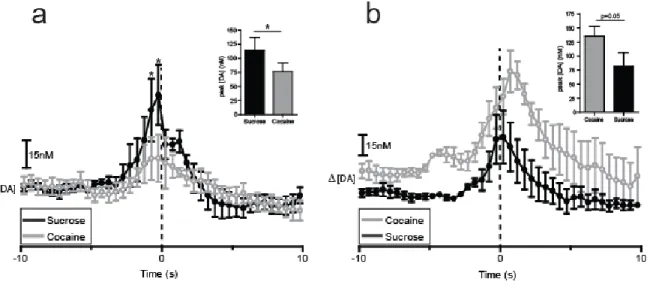
Figure 2.6. DA traces divided by order of sucrose/cocaine multiple schedule. (a) Data from animals (n = 4) that self-administered sucrose followed by cocaine. DA concentrations are averaged into 500 msec bins (mean ± sem) and aligned to lever press (dotted line, time 0s) for sucrose (black) and cocaine (gray). Asterisks above closed circles indicate significant differences in DA concentration between the two reinforcer types within the indicated 500 msec bins, p < 0.05. (b) Data from animals (n = 4) that self-administered cocaine followed by sucrose. Insets: comparisons of peak [DA] calculated with 100 msec bins within the 3 s window surrounding lever press, *p < 0.05.
39
press and ending at lever press, or time 0 (p < 0.05). Similarly, there were significant differences in peak [DA] concentration across reinforcer conditions. Examination of peak [DA] independent of time epoch showed that when sucrose was self-administered prior to cocaine, peak DA concentrations were higher relative to sucrose-responding compared to cocaine-responding (t3 =
4.206; p < 0.05; Fig 2.6a, inset).
A similar analysis was completed to determine [DA] release dynamics during the multiple schedule when reinforcer order was reversed (i.e., when cocaine was given in phase 1 and sucrose in phase 2). A two-way repeated measures ANOVA (reinforcer type x time) conducted on DA concentration for recordings in which cocaine was self-administered in phase 1 showed a main effect of reinforcer type (F(1,3) = 13.491, p > 0.05) and a main effect of time (F(39,117) = 7.546, p < 0.0001), but no reinforcer type x time interaction (F(39,117) = 1.003, p > 0.05; Fig 2.6b). These findings indicate that [DA] increased across time, and this increase was higher during responding for cocaine than during responding for sucrose. Additional analysis was completed to compare peak [DA] across the two reinforcer types. Here, the analysis revealed a trend in higher peak DA concentrations relative to responding for cocaine than during responding for sucrose (t3 = 3.097; p = 0.0534; Fig 2.6b, inset).
40
Figure 2.7. DA traces divided by order of sucrose/food multiple schedule. (a) Data from animals (n = 4) that self-administered sucrose followed by food. DA concentrations are averaged into 500 msec bins (mean ± sem) and aligned to lever press (dotted line, time 0s) for sucrose (black) and food (gold). Asterisks above closed circles indicate significant differences in DA concentration between the two reinforcer types within the indicated 500 msec bins, p < 0.05. (b) Data from animals (n = 4, 5 recordings) that self-administered food followed by sucrose. Insets: comparisons of peak [DA] calculated with 100 msec bins within the 3 s window surrounding lever press.
administered in phase 1 showed no main effect of reinforcer type (F(1,3) = 1.359, p > 0.05); however, there was a main effect of time (F(39,117) = 1.584, p < 0.05) and a significant reinforcer type x time interaction (F(39,117) = 1.907, p < 0.005; Fig 2.7a). Newman-Keuls post hoc tests on the significant reinforcer type x time interaction revealed that [DA] was higher during responding for sucrose than during responding for food beginning 1 s before lever press and ending 0.5 s following lever press (p < 0.05).
41
0.05; Fig 2.7b). Thus, DA concentration increased from baseline during responding for both sucrose and food, but there were no significant differences in [DA] between the two types of reinforcers.
Average peak DA concentrations were not different between the two reinforcers when sucrose was self-administered in phase 1 (t3 = 2.361; p > 0.05; Fig 2.7a, inset) nor when food
was self-administered in phase 1 (t4 = 1.493; p > 0.05; Fig 2.7b, inset).
Next, we examined the influence of reinforcer order (i.e., self-administered 1st or 2nd) on peak DA concentration during the sucrose/cocaine multiple schedule. Again, peak [DA] was calculated with 100 msec bins restricted to a 3 s analysis window surrounding lever press. A two-way mixed design ANOVA with main effects of reinforcer type (sucrose vs. cocaine; between subjects factor), reinforcer order (1st or 2nd in multiple schedule; within subjects factor), and type x order interaction was performed on peak DA concentration. This statistic revealed a main effect of reinforcer order (F(1,6) = 21.847, p < 0.005), but no main effect of reinforcer type (F(1,6) = 0.253, p > 0.05) or interaction (F(1,6) = 0.705, p > 0.05; Fig 2.8a). Therefore, peak [DA] was significantly higher for the reinforcer self-administered first compared to the reinforcer self-administered second. These findings indicate that a higher average peak DA concentration was observed in phase 1, regardless of the type of reinforcer (sucrose or cocaine).
42
was higher relative to responding for sucrose than during responding for food independent of order in the multiple schedule.
Figure 2.8. The influence of reinforcer order and reinforcer type on peak DA concentration. (a) Comparison of peak [DA] for the sucrose (black bars) versus cocaine (gray bars) multiple schedule. (b) Comparison of peak [DA] for the sucrose (black bars) versus food (gold bars) multiple schedule. *p < 0.05
43
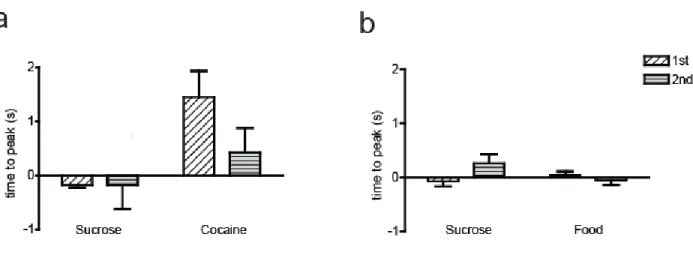
peak [DA] was later for cocaine compared to sucrose (p = 0.074). These findings indicate that the time to reach peak DA concentration was slightly delayed when animals pressed for intravenous cocaine compared to when they pressed for sucrose pellets, independent of phase.
For the sucrose/food multiple schedule, a two-way mixed design ANOVA was completed with main effects of reinforcer type (within subjects factor), reinforcer order (between subjects factor) and type x order interaction on peak [DA] concentration. Results revealed no main effect of reinforcer type (F(1,7) = 1.028, p > 0 .05), no main effect of reinforcer order (F(1,7) = 2.449, p > 0.05 ), and no interaction (F(1,7) = 1.622, p > 0.05; Fig 2.9b). Thus, unlike the sucrose/cocaine multiple schedule, there was no difference in time to peak [DA] relative to reinforcer type in the sucrose/food multiple schedule.
Figure 2.9. The influence of reinforcer type on time to peak. (a) Comparison of time to peak for the sucrose/cocaine multiple schedule. (b) Comparison of time to peak for the sucrose/food multiple schedule. Time 0 corresponds to lever press response. Positive numbers indicate a peak that occurs after lever press, negative numbers indicate a peak that occurs before lever press.
Histology
44
45 Discussion
The present study was completed to determine rapid DA release dynamics in the NAc core during operant responding for a drug (cocaine) versus a natural reward, or two natural rewards (sucrose and food), using multiple schedule designs. Use of the multiple schedules enabled a comparison of DA release events in discrete NAc locations during lever pressing for different rewards within the same behavioral session. During the cocaine/sucrose multiple schedule, similar increases in rapid DA signaling were observed during both phases of the task. Thus, unlike the selective cell firing of NAc neurons related to reinforcer type observed in previous studies (Carelli et al., 2000; Carelli, 2002; Carelli & Wondolowski, 2003; Carelli & Wondolowski, 2006; Cameron & Carelli, 2012), rapid DA release does not ‘turn on’ or ‘turn off’ across each phase of the cocaine/sucrose multiple schedule. This finding indicates that rapid DA release is not reinforcer specific during situations involving goal-directed actions for cocaine versus a natural reward. However, more subtle differences were observed in peak DA concentration across the drug versus natural reward conditions related to the order of reinforcer presentation, the type of reinforcer, and the time to reach peak [DA]. Likewise, similar DA release dynamics were observed during operant responding for two natural rewards, sucrose and food, also with subtle differences in peak [DA] release across reinforcer conditions. The primary findings of the present study are discussed in detail below.
Rapid DA release is not reinforcer specific during goal-directed behavior for cocaine versus a natural reward
46
observed phasic DA release in the NAc on a timescale similar to phasic cell firing in separate studies that examined cocaine versus natural rewards (Phillips et al., 2003b; Roitman et al., 2004). Given these two lines of research, we hypothesized that rapid DA release in discrete NAc locations might also show differential activity relative to goal-directed actions for cocaine versus sucrose. As such, we predicted that we would measure increases in DA release during one phase of the cocaine/sucrose multiple schedule, but not during the other phase.
However, unlike previous electrophysiology studies, we did not observe reinforcer specificity in DA release dynamics during lever pressing for a natural reinforcer (sucrose) versus intravenous cocaine. That is, we observed rapid DA release during both phases of the sucrose/cocaine multiple schedule. Further, not only did we observe similar DA release to both reinforcers in our task, but peak [DA] was not different. That is, collapsed across all animals, peak sucrose-evoked [DA] was almost identical to peak cocaine-evoked [DA]. These findings may provide important insight into the functional organization of the NAc (see below).
Despite these findings, there were more subtle differences in peak DA concentration during the sucrose/cocaine multiple schedule. For example, we observed differences in rapid DA release as a function of reinforcer order in our task. Specifically, when cocaine was self-administered in phase 1, peak [DA] was higher relative to cocaine-responding than during sucrose-responding in phase 2, and vice versa for the opposite order of presentation. Although we designed the experiment to minimize reward comparison (i.e., ‘contrast effects’), the subtle differences may be attributed to
47
Another more subtle difference between DA release dynamics across the phases of the sucrose/cocaine multiple schedule was the time to reach peak [DA]. Prior work using FSCV indicated that DA concentrations began to increase just prior to operant responding for cocaine (Phillips et al., 2003b) and sucrose (Roitman et al., 2004), and this increase in DA peaked near the execution of the lever press response. While similar in their temporal pattern, the actual time to reach peak [DA] was never compared between the two different types of reinforcers since those measurements were completed in different animals. However, here we observed that the time to reach peak [DA] was delayed during cocaine-responding compared to responding for sucrose. While the delayed peak for cocaine did not reach statistical significance, this is likely a result of the relatively lower temporal resolution (100 msec) of FSCV compared to other techniques such as electrophysiology. Nonetheless, a clear difference emerged in time to peak between cocaine and the natural reinforcers food and sucrose. This difference could be related to the interoceptive cues associated with cocaine and food/sucrose (i.e., an intravenous drug infusion over 6 s versus the immediate delivery of a pellet to a foodcup). Since these features are intrinsic to the reinforcer and do not change with the internal state of the animal, the time to peak findings suggest that DA may be encoding some absolute properties of a reinforcer in addition to relative properties such as hedonic value.
Rapid DA release is not reinforcer specific during goal-directed behavior for two natural rewards
48
earlier electrophysiology work found that the majority of phasic NAc neurons (68%) showed similar types of patterned discharges across two natural reinforcers (food versus water; Carelli et al., 2000). This overlapping pattern of phasic activity was maintained even when one of the natural reinforcers was of greater hedonic value. Specifically, when animals performed a multiple schedule for water and highly palatable sucrose, the majority of NAc neurons (65%) were similarly activated (Roop et al., 2002).