SPREADING THE FAITH OR SHARING THE FAITH?
CONTRASTING CONVERSION OPINIONS AND EVANGELISTIC BEHAVIOR AMONG RELIGIOUS YOUNG PEOPLE IN THE UNITED STATES
Adam Layton Long
A thesis submitted to the faculty at the University of North Carolina at Chapel Hill in partial fulfillment of the requirements for the degree of Master of Arts in the Department of Sociology in
the College of Arts and Sciences.
Chapel Hill 2012
ABSTRACT
Adam Layton Long: Spreading the Faith or Sharing the Faith? Contrasting Conversion Opinions and Evangelistic Behavior among Religious Young People in the United States
(Under the Direction of Ted Mouw)
This paper contrasts correlates of conversion opinions and evangelistic behavior of
religious young people in the United States by comparing two random effects longitudinal logistic
regression models based on three waves of the National Study of Youth and Religion. By
distinguishing a) the belief that it is okay to convert others to one’s own religion from b) sharing
one’s faith with people of other faiths, this project demonstrates that proselytizing and
evangelism are distinct though overlapping social phenomena. Interpreting odds ratios from
models including both internal and external factors highlights the differing effects of control
variables and measures of religious content, conduct, and centrality. Interpreting this evidence
prompts a theoretical discussion of how greater religious pluralization may lead to more unsettled
TABLE OF CONTENTS
LIST OF TABLES………v
INTRODUCTION………..….1
Internal and External Dynamics...………2
Modernity and Pluralism……….3
Centrality, Content, and Conduct………...6
Evangelism and Proselytizing………..8
METHODOLOGY………12
Data………12
Measures………14
Analysis………..18
FINDINGS……….19
Controls………..19
Content………...21
Conduct………..22
Centrality………24
CONCLUSION………..26
APPENDIX 1: TABLES OF DATA FINDINGS………..31
LIST OF TABLES
Table 1 - Descriptive Statistics for Religious Young People across
Three Waves (N = 5,037)………...30
Table 2 - Odds Ratios from Random Effects Three-Wave Panel Models Predicting Conversion Opinions and Faith Sharing among Religious Young
“In fact, the man who has a genuine faith feels an irresistible need to spread it. To do so, he comes out of his isolation, he approaches others, he seeks to convince them, and it is the ardor of the convictions he brings about that in turn reinforces his own. That ardor would speedily dissipate if left alone. ” (Durkheim [1912] 1995:427)
“Evangelism refers to excursions made by sectarians to the outside world for the purpose of recruiting sympathizers, supporters, and members. Thus, it is well suited the exuberance and impetuosity characteristic of rebellious youth. ” (Matza 1961: 110)
INTRODUCTION
In his treatise on the social sources of religion, Emile Durkheim argues that nurturing a
passionate religious disposition requires spreading one’s faith. Encountering those who do not
share one’s spiritual outlook stokes the fires of religious passion. It is when the true believer
“comes out of isolation” that religious experience becomes a social one (Durkheim [1912] 1995:
427). According to Durkheim, it takes an Other to build a faith.
Scholars of religion have made various attempts at naming this encounter with the
religious Other. When referring to religious talk across social boundaries, terms such as
“proselytizing,” “evangelism,” and “spreading the faith” are often used interchangeably (e.g.,
Bibby and Brinkerhoff 1974). In common parlance, “proselytizing” denotes the attempt to make
a convert, to persuade another to adopt and integrate an alternative religious belief, practice, or
tradition. Definitions of “evangelism,” however, usually include a wider semantic range.
Derived from the Greek word euangelion, the term “evangel” has been translated into
English as “glad tidings,” “good news,” or simply “gospel.” The contemporary Evangelical
spreading of “good news.” This word’s Christian origin goes hand in hand with common
perceptions of evangelism as a distinctly Christian activity. As Durkheim understood, however,
the potential for sharing what one considers “good news” with the Other is possible wherever
religious boundaries exist.
In order to better understand these verbal encounters across religious boundaries, it is
important to account for both the external and internal dynamics at work when evangelization
occurs. No understanding of how people talk about their faith across social boundaries is
complete without grasping both the external and internal forces that shape such encounters.
Internal and External Dynamics
Scholars of church growth have noted that both institutional factors and contextual factors
contribute to a congregation’s success in attracting adherents and increasing attendance (Dudley
and Cummings 1983). The process of evangelism itself has been characterized as a supply-side
advantage of congregations seeking to break a pattern of stalled growth (Hadaway 1991). From
this perspective, it is the internal dynamic of the congregation’s commitment to spreading its
message that facilitates numerical growth. For example, a study of conversions to Christianity
among Chinese immigrants to the U.S. characterizes church evangelization materials and programs
as effective forms of resource mobilization (Zhang 2006). Other researchers have noted the
distinctly external dynamics that shape a congregation’s efforts at spreading the faith. One study
highlights the role of a city’s population growth in influencing it’s Mennonite community to shift
from isolation to evangelism (Wiesel 1977). As the population of Others increased, so did the
While some scholars of religion debate the relative merits of focusing on either external or
internal dynamics, a number of researchers advocate a more holistic, “both/and” approach that
incorporates both external and internal factors (Bedell 1989, Sherkat 1998, Trinitapoli and Vaisey
2009). The fullest accounts of evangelism adopt this approach in explaining the sharing of faith
across religious boundaries. For example, a historical study of evangelism during the Second Great
Awakening found that both supply-side and demand-side factors contributed to the movement’s
success in 1830s New York (Johnson 1995). While studies of evangelism often focus on
congregations as the unit of investigation, it is possible—perhaps preferable—to incorporate this
“both/and” approach to the study of individual-level evangelism. If so, it would be important to
understand the external context for sharing faith in the modern world.
Modernity and Pluralism
In the wake of the European Enlightenment, early sociologists attempting to understand
the shift to Modernity set a trajectory for their academic discipline in forecasting the demise of
religious belief and practice (Gorski 2003). Since its heyday in the 1960s, this secularization
thesis has been severely contested by the persistence of religion in the contemporary world.
Though faith in secularization may be waning, it has become clear that the shift to Modernity has
not left religion untouched (Jenkins 2002, Wolfe 2003). Modernity does not necessarily
secularize, but it does pluralize:
Sociologists employing a rational choice, supply-side approach have argued that greater
pluralism necessarily increases levels of religious belief and participation (Stark and Finke 2000).
Others have contested this notion, claiming that the “empirical evidence does not support the
claim that religious pluralism is positively associated with religious participation in any general
sense” (Chaves and Gorski 2001: 261). When it comes to the topic of sharing faith, one may
affirm aspects of both perspectives. While pluralism may not increase religious participation in
“any general sense,” it should not be dismissed as an external factor in shaping the particular case
of evangelism (Nelson 1998). Applying Berger and Zijderveld’s insight that Modernity weakens
the walls of segregation that hinder conversation between social groups, it would be expected that
evangelism will persist among religious people in a pluralized context due to increasing contact
with Others.
It is one thing to claim that modern pluralization creates an opportunity structure for
evangelism. It is another thing to provide a possible mechanism at work in this relationship
(Hedström and Swedberg 1998). Toward that end, Ann Swidler’s theory of culture in action
provides an account that can be fruitfully applied to studies of religion (Swidler 1986, Regnerus
and Smith 1998). While culture provides resources for both motivating and justifying action
(Vaisey 2009), Swidler argues that people who become unsettled will dip into their cultural
toolkits for new strategies of action. Those who move through life with stable repertoires look to
cultural resources when confronted with a disruption in their habitual modes of action. The
argument being presented here is that Modernity pluralizes, and pluralization unsettles.
unsettling movement, especially when the journey down the rabbit hole is unanticipated (Carroll
[1865] 1992).
The reference to British children’s literature is not without merit. Swidler herself notes
the particular relationship between her theory of culture and the lives of young people:
“Being swept away by cultural experiences, from religious conversion to rock concerts, seems mainly an activity of the young…. Young people are voracious culture consumers because they are still trying out (and trying on) the possible selves they might become. They are in the process of forming and reforming strategies of action, developing the repertoire of cultured capacities out of which they will construct the patterns of their adult lives” (Swidler 2003: 89, 90).
Researchers wanting to better understand how evangelism becomes a strategy of action for those whose lives have become unsettled by pluralism would certainly benefit by studying religious young people in a socially diverse environment. The study of youth and religion provides an especially helpful field for understanding the cultural dynamics of sharing faith in a pluralized world.
While scholars disagree on the precise extent of religious diversity in the United States,
the 1965 Immigration and Naturalization Act has clearly expanded the religious landscape to
include more than Protestant, Catholic, and Jew (Herberg 1983, Eck 2001, Chaves 2011). Diana
Eck (2006) has concluded that “This generation of young people is what we might call the first ‘interfaith generation.’ ” In response to this expanding religious field, an interfaith youth movement has arisen, attempting to provide young people with new strategies of action to include in their cultural toolkits. This movement attempts to help religious people link their private religious discourse with a public religious discourse, which will prevent conflict and multiply social capital (Patel 2006). Movement leaders distinguish between diversity, which has to do with proximity, and pluralism, which has to do with engagement (Patel 2006). The argument being presented here is that even without the assistance of interfaith repertoires, young people in an increasingly diverse
If the argument about the unsettling effects of pluralism is accurate, increased effects among minority populations should become apparent. Because they have more opportunities to become unsettled by encountering majority traditions, religious minority populations should evidence higher levels of religious talk across social boundaries—regardless of their tradition’s teaching on the need for attracting converts. Prior research demonstrates that shifting between majority to minority statuses does influence strategies of action for proselytizing among immigrant congregations (Yang and Ebaugh 2001). And even researchers who doubt that pluralism leads to greater religious participation in general conclude that empirical evidence supports the claim that a minority social position does evoke greater religious commitment (Chaves and Gorski 2001).
As argued above, examining the external factors influencing religious patterns provides only half the story. Offering a fuller account requires addressing the internal factors as well. In order to achieve continuity with other studies of youth and religion using the same data, this study adopts the approach presented by Pearce and Denton (2011), which focuses on the three main dimensions of religiosity: the centrality of religion to life, the content of religious belief, and the conduct of religious activity. These three C’s provide the organizational structure for exploring the internal factors shaping patterns of faith sharing among U.S. young people.
Centrality, Content, and Conduct
Durkheim’s century-old insight concerning the central role played by religious passion in spurring on evangelistic behavior continues to prove persuasive. Robert Putnam and David E. Campbell (2010) argue that those who regard religion as most central to their lives are the most active in sharing their faith. According to these authors, believing that only one religion is true motivates true believers to engage in evangelism. Other researchers suggest that religious
While that may be the case, the study design does not include a comparison group. As such, it remains difficult to determine if the effects of religious experience would remain the same for other groups. Because Pentecostals encourage and expect charismatic activities such as speaking in tongues, it might be that the religious experiences serve to confirm preexisting beliefs, providing what is interpreted as evidence for their veracity. It is not difficult to imagine how the coherence between belief and experience could incite such believers to spread their ideas. However, it is unclear whether or not this relationship would hold among other, non-charismatic groups. Though the specific mechanism involved in the causal argument remains unclear, the authors of this study do allow that charismatic activities serve as “indicators of a personal relationship with God ”
(Poloma and Pendleton 1989). Thus, their study endorses the perspective that as religious centrality rises, so does evangelistic activity.
Another internal factor that may affect such activity concerns the content of one’s religious beliefs. While some theorists argue that ideology serves mainly to justify actions that have already been adopted, others suggest that holding particular beliefs can actually motivate behavior (Smith 2003, Vaisey 2009). For example, David W. Stevens (2004) discovered that a commitment to evangelizing nonmembers proved more salient than intergenerational conflict in shaping strategies of action in an immigrant congregation. When it comes to sharing faith, evidence suggests that evangelistic activity simply cannot be sustained without maintaining its motivating ideology (Zald and Denton 1963). Notions of “the judgment day” and “the apocalypse” prove especially significant when discerning the role of belief in the process of evangelism. Religious scenarios concerning the “end of the world ” have been shown to animate collective action that centers on spreading faith (McMinn 2001).
Along with centrality and content, religious conduct plays a role in any thorough discussion of evangelism. A persistent theme in the literature involves the distinction between evangelism and social justice action. Several studies claims that religion individuals and congregations in the U.S. sort neatly into those that focus on evangelism and those that prefer service activities, such as
the split runs within single denominations (Hoge, Perry, and Klever 1978, Hoge, et al. 1982) and faith-based organizations (Ebaugh, Rose, Chafetz, and Pipes 2006). At other times, the distinction between evangelistic groups and service-oriented groups maps neatly onto conservative and liberal religious traditions (Bibby and Brinkerhoff 1974, Wilson and Janoski. 1995). Studies involving the religious lives of young people confirm this trend. Pargament and colleagues (1984) find that highly religious college students desire more evangelistic and less service-oriented activity from their campus ministry organizations, while the unchurched report more concern for social justice.
However, not all empirical evidence reinforces the neat distinction between evangelistic conservatives and service-oriented liberals. Regnerus, Smith, and Sikkink (1998) note that Evangelicals contribute slightly more money directly to assist people living in poverty than either Liberal Protestants or Catholics. While not a competition, this finding challenges the received wisdom that Conservative Protestants necessarily focus on evangelism to the exclusion of social justice. Within Conservative Protestantism, R.L. Young (1992) discover a distinction between more evangelistic and more fundamentalist camps concerning support for the death penalty. Those considered more evangelistic reported greater opposition to the death penalty than did their fundamentalist counterparts, leading the authors to posit a relationship between holding an evangelistic outlook and having concern for the welfare of others. While the studies mentioned above tie evangelism to other-worldly preoccupation, this study links evangelism directly with concern for the world here and now. When it comes to young people, Trinitapoli and Vaisey (2009) find that short-term missions trips for religious adolescents most often focus on service projects rather than proselytizing. As it turns out, attending these mainly service-oriented trips increases both evangelistic activity and the opinion that it is acceptable to proselytize people of other religious groups.
Evangelism and Proselytizing
decide how to respond in return. In an increasingly globalized civil society, religious conversion is both protected and contested (Thomas 2001). On the one hand, personal religious decisions fall into the realm of individual liberties, the protection of which signals broad-minded tolerance of competing viewpoints. On the other hand, conversion can be viewed as a threat to minority ethno-cultural groups. Proselytizing, or the attempt to make religious converts, becomes stigmatized because it posits the supremacy of a single cultural narrative that requires other-worldly salvation. The very act of trying to persuade others to adopt a new religious frame transgresses the broader civil frame of tolerance and inclusion (Ingram 1989).
By focusing on the proselytizing behaviors of individual religious groups, one may be tempted to view the problematic nature of proselytizing as deriving from the group itself instead of arising from the inherent tension between the religious group and its context:
“According to those who say an evangelical had at some time tried to convert them to their faith, only between ten and twenty percent said that that was a positive experience. About one-half said it was a negative experience. The remainder said it was neither positive nor negative. Evangelicals may be ‘out there’ evangelizing. But when they do so, they are generally not leaving particularly good impressions on those they are proselytizing. This suggests that evangelicals have a real problem knowing how to communicate their message in a manner that will be well-received; or perhaps rather that the character of the evangelical message message itself, influenced as it is by important features of the evangelical
subculture, tends to be alienating” (Smith 1998: 181-182, emphasis added).
Given the contested nature of proselytizing in a globalized civil society, one wonders whether it is fair to charge any religious group with poor communication or an alienating message without providing a comparison group. Are Evangelicals more alienating than Latter-day Saints or Catholics or Muslims or Buddhists? Perhaps. Or it might be that anyone asserting his or her religious
message as “the truth ” runs the risk of alienating the Other by transgressing the civil frame of tolerance and inclusion.
value evangelism while avoiding intolerance (Hadaway 1980). Likewise, positive attitudes towards evangelism can certainly be distinguished from fanaticism, defined as the “degree of missionary zeal to spread particular belief as a panacea for social and personal ills” (Seyfarth 1984: 56). A stated goal of the youth interfaith movement centers on equipping young people to link their private religious discourse with a public religious discourse, preventing conflict and multiplying social capital (Patel 2006). Such innovation serves as a reminder that the unsettledness that results from the intersection of the globalized civil frame and the particularistic religious frame can generate novel strategies of action. Cultural norms certainly shape behavior; but their malleability might exceed that of an iron cage or steel-hard shell (cf. Weber [1905] 2002).
Recognizing that different religious traditions adopt distinctive approaches to sharing their faith further nuances the topic of evangelism. Known for their Reformation roots in the doctrine of
sola scriptura, Protestants tend toward sharing their faith verbally and cognitively (McCallion 2008). Conversely, evidence of the Catholic focus on a sacramental understanding of the universe plays out in their visual and material approaches to evangelism (ibid.). Such distinctive approaches become reinforced through various venues of religious education. For example, rural Evangelical Protestant youth ministries engage in evangelism activities at much higher rates than their Catholic counterparts (Goreham 2004). However, groups from both traditions engage in compassion outreaches such as visitation at similar levels (ibid.). As this project focuses on verbal
communication, it should be noted that some religious traditions conceive of evangelism in terms that transcend conversation.
populations. Similarly, African-American Protestant congregations that utilize gospel rap music in their church services often do so with the intention of attracting younger African-American males toward religious conversion and participation—often with great success (Barnes 2008). These two examples highlight how different religious groups conceptualize in-group outreach.
Given the multiplicity of outreach approaches among religious groups, it becomes theoretically useful to distinguish between evangelism and proselytizing. Such a distinction will grow ever more salient as deeply religious people become unsettled by the global civil frame of tolerance. Evangelism should denote any religious talk across social boundaries. It occurs when a religious person converses about his or her religion with a person of a different or no religious perspective. This talk may or may not have as its goal the conversion of the Other. Instead, such witnessing may consist solely of explanation with no intent to persuade. Proselytism, on the other hand, is a more limited term. This subset of evangelism aims directly at making converts to one’s religious point of view. The distinguishing characteristic of proselytizing is the persuasive intent of the interaction. This distinction provides a way of accurately describing the lived experiences of religious people who encounter the Other (cf. Bibby and Brikerhoff 1974). Put simply, evangelism is sharing the faith, and proselytizing is spreading the faith.
METHODOLOGY
Data
The following discussion quotes and adapts the “Standard Methods Information
Recommended for Use in Journal Articles from the National Study of Youth and Religion
Telephone Survey Codebook.” The National Study of Youth and Religion (NSYR)’s longitudinal
telephone survey began as a nationally representative telephone survey of 3,290 English and
Spanish speaking teenagers between the ages of 13 and 17. The baseline survey was conducted,
with the teen respondents and one of their parents, between July 2002 and April 2003 by
researchers at the University of North Carolina at Chapel Hill. A random-digit dial (RDD)
telephone method was employed to generate numbers representative of all household telephones
in the 50 United States. Also included were 80 oversampled Jewish households, not nationally
representative (described below), bringing the total number of completed cases in the first wave
of NSYR to 3,370. The second wave and third waves of the NSYR are re-surveys of the Wave 1
English-speaking teen respondents. All waves of the survey were conducted by telephone using a
Computer Assisted Telephone Interviewing (CATI) system.
The Wave 2 survey was conducted from June 2005 through November 2005 when the
respondents were between the ages of 16 and 21. Wave 3 of the survey was fielded from
September 2007 through April 2008 when the respondents were between 18 and 24 years old.
completed the Wave 2 survey or not, including those out of the country and in the military. Of
the original respondents, 2,604 participated in the second wave of the survey resulting in an
overall retention rate of 78.6 percent. The predominant source of attrition in the second wave
was non-located respondents. The Wave 2 cooperation rate was 89.9 percent. The refusal rate for
Wave 2, calculated as the number of eligible respondents (N = 3,312) that refused to take part in
the survey, was 4.0 percent. In Wave 3, 2,532 original youth respondents participated in the
survey for an overall Wave 1 to Wave 3 retention rate of 77.1 percent. The main source of
attrition in the third wave was again non-located respondents (although not necessarily the same
as those not located in Wave 2). The Wave 3 refusal rate, calculated as the number of eligible
respondents (3,282) who refused, was 6 percent. The percentage of respondents who completed
all three waves of the survey was 68.4 percent.
Diagnostic analyses comparing NSYR data with U.S. Census data on comparable
households and with comparable adolescent surveys---such as Monitoring the Future, the
National Household Education Survey, and the National Longitudinal Study of Adolescent
Health---confirm that the NSYR provides a nationally representative sample without identifiable
sampling and nonresponse biases of U.S. teenagers ages 13-17 and their parents living in
households (for details, see Smith and Denton 2003). For descriptive purposes, a weight was
created to adjust for number of teenagers in household, number of household telephone numbers,
census region of residence, and household income. A separate weight is used in multivariate
analyses that control for census region and household income, which adjusts only for number of
teenagers in a household and number of household telephone numbers. The 80 Jewish oversample
Measures
A major strength of utilizing all three waves of NSYR data is the ability to investigate
trends in evangelism across time. Rather than providing only a cross-sectional snapshot at a
single moment, this analysis offers the benefits of using longitudinal data. It notes the
relationships between dependent and independent variables across three different points in time,
enhancing the possibility of positing causal arguments. Though utilizing lagged variables can
further assist in making causal arguments, it was ruled about for two reasons. First, one
dependent and several independent variables measure activity within the last year. Lagging
variables that already includes a delayed time component would introduce excessive time
distortion into the models. Second, the time periods between the three different waves of the
NSYR are not equidistant, making it difficult to assess the relative effect of lagging between
waves.
Preparing the panel data set began with dropping all nonreligious young people from each
of the three waves. While it may have been interesting to capture the opinions and practices of
nonreligious young people concerning evangelism, the NSYR skip sequence precluded them from
questions on this topic. Young people who reported having no religious tradition, no belief in
God, and/or no attendance at religious services did not answer questions about evangelism and do
not appear in this analysis. This resulted in dropping 651 respondents from the first wave, 723
from the second, and 916 from the third. Once the dependent and independent variables from
each wave were prepared and respondents with missing or unusable responses were dropped, the
three waves were combined into a single panel data set with an N = 5,037. Rather than
description of univariate statistics focuses on trends across waves and rounded percentages from
the total sample.
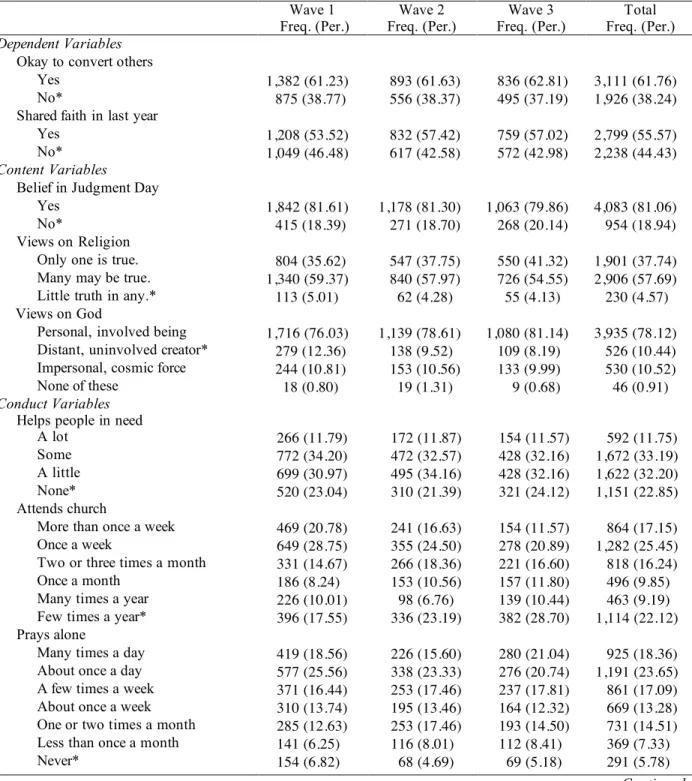
Table 1 About Here
This project compares the impact of one set of independent variables on two
dichotomous dependent variables, all of which appear in Table 1. The first dependent variable
captures young people’s opinions about the act of proselyting: “Is is okay for religious people to
try to convert other people to their faith, or should everyone leave everyone else alone?” At each
wave, slightly more than 60 percent of each wave said yes, while the remainder (40 percent) said
no. The second dependent variable measures the extent of evangelism by young people: “In the
last year, have you shared your own religious faith with someone else not of your faith?” At each
wave, approximately 55 percent indicated they had, while the remainder (45 percent) said they
had not. Including both dependent variables in this analysis makes it possible to contrast
opinions about proselytizing with activity involving evangelism. The remaining independent
variables fall into four categories: controls, content, conduct, and centrality.
The control measures for this project include age, sex, race/ethnicity, census region, and
religious tradition. As the only continuous variable, age ranges from 13 to 17 in wave one, from
16 to 20 in wave two, and from 17 to 24 in wave three. Age in the total sample has a mean of 17
and a standard deviation of 2.5. As all other variables are either nominal or ordinal, dummies for
each measure appear in the final models. Because the NSYR data contains four cases in which
respondents changed their gender identification at least once, the measure of gender used for all
three waves reflects the response given at the first wave. The total ratio of females to males is
sole indication of this measure for all three waves. As expected, Whites constitute the majority of
the total sample (67 percent), followed by African Americans (18 percent), Latinos/as (10
percent), and Other races/ethnicities (5 percent).
Though including the Other race/ethnicity category will not reveal substantive information
about the effects of specific groups within it, the inclusion allows this project to address the
issue of minority status in an age of increasing diversity. For example, it will not be possible to
make claims about the effect of being Asian on the dependent variables. But it will be possible to
explore how occupying a minority position does. This same principle applies to religious
tradition. While Conservative Protestant (41 percent) and Catholics (26 percent) constitute the
largest groups, the equally represented Mainline Protestants (13 percent) and African American
Protestants (13 percent) accompany Latter-day Saints (3 percent), Jewish (1 percent), and
Others (3 percent). Rounding out the control variables, the census region shows concentrations in
both the South (47 percent) and Midwest (25 percent) with fewer respondents residing in the
West (17 percent) and Northeast (12 percent).
The three content measures for this project include belief in a judgment day, views on
religion, and views on God. In response to the question, “Do you believe that there will come a
judgment day when God will reward some and punish others, or not?” a large majority (81
percent) responded yes, and the rest (19 percent) responded no. When asked to identify which
statement comes closest to their own views about religion, over half agreed that many religions
may be true (58 percent), a sizable portion indicated that only one religion is true (38 percent),
and a minority expressed the view that there is very little truth in any religion (5 percent). When
for a personal being involved in lives of people (78 percent). Much smaller portions viewed God
as an impersonal, cosmic life force (11 percent) or as a creator who is uninvolved in the world (10
percent). Only 1 percent chose none of these options.
The three conduct measures for this project include helping people in need, attending
church, and praying alone. When asked, “In the last 12 months, how much, if at all, did you help
homeless people, needy neighbors, or other people in need, directly, not through an
organization?” responses included a lot (12 percent), some (33 percent), a little (32 percent), and
none (23 percent). Rates of church attendance consisted of the following categories: more than
once a week (17 percent), once a week (25 percent), two or three times a month (16 percent),
once a month (10 percent), many times a year (9 percent), and a few times a year (22 percent).
When asked how often they pray alone, student reported praying many times a day (18 percent),
about once a day (24 percent), a few times a week (17 percent), about once a week (13 percent),
one or two times a month (15 percent), less than once a month (7 percent), and never (6 percent).
While consolidating the responses to this and other measures into fewer categories makes for
simpler models, including all of the responses provided in the original survey design allows for
greater analytical detail.
The three centrality measures for this project include thinking about the meaning of life,
rating the importance of faith for daily life, and feelings of closeness to God. When asked “How
often, if at all, do you think about the meaning of life?” respondents chose between the options very often (26 percent), fairly often (19 percent), sometimes (32 percent), rarely (16 percent),
and never (8 percent). When asked “How important or unimportant is religious faith in shaping
somewhat (31 percent), not very (7 percent), and not at all (2 percent). And when asked “How
distant or close do you feel to God most of the time?” the options included extremely close (12
percent), very close (29 percent), somewhat close (37 percent), somewhat distant (17 percent),
very distant (4 percent), and extremely distant (1 percent).
Analysis
This project presents two longitudinal regression models prepared using the xtlogit
command in the statistical software package STATA. As this package disallows the use of
weights with the xtlogit command, these models utilize unweighted data. Because the NSYR
panel data set does not contain sufficient variation to adopt a fixed effects approach, this project
presents random effects models. While using fixed effects models can assist in making causal
arguments, such models drop from the analysis variables that do not exhibit sufficient variation
over time. By using a random effects approach, this project retains a fuller set of measures,
enabling a discussion of important insights based on more stable variables (e.g., sex,
race/ethnicity).
When discussing a single dependent variable, researchers often present several regression
models containing different groupings of independent variables. This allows the researcher to
contrast partial models with the final model containing all or most of the independent measures.
This project, however, highlights the differences between models with two different dependent
variables. Rather than contrasting different groupings of independent measures on a single
dependent variable, this project contrasts the effects of the same set of independent measures on
two different dependent variables. Because the main comparison occurs between models rather
FINDINGS
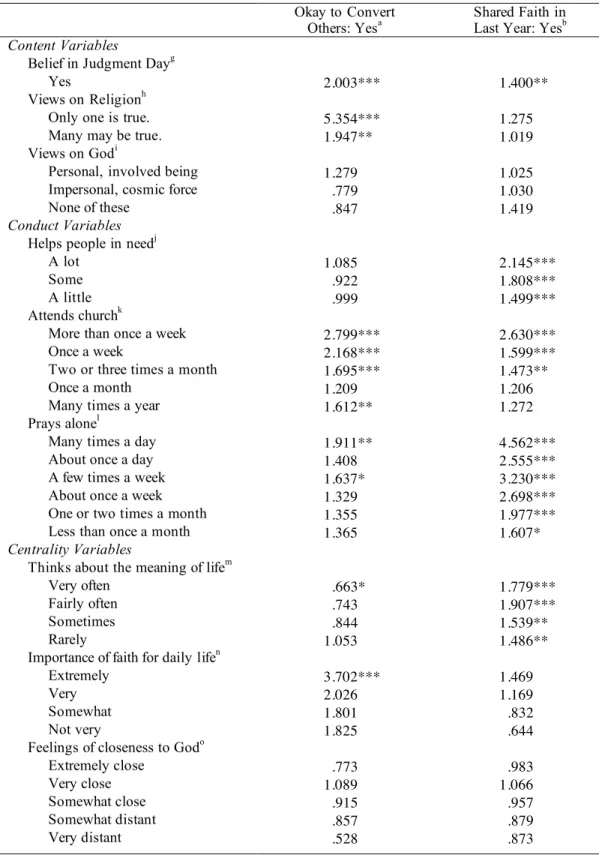
Table 2 presents the odds ratios from the random effects three-wave panel models
predicting conversion opinions and faith sharing among religious young people. Rather than
discussing the models separately, this analysis compares and contrasts the influence on both
dependent variables of the four categories of independent variables: controls, content, conduct,
and centrality.
Table 2 About Here
Controls
The first control variable, age, has no significant effect on whether religious young people
feel that it is okay to convert others. However, each additional year of life year increases by 8
percent the odds that a religious young person has shared his or her faith with a person of
another faith. While conversion opinions appear relatively stable over time, aging increases the
likelihood that religious young people will share their faith with a person of a different faith.
While the odds of believing it is okay to convert others are 73 percent higher for males than for
females, the odds of sharing faith are the same for both genders. While males demonstrate a higher
level of tolerance for persuading others on religious matters, they do not share their faith at higher
rates.
When it comes to race and ethnicity, only one group differs significantly from whites on
okay to convert others for Latinas/os are about 40 percent lower than for whites. And the odds
of faith sharing for African Americans are about 40 percent lower than for whites. Perhaps
Latino/a young people express lower tolerance for proselytizing as a reaction to assimilation
pressures placed on people perceived to be immigrants. And the lower rates of faith sharing
among African American young people may result from a focus on in-group outreach rather than
out-group proselytizing. While census region has no significant effect on conversion opinions, the
odds of faith sharing are 50 percent higher among those living in the west than those residing in
the south. It may be that religious young people living in less religious areas are more likely to
have (and take) opportunities to share their faith with those who see things differently.
The control variable demonstrating the most divergent influence on the two dependent
variables is religious tradition. While several religious traditions have similar odds of conversion
opinions and faith sharing compared to Conservative Protestants, other groups differ from them
in opposite directions on conversion opinions and faith sharing. Compared to Conservative
Protestants, the odds of thinking it is okay to convert others for African American Protestants
are 50 percent lower, and the odds of faith sharing are 40 percent lower. Among Catholics the
same odds are 30 percent lower and 70 percent lower, and among Mainline Protestants they are
40 percent lower and not significantly different. These trends reaffirm the greater emphasis
placed on verbal evangelism among Conservative Protestants, with the caveat that Mainline
Protestant young people share their faith at rates that are not significantly different than their
Conservative Protestant cousins.
The pattern of having a similar or lower rate of believing it is okay to convert others and a
other groups. Among Other religious groups, the odds of thinking it is okay to convert people is
not significantly different at the .01 level than for Conservative Protestants, but the odds of
sharing faith for Other religious groups is almost 250 percent higher. Among Jewish young
people, the same odds are 90 percent lower and 620 percent higher. This massive disparity
signals a clear distinction between proselytizing, which aims at converting others, and evangelism,
which includes any sharing of religion across social boundaries. Finally, the odds of believing it is
okay to convert others for Latter-day Saints are about 400 percent higher than for Conservative
Protestants, but this same group joins Mainline young people in sharing their faith at a rate that
does not differ significantly from the reference group. New religious movements that pursue the
dual goals of proselytizing others while seeking cultural legitimation as a Christian group may
find it difficult to engender evangelistic behavior exceeding that of the dominant evangelical strain
of Christianity.
Content
The content variable of believing in a judgment day exhibits a positive influence on both
conversion opinions and faith sharing. The odds of thinking it is okay to convert others for those
who believe in a judgment day are 100 percent higher as for those who do not. And the odds of
sharing faith for the same group are 40 percent higher. While it is possible that some young
people find themselves sharing their faith and later extrapolate backward to proselytizing
opinions and judgment day beliefs, it seems much more likely that such beliefs motivate
evangelistic action. It is difficult to imagine a young person sharing faith and later concluding,
“There must be a judgment day because I have had a religious conversation across social
who believe that many religions may be true have odds of thinking that it is okay to convert
others that are about 90 percent higher, and those who think that only one religion is true have
odds that are 450 percent higher. Such views on religion have no significant influence on
evangelistic behavior. Similarly, one’s view of God has no significant influence on either
conversion opinions or evangelistic activity.
Conduct
While the conduct variable of helping people in need has no significant effect on
conversion opinions, it does influence evangelism activity. Compared to young people who never
help people in need, the odds of sharing faith for those who help a little are 50 percent higher, for
those who help some are 80 percent higher, and for those who help a lot are 110 percent higher.
This relationship suggests that religious young people who share their faith may view such
conversation primarily as a means of being helpful to others. Compared to young people who
attend church only a few times a year, the odds of thinking it is okay to convert others for those
who attend many times a year are 60 percent higher for those attending many times a year, 20
percent higher for those attending once a month, 70 percent higher for those attending two or
three times a month, 110 percent higher for those attending once a week, and 180 percent higher
for those attending more than once a week. A similar pattern holds between church attendance
and evangelistic activity. Compared to the same reference group, the odds of sharing faith are 27
percent higher for those who attending once a month, 20 percent higher for those attending once a
month, 47 percent higher for those attending two or three times a month, 60 percent higher for
those attending once a week, and 160 percent higher for those attending more than once a week.
times a year” and the more frequent “once a month” may result from the higher desirability of
selecting an attendance category containing the word “many” vs. a category that contains the
word “once.”
The act of praying alone demonstrates a much stronger relationship to faith sharing than
conversion opinions. Compared to those who never pray alone, the odds of believing it is okay to
convert others are 64 percent higher for those who pray a few times a week and 90 percent higher
for those who pray many times a day. However, compared to the same reference group, the odds
of sharing faith are 61 percent higher for those who pray alone less than once a month, 98 percent
higher for those who pray alone one or two times a month, 170 percent higher for those who
pray alone about once a week, 223 percent higher for those who pray alone a few times a week,
156 percent higher for those who pray alone about once a day, and 356 percent higher for those
who pray many times a day. This pattern clearly demonstrates that the more regularly religious
young people talk with God, the more likely they are to have shared their faith with a person of a
different religious orientation. More talking to God equals more talking to religious Others. The
slight dip in both categories that occurs with the about once a day group. The slight dip in both
conversion opinions and faith sharing between the less frequent “a few times a week” and the
more frequent “about once a day” may result from the higher desirability of selecting a prayer
category containing the word “few” vs. a category that contains the word “once.” It might also be
that religious young people feel obligated to report praying alone about once a day, regardless of
Centrality
The centrality variable of thinking about the meaning of life bears little relationship with
conversion opinions among religious young people. Compared to those who never think about
the meaning of life, the odds of thinking that it is okay to convert others are not significantly
different from any category except those who think about the meaning of life very often—odds
which are 34 percent lower. Perhaps religious young people with a deeply contemplative
approach to life feel strongly about their conclusions, resisting others’ attempts to change their
minds. If so, this suggests that such contemplatives spend at least some effort putting themselves
in others’ shoes, imagining what it would be like to be on the receiving end of unwanted
proselytizing attempts.
When it comes to faith sharing, a much different pattern arises. Compared to those who
never think about the meaning of life, the odds of faith sharing are 49 percent higher for those do
so rarely, 54 percent higher for those who do so sometimes, 91 percent higher for those who do
so fairly often, and 78 percent higher for those who do so very often. This pattern suggests that
contemplation decreases rhetoric and increases sharing. The more that religious young people
think about the meaning of life, the more likely they are to discuss—but not demand agreement
with—their religious thoughts.
Of the final two centrality variables—the importance of faith for daily life and feelings of
closeness to God—only one significant relationship emerges. Compared to those who rate faith
as being not at all important for daily life, the odds of thinking that it is okay to convert others
this one notable exception, these two subjective measures of religious centrality exert no influence
CONCLUSION
The main finding of this project is that evangelism and proselytizing are not synonymous.
Regression analysis distinguishes two distinct relationships between the independent variables
and the two dependent variables: conversion opinions and evangelistic behavior. Understanding
the distinctions between these relationships requires distinguishing between internal and external
factors.
Given the single exception of thinking about the meaning of life, increases in the internal
measures—content, conduct, and centrality—correlate with increases in one or both of the
dependent variables. While belief in a judgment day strengthens both conversion opinions and
faith sharing, religious exclusivism increases only conversion opinions, and beliefs about the
nature of God exert no influence on either measure. While private prayer and church attendance
strengthen both conversion opinions and faith sharing, helping people in need relates positively
only with faith sharing. While thinking about the meaning of life strengthens faith sharing, only
rating faith as extremely important for life correlates with positive conversion opinions. Though
previous studies argue for a positive relationship between spiritual experience and evangelism
(Poloma and Pendleton 1989), feelings of closeness to God show no influence on either
conversion opinions or faith sharing in these models. The overall pattern provides some evidence
when noting the specific ways in which these internal measures relate differently with conversion
opinions and faith sharing.
Young people who espouse exclusivist beliefs and go to church often prove more likely to
think it is okay to convert people of other faiths to their own. This suggests that participation
rooted in congregational life and religious exclusivism increases competition in the market of
ideas. The more one gathers with people of like faith and assents to exclusivist doctrines, the
more he or she sees interaction with religious Others in terms of persuasion. It is easy to see how
believing that only one religion is true demonstrates religious exclusivism, and believing in a
judgment day at least raises the possibility that a distinction will be made between the innocent
and the guilty, the saved and the damned. But it is also true that congregational life socially
embodies such exclusivism. While religious congregations may make every attempt to be inviting
to newcomers, they nonetheless maintain boundaries between insiders and outsiders. Even the
most open and welcoming congregations distinguish themselves from those who are not open and
welcoming. Both belief and group formation contribute to maintaining the distinction between the
sacred and the profane, a distinction that becomes important to impress upon others.
Surprisingly, these exclusivist internal factors are not the most important influences on
faith sharing. Young people who increasingly pray alone, help people in need on their own, and
ponder the meaning of life are actually more likely to share their faith with others. As faith
becomes internalized and generosity becomes intrinsic, religious young people become more
likely to evangelize. Importantly, this pattern emerges when controlling for religious tradition. In
this case, the old dichotomy between sharing one’s faith and working for social justice lacks
Rather the more likely religious young people are to help those in need, the more likely they are
to share their faith. The emerging generation simply has not received the memo that they are
supposed to choose one or the other. Given that some young people report both believing that it
is okay to convert others and sharing their faith in the previous year, clearly some evangelism
includes the attempt to convert others. However, exploring control variables demonstrates that
this is not necessarily the case for all young evangelists.
Age, sex, and race/ethnicity show uneven influences on conversion opinions and faith
sharing. Aging increases the likelihood of sharing faith, but not of thinking that it is okay to
convert others. It might be that growing older increases opportunities and/or confidence for
conversing about religion across social boundaries. Flipping the pattern, males and females have
the same levels of faith sharing, but men are more likely to think that it is okay to convert others.
The social construction of masculinity surely encourages and enables more aggressive forms of
religion; but it does not incite the actual practice of evangelism. When it comes to race/ethnicity,
Whites hold similar conversion opinions and faith sharing with other groups, excepting Latinas/os
who are less willing to say that it is okay to convert others and African-Americans who are less
likely to share their faith. As argued above, such differences may arise from both the reactions to
assimilation pressures placed on people perceived to be immigrants and a focus on in-group
outreach rather than out-group proselytizing.
Detecting how increasing pluralism structures conversion opinions and faith sharing
among religious young people requires examining the effects of the final two external factors:
census region and religious tradition. In the case of census region, living in the west has no effect
south. Perhaps this occurs because the south is more densely populated with religious young
people than is the west. The experience of living in an area with fewer religiously likeminded
peers presents more opportunities to have religious conversations across social boundaries. This
pattern intensifies when evaluating the effects of religious tradition. As described above, African
American Protestants, Catholics, and Mainline Protestants espouse less proselytizing rhetoric
and report less or similar evangelistic behavior as Conservative Protestants. These mainstream
religious traditions, known for in-group outreach, nonverbal evangelism, social action do not
encourage aggressive verbal proselyting. Occupying a minority religious position, however, does
not necessarily weaken conversion opinions. While Latter-day Saints are many times more likely
to believe it is okay to convert others than Conservative Protestants, but this belief does not
translate into more faith sharing. Perhaps many Mormon young people live in close proximity
with other Mormon young people, having less opportunity to engage with religious Others.
The most striking findings from this project—and the greatest evidence that proselytizing
and evangelism are not synonymous—arise from examining young people who are Jewish or
from other religions. These cases demonstrate the greatest effects of occupying minority religious
positions in a pluralistic world. While the odds of thinking that it is okay to convert others are
the same for Conservative Protestants and Other religions, the odds of sharing faith are
considerably higher for the minority group. In an even greater divergence, religiously Jewish
young people have much lower odds of believing that it is okay to convert others and much
higher odds of sharing their faith. The contrast is 85 percent lower and 620 percent higher as
of having greater odds of believing that it is okay to convert others but lower odds of sharing their
faith as compared to the control group.
While some Christian groups label other Christian groups religious outsiders, others do
not. Methodists might talk about their faith with Anglicans without reporting that they have
shared their faith with a person of another faith. More conservative Christian groups, however,
might view every religious conversation with someone not from their tradition or church as an
opportunity to proselytize. In the case of religious minorities, however, the social boundaries
become clearer to both parties. It is important to note that the greatest divergence in conversion
opinions and faith sharing arises within a non-Christian religious tradition. In occupying a
minority religious position, even non-proselytizing religious such as Judaism will have highly
evangelistic young people. If this pattern holds, then increasing pluralization will lead to more
unsettled lives which will produce more evangelism. Regardless of their conversion opinions, the
arrival of non-Christian religious groups will increase the opportunities for and the instances of
this behavior. Future research on this topic would do well to distinguish between proselytizing
and evangelism—the attempt to convert and the broader category of sharing faith across social
APPENDIX 1: TABLES OF DATA FINDINGS
Table 1. Descriptive Statistics for Religious Young People across Three Waves (N = 5,037)
Wave 1 Wave 2 Wave 3 Total
Freq. (Per.) Freq. (Per.) Freq. (Per.) Freq. (Per.) Dependent Variables
Okay to convert others
Yes 1,382 (61.23) 893 (61.63) 836 (62.81) 3,111 (61.76)
No* 875 (38.77) 556 (38.37) 495 (37.19) 1,926 (38.24)
Shared faith in last year
Yes 1,208 (53.52) 832 (57.42) 759 (57.02) 2,799 (55.57)
No* 1,049 (46.48) 617 (42.58) 572 (42.98) 2,238 (44.43)
Content Variables
Belief in Judgment Day
Yes 1,842 (81.61) 1,178 (81.30) 1,063 (79.86) 4,083 (81.06)
No* 415 (18.39) 271 (18.70) 268 (20.14) 954 (18.94)
Views on Religion
Only one is true. 804 (35.62) 547 (37.75) 550 (41.32) 1,901 (37.74) Many may be true. 1,340 (59.37) 840 (57.97) 726 (54.55) 2,906 (57.69) Little truth in any.* 113 (5.01) 62 (4.28) 55 (4.13) 230 (4.57) Views on God
Personal, involved being 1,716 (76.03) 1,139 (78.61) 1,080 (81.14) 3,935 (78.12) Distant, uninvolved creator* 279 (12.36) 138 (9.52) 109 (8.19) 526 (10.44) Impersonal, cosmic force 244 (10.81) 153 (10.56) 133 (9.99) 530 (10.52)
None of these 18 (0.80) 19 (1.31) 9 (0.68) 46 (0.91)
Conduct Variables Helps people in need
A lot 266 (11.79) 172 (11.87) 154 (11.57) 592 (11.75)
Some 772 (34.20) 472 (32.57) 428 (32.16) 1,672 (33.19)
A little 699 (30.97) 495 (34.16) 428 (32.16) 1,622 (32.20)
None* 520 (23.04) 310 (21.39) 321 (24.12) 1,151 (22.85)
Attends church
More than once a week 469 (20.78) 241 (16.63) 154 (11.57) 864 (17.15)
Once a week 649 (28.75) 355 (24.50) 278 (20.89) 1,282 (25.45)
Two or three times a month 331 (14.67) 266 (18.36) 221 (16.60) 818 (16.24)
Once a month 186 (8.24) 153 (10.56) 157 (11.80) 496 (9.85)
Many times a year 226 (10.01) 98 (6.76) 139 (10.44) 463 (9.19)
Few times a year* 396 (17.55) 336 (23.19) 382 (28.70) 1,114 (22.12) Prays alone
Many times a day 419 (18.56) 226 (15.60) 280 (21.04) 925 (18.36) About once a day 577 (25.56) 338 (23.33) 276 (20.74) 1,191 (23.65) A few times a week 371 (16.44) 253 (17.46) 237 (17.81) 861 (17.09) About once a week 310 (13.74) 195 (13.46) 164 (12.32) 669 (13.28) One or two times a month 285 (12.63) 253 (17.46) 193 (14.50) 731 (14.51) Less than once a month 141 (6.25) 116 (8.01) 112 (8.41) 369 (7.33)
Never* 154 (6.82) 68 (4.69) 69 (5.18) 291 (5.78)
Table 1. (Continued)
Wave 1 Wave 2 Wave 3 Total
Freq. (Per.) Freq. (Per.) Freq. (Per.) Freq. (Per.) Centrality Variables
Thinks about the meaning of life
Very often 519 (23.00) 384 (26.50) 387 (29.08) 1,290 (25.61)
Fairly often 434 (19.23) 286 (19.74) 249 (18.71) 969 (19.24)
Sometimes 723 (32.03) 450 (31.06) 420 (31.56) 1,593 (31.63)
Rarely 406 (17.99) 211 (14.56) 181 (13.60) 798 (15.84)
Never* 175 (7.75) 118 (8.14) 94 (7.06) 387 (7.68)
Importance of faith for daily life
Extremely 535 (23.70) 383 (26.43) 368 (27.65) 1,286 (25.53)
Very 803 (35.58) 459 (31.68) 444 (33.36) 1,706 (33.87)
Somewhat 710 (31.46) 466 (32.16) 408 (30.65) 1,584 (31.45)
Not very 165 (7.31) 118 (8.14) 92 (6.91) 375 (7.44)
Not at all* 44 (1.95) 23 (1.59) 19 (1.43) 86 (1.71)
Feelings of closeness to God
Extremely close 311 (13.78) 147 (10.14) 137 (10.29) 595 (11.81)
Very close 676 ( 29.95) 389 (26.85) 396 (29.75) 1,461 (29.01)
Somewhat close 831 (36.82) 546 (37.68) 508 (38.17) 1,885 (37.42) Somewhat distant 334 (14.80) 286 (19.74) 220 (16.53) 840 (16.68)
Very distant 72 (3.19) 62 (4.28) 54 (4.06) 188 (3.73)
Extremely distant* 33 (1.46) 19 (1.31) 16 ( 1.20) 68 (1.35)
Control Variables Sex
Female* 1,150 (50.95) 765 (52.80) 710 (53.34) 2,625 (52.11)
Male 1,107 (49.05) 684 (47.20) 621 (46.66) 2,412 (47.89)
Race/Ethnicity
African American 418 (18.52) 248 (17.12) 238 (17.88) 904 (17.95)
Latina/o 248 (10.99) 129 (8.90) 130 (9.77) 507 (10.07)
Other 115 (5.10) 76 (5.24) 58 (4.36) 249 (4.94)
White* 1,476 (65.40) 996 (68.74) 905 (67.99) 3,377 (67.04)
Census Region
Midwest 521 (23.08) 353 (24.36) 362 (27.20) 1,236 (24.54)
Northeast 314 (13.91) 188 (12.97) 104 (7.81) 606 (12.03)
South* 1,020 (45.19) 694 (47.90) 641 (48.16) 2,355 (46.75)
West 402 (17.81) 214 (14.77) 224 (16.83) 840 (16.68)
Religious Tradition
African American Protestant 330 (14.62) 160 (11.04) 149 (11.19) 639 (12.69)
Catholic 627 (27.78) 380 (26.22) 322 (24.19) 1,329 (26.38)
Evangelical* 870 (38.55) 627 (43.27) 586 (44.03) 2,083 (41.35)
Jewish 34 (1.51) 11 (0.76) 6 (0.45) 51 (1.01)
Latter-day Saints 63 (2.79) 50 (3.45) 48 (3.61) 161 (3.20)
Mainline 274 (12.14) 187 (12.91) 180 (13.52) 641 (12.73)
Other 59 (2.61) 34 (2.35) 40 (3.01) 133 (2.64)
TOTALS 2,257 (100.00) 1,449 (100.00) 1,331 (100.00) 5,037 (100.00)
Table 2. Odds Ratios from Random Effects Three-Wave Panel Models Predicting Conversion Opinions and Faith Sharing among Religious Young People (N = 5,037)
Okay to Convert
Others: Yesa Shared Faith in Last Year: Yesb Content Variables
Belief in Judgment Dayg
Yes 2.003*** 1.400**
Views on Religionh
Only one is true. 5.354*** 1.275
Many may be true. 1.947** 1.019
Views on Godi
Personal, involved being 1.279 1.025
Impersonal, cosmic force .779 1.030
None of these .847 1.419
Conduct Variables Helps people in needj
A lot 1.085 2.145***
Some .922 1.808***
A little .999 1.499***
Attends churchk
More than once a week 2.799*** 2.630***
Once a week 2.168*** 1.599***
Two or three times a month 1.695*** 1.473**
Once a month 1.209 1.206
Many times a year 1.612** 1.272
Prays alonel
Many times a day 1.911** 4.562***
About once a day 1.408 2.555***
A few times a week 1.637* 3.230***
About once a week 1.329 2.698***
One or two times a month 1.355 1.977***
Less than once a month 1.365 1.607*
Centrality Variables
Thinks about the meaning of lifem
Very often .663* 1.779***
Fairly often .743 1.907***
Sometimes .844 1.539**
Rarely 1.053 1.486**
Importance of faith for daily lifen
Extremely 3.702*** 1.469
Very 2.026 1.169
Somewhat 1.801 .832
Not very 1.825 .644
Feelings of closeness to Godo
Extremely close .773 .983
Very close 1.089 1.066
Somewhat close .915 .957
Somewhat distant .857 .879
Very distant .528 .873
Table 2. (Continued)
Okay to Convert
Others: Yesa Shared Faith in Last Year: Yesb Centrality Variables
Thinks about the meaning of lifem
Very often .663* 1.779***
Fairly often .743 1.907***
Sometimes .844 1.539**
Rarely 1.053 1.486**
Importance of faith for daily lifen
Extremely 3.702*** 1.469
Very 2.026 1.169
Somewhat 1.801 .832
Not very 1.825 .644
Feelings of closeness to Godo
Extremely close .773 .983
Very close 1.089 1.066
Somewhat close .915 .957
Somewhat distant .857 .879
Very distant .528 .873
Control Variables
Age 1.017 1.076***
Malec 1.732*** 1.044
Race/Ethnicityd
African American .790 .586**
Latina/o .592** .775
Other .871 .914
Census Regione
Midwest .984 1.276*
Northeast 1.157 1.293
West .867 1.468**
Religious Traditionf
African American Protestant .488*** .612**
Catholic .282*** .680***
Jewish .147*** 7.198***
Latter-day Saints 5.096*** 1.439
Mainline .617** 1.091
Other .538* 2.448**
Wald X2 (47) 521.620*** 439.260***
Source: National Study of Youth and Religion (Wave 1: 2003, Wave 2: 2005, Wave 3: 2007-2008) aThe reference category is no. bThe reference category is no. cThe reference category is female. dThe reference category is white. eThe reference category is South. fThe reference category is Evangelical. gThe reference category is no. hThe reference category is little truth in any. iThe reference category is distant, uninvolved creator. jThe reference category is none. kThe reference category is a few times a year. lThe reference category is never. mThe reference category is never. nThe reference category is not at all. oThe reference category is extremely distant.
REFERENCES
Barnes, S.L. 2008. “Religion and Rap Music: An Analysis of Black Church Usage.” Review of Religious Research 49(3):319–338.
Bedell, Kenneth B. 1989. “Young Evangelicals in the 19th and 20th Centuries.” Review of Religious Research 30(3):255-261.
Berger, Peter, and Anton Zijderveld. 2009. In Praise of Doubt: How to Have Convictions without Becoming a Fanatic. 1st ed. New York: HarperOne/HarperCollins Publishers.
Berman, E. 2009. “Voices of Outreach: The Construction of Identity and Maintenance of Social Ties Among Chabad-Lubavitch Emissaries.” Journal for the Scientific Study of Religion 48(1):69–85.
Bibby, R.W., and M.B. Brinkerhoff. 1974. “When proselytizing fails: an organizational analysis.” Sociology of Religion 35(3):189.
Carroll, Lewis. [1865] 1992. Alice in Wonderland. 2nd ed. New York: W. W. Norton & Co. Chaves, Mark. 2011. American Religion: Contemporary Trends. Princeton, N.J.: Princeton
University Press.
Chaves, Mark, and Philip S. Gorski. 2001. “Religious Pluralism and Religious Participation.” Annual Review of Sociology 27:261-281.
Chen, Carolyn. 2002. “The Religious Varieties of Ethnic Presence: A Comparison between a Taiwanese Immigrant Buddhist Temple and an Evangelical Christian Church.” Sociology of Religion 63(2):215-238.
Dudley, R.L., and D. Cummings Jr. 1983. “A study of factors relating to church growth in the North American Division of Seventh-Day Adventists.” Review of Religious Research 24(4): 322–333.
Durkheim, Émile. [1912] 1995. The Elementary Forms of Religious Life. Translated by Karen E. Fields. New York: Free Press.
Ebaugh, Helen Rose, Janet S. Chafetz, and Paula F. Pipes. 2006. “Where’s the Faith in Faith-Based Organizations? Measures and Correlates of Religiosity in Faith-Faith-Based Social Service Coalitions.” Social Forces 84(4): 2259-2272.
Eck, Diana L. “Preface” in Building the Interfaith Youth Movement: Beyond Dialogue to Action.
edited by Eboo Patel and Patrice Brodeur. Lanham Md.: Rowman & Littlefield Publishers.
Goreham, Gary A. 2004. “Denominational Comarison of Rural Youth Ministry Programs. ”
Review of Religious Research 45(4):336-348.
Gorski, Philip S. 2003. “Historicizing the Secularization Debate: An Agenda for Research” in Handbook of The Sociology of Religion, edited by Michele Dillon. New York: Cambridge University Press.
Hadaway, C.K. 1980. “Conservatism and Social Strength in a Liberal Denomination.” Review of Religious Research 21(3): 302–314.
Hadaway, C.K. 1991. “From stability to growth: A study of factors related to the statistical revitalization of Southern Baptist congregations.” Journal for the Scientific Study of Religion 30(2): 181–192.
Hedström, Peter, and Richard Swedberg. 1998. Social Mechanisms: An Analytical Approach to Social Theory. New York: Cambridge University Press.
Herberg, Will. 1983. Protestant, Catholic, Jew : An Essay in American Religious Sociology. Chicago: University of Chicago Press.
Hoge, R., Everett L. Perry, and Gerald L. Klever. 1978. “Theology as a Source of Disagreement about Protestant Church Goals and Priorities.” Review of Religious Research 19(2):116-138.
Hoge, R., Esther Heffernan, Eugene F. Hemrick, Hart M. Nelsen, James P. O’Connor, Paul J. Philbert, and Andrew D. Thompson. 1982. “Desired Outcomes of Religious Education and Youth Ministry in Six Denominations.” Review of Religious Research 23(3): 230– 254.
Ingram, Larry C. 1989. “Evangelism as Frame Intrusion: Observations on Witnessing in Public Places.” Journal for the Scientific Study of Religion 28(1): 17-26.
Jenkins, Philip. 2002. The Next Christendom: The Coming of Global Christianity. Oxford: Oxford Univ. Press.
Johnson, Curtis D. 1995. “Supply-Side and Demand-Side Revivalism? Evaluating the Social Influences on New York State Evangelism in the 1830s.” Social Science History 19(1):1-30.
Kanagy, C.L. 1992. “Social action, evangelism, and ecumenism: The impact of community, theological, and church structural variables.” Review of Religious Research 34(1): 34–50. Matza, D. 1961. “Subterranean traditions of youth.” The Annals of the American Academy of