USING THE FIVE FACTOR MODEL OF PERSONALITY STRUCTURE TO IDENTIFY THE ANTECEDENTS OF POLITICAL AMBIVALENCE
Delia Nichole Acevedo
A dissertation submitted to the faculty of the University of North Carolina at Chapel Hill in partial fulfillment of the requirements for the degree of Doctor of Philosophy in the
Department of Political Science.
Chapel Hill 2012
Approved by:
Pamela Johnston Conover Thomas M. Carsey
ii ©2012
iii
ABSTRACT
DELIA NICHOLE ACEVEDO: Using the Five Factor Model of Personality Structure to Identify the Antecedents of Political Ambivalence
(Under the direction of Pamela Johnston Conover)
Research suggests that citizens may experience ambivalence if they use multiple
values or cues from various social groups that champion conflicting views in their attempt to
provide structure to their political attitudes, or if they find themselves in information
environments where diverse positions about political objects are discussed. While valuable,
these explanations ignore the roles that personality traits may play in predisposing
individuals to experience this attitudinal state. In this dissertation, I offer an individual-level
theory of the antecedents of political ambivalence, and contend that ambivalent attitudes are
likely caused by deeply rooted individual differences that systematically influence behaviors
and attitudes, in addition to the external factors that have been addressed in past studies.
Using the Five Factor Model of personality structure as my theoretical framework, I develop
a set of hypotheses about the direct effects that the “Big Five” traits of Openness to
Experience, Conscientiousness, Extraversion, Agreeableness, and Neuroticism have on the
likelihood that a citizen will experience ambivalence. I test my hypotheses using data
gathered from the 2008 Cooperative Congressional Election Survey (CCES) and a series of
survey experiments administered to undergraduate students at the University of North
Carolina at Chapel Hill between 2008 and 2011. I find some support for my theory that
iv
affect conflict and value conflict continue to exhibit a powerful influence on this attitudinal
v
ACKNOWLEDGEMENTS
I am very thankful to the faculty, friends, and family members who have supported
me throughout my doctoral studies and journey to become “Ph.DD.” When I was an M.A.
student at the University of Central Florida, I was lucky enough to have several mentors who
encouraged me to pursue a Ph.D. in Political Science: Jonathan Knuckey, Philip H. Pollock,
and Bernadette Jungblut. They prepared me well for the coursework that I would encounter
and engage in while in graduate school at UNC. I feel very fortunate to have had the best
advisor while at UNC, Pam Conover, who provided valuable advice and encouragement over
the years, as well as constructive feedback on countless drafts of my dissertation. I cannot
thank her enough for the guidance she provided and the many “pep talks” she gave along the
way. My committee members, Tom Carsey, Mike MacKuen, Don Searing, and Kevin
McGuire, provided thoughtful comments and suggestions on my work as well. I am grateful
for the wonderful group of friends that I made while at UNC, especially my academic twin
Patrick Miller, my dissertation lobster Christine Carpino, Laura Shaffer, Nick and Trista
Pyeatt, and Adam Chamberlain. Election night parties will never be the same without you.
Finally, to my mom, Dee Goolsby, and my husband, Carlos Acevedo, thank you for asking
me when I was going to finish my dissertation on a regular basis, and for putting up with my
vi
TABLE OF CONTENTS
LIST OF TABLES ... ix
LIST OF FIGURES ...x
Chapter I. INTRODUCTION ...1
II. LITERATURE REVIEW ...7
Attitudinal Ambivalence ...7
What is Attitudinal Ambivalence? ...7
Political Consequences of Ambivalence ...13
Gaps in Our Understanding ...15
Potential Causes of Attitudinal Ambivalence ...16
Explanation I: Value Conflict ...17
Explanation II: Overabundance of Information in the Environment ...19
Explanation III: Multiple, Competing Identities or Ideologically Inconsistent Group Affect ...22
Drawing Connections ...26
Personality and Political Science Research ...28
Personality Structure and the Application of the Five Factor Model of Personality ...31
Application of the Five Factor Model to Political Science and Public Opinion Research ...36
vii
III. THEORY AND HYPOTHESES ...44
Personality and Political Attitudes Research ...44
Theoretical Framework ...46
Why the “Big Five?” ...48
Hypotheses ...53
Hypothesis 1: Openness to Experience ...53
Hypothesis 2: Conscientiousness ...54
Hypothesis 3: Agreeableness ...55
Hypothesis 4: Neuroticism ...55
Hypothesis 5: Extraversion ...56
Trait Interactions ...58
Hypothesis 6: Openness to Experience x Neuroticism ...58
Hypothesis 7: Conscientiousness x Agreeableness ...59
Conclusion ...60
IV. PERSONALITY TRAITS AS ANTECEDENTS OF POLITICAL AMBIVALENCE ...61
Data ...62
Political Attitudes Studies with 50-Item “Big Five” Trait Inventory ...67
2008 CCES and 2011 Political Attitudes Study with Ten-Item Personality Inventory ...70
Virtues of Using Multiple Data Sources ...72
Measures ...73
Dependent Variables ...73
viii
Objective Ambivalence ...75
Key Explanatory Variables ...77
Personality Traits ...77
50-Item Personality Trait Inventory...78
Ten-Item Personality Inventory (TIPI) ...79
Other Determinants of Ambivalence ...80
Value Conflict ...80
Group Affect Conflict ...81
Control Variables ...82
Personality Traits as Predictors of Subjective Ambivalence ...85
Personality Traits as Predictors of Objective Ambivalence ...91
TIPI and Objective Ambivalence ...101
CCES Findings ...103
Student Survey of Political Attitudes Findings ...108
Conclusions ...114
Personality Traits as Antecedents of Ambivalence ...114
Other Antecedents of Ambivalence ...121
V. CONCLUSION ...125
APPENDIX A. 2008-2009 Political Attitudes Study (PAS 1) ...136
APPENDIX B. 2010-2011 Political Attitudes Study (PAS 2) ...148
APPENDIX C. 2008 CCES and 2011 Political Attitudes Study (PAS 3) ...162
ix
LIST OF TABLES
Table
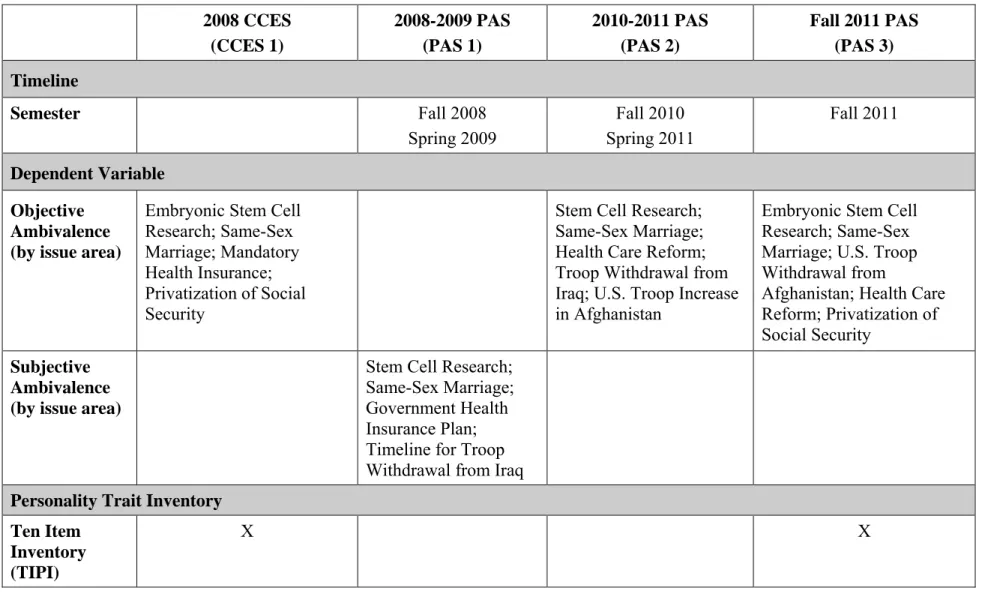
4.1. Data Source Matrix (Variables by Study and Semester) ...65
4.2. Subjective Ambivalence Index Items (Mulligan 2006) ...75
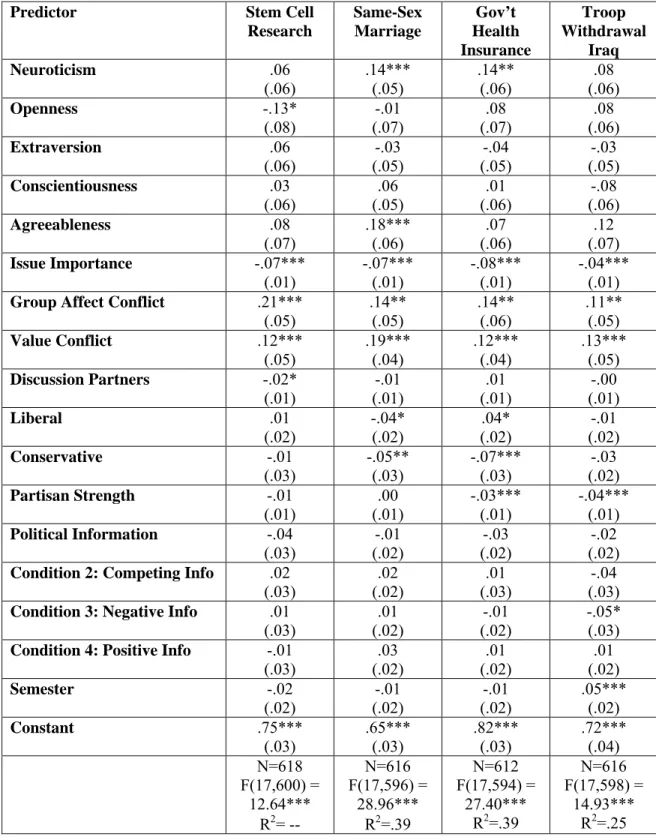
4.3. Antecedents of Subjective Ambivalence, PAS 1 ...87
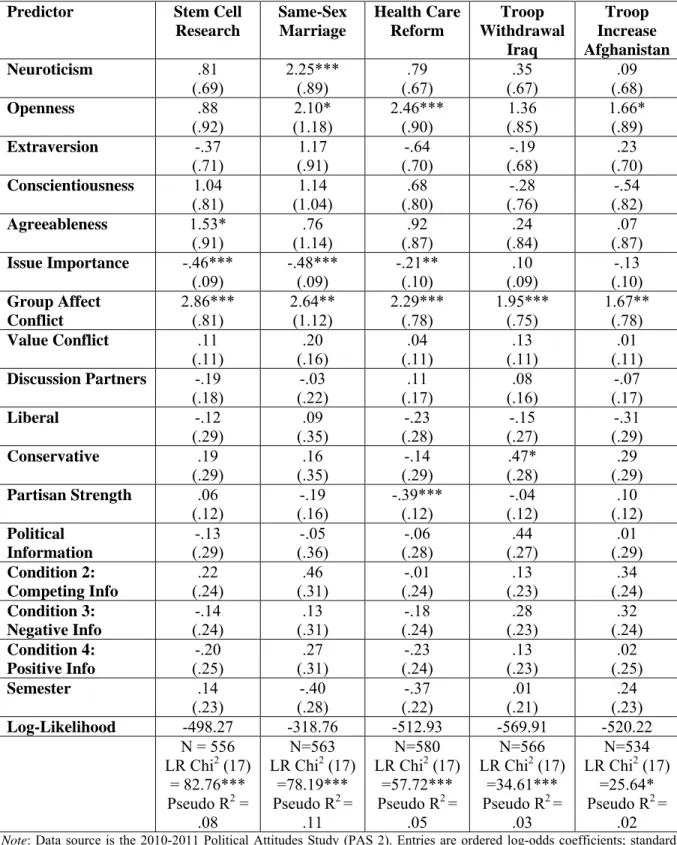
4.4. Antecedents of Objective Ambivalence (Ordered Logistic Regression),
PAS 2 ...94
4.5. Antecedents of Objective Ambivalence (Proportional Odds Ratios),
PAS 2 ...95
4.6. Antecedents of Objective Ambivalence (Ordered Logistic Regression),
CCES...103
4.7. Antecedents of Objective Ambivalence (Proportional Odds Ratios),
CCES...104
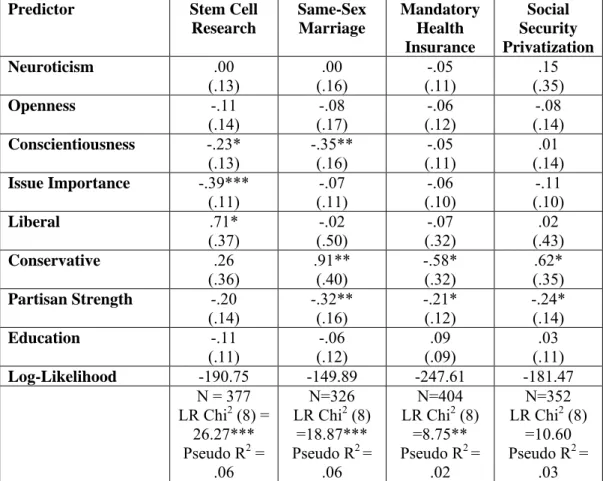
4.8. Antecedents of Objective Ambivalence (Ordered Logistic Regression),
PAS 3 ...108
4.9. Antecedents of Objective Ambivalence (Proportional Odds Ratios),
PAS 3 ...109
x
LIST OF FIGURES
Figure
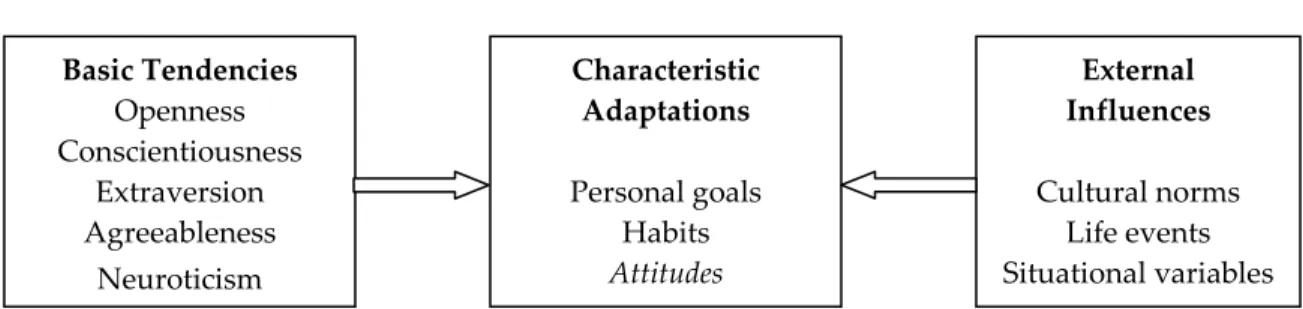
3.1. Five Factor Model of Personality ...46
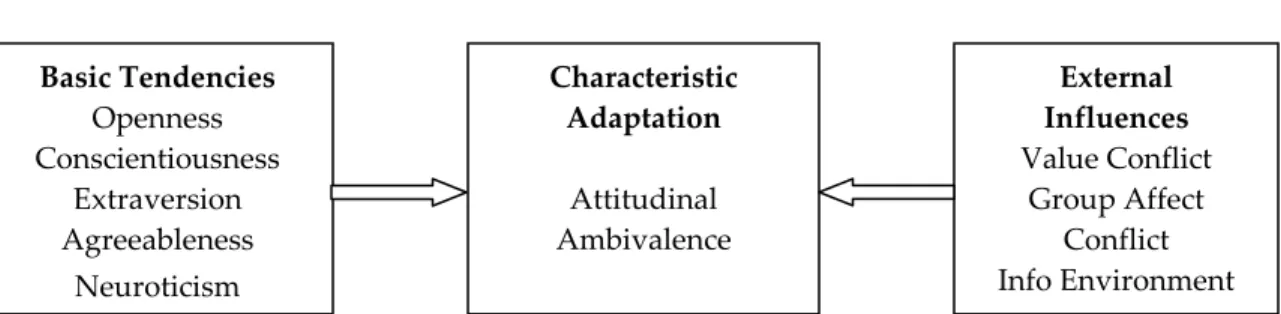
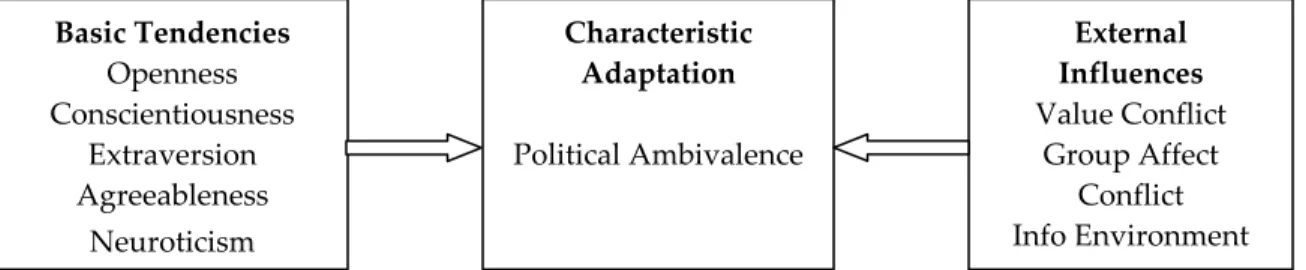
3.2. Theoretical Framework Summary ...48
CHAPTER ONE INTRODUCTION
During the 2004 Presidential election, reporters from the New York Times interviewed
a number of Evangelical Christians to uncover their attitudes toward the issue of amending
the Constitution to outlaw same-sex marriage. As expected, some strongly supported this
amendment on “biblical” grounds. However, other Evangelical Christians and pastors alike
were ambivalent on the issue. Even though they expressed some support for an amendment
based on their faith and Christian values, they were opposed to the amendment because of
their personal relationships with gays and lesbians and their opinions regarding the proper
role of government in regulating individual behavior (Kirkpatrick 2004). Ambivalence
toward this proposed amendment may have been even more pronounced among other voters
who did not identify strongly as Evangelicals. Scholarly evidence suggests that the American
public, broadly defined, demonstrates ambivalent attitudes on a number of other gay rights
issues—particularly on issues that could be seen as violations of civil rights and liberties such
as prohibiting gays from joining the Boy Scouts and allowing gays and lesbians to serve in
the military (Craig et al. 2005).
Attitudinal ambivalence is not limited to gay rights issues. Scholars have uncovered
2
as social welfare, abortion, and immigration (Feldman and Zaller 1992; Craig, Kane, and
Martinez 2002; Alvarez and Brehm 1995; Martinez, Craig, and Kane 2005). Other studies
also suggest that individuals experience attitudinal ambivalence toward political candidates
in the contexts of U.S. presidential and congressional elections and toward members of
minority racial groups (Keele and Wolak 2008; Lavine 2001; Basinger and Lavine 2005;
Katz and Hass 1988). The idea that “conflict is at the root of politics” is not a new one (Craig
and Martinez 2005: xv). Conflict in the considerations that citizens hold about political
objects has noteworthy consequences for political attitudes and behavior.
Ambivalence is significant for a number of reasons. Political science and social
psychological research suggests that attitudinal ambivalence likely plays an important role in
mediating and moderating the relationships between political attitudes and behavior
(Martinez, Craig, and Kane 2005: 10; Lavine 2001). Specifically, those citizens who are
ambivalent about an issue or which political candidate they will support in a general election
take significantly longer to express their opinions when compared to others who are not
ambivalent (Lavine 2001; Lavine and Steenbergen 2005; Albertson, Brehm, and Alvarez
2005). Since ambivalent citizens may recognize the merits of two opposing sides of a
political debate, or like and dislike a political party or candidate at the same time, heuristics
like partisan identification and ideological labels mean less and do not translate into reliable
decision-making cues (Basinger and Lavine 2005). Over the course of a campaign, those
voters who are ambivalent exhibit more instability in their candidate evaluations and voting
preferences when compared to others with single-sided political attitudes (Lavine and
Steenbergen 2005; Fournier 2005). Finally, ambivalent attitudes are held with “less
3
2005: 171). As a result, ambivalent individuals may be more prone to persuasive attempts
made by politicians than those who are not ambivalent about the same political object
(Mendelberg 2001; Lavine 2001).
If we examine some of the most far reaching and important studies of voting behavior
and ideological identification in the American context, voters who are deemed the most
“sophisticated” or politically thoughtful are those who possess a highly constrained set of
beliefs and whose beliefs about political objects are not subject to much change much over
time (Campbell et al. 1960; Converse 1964). An assumption that is implicit in much of this
literature and one that is also present in classic psychological theories of cognitive
consistency (e.g., balance theory or cognitive dissonance) is that cognitive conflict is an
uncomfortable state of mind—and a quality that is not valued in the American voter (Heider
1946; Festinger 1957).
But if we take a closer look at the concept of ambivalence, it may actually cast
citizens in a positive light, especially given the evidence that suggests that a considerable
portion of the public is politically disinterested and/or ignorant (Meffert, Guge, and Lodge
2004; Lavine 2001; Berelson, Lazarsfeld and McPhee 1954; Campbell et al. 1960; Converse
1964; Smith 1989; Delli Carpini and Keeter 1996). From a normative standpoint, political
ambivalence “suggests openness” (Keele and Wolak 2008: 654) and can be considered a sign
of thoughtfulness among voters (Meffert, Guge, and Lodge 2004). Instead of relying solely
on one-sided political beliefs, ambivalent individuals possess some of the qualities that we
would like “ideal” democratic citizens to hold. Since they have multiple and conflicting
thoughts about political objects, they may be likely to recognize that political debates are
4
Visser, and Tetlock 2000; Nir 2005). Those who “easily take a position in an issue debate are
less likely to be reflective in their decision making and resist consideration of relevant
evidence” when compared to others who possess multiple and conflicting thoughts about
political objects (Keele and Wolak 2008: 654).
Yet, while we know a great deal about the consequences of ambivalence, we know
comparatively little about its underlying causes (Martinez, Craig, and Kane 2005; Keele and
Wolak 2008). One of the key questions that remains unanswered is whether all citizens are
equally likely to possess ambivalent attitudes toward political objects. If we examine the
literature to identify those who are likely to make up this subsample of the American
electorate, we do not find a satisfying answer. Since ambivalence has important implications
for political attitudes and behavior, it is useful to identify the characteristics of individuals
who are likely to experience it.
In this dissertation, I examine a set of causal factors that are hypothesized to lead
citizens to experience attitudinal ambivalence about political issues. Much of the existing
research on the antecedents of ambivalence focuses on three explanations: the inherently
conflicting nature of the values that structure individual attitudes within our political culture
(Alvarez and Brehm 1995, 1997; Feldman and Zaller 1992; Katz and Hass 1988); the ties to
multiple identity groups that conflict with regard to their stances on policies or toward
candidates running for office (Lavine and Steenbergen 2005); and exposure to multiple
points of view within an individual’s information environment (Huckfeldt, Mendez, and
Osborn 2004; Keele and Wolak 2008). While valuable, these explanations all hinge on the
assertion that if some sort of conflict exists within a citizen’s thought process or
5
competing reference groups are not only conceptualized in the literature as causal factors
contributing to ambivalence (Baek 2010; Alvarez and Brehm 1995; McGraw, Hasecke, and
Conger 2003; Huckfeldt, Mendez, and Osburn 2004; Craig et al. 2005), but they are
sometimes equated with forms of ambivalence as well (see, for example, Feldman and Zaller
1992; Steenbergen and Brewer 2004; Lavine and Steenbergen 2005). It is therefore unclear
whether these explanatory factors are truly antecedents of ambivalence or simply modified
forms of ambivalence itself.
At its most basic level, political ambivalence is an attitudinal state experienced by a
citizen that is characterized by conflict in the considerations that the individual holds about
an object. In the chapters that follow, I offer a theory about the antecedents of attitudinal
ambivalence that is rooted in the personality traits of citizens. Most simply stated, some
individuals, by virtue of their core dispositions or personality traits, may be more likely to
experience attitudinal ambivalence than others. Furthermore, these traits may predict the
likelihood of experiencing ambivalence across a range of political issues.
Systematic research within the field of personality psychology strongly suggests that
the structure of human personality can be broken down into five core traits: Openness to
Experience, Conscientiousness, Extraversion, Agreeableness, and Neuroticism (Wiggins and
Trapnell 1997; Digman 1990; McCrae and Costa 1996, 1997, 2003, 2008; Goldberg 1992,
1993; Saucier and Goldberg 1996; Mondak 2010; Mondak and Halperin 2008). Importantly,
these traits have well established links to attitudes and behavior—even in political contexts
(Digman 1990; Schoen and Schumann 2007; Caprara et al. 2006; Mondak and Halperin
6
research on the influence that personality exerts on political attitudes and behavior, I employ
this model of personality structure in my research as well.
In this dissertation, I first consider the concept of attitudinal ambivalence, its
implications for politics, and past accounts of the conditions under which it may be
experienced by individuals. I then move on to a discussion of the Five Factor Model, or “Big
Five” framework, of personality structure and the effects that personality traits have on
political behavior and attitudes. Next I employ this framework to offer a theoretical argument
for how the five personality traits are expected to influence the likelihood of experiencing
attitudinal ambivalence. Empirically, I test my hypotheses using data collected from
undergraduate students at the University of North Carolina at Chapel Hill, and a random
sample of adults in the American electorate with question space obtained on the 2008
Cooperative Congressional Election Study. Finally, in my concluding chapter, I discuss the
implications of my study for our understanding of political ambivalence and other political
CHAPTER TWO LITERATURE REVIEW
Attitudinal Ambivalence
In his seminal article on the nature of belief systems of the mass public, Philip
Converse (1964) noted the instability of attitudes when respondents were asked to report
their beliefs on a variety of political issues at repeated points in time, suggesting that most
citizens did not possess strongly held views on political issues at all. Only a small portion of
the public—the most highly educated or political elites—appeared to pay careful attention to
politics and hold consistent or ideologically “constrained” attitudes. The majority of
respondents accepted information about political issues from elites in bundled packages,
without a complete understanding of how those packages of issues “fit” together
ideologically. Moreover, “nonattitudes” seemed to run rampant. Research that has been
conducted since that time continues to find evidence of a lack of political interest and
knowledge among the electorate (see, for example, Smith 1989; Delli Carpini and Keeter
1996). However, Converse’s characterization of the American public has been challenged. In
particular, research on attitudinal ambivalence questions the notion that ordinary individuals
do not think much of, or carefully about, politics. Instead of lacking constrained attitudes
about political issues, parties, or candidates, this newer line of work suggests that some
8
political objects at the same time (Meffert, Guge, and Lodge 2004; Lavine 2001; Yoo 2010).
The grounds for this challenge stem, in part, from how one conceptualizes the
structure of attitudes in political science research. Unidimensional attitude theory has
strongly influenced the way scholars think about and measure political attitudes (Yoo 2010;
Meffert, Guge, and Lodge 2004; Lavine 2001). According to this theory, as a citizen’s
negative evaluation of a political issue, candidate, or party increases, the positive evaluation
of the same political object decreases; likewise, an increase in the positive evaluation of a
political issue, candidate, or party is met with a decrease in the negative evaluation of the
object. To measure a political attitude, respondents are typically asked to indicate their stance
toward the object on a bipolar scale. The midpoint of the scale indicates “neutrality,” which
is supposed to be indicative of either a balance of negative and positive feelings or thoughts
or indifference, which is a complete lack of any feelings or thoughts (Campbell et al. 1960;
Yoo 2010; Lavine 2001). This is problematic because thinking about politics affects political
behavior differently than not thinking about politics at all.1
Social and political psychologists have reevaluated the unidimensional
conceptualization of attitudes. They recognize that the evaluations a person possesses about a
political object may be consistent with one another (Eagly and Chaiken 1993): evaluations of Grouping these distinct attitudinal
states into the same “neutral” response category impedes our ability to understand the unique
effects that different types of political attitudes have on behavior (Yoo 2010; Meffert, Guge,
and Lodge 2004).
9
a political issue, candidate, or party may be marked by extremely positive or negative beliefs
or feelings. But attitudes can also be more complex: some individuals can “simultaneously
hold evaluatively inconsistent beliefs” about an object (Eagly and Chaiken 1993: 123;
Meffert, Guge, and Lodge 2004; Cacioppo and Berntson 1994; Cacioppo, Gardner, and
Berntson 1997). For instance, in a political context, citizens may recognize the pros and cons
of a political issue stance, or find that they like and dislike a candidate or party at the same
time (see, for example, Yoo 2010; Feldman and Zaller 1992; Zaller 1992; Lavine 2001;
Meffert, Guge, and Lodge 2004; Basinger and Lavine 2005). Furthermore, these citizens may
place similar weights on those positive and negative evaluations. This simultaneous existence
of conflicting evaluations is known as attitudinal ambivalence (Martinez, Craig, and Kane
2005; Steenbergen and Brewer 2004; Eagly and Chaiken 1993; Feldman and Zaller 1992;
Zaller 1992; Cacioppo and Berntson 1994; Priester and Petty 1996, 2001; Lavine 2001; Yoo
2010).
More specifically, there is general agreement in both political science and social
psychology regarding two “necessary and sufficient conditions” for the experience of
attitudinal ambivalence (Thompson and Zanna 1995: 263; Basinger and Lavine 2005). First,
the positive and negative evaluations that a person directs toward an object should be of
analogous magnitude (Basinger and Lavine 2005: 197; see also, Thompson, Zanna, and
Griffin 1995: 263; Meffert, Guge, and Lodge 2004; Priester and Petty 1996). Conflict in the
thought process of an individual will decrease, and attitudes will become more single-sided,
as the evaluations favoring one side of a political debate increase relative to the other side
(Thompson and Zanna 1995). Second, the positive and negative evaluations about a political
10
have stronger positive and negative evaluations, and decrease when they have weaker
positive and negative evaluations directed at the same object (Thompson and Zanna: 1995:
263; Thompson, Zanna, and Griffin 1995; Meffert, Guge, and Lodge 2004).
Research and inquiry into attitudinal ambivalence in political contexts is relatively
new, although social psychologists have been studying the concept since the late 1960s and
early 1970s (Kaplan 1972; Eagly and Chaiken 1993; Martinez, Craig, and Kane 2005). The
lack of ambivalence research in political science can be traced to a pair of complicating
factors. First, research conducted by social psychologists studying cognitive dissonance and
balance theory suggested that individuals prefer cognitive consistency to experiences like
logical inconsistency and dissonance (see, for example, Heider 1946; Festinger 1957;
Thompson and Zanna 1995; Meffert, Guge, and Lodge 2004; Eagly and Chaiken 1993).
Instead of being willing to tolerate inconsistent thoughts or feelings about an object, citizens
were expected to take whatever steps necessary to resolve their psychological discomfort,
even if that meant denying or ignoring that any conflict existed or choosing to create a new
“belief structure” about the attitude object (Eagly and Chaiken 1993). These expectations
made their way into theories and expectations regarding political attitudes.
Dissonance, or cognitive imbalance, may be a taxing psychological state. However,
while cognitive imbalance can produce a motivational force for resolving evaluative
discrepancy, evidence suggests that this force may be greater for some individuals than it is
for others. For example, Thompson and Zanna (1995) found that individuals who score high
on one aspect of personality (Need for Cognition) enjoy thinking through problems, dislike
ambiguity, work to resolve conflict, and are less likely to be ambivalent about social issues
11
aspect of personality (Fear of Invalidity) is associated with a significant increase in the
likelihood of experiencing attitudinal ambivalence on some social issues.2
Second, the recent emergence of ambivalence research in political science also stems
from the long standing assumption discussed previously that attitudes are bipolar in nature
(Eagly and Chaiken 1993; Meffert, Guge, and Lodge 2004: 64-66; Thompson and Zanna
1995; Yoo 2010; Feldman and Zaller 1992). Many influential survey techniques that were
developed to measure attitudes among members of the public (e.g., Thurstone, Likert, and
Semantic Differential scales) grew out of this assumption (Thompson and Zanna 1995;
Meffert, Guge, and Lodge 2004). While there is now recognition, especially in social Those who score
high on Fear of Invalidity report being anxious about making decisions and fear making
costly mistakes; but, they also enjoy thinking through problems, are more hesitant to resolve
cognitive inconsistencies, and tend to value opposing arguments on social issues more
equally (Thompson and Zanna 1995). Additionally, those who are motivated by accuracy
goals when making political judgments and who are willing to devote more cognitive effort
to a judgment task have been shown to be more likely to be ambivalent than others who do
not share those motivations (Rudolph and Popp 2007). Thus, the overarching assumptions
and expectations that have grown out of the existing literature on cognitive conflict may be
too simple. A careful evaluation of existing evidence suggests that enduring individual
differences may lead some individuals to be more tolerant of cognitive inconsistencies about
political objects than others. Furthermore, cognitive inconsistency is not perceived by all
people to be a negative attitudinal state.
12
psychology, that individuals may hold both positive and negative evaluations of political
objects concurrently, new measurement tools that are able to capture these separate
evaluations are rarely included in survey instruments (Cacioppo and Bernston 1994;
Cacioppo, Garner, and Bernston 1997; Thompson and Zanna 1995; Meffert, Guge, and
Lodge 2004; Feldman and Zaller 1992).
This is especially true in the field of political science. Often times, respondents on a
large-scale survey instrument, such as the National Election Study or the General Social
Survey, are asked to report their summary stances on important political issues like same-sex
marriage and stem cell research, among many others. It is useful to ascertain whether citizens
support or oppose a particular issue, in addition to the strength of their evaluation(s).
However, the response categories offered to survey respondents inevitably mask the
complexity of their attitudes.
For example, if some citizens have competing considerations about a political object,
then they may simply average across the considerations that come to mind when they are
taking the survey (Zaller 1992; Zaller and Feldman 1992). This process may result in a
moderate or neutral response, which might also explain why attitudes held by some members
of the mass public appear to be unstable if measured repeatedly over time. Meanwhile, other
citizens may choose the same neutral response category on the survey instrument if they are
indifferent toward that political object, since they lack any considerations about it at all
(Meffert, Guge, and Lodge 2004; Yoo 2010).
These are two entirely different attitudinal states, but they end up being grouped
together in the same response category, and thereby cloud its meaning. Unless we ask
13
object, we are unable to uncover empirical evidence of ambivalence because we cannot
distinguish it from genuine absence of affect or thoughts toward an attitude object (Kaplan
1972; Thompson, Zanna, and Griffin 1995; Meffert, Guge, and Lodge 2004). Thus, the lack
of research on political ambivalence may be a function of the survey instruments we use in
much of our work. Since ambivalence cannot be easily measured with existing data it is often
ignored and perceived as an insignificant attitudinal state—even though research on the
psychology of attitudes across a number of different political contexts would suggest
otherwise (Eagly and Chaiken 1993; Thompson and Zanna 1995; Craig and Martinez 2005).
Ambivalence is experienced by a significant portion of the American electorate
across a variety of political issues and in partisan and candidate evaluations. In their study of
cognitive reactions to presidential candidates during the 1980-1996 presidential election
years, Meffert, Guge, and Lodge (2004) found that 25 percent of respondents simultaneously
expressed positive and negative considerations about candidates. When they expanded their
definition of ambivalence to include conflicting cognitions and feelings about candidates,
they found that almost 40 percent of the public expressed ambivalence (70). Similarly,
Basinger and Lavine (2005) found that voters who held ambivalent partisan attitudes
constituted approximately 30 percent of the electorate. Clearly, a substantial portion of the
public experiences ambivalence; it is not a trivial attitudinal state experienced by an
insignificant number of Americans in the mass electorate. Political Consequences of Ambivalence
Moreover, ambivalence about political objects has serious consequences.
14
attitudes and behavioral intentions. In their examination of House elections, Basinger and
Lavine (2005) found that ambivalence mediated the extent to which some voters relied on
partisanship and ideology when making vote choice decisions. Specifically, those voters who
were politically informed but ambivalent about their partisan identification used ideology,
while those who were politically uninformed but partisan ambivalent used retrospective
economic evaluations, to guide their vote choice decisions. Similarly, in their examination of
attitudes toward gay rights policies, Craig et al. (2005) found that ambivalence in this policy
area weakened the relationship between attitudes toward gay rights and overall evaluations of
the incumbent governor. Lavine (2001) found that ambivalence moderated the relationship
between one’s expressed intent to vote for a Democratic or Republican candidate and actual
vote choice. Those who were less ambivalent were more likely to vote for their “intended
candidate” (926).
There are other attitudinal implications of ambivalence as well. Compared to those
with single-sided attitudes, people experiencing attitudinal ambivalence tend to take longer
when deciding which candidate they will support in a general election contest (Lavine 2001;
Lavine and Steenbergen 2005), which may make them more open to political ads and other
persuasive messages expressed by politicians during the course of a campaign. Lavine and
Steenbergen (2005) also found that compared to those with one-sided attitudes toward
candidates, voters who were ambivalent exhibited more instability in their presidential
candidate evaluations over the course of the electoral campaign and were more likely to split
their tickets at the polls. In his analyses of a number of different voting decisions in the
United States, Great Britain, and Canada across nine different surveys, Fournier (2005) found
15
compared to the voting preferences of individuals who were not ambivalent. Mendelberg
(2001) suggested that those who experience ambivalence about policies dealing with race
(i.e., experience conflict between the value of equality and racial resentments) may be more
prone to implicit appeals made by politicians. In their study of ambivalence toward
presidential candidates between 1980 and 1996, Meffert, Guge, and Lodge (2004) discovered
that those who were ambivalent showed less polarized attitudes and a greater aptitude to
make more balanced and accurate political judgments compared to those who held one-sided
and indifferent attitudes. Most recently, using data from the 1980-2004 National Election
Studies, Yoo (2010) found that compared to those who were indifferent about presidential
candidates, ambivalent individuals were more likely to turn out at the polls and participate in
campaign activities (173). Interestingly, ambivalent voters also had similar turnout levels
when compared to those who held more polarized views about political candidates (173).
Thus, while the experience of political ambivalence may be more cognitively taxing
for citizens than simply holding univalent political attitudes, evidence suggests that it is
nonetheless experienced by a substantial portion of the electorate. Furthermore, the
experience of attitudinal ambivalence has noteworthy consequences for political attitudes and
behavior. Making the assumption that all citizens possess univalent political attitudes, and
that indifference and ambivalence can be included within the same attitudinal response
category, leads us to develop incomplete—and inaccurate—expectations about the political
behavior and attitudes of voters.
Gaps in Our Understanding
16
American electorate across a variety of political issues, elections, and partisan evaluations.
Ambivalence has important consequences for our study of political behavior and attitudes.
However, while we know many of the consequences of attitudinal ambivalence, we know
much less about its underlying causes (Martinez, Craig, and Kane 2005, Thompson and
Zanna 1995; Keele and Wolak 2008). Our understanding of ambivalence is restricted and
incomplete if we cannot identify the characteristics and conditions that cause individuals to
possess multidimensional political attitudes. As such, the broad research question that my
dissertation will address is: “What are the antecedents of political ambivalence?”
Before I move on to a more in depth discussion of my theory regarding the
personality trait antecedents of attitudinal ambivalence, it is important to summarize the
findings of a few key approaches that scholars have taken in their attempts to answer this
research question. A small number of studies have examined the association between
demographic and other individual-level variables commonly used in studies of political
attitudes and various forms of ambivalence. For example, those who have strong partisan or
ideological ties are typically less likely to experience ambivalence than those who have
weaker ties (Rudolph and Popp 2007; Steenbergen and Brewer 2004). Older Americans are
more likely to be ambivalent than younger Americans, while those who are more politically
sophisticated are less likely to be ambivalent than others who are not as sophisticated
(Steenbergen and Brewer 2004). Those who score high on Personal Fear of Invalidity and
fear making mistakes are more likely to experience ambivalence than those who score low on
17
ideological identification have been shown to be both positively associated with ambivalence
in some studies (Rudolph and Popp 2007; Feldman and Zaller 1992), and negatively
associated with ambivalence in others (Thompson and Zanna 1995; Steenbergen and Brewer
2004).
Much of the remaining research that has been conducted on the antecedents of
ambivalence focuses on three factors:
• the experience of value conflict toward a specific policy issue;
• the exposure to a wide variety of viewpoints on an issue or toward a candidate in
a particular information environment (e.g., in a heterogeneous discussion group or
general election); and
• the individual’s favorable evaluation of multiple social groups that are relevant to
a political judgment, but that conflict with regard to the stance(s) they take on key
political issues or candidates.
These explanatory accounts have done a great deal to advance our knowledge in this area.
The explanations are logical and make intuitive sense. Further, they are complimentary in
that they offer an internal, value-based account of the source(s) of ambivalence (i.e., value
conflict) as well as an account stemming from external or situational factors (e.g., exposure
to diverse viewpoints in the information environment). However, weaknesses in these
explanations also exist. I will present, and evaluate, each of these three explanations in turn.
Explanation I: Value Conflict
There is a fairly extensive literature on the experience of value conflict. The premise
18
reliance—shape citizens’ policy and candidate preferences and form the basis of ideology
(Feldman and Zaller 1992; Feldman 1988; McClosky and Zaller 1984; Rokeach 1973).
However, when these core values are applied to concrete policy areas, they often conflict,
which can lead citizens to experience ambivalence. For example, Feldman and Zaller (1992)
and Gainous and Martinez (2005) examine attitudes toward social welfare policies in the
United States, and find that both conservatives and liberals experience some ambivalence as
a result of value conflict. Other evidence suggests that individuals experience value conflict
on racialized policy issues and abortion (Katz and Hass 1988; Alvarez and Brehm 1995).
The value conflict explanation has merit. If people use more than one value to
structure their views on issues or toward political candidates, it is possible that those values
could come into conflict. For example, on the issue of same-sex marriage, the application of
the value of egalitarianism might push a citizen to support the policy; however, if moral
traditionalist values are also important, then that individual may be pushed to oppose the
policy. This value conflict may lead that person to hold an ambivalent position on the issue
due to the competing considerations that are brought to bear based upon the values used to
structure the attitude.
While insightful, the value conflict explanation accounts for one form of conflict in
considerations with another. While this may be a partial explanation, it still does not address
the underlying mechanism for why this may occur. Several questions remain unanswered.
Are all individuals equally likely to experience value conflict when evaluating their position
on an issue? Or, can some individuals more easily order the relative importance of two
competing values, and thereby avoid internal conflict in their considerations? Are some
19
evaluating their position(s) on policies when compared to others? Furthermore, value conflict
is not only conceptualized in the literature as a causal factor contributing to ambivalence
(Baek 2010; Alvarez and Brehm 1995; McGraw, Hasecke, and Conger 2003), but it is also
sometimes characterized as a form of ambivalence as well (Feldman and Zaller 1992;
Steenbergen and Brewer 2004). It is therefore unclear whether value conflict is an antecedent
of ambivalence, or simply another form of ambivalence itself.
Explanation II: Overabundance of Information in the Environment
Another explanation for the origins of attitudinal ambivalence focuses on factors that
lie outside of an individual’s psyche—specifically, the information environment. Scholars
contend that citizens who are exposed to a two-sided and concentrated flow of information
will be more likely to consider multiple viewpoints when formulating political judgments
(Huckfeldt, Mendez, and Osborn 2004; Mutz 2002; Keele and Wolak 2008; Nir 2005).
Ambivalence may be experienced by those citizens who find that they value multiple,
opposing beliefs about the same political object following exposure to diverse viewpoints.
A two-sided information environment can take different forms. For example, a
general election may provide a “two-sided flow of persuasive information” intended to
convince voters to support one candidate over another (Lavine 2001: 926). Consequently,
some voters may be likely to accept messages from both sides, which can lead to
ambivalence over which candidate the voter will support in an election (Lavine 2001; Keele
and Wolak 2008). Heterogeneous political discussion networks also have the potential to
create a diverse information environment for individuals. Mutz (2002) contends that if
20
to arguments that challenge their existing views. If this exposure leads them to equally value
opposing arguments relating to an object or issue, then the likelihood that an individual will
experience ambivalence may increase as a result (840).
In a similar study, Huckfeldt, Mendez, and Osborn (2004) examined the role that
political discussion partners can play in creating ambivalence about political candidates.
Using data from the National Election Study, they found that ambivalence toward political
candidates—in this study Bush or Kerry—was highest among those whose discussion
partners included supporters of both presidential candidates. Alternatively, ambivalence was
lowest amongst those whose discussion partners shared the same presidential candidate
preferences.
Again, this theoretical account for the origins of attitudinal ambivalence is logical.
When citizens are exposed to a wider variety of considerations with regard to a political issue
or candidate, some citizens may come to hold and value beliefs that conflict. However, this
explanation leaves some questions unanswered as well. First, people may be able to cite a
number of apparently conflicting considerations (likes/dislikes, pros/cons) after engaging in
conversation with others who hold dissimilar attitudes, or after being exposed to campaign
information from politicians. But simply being aware of multiple competing considerations,
and being able to report them when answering a question on a survey instrument, does not
necessarily constitute evidence of evaluative conflict. If the positive considerations are not
held with the same passion or fervor as the negative considerations, then attitudinal
ambivalence is unlikely.
Second, the assumption that engaging in political discussions with others who are
21
political issue or candidate is probably overstated. Cass Sunstein’s research on the “Law of
Group Polarization” speaks to this point. Drawing on past work that examines heterogeneous
discussion groups in the medical field, he contends that participants often value the views of
members perceived to be of “high status” groups, and discount the viewpoints offered by
“low status” group members (e.g., women, African Americans, and those who are not well
educated). He also questions the implicit assumption that all individuals enter group
discussions without particular “pre-deliberation tendencies”—preexisting preferences about
the position that they would like to take on the issue. Because people enter group discussions
with these preferences, they are more likely to actually intensify their preexisting view(s) as a
result of discussion and exposure to alternative viewpoints offered by group members. He
finds that this is especially likely to occur when a more “dominant” group member holds a
similar attitude,3 and if the persuasive appeals offered by group members with opposing
views are not convincing. Like Huckfeldt, Mendez, and Osborn (2004), Sunstein (2002)
concedes that attitude moderation (perhaps due to ambivalence) may occur if the discussion
group consists of members who equally oppose and favor the political object (i.e., issue or
candidate).4
3If that dominant group member also shares the same sense of identity or “common fate” with the individual making a political judgment, the movement of the individual’s attitude toward that of the group member(s) perceived to be similar will likely be even more pronounced (Sunstein 2002).
However, this simply may not be a realistic discussion situation. Moreover, even
when convincing competing viewpoints are made public in heterogeneous discussion
networks, it does not follow that all individuals will carefully consider these conflicting
22
views, and subsequently experience ambivalence. In sum, this account of the origins of
ambivalence still does not help us to predict “who,” amongst those who are exposed to
competing viewpoints, will experience attitudinal ambivalence over a political object as a
result.
Explanation III – Multiple, Competing Identities or Ideologically Inconsistent Group Affect
Finally, another plausible explanation for the origins of attitudinal ambivalence stems
from the idea that individuals possess ties, or felt affect, toward multiple social identity
groups. When an issue or candidate emerges on the political agenda, and citizens are asked to
indicate their positions in relation to that attitude object, a person may use “likes” and
“dislikes” of social groups to inform their political judgments (Converse 1964; Conover and
Feldman 1981; Lavine and Steenbergen 2005). According to a “group centrism hypothesis,”
individuals may use felt affect toward social groups as relevant cues for formulating
judgments because “social groups are central organizing elements of political belief systems”
that introduce “order to what might otherwise be largely haphazard collections of cognitively
isolated opinions” (Lavine and Steenbergen 2005: 7; see also Eagly and Chaiken 1993: 141;
Converse 1964; Campbell et al. 1960; Brady and Sniderman 1985; Conover and Feldman
1981). However, when a person holds positive affect toward social groups that stand in
opposition to one another on a particular issue or candidate, those social group cues may not
be useful to the individual making the political judgment. Instead, the groups that were
initially perceived to be relevant information sources may expose the person to competing
23
This idea has its roots in the “cross pressures” hypothesis, which was first put forth by
Lazarsfeld, Berelson, and Gaudet (1944) in The People’s Choice. In this book, the authors
examined a panel of potential voters in the 1940 Presidential election to understand better
how people formulate their political judgments. They found that individuals may be faced
with two or more social affiliations (like race and religion, or class and religion) that tend to
pull them in opposing directions. In this type of situation, those voters faced with conflicting
identities, or cross pressures, are more likely to split their tickets at the polls, have lower
levels of interest or information about elections and politics in general, and hold disparate
attitudes with regard to political objects due to the contradictory positions espoused by their
social groups. There is additional empirical evidence that complements this notion. Lavine
and Steenbergen (2005) uncover similar findings when they examine citizens’ affective
evaluations of multiple social groups. Their empirical results show that potential voters who
hold positive (or negative) feelings toward both liberal and conservative social groups
experience significantly more ambivalence toward choices involving policies and candidates
than individuals who do not hold similar “ideologically inconsistent” group feelings (24).
Like the other two approaches to studying the origins of attitudinal ambivalence, the
competing identities explanation has merit. This idea is seemingly supported by a major
implication that stems from tests of Heider’s balance theory in numerous social situations:
individuals are prone to “agree with people [and groups] that they like, and disagree with
people [and groups] that they dislike” (Eagly and Chaiken 1993: 141). Thus, if a person has
positive affect for more than one social group, and perceives their cues to be of roughly equal
24
internalized, conflict in considerations if those groups take opposing positions on a particular
political object (e.g., an issue, presidential candidate, etc.).
But while these empirical accounts focus on felt affect toward social groups, they do
not consider factors such as identity group salience and status, which may minimize the
likelihood of ambivalence stemming from conflicting reference groups. Identifying as a
member of a social group provides a person with a cognitive foundation for interpreting
experience and appropriate role behaviors (Stryker and Burke 2000), just as felt affect
towards social groups can serve as judgment cues. Identity theorists (Mattis et al. 2008;
Shapiro et al. 2010) acknowledge that individuals possess multiple cross-cutting identities.
For example, a woman may identify as African American, while simultaneously thinking of
herself as an Evangelical Christian who is a member of the middle class. If such a woman
were faced with taking a position on an issue like abortion, these identities could potentially
pull her in opposing directions. Her identity as an Evangelical might lead her to oppose
abortion rights, while her identity as a woman might simultaneously lead her to support
abortion rights. However, evidence suggests that people are relatively adept at ordering the
salience of their identities when making political judgments; the higher the “salience of an
identity relative to other identities…the greater the probability of behavioral [or attitudinal]
choices in accord with the expectations attached to that identity” (Stryker and Burke 2000:
286). Individuals are also aware that some social identities are perceived to be of higher
status than others. Thus, in order to preserve a positive sense of self, individuals may often
defer to the higher status identity group when making a decision, and this tendency is even
more pronounced in situations that make the relative group status rankings apparent
25
Others who study the effects that social identity can exert on political
decision-making note that rather than assuming that social categories are independent entities that act
alone to shape the choices that individuals make, it is important to recognize that these
categories (e.g., race or ethnicity, gender, and class) “intersect” and “interact” to form
different meanings and experiences for individuals that cannot be explained by each identity
on its own (Warner 2008: 454; Shields 2008; Purdie-Vaughns and Eibach 2008; Hancock
2007; Crenshaw 1994). The academic study of “dueling” identities and their influence on
political judgments produces an artificial choice dichotomy (Hancock 2007; Crenshaw
1994). Examinations of personal narratives support the notion that identities are not discrete
entities (Bowleg 2008). Take, for example, Maya Rupert, an African American woman who
was asked to discuss how her sense of identity influenced her decision about whether she
would support Barack Obama or Hilary Clinton in the democratic presidential primary race
in 2007. She stated that her “dual identities” as an African American and a woman could
produce some psychic conflict. But, she also urged the public to acknowledge that the
decision for whom to vote for is not solely a “symbolic” choice. She states,
…of course identity doesn’t work like that. Women of color are not “women who happen to be racial minorities” and we’re not “racial minorities who also happen to be female.” We’re women of color. And both of those identities inform our decisions, along with many other identities we happen to embrace…Dividing the issue…[forces] an artificial ranking of identities in which no one wants to engage (Rupert 2007: E-3, emphasis added).
When we think of organized identity groups as “coalitions” (e.g., reconceptualize “race” as a
coalition of “men” and “women” or as a coalition of members of the working, middle, and
upper classes) we recognize that the intersection of these different group identities creates
26
Thus, while individuals may often have multiple, conflicting identities, this state may
not necessarily lead to attitudinal ambivalence. While some individuals may experience
attitudinal ambivalence as a result of these competing identities, others may not. For
example, if some people evaluate multiple social groups positively and perceive those groups
to be of roughly equal status, then competing cues regarding political issues taken from those
groups may lead them to experience attitudinal ambivalence. But this may not always be the
case. Some may be able to rank the relative salience of one identity group cue over another,
while others may use their collective identities to formulate a unique and strongly held
viewpoint. Simply focusing on the affective evaluations of multiple social identity groups
and their potential for causing psychological conflict in considerations does not provide us
with information regarding what makes someone systematically less able to rank the relative
salience of ideologically inconsistent social reference groups.
Drawing Connections
The three explanations outlined above provide us with plausible accounts of the
conditions under which individuals may experience attitudinal ambivalence. These accounts
share the common premise that attitudinal ambivalence is likely to occur only when the
potential for conflict in considerations exists in a person’s choice set—whether that be in the
inherently conflicting nature of the values that structure the political decision in question, or
in the social setting in which the choice is made. But while valuable and logical, each of the
explanations is also lacking. More specifically, the three overarching accounts address the
value bases and environmental factors that contribute to the experience of political
27
all else constant, some individuals are more likely than others to consider and place value on
the merits of two competing sides of a debate and experience political ambivalence as a
result.
Each of the approaches leads us to ponder the following question: Are we
overlooking systematic differences among individuals when we try to identify those who will
be most likely to experience attitudinal ambivalence toward a political object, such as a
policy or candidate? I contend that the answer is yes, and in this dissertation, I provide a
personality trait explanation for why some citizens are more likely to entertain competing
considerations and experience attitudinal ambivalence than otherwise similar individuals. In
doing so, I apply McCrae and Costa’s (1996, 1997, 2003, 2008) Five Factor Model of
Personality to the study of ambivalence, and contend that broad, non-conditional dimensions
of personality, in combination with environmental factors and values, contribute to the
experience of this attitudinal state.
In the chapters that follow, I apply this framework of personality structure to the
study of attitudinal ambivalence. Systematic research on the structure of human personality
within the field of personality psychology over the past forty years strongly suggests that it
can be broken down into five basic traits: Openness to Experience, Conscientiousness,
Extraversion, Agreeableness, and Neuroticism (Digman 1990; Pervin 1996; McCrae and
Costa 2008, 2003, 1997, 1996; Mondak 2010; Mondak et al. 2010; John, Naumann, and Soto
2008; John and Srivastava 1999; Gerber et al. 2010, 2011). This framework consists of
personality traits that are “nonpolitical” in nature, though it has been employed in studies of
partisanship and political behavior in Italy, Germany, and most recently in the United States
28
2008; Mondak 2010; Mondak et al. 2010; Gerber et al. 2010, 2011; Hibbing, Ritchie, and
Anderson 2011). By considering the direct effects that personality traits have on attitudinal
ambivalence, I will supplement existing causal explanations and formulate a more complete
understanding of this phenomenon.
Personality and Political Science Research
Before I present my theory and hypotheses on the personality trait antecedents of
attitudinal ambivalence, it is useful to examine the model of trait structure that I employ, as
well as some of the key findings of how personality traits influence political behavior and
attitudes. On a daily basis, we come into contact with others whom we may perceive to be
patient, social, tolerant of ambiguity, and/or intellectually curious. We also come into contact
with people we would describe as being generally nervous across social settings, quick to
make judgments, and relatively intolerant of ambiguity. Research in personality psychology
suggests that these individual differences, which are known as personality traits, “provide
coherence and continuity in behavioral [and thought] patterns across different settings” in our
everyday lives (Caprara and Zimbardo 2004: 582). They also “create, foster, and preserve a
sense of personal identity” (582; see also, McCrae and Costa 2008, 2003, 1996).5 They are
“enduring dispositions” and help us to describe “what people are like” (Roccas et al. 2002).6
5Similarly, McCrae and Costa (1995) define personality traits as “dimensions of individuals in tendencies to show consistent patterns of thought, feeling, and action.”
If we can come to understand better the psychological tendencies of individuals, we should
29
be better able to predict their attitudes and behaviors (Mondak 2010; Mondak et al. 2010;
Gerber et al. 2010, 2011; McCrae and Costa 1996; Hibbing, Ritchie, and Anderson 2011).
Importantly for political science research, personality traits exert significant effects
on political attitudes and behavior (Mondak et al. 2010; Mondak 2010; Gerber et al. 2010,
2011; Hibbing, Ritchie, and Anderson 2011; Mondak and Halperin 2008: 335; see also
Adorno et al. 1950; Altmeyer 1987, 1996, 1998; Ekehammar et al. 2004; McFarland 1998;
Feldman and Stenner 1997; Sidanius and Pratto 1999; Sidanius, Pratto, and Bobo 1994;
Pratto et al. 1994). In political psychology, we can find numerous examples where scholars
use personality traits to explain the actions and judgments of political leaders (Winter 1987,
2004; Barber 1977, 1988, 1992; Choiniere and Kiersey 1992; Post 1993). Political
psychologists have also published studies examining the connection between personality
traits and political tolerance, authoritarianism, social dominance, and political ideology
(Gerber et al. 2010; Adorno et al. 1950; Stenner 2005; Altmeyer 1987, 1996, 1998; Feldman
and Stenner 1997; Sidanius and Pratto 1999; Pratto et al. 1994; Ekehammar et al. 2004;
McFarland 1998; McClosky 1964). But even though there has been an increase in interest in
such topics and evidence of significant political implications, political scientists continue to
be unlikely to employ personality traits as variables in their analyses of the general political
attitudes and behaviors of members of the mass American electorate (Mondak 2010; Mondak
et al. 2010; Mondak and Halperin 2008; Gerber et al. 2010, 2011; Hibbing, Ritchie, and
Anderson 2011). Why is this the case?
The relative lack of personality research in political science does not mean that
studying traits is unimportant for gathering a more complete understanding of political
30
Instead, the lack of research focusing on personality traits and political science research
stems from a number of other factors. First, and perhaps most importantly, political scientists
prefer to use large-scale (“big N”) surveys to explain political attitudes and voting behavior.
There is great appeal in generalizing findings across samples that are representative of the
American electorate. However, utilizing these surveys as a primary data source for
explaining political attitudes and behavior comes at a cost. More often than not, personality
inventories are too long to be included on these instruments (Mondak et al. 2010; Gosling,
Renfrow, and Swann 2003). Thus, while appealing, using these surveys may lead researchers
to fall victim to the “law of the instrument” (Kinder and Palfrey 1992), wherein data
collection and measurement drives theorizing. That is, researchers tend to neglect studying
interesting and plausible research questions since data on the personality traits of members of
the general electorate may not be readily available.7
Second, when we think of how personality may affect political behavior and attitudes,
there are a large number of potentially applicable personality traits. This has led some
scholars to “pick and choose” traits that could perhaps be of most interest to the phenomena
they wish to explain (Mondak 2010; Mondak and Halperin 2008). For example, among those
who do attempt to use personality traits to more completely understand the political attitudes
and behavior of members of the general public, their works tend to focus on a very limited
number of personality characteristics (such as the Need for Cognition, Self Esteem, Social
Dominance Orientation, or Right Wing Authoritarianism) rather than on traits that have been
demonstrated to be part of a comprehensive model of personality structure (Sniderman 1975;
31
Thompson and Zanna 1995; Mondak and Halperin 2008; Mondak 2010). This is especially
evident in research that focuses on the role(s) that particular personality factors, such as
Social Dominance Orientation (SDO) or Right Wing Authoritarianism (RWA), play in
explaining deviant, undesirable, or negative behaviors like political intolerance or prejudice
toward social groups (see, for example, Altmeyer 1997, 1998; Pratto et al. 1994; Akrami and
Ekehammar 2006; Ekehammar and Akrami 2007; Ekehammar et al. 2004; McFarland 1998).
While these personality factors are powerful predictors, a focus on select factors or
traits has led some to argue that the study of personality and politics is a field with a “jerry
built appearance” (Sniderman 1975; quoted in Mondak and Halperin 2008; Mondak 2010).
But from a more practical standpoint, the approach of picking and choosing only some
personality traits for study—while simultaneously ignoring others that could be important—
limits our understanding of how traits can influence political attitudes and behavior, because
it is difficult or impossible to generalize findings both within the broad field of political
behavior and across different academic disciplines as well (Mondak 2010; Mondak and
Halperin 2008).
Personality Structure and the Application of the Five Factor Model of Personality
While personality psychologists largely agree that traits are important to study, the
quest to identify, in a systematic manner, a useful taxonomy of traits to apply to studies of
behavior and attitudes has been ongoing since the 1930s (Digman 1996, 1990). Over the
course of the past two decades, however, the field of personality psychology has largely
reached a consensus on a framework for studying the composition of human personality
32
Soto 2008; Mondak 2010; Mondak and Halperin 2008; Mondak et al. 2010; Gerber et al.
2010). Since the 1990s, the leading approach to studying the effects that personality has on
behavior and attitudes has been the trait-based approach (Schoen and Schumann 2007).8
A relatively “new” conceptual framework for studying the effects that personality
traits have on individual behavior and attitudes emerged in the 1980s, and is called the “Big
Five” or Five Factor Model (FFM) of personality (Digman 1996: 1; McCrae and Costa 1987,
1996, 1997, 2003, 2008; Goldberg 1993; Wiggins 1996; Wiggins and Trapnell 1997). Over
2,000 articles that use this model of personality structure have been published (John,
Naumann, and Soto 2008; John and Srivastava 1999). This framework for studying
personality traits has a long history and might actually be a “rediscovery” (Digman 1996:
12). In his Presidential Address at the American Psychological Association meeting in 1933,
Thurstone discussed a factor analysis that he conducted on 60 adjectives that were used by
his subjects to rate acquaintances, and noted that “it is of considerable psychological interest
to know that the whole list of [60] adjectives can be accounted for by postulating only five The
underlying premise of this research is the idea that behaviors and attitudes that appear to be
random in specific settings are actually quite systematic if similar behaviors and/or attitudes
are studied across different domains or contexts (Thompson and Zanna 1995; McCrae and
Costa 1982, 1995, 1996, 1997, 2003, 2006, 2008). Enduring individual dispositions, or
personality traits, underlie those systematic patterns of behavior and attitudes (Gerber et al.
2010; McCrae and Costa 1996).
33
independent common factors” (quoted in Digman 1996: 1). A few years later, Allport and
Odbert (1936) examined all adjectives found in the dictionary to identify the language
markers that individuals use to identify personality traits. Using the traits identified by
Allport and Odbert, Cattell then conducted three separate factor analytic studies of bipolar
ratings scales in the 1940s, and he identified 16 primary factors (De Raad 2000; Digman
1996). Scholars have since reexamined Cattell’s work and have been unable to replicate the
16 factor findings. Instead, they find robust evidence for a five factor structure for human
personality traits (Tupes 1957; Tupes and Christal 1992; Norman 1963; Borgatta 1964;
Eysenck 1970; Guilford 1975; Goldberg 1993, 1992, 2006; McCrae and Costa 2008, 2006,
2003, 1997, 1996, 1987).
Five common personality traits have repeatedly emerged across different studies
conducted over time (refer to footnote 8, or see Digman 1996; John, Naumann, and Soto
2008; John and Srivastava 1999; Wiggins and Trapnell 1997; McCrae and Costa 1996, 2006,
2008; Goldberg 1992, 1993; Tupes and Christal 1992). This “Big Five” framework or FFM
provides an encompassing taxonomy that serves to organize the myriad trait concepts (or
adjectives) examined in past research into a single classification framework (John and
Srivastava 1999; Mondak and Halperin 2008; Mondak 2010; McCrae and Costa 1996;
Caprara and Zimbardo 2004). In this framework, traits are viewed as “dimensions of
individuals in tendencies to show consistent patterns of thought, feeling, and action”
(McCrae and Costa 1995). They have been shown to have some basis in genetics and are
quite stable over the course of the life cycle (Bouchard 1997; Van Gestel and Van
Broeckhoven 2003; Costa and McCrae 1988, 2006; McCrae and Costa 2003, 1996; 1982;