THE GOVERNMENT OF THE REPUBLIC OF HUNGARY
W
W
E
E
ST
S
T
P
PA
A
NN
N
N
ON
O
N
O
O
PE
P
E
R
R
A
A
T
T
I
I
O
O
N
N
A
A
L
L
P
PR
RO
O
GR
G
RA
A
MM
M
ME
E
Reference (CCI) number for the operational programme: 2007HU161PO003
2
20
00
07
7
–
–
2
20
01
13
3
Version: NYDOP_070704_en.doc
C
C
O
O
N
N
T
T
E
E
N
N
T
T
S
S
CONTENTS... 2
1.EXECUTIVESUMMARY ... 4
2.SITUATION ANALYSIS... 7
2.1 General characteristics of the region... 7
2.2 Social situation ... 14
2.3 Economic Situation ... 22
2.4 Infrastructural attributes ... 31
2.5 Regional attributes and Differences ... 34
2.6 Findings of the Regional Development Operational Programme from 2004 – 2006 . 38 2.7 Summary of the Ex-ante Evaluation ... 42
2.8 Results of the Strategic Environmental Assessment ... 45
Official statement on the strategic environmental assessment of the SROP ... 45
3.SWOT ANALYSIS FOR THE WEST PANNON REGION... 52
4.STRATEGY... 54
4.1 The Objectives of the Operational Programme... 54
4.2 Horizontal Objectives... 60
4.3 Indicators assigned to the objectives... 65
4.4 External Coherence of the Objectives of the Operational Programme ... 66
4.5 Logic of interventions ... 72
4.6 Overall Objective Contribution of Community Funds to the Funding of the Operational Programme by indicative category... 73
4.7 Local Considerations... 73
4.8 experimental approaches, exchange of experience ... 75
4.9 Partnership consultation of the Operational Programmes... 76
5.PRIORITY AXES... 80
5.1 Regional economic development ... 80
5.2 Tourism development – Renewal of Pannon Heritage ... 85
5.4 Environmental protection and transport infrastructure ... 98
5.5 Development of local and regional public services: ... 103
5.6 Financing the implementation of the West Pannon Operational Programme (technical assistance)... 109
6.INDICATIVELISTOFMAJORPROJECTS ... 112
7.FINANCIAL ALLOCATION... 113
7.1 Annual Financial Allocation of the West Pannon OP (table A) ... 113
7.2 Priority based Financial Allocation of the West Pannon OP (table B) ... 114
8.PROVISIONS CONCERNING THE IMPLEMENTATION OF THE OPERATIONAL PROGRAMME115 8.1 Management ... 115
8.2 Monitoring and Evaluation... 126
8.3 Financial Management and Control ... 132
8.4 Provisions related to Information Supply and Publicity ... 136
8.5 Community policies and horizontal principles – Sustainability, Equal Opportunities and Partnership, State Aid, Public Procurement ... 138
8.6 Provisions Related to Electronic Data Communication between the Commission and the Member State ... 140
9.ANNEXES... 142
Motto:
“A wise man will firstly put concept into word and word into deed. He will not have his words disorderly. All depends on this.'
1
1
.
.
E
E
X
X
E
E
C
C
U
U
T
T
I
I
V
V
E
E
S
S
U
U
M
M
M
M
A
A
R
R
Y
Y
As one of the 6 convergence regions the WPOP (the West Pannon Operational Programme) supports primarily the No. 5 Spatial Devel priority of the New Hungary Development Plan (New Hungary Development Plan [NHDP]) that is Hungary's National Strategic Reference Framework for the utilisation of the Structural and Cohesion Funds of the European Union in the period between 2007 and 2013). However, the development needs of the region for the period of 2007 – 2013 can be met together by the programme of the regional and sectoral operational programmes.
Overall objective of the OP: to establish an economic and public service infrastructure in line with the regional environment through environmentally consciously planned development in order to promote growth and employment. Five specific development objectives support this overall objective:
Specific objective Indicator
Economy built on local innovative resources and corporate networks
Growth in the gross added value (GVA) generated by the business sector as a result of the
programme Tourism based on high quality services
and leveraging heritage
Growth of added value generated by the accommodation and hospitality sector Network of towns comprised of liveable
towns providing efficient support for regional centres
Utilised brown-field area
High quality environment and safe access to regional centres and sub-centres
Increase in the number of residents having access to micro-regional centres within 15/20/30 minutes by public roads (1000 people)
Infrastructure supporting public services based on the local environment
Decrease in the share of pupils not able to meet basic knowledge criteria in those schools where the share is more than 50%
The operational programme supports all of the ten micro-economic objectives of the Integrated Directives, which transform the Lisbon Strategy of the European Union into structural objectives, as well as the majority of employment objectives (development of employment measures, providing a local market, market compliance, education and training meeting market demand). The horizontal objectives specified in the NHDP are all apparent directly or indirectly in the structure of the operational programme.
Developments
EUR 545.6 million* is available for the West Pannon operational programme.
Priority Priority framework (euro) Percentage ratios
1. Regional economic development
1.1. Development of services related to the regional cluster and providing support for the use of entrepreneurial consulting activities
1.2. Development of the investment environment
83,888,788 15.38 %
2. Tourism development – renewal of Pannon Heritage 2.1. Widening the Pannon thermal programme 2.2. Pannon Cultural Route
2.3. Development of regional eco-tourism (active) programs
2.4. Development of commercial accommodation and services
2.5. Creation and development of local and regional tourist destination management organisations and clusters of the tourism sector.
128,909,981 23.63 %
3. Urban development
3.1. Renewal of urban centres to safeguard values
3.2. Integrated urban rehabilitation in impoverished urban residential areas or housing estates threatened by impoverishment
3.3. Improvement of the infrastructural criteria of local and regional community transport
103,874,832 19.04 %
4. Environmental protection and transport infrastructure 4.1. Wastewater management for small municipalities 4.2. Rehabilitation of municipal waste deposits 4.3. Improvement of the quality of surface waters and
mitigation of risks caused by surface water 4.4. Establishing and developing of services related to
protecting the environment
4.5. Development of regional transport links
5. Infrastructure development for local and regional public services
5.1. Development of health infrastructure and services 5.2. Development of social infrastructure and services 5.3. Development of public education infrastructure
and services
5.4. Enhancement of regional information society
99 793 472 18,29%
TA 19,643,123 3.60%
Total 545,591,639 100%
* at current price, with 15 % national co-financing
Partnership
The WPOP strategy and the distribution of resources between each area has been finalised based on partnership consultation managed in accordance with EU requirements.
2
2
.
.
S
S
I
I
T
T
U
U
A
A
T
T
I
I
O
O
N
N
A
A
N
N
A
A
L
L
Y
Y
S
S
I
I
S
S
2.1
G
ENERAL CHARACTERISTICS OF THE REGIONThe West Pannon planning-statistical region comprises three counties of the westernmost edge of the territory of Hungary: Győr-Moson-Sopron, Vas and Zala Unusually, this region which spans from north to south borders four countries: Slovakia, Austria, Slovenia and Croatia. To the east and south, it borders the South Transdanubia and Central Transdanubia regions. It is unique within the country in that there are five towns with county jurisdictions (Győr, Sopron, Szombathely, Zalaegerszeg, Nagykanizsa) within its area.
1 Location of the West Pannon region within Central Europe
Source: András Somfai1
1
Vienna 1.6 million, Bratislava 0.5 million, Budapest 1.8 million, Zagreb 1.2 million, Catchment area: Budapest Vienna, Zagreb, West Pannon regional border
2.1.1Natural - environmental features
The region is rich in natural assets, the quality of the environment is good compared to the national average and to the problems experienced in other regions. The region includes three national parks (Fertő-Hanság National Park, Őrség National Park, Balaton National Park), five nature protection zones (Szigetköz, Pannonhalma, Sopron-, Kőszeg, Sághegy Nature protection zones) and several nature conservation areas. NATURA 2000 areas have been designated (Annex 1). This significantly predetermines infrastructural and other developments which require large areas (line facilities, industrial parks, water reservoirs, water works), since the existence of designated areas and the maintenance of their biodiversity has to be guaranteed. This also has an impact on agriculture, since the subsidy due for NATURA 2000 areas appears during the planning phase (from the European Agricultural Fund for Rural Development or EAFRD). The unregulated section of the river Rába and the indigenous forests, as well as the Sensitive Natural Areas (SNA) are important natural areas that are not protected (Annex 2).
The economic development of former decades has had a negative impact, since the development of municipalities and infrastructure has destroyed significant areas of wild and arable lands. Another problem is that some of the population are insensitive to their environment. Reasons behind this include incorrect forms of learned behaviour and poor environmental education, resulting in a lack of long-term, environmentally aware thinking; in many cases, environmental issues are overshadowed by economic interests.
All types of underground water according to the domestic hydro-geographical grouping can be found here: groundwater, coastal filtered water, stratum water, karst and fissure water. The quality of water compared to the overall national average is good. Thermal waters are a key feature of this region and are the basis of medical institutions of national significance. The quantity of underground water is considerable, but thermal waters are at risk due to exploitation and lack of a system monitoring quantitative changes.
The two largest natural lakes of the region, lakes Balaton and Fertő have national significance from the point of view of both nature protection and tourism. The largest river is the Danube and second largest the Rába. Most of the surface waters of the region are of satisfactory quality. However, there are also highly polluted surface waters. These include the Ikva, the Hanság main canal, Gyöngyös-Sorok, the lower part of the Zala, the Vizslarét ditch in Zalaegerszeg, the Avas ditch, the Büdös ditch in Keszthely, the Szentlászló stream and the Principális canal under Nagykanizsa.
Air quality of the region is mostly influenced by transport and industry. In addition, air pollutants resulting from residential heating systems also effect emissions. Regarding the distribution of industrial plants in the region, the majority of industrial plants are located in larger towns. Air pollution resulting from transport is influenced by the type of transit resulting from the location of the region, as well as the industrialization of the western part of the region, which also attracts transport. Regarding sulphur dioxide and settling particles, the air pollution levels in the towns examined in the region is generally satisfactory, although with regard to nitrogen dioxide, the situation is less favourable. Due to a low number of measurement results, no generally valid conclusions can be drawn regarding the dust levels in the air.
The region is dominated by arable land, but there is also a significant amount of forestry. The
dominant soil type is brown forest soil with clay streaks and the ratio of brown forest soil with pseudogley is also significant. The Small Plains region is characterised by good quality chernozem soils. In terms of soil degradation processes, the most serious problem is the acidification of soils, which has an impact on 56.1 % of the region’s agricultural land.
Some 158,528 hectares suffer water erosion and therefore protection against this needs to be a key task. Some 31,000 hectares are exposed to wind erosion.
Following the regime change, the use of chemical fertilisers has dropped drastically and this became apparent in the nutrient levels of the soil. However, it also brought about a significant drop in the environmental burden. In addition to the drop in soil nutrient levels, the decline of organic fertilisers has resulted in the deterioration of both soil structure and soil organics. There needs to be more emphasis on sustainable agricultural methods.
Agricultural opportunities are very varied in the region. If the inherent advantages are leveraged, there is a good potential for establishing a method of farming that is multifunctional, diverse and adapted to local opportunities. While the area of the Small Plains and Sárvár flatlands may be primarily suitable for the implementation of intensive agricultur e (arable farming and animal husbandry), the geographic and economic conditions to the south and the west are more favourable to small and medium scale, as well as extensive natural farming and also for animal husbandry based on grassland farming and forestry.
The Zala and South Vas regions (mostly the parts containing micro-villages) are characterised by smallholdings, which ensures a varied farming structure and diverse landscape. In addition to a high natural value, the forested areas and game stock of the region (primarily Zala and Vas counties) represents a major economic resource (e.g. tourism, wood processing, renewable energy). Forestry is still undertaken there in a manner that is less environmentally friendly, mostly by clear felling – in many cases even in protected areas.
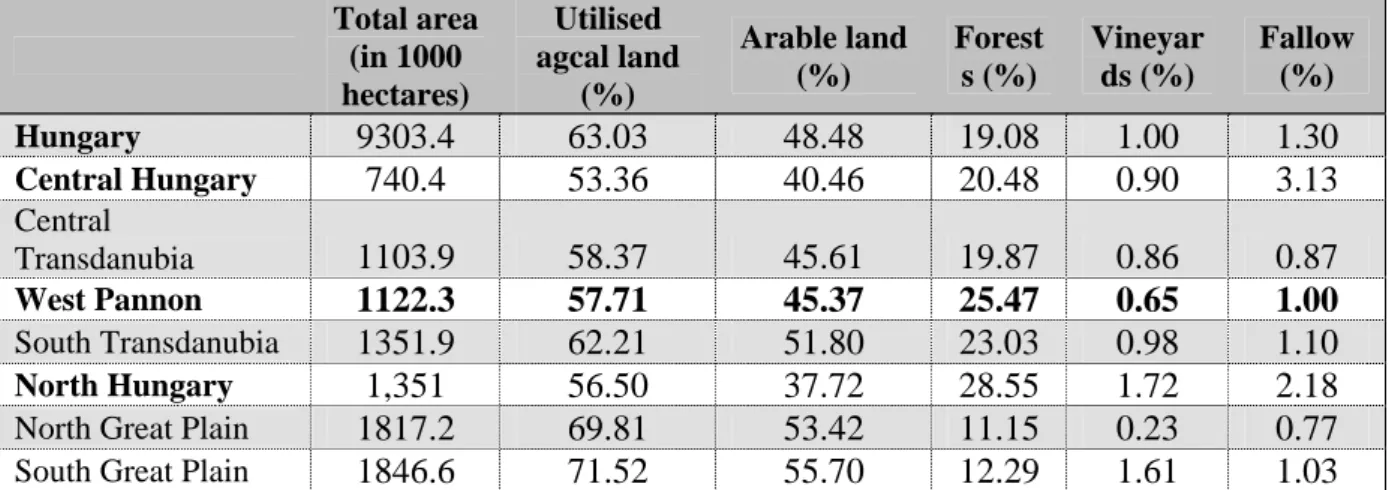
Table 1. Some important data concerning land use (2004) Total area (in 1000 hectares) Utilised agcal land (%) Arable land (%) Forest s (%) Vineyar ds (%) Fallow (%) Hungary 9303.4 63.03 48.48 19.08 1.00 1.30 Central Hungary 740.4 53.36 40.46 20.48 0.90 3.13 Central Transdanubia 1103.9 58.37 45.61 19.87 0.86 0.87 West Pannon 1122.3 57.71 45.37 25.47 0.65 1.00 South Transdanubia 1351.9 62.21 51.80 23.03 0.98 1.10 North Hungary 1,351 56.50 37.72 28.55 1.72 2.18
North Great Plain 1817.2 69.81 53.42 11.15 0.23 0.77
South Great Plain 1846.6 71.52 55.70 12.29 1.61 1.03
Source: Eurostat
2.1.2Settlement network
The West Pannon region has a particular settlement network (primarily due to the varied landscape, as well as the past and present structure of the transport network). It is essential that this be taken into account when organising public services efficiently and at an appropriate level, as well as for regional development. In addition to the network of towns, the region’s settlement network is characterised by a very high ratio of micro-villages and
dwarf villages. West Pannon is made up of 626 villages and 28 towns. As a result of the dense settlement network, the number of municipalities per 100 km2 is higher here than in any other region (5.8).
Table 2. Municipality Structure data, 2005. -499 500-999 1000-4999 5000-9999 10000- Regional Unit Area km2 Number of municipalities Number of towns Population Density Number of Residents
(thousand) Ratio of municipalities with the above population, % Győr- Moson-Sopron 4 208 182 9 104.5 439.9 29.7 25.8 41.8 0.5 2.7 Vas 3 336 216 10 79.5 265.2 60.2 24.5 12.5 0.5 2.3 Zala 3 784 257 9 78.0 295.2 59.9 22.2 16.0 0.8 1.1 West Pannon 11 329 655 28 89 1 000.3 51.6 24.0 21.7 0.7 2.0 Source: CSO
Due to the natural environment (Small Plains) and the production traditions, the market town based settlement network of Győr-Moson-Sopron County mostly resembles that of the Great Plain regions. The structure of the settlement network is much more fragmented in Vas and Zala counties. This is most acutely so in Zala County, while Vas County is typically a transition between Győr-Moson-Sopron and Zala counties. This phenomena is best indicated by the settlement density value, the ratio of municipalities with a population below 200 and 500 (micro-villages and dwarf villages), as well as the average village population figures. (Table 2).
2.1.3Cultural and Ethnographic Attributes
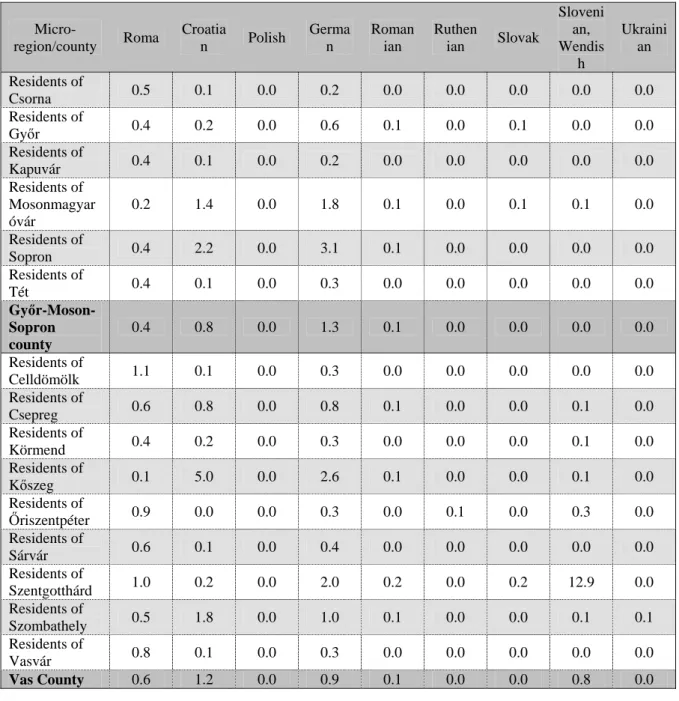
The varied geography and landscape, the historic past and the coexistence of various ethnic groups over several centuries has created a multi-faceted culture in West Pannon. The population living in the area of the region is not uniform regarding ethnicity, language, or cultural traditions. From an ethnographic point of view, the ethnic groups living in the region (Slovenians, Germans, Croatians and Roma) (Table 3) all contribute their own language, culture and traditions to enrich the region’s ethnographic and folk art heritage. There are many of elements of cultural heritage that are unique to the region and which enrich national and universal assets (folk architectural heritage, folklore, culinary specialties, etc.). Distinguished craftspeople and communities are striving to maintain handicrafts and other crafts (such as pottery and wood carving) within the region. The settlement network of certain parts of this region (together with the use of the local landscape) represent assets in themselves (including unique village structures, such as the “nail” and “Diaspora” structures, Zala vine hills and closed gardens); in many places, these are combined with other architectural, cultural and religious heritage.
The region currently contains 2,300 historic monuments, but their number is constantly increasing. About a fifth of all historical monuments in Hungary are to be found in this region. This is especially significant if one takes into account the fact that Hungary’s two most intact historic towns (Sopron and Kőszeg), as well as the two Baroque towns, Győr and Szombathely, are all in this region. Sites of key importance include Pannonhalma Benedictine Abbey, large castles (Fertőd, Körmend, Keszthely) and the early churches that have remained intact (the largest of which are Lébény and Ják). In addition, there are numerous other smaller secular and church-owned monuments that play a significant role in showcasing traditional
construction and the other cultural assets in the region. In addition to historical monuments categorised as such according to the relevant legislation, this region has a variety of other values under local protection here that need to be paid particular attention.
In addition to providing a good opportunity to exploit tourism, maintenance of these sites represents a serious financial commitment (especially regarding the maintenance of a high number of privately-owned monuments).
Currently, there are records of some 8,000 archaeological sites, but due to research this number is increasing all the time. There are 57 individually protected sites. Key sites include the ancient and medieval towns (Sopron, Győr, Szombathely, Kőszeg, Zalalövő, Lébény, Mórichida), as well as other unique historic sites (Zalavár, Keszthely- Fenékpuszta, Vasvár entrenchment) and protected earthwork fortifications (Sopron-Burgstall, Őrimagyarósd, Zalacsány, Tömörd).
Table 3. Ratio of minorities in the region (% breakdown by micro-region and county), 2001.
(minorities representing at least 0.1% in the region) Micro-region/county Roma Croatia n Polish Germa n Roman ian Ruthen ian Slovak Sloveni an, Wendis h Ukraini an Residents of Csorna 0.5 0.1 0.0 0.2 0.0 0.0 0.0 0.0 0.0 Residents of Győr 0.4 0.2 0.0 0.6 0.1 0.0 0.1 0.0 0.0 Residents of Kapuvár 0.4 0.1 0.0 0.2 0.0 0.0 0.0 0.0 0.0 Residents of Mosonmagyar óvár 0.2 1.4 0.0 1.8 0.1 0.0 0.1 0.1 0.0 Residents of Sopron 0.4 2.2 0.0 3.1 0.1 0.0 0.0 0.0 0.0 Residents of Tét 0.4 0.1 0.0 0.3 0.0 0.0 0.0 0.0 0.0 Győr-Moson-Sopron county 0.4 0.8 0.0 1.3 0.1 0.0 0.0 0.0 0.0 Residents of Celldömölk 1.1 0.1 0.0 0.3 0.0 0.0 0.0 0.0 0.0 Residents of Csepreg 0.6 0.8 0.0 0.8 0.1 0.0 0.0 0.1 0.0 Residents of Körmend 0.4 0.2 0.0 0.3 0.0 0.0 0.0 0.1 0.0 Residents of Kőszeg 0.1 5.0 0.0 2.6 0.1 0.0 0.0 0.1 0.0 Residents of Őriszentpéter 0.9 0.0 0.0 0.3 0.0 0.1 0.0 0.3 0.0 Residents of Sárvár 0.6 0.1 0.0 0.4 0.0 0.0 0.0 0.0 0.0 Residents of Szentgotthárd 1.0 0.2 0.0 2.0 0.2 0.0 0.2 12.9 0.0 Residents of Szombathely 0.5 1.8 0.0 1.0 0.1 0.0 0.0 0.1 0.1 Residents of Vasvár 0.8 0.1 0.0 0.3 0.0 0.0 0.0 0.0 0.0 Vas County 0.6 1.2 0.0 0.9 0.1 0.0 0.0 0.8 0.0
Residents of Keszthely 1.0 0.1 0.0 0.6 0.1 0.0 0.0 0.0 0.0 Residents of Lenti 1.3 0.4 0.0 0.2 0.0 0.0 0.0 0.0 0.0 Residents of Letenye 3.2 13.4 0.0 0.2 0.0 0.0 0.0 0.0 0.0 Residents of Nagykanizsa 1.9 0.8 0.0 0.3 0.0 0.0 0.0 0.0 0.0 Residents of Zalaegerszeg 1.3 0.1 0.0 0.4 0.1 0.0 0.0 0.0 0.0 Residents of Zalaszentgrót 2.2 0.2 0.1 0.2 0.1 0.0 0.0 0.0 0.0 Zala County 1.6 1.2 0.0 0.4 0.0 0.0 0.0 0.0 0.0 West Pannon Region 0.8 1.0 0.0 0.9 0.1 0.0 0.0 0.2 0.0
2.2
S
OCIAL SITUATION2.2.1Demographic processes
Looking back on past decades, the population of West Pannon has decreased. Recent years have brought about a slight increase, which is not due to natural increase, but rather to increase from migration to the area.
On 1 January 2004, the region had a total of 1,003,185 residents, which is approximately ten percent of the population of the country. Some 44 percent lived in Győr-Moson-Sopron County, 30 percent in Zala and 26 percent in Vas County. The population density is 89 people/km2, which shows a heterogeneous picture across the counties: Vas (80) and Zala (78) counties have a value that is much lower that the regional value, which is offset by the value of Győr-Moson-Sopron County (104.5).
Population trends are different for each county: Since 1990, the population has increased in Győr-Moson-Sopron, but not in the other two counties. The natural decrease is 0.45 percent in West Pannon and was especially high in Zala in 2003 when compared to the national average (0.57 percent). In Zala, the natural decrease is mostly characteristic of municipalities with a population below 200, where depopulation of some municipalities can also be projected due to the high average age.
The rate of population decrease resulting from natural causes has been offset by a positive net internal migration during recent years. These additional numbers resulting from immigration have increased the population of regional towns and their environs: primarily Győr, but Keszthely, Hévíz, Sárvár and Zalaegerszeg are also destinations for internal migration.
The ratio of genders in West Pannon is unbalanced: there were 1,077 women to 1,000 men on 1000 January 2003, which is lower than the national average. The age distribution of the region’s population is characterised by a low ratio of children (65 to 14-year-olds 15%) and a relatively high ratio of senior citizens (over-65s 15.5%). The ageing index, which compares the senior and child populations is higher than the national average in West Pannon. Not taking the capital into account, the ageing index for Zala County is especially high (115.8). Life expectancy at birth is relatively favourable by Hungarian standards: in the case of males and females born in 2003 in the West Pannon region it was 68.8 years and 77.4 years, respectively. In the case of “micro-villages” with population
Figure 2
Population changes per 1,000 people between 2000 and 2004 by micro-regions
below 200, the ratio of seniors exceeds 30%.
2.2.2Training and Education
The educational level of the region’s population has risen during the past decade. One fifth of the population speaks at least one foreign language in addition to their native language. Due to the proximity of the border, the ratio of German speakers is the highest within the region (14%); English is much less frequently known (6%).
System of training and education
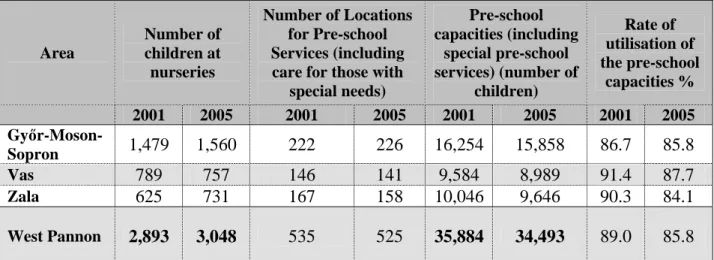
The institutionalisation of children’s day-care is very uneven in the region and is especially lacking in Vas and Zala counties. In 2003, there were 26 nurseries operating in Győ r-Moson-Sopron County, 15 in Vas County and 9 in Zala County. There are no nurseries in the Pannonhalma, Tét, Őriszentpéter, Letenye and Zalaszentgrót micro-regions, where this is one of the numerous disadvantages that prevent women with small children from finding employment. Family day-care centres are almost completely non-existent in the region.
Due to demographic processes, pre-school school age population decreasing since the beginning of the nineties in all three counties. In parallel with this process, the number of children receiving pre-school care is also decreasing.
Table 4. Nursery and pre-school services 2001 and 2004
Area Number of children at nurseries Number of Locations for Pre-school Services (including care for those with
special needs) Pre-school capacities (including special pre-school services) (number of children) Rate of utilisation of the pre-school capacities % 2001 2005 2001 2005 2001 2005 2001 2005 Győ r-Moson-Sopron 1,479 1,560 222 226 16,254 15,858 86.7 85.8 Vas 789 757 146 141 9,584 8,989 91.4 87.7 Zala 625 731 167 158 10,046 9,646 90.3 84.1 West Pannon 2,893 3,048 535 525 35,884 34,493 89.0 85.8 Source: KSH, TeIR
Exact match between the number of nursery places and the demand is missing. In disadvantaged areas of the region (primarily in Zala County), the participation of women on the labour market is hindered by the shortcomings of pre-school services and the lack of places; this means that the number of disadvantaged children is increasing. Alternative day-care services are currently not widely available either, making employment even more difficult. This is one of the key focuses of the National Reform Programme.
Primary and secondary level education is available to all young people of school age, so the level of enrolment within this group is theoretically at maximum. At the same time, due to the settlement network of the region consisting of micro-villages, the highest level provision of primary education at a location that is the nearest to the place of residence is difficult to ensure.
In terms of secondary education, the counties of West Pannon are quite diverse. Based on the numbers of pupils, general secondary schools have better results in Győr-Moson-Sopron County and vocational schools in Vas and Zala Counties. Vocational schools are typically located in cities with county jurisdictions, where 86% of the institutions are located.
The vocational training structure characteristic of the region more or less reflects national trends. A large percentage of those participating in vocational education take their school leaving examination in the West Pannon region. Within the national vocational education structure, the technical, economic and service areas are of a high priority, while the ratio of training in human and agricultural subjects is low – the exception to the latter being Vas County. The reason why there is parallel education and unused capacity is that there is no regional level information system to compare the education available to the demand of the labour market, so making it possible to continuously evaluate and modify the structure of education.
With the exception of Vas County, efforts are being made to provide higher level vocational training through seven secondary schools and the universities in Győr-Moson-Sopron County and since there are no universities, in secondary schools in Zala (11 secondary schools). The ratio of those participating in adult education is below the national average.
West Pannon does not play a leading role in the higher education and training structure of Hungary. There is a lack of a real university centre, or based on the regional background, a university network with all relevant components of the “universitas” within the region, as are useful related areas (such as applied research and development). The most serious problem is posed by parallel education provided by higher level educational institutions in the region (in the fields of economics, pedagogy and engineering). This is a problem since it means that the institutions attract potential students from each other. There is a lack of an appropriate apprentice system to ensure practical education for students in secondary and higher level vocational training.
A higher level of education is characteristic within the region in the direct vicinity of centres of higher level education. The best position is enjoyed by the micro-region of the two largest towns in the region (Győr and Szombathely), where educational indicators are significantly above the regional average. The two micro-regions can be characterised by a high level of education and a high presence of higher education graduates on the labour market. The situation of several medium to large town (Keszthely, Kőszeg, Nagykanizsa, Sopron, Zalaegerszeg) is also above average for all indicators. The situation in the micro-regions of Körmend, Mosonmagyaróvár, Sárvár and Figure 3
Regional schooling indicators by micro-region
A darker colour indicates micro-regions with more favourable indicators, while lighter colours indicate a gradual deterioration of the indicators.
Szentgotthárd is average, mainly due to the high proportion of those with college degrees, because the centres of the regions act as educational centres. The data for micro-regions with small towns acting as the micro-regional centre is below average. The Letenye, Tét and Vasvár micro-regions face the greatest difficulties: their indicators are far below the average.
Environmental education outside of the school framework is becoming increasingly significant at a national level as well as in West Pannon. This relates to the increasing popularity of the lifelong learning principle, the strengthening of non-governmental organisations and the growing responsibility for nature and the environment following the change in regime. There are significant centres for environmental education in the region: member organisations of the National Association of Educational Centres for the Protection of the Environment and Nature, national parks, public cultural institutions, non-governmental organisations.
2.2.3Healthcare
Community guidelines also focus on healthcare, since there are significant differences between European regions in terms of health and access to healthcare. It is therefore important for cohesion policy to support healthcare institutions in order to help to increase the number of years spent healthy and working, with a special focus on poorer member states and regions. The development of community-based healthcare preventative measures need to play an important role in reducing inequalities in the field of healthcare. Good healthcare services mean a higher level of labour market participation, more time spent working over one’s lifetime, higher productivity and lower healthcare expenses and social costs.
Health status
From amongst the demographic data influencing the health of the population of the West Pannon region (2003), infant mortality per 1000 live births (6.0), as well as the number of abortions per 1000 live births (44) are especially high. In 2003, rates for the most common diseases (disease of the bone and muscle system, circulatory, respiratory system, mental, cancer, digestive system) per 10,000 residents shows many differences. There are also significant differences on a micro-regional and county level. The Pannonhalma micro-region has the lowest occurrence of most of the diseases above, while rate of diseases occurring in the micro-regions of Körmend, Szentgotthárd and Celldömölk was unfortunately the highest. Within this region, the ratio of new breast cancers per 100,000 residents is the second highest in the country for breast cancer! Regarding diseases in children, the occurrence of asthma is above the national average for both boys and girls. Regarding indicators derived from mortality rates – with the exception of diseases of the digestive system, where the mortality rate is the highest in the country –, regional indicators are more favourable than the national average for all key causes of death.
The state of health of the population is mostly influenced by lifestyle. Although the food intake consists of more vegetables and fruits, the ratio of obese and overweight people is above the national average. The number of registered alcoholics per 10,000 residents is the second highest in the country. Lifestyle-related problems, as well as the early recognition of various diseases, together with services provided near the residents and prevention have a high influence on the general state of health of the region, as do health development programmes customised for individuals and small communities. The National Reform Programme also places key focus on increasing the number of healthy years via health
Az egy háziorvosra és házi gyermekorvosra jutó lakosok száma, 2003.
Győri Téti Mosonmagyaróvári Csornai Kapuvári Sopron-Fertődi Pannon-halmi 1606 1564 1491 1688 1432 1586 1766 Kőszegi Csepregi Szombathelyi Körmendi Szent-gotthárdi Ő rszent-péteri Lenti Zalaegerszegi Vasvári Sárvári Celldömölki Zala-szentgróti Nagykanizsai Letenyei Keszthely-Hévizi 1200 - 1350 1351 - 1500 1501 - 1650 1651 - Régió: 1539 1660 1419 1311 1389 1211 1354 1873 1772 1550 1330 1435 1246 1600 1546 1249
Forrás: KSH megyei statisztikai évkönyvek Győr-Sopron: 1589
Zala: 1570
Vas: 1432
maintenance and disease prevention programmes; these result in an increase in time spent in active work.
The health care system
In terms of the availability of specialists the number of doctor positions per 10,000 residents is 30.1 (national: 37.8), showing that this region has the third smallest number of doctors in Hungary. Within the region, the number is the lowest in Vas County (24.9), followed by Zala (25.9) and Győr-Moson-Sopron (26.3) Counties. Regarding basic health services, there were 512 general practitioners in the region in 2002: the number of residents per GP was: 1,539. The number of family paediatricians per 10,000 children aged 0 to 18 is 6.4 (national: 6.9), which is the second lowest number for all regions. In 2003, the number of district nurses in the region was 584. The number of newborns and families receiving care per district nurse is the lowest in the region and the number of expectant mothers per district nurse is the second lowest in the country. The number of trained, home based nurses in the region was 27 in 2002, which is the lowest for all regions.
Number of residents per general practitioner and family paediatrician, 2003
Within the system of national inpatient care, this is one of the regions which does not have a medical university as a top centre of progressive healthcare. Regarding the number of institutions providing healthcare for inpatients per 100,000 residents, the region has a high density of hospitals when compared to the national average: 1.69 (national: 1.80). Capacity in regional institutions providing inpatients care often results in parallel services operating alongside each other. As these are eliminated, outpatient centres need to be developed in parallel. Integrated clinics providing outpatient care on the regional and micro-regional level, which are not integrated with hospitals (e.g. Lenti), also play a large role in caring for patients, but this role does not receive much attention. Besides general practitioner and central emergency clinics, the infrastructure is nearly 20 to 30 years behind the desired level.
Regarding chronic and rehabilitation beds per 10,000 residents, the region does not have the number of beds agreed with the national health fund for follow-up treatment, chronic rheumatology, alcoholism treatment and drug addict treatment. There is insufficient capacity for senior citizen support and demographic data indicates that a solution is required. Within the region, there is a significant difference between the counties according to specialisation and many imbalances which complement each other. There are specialist services which are regional or serve more than one region, for example plastic surgery, surgery for burns and neurological surgery in Győr-Moson-Sopron County, radiotherapy and oncoradiology in Vas County and cardio-surgery in Zala County.
Health tourism services at institutions in this region are only sparsely present in those municipalities with medical tourism (e.g. Hévíz and Balf). Certain rehabilitation and recreational treatments and the use of thermal waters for specific types of diseases as complementary treatments are currently not favoured by healthcare services providers.
2.2.4Social policy
The region's economic productivity is higher than the national average, however, this beneficial economic situation does not result in a poverty rate lower than that of other regions. This is possibly due to inequalities of income within the region and in part to high
consumer prices and cost of living. Every tenth household in the region is living from significantly less than the household considers enough to cover the cost of living.
There are more senior citizens in micro-villages than in towns. According to year 2001 data the following micro regions are most affected by ageing: Tét (ratio of over 60s: 23.1%),
Őriszentpéter (28.2%), Vasvár (23.9%), Letenye (25.1%), Lenti (25.4%). Due to the high number of senior citizens, it is important for an increasing number of communities to become responsible for establishing care and residential institutions for the elderly, in addition to the concentrated residential home in each region.
According to the census data of 2001, 3.9% of the Roma population lives in the region, but they are highly dispersed. Concentration of the Roma population is less typical at a municipal level, but segregation and separation are present. The regional distribution of the Roma population within the region is characterised by the fact that it is above average in the micro-regions of Letenye, Zalaszentgrót and Nagykanizsa. Some key examples of Roma communities concentrated in municipalities include Csapi, Zalakomár, Zalakaros, Garabonc, Galambok, Rezi, Karmacs, Pacsa and environs, Sormás and Türje.
Regarding family support and child welfare services, single-person services are predominant in the small municipalities, where district nurse or teacher carries out child welfare tasks on a part-time basis. Services in towns operate within an institutional framework. Personnel criteria of institutional services are good, material assets and general criteria is generally adequate. The material criteria of providing help are not provided in all small municipalities and facilities are not suitable for receiving clients. According to data from 2003, services are not operational in seven municipalities of Vas County. The two other counties are covered. In Zala, this service is provided within the framework of a larger association. In 2003, 134 out of 182 municipalities in Győr-Moson-Sopron County formed an association for this task, thereby ensuring that their tasks will be performed more efficiently and in line with statutory requirements.
Figure 5
Capacity of senior home centres per 1000 residents, 2004
Figure 6
The number of Roma per 1000 residents by micro-regions, 2001
Source: KSH, TeIR Source: KSH, TeIR
Based on the census data from 43, there are 43,461 people living with disabilities in West Pannon. This number is the lowest both nationally and regionally and the situation is most favourable in Vas County. The number of people with disabilities shows a significant increase for over-40s, one reason for which might be that disabilities have been acquired during their lifetimes. According to data from 9, there are nine institutions within the region that provide day-care support for the disabled, only two of which are located in Zala County. In terms of developing a system of institutions providing support for those living with disabilities, the region lags furthest behind in comparison with the rest of Hungary. It has the lowest number of day-care and live-in institutions of any region.
Regarding access to the provision targeted at people with addictions, the region faces serious problems. For example, there are no day-care facilities for people with addictions in Zala County, while there are only two such facilities in both Győr-Moson-Sopron County and Vas County. Regarding the support of psychiatric patients, the situation is even worse: there is no day-care form of support in either Zala or Győr-Moson-Sopron County – and there is only one such facility in Vas County. There are seven municipalities in the region which provide support for the homeless.
2.2.5Unemployment
Based on strategic community guidelines, the strengthening of active and preventive measures on the labour market should become an important priority, in order to overcome the obstacles to entering and remaining in the labour market, as well as to promote mobility for job seekers, the unemployed, as well as inactive and elderly workers and those who are threatened by unemployment, with special regard to low qualified workers.
The number of unemployed dropped drastically up until 2002. Although the number of unemployed in the three counties was nearly 50,000 during the few years after the regime change, it dropped to only 26,000 by 1998 and to about 18,000 by 2002. From 2002 on, as a result of unfavourable labour market developments, the number of those without jobs has once again risen to above 20,000, which primarily affects Vas and Zala counties. The ratio of manual workers, unskilled workers and career starters is lower than the national average. From a labour market point of view, the Roma population faces the greatest difficulties.
In December 2005, 7.4% of the nationally registered unemployed lived in the region. Compared to this, the 8.3% rate of white collar unemployment and approximately 9.4% rate of graduate unemployment is significantly above the national average. On one hand, this indicates a surplus in people with higher level education and on the other, an lack of white collar jobs in the region.
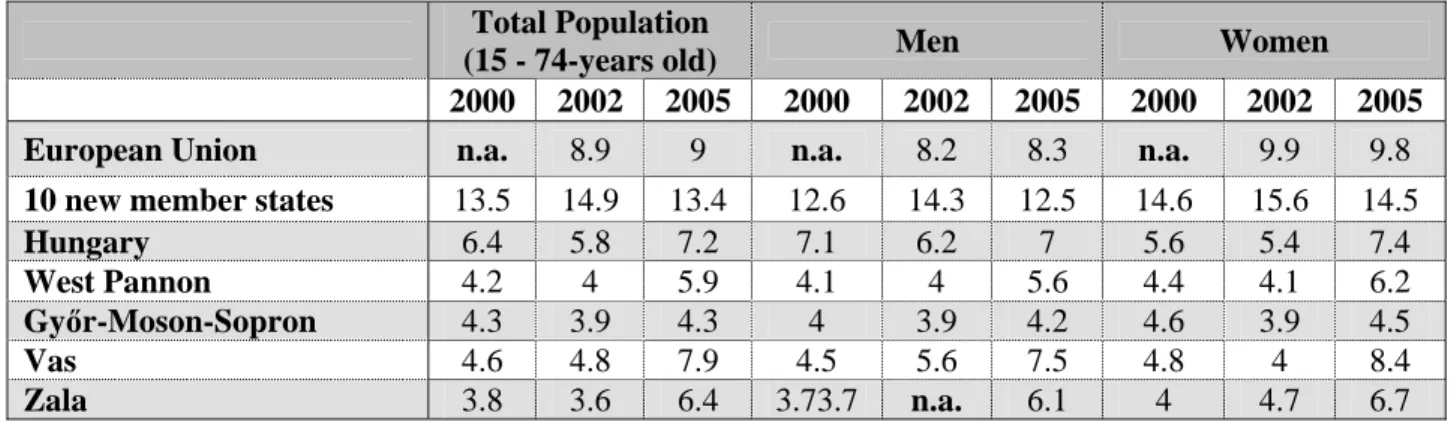
Table 5. Unemployment trends (%)
Total Population
(15 - 74-years old) Men Women
2000 2002 2005 2000 2002 2005 2000 2002 2005
European Union n.a. 8.9 9 n.a. 8.2 8.3 n.a. 9.9 9.8
10 new member states 13.5 14.9 13.4 12.6 14.3 12.5 14.6 15.6 14.5
Hungary 6.4 5.8 7.2 7.1 6.2 7 5.6 5.4 7.4 West Pannon 4.2 4 5.9 4.1 4 5.6 4.4 4.1 6.2 Győr-Moson-Sopron 4.3 3.9 4.3 4 3.9 4.2 4.6 3.9 4.5 Vas 4.6 4.8 7.9 4.5 5.6 7.5 4.8 4 8.4 Zala 3.8 3.6 6.4 3.73.7 n.a. 6.1 4 4.7 6.7 Source: Eurostat
The ratio of long term unemployed to all unemployed people has slightly decreased in recent years, but it is still around 40%, which is lower than the EU and national average.
Table 6. Long term unemployment trends (%)
2000 2002 2005
European Union n.a. 44.2 45.47
Hungary 47.9 43.4 45.05
West Pannon 42.9 38.9 40.08
2.3
E
CONOMICS
ITUATIONIn 2003, 10.7% of Hungary’s gross domestic production (GDP) came from West Pannon. There have been no significant changes in the trend for GDP share. From 1998 to 2003, there has been a slight increase for Győr-Moson-Sopron County and some decrease for Vas. Between 2001 and 2003, the GDP growth of all three counties of the region exceeded the national average calculated without Budapest.
At the same time, looking at the average of the countries of the European Union, the GDP per capita is below 65% of the EU average, which is considered as disadvantaged according to the Lisbon Objectives. According to the micro-economic situation as depicted in the National Reform Programme, while the economy of Hungary has undergone drastic growth during the past decade, it has been somewhat left behind by those EU10 that countries which begun catch up at a later stage.
Dynamic economic restructuring has not taken place evenly across the region and there has been a further increase in existing regional differences (between more developed Győ r-Moson-Sopron and less developed Zala). In 2002, the per capita GDP of Győr-Moson-Sopron was near 69% of the extended EU (EU25) average, while for Vas it was around 58% and for Zala around 51%. Starting in 1998, there have been some changes in the structure of the economy and some employers who used waged labour have left the region. After a period in which activity based on waged labour decrease, there followed a positive period in Győ r-Moson-Sopron County from the point of view of employment and capital utilisation. This period had been full of contradictions in Vas County, while Zala had to face new difficulties. In terms of economic performance, the industrial centres that were the most capable of attracting foreign working capital acted as the drivers for development: Győr, Szombathely, Sopron, Sárvár, Mosonmagyaróvár, as well as Szentgotthárd and its vicinity. The economic performance of the two towns in Zala County with county jurisdictions was somewhat lower. The lowest performance levels were evident in two micro-regions each in Zala (Zalaszentgrót, Letenye) and Vas (Vasvár, Őriszentpéter).
Table 7. GDP trends (1995, 2000, 2003) 1995 2000 2004 Per Capita (PPS) Per capita, as a percentage of the EU25 average Per Capit a (PPS) Per capita, as a percentage of the EU25 average Per Capita (PPS) Per capita, as a percentage of the EU25 average European Union (25 countries) 15,513 100.0 20,114 100.0 22,415 104.2
10 new member states 7,196 46.4 10,098 50.2 12,406 57.7
Hungary 7,653 49.3 10,627 52.8 13,751 64
West Pannon 7,883 50,8 12,150 60.4 14,359 66.8
Győr-Moson-Sopron
County 8,320 53.6 n.a. n.a. 15,896 73.9
Vas County 8,154 52.6 n.a. n.a. 13,870 64.5
Zala County 7,022 45.3 n.a. n.a. 12,514 58.2
In terms of competitiveness at the micro-regional level the situation is even more polarised. Based on economic openness, availability of global networks and expressways, the capacity of innovation centres, as well as the presence of human resources, information and communication technologies, the close environs of towns with county jurisdictions and Sárvár can be viewed as absolutely or relatively competitive, as can the micro-regions of Keszthely-Hévíz and Szentgotthárd, due to their special attributes. On the other hand unfortunately, there are a number of micro-regions that are not competitive based on these considerations; these are primarily along the south border of the region, as well as the internal periphery of Vas and Zala (Csepreg, Vasvár, Körmend, Őriszentpéter, Zalaszentgrót, Lenti, Letenye). However, it is important that regional differences between each micro-region are emphasised, especially in the case of “urban” micro-regions (e.g. the relationship between the environs of Szombathely and the micro-region near Sorok to the south of the town). The quality of the investment environment is decisive in defining productivity and economic growth, which plays a role in the fulfilment of the Lisbon Objectives through the implementation of the Reform Programme. In line with the most important sectors of the region, cluster initiatives have been launched continuously since 2000. These initiatives are aimed at promoting cooperation and interaction between companies and providing special services as well as infrastructure for the key sectors that play a dominant role in the economy of the region (motor industry, electronics, mechatronics, wood industry, furniture industry, environmental technologies, alternative resources, health tourism, medical tourism, logistics), as well as related and supporting industries. They are based on highly skilled workforce in line with the expectations of the clusters, technology and technical infrastructure; the objective is to improve the competitiveness of the enterprises already operating in the region and to launch new enterprises. In line with strategic community guidelines, the region is consciously concentrating on achieving an economic situation which is in line with its requirements and possibilities, where the basis of growth is innovation and entrepreneurial intellectual potential.
The first such initiative was organised in 2000 in the area of the automobile industry [Pannon Automobile Cluster (PANAC) – headquartered in Győr], followed by similar initiatives in the wood and furniture industry in 2001 [Pannon Wood and Furniture Industry Cluster (PANFA) – Zalaegerszeg], thermal tourism [Pannon Thermal Cluster (PANTERM) – Bük] and the electronics industry [Pannon Electronic Cluster (PANEL) – Szombathely] In 2005, the scope was further expanded with the aim of developing the textile industry, logistics, as well as local products and the preparation of a similar organisation started in 2006 in the area of renewable and alternative
Figure 7
Entrepreneurial environment, foreign ownership, sector concentration by
micro-region in West Pannon
A darker colour indicates micro-regions with more favourable indicators, while lighter colours indicate a gradual deterioration of the indicators.
energy sources. This latter area may be especially important for the region, since renewable energy can meet important points of synergy with both the wood industry and the automobile industry.
2.3.1Economic Activity
The number of registered enterprises in the West Pannon region was nearly 117,000 at the end of 2004, which is 12.4% higher than the figure for 117 and 21.6% more than the same figure eight years ago. The number of enterprises per 1,000 residents at 117 (this was only 104 in 1000) is significantly higher than the national average; it also exceeds the same indicator for every region except for Budapest. Some 80% of registered enterprises are operational enterprises; this ratio is also higher that the national reference figure.
The type of business is generally selected in line with capital intensity, activity and opportunities. It is apparent that private initiatives and individual enterprises are much more active in less economically developed micro-regions than in towns with county jurisdictions. The difference may be as high as 10 to 15 percent. This means that more than 32,000 operating enterprises are partnerships, the number of which has doubled during the past 10 years; this also indicates a strong entrepreneurial base. Some 129 of operational enterprises are large enterprises with a headcount exceeding 250, while there are 500 medium-sized enterprises with a headcount of 50 to 250, which means that 98% are micro and small enterprises with a headcount below 50.
The regional concentration of the economy is indicated by the fact that nearly half of operational enterprises have their headquarters in county towns (Győr, Szombathely, Zalaegerszeg) or the relevant micro-region (furthermore, one quarter of these are in Győr or its close environs). If we add the Sopron, Nagykanizsa, Mosonmagyaróvár and Keszthely micro-regions to the county towns, 80% of enterprises are operating in larger towns or their vicinity. This concentration is clearly because of established infrastructure, availability of an appropriately trained workforce and the proximity of a potential market encouraged industrial and construction enterprises to locate and operate in the area. At the same time, the market and the high level of urbanisation also draws service sector enterprises to larger and medium-sized towns.
In terms of the number of enterprises, the structure of the economy is similar in all the counties of the West Pannon region. Approximately 5 – 7% of companies are active in agriculture, 9% in industry and 10% in the construction industry, while three quarters of operational enterprises are related to the tertiary sphere. Due to the lower employee headcount, this has a much higher share than the sector’s contribution to gross added value or employment.
2.3.2Employment
Increasing employment is one of the key Lisbon Objectives set out by the EU. In this respect, despite negative developments in recent years, the region is in a more favourable situation than most regions in Hungary: the only place where this indicator is more favourable is Budapest. The activity rate is approximately 3 percent above national average. The employment chapter of the National Action Plan is based on the year 2004 national employment action plan. In this region the target figures of employment laid out in the year 2004 action plan seem to 'be reached' in relation to the average of the EU Member States for year 2006, however, there are substantial differences between and within regions. According
to community guidelines, investments in infrastructure, enterprise development and research increase the number of employment opportunities, both in the short term as a result of primary impact and in the long term as a result of favourable impact on competitiveness. In order to increase employment as far as possible through these investments and to establish permanent jobs of a high quality, human resources should be further improved and utilised.
There are also differences between the counties in this respect. Activity levels are highest in Vas County, where despite the slight decrease of recent years, economic activity was nearly 60% in 2004, while in Zala it was around 58% for almost 10 years. By contrast, in Győ r-Moson-Sopron county this ratio, which was still as high as about 60 percent back in the mid-nineties, had dropped to 55% by 2004, the lowest figure even within the region. There is a significant difference between the levels of activities of women and men in the region. Men's activity rate was more than 10 percentage points higher in 2005, exceeding the national and the EU average.
Table 8. Trends in the activity ratio (in the 15-64 year old generation)
Total Population Men Women
2000 2002 2005 2000 2002 2005 2000 2002 2005
European Union n.a. 69.9
70.1 n.a. 77.3 77.8 n.a. 60.6
62.62. 55
10 new member states 66.5 65.7 65.8 73 72.2 72.4 60.2 59.4 59.4
Hungary 60.1 59.7 61.3 67.9 67.1 67.9 52.7 52.7 55.1
West Pannon 66.2 66.4 66 74.1 74 72.3 58.4 58.9 59.7
Source: Eurostat
Employment numbers have been dropping continuously since the middle of the 1990s, although the decrease is slight. At the same time, it is apparent that employment levels are higher than the national average and are similar to the EU average, while differences in employment between women and men are prevalent. This difference has increased during recent years.
Table 9. Employment indicator trends (ages 15 – 64)
Total Population Men Women
2000 2002 2005 2000 2002 2005 2000 2002 2005
European Union n.a. 62.7 63.7 n.a. 70.9 71.2 n.a. 54.5 56.2
10 new member
states 57.4 55.8 56.9 63.7 61.8 63.3 51.3 50 50.7
Hungary 56.3 56.2 56.9 63.1 62.9 63.1 49.7 49.8 51
West Pannon 63.4 63.7 62.1 71.1 71.1 68.2 55.8 56.4 55.9
Source: Eurostat
2.3.3Research and Development
The Lisbon strategy of the European Union places considerable emphasis on research, development and innovation, as one of the main pillars of competitiveness. The National Reform Programme focuses on the economy’s weak potential for innovation at a national level. This region plays a key role in this respect. Regarding research and development potential, the weight of the West Pannon region is far below its economic weight, or even below its national share based on population. This is despite the fact that since the middle of the 1990s, the West Pannon region has been one of the regions most capable of dynamically expanding its
R&D performance. Due to the low baseline, it has not even reached the average for rural Hungary (excluding Budapest) in 2004. Higher education and research centres in Budapest and East Hungary are currently much more competitive and able to raise funds that those in West Pannon, so it is not expected that the difference between the regions in this respect will decrease tangibly in the future. In terms of key indicators, the share of this region in Hungary was only between 4 to 7% in 2004. Based on R&D expenditures, West Pannon ranks fifth or sixth among the regions and it is slightly higher than North Hungary and South Transdanubia in terms of certain indicators. It is apparent (Table 10) that in terms of the Lisbon R&D indicators, the region is far below the EU average.
Table 6. R&D expenditures per GDP and the number of R&D employees in all employment (2000, 2003)
R&D expenditures per GDP (%)
Those employed in R&D in all employment (%)
2000 2004 2000 2004
European Union (EU25) 1.86 1.86 1.44 1.49
10 new member states (NMS) 0.77 0.78 0.90 0.93
Hungary 0.79 0.88 1.18 1.27
West Pannon 0.20 0.31 (2003) 0.51 0.54
Source: Eurostat
Two thirds of research locations are parts of universities and colleges. In addition, there is also research and development work in progress in research institutes and other research facilities financed by the state budget. Environmental sciences, agricultural sciences and certain technical sciences are the predominant fields of research. R&D activities are not significant within the scope of entrepreneurs, since at multi-national companies most high-tech solutions, manufacturing processes and finished parts are delivered to Hungary as part of the international flow. Although the ratio of those with education in technical and natural sciences is only approximately one third of the EU15 average and there is a significant lack of technicians and skilled workers, the number and quality of university-enterprise synergies is expanding in the area of technical sciences and the vast majority of corporate R&D utilisation is concentrated in technical fields – the National Reform Programme also provides an outline of the trends typical for the region. Knowledge and innovation is at the focus of EU efforts aimed at promoting economic development and job creation and is also a high priority in community guidelines. Due to the nature of the system of higher education institutions and the structure of the economy, research and development is clearly concentrated in Győr-Moson-Sopron County which in home to two universities, while the regional share for Vas and Zala Counties is more modest. In 2004, 64.4% of the research and development locations of the region and 71.3% of R&D professionals were located in Győr-Moson-Sopron County. The relative dominance of Győr-Moson-Sopron County in the region is expected to increase in future, while that of the other two counties will decrease, since the new, “regional university knowledge centres” (dealing with the issues of forest and wood utilisation as well as the auto industry), as well as cooperation research centres (environmental resources, auto industry, electronics and logistics) were established in 2004 and 2005, at the University of West Hungary and Saint Stephen University in Sopron and in Győr.
2.3.4Tourism
location of the region, tourism’s significance is due to the fact that the region has a wide and varied selection of tourist sites and attractions. The border crossing points of the region are responsible for nearly half of all people crossing into Hungary. Almost all sectors of tourism offer good opportunities for rest and relaxation. Part or the whole of eight of Hungary's 27 resort regions are located in this region, thus nearly two thirds of the municipalities of West Pannon are in resort areas or offer holiday and tourism opportunities. The majority of regional tourism performance comes from these municipalities.
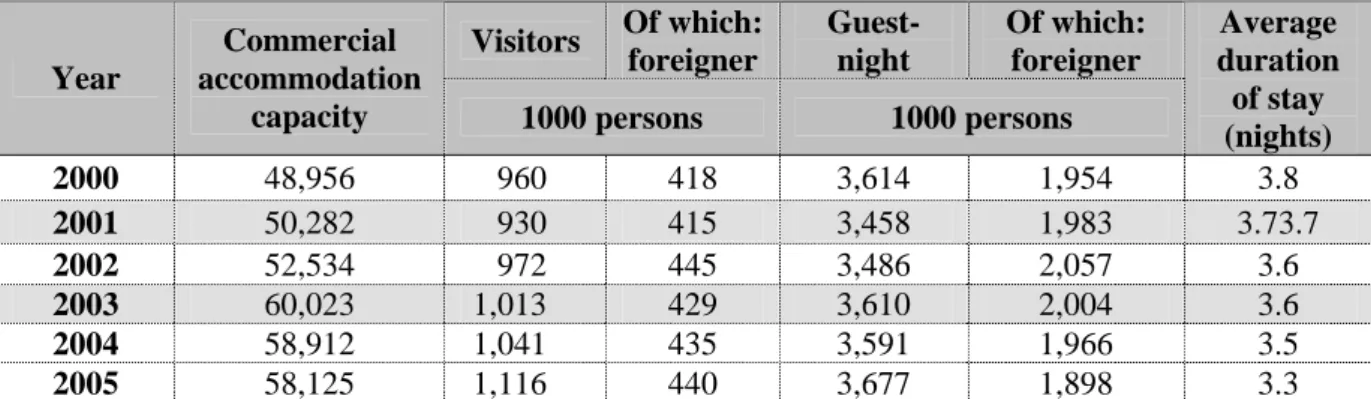
In terms of the guest-nights, the West Pannon region ranks second in Hungary after the Central Hungary region. Tourism plays an increasingly important role in the region's economy. While in 2002 a total of 5,239 enterprises were actually operating in this sector, by 2005 the number of such businesses had increased to 11,211, equalling 214 % of the number recorded in 2002. The proportion of tourism enterprises increased as a percentage of the total number of undertakings as well, from 5.6 % in 2002 to 8.8 % in 2005. The trends observed in the sector are promising continued expansion, for which the region has the required resources and conditions.
Health tourism, based on the rich availability of thermal and medical waters, is a field that needs to be stressed separately from amongst the key fields of tourism. Spas are operating in teh following towns in this region: Balf (Sopron), Bük, Győr, Hévíz, Kapuvár, Kehidakustány, Lenti, Mosonmagyaróvár, Sárvár, Szeleste és Zalakaros. Thermal spas are available to the guests in another 10 municipalities and two have both medical spas and thermal spas. These spas play a strong role in their area. Based on their attributes, Hévíz, Bük, Zalakaros and Sárvár are the dominant spa locations in the region. The spas here provide important medical services. The number of visitors is high and tourists are also drawn in significant numbers from neighbouring countries. It is likely that in the medium term, these spas will define the standing and image of the region as a destination for thermal spa tourism. Most of the spas have undergone a high level development during recent years, the range of services has expanded, resulting in increased international competitiveness. Specialisation, namely the specialisation of the services provided started together with improvements. Health tourism, based on thermal spa water, is of primary significance for the region. High level features that may complement this include wellness services, as well as other services aimed at active rest and relaxation, such as hiking (the blue sign trek), riding, bicycle tours, hunting, fishing, flying sports, golf, entertainment presenting the local culture, wine roads and culinary trips.
West Pannon is also rich in wine-related and culinary assets and specialties. Some 77 municipalities in the region belong to historic wine regions or are classified as wine producing areas. From amongst the historic wine regions, the complete area of the Pannonhalma-Sokoróalja and the Sopron wine region is to be found here and some parts of the Somló, Balaton Highlands and Balatonmellék wine regions are in this region. Wine roads have been established in all wine producing areas. In addition, tourism opportunities are made more varied by wine festivals, wine days, wine competitions and a wine ball in Kőszeg. Cultural and architectural heritage also represent a strong draw. These include the World Heritage Pannonhalma Abbey, Lake Neusiedler (as a cultural region, along with a large number of historic fortifications, castles, mansions and religious buildings. The region’s most significant sites include the Eszterházy mansion in Fertő, the Batthyány mansion in Körmend and the Jurisics castle in Körmend, but these are in need of development. There are high profile and diverse cultural events in this region. Several are well-known internationally, such as the “Baroque Days” in Győr, Mediawave, the Savaria Historic Carnival, the Balaton Festival and the Stork-Leg World Games. Some towns in the region
(Keszthely, Sopron) also provide excellent opportunities for conference tourism.
The varied landscape, as well as the region’s rich flora and fauna also serve as a serious tourist attraction for nature lovers. The parks open to visitors in the Fertő-Hanság and Őrség National Parks, Lake Balaton, the Kis-Balaton, and Lake Neusiedler, as well as smaller lakes and rivers provide varied opportunities for active relaxation, for groups in small rowing boats and for those seeking for fishing in 'wild waters'. Part of the National Blue Sign Trek leads through the region. In line with the main objectives of the region, this is one reason why the safeguarding and showcasing natural assets has to play an especially important role. Cycle tourism is one of the fastest growing areas of tourism. Due to increased demand, several kilometres of cycle paths have been and are being built, especially in the area of the Fertő Lake, Balaton and near the border. According to available data, West Pannon has cycle paths exceeding 300 km in length, which comprises more than one fifth of the national network. The isolation of these improvements poses a problem: the various cycle paths are not interconnected either at a regional or international level.
In line with the growth of tourism opportunities, the capacity of commercial accommodation has increased gradually during recent years. In 2003, the region had commercial accommodation capacity or more than 60,000 beds, comprising 17% of total national capacity. In the near future, the development of existing accommodation and their differentiation by target groups needs to be in the focus instead of increasing accommodation capacity. The distribution of accommodation between counties is uneven. Due to the attraction of the Balaton shore, Hévíz and Zalakaros, 44% of commercial accommodation can be found in Zala County, 37% in Győ r-Moson-Sopron and a mere one fifth in Vas.
10% of the national hotel capacity and 60% of the regional capacity has been established in Zala, only the capital and Somogy County have more than this. In line with increasing accommodation capacity, the turnover of commercial accommodation has steadily increased during recent years. During recent years, private accommodation activities have become more intense in towns and key tourist destinations. Village tourism is also gaining popularity. This is primarily due to the fact that the standard of services has improved and the role of marketing in attracting visitors has increased. This form of holiday has become increasingly popular. This is on partly due to the peaceful and relaxed environment and partly due to the very varied countryside; this trend is expected to continue.
Figure 8
Micro-regional attributes of commerce and tourism
A darker colour indicates micro-regions with more favourable indicators, while lighter colours indicate a gradual deterioration of the indicators.