This is a repository copy of
General immunity and superadditivity of two-way Gaussian
quantum cryptography
.
White Rose Research Online URL for this paper:
http://eprints.whiterose.ac.uk/96139/
Version: Published Version
Article:
Ottaviani, Carlo orcid.org/0000-0002-0032-3999 and Pirandola, Stefano
orcid.org/0000-0001-6165-5615 (2016) General immunity and superadditivity of two-way
Gaussian quantum cryptography. Scientific Reports. 22225. ISSN 2045-2322
https://doi.org/10.1038/srep22225
[email protected]
https://eprints.whiterose.ac.uk/
Reuse
Unless indicated otherwise, fulltext items are protected by copyright with all rights reserved. The copyright
exception in section 29 of the Copyright, Designs and Patents Act 1988 allows the making of a single copy
solely for the purpose of non-commercial research or private study within the limits of fair dealing. The
publisher or other rights-holder may allow further reproduction and re-use of this version - refer to the White
Rose Research Online record for this item. Where records identify the publisher as the copyright holder,
users can verify any specific terms of use on the publisher’s website.
Takedown
If you consider content in White Rose Research Online to be in breach of UK law, please notify us by
General immunity and
superadditivity of two-way
Gaussian quantum cryptography
Carlo Ottaviani & Stefano Pirandola
We consider two-way continuous-variable quantum key distribution, studying its security against general eavesdropping strategies. Assuming the asymptotic limit of many signals exchanged, we prove that two-way Gaussian protocols are immune to coherent attacks. More precisely we show the general superadditivity of the two-way security thresholds, which are proven to be higher than
the corresponding one way counterparts in all cases We perform the security analysis rst reducing
the general eavesdropping to a two-mode coherent Gaussian attack, and then showing that the
superadditivity is achieved by exploiting the random on o switching of the two way quantum
communication. This allows the parties to choose the appropriate communication instances to prepare the key, accordingly to the tomography of the quantum channel. The random opening and closing of the circuit represents, in fact, an additional degree of freedom allowing the parties to convert, a posteriori, the two-mode correlations of the eavesdropping into noise. The eavesdropper is assumed
to have no access to the on o switching and indeed cannot adapt her attack We explicitly prove that
this mechanism enhances the security performance, no matter if the eavesdropper performs collective or coherent attacks.
Quantum Key Distribution (QKD)1 is today one of the most advanced quantum technologies among those emerged from the fundamental research in quantum information. Rapidly progressing towards practical imple-mentations2, the interest in QKD is motivated by the promise of achieving eicient distribution of cryptographic keys over insecure channels. In fact its main goal is to provide an information-theoretic secure strategy to share cryptographic keys in order to replace the current computationally-secure solution3, which has been proved to be vulnerable4 to attacks by quantum computers.
he typical scenario involves two parties, Alice and Bob, who want to share a secret message over an insecure channel5. To achieve this goal they encode classical information in non-orthogonal quantum states, which are sent over a noisy quantum channel under control of an eavesdropper, Eve. he standard assumptions to analyze the security of QKD protocols are the following: Eve is computationally unbounded, but has no-access to the parties’ private spaces2,5 and, most importantly, she is restricted by the no-cloning theorem6. he distribution of private keys is possible because any attempt to extract the encoded information unavoidably introduces noise on the quantum states. Monitoring this noise the parties can quantify how much Eve has learnt on the secret key and, consequently, apply classical error correction and privacy ampliication protocols reducing Eve’s information to a negligible amount. Once they have distilled such a key, the parties can safely use the one-time pad protocol. In case the level of noise is too high, above the security threshold, they can to abort the protocol (denial of service).
he irst theoretical proposals for QKD protocols have been designed for discrete variables (DV)1 systems. Today several remarkable implementation of DV-QKD have been achieved in both ibers7 and free space8. Beside this approach, several protocols exploiting quantum continuous-variable (CV) systems have been put forward9–14. In CV-QKD15 the information is encoded in quantum systems with continuous spectra (ininite-dimensional Hilbert space), and a special attention has been devoted to Gaussian CV systems16.
Gaussian CV-QKD has been achieved in in-ield implementations17, with practical performances comparable to those of DV-QKD, despite the latter appears to be more robust for long-distances. he result of ref. 17 has been possible combining eicient reconciliation protocols11, post-selection18 techniques and eicient classical com-pression codes19. he interest in optical CV systems, for quantum information purposes, is now growing, boosted mainly by the natural properties of these systems: relatively cheap experimental implementation, higher rates, Department of Computer Science York Centre for Quantum Technologies University of York YO GH UK Correspondence and requests for materials should be addressed to C O email carlo ottaviani york ac uk Received December
Accepted January Published March
www.nature.com/scientificreports/
broadband detection techniques20, and the possibility of exploiting a wide range of frequencies21,22. hese natural properties make CV-QKD a promising candidate for future practical real-world implementations, especially in the mid-range distances like the metropolitan areas where high rates are desirable23.
Today, many theoretical eforts are devoted to the design of device independent (DI) QKD protocols24,25. Despite recent remarkable results, the practical implementation of this approach remains still diicult26–28. Very likely the next generation of end-to-end quantum networks will use the recently introduced29,30 measurement device independent QKD (MDI-QKD) which allows the distribution of cryptographic keys preserving the pro-tection against the most typical side-channel attacks, without the need to pass a Bell test (see ref. 29 for a general security analysis). Recently a very high-rate CV-MDI QKD protocol has been proposed and tested in a proof of principle experiment23,31,32.
Alongside the study of end-to-end QKD, it is also of great interest the design of more robust point-to-point
QKD schemes improving the security performances of CV-QKD in noisier environments14 or able to exploit trusted noise33 to implement QKD at diferent frequencies21. In this regard, the two-way protocols14, where the parties make a double use of the quantum channel to improve the tolerance to noise, show higher security thresh-olds than the one-way counterparts. his idea has been also extended to thermal QKD34. Also note that the two-way protocols have been developed for DV-QKD35,36 and can be used for direct quantum communication37,38.
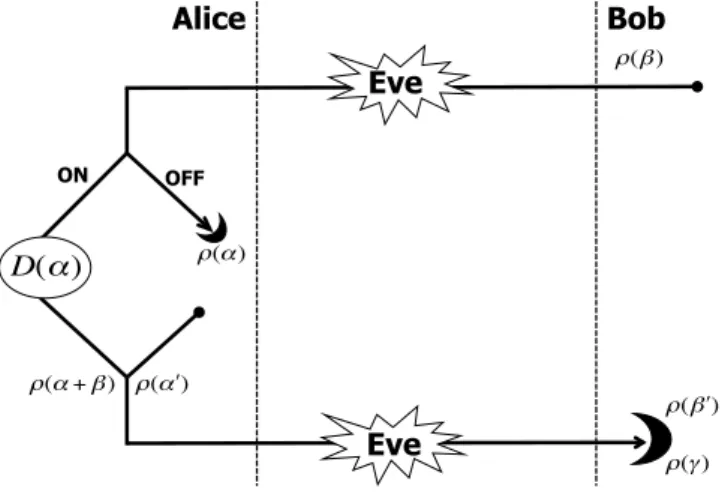
he main result in this work is the explicit study of the asymptotic security of two-way Gaussian protocols against coherent attacks, and the proof that these schemes are in fact immune to this eavesdropping. he general strategy to achieve this goal follows a previous insight14 and can be summarized as follows (see Fig. 1): he parties randomly switch ON or OFF the two-way communication line, and they post-select the OFF instances if they detect the presence of coherent attacks, otherwise they use the ON instances. We explicitly study the security threshold of the OFF coniguration against two-mode coherent attacks, which are the residual eavesdropping ater de Finetti reduction. Our approach allows us to prove that the superadditivity of the two-way thresholds is a general feature. his result can also be understood noting that the ON/OFF switching activates an additional degree of freedom, exclusive to the parties, which can be used to convert (a-posteriori) Eve’s correlations into a noise on which Eve has no control.
Results
The Scheme.
In Fig. 1 we describe a two-way quantum communication protocol. We focus on use of coher-ent states, for the encoding, and heterodyne detections for the decoding10,14. Bob prepares a Gaussian-modulated reference coherent state with density matrix ρ β( ), and use the quantum channel to transmit it to Alice who, ran-domly, decides to close (case ON) or open (case OFF) the quantum communication. Let discuss the two cases in detail.Case ON: Alice encoding is performed by applying a Gaussian-modulated displacement Dˆ( ) on the reference α state ρ β( ), obtaining a new coherent state with density matrix ρ(α+β). his is sent back to Bob who performs heterodyne detection on the received state ρ(α+β), and applies classical post-processing in order to subtract the reference variable β and derive Bob’s estimate β of Alice’s variable α.
Figure 1. Two-way CV-QKD protocol. Steps: forward, Bob prepares coherent states of amplitude β and density matrix ρ(β) and sends them through the noisy channel. Using the circuit in ON coniguration, Alice applies a random displacement D( ) on α ρ β( ) encoding information in the amplitude α. Backward, Alice then sends the quantum state ρ(α+β) to Bob who applies heterodyne detection with outcome γα+β, and applies classical post-processing to subtract the reference amplitude β to recover α. In OFF coniguration, the circuit is opened at Alice’s station. She applies heterodyne detection on the reference state, obtaining the variable α. She then prepares a new coherent state ρ( ) which is sent back to Bob who heterodynes this state obtaining α′ the variable β′. During the quantum communication Eve, as well as Bob, does not know which setup of the circuit has been adopted. For this reason, she is forced to attack both communication steps, and cannot adapt her attack to the ON/OFF setup.
Case OFF. Alice applies heterodyne detection on the reference state ρ β( ) with outcome α. hen, she prepares a new Gaussian-modulated coherent state ρ( ) which is sent back to Bob, who heterodynes it with outcome α′ β′. Ater this, the parties can use the two pairs of variables { , } and α β { ,α β′ ′} to prepare the key.
We note that, during the quantum communication, both Bob and Eve do not know the coniguration adopted. his information is shared during the phase of parameter estimation and is part of the classical communication performed by Alice over the public channel. In the following we focus on the use of reverse reconciliation (RR)11,16 (direct reconciliation is discussed in the supplemental material). With the quantum communication in ON, the RR corresponds to Alice inferring Bob’s inal outcome variable β. With the circuit in OFF, the RR corresponds to Bob estimating Alice’s variable α during the forward stage, followed by Alice estimating Bob’s detection variable β′.
As described in ref. 14 the advantage of having the ON/OFF switching is that this degree of freedom can be used to post-select the data in order to prepare the key. Ater the channel tomography they can determine which attack has been performed and in which status of the circuit. hen they keep data from case ON when they detect a collective attack, while they use data exchanged with the circuit in OFF when the attack is coherent.
Security analysis and attack reduction.
We study the security of the scheme assuming the asymptotic limit of many uses of the quantum channel, N1. In the worst-case scenario the eavesdropper attaches ancillary quantum systems, Ek, to each exchanged signal, and process the Ek’s by a global coherent unitary operation. he ancillary output modes are stored in a quantum memory (QM), and coherently measured ater the classical com-munication between Alice and Bob at the end of the protocol. Such an eavesdropping deines a general coherent attack.he parties can now reduce the complexity of the previous scenario, by applying symmetric random permu-tations39 of their classical data. his allows them to get rid of all the correlations between distinct instances of the protocol. It is then clear that, in the case of two-way communication, the de Finetti symmetrization provides a residual two-mode coherent attack, where the only surviving correlations are those between E1 and E2, used by Eve in each single round-trip. hese ancillary modes are mixed with the forward and backward signals by means of beam splitters. Note that we can rid of additional modes e because we work in the asymptotic limit and we bound Eve’s accessible information using the Holevo function40. Finally, a further simpliication comes from the extremality of Gaussian states16, which means that we can restrict Eve’s input ρ
E E1 2 to be a Gaussian state. he Gaussian attack is collective, when E1, E2 are uncorrelated, or two-mode coherent when they are corre-lated. Studying this second case with the circuit in ON and in DR, ref. 41 found that optimal two-mode attacks exist which can reduce the security performances of the two-way protocol below the one-way threshold. Here we show that, using the scheme with the ON/OFF switching, and post-selecting the optimal key-rate accordingly to the attack detected, the parties can overcome this problem. he security analysis is performed according to the setup shown in Fig. 2, where Fig. 2(a) refers to collective attacks, while Fig. 2(b) refers to two-mode coherent attacks. In the latter case, the security analysis is performed in the entanglement based (EB) representation11,16.
Description of the two-mode Gaussian attack in the EB representation.
In EB representation bothBob and Alice remotely prepare coherent states on the travelling modes B1′ and A2′ by using two-mode squeezed vacuum states, described by covariance matrices (CMs) of the following form
Figure 2. Panel (a) shows the two-way scheme in ON coniguration. his is used against collective Gaussian attacks, typically implemented by means of two independent entangling cloners. Each beam-splitter has transmissivity T, and Eve mixes the ancillas E1′ and E2′ with the signals modes B1 and A2 Panel (b) describes the OFF coniguration, whose security is studied against two-mode Gaussian attacks. In this case we study the security of the scheme in the entanglement based representation.
www.nature.com/scientificreports/
µ µ µ µ = − − ′ V I Z Z I 1 1 , (1) B B B B B B 2 2 1 1 µ µ µ µ = − − ′ V I Z Z I 1 1 , (2) A A A A A A 2 2 2 2on which they apply heterodyne detections on the respective local modes B1 and A2. he parameters µA=µ+1, and µB=µ+1 describe the variance of the thermal state injected by Alice and Bob, respectively. he two trav-elling modes, B1′ and A2′, are mixed with Eve’s modes, E1 and E2, on two identical beam splitters, with transmissiv-ity T. Eve’s input state ρE E
1 2 is a zero mean, two-mode correlated thermal state, with CM
ω ω = = ′
(
)
V g g I G G I , withG , (3) E E1 2where ω≥1 gives the variance of the thermal noise injected, while g and g′ describe the correlations between the two ancillas.
Note that the double use of the channel corresponds to a sequential use of the same communication line (opti-cal ibre), so it is reasonable to consider a symmetric channel (T and ω are the same during the forward and backward communication). he correlation parameters g and g′ must fulill the following constraints
ω ω ω ω
< ′ < + ′ − ≥ + ′
g , g , 2 g g 1 g g , (4) in order to certify that VE E1 2 is a bona fide CM. If g′ =g, we must have
ω ω
− ≤g≤ −
1 1, with the two extremal conditions corresponding to E1 and E2 sharing maximal separable correlations42,43. If g′ = −g the ancil-las share non-separable correlations. The Eq. (4) provides the bound − ω2−1 ≤g≤ ω2−1, with the extremal values corresponding to maximally entangled states. Finally, if g= ′ =g 0, the two ancillas are not correlated, and the two-mode attack collapses to a standard collective one, based on two independent entangling cloners.
Key-rates and security thresholds.
We compute now the secret-key rate R:=I−IE, where I is Alice-Bobmutual information, and IE is Eve’s accessible information. In the asymptotic case N1, IE can be replaced by
the Holevo information χ. Hence we write
χ
= − .
R: I (5)
he goal of the security analysis is the computation of the bound χ, which is deined as
χ =: SE−SEx. (6)
he functional SE is the von Neumann entropy, relative to Eve’s quantum state ρE, and SEx is that corresponding to ρEx, which describes Eve’s sate conditioned on the outcomes of the measurements performed by the parties.
Against collective attacks, the parties use the protocol in ON, and we have the following ON key-rate α β χ ε β
= − .
RON: ION( : ) ON( : ) (7)
By contrast, against coherent attacks, they use the circuit in OFF, for which we have the following OFF key-rate χ
= −
ROFF IOFF OFF, (8) where
α β α β
= + ′ ′
I I ( : ) I ( : )
2 (9)
OFF OFF OFF
is the mutual information averaged over the forward and backward use, and
χOFF:=SAB−SABα β, ′ (10)
is computed on Alice and Bob’s output state ρAB.
hus, for collective attacks we select the ON key-rate RON, while for coherent attacks we select the OFF key-rate ROFF. Both these key-rates are function of channel parameters, i.e., transmissivity T and excess noise
ω
= − −
N: (1 T)( 1)/ (which gives the extra noise on the channel with respect the vacuum shot-noise). he T
OFF key-rate, ROFF, is also function of the correlation parameters g and g′. herefore, once we have R, we ind the
′ = .
R T N g g( , , , ) 0 (11) his condition provides threshold curves of the type N=N T g g( , , ′) which simpliies to N=N T( ) for collective attacks.
Formulas for the key-rates.
he computation of the secret-key rates can be performed using the math-ematical tools described in ref. 16. From the knowledge of the CM describing the total and conditional states, we can compute the von Neumann entropies and inally the key rates. For the protocol with coherent states and heterodyne detection we ind the following key-rates∑
ν ω = + − + Λ + = − R T T e T h h log 2 (1 ) (1 )(1 ) ( ) 2 ( ), (12) ON i i 1 3∑
ν ν = − + Λ + ′ − =± ˜( )
R T e T h h log 2 (1 )(1 ) ( ) 2 , (13) OFF j j j where = + + − − − . h x( ): x 1 x x x 2 log 1 2 1 2 log 1 2 In the previous formulas, the symplectic eigenvalues νi are computed numerically and we define
Λ:=T2+(1−T2)ω and Λ = + − ω ∼
T T
: (1 ) . It is of particular interest the OFF key-rate of Eq. (13), from which we notice that one can recover the one-way key-rate in the case of collective attacks (g= ′ =g 0). he expressions of the total and conditional symplectic eigenvalues can be computed analytically for large modula-tion, being equal to
ν → ω± ω± ′ ± ( g)( g) , (14) ν λ λ ′ → + − ′ + − ± ± ± T T T [ 1 ][ 1 )] , (15) where λ±=T+(ω±g)(1−T) and λ±′=T+(ω± ′g)(1−T).
Protocol with coherent states and homodyne detection.
Here we give the key-rate R for the two-way protocol with coherent states and homodyne detection. he only change with respect to the previous scheme is clearly the use of homodyne detection for decoding. With the circuit in ON, Bob prepares coherent states, ran-domly displaced by Alice and inally homodyned by Bob. With the protocol in OFF, Bob prepares coherent states and Alice performs homodyne detection. hen she sends back newly prepared coherent states which are homo-dyned by Bob. Ater some algebra, we obtain the following analytical expressions for the key-ratesω ω ν ω = + + − − Λ + − R T T T h h 1 2 log ( 1) (1 ) ( ) ( ), (16) ON 2 3
∑
ω ω ν = − − ′ − Λ − . =± ˜ R g g T h 1 2 log ( )( ) (1 ) ( ) 2 (17) OFF i i 2 2 2 2 4In the ON key-rate of Eq. (16), used against collective attacks, the asymptotic symplectic eigenvalue ν can be computed analytically as ν ω ω ω ω = + − + + + − . T T T T T : [1 (1 ) ] ( 1) 2 3 2 3
By contrast, the OFF key-rate of Eq. (17) is exploited under coherent attacks, and the total symplectic eigen-values ν
i are the same as given in Eq. (14). he details to obtain Eqs. (16) and (17) can be found in the
supplemen-tal material, where we also include the secret-key rates computed in DR.
Discussion
he security analysis of the thresholds coming from Eqs. (12) and (13) is summarized in Fig. 3. In particular, the security threshold for the ON coniguration is conirmed14 to be superadditive in Fig. 3 (top-let). he black-solid line corresponds to the ON threshold, which is clearly above the threshold of the one-way protocol (dashed line). his comparison is done against collective attacks. he top-right panel of Fig. 3, shows the security threshold for the OFF coniguration in the presence of several two-mode attacks with diferent values of the correlation param-eters g= ′g. he curves labeled (a–d) corresponds to the points in Fig. 3 (bottom-let). For example, the red curve
www.nature.com/scientificreports/
ω ′ = = ± −
g g ( 1), and the curve (c) corresponds to g′ =−g=±(ω−1). Finally, the dashed curve (d) corresponds to the center of the correlation plane, where the OFF threshold coincides with the one-way thresh-old. hus, we see that for any value of Eve’s correlation parameters, g and g′, Alice and Bob can always post-select an instance of the two-way protocol (ON or OFF) whose threshold is strictly greater than that of the correspond-ing one-way protocol.
Finally, Fig. 3 (bottom-right) describes the connection between the OFF key rate and the amount of corre-lations in Eve’s ancillas, as quantiied by the quantum mutual information. We can see that the OFF key rate not only is positive (while the one-way rate is always zero) but it also increases with Eve’s correlations, which are converted into noise by the OFF coniguration. hus, the ON/OFF switching, together with the post-selection of Figure 3. his igure summarizes the results for the protocol with coherent states and heterodyne
detection, whose rates are given inEqs. (12) and (13). he top panels describe the security thresholds, in terms of tolerable excess noise N versus transmissivity T. In the top-let panel, we consider collective attacks and we compare the ON two-way threshold RON=0 (black solid line) with the threshold of the one-way protocol (dashed line). In the pink region the two-way protocol is secure, while the one-way counterpart is not. In the top-right panel, we consider coherent attacks and we compare the OFF two-way threshold (a–c) with respect to the one-way threshold (d). In particular, curve (a) is obtained for g= ± ω2−1, i.e., Eve using maximally entangled states; curve (b) considers the case g′ =g with g= ±(ω−1); and curve (c) refers to g′ =−g and
ω
= ± −
g ( 1). Note that curve (d) coincides with the OFF threshold against collective attacks, in which case the protocol is used in ON. he same labels (a–d) are used in the bottom-let panel, which describes the various attacks on the correlation plane ( ,g g′), obtained setting ω
.
1 097 in the constraint of Eq. (4). Finally, in the bottom-right panel, we plot the OFF key-rate against coherent attacks (red lines), compared to the quantum mutual information (black lines) describing the correlations of Eve’s ancillas. We set T=0 3 and . ω
.
1 097, so that the one-way rate is zero. We see that the OFF key-rate is always strictly positive and it increases for increasing correlations in the attack.
the correct instances, allows one to implement two-way CV-QKD in a way which is not only secure, but also more robust to excess noise with respect to one-way protocols under completely general attacks.
Methods
A detailed description of the methods can be found in the supplementary material. he security analysis of the protocol has been performed in the entanglement based representation for the case OFF, so that we could com-pute the Holevo bound from the study of Alice-Bob CM. For the case ON in RR, we started from the output covariance matrix of Eve, to compute the total von Neumann entropy. We then computed the conditional von Neumann entropy completing Eve’s covariance matrix with the Bob’s mode on which we applied the heterodyne or the homodyne measurement, accordingly with the case studied.
Conclusions
In this work we have studied the security of two-way CV-QKD addressing, explicitly, the superadditivity of its security threshold against coherent attack. To the best of our knowledge this represents the irst attempt of such a complete study for direct point-to-point two-way protocols. Our security analysis is obtained assuming the asymptotic limit, i.e., large number of signals exchanged and large modulation. his allowed us to ind closed for-mulas for the secret-key rates, from which we have proved that the two-way Gaussian protocols are more robust to excess noise than their one-way counterparts in both collective and coherent attacks.
For this property, it is crucial the random ON/OFF switching of the protocol, so that the eavesdropper’s cor-relations are under control of the parties and they are transformed, if needed, into useless noise. Our analysis contributes to the general understanding of the security properties of two-way protocols and is useful to extend CV-QKD to regime with high excess noise. Future developments could involve the study of this ON/OFF switch-ing strategy in more complex quantum communication scenarios.
References
1. Bennet, C. H. & Brassard, G. Quantum cryptography: public key distribution and coin tossing, Proceedings of the IEEE International Conference on Computers, Systems, and Signal Processing, Bangalore, p. 175 (1984).
2. Scarani, V. et al. he security of practical quantum key distribution. Rev. Mod. Phys.81, 1301 (2009).
3. Rivest, R., Shamir, A. & Adleman, L. A method for obtaining digital signatures and public-key cryptosystems. Communications of
the ACM21(2), 120–126, (1978).
4. Shor, P. W. Polynomial-time algorithms for prime factorization and discrete logarithms on a quantum computer. SIAM J. Sci. Statist.
Comput. 26, 1484 (1997), quant-ph/9508027.
5. Gisin N. et al. Quantum cryptography. Rev. Mod. Phys.74, 145–195 (2002).
6. Wootters, W. & Zurek, W. A single quantum cannot be cloned. Nature299, 802–803 (1982).
7. Korzh, B. et al. Provably secure and practical quantum key distribution over 307 km of optical ibre. Nature Phot. 9, 163–168 (2015). 8. Ursin, R.et al. Entanglement-based quantum communication over 144 km. Nature Phys3, 481–486 (2007).
9. Grosshans, F. & Grangier, P. Continuous variable quantum cryptography using coherent states, Phys. Rev. Lett.88, 057902 (2002). 10. Weedbrook, C. et al. Quantum cryptography without switching. Phys. Rev. Lett.93(17), 170504 (2004).
11. Grosshans, F. et al. Virtual entanglement and reconciliation protocols for quantum cryptography with continuous variables.
Quantum Information & computation (2003).
12. Garcia-Patron, R. & Cerf, N. J. Continuous-variable quantum key distribution protocols over noisy channels. Phys. Rev. Lett.102,
130501 (2009).
13. Grosshans, F. et al. High-rate quantum cryptography using Gaussian-modulated coherent states. Nature421, 238–241 (2003). 14. Pirandola, S. et al. Continuous variable quantum cryptography using two-way quantum communication. Nature Phys. 4, 726 (2008). 15. Diamanti, E. & Leverrier, E. Distributing secret keys with quantum continuous variables: principle, security and implementations.
Entropy17, 6072 (2015).
16. Weedbrook, C. et al. Gaussian quantum information, Rev. Mod. Phys.84, 621 (2012).
17. Jouguet, P. et al. Experimental demonstration of long-distance continuous-variable quantum key distribution. Nature Photonics7,
378–381 (2013).
18. Silberhorn, C. et al. Continuous variable quantum cryptography: beating the 3 dB Loss Limit, Phys. Rev. Lett.89, 167901 (2002). 19. Leverrier, A. et al. Multidimensional reconciliation for a continuous-variable quantum key distribution. Phys. Rev. A77, 042325
(2008).
20. Braunstein, S. L. & van Lock, P. Quantum information with continuous variables. Rev.Mod.Phys.77, 513 (2005). 21. Weedbrook, C. et al. Quantum cryptography approaching the classical limit Phys. Rev. Lett.105, 110501 (2010). 22. Weedbrook, C. et al. Continuous-variable quantum key distribution using thermal states. Phys. Rev. A86, 022318 (2012). 23. Pirandola, S. et al. Reply to ‘Discrete and continuous variables for measurement-device-independent quantum cryptography’. Nature
Phot. 9, 773 (2015).
24. Ekert, A. Quantum cryptography based on the Bell’s theorem. Phys. Rev. Lett.69, 1293 (1992).
25. Gisin, N. et al. Proposal for implementing device-independent quantum key distribution based on a heralded qubit ampliier. Phys.
Rev. Lett.105, 070501 (2010).
26. Vazirani, U. & Vidick, T. Fully device-independent quantum key distribution. Phys. Rev. Lett.113, 140501 (2014). 27. Colbeck, R. Victory for the quantum code maker? Physics7, 99 (2014).
28. Hensen, B. et al. Experimental loophole-free violation of a Bell inequality using entangled electron spins separated by 1.3 km, arXiv 1508.05949 (2015).
29. Braunstein, S. L. & S. Pirandola Side-channel-free quantum key distribution. Phys. Rev. Lett.108, 130502 (2012).
30. Lo, H.-K., Curty, M. & Qi, B. Measurement-device-independent quantumkey distribution. Phys. Rev. Lett.108, 130503 (2012). 31. Pirandola, S. et al. High-rate measurement-device-independent quantum cryptography. Nature. Phot.9, 396 (2015). See also
arXiv.1312.4104 (2013).
32. Ottaviani, C., Spedalieri, G., Braunstein, S. L. & Pirandola, S. Continuous-variable quantum cryptography with an untrusted relay: Detailed security analysis of the symmetric coniguration. Phys. Rev. A91, 022320 (2015).
33. Pirandola, S. Quantum discord as a resource for quantum cryptography. Sci. Rep.4, 6956 (2014).
34. Weedbrook, C., Ottaviani, C. & Pirandola, S. Two-way quantum cryptography at diferent wavelengths. Phys. Rev. A89, 012309 (2014).
35. Boström, K. & Felbinger, T. Deterministic secure direct communication using entanglement. Phys. Rev. Lett.89, 187902 (2002). 36. Lucamarini, M. & Mancini, S. secure deterministic communication without entanglement, Phys. Rev. Lett.94, 140501 (2005). 37. Shapiro, J. H. Defeating passive eavesdropping with quantum illumination. Phys. Rev. A80, 022320 (2009).
www.nature.com/scientificreports/
38. Zhang, Z. et al. Entanglement’s beneit survives an entanglement-breaking channel. Phys. Rev. Lett.111, 010501 (2013).
39. Renner, R. & Cirac, J. I. de Finetti representation theorem for ininite-dimensional quantum systems and applications to quantum cryptography. Phys. Rev. Lett.102, 110504 (2009).
40. Pirandola, S., Braunstein, S. L. & Lloyd, S. Characterization of collective gaussian attacks and security of coherent-state quantum cryptography. Phys. Rev. Lett.101, 200504 (2008).
41. Ottaviani, C., Mancini S. & Pirandola, S. Two-way Gaussian quantum cryptography against coherent attacks in direct reconciliation.
Phys. Rev. A92, 062323 (2015).
42. Pirandola, S. Entanglement reactivation in separable environments. New J. Phys.15, 113046 (2013).
43. Pirandola, S., Seraini, A. & Lloyd, S. Correlation matrices of two-mode bosonic systems. Phys. Rev. A79, 052327 (2009).
Acknowledgements
We acknowledge inancial support from the EPSRC via the ‘UK Quantum Communications HUB’ (Grant no. EP/M013472/1).
Author Contributions
C.O. performed the security analysis and wrote the manuscript. S.P. supervised the project.
Additional Information
Supplementary information accompanies this paper at http://www.nature.com/srep Competing inancial interests: he authors declare no competing inancial interests.
How to cite this article: Ottaviani, C. and Pirandola, S. General immunity and superadditivity of two-way Gaussian quantum cryptography. Sci. Rep.6, 22225; doi: 10.1038/srep22225 (2016).
his work is licensed under a Creative Commons Attribution 4.0 International License. he images or other third party material in this article are included in the article’s Creative Commons license, unless indicated otherwise in the credit line; if the material is not included under the Creative Commons license, users will need to obtain permission from the license holder to reproduce the material. To view a copy of this license, visit http://creativecommons.org/licenses/by/4.0/