A C O M P A R I S O N O F M E T H O D S F O R T H E
E X T R A C T I O N O F S M E C T I T E S F R O M C A L C A R E O U S
R O C K S B Y A C I D D I S S O L U T I O N T E C H N I Q U E S
R . J. C O O K
Postgraduate Research Institute for Sedimentology, The University, PO Box 227, Whiteknights, Reading RG6 2AB, UK
(Received 5 March 1991; revised 30 May 1991)
A B S T R A C T : Four methods of extracting clays from calcite-rich samples were compared: (i) sodium acetate buffer solution; (ii) lithium acetate buffer solution; (iii) hydrochloric acid; (iv) liquid cation-exchange acid. The methods were tested on mixtures consisting of 80% calcite, 10% quartz and 10% hectorite. Potassium had previously been exchanged on to the interlayer sites of the clay. XRD traces of the extracted clays appeared identical with those of the original clays except for a sharpening of the 001 reflection. The bulk chemistry of the clay was unchanged except by the HCI extraction, which appeared to cause a stripping of the octahedral cations. With all of the methods the exchangeable cation content was altered; the sodium acetate method, for example, retained only 17% of the original exchangeable K +, the other methods all retaining <10%.
Clay minerals are usually s e p a r a t e d f r o m c a r b o n a t e rocks by acid dissolution ( R a y et al., 1957; O s t r o m , 1961; P e t e r s o n , 1961; Jackson, 1969). Previous w o r k e r s have e x a m i n e d X - r a y diffraction ( X R D ) p a t t e r n s of the clays for c o n s e q u e n t i a l changes, but not their structural chemistry and i n t e r l a y e r chemistry. The i n t e r l a y e r chemistry may be greatly affected by the release o f Ca 2+ and Mg 2+ from the c a r b o n a t e during dissolution since divalent cations are p r e f e r e n t i a l l y t a k e n up by clays (Carroll, 1959). Cations p r o d u c e d from the dissolution of c a r b o n a t e can interfere with cation exchange capacity and e l e m e n t a l analyses (Eslinger & P e v e a r , 1988). It is thus desirable to k n o w how any clay extraction techniques m a y affect not only X R D characteristics but also structural and i n t e r l a y e r chemistry.
This p a p e r c o m p a r e s four techniques for the extraction o f smectites from calcareous rocks using acid solutions and c o m p a r e s the X R D traces, the structural chemistry and the i n t e r l a y e r chemistry of the clays.
E X P E R I M E N T A L T E C H N I Q U E S
Starting materials
I n o r d e r to c o m p a r e the m e t h o d s it h a d to be possible to refer the resultant clay c o m p o s i t i o n t o the original. F o r this r e a s o n the e x p e r i m e n t s were carried out on synthetic mixtures consisting of 80% calcite, 10% quartz a n d 10% hectorite. The X R D p a t t e r n and the chemical c o m p o s i t i o n of the h e c t o r i t e had b e e n p r e d e t e r m i n e d .
H e c t o r i t e [(l/2Ca, Na)y(Mg6_yLiy)SisO20(OH)4 ], a t r i o e t a h e d r a l smectite, was chosen as the most susceptible of the smectite clays to acid attack ( O s t r o m , 1961). The hectorite was a
The clay was initially saturated with K + by washing with 1 M KC1 solution twice for 30 min and then overnight (Bain & Smith, 1987). The clays were then washed with distilled water to remove any residual KC1. The washings were monitored by the use of AgC1 solution, which produces a cloudy white precipitate if C1 ions are present. If this washing is too vigorous exchangeable cations may be stripped off (Bain & Smith, 1987).
Extraction methods'
In each extraction (performed in duplicate) 5 g of sample was used. Repeated wetting and drying of the samples was avoided as this can affect the clay structure (Chaussidon, 1962).
Sodium acetate (NaOAc) buffer solution (after Jackson, 1969). Sodium acetate solution (1 M) was used to buffer acetic acid at p H 5.0. The leaching solution was added 50 ml at a time and when the solution was spent it was separated off by centrifugation and a further 50 ml added. In all, 300 ml of leaching solution was required. The process took two days at room temperature with constant stirring for completion, completion being the dissolution of all the calcite present in the sample as indicated by the lack of effervescence on adding concentrated HC1 to a small fraction of the treated sample. At the end of the process the solid was washed carefully with distilled water to remove any residual leaching solution, and the clays were finally separated by sedimentation.
Lithium acetate (LiOAc) buffer solution (after Peterson, 1961). Lithium acetate solution (1 M) was used to buffer acetic acid at pH 4.5. Lithium was chosen as this is one of the ions least likely to replace other cations already in the clay structure (Peterson, 1961). The leaching solution (300 ml) was added in one operation ensuring that the cations released by carbonate dissolution would be kept in low concentration and thus have less effect (Peterson, 1961). This process was also completed in two days at room temperature with constant Stirring, and the clay was washed and separated as above.
Hydrochloric acid. Hydrochloric acid is generally employed for dissolution purposes when dealing with dolomites or coarse-grained calcites (Eslinger & Pevear, 1988). The method was used to compare strong-acid and weak-acid methods. Eighty ml of 10% HC1 were added to the sample. Dissolution was complete after one hour at room temperature with constant stirring. The solids were then washed to remove residual HC1 and the clays separated by sedimentation.
Liquid cation-exchange acid. This method was devised in an attept to counter the effect of the cations released by the carbonate dissolution exchanging on to clay interlayer sites, on the basis that the cation-exchange acid removed the released cations from the solution and thus lessened their effect on the interlayer chemistry of the clay.
The experiment is shown schematically in Fig. 1. An aqueous-phase leaching solution, consisting of acetic acid buffered at pH 6.5 by NaOAc, was added (200 ml) followed by an equal volume of an organic phase containing the cation-exchange acid. The organic phase consisted of the cation-exchange acid dissolved in ethyl-ether in the ratio 5% wt/vol of acid to solvent. Ethyl-ether was chosen as the solvent as it is partially soluble in water and water is partially soluble in it, thereby allowing exchange between the two phases to occur readily. The cation-exchange acid chosen was pentadecafluorooctanoic acid RCOzH
Smectite extraction from calcareous rocks
~o~..c~.+. o - ~
/ /
-~,
Organic phase
OH OH
1
Sample
Fro. 1. Schematic diagram for cation exchange method.
(R = (CF2)6CF3). This acid is selective towards Ca 2+ and Mg 2+ (Coleman
et al.,
1962) which are major elements in carbonates.The general reactions of this process are:
CaCO3 + 2H + > H 2 0 + CO 2 q- Ca 2+ (1)
2RfOzH(org) + CaZ+(aq) < > 2H+(aq) + ((RfO2-)2CaZ+}(org) (2)
Equation (2) shows the exchange of Ca 2+ across the interface for 2H + lost by the dissolution process in equation (1). In this way the aqueous leaching solution remains relatively undepleted during the process, unlike the other methods.
The process took 8 h to complete, with constant stirring. The sample was then carefully washed and the clay separated by sedimentation.
Preparation of samples for analysis
The initial clay, a clay sample washed with deionized water for 0.5 h, and the extracted clays were allowed to air-dry and each separated into four subsamples. Two orientated-clay tiles were made for each of the clay samples for XRD analysis using a Philips PWl710 diffractometer and Cu-Kolradiation. For one tile per sample an air-dried trace was run from 2-20~ For the second tile, successive traces were run from 2-14~ after allowing the tile to air-dry, after glycollation for 4 h, and after heating at 375~ for 1 h.
The bulk chemistry of the clay was determined by electron microprobe analysis and by wet chemical methods. For the former, the clays were mounted on carbon-coated A1 stubs and analysed chemically using a J E O L JSM-840 SEM fitted with a Link Systems energy- dispersive X-ray spectrometer. The clay coating on the stub was 2 mm thick to prevent penetration of the incident electron beam to the A1 stub itself. The wet chemical method was used for the determination of Li which cannot be detected by the energy-dispersive X-ray spectrometer. The extracted clays were dissolved in HF and the solution analysed by inductively-coupled plasma (ICP) spectroscopy.
including K + (Carroll, 1959). A l l the washings were collected for K + analysis by ICP.
R E S U L T S A N D D I S C U S S I O N
X R D analysis
The X R D traces for the initial and e x t r a c t e d clays are shown in Figs. 2 and 3. Fig. 2 shows the characteristic b e h a v i o u r of smectites in all the traces: expansion of the 001 p e a k to 17 after glycollation for 4 h and a collapse to 10 A after heating at 375~ for 1 h. Similar
t
tl
tl
!~
i ~
Initial
lit'\
, . I I I I I I I I I 3 2 0 I I15
Traces
_ _ _ m Air Dried
. . .
Glycolated
375oc
tl,
,'/', ',
tl: ,,,/, \,
:~',- ;
t/',.,'/ ~ \
-,,,,
ttt/ ,, x,
",....~, \_<,..,,
I I I I I I I I I I I I I I I I I I 3 2 e ~3 3 2 0 I I15
!il fi,,
:/',
,'r
~', L,',, \
~'a ; 1 ~
Cation Exchange
i/~
/ / I '~
HCI
t:;i/ii
~;' ,,,,
I I I I I I I I I I I ! I | I I I I I I I
3 2 e i3 3 2 e
Fi6.2. XRD traces for initial and extracted clays. Cu-Ko~ radiation.
I
\ LiOAc
NaOAc
Cation Exchange
HCI
20
Fro. 3. XRD traces of air-dried initial and extracted clays. Cu-K0: radiation.
behaviour is seen for all the extracted clay traces as well as the initial clay trace. The only difference is seen when the air-dried traces are compared (Fig. 3); the main peak for the extracted clays, although in the same position, is sharper. This phenomenon can be related to the interlayer cations on the clays. In the initial clay the broad peak is due to a mixture of single and double water layer hydrates in the interlayers relating to K + and Ca 2+, respectively. With the treated clays the main interlayer cations (Ca 2+, Ca ~+ and Na +, or H § form double water layer hydrates only, resulting in a sharper peak between 14 and 15 A (Barshad, 1950; Suquet et al., 1975; Cowking et al., 1983). Apart from this sharpening of the air-dried peak, however, the X R D traces for the clays are basically unaltered by any of the techniques.
Bulk chemical analysis
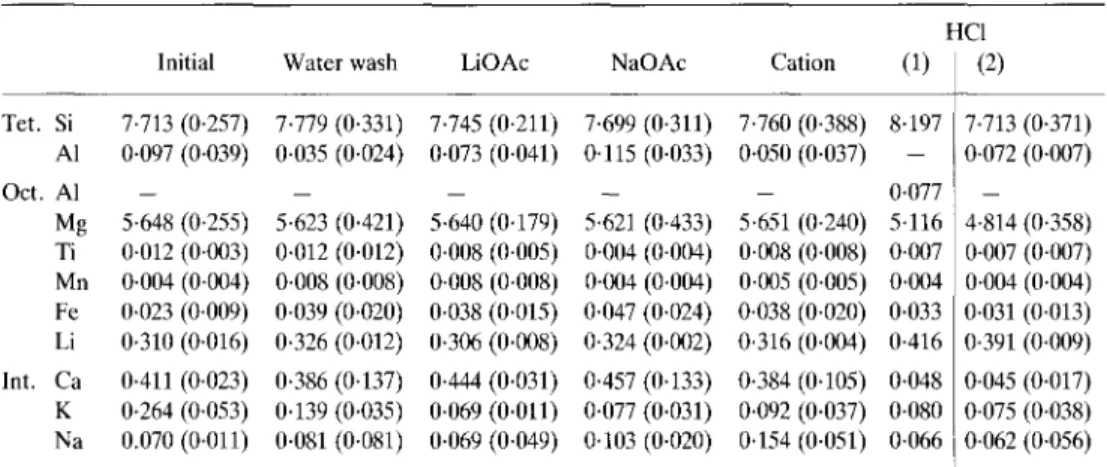
The results of the bulk chemical analyses are shown in Table 1. The cations have been assigned in appropriate amounts to tetrahedral, octahedral and interlayer positions to indicate chemical changes in the structural unit caused by any of the processes. It can be seen from Table 1 that clay samples washed with water or extracted by the use of either LiOAc, NaOAc or the cation exchange method show no significant variation in their chemical composition from that of the initial sample. For the HCl-extracted clay, however, there appears to be an enrichment of SiO2. If a constant SiO2 content is assumed and the results are corrected for this, there appears to have been leaching of Mg from octahedrat
HCI
Initial Water wash LiOAc NaOAc Cation (1) (2)
Tet. Si 7.713 (0.257) 7-779 (0.331) 7-745 (0-211) 7.699 (0.311) 7-760 (0-388) 8.197 AI 0.097 (0.039) 0-035 (0.024) 0-073 (0.041) 0.115 (0-033) 0.050 (0.037) -- Oct. AI . . . 0.077 Mg 5.648 (0.255) 5.623 (0-421) 5.640 (0.179) 5.621 (0.433) 5.651 (0.240) 5.116 Ti 0.012 (0.003) 0.012 (0-012) 0.008 (0-005) 0-004 (0-004) 0.008 (0.008) 0.007 Mn 0.004 (0.004) 0.008 (0.008) 0.008 (0.008) 0-004 (0.004) 0.005 (0.005) 0.004 Fe 0.023 (0.009) 0,039 (0.020) 0.038 (0.015) 0-047 (0.024) 0.038 (0.020) 0-033 Li 0.310 (0.016) 0.326 (0.012) 0.306 (0.008) 0.324 (0.002) 0.316 (0.004) 0.416 Int. Ca 0.411 (0.023) 0.386 (0.137) 0.444 (0-031) 0.457 (0.133) 0-384 (0-105) 0-048 K 0.264 (0.053) 0.139 (0.035) 0.069 (0-011) 0.077 (0.031) 0.092 (0-037) 0.080 Na 0.070 (0.011) 0-081 (0.081) 0-069 (0-049) 0.103 (0-020) 0.154 (0.051) 0.066 7.713 (0-371) 0.072 (0-007) 4-814 (0.358) 0.007 (o.oo7) 0.004 (0.004) 0.031 (0.013) 0.391 (0.009) 0.045 (0-017) 0.075 (0-038) 0.062 (0-056) Initial--initial clay composition. Water wash--clay after washing with water. LiOAc--clay extracted by lithium acetate method. NaOAc--clay extracted by sodium acetate method. Cation--clay extracted by cation-exchange acid method. HCI--clay extracted by HCI method; actual result (1), and corrected assuming constant silica (2).
TABLE 2. Exchangeable K + results.
Exchangeable % exchangeable Method K+/p.p.m. K + retained Initial Initial Initial Initial Water wash Water wash LiOAc LiOAc NaOAc NaOAc HCI HCI Cation exchange Cation exchange 22,260 21,940 22,470 22,580 9,497 10,153 2,494 1,834 3,752 2,635 1,329 1,109 I 1,301 1,340 m 43 46 11 8 17 11 6 5 6 6
sites in t h e clay. It is i n t e r e s t i n g to n o t e t h a t this c h a n g e in s t r u c t u r a l c h e m i s t r y o c c u r r e d w i t h o u t significantly a l t e r i n g t h e X R D t r a c e of t h e HC1 e x t r a c t e d clay.
Exchangeable cation results'
T h e v a r i a t i o n in t h e e x c h a n g e a b l e o r i n t e r l a y e r cations c a n be s e e n in T a b l e 1 and t h e e f f e c t o n t h e e x c h a n g e a b l e K in p a r t i c u l a r can be s e e n in T a b l e 2. A l t h o u g h t h e results in
Table 2 relate to K only, they do indicate that loss of e x c h a n g e a b l e cations occurs during the process.
The best result was p r o d u c e d by the N a O A c m e t h o d which showed r e t e n t i o n o f b e t w e e n 11 and 17% of exchangeable K. This result, however, is still not g o o d and n o n e of the m e t h o d s is satisfactory in leaving the e x c h a n g e a b l e K content unaltered. It should also be noted that washing the clay s a m p l e with d e i o n i z e d w a t e r for 0.5 h p r o d u c e d a loss of o v e r 50% of the exchangeable K. This would t e n d to suggest that p r e s e r v a t i o n of exchangeable cations on clays would be difficult if the technique involves solution methods.
C O N C L U S I O N S
None o f the m e t h o d s tried affected the X R D traces of the clays o t h e r t h a n causing a sharpening of the 001 p e a k of the air-dried clay. F r o m the X R D results it would a p p e a r that there is nothing to choose b e t w e e n the m e t h o d s . O n the basis o f the X R D results alone, therefore, HC1 would a p p e a r to be the best m e t h o d because it takes only 1 h c o m p a r e d with 8 h for the next fastest. F r o m the bulk chemistry results, however, it is seen that the use of HC1 causes the stripping of cations from the structure, w h e r e a s the use of the buffered w e a k acids or the cation-exchange acid does not a p p e a r to alter the bulk chemistry of the clay. W h e n considering the e x c h a n g e a b l e cation results, there is again little to chose b e t w e e n any of the m e t h o d s ; they are all equally p o o r in the p r e s e r v a t i o n of the exchangeable cations.
In c o m p a r i n g the m e t h o d s , those using buffered w e a k acid o r the cation-exchange acid would b e p r e f e r a b l e to the HC1 m e t h o d as no d a m a g e o c c u r r e d to the clay structure. T h e cation-exchange m e t h o d m a y be p r e f e r a b l e to e i t h e r of the buffered w e a k acid m e t h o d s as it is faster. The use of a cation exchanger, however, m a k e s the process much m o r e expensive. C o m p a r i n g the two w e a k acid m e t h o d s is h a m p e r e d by the difference in m e t h o d o l o g y . Extractions have b e e n carried out using single a d d i t i o n s of N a O A c - b u f f e r e d acid and there is no difference in the results over the multiple addition m e t h o d . In the a u t h o r ' s o p i n i o n the N a O A c - b u f f e r e d acid, either using single or multiple additions, is an efficient and simple m e t h o d for the dissolution of c a r b o n a t e with minimal a m o u n t of d a m a g e occurring to the clay.
ACKNOWLEDGMENTS
This work was undertaken whilst in receipt of a Natural Environmental Research Council studentship. I would like to thank Dr B. Sellwood and especially Dr A. Parker for encouragement given with this work. This paper is Reading University PRIS Contrib. No. 160.
REFERENCES
BAIN D.C. & SMITH B.F.L. (1987) Chemical analysis. Pp. 248-274 in: A Handbook of Determinative Methods in Clay Mineralogy (M.J. Wilson, editor). Blackie & Son, Glasgow & London.
BARSHAD I. (1950) The effect of the interlayer cations on the expansion of the mica type of crystal lattice. Am. Miner. 35, 225-238.
CARROLL, D. (1959) Ion exchange in clays and other minerals. Bull. Geol. Soc. Am. 70, 749-780.
CHAUSSIDON J. (1962) The exchange complex: The general laws of anion and cation exchange. Pp. 377-389 in: Constituents and Properties of Soils (M. Bonneau & B. Souchier, editors). Academic Press, London. COLEMAN C.F., BLAKE JR. C.A. & BROWN K.B. (1962) Analytical potential of separation by liquid ion exchange.
Course No. 22, pp. A-28. SEPM, USA.
JACKSON M.L. (1969) Soil Chemical Analysis--Advanced Course. 2nd ed., pp. 32-37. Published by the author,
Madison, Wisconsin.
OSTROM M.E. (1961) Separation of clay minerals from carbonate rocks by using acid. J. Sed. Pet. 31, 123-129.
PETERSON M.N.A. (1961) Expandable chloritic clay minerals from Upper Mississipian carbonate rocks of the
Cumberland Plateau in Tennessee. Am. Miner. 46, 1245-1269.
RAY S., GAULT H.R. & DODO C.G. (1957) The separation of clay minerals from carbonate rocks. Am. Miner. 42,
681~586.
SUQUET H., CALLE C. DE LA & PEZERAT H. (1975) Swelling and structural organization of saponite. Clays Clay