Aggregate Extraction in
Ontario:
A Strategy for the Future
Aggregate Extraction in Ontario:
A Strategy for the Future
by Matt Binstock and Maureen Carter-Whitney Canadian Institute for Environmental Law and Policy
Acknowledgements
The Canadian Institute for Environmental Law and Policy (CIELAP) would like to thank all of the various participants in this study who committed their time to being interviewed and to providing information; Gravel Watch Ontario for providing extensive input into the research process; and those who anonymously reviewed this paper.
We would also like to thank MEC and the George Cedric Metcalf Charitable Foundation for their financial assistance.
Copyright © 2011 Canadian Institute for Environmental Law and Policy.
ISBN #978-1-896588-70-4
This publication can be downloaded from our website at www.cielap.org
About CIELAP
Founded in 1970, the Canadian Institute for Environmental Law and Policy (CIELAP) is an independent, not-for-profit professional research and educational institute committed to
environmental law and policy analysis and reform. CIELAP is incorporated under the laws of the Province of Ontario and registered with Revenue Canada as a charitable organization. Our registration number is 11883 3417 RR0001. CIELAP informs legislative, policy and
regulatory outcomes for Sustainability at the national and provincial/territorial levels of government in Canada.
About the Authors
Matt Binstock is a Policy Researcher at CIELAP. Matt holds a Bachelors Degree in Environmental and Resource Studies from Trent University and a Masters Degree in
Environmental Studies from York University. Maureen Carter-Whitney (LL.B., LL.M.), Research Director at CIELAP, is an
environmental lawyer with a background in legal research and environmental public policy analysis, and a strong interest in sustainable land use planning and in public engagement in environmental decision-making. She also teaches environmental law and is the author of LexisNexis’ looseleaf publication,
Table of Contents
Executive Summary ... i
Summary of Recommendations... iii
1. Introduction and Background ... 1
2. The 2009 State of the Aggregate Resource in Ontario Study ... 4
3. Understanding the Controversy: Aggregate Extraction and Land Use Conflicts ... 6
4. Environmental, Social and Human Health Impacts of Aggregate Extraction in Ontario 9 4.1 Impacts on the Landscape ... 11
4.2 Loss of Agricultural Land ... 11
4.3 Impacts on Water Quantity ... 12
4.4 Impacts on Water Quality ... 14
4.5 Social and Human Health Impacts ... 14
4.6 Cumulative Impacts... 15
4.7 Evaluating Environmental Impacts ... 16
5. Legal and Policy Framework for Aggregates in Ontario... 19
5.1 History of Aggregates Policy in Ontario... 19
5.2 Provincial Policy Statement, 2005 ... 20
5.3 Aggregate Resources Act... 21
5.4 Supporting Policy on Aggregates: Provincial Standards and the Policy and Procedures Manual... 21
5.5 Natural Heritage Reference Manual... 22
5.6 Other Provincial Land Use Policies Governing Aggregate Management in Ontario ... 22
6. Current Issues in Aggregate Extraction in Ontario ... 25
6.1 Balancing the need for Mineral Aggregate with other Land Use Interests in a High Growth Region ... 25
6.2 Supply and Demand for Aggregates ... 30
6.3 Underutilization of Recycled Aggregate... 32
6.4 Site Plan Amendments ... 38
6.5 Rehabilitation ... 41
6.6 Compliance Monitoring ... 47
6.7 Pricing and Accounting for the Cost of Aggregates ... 49
7.1 Barriers to “Close-to-market” Management of Mineral Aggregate Resources ... 55
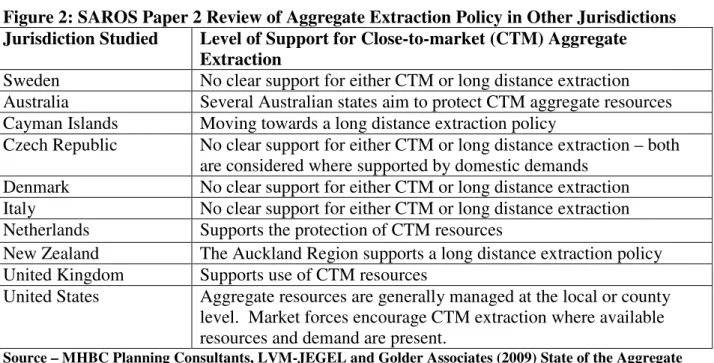
7.2 Distance from Markets and Long-Term Aggregate Supply: Policy in Other Jurisdictions56 7.3 Jurisdictions Considering Alternatives to “Close-to-market” Aggregates... 58
7.4 Current Transportation Scenarios for Aggregates in Ontario ... 60
7.5 Transportation of Aggregates in Other Jurisdictions ... 63
7.6 Potential Co-Benefits of Rail Transportation... 70
7.7 Current Policy Barriers to Rail Transportation in Ontario... 71
8. Conclusions... 75
Appendix A: Planning for Sustainability: Provincial Policy Review Collaborative Comments on Aggregate Resources (2010). ... 76
Appendix B: Summary of Key Findings and Recommendations from MNR’s Review of the Aggregate Resources Act With Respect to “Rehabilitation of land from which aggregate has been excavated” (2006) ... 78
Executive Summary
Aggregate extraction continues to be one of the most controversial land use issues in Ontario. Demand for aggregate resources in fast growing municipalities in the province, combined with a policy and legislative framework promoting extraction of aggregates close to the markets where they will be consumed, has resulted in substantial resistance to new aggregate extraction
operations when they are proposed.
In 1992, the Ministry of Natural Resources (MNR) developed a State of the Resource Report on aggregate reserves, consumption trends, conservation and recycling, with a primary focus on Southern Ontario. The report informed the development of policies and programs, and provided guidance to municipal planning processes. The Environmental Commissioner of Ontario (ECO) has repeatedly called for MNR to update its State of the Resource Report and the ECO’s 2006/07 Annual Report specifically recommended that MNR also develop an aggregates conservation strategy. In 2007, MNR stated in response that, while it was committed to developing a strategy, it needed first to update its 1992 State of the Aggregate Resource in Ontario Study (SAROS). A new SAROS was completed in 2009. It updated information in the 1992 report, included research on new subject matters and expanded the geographic scope to include all regions of Ontario. The subject matter was divided into six components and contracted out to independent consultants, who produced a series of papers; many of the findings from these papers were ultimately consolidated into a final report authored by the Ministry of Natural Resources. It is anticipated that, with the completion of the SAROS reports, MNR now has the background information it needs to soon develop a broader strategy to conserve aggregates, improve environmental safeguards and oversight and reform transportation methods, while recognizing the numerous economic benefits that the resource provides to the province.
This report is intended to provide commentary on the 2009 SAROS and additional research that will inform the development of an improved Ontario aggregates strategy. It is hoped that this research will assist various stakeholders to work together to create a strategy for aggregates in Ontario that reflects environmental and social values, as well as economic interests.
Authors of the SAROS reports suggest that high quality aggregates located in close proximity to the Greater Toronto Area (GTA) are growing scarce and shortages may be experienced within 10 to 20 years if new licences are not approved in close-to-market areas. If this scenario is realized, reliance on aggregate reserves located further from high demand areas will surely increase. At the same time, long term alternatives to the current close-to-market approach, such as
transportation of aggregates by rail or barge from northern Ontario, are described in the SAROS as having serious social, environmental and economic implications.
Some sections of the SAROS reports do suggest that improved demand management for aggregates may be possible through changes in urban design and greater recycling, but both of these options are currently hindered by a lack of data. The net impact of trends in urban
planning and design, such as the smart growth principles prescribed under the province’s Growth Plan for the Greater Golden Horseshoe Region, on the demand for virgin aggregates is not fully
known. Basic data on the types, quantities and locations of materials that could be used as substitutes for virgin aggregate are also currently lacking.
At the same time, a constraints analysis undertaken for the SAROS reports indicates that large amounts of aggregate could still be extracted from the bedrock of Southern Ontario, but that 93% of these deposits that are currently unlicenced overlap with environmental or agricultural features. A likely outcome of these SAROS findings will be increased pressure to open additional areas in the Greenbelt, Oak Ridges Moraine and Niagara Escarpment Plans, where much of the aggregate that supplies the GTA is currently extracted. These three land use plans will be undergoing a 10-year consolidated review in 2015 and aggregates will likely be a central focus of this process.
In particular, the Oak Ridges Moraine Conservation Plan (ORMCP) anticipates that heightened demand for close-to-market aggregates may mean that new aggregate extraction is permitted in its Natural Core Areas, where it is currently restricted in order to protect key natural heritage features. Numerous licenced aggregate pits exist across the Oak Ridges Moraine, many in close proximity to Natural Core Areas, which could potentially be candidates for expansion if current restrictions were eased. Also, communities just beyond these protected areas such as Simcoe will likely continue to see an increase in demand for aggregates to supply GTA markets. Overall, the SAROS study suggests that if the status quo for managing aggregates in the province is
maintained, future supplies of aggregate for the GTA market will come from sites located within or just beyond regional conservation plan areas.
The social and economic benefits provided by Ontario’s aggregates in various applications are well understood and are discussed in depth in the SAROS reports. The importance of aggregate resources to the province is also reflected in a planning policy framework supporting close-to-market extraction of aggregates, which has been in place in one form or another since the 1970s. Regarding the current provincial approach to aggregate resource management, some of the
stakeholders interviewed for CIELAP’s research believe that there is a tipping point at which the need to preserve remaining natural heritage features should outweigh the benefits of close-to-market aggregates management. Several respondents also pointed to a need for better accounting of social and environmental costs related to aggregate extraction. The province’s current fee of 11.5 cents per tonne of aggregate extracted, does not address all of these costs and in some cases only covers the cost of road maintenance for municipalities hosting aggregate operations. Also, this relatively low fee means that the use of recycled material is not an attractive alternative from a financial perspective.
Better accounting of the full cost of aggregate extraction, including social and environmental impacts is required. Once this has been achieved, the provincial government needs to ensure that such costs are reflected in the total price paid for aggregates.
An aggregates strategy for Ontario must address these seemingly conflicting interests with a comprehensive approach that manages current demand, but also takes a long-term view that contemplates the potential for the future use of rail or marine transportation from areas where there may be less land use conflict. For example, in the United States and the UK, transportation
of aggregates by rail has seen modest growth in recent years, suggesting that this is both feasible and, in some contexts, an appropriate solution.
Inter-ministerial cooperation is needed to:
• enable transportation reform to allow for the growth of rail infrastructure over the long
term and reduce dependence on continual, large-scale highway expansion projects;
• develop sufficient government staff capacity to apply and enforce the Aggregate
Resources Act (ARA) in all areas with significant resources throughout the province;
• establish both incentives for greater recycling, rehabilitation and information sharing
among stakeholders and disincentives targeting waste and bad practices that perpetuate a negative public perception; and
• reform the current framework for rehabilitation of worked out pits and quarries by
establishing both incentives and requirements to improve the quality and quantity of rehabilitation throughout the province.
The UK provides one of the strongest examples of what can be achieved in terms of sustainable aggregate resource management, as was acknowledged in several areas of the SAROS report and by MNR. However, a levy charged on virgin aggregates in the UK is currently 2.00 GBP (approximately $3.22 CDN) per tonne of aggregate extracted. Ontario’s current fee of 11.5 cents per tonne would likely not be sufficient to support the development of similar initiatives. A long-term aggregates strategy must begin to examine other, more comprehensive ways to define the value and appropriate price of the resource. Increased aggregate royalties could also improve staff capacity in MNR to allow for greater compliance with and enforcement of the ARA, and to develop programs that promote knowledge sharing between government, industry and interested stakeholders. Other jurisdictions, such as Sweden and the Netherlands, have faced similar land use conflicts and environmental challenges within their own aggregate industries and their responses include the establishment of taxes on virgin aggregate; taxes or bans on the landfilling of wastes that are suitable for use as aggregate; and financial incentives to make greater use of recycled materials in construction.
The SAROS report should be viewed as an important step toward a long term aggregates
strategy. It should be the catalyst for a broad, open debate on which elements will be needed in a new strategy that will be most beneficial for Ontario from economic, social and environmental perspectives. The report should also lead to ongoing research on the environmental impacts and costs of extraction, jurisdictional review and improved data sharing and analysis.
Summary of Recommendations
Section 4 – Environmental, Social and Human Health Impacts of Aggregate Extraction in Ontario
Continue to study environmental impacts of aggregate extraction. The Ontario government should identify an efficient means of undertaking a comprehensive study of the environmental, social and cultural heritage impacts of aggregate extraction in an Ontario-specific context that
includes cumulative impacts, and provides a broader understanding of land use change issues such as the loss of agricultural land. This study should be led an independent body, but with extensive input by MNR and the Ministry of the Environment (MOE), as they have direct access to critical field data for determining trends. The study should also include input from other stakeholders such as environmental non-profit organizations, municipalities and the public. In addition, MNR should make a database of field audit information collected by aggregate inspectors available to the public in order to allow third parties to track trends in environmental impacts and identify potential problem areas that need greater attention.
Section 6.1 – Balancing the need for Mineral Aggregate with other Land Use Interests in a High Growth Region
Increase producer requirements for monitoring and reporting. MNR should use additional provincial funding to increase enforcement of the ARA. At the same time producer requirements, especially for larger, more complex operations should be increased by requiring more detailed monitoring under the Compliance Assessment Report system, as well as more frequent site visits from MNR inspectors. MNR should issue fines against aggregate producers who submit
incomplete or inaccurate Compliance Assessment Reports.
Introduce sunset clauses on aggregate licences. MNR should introduce a sunset clause on aggregate licences. While sunset clauses could be phased in gradually for the entire province, at minimum the use of sunset clauses for aggregate operations in the Oak Ridges Moraine,
Greenbelt and Niagara Escarpment areas should be considered during the 2015 consolidated review of the three regional plans.
Section 6.2 – Supply and Demand for Aggregates
Determine the impact of urban development on the demand for aggregates. As a first step towards creating an aggregates conservation strategy, MNR in collaboration with the Ministry of Transportation (MTO) and the Ministry of Municipal Affairs and Housing (MMAH) should undertake further research on the impact of different urban development approaches on the demand for virgin aggregates. Once urban design approaches that can reduce the need for virgin aggregate over the long term have been identified, these should be incorporated as requirements where feasible in an aggregates conservation strategy. For example, provincial infrastructure funding could be made conditional on the use of materials and/or designs that minimize the need for virgin aggregate.
Section 6.3 – Underutilization of Recycled Aggregate
The provincial government should promote and where possible, require the use of recycled aggregate to the fullest extent possible without compromising safety or durability of
infrastructure by doing the following:
a) Follow the SAROS recommendation to create an inventory of recycling activity and available materials. MNR should pursue all recommendations provided in SAROS
b) Establish provincial targets for recycling aggregate. As a component of the province’s proposed Aggregates Conservation Strategy, adopt a recycling target of 10 to 15%
substitution of virgin aggregate for recycled/secondary material. Recycling targets should also be increased incrementally over time as knowledge on the availability of suitable materials and recycling practices improve.
c) Remove municipal barriers to recycling aggregate. MMAH, in collaboration with the Ministry of Infrastructure and MNR, should use provincial legislation to address
municipal official planning barriers to the use of recycled aggregate. For example, municipalities designated as urban growth centres under the Places to Grow Act, 2005
should be required to accommodate recycling facilities and encourage the use of recycled aggregate in infrastructure, as appropriate.
d) Introduce a landfill tax to reduce unnecessary landfilling of usable material. As a component of a long-term aggregates strategy, the Ontario government should combine an aggregates royalty increase for virgin aggregate with a provincial landfill tax that will reduce the disposal of waste products that have the potential to act as a substitute for virgin aggregate.
Section 6.4 – Site Plan Amendments
Make major changes to aggregate operations conditional on use of best practices. MNR should revise the current procedure for major site plan amendments to encourage producers to implement best practices. Approval of requests, such as for tonnage increases, increases in the depth of extraction, removal of setbacks or addition of new equipment to a site should be conditional on evidence of successful progressive rehabilitation to date and/or a tightened timeframe for resource depletion and final rehabilitation.
Section 6.5 - Rehabilitation
MNR should commit to implementing all key recommendations already identified through their EBR review of rehabilitation in 2006 and in SAROS Paper 6: Rehabilitation.
MNR should strongly consider reintroducing the security deposit model for rehabilitation of worked out pits and quarries. As recommended in SAROS Paper 6: Rehabilitation, MNR should consider reintroducing the security deposit model for aggregate licences to increase the financial incentive to rehabilitate worked out sites.
Section 6.6 – Compliance Monitoring
Increase the number of aggregates field inspectors. The Ontario government should make funding available to restore the number of aggregate field inspectors to a level that will enable more frequent and thorough monitoring of a greater number of pits and quarries in the province.
Section 6.7 – Pricing and Accounting for the Cost of Aggregates
Gradually increase the current aggregate royalty rate and licence fees to fund reforms. MNR should increase the current per tonne licence fees and royalties charged on the extraction of aggregates. As a starting point, the rate should be increased to a level sufficient to continue to fund additional staff capacity within MNR. Additional revenue from future increases should be used to further recycling efforts, extend the geographic areas covered by the ARA, improve rehabilitation efforts and support further research into how the industry can improve practices. The royalty rate and fee increases should be phased in incrementally over time.
Section 7 – Long-Term Considerations for Aggregates Management in Ontario
Continue to investigate long term alternatives to close-to-market aggregate extraction supported by truck transportation. MNR, in collaboration with MTO, should continue to lead research into using rail transportation from as a long-term option for the movement of aggregates to high demand areas. This research should include an analysis of various transportation
alternatives that will take into account a broad range of costs and benefits including social and economic benefits and environmental factors. This research should inform the eventual
development of a provincial rail strategy.
Improve knowledge of how different types of aggregate are used and how they move from the extraction site to the job site. MNR, in collaboration with the Ontario Aggregate Resources Corporation (TOARC) and the Ontario Sand, Stone and Gravel Association (OSSGA), should make information on annual tonnage and transportation routes of existing operations available to municipalities and to third party bodies.
1. Introduction and Background
Ontario’s Aggregate Resources Act1 defines “aggregates” as gravel, sand, clay, earth, shale, stone, limestone, dolostone, sandstone, marble, granite and rock. Aggregates are used primarily for the construction and maintenance of numerous types of infrastructure, including highways, bridges and sewer mains. Aggregates are also used in the manufacturing of products such as pharmaceuticals and cosmetics.
The extraction of aggregate resources in Ontario often becomes controversial for the damage it causes to natural landscapes and the impacts it causes in local communities. Pits and quarries remove natural vegetation, top soil and subsoil, leading to loss of animal wildlife, biodiversity and aquatic systems. Aggregate extraction can have negative effects on water quality and quantity, natural heritage features, and endangered species and can adversely impact nearby residents and those who enjoy recreation and tourism (notably eco-tourism). Adjacent communities and adjacent ecosystems are affected by noise, dust and vibration.
Ontario is at a crossroads on the issue of aggregate extraction. In 2009, Ontario’s Ministry of Natural Resources (MNR) completed an update of the 1992 State of the Aggregate Resource in Ontario Study (SAROS), which it has stated will inform the development of a broader provincial aggregates strategy.2 Over the years, MNR has also indicated that it is committed to the
development of an aggregates conservation strategy in collaboration with other provincial
ministries. While a broader provincial aggregates strategy would address issues such as ensuring long term aggregate supplies and transportation of aggregates to high demand areas, an
aggregates conservation strategy would also address the need to reduce consumption of aggregates through demand management and increased use of recycled material.3 The development of these strategies presents a rare and significant opportunity for conservation organizations and other stakeholders who seek a greater balance between aggregate extraction activities and environmental protection to inform the development of a long-term strategy for aggregate resources in Ontario.
Over the last three decades, production of aggregate in Ontario has fluctuated between
approximately 100 million and 200 million tonnes annually.4 Industry estimates that, over the next 25 years, the GTA will require approximately 1.5 billion tonnes of aggregate as urban infrastructure is renewed and built.5 If more protective policies are not put into place, much of this aggregate will come from some of the most ecologically sensitive land in and around the
1
R.S.O. 1990, c, A.8
2
Ontario Ministry of Natural Resources, Results Based Plan 2009-2010 (2009), 10.
http://www.mnr.gov.on.ca/stdprodconsume/groups/lr/@mnr/@about/documents/document/274148.pdf
3
Personal Communication, Ontario Ministry of Natural Resources, July 2010
4
Altus Group. State of the Aggregate Resource in Ontario Study Paper 1: Aggregate Consumption and Demand.
Toronto: Queens Printer for Ontario, 2009, 7.
http://www.mnr.gov.on.ca/stdprodconsume/groups/lr/@mnr/@aggregates/documents/document/stdprod_06771 2.pdf
5
Toronto Environmental Alliance. “Dig Conservation, Not Holes”2008.
Ontario Greenbelt. Many of the massive gravel pits and quarries proposed for Ontario could cause severe environmental degradation to the Niagara Escarpment, a UNESCO World Biosphere Reserve within the Greenbelt, Areas of Natural and Scientific Interest (ANSIs) and remaining areas in Ontario’s unique but increasingly depleted Carolinian zone.
Outdated policies and compliance requirements make it challenging for the Ontario government to ensure sustainable aggregate operations. There are numerous problems with how current legislation is enforced, including inadequate monitoring of environmental impacts, and a lack of effective mechanisms for inspection, enforcement and rehabilitation of aggregate operations. Current provincial land use planning legislation and policies give priority to aggregate extraction over other land uses, sometimes leading to negative impacts on the health, safety, quality of life and well-being of citizens, natural landscapes, and the environment.
In 1992, MNR developed a State of the Resource Report on aggregate reserves, consumption trends, conservation and recycling. The report informed the development of policies and programs and provided guidance to municipal planning processes. The Environmental Commissioner of Ontario (ECO) has repeatedly called for MNR to update its State of the Resource Report and the ECO’s 2006 /07 Annual Report specifically recommended that MNR develop an aggregates conservation strategy.6 In 2007, MNR stated in response that, while it was committed to developing a strategy, it needed first to update its 1992 State of the Resource Report. This updated study was completed in 2009. It is anticipated that, with the completion of the update, MNR will have the background information it needs to soon develop a broader strategy to conserve aggregates and better protect the environment.
In the analysis that follows, CIELAP provides research that will inform the ultimate development of an improved Ontario aggregates strategy. It is hoped that this research will assist various stakeholders to work together to create a strategy for aggregates in Ontario that reflects environmental and social values as well as economic interests.
This report explores:
• the impacts of current regulations and policies on aggregate extraction in Ontario; • the actual experience with new and expanded aggregate operations in recent years,
particularly in Southern Ontario since the time that Oak Ridges Moraine Conservation Plan, Greenbelt Plan and other land use plans have come into force; and
• how best to balance competing objectives that include land conservation, protecting
natural heritage, maintaining water resources, supporting healthy communities and obtaining aggregate resources.
CIELAP has sought to provide a balanced analysis and represent the perspectives of a broad range of stakeholders with an interest in aggregates policy in Ontario. To achieve this goal, we interviewed a range of stakeholders with an interest in aggregates policy including: citizen’s
6
Environmental Commissioner of Ontario. 2007. Reconciling Our Priorities. Toronto: Queen’s Printer for Ontario, 45. http://eco.on.ca/eng/index.php/pubs/eco-publications/2006-07-annual-report.php
groups and non-profit organizations; academics; municipal planners; industry representatives7; and provincial government staff. In total, 12 informal, semi-structured interviews were
conducted for the purposes of this project.
CIELAP’s research also drew on publicly available data sources such as records of site plan amendments for aggregate operations on the Environmental Registry Database, records of active aggregate licences in MNR’s Aggregate Licensing and Permitting System (ALPS) and previous analyses of aggregates issues featured in Annual Reports to the Legislature by the Environmental Commissioner of Ontario. CIELAP also reviewed aggregates policies and practices in other jurisdictions to inform recommendations for Ontario.
7
CIELAP interviewed: staff at the regional municipalities of Simcoe, Peel, Clarington, Halton and North Dumfries provincial staff at MNR, the Ministry of Transportation and the Ministry of Municipal Affairs and Housing; industry representatives with the Ontario Sand Stone and Gravel Association; representatives of Gravel Watch Ontario and the Toronto Environmental Alliance; and a York University professor who has published articles on pits and quarries in Ontario. A majority of interviews were conducted in person or by telephone, with the exception of two interviews which were conducted by email correspondence.
2. The 2009 State of the Aggregate Resource in Ontario
Study
MNR’s initial 1992 State of the Resource Report was updated in 2009. The scope of this study was expanded beyond that of the 1992 study to include consideration of a broader geographic region of Ontario and addressed various components of aggregate resource management in more detail. The study was undertaken by a group of consultants with extensive background in and involvement with Ontario’s aggregate industry. The goals of the SAROS update included:
• updating information about the supply and demand for aggregates in the province; • determining the amount of aggregate remaining in existing reserves;
• identifying possible constraints on the long term aggregate supply;
• developing a methodology for creating an inventory of material with potential to be
recycled;
• providing an overview of the social, economic and environmental value of aggregates to
residents of Ontario;
• investigating alternative methods of aggregate delivery using different modes of
transportation; and
• providing up to date information on the status of rehabilitation of pits and quarries.
Research and recommendations related to the above goals were presented in 6 background papers; SAROS Paper 1: Aggregate Consumption and Demand; SAROS Paper 2: Future
Aggregate Availability and Alternatives Analysis; SAROS Paper 3: The Value of Aggregates;
SAROS Paper 4:Reuse and Recycling; SAROS Paper 5: Aggregate Reserves in Existing
Operations; and SAROS Paper 6: Rehabilitation.
The SAROS update was also informed by two panels: an Advisory Panel composed of
representatives from citizens’ organizations, academia, the aggregate industry, municipalities, conservation authorities and provincial government; and a Technical Expert Panel with similar stakeholder representation.8 The study concluded with the publication of a Consolidated Report authored by MNR that identified key findings of the project consultants as well as a list of recommendations produced by the SAROS Advisory Panel. The Advisory Panel identified the following as perspectives that must be recognized as a first step towards improved aggregate resource management:
• The SAROS initiative is the first step of an ongoing effort to increase knowledge and
understanding of aggregates in the province;
• The province needs to take a proactive, strategic approach to aggregates management and
this approach must reflect collaborative planning on a landscape level; and
8
Ontario Ministry of Natural Resources. State of the Aggregate Resource in Ontario Study - Consolidated Report. Toronto: Queens Printer for Ontario, 2010, 4.
• The province should adopt a model of integrated aggregates management that allows for
both an economically competitive and environmentally sustainable aggregates industry – there is an opportunity to study other jurisdictions with the intent of identifying best practices that could be applied in Ontario.9
In addition the Advisory Panel provided a list of specific recommendations, which included the following:
• the development of a long term strategic aggregate road map;
• the improvement and protection of access to critical aggregate resources for future use; • identification of strategies to reduce, reuse and recycle aggregates in partnership with
municipalities;
• development of an aggregates conservation strategy;
• increased promotion of rehabilitation by the provincial government; and
• rationalization of the existing approvals process to remove duplication and overlap.10
Shortly after the completion of the SAROS report, Gravel Watch Ontario – a group of citizens’ organizations with an interest in the promotion of a sustainable aggregates industry – published a series of reports that highlighted concerns with the various aspects of the SAROS study. Gravel Watch raised questions regarding: the scope of analysis applied to the alternatives and
transportation analysis in SAROS Paper 2: Future Aggregate Availability and Alternatives
Analysis; the extent to which economic, social and environmental costs and benefits of aggregate
were accounted for in SAROS Paper 3: The Value of Aggregates; the conclusions drawn regarding the amount of aggregate remaining in the province’s existing licenced reserves in
SAROS Paper 5: Aggregate Reserves in Existing Operations; and the general transparency of the
SAROS process.111213
In addition, a number of information gaps were identified by MNR upon conclusion of the SAROS exercise, including the volume of reserves remaining in existing aggregate sites, the volume of recyclable aggregates not being utilized, qualitative data to assess rehabilitation performance; and easily accessible information about rehabilitation presented in a consistent format.14
9
Ontario Ministry of Natural Resources. State of the Aggregate Resource in Ontario Study - Aggregate Resource
Advisory Committee Consensus Recommendations to the Minister of Natural Resources. Toronto: Queens
Printer for Ontario, 2010. http://www.mnr.gov.on.ca/stdprodconsume/groups/lr/@mnr/@aggregates
/documents/document/stdprod_067787.pdf
10 Ibid.
11
Gravel Watch Ontario. Saros Predicts the Past: Gravel Watch’s Critique of MNR’s Consolidated Report for
SAROS, 2010. http://www.gravelwatch.org/orig-gw/saros/100630-gwo-critique-consolidated-rept.pdf 12
Markvart T. A Sustainability-Based Review of the Ministry of Natural Resources 2009 State of the Aggregate Resource in Ontario Study, 2010. http://www.gravelwatch.org/orig-gw/saros/100716-Master-Final-SAROS-Review-GWO-TM.pdf
13
Gravel Watch Ontario. Review of Golder SAROS Paper 5 On Reserves of Aggregates in Ontario, 2010.
http://www.gravelwatch.org/orig-gw/saros/100815-Master-Final-SAROS-Review-Golder-GWO.pdf
14
3. Understanding the Controversy: Aggregate Extraction
and Land Use Conflicts
While extraction practices and rehabilitation have improved significantly since the early days of Ontario’s aggregate industry, some degree of negative impact is unavoidable. The nature of the aggregate extraction process makes operating a pit or quarry in populated areas without
impacting local communities, or causing some level of land use conflict highly difficult. There is evidence to support this internationally as quarries are almost unanimously met with public resistance in most jurisdictions where they occur. Land use conflict in Ontario is particularly severe in the GTA rural fringe where significant aggregate resources exist close to a large population and market.
While aggregate extraction is an ongoing source of aggravation for local communities and a serious concern among some environmentalists, the broad importance of aggregates to our built environment and economy cannot be overlooked. The challenges associated with the aggregates industry have remained largely the same since the 1970s. Aggregates are considered an essential good with a low per tonne cost, which imposes a significant impact on landscapes. The need to minimize transportation costs has in most cases meant that aggregate extraction sites and related facilities are often located near population centres. This has been described by some researchers as the paradox of the aggregate industry: a steady and predictable demand for aggregates
combined with local populations who would prefer mining operations to be located in more remote areas.15
The Environmental Commissioner of Ontario (ECO) has noted that the geologic formations from which aggregates can be extracted are clustered naturally, and current provincial policy requiring that aggregates be extracted close to markets exacerbates the clustering effect seen in pit and quarry development in Southern Ontario.16
According to MNR, there are 3729 aggregate licences on private lands and 2329 aggregate permits on crown lands in the province.17 MNR indicates that approximately 85% of Ontario’s aggregate production takes place in the southern part of the province where there has been
extensive migration to urban areas, and population levels and densities are high.18 It is likely that this trend will continue into the future, suggesting that conflicts over the siting of aggregate operations will increase in decades to come. Ontario is projected to have a provincial population of between 15 and 20 million by 2036.19 Most of this growth will take place in Southern and
15
R. Poulin, R. C. Pakalnis and K. Sinding, “Aggregate resources: Production and environmental constraints,”
Environmental Geology, 23 (1994). http://www.springerlink.com/content/m68j21t127138546/. 16
Environmental Commissioner of Ontario, Annual Report - Building Resilience. Toronto: Queen’s Printer for
Ontario. (2009), 30-31. http://www.eco.on.ca/eng/uploads/eng_pdfs/2009/ar2008.pdf
17
Personal Communication, Ontario Ministry of Natural Resources, July 2010. 18
Ontario Ministry of Natural Resources. “Managing Aggregate Resources”. June 5, 2009.
http://www.mnr.gov.on.ca/en/Business/Aggregates/2ColumnSubPage/STEL02_167024.html 19
Ontario Ministry of Finance, Ontario Population Projections Update, (2010), 5.
Central Ontario. For example, the most recent population projections issued by the Ministry of Finance indicate that between 2009 and 2036, the population of the GTA will increase from 6.1 million to 9.1 million.20 More modest growth is predicted for the Southwestern, Central and Eastern regions of the province, while minimal growth, or in some cases a net out-migration, is projected across most of northern Ontario.21
Aggregate reserves are already partially constrained by the Niagara Escarpment Plan (NEP), Oak Ridges Moraine Conservation Plan (ORMCP), and most recently, the Greenbelt Plan. As a result, areas that have been an important source of aggregate just beyond what might be currently defined as ‘close-to-market’, including Simcoe County, Grey County, the Carden Plain and locations in south-eastern Ontario such as Clarington and Alnwick-Haldimand, may be subject to heightened demand in years to come.
Many jurisdictions throughout the world face similar issues to Ontario in terms of growing urbanization and increasingly constrained resources and some are considering the option of transporting aggregate over longer distances. In fact, urbanization, rural migration, more stringent zoning and environmental regulation are challenges for close-to-market extraction in virtually every jurisdiction examined for this report.
All of the trends discussed above are exacerbated by the concern that close-to-market supplies are running out. Research conducted by the National Research Council of Canada in the late 1970s predicted shortages of high quality aggregates, such as those capable of meeting the province’s specifications for highway construction or other infrastructure applications, throughout Canada around larger urban areas during the next 25 years.22 However, the recent SAROS study suggests that in Ontario, fears of a shortage of aggregates close to urban areas expressed in the late 1970s were not realized. SAROS Paper 1: Aggregate Consumption and
Demand indicates that rising consumption of aggregates in the province, which reached an
all-time high in 1989, has consistently been met through Ontario based supplies.23
Those researching the aggregate industry have long suggested sequential land use, where mineral aggregates are extracted before other potentially conflicting land uses such as residential
development are permitted, as a means of avoiding shortages of the resource.24 While a
sequential approach to land use may be more difficult to implement, there may be some potential to adopt this approach in certain regions of Ontario, as opposed to smaller, more densely
20
Ontario Ministry of Finance, Ontario Population Projections Update, (2010), 11-14.
http://www.fin.gov.on.ca/en/economy/demographics/projections/projections2009-2036.pdf . 21
Ibid.
22
Grattan-Bellew, P. E., L.M. M. Dolar-Mantuani, and P. J. Sereda. The Aggregate Shortage and High-Alkali Cement in a Changing Energy Situation. National Research Council Canada, 1978. http://www.nrc-cnrc.gc.ca/obj/irc/doc/pubs/nrcc16693/nrcc16693.pdf
23
Altus Group. State of the Aggregate Resource in Ontario Study Paper 1: Aggregate Consumption and Demand.
Toronto: Queens Printer for Ontario, (2009), 10.
http://www.mnr.gov.on.ca/stdprodconsume/groups/lr/@mnr/@aggregates/documents/document/stdprod_06771 2.pdf
24
R. Poulin , R. C. Pakalnis and K. Sinding. “Aggregate resources: Production and environmental constraints.”
populated jurisdictions in other parts of the world that are turning to imports of aggregates. However, the opportunities for this to take place in Southern and some areas of Central Ontario are becoming increasingly scarce. The need for a long term aggregates management strategy for Ontario is becoming clear.
4. Environmental, Social and Human Health Impacts of
Aggregate Extraction in Ontario
The extraction of aggregate resources can cause significant environmental damage and has the potential to negatively impact human health and quality of life, especially if producers do not follow mitigation measures. In Ontario, aggregate extraction operations are defined as either pits or quarries. The distinction between pits and quarries is made based on the type of materials extracted.25 Unconsolidated materials such as sand and gravel are extracted from pits, while consolidated materials such as limestone and granite are extracted from quarries. Pits are in some cases smaller scale operations with less significant impacts, but vary widely in size across the province.
Example of a pit in the municipality of St. Mary’s, Ontario. Photo courtesy of Tony Dowling.
Quarries are often more substantial operations and may have more significant environmental and social impacts. If aggregate extraction will be occurring at a depth that extends below the water table, the pit or quarry must also be dewatered by pumping the inflow of groundwater out of the excavated area.26
25
Ontario Ministry of Natural Resources. “License Applications”
http://www.mnr.gov.on.ca/en/Business/Aggregates/2ColumnSubPage/STEL02_167064.html
26
Capita-Symonds Ltd. Mitigating the Impacts of Quarry Dewatering in Sand and Gravel Deposits. (2006), 1.
Aggregate reserves in quarries must be blasted out using explosives which are put into place by drilling into the quarry face. After aggregate deposits are broken up by explosive blasts, they are transported by truck to crushing equipment, where they are further refined and sorted into
categories for either immediate use or to be further refined and processed for use in materials such as asphalt. 27
Example of a quarry located in the municipality of Tatlock, Ontario.
A comprehensive study of the long-term environmental impacts of pits and quarries in Ontario has never been conducted. Generally, the potential impacts of pits and quarries are contemplated in detail during the licence approval process, where the project proponent must provide a wide range of technical studies detailing potential impacts on groundwater, dust, noise levels and impact on natural and cultural heritage features, as well as how these impacts will be monitored and mitigated or prevented over the lifespan on the operation.
Additional consideration of environmental impacts often takes place at the Ontario Municipal Board (OMB), an independent review tribunal which resolves land use planning disputes in the province. In the case of an OMB hearing, the potential impacts of a pit or quarry may be assessed in greater detail by one or more expert witnesses prior to the operation being approved or rejected, but competing assessments of potential environmental impacts are normally only
27
Dufferin Aggregates. “Dufferin Aggregates Brochure”
possible when the opponents to the pit or quarry have sufficient funds to hire their own independent consultants. In these cases, the OMB weighs the relative merits of technical analyses provided by the proponents and opponents, before coming to a final decision on a project approval.
The following sections attempt to summarize environmental impacts of aggregate extraction identified in the literature and highlight some of the potential environmental impacts that have been identified as being specific to Ontario.
4.1 Impacts on the Landscape
Because there are limited opportunities for aggregate extraction close to the markets where they will be used, there is often a conflict between the preservation of environmentally significant landscapes and maintaining a steady and affordable supply of aggregates for construction
materials. As noted above, the aggregates extraction process requires that vegetation and topsoil be removed from the site, resulting in the loss of natural habitats and soil productivity. 28
Aerial view of a quarry in the regional municipality of Clarington, Ontario. Photo courtesy of the Center for Community Mapping (COMAP).
4.2 Loss of Agricultural Land
The 2009 SAROS documented the loss of agricultural land in some areas of Ontario as a result of aggregate extraction operations. In SAROS Paper 3:The Value of Aggregates, an analysis of
28
Environmental Commissioner of Ontario. Annual Report 2002-2003.Thinking Beyond the Near and Now.
31 of the most recently approved aggregate licences determined that close to 100% of the licenced land upon which aggregates were extracted was classed as either agricultural or woodland. 50% of agricultural lands within the sample were comprised of class 4-7 soils, and 47.6% of class 1-3 soils (a majority of this being Class 2 soils).29 Areas comprised of Class 1-3 soils, as defined by the Canada Land Inventory for Agriculture, are considered to be prime agricultural lands under Ontario’s Provincial Policy Statement, and of the highest capability to support agriculture. Class 4-7 soils generally have more limitations in their ability to support agriculture.3031 Using maps and data describing the pre-extraction features of the licenced sites and the future rehabilitation plans provided by MNR, the authors of SAROS Paper 3: The Value
of Aggregates projected what the net land use changes would be across the 31 licences in the
sample over time. It was determined that 62% of the agricultural lands removed in the sample would be returned to agricultural use through rehabilitation, while the remainder would be left to naturally regenerate.32 The study could not provide information on whether the agricultural lands created through rehabilitation would be the same Canada Land Inventory class as those removed.33
In addition to the temporary or permanent loss of agricultural land as a result of aggregate extraction, agricultural land is also being lost in Ontario due to urbanization and agricultural industry trends. The greatest loss of agricultural land has occurred in the GTA.34 For example, between 1976 and 1997 the GTA lost over 3000 hectares of land per year as a result of
urbanization.35
4.3 Impacts on Water Quantity
Pits and quarries can have significant negative impacts on water quantity both on-site and in adjacent areas. Removal of vegetation and topsoil at the beginning of the extraction process can result in the loss of natural stream flow patterns. Aggregate deposits in their natural state also act as reservoirs, making the loss of water storage function a direct and largely unavoidable
consequence of the aggregate extraction process.36 In Sweden, the loss of natural gravel deposits
29
AECOM. State of the Aggregate Resource in Ontario Study Paper 3: The Value of Aggregates. (2009), 102.
http://www.mnr.gov.on.ca/stdprodconsume/groups/lr/@mnr/@aggregates/documents/document/stdprod_06773 0.pdf
30
Agriculture and Agri-Food Canada, “Overview of Classification Methodology For Determining Land Capability for Agriculture” http://sis.agr.gc.ca/cansis/nsdb/cli/classdesc.html
31
Ontario Ministry of Municipal Affairs and Housing. Provincial Policy Statement. Toronto: Queen’s Printer for
Ontario. (2005), 5. http://www.mah.gov.on.ca/Page1485.aspx
32
AECOM. State of the Aggregate Resource in Ontario Study Paper 3: The Value of Aggregates (2009), 99
http://www.mnr.gov.on.ca/stdprodconsume/groups/lr/@mnr/@aggregates/documents/document/stdprod_06773 0.pdf
33
Ibid, 106. 34
Margaret Walton. Agriculture in the Central Ontario Zone – An Issues Paper. Neptis Foundation (2003).
www.neptis.org/library/cf_download.cfm?file=1Agriculture-v2
35
Robert M. White, Danielle Lam Kuzak and William Kuo. Space, Form and Change in the Greater Toronto
Area Neptis Foundation (2001), 9. http://www.neptis.org/library/show.cfm?id=57&cat_id=27
36
Environmental Commissioner of Ontario, Annual Report 2002-2003 -Thinking Beyond the Near and Now
critical to maintaining drinking water sources for some municipalities served as the initial
motivation for developing policies to curb the use of gravel as construction aggregate.37
In the case of aggregate operations that extend below the water table, a number of negative hydrological impacts may occur. During the process of dredging an aggregate pit, gravel that is removed may be replaced with groundwater and precipitation, and evaporation from on-site ponds can occur at a faster rate than would occur from the natural land surface. Leveling out of the groundwater table in the pit pond can also cause alteration of groundwater flow patterns in surrounding areas.38 Lowering of the water table during aggregate extraction may drain
surrounding wetlands that are fed by groundwater discharge.39
Aggregate extraction in Ontario displaces large quantities of water both through the process of
quarry dewatering and washing of extracted materials. Permits to Take Water are required for quarry dewatering as well as for the washing of aggregates. The daily average water takings for the purposes of quarry dewatering in Ontario have been estimated at up to 10 million litres per day, while the average daily water takings for washing of aggregate materials have been
estimated to be up to 8.8 million litres per day.40 While much of this water can be returned to the source, there are still uncertainties surrounding the broader impacts of water taking in this
manner.
A case study carried out on 8 quarries across the state of Minnesota in 2005 noted that while impacts on water resources do not occur in every case, declines in aquifer levels resulting from quarry dewatering and alterations of the hydraulic gradient can be a common occurrence.41 Similar research has been carried out on a quarry in Ohio, which found that dewatering of
37
Mark S. Winfield and Amy Taylor. Rebalancing the Load: The Need for an Aggregates Conservation Strategy
for Ontario. The Pembina Institute (2005), 31. http://pubs.pembina.org/reports/Aggregatesfinal-web2.pdf
38
Ontario Ministry of Natural Resources. Cumulative Effects Assessment Best Practices Paper for Below Water
Table Aggregate Operations within the Grand River Watershed. (2009), 4.
http://www.grandriver.ca/policyplanningregulations/Aggregatebestpractices_April2009.pdf
39
Murray Ostrander et al., Impact of Aggregate Extraction Activities on Cold Water Discharge and Watertable Drawdown. (n.d.), 3-5. http://www.waterloohydrogeologic.com/consulting/publications/aggregate_paper.pdf
40
Legislative Assembly of Ontario. Standing Committee on Public Accounts, Thursday 7 April 2005.
http://www.ontla.on.ca/committee-proceedings/transcripts/files_html/2005-04-07_P020.htm
41
J. A. Green et al., Hydraulic Impacts of Quarries and Gravel Pits. Minnesota Department of Natural Resources (2005). http://www.dnr.state.mn.us/publications/waters/quarries_impacts.html
Recent Cases: The Flamborough Quarry
In April 2010, the Ministry of Municipal Affairs and Housing issued a Minister’s Zoning Order (MZO) under the Planning Act to block a proposal by St. Mary’s Cement to develop a quarry in the Hamilton area, which would have been located within the Natural Heritage System of Ontario’s 2005 Greenbelt Plan. Concerns surrounding the proposed quarry were in part related to the artificial groundwater recharge system that would be used to maintain the existing local groundwater regime, which had not been field tested. The MZO was recently appealed by St. Mary’s Cement and a final decision on the Flamborough quarry proposal is pending.
quarries had caused the drawdown of nearby wells.42 Whether or not dewatering has a significant environmental impact depends to some extent on the proximity of the site to man-made features such as wells, or natural features such at wetlands. Such features can be negatively impacted if they are within the area influenced by dewatering.43 Less obvious, small scale impacts of aggregate extraction on water resources may also occur as a result of creating temporary stockpiles of soil and overburden on-site, which can alter local drainage patterns.44
4.4 Impacts on Water Quality
Aggregate extraction may have an adverse impact on water quality due to on site contamination from fuel storage or asphalt plants. While few impacts of aggregate operations on drinking water supplies have been documented, concern may arise when former aggregate pits are used for landfilling or residential development.45 Recently, local citizens and municipal governments have raised such concerns over the use of a former gravel pit in the Oak Ridges Moraine to store displaced soil from development projects in the GTA.46
A literature review carried out on behalf of MNR in 2006 found that there have been very few documented instances of aggregate extraction having negative impacts on water resources in terms of either quality or quantity.47 More research specific to Ontario is required to verify these findings in a local context.
4.5 Social and Human Health Impacts
Aggregate operations have the potential to negatively impact human health and quality of life due to the amounts of noise, dust and vibration associated with quarrying activities and transportation of aggregates from the site. Particulate matter released during extraction and processing may also be a human health hazard if it is not properly controlled.48
Crystalline silica, a byproduct of natural aggregate, may cause temporary respiratory irritation or more serious long-term effects.49 There is some preliminary evidence to suggest that exposure to
42
Martin D. Van Oort, “Numerical modeling of the effects of quarry dewatering operation in Northwest Ohio.”
Geological Society of America 2003 Seattle Annual Meeting (November 2–5, 2003)
http://gsa.confex.com/gsa/2003AM/finalprogram/abstract_66624.htm
43 Ibid.
44
Thompson, A. and C. Howarth. Reducing the Effect of Aggregate Quarrying on the Water Environment.
(2007), 36. http://www.sustainableaggregates.com/docs/revs/t1b_water.pdf
45
Blackport Hydrogeology Inc. and Golder Associates, Applied Research on Source Water Protection Issues in
the Aggregate Industry. (2006), 55. http://www.mnr.gov.on.ca/stdprodconsume/groups/lr/@mnr/@aggregates/ documents/document/mnr_e000024.pdf
46
Vanessa Lu. “Fears of contaminated soil on Oak Ridges Moraine” The Toronto Star. Feb. 13, 2011.
www.thestar.com/news/article938201--fears-of-contaminated-soil-on-oak-ridges-moraine
47
Ibid
48
W. Birch, H. Datson and I. Lowndes. Sustainable Aggregates Forward Thinking Project: Theme 1 – Reducing
the Environmental Effect of Aggregate Quarrying: Dust, Noise and Vibration. (2008), 8.
http://www.sustainableaggregates.com/docs/revs/t1c_dnv.pdf
49
Cemex Inc. Natural Aggregates Safety Data Sheet. (2008).
crystalline silica can lead to an increased risk of lung cancer, though more robust data are required to determine whether there is a direct link.5051
In April 2010, the Ontario Minister of Municipal Affairs and Housing issued a Minister’s Zoning Order under the Planning Act52 to block a proposal submitted by St. Mary’s Cement Inc. to develop an aggregate quarry in the Town of Flamborough (now part of the city of Hamilton).53 In this case, Hamilton’s Chief Medical Officer expressed concern over the potential impacts on groundwater quality and quantity that could affect nearby groundwater users. 54 While the
Minister’s Zoning Order has been appealed to the OMB and the Flamborough quarry may still be approved, the case illustrates that large complex quarry proposals can often raise substantial concerns regarding impacts on water resources.
There is some evidence to suggest that properties located next to aggregate extraction sites suffer from lower property values, although proving this conclusively is challenging due to the wide range of factors that may potentially reduce property values.
4.6 Cumulative Impacts
While pits and quarries may have relatively benign environmental impacts in comparison to other mining activities that produce toxic by-products, the secondary impacts and cumulative impacts of a number of small aggregate operations located close together may have a significant net effect. There are still knowledge gaps on the cumulative impact of multiple aggregate extraction operations located in close proximity to one another. The cumulative impacts of multiple aggregate operations extracting below the water table is currently being studied by the Ontario Sand Stone and Gravel Association, as well as the Ministry of the Environment (MOE) and MNR.55
The Ontario Sand, Stone and Gravel Association and the Government of Ontario are also currently conducting additional research on cumulative impacts on the Carden Plain and Mill Creek Watershed. The results are expected to be made public upon completion.56
50
C.A. Soutar et. al., “Epidemiological Evidence on the Carinogenity of Silica: Factors In Scientific Judgement,”
The Annals of Occupational Hygiene 44 no. 1 (2000), 3-14. 51
Ulm et. al., “Silica, Silicosis and Lung Cancer: Results From a Cohort Study in the Stone and Quarry Industry,”
International Archives of Occupational and Environmental Health. 77 no. 5 (2004), 313-318.
52
R.S.O. 1990, c. P.13. 53
O. Reg. 138/10. See also Ontario Ministry of Municipal Affairs and Housing, “Province Listens, Stops Proposed Quarry in Hamilton,” (April 13th, 2010).
http://www.mah.gov.on.ca/Page7239.aspx?DateTime=634067477400000000&PageMode=View
54
City of Hamilton Public Health Services, Email message, St. Marys Cement Inc. (Canada), Application for a Category 2 Class A Quarry License under the Aggregate Resources Act (ARA) , Concession 11, Parts of Lots 1, 2, and 3 in the Former Township of East Flamborough, in the City of Hamilton, (May 20th, 2009).
http://www.hamilton.ca/NR/rdonlyres/DED357BD-1B7C-4639-8A466AEB3BD9C82A/0/PublicHEalthARAApplicationMay2009.pdf 55
Personal communication Ontario Sand Stone and Gravel Assocation, March 2010 56
4.7 Evaluating Environmental Impacts
The environmental impacts of aggregate extraction in Ontario have been highly debated.
Industry stakeholders generally describe aggregate extraction as a clean industry, with little to no impact on water resources.57 Representatives of the aggregates industry also contend that
disturbance of land is only temporary and that, in many cases, operations conclude with a
landscape of higher quality than the one that existed initially. In contrast, critics point to a range of ongoing problems associated with aggregate extraction, including massive land disturbances, dewatering and noise and air quality issues. Overall, it is a challenge to effectively evaluate the environmental impacts of aggregate extraction operations.
SAROS Paper 3:The Value of Aggregates, outlines some of the environmental impacts
associated with aggregate extraction, both in terms of the extraction process and the end uses of aggregates. These include the following:
• Potential health issues related to poorly maintained stormwater ponds established on
aggregate extraction sites;
• Construction of new roads, highways, bridges and dams enabled by inexpensive
aggregates that can cause damage to the surrounding environment;
• Decreased ecological connectivity resulting from road construction, as well as the
creation of edge environments58 along roads that can promote increased growth of invasive or non-native species;
• Decreased biodiversity and loss of habitat associated with the construction of dams and
airports; and
• Substantial loss of agricultural land to develop new extraction operations.
SAROS Paper 3:The Value of Aggregates also attempted to determine public perceptions of the
environmental and social costs and benefits of the aggregate industry through a telephone survey and content analysis of a sample of Ontario Municipal Board hearing decisions related to
aggregates projects.
Residents living in close proximity to aggregate extraction operations were most likely to
identify noise, dust and vibration as impacts, while those dispersed throughout the province were more likely to identify broader environmental impacts on the landscape as key costs of aggregate extraction.59 Respondents who identified these broader environmental impacts represented a
57
Ontario Stone, Sand and Gravel Association. About Aggregates #8 - Groundwater in the Aggregate Industry.
(2010), 2-3. http://www.ontariossga.com/Downloads/publicationsPFDs/Groundwater2010.pdf.
58
Ontario’s Natural Heritage Reference Manual (2010) Defines edge environments as “the area where different habitats (or habitat conditions)” meet. Edge environments can be createdby human activities such as
clearcutting of forests, road construction or creation of farmland. Edge environments can be more favorable to non-native and invasive species, as they can outcompete native species that have more specialized habitat requirements In Southern Ontario, the fragmentation of woodlands has resulted in the creation of large amounts of edge habitat.
59
AECOM. State of the Aggregate Resource in Ontario Study Paper 3: The Value of Aggregates. (2009), 73-74
http://www.mnr.gov.on.ca/stdprodconsume/groups/lr/@mnr/@aggregates/documents/document/stdprod_06773 0.pdf
statistically significant majority in the survey results. Perceptions of the costs and benefits of aggregate extraction varied by region. For example, respondents in central-west Ontario were more likely to associate aggregate extraction with social costs and nuisance, while respondents living in northern Ontario were most likely to identify development and infrastructure projects as a key benefit of aggregate extraction.60
SAROS Paper 3: The Value of Aggregates and SAROS Paper 6: Rehabilitation attempted to
assess the environmental impacts of aggregate extraction by reviewing samples of both recently granted and surrendered aggregate licences. While the use of small sample sizes in comparison to the overall number of pits and quarries in the province was likely due to time and budget constraints of the SAROS study, further research would be beneficial in drawing conclusions on the environmental performance of the industry as a whole.
Conclusions made in SAROS Paper 3: The Value of Aggregates about environmental impacts and the preservation of natural features on aggregate sites were based on a small sample of the 31 most recent aggregate licences granted in Ontario. While the study indicated that there might have been some improvement in preserving environmental features on aggregate sites in very recent years, it may also understate the impact of aggregate operations that have not been recently approved, of which there are many in the province.
Generally speaking, proponents applying for an aggregate licence largely examine the potential for site-specific environmental impacts that could be associated with an extraction operation through technical studies undertaken by consultants for the aggregate producer. Additional studies authored by consultants for project proponents or opponents may be produced if a proposed project is subject to an appeal before the OMB.
In many cases there is limited monitoring of whether or not the anticipated impacts actually occur beyond the self-reporting conducted by the aggregate industry through the submission of Compliance Assessment Reports61, alongside field inspections carried out by MNR to verify this information. In some cases, up to five years may pass before a site can be inspected by MNR and information submitted in Compliance Assessment Reports is verified.62
60
Ibid, 81.
61
Compliance Assessment Reports are forms submitted to MNR and municipalities by aggregate licence and permit holders in the province as a requirement under the ARA. The Compliance Assessment Report system
was introduced with the passing of the Aggregate and Petroleum Resources Statute Law Amendment Act of
1996. Compliance Assessment Reports provide some details on compliance with the site plan and other conditions on the license. Compliance Assessment Reports also require producers to submit basic data on the progress of their rehabilitation efforts. Compliance Assessment Reports are discussed in further detail in section 6.6 of this report. A sample copy of a Compliance Assessment Report can be viewed at:
http://www.gravelwatch.org/orig-gw/docs/ara-stds-v1.0/590-591-592.pdf 62
Ontario Ministry of Natural Resources. Environmental Bill of Rights File No. R2003008 - Review of the Aggregate Resources Act With Respect to Rehabilitation From Which Aggregate Has Been Excavated.
Toronto: Queens Printer for Ontario, 2006, 16.
Summary:
Despite many allegations of environmental damage caused by aggregate extraction, specific documentation of impacts after operations have begun remains an ongoing information gap in Ontario. While some of this information may be gleaned from Compliance Assessment Reports, aggregate inspectors and MNR have indicated that these forms may not always be reliable. Some studies have attempted to address issues such as assessing the impact of aggregate
extraction operations on source water protection and additional industry-led studies are currently being conducted to determine the cumulative impact of aggregate extraction operations on groundwater resources, but additional work needs to be done. Currently, much of the research related to the environmental impacts of aggregate extraction focuses on potential impacts of operations and is conducted either by consultants hired by the proponent or by consultants hired by concerned citizens where funds allow.
A comprehensive third party assessment of the environmental and social impacts of the industry in Ontario would be beneficial in moving towards a long-term aggregates strategy. A more detailed understanding of the impacts of the industry would also enable further analysis of the broader environmental and social costs of aggregate extraction, which could be used to compare against the already well established economic benefits in future State of the Resource Reporting. For example, the surveying of aggregate sites, as was recently carried out on 31 recent licences
for SAROS Paper 3: The Value of Aggregates, could be conducted on an ongoing basis and the
results made public for analysis. Recently, MNR has made records of rehabilitation orders issued to aggregate producers available for public review.
Recommendation:
Continue to study environmental impacts of aggregate extraction. The Ontario government should identify an efficient means of undertaking a comprehensive study of the environmental, social and cultural heritage impacts of aggregate extraction in an Ontario-specific context that includes cumulative impacts, and provides a broader understanding of land use change issues such as the loss of agricultural land. This study should be led by an independent body, but with extensive input by MNR and MOE, as they have direct access to critical field data for
determining trends. The study should also include input from other stakeholders such as
environmental non-profit organizations, municipalities and the public. In addition, MNR should make a database of field audit information collected by aggregate inspectors available to the public in order to allow third parties to track trends in environmental impacts and identify potential problem areas that need greater attention.