Вищий навчальний заклад Укоопспілки «ПОЛТАВСЬКИЙУНІВЕРСИТЕТЕКОНОМІКИІТОРГІВЛІ» В.В. Карцева І.В. Фисун Н.О. Демченко О.А. Горбунова
СТРАХОВИЙ МЕНЕДЖМЕНТ
Навчальний посібник для студентів вищих навчальних закладів з англійською мовою навчання Київ, 2017УДК 368.021(075.8) ББК 65.271-21я73 C 83 Рекомендовано до видання, розміщення в електронній бібліотеці та використання в навчальному процесі вченою радою Вищого навчального закладу Укоопспілки «Полтавський університет економіки і торгівлі», протокол №5 від 24 травня 2017 р. Рецензенти: Навроцький С.А. — доктор економічних наук, професор, головний нау-ковий співробітник відділу кредитування, страхування та фінансів підприємств Національного наукового центру «Інститут аграрної економіки» НААН України Давиденко Н.М. — доктор економічних наук, професор, завідувач кафед-ри фінансів Національного університету біоресурсів і пкафед-риродококафед-ристування України Карцева В.В., Фисун І.В., Демченко Н.О., Горбунова О.А. С 83 Страховий менеджмент: навч. посіб. для студентів вищих навчаль-них закладів з англійською мовою навчання / Карцева В.В., Фисун І.В., Демченко Н.О., Горбунова О.А. — К.: Видавничий дім «Кондор», 2017. — 148 с. ISBN У навчальному посібнику визначені особливості управління у страховому бізнесі. Розглянуто сутність і значення страхового менеджменту, ресурсний по-тенціал, структуру й органи управління страховика, комунікації та інформацій-не забезпечення страхового меінформацій-неджменту. Значна увага приділена плануванню у страховій діяльності, страховому маркетингу, управлінню відбором ризиків, урегулюванню страхових претензій, управлінню грошовими потоками, фінан-совою надійністю та організації проведення фінансового моніторингу у страхо-вих компаніях. Кожна тема має питання для самоконтролю, глосарій, тестові завдання, рекомендовані інформаційні джерела. Посібник розрахований на анг-ломовних студентів вищих навчальних закладів. ISBN УДК 368.021(075.8) © Карцева В.В., Фисун І.В., Демченко Н.О., Горбунова О.А., 2017 © Видавничий дім «Кондор», 2017
“POLTAVA UNIVERSITY OF ECONOMICS AND TRADE” (PUET) V.V. Kartseva I.V. Fysun N.O. Demchenko O.A. Gorbunova
INSURANCE MANAGEMENT
MANUALfor the students of the higher educational establishments with the English language of instruction
УДК 368.021(075.8) ББК 65.271-21я73 C 83
The Academic Council of the Higher Educational Establishment of Ukoopspilka “Poltava University of Economics and Trade” recommended for publishing,
placing in the electronic library, and using in the educational process Оn 24 Мay,2017, protocol №5.
Authors:
V.V. Kartseva, Professor of Department of Finance and Banking of «Poltava University of Economics and Trade», of Economics Science (Ph.D.)
I. V. Fysun, Associate Professor of Department of Finance and Banking of «Poltava University of Economics and Trade», Candidate of Economics Science (Ph.D.)
N.O. Demchenko, Associate Professor of Department of Translation of Luhansk Taras Shevchenko National Univesity, Candidate of Pedagogical Sciences (Ph.D.)
O.A. Gorbunova, Assistant of Department of Finance and Banking of Poltava University of Economics and Trade»
Readers:
A. S. Nawrocki, Doctor of Economics Science, Professor, Chief Scientific Of-ficer of Department of lending, insurance and finance of companies of National Science Center «Institute of agrarian economy»
N.M. Davydenko, Doctor ofEconomics Science, Professor, Head of Department of Finance of National University of Life and Environmental Sciences of Ukraine
Karceva V.V., Fysun I.V., Demchenko N.O., Gorbunova O.A
С 83 Insurance management: manual for the students of the higher educational establishments with the English language of instruction / Karceva V.V., Fysun I.V., Demchenko N.O., Gorbunova O.A. — К.: Publishing house “Condor”, 2017. — 148 p.
In the manual, the specific features of management in the insurance business. The essence and importance of insurance management, resource potential, structure and management bodies of the insurer, communications and information support of insurance management. Considerable attention is given to planning in the insurance business, insurance marketing, manage selection risks, manage insurance claims, cash flow management, financial strength and organization of financial monitoring of in-surance companies.Each topic is provided with questions for self-control or glossary, test tasks and the recommended references. The manual is worked out for English-speaking students of higher educational institutions.
ISBN УДК 368.021(075.8)
© Karceva V.V., Fysun I.V.,
Demchenko N.O., Gorbunova O.A, 2017
CONTENTS
INTRODUCTION ... 7
MODULE 1. THEORETICAL AND ORGANIZATIONAL BASES OF INSURANCE MANAGEMENT ... 9
Topic 1. The Essence and Importance of insurance Management ... 9
1. The need, essence and functions of insurance management ... 9
2. Goals and objectives of insurance management ... 12
3. Legal support of insurance management... 14
Glossary ... 19
Tests ... 20
Topic 2. Resource Potential, Structure and Management of Insurance Organization ... 23
1. Resource potential and the basic organizational and legal forms of insurance activity in Ukraine ... 23
2. Process formation of an insurance company, reorganization and liquidation .... 26
3. The organizational structure and management of the insurer ... 29
Glossary ... 33
Tests ... 34
Topic 3. Process Planning in Insurance Activity ... 38
1. The economic essence and principles of financial planning in insurance activity ... 38
2. Strategic planning of insurance activity ... 40
3. Operational planning of insurance activity ... 42
4. Methods of financial planning in the insurance company ... 44
Glossary ... 48
Tests ... 48
Topic 4. Communication and Information Services Insurance Management 52 1. The concept and importance of communication and information in insurance management ... 52
2. Principles of mutual relations of participants of the insurance process ... 55
3. Communication and information support in the management of business processes of the insurer ... 57
Glossary ... 60
Tests ... 61
Topic 5. Management Мarketing Аctivity in Іnsurance Business ... 65
1. The essence and components of the insurance marketing ... 65
2. Insurance services as an essential element of insurance marketing ... 67
3. Tasks and functions of the marketing service of the insurance company ... 70
Glossary ... 74
MODULE 2. CONTENT AND PROCEDURE OF MAJOR COMPONENTS
OF INSURANCE MANAGEMENT ... 78
Topic 6. Risk Selection Management for Insurance ... 78
1. Classification, identification and assessment of risks in insurance ... 78
2. Risk-management as a system of management risks of the insurer ... 81
3. Tariff Policy Management and risks selection for insurance ... 84
Glossary ... 87
Tests ... 88
Topic 7. The Settlement of Insurance Claims ... 91
1. The essence, principles and stages of settlement of insurance claims ... 91
2. The Payment Order of Insurance Compensation... 93
3. The composition and methods of calculating insurance reserves to provide insurance benefits ... 95
Glossary ... 100
Tests ... 101
Topic 8. Cash Flow Management of the Insurer ... 104
1. The essence, principles and objectives of cash flow management of the insurer ... 104
2. Management of Cash inflows of insurance company ... 107
3. Management of Cash outflows of insurance company ... 109
Glossary ... 113
Tests ... 114
Topic 9. Management of Financial Stability of the Insurer ... 118
1. Signs and factors to ensure financial stability of the insurer ... 118
2. Tax management of insurance activities ... 121
3. Investment activity management of insurance company ... 123
4. Management of insurer solvency, the formation and use of profit ... 124
Glossary ... 127
Tests ... 128
Topic 10. Financial Monitoring of Insurance Companies ... 131
1. The essence and necessity of financial monitoring implementation of insurance company... 131
2. Legislative support and organization of financial monitoring of insurance company ... 134
3. Methods of income legalization, from crime, by insurance tool ... 137
Glossary ... 139
Tests ... 140
INTRODUCTION
Insurance policy is one of the most important features of the market economy. Successful function of insurance company is impossible without highly qualified management as it encourages competition and efficiency. All these goals inspire the development of insurance management. The subject «Insurance Management» is provided with the program of the spe-cialty «Finance, Banking and Insurance» as well as the modern methods of financial resources management for further participation in the insurance market activity in order to satisfy the needs of the insurance services.
The purpose of this discipline is to develop the students’ system of theoretical knowledge and practical skills to prepare and implement management decisions that ensure rational use of formation and potential harmonization of insurance companies and financial interests of insurance consumers, owners and staff of insurance companies, insurance intermedi-aries and the state. To achieve this goal the following tasks should be per-formed: to get stable knowledge on the theory and practice of insurance company management, to provide insurance services and risk assessment, to settle insurance claims.
Mastering the discipline «Insurance Management» is based on the previous studies of the general theory of finance as well as «Business Eco-nomics», «Financial Markets», «Business Finance», «Insurance», «Manage-ment» and others.
Having mastered the discipline «Insurance Management» a student must know: some essence, functions and role of insurance management in market economy; the procedure of design, registration and licensing of in-surance companies; the content of the government supervision of their ac-tivity; principles of an insurer rational structure formation and full powers of their management; principles of insurance company management; methods of working out the strategic plan of the insurer; the essence and methods of marketing activities of insurance organizations; methods of studying the demand for insurance services; risk selection technology of insurance and insurance claims settlements; insurer cash flow manage-ment; conditions and ways to improve the financial stability of the in-surance company; procedures of insurer financial monitoring operations; to be able to develop strategic goals and objectives of the insurer; to form a rational structure of insurance management organization; to analyze the state of the insurance market; to explore the demand for insurance services
and system of their sale; to issue an insurance contract, to fix the insured event and calculate the appropriate amount of payment to the victims; to analyze the insurer activities and propose measures of their improvement; to determine the adequacy of insurance reserves and to verify the insurer financial transaction correctness.
Manual material is based on the laws of Ukraine, Verkhovna Rada (Parliament) resolutions, decrees of the President, decisions of Cabinet; in-structional materials of Ministry of Finance, the State Service of Financial Monitoring, National Commission for State Regulation of Financial Ser-vice Markets concerning the functioning of the insurance market members.
Each topic contains the reference of textbook and it is provided with the lecture notes, recommended references and a glossary. Practical skills as well as inspiring logical thinking of students are encouraged with the proposed tutorial questions and tests.
The content of this manual is the result of the general experience of teaching the academic subject «Insurance Management» at the Department of Finance and Banking in the higher education institution Ukoopspilka «Poltava University of Economics and Trade.»
The authors express cordial gratitude to Doctors of Economics, pro-fessors S.A Navrotski and N. M Davydenko for giving constructive com-ments and suggestions for improving the content of the manual during the revision period.
MODULE 1.
THEORETICAL AND ORGANIZATIONAL
BASES OF INSURANCE MANAGEMENT
Topic 1. The Essence and Importance of insurance Management
Issues:
1. The need, essence and functions of insurance management 2. Goals and objectives of insurance management
3. Legal support of insurance management
1. The need, essence and functions of insurance management
Insurance, like any other entities, requires management in the organi-zation, planning, regulation and control. First of all, management requires the activity of the insurer related to the formation and use of insurance capital. Due to the fact that primary insurer income is income from in-surance business, that it is impossible carry out investment activities with-out it, the main task of insurance companies is the attraction of a large number of insurers and use the collected premiums for investment activi-ties. All this was made possible by thoughtful and balanced policy manage-ment. That is why insurers need a balanced approach to the issue of risk-taking, efficient use of reinsurance, to pay more attention to preventive measures.
The functioning of an insurance company in conditions of market economy requires a high level of organization, which is essential to the achievement of the goal of the insurer, to ensure its competitiveness and effectiveness. It leads to the need in the management of its special direc-tion — insurance management.
Managing insurance activities should be considered in terms of indi-vidual insurance companies in the insurance market and in terms of rela-tions in this market environment. Development of insurance management in Ukraine can be characterized by a number of indicators of activity of surance companies, which are the macroeconomic indicators of the in-surance market. If these indicators are positive, it is possible to think about effective insurance management.
Insurance management can be viewed as management of the insurance company in a competitive economic environment that includes goal set-ting, choice of means and methods of achieving development.
Object management in insurance management in the general sense stands total insurance capital intended for compensation of possible losses of insurers. The institutional entities of insurance management, which generate and use insurance capital, there are the insurance and reinsurance companies. However, their successful performance depends on other pro-fessional participants of the insurance market, including insurance agents.
In addition, effective management of insurance management is not possible without the involvement of potential insurers (individuals and businesses) and the regulator of the insurance market of the country.
Effective management provides a basis for economic growth of in-surer. Based on the available insurance interests, the insurance company provides a package of insurance products oriented to meet the needs of as-surers. The development of all business processes is the main task of manage-ment in the insurance company.
Thus, the insurance management is the professional management of the insurer in a market economy, aimed at maximizing profits in the ra-tional use of available resources. Insurance management examines the most rational management technology by insurance companies and other professional participants of the insurance market.
The essence of insurance management is revealed in its functions. Functions of insurance management are specific types of management activities that are carried out using special techniques and methods, as well as the corresponding organization of work and control activities of the in-surance company.
The most common functions are planning, organization, motivation and control (Fig.1.1).
Implementation of all these functions is the management process by the insurance company. Functions are provided by two types of connecting processes — information communications and management decisions.
Figure 1.1 — Functions of insurance management
F unc ti ons of i ns ura nc e m an ag em en t organization motivation control planning
Planning is the initial step in the management process. Its implemen-tation involves deciding what, how, when and who to do. Using the plan-ning function is a unity and coordination of efforts of personnel of the in-surance company. Other functions provides the implementation of the es-tablished plan.
The function of the organization is to prepare all necessary for the im-plementation of the plan. Organization of work involves the integration of material-technical base and financial systems with human resources of in-surance company. It involves the delegation of authority (the right to make decisions and use the resources of the insurance company) by certain em-ployees, as well as adjustment of the organizational structure of the in-surance company for tasks that the insurer needs to solve.
The function of motivation means clearly formed in the insurance em-ployee’s desire to fulfill the requirements set by the leadership of the in-surance company in full with the required quality. It provides by optimiza-tion process steps: supporting the best balance between results and costs of achieving it. The main means of motivation are the orders and instructions relating to the execution of the work.
Control function provides a comparison of planned and actually the result. Control means the management process aimed at the detection of quantitative and qualitative deviations from the planned indicators. The most important control components are setting standards achieved by comparing a period of what was planned and an indication of how to cor-rect errors.
There are several forms of control. There is complete and selective control. Complete control is used in situations when it is necessary to check the activities of all employees, example, reporting of all insurance agents. Selective control is used when the full control of any reason is im-possible.
In addition, there are forms of control as the previous, current and
next. Currently, more prevalent is concept of controlling. In line with this concept the control function is vested in a special unit that provides the system of continuous evaluation of insurance company’s activity in general.
All control functions that reflect the essence of insurance management are closely interrelated and interdependent.
The specificity of the insurance management due to the peculiari-ties of the insurance activity. The process of selling insurance policies al-ways involves direct contact with prospective assurers, resulting in
opera-tional technology amenable to standardization. Insurance brokers are the link between the insured and the insurer under the insurance contract, and therefore have the greatest amount of information about insurance interests and preferences of customers. Work insurance agent, which is basically a strain on the conclusion of insurance contracts require a creative approach, and its performance is largely determined by his personal qualities, knowledge of the insurance business, as well as the psychology of com-munication with potential assurers. It leads to the possibility of new organi-zational forms of selling insurance policies, promotes the insurance pro-posal that meets the needs of existing customers and attractive to potential assurers. Last time, there is a new trend of providing additional services to the assurers who have concluded an insurance contract of a specific kind. All this strengthens the competitiveness of insurance companies and pro-vides the solution of problems concerning the development of insurance.
2. Goals and objectives of insurance management
The goals of the insurance management due to the objectives of the insurance companies in a particular economic environment (insurance market). It is possible to allocate common (economic) and specific (social) purposes of insurance management.
Common (economic) purposes related to the main causes of creating the insurance company. These objectives are reflected in the Charter of the insurer. It is formulated as protection of property interests of businesses and individuals through insurance activities aimed at profit insurance company. Insurance activities is the relationships that are formed for the protection of property interests of businesses and individuals at certain events (insurance cases) due to money funds generated from insurance premiums paid by its (insurance premiums).
The most important economic goal of the insurance company, as a business structure, is maximizing profits. The owners of the insurance company, forming the chartered capital, oriented to profitable placement of funds, which gives them a steady income. Making a profit is also in-terested assurers, as the financial success of the insurer is evidence of the reliability and stability of the insurance company with which they are dealing. The common interest in the profitable operation of the insurance company finds its labor staff, including senior managers.
Maximizing profit of insurance companies often realize is clear: in-crease of insurance premiums due to the inin-crease in sales of insurance policies and at the same time reducing costs associated with maintenance
of the insurance company and the process of maintenance of insurance agreements. In this sense stated goal focuses not on long-term operation of the insurer.
In the broader sense of economic purpose of insurance management should not be to focus on maximizing current profits of the insurance company, and to maximize its value, including the receipt of long-term profitability, potential growth of volumes of insurance transactions, the ac-ceptance of insurance risks in relation to estimated insurance.
In addition, the insurance company is a special business structure that accumulates assurer’s cash in insurance capital financial resources in-tended to provide taken to their obligations under insurance agreements.
Expressing economic distributive relations in the sphere of insurance capital that is managed by the management joint-stock insurance company, involved in the whole reproduction process. Given the specifics of in-surance capital, inin-surance management should be focused on securing the resource base of the insurer, includes the full support of obligations to in-surers under the terms of insurance contracts.
The realization of this goal involves the establishment of an insurance company management system current liquidity, balance of assets and lia-bilities of the insurer on the terms and sums of insured, the availability of insurance reserves and the system of assessment of insurance risks.
Specific (social) insurance management objectives primarily related to the need fullest satisfaction of insurance needs of clients of the insurance company and an optimal set of insurance products adequately that cor-respond to existing insurance interests.
At the same time should be provided with appropriate insurance pro-tection these property interests, as well as the appropriate level of client service insurance company. For this management system it should have at their disposal marketing research product and price insurance market, de-velopment of appropriate information and educational programs that enable professionals to develop skills (especially insurance agents) to communicate with potential customers of insurance companies.
The social aspect of the objectives of insurance management is also in the specific economic guarantees for small and medium businesses and creating new jobs in the area of insurance (insurance expertise, insurance marketing, acquisition). In a broad economic context, the insurance com-pany is a public institution which aims to closely link its activities with the General economic development and thereby strengthen the resource base and further expansion of insurance operations.
The economic and social goals of the insurance company determine
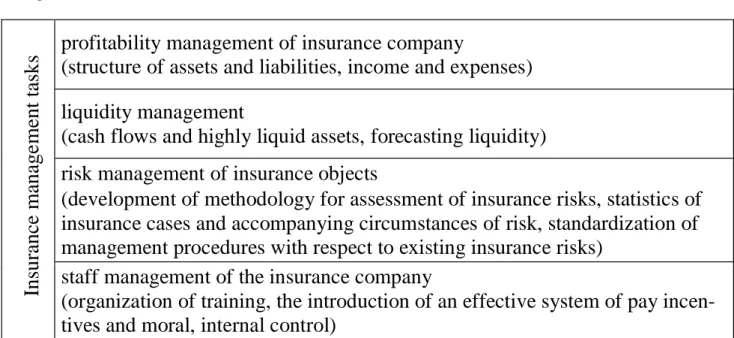
insurance management tasks. The main tasks of insurance management are the following:
- profitability management of insurance companies — control of the volume and structure of active and passive operations of the insurance company and the revenues and expenses of the insurer;
- liquidity management by optimizing the profit — cash flow manage-ment, organization of control over condition of highly liquid assets, fore-casting the liquidity position of the insurance company;
- risk management, specific objects of insurance, regarding the con-clusion of corresponding insurance contracts — development of methods for the assessment of various insurance risks, statistics of insurance cases and accompanying circumstances of risk, standardization of management procedures with respect to existing insurance risks;
- staff management of the insurance company — ensuring maximum realization of its potential. It provides to training of staff, implementing an effective system of remuneration and pecuniary incentives, internal control (Fig. 1.2). In su ran ce m an ag e m en t t as k
s profitability management of insurance company (structure of assets and liabilities, income and expenses)
liquidity management
(cash flows and highly liquid assets, forecasting liquidity) risk management of insurance objects
(development of methodology for assessment of insurance risks, statistics of insurance cases and accompanying circumstances of risk, standardization of management procedures with respect to existing insurance risks)
staff management of the insurance company
(organization of training, the introduction of an effective system of pay incen-tives and moral, internal control)
Figure 1.2 — Insurance management tasks
This is a deliberate effect on the human component, oriented ac-cording to the abilities of the staff of the insurance company selected objec-tives, strategy and conditions of development of insurance business.
3. Legal support of insurance management
Legal support of insurance are legislative and normative acts regu-lating insurance activity, both in general and in specific directions.
The system of legal regulation of insurance contains provisions are identified:
– Constitution of Ukraine;
– international agreements signed and ratified by Ukraine; – Civil Code of Ukraine;
– Commercial Code of Ukraine; – Tax Code of Ukraine;
– the laws of Ukraine and resolutions of Government of Ukraine; – edicts and orders of President of Ukraine;
– decrees, resolutions and orders of the Government of Ukraine; – regulations (instructions, methods, orders) adopted by ministries, departments and central authorities and registered by the Ministry of Jus-tice of Ukraine;
– regulations of the authority conducting state supervision of in-surance activity under the laws of Ukraine;
– regulations of local authorities in cases where the individual regu-lation of insurance activity has been delegated to these agencies by the President or the Government of Ukraine.
The Constitution of Ukraine, adopted June 28, 1996, determined that the laws of Ukraine established principles of creation and functioning of the financial market (article of law 92) and the Cabinet of Ministers of Ukraine provides financial policy (article of law 116).
During 1992–1993 most independent states formed after the disinte-gration of the former USSR was accepted legislative acts on insurance is-sues. In the summer of 1992 Ukrainian state insurance commercial organi-zation with leading insurance companies established in the period 1990– 1992, submitted to the Cabinet of Ministers of Ukraine the first draft “In-surance law”, aims to coordinate the positions of several involved in the insurance business departments and agencies. In December 1992 the pro-ject after the agreement was re-submitted for consideration of the Cabinet of Ministers of Ukraine. Because according to the decision of the Verkhovna Rada of Ukraine in this period, the Government received the right to issue decrees, which had the status of laws, the draft was adopted as a decree in may 1993.
Decree of the Cabinet of Ministers of Ukraine «Insurance law» was actually the first basic legislative act that provided for the system of legal regulation of insurance activity. This Decree defined the basic terms and concepts related to insurance activities (insurance market).
The development of market economy in Ukraine was in need of adopting new legislation that regulates how the conceptual apparatus and the exercise of insurance activities.
On 6 March 1996 the Verkhovna Rada of Ukraine adopted the «In-surance law», 4.10.2001 it was amended and supplemented. It is the main act of legislation in this industry in our country.
The «Insurance law» has 5 major sections.
The first section reveals the main concepts and terminology: it deter-mines such basic concepts as insurance, insurers, assurers, insurance objects, insurance forms, insurance risks and insurance cases, insurance amount, insurance compensation, insurance payments and insurance rates, coinsurance, reinsurance association of insurers, insurance agents and in-surance brokers and others. The centerpiece of this section is occupied by the rules that define the requirements for the insurer during its establish-ment and registration, as well as the procedure of obligatory insurance.
The second section of the Act regulates the conduct of insurance: de-fines the requirements for contracts and insurance regulations and the rele-vant currency, sets forth the duties of insurers and insured in a particular situation. The importance of legislative norms, envisaged by the section is the maximum completeness of contract relations, the rights and obligations of the parties in the insurance industry. In fact, it specifies general rules of civil law in this range.
The third section defines the conditions to ensure the solvency of in-surers and very important. This section reveals the financial mechanism of insurance, certain restrictions are established regarding the possibility of commitments and general principles defined audit insurer. Important ar-ticles of the law in this section are those, which refers to the procedure of forming insurance reserves and types of both technical and life insurance. Some articles regulate issues relating to the establishment of guarantee funds, accounting and reporting.
The fourth section defines the principles of state insurance supervi-sion. This section defines the institution that carries out state supervision of insurance activities and sets its rights and responsibilities. This section describes the licensing of insurance activities, which provides the legal regulation of insurers in the insurance market. The law specifies the par-ticular features of the liquidation, reorganization and financial rehabilita-tion of insurers that allows to control it after they cease their activities.
Final, the fifth section provides for the regulation of such general points as the basis of international law, the procedure and the steps in the application of certain rules, etc.
When the law was passed, the government has introduced a number of laws, including statutes and regulations governing individual issues of in-surance. Thus, a separate Government decree defines the procedure of regu-lation of reinsurance in Ukraine. It is also the Government’s resolution of legal regulation of intermediaries, brokers and agents in the insurance market. A separate decree of the Government defined the peculiarities of mutual insurance companies.
Government resolutions regulate the procedure of implementation of each type of obligatory insurance. Separate resolution specify the size limits of the costs of the proceedings in the case of obligatory insurance, and also regulates the creation of state and national insurance companies and mandatory associations of insurers.
Government orders are submitted as separate orders regarding experi-ments in the field of insurance. Orders can solve certain issues of regula-tion of insurance rates, the terms of contracts when it does not contradict the laws of Ukraine.
Regulations of ministries and departments — instructions, practices, orders registered in the Ministry of justice, are detailed certain legislation. This is especially true for those matters within the scope of the regulation of several departments. For example, these acts regulate the accounting and statistical reporting insurers for the implementation of the customs or law enforcement of a general financial and insurance supervision. Some-times such acts are approved methods of calculation of insurance rates. Joint acts sets out the regulations for registration of insurers in the system of various departments.
Regulations of local authorities, as a rule, are administrative in nature, outlining, within certain administrative units especially the performance of activities of certain government or institutional documents. The role of the legal acts of local authorities in the insurance industry minor in connection with the assignment of most of the issues on regulation of insurance activi-ties at the national level.
The Ukrainian «Insurance law» was defined executive authorities, exer-cising appropriate oversight. Till 2000 year such authority in Ukraine was the Committee for insurance supervision that obeys to the Cabinet of Ministers of Ukraine. From 2000 to 2003 years, the functions of the Au-thorized body belonged to the Ministry of Finance of Ukraine, in particular the Department of financial institutions and markets. After april 26, 2003 year — the State Commission for regulation of financial services markets of Ukraine. By the presidential decree of Ukraine from November 23,
2011 year № 1070/2011 created the national Commission, which performs state regulation in the sphere of financial services markets, in its activity is guided by the Constitution and laws of Ukraine, and also presidential de-crees of Ukraine and resolutions of Verkhovna Rada of Ukraine, accepted according to the Constitution and laws of Ukraine, acts of the Cabinet of Ministers of Ukraine, regulations on the State Commission for regulation of financial services markets of Ukraine (Resolution of the Cabinet of Ministers of Ukraine of February 3, 2010 year, № 157).
The main functions of the Commissioner authority, by article 36 of the «Insurance law» are (total of 14):
- maintenance of the unified state register of insurers (reinsurers) and the state registry of insurance and reinsurance brokers;
- issuance of licenses to insurers to conduct insurance activities and audits of its compliance with the issued license;
- inspections on the correct application of insurers (reinsurers) and in-surance intermediaries legislation on inin-surance activity and accuracy of reporting;
- development of regulatory and guidance documents on insurance ac-tivities assigned by this Law to the competence of the Authorized Agency
- adoption within its competence, of regulations on insurance and bro-kerage activities in insurance and reinsurance;
- monitor the solvency of insurers under insurance taken its obliga-tions to assurers;
- establishment of rules of formation, accounting and placement of in-surance reserves and reporting indicators;
- implementation and coordination of legislation in certain of educa-tion, training and retraining;
- participation in international cooperation in the field of insurance and reinsurance, organization of implementation of the international trea-ties of Ukraine on these issues.
Article 37 of the «Insurance law» is displayed, which has the rights authorized body (total of 11). There are the main:
- obtain in the prescribed manner from insurers of the reporting on in-surance activities, information about its financial condition and the neces-sary explanations regarding the reporting of data;
- carry out checks on the correct application of the insurers of the Ukrainian legislation on insurance activity;
- issue instructions to insurers about elimination of the revealed viola-tions of requirements of the legislation on insurance activity, and in case of
its failure to stop or limit action of licenses of these insurers until elimina-tion of the revealed infringements or to make a decision about withdrawal of licenses and exclusion from the state register of insurers (reinsurers);
- carry out thematic inspections of the activities of the insurer;
- monitor the accuracy and made of the information that is provided by the insurance market participants;
- apply to the court for canceling the registration of the insurer (rein-surer) or insurance intermediary in cases provided by law;
Detailed functions and rights of the Authorized body on supervision of insurance activity set out in the «Insurance law».
References: [1–6], [12], [17], [20], [22], [25], [28].
Questions for self-control
1. What is the need for management of insurance?
2. What is the specificity of the insurance management? 3. What is the essence of insurance management?
4. What are the functions inherent in insurance management?
5. What is the essence of planning functions in insurance manage-ment?
6. What are the characteristics of the control function in insurance management?
7. What are purposes of insurance management?
8. What are the main objectives of insurance management?
9. What are the legal foundations of legal regulation of insurance ac-tivity in Ukraine?
10. What purpose was adopted the «Insurance law»?
Glossary
Control in insurance management — the process of management, aimed at the detection of quantitative and qualitative deviations from the planned indicators
Insurance management — professional management of the insurer’s activity in conditions of market economy aimed at obtaining maximum profits with efficient use of all available resources
Functions of insurance management — specific types of manage-ment activities that are carried out using special techniques and methods, as well as the corresponding organization of work and control activities of the insurance company
General (economic) goals of insurance management — protection of property interests of businesses and individuals through insurance activi-ties aimed at profit insurance company
Motivation in insurance management — clearly formed in the in-surance employees desire to fulfill the requirements set by the leadership of the insurance company in full with the required quality provided by op-timizing the process steps (supporting best balance between results and costs of achieving it)
Management object in insurance managemen — total insurance capital intended for compensation of possible losses of insurers
Organization in insurance management — preparation of all neces-sary for the implementation of the plan, which involves the integration of logistical and financial systems, human resources insurance company
Planning in insurance management — the initial phase of the manage-ment of the insurance activities, which achieved the unity and coordination of staff of insurance company
Specific (social) insurance management goals — the most complete satisfaction of needs of insurance customers the insurance companies and the creation of an optimal set of insurance products, adequately those that correspond to available insurance interests
Tests
Test 1. Insurance management is:
a) professional management of the activities of the insurance company; b) technology financial planning;
c) the process of drafting, adopting and further control of budgets; d) management of insurance market.
Test 2. The necessity of insurance management is predefined by the: а) specific of activity of insurer;
b) unicity of insurance activity;
c) necessity of management of insurer activity; d) necessity of planning of insurance activity.
Test 3. The insurer — is:
a) legal entity that under current law assumes responsibility for damages and has license to conduct insurance business;
b) legal entity that carries out insurance under a contract with the in-surer;
d) the person or entity that receives reimbursement in the insurance case
Test 4. Voluntary Associations of insurers are created to: a) protection of economic interests of potential policyholders; b) protect the economic interests of insurance intermediaries;
c) coordination of activities of insurers engaged in specific types of insurance;
d) coordination of activities of insurance intermediaries.
Test 5. Professional participants of the insurance market include: a) insurers, banks, the stock exchange;
b) insurers, reinsurers, insurance intermediaries; c) the insurer and the insured;
d) association of insurers, credit unions, pawnshops.
Test 6. The basis of calculation of insurance capital is: a) insurance indemnities and compensations;
b) insurance reserves; c) the assets of the insurer;
d) the collected insurance premiums.
Test 7. The goals of insurance management are classified as: a) state and public;
b) general and specific;
c) the economic and political; d) administrative and financial.
Test 8. It is not the function of insurance management: a) planning;
c) organization; c) reinsurance; d) motivation.
Test 9. There are forms of control: a) insurance and reinsurance;
b) individual and collective; c) complete and selective;
d) preliminary, current and subsequent.
Test 10. Economic goal of the insurance management is: a) the development of the insurance market;
b) maximizing current profits;
d) maximizing the value of the insurance company.
Test 11. The social goal of the insurance management is: a) the development of the insurance legislation;
b) meet the insurance needs of clients of the insurance company; c) the creation of new jobs in the insurance industry;
d) profit maximization.
Test 12. Clearly formed in the insurance employees desire to fulfill the requirements set by the management of the insurance company as-sumes the function:
a) planning; b) organization; c) motivation; d) control.
Test 13. Comparison of planned and actual obtained result provides a function:
a) planning; b) organization; c) motivation; d) control.
Test 14. Authorized governmental authority that oversees insurance activities in Ukraine is:
a) The Ministry of Finance of Ukraine;
b) The National Commission for State Regulation of Financial Ser-vices Markets;
c) The Antimonopoly Committee;
d) League of Insurance Organizations of Ukraine.
Test 15. Which of the functions assigned to The National Commission for State Regulation of Financial Services Markets:
a) determining the minimum authorized capital of insurers; b) processing insurance rates;
c) granting licenses for insurance activity;
d) registration of insurance contracts, which transferred to the risks of reinsurance to non-residents.
Topic 2. Resource Potential, Structure and Management
of Insurance Organization
Issues:
1. Resource potential and the basic organizational and legal forms of insurance activity in Ukraine
2. Process formation of an insurance company, reorganization and liquidation
3. Structure management of the insurer
1. Resource potential and the basic organizational and
le-gal forms of insurance activity in Ukraine
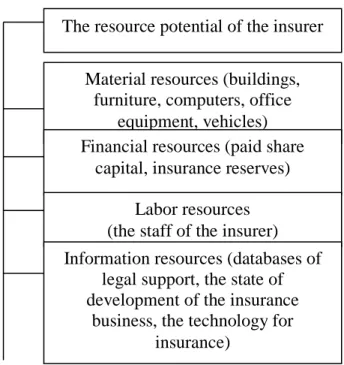
Commercial activities can not be carried out without the requisite fac-tors, namely: material, energy, labor, financial and information resources. Its combination and rational structure determine the potential of the com-pany. Potential insurance companies determine its available financial, ma-terial, human and information resources (Fig. 2.1).
Resources have to be constantly managed, it means to determine the quantity and quality of resources required, method, duration and place of its interaction.
Figure 2.1 — Components of the resource potential of the insurer
Material resources of the insurer could include rooms for the office and its separate structural divisions (including maximum convenience to potential assurers), furniture, telephone, computer, copiers and other equipment of the vehicle.
The resource potential of the insurer Material resources (buildings,
furniture, computers, office equipment, vehicles) Financial resources (paid share
capital, insurance reserves) Labor resources (the staff of the insurer) Information resources (databases of
legal support, the state of development of the insurance
business, the technology for insurance)
Financial resources provide reliability obligations of the insurance company and consist primarily of cash of the paid-up share capital and of insurance reserves, sufficient for the payment of insurance claims on in-surance agreements.
Labor resources of the insurer are important for its success. From the intellectual and professional level of the staff of the insurance company depends on the achievement of strategic objectives. Workers do not per-ceive the automatic, unconscious control. One or another individual comes into an organization with a specific purpose and require appropriate assis-tance in achieving it. Therefore, the leadership must constantly make every effort for the rational selection of employees and unlock their professional abilities.
Insurance is one of the business sectors most dependent on infor-mation systems. Each insurer feels the need to constantly analyze changes in external and internal factors that can affect the performance of the com-pany. Databases help it contain the system acts on legal support of the company, describing the economy as macroeconomic and microeconomic levels, the state of the national and regional insurance markets, giving an idea of global trends and new technologies of insurance.
The basis of the success of the insurance company is human resources. The impact of intellectual and professional development of staff insurer to insurer achieving strategic goals is crucial.
The success of the insurer often depends on «the narrowest component of the potential. However, it often becomes necessary to increase one fac-tor by weakening another. So, creating or developing the insurance busi-ness, you need to pay attention to the rational formation of each compo-nent of a company’s potential.
The insurance company is a legally registered business entity, where the formation of capital and insurance are interwoven individual and col-lective interests. The insurance company according to the license takes the responsibility via fee to compensate the insured caused the insured event the loss or to pay the insured amount.
Economic Code of Ukraine provides for the establishment of in-surance companies in the following organizational and legal forms: corpo-rations, general partnerships, limited partnerships, additional liability. Al-so, the law provides for the creation of state insurance companies. In addi-tion, a special category of insurance companies represent mutual insurance companies.
Participants of the insurer should not be less than three. The subject of direct activities of an insurer should be only insurance, reinsurance and fi-nancial activities related to the formation, placement of insurance reserves and its management.
Private insurers can be individuals, joint and other insurance compa-nies. The state insurers can be based and guided on behalf of the govern-ment or the nationalization of joint stock insurance companies and trans-forms its property into state property.
For organizational form insurers are divided as follows.
Joint stock insurance company is type of insurer is created and operates with a charter capital divided into shares that give their holders the right to participate in the management of the company and receive part of the profit in the form of dividends. A characteristic of joint organiza-tions is the distribution of responsibility between participants and com-mitments made. In Ukraine insurance market is dominated by joint stock companies as private. However, more perspective for the insurance busi-ness is public joint stock companies, which have the ability to raise funds through the sale of shares on the open market.
Partnership with additional liability is the insurer in the form of a business partnerships, the authorized capital is divided into shares deter-mined by statutory documents. Participants are responsible for its obliga-tions with their contribuobliga-tions to the charter capital, and in case of insuffi-ciency of these funds — advanced by property.
Partnership with full liability is the insurer as a union of several per-sons who personally involved in the affairs of the company, and each bears full responsibility by the obligations of the partnership not only by in-vested capital, but also by all their property.
Insurer in the form of a limited partnership combines two types of participants, including full partners and investors-limited. Legal status of full partners similar to full partnership. They engage in business activities on behalf of the limited partnership, responsible for the company’s obliga-tions with all its assets. Participants don’t participate in the management of the company (acting on its behalf under instructions), responsible for the company’s obligations within their contributions to the share capital and participate in the distribution of profits on invested capital.
The mutual insurance company (MIC are legal entity-insurers are es-tablished in accordance with Ukrainian «Insurance law of Ukraine» with the purpose of insuring the risks of that company. Each member of the so-ciety, subject to the use of all the obligations to the mutual insurance
com-pany, regardless of the amount of the premium, has the right to obtain all the necessary insurance indemnity in case of insured event. Currently Ukraine has not registered any insurer in the form MIC.
Outside the scope of insurance coverage the insurance company can be divided into local, regional, national and transnational (international).
The licenses of almost all companies issued with the right of implementa-tion of activities throughout the country. It is therefore difficult to investi-gate within what regions or cities have one or another insurer. However, given the scale of the territory that is covered by insurance coverage, we can say that each of these insurance companies perform their specific func-tions and meets certain criteria.
Life insurance companies engaged in long-term cumulative types of insurance (for survival in case of death, additional pensions, etc.) and risk insurance company engaged in both types of short-term insurance (proper-ty, land transport accidents, etc.).
Reinsurers are insurers that do not perform direct insurance operations and taking risks of other insurers in reinsurance and may transfer part of its in retrocession (re-reinsurance).
By amount of capital and by other economic indicators, which deter-mine the rating of the insurance companies, in the market allocate large, medium and small insurance companies.
2. Process formation of an insurance company,
reorganiza-tion and liquidareorganiza-tion
Creating an insurance company is usually in three stages: Stage 1: State registration of insurance companies as a business entity; Stage 2: Registration issue of shares of the insurance company (if the insurer is es-tablished as a joint stock company); Stage 3: licensing of insurance com-pany.
In the first stage, the insurance company is registered as a business en-tity in accordance with the Commercial code of Ukraine and Law of Ukraine «On state registration of legal entities and individuals-entrepreneurs». State registration of insurance companies is carried out by the state Registrar only in the Executive Committee of the city Council of the city of regional value or in district, district in the cities of the state ad-ministration at the location of the legal entity.
The insurance company needs to have its own name, which contains information about its legal form and name. Chartered capital of insurance companies should be formed only in the monetary form. It is allowed the
authorized capital of the insurance company securities, issued by the State at their nominal value in the manner determined by the National Commis-sion for State Regulation of Financial Services Markets, but not more than 25 per cent of the share capital. It isn’t allowed to use the share capital notes, funds of insurance reserves, budget and funds received in credit, loan and secured, make intangible assets.
The total amount of contributions to an insurance company authorized capitals of other insurance companies in Ukraine cannot exceed 30 percent of its own share capital, including the contribution to the charter capital of a separate insurance company cannot exceed 10 percent. These require-ments do not apply to an insurance company that provides insurance other than life insurance in case of its contribution to the authorized capital of the insurer that provides life insurance.
Based on the results of the check the insurance company receives the certificate of state registration — a document certifying the fact of entering into the Uniform state register of note about the state registration of the company. At this point, the insurance company can operate as a business entity, but has no right to engage in insurance.
The second step is the registration of the issue of shares of the in-surance company (provided the company established as a joint stock com-pany). The procedure for the issue of shares is governed by the Civil and Commercial Code of Ukraine, Laws of Ukraine «On Securities and Stock Market», «On Joint Stock Companies» and other regulations of the Na-tional Commission for State Regulation of Financial Services Markets.
After the registration of the share issue private and public joint stock companies issued a certificate of registration of the share issue.
The third stage is the licensing of insurance company. Licensing of in-surance operations of the inin-surance company, which will operate on the territory of Ukraine is mandatory and is carried out by the National Com-mission, carrying out state regulation in the sphere of financial services markets. The license is issued for conducting a particular type of surance, at the same time gives the right for this kind of reinsurance for in-surance throughout Ukraine. The licensing process is governed by the Li-cense terms of the insurance activities. The licensing process includes the issuance, renewal and revocation of licenses, issue of duplicates of li-censes, conducting licensed cases of the National Commission, carrying out state regulation in the sphere of financial services markets.
According to the Commercial Code of Ukraine and Ukrainian «In-surance law», the in«In-surance company may terminate its activities through
reorganization (merger, joining, division, separation, transformation) or liquidation. Reorganization of the insurance company carried out in the manner specified by the current legislation of Ukraine, allowing for the provision of succession to conclude insurance contracts established by the National Commission for State Regulation of Financial Services Markets.
The merger provides termination of activities of two or more exclu-sively of insurance companies as legal entities and transfer of all property rights and obligations to another insurance company-a legal entity the rights of a branch or without opening a branch.
The joining provides for the termination of the activities of an in-surance company as a legal entity and transfer of all property and non-property rights and obligations to another insurance company on the rights of a branch or without opening a branch.
The division provides for the termination of the activities of an in-surance company as a legal entity and the transfer by the distribution act (balance) in the relevant parts of all his property and non-property rights and obligations of several insurance companies — legal entities that are created as a result of the reorganization.
Separation envisages the establishment of the insurance company-a legal entity (or several insurance companies), when property and non-property rights and obligations of the insurance company-a legal entity (that is reorganized) in relevant parts follow to it by the distribution act (balance). In practice, often instead of separating there is establishing new insurance companies because it is much easier and requires less cost.
Transformation provides:
- change the legal norms of society, which an insurance company was established. This new insurance company has all property and rights and obligations of the company, reorganized;
- conversion of insurance company into insurance intermediary, sub-ject to repayment of its economic and moral obligations to insurers and re-insurers.
The reorganization (sanitation) insurance company made under the decision of the higher authority of the insurance company or at the request of the National Commission for State Regulation of Financial Services Markets in the application of sanctions for violation of insurance laws. The process of liquidation of the insurance company is controlled by the Na-tional Commission for State Regulation of Financial Services Markets.
Termination of the insurance of the company is possible in the fol-lowing cases:
- by the decision of the higher authority of the insurance company; - a court decision on the proposal of controlling the activities of the insurance company (for example, National Commission for State Regula-tion of Financial Services Markets), in the case of systematic or gross vio-lations of the law. The National Commission for State Regulation of Fi-nancial Services Markets may suspend a license for insurance activity in violation of the insurer of the current legislation and regulations, and in the case of gross violation of the law to cancel the license for insurance.
Liquidation of the insurance company is the appointed the liquidation Commission, and in the case of termination of the company by the court — the liquidation Commission appointed by the court. In the case of recognition of the insurance company bankrupt, liquidation is carried out according to the liquidation procedure provided by the Law of Ukraine «On restoring debtor’s solvency or declaring bankruptcy».
3. Structure management of the insurer
After receiving a license for insurance, the insurer is entitled to work for her throughout Ukraine abroad. It is possible for the insurer through the creation of its structural subdivisions of different levels in Ukraine and in other countries (Fig. 2.2).
Figure 2.2 — The scheme of the territorial structure of the insurer
A set of standard units, its functions and subordination system are de-termined by the characteristics of the financial cycle. Typical functions in the insurance company is marketing; develop your own package of standard insurance products; negotiations with potential customers to implement in-surance contracts; underwriting; execution and support of inin-surance con-tracts; actuarial calculations; settlement of losses; finance and investment; general business functions and more.
Each insurance company forms the workforce at its discretion, and depending on the goals and recommendations of the management or owners of the company.
The most common is the linear-functional management system insurer that provides direct subordination to the president of the insurance compa-ny of all other departments.
The central office of the insurer Regional offices in Ukraine (branches, management, sales centers) Departments in the regions of Ukraine Representative offices
in countries around the world
The divisional system, focused on the greater autonomy of the struc-tures of the insurance company. To some extent, the divisional manage-ment system provides for the rejection of the Directive of the company management.
Direct management of the insurance company does by the Chairman of the Board who is appointed or elected in accordance with the Charter of the company. In some cases, the position can be called «President», «CEO» or «chief Manager of the company».
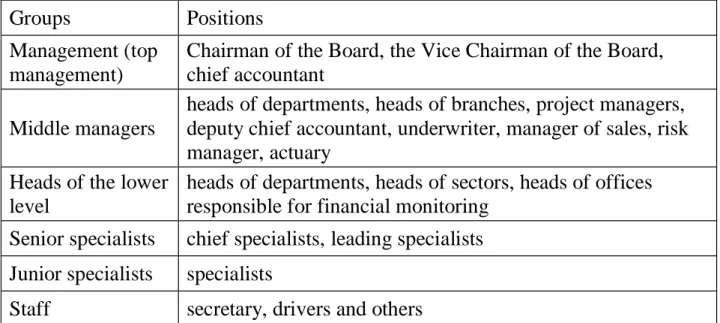
Traditionally, the insurance company personnel divided as follows: - management (top management);
- middle managers;
- heads of the lower level; - senior specialists;
- junior specialists; - staff (Table 2.1)
Table 2.1 — The staff of the insurer
Groups Positions Management (top
management)
Chairman of the Board, the Vice Chairman of the Board, chief accountant
Middle managers
heads of departments, heads of branches, project managers, deputy chief accountant, underwriter, manager of sales, risk manager, actuary
Heads of the lower level
heads of departments, heads of sectors, heads of offices responsible for financial monitoring
Senior specialists chief specialists, leading specialists Junior specialists specialists
Staff secretary, drivers and others
The Chairman of the Board is assisted by his deputies or Vice-presidents, who are directly subordinate to him and in case of his absence temporarily, perform its functions. In addition, top officials applies chief accountant of the company.
According to the professional requirements for managers and chief accountants of financial institutions (approved by the State Commission for State Regulation of Financial Services Markets №1590, 13 July 2004), the head and chief accountant of the insurance company can only be a per-son who has completed higher economic or legal education (specialist, master), was training at the appropriate specialization according to the
program agreed with the National Commission for state regulation of fi-nancial services markets.
In addition, this person has general experience of work not less than five years, including managerial experience of at least two years, of which at least one year in the financial services market. Also, for the past five years, that person was not a leader, chief financial officer or chief ac-countant of the financial institution, declared bankrupt, prone procedure of forced liquidation or which was used measure the impact of the body that regulates the financial services markets, including the National Commis-sion for state regulation of financial services markets in the form of re-moval from the leadership of the financial institution and the appointment of an interim administration and have no outstanding criminal convictions for premeditated crimes in the sphere of economic and service activities, and not be deprived of the right to occupy certain positions and engage in certain activity.
Chairman of the insurance company is personally responsible for its activity as to the owners of the company, and to state agencies that may control the economic activities of the insurance company. This responsibil-ity is transformed into a right chairman without authorization to sign con-tracts and other civil documents and perform other actions on behalf of the company.
Depending on the circumstances, chairman of the company can pro-vide the right to sign financial documents his deputies. Vice Chairman of the Board shall have the right to sign documents of the insurance company only under orders of Chairman of the Board, unless otherwise stipulated by the charter company. Chairman of the Board is responsible for perfor-mance of the company and as the officer responsible for the violation of the law, including bear administrative and criminal liability for the company.
Chairman of the Board can perform both functions of Chairman of the Board of Directors.
In Western Europe, the operational management of the company usual-ly performs general manager. Unlike the chairman of the insurance com-pany, its functional responsibilities are coordinating nature.
The main task of the general manager is to coordinate the work of other top managers (managers of the implementation, a risk-manager, un-derwriter, etc.) in accordance with the purposes of strategic and tactical plans.
Chief manager who routinely deprived of necessary care for subordi-nates, have sufficient time to evaluate the project qualified strategic and
tactical plan to consider a new model of insurance services and to define the most important links, hampering the company.
Today in Ukraine there is a general manager position typically in companies with foreign capital. In foreign practice general manager has broad powers in the management of the company. At the same time, other top managers have the authority for making operational management deci-sions without additional approval and documentation.
Number of Vice Chairman of the Board and their functional responsi-bilities are established by the owners of the company or Chairman of the Board at its discretion. Different insurance companies as Vice Chairman of the Board differ. In some of them the deputy chairman plays an important role in the management and may even full control of the company. In other deputy role be reduced to perform certain assignments chairman. The mechanism of work deserves attention, in which the deputy chairmen of the assigned duties with full control certain area of insurance or a separate structural element (e. g., management front-office or back-office).
Chief accountant of insurance company controls the financial re-porting of the company. Responsibilities of the chief accountant of the in-surance company cover all aspects of the company’s financial perfor-mance. Chief accountant, as an official, shall bear administrative and crimi-nal liability for the performance of insurance company tax obligations. It requires the chief accountant qualifications and comprehensive under-standing of insurance.
Depending on the structure of the insurance company to the chief ac-countant can be charged with the organization reporting to the National Commission for State Regulation of Financial Services Markets. In some cases, the chief accountant performs financial analysis of the company. However, experience shows that such activity is conditional and is not car-ried out in a professional manner.
The authority of heads of branches (representations) determined by management of the insurance company with specific activities. Profes-sional requirements of the National Commission for State Regulation of Financial Services Markets of the heads of separate units are similar to the head of the insurance company.
With strict regulation of the company from management, functional responsibilities of heads of departments actually confined to the timely implementation of the instructions received.
The decentralization of the management of the insurance company heads of departments may have the authority to make independent deci-sions, which generally relate to the insurance contracts.
Search for candidates for the insurer can be: within the company, with the help of employees, this may be the candidate that most appeal to the company providing the work a job through the media, the use of services of public and private employment services, recruitment personnel by graduates.
References: [1–6], [13], [21], [22], [26], [33].
Questions for self-control
1. What are the components of the resource potential of the insurance company?
2. What is the subject of direct activity of the insurer?
3. What is classification of insurers by organizational-legal form?
4. Which of the organizational-legal forms of insurance activity is most prevalent in Ukraine? Why?
5. What is the need for functioning separate units of the insurance company?
6. What are the association of insurers operating in Ukraine? What are the functions they perform?
7. What are the steps of creating an insurance company?
8. How the insurance company can cease operations? Give a descrip-tion of each method.
9. What are the main types of organizational structures of management of the insurance company?
10. Who performs direct management of the insurance company? What are the functions it performs?
Glossary
Division — termination of the activities of an insurance company as a legal entity and the transfer by the distribution act (balance) in the relevant parts of all his property and non-property rights and obligations of several insurance companies — legal entities that are created as a result of the re-organization.
Joining — termination of the activities of an insurance company as a legal entity and transfer of all property and non-property rights and obliga-tions to another insurance company on the rights of a branch or without opening a branch
Joint stock insurance company — type of insurer is created and operates with a Charter capital divided into shares that give their holders