
NAVAL
POSTGRADUATE
SCHOOL
MONTEREY, CALIFORNIA
DISSERTATION
Approved for public release; distribution is unlimited MEASUREMENT OF SOFTWARE PROJECT
MANAGEMENT EFFECTIVENESS
by
Kadir Alpaslan Demir December 2008
Dissertation Co-supervisors: James Bret Michael
REPORT DOCUMENTATION PAGE Form Approved OMB No. 0704-0188 Public reporting burden for this collection of information is estimated to average 1 hour per response, including the time for reviewing instruction, searching existing data sources, gathering and maintaining the data needed, and completing and reviewing the collection of information. Send comments regarding this burden estimate or any other aspect of this collection of information, including suggestions for reducing this burden, to Washington headquarters Services, Directorate for Information Operations and Reports, 1215 Jefferson Davis Highway, Suite 1204, Arlington, VA 22202-4302, and to the Office of Management and Budget, Paperwork Reduction Project (0704-0188) Washington DC 20503.
1. AGENCY USE ONLY (Leave blank) 2. REPORT DATE December 2008
3. REPORT TYPE AND DATES COVERED
Dissertation
4. TITLE AND SUBTITLE: Measurement of Software Project Management Effectiveness
6. AUTHOR(S) Kadir Alpaslan Demir
5. FUNDING NUMBERS
7. PERFORMING ORGANIZATION NAME(S) AND ADDRESS(ES)
Naval Postgraduate School Monterey, CA 93943-5000
8. PERFORMING
ORGANIZATION REPORT NUMBER
9. SPONSORING / MONITORING AGENCY NAME(S) AND ADDRESS(ES)
N/A
10. SPONSORING / MONITORING AGENCY REPORT NUMBER
11. SUPPLEMENTARY NOTES The views expressed in this thesis are those of the author and do not reflect the official policy or position of the Department of Defense or the U.S. Government.
12a. DISTRIBUTION / AVAILABILITY STATEMENT Approved for public release; Distribution is unlimited.
12b. DISTRIBUTION CODE
13. ABSTRACT (maximum 200 words)
Evaluating, monitoring, and improving the effectiveness of project management can contribute to successful acquisition of software systems. In this dissertation, we introduce a quantitative metric for gauging the effectiveness of managing a software-development project. The metric may be used to evaluate and monitor project management effectiveness in software projects by project managers, technical managers, executive managers, project team leaders and various experts in the project organization. It also has the potential to be used to quantify the effectiveness improvement efforts on project management areas. The metric is validated by conducting survey studies on software projects from public and private sectors. A statistical analysis of sixteen surveys on software projects, spanning small to large development projects, indicated that there is a strong positive correlation with software project success ratings provided by study participants and project management effectiveness measurements. Other contributions of this research include identification of approaches for measuring project management effectiveness of software projects, establishment of theories on project management and on project management effectiveness measurement, and the introduction and validation of a framework for software project management.
15. NUMBER OF PAGES
428
14. SUBJECT TERMS Type Keywords Here
Project Management, Software Project Management, Project Management Effectiveness, Software Project Management Effectiveness, Software Metrics, Software Project Management Effectiveness Metric, Theory of Project Management, Software Project Management Measurement, Software Project Management Framework, Theory of Software Project Management, Project Management Metrics 16. PRICE CODE 17. SECURITY CLASSIFICATION OF REPORT Unclassified 18. SECURITY CLASSIFICATION OF THIS PAGE Unclassified 19. SECURITY CLASSIFICATION OF ABSTRACT Unclassified 20. LIMITATION OF ABSTRACT UU
NSN 7540-01-280-5500 Standard Form 298 (Rev. 2-89)
Approved for public release; Distribution is unlimited
MEASUREMENT OF SOFTWARE PROJECT MANAGEMENT EFFECTIVENESS
Kadir Alpaslan Demir Lieutenant, Turkish Navy
B.S. in Computer Engineering, Turkish Naval Academy, 1999 M.S. in Computer Science, Naval Postgraduate School, 2005 M.S. in Software Engineering, Naval Postgraduate School, 2005 Submitted in partial fulfillment of the requirements for the degree of
DOCTOR OF PHILOSOPHY IN SOFTWARE ENGINEERING
from the
NAVAL POSTGRADUATE SCHOOL December 2008
Author: __________________________________________________ Kadir Alpaslan Demir
Approved by:
______________________ _______________________
James Bret Michael John Osmundson
Professor of Computer Science Research Assoc. Professor of and Electrical/Computer Eng. Information Science
Dissertation Co-Supervisor Dissertation Co-Supervisor Committee Chairman
______________________ _______________________
Gary Langford Man-Tak Shing
Lecturer of Systems Engineering Assoc. Professor of Computer Science
______________________ Mikhail Auguston
Assoc. Professor of Computer
Science Approved by: _________________________________________________________
Peter Denning, Chair, Department of Computer Science Approved by: _________________________________________________________
ABSTRACT
Evaluating, monitoring, and improving the effectiveness of project management can contribute to successful acquisition of software systems. In this dissertation, we introduce a quantitative metric for gauging the effectiveness of managing a software-development project. The metric may be used to evaluate and monitor project management effectiveness in software projects by project managers, technical managers, executive managers, project team leaders and various experts in the project organization. It also has the potential to be used to quantify the effectiveness improvement efforts on project management areas. The metric is validated by conducting survey studies on software projects from public and private sectors. A statistical analysis of sixteen surveys on software projects, spanning small to large development projects, indicated that there is a strong positive correlation with software project success ratings provided by study participants and project management effectiveness measurements. Other contributions of this research include identification of approaches for measuring project management effectiveness of software projects, establishment of theories on project management and on project management effectiveness measurement, and the introduction and validation of a framework for software project management.
TABLE OF CONTENTS
I. INTRODUCTION...1
A. BACKGROUND ...1
B. CONTRIBUTIONS OF THIS RESEARCH ...3
C. OVERVIEW OF THE DISSERTATION...4
D. STATEMENT OF THE PROBLEM ...5
E. SIGNIFICANCE OF THE PROBLEM...6
F. RESEARCH HYPOTHESIS ...8
G. RESEARCH OVERVIEW...8
1. Research Questions...8
2. Research Strategy ...9
3. Research Scope...12
H. ASSUMPTIONS AND APPLICABILITY ...12
1. Assumptions...12
2. Applicability ...13
I. KEY DEFINITIONS: PROJECT, SOFTWARE PROJECT, PROJECT MANAGEMENT, AND SOFTWARE PROJECT MANAGEMENT ...14
II. RELATED WORK ...17
A. DISCUSSION OF PROJECT SUCCESS...17
B. PROJECT SUCCESS FACTORS...19
C. COMPREHENSIVE LIST AND COMPARISON OF PROJECT SUCCESS FACTORS ...25
D. PROJECT FAILURE FACTORS...27
E. THE ROLE OF PROJECT MANAGEMENT IN ACHIEVING PROJECT SUCCESS...28
F. MEASUREMENT OF PROJECT SUCCESS ...31
G. MEASUREMENT OF SOFTWARE PROJECT MANAGEMENT EFFECTIVENESS...34
H. SUMMARY ...36
III. APPROACHES FOR MEASURING PROJECT MANAGEMENT EFFECTIVENESS IN SOFTWARE PROJECTS ...39
A. INTRODUCTION...39 B. SUCCESS PYRAMID ...40 C. DISCUSSION OF APPROACHES ...44 1. Subjective Evaluation ...45 2. Questionnaire-based Measurement...46 3. Metrics-based Measurement...47 4. Model-based Measurement ...48 D. CONCLUSIONS ...51
A. INTRODUCTION...53
B. BASICS OF THE THEORY OF PROJECT MANAGEMENT ...55
C. DISCUSSION OF REPRESENTATIONAL THEORY OF MEASUREMENT AND ITS APPLICABILITY...56
1. Introduction...56
2. Empirical Relational System...58
3. Numerical Relational System...58
4. Representation Condition ...59
5. Uniqueness Condition...60
D. DIRECT AND INDIRECT MEASUREMENT ...60
E. A THEORY OF PROJECT MANAGEMENT EFFECTIVENESS MEASUREMENT...62
V. DEVELOPMENT OF A FRAMEWORK FOR SOFTWARE PROJECT MANAGEMENT ...63
A. INTRODUCTION TO 3PR FRAMEWORK...63
B. MAIN PROJECT MANAGEMENT AREAS ...75
1. People ...75 2. Process...78 3. Product...81 4. Risk...82 C. PEOPLE...83 1. Communication ...83 2. Teamwork...84 3. Leadership ...84 4. Organizational Commitment ...84 5. Project Manager...84 6. Stakeholder Involvement ...85
7. Staffing and Hiring ...85
D. PROCESS ...85
1. Requirements Management ...85
2. Project Monitoring and Control...86
3. Project Planning and Estimation...86
4. Scope Management ...86 E. PRODUCT...87 1. Configuration Management...87 2. Quality Engineering...87 F. RISK...88 1. Risk Assessment ...88 2. Risk Control ...88 G. CONCLUSION ...88
VI. VALIDATION OF THE FRAMEWORK FOR SOFTWARE PROJECT MANAGEMENT ...91
A. INTRODUCTION...91
B. SURVEY STUDY...91
1. Pilot Study Introduction...91
2. Pilot Study Instrument ...92
3. Pilot Study Results ...93
D. SURVEY INSTRUMENT ...94
E. TIME FRAME OF THE SURVEY...95
F. POPULATION OF THE SURVEY ...95
G. ANALYSIS OF THE RESPONSES TO THE SURVEY ...95
1. Question 1 ...96 2. Question 2 ...97 3. Question 3 ...97 4. Question 4 ...98 5. Question 5 ...100 6. Question 6 ...102 7. Question 7 ...103 8. Question 8 ...104 9. Question 9 ...105 10. Question 10 ...106 11. Question 11 ...108 12. Question 12 ...112 13. Question 13 ...115
H. VALIDITY OF THE SURVEY STUDY...116
I. CONCLUSION ...117
VII. SOFTWARE PROJECT MANAGEMENT EVALUATION INSTRUMENT (SPMEI) AND SOFTWARE PROJECT MANAGEMENT EVALUATION MODEL (SPMEM)...119
A. INTRODUCTION...119
B. SOFTWARE PROJECT MANAGEMENT EVALUATION INSTRUMENT (SPMEI) ...119
1. Basic Characteristics of the Instrument ...119
2. Basic Design Characteristics of the Instrument...122
a. SPMEI is a Self-administered Questionnaire...122
b. SPEMI is Composed of Sections ...123
c. SPMEI is User-friendly ...123
d. SPMEI is Comprehensive...124
3. The Instrument Design Process ...124
a. Step 1: Search for the Sources of Information...124
b. Step 2: Categorization of Information ...125
c. Step 3: Detailed Analysis of Information Gathered ...126
d. Step 4: Development of Questions...126
e. Step 5: Interface Design ...127
f. Step 6: Testing and Redesign...127
4. Question Types in SPMEI ...128
a. Approach 1: The Existence of an Activity...129
b. Approach 2: The Existence of an Entity ...130
d. Approach 4: The Rigor or the Quality in the Existence of
an Entity ...131
5. Optional Questions in SPMEI...131
6. Other Significant Characteristics of the Instrument...132
7. Pilot Studies on the Instrument ...144
C. SOFTWARE PROJECT MANAGEMENT EVALUATION MODEL (SPMEM) ...145
1. High-Level Evaluation Model...145
2. Project Management Area Evaluation Models ...147
a. Communication Area Evaluation Model ...152
b. Teamwork Area Evaluation Model ...152
c. Leadership Area Evaluation Model ...153
d. Organizational Commitment Evaluation Area Model...153
e. Project Manager Area Evaluation Model ...153
f. Stakeholder Involvement Area Evaluation Model...154
g. Staffing and Hiring Area Evaluation Model ...154
h. Requirements Management Area Evaluation Model ...154
i. Project Monitoring and Control Area Evaluation Model ...155
j. Project Planning and Estimation Area Evaluation Model .155 k. Scope Management Area Evaluation Model ...155
l. Configuration Management Area Evaluation Model...155
m. Quality Engineering Area Evaluation Model ...155
n. Risk Assessment Area Evaluation Model...155
o. Risk Control Area Evaluation Model...156
VIII. SURVEY STUDIES ON SOFTWARE PROJECTS AND DATA ANALYSIS .157 A. INTRODUCTION...157 B. DATA COLLECTION ...157 C. SURVEY STUDIES ...158 1. Project A ...159 2. Project B ...162 3. Project C ...164 4. Project D ...168 5. Project E ...170 6. Project F...172 7. Project G ...174 8. Project H ...176 9. Project I...178 10. Project J ...182 11. Project K ...184 12. Project L ...186 13. Project M ...188 14. Project N ...191 15. Project O ...193 16. Project P...195 17. Project R ...197
18. Project X ...200
19. Project Y ...203
20. Project Z ...205
D. DATA ANALYSIS ...208
E. SOUNDNESS OF THE MEASUREMENT STUDY ...235
1. Sources of Measurement Differences ...235
a. The Respondent as an Error Source ...235
b. The Measurer as an Error Source ...237
c. Situational Factors...238
d. The Instrument as an Error Source ...238
2. Validity of the Measurement...239
a. Content Validity ...242
b. Criterion-Related Validity...242
c. Construct Validity ...243
3. Reliability of the Measurement...244
4. Practicality of the Measurement...245
IX. FINDINGS ...247
X. CONCLUSIONS AND FUTURE DIRECTIONS...255
A. CONCLUSIONS ...255
B. FUTURE DIRECTIONS...260
1. Development of an Automated Tool...260
2. Increasing the Sample Size...261
3. Conducting an In-depth Analysis of Project Management Areas based on the Data Gathered with SPMEI...261
APPENDIX A: GLOSSARY...263
APPENDIX B: PILOT SURVEY STUDY: SELF-ADMINISTERED QUESTIONNARE ...267
APPENDIX C: SURVEY INSTRUMENT: SELF-ADMINISTERED QUESTIONNARE ...273
APPENDIX D: SURVEY QUESTION #5 FURTHER ANALYSIS ...281
1. COMMUNICATION...282 2. TEAMWORK ...283 3. LEADERSHIP ...284 4. REQUIREMENTS MANAGEMENT ...285 5. ORGANIZATIONAL COMMITMENT ...286 6. PROJECT MANAGER...287 7. STAKEHOLDER INVOLVEMENT ...288
8. PROJECT MONITORING AND CONTROL ...289
9. PROJECT PLANNING AND ESTIMATION...290
10. SCOPE MANAGEMENT ...291
11. RISK CONTROL...292
14. RISK ASSESSMENT ...295
15. QUALITY ENGINEERING ...296
16. SUPPORT ACTIVITIES ...297
17. TECHNICAL COMPLEXITY...298
APPENDIX E: MAPPING OF THE PROJECT MANAGEMENT PROCESSES TO THE PROJECT MANAGEMENT PROCESS GROUPS AND THE KNOWLEDGE AREAS [FROM (PMI, 2004)]...299
APPENDIX F: SOFTWARE PROJECT MANAGEMENT EVALUATION INSTRUMENT (SPMEI) ...301
A. GENERAL PROJECT RELATED QUESTIONS (17 QUESTIONS – ABOUT 5 MINUTES) ...307
B. COMMUNICATION SECTION (23 QUESTIONS – ABOUT 7-12 MINUTES)...309
C. TEAMWORK SECTION (30 QUESTIONS – ABOUT 10 MINUTES) 313 D. LEADERSHIP SECTION (17 QUESTIONS – ABOUT 3-6 MINUTES)...318
E. ORGANIZATIONAL COMMITMENT SECTION (27 QUESTIONS – ABOUT 7-12 MINUTES) ...321
F. PROJECT MANAGER SECTION (27 QUESTIONS – ABOUT 5-9 MINUTES)...325
G. REQUIREMENTS MANAGEMENT SECTION (27 QUESTIONS – ABOUT 5-9 MINUTES) ...331
H. STAKEHOLDER INVOLVEMENT SECTION (12-16 QUESTIONS – ABOUT 3-7 MINUTES) ...335
I. PROJECT MONITORING AND CONTROL SECTION(19 QUESTIONS – ABOUT 4-8 MINUTES)...338
J. PROJECT PLANNING AND ESTIMATION SECTION (35 QUESTIONS – ABOUT 10-18 MINUTES)...341
K. SCOPE MANAGEMENT SECTION (16 QUESTIONS – ABOUT 3-8 MINUTES)...347
L. RISK CONTROL SECTION (17 QUESTIONS – ABOUT 3-8 MINUTES)...350
M. STAFFING/HIRING SECTION(29 QUESTIONS – ABOUT 7-13 MINUTES)...352
N. CONFIGURATION MANAGEMENT SECTION (13 QUESTIONS – ABOUT 3-7 MINUTES) ...356
O. RISK ASSESSMENT SECTION (20 QUESTIONS – ABOUT 5-10 MINUTES)...358
P. QUALITY ENGINEERING SECTION (20 QUESTIONS – ABOUT 4-10 MINUTES) ...361
APPENDIX G: SOFTWARE PROJECT MANAGEMENT EVALUATION MODEL SHEET BY SECTION ...365
A. COMMUNICATION SECTION...365
C. LEADERSHIP SECTION ...367
D. ORGANIZATIONAL COMMITMENT SECTION ...368
E. PROJECT MANAGER SECTION...369
F. REQUIREMENTS MANAGEMENT SECTION ...370
G. STAKEHOLDER INVOLVEMENT SECTION ...371
H. PROJECT MONITORING AND CONTROL SECTION ...372
I. PROJECT PLANNING AND ESTIMATION SECTION...373
J. SCOPE MANAGEMENT SECTION ...374
K. RISK CONTROL SECTION...375
L. STAFFING AND HIRING SECTION...376
M. CONFIGURATION MANAGEMENT SECTION ...377
N. RISK ASSESSMENT SECTION ...378
O. QUALITY ENGINEERING SECTION ...379
APPENDIX H: DATA ANALYSIS OF SCORES ...381
APPENDIX I: PROJECT SUCCESS POTENTIAL EVALUATION LIST [FROM (THE STANDISH GROUP, 1995B)]...383
LIST OF REFERENCES ...385
LIST OF FIGURES
Figure 1. Research Framework ...11
Figure 2. A Model of Project Success [From (Pinto and Slevin, 1988)] ...28
Figure 3. The Stages of Project Life Cycle and Associated Parties to Each Stage [From (Munns and Bjeirmi, 1996)] ...29
Figure 4. Assessment of Project Success over Time [After (Pinto and Slevin, 1988)]...30
Figure 5. The Scope of Success within Project Life Cycle [From (Munns and Bjeirmi, 1996)]...31
Figure 6. Success Pyramid ...43
Figure 7. The Scope of Success at Different Levels ...44
Figure 8. Four Approaches for Software Project Management Effectiveness Measurement...45
Figure 9. Activities and Entities. ...56
Figure 10. Basic Project Management Process Areas (Taken from (CMMI, 2002))...65
Figure 11. Advanced Project Management Process Areas (Taken from (CMMI, 2002))...65
Figure 12. The Wheel and Axle Model [From (Forsberg et al., 2005)]...67
Figure 13. The Project Cycle Portrayed as an Axle [From (Forsberg et al., 2005)] ...68
Figure 14. Management Elements [From (Forsberg et al., 2005)]...68
Figure 15. A Mindmap for Software Project Management [From (Philips, 2000)]...70
Figure 16. The Five Dimensions of a Project [From (Wiegers, 1996)] ...72
Figure 17. Flexibility Diagram of a Quality-Driven Application [From (Wiegers, 1996)]...73
Figure 18. Quality Leverage Points [From (Kulpa, 2007)]...74
Figure 19. High Level Summary of Process Group’ Interactions [From (PMI, 2004)]....80
Figure 20. Overview of Project Management Knowledge Areas and Project Management Processes [From (PMI, 2004)] ...81
Figure 21. Past Roles of Survey Participants ...98
Figure 22. Question #4: The Number of Projects Participated In – The Number of Responses...99
Figure 23. Question #4: The Number of Projects Participated In – Percentage ...99
Figure 24. Question #6: Bar Chart of the Responses ...102
Figure 25. Question #6: Pie Chart of the Responses...103
Figure 26. Question #7: Bar Chart of the Responses ...103
Figure 27. Question #7: Pie Chart of the Responses...104
Figure 28. Question #8: Bar Chart of the Responses ...104
Figure 29. Question #8: Pie Chart of the Responses...105
Figure 30. Question #10: Management Challenges in Software Projects...108
Figure 31. Mean Ratings of Main Project Management Areas...109
Figure 32. Distribution of Responses in People Area ...110
Figure 33. Distribution of Responses in Process Area...110
Figure 34. Distribution of Responses in Product Area...111
Figure 36. The Scope of Success within Project Life Cycle [From (Munns and
Bjeirmi, 1996)]...137
Figure 37. Distribution of Project Size in Terms of Average Number of People Involved ...211
Figure 38. Time Frame of Projects Analyzed ...213
Figure 39. Time Frame of Projects in the Dataset Categorized by Decades...213
Figure 40. Actual Schedule of Projects in the Dataset ...214
Figure 41. Distribution of PME Scores - Bar Chart ...215
Figure 42. Distribution of PME Scores – Scatter Plot ...215
Figure 43. Distribution of Success Ratings – Bar Chart ...216
Figure 44. Project Success and Rounded PME Score for each Project in the Dataset....217
LIST OF TABLES
Table 1. Classification of Projects/Characteristics [From (Kerzner, 1992)]...76
Table 2. The Number of Responses to Each Question ...96
Table 3. Software Project Management Areas and Ordering of Ratings...100
Table 4. Means of Ratings ...102
Table 5. Question #9 : Number of Responses Categorized Based on Type of Application Developed ...106
Table 6. Question #10 : Management Challenges in Software Projects...107
Table 7. Classification of Responses to Question #12 – Sorted from Highest Frequency to Lowest...112
Table 8. Classification of Responses to Question #12 - Rearranged with Respect to Main Project Management Areas...113
Table 9. Other Responses to Question #12 ...114
Table 10. Basic Characteristics of SPMEI...120
Table 11. Number of Questions in SPMEI ...121
Table 12. Number of Questions in SPMEI Categorized with Respect to the Main Area...122
Table 13. Optional Questions in SPMEI Based on Certain Conditions...132
Table 14. Origin of Elements Present in Current Project Management Practice [From Cooke-Davies, 2001)] ...133
Table 15. Number of Questions, Lowest and Highest Possible Score and Range of Scores for each Project Management Area...149
Table 16. Scaling Factors for Project Management Areas...151
Table 17. Identifiers Corresponding to Project Management Areas...152
Table 18. Project A Data in Tabular Form...161
Table 19. Project B Data in Tabular Form...163
Table 20. Project C Data in Tabular Form...167
Table 21. Project D Data in Tabular Form...169
Table 22. Project E Data in Tabular Form ...171
Table 23. Project F Data in Tabular Form ...173
Table 24. Project G Data in Tabular Form...176
Table 25. Project H Data in Tabular Form...177
Table 26. Project I Data in Tabular Form ...181
Table 27. Project J Data in Tabular Form...184
Table 28. Project K Data in Tabular Form...185
Table 29. Project L Data in Tabular Form ...187
Table 30. Project M Data in Tabular Form...190
Table 31. Project N Data in Tabular Form...192
Table 32. Project O Data in Tabular Form...194
Table 33. Project P Data in Tabular Form ...196
Table 34. Project R Data in Tabular Form...199
Table 35. Project X Data in Tabular Form...202
Table 37. Project Z Data in Tabular Form ...207
Table 38. Overview of Projects in the Dataset...209
Table 39. Overview of Projects: Number of People Involved ...210
Table 40. Product Size ...212
Table 41. Project Management Area Scores...221
Table 42. Data Analysis of Main Area Scores...222
Table 43. Data Analysis of People Area Scores ...223
Table 44. Data Analysis of Process Area Scores ...224
Table 45. Data Analysis of Product Area Scores...225
Table 46. Data Analysis of Risk Area Scores...226
Table 47. Correlation Coefficient of Main Project Management Areas (Project A to Project P)...230
Table 48. Correlation Coefficient of Main Areas to Project Management Areas (Project A to Project P) ...231
Table 49. Identifiers for Project Management Areas...232
Table 50. Correlation Coefficient of Project Management Areas (Project A to Project O) ...233
Table 51. Correlation Coefficient of Project Management Areas (All 20 Projects)...234
Table 52. Contributions to Defense Community and Software Engineering Body of Knowledge ...259
EXECUTIVE SUMMARY
Achieving high effectiveness in project management helps to ensure a successful outcome from the project. Currently, the software engineering body of knowledge lacks adequate tools that will help to quantify the project management effectiveness in software projects. Furthermore, the ability to assess or measure the status is essential to conduct any formal process improvement effort. In this dissertation, a software project management effectiveness metric is introduced. This metric provides a standard quantitative measure of project management effectiveness from project start to project delivery. It will help managers in software project development organizations to evaluate, monitor and improve project management effectiveness. Simply, this metric will guide project stakeholders to achieve better project outcomes, such as completing the project on time, within budget, with required functionality and with creation of value for project stakeholders.
Twenty survey studies on software projects are conducted to investigate the applicability and limitations of the metric. In addition, survey studies provided the necessary empirical evidence required for the validation of the metric. Pearson product moment correlation analysis on the data gathered from survey studies showed that there is a strong positive correlation with software project success ratings provided by study participants from survey studies and project management effectiveness measurements. The result of the analysis on the data set indicates that half of the variation in software project success may be explained by the project management effectiveness metric. This and other results based on the analysis conducted on the data set shows that the proposed software project management effectiveness measurement is sound.
The measurement of software project management effectiveness involves the use of two new tools developed within this research. The software project management evaluation instrument (SPMEI) is used to gather project data. Basically, this instrument is a data collection tool to gather project data related to fifteen project management areas. They are communication, teamwork, leadership, organizational commitment, project
manager, stakeholder involvement, staffing and hiring, requirements management, project planning and estimation, project monitoring and control, scope management, configuration management, quality engineering, risk assessment, and risk control. The instrument is comprehensive. A member of the project organization who has broad knowledge on all aspects of the project management fills out this questionnaire-based instrument. Then the data gathered with the instrument is fed into the software project management evaluation model (SPMEM). This model is used to measure the effectiveness based on the data gathered with the instrument. Responses to questions in the instrument are assigned with specific scores. The evaluation model simply combines these scores in a systematic way as it is hypothesized. SPMEM produces a score for each project management area and these scores are then used to compute a project management effectiveness (PME) score based on a scale from 0 to 10. A score of 0 indicates the least effective project management while a score of 10 indicates the most effective project management. A high PME score indicates a high probability of project success while a low PME score indicates a low probability of project success.
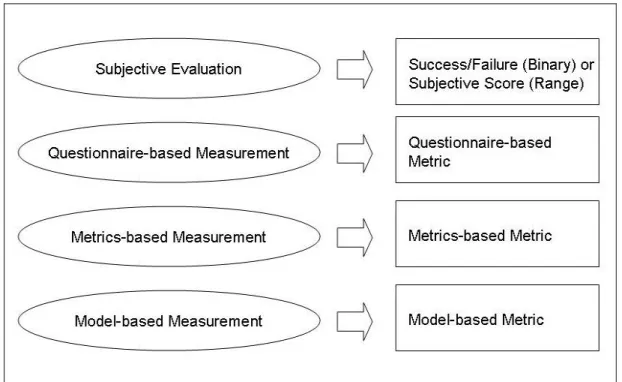
This doctoral research includes other contributions to the software engineering body of knowledge. At the beginning of the research, approaches for measuring the project management effectiveness in software projects are identified. This identification guided the selection of a suitable measurement approach. There are four ways to assess or measure the project management effectiveness. They are subjective evaluation, questionnaire-based measurement, metrics-based measurement, and model-based measurement. The chosen approach was the questionnaire-based measurement since this approach has shown promise in an earlier study while two other approaches, metrics-based measurement and model-metrics-based measurement, have not been used before. The other approach, subjective evaluation, was used by study participants to rate the success of their projects. The identification of approaches for measuring project management effectiveness will help researchers to develop other metrics in their future studies.
Project management discipline suffers from the lack of a theory of project management. This important issue has been raised by various scholars in recent years. These scholars indicated that not having a theory of project management poses challenges
for advancing the body of knowledge. This research was also challenged due to the lack of a project management theory that lays the foundation for the development of a project management effectiveness metric. During the early phases of this research, the necessity for the development of a theory of project management became clear. Therefore a simple, yet powerful, theory of project management was developed. Simplicity is important because project management is complex by nature and development of the metric would be more challenging if the theory could not simplify the concepts. This theory aided the metric development process by providing a solid foundation to build upon. The core concepts in the theory of project management are activities and entities. A project is simply the result of a project management function that takes various activities and entities as its inputs. The ideal goal of project management is to find the right and efficient combination of necessary activities and entities to reach the desired outcome. Identification of activities and entities and arrangement of these activities and entities in an appropriate order while dealing with constraints are the tools to bring the project to life. The main task in the development of the software project management evaluation instrument was the identification of activities and entities used in software projects.
A theory of project management effectiveness measurement is developed based on the theory of project management and the core concepts identified with it. The theory of project management effectiveness measurement simply states that it is possible to measure project management effectiveness via measuring the effectiveness of activities and entities in software projects.
The development of another theory from the theory of project management and the successful results achieved in this research provides evidence for the validity of the proposed theory of project management.
Software project management is broad and complex by nature. The theory of project management lays the foundation for further advancement. Furthermore, it helps us to overcome the challenges of dealing with this complexity by enabling us to understand project management in terms of core concepts with a simpler view. It is essential to identify the boundaries as well. A software project management framework was developed in this research for two purposes. One of the purposes is to identify the
boundaries of project management and necessary project management areas to be included in the effectiveness measurement. The other one is to categorize project management areas with respect to main areas. The main project management areas are people, process, product and risk. Each section in SPMEI corresponds to a project management area in the framework. Each project management area is categorized under one of the main areas. The first letters of these main areas are used in naming the framework. As a result, it is named as 3PR framework. This framework guided the development of the metric by helping the identification of what to include in the measurement. The 3PR framework is simple and modifiable. Therefore, it served well during the development of the metric. This framework is validated via a survey of software practitioners around the world. In addition, this validation survey helped to identify importance weightings for each main project management area. These weights are used in the development of the software project management evaluation model to compute the effectiveness score.
In this research, the development of software project management effectiveness metric required the accomplishment of a set of related studies, mainly because either such studies do not exist in prior literature or the existing literature are found to be inadequate. The findings of the analysis conducted on the data gathered from survey studies indicates that the software project management effectiveness metric proposed in this research is sound, valid and applicable to be used in software projects.
ACKNOWLEDGMENTS
I would like to dedicate this work to all the people trying to make this world a better place to live for all others. This has been a long, exciting, joyful and demanding journey. Many people helped me in this journey. I will not able to mention all these people here. They know themselves. I want to thank them all anonymously.
First, I thank my family. I would not able to finish this journey if I did not have their constant and incredible support. Dad, Mom, Aslı, Selim, Cengiz. I love you so much.
I would like to thank my committee members, Dr. Osmundson, Dr. Michael, Mr. Langford, Dr. Shing, and Dr. Auguston, for their guidance and support. I learned a lot from them. I also want to thank Dr. Peter J. Denning for coaching and inspiring me. I thank Dr. Douglas J. Fouts with all my heart for believing in me. All my professors, whom I take courses from, are good teachers. They taught me well. I am very lucky to learn from the best.
I thank my friends, Musa, Serdar, Sefa, Çağlar, and Mert for their support. I thank to my big brothers and sisters, Ufuk and Serap Canöz, Mehmet and Ayşegül Gümüş. Their support for my success is undeniable. They always believed in me. I am blessed to have them as my friends.
I thank Martin Machniak and Mary Grossman for their help. Mr. Capers Jones has been an inspiration to me. I thank him for sharing his vast experience and knowledge. I appreciate Dr. Peter Chow’s selfless mentoring. I also thank Kimberly Wiefling and SDForum Engineering Leadership Special Interest Group. I learned a lot from the meetings of this special interest group formed by incredible practitioners.
I thank Vishant and Neşe Shahnawaz, Dr Nafiz and Nilgün Arıca for their support and friendship. I also thank Vehbi, Sebahat, Çare and Ogün Meriçligil for their love.
Finally, I thank to a very special person, Seda. Without her support, encouragement, and inspiration, this research would not have been successfully completed.
I. INTRODUCTION
A. BACKGROUND
The term “software crisis” was coined in 1968 at a NATO working group meeting on software engineering. At the time, the term referred to the inability of the government defense organizations of NATO countries to procure software-intensive systems on schedule, within budget, and with the desired level of functionality and dependability. The discipline known as software engineering is relatively new in relation to its sister engineering disciplines, but the pace of the evolution of software engineering into a mature engineering discipline needs to pick up because the lion’s share of the functionality in most systems produced today is implemented in software.
A report by the U.S. General Accounting Office (GAO) (1979) states that of the government software development projects analyzed:
- more than 50% had cost overruns; - more than 60% had schedule overruns;
- more than 45% of the delivered software could not be used;
- more than 29% of the software contracted for was never delivered; and - more than 19% of the software had to be reworked.
The Standish Group Report (1995) found that, on average, approximately 16% of software projects were completed on time and within budget. In addition, the projects completed contained only approximately 42% of the originally proposed features and functions. These two reports indicate that the situation has not changed.
The 1987, the Defense Science Board reported that:
After two decades of largely unfulfilled promises about productivity and quality gains from applying new software methodologies and technologies, industry and government organizations are realizing that their fundamental problem is the inability to manage the software processes.
The U.S. DoD responded to this and various statements in similar reports by sponsoring the creation of the Software Engineering Institute (SEI) at the Carnegie Mellon University. SEI was tasked with finding ways to improve the software engineering processes used by the DoD and its contractors. One of the improvements developed by SEI is the Capability Maturity Model (CMM), which is now in use throughout the DoD. The CMM serves as a means to identify key practices to improve organizations’ software development processes and propose models to encompass systematic advancements in various aspects of the process. The SEI specialized the original model to address software (SW-CMM), management of human-resources (P-CMM), systems engineering (SE-(P-CMM), integrated product development (IPD-(P-CMM), and software acquisition (SA-CMM). These models, except for SA-CMM, are now part of the Capability Maturity Model Integration (CMMI).
The Algorithmic Constructive Cost Model (COCOMO), developed in 1981, is one of the earliest and most widely used software project cost-estimation models (Boehm, 1981). The model is primarily used for developing predictions based on basic, intermediate, and detailed COCOMO; each level provides a different degree of rigor. Basic COCOMO is only useful when a quick, early, rough estimate is required. Intermediate COCOMO produces better results. Intermediate and detailed COCOMO take into account attributes of the software product, computer hardware, development personnel, and the project. Detailed COCOMO is more rigorous and describes the software as a module-subsystem-system hierarchy. In this model, software development is estimated by phase. However, neither of these models takes into account project management quality. Boehm, developer of these models, indicates that poor management can increase software costs more rapidly than any other factor. Furthermore, when estimating cost with COCOMO, there is an assumption built into the model that the project will be well-managed. Boehm also points out that management quality ratings are not easy to determine.
The first version of COCOMO II was released to the public in 1997. A few other versions with improvements were made available in subsequent years. COCOMO II was developed in response to the increasing difficulties in cost estimations with COCOMO 81
and COCOMO 87. Accidental advancements in the field such as development of new life cycle models, COTS and other reuse approaches, object oriented approaches, etc., were the reason for such difficulties (Brooks, 1995). COCOMO II has three submodels called Applications Composition, Early Design, and Post-architecture models (Boehm et al., 2000). It is crucial to state that COCOMO II recognizes the importance of maturity in cost, effort and schedule estimation. The model has a parameter called “process maturity” as an exponent scale factor. Process maturity affects the estimated effort exponentially (Boehm et al., 1995).
Development of CMMI and COCOMO models are two important studies in the field of software project management. These studies may be complemented with the introduction of a well-established software project management effectiveness metric. Such a metric would complement the CMMI and existing metrics, possibly contributing to further improvements in the software development processes and their applications in the development of software-intensive systems. The metric may be used as an input in software cost estimation models for better estimates.
B. CONTRIBUTIONS OF THIS RESEARCH
There is limited scientific work that addresses theories and foundations in software project management. The bulk of the work related to this area is based on experience reports with limited empirical studies.
This study expands the body of knowledge by laying new foundations and an introduction of a metric to evaluate the project management effectiveness in software projects. The contributions are listed below:
1. Introduction of a theory of project management.
2. Introduction of a theory of project management effectiveness measurement.
3. Identification of approaches for measuring project management effectiveness.
5. Development of a self-evaluation instrument for software project management.
6. Development of a metric for software project management effectiveness. Quality research enables us to ask new questions while providing answers to the old ones. These questions help us to improve the field. This research helps us to ask new questions in the field of software project management.
C. OVERVIEW OF THE DISSERTATION
This dissertation consists of ten chapters. Chapter I includes the introduction of the research. In the introduction section, statement and significance of the problem, the research hypothesis, the research overview, the assumptions and applicability of the metric, and the key definition are presented.
Chapter II discusses the related work. In this chapter, discussion of project success, project success and failure factors, the role of project management in achieving project success, measurement of project success, and software project management effectiveness are presented.
In Chapter III, the approaches for measuring the management effectiveness of software projects are outlined. Four different approaches are discussed with examples from prior research studies. The contribution in this chapter is the guidance for future researchers in the selection of metric development approaches.
Chapter IV introduces a theory of project management. This theory builds the necessary foundation for the development of the metric. In addition, a theoretical foundation for measurement of project management effectiveness is presented.
A framework for software project management is introduced in Chapter V. Related frameworks from various standards and software project management literature are discussed. The project management areas in the framework are explained.
In Chapter VI, the results from a survey study on software project management are presented. The goal of this survey study was to validate the framework introduced in the previous chapter. The results of the survey supported the validation of the framework.
In Chapter VII, the software project management evaluation instrument (SPMEI) and the evaluation model are explained. The overall structure, important characteristics, and the development of the instrument are discussed.
The analysis of the survey studies on software projects can be found in Chapter VIII. Each study is discussed briefly. The data analysis from these studies is also presented here.
The findings of this research are presented in Chapter IX, while conclusions and future work are discussed in the tenth and final chapter of the dissertation.
D. STATEMENT OF THE PROBLEM
Brooks (1995) points out in his well-known book that there are essential and accidental difficulties of software engineering. The accidental difficulties are timely problems of the field; they are solved with major breakthroughs and solutions, leading to increases in software development productivity. However, they are not inherent in the essence of software. According to Brooks, essential difficulties are inherent to the nature of software and they are complexity, conformity, changeability, and invisibility. If that is the case, no matter how much automation is acquired, software project development will continue to be a human-intensive task. Effective software project management is an important factor in the success of a software development project.
Without the use of metrics, software engineering processes will continue to be ad hoc processes at best. The SEI recognized this fact and incorporated a rating system to describe the maturity of an organization, from CMM level-one as ad hoc to level-five as optimizing. In order to comply with CMM level-four, organizations have to collect metrics related to software development processes. CMM level-five necessitates continuous effort on gathering these metrics and applying the metrics to continuously improve the process.
Currently, the software engineering field lacks a well-founded software project management metric. Such a metric could enable software project managers to measure
the project management effectiveness, identify problematic areas during projects, identify challenged areas in completed projects (e.g., postmortem analysis), and shed light on forthcoming ones.
E. SIGNIFICANCE OF THE PROBLEM
In 2000, the Defense Science Board published a report on the subject of software process, stating that:
… [the] DSB Task Force observed that requirements and management are the hardest part of the software task and advocated the use of revolutionary practices. This is still true today.
Furthermore, in the major findings and recommendations section of the same report, that the DSB concluded that “In general, the technical issues, although difficult at times, were not the determining factor. Disciplined execution was.”
DeMarco and Lister state in their recognized book about productive projects and teams: “For overwhelming majority of the bankrupt projects we studied, there was not a single technological issue to explain the failure.” Furthermore, “the major problems of our work are not so much technological as sociological in nature” (DeMarco & Lister, 1987; DeMarco & Lister, 1999).
Robertson and Robertson (2005) start one of the chapters named “Project Sociology” in their book with:
In several decades of project experience, we have never seen a project fail for technical reasons. It has always been human failures that have caused otherwise good projects to grind to a halt.
These findings clearly point out that managing the software development process is still a fundamental problem within the defense community and the commercial world. However, little research has been devoted to this issue. In this dissertation, the goal is to develop and experiment with a project software management metric to measure the effectiveness of software project management.
The benefits of gathering metrics have been advocated by many researchers and practitioners in the field. Putnam and Myers (2003) explain how to use the metrics in software projects and how they are related with each other. They clearly emphasize that metrics provide and enable:
• dependable estimates of project effort, schedule, and reliability;
• control of the project during its course;
• ability to re-plan an errant project along the way;
• master-planning the assignment of resources to all projects within the organization;
• monitoring process improvement from year to year.
Having a software project management metric will complement the current set of metrics and provide us with a broader understanding of software development dynamics.
The ten most important success factors are identified in an IT project by The Standish Group’s CHAOS study (1994). In 2000, the ratings of the factors are updated by The Standish Group (2000). According to the new rating, the factors, executive support and experienced project manager, were rated first and third with a success factor of 18 and 14 out of 100 respectively. A software project management metric will provide a project management evaluation that can be used by project managers to better manage software development efforts.
Finally, Peter W. G. Morris (Pinto, 1998) states that:
One of the major areas of project management development over the next few years, I believe, will be establishing and refining interindustry metrics for quantifying performance improvements. Much of this work will be IT related.
Martha Gray (1999) discusses the state of software metrics and emphasizes the immaturity of software metrology and its fundamentals. She points out the importance of having measures for software and IT industry. This study will be an addition to the set of metrics and it will form a basis for discussion over the measurement of project management effectiveness in software projects.
F. RESEARCH HYPOTHESIS
There is only one hypothesis in this research:
• The success of a software project positively correlates to its project management effectiveness.
The success rating of the project will be provided by the survey study participants. They will assess the success of a project based on their perspectives. They will rate the project success on a 0 to 10 scale, with 0 being complete failure and 10 being complete success. The software project management effectiveness (PME) will be acquired using the software project management evaluation instrument and model. The PME metric will be on a scale from 0 to 10.
The testing of the hypothesis will be conducted by analyzing the Pearson product-moment correlation coefficient (PMCC) between these two measures.
G. RESEARCH OVERVIEW
1. Research Questions
We believe that it is possible to develop a software project management effectiveness metric. This metric should be meaningful enough that it provides insights on the quality of the project management. The measure should also be able to distinguish between the projects following certain expected best practices and others lacking some of these practices.
The following questions will be addressed with this research: 1. What are the most important project management areas?
2. What are the possible approaches for measuring the project management effectiveness?
3. Is it possible to develop a simple theory of project management and measurement of project management effectiveness?
4. Is it possible to develop a software project management metric that measures the project management effectiveness in a software project? 5. Will this metric be sound, meaningful and applicable?
Soundness of the metric is that software practitioners respond positively when applying the metric. To get some idea regarding the soundness, we can simply ask them if they find the metric sound during its application. Further analysis can be conducted by identifying and responding to validity concerns. Meaningfulness of the metric is that it yields different results for the project management in which one of them clearly lacks certain best practices. Applicability of the metric is that the measurement is practical.
Answering the fifth research question in detail requires substantial research that expands beyond the scope of this dissertation. However, some evidence can be provided as to whether such qualities are captured to a certain level with the metric. It is important to address these qualities in a metric development effort.
2. Research Strategy
The objective of this research is to develop a software project management effectiveness metric. The literature on the subject is limited and mostly consists of rough models such as Pinto and Slevin (1987) and Wohlin and von Mayrhauser (2001) for project success.
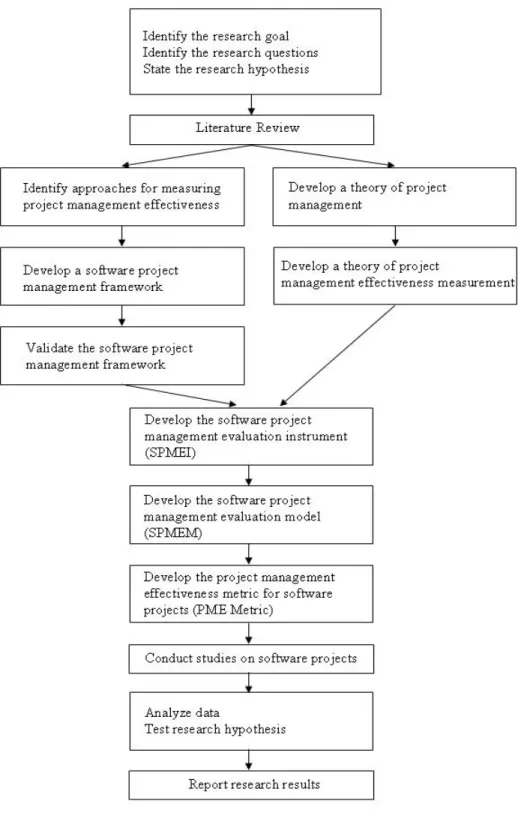
Identification of crucial and common aspects for software project management is the first step for this research. Second, this identification will help us to develop a framework to work on. The validation of the framework is necessary to ensure the soundness of the metric. A survey of software practitioners will be conducted for the validation as a third step. Then, using the framework and its components, a measurement tool will be developed. Finally, data will be collected from real-world software projects and the results will be analyzed.
Any meaningful measurement instrument should be able to distinguish two different entities based on the goal of the measurement. In addition, it is imperative to be able to substantiate one measure with another measure. Therefore, in this research, two
different measures will be used. These two types of scores will be analyzed for positive correlation. The data analysis from survey studies will help us to determine the soundness, meaningfulness and applicability of the software project management effectiveness metric (PME). The framework of the research is shown in Figure 1.
3. Research Scope
The scope of the research includes:
• A background analysis and literature review.
• Development of a viable framework for software project management.
• Validation of the framework through a survey study.
• Identification of significant aspects of software project management.
• Development of a metric that measures the project management effectiveness in software projects.
• Validation of the metric through studies on software projects.
H. ASSUMPTIONS AND APPLICABILITY
It is important to state the assumptions and applicability of the measurement activity clearly. Therefore, assumptions and applicability of the metric are provided below.
1. Assumptions
Assumption 1. A software project development requires at least an informal process that involves certain activities.
Assumption 2. Software project management requires certain concepts, entities, roles and functions to exist within the software project team and the rest of the stakeholders.
Assumption 3. Small size maintenance projects require different management techniques than software development projects. Therefore, the metric may not be reliable for small software maintenance projects.
Assumption 4. There exists at least one person who has insight over a broad aspect of project management and the metric instrument is to be used by such a person.
2. Applicability
Applicability 1. The metric instrument is designed to be applicable to software or software intensive projects. It is not applicable to projects in which only a very small portion of the project involves software development.
Applicability 2. The metric is applicable to canceled projects on the condition that at least some requirements development activities are conducted.
Applicability 3. The instrument measures the project management effectiveness from the project start to the customer delivery time or the time it is canceled. The project start time is defined (for the purpose of this metric) as the time after the business decision is made to go ahead with the project. Therefore, the soundness and quality of the business decision is not included in this measurement. Because the metric instrument evaluates the management effectiveness during the development, the business decision is not considered a part of the development for the purpose of this study. The quality assessment of the business decision may require different metrics.
The measure of project management effectiveness may be high even though the customer never uses the deliverables of the project due to various reasons. The assessment of customer satisfaction after delivery is not included in the measurement.
Applicability 4. The metric is not designed to evaluate the effectiveness of small software maintenance projects.
Applicability 5. The metric is not applicable to very small software development efforts in which certain management roles and functions are not distinctively identifiable. These projects generally include a very small team of developers.
Applicability 6. The metric instrument should be used by a project manager, an executive manager or a project team member who has broad insight into all management aspects of the project.
I. KEY DEFINITIONS: PROJECT, SOFTWARE PROJECT, PROJECT MANAGEMENT, AND SOFTWARE PROJECT MANAGEMENT
First of all, we have to define what a project is and discuss if the definition applies to software projects. There are various definitions of projects in the literature. One of the best is offered by Tuman (1988):
A project is an organization of people dedicated to a specific purpose or objective. Projects generally involve large, expensive, unique, or high risk undertakings which have to be completed by a certain date, for a certain amount of money, within some expected level of performance. At a minimum, all projects need to have well defined objectives and sufficient resources to carry out all the required tasks.
Some of the recognized researches on various aspects of projects are reported by Jeffrey K. Pinto and Dennis P. Slevin dating back to the 1980s. Pinto and Slevin (1988) defined the characteristics of projects as follows:
- A defined beginning and end (specified time to completion).
- A specific, preordained goal or set of goals (performance expectations). - A series of complex or interrelated activities.
- A limited budget.
All of these project characteristics also apply to software projects without exception. An addition to these characteristic is as follows:
The project emphasis must be on software or a mix of software and hardware.
The definition of a software project for the purpose of this dissertation is as follows:
A software project is an undertaking in which the emphasis is a piece of software or a mix of software and hardware and it involves a series of complex or interrelated activities to achieve a specific, preordained goal or set of goals. The software project has a limited budget, a defined beginning and an end.
Munns and Bjeirmi (1996) state that the distinction between the project and project management is less than precise. Definitions for these two terms are also provided
and their definition of a project is quite similar with the given definition above. The definition of project management is given by Munns and Bjerimi (1996) is:
…project management can be defined as the process of controlling the achievement of the project objectives. Utilizing the existing organizational structures and resources, it seeks to manage the project by applying a collection of tools and techniques, without adversely disturbing the routine operation of the company.
The functions of project management include:
- Defining what needs to be done in order to achieve project goals. - Establishing the boundaries and extent of work.
- Determining, planning, estimating and allocating the resources required. - Planning and implementing the work.
- Monitoring the progress of work.
- Managing risk, adjusting and accommodating deviations from the plan. The definitions of project and project management may seem to overlap in many aspects. Both are oriented towards the accomplishment of the project. However, Munns and Bjeirmi (1996) point out an important difference between these two. While the scope of a project is long-term, the scope of project management is short-term. The expected benefits from a project may be financial, technical or marketing-oriented. All of these benefits tend to be long-term in nature. For example, in order to determine the return on investment from the project, a certain point of time must be reached after the project is successfully in place. If the return on investment is computed just after the project implementation, it is unlikely to reflect the correct figure. Also, the project success factors and the perception of project success change over time (Pinto and Slevin, 1988; Pinto and Prescott, 1988; Pinto and Mantel, 1990; Fortune and White, 2006). On the other hand, project management is oriented towards planning and control. The basic concerns are on-time delivery, expenditures within budget expectations, and achieving the necessary expected performance. All these are short-term goals in the life cycle of a project. After the project delivery for use, project management tasks are either completed or significantly reduced. Thus, project management success should be measured upon
project delivery when most project management tasks are completed. Software project management refers to the project management when the project emphasis is on software or a mix of software and hardware.
II. RELATED
WORK
The research on success and effectiveness of project management has been the interest of various researchers in the past. However, most of the research completed was not specifically targeted to the software development field. The projects analyzed in these studies included projects from diverse fields such as construction, manufacturing, environmental, etc. It has been recognized that managing software projects is different in many aspects (Brooks, 1995). However, it is possible to extract similarities that can help us to conduct studies on software project management effectiveness.
A. DISCUSSION OF PROJECT SUCCESS
First, it is important to emphasize that project success is not the same as project management success (Cooke-Davies, 2004c).
Defining project success is not an easy task. According to Griffin and Page (1996), it is multifaceted and difficult to measure. Even though many studies have been conducted on identification of project success factors, project failure factors or related areas, the criteria for success have not been well-established. Pinto and Slevin (1998, p. 379) state that “success” and “failure,” like beauty, are in the eyes of the beholder. There is a significant risk of mislabeling projects as success or failure when there are no universally agreed criteria. Pinto and Slevin argued the need for a working definition of project success. The three conventional criteria of project success present challenges. These conventional criteria are:
• Time (completing the project within the scheduled time frame).
• Cost (completing the project within its budget limits).
• Performance (completing the project with achieving its intended mission and specifications).
Pinto and Rouhiainen (1998) state that these criteria do not work in the modern business world. The tremendous competition in this modern business world requires a customer-oriented focus. Therefore, customer satisfaction should be a criterion in the evaluation of project success.
Glass (1999) points out the need for a new theory of project success. Different stakeholders may have different concerns. This is inevitable. One of the key challenges of any project management is to align the goals and address the concerns of the stakeholders. Linberg (1999) showed that the definition of success for software practitioners is quite different from the conventional criteria. Software practitioners may classify a project as a success even though it is late, or perhaps over budget. They are more concerned with the quality and functionality of the product. Also, they may even view a cancelled project as a success due to the lessons learned from the project. Agarwal and Rathod (2006) investigated the notion of software project success for different stakeholders. They examined project success in the views of programmers/developers, project managers, and customer account managers. Procaccino (2002, et al., 2005) developed a quantitative model for early assessment of software development success in the practitioner’s perspective.
Griffin and Page (1996) suggest that the most appropriate set of success measures should be derived from the project strategy. For example, the success criteria for a product development that opens up a new market should be different than the criteria for the development of a product that is extending a product line. They relate the product development success to the company’s innovation strategy.
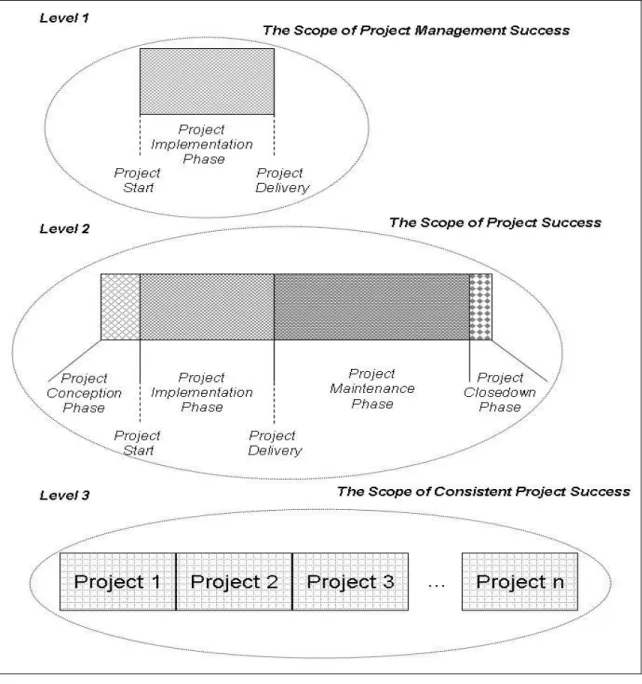
Cooke-Davies (2004a) examines the issue with a broader view. His view beautifully clarifies some challenged research areas. He provides a definition of success at different levels. His questions for each level help us to focus on the heart of the matter. According to him, there are three levels of success:
• Level 1. Project Management Success – was the project done right? At this level, the measures of success are the traditional project success criteria. The job of project management is about managing time, cost and quality. The project management’s job should start after the decision about
the business case has been concluded by upper management. Therefore, the question “was the project done right?” really suggests what the measure of success at this level is. The focus of this study is the first level of success which is project management success.
• Level 2. Project Success – was the right project done?
This level of success is about choosing the right problem to solve.
• Level 3. Consistent Project Success – were the right projects done right, time after time?
This level of success is about organizational success. In order to reach organizational success, organizations have to complete projects successfully over and over.
B. PROJECT SUCCESS FACTORS
This dissertation focuses on software project management effectiveness, evaluation, and the development of a metric. The literature on the subject is quite limited. However, it is possible to draw similarities from researches on project management and project success. These studies mostly focus on the broad aspects of projects. A brief overview of selected studies on project success will be provided next.
A significant part of literature on project management is the identification of critical factors for project success or successful project implementation. Most of them are theoretically based and only some fraction of them is empirically-supported. One of the earliest attempts was conducted by Pinto and Slevin (1987). They identified critical success factors felt to be predictive of successful project management. Ten factors were discovered after an empirical study. Some of these factors are also mentioned in other theoretical research (Martin, 1976; Locke, 1984; Cleland and King, 1983; Sayles and Chandler, 1971; Baker, Murphy & Fisher, 1983; DeCotiis and Dyer, 1979). The ten factors are:
![Figure 3. The Stages of Project Life Cycle and Associated Parties to Each Stage [From (Munns and Bjeirmi, 1996)]](https://thumb-us.123doks.com/thumbv2/123dok_us/11113030.2999374/55.918.238.681.593.867/figure-stages-project-cycle-associated-parties-stage-bjeirmi.webp)
![Figure 4. Assessment of Project Success over Time [After (Pinto and Slevin, 1988)]](https://thumb-us.123doks.com/thumbv2/123dok_us/11113030.2999374/56.918.183.736.678.962/figure-assessment-project-success-time-pinto-slevin.webp)
![Figure 5. The Scope of Success within Project Life Cycle [From (Munns and Bjeirmi, 1996)]](https://thumb-us.123doks.com/thumbv2/123dok_us/11113030.2999374/57.918.161.601.426.639/figure-scope-success-project-life-cycle-munns-bjeirmi.webp)

![Figure 12. The Wheel and Axle Model [From (Forsberg et al., 2005)]](https://thumb-us.123doks.com/thumbv2/123dok_us/11113030.2999374/93.918.153.765.106.708/figure-wheel-axle-model-forsberg-et-al.webp)
![Figure 14. Management Elements [From (Forsberg et al., 2005)]](https://thumb-us.123doks.com/thumbv2/123dok_us/11113030.2999374/94.918.226.685.352.856/figure-management-elements-from-forsberg-et-al.webp)
![Figure 15. A Mindmap for Software Project Management [From (Philips, 2000)]](https://thumb-us.123doks.com/thumbv2/123dok_us/11113030.2999374/96.918.144.775.108.582/figure-mindmap-software-project-management-philips.webp)
