Cláudia Serre-Miranda, MSc*
Susana Roque, PhD* Nadine Correia Santos,
PhD
Carlos Portugal-Nunes, BSc
Patrício Costa, PhD Joana Almeida Palha,
PhD Nuno Sousa, MD, PhD Margarida Correia-Neves, PhD Correspondence to Dr. Correia-Neves: mcorreianeves@ ecsaude.uminho.pt Supplemental data at Neurology.org/nn
Effector memory CD4
1
T cells are
associated with cognitive performance in a
senior population
ABSTRACT
Objective:Immunosenescence and cognitive decline are common markers of the aging process. Taking into consideration the heterogeneity observed in aging processes and the recently described link between lymphocytes and cognition, we herein explored the possibility of an asso-ciation between alterations in lymphocytic populations and cognitive performance.
Methods:In a cohort of cognitively healthy adults (n5114), previously characterized by diverse neurocognitive/psychological performance patterns, detailed peripheral blood immunophenotyping of both the innate and adaptive immune systems was performed by flow cytometry.
Results:Better cognitive performance was associated with lower numbers of effector memory CD41T cells and higher numbers of naive CD81T cells and B cells. Furthermore, effector memory
CD41T cells were found to be predictors of general and executive function and memory, even
when factors known to influence cognitive performance in older individuals (e.g., age, sex, edu-cation, and mood) were taken into account.
Conclusions:This is the first study in humans associating specific phenotypes of the immune sys-tem with distinct cognitive performance in healthy aging. Neurol Neuroimmunol Neuroinflamm
2015;2:e54; doi: 10.1212/NXI.0000000000000054
GLOSSARY
CM5central memory;CMV5cytomegalovirus;EM5effector memory;GDS5mood;GENEXEC5general and executive function;LD5late differentiated;MEM5memory;Treg5regulatory T cell.
The identification of factors contributing to healthy aging is increasingly relevant in modern
soci-eties in order to define strategies to sustain and improve quality of life for older individuals.
Immu-nosenescence and cognitive decline are common changes accompanying aging, but their potential
interaction is far from being understood. In fact, the interaction between cognition and parameters
of the immune system has been explored mostly in the last decade, and largely through studies using
animal models.
1–6The current view is that the immune system plays a modulatory role in brain
function, including in cognitive abilities and neurogenesis,
7,8which supports the notion that
throughout life the brain is not
“
immune privileged
”
but rather
“
enjoys the privilege
”
of
immune-dependent maintenance. So far, it is established that (1) severe combined immune
defi-cient mice, which lack B and T cells, and nude mice, which are devoid of T cells, present a
significant impairment in hippocampal-dependent spatial learning and memory,
3,9,10and,
impor-tantly, these cognitive deficits are reversed by reconstituting the mouse immune system with T
cells
3,9,10but not with other immune cells
10; (2) CD4
1T cell
–
depleted mice present impaired
performance in reversal learning in the Morris water maze
4; and (3) acute suppression of T cells by
immunosuppressive drugs currently used in clinical trials or in disease treatment is sufficient to cause
cognitive deficits in adult wild-type mice.
1,3,10In addition, very recent studies revealed that
*These authors contributed equally to the manuscript.From the Life and Health Sciences Research Institute (ICVS) (C.S.-M., S.R., N.C.S., C.P.-N., P.C., J.A.P., N.S., M.C.-N.), School of Health Sciences, University of Minho, Braga; ICVS/3B’s - PT Government Associate Laboratory (C.S.-M., S.R., N.C.S., C.P.-N., P.C., J.A.P., N.S., M.C.-N.), Braga/Guimarães; and Clinical Academic Center—Braga (C.S.-M., S.R., N.C.S., C.P.-N., P.C., J.A.P., N.S.), Braga, Portugal. Go to Neurology.org/nn for full disclosures. Funding information and disclosures deemed relevant by the authors, if any, are provided at the end of the article. The Article Processing Charge was paid by the University of Minho, Portugal.
This is an open access article distributed under the terms of the Creative Commons Attribution-Noncommercial No Derivative 3.0 License, which permits downloading and sharing the work provided it is properly cited. The work cannot be changed in any way or used commercially.
bloodborne factors from old mice are able to
impair spatial learning and memory as well as
neurogenesis and synaptic plasticity in young
animals.
11In contrast, blood from young
ani-mals is able to reverse age-related
impair-ments in cognitive function and synaptic
plasticity.
12While the precise bloodborne
factors influencing cognition remain to be
elucidated, they may relate to immune cells
and/or immune mediators.
Taking into consideration the data available
from animal studies and recognizing that both
age-associated cognitive decline and
modifica-tions on the immune cells vary greatly between
individuals,
13,14we hypothesized that there is
an association between age-associated alterations
in leukocytes and cognitive performance in
healthy aging individuals. To test this
hypothe-sis, we explored the association of the immune
system cells profile and the cognitive phenotype
in a well-characterized cohort of senior
individ-uals with distinct cognitive performances.
METHODS Participant characterization.The 114 par-ticipants enrolled were selected from a cohort of 1,051 individuals, as representative of good and poor cognitive performers based on neurocognitive/psychological per-formance patterns.15,16The participants from the initial
cohort are senior community-dwelling individuals living in the Minho region of Portugal and are representative of the country’s population in terms of age distribution, sex, and school years. Participants who were unable to attend the clinical and neuropsychological sessions, were diagnosed with dementia and/or unable to understand informed consent, or who had disorders of the central nervous system or overt thyroid pathology, were excluded from the larger cohort. The cohort was established in accordance with the principles expressed in the Declaration of Helsinki, and the work was approved by the Portuguese national ethical committee (Comissão Nacional de Protecção de Dados) and by local ethics review boards. All the participants gave voluntary informed written consent.
A team of trained psychologists assessed the cogni-tive and mood profile of the participants as described in Santos et al.16Briefly, the cognitive profile was
estab-lished using a battery of neurocognitive and psycholog-ical tests selected to evaluate short-term verbal memory, verbal working memory, response inhibition/cognitive flexibility, verbal fluency, multiple trial verbal learning and memory, high-level information processing speed, global cognitive status, and mood. Using a principal component analysis, the neurocognitive/psychological
test variables were grouped into 3 dimensions: memory (MEM), general and executive function (GENEXEC), and mood (GDS) (for details see Santos et al.16). The
cognitive groups were classified as good and poor per-formers following cluster analysis. All the statistical analysis of the cognitive evaluation and individual clustering followed the method in our previous publi-cation.16 Descriptive information regarding age, sex,
school years, and scores for GDS, MEM, and GENEXEC for all participants and for the good and poor cognitive performance groups is described in table e-1 at Neurology.org/nn.
While the full characterization of the acquired immune system was performed for all 114 individu-als, the innate immune system was analyzed for only 79 individuals (table e-2). The presence of anti-cytomegalovirus (CMV) immunoglobulin G was determined, and only 7 of the 114 participants were considered nonimmune to CMV; no correlations were observed between CMV antibody titers and the cognitive performance of the participants. All par-ticipants presented C-reactive protein levels below the limit associated with active inflammation/infection (10 mg/L).17 Information about anti-inflammatory/
immunomodulatory medication was collected at the time of clinical interview; 18 of the participants were receiving this type of therapy (information provided in table e-1).
Flow cytometry analysis.Blood was collected to EDTA blood collection tubes and processed for standard hospital leukogram (Braga’s Hospital) and multipara-metric flow cytometry analyses on the same day of collection (see e-methods for details). Leukogram analysis was conducted at the certified pathology lab-oratory of Braga’s Hospital, following standard pro-cedures. A code was assigned to each participant and all the analyses were assessed blindly.
Statistical analysis.Data for MEM, GENEXEC, and GDS were used in the analysis aszscores, as previ-ously determined by Santos et al.16To evaluate
nor-mal distribution of the variables, skewness and kurtosis values were calculated and the approximate normal distribution was defined for variables with absolute values of skewness below 3 and of kurtosis below 8.18Levene test was used to evaluate equality of
variances.
To compare immune systems’cell populations (cell counts per mL of blood) between good and poor cog-nitive performance groups (descriptive statistics of vari-ables are presented in table e-2), an independent-sample
ttest was performed for variables with normal distribu-tion and a Mann-WhitneyUtest for variables with non-normal distribution.pValues below 0.05 were consid-ered significant, and to quantify the strength of the differences, Cohen d was calculated as a measure of
effect size (0.2 is considered a small effect size, 0.5 a medium effect size, and 0.8 a large effect size).19
To correlate immune systems’ cell populations (cell counts) with cognitive (MEM and GENEXEC) dimensions, a Pearson correlation coefficient test was performed for variables with normal distribution and a Spearman rank correlation coefficient test for variables with non-normal distribution. The coefficient of deter-mination (R2) was calculated as a measure of effect size
(0.0196 is considered a small effect size, 0.1300 a medium effect size, and 0.2600 a large effect size).19
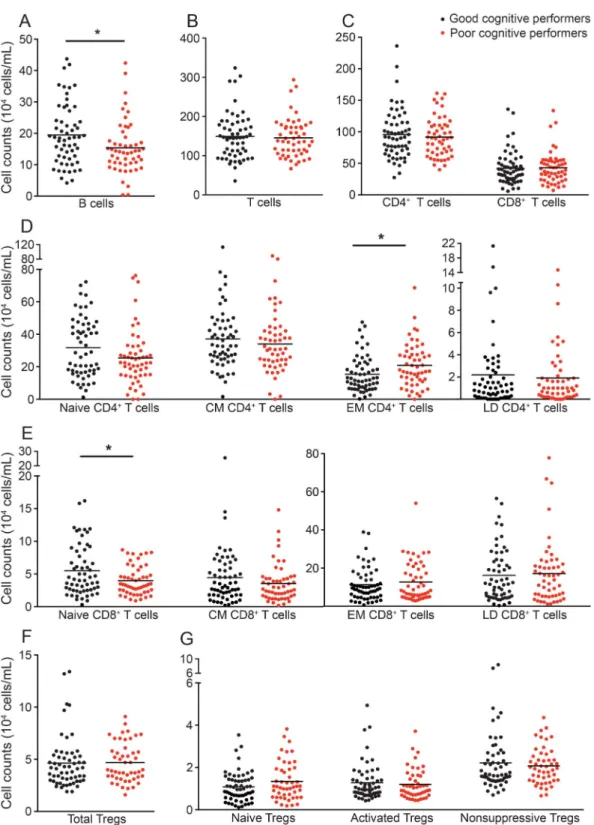
Hierarchical regression analysis was performed to compare different models to predict MEM or GENEXEC dimensions (dependent variables) and to test whether successive models fit better than the previous ones. Variables with non-normal distribu-tion and with tolerance values below 0.4 (to avoid mul-ticollinearity between variables) were excluded from the model. The statistical procedures were performed in IBM SPSS Version 20 (IBM Corp, Armonk, NY). RESULTS B cells, naive CD81 T cells, and effector memory CD41 T-cell counts correlate with cognitive performance.When characterizing the overall immune system, no differences between good and poor cogni-tive performers were observed in the leukogram cell subpopulations (lymphocytes, monocytes, neutro-phils, basoneutro-phils, and eosinophils; figure e-1). A more detailed flow cytometry analysis of the acquired immune system cells revealed that, when compared to poor performers, good cognitive performers pre-sented significantly higher B-cell counts (figure 1A;
t(110)52.354,p50.020,d50.45). No differences
were seen between good and poor cognitive perform-ers regarding total T-cell counts (figure 1B;t(110)5
0.355,p50.723) or the 2 main T-cell populations (figure 1C; CD41[t(110) 50.617,p50.539] and
CD81 [t(110) 5 20.196, p50.845]). The CD41
and CD81T-cell compartments (naive, central mem-ory [CM], effector memmem-ory [EM], and late differen-tiated [LD]), whose proportion has been shown to change with aging,20displayed a distribution pattern
(figure 1, D and E) in accordance with the described dynamics of these T-cell compartments in aging.20It
is interesting that the poor cognitive performers pre-sented higher numbers of EM CD41 T cells (figure 1D;t(110)5 2 2.510,p50.014, d5 0.48), with
no differences in other CD41T-cell compartments (fig-ure 1D; naivet(109.9)51.770,p50.080; CMt(110)5
0.780,p50.480; LDU(110)51,545,z5 20.108, p50.919), and lower numbers of naive CD81T cells (figure 1E;t(93.75)52.600,p50.011,d50.54), with
no differences among the CD81T-cell compartments (figure 1E; CMU(110)51,375,z5 21.096,p5
0.273; EMt(110)5 20.774,p50.440; LDt(110)5 20.332,p50.746).
No differences were noted in total regulatory T cell (Treg) counts (figure 1F;t(106) 5 0.046, p5
0.963) or in the Treg compartments (figure 1G; naive Tregs t(106) 5 1.667, p 5 0.098; activated Tregs t(106) 5 0.480, p 5 0.632; nonsuppressive Tregs U(106)51,387,z5 20.361,p50.718), possibly
indicating that this cell population is not associated with cognitive performance.
There were no differences in the dendritic and nat-ural killer cell counts (figure e-2).
EM CD41T-cell numbers predict memory and executive performance.Cognitive performance is known to relate directly or indirectly to sex, age, mood and, particularly, education.13,15,21–24 In addition, variations in the
immune system are associated with age and mood.20,25,26
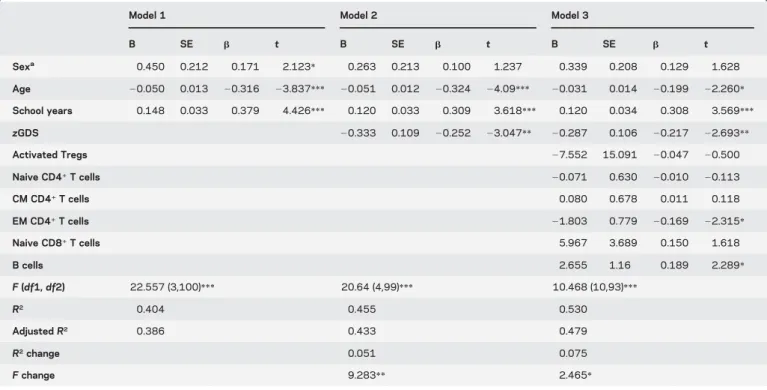
Therefore, we next investigated whether these factors influenced the differences observed in the immune sys-tem between distinct cognitive performers. To do so, hierarchical linear regression models were used to predict the GENEXEC and MEM dimension performances. The adaptive immune system variables appeared to be the most promising, so those that presented statistically significant correlations with GENEXEC and MEM (table e-3) were included in the regression model to determine to what extent they were able to predict the cognitive performance in both domains. The first block of variables included age, sex, and school years, which are known to strongly relate to cognitive performance.13,15,16,21,24 The second block addressed
mood, which also affects cognitive function.15,16,22,23,27
The third (last) block included the immune system variables (activated Tregs, naive CD41 T cells, CM CD41T cells, EM CD41T cells, naive CD81T cells and B cells in the GENEXEC model; naive CD41T cells, EM CD41T cells, naive CD81T cells and B cells in the MEM model). The hierarchical linear regression analysis revealed that the first block predicted 38.6% (adjusted R2) of the GENEXEC dimension variance
and that all variables were statistically significant predic-tors (table 1; model 1). Adding the second block to the model increased the prediction of GENEXEC signifi-cantly 5.1% (R2change), with the sex variable ceasing to
be a significant predictor (table 1; model 2). Finally, the inclusion of the third block further increased the predic-tive power by 7.5% (table 1; model 3). Overall, model 3, which comprises all the variables, predicted 47.9% (adjustedR2) of the GENEXEC variance. Moreover, in
addition to age, mood, and school years, EM CD41T cells and B cells were statistically significant predictors of GENEXEC. This means that even when considering the variables previously known to affect cognitive func-tion as predictors, the variables of the immune system proved to be good predictors (although as expected with lower impact [lowerb]). Altogether these observations indicate that better cognitive performers in the
GENEXEC dimension are not just younger individuals with higher education levels and better mood, as shown previously, but also those with lower EM CD41T-cell counts and higher B-cell counts in the blood.
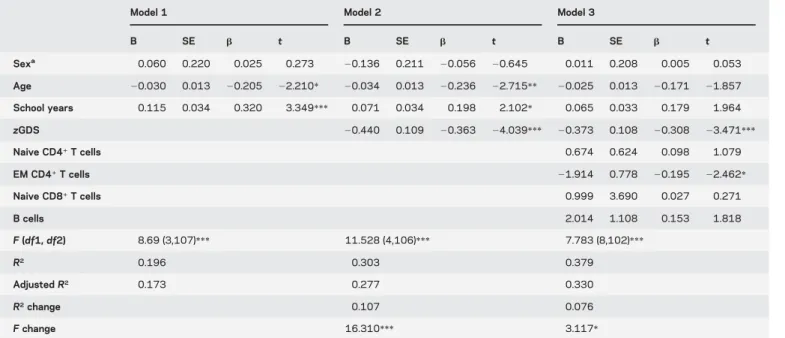
With respect to the MEM dimension, the hierar-chical regression showed that the first block predicted almost 20% (adjusted R2) of the MEM dimension
variance, with age and school years being statistically
Figure 1 Distinct cognitive performers present differences in the cell populations of the adaptive immune system
The profile (cell counts per mL of blood) of good (black) and poor (red) cognitive performers with regard to B cells (A); T cells (B); CD41and CD81T-cell subpopulations (C); CD41and CD81T-cell compartments (D and E), subdivided as naive, central memory (CM), effector memory (EM), and late differentiated (LD) T cells; CD41regulatory T cells (Tregs) (F), subdivided as naive Tregs, activated Tregs, and nonsuppressive Tregs (G). Each dot represents one individual and the line represents the mean of the group.*p,0.05.
significant predictors (table 2; model 1). The addition of the second block significantly increased the predic-tive power 10.7% (R2change), with mood being the
variable with the highest impact on MEM prediction (table 2; model 2). The addition of the last block raised statistical significance by 7.6% (table 2; model 3) for MEM. Following the GENEXEC findings, in model 3 all variables comprehensively explained 33% of the MEM dimension, in which, in addition to mood, EM CD41T cells were again statistically sig-nificant predictors. The approach indicated that bet-ter cognitive performers in memory function have better mood scores and lower EM CD41 T-cell counts.
It is also important to highlight that in this cohort only 18 participants were receiving anti-inflammatory/ immunoodulatory treatment, and no differences were detected in the cellular populations analyzed when comparing individuals receiving treatment to those not receiving treatment (data not shown). We also included this factor in the hierarchical regression mod-els as a factor to control, and anti-inflammatory/ immunomodulatory treatment showed no impact on cognitive function or on the correlation between EM CD41 T cells and cognitive performance (data not shown).
DISCUSSION This study shows that better cognitive performance in a healthy senior population is
associated with lower numbers of EM CD41T cells, higher numbers of naive CD81T cells and higher numbers of B cells. Furthermore, EM CD41T cells are predictors of GENEXEC and MEM, even when factors known to influence cognitive performance (e.g., age, sex, education and mood) are taken into account.
The immune cell population strongly associated with cognitive performance in our healthy senior cohort is the EM CD41T cells population. Higher EM CD41T-cell numbers negatively predict MEM and GENEXEC performance. Of interest, other au-thors reported that patients diagnosed with probable Alzheimer disease and cognitive deficits according to the Mini-Mental State Examination presented with significantly lower levels of CD41 naive T cells (CD45RA1) and an increase in the activated/naive CD41 T-cell ratio (CD45RO1/CD45RA1) com-pared with age-matched cognitively healthy individ-uals.28 This suggests that pathologically related
cognitive deficits are associated with alterations in the CD41T-cell compartments.28 Of note, we also
observed more EM CD41T cells in the poor cogni-tive performers, even though the individuals enrolled in our study presented no detectable pathologic cog-nitive alteration. The link between CD41T cells and cognitive performance has been proposed based on preclinical studies. In fact, systemic depletion of CD41 T cells in mice significantly reduced
Table 1 Hierarchical linear regression models to predict GENEXEC
Model 1 Model 2 Model 3
B SE b t B SE b t B SE b t Sexa 0.450 0.212 0.171 2.123 * 0.263 0.213 0.100 1.237 0.339 0.208 0.129 1.628 Age 20.050 0.013 20.316 23.837*** 20.051 0.012 20.324 24.09*** 20.031 0.014 20.199 22.260* School years 0.148 0.033 0.379 4.426*** 0.120 0.033 0.309 3.618*** 0.120 0.034 0.308 3.569*** zGDS 20.333 0.109 20.252 23.047** 20.287 0.106 20.217 22.693** Activated Tregs 27.552 15.091 20.047 20.500 Naive CD41T cells 20.071 0.630 20.010 20.113 CM CD41T cells 0.080 0.678 0.011 0.118 EM CD41T cells 21.803 0.779 20.169 22.315* Naive CD81T cells 5.967 3.689 0.150 1.618 B cells 2.655 1.16 0.189 2.289* F(df1,df2) 22.557 (3,100)*** 20.64 (4,99)*** 10.468 (10,93)*** R2 0.404 0.455 0.530 AdjustedR2 0.386 0.433 0.479 R2change 0.051 0.075 Fchange 9.283** 2.465*
Abbreviations: CM5central memory; EM5effector memory; Tregs5regulatory T cells. *p,0.05,**p,0.01,***p,0.001.
hippocampal neurogenesis and impaired reversal learning; such effects were not observed for CD81 T cells neither for B cells.4,29Recent studies showed
that a substantial increase in CD41T cells, but not in CD81T cells, was observed in the meninges of mice that performed a cognitive task.1Moreover, the
re-cruited cells were activated CD41T cells (CD691; CD251Foxp3-) producing IL-4 (Th2 phenotype) and
not IFN-g (Th1 phenotype),1 suggesting that the
cytokines produced by CD41T cells may play a role in cognition. In fact, a more proinflammatory profile has been associated with cognitive impairments in older individuals.30,31Because EM CD41T cells are the major cytokine producers among T cells,32 the
association found in our population between higher EM CD41T cells and poor cognition may be related to a more proinflammatory profile. Further studies are needed to better understand the interplay between the CD41T-cell populations, their specific cytokine production profile, and cognitive performance. This study also identified an association between B-cell counts and cognition (individuals with better cogni-tive performance presented with higher B-cell counts).
We next used hierarchical regression models to investigate the impact of the immune system in both the MEM and GENEXEC cognitive domains. The analysis revealed that all the immune system variables included in the models increased the predictive power of both cognitive domains almost 8%. Because this effect is in addition to the effect of other factors known to explain cognitive performance in senior
populations, the effect of the immune system varia-bles should be included when addressing cognitive differences among older individuals. Regarding the models used in this study, all variables explained GENEXEC better than MEM. We previously dem-onstrated that the predicted cognitive score (a“latent” cognitive score calculated using structural equation modeling based on 3 identified cognitive dimensions [general and executive function, memory, and a higher-level executive processing capacity] and 4 pre-dictors [sex, age, school years, and GDS]) is more strongly explained by GENEXEC than by MEM, which is in agreement with the present observations. Furthermore, in the structural equation model, the included variables explained 62% of the variability of the latent cognitive score,16 indicating that other
unknown factors are also of relevance. Based on the current findings, the inclusion of immune system parameters as predictors (mainly EM CD41T cells and/or B cells) can probably increase the explanation of the variability of cognition observed among senior individuals.
In summary, to the best of our knowledge, this is the first study identifying a phenotype of the immune system associated with poorer/better cognitive perfor-mance in individuals with healthy cognitive aging. This study is potentially limited by the relatively small num-ber of participants; thus, the present findings must be confirmed in other human cohorts fully characterized for their neurocognitive/psychological performance patterns in order to establish these“immunomarkers” as predictors of cognitive performance in aging. In
Table 2 Hierarchical linear regression models to predict MEM
Model 1 Model 2 Model 3
B SE b t B SE b t B SE b t Sexa 0.060 0.220 0.025 0.273 20.136 0.211 20.056 20.645 0.011 0.208 0.005 0.053 Age 20.030 0.013 20.205 22.210* 20.034 0.013 20.236 22.715** 20.025 0.013 20.171 21.857 School years 0.115 0.034 0.320 3.349*** 0.071 0.034 0.198 2.102* 0.065 0.033 0.179 1.964 zGDS 20.440 0.109 20.363 24.039*** 20.373 0.108 20.308 23.471*** Naive CD41T cells 0.674 0.624 0.098 1.079 EM CD41T cells 21.914 0.778 20.195 22.462* Naive CD81T cells 0.999 3.690 0.027 0.271 B cells 2.014 1.108 0.153 1.818 F(df1,df2) 8.69 (3,107)*** 11.528 (4,106)*** 7.783 (8,102)*** R2 0.196 0.303 0.379 AdjustedR2 0.173 0.277 0.330 R2change 0.107 0.076 Fchange 16.310*** 3.117*
Abbreviations: CM5central memory; EM5effector memory; Tregs5regulatory T cells. *p,0.05,**p,0.01,***p,0.001.
addition, prospective studies must follow on how the immune system profile further relates to cognitive decline.
AUTHOR CONTRIBUTIONS
C.S.-M. and S.R. performed the immune cell phenotyping experiments and analysis. N.C.S. and C.P.-N. performed the recruitment of the indi-viduals. C.S.-M., N.C.S., and P.C. performed the statistical analysis of the data. J.A.P., N.S., and M.C.-N. designed the study and established the cohort. All authors contributed to the planning of the experiments, data interpretation, writing of the manuscript, and approval of the final version of the manuscript.
ACKNOWLEDGMENT
The authors acknowledge the Portuguese Foundation for Science and Technology (FCT) for providing a postdoctoral fellowship to S.R. (SFRH/BPD/72710/2010). C.S.-M. and C.P.-N. are supported by research fellowships of MyHealth (DoIT—Desenvolvimento e Oper-acionalização da Investigação de Translação, Contract 13853). N.C.S. is supported by a SwitchBox postdoctoral fellowship. The authors thank Teresa Castanho and all study participants.
STUDY FUNDING
This work was funded by the European Commission (FP7):“SwitchBox” (Contract HEALTH-F2-2010-259772) and co-financed by the Portu-guese North Regional Operational Program (ON.2—O Novo Norte) under the National Strategic Reference Framework (QREN), through the European Regional Development Fund (FEDER).
DISCLOSURE
C. Serre-Miranda, S. Roque, N.C. Santos, C. Portugal-Nunes, and P. Costa report no disclosures. J.A. Palha is a coeditor on an issue in
Frontiers in Neurosciences. N. Sousa is Editor-in-Chief for Frontiers in Behavioral Neuroscienceand Associate Editor forMolecular Neurodegener-ation. M. Correia-Neves reports no disclosures. Go to Neurology.org/nn for full disclosures.
Received July 24, 2014. Accepted in final form November 18, 2014.
REFERENCES
1. Derecki NC, Cardani AN, Yang CH, et al. Regulation of learning and memory by meningeal immunity: a key role for IL-4. J Exp Med 2010;207:1067–1080.
2. Kipnis J, Gadani S, Derecki NC. Pro-cognitive properties of T cells. Nat Rev Immunol 2012;12:663–669. 3. Ron-Harel N, Segev Y, Lewitus GM, et al. Age-dependent
spatial memory loss can be partially restored by immune activation. Rejuvenation Res 2008;11:903–913. 4. Wolf SA, Steiner B, Akpinarli A, et al. CD4-positive T
lymphocytes provide a neuroimmunological link in the control of adult hippocampal neurogenesis. J Immunol 2009;182:3979–3984.
5. Ziv Y, Ron N, Butovsky O, et al. Immune cells contribute to the maintenance of neurogenesis and spatial learning abilities in adulthood. Nat Neurosci 2006;9:268–275. 6. Ziv Y, Schwartz M. Immune-based regulation of adult
neurogenesis: implications for learning and memory. Brain Behav Immun 2008;22:167–176.
7. Kipnis J, Derecki NC, Yang C, Scrable H. Immunity and cognition: what do age-related dementia, HIV-dementia and “chemo-brain”have in common? Trends Immunol 2008;29:455–463.
8. Schwartz M, Shechter R. Protective autoimmunity func-tions by intracranial immunosurveillance to support the mind: the missing link between health and disease. Mol Psychiatry 2010;15:342–354.
9. Kipnis J, Cohen H, Cardon M, Ziv Y, Schwartz M. T cell deficiency leads to cognitive dysfunction: implications for therapeutic vaccination for schizophrenia and other psy-chiatric conditions. Proc Natl Acad Sci U S A 2004;101: 8180–8185.
10. Brynskikh A, Warren T, Zhu J, Kipnis J. Adaptive immu-nity affects learning behavior in mice. Brain Behav Immun 2008;22:861–869.
11. Villeda SA, Luo J, Mosher KI, et al. The ageing systemic milieu negatively regulates neurogenesis and cognitive function. Nature 2011;477:90–94.
12. Villeda SA, Plambeck KE, Middeldorp J, et al. Young blood reverses age-related impairments in cognitive func-tion and synaptic plasticity in mice. Nat Med 2014;20: 659–663.
13. Paulo AC, Sampaio A, Santos NC, et al. Patterns of cog-nitive performance in healthy ageing in Northern Portugal: a cross-sectional analysis. PLoS One 2011;6:e24553. 14. Salthouse TA. Selective review of cognitive aging. J Int
Neuropsychol Soc 2010;16:754–760.
15. Santos NC, Costa PS, Cunha P, et al. Mood is a key determinant of cognitive performance in community-dwelling older adults: a cross-sectional analysis. Age (Dordr) 2013;35:1983–1993.
16. Santos NC, Costa PS, Cunha P, et al. Clinical, physical and lifestyle variables and relationship with cognition and mood in aging: a cross-sectional analysis of distinct educa-tional groups. Front Aging Neurosci 2014;6:21. 17. Clyne B, Olshaker JS. The C-reactive protein. J Emerg
Med 1999;17:1019–1025.
18. Kline RB. Principles and Practice of Structural Equation Modeling. New York, NY: Guilford Press; 2005. 19. Kotrlik JW, Williams HA. The incorporation of effect size
in information technology, learning, and performance research. Inf Technol Learn Perform J 2003;21:1–7. 20. Saule P, Trauet J, Dutriez V, Lekeux V, Dessaint JP,
Labalette M. Accumulation of memory T cells from child-hood to old age: central and effector memory cells in CD4 (1) versus effector memory and terminally differentiated memory cells in CD8(1) compartment. Mech Ageing Dev 2006;127:274–281.
21. Ardila A, Ostrosky-Solis F, Rosselli M, Gomez C. Age-related cognitive decline during normal aging: the complex effect of education. Arch Clin Neuropsychol 2000;15: 495–513.
22. Forstmeier S, Maercker A. Motivational reserve: lifetime motivational abilities contribute to cognitive and emo-tional health in old age. Psychol Aging 2008;23:886–899. 23. Harvey PD, Reichenberg A, Bowie CR. Cognition and aging in psychopathology: focus on schizophrenia and depression. Annu Rev Clin Psychol 2006;2:389–409. 24. Minicuci N, Marzari C, Maggi S, Noale M, Senesi A,
Crepaldi G. Predictors of transitions in vitality: the italian longitudinal study on aging. J Gerontol A Biol Sci Med Sci 2005;60:566–573.
25. Dowlati Y, Herrmann N, Swardfager W, et al. A meta-analysis of cytokines in major depression. Biol Psychiatry 2010;67:446–457.
26. Miller AH, Maletic V, Raison CL. Inflammation and its discontents: the role of cytokines in the pathophysiology of major depression. Biol Psychiatry 2009;65:732–741. 27. Stine-Morrow EA, Parisi JM, Morrow DG, Park DC. The
effects of an engaged lifestyle on cognitive vitality: a field experiment. Psychol Aging 2008;23:778–786.
28. Tan J, Town T, Abdullah L, et al. CD45 isoform altera-tion in CD41T cells as a potential diagnostic marker of Alzheimer’s disease. J Neuroimmunol 2002;132:164–172. 29. Radjavi A, Smirnov I, Kipnis J. Brain antigen-reactive CD41T cells are sufficient to support learning behavior in mice with limited T cell repertoire. Brain Behav Immun 2014;35:58–63.
30. Dimopoulos N, Piperi C, Salonicioti A, et al. Indices of low-grade chronic inflammation correlate with early
cognitive deterioration in an elderly Greek population. Neurosci Lett 2006;398:118–123.
31. Trollor JN, Smith E, Baune BT, et al. Systemic inflam-mation is associated with MCI and its subtypes: the Syd-ney Memory and Aging Study. Dement Geriatr Cogn Disord 2010;30:569–578.
32. Okada R, Kondo T, Matsuki F, Takata H, Takiguchi M. Phenotypic classification of human CD41T cell subsets and their differentiation. Int Immunol 2008;20:1189–1199.