NBER WORKING PAPER SERIES
TOWARDS A THEORY OF FIRM ENTRY
AND STABILIZATION POLICY
Paul R. Bergin
Giancarlo Corsetti
Working Paper 11821
http://www.nber.org/papers/w11821
NATIONAL BUREAU OF ECONOMIC RESEARCH
1050 Massachusetts Avenue
Cambridge, MA 02138
December 2005
The views expressed herein are those of the author(s) and do not necessarily reflect the views of the National
Bureau of Economic Research.
©2005 by Paul R. Bergin and Giancarlo Corsetti. All rights reserved. Short sections of text, not to
exceed two paragraphs, may be quoted without explicit permission provided that full credit, including ©
notice, is given to the source.
Towards a Theory of Firm Entry and Stabilization Policy
Paul R. Bergin and Giancarlo Corsetti
NBER Working Paper No. 11821
December 2005
JEL No. E22, E52, L16
ABSTRACT
This paper studies the role of stabilization policy in a model where firm entry responds to shocks and
uncertainty. We evaluate stabilization policy in the context of a simple analytically solvable sticky
price model, where firms have to prepay a fixed cost of entry. The presence of endogenous entry can
alter the dynamic response to shocks, leading to greater persistence in the effects of monetary and
real shocks. Entry affects welfare, depending on the love of variety in consumption and investment,
as well as its implications for market competitiveness. In this context, monetary policy has an
additional role in regulating the optimal number of entrants, as well as the optimal level of
production at each firm. We find that the same monetary policy rule optimal for regulating the scale
of production in familiar sticky price models without entry, also generates the amount of
(endogenous) entry corresponding to a flex-price equilibrium.
Paul R. Bergin
Department of Economics
UC, Davis
One Shields Ave.
Davis, CA 95616
and NBER
Giancarlo Corsetti
European University Institute
Badia Fiesolona
Via dei Roccettini 9
1-50016 San Domenico di Fiesole (FI)
Italy
1
Introduction
Business cycles are characterized by sizeable investment dynamics of …rm entry and exit. Just as real and monetary shocks may lead …rms to adjust the scale of production, they also create opportunities to introduce new goods in the market, as lower costs or higher demand raise the pro…tability of new product lines. A small but dynamic strand of literature has recently reconsidered di¤erent dimensions in which models with …rm entry and product va-riety can contribute to our understanding of the business cycle in closed and open economies (e.g. Ghironi and Melitz, 2005; Jaimovich, 2004). These aim to provide a more realistic model of imperfectly competitive markets in manufacturing, where entry drives pro…ts to zero and generate plausible market dynamics; in some versions, they also shed light on the role of research and development in generating economic ‡uctuations.1 The question we investigate in this paper is their monetary policy dimension.
One can list several reasons why business cycle researchers should be interested in …rm entry. Firstly, we see strong empirical evidence that entry dynamics comove with the busi-ness cycle, a stylized fact that will be discussed below. Secondly, entry has the potential to serve as an ampli…cation and propagation mechanism for real shocks, and to a¤ect the transmission mechanism for monetary policy. Thirdly entry may have notable welfare ef-fects, to the degree that households derive utility from greater variety, or to the degree that the entry of new …rms raises competition in a market. By way of example, under a standard Dixit-Stiglitz speci…cation with a substitution elasticity implying a 20% markup, a one per-cent decrease in consumption expenditure lowers the total consumption index by 20% more if it corresponds to 1 percent reduction in the number of varieties bought by the consumers, rather than a proportional fall in the consumption of each variety.2 This example illustrates that the extensive margin of consumption and output ‡uctuations, in the form of changes in the number of …rms and varieties, can have distinct implications from the intensive margin, the average size of …rms. Thus, as a …nal point, in light of its e¤ect on welfare we expect entry to a¤ect the design of optimal monetary policy, as output gap stabilization may now
1Recent open macro literature has explored the role of …rm entry in the international business cycle,
and analyzed international spillovers from policy and productivity shocks. (See Ghironi and Melitz, 2005; Corsetti, Martin, and Pesenti, 2005, among others.) Some contributions have also reconsidered issues of the welfare e¤ects of product varieties – with potentially relevant implications for the design of international and domestic price indexes. (See the above contribution and Broda and Weinstein, 2004). Some traits of these models are in common with a related literature on …rm entry focusing on issues of indeterminacy of equilibria and increasing returns. (See Chatterjee et al., 1993; Devereux et al., 1996; and Kim, 2004).
2This can be easily seen by considering the Dixit-Stigliz consumption aggregator over symmetric varieties: C = R0nc(h) 1 1 =n 1c(h):Writing this in percent changes:Ce =
1en+ec(h):For a typical case of = 6;a percentage rise in the number of varietiesna¤ects totalCby 1.2 times as much as an equal percentage rise in average sizec(h).
have an extensive as well as an intensive margin.
In this paper, we …rst brie‡y document the correlation of entry with monetary shocks, augmenting standard VAR models with measures of new …rm incorporations and net busi-ness formation. Second, we build a stylized sticky price model of monetary policy when …rm entry is endogenous. Firms must prepay a (possibly time-varying) …xed cost in the period prior to production, which is the cost of an exogenously given quantity of interme-diate inputs that are necessary to start up production. This startup …xed cost must be paid each period — it could be interpreted as investment expenditure under the simplifying assumption of complete depreciation of capital within the period. Firms cover such cost with their pro…ts derived from monopolistic pricing. As demand and cost are a¤ected by shocks, the number of …rms that …nd it pro…table to enter the market will vary over time. Di¤erent from the standard speci…cation, …rms enter the market by producing new di¤eren-tiated products, thus enlarging the set of goods available to consumers and other …rms. We allow for love for variety in preferences, so that enlarging the set of goods may have positive e¤ects on household utility. Price stickiness takes the form of prices that are set one period in advance.
We …nd that entry a¤ects the transmission of technology shocks as well as monetary policy transmission. With endogenous entry, the e¤ect of productivity shocks on output is magni…ed by the increase in investment demand driven by new …rms. With free entry, most of the output e¤ect can be attributed to the creation of new …rms and products, i.e. to the extensive margins. Monetary shocks also induce entry much as investment responds in a standard model: for a given entry (investment) cost, a fall in the real interest rate raises the expected discounted pro…ts from creating a new …rm. Di¤erent from the standard model, however, …rms investing in new capital stock do not raise the scale of production of a given set of products (i.e. to exploit intensive margins) — facing a fall in their equilibrium prices. Product di¤erentiation (i.e. exploiting extensive margins) allow them to operate with limited or no deterioration of their prices. As with productivity shocks, endogenous entry tends to generate some endogenous persistence in response to monetary shocks, though these particular e¤ects are not large in the calibrated version of the model.
Our stylized model allows us to evaluate analytically monetary policy. We …rst show that there exists a simple class of policy rules such that the market allocation with nominal rigidities coincides with a market allocation where all prices are ‡exible. This class of policy is isomorphic to the one studied in Corsetti and Pesenti (2005a,b), in the context of a model without …rm entry and investment. In an economy with these rules in place, the individual good pricespare constant, but the welfare-based CPI ‡uctuates with entry. For exactly this
reason, the goal of (welfare-based) CPI stability may not be a good target for policy makers. To the extent that it is desirable to support a ‡ex price allocation, monetary authorities should stabilize …rms’marginal costs and prices. The price level may then freely ‡uctuate with entry, providing information about ‡uctuation in consumption utils — given prices — that households enjoy.
However, the allocation in a ‡exible price equilibrium will not be in general Pareto optimal. There are three distortions in our economy: monopoly power in production, under or oversupply of varieties, and nominal rigidities. Correcting the …rst two distortions requires an appropriate set of taxes and subsidies. Only if these are in place, can monetary policy be e¤ective in targeting the e¢ cient allocation.
We study two important macroeconomic consequences of lack of macroeconomic stabi-lization in our distorted economy. First, as in Corsetti and Pesenti (2005a,b), the lack of monetary stabilization translates into higher product prices. As a result, insu¢ cient sta-bilization lowers the average scale of activity of all …rms in existence. Second — this is a speci…c contribution of our paper — we show that the lack of stabilization lowers the average number of …rms relative to a ‡ex price allocation. This result is not obvious, since higher prices set by …rms against increasing uncertainty tend to rise pro…ts in equilibrium, hence creating an incentive to enter. Our analytical welfare analysis …nds that unconditional ex-pected welfare is unambiguously lower under a lack of stabilization, for all parameterizations of love for variety. But the welfare gains of stabilization policy rise with greater love for variety, potentially by a notable percentage — of the same order of magnitude as average markup.
We conclude our analysis by augmenting our model to explore the e¤ects of …rm entry on market competitiveness. We adapt a translog preference speci…cation: new entry of …rms raises the density of market competition and the elasticity of substitution between varieties. This forces …rms to lower their markups and thereby reduces the monopolistic distortion in the economy. We show that this reallocates adjustment between extensive and intensive margins, and it o¤ers an additional motivation for stabilization policy as a means of raising welfare.3
A related paper in the recent literature is by Bilbiie, Ghironi and Melitz (2005), which studies the dynamics of entry along the business cycle. In addition to di¤erences in the
3Since we focus on stabilization policy, we abstract from the growth dimension stressed by other
macro-economic models with entry, namely, the link between the creation of new …rms and technological change when progress is embodied in new capital (e.g. Campbell 1998). Nonetheless, we observe that our model shares two standard predictions with this literature. First, current productivity shocks lead to entry — in this sense, entry is procyclical. Second, future productivity shocks leads to exit. The reason is however di¤erent from the obsolescence of current capital. Rather, exit is due to the anticipation of a fall in prices and sales revenue due to productivity gains in a (monopolistic) competitive environment.
model speci…cation, while their focus is on cyclical properties of the macroeconomic process with …rm entry, we concentrate on stabilization policy issues.
This paper is organized as follows. Section 2 introduces our model. Section 3 charac-terizes the ‡exible price equilibrium and compares it to the Pareto optimal allocation. The next two sections analyze monetary transmission and policy rules. Section 6 concludes.
2
A look at the evidence
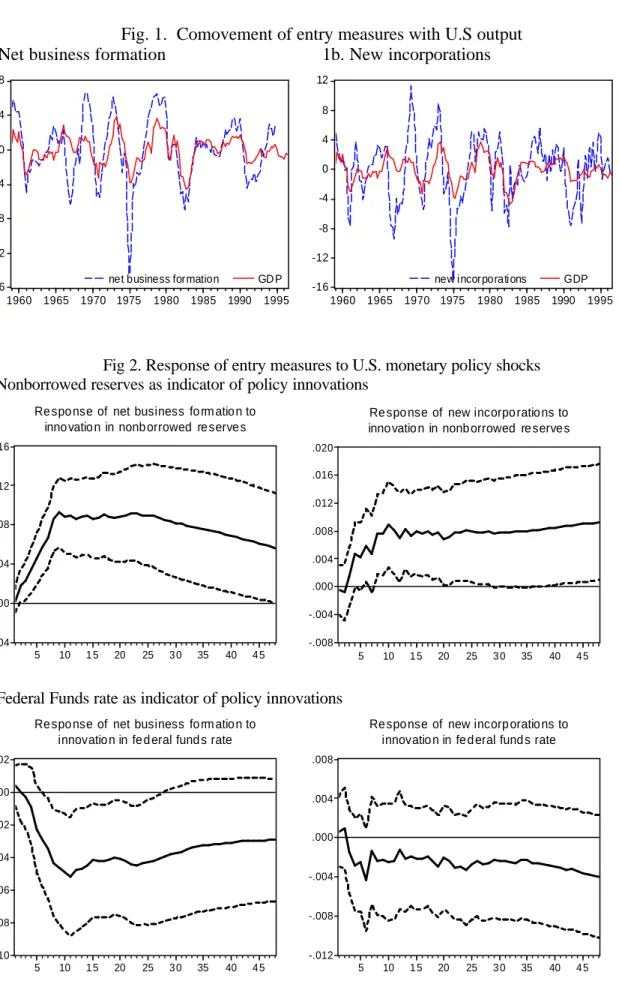
As empirical motivation for our inquiry, Figure 1 plots two metrics of entry, the U.S. index of net business formation and the number of new incorporations. The comovements with GDP are obvious, with correlations as high as 0.73 and 0.53, respectively. While the comovement with output has been noted in earlier research (see e.g. Bilbiie, Ghironi and Melitz, 2005; Jaimovich, 2004; Devereux et al., 1996), we go on here to document a relationship with monetary policy. To this goal, simple unconditional correlations are not appropriate. Indeed, if one uses the increase in nonborrowed reserves ratio to total reserves as an indicator of an expansionary monetary policy stance, its unconditional correlations with the above measures of entry are negative (-0.28 and -0.18), rather than positive as one might expect. Similarly, the correlation with the federal funds rate has di¤erent sign (-0.04 and 0.06) depending on the measure of entry, whereas one may instead expect an unambiguously negative correlation with this indicator of monetary contraction. Clearly, a likely problem is that monetary policy is adjusted counter to business cycle ‡uctuations, so the unconditional correlations are likely con‡ating endogenous monetary contractions with the booms in GDP that may have given rise to them.
Using even a simple VAR to separate these e¤ects gives a dramatically di¤erent and much clearer picture. First, we follow Eichenbaum and Evans (1995) in specifying a VAR ordering the nonborrowed reserves ratio after industrial production and consumer prices. In addition, we follow Christiano, Eichenbaum and Evans (1999) by including sensitive commodity prices to control the price puzzle. In this system we insert in turn each of our measures of entry.4 Figure 1a shows that now there is a statistically signi…cant positive e¤ect of nonborrowed reserves on net business formation; …gure 1b shows a similar e¤ect on incorporations, with signi…cance starting in the eight month after the shock. Then, as in Eichenbaum and Evans
4The full list of variables in order are: industrial production, CPI, commodity prices, non-borrowed
reserves ratio, and net business formation (or new incorporations). The …rst two and the …nal series are in logs. Data is monthly, running from 1959:1 to1996:9 when incorporations are used and to 1994:12 for net business formation. The entry series have been discontinued, with net business formation obtained from Economagic, and incorporations from the Survey of Current Business. Identi…cation is by Cholesky decomposition, where monetary policy can respond contemporaneously to production, CPI, and commodity prices.
(1995), we also include the federal funds rate in the system as an alternative measure of monetary policy stance.5 As seen in …gures 2a and 2b, the direction of the e¤ect once again conforms with our intuition: a rise in the interest rate discourages entry, with signi…cance in the net business formation case. Our conclusion from this exercise is that there appears to be a relationship between monetary policy and entry. This invites theoretical exploration of how entry might operate as part of the monetary policy transmission process and how it might a¤ect optimal policy design.
3
The model
We consider a closed economy where households consume a basket of di¤erentiated tradable goods, demanding positive quantities of all the goods available in the market. They supply labor to …rms and own claims on …rms’pro…ts. We scale the economy such that there are
Lthouseholds in the economy.
The number of goods varieties produced by …rms is endogenously determined in the model. To start production of a particular good variety, …rms sustain entry costs consisting of the costs of intermediate inputs required to set up a …rm’s capital. Once the entry costs are paid, …rms start producing with a period lag. They operate under conditions of monopolistic competition: in equilibrium …rms will choose to produce one speci…c variety only. Hence, an increase in nt corresponds to both the introduction of new varieties, and the creation of new …rms. For simplicity, we assume that, at the end of this period the capital invested in the creation of a speci…c variety fully depreciates and the production process starts again with new entry of …rms. Firms and goods varieties are de…ned over a continuum of massntand indexed byh2[0; nt].
The government is assumed to set monetary policy, collect seigniorage, and rebate any surplus to households in a lump-sum function.
3.1
Households
The utility of the representative national household is a positive function of consumption
Ctand money holdingMt=Ptand a negative function of labor e¤ort `t–whereasPtis the welfare based consumption price index (de…ned below) andMtis the stock of money that the representative household chooses to hold during the period. As household preferences are de…ned over a very large set of goods, utility is a well-de…ned (and non-decreasing) function of all goods available in the market.
5The variable list now consists of: industrial production, CPI, commodity price, federal funds rate,
The representative household maximizes P1t=0 tU(Ct), whereas utility in periodt is:
Ut= logCt `t+ ln
Mt
Pt
(1)
In the above expressionCt is a composite good that includes all varieties:
Ct=At Z nt 0 Ct(h)1 1 dh 1 (2) where At (nt) 1: (3)
As in Benassy (1996) and the working paper version of Dixit and Stiglitz (1974), in our speci…cation of preferences the parameter denotes the elasticity of intratemporal (i.e., across varieties) substitution, with 1, and the parameter measures the degree of consumers’ love for variety: 1 represents the marginal utility gain from spreading a given amount of consumption on a basket that includes one additional good variety (see Corsetti Martin and Pesenti, 2005). In what follows, we will conveniently restrict the value of the to be close to 1, so that our speci…cation of consumption is close to the standard Dixit-Stiglitz case.6
In each period, households buy st(h)shares in the …rm h(which start operating in the following period) at the price qt(h). At the same time, they receive dividend payments from their previous period investment. The budget constraint for the representative Home household is therefore: Z nt 0 pt(h)Ct(h)dh+ Z nt+1 0 st(h)qt(h)dh+Bt+Mt (4) wt`t+ Z nt 0 st 1(h) t(h)dh Tt+ (1 +it)Bt 1+Mt 1
wherept(h)denotes the price of varietyh;st(h)is the share of …rm hpurchased in period t;wtis the nominal wage rate; t(h)is …rm h’s total dividend paid in periodt;T are lump-sum net taxes denominated in Home currency, Bt is the household’s holding of a nominal bond (in zero net supply), and i is the nominal interest rate. Note that consumption falls onntgoods, …nancial investment onnt+1 shares.
3.2
Firms and the government
The representative …rm producing a speci…c varietyhhas access to the following production function:
Yt(h) = t`t(h) (5)
6By assuming log preferences, we restrict our attention to economies with a well de…ned balanced growth
path. However, we also abstract from potentially interesting wealth e¤ects on labor supply (see Corsetti, Martin and Pesenti, 2005).
where Y(h) is the output of variety h, `(h) is labor used in its production, and t is a country-speci…c labor productivity innovation that is common to all Home …rms.
To start the production of a varietyhat timet+ 1, at timeta …rm needs to installKt units of capital. The latter consists of a basket of intermediate inputs/goods:
Kt=AK;t Z nt 0 Kt(h)1 1 dh 1
Here,AK;t is an indicator of e¢ ciency of investment de…ned as:
AK;t (nt) K 1 (6)
which is a direct analog to the love of variety in consumption. For a given requirementKt, a higher e¢ ciency indexAK;t implies a smaller demand of goods
Rnt
0 K(h)dh.
Let pt(h) denote the price of variety h. From cost minimization, we can derive the investment demand for the goodh
Kt(h) =AK;t1
pt(h)
PK;t
Kt
wherePK is the price index of a unit ofK:
PK;t= 1 AK;t Z nt 0 pt(h)1 dh 1 1
Observe that in a symmetric equilibrium the demand for the goodhisK(h) =Kt=n k. The entry costsq(h)faced by a …rm are thus equal to:
qt(h) =PK;tKt (7)
For simplicity, in what follows we assume 100 percent depreciation: after paying the …xed cost, a …rm can produce varietyhin periodt+ 1only.
Since we assume that households will demand any number of varieties supplied in the market, from the vantage point of a new …rm it will never be pro…table to produce a particular variety already produced by other …rms, rather than introducing a new one. Hence in equilibrium …rms are monopolistic suppliers of one good only. The resource constraint for varietyhis:
Yt(h) LtCt(h) +nt+1Kt(h) (8)
where Ct(h)is consumption of good hby the representative Household, while the second term on the RHS is the demand for investment goods by all the …rms that will be producing int+ 1.
Households and …rms will be symmetric in equilibrium. Hence we can write theh…rm’s operating pro…ts as:
We posit that …rms are atomistic, so that they ignore the e¤ect of their pricing decision on the price level.
Domestic households provide labor to …rms for both start-up and production activities. Hence the resource constraint in the Home labor market is:
Lt`t Z nt 0 Yt(h) t dh: (10)
We abstract from public consumption expenditure. The government uses seigniorage revenues and taxes to …nance transfers. The public budget constraint is simply:
Mt Mt 1+
Z Lt
0
Tt(j)dj=Mt Mt 1+LtTt= 0 (11)
and in equilibrium money supply equals demand, orMt=R Lt
0 Mt(j)dj. Finally, the bond
is in zero net supply:
Z 1 0
Bt(j)dj = 0: (12)
so that Bt = 0 in aggregate terms. Throughout our analysis we will consider two sources of uncertainty. labor productivity t and investment requirement for entryKtare random variables.
3.3
Equilibrium allocation
The representative Home household maximizes (1) with respect toCt(h),`t,Bt,st(h)and
Mt subject to (4). The …rst order conditions are:
Ct(h) =At 1 pt(h) Pt Ct (13) wt= PtCt (14) 1 PtCt = (1 +it)Et 1 Pt+1Ct+1 (15) q(h) PtCt =Et t +1(h) Pt+1Ct+1 (16) Mt Pt = 1 +it it (17)
wherePtis the utility-based consumer price index:
Pt= 1 At Z nt 0 pt(h)1 dh 1 1 (18)
Note that households will …nance new …rms as long as the present discounted value of expected pro…ts will be above the cost of entry
qt(h) Et U0(Ct+1) U0 (Ct) Pt Pt+1 t+1(h)
With competitive markets and free entry, the number of …rms will adjust until the above holds with an equality sign. Following Corsetti and Pesenti [2005a] it is convenient to de…ne two new variables as follows
t = PtCt Qt;t+1 = PtCt Pt+1Ct+1 = t t+1
The …rst is a measure of monetary stance. The second is the stochastic discount factor. We introduce nominal rigidities by assuming that …rms preset the price of their products before shocks are realized (i.e. simultaneously to the decision to enter), and stand ready to meet demand at the ongoing price. Hence, the entry decision coincides with the optimal choice of this price for the period of production. Firms choose their price maximizing the expected discounted value of their pro…ts
M axp(h) Et[Qt;t+1 t+1(h)]
M axp(h) EtfQt;t+1[Lt+1pt+1(h)Ct+1(h) +nt+2pt+1(h)Kt+1(h) wt+1`t+1(h)]g
Using the …rst order conditions of the representative household, the price indices, and the de…nition of we can also rewrite the …rm’s problem as
M axp(h)Et[Qt;t+1 t+1(h)] =Et t t+1 pt+1(h) k t+1 t+1 Lt+1 nt+1 t+1 Pt+1 +nt+2Kt+1 n K t+1
The optimal preset price satis…es7
pt+1(h) = 1 Et t+1 Lt+1 nt+1 t+1 Pt+1 +nt+2Kt+1 n K t+1 Et 1 t+1 Lt+1 nt+1 t+1 Pt+1 +nt+2Kt+1 n K t+1 (19)
It is easy to verify that, with ‡exible prices, the optimal price set at time will take the well-known form pt+1= [mark up] M Ct= 1 t+1 t+1 (20)
whereM C stands for marginal costs.
We have seen above that free entry in a competitive market impliesqt(h) =Et[ Qt;t+1 t+1(h)]. Substituting the …rst order conditions of the representative household’s problem and using our de…nitions above, we can write
PK;tKt=Et t t+1 pt+1(h) t+1 t+1 Lt+1 nt+1 t+1 Pt+1 +nt+2Kt+1 n K t+1 (21)
This expression and equation (19) summarize the macroeconomic process in our economy.
7We note here that, with preset prices, large negative shocks may make ex post operating pro…ts negative
– raising an issue of whether …rms will voluntarily accept to produce even if they are loosing money. For simplicity, we rule this possibility out by restricting the support of the shock (as discussed in Corsetti and Pesenti, 2001).
4
Flex-price equilibrium and welfare with monopolistic
distortions
In this section, we analyze the ‡exible price equilibrium allocation and its welfare proper-ties relative to a Pareto-optimal allocation, with the goal of providing useful positive and normative benchmarks for the analysis to follow. Using (19) and (20), the dynamics of an economy with ‡exible prices is captured by the di¤erence equation below:
1 Kt t n1 K t =Et 8 > < > : 1 t+1 1 1 2 6 4Lt+1 nf lext+1 t+1 1 +n f lex t+2Kt+1 nf lext+1 K 3 7 5 9 > = > ; (22) where the superscript ‘‡ex’stands for ‡exible-price equilibrium. Clearly, money is neutral. Investment in entry however responds to productivity shocks.
4.1
Real shocks and economic dynamics
From (22), the entry cost qt (on the left hand side of the expression) falls with positive innovations to investment e¢ ciency (corresponding to a fall in Kt) and/or with positive shocks to t (in a ‡ex price equilibrium, productivity gains reduce current goods prices, decreasing the costs of investment). Entry in turn reduces expected pro…ts, restoring equi-librium. Observe that entry reduces pro…ts from both consumption sales (…rst term in the squared brackets of (22)) and investment sales (second term).
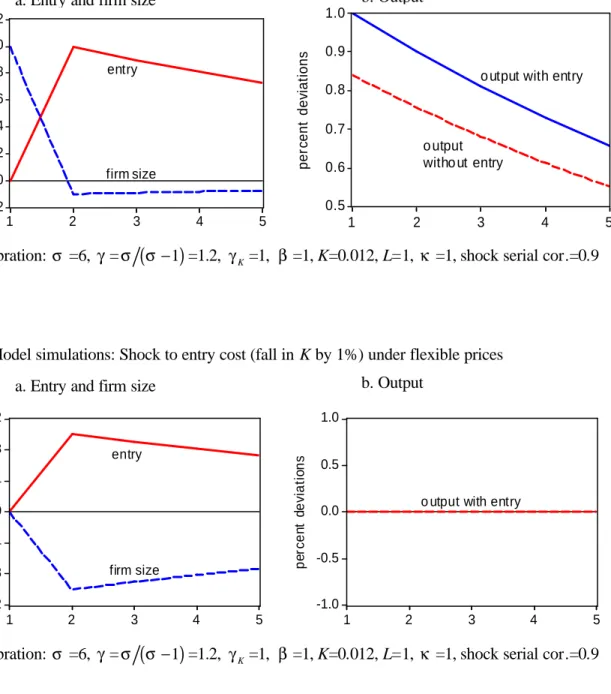
These e¤ects are illustrated by Figure 3, which plots the e¤ect of a persistent rise in productivity in a linearized and calibrated version of the model.8 Relative to the standard model without entry, the e¤ect of the shock on output is larger, as it includes the demand for investment. Since in our calibrated economy investment is 16% of output in steady state, output is approximately 16% larger.9 Observe also that once …rms have a chance to enter, the rise in output generated by the shock operates at the extensive margin, with no increase in average …rm size at the intensive margin. This must be the case in equilibrium, since any rise in …rm size would indicate there were extra sales and hence pro…ts net of the …xed entry costs which potential entrants are not exploiting. The e¤ects of a 1% drop in entry cost,Kt, are illustrated in …gure 4. New …rms enter and …rm size falls proportionately, as an unchanged level of output is divided among the larger number of …rms.
8Calibrated values are: = 6; =
1 = 1:2; K = 1, = 1;serial correlation in shock = 0:9;
K= 0:012; L= 1.
9It is easy to show that in this economy the steady state share of investment expenditure in output
equals , so it does not depend at all on the calibration of the …xed cost parameterK(which is di¢ cult to calibrate).
An anticipated shock to marginal costs ( t+1), however, has ambiguous e¤ects on the
allocation. While it encourages entry because of its e¤ect on future entry costs (investment will be cheaper in the future), its impact on future goods prices is not necessarily good news for pro…tability. Intuitively, with falling marginal cost, each …rm will try to increase pro…ts by lowering its own price. But since the shock is common to all, in the new equilibrium the product prices will be uniformly lower, reducing pro…ts.
The above equation also suggests that the number of …rms temporarily rises in response to an anticipated higher investment requirement (a higherKt+1, which is a negative shock to
expectations about the investment technology). By the same token,ntis higher in response to anticipated growth in market size (a largerLt+1).10
Observe that with e¢ ciency gains in investment due to goods variety ( K 6= 1), the expression (22) is a non linear second-order di¤erence equation in n: any temporary de-viations of n from its long run value induce persistent e¤ects on the costs of investment. Hence investment demand and entry change over time in response to any shock, also driving consumption demand. These e¤ects would disappear as the system returns to steady state. To gain further insight on the equilibrium allocation, it is analytically convenient to focus on the case of a stationary economy with i.i.d. shocks to productivity and no serial dependence in entry ( K = 1). Expected discounted pro…ts are constant, and entry is di-rectly proportional to current productivity shocks twhile varying inversely with investment requirement at entryKt. nf lext+1 = t Kt Et " L 1 +n f lex t+2 t+1 Kt+1 #
Taking expectation at timet 1 and rearranging yield
Et 1nf lext+1 Kt t =Etnf lext+2 Kt+1 t+1 = 1 1 L
Substituting this result in the previous expression, we obtain
nf lext+1 Kt
t
= 1 1 L (23)
In a stationary economy with ‡exible prices, the number of …rms moves in proportion to the productivity indexKt= t. IfKis constant, all the adjustment takes place at the extensive margin: …rm size is una¤ected.
By using the resource constraint of the economy, we also obtain a second important result (details are in appendix):
`f lext = 1 1 =`f lex (24)
The equilibrium rate of employment is constant. Output and entry (along the intensive and the extensive margins) ‡uctuates with productivity. Adding up quantities across goods (ignoring di¤erences across products), this economy produces tL`f lex. Of this aggregate quantity, a proportion = goes into investment,( )= into consumption. Unless = 1, however, these quantities are not appropriate measures of GN P, C and I, because they ignore the utility value of product diversi…cation.
4.2
Entry and Pareto e¢ ciency
In our economy, a competitive allocation can be characterized by either excessive or in-su¢ cient creation of varieties, depending on the interaction between love for variety and monopolistic distortions. If an interior solution for n exists, the e¢ cient mass of varieties satis…es Kt t =Et Lt Lt+1 ( 1) 1 nP:O: t+1 Lt+1 + ( k 1) t+1 nP:O: t+2Kt+1 nP:O: t+1
As in the market equilibrium, the Pareto-optimal number of varieties in a stationary econ-omy (withi:i:d:shocks and K 6= 1) will be proportional to t=Kt
nP:O:t+1 = t
Kt
1
L( 1) (25)
Observe …rst that, !1 implies that nP:O:t+1 !0, while nf lext+1 tends to a positive number. In the case of no love for varieties, the e¢ cient mass of varieties is zero: it would be e¢ cient for …rms to supply only one good variety, at a price equal to the marginal cost. But this would clearly be inconsistent with a market allocation, as …rms would not be able to …nance their entry costs.
Take the ratio ofnf lex tonP:O:
nf lext+1
nP:O:
t+1
= 1
( ) ( 1)
It is easy to verify that this ratio will be larger than unity with a Dixit-Stiglitz aggregator in consumption, i.e. for ! 1. A market allocation would not deliver enough product diversity. To gain further insight, posit '1. In the Dixit-Stiglitz case, the above ratio is then approximately equal to1 1= : the lower the elasticity of substitution across products, the larger …rms’monopoly power, the larger the gap in variety between a market allocation and the Pareto optimal allocation.11
1 1Using the above expression, it is also easy to calculate which value of would make the number of …rms
in a competitive equilibrium converge to the Pareto optimal number of …rms. This happens to be the case when is close to1 + 1= . It is worth stressing that, even if happens to be equal to1 + 1= , the market allocation will not be Pareto-optimal, because of monopoly power in production.
By the same token, compare individual consumption in a ‡ex price equilibrium and a Pareto e¢ cient allocation (indexed by the superscript ‘P.O.’)
Ctf lex = t 1 nf lext 1 CtP:O: = t 1 nP:O:t 1 =) C P:O: t Ctf lex = 1 nP:O: t nf lext ! 1
The wedge in consumption depends on two sources of ine¢ ciency: the markup charged by …rms; and the equilibrium supply of varieties, that however only matters if > 1. Distortions in the labor market will also be a function of the ‘gap’in the number of varieties. Not surprisingly, employment in the consumption sector,`Ct, inherits the same distortions a¤ecting consumption `P:O: Ct `f lexCt = 1 nP:O: t nf lext ! 1
while the wedge of employment in investment activities between a Pareto Optimal and a market allocation will simply be equal to the wedge in the number of varieties,nP:O:t+1=nf lext+1:
Overall, the e¢ cient labor supply is constant and equal to
`P:O:= 1[1 + ( 1)] (26)
In general, as a decentralized equilibrium generally will not be Pareto e¢ cient, welfare-optimizing policymakers would want to adopt …scal instruments to correct distortions. An instance of an optimal …scal policy correcting monopolistic distortions consists of subsidies to production and investment, …nanced with lump-sum taxation. The former induce …rms to raise production up the point in which prices equal to marginal costs (therefore making expected discounted pro…ts identically equal to zero). The subsidy covering the costs of entry should be limited to a mass of goods variety optimally chosen in relation to e¢ ciency gains in preferences.
Relative to the standard macroeconomic model with imperfect competition but a given set of varieties, therefore, an explicit speci…cation of entry costs is helpful in clarifying the source of monopoly power in production. Entry and market dynamics is nonetheless distorted, creating a need for a …scal correction similar in spirit to the interventions envisaged by recent contributions on monetary policy, whereas appropriate taxes are assumed in order to approximate the market equilibrium (with an optimal monetary policy in place) around the …rst-best allocation.
5
Nominal rigidities and the transmission of monetary
and real shocks
With nominal rigidities, the macroeconomic process in a symmetric equilibrium is described by the following two equilibrium conditions:
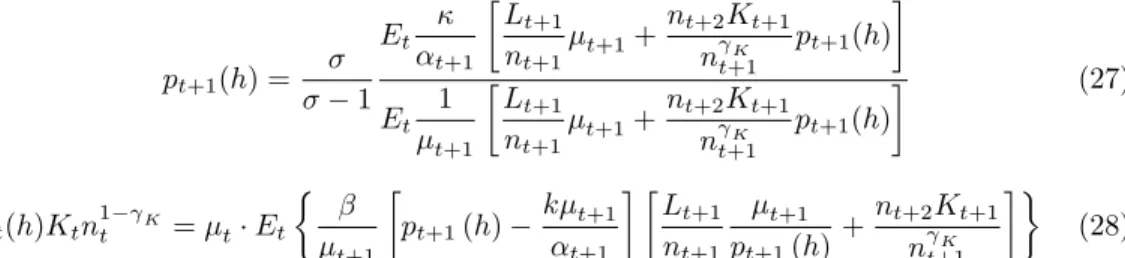
pt+1(h) = 1 Et t+1 Lt+1 nt+1 t+1 +nt+2Kt+1 n K t+1 pt+1(h) Et 1 t+1 Lt+1 nt+1 t+1 +nt+2Kt+1 n K t+1 pt+1(h) (27) pt(h)Ktn1t K = t Et t+1 pt+1(h) k t+1 t+1 Lt+1 nt+1 t+1 pt+1(h) +nt+2Kt+1 n K t+1 (28)
Hereafter, we will use these conditions to trace the transmission of monetary and real shocks. Clearly, money is not neutral. Consider a once-and-for-all unanticipated temporary shock to at time t (money stocks go back to their initial value from t+ 1 on). From the RHS of the above equation, we see that a monetary shock t that lowers real interest rates translates into a higher discount factor, therefore boosting expected discounted pro…ts. Even though in our model nominal wages move in proportion to the nominal shock (reducing …rms’ markup ex post), with preset goods prices the overall entry costs does not change. Hence, by reducing the real interest rate a temporary monetary shock will lead to entry: at timet+ 1there will be a higher number of …rms and goods. Since the number of …rms is predetermined and cannot rise in the same period in which the shock occurs, the rise in demand (for both investment and consumption) driven by a monetary shock is met by a rise in output per …rm solely at the intensive margin. The extensive margin takes e¤ect only after one period, when the number of …rms rises. We stress the analogy in the monetary transmission channel between this model with entry and standard models without entry but with investment in physical capital. The e¤ect of expansionary monetary shocks on the e¤ective real interest rate induces a rise in consumption demand and investment (the latter via a raise in expected discounted pro…ts), which translates into higher real output.
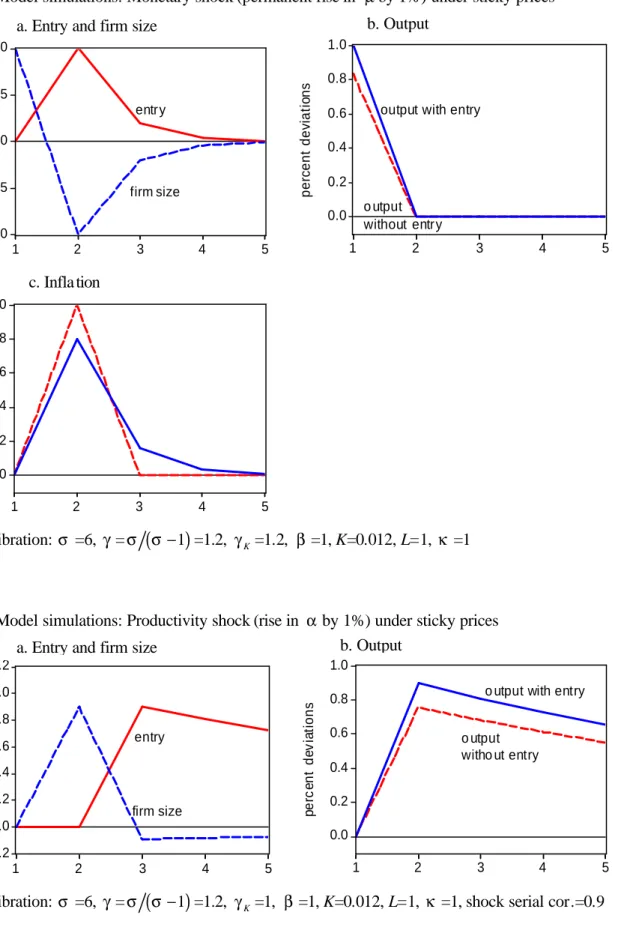
Figure 5 illustrates the e¤ects of a permanent monetary shock using the linearized and calibrated version of the model.12 Observe …rst that, just as with the productivity shock discussed in the previous section, entry raises the output e¤ects of monetary shocks. In the experiment in Figure 5, steady state investment is about 12% of output and the rise in output is approximately by this amount.13 Since we set
K 6= 1, there is some persistence
1 2Calibrated values are the same as in the previous simulation, exept that we re-introduce love of variety
in investment ( K= ): = 6; = 1 = 1:2; K= 1:2, = 1; K= 0:012; L= 1.
1 3The steady state investment share no longer exactly equals exactdly since love of variety in investment
in the e¤ect of a monetary shock on entry. In the second period after the shock, there still is a noticeable amount of extra …rms, due to the fact that the larger number of varieties available in the previous period make entry less costly. However, persistence in the e¤ect of money on entry does not translate into persistence in the e¤ect on output.
Perhaps most interesting is the observation that, with endogenous entry, the in‡ationary e¤ects of monetary expansion are diminished by about 17%. Under love of variety, the rise in entry works to lower the cost of one unit of the consumption index. This indicates that the in‡ationary consequences of monetary expansions may be less severe than suggested by the o¢ cial measures of the CPI, to the extent that these fail to properly take into consideration entry and variety e¤ects.
As prices are preset during the period, temporary productivity shocks (changes in t lasting only one period) do not impact the allocation at all. Productivity shocks to t can a¤ect entry if they are persistent, as illustrated in Figure 6. The e¤ects of such a shock closely resemble those of the ‡exible price case, though entry is delayed an extra period. This is because under sticky prices it takes a period before the productivity gain is able to lower prices and hence entry costs. Regarding a shock to entry costs (Kt), since this shock did not imply any change in marginal cost or price setting under the ‡exible price case discussed previously, the e¤ects under sticky prices are the same as those shown previously in …gure 4. Thus, di¤erent from productivity innovations to t, shocks to investment e¢ ciency raise
nt+1 also when prices are sticky.
6
Monetary policy rules and the consequences of lack
of stabilization
In this section we turn to stabilization policy, focusing on the e¤ects of monetary rules, whereas we express our indicator of monetary stance as a function of exogenous shocks to productivity. To facilitate analytical solution, we again limit ourselves to the case of i.i.d. shocks and no serial dependence in entry ( K = 1).
6.1
Monetary rules supporting a ‡ex-price allocation
A …rst question regards the conditions (if any) under which there exist monetary rules that support a ‡ex-price and ‡ex-wage allocation. The answer is positive: in our economy there exists a class of policy rules that equalize the allocation across market equilibria with and without nominal rigidities. Such a class is identical to the one studied by Corsetti and Pesenti (2005a,b) for a much simpler economy without entry. Suppose that monetary
authorities pursue policy rules such that
t= t t
at all times, whereas t is a possibly time-varying variable anchoring the level of nominal prices. Setting t= 1for simplicity, it is easy to verify that marginal costs are identically equal to , and preset prices are constant
pt+1(h) =
1: (29)
In other words, marginal costs are completely stabilized. Using this expression in the free entry condition, we obtain exactly the same expression characterizing a ‡ex price allocation (22). As discussed in Corsetti and Pesenti (2005a,b), this result nicely generalizes to more articulated speci…cations of nominal rigidities, including costs of nominal price adjustment or Calvo-Yun pricing, which allow some price ‡exibility ex post (either by all …rms, or by some …rms only). The reason is that rules that stabilize marginal costs take away any incentive to change prices ex post. A …rm that can re-optimize its pricing decisions would not alter the nominal price of its product. Observe that randomness in Kt per se does not create any policy trade-o¤ for policy makers, as (independently of price stickiness) entry ‡uctuates endogenously in response to it.
In an economy with the above rule in place, the individual good prices pare constant, but the welfare-based CPI comoves negatively with entry. For exactly this reason, the goal of (welfare-based) CPI stability may not be a good target for policy makers. To the extent that it is desirable to support a ‡ex price allocation, monetary authorities should stabilize …rms’marginal costs and product prices, not the CPI. The price level should instead move freely with entry, providing information about ‡uctuation in consumption utils which — given prices — households enjoy.
As discussed above, however, pursuing policy rules that ensure t = t will not be su¢ cient to ensure a Pareto optimal allocation. This is because monopoly pricing distorts consumptions and labor, and the supply of varieties may be too large or too small. The above monetary stabilization rule in general must be complemented with appropriate taxes and subsidies.
It is nonetheless useful to analyze the behavior of our economy when no taxes or subsidies address these supply side distortions, as to dissect the macroeconomic implications of a lack of stabilization. Posit that monetary authorities pursue policy rules implying:
i.e., they pursue rules that make them react to productivity shocks only, although they may react to them with di¤erent intensity. When = 1, clearly = : we are in the case discussed above, whereas stabilization rules are supporting a ‡ex-price allocation. When
1, instead, stabilization is ‘incomplete,’ in the sense that policy makers do not fully stabilize marginal costs and product prices.
6.2
Incomplete stabilization
What are the consequences of incomplete stabilization? For tractability in what follows we keep our assumption that productivity is stationarity, so that in equilibrium nt+2 will be
independent ofnt+1. Also, we set = 0: monetary authorities do not react to shocks at
all, and money evolves along some deterministic path. This would be the case if the central bank let money grow at some rate that may vary over time, but it is not contingent on current economic shocks. In this case, the optimal preset price is
pt+1(h) =
1Et 1
t+1
; (30)
an expression which is increasing in the variance of : the higher the uncertainty about future productivity, the higher the preset price. Note that with i.i.d. shocks, goods price will be constant.
Comparing optimal prices in the case of complete stabilization ( = 1) and no stabi-lization ( = 0) of productivity shocks yields a conclusion consistent with the analysis in Corsetti and Pesenti (2005a,b). Prices are higher in the absence of stabilization.14 Marginal cost uncertainty exacerbates monopolistic distortions in the economy.
In the model with a …xed number of varieties by Corsetti and Pesenti (2005a, b), lack of stabilization implies that because of nominal rigidities employment falls suboptimally when productivity is high, while rise suboptimally when productivity is low. For a given average employment level, this implies that output and consumption will be below the average level in a ‡ex price equilibrium. The same can be said regarding the level of output of each …rm in our economy with entry. To generalize such result to the aggregate level of output, however, we …rst need to establish what happens to the number of …rms and goods varieties in an equilibrium without stabilization.
Observe that i.i.d. shocks to do not translate into any ‡uctuation in entry: given goods prices (30), random ‡uctuations in productivity only a¤ect employment and output, not investment or consumption. The number of …rms nt+1 will only vary with K. Using
1 4If a fraction of …rms can re-optimize their prices within the period, then lack of stabilization would also
(30) in (28), we can write for the no-stabilization case 1Et 1 1 t Kt (31) =Et 8 < : 1 Et 1 t+1 t+1 2 4 L nno stabilize t+1 1 1Et h 1 t+1 i+n no stabilize t+2 Kt+1 nno stabilize t+1 3 5 9 = ; As shown in the appendix, this expression can be simpli…ed as follows:
Et 1 nno stabilizet+1 Kt = 1 1 L 1 Et 1 h 1 t i (32)
Conversely, in a ‡ex-price equilibrium, or in an equilibrium with complete stabilization, investment ‡uctuates with the state of the economy: the number of …rms rises when pro-ductivity is high and/or investment requirement is low. Using (30) in (28) setting t= t, we can derive (details are in the appendix):
Et 1 nstabilizet+1 Kt = 1 1 L 1 Et 1 h 1 t i covt 1 h 1 t; n stabilize t+1 Kt i Et 1 h 1 t i (33)
Comparing the two expressions (32) and (33): since the covariance term is negative (as a rise in leads to highernnext period), it follows that:
Et 1 nstabilizet+1 Kt > Et 1 nno stabilizeKt : (34)
On average, for any given path ofK, there are more varieties and …rms in a fully stabilized economy (whose allocation coincides with the ‡exible price allocation).
In principle, one might have conjectured that higher preset prices due to lack of sta-bilization (our …rst result above) may actually encourage entry by raising expected pro…ts (the opposite of our second result). This conjecture however ignores the fact that higher goods prices also raise investment costs. Overall, in our economy above entry is discouraged by lack of stabilization.
Observe that in our distorted economy with no stabilization, employment suboptimally ‡uctuates with productivity shocks, falling when these are high and vice-versa. These shocks open output gaps that are not (but should be) counteracted by stabilization policy. In our framework, the gap between output with ‡exible prices tL`f lex, and output with nominal rigidities but no stabilization policy tL`no stabilize will simply be proportional to the productivity shock:
tL`no stabilize tL`f lex = 1 t Et 1 t+1 1
Yet, as shown in appendix, with i.i.d. shocks expected employment in an economy with sticky price but no stabilization is still constant at its ‡ex-price (natural) level:
Et 1`no stabilize=`f lex:
i,e. it is identical to expected labor supply in a fully stabilized economy. Hence, ex ante, lack of stabilization does not impinge on expected disutility from labor.
6.3
Welfare
In the previous subsection, we have shown that lack of monetary policy means that prices are high and entry is low, and on average consumption and output are below their level in a fully stabilized economy. Now, when love of variety conforms to Dixit Stiglitz with
= =( 1), lack of stabilization is surely detrimental to welfare. Monopolistic distortions are exacerbated, and the number of varieties falls relative to an already suboptimal (average) level. Can we be sure that incomplete stabilization is detrimental in general, also when the number of varieties in a market allocation is too high from a welfare perspective?
To address this question, we …rst derive an analytically tractable expression for the expected utility of the representative households. Since expected employment is constant at its ‡ex price level, expected utility only varies with the expected (log of) consumption (see the appendix). Thus, in a stationary economy:
E0Ut=E0lnCt+constant:=E0[ln ( t) lnPt] +constant:
With symmetry among …rms, the price level varies inversely with entry: Pt = n1 p. Abstracting from constant terms (independent of stabilization policies) expected utility can then be written:
E0Ut=E0[ln ( t) + ( 1) lnnt lnpt]
Recall that, with no stabilization, = 1, andp= 1Et 1 1t ; with full stabilization, = ,p= 1. The di¤erence in expected utility in the two cases simpli…es to
E0Utstabilize E0Utno stabilize=
=E0 ln ( t) + ( 1) lnnstabilizet E0 ( 1) lnnno stabilizet lnEt 1 1
t
=
' 0:5varln t) + ( 1)E0 lnnstabilizet lnnno stabilizet >0 which (provided the marginal bene…t of variety is nonnegative 1 0) is unambiguously positive. Intuitively, even when the market supply of product diversi…cation is excessive from a welfare perspective, it is not a good idea to give up macroeconomic stabilization on
the ground that this would, on average, lower the number of varieties. This is because, as shown above, lack of stabilization also raise prices, therefore exacerbating (welfare-reducing) monopolistic distortions in the economy, and depressing consumption and average output. We also note that the welfare wedge that can be attributed to failure to stabilize marginal costs is rising in productivity uncertainty, as captured by the …rst term on the right hand side of the above expression.
Setting for simplicityK= 1, we can write
E0 lnnstabilizet lnnno stabilizet = E0 lnnstabilizet+1 lnnno stabilizet+1 = E0 Et 1lnnstabilizet+1 lnnno stabilizet+1 = E0 0 @Et 1ln 1 1 L t ln 0 @ 1 1L 1 Et 1 h 1 t i 1 A 1 A = E0 Et 1ln ( t) + ln Et 1 1 t = E0 Et 1ln ( t) +Et 1ln 1 t + 0:5vart 1 ln 1 t = E0(Et 1ln ( t) Et 1ln ( t) + 0:5vart 1(ln t)) = 0:5vart 1(ln t) So to simplify the earlier expression:
E0Utstabilize E0Utno stabilize= 0:5var(ln t)+( 1) [0:5vart 1(ln t)] =
2vart 1(ln t)>0
That is, the utility gap opened by insu¢ cient stabilization becomes proportional to the variability of productivity shocks. Note that in our set up, such gap is already expressed in terms of equivalent units of consumption, that equate welfare in an economy with full stabilization and in an economy without stabilization. To wit:
E0Uno stabilize((1 +x)Ct; `t) = E0Utstabilize
E0ln Cno stabilize(1 +x) = E0ln Cstabilize
E0ln Cno stabilize + ln (1 +x) = E0ln Cstabilize
x ' E0ln Cstabilize E0ln Cno stabilize =
2var(ln t)
A …rst conclusion we can draw is that welfare gains from stabilization are therefore of the same order of magnitude as Lucas (1987, 2003). However, there is now a new element. Love for variety tends to amplify these gains: to the extent that stabilization raises average entry, preferences for product variety add another dimension to the costs of lack of stabilization.
In particular, for the love of varity implied by the standard Dixit-Stiglitz speci…cation,
= 1, the welfare cost of business cycle ‡uctuations is ampli…ed by this same value,
1, which one may recall also turns out to be the equilibrium price markup charged by
optimizing …rms over marginal costs. This con…rms the point made in the introduction, that the extra welfare cost of entry ‡uctuations is of the same magnitude as the price markup.
7
Endogenous entry and market competitiveness
The analysis above showed that there is a role for stabilization policy to improve welfare by a¤ecting the number of entrants, provided there is love for variety in consumption. Another reason why the number of entrants might a¤ect welfare is that this may in‡uence the degree of competitiveness within markets. One way to get at this idea is to use the endogenous markup implied by translog preferences, as discussed in Bergin and Feenstra (2000) and Feenstra (2003). Building on Feenstra (2003), characterize household preferences over varieties by the following price index unit cost function:
lnPt= 2 4 nt X h=1 lnpt(h) nt + nt X h=1 nt X j=1 !hilnpt(h) lnpt(i) 3 5 lnAT L;t (35) over some large number of entrants,n, where
!h;i= 8 < : nt 1 nt ; h=i 1 nt; h6=i AT L;t=Atn 1 1 t =n 1 t :
Here we have included an additive termAT L;tto capture love of variety, and an extra scale parameter to scale the demand elasticity for use later. As in the CES preferences in previous sections, = 1 (AT L = 0) indicates no love of variety. Note that aggregating this price index over identical …rms delivers the same price index as equation (18) for the previous set of preferences:
lnPt = lnpt(h) lnAT L;t (36)
Pt = pt(h)n1t
We use (35) to compute the demand function facing each …rm. We compute the share of spending going to each good (s(h)) as the derivative of the unit cost function with respect to the …rm’s price: st(h) = pt(h)ct(h) PtCt = @P @P(h)= 1 nt + nt X i=1 !hilnp(i) (37)
or pt(h)Ct(h) = " 1 nt + nt X i=1 !hilnp(i) # PtCt (38)
Note that when aggregating over identical …rms, this produces the same allocation of demand over varieties as in the previous model in equation (13):ct(h) =Ct=nt:
Denoting the time-varying demand elasticity as t, one can compute1 tas the deriva-tive of the share with respect to the good’s price by di¤erentiating (37) and evaluating over symmetric …rms: @lnst(h) @lnpt(h) = st(h) nt 1 nt = (nt 1)
This indicates that the demand elasticity facing a variety is t = 1 (1 nt). For the special case of = 1, t=n, the elasticity equals the number of entrants. But if we wish to consider cases with a large number of entrants, the scale parameter can be set small.
Combining the demand facing a …rm (38) with the …rm price setting problem from earlier in the paper, one …nds the following price setting condition:
pt+1(h) =M Ut Et t+1 Lt+1 nt+1 t+1 Pt+1 +nt+2Kt+1 nt+1 Et 1 t+1 Lt+1 nt+1 t+1 Pt+1 +nt+2Kt+1 nt+1 (39) where M Ut= t t 1 = 1 1 (1 nt+1) (40)
which is identical to the price-setting equilibrium condition from the previous version of the model, except that the constant demand elasticity has been replaced by the time-varying elasticity that is a function of the number of entrants. We restrict the number of …rms to be large enough, so that …rms take the elasticity as beyond their control. Note that while this elasticity is time varying, it is known at the time prices are set. So it remains like the earlier model in this respect without adding an extra dimension of uncertainty to complicate model solution. Once aggregated over identical …rms, all other equilibrium conditions remain unchanged.
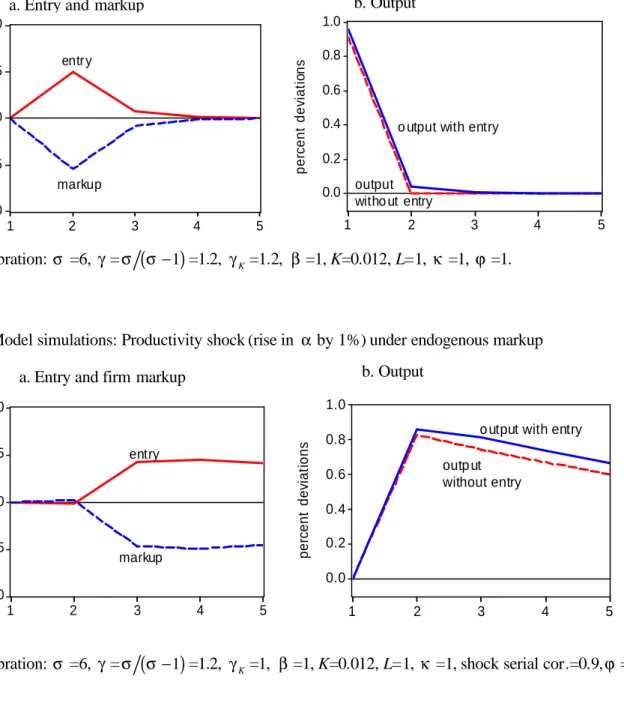
Figures 7 and 8 illustrate the dynamics for shocks in the linear approximation to the model.15 Observe …rst that in each case the markup in pricing falls in inverse proportion to the new entry. This is a useful implication, since countercyclical markups are a well-documented feature of business cycle data (see Bills, 1987; Rotemberg and Woodford, 1991). Next observe that there is now some positive persistence in the e¤ects of monetary policy on
1 5The calibration is the same as previous cases, with the additional parameter set to unity. So = 6;
= 1 = 1:2; K= 1for productivity for the shock experiment and1:2for the monetary shock experiment,
output, though the e¤ect is small. Finally, observe that the initial impact on entry for both shocks is about half of that observed with CES preferences and exogenous markups. The reason is that as more entry drives down the markup and hence pro…ts, it takes fewer new entrants to drive monopolistic pro…ts back down to the …xed entry cost. One interesting implication of this feature, is that now the rise in output is evenly split between the extensive and intensive margins, rather than all taking place at the extensive margin whenever entry is permitted. While empirical work is yet to be done on the precise breakdown of output deviations into intensive and extensive margins, the fact that endogenous markups allow this breakdown to be calibrated will likely prove useful as future research brings models of entry to the data.
The fact that the endogenous markup generates some persistence here means that serial dependence no longer can be eliminated by choosing K = 1. This precludes the type of analytical solution used in the previous section to rank formally the e¤ects of alternative monetary policies on entry and welfare analysis. Nonetheless, it is clear that endogenous markups provide an additional reason why entry matters for welfare. As more …rms enter and the market becomes more dense, the demand elasticity rises and markups fall, reducing the monopolistic distortion in the market. Consequently, this version of the model should predict an even wider range of cases where policies promoting greater entry would improve welfare.
8
Conclusion
This paper explores some basic monetary policy issues in a model with …rm entry. We use a stylized model in which …rms use monopoly pro…ts to pay a …xed cost of entry prior to each period of production, and in which prices are preset one period. In this context entry has implications for the transmission of monetary and technology shocks, with features similar to investment dynamics in standard models without entry. However, entry matters in terms of its implications for welfare, working through either love of variety in preferences, or the possibility that new entry may raise competitiveness in the market and reduce the monopolistic distortion.
We analyze reasons why stabilization policy has a role to play in promoting entry. Pre-vious literature has shown that, absent stabilization policy, uncertainty about productivity induces …rms to raise their markups and thereby lower welfare relative to their level in the ‡ex-price allocation. In this paper we replicate this result in an economy with entry. In addition, we show that, on average, uncertainty also lowers entry relative to a ‡ex-price al-location. Since the amount of entry can a¤ect welfare in the ways noted above, stabilization
policy has an additional role in regulating the optimal number of entrants, as well as the optimal level of production per …rm.
References
[1] Benassy, J-P., 1996, Taste for variety and optimum production patterns in monopolistic competition, Economics Letters 52, 41-47.
[2] Bergin P. and R. Feenstra, 2000, Staggered price setting and endogenous persistence, Journal of Monetary Economics 45 (3), 657-680.
[3] Bilbiie, F., F. Ghironi, and M. Melitz, 2005, Business cycles and …rm dynamics, Mimeo.
[4] Bils, M., 1987, The cyclical behavior of marginal cost and price, American Economic Review 77 (5) 647-666.
[5] Broda, C. and D. Weinstein, 2004, Globalization and the gains from variety, NBER Working Paper No. 10314
[6] Campbell, J. 1998, Entry, exit, embodied technology, and business cycles, Review of Economic Dynamics 1, 371-408.
[7] Chatterjee, S., R. Cooper, and B. Ravikumar, 1993, Strategic complementarity in busi-ness formation: aggregate ‡uctuations and sunspot equilibria, The Review of Economic Studies 60, 795-811.
[8] Christiano, L, Eichenbaum, M., and C. L. Evans, 1999, Monetary policy shocks: what have we learned and to what end? in J. Taylor and M. Woodford and eds., Handbook of Macroeconomics.
[9] Corsetti, G., P. Martin and P. Pesenti, 2005, Productivity spillovers, terms of trade and the ‘home market e¤ect”, CEPR DP 4964, NBER WP 11165.
[10] Corsetti, G. and P. Pesenti, 2001, Welfare and macroeconomic interdependence, Quar-terly Journal of Economics 116(2), 421-445.
[11] Corsetti, G. and P. Pesenti, 2005a, International dimensions of optimal monetary policy, Journal of Monetary Economics 52(2), 281-305.
[12] Corsetti, G. and P. Pesenti, 2005b, The simple geometry of transmission and stabiliza-tion in closed and open economy, NBER wp no. 11341, CEPR dp no. 5080, New York Fed Sta¤ Report no. 209.
[13] Devereux, M., A. Head and B. Lapham, 1996, Aggregate ‡uctuations with increasing returns to specialization and scale, Journal of Economic Dynamics and Control 20, 627-657.
[14] Dixit, A.K. and J. Stiglitz , 1974, Monopolistic competition and optimum product diversity, working paper version, published in The monopolistic competition revolution in retrospect, edited by Brakman and Heijdra, 2003, Cambridge University Press.
[15] Eichenbaum, Martin, and Charles L. Evans, 1995, Some empirical evidence on the e¤ects of shocks to monetary policy on exchange rates, Quarterly Journal of Economics 110 (4), 975-1009.
[16] ________, 2003, A homothetic utility function for monopolistic competition mod-els, without constant price elasticity, Economics Letters 78, 79-86.
[17] Ghironi, F. and M. Melitz, 2005, International trade and macroeconomics dynamics with heterogenous …rms, Mimeo.
[18] Jaimovich, Nir, 2004, Firm dynamics, markup variations, and the business cycle, Mimeo
[19] Kim, J. 2004, What determines aggregate returns to scale? Journal of Economic Dy-namics and Control 28, 1577-1594.
[20] Lucas, Robert E., Jr., 1987, Model of Business Cycles, Basil Blackwell
[21] Lucas, Robert E., Jr., 2003, Macroeconomic Priorities, American Economic Review 1, 1-14.
[22] Rotemberg, J. and M. Woodford, 1991, Markups and the business cycle, in O. J. Blanchard and S. Fischer (eds.), NBER Macroeconomics Annual 1991. Cambridge, MIT Press.
Appendix
Nonstochastic Steady state
In a non-stochastic steady state, the optimal price and the free entry conditions de…ned above are p= 1 n k 1 " L n [ +(1 ) ] 1 ( 1)1 ( ) 1# = K ( 1)( )
In general, the model is highly non linear, and the steady state allocation may not be unique. In some special cases, however, the solution becomes quite tractable. If k = 1, for instance, the number of …rms and varieties is
n ( 1) = L 1 ( 1)1 ( ) K ( 1)( ) + 1
Note that, as long as is not too large –so that the exponent ofnis positive –the number of …rms is increasing in the size of the country and patience (i.e., increasing in L and ), and decreasing in entry costs (i.e., decreasing in K, increasing in ). Lower marginal costs (an increase in productivity ) have however ambiguous implications.
Furthermore, withK= 0, the expression simpli…es to
n[ ( 1) ] = L
1 ( 1)1 ( )
When entry costs consist of labor costs only, and is su¢ ciently high, higher manufacturing productivity (a higher ) leads to exit in steady state (i.e., it leads to a lowern).
Pareto optimal allocation
This section of the appendix sets the planner problem and characterize the e¢ cient alloca-tion. Write the resource constraint for individual goodh
Yt(h) =LtCt(h) +nt+1Kt(h) In the aggregate ntYt(h) = nt Lt Ct nt +nt+1 Kt n K t = = n1t LtCt+nt+1n1t KKt Combining this expression with technology
we can rewrite the resource constraint for the economy as follows:
Lt`t=
n1t LtCt+nt+1n1t KKt
t
(A.1)
Write the Pareto problem
M ax 1 X =0 [lnC ` ] + (A.2) t ( Lt`t n1t LtCt+nt+1n 1 K t Kt t ) + Et t+1 ( Lt+1`t+1 n1t+1Lt+1Ct+1+nt+2n1t+1KKt+1 t+1 ) +:::
The …rst order conditions with respect to`andC are
+ tLt= 0 =) t= Lt 1 CP:O: t t nP:O: t 1 Lt t = 0 which imply: CtP:O: = t n P:O: t 1
The …rst order condition with respect tont+1 yields
t " nP:O: t 1 K Kt t # Et t+1 (1 ) Lt+1CtP:O:+1 t+1 nP:O:t+1 + (1 K)n P:O: t+2 Kt+1 t+1 nP:O:t+1 k = 0
Substituting the Lagrange multiplier and optimal consumption, we can also write: " nP:O: t 1 K Kt t # Et Lt Lt+1 (1 ) Lt+1 nP:O: t+1 1 + (1 K)n P:O: t+2Kt+1 t+1 nP:O:t+1 k = 0
In the case of no e¢ ciency gains from variety in investment, K = 1, this expression simpli…es to: nP:O:t+1 k=1= t Kt Lt ( 1) 1 :
which we use in the text. It is easy to verify that e¢ cient labor supply is constant and equal to (26) in the text.
Ranking entry over policy rules
In this section of the appendix, we derive the expressions (32) and (33) discussed in the main text. First, consider the case of no stabilization policy, where t= 1. From (31) we can write 1Et 1 1 t Kt= = 1 nno stabilize t+1 1 L+ 1 Et 1 t+1 Et nno stabilizet+2 Kt+1 Et nno stabilize t+2 Kt+1 t+1 :
Rearranging: nno stabilizet+1 Kt= 1 2L+Et h 1 t+1 i Et nno stabilizet+2 Kt+1 1Et hnno stabilize t+2 Kt+1 t+1 i Et 1 h 1 t i We see here that the product nno stabilize
t+1 Kt is a function of constants and expectations datedt, which are constant. Sonno stabilize
t+1 Kt is not time varying under this policy rule. Take expectations as oft 1: Et 1 nno stabilizet+1 Kt = = Et 1 21L+Et h 1 t+1 i Et nno stabilizet+2 Kt+1 1Et hnno stabilize t+2 Kt+1 t+1 i Et 1 h 1 t i = 1 2L+1Et 1 h 1 t+1 i Et 1 nno stabilizet+2 Kt+1 1covt 1 h 1 t+1; n no stabilize t+2 Kt+1 i Et 1 h 1 t i Since shocks are i.i.d., we can further simplify this:
Et 1 nno stabilizet+1 Kt = 8 < : 1 2 L 1 Et 1 h 1 t i+ 1Et 1 Kt+1nno stabilizet+2 1covt 1 h 1 t+1; Kt+1n no stabilize t+2 i Et 1 h 1 t i 9 = ; Entry is serially independent, expectations of the product of nno stabilize+1 K are the same
for all periods :
1 Et 1 nno stabilizet+1 Kt = 8 < : 1 2 L 1 Et 1 h 1 t i 1covt 1 h 1 t+1; n no stabilize t+2 Kt+1 i Et 1 h 1 t i 9 = ; 1 Et 1 nno stabilizet+1 Kt = = 1 ! 1 Et 1 h 1 t i 21L 1covt 1 1 t+1 ; nno stabilizet+2 Kt+1
Since with nominal rigidities,entry does not respond to productivity shocks, as discussed above, we know that in the case ofi:i:d:shocks the covariance terms on the right hand side is zero. We therefore can write (32) in the text.
Second, consider the case of stabilization policy with t= t, in which case the allocation coincides with the ‡exible price one. Again using (29) in (28), we can write
1 Kt t = Et ( t+1 1 " L nstabilize t+1 t+1 1 +n stabilize t+2 Kt+1 nstabilize t+1 #) = 1 L nstabilize t+1 + 1 1 1 nstabilize t+1 Et 1 t+1 nstabilizet+2 Kt+1 :
Rearranging nstabilizet+1 Kt t = 1 L1 + 1 1 Et 1 t+1 nstabilizet+2 Kt+1 = 21L+1Et 1 t+1 Et Kt+1nstabilizet+2 + 1 covt 1 t+1 ; nstabilizet+2 Kt+1
and take expectations as oft 1:
Et 1 nstabilizet+1 Kt; 1 t = = 21L+ 1Et 1 1 t+1 Et 1 nstabilizet+2 Kt+1 + 1 covt 1 1 t+1 ; nstabilizet+2 Kt+1 or Et 1 1 t Et 1 nstabilizet+1 Kt +covt 1 1 t ; nstabilizet+1 Kt = 21L+ Et 1 1 t+1 Et 1 nstabilizet+2 Kt+1 +covt 1 1 t+1 ; nstabilizet+2 Kt+1
As above, with i.i.d. shocks:
Et 1 1 t Et 1 nstabilizet+1 Kt +covt 1 1 t ; nstabilizet+1 Kt = 1 2 L + Et 1 1 t Et 1 nstabilizet+1 Kt+1 +covt 1 1 t ; nstabilizet+1 Kt+1 1 Et 1 1 t Et 1 nstabilizet+1 Kt +covt 1 1 t ; nstabilizet+1 Kt = 1 2 L
The expression (33) in the text follows.
Expected labor supply and the natural rate of employment
In this appendix we derive the expected labor supply under nominal rigidities. Using the resource constraint (A.1) and setting K= 1
`t=n1t Ct 1 t +nt+1 Kt t 1 Lt
SinceC= =PtandPt=n 1p=n1 1Et 1 t , we can rewrite the above as
`t= t 1Et 1 t 1 t +nt+1 Kt t 1 Lt
Take expectations at timet 1:
Et 1`t = 1 Et 1 t Et 1 t +Et 1 nt+1 Kt t 1 Lt = = 1 +Et 1 nt+1 Kt t 1 Lt
In the case of full stabilization of marginal costs, the monetary rule replicates the ‡exible price equilibrium. Hence, using the expectations of (23), and substituting into the above, we obtain Et 1`stabilizet = 1 + 1 1 = = 1 1 + = = 1 = 1 1 =`f lex
In the case of no stabilization we know that entry is independent of productivity shocks. Hence 1 Lt Et 1 nno stabilizet+1 Kt 1 t = = 1 Lt Et 1 nno stabilizet+1 Kt Et 1 1 t From the previous section of the appendix we know that:
Et 1 nno stabilizet+1 Kt = 1 1 L 1 Et 1 h 1 t i hence 1 Lt Et 1 nno stabilizet+1 Kt 1 t = = 1 Lt 1 1 L 1 Et 1 h 1 t iEt 1 1 t = = 1 1
Fig. 1. Comovement of entry measures with U.S output
1a. Net business formation
1b. New incorporations
-16 -12 -8 -4 0 4 8 1960 1965 1970 1975 1980 1985 1990 1995 net business formation GD P
-16 -12 -8 -4 0 4 8 12 1960 1965 1970 1975 1980 1985 1990 1995 new incorporations GDP
Fig 2. Response of entry measures to U.S. monetary policy shocks
2a. Nonborrowed reserves as indicator of policy innovations
-.004 .000 .004 .008 .012 .016 5 10 1 5 20 25 3 0 35 40 4 5
Re spo nse of net business fo rm atio n to inno vatio n in nonb orrowed re serve s
-.008 -.004 .000 .004 .008 .012 .016 .020 5 10 1 5 20 25 3 0 35 40 4 5
Re spo nse of new incorpo ratio ns to inno vatio n in nonb orrowed re serve s
2b. Federal Funds rate as indicator of policy innovations
-.010 -.008 -.006 -.004 -.002 .000 .002 5 10 1 5 20 25 3 0 35 40 4 5
Re spo nse of net business fo rm atio n to innovatio n in fe d eral fund s rate
-.012 -.008 -.004 .000 .004 .008 5 10 1 5 20 25 3 0 35 40 4 5
Re spo nse of new incorp oratio ns to innovatio n in fe d eral fund s rate
Fig 3: Model simulations: Productivity shock (rise in
α
by 1%) under flexible prices
-0.2 0.0 0.2 0.4 0.6 0.8 1.0 1.2 1 2 3 4 5 p e rc e n t d e v ia ti o n s entry firm size 0.5 0.6 0.7 0.8 0.9 1.0 1 2 3 4 5 p e rc e n t d e v ia ti o n so utput with entry
o utput witho ut entry
calibration:
σ
=6,
γ
=
σ σ
(
−
1
)
=1.2,
γ
K=1,
β
=1,
K
=0.012,
L
=1,
κ
=1, shock serial cor.=0.9
Fig 4: Model simulations: Shock to entry cost (fall in
K
by 1%) under flexible prices
-1.2 -0.8 -0.4 0.0 0.4 0.8 1.2 1 2 3 4 5 p e rc e n t d e v ia ti o n s entry firm size -1.0 -0.5 0.0 0.5 1.0 1 2 3 4 5 p e rc e n t d e v ia ti o n s
o utput with entry
calibration:
σ
=6,
γ
=
σ σ
(
−
1
)
=1.2,
γ
K=1,
β
=1,
K
=0.012,
L
=1,
κ
=1, shock serial cor.=0.9
a. Entry and firm size
b. Output
Fig 5: Model simulations: Monetary shock (permanent rise in
µ
by 1%) under sticky prices
-1.0 -0.5 0.0 0.5 1.0 1 2 3 4 5 p e rc e n t d e v ia ti o n s entr y firm size 0.0 0.2 0.4 0.6 0.8 1.0 1 2 3 4 5 p e rc e n t d e v ia ti o n soutput with entry
o utput without entry
0.0 0.2 0.4 0.6 0.8 1.0 1 2 3 4 5
calibration:
σ
=6,
γ
=
σ σ
(
−
1
)
=1.2,
γ
K=1.2,
β
=1,
K
=0.012,
L
=1,
κ
=1
Fig 6: Model simulations: Productivity shock (rise in
α
by 1%) under sticky prices
-0.2 0.0 0.2 0.4 0.6 0.8 1.0 1.2 1 2 3 4 5 p e rc e n t d e v ia ti o n s entry firm size 0.0 0.2 0.4 0.6 0.8 1.0 1 2 3 4 5 p e rc e n t d e v ia ti o n
s o utput with entry
o utput witho ut entry
calibration:
σ
=6,
γ
=
σ σ
(
−
1
)
=1.2,
γ
K=1,
β
=1,
K
=0.012,
L
=1,
κ
=1, shock serial cor.=0.9
a. Entry and firm size
b. Output
a. Entry and firm size
b. Output