University of Massachusetts - Amherst
ScholarWorks@UMass Amherst
Dissertations Dissertations and Theses
5-1-2010
The Effects of GoSolve Word Problems Math
Intervention on Applied Problem Solving Skills of
Low Performing Fifth Grade Students
Jessica Lynn Fede
University of Massachusetts - Amherst
Follow this and additional works at:http://scholarworks.umass.edu/open_access_dissertations
This Open Access Dissertation is brought to you for free and open access by the Dissertations and Theses at ScholarWorks@UMass Amherst. It has been accepted for inclusion in Dissertations by an authorized administrator of ScholarWorks@UMass Amherst. For more information, please contact [email protected].
Recommended Citation
Fede, Jessica Lynn, "The Effects of GoSolve Word Problems Math Intervention on Applied Problem Solving Skills of Low Performing Fifth Grade Students" (2010).Dissertations.Paper 236.
THE EFFECTS OF GO SOLVE WORD PROBLEMS MATH INTERVENTION ON APPLIED PROBLEM-SOLVING SKILLS OF LOW PERFORMING FIFTH GRADE
STUDENTS
A Dissertation Presented by
JESSICA L. FEDE
Submitted to the Graduate School of the
University of Massachusetts Amherst in partial fulfillment of the requirements for the degree of
DOCTOR OF PHILOSOPHY May 2010
School of Education School Psychology Program
© Copyright by Jessica L. Fede 2010 All Rights Reserved
THE EFFECTS OF GO SOLVE WORD PROBLEMS MATH INTERVENTION ON APPLIED PROBLEM-SOLVING SKILLS OF LOW PERFORMING FIFTH GRADE
STUDENTS
A Dissertation Presented by
JESSICA L. FEDE
Approved as to style and content by:
_____________________________________ William J. Matthews, Chair
_____________________________________ John M. Hintze, Member
_____________________________________ Margaret E. Pierce, Member
_____________________________________ Christopher E. Overtree, Member
___________________________________________ Christine B. McCormick, Dean
DEDICATION
I would like to dedicate this dissertation to my family and friends who have shown me an unlimited amount of support.
v
ACKNOWLEDGMENTS
I would not have been able to complete this research project without the help and support from some very talented individuals. I would like to start by thanking my committee members: John Hintze, Christopher Overtree, Margy Pierce and my dissertation chair Bill Matthews. I would like to thank Margy Pierce for presenting me with this research opportunity and supporting me through the data collection process and John Hintze for lending his expertise on the research design. Also, words cannot express my gratitude towards my dissertation chair Bill Matthews for his faith, patience, support, humor, and friendship throughout my graduate school career.
I would like to thank Craig Wells and Lisa Keller for helping me with the statistical aspect of this project. I would also like to acknowledge Alicia Gram for helping with data collection and the creation of the examiner-made probes. Finally, I would like to thank the staff, faculty, parents and students who participated in this project. I would especially like to thank Charlene Soverow, Marc Castanzi and Susan Federico for their interest and flexibility in seeing this project through to completion.
I would also like to extend a thank you to Gary Stoner, my first year advisor, for helping me fall in love with the field of school psychology. Thank you to Cindy McGurl and Walter Leopold for providing me with opportunities to develop my skills and expand my knowledge in the field of school psychology. Also, I would like to thank Rebecca Gajda and Vivian Ferry for teaching me how to be an effective teacher in the classroom as well as John Palmer, my undergraduate advisor.
vi ABSTRACT
THE EFFECTS OF GO SOLVE WORDPROBLEMS MATH INTERVENTION ON APPLIED PROBLEM-SOLVING SKILLS OF LOW PERFORMING FIFTH GRADE
STUDENTS MAY 2010
JESSICA L. FEDE, B.A., COLGATE UNIVERSITY M.A., BOSTON COLLEGE
Ph.D., UNIVERSITY OF MASSACHUSETTS AMHERST Directed by: Professor William J. Matthews
This research investigation examined the effects of GO Solve Word Problems math intervention on problem-solving skills of struggling 5th grade students. In a randomized controlled study, 16 5th grade students were given a 12-week intervention of GO Solve, a computer-based program designed to teach schema-based instruction strategies (SBI‟s) to solve math word problems and 16 control students continued with the standard school-based mathematics curriculum. A subset of items from the Massachusetts Comprehensive
Assessment System (MCAS) as well as the Group Mathematics Assessment and Diagnostic Evaluation (GMADE) was used to measure student test performance. Examiner-made probes were given to both the treatment and control groups every other week to measure student progress. Results indicate that the mean difference scores of the experimental and control groups were statistically significant on a subtest of MCAS problems and a large effect size was reported. However, no statistically significant difference between the experimental and control groups was found on the on the Process and Application subtest of the GMADE. On examiner-made probes, there was a statistically significant difference between the experimental and control groups. Limitations of this study as well as implications for practice will be discussed.
vii TABLE OF CONTENTS ACKNOWLEDGMENTS ... v ABSTRACT ... vi LIST OF TABLES ... ix LIST OF FIGURES ...x CHAPTER 1. STATEMENT OF THE PROBLEM ...1
Summary of Research on Mathematics Instruction ...1
United States Compared to Other Countries ...3
The Demand for Adequate Math Skills ...5
High-Stakes Mathematical Testing ...7
Mathematics Instruction ...8
Increased Focus on Problem-solving ...10
Raising Word Problem Achievement ...14
Mathematics Disabilities ...15
Differences in Problem-solving Skills...21
Effective Problem-solving Interventions and Research Themes ...23
Computer-Assisted Instruction ...31
Problem Personalization ...34
Schema-based Learning: A Theoretical Explanation ...36
Current Investigation ...40
2. METHODS ...43
Participants and Setting ...43
Instructional Environments ...44
Criteria for Inclusion ...45
Characteristics of Participants ...46 Research Design...47 Dependent Variables ...47 Independent Variable ...54 Procedure ...62 Control Group ...64
Data Analytic Plan ...64
3. RESULTS ...66
Descriptive Statistics ...67
Means and Standard Deviations for Pre-Test Measures ...67
Means and Standard Deviations for Post-test Measures ...69
MCAS Pre-Post Test Analysis ...70
GMADE Pre-Post Test Analysis ...71
Probe Data Analysis ...72
Math Anxiety Analysis ...74
GO Solve Student Survey ...75
4. DISCUSSION ...78
viii
Theoretical Explanations ...79
Limitations ...87
Selection ...87
Resentful Demoralization ...88
Financial and other Considerations ...88
Implications for Practice ...90
Future Directions ...93
Summary and Conclusions ...94
APPENDICES A. STUDENT AND PARENTAL CONSENT FORMS………96
B. ITEM RESPONSE THEORY DATA ...99
C. TEST CHARACTERISTIC CURVE ...100
D. MCAS PRE-TEST ...101
E. POST-TEST MCAS ...108
F. ADMINSTRATION INSTRUCTION FOR THE EXAMINER-MADE WORD PROBLEM PROBES ...114
G. EXAMINER-MADE PROBES ...115
H. MATH ANXIETY QUESTIONNAIRE ...129
I. QUESTIONNAIRE ABOUT GO SOLVE WORD PROBLEMS ...130
J. SUM OF SQUARES………..133
ix
LIST OF TABLES
Table Page
1.1 Learning Differences Between Good and Poor Problem-solvers……… 22 1.2 Problem Solving Strategies………... 25 2.1 Level 5 GMADE Process and Application Subtest Reliability Coefficients ….. 51 2.2 Sequence of the Administration of Dependent Measures……… 54 2.3 Timeline for Screening, Pre-testing, Interventions, and Post-testing ………. 63 3.1 Descriptive Statistics at Pre-test………... 69 3.2 Descriptive Statistics at Post-test……….. 69 3.3 Means and Standard Deviations for Gain Scores by Group………. 70 3.4 Means and Standard Deviations of Examiner-Made Probes at Seven Time
Points……… 72
3.5 Means and Standard Deviations for Gains on the Mathematics Anxiety
Rating Scale……….. 74
3.6 Means and Standard Deviations of the Go Solve Student Survey……… 75
x
LIST OF FIGURES
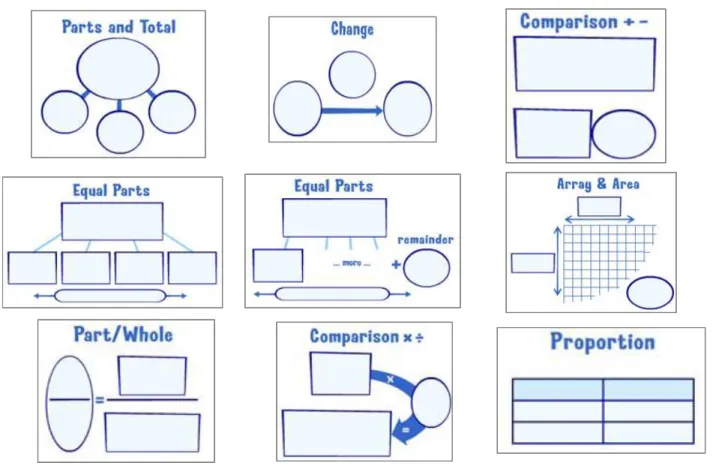
Figure Page 2.1 Graphic Organizers for Go Solve Word Problems ... 59 3.1 Estimated Marginal Means of Measure ... 73
1 CHAPTER 1
STATEMENT OF THE PROBLEM
The passage of No Child Left Behind Act of 2001 has placed heavy emphasis on outcomes for all students and has forced school districts to adopt evidence-based teaching methods and interventions (U.S. Department of Education, 2005). However, most of the research conducted as a result of this legislation has focused on improving reading
instruction outcomes (U.S. Department of Education, 2005). Over the last two decades, and more recently, with the National Reading Panel (2000) identifying the five major
components of reading, a great deal of progress has been made in understanding reading difficulties. Disabilities and instruction in mathematics, however, have not been as closely studied (Fuchs & Fuchs, 2001).
Summary of Research on Mathematics Instruction
Fuchs, Compton, Fuchs, Paulsen, Bryant, and Hamlett (2005) found that compared to the areas of reading and reading instruction, less is known about effective mathematics instruction and interventions that can aid children struggling in mathematics. Even with the lack of research and attention given to the area of mathematics, two of the most commonly observed academic problems for children with learning disabilities involve difficulties acquiring basic skills in mathematics and reading (Robinson, Menchetti, & Torgesen, 2002). Furthermore, Fuchs and Fuchs (2001) indicate that prevention of mathematics difficulties in the United States is generally ineffective, not only for students with learning disabilities, but for non-disabled learners as well. Gersten, Baker, and Lloyd (2000) reported that one of reasons for the lackluster mathematics performance includes the scarcity of well designed intervention studies to validate effective teaching practices, now at their lowest level in 30
2
years. No doubt the lack of research on effective mathematics instruction, prevention and interventions contributes to the poor performance of U.S. students in mathematics.
In 2001, the report Adding It Up by the National Research Council (NRC) announced the findings of an 18-month project in which 16 experts in the field synthesized relevant research on mathematics learning from pre-kindergarten through Grade 8. The report
concluded that research has consistently shown the weakness of U.S. students in mathematics (National Research Council, 2001). The National Assessment of Educational Progress (NAEP) (2005) survey of The Nation’s Report Card reported that 64% of 4th grade students failed to demonstrate a “proficient” level of required math skills (Perie, Grigg, & Dion, 2005). On the 2003 NAEP assessment, only 29% of 8th grade students scored at the proficient level in mathematics. Students who did reach proficiency struggled with mathematical knowledge, application to real-world situations, and mathematics analytic skills. Furthermore, NAEP (2003) found that although the trends for improvements in math have increased between the years 1990 to 2000, there are still a large number of students who have substantial trouble solving math problems. In addition, many studies indicate that even though U.S. students may not fare badly when asked to perform straightforward
computational problems, they nonetheless have difficulty understanding basic mathematical concepts in word problems (National Research Council, 2001). For example, on the 2005 NAEP assessment, the following problem was given to 4th grade students: A club needs to sell 625 tickets. If it has already sold 184 tickets to adults and 80 tickets to children, how many more does it need to sell? Forty-four percent of 4th graders answered correctly, obtaining an answer of 361. However, 66% of students obtained an incorrect answer, answering 809. Clearly, many students in the United States struggle when solving word problems. According to NAEP reports dating back over 25 years, one of the greatest deficits
3
in U.S. students‟ learning of mathematics is their ability to solve word problems (National Research Council, 2001).
United States Compared to Other Countries
The RAND Mathematics Study Panel (2003) was convened to inform the United States Department of Education‟s Office of Educational Research on ways to improve the quality and usability of education research and development. One of the primary reasons for creating the panel was to better develop proficiency in mathematics in light of the current United States educational standards and the lackluster mathematics performance of United States students compared to the performance of students in other countries (RAND
Mathematics Study Panel, 2003). In 2008, President Bush established the National
Mathematics Advisory Panel via Executive Order 13398. The panel, which was supported by the United States Congress, indicated “international and domestic comparisons show that American students have not been succeeding in the mathematical part of their education at anything like a level expected of an international leader” (National Mathematics Advisory Panel, p. xii). Clearly, a need exists for substantial improvements in the mathematical achievements of U.S. students.
International comparisons of mathematics achievement demonstrate many of the same findings as the NAEP results. On several international mathematics assessments conducted since the 1970s, the overall performance of U.S. students has lagged behind the performance of students in other countries. Currently, the most comprehensive study is the
Third International Mathematics and Science Study (TIMSS), which is the third comparison of mathematics and science achievement carried out since 1995 by the International
4
to the curricula of the participating countries, providing an indication of the degree to which students have learned the concepts in mathematics and science to which they have been exposed in school. The most recent TIMSS report results indicate that United States‟ 4th graders performed lower than their peers in eleven countries (Singapore, Hong Kong, Japan and Chinese Taipei, being the top four). Furthermore, United States‟ 8th
graders performed lower than students in nine countries (Singapore, Hong Kong, Chinese Taipei and Japan, being the top four). Results from the 2003 TIMSS also indicated that only 7% of U.S. 8th grade students scored at the advanced level, compared to about one-third of students from the highest performing countries (Singapore, Chinese Taipei, Korea, and Hong Kong). A report disseminated by the Programme for International Student Assessment (PISA) further
illustrates how poorly American students are performing in the area of mathematics. The 2000 PISA report indicated that about two-thirds of the students in participating countries had average scores in mathematical problem-solving which were above those of U.S. students; in 2003, more U.S. students scored at or below the lowest level of proficiency in problem-solving than the international average (Kinder & Stein, 2006). In addition, unlike countries in which a national curriculum exists in mathematics (e.g. Japan and China), in the United States, the curriculum frameworks are developed by each state (Reed, 1999). Overall, reports have consistently underscored that American students have fallen behind students from other industrialized countries in mathematics (Beaton, Mullis, Martin, Gonzalez, Kelly & Smith, 1996; Geary, 1996; Kinder & Stein, 2006; Ysseldyke, Betts, Thill, & Hannigan, 2004).
Clearly, the disappointing mathematics achievement levels of middle school students in the United States have been well-documented, based on both national and international assessments. Too few U.S. students are “leaving elementary and middle school with adequate
5
mathematical knowledge, skill and confidence for anyone to be satisfied that all is well in school mathematics” (National Research Council, 2001, p. 407).
The Demand for Adequate Math Skills
The disparate performance of American students with respect to their international peers is alarming, given the growing demand for math proficiency and the need for math problem-solving skills in upper levels of employment. The National Research Council (2001) reported that the mathematical skills of students in the U.S. are falling short of what is needed in the workplace. United States‟ students with weak mathematics skills will be adversely affected not only inside the classroom, but also outside the classroom and in the real world.
Today, it is essential for students to learn the necessary mathematics skills in order to attain success in society. According to the NRC‟s (2001) report Adding It Up, “children today are growing up in a world permeated by mathematics. The technologies used in homes, schools, and the workplace are all built on mathematical knowledge” (p. 15). Yet, many students struggle to acquire basic mathematic skills. According to the NRC (2001),
Public concern about how well U.S. schoolchildren are learning mathematics is abundant and growing. The globalization of markets, the spread of information technologies, and the premium being paid for workforce skills all emphasize the mounting need for proficiency in mathematics. Media reports of inadequate teaching, poorly designed curricula, and low test scores fuel fears that young people are deficient in the mathematical skills demanded by society. (p. xiii)
The United States is currently experiencing a need for critical educational change. According to National Council of Teacher of Mathematics (NCTM) (2000), new knowledge, tools, and ways of performing and teaching mathematics are blossoming. The need to understand the demands for competency in mathematics as it applies to everyday life
6
continues to grow. Increased use of technology in American society indicates that the United States cannot afford to provide children with inadequate mathematics instruction and
education (Glenn, 2000). Business leaders have claimed that the labor force in our information-oriented society needs more sophisticated mathematical skills, especially the ability to communicate with mathematical systems and to solve a variety of complex problems (Reed, 1999). Glenn (2000) estimates that approximately 85% of jobs can be classified as skilled, with jobs in the health and computer industries continuing to increase. According to the National Mathematics Advisory Panel (2008):
During most of the 20th century, the United States possessed peerless mathematical prowess -- not just as measured by the depth and number of the mathematical specialists who practiced here, but also by the scale and quality of its engineering, science, and financial leadership, and even by the extent of mathematical education in its broad population. But without substantial and sustained changes to its educational system, the United States will relinquish its leadership in the 21st century. (p. xi)
Even with job demands requiring greater emphasis on mathematical problem-solving and the need for individuals to possess mathematical skills, schools are not preparing students adequately. The learning and teaching of mathematics has not kept up with the changes in the labor force brought about by advances in technology (Reed, 1999). Although many individuals may have been taught calculation skills, oftentimes they remember rules that are not grounded in understanding (RAND Mathematics Study Panel, 2003).
According to the NCTM‟s Principles and Standards for School Mathematics (2000), “those who understand and can do mathematics will have significantly enhanced
opportunities and options for shaping their futures. A lack of mathematical competence keeps those doors closed” (p. 5). Furthermore, a report published by the U.S. Department of Labor (1991) emphasized the importance of thinking, reasoning, and problem-solving skills.
7
According to the NRC‟s report Adding It Up (2001), “citizens who cannot reason mathematically are cut off from the whole realm of human endeavor” (p. 15). American children need to be leaving school with adequate mathematics skills in order to be
competitive within the workforce, given that more jobs require mathematical skills. Phillips (2007) reports that 78% of adults cannot explain how to compute the interest paid on a loan and 71% cannot calculate miles per gallon on a trip. The RAND Mathematics Study Panel (2003) indicates, “the personal, occupational and educational demands placed on all Americans in the 21st century call for a level of a mathematical proficiency that in generations past was required of only a few” (p. 77).
High-Stakes Mathematical Testing
To ensure that students are meeting standards, states and districts have mandated and developed a variety of mathematical assessments. High-stakes testing has caused an increase in expectations for student performance and has generated a significant amount of
controversy regarding how these tests are developed and administered. Reform efforts such as the accountability movement have aimed to improve mathematics instruction for all students. However, disagreement has centered on the specific competencies that should be measured (Miller & Mercer, 1997). During the first test given in the spring of 1999, Arizona, for example, had a 1 in 10 sophomore pass rate (National Research Council, 2001). In addition, many states such as Massachusetts and New York have lowered passing scores on exams; however, in order to graduate, students must pass these tests.
Despite the controversy, the trend of requiring testing for graduation has gained much momentum. Lerner (1993) indicated that over three-quarters of all school districts in the United States require high school students to pass a minimum competency test before
8
receiving a diploma. Minimum competency testing has been debated in Massachusetts with respect to the Massachusetts Comprehensive Assessment System (MCAS). Many have argued about the difficulty of the test, while others have focused on its content. For example, some educators have focused on the mathematics section of the MCAS and the way it aligns with the curriculum and standards taught in the classroom. A thorough examination of the MCAS reveals great emphasis is placed on a child‟s ability to solve applied mathematical problems. Most problems are presented in a word problem format. Given the emphasis placed on applied mathematical problems on state tests such as the MCAS, students must acquire the necessary skills to solve complex mathematical problems. In addition, given the increased emphasis on the importance of mathematical problem-solving and the poor performance of students, many researchers have chosen to seek better instructional approaches and interventions for teaching these skills with greater efficacy and success (Babbitt & Miller, 1996).
Mathematics Instruction
Over the last ten years, a great deal of attention has been paid to curriculum reform in mathematics education, which is slowly starting to find its ways into American classrooms (Alper, Fendel, Frasser, & Resek, 1995). The strongest push for change has come from mathematics educators who have argued that current instruction has focused too much on efficient computation and not enough on problem-solving and mathematical understanding (Reed, 1999). The NCTM (2000) outlined critical content and process standards in the
Principles and Standards for School Mathematics. These standards have created a roadmap for the creation and development of textbooks and assessments (O‟Connell, 2007). Further, these standards have help to guide thinking of what should be taught in American
9
classrooms. The first five standards outline the content standards related to number and operations, algebra, geometry, measurement, and data analysis and probability (NCTM, 2000). The second set of standards outlines the process goals including problem-solving, reasoning and proof, communication, connections, and representations (NCTM, 2000). These standards must be taught to all children efficiently regardless of whether or not they have a disability. Jitendra and Xin (1997) emphasize the importance of providing quality instruction to students with disabilities and those at-risk for mathematical failure.
The NRC (2001) identified the following five components required for successful mathematical proficiency:
conceptual understanding- comprehension of mathematical concepts, operation, and relations
procedural fluency- skill in carrying out procedures flexibly, accurately, effectively, and appropriately
strategic competence- ability to formulate, represent, and solve mathematical problems
adaptive reasoning- capacity for logical thought, reflection, explain, and justification
productive disposition- habitual inclination to see mathematics as sensible, useful, and worthwhile, coupled with a belief in diligence and one‟s own efficacy.
The Council stressed that these five strands should be interwoven and interdependent by indicating:
One of the most serious and persistent problems facing school mathematics in the United States is the tendency to concentrate on one standard of proficiency to the exclusion of the rest. The integrated and balanced development of all five standards of mathematical pro- efficiency should guide the teaching and learning of school mathematics. Instruction should not be based on extreme positions that students learn, on one hand, solely by internalizing what a teacher or book says or, on the other hand, solely by inventing mathematics on their own. (p. 11) In response to these recommendations by the NCTM and the NRC, districts have begun to adopt curricula that follow and incorporate all of the standards. The six basic
10
principles that have guided curriculum reform and implementation are as follows: 1) equal opportunity for all students, 2) a comprehensive and coordinated curriculum across grades, 3) excellent teachers who have the content and pedagogical knowledge for assessing and
instructing students, 4) active construction of knowledge by students who are empowered mathematically, 5) appropriate assessment that provides direction for instruction and
supports learning, and 6) technology as an essential component of mathematics teaching and learning (NCTM, 1989, 2000). According to Montague and Jitendra (2006), teachers and districts have adjusted and modified curricula and instruction which represents a dramatic departure from traditional models. In addition, these new curricula, together with the
principles disseminated by the NCTM (2000), emphasize the importance of problem-solving, conceptual understanding, and communication concerning mathematics.
Increased Focus on Problem-solving
NCTM (2000) has identified problem-solving as its number one priority. It has become quite clear that an individual‟s ability to problem-solve in mathematics enhances his or her ability to function in the context of everyday situations and work settings (Bottge & Hasselbring, 1993). Results of the 2003 PISA study reveal that performance by United States‟ 15 year-olds in math problem-solving when compared to other leading industrialized nations is alarming (National Center for Education Statistics, 2004). Specifically, in the area of problem-solving, United States‟ students scored below the average scores of other
industrialized countries and lower than 25 of the other 38 participating countries.
Lackluster mathematics performance may stem in part from the lack of a common understanding of what problem-solving entails. Babbitt and Miller (1996) indicate that understanding what is meant by mathematical problem-solving can be very complex and confusing to many. Depending on whom you ask, the answer to the question “What is
11
problem-solving?” can vary. Mercer and Miller (1992) examined ten books and numerous articles about problem-solving and identified thirty-seven different descriptors of
mathematical problem-solving. Mayer and Hegarty (1996) defined problem-solving as “a process of moving from a given state to a goal state with no obvious way to progress from one state to the other state” (p. 31). Mathematical problem-solving encompasses the use of knowledge, skills, and strategies to solve novel problems (Xin & Jitendra, 2006). Chen and Liu (2007) indicate that most word problems consist of a “three component structure”: (a) a “set-up component,” consisting of the roles and places in the story problem, (b) an
“information component,” which provides the data required to solve the problem, and (c) a “question component,” which is the main question students are asked to solve (p. 106). Yet, even without agreement about the definition, according to Jonassen (2003), problem-solving is perhaps the most important component of mathematics. As O‟Connell (2007) states, “the ability to solve problems is the ultimate goal of mathematics” (p. 1). One of the primary goals in teaching mathematics is not to simply teach students to add, subtract, multiply and divide, but rather, to apply these various mathematics skills to solve word problems. When students are engaged in problem-solving tasks, they are able to develop an understanding of math content and use that content understanding to find solutions to problems.
In the United States, the structure of the math curriculum and the content of many math textbooks have reinforced a procedural approach to solving math word problems that undermines deep understanding. Traditional mathematics textbooks often do not provide the instruction that is recommended by the NCTM (Griffin & Jitendra, 2008). A study which examined five 3rd grade mathematics textbooks and assessed how they matched with the standards, Jitendra, Sczeniak, and Deatline-Buchman (2005) found that the textbooks inadequately addressed them. Specifically, opportunities for reasoning and making
12
connections were present in less than half the instances in these textbooks. Many problems in textbooks allow students to look at a few key words and numbers to apply the algorithm; they do not actually have to read and understand the problems. Sometimes the key word or direct translation approach may lead to success narrowly; however, this is not always applicable to all problems.
A great deal of mathematics instruction in the United States skips the steps of understanding and modeling the situation and moves directly towards a problem‟s solution. Much instruction has primarily focused on key words which “subverts mathematical
understanding” and oftentimes leads to wrong answers (Clement & Bernhard, 2005, p. 364). Mathematics curricula and textbooks have historically reinforced a procedural approach to tackling math word problems that undermines deep understanding. According to the NRC (2001), in comparison with the curricula of countries achieving well on international comparisons assessments, “U.S. elementary and middle school mathematics curriculum has been characterized as shallow, undemanding, and diffuse in content coverage” (p. 4). Stigler, Fuson, Ham, and Kim (1986) found that a textbook chapter usually presents a few
mathematics problems for students to learn and then is typically followed by a set of
similarly structured word problems that are related and are often in simple form. In addition, according to van Garderen (2006), traditional mathematics textbooks do not make explicit the relationship between numerical operations. Many textbooks organize problems in such a way that require students to solve word problems using all the same operation (Jitendra, Griffin, Haria, Leh, Adams, & Kaduvettoor, 2007). This does not allow students to have the opportunity to discriminate and learn about problems that require different strategies and solutions to solve.
13
According to Griffin and Jitendra (2008), most textbooks include general strategy instruction (GSI) that involves the use of heuristic and multiple strategies based on Polya‟s seminal principles for problem-solving . Polya‟s four-step problem-solving model includes: a) understanding the problem, b) devising a plan, c) carrying out a plan, and d) looking back and reflecting (Polya, 1957). However, GSI has recently come under scrutiny. Even though students are exposed to a variety of strategies and are encouraged to develop different ways of thinking about a problem, GSI does not train them to approach problem-solving in a systematic manner (Jitendra et al., 2007). Historically, a few experimental studies have explored specific instructional methods in the area of mathematics problem-solving (Kinder & Stein, 2006). Miller, Butler, and Lee (1998) synthesized the research on teaching
mathematics problem-solving to students with learning disabilities and identified the following effective problem-solving interventions: cognitive and metacogntive strategy instruction, the use of manipulatives and drawing, use of schematic diagrams, and direct instruction involving fact families. According to Kinder and Stein (2006), many research reviews indicated that student performance improved through the use of peer tutoring, directed instruction, and systematic feedback. Fennema et al. (1996) found that the gain in students‟ concepts and problem-solving performance appears to be directly related to changes in teachers‟ instruction. In the classrooms, gains were reported. Although
researchers were not able to directly connect the gains with specific changes, changes were seen across many dimensions which included: teachers providing more opportunity for students to reflect on concepts and engage in problem-solving, children being allowed to share their thinking, and teachers whose instruction was identified as being more cognitively guided to the problem-solving of children.
14
Research conducted by Miller, Butler, and Lee (1998) found that specific
instructional procedures were of particular importance, including teacher demonstrations and student modeling. Specifically, research has shown that students need to have clear mental models and an understanding in order to make sense of the problems they encounter. For instance, research has shown a preference for video rather than text formats for constructing these mental models. According to the Cognition and Technology Group at Vanderbilt (1990), “It is dynamic, visual, and spatial, and students can more easily form rich mental models of the problem situation” (p. 2). More research is needed on evidence-based instructional practices in teaching mathematical word problems.
Raising Word Problem Achievement
The new mathematics curriculum standards have led both general and special educators to explore ways to help students with and without disabilities develop proficiency in problem-solving; however, gains in performance have been difficult to achieve for a variety of reasons (Cawley, Parmar, Yan, & Miller, 1998). According to Reed (1999), educators and cognitive scientists have criticized word problems as being too artificial in order to transfer to real-world situations. For example, Brown, Collins and Duguid (1989) stated the following in their influential article entitled “Situated Cognition and Culture of Learning”:
Math word problems, for instance, are generally encoded in a syntax and diction that is common only to other math problems…By participating in such ersatz activities, students are likely to misconceive entirely what practitioners actually do. As a result, students can easily be introduced to a formalistic, intimidating view of math that encourages a culture of math phobia rather than one of authentic math activity. (p. 34).
Word problems can pose difficulties for students because of the complexity of the problem-solving process (Jonassen 2003; Xin & Jitendra, 2006) and have always been
15
difficult for many students, but it is particularly so for students with learning disabilities. For instance, many students with disabilities have difficulties determining the correct operational process for solving the word problem as well as identifying and ignoring
extraneous information (Lee & Hudson, 1981). In addition, according to Montague and Bos (1986), many children, especially children with disabilities, have difficulties completing all the steps to a word problem.
Research has shown that many students with learning difficulties also have difficulties with language. Learner (1993) indicates that children with language disorders may also have confusion with mathematics vocabulary, for instance, the terms “take away,” “minus,” “add,” and “borrowing.” In order for students to be able to complete word problems successfully, they need to understand the underlying language structure. Additionally, research has shown that some students oftentimes have no difficulty with the language they encounter, but are confused when the language in a word problem is not exactly like their own. Overall, many researchers have documented a number of reasons why it has been difficult raising math achievement of students with and without disabilities (Bottge, Heinrichs, Chan, & Mehta, 2003; Cawley et al., 1998).
Mathematics Disabilities
As the previous section outlined, today, children present with a wide range of academic needs which can impede the improvement of problem-solving skills. Research on mathematics disabilities and how they affect learning has lagged behind immensely
compared to the area of reading disabilities (Fuchs & Fuchs, 2001; National Research Council, 2001). According to Bryant and Bryant (2008), when compared to the research base in reading difficulties, identification of mathematics disabilities is limited at best. The problem of mathematics underachievement appears to be particularly severe for students
16
with disabilities and those at risk for mathematics failure (Carnine, Jones, & Dixon, 1994). According to Brian, Bay, Lopez-Reyna, and Donahue (1991), at least a quarter of students with learning disabilities are identified for special education services because of significant discrepancies between aptitude and mathematics performance. According to the 21st Report to Congress (Glenn, 2000), students with disabilities have lower math skills than their general education peers. Jordan, Kaplan, Locuniak, and Ramineni (2007) reported that students with math disabilities usually fall at or below the 15th percentile on standardized math tests, despite having average or above average intelligence. Powell, Fuchs, Fuchs, Cirino, and Fletcher (2009) reveal that studies examining mathematics disabilities often have different procedures for identifying students. For instance, common criteria include
performance 1, 1.5, or 2 deviations below the mean of a national normative framework, discrepancies of one or two deviations between achievement and IQ (Parmar, Cawley, & Frazita, 1996), or nationally norm-referenced percentile cutoff points, with cutoffs points including the 10th, 25th, 31st, 35th, or 45th percentiles (Mazzocco & Thompson, 2005). Therefore, students identified as having math difficulties in one study might fail to meet the inclusion criteria in another.
Another source of confusion stemmed from the labels used to characterize students who demonstrate challenges in learning and applying mathematics skills and concepts (Bryant & Bryant, 2008; Fuchs & Fuchs, 2005; Jitendra et al., 2005). One common way to identify students is with the label of mathematics learning disability (MLD). Research has shown a large percentage of students receiving learning disability services experience difficulties with mathematics calculation or mathematical reasoning, not attributable to other conditions (Bryant, Bryant & Hammill, 2000). For over 20 years, math disabilities have been recognized as a type of learning disability, as evidenced by the inclusion of mathematics in
17
the two most pertinent definitions of learning disabilities: the National Joint Committee on Learning Disabilities and the Individuals with Disabilities Act (Bryant et al., 2000).
Severe problems in mathematics are oftentimes referred to as dyscalculia, yet another term that is commonly used to describe students struggling in mathematics. According to Shalev, Manor, Kerem, Ayali, Badichi, Friedlander, and Gross-Tsur (2001), dyscalculia is a specific learning disability affecting the acquisition of arithmetic skills in an otherwise normal child. Other researchers have described dyscalculia in a somewhat different way. Landerl, Bevan, and Butterworth (2004) described dyscalculia as a condition in which a child is born with a condition that affects his or her ability to acquire the usual arithmetical skills.
As a more inclusive definition for students who struggle in mathematics, researchers have sometimes used the term mathematical difficulties to describe students who perform below certain benchmarks, regardless of etiology. This term allows researchers to include students whose math difficulties may stem from poor instruction or economic disadvantage, students who would be excluded under the terms described above (Mazzacco, 2007).
Barbaresi, Katusic, Colligan, Weaver, and Jacobson (2005) conducted a population-based prevalence study in the United States and have suggested that the cumulative incidence of math learning disability ranges from six to fourteen percent, depending on the way
mathematics disabilities are defined. Lyon (1996) reports similar estimates, and that six percent of school-aged children are identified as having difficulties in mathematics that cannot be attributed to low intelligence. However, it is difficult to determine the prevalence of mathematical disabilities, since definitions differ and diverse learning difficulties overlap with mathematical deficits (Wadlington & Wadlington, 2008). According to Geary (2000), there are no universal criteria for diagnosing math difficulties and disabilities. With no
18
universal criteria and differing definitions, diagnosing mathematics disabilities can be very subjective.
Some controversy stems from the issue of whether or not a math learning disability (MLD) stems from a universal core deficit, or whether subtypes of students may show different profiles of strength and vulnerability in the wide range of skills related to
mathematics. One potential candidate for the core deficit underlying MLD is number sense, the ability to quickly understand, approximate and manipulate numerical quantities
(Dehaene, 1997). Wilson and Dehaene (2007) have argued convincingly that a core deficit in number sense is related to impairment in a region of the parietal cortex that specializes in approximate magnitude processing. Butterworth (2005) concurs, arguing that the human brain is hardwired for processing numbers. According to Butterworth, the difficulty some students have with mathematics can be traced to two main causes – genetics and inadequate instruction. He further explains that the reasons for inadequate performance in mathematics can be the result of genetics or, in a small number of instances, dyscalculia or dyslexia, which can impair mathematical ability. Clearly, more information is greatly needed about mathematics disabilities to inform the practices of early identification, intervention, or instructional modifications of children with persistent difficulty in mathematics (Garrett, Mazzocco, & Baker, 2006).
In contrast, efforts to identify subtypes of MLD have focused on the variability displayed by students in the range of skills important in mathematics, including memory, visual-spatial processing, language, phonological processing (or co-morbid reading disability and math disability). One of the most prominent models of the subtypes of MLD was
developed by David Geary (2000), who identified the following potential subtypes of dyscalculia:
19
1. Semantic memory: difficulty retrieving arithmetic facts
2. Procedural memory: difficulty understanding and applying mathematical procedures
3. Visuospatial memory: difficulty understanding spatially represented numerical information such as misalignment of columns, place value errors, or geometry This model highlights the role of memory in mathematics. In fact, research has demonstrated that many students who exhibit memory problems and who are slower in processing
information lack the ability to retrieve arithmetic combinations that are often needed to solve mathematical problems commonly encountered in middle school (Bryant, Kim, Hartman & Bryant, 2006). Students who have memory difficulties can also have problems in recalling and executing the multiple steps that are needed to solve complex problems such as word problems (Bryant et al., 2006).
Another effort at identifying subtypes of students with MLD has focused on students with language difficulties (Wadlington & Wadlington, 2008). Many children with
mathematical disabilities also struggle with language; therefore, language skills become very important to math achievement. The use of language is necessary for calculations and word problems (Miller & Mercer, 1997). When computing, language skills are needed to
systematize the recall and use of many procedures, rules, and math facts. Math problem-solving is also complicated by students‟ difficulty reading and understanding the language in word problems. Englert, Culatta, and Horn (1987) have found that irrelevant numerical and linguistic information in word problems are especially troublesome for many students with MLDs. Moreover, children with auditory comprehension problems may have difficulty learning new math concepts when they are presented orally. Similarly, children with
20
language retrieval deficits can exhibit problems explaining their thinking aloud (Wadlington & Wadlington, 2008).
The final line of research looking at subtypes of MLD considered the role of phonological processing as a common and underlying cause of both reading and math disabilities. Research has shown that some students perform poorly in mathematics yet perform relatively well in reading, whereas others perform poorly in mathematics and have concurrent reading difficulties. Hecht (2002) found that students may struggle both with reading and math due to weak phonological processing skills, whereas math difficulties that occur without concurrent reading difficulties may be due to poor number sense. Research has also shown that there are differences between students who have both math and reading disabilities (MDRD) and students with just math disabilities (MD-only). For example, Geary, Liu, Chen, Saults, and Hoard (1999) conducted a study in the fall and spring of 1st grade which assessed the performance of 25 students with MDRD and 15 students with MD-only MD-only on a global mathematics test. MDRD students scored below the 20th percentile on math and reading, whereas MD-only students scored below the 20th percentile in math but had average reading scores. In addition, on comprehension measures, MDRD students performed significantly below MD-only students and average-performing peers, and many MDRD students were unfamiliar with proper representations of numbers. Furthermore, Pellegrino and Goldman (1987) found that even when simple calculations are required to solve word problems, both MDRD and MD-only students struggled with problem-solving compared to average performing peers, but MD-only students generally outperform MDRD students. There is some evidence that “when IQ and reading are controlled, „true‟ math deficits are specific to mathematical concepts and problem types” (Zentall & Ferkis, 1993, p. 6).
21
According to Bryant et al. (2008), much like current practices in early reading instruction, the achievement gap of students with disabilities compared to their typically achieving peers will remain problematic without preventive practice in the early grades. One of the contributing factors in mathematics instruction in special education, especially, has been focused on teaching rote memorization of facts and computational skills instead of developing important concepts and applying mathematics to real-world problem situations (Baroody & Hume, 1991). Jitendra, DiPipi and Perron-Jones (2002) indicate many researchers argue that “highly procedural instruction (meaningless drill and practice of computation facts) may sustain the characterization of students with learning disabilities as passive learners and fail to fill the gaps in their concepts” ( p. 23). Therefore, it is not surprising that students with learning disabilities have difficulty with higher level
mathematics skills, for example, solving word problems. However, Fuchs and Owen (2002) concluded that when elementary-aged students with mild disabilities are taught a strategy to solve math word problems, their performance on process and product was better than that of students who received conventional instruction. In addition, their study showed that an emphasis on transfer skills and peer mediation improved student performance. Overall, prior to 2000, research did not seem promising with respect to the remediation of children who are struggling and have a disability in mathematics. However, with the introduction of recent interventions, positive outcomes are much more promising.
Differences in Problem-solving Skills
Research on mathematical disabilities has contributed to our understanding of the development of problem-solving skills in school-aged children. Much of this work has focused on comparing the characteristics of good and poor problem-solvers. Research had shown that good math problem-solvers develop a representation of the problem they are
22
attempting to solve, and that students construct a mental model of the information and the relationships among the elements of the problems (Riley, Greeno, & Heller, 1983). Students are then able to take this information to select a solution strategy and apply the strategy to find the answer. Montague (2006) studied the difference between good between good and poor problem-solving skills.
Table 1.1
Learning Differences Between Good and Poor Problem-solvers
Good Problem-solvers Poor Problem-solvers
Repertoire of strategies Limited strategies Metacognitive approach
Immature metacognitive abilities
Motivated Low motivation
Memory capacity
Attention, memory, language problems Developed language Impulsive
Appropriately confident
Uncertain approach to problems
Attentional focus
Inability to detect and correct errors
Self-directed and self-regulating
Problem representation difficulties
Ability to generalize learning Poor generalizers
Overall, Montague (2006) found that good problem-solvers used a variety of
strategies to solve word problems and were described as self-directed. Poor problem-solvers had a limited number of strategies they could use when solving a word problem, were impulsive, and lacked motivation. In addition, Stigler et al. (1986) found that the better the student is at recognizing the problem situation and representing it, the better his or her ability to solve more complex math problems. Hegarty, Mayer, and Monk (1995) found that good
23
problem-solvers tend to look beneath the surface information at the underlying problem model.
Effective Problem-solving Interventions and Research Themes
As the previous discussion highlighted, there are considerable differences between good and poor problem-solvers, underscoring the need for effective interventions and teaching strategies targeting problem-solving. Although this line of research is still in its infancy, several promising components have emerged, which, when incorporated into
classroom instruction, may prove beneficial for students who struggle with problem-solving. Therefore, each of the themes which have emerged from this body of research will be
discussed further below.
One of the most commonly referenced approaches to teaching problem-solving involves the use of keywords. This also has been described as direct translation. Students are taught to look for particular cue words in their word problems. The typical strategy is to search for a keyword word such as “more” which can sometimes mean “to add”, and use this information to directly translate the problem into its computational form (Woodward, 2006). However, many researchers have criticized this approach, since the key words do not
necessarily indicate the appropriate operation (Fuson, Carroll, & Landis, 1996; Nesher & Teubal, 1975; Verschaffel, Greer, & de Corte, 2000). Cognitive research during the 1990s demonstrated that this kind of instruction was not only limiting, but it was generally
associated with poor problem-solvers (Woodard, 2006). In addition, research conducted by Hegarty, Mayer and Green (1992) found that students who search for keywords and who do not spend sufficient time representing the problem are more likely to make significantly more errors when problems are presented in an inconsistent format.
24
According to Sowder (1988), many well-meaning instructors teach the keyword strategy and are not aware of its shortcomings. Sowder (1988) acknowledges: “The spirit of teaching key-words -- getting students to think about the situation -- is all right, but students sometimes look only for the key words and ignore the whole context. It is, of course, also easy to write story problems with key words alone, that suggest incorrect operations for the problems” (pp. 230-231). Oftentimes, the keyword strategy approach causes children to arrive at the wrong answer.
Perhaps the classic example of this phenomenon is the “Captain‟s Age Problem.” A group of French researchers presented a class of students with the following problem: “There are 26 sheep and 10 goats on a ship. How old is the captain?” Most students readily offered responses, even though the problem and their answers made no sense (Snyder, 2005). Many versions of this problem have been shown to students around the world, and their responses have been pretty much the same. Verschaffel et al. (2000) reported “traditional math education has taught students to approach word problems in a thoughtless and mechanical way” (p. 6). Overall, “problem-solving is more than just a goal of learning mathematics; it is also a critical process, woven across the entire mathematics curriculum through which students are able to explore and understand mathematics” (NCTM, 2000, p. 52).
A second theme found in the literature pertains to the instruction of general problem-solving strategies. Problem-problem-solving strategies, according to O‟Connell (2007), “are what we do in our heads as we make sense of and solve problems. They are our tools for simplifying problems and revealing the possible paths to solutions” (p. 28). Developing students‟ problem-solving abilities can be a challenging task. Building problem-solving skills through the teaching of strategies requires attention to building both mathematical skills and the thinking process (O‟Connell, 2007).
25
Babbitt and Miller (1996) list a variety of strategies that have been used to teach problem-solving skills. They indicate that the most crucial components of these strategies are: “reading the problems carefully, thinking about the problem via self-questioning or drawing, visualizing, underlying, or circling relevant information, determining the correct operation or solution strategy, writing the equation(s), and computing and checking the correct answer”(1996, p. 392).
Table 1.2
Problem-solving Strategies
continued on the next page
Researchers Strategy Steps
Babbitt (1993) Read the problem Underline the problem
Choose solution strategy and solve Check, “Is the question answered?” Check, “Does the answer make sense?”
Consider applications and extensions
Bennett (1981) Pre-organize
Post-organize
Read the problem Underline numbers Reread the problem Decide on the operation
Write the mathematical sentence Read
Check operation Check math statement Check calculations Write labels
Case, Harris, and Graham (1992) Read the problem out loud
Look for important words and circle them
Draw pictures to help tell what is happening
26
Write down the math sentence Write down the answer
Fleischner, Nuzum, and Marzolla (1987) Read Reread Think Solve Check
Kramer (1970) Read the problem Reread the problem
Use objects to show the problem Write the problem
Work the problem Check your answer Show your answer
Miller and Mercer (1993)
Then to compute the answer…
Find what you‟re solving for Ask what are the parts of the problem
Set up the numbers
Tie down the sign
Discover the sign
Read the problem
Answer, or draw and check
Write the answer
Montague and Applegate (1993) Read Paraphrase Visualize Hypothesize Estimate Compute Check
Polya (1957) Understand the problem Devise a plan
Carry out the plan
Look back to verify that the answer is reasonable
27
Snyder (1988) Read the problem
I know statement
Draw a picture
Goal statement
Equation development
Solve the equation
Watanabe (1991) Survey the question
Identify key words and labels
Graphically draw problem
Note type of operation (s) needed
Solve and check problem
Cited from Babbitt & Miller (1996)
Other problem-solving strategies have involved introducing a graduated word-problem sequence (Miller & Mercer, 1993). This strategy has primarily been used in the younger grades and involves the progression from words to phrases to sentences, with the numbers still aligned. Then, a traditional word problem paragraph format is presented to the student and the first word problems are presented in the traditional paragraph format
problems that do not contain any extraneous information. Once students have mastered these problems, problems with extraneous information are presented; then, students learn to make up their own word problems. According to Babbitt and Miller (1996), the entire graduated sequence is should be taught to students in twenty-one lessons.
Montague, Morgan, and Warger (2000) examined Solve It!, a research-based instructional program designed to help students having difficulty in mathematics to solve word problems. Specifically, Solve It! was designed to help students learn how to understand a mathematical problem, analyze information, develop logical plans to problem solve, and
28
evaluate solutions. The program was intended to help improve the problem-solving skills of middle and secondary students who have adequate reading and computational skills, but still have difficulty in solving math word problems. Strategies incorporated into the program were selected based on a review of the literature and a process-task analysis of problem-solving (Montague, 2006). Solve It! also provides teachers the opportunities to use proven instructional techniques in the classroom that help their students acquire and effectively utilize cognitive processes and self- regulation. A math problem-solving routine was developed and tested in a series of studies with middle and secondary students with learning disabilities (Montague, 1992). Results of the various studies conducted by Montague and colleagues have shown the effectiveness of the program with individual students and groups of between 8 and 12 students. After receiving the instruction, the students with learning disabilities were compared to average- achieving peers and performed well. Montague et al. (2000) concluded that the program was successful for students with mathematical LD and could, therefore, be used in inclusive general education and special education classrooms.
Prior to attempting to solve word problems, students must first memorize the cognitive processes and self-regulation strategies necessary for solving them (Montague, 2006). According to Smith (1998), verbal rehearsal is a mnemonic strategy that enables students to memorize. In addition, verbal rehearsal allows students to memorize and recall automatically the labels and definition of the problem-solving strategy. Montague (2006) developed an acronym to help students remember as they verbally rehearse while they are solving word problems. The acronym Montague (2006) developed was RPV-HECC, which stands for the following:
29 P= Paraphrase -- in your own words
V=Visualize draw a picture or diagram
H=Hypothesize -- make a plan
E=Estimate -- predict the answer
C=Compute -- do the arithmetic
C= Check -- make sure everything is right
The goal of having students use acronyms is that they will be able to recite from memory the various strategies and processes needed to solve word problems effectively.
Process modeling is another common problem-solving strategy, also referred to as cognitive modeling. Process modeling is simply thinking aloud while showing an activity. When using process modeling, a child simply says everything he or she is thinking and doing while solving a word problem. According to Montague and Applegate (1993), process modeling enhances reading comprehension, computation, and problem-solving skills.
Another theme from the research teaches children to draw diagrams that represent the relationships among quantities in a given problem. Shigematsu and Sowder (1994)
recommended students to “make a drawing” and further, Diezman and English (2001) indicated that drawing a diagram will make the relationships in a word problem become clear, thus providing a foundation to solve the problem correctly. Research by van Garderen (2006) showed that students with learning disabilities were less likely to include schematic information in their diagrams than typically- developing students. Moreover, when students were able to create schematic diagrams, they were more likely to produce a correct answer. Fuson and Willis (1989) worked with students of all ages, employing drawings to illustrate three addition and subtraction situations. They found that students who created correct drawings almost always selected a correct solution strategy. Labeling drawings also helps
30
students better identify the problem type and allow them to solve more difficult problems. Van Garderen‟s research (2006) has also shown that with practice, students are able to become more proficient in generating correct diagrams.
Although diagrams have been cited to be powerful visualization strategies for representing word problems which help abstract concepts become more concrete, not all research has found this to be true. Van Garderen (2007) indicated that research examining the relationship between visualization -- both external (diagrams) and internal images (mental imagery) -- and mathematical problem-solving has been somewhat equivocal. Van Garderen‟s research (2006) indicated that some studies have found a strong relationship, whereas others have found either a tentative or no relationship.
Overall, van Garderen (2006) reported that the use of diagrams supports the expectations set forth by the NCTM (2000) in that “students are expected to: a) use and create representations to organize, record, and communicate mathematical ideas, b) select, apply, and translate among mathematical representations, and c) use representation(s) to model and interpret physical, social, and mathematical phenomena” (p. 67). According to Dreyfus and Eisenberg (1996), the use of diagrams as a problem-solving strategy will only be effective for a student who has learned to use them in a flexible manner during the problem-solving process.
Another line of research on effective instruction in the area of problem-solving has focused on the utility of providing students with worked examples of word problems. A worked example involves the teacher modeling the problem-solving process prior to students engaging in the problem- solving process independently. Research by Cooper and Sweller (1987) has examined the role of worked examples in problem-solving and suggest that worked examples help students break the process into clear subgoals to aid them in
31
discovering the relationship to the problem situation as well as to the solution strategy. Furthermore, Cooper and Sweller (1987) found that providing students with worked examples increased their instructional efficiency in addition to improving their transfer for learning.
Computer-Assisted Instruction
Computer-assisted instruction (CAI) has been used to support general education and special education students, particularly in the area of reading. The NCTM (2000) calls for using technological tools that allow students to focus on “decision-making, reflection, reasoning, and problem-solving” (p. 24). However, little research has been conducted concerning the use of computers for teaching students mathematics skills, in particular, how to solve word problems. Recognition of the need to teach mathematics to students with learning disabilities has increased significantly over the last decade (Babbitt & Miller, 1996). Despite the amount of research conducted with respect to CAI in special education, few studies have produced conclusive findings on its efficacy with respect to math instruction for students with disabilities. Goldman and Pellegrino (1999) found that extended practice with computers increased automaticity in basic math tasks for children with learning disabilities. Also, Okolo (1992) found that simple drill and practice software programs and computer game formats were both effective in building acquisition and fluency skills.
Researchers have begun to look at the effects of the use of computers on more traditional instruction. According to Babbitt and Miller (1996), the results of these studies have been mixed. For instance, Trifiletti, Frith, and Armstrong (1984) compared the effects of SPARK-80 Computerized Mathematics System to traditional resource room instruction using Steck-Vaughn math workbooks. Trifiletti et al. (1984) found that the computerized program was more effective than the traditional resource room instruction. Also, Berthhold
32
and Sachs (1974) found that the use of computers with children with learning disabilities produced inferior gains when compared to traditional instruction. A study by Bahr and Rieth (1989) showed that the combination of directed teacher intervention and CAI is more
effective than CAI alone. A study by Harskamp and Suhre (2007) explored the effectiveness of two interactive computer programs for high school students. Results indicated that both computer programs improved problem-solving ability more strongly than traditional mathematics instruction. Both weak and skilled students improved with the program. Research also found the programs aided students in improving the quality of their analysis during problem-solving. However, a study by Gleason, Carnine, and Boriero (1990) compared the effects of teacher-directed instruction versus computer-based instruction for students with learning disabilities. Students were taught multiplication and division word problems either by the computer or by a teacher. Researchers found that there was no significant difference between the students who received either the computer or the teacher-directed instruction. Furthermore, a report released by Dynarski et al. (2007) found that at one school, differences in student test scores were not statistically significant between
classrooms that were randomly assigned to use mathematics software products and those that were randomly assigned not to use products.
Another potential benefit to CAIs involves the potential for individualizing certain aspects of instruction to the needs of an individual child. For example, CAI interventions often adjust the pacing of instruction and difficulty level to the performance of the student. Also, CAI programs provide the child with extensive opportunities to respond, as well as timely and specific feedback on the accuracy of those responses. CAI programs can also be designed to provide the teacher with assessment data that charts students‟ growth on
33
particular skills. These aspects of instruction have been demonstrated to be particularly effective at improving student outcomes across the curriculum (Trifiletti et al.,1984).
Another theme in the research on effective instruction concerns the use and
implementation of anchored instruction. The Cognition and Technology Group at Vanderbilt University (CTGV) (1990) examined the use of anchored instruction and found it to be an effective learning tool. Anchored instruction attempts to enhance learning by centering lessons around a concept, situation or idea that is of interest to students. The CTGV examined the way anchored instruction brings real-life problem-solving contexts into the classroom via computer videodiscs. Through this method, students are taught how to first identify important information and then to come up with their own strategies to find solutions. The CTGV (1990) published a series of video anchors called The Adventures of Jasper Woodbury developed by Goldman, Pellegrino, and Bransford (1994). The series allows students to navigate videodiscs to solve geometry and algebra problems and problems that focus on concepts such a distance and rates. The video anchor presents a realistic scenario to students and consists of multiple problems. The first series, designed for 5th and 6th grade students, involves a person named Jasper Woodbury. The program requires the students to follow Jasper Woodbury on an adventure during which they are required to solve complex mathematical problems. In the first adventure, Jasper sets out for Cedar Creek in a small motorboat to look at an old cruiser for possible purchase. The major goal is to get home before sunset before running out of gas. Throughout the program, students are
expected to generate sub-problems that represent possible obstacles to his goal and to invent strategies for solving sub-problems. The goals of the program were to help students develop mathematical skills for formulating and solving word problems and to motivate students to become proficient in the basic skills of mathematics (Reed, 1999).