Electronically Tunable Third-Order
Quadrature Oscillator Using CDTAs
Jiun-Wei HORNG, Hung LEE, Jian-Yu WU
Dept. of Electronic Engineering, Chung Yuan Christian University, Chung-Li, 32023, Taiwan [email protected]
Abstract. A current/voltage-mode third-order quadrature oscillator based on current differencing transconductance amplifiers (CDTAs) is presented in this paper. Outputs of two current-mode and two voltage-mode sinusoids each with 90o phase difference are available in the quadrature oscillator circuit. The oscillation condition and oscillation frequency are independently controllable. The proposed circuit employs only grounded capacitors and is ideal for integration. Simulation results are included to confirm the theoretical analysis.
Keywords
Current differencing transconductance amplifiers, quadrature oscillator, current-mode, voltage-mode, active circuit.
1.
Introduction
Various new current-mode active building blocks have received considerable attentions owing to their larger dynamic range and wider bandwidth with respect to opera-tional amplifier based circuits. As a result, current-mode active components have been increasingly used to realize active filters, sinusoidal oscillators and immittances.
Quadrature oscillator is used because the circuit pro-vides two sinusoids with 90o phase difference, as for exam-ple in telecommunications for quadrature mixers and single-sideband generators or for measurement purposes in vector generators or selective voltmeters. Therefore, quad-rature oscillators constitute an important unit in many communication and instrumentation systems [1-18]. Two-integrator loop technique was developed to realize quadra-ture oscillators by using operational amplifiers or transcon-ductance elements in [1-2]. Soliman [6] describes several quadrature oscillator circuits based on the modification of two-integrator loop technique using current conveyors. Holzel [3] proposed a method for realizing quadrature oscillator consists of two allpass filters and an inverter using operational amplifiers. Keskin et al. [15], [17] pro-posed two quadrature oscillators that were designed out by the method in [3] using current differencing buffered
amplifiers (CDBAs) or current differencing transconduc-tance amplifiers (CDTAs). Ahmed et al. [4] proposed two quadrature oscillator circuits that were realized based on the allpass filters and the non-inverting integrators as building blocks using operational transconductance ampli-fiers (OTAs). This method was also used in [16] and [18] to obtain a quadrature oscillator using CDBAs and CDTA, respectively.
In 2003, a new current-mode active element that is called current differencing transconductance amplifier (CDTA) was introduced [19]. Owing to the current con-veying property, the CDTA is one of the modifications of the current conveyor (CC). Many applications in the design of active filter [20] and multiphase sinusoidal oscillator [21] using CDTAs as active elements have received consider-able attention. A second-order current-mode quadrature oscillator consists of two CDTAs, four resistors and two capacitors was presented in [17]. However, the capacitors used in this circuit are connected to the input terminals of the CDTAs. Since the input terminals of CDTA have para-sitic resistances [21], this quadrature oscillator [17] is not ideal for high frequency applications. The CDTA based second-order current-mode quadrature oscillator in [22] was designed out using two-integrator loop technique. The main disadvantage of this oscillator is that there is no con-trol on the condition of oscillation. In 2007, Tangsrirat proposed a second-order quadrature oscillator using three CDTAs and two grounded capacitors [23].
Because the high-order network has high accuracy and high quality factor, it gives good frequency response with low distortion [9-12]. A third-order current-mode quadrature oscillator using three CDTAs and three grounded capacitors was presented in [24]. However, the oscillation condition and oscillation frequency of the cir-cuit presented in [24] cannot be controlled independently.
In this paper, a new CDTAs based current/voltage-mode third-order quadrature oscillator circuit is presented. The oscillation condition and oscillation frequency of the proposed quadrature oscillator can be independently controllable. The proposed quadrature oscillator uses grounded capacitors. The use of only grounded capacitors is especially of interest from the fabrication point of view [25].
2.
Proposed Circuits
The circuit symbol and the equivalent circuit of the CDTA are shown in Fig. 1. The terminal characteristic of the CDTA can be described by the following equations [19]:
vp = vn = 0, iz = ip – in and ix =
gmvz =
gmZziz (1)where p and n are input terminals, z and x± are output terminals, gm is the transconductance gain, and Zz is
exter-nal impedance connected at the z termiexter-nal. According to the above equation and equivalent circuit of Fig. 1(b), the current flowing out of the terminal z (iz) is a difference between the currents through the terminals p and n (ip – in). The voltage drop at the terminal z is transferred to the cur-rents at the terminal xi+ by the transconductance gain (gm),
which is electrically controllable by an external bias volt-age. These currents that are copied to a general number of output current terminals xj-, are equal in magnitude but
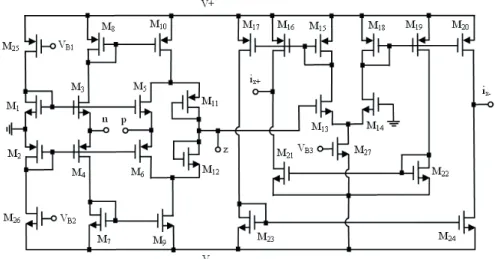
flow in opposite directions. A possible CMOS-based CDTA circuit realization is given in Fig. 2 [17].
The CDTAs based third-order quadrature oscillator is shown in Fig. 3. The characteristic equation of the circuit in Fig. 3 can be expressed as
0 3 2 1 2 1 3 1 3 2 2 3 2 1 3 m m m m m m sCg g g g g g C C s C C C s . (2)
The oscillation condition and oscillation frequency can be obtained as 1 1 3 3 C g C g m m , 2 1 2 1 C C g gm m o (3),(4)
From equations (3) and (4), the oscillation frequency can be controlled by gm2. The oscillation condition can be independently controlled by gm3. From Fig. 3, the current transfer function from Io2 to Io1 is
3 3 1 2 ) ( ) ( sC g s I s I m o o . (5)
Fig. 1. (a) Circuit symbol of CDTA. (b) Equivalent circuit of CDTA.
Fig. 3. The proposed current-mode quadrature oscillator.
Under sinusoidal steady state, equation (5) becomes o j m o o e C g j I j I 90 3 3 1 2 ) ( ) (
. (6)The phase difference,, between Io2 and Io1 is
o 90
(7) (ip - in) vn vp in ip v xj-vxi+ i xj-ixi+ gmvz gmvz vz iz (a) (b) xi+ xj- z n p CDTA vn vp in ip v xj-vxi+ i xj-ixi+ vzensuring the currents Io2 and Io1 to be in quadrature. The voltage transfer function from Vo2 to Vo1 is
3 2 1 2 ) ( ) ( sC g s V s V m o o . (8)
Under sinusoidal steady state, equation (8) becomes o j m o o e C g j V j V 90 3 2 1 2 ) ( ) (
. (9)The phase difference,, between Vo2 and Vo1 is
o 90
(10)ensuring the voltages Vo2 and Vo1 to be in quadrature. The proposed quadrature oscillator employs only grounded capacitors. The use of grounded capacitors is particularly attractive for integrated circuit implementation [25]. From equations (6) and (9), the magnitude of Io2 and
Io1 or Vo2 and Vo1 need not to be the same. For the applica-tions need equal magnitude quadrature outputs, another amplifying circuits are needed.
3.
Non-Ideal Effects
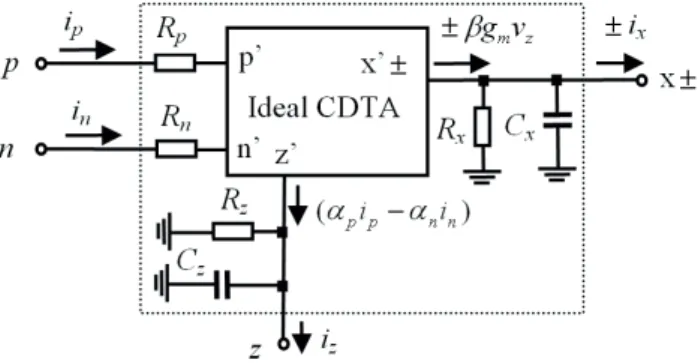
Taking the non-idealities of the CDTA into account, Fig. 4 shows the simplified equivalent circuit that is used to represent the non-ideal CDTA [21]. In the figure, αp= 1– εp
and εp (εp<< 1) is the current tracking error from the p
terminal to the z terminal of the CDTA, αn = 1 – εn and εn
(εn<< 1) is the current tracking error from the n terminal
to the z terminal of the CDTA, and β= 1 – εi and εi
(εi<< 1) is the output transconductance tracking error
from the z terminal to x terminal of the CDTA.
Fig. 4. The non-ideal CDTA.
Moreover, there are parasitic resistances (Rp and Rn) at terminals p and n, and parasitic resistances and capacitan-ces (Rz, Cz and Rx, Cx) from terminals z and x to ground. Re-analysis of the proposed quadrature oscillator in Fig. 3 using the non-ideal CDTA model and assuming that the operation oscillation frequencies, ω, are very much smaller than 1/(Cx Rn) or 1/(Cx Rp) and the parasitic resistances at the x terminals are very much greater than the parasitic resistances at p or n terminals of CDTAs. The characteris-tic equation of Fig. 3 becomes
[ ' '( ) ' ' ' ' ] ' ' ' 2 3 2 2 3 1 1 12 1 1 2 3 1 3 2 1 3 z z z n m G C C G C C G g C C s C C C s )] ( ' ' ) ( ' [ 3 1 12 1 3 1 2 3 2 1 2 1 12 1 2 1 22 11 1 2 2 1 3 z z n z m z z z z n z m n p m m G G G g C G G C G G G g g g C s 0 ) ( ) ( 12 1 1 1 3 2 22 1 3 31 21 3 1 3 11 2 2 1 n m z z z n z p p m p m m g G G G G g g g (11) where C1'C1Cz1, C2'C2Cz2, C3'C3Cz3.
The modified oscillation condition and oscillation frequency are 2 3 1 3 2 1 1 12 1 1 3 2 12 1 1 1 3 2 22 1 3 31 21 3 1 3 11 2 2 1 ' ' ' ' ) ( ' ' ) ( ) ( z z z n m n m z z z n z p p m p m m G C C G C C G g C C g G G G G g g g
' ' ' ) ( ' ' ) ( ' 3 2 1 3 1 12 1 3 1 2 3 2 1 2 1 12 1 2 1 22 11 1 2 2 1 3 C C C G G G g C G G C G G G g g g C z z n z m z z z z n z m n p m m , (12) ' ' ' ) ( ' ' ) ( ' 3 2 1 3 1 12 1 3 1 2 3 2 1 2 1 12 1 2 1 22 11 1 2 2 1 3 C C C G G G g C G G C G G G g g g C z z n z m z z z z n z m n p m m o . (13) Because the values of α and β are slightly less than unity [26], the parasitic conductances (Gzs) at the z termi-nals of CDTAs are not zero and the capacitances C’1, C’2and C’3 are greater than C1, C2 and C3, respectively. From
(12) and (13), the oscillation condition and oscillation frequency are deviated from the ideal cases. Therefore, to compensate this effect, we can slightly adjust the gm2 value. The oscillation condition still can be controlled by gm3. The active and passive sensitivities of the quadrature oscillator are all low and obtained as
2 1 22 12 11 1 2, , , , o n p S ; 2 1 ' ,' , 2 1 2 1 o o m m g C C g S S ; ' 0 3 o C S .
4.
Simulation Results
The quadrature oscillators were simulated using HSPICE. The CMOS CDTA implementation is shown in Fig. 2 (using 0.18 μm MOSFET from TSMC). The aspect ratios of the MOS transistors were chosen as in Tab. 1. The multiple current outputs can be easily implemented by adding output branches. Fig. 5 represents the voltage-mode quadrature sinusoidal output waveforms of Fig. 3 with C1 =
= C2 = C3 = 100 pF, gm1 = 0.269 mS, gm2 = 0.355 mS and
gm3 = 0.401 mS where gm3 was designed to be larger then the theoretical value to ensure the oscillations will start. The bias voltages are VB1 = 0.7V, VB2 = -0.7V, V+ = 1.25V
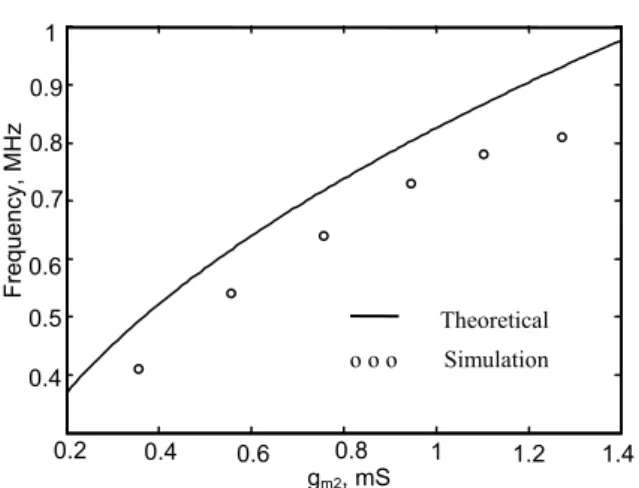
and V- = -1.25V. The power dissipation is 2.8782 mW. The results of the Vo1 and Vo2 total harmonic distortion analysis are summarized in Tab. 2 and Tab. 3, respectively. Fig. 6 shows the simulation results of the oscillation frequencies of Fig. 3 by varying the value of the transconductance gm2
with C1 = C2 = C3 = 100 pF, gm1 = 0.269 mS and gm3 was
varied with gm2 by equation (3) to ensure the oscillations will start. From Tab. 2 and 3, the total harmonic distortion of Vo1 or Vo2 is larger than 9%. For the applications need sinusoidal quadrature outputs, other filtering circuits are needed. Because the CDTA has parasitic capacitor from the z terminal to the ground (Cz) and the tracking errors of CDTA (α and β) are slightly less than unity, this can explain why simulated oscillation frequencies in Fig. 6 are lower than theoretical predicted. This effect can be mini-mized by slightly adjust the gm2 value.
Fig. 5. The simulated voltage-mode quadrature output waveforms of Fig. 3.
MOS transistors Aspect ratio (W/L) M1, M3, M5, M7, M9, M12, M21, M22, M23, M24, M26 27/1.8 M2, M4, M6, M8, M10, M11, M13, M14, M25, M27 72/1.8 M15, M16, M17, M18, M19, M20 63/1.8
Tab. 1. Aspect ratios of the MOSs in Fig. 2. Harmonic no Frequency (hz) Fourier component Phase (deg) 1 410.0000k 164.3047m 78.8907 2 820.0000k 1.1578m 28.9474 3 1.2300M 16.1485m 59.0586 4 1.6400M 633.3720u -5.9456 5 2.0500M 4.9412m 45.7420 6 2.4600M 216.4871u -53.4055 7 2.8700M 2.0743m 32.8476 8 3.2800M 64.7923u 143.9968 9 3.6900M 801.1292u 22.6329 dc component = 5.606D-03 total harmonic distortion = 10.3989 percent Tab. 2. Total harmonic distortion analysis of Vo1 in Fig. 3.
Harmonic no Frequency (hz) Fourier component Phase (deg) 1 410.0000k 161.8072m -15.8438 2 820.0000k 1.6354m -151.6867 3 1.2300M 14.3267m 137.1491 4 1.6400M 576.4303u -8.6467 5 2.0500M 3.4543m -60.6587 6 2.4600M 170.3654u -136.6209 7 2.8700M 839.9577u 118.0214 8 3.2800M 317.2807u 54.1174 9 3.6900M 459.2626u 6.8039 dc component = -1.593D-02 total harmonic distortion = 9.1925 percent Tab. 3. Total harmonic distortion analysis of Vo2 in Fig. 3.
Fig. 6. Simulation result of the oscillation frequency of the circuit given in Fig. 3, which is obtained by varying the value of the transconductance gm2.
5.
Conclusion
In this paper, a new current/voltage-mode third-order quadrature oscillator using three CDTA and three grounded capacitors is proposed. Outputs of two current-mode and two voltage-current-mode sinusoids each with 90o phase
difference are available in the proposed circuit. The oscilla-tion condioscilla-tion and oscillaoscilla-tion frequency of the proposed quadrature oscillator are independently controllable. Simu-lation results verify the theoretical analysis.
Acknowledgment
The authors would like to thank the reviewers for their constructive comments.
References
[1] SEDRA, A. S., SMITH, K. C. Microelectronic Circuits. 4th edition. New York: Oxford University Press, pp. 984-986, 1998.
[2] KHAN, I. A., KHWAJA, S. An integrable gm-C quadrature oscillator. International Journal of Electronics, 2000, vol. 87, p. 1353-1357.
[3] HOLZEL, R. A simple wide-band sine wave quadrature oscillator.
IEEE Transactions on Instrumentation and Measurement, 1993, vol. 42, p. 758-760.
[4] AHMED, M. T., KHAN, I. A., MINHAJ N. On transconductance-C quadrature oscillators. International Journal of Electronics, 1997, vol. 83, p. 201-207.
[5] ABUELMA’ATTI, M. T., ALZAHER, H. A. Comment on current-mode quadrature sinusoidal oscillator using single FTFN.
International Journal of Electronics, 1998, vol. 85, p. 177-180. [6] SOLIMAN, A. M. Synthesis of grounded capacitor and grounded
resistor oscillators. Journal of the Franklin Institute, 1999, vol. 336, p. 735-746. 1 Frequency, MHz 0.2 0.4 0.6 0.8 1 1.2 1.4 0.4 0.5 0.6 0.7 0.8 0.9 gm2, mS Theoretical o o o Simulation
[7] HORNG, J. W. Current differencing buffered amplifiers based single resistance controlled quadrature oscillator employing grounded capacitors. IEICE Transactions on Fundamentals of Electronics, Communications and Computer Sciences, 2002, vol. E85-A, p. 1416-1419.
[8] HORNG, J. W. Current-mode quadrature oscillator with grounded capacitors and resistors using two DVCCs. IEICE Transactions on Fundamentals of Electronics, Communications and Computer Sciences, 2003, vol. E86-A, p. 2152-2154.
[9] PROMMEE, P., DEJHAN, K. An integrable electronic-controlled quadrature sinusoidal oscillator using CMOS operational transconductance amplifier. International Journal of Electronics, 2002, vol. 89, p. 365-379.
[10] HORNG, J. W., HOU, C. L., CHANG, C. M., CHUNG, W. Y., TANG, H. W., WEN, Y. H. Quadrature oscillators using CCIIs.
International Journal of Electronics, 2005, vol. 92, p. 21-31. [11] HORNG, J. W., HOU, C. L., CHANG, C. M., PAN, S. W., SHIE,
J. Y., WEN, Y. H. Third-order quadrature oscillator with grounded capacitors using CCIIs. WSEAS Transactions on Electronics, 2007, vol. 4, p. 20-22.
[12] MAHESHWARI, S., KHAN, I. A. Current controlled third order quadrature oscillator. IEE Proc.-Circuits, Devices and Systems, 2005, vol. 152, p. 605-607.
[13] HORNG, J. W., HOU, C. L., CHANG, C. M., CHOU, H. P., LIN, C. T., WEN, Y. H. Quadrature oscillators with grounded capacitors and resistors using FDCCIIs. ETRI Journal, 2006, vol. 28, p. 486 to 494.
[14] HORNG, J. W., HOU, C. L., CHANG, C. M., CHENG, S. T., SU, H. Y. Current or/and voltage-mode quadrature oscillators with grounded capacitors and resistors using FDCCIIs. WSEAS Transactions on Circuits and Systems, 2008, vol. 7, p. 129-138. [15] KESKIN, A. U., AYDIN, C., HANCIOLU, E., ACAR, C.
Quadra-ture oscillator using current differencing buffered amplifiers (CDBA). Frequenz, 2006, vol. 60, p. 21-23.
[16] TANGSRIRAT, W., PISITCHALERMPONG, S. CDBA-based quadrature sinusoidal oscillator. Frequenz, 2007, vol. 61, p. 102-104.
[17] KESKIN, A. U., BIOLEK, D. Current mode quadrature oscillator using current differencing transconductance amplifiers (CDTA).
IEE Proc.-Circuits, Devices and Systems, 2006, vol. 153, p. 214-218.
[18] JAIKLA, W., SIRIPRUCHYANUN, S., BAJER, J., BIOLEK, D. A simple current-mode quadrature oscillator using single CDTA.
Radioengineering, 2008, vol. 17, p. 33-40.
[19] BIOLEK, D. CDTA-Building block for current-mode analog signal processing. In Proceedings of the ECCTD’03, Krakow, Poland, 2003, vol. III, p. 397-400.
[20] KESKIN, A. U., BIOLEK, D., HANCIOGLU, E., BIOLKOVA, V. Current-mode KHN filter employing current differencing transconductance amplifiers. AEU International Journal of Electronics and Communications, 2006, vol. 60, p. 443-446. [21] TANGSRIRAT, W., TANJAROEN, W. Current-mode multiphase
sinusoidal oscillator using current differencing transconductance amplifiers. Circuits, Systems and Signal Processing, 2008, vol. 27, p. 81-93.
[22] BIOLEK, D., BIOLKOVA, V., KESKIN, A. Current mode quadrature oscillator using two CDTAs and two grounded capacitors. In Proceedings of the 5th WSEAS Int. Conf. on System Science and Simulation in Engineering. Tenerife, Canary Islands, (Spain), December 16-18, 2006, p. 368-370.
[23] TANGSRIRAT, W. Current differencing transconductance amplifier-based current-mode four-phase quadrature oscillator.
Indian Journal of Engineering and Material Sciences, 2007, vol. 14, p. 289-294.
[24] HORNG, J. W. Current-mode third-order quadrature oscillator using CDTAs. Active and Passive Electronic Components, 2009, Article ID 789171, p. 1-5.
[25] BHUSHAN, M., NEWCOMB, R. W. Grounding of capacitors in integrated circuits. Electronic Letters, 1967, vol. 3, p. 148-149. [26] FABRE, A., SAAID, O., BARTHELEMY, H. On the frequency
limitations of the circuits based on second generation current conveyors. Analog Integrated Circuits and Signal Processing, 1995, vol. 7, p. 113-129.
About Author ...
Jiun-Wei HORNG was born in Tainan, Taiwan, Republic of China, in 1971. He received the B.S. degree in Elec-tronic Engineering from Chung Yuan Christian University, Chung-Li, Taiwan, in 1993, and the Ph.D. degree from National Taiwan University, Taipei, Taiwan, in 1997. From 1997 to 1999, he served as a Second-Lieutenant in China Army Force. From 1999 to 2000, he joined CHROMA ATE INC. where he worked in the area of video pattern generator technologies. Since 2000, he was with the Dept. of Electronic Engineering, Chung Yuan Christian University, Chung-Li, Taiwan as an Assistant Professor. He is now an Associate Professor. Dr. Horng joins the editorial board of Active and Passive Electronic Components from 2010. His teaching and research interests are in the areas of circuits and systems, analog electronics, active filter design and current-mode signal processing.
Hung LEE received the B.S. degree in Electronic Engi-neering from Fu Jen Catholic University, Taipei, Taiwan, in 2009. Presently, he is working toward the M.S. degree in Electronic Engineering at Chung Yuan Christian Univer-sity, Chung-Li, Taiwan. His research interests are in the area of analog filter design, electronic circuit design and simulation.
Jian-Yu WU is now working toward the M.S. degree in Electronic Engineering at Chung Yuan Christian Univer-sity, Chung-Li, Taiwan. His research interests are in the area of analog filter design, electronic circuit design and simulation.