Nijmegen
The following full text is a publisher's version.
For additional information about this publication click this link.
http://hdl.handle.net/2066/200927
Please be advised that this information was generated on 2019-06-02 and may be subject to
change.
doi: 10.3389/fpsyg.2018.00993
Edited by: Umberto Ansaldo, University of Hong Kong, Hong Kong Reviewed by: Cornelia Loos, Georg-August-Universität Göttingen, Germany Wendy Sandler, University of Haifa, Israel *Correspondence: Sascha Couvee [email protected]
Specialty section: This article was submitted to Language Sciences, a section of the journal Frontiers in Psychology Received:25 January 2018 Accepted:28 May 2018 Published:17 July 2018 Citation: Couvee S and Pfau R (2018) Structure and Grammaticalization of Serial Verb Constructions in Sign Language of the Netherlands—A Corpus-Based Study. Front. Psychol. 9:993. doi: 10.3389/fpsyg.2018.00993
Structure and Grammaticalization of
Serial Verb Constructions in Sign
Language of the Netherlands—A
Corpus-Based Study
Sascha Couvee* and Roland Pfau
Department of Linguistics, University of Amsterdam, Amsterdam, Netherlands
In serial verb constructions (SVCs), multiple independent lexical verbs are combined in a mono-clausal construction. SVCs express a range of grammatical meanings and are attested in numerous spoken languages all around the world. Yet, to date only few studies have investigated the existence and functions of SVCs in sign languages. For the most part, these studies—including a previous study on Sign Language of the Netherlands (NGT)—relied on elicited data. In this article, we offer a cross-modal typological contribution to the study of SVCs by investigating the phenomenon based on naturalistic corpus data from NGT. A search of the Corpus NGT yielded 41 mono-clausal utterances in which one of a closed set of verbs—namelyGO, GIVE, TAKE, andCALL—combines with another lexical verb. While the combinations we found are in
important respects reminiscent of SVCs described for spoken languages, our data also confirm the previous finding that the fixed verb in the SVC serves to express agreement (by means of spatial modulation) when the other verb cannot do so. In addition, we identified some novel uses of the verbsGOandGIVE:(i)GOfunctioning as a future tense
marker and (ii) GIVE functioning as a light verb. We will also discuss aspects of the
grammaticalization of SVCs in NGT: from lexical verb to light verb to auxiliary, again offering some comparison to grammaticalization paths described for spoken languages.
Keywords: serial verb construction, Sign Language of the Netherlands, grammaticalization, corpus, agreement
INTRODUCTION
Verbs and verbal inflection in sign languages have received considerable attention since the early days of sign language linguistics (Fischer and Gough, 1978; Klima and Bellugi, 1979; Padden, 1983), and their properties and appropriate characterization are still under scrutiny in recent studies (Meir, 2002; Lillo-Martin and Meier, 2011; Wilbur, 2013; Schembri et al., 2016). One of the issues that is hotly debated in the literature is the applicability of certain morphosyntactic notions that have been established on the basis of spoken languages to the domain of sign languages, that is, the cross-modal applicability of these notions. Obviously, given that sign languages make use of different articulators—not only the hands, but also the head, face and body—in the transmission of lexical and grammatical information, it cannot be taken for granted
that concepts and models developed for spoken languages can be applied to languages in the visual-gestural modality. Yet, after 50 years of research, there is now broad consensus that many aspects of the structural make-up of sign languages are modality-independent; e.g., a prosodic hierarchy, relativization strategies, and reduplication as a morphological process—to give just three examples from different domains (cf. Wilbur, 2009; Sandler, 2012; Pfau and Steinbach, 2016). At the same time, however, there is also growing awareness that the modality of signal transmission impacts certain aspects of the lexicon and grammar (Meier, 2012). Think, for instance, of the availability of two identical articulators, the two hands, and the use of the signing space in front of the signer’s body for grammatical purposes. Yet, despite the modality-specific flavor of these articulatory strategies, some sign linguists have argued that, at a sufficiently abstract level, they can be modeled in a modality-independent way (e.g., Pfau et al., submitted;Kimmelman, 2017).
Verbs and spatial grammar also figure prominently in this paper, which focuses on a specific type of verbal construction: serial verb constructions (SVCs) in Sign Language of the Netherlands (Nederlandse Gebarentaal—NGT). SVCs are mono-clausal constructions which contain multiple lexical verbs. They are thus clearly distinct from (i) complex constructions such as e.g., coordination (She came and danced) and (ii) auxiliary-verb constructions (They must leave). Across spoken languages, SVCs have been found to express a range of grammatical meanings, including a sequence of actions or a cause and effect relation between the actions expressed by the verbs (Aikhenvald, 2006).
Although there is an extensive body of literature on SVCs in spoken languages, there has been comparably little research on SVCs in sign languages. Recently, however, a 1996 presentation on SVCs in NGT, which had been circulated as a manuscript, has been published as aPaper from the Sign Language Underground
(Bos, 1996/2016). The current study is inspired by Bos’ seminal work and continues the investigation of SVCs in NGT. However, while Bos’ research was based on elicited data, we investigate the occurrence of this construction type in naturalistic corpus data. To that end, we searched the Corpus NGT, a large online corpus with videos of conversations between signers, for utterances which contain one of the verbs that Bos had previously identified (GO,GIVE,TAKE, andCALL) in combination with another lexical verb. Just like Bos, we analyze morphosyntactic and syntactic properties of these constructions: the distribution of agreement inflection, word order, and argument structure. Furthermore, we add to the picture some speculations on new uses of some of the verbs participating in SVCs: (i)GIVEfunctioning as a light verb and (ii)GO functioning as a future tense marker. Our findings contribute to the existing knowledge on SVCs and indicate that more research on this topic in more sign languages will likely reveal striking similarities to SVCs found in spoken languages as well as potentially modality-specific properties.
We start our investigation in section Serial Verb Constructions Across Language Modalities by offering an overview of previous research on SVCs in spoken and sign languages, including also a summary of the findings of
Bos (1996/2016). In section Methodology, we describe our methodology, in particular, the application of criteria for
identifying SVCs. Results per verb are presented in section Results, where we also comment on the range of free verbs that the fixed verbs combine with. In section A Cross-Linguistic Perspective on Serial Verb Constructions, we then discuss structural and functional properties of SVCs from a cross-linguistic perspective, and we compare the patterns to those reported by Bos. Speculations about possible grammaticalization paths are offered in section Grammaticalization. Section Conclusion concludes the paper.
SERIAL VERB CONSTRUCTIONS ACROSS
LANGUAGE MODALITIES
Obviously, multiple verbs are commonly combined within a sentence—think, for instance, of auxiliary-verb constructions (e.g., They have eaten or You should pay) and infinitival complements (e.g.,She came to dance). However, not all of these combinations qualify as SVCs. In fact, most of them don’t. In section Defining Properties of Serial Verb Constructions, we will introduce the defining properties of SVCs, extracted for the most part from typological overviews byAikhenvald (2006)and
Haspelmath (2016), which are based entirely on data from spoken languages. We then turn to sign languages. We summarize findings from various sign languages, including NGT, in section Serial Verb Constructions in Sign Languages before highlighting the contribution of the present study in section Contribution of the Present Study.
Defining Properties of Serial Verb
Constructions
Based on a wealth of data from typologically diverse spoken languages, researchers have identified a number of general defining properties of SVCs. According toHaspelmath (2016, p. 296), a SVCs “is a mono-clausal construction consisting of multiple independent verbs with no element linking them and with no predicate-argument relation between the verbs.” SVCs have been identified in many different spoken languages from all around the world, such as Oceanic languages, Amazonian languages, the languages spoken in New Guinea, Southeast Asian languages, West African languages, and creole languages (Aikhenvald, 2006, p. 52). In the following, we will flesh out the five properties (or “key components”) that make up Haspelmath’s definition, also adding to the picture criteria offered byAikhenvald (2006).
(i) Independent Verbs
The verbs that participate in SVCs are independent verbs, that is, forms that can express a dynamic event in a non-elliptical utterance without any other verb. This is true for the verbs involved in the Cantonese SVC in (1) and the Saramaccan SVC in (2).
(1) Cantonese (Sinitic, Sino-Tibetan;Matthews, 2006, p. 76) lei5 lo2 di1 saam1 lai4
you take PL clothing come
(2) Saramaccan (English-based creole; Byrne, 1990, in
Aikhenvald, 2006, p. 26)
Kófi bi bái dí búku dá dí muyé Kofi TNS buy the book give the woman
‘Kofi had bought the woman the book.’
Furthermore, it has been observed, that cross-linguistically, some verbs tend to occur more frequently in SVCs than other verbs. Verbs that are commonly used in SVCs are basic verbs of motion [e.g., “come” and “go”; cf. (1)], direction, posture (e.g., “sit” and “stand”), and location (Aikhenvald, 2006). Some languages also employ valency-increasing or argument-adding SVCs. A verb often used in this construction type is “give,” which can also add a benefactive meaning, as is illustrated by the example from Saramaccan in (2).
(ii) Monoclausality
Crucially, the two (or more) verbs belong to a single clause. Consequently, SVCs are also conceptualized as a single event. In the Cantonese example in (1), for instance, there is no taking-event that would be independent from the coming-taking-event (e.g., take some clothes from a pile of clothes and then come). Rather, the combination of the two verbs within a single clause yields the meaning “bring.” The Taba example in (3) is slightly different, as the dying-event is a result of the biting-event. Still, given the causal relationship, that is, the fact that the death is a direct consequence of the biting, we are dealing with a single event. It is, for example, impossible that the pig died for another reason than the bite, or that it only died from the bite 2 days later. All three examples provided so far also illustrate that the verbs in an SVC do not have to be adjacent.
(3) Taba (Austronesian; Bowden, 2001, in
Aikhenvald, 2006, p. 2)
n=babas welik n=mot do 3SG=bite pig 3SG=die REAL ‘It bit the pig dead.’
Monoclausality of the SVC is further evidenced by the fact that all participating verbs must share tense, aspect, and polarity specification. This implies, for instance, that it is impossible to negate just one of the verbs [e.g., taking the clothes and not coming in (1)]. Yet another important indication that SVCs are monoclausal is that there are no pauses or intonational breaks within the construction; that is, the construction has the same intonational properties as a monoverbal clause (Aikhenvald, 2006).
(iii) No Linking Elements
Related to the monoclausality constraint is the fact that there should be no coordinating or subordinating element between the verbs. This constraint excludes English multi-clausal structures like She came and danced. Still, English, a non-serializing language, allows for the double verb construction in (4a), which, on the surface, resembles a SVC (Bjorkman, 2016, p. 54). (4) a. Every morning I go buy a coffee.
b.∗Every morning he goes buys a coffee.
However, constructions of this type are not considered SVCs since they are not productive: they can only be used in a specific context and only a few verbs are allowed. Overt marking of the verbs as in (4b) results in ungrammaticality. Additionally, it is possible to add a conjunction between the verbs, without changing the meaning (Aikhenvald, 2006).
In serializing languages, minimally different multi-clausal structures commonly exist next to SVCs. Compare the Taba example in (5) to the one provided in (3) above. The example does not include a coordinate conjunction but use of the causative marker and the object pronoun indicates that we are dealing with two clauses [i.e., the argumentpigis not shared—see point (iv)].
(5) Taba (Austronesian; Bowden, 2001, in
Aikhenvald, 2006, p.2)
n=babas welik n=ha-mot i 3SG=bite pig 3SG=CAUS-die 3SG
‘It bit the pig and killed it.’
(iv) Argument Structure Properties
Some observations can be made concerning the argument structure of the verbs involved in the SVC. First, the verbs can have different transitivity values. Examples (1) and (3), for instance, involve an intransitive and a transitive verb, while (2) includes a transitive and a ditransitive verb. Second, the verbs in an SVC commonly share arguments (Aikhenvald, 2006). In (1), the second person pronoun is the subject of both verbs (take
andcome); in (3),pigis the object of the first verb (bite), but the subject of the second one (die).
Third, as for argument structure properties, Haspelmath (2016)adds yet another criterion: One of the verbs should not be (part of) an argument of the other verb. This criterion excludes complement clause constructions like the one from Samoan in (6), whereswimis part of an infinitival complement embedded underknow (the same criterion excludes English examples like
He helped me wash the car).
(6) Samoan (Austronesian; Mosel, 2004, in
Haspelmath, 2016, p. 305)
‘ou te lee iloa ‘a’au
1SG TAM not know swim ‘I don’t know how to swim.’ (v) Construction
Finally, Haspelmath (2016) states that a SVC must be a productive, schematic construction with a concrete meaning. The meaning of the SVC must be determinable from its elements. In other words, constructions that involve non-compositional combinations of verbs do not fall under the definition of SVC, as such idiomatic constructions are usually not productive [as is true e.g., for (4)]. In this context,Haspelmath(2016, p. 297) remarks: “In very general terms, typology does not take into account idiomatic expressions, and confines itself to regular patterns in languages”1.
1It seems that Aikhenvald’s approach is different in this respect, as she points out
Furthermore, constructions that comply with these five criteria can be divided into two broad classes: asymmetrical SVCs and symmetrical SVCs. In asymmetrical SVCs, one of the verbs is from a restricted semantic class while the other verb is taken from a non-restricted class. The “free” verb describes the event while the restricted verb adds to the construction a specification, such as direction or manner, or tense-aspect meaning. In (2), for instance, bái(“buy”) is the free verb anddá (“give”) is the restricted verb providing directional meaning. The fixed verbs in asymmetrical SVCs tend to grammaticalize, as evidenced by semantic bleaching and (at times) phonological erosion, often at the same time preserving their status as independent lexical verbs (Lord, 1993). In contrast, the verbs in symmetrical SVCs are all taken from a semantically unrestricted class. According toAikhenvald(2006, p. 28), the order of verbs in symmetrical SVCs is iconic, that is, “it follows the temporal sequence of the subevents,” as is evident from example (3).
Serial Verb Constructions in Sign
Languages
As mentioned previously, to date, SVCs have not received a lot of attention in the sign language literature. An early study on American Sign Language (ASL) focused on one specific construction type, namely “serial verbs of motion” which—as the name implies—express a motion event. As we will include in our discussion SVCs with motion verbs, we will briefly address this study, as well as a subsequent study on the phenomenon, in section Serial Verbs of Motion. In section Serial Verb Constructions in NGT, we then summarize the findings ofBos (1996/2016), which constitute the starting point for our corpus-based investigation. However, before turning to these previous studies, we introduce in section Space and Prosody in Sign Languages aspects of sign language grammar that will play a role in our discussion of sign language SVCs.
Space and Prosody in Sign Languages
Two of the components of sign language grammar we wish to briefly introduce pertain to the modification of predicates, namely spatial agreement and classifiers; the third one concerns the marking of prosodic structure.
In most sign languages studied to date, a subgroup of verbs, the so-called “agreeing” or “directional” verbs, can be spatially modified to mark the subject and/or object (e.g., in NGTGIVE,
VISIT,HELP). Typically, in these verbs, the movement starts at the locus in signing space associated with the subject and proceeds toward the locus associated with the object. These can be loci of present referents (e.g., signer or addressee) or arbitrary loci that have been introduced for non-present referents by means of a pointing sign. An important qualification is that not all verbs can be modified in this way (Padden, 1983; Meir, 2002). Body-anchored verbs, like e.g.LOVEandUNDERSTANDin NGT, do not allow spatial modification—such verbs are referred to as “plain” verbs. Different sign languages employ different strategies for marking argument structure with plain verbs, e.g., word order or
“hit” and “split open” in Igbo to form a compound meaning “shatter” (Aikhenvald, 2006, p. 2).
the use of a dedicated auxiliary (see section Grammaticalization for further discussion). Moreover, in some verbs, the handshape can be modified to represent certain shape characteristics of a referent, be it a subject or an object (e.g., in NGT GIVE, BE
-LOCATED,MOVE)—such meaningful handshapes are commonly referred to as “classifiers” and the verbs they combine with as “classifier predicates.”
In (7a), we present an NGT example that illustrates both types of modification. First, the non-present referent COLLEAGUE is localized at locus 3a by means of the pointing sign INDEX; subsequently, the verb GIVE moves from this locus toward the signer, thus expressing the meaning “he gives me.” At the same time, the handshape is changed to a T-handshape (thumb and index finger make contact, other fingers extended), a handling (hd) classifier representing the handling of a long thin object (other classifier types will be introduced in the next section).2
(7) NGT3
a. COLLEAGUE INDEX3aPEN3aGIVE(hd:T)1
‘(My) colleague gives/gave me a pen.’
re /be – grijp/
b. INDEX1BROTHER INDEX3a,ASSIGNMENT UNDERSTAND INDEX3a
‘My brother, he understands the assignment.’
Prosodic constituency in sign languages is marked by manual and non-manual signals (e.g., Nespor and Sandler (1999),
Dachkovsky and Sandler (2009); see Sandler (2012) for overview). In (7b), the topic constitutes an intonational phrase (IP). Manually, this is marked by a phrase-final hold and a pause. As for non-manual marking, we observe raised eyebrows (re) accompanying the topic; in addition, the right boundary of an IP is commonly marked by an eye blink. Of importance in our context is the fact that mouthings, i.e., silent articulations of a (part of a) Dutch word corresponding to the meaning of a sign, can also serve a prosodic function, as they may spread to mark a prosodic word (Sandler, 1999; Crasborn et al., 2008a)4. This is also observed in (7b), where the mouthing accompanying the verbUNDERSTAND(Dutchbegrijpen) spreads onto the sentence-final subject pronoun. The first syllable of the Dutch stem is articulated while the verb is signed, the second syllable while the hand moves toward locus 3a;
2In our description of both agreement and classifiers, numerous complexities
are neglected. Here, we only note that even applying the notions agreement and classifier to the phenomena at hand is controversial; for overviews and discussion, see e.g.Liddell (2003); Lillo-Martin and Meier (2011); Mathur and Rathmann (2012); Zwitserlood (2012), andSchembri et al. (2016).
3Following usual conventions, signs are glossed in SMALL CAPSusing English
words which most closely reflect the signs’ meaning. The glossINDEX/IXstands for a pointing sign, often used as a personal pronoun. Subscript numbers refer to loci in the signing space that are employed in pronominalization and verb agreement: 1=first person (locus close to the signer’s body); 2=second person
(locus close to addressee); 3a/3b=third person (locus towards the right (a) or left
(b) side of the signing space). “++” indicates reduplication. A line above the gloss
signals the presence of a non-manual marker; the length of the line indicates the scope (i.e. onset and offset) of the respective marker. The non-manual markers relevant in the present study are: bs=body shift; eg=eye gaze; hb=head back;
hs=headshake; pl=pursed lips; re=raised eyebrows; top=topic marking
(raised eyebrows).
4Mouthings are commonly used in NGT, be it redundantly or for the purpose of
in addition, the movement of the verb and the pronoun are fused into one continuous contour. In combination, mouthing and movement indicate that the pronoun is cliticized to the verb.
Serial Verbs of Motion
Supalla (1990)describes a construction type in ASL which refers to a motion event and systematically includes two verbs, one expressing the movement path and the other the manner of movement; he labels this construction “serial verbs of motion.” A representative example is given in (8). After introducing the moving entity, the signer first expresses the manner of motion, namely running, by using a classifier construction (Supalla, 1986). Both hands have a slightly bent 1-handshape (index finger extended) with the fingertips pointing downward; this is a body part (bp) classifier referring to the legs. It is the combination of these handshapes with the alternating movement of the two hands that yields the meaning of running.Supalla(1990, p. 133) stresses the fact that “the hands must remain in place, in front of the signer’s body, while these movements are made.” The path is only expressed subsequently by a one-handed sign. Once again, we observe a 1-handshape, but this time with the fingertip oriented upwards. This is a whole entity (we) classifier referring to the person as a whole. The lexical meaning of the second verb is “go,” and it expresses the path by means of its movement properties, namely moving upward in a zigzag motion. In other words, (8) contains two lexical verbs which join forces to express the complex movement5.
(8) ASL (Supalla, 1990, p. 135—our glosses)6
PERSONRUN(bp:1-1)GO(we:1)-UP-ZIGZAG
‘A person (is) running zigzag up(hill).’
Supalla argues that a multi-verb construction is required in this case, as ASL has a grammatical restriction that bans the simultaneous combination of a body part classifier with a sign expressing path. Hence, the two meaning components have to be expressed independently. He further identifies the following two grammatical restrictions: (i) the manner verb always precedes the path verb, and (ii) no other constituent can intervene between the two verbs of a motion SVC—in crucial contrast to what we observed in the spoken language examples in section Defining Properties of Serial Verb Constructions.
Taking Supalla’s seminal work as a starting point,Benedicto et al. (2008)compare syntactic properties of motion SVCs in ASL, Catalan Sign Language (LSC), and Argentinean Sign Language (LSA). They find that the constraint on order also holds for LSA, but not for LSC, where both orders are grammatical. The order path–manner is illustrated in example (9a). Furthermore, they observe a sequence that they refer to as “sandwich” pattern, in which one of the verbs is doubled (Fischer and Janis, 1990). Both LSC and LSA allow for the order manner–path–manner, and LSC in addition displays the order path–manner–path. The former
5While the handling classifier in (7a) refers to an object, both body part and whole
entity classifiers refer to subjects (Glück and Pfau, 1998; Benedicto and Brentari, 2004).
6Supalla illustrates this example by means of drawings. Our gloss of the verbs is
based on these drawings; also, the moving entity person has been added.
sandwich pattern is illustrated by the LSA example in (9b). As in ASL, in both LSC and LSA, no constituent can intervene between the two verbs.
(9) LSC (a) and LSA (b) (Benedicto et al., 2008, p. 117, 119—glosses adapted)
a. GO(we:1)-RIGHT.TO.LEFTLIMP(bp:1-1)
‘(A person) goes limping by (from right to left).’ b. PERSONRUN GO(we:1)-UPRUN
‘A person ran up (the hill).’
Costello (2016)argues that these constructions, despite the fact that they include verbs of motion, are not SVCs of the directional type (comparable to (1) above). Rather, “it is the manner verb that categorizes this type of construction, making it a symmetrical manner construction” (Costello, 2016, p. 257), comparable to the Ewe example in (10).
(10) Ewe (Niger-Congo; Ameka, 2006, in Costello, 2016, p. 254)
ev-í mé-tá yi x -a me o
child-DEF NEG-crawl go room-DEFcontaining.region.ofNEG ‘The child didn’t crawl into the room.’
While we agree with the classification as a manner, rather than a directional, SVC for the above cases, we have to keep in mind that the verb “go” is usually considered a member of the restricted class of verbs. We thus think that we are actually dealing with asymmetrical SVCs in which the free verb (run, limp, crawl) describes the event while the restricted verb adds specification of direction.
Motion SVCs of this type are relevant to our study, as we, following Bos (1996/2016), will also include SVCs with the motion verb GO. However, as will become evident in section SVCs With Movement Verb GO, the motion SVCs in our dataset are different, as the verb GO is indeed fixed, that is, it is a general directional verb and not a complex predicate that combines with classifier or path morphemes.
Serial Verb Constructions in NGT
NGT is a sign language used in the Netherlands which has developed over the last 200 years (Tijsseling, 2014). Aspects of the grammar of NGT are fairly well described, at least compared to many other sign languages7. The basic word order is usually claimed to be SOV (Koolhof and Schermer, 2009; Brunelli, 2011), but recent corpus studies find that SVO is also commonly used (Oomen and Pfau, 2017).Bos (1996/2016)is the only previous work on SVCs in NGT8. Interestingly, throughout the article, Bos
7We cannot provide a comprehensive overview here, but with respect to the verbal
domain, relevant studies includeBos (1990, 1993, 1994, 1998/2017),Zwitserlood (2003); Zwitserlood and Van Gijn (2006), andOomen (2016, 2017).
8As for studies dedicated to SVCs in other sign languages, we are only aware of
Lau (2012)andCostello’s (2016)commentary onBos (1996/2016). However, as is also evident fromCostello (2016), SVCs or constructions that resemble SVCs are sometimes mentioned in the context of other construction types (e.g. motion or causation events). For the sake of cross-linguistic comparison, we provide here an example from Hong Kong Sign Language (HKSL) that is similar to the NGT example (11b).
refers to the constructions under investigation as “double verb constructions”; only in the conclusion, she points out that the double verb constructions have almost all the characteristics of SVCs in spoken languages—and the title of her paper reflects this conclusion.
For her study, Bos collected data from nine deaf participants (age 21–27), who were active members of the Deaf community and used NGT on a regular basis with deaf family and/or friends. The participants were filmed while performing different tasks which had been designed to elicit the use of 80 NGT verbs. The recordings were transcribed, and certain characteristics of the signers’ productions [e.g., verb(s) used, expression and locus of agreement, properties of the arguments] were entered into a database. Subsequent analysis yielded 116 double verb constructions.
One of the verbs in these constructions always comes from a fixed set of four verbs: GO, GIVE, TAKE, or CALL; the
constructions therefore are candidates for asymmetrical SVCs. All four verbs have fairly general semantics and are also commonly found in SVCs in spoken languages (Aikhenvald, 2006). In contrast, the other verb in the NGT double verb constructions, the free verb, comes from a larger group of verbs. Yet, Bos observes that the free verbs are always from the same semantic class as the fixed verbs. The verb GO combines with other verbs of movement such asWALK(11a). The transfer verbs GIVEand TAKE combine with free verbs that also express the transfer of an object such asBORROWorPAY(11b). Finally,CALL
tends to co-occur with other speech act verbs, e.g.,ASK(11c). As for the order of the two verbs, Bos observes that the free verb usually precedes the fixed verb.
(11) NGT (Bos, 1996/2016, p. 238, 244) a.INDEX1WALK 1GO2 PALM-UP
‘I’ll walk to you(r place).’
/be – ta – len/
b. PLEASE INDEX1PAY INDEX1 1GIVE2 INDEX2 PALM-UP
‘I want to pay you (for it).’
/ge – vraagd/
c.INDEX1 INDEX1 BROTHER ASKINDEX1 1CALL3a[. . . ]
‘I asked my brother [. . . ].’
Bos (1996/2016) offers several arguments for analyzing these (and similar) constructions as SVCs. First, she stresses that the double verb constructions are mono-clausal, as they denote a single event. That is, a translation in which the verbs are not in the same clause, e.g., “I want to pay and give you” for (11b), does not capture the meaning of these sentences. A mono-clausal analysis is further supported by the observation that it is not possible to negate only part of the construction, i.e., one of the verbs. In (11a), for instance, a simultaneous negative headshake could not be used to express that I am going to you but not by means of walking (cf. the Ewe example in (10), which is negated by the discontinuous morpheme mé. . . o). Second, the verbs in the double verb constructions share arguments, as is also commonly the case in SVCs found in spoken languages.
Third, the examples that Bos analyzed also display prosodic characteristics of a single clause. Crucially, there are never
(i) HKSL (Lau, 2012, p. 174)
SISTER EGG-CAKE BUY 0GIVE3 MOTHER
‘Lit. The sister bought a birthday cake (and) gave (it) to mother.’
intervening pauses in between the verbs; the verbs are under one fluent intonation contour. In examples (11bc), the mouthing lends further support to this claim. Despite the presence of an intervening subject pronoun, in both examples, a mouthing associated with the first verb spreads over the second verb (betalenis the infinitival form of “pay,”gevraagdis the participle of “ask”), thus defining a prosodic word, which again indicates that these are mono-clausal constructions.
In a sense, the fixed verb does not contribute much to the meaning of the SVC as a whole. Consequently, the translations in (11) only include the meaning of the free verb. One may therefore wonder why an SVC is used in the first place. Bos (1996/2016)argues that the main function of the fixed verb is to express agreement whenever the free verb is a plain verb that cannot be spatially modified. Note that in all three examples in (11), the fixed verb carries subscripts which indicate that the verb is spatially modified. The free verbsWALK, PAY, andASK
are not modified in this way. We will discuss this interesting observation in more detail in section Function of SVCs. For now, suffice it to say thatBos (1996/2016)concludes that the double verb constructions she encountered in the elicited data share interesting properties with asymmetrical SVCs in spoken languages9.
Contribution of the Present Study
Equipped with background knowledge on SVCs in spoken and sign languages, we can now proceed to our study. As mentioned in the previous section, the seminal investigation by Bos (1996/2016)focused on SVCs in elicited utterances. In contrast, we examine the occurrence of SVCs in naturalistic language data. We extracted instances of SVCs from the Corpus NGT (Crasborn and Zwitserlood, 2008; Crasborn et al., 2008b), a database which consists of signed conversations between two signers. Adding corpus data to the picture is a worthwhile endeavor, as recent corpus-based studies on NGT and other sign languages have shown that generalizations that have been established based on elicited data and/or grammaticality judgments sometimes have to be reconsidered once corpus data are added to the data pool. This does not necessarily mean that these generalizations are wrong, but it may indicate that they are too strict, as the corpus data reveal more variation than has previously been assumed. For NGT, such variation has been identified in the domains of word order, including the position of manual negation (Oomen and Pfau, 2017), agreement (Legeland, 2016), and the use of mouthings (Bank, 2014)10. An important contribution of the
9For the sake of completeness, let us point out that the following multi-verb
constructions will not be included in our study of SVCs: (i) constructions involving a “shifted referential framework,” in which the same lexical verb is signed twice but from different perspectives (Agent vs. Patient perspective), e.g.PUSHin British Sign Language (Morgan and Woll, 2003); (ii) “verb sandwich” constructions, which are also characterized by doubling of the lexical verb but in which the second verb carries additional morphology (e.g. aspect) that is not present on the first verb (Fischer and Janis, 1990, for ASL); (iii) resultative constructions, which may involve two different lexical verbs, e.g.SHAKEandWAKE-UPin German Sign Language (Loos, 2017).
10As for other sign languages, seeDe Beuzeville et al. (2009)andFenlon et al.
(2018) for the spatial modification of verbs in Australian and British Sign Language, respectively, andGeraci et al. (2015)for wh-questions in Italian Sign Language.
present study is thus testing Bos’ generalizations on the basis of data from the Corpus NGT.
In addition, we will pay attention to syntactic properties of the SVCs, such as order of the verbs and the nature of intervening elements; these properties are mentioned in Bos (1996/2016), but are not discussed in detail. Finally, some examples extracted from the corpus data will allow us to offer some speculations on grammaticalization.
METHODOLOGY
Data were extracted from the Corpus NGT (Crasborn and Zwitserlood, 2008; Crasborn et al., 2008b), a large, partly annotated corpus including videos of 92 signers (recorded 2006– 2008). The data consist of free and elicited conversations between pairs of signers from different regions in the Netherlands. Most of the corpus is freely available and annotated in Dutch; part of it is translated into Dutch and English.
Participants
For our study, we used data from 35 signers (15 female), aged 18–84. The participants in this sample came from different regions in the Netherlands: Groningen (17), Amsterdam (11), St.-Michielsgestel (4), Voorburg (2), and Rotterdam (1). All of them were deaf from birth or became deaf soon after birth and started using NGT at an early age (before the age of 4).
Procedure: Searching the Corpus
The Corpus NGT is partly annotated in ELAN. ELAN (Crasborn and Sloetjes, 2008) allows for searches in the annotations. Our first step was to search for all instances of the four verbs discussed byBos (1996/2016), namely, GO(Dutchgaan),GIVE
(geven), TAKE (pakken), and CALL (roepen); to this, we added the verbCOME(komen). With respect to this latter verb, a few explanations are in place. As pointed out in section Defining Properties of Serial Verb Constructions, the verb meaning “come” commonly participates in SVCs. More importantly, however, the verbs that are glossed as GO and COME in the
Corpus NGT have the same phonological form: the index finger is extended and slightly bent, and the hand performs a path movement in the signing space. What motivates use of the one gloss over the other is the direction of movement, which is away from the signer for GO, but toward the signer forCOME
(e.g., “I go to her” vs. “She comes to me”). It seems to us that the use of two different glosses does not reflect a difference in meaning; rather it is based on the spoken language. Therefore, in the remainder of this paper, we will collapseGOand COME, and gloss them consistently asGO. In other words: some of our
glossed examples differ from the annotations in this respect. Based on corpus data, we first confirmed that all five verbs can be used independently (criterion (i) in section Defining Properties of Serial Verb Constructions). That this is indeed the case, is illustrated by the examples in (12) (see section Procedure: Applying the SVC criteria for explanation of the example codes).11
11Note thatCALL, when used in isolation, can receive various translations, such as
“tell,” “inform,” and even “ask.”
(12) a. INDEX3 OLYMPICS GO3 ROMANIA [1086-S048-00:19] ‘They went to the Olympics in Romania.’
b. MOTHERCOME [369-S024–00:58]
‘My mother came.’
c. 2GIVE3SUBSIDY [486-S024-04:10]
‘You gave him/her a subsidy.’
d. 3TAKEBONE MEAT [1843-S076-00:15]
‘(The dog) took the bone with meat (on it).’ e. INDEX1 1CALL3NICE INDEX3 BIRD FLY WINDOW
[94-S001-00:05] ‘I told him/her (that) it’s nice that there is
a bird flying outside the window.’
Once the independent use of these verbs had been established, we started our search for SVCs. Given that the corpus is not annotated for word class, it was not possible to easily search for one of the five verbs in combination with another verb. Therefore, all instances had to be reviewed manually.
Our initial search yielded a number of irrelevant occurrences, in particular, glosses which included the search item as part of another verb with a more specific meaning, for instance,
WEGGAAN (“to leave”; literally “go away”) or LESGEVEN
(“to teach”; literally “give lesson”). Once we excluded these occurrences, 1,389 cases remained for further analysis. In a second step, we then looked at the context of the verbs—three words to the left and three words to the right—in order to determine whether another verb occurred within this domain. All instances in which the search domain did not include another verb or included either a modal verb or a verb that did not fall within the semantic class of the fixed verb were initially categorized as “exclude.” Cases in which one of the five verbs occurred with another verb from the same semantic class within the search domain were categorized as “possible SVC”—there were 128 instances of this type. In the course of the search, certain examples led us to establish a third category, for reasons to be explained below.
Procedure: Applying the SVC Criteria
For the 128 instances in the “possible SVC” category, we then closely inspected the video and applied the remaining criteria (ii) to (v) introduced in section Defining Properties of Serial Verb Constructions. This coding was done separately for the whole dataset by the two authors. Agreement between coders was 89%; the 14 cases for which they initially came to different conclusions were discussed, and an agreement was reached with respect to their inclusion or exclusion. Coding was done in the following way.
In order to determine whether the two verbs belonged to the same clause, we first applied criterion (iii), the “no linking element” criterion. Our data set did not include any examples with manual linking elements. It has to be noted, however, that— despite the existence of certain manual conjunctions (e.g.,PLUS, OR, BECAUSE)—coordination and subordination are often not
marked by manual signs in NGT (Van Gijn, 2004). In a next step, we therefore looked at prosodic cues, most importantly pauses and the scope of non-manual markers [criterion (ii)]12.
12The nature of the data did not allow us to apply syntactic tests for
Subsequently, we checked criterion (iv), argument structure properties of the utterance, and confirmed that the two verbs share arguments and that one of the verbs is not (a part of) an argument of the other verb [cf. (6)]. Following the application of these criteria, 41 instances of SVCs remained. Finally, it was also clear that none of these remaining examples exemplified an idiomatic expression [criterion (v)].
With respect to our check of prosody and argument structure, a few additional explanations are in order. All 128 examples were coded for prosody, taking into account manual and non-manual markers that have been identified in previous studies (e.g.,Nespor and Sandler, 1999; Sandler, 1999). To that end, every example was viewed multiple times in slow motion. We excluded examples in which a clearly visible pause separated the two verbs and/or in which a non-manual indicated that the two verbs belong to separate prosodic constituents. In (13a), both these factors apply:ROLLis followed by a pause (ca. 500 ms), and a non-manual question marker accompanies the intervening INDEX
and the fixed verbGO. This indicates that the two verbs belong to separate clauses, a declarative followed by an interrogative. (13)
hb & re
a. ROLL INDEX3 GO3 [210-S011-01:12]
‘(The cat) rolled further. Where did he go?’
b. ELECTRICITY3GO1 PALM-UP RUN[1839-S076-00:28]
‘An electric shock comes and so (the cat) runs away.’ As for argument structure, we did indeed find a few examples in which the two verbs, although in close proximity to each other, did not share any arguments. One such case is exemplified in (13b) (in fact, herePALM-UPmight function as a conjunction).
Within the “exclude” group, we encountered a couple of examples which, although not constituting SVCs according to our definition, were considered interesting from a grammaticalization perspective. As one of our goals is to offer some speculations about possible grammaticalization, we decided to create a third category “grammaticalization.” To this newly established category, we transferred: (i) ten examples involving GO in which it behaves like a future marker; (ii)
eight examples withGIVEwhich are reminiscent of a light verb construction, that is, instances in whichGIVEcombines with a noun or adjective and does not fully predicate semantically (cf. English “to give a shout”;Butt, 2010, p. 48); and (iii) 45 examples in which CALLappears to function as a direct speech marker.
We will return to these cases, in particular those in (i) and (ii), in section Grammaticalization.
Finally, all examples extracted from the corpus were assigned a code following the scheme [video.file-signer-time.code]. Thus, code [390-S019-00:53] specifies that the example comes from video file 39013, is signed by signer S019, and occurs at time
point 00:53. In the reported examples, Dutch glosses were translated into English, using English words that are the closest approximations of the Dutch meaning. Also note that we added subscripts to the verbs in the examples whenever it was clear for which person/object the verbs were inflected. Furthermore,
13All video files are freely available from http://www.ru.nl/corpusngt/de_filmpjes/
download-filmpje-tmp/
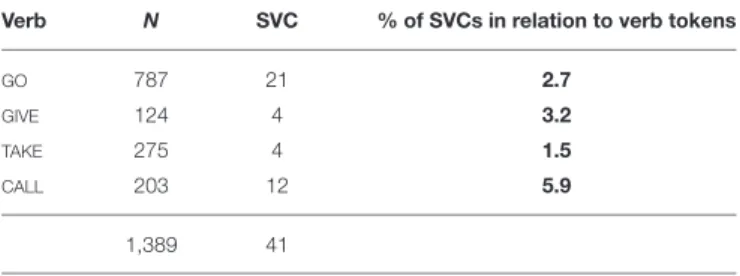
TABLE 1 |Number of SVCs per fixed verb in our data set, in relation to number of tokens of the four verbs.
Verb N SVC % of SVCs in relation to verb tokens
GO 787 21 2.7
GIVE 124 4 3.2
TAKE 275 4 1.5
CALL 203 12 5.9
1,389 41
for most of the Corpus NGT, no translations are provided yet. For examples including Dutch translations, we translated them into English; for the examples without translations, we offer translations that take into account the context in which the example was uttered.
RESULTS
An overview of the distribution of the SVCs is given in
Table 1. Note that this table only includes the 41 instances that remained after applying the SVC criteria; the examples that were categorized as “grammaticalization” are not included. The table reveals that we encountered only a few SVCs per verb. This might be due to the nature of the data collection; signers engaged in more or less free conversations in a naturalistic setting. In some of the clips, signers retell a story based on elicitation materials, but these materials had not been designed to elicit specific grammatical constructions such as SVCs. In the next three subsections, we report illustrative examples of SVCs per verb. Grammatical properties of the examples, including similarities and differences between different verbs, will be discussed in section A Cross-Linguistic Perspective on Serial Verb Constructions.
SVCs With Movement Verb
GOOur data set included a total of 787 instances of the verbsGO
and COME (recall that we subsume COME under GO); these were analyzed according to the procedure outlined in section Procedure: Applying the SVC Criteria. In particular, we searched for combinations ofGOwith other verbs of (implied) movement.
This search yielded 21 cases that were analyzed as SVCs. In these examples, GO combined with one of six other motion verbs, namelyWALK(14a) (10 instances), CYCLE(14b) (6 instances),
HUNT(2 instances), and one instance each ofRUN,SEND, and
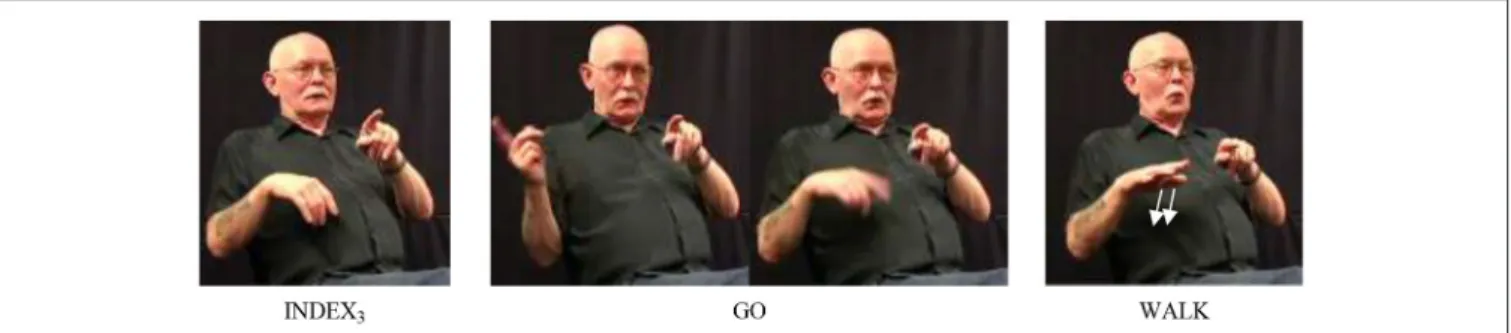
SWIM14. Note that in both examples, non-manuals indicate that
fixed and free verb form a prosodic unit: mouthing in (14a), pursed lips in (14b). In addition, in (14a), theINDEXis articulated with the non-dominant hand and held while the dominant hand articulates the two verbs (weak hand spread; seeFigure 1).
14Our inclusion of the verbHUNTindicates that we allow for combinations in
which the free verb does not express movement per se (as e.g.WALKandCYCLE
do), but rather implies movement of the referent. In both examples withHUNT, the mouthing associated with the free verb spreads ontoGO.
FIGURE 1 |Illustration of example (14a); for the fixed verbGO, the beginning and end of the movement trajectory are shown.
(14)
/loop/
a. INDEX3GOWALK [316-S016-00:13] ‘(The turtle) walked slowly.’
pl
b. TOGETHER CYCLEGO3PARTY [516-S026-01:02]
‘We cycled together to the party.’
Let us briefly examine in how far our examples involving
GO can be compared to the “serial verbs of motion” (SVM) constructions. As described in section Serial Verbs of Motion, in SVM constructions (in ASL, LSC, and LSA), a verb expressing path combines with a manner verb; the former involves an entity classifier, while the latter involves a body part classifier. The SVCs we report above are different from SVM constructions in a number of respects. First, in our examples, the fixed verb
GOis a generic directional verb, which does not provide details about the moving entity or the path; that is, it never combines with an entity classifier, and it is never modified for specific path properties like “zigzag” or “upwards.” Second, the free verb does not always involve a body part classifier—only the free verbs
WALK,RUN, andSWIMcan be analyzed as classifier predicates15. Third, in contrast to what has been described for ASL, LSC, and LSA, in our data, other elements may intervene between the two verbs (seeTable 2 below). We thus conclude that our SVCs, while being functionally similar to SVM constructions, are structurally different. This should not be taken to imply that SVM constructions are not attested in NGT. It only means that our corpus search did not yield such constructions, as the path verb participating in the SVM construction would not be glossed as
GOin the Corpus NGT.
SVCs With Transfer Verbs
GIVEand
TAKEBos (1996/2016)observes that the transfer verbsGIVEandTAKE
may participate in SVCs by combining with verbs that express (concrete or abstract) transfer. We therefore searched our data set for examples in whichGIVE/TAKEcombine with another transfer verb.
Analysis of 124 occurrences of GIVEyielded only four clear
cases of SVCs: two instances with the free verb TAKE-OVER
15In 3/10 instances,WALKwas not expressed by the regular sign (inverted V-hand
representing two-legged entity) but by a verb that portrayed the walking of a bear or a lion, whereby the two hands represent the paws of the animal.
(Dutchovernemen) (15a), one withPAY(15b), and one withSAVE
(in the sense of “rescue”; Dutchredden). Clearly, in the examples involvingTAKE-OVER and SAVE, the transfer semantics of the free verb are more abstract. While there is concrete transfer of an object in (15b), (15a) actually expresses the transfer of knowledge. And even for the SAVE-case, it can be argued that it involves
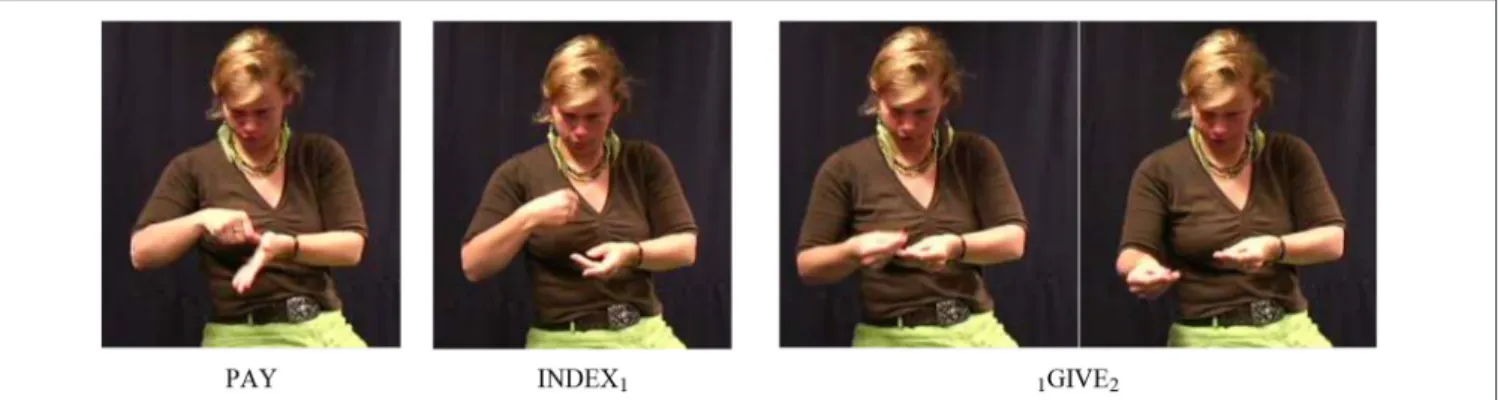
the abstract transfer of support from Agent to Patient (as in English “to give support”). As in (11bc), prosodic characteristics (no pause/hold) and semantics (single event) strongly suggest that we are not dealing with multi-clausal utterances—despite the intervening subject pronoun. In (15b), we also observe weak hand spread (on the non-dominant hand; seeFigure 2).
(15) a.NEW SIGN 2TAKE-OVER1 INDEX1 1GIVE3b
[16-S003-03:31] ‘I pass on new signs to them.’
eg & bs-3b
b.INDEX1 PAY INDEX1 1GIVE2 [250-S013-06:02]
‘I buy (cookies) for you.’
TAKE occurred more frequently in our data set than give (275 tokens), but as with GIVE, after applying our procedure, only
four combinations that were analyzed as SVCs remained, and each one involved a different free verb, namelyTHROW (16a),
DESCEND(16b),MOVE, andTAKE-WITH. In all SVCs involving
TAKE, the two verbs were signed with one continuous movement, so without any intervening signs (as indicated by “∧”; see
Figure 3).
(16) a.PUNISHMENT3aTAKE∧THROW3bPRISON
[5-S004-05:04] ‘As punishment, he was thrown into prison.’
b. CAGE BLANKET3TAKE1∧DESCEND
[325-S015-00:45] ‘He takes down the cage, which is covered
by a blanket.’
SVCs With Speech-Act Verb
CALLOur data set included 203 instances of CALL. After searching for combinations with other speech act verbs and subsequently applying our procedure, we identified 12 instances of SVCs. In these examples,CALL (seeFigure 4) combined with one of six verbs:ASK(four instances) (17a),SAY(four instances), and one
instance each ofREQUEST (17b),INFORM, SIGN, and THANK.
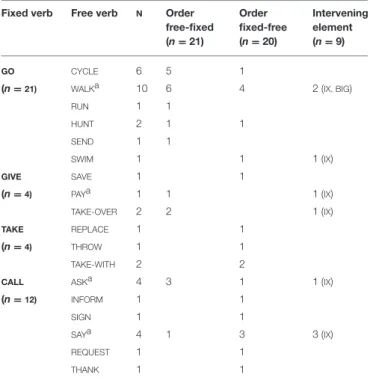
TABLE 2 |Overview of attested combinations of fixed verb (GO, GIVE, TAKE, CALL) and free verb, order of the fixed and free verb in the SVC, and presence and nature of intervening element (IX=INDEX).
Fixed verb Free verb N Order free-fixed (n=21) Order fixed-free (n=20) Intervening element (n=9) GO CYCLE 6 5 1
(n=21) WALKa 10 6 4 2 (IX, BIG)
RUN 1 1 HUNT 2 1 1 SEND 1 1 SWIM 1 1 1 (IX) GIVE SAVE 1 1 (n=4) PAYa 1 1 1 (IX) TAKE-OVER 2 2 1 (IX) TAKE REPLACE 1 1 (n=4) THROW 1 1 TAKE-WITH 2 2 CALL ASKa 4 3 1 1 (IX) (n=12) INFORM 1 1 SIGN 1 1 SAYa 4 1 3 3 (IX) REQUEST 1 1 THANK 1 1
aThese free verbs are also reported byBos (1996/2016)to occur in her data set16.
verb (vragenmeans “ask”) spreads over the fixed verb, thus clearly indicating that the two verbs belong together (seeFigure 4). (17)
hs /vraag/
a. GOOD UNDERSTAND INDEX1ALSO ASK1CALL3
PALM-UP [65-S005-00:12] ‘If I don’t understand it, I just ask (them).’
eg & bs-3b b. INDEX3 1CALL3REQUEST FOOD3GIVE1
[519-S026-01:01] ‘I asked him to give me food.’
A CROSS-LINGUISTIC PERSPECTIVE ON
SERIAL VERB CONSTRUCTIONS
In his insightful commentary on Bos (1996/2016), Costello (2016) offers a thorough comparison of (asymmetrical) SVCs in spoken languages and NGT. Applying ten generalizations, based on Haspelmath (2016), he re-assesses Bos’ conclusion that the NGT “double verb constructions” are structurally and functionally similar to SVCs in spoken languages, and he also concludes that NGT SVCs “fit into the bigger picture.”
We shall not repeat the details of Costello’s comparison here, but rather offer some additional findings concerning the
16As pointed out by a reviewer, it is likely that the number of occurrences of free
verbs is related to their frequency;ASKandSAY, for instance, are certainly more frequent thanINFORMandREQUEST. Frequency, however, is not easily calculated in the corpus, as two-handed signs are represented on two tiers and thus counted twice.
structure and function of NGT SVCs, based on the corpus data. As for the generalizations, suffice it to say that Costello finds that most of them hold for the NGT data, that some cannot be applied to sign languages (e.g., shared tense value—as sign language verbs are not inflected for tense), and that two are contradicted by the NGT data. These latter two generalizations have to do with the nature of the subject: (i) if the two verbs in the SVC have different subjects, the second one is intransitive; (ii) the verbs participating in the SVC cannot have different Agents [see e.g., the Taba example in (3), where the verbs have different subjects, but the subject of the second verb is not an Agent].
Bos (1996/2016, p. 245) reports one example which does not obey these generalizations, namelyINDEX2 BUY 1GIVE2 (“You
bought it from me”), where the two verbs have different Agents, and the second verb is not intransitive. In our data, however, comparable examples did not surface, that is, the corpus data appear to be more in line with the generalizations than the elicited data.
In this section, we discuss selected structural and functional aspects of the data we extracted from the corpus, and we offer a cross-linguistic comparison of our findings, drawing on data from both spoken and sign languages, in particular the findings reported by Bos (1996/2016). In section Order of Fixed Verb and Free Verb, we start by describing the order of fixed and free verb. Subsequently, we address the nature of intervening elements (section Intervening Elements), argument structure properties (section Argument Structure Properties), and the function of SVCs (section Function of SVCs).
Order of Fixed Verb and Free Verb
Table 2provides an overview of all attested verb combinations in our data set, the order of the verbs within the SVC, and the occurrence of elements intervening between the free and the fixed verb.
As for the verbs participating in SVCs, we pointed out previously that the set of fixed verbs that Bos identified overlaps with verbs that are known to commonly participate as fixed verb in SVCs in spoken languages. Looking at the free verbs, we note that the set of free verbs that we identified is quite different from the free verbs reported inBos (1996/2016). In fact, only four verbs overlap in both data sets (WALK,PAY, ASK,SAY—seeTable 2). Given the different data types, this discrepancy is not unexpected. Concerning the order of verbs,Bos (1996/2016) notes that in her data, the verbs in the SVC usually appear in the order free verb—fixed verb. However, she does not indicate how many of her examples contradict this pattern (and she does not provide an example of the opposite order). Our corpus data clearly indicate that the opposite order, with the fixed verb preceding the free verb, is also possible. In fact, almost 50% of our examples (20/41) show this order. Yet, different verbs show different preferences. In the following, we discuss per verb the attested combinations and the order of verbs within the SVC.
(i)GO
As for the attested free verbs in SVCs involvingGO, our findings are in line with those ofBos (1996/2016), as she also observes that GO combined in most of her examples with the sign
FIGURE 2 |Illustration of example (15b); for the fixed verbGIVE, the beginning and end of the movement trajectory are shown.
FIGURE 3 |Illustration of example (16a); for both the fixed and the free verb, the beginning and end of the movement trajectory are shown.
FIGURE 4 |Illustration of example (17a); note that the fixed verbCALLdoes not involve path movement, only a slight hand-internal movement executed at the wrist.
WALK (17/36 cases); other combinations she reports include
BRING, ACCOMPANY, and FLY. However, in her data set, no combinations with the other five verbs we found occurred. For the order of the verbs,Bos(1996/2016, p. 241) further notes that “in most double verb constructions, the fixed verb appears as the second verb,” but she does not specify how often the reverse order occurs. Our data indicate that in combinations withGO, the order
fixed verb—free verb is not uncommon, as it appears in 7 out 21 instances (33%)—four withWALK(14a), and one each with
CYCLE,HUNT, andSWIM. (ii)GIVEandTAKE
Given the small numbers for GIVE and TAKE, a comparison of our findings to those of Bos (1996/2016) may not be
very informative. Still, we want to briefly comment on the attested combinations and the order. As for GIVE, Bos also
observes co-occurrences with PAY but not with TAKE-OVER
or SAVE. The most common combination in her data is with
LEND/BORROW (21/34 cases), probably due to the elicitation procedure. Similarly, in her data, TAKE commonly combines withLEND/BORROW(8/16 cases), but also withBUY(7/16 cases).
The combinations we found for TAKE are not attested in her data.
Interestingly, in our data, the order is different forGIVEand
TAKE. WhileGIVEfollows the free verb in three out of the four cases (the SAVE-case being the only exception), and is thus in
line with the pattern described by Bos, TAKE always precedes
the free verb. Note that Bos does not provide examples with
TAKE, but she does mention that the free verbs are initial— in contrast to what we observe. Although the small number of examples does not allow for firm conclusions, we note that the order of verbs is iconic in our examples in that it mirrors the temporal sequence of events: for TAKE, one first has to take an entity before one can further manipulate it (e.g., by passing it on or throwing it), while in the giving event, receiving the entity (e.g., by taking it over from someone) happens before one can give it to someone (cf. Haiman, 1985). Still, we have to keep in mind that for both verbs, the reduced variation may be due to the smaller number of tokens.
(iii)CALL
In both Bos’ and our data set, CALL most frequently co-occurred with ASKand SAY. InBos (1996/2016), ASKaccounts
for 15/30 instances andSAYfor 8/30 instances. She further reports combinations withPHONEandTELL, but no combinations with the other three verbs we found in the corpus data. As for the order of free and fixed verb, we find thatCALLprecedes the free verb in eight out of 12 cases (17b)—again contradicting the preferred order identified byBos (1996/2016).
Recall from section Defining Properties of Serial Verb Constructions, that iconicity has been claimed to be a factor determining the order of verbs in symmetrical SVCs (Aikhenvald, 2006, p. 28). Despite the claim that “in asymmetrical constructions the order is not necessarily iconic” (Costello, 2016, p. 255), we think that the argument can be extended to asymmetrical SVCs. In fact, studies on spoken languages suggest that within a language that features “give” and “take” SVCs, the order may also be different for the two types, as is illustrated by the Engenni examples in (18) (also seeVeenstra (1996)for Saramaccan).
(18) Engenni (Niger-Congo, Kwa;Lord, 1993, p. 38, 130)
a. ò tou kye î
he take(it) give him ‘He gave it to him.’
b. o tou inya dire
she take rice cook ‘She cooks rice.’
In contrast, the position of the fixed verbs GO and CALL
vis-à-vis the free verb appears to be more flexible. Once again,
we believe that iconicity is at stake—or rather, the lack of iconicity in these types of SVCs. Note that in the directional case (e.g., CYCLE GO), temporal iconicity is not involved: the movement toward a location temporally overlaps with the cycling event. Similarly, in SVCs withCALL, the two speech act verbs refer to the same communicative event. Given this line of reasoning, it is actually quite surprising that Bos (1996/2016)
reports a fixed order also for these two verbs. Yet, it has to be noted that the two orders are not evenly distributed in our data; as is evident fromTable 2, the two verbs show different preferences.
The data from the Corpus NGT, which was recorded between 2006 and 2008, thus shows more variation than the data which Heleen Bos collected in 1991. This might point into the direction of an ongoing language change. As described in section Serial Verb Constructions in NGT, NGT has traditionally been described as an SOV language. Already in 1963, Greenberg, in his famous work on language universals, noted that there is a correlation between the basic word order of a language and the order of main verbs and auxiliaries (Universal 16). In his language sample, inflected auxiliaries in SOV languages always followed the main verb (Greenberg, 1963, p. 65). This is also the most frequent order inBos’ (1996/2016)SVC data. However, a recent corpus-based study finds that SVO order is also commonly used (Oomen and Pfau, 2017). It is possible that the variation in word order goes hand in hand with variation in the positioning of the fixed verb vis-à-vis the free verb. Admittedly, however, based on our data set, such a correlation cannot be established, as only few of the SVC examples contain a direct object (in addition, subject pronouns are frequently dropped)17.
Intervening Elements
Another structural property that deserves attention is the nature of the intervening element. Similar to what Bos (1996/2016)
described, and similar to what we know from SVCs in spoken languages (see section Defining Properties of Serial Verb Constructions), we also find that the verbs in an SVC do not have to be adjacent. Still, in our data set, an intervening element is only observed in nine out of 41 SVCs (22%); see rightmost column inTable 2. Interestingly, in eight of these cases, the intervening sign is a pronominal INDEX (and in four out of these eight cases, a first-person pronoun). Also note that seven of theINDEX
signs are subject pronouns, and only one is an object pronoun. For instance, in (19a), a first person subject pronoun intervenes between the free and the fixed verb. In the remaining example, the intervening sign is the adjective BIG(19b). Note, however, that in this example, too, the intervening element, which fuses with the free verb, refers to a (previously mentioned) referent, a bear.
17In this context, it is interesting to note that recent corpus-based work on modal
verb clusters in NGT also indicates that the order of the verbs within the verb cluster may vary (Couvee and Broedelet, 2016). Traditionally the order in NGT verb clusters has been claimed to be main verb—modal verb. However, the corpus data reveal that in most clusters, the modal precedes the main verb.
(19)
eg & bs-3b
a. INDEX1PAY INDEX1 1GIVE2(PL)[250-S013-06:02]
‘I buy (cookies) for you.’
b. 3GO1 BIG∧WALK [2150-S085-00:24]
‘The big (bear) walked towards me.’
For the eight cases in which anINDEXintervenes, we also checked whether this was more likely to occur in one of the two orders. However, no clear pattern emerged. With GO, the fixed verb precedes the free verb in all three cases; withGIVE, the free verb
precedes the fixed verb in both cases; and withCALL, the pattern is mixed, with two examples displaying the order free–fixed and the other two the order fixed–free.
Bos (1996/2016) mentions that in about one third of her examples, an element intervenes between the two verbs, and that most frequently this element is a subject pronoun—in line with what we found. She only provides examples in which the intervener is a first-person pronoun [see (11bc) above], but mentions that nouns and adverbial signs may also intervene. We did not find such cases in our data.
Clearly, the constraint on intervening elements that we find in our data does not hold for the spoken language examples presented in section Defining Properties of Serial Verb Constructions, where full noun phrases commonly intervene between the two verbs [also see (18b)]. Yet, occasionally, SVCs in spoken languages appear to be constrained in a similar way. For instance, in one type of SVC in Degema, the two verbs, when not appearing adjacent to each other (20a), can only be separated by a mono-syllabic pronoun (20b). Rolle and Kari (2016)refer to this pattern as single-marked SVC pattern, as both verbs carry one inflectional clitic (FE=factative)18.
(20) Degema (Niger-Congo, Benue-Congo;
Rolle and Kari, 2016, p. 146)
a. Ohoso o=sóm túl=n ó.yi
Ohoso 3SG=be.good reach=FE him ‘Ohoso is as handsome/good as him.’
b. Breno o=d.úw mé tá.=¯an
Breno 3SG=follow me go=FE
‘Breno went with me.’
Rolle and Kari argue that the two verbs in the single-marked pattern form a verbal complex, and that the formation of this complex is sensitive to locality, where locality is measured prosodically: “If the two verbs are separated by a prosodically heavy object, the verbs are not sufficiently local for the creation of the verbal complex” (Rolle and Kari, 2016, p. 157). The clitics then attach to the edges of the verbal complex.
We propose to apply a similar line of reasoning to our NGT data. A noun (phrase) cannot intervene between the fixed and the free verb because they also form a verbal complex, and thus a prosodic constituent. Pronouns, on the other hand,
18In addition, they describe a double-marked SVC pattern, in which both verbs
carry inflectional proclitics and enclitics. This pattern appears when the two verbs are separated by a prosodically heavy (bisyllabic) direct object. We shall not discuss this pattern further, but it should be clear that we are not claiming that two distinct patterns exist in NGT, which would be distinguished by the number of inflectional markers on the participating verbs.
are prosodically light elements that can be integrated into the complex (in fact, some of the intervening pronouns are so light that we had to check the videos a couple of times to detect them)19. This prosodic account is further supported by the observation that mouthings may spread from the free verb onto the fixed verb [see (14a) and (17a)]—which is indicative of prosodic integration. Yet, we only extend the prosodic account to NGT. Clearly, NGT is different from Degema in that inflectional markers do not necessarily attach to the edges of the verbal complex.
Argument Structure Properties
A common characteristic of SVCs is that the two verbs share arguments. For instance, in the spoken language examples presented in section Defining Properties of Serial Verb Constructions, the second person subject is shared by the two verbs in (1); the subject as well as the direct object are shared in (2); and in (3), the object of the first verb is the subject of the second verb. We therefore also looked into the argument-sharing properties of the fixed and free verb in our data set. It turned out that the two verbs share the subject in all 41 SVCs. In addition, the object was shared between the two verbs in 15 SVCs. This pattern is illustrated in (21a), where the fixed verb
CALLand the free verb ASK share a first-person subject and a third person object (not overtly realized). In (21b), the free and the fixed verb are ditransitive, and they share the subject (first person) and the direct object (NEW SIGN); the indirect objects, however, are not shared (second person vs. third person). Our data set does not include examples in which only the object is shared, or in which the subject of one verb is the object of the other [but, as mentioned in the introduction to section A Cross-Linguistic Perspective on Serial Verb Constructions,Bos (1996/2016)reports an example of the latter type:INDEX2 BUY 1GIVE2(“You bought it from me”)].
(21)
hs /vraag/
a. GOOD UNDERSTAND INDEX1ALSO ASK1CALL3
[65-S005-00:12]
PALM-UP
‘If I don’t understand it, I just ask (them).’ b. NEW SIGN2TAKE-OVER1INDEX1 1GIVE3b
[16-S003-03:31] ‘I pass on new signs to them.’
Given differences in argument structure of the participating verbs, it is not surprising that there are clear tendencies with respect to shared arguments. For instance, the fixed verbGO is intransitive, and so are the free verbs it combines with; hence, we observe subject sharing in all 21 cases. The fixed verbCALL, on the other hand, is transitive and, for the most part, combines with other transitive speech act verbs. Consequently, in almost all cases, subject and object are shared. One case, in whichCALL
combines with the verbSIGN, is unclear, as SIGNcan be used intransitively (“I sign”) and transitively (“I sign to him/her”).
19Seevan der Kooij and Crasborn (2008)for the prosodic integration of pointing