Article
An Idea Whose Time Has Come? Modern
Slavery, Multiple Streams Approach and
Multilayer Policy Implementation
Alison Gardner*
Abstract
This article uses Kingdon’s multiple streams approach to analyse the implementa-tion gap between anti-slavery legislaimplementa-tion and front-line practice, with particular ref-erence to emerging challenges in the implementation of the UK’s 2015 Modern Slavery Act. The multiple streams approach suggests that policy change and imple-mentation depends on an active coupling of problems, politics and policy, often by proactive ‘policy entrepreneurs’ drawing upon supportive policy communities. While this conjunction can be observed in the framing of the UK’s anti-slavery policy at a national level, document review and survey evidence suggests a failure to con-sistently replicate the same elements at a local level. It is suggested that this has resulted in differentiated engagement with anti-slavery policy from crucial local part-ner organizations, including UK local authorities and the voluntary sector. While in some cases local ‘focusing’ events, politics and policy entrepreneurs have helped to galvanize partnership action, in many localities there is a lack of coordination, resource and impetus. The article makes recommendations to strengthen local im-plementation, including attention to reframing the ‘problem’ of modern slavery, to ensure that it has resonance for local stakeholders, including local political leaders. It is also important for government to recognize competing demands on service pro-viders, and address contradictions that lead to tensions at the front line, particularly between victim care and immigration enforcement. Future policies could also more proactively support local policy networks and communities engaged in anti-slavery activity, embracing different conceptions of the policy challenge beyond a criminal justice perspective. These findings have relevance not only for the UK but also for other nations considering how to embed anti-slavery policy into local practice. Keywords: anti-slavery; collaboration; human trafficking; Kingdon; local partnerships
* The author ([email protected]) is Assistant Professor of Local Governance and Anti-Slavery Policy at the University of Nottingham and leads ‘slavery-free communities’, a re-search programme at the university that aims to understand how to create healthy and prosperous places resistant to modern slavery.
VCThe Author(s) 2018. Published by Oxford University Press.
This is an Open Access article distributed under the terms of the Creative Commons Attribution License (http://creativecom-mons.org/licenses/by/4.0/), which permits unrestricted reuse, distribution, and reproduction in any medium, provided the origi-nal work is properly cited.
Journal of Human Rights Practice, 2018, 1–21 doi: 10.1093/jhuman/huy022 Article
The global movement to end modern slavery and human trafficking has gathered consider-able momentum in recent years. Unprecedented cooperation by the International Labour Organization and Global Slavery Index through ‘Alliance 8.7’ has developed greater con-sensus on macro-level statistics, contributing towards a clearer global understanding of the scale of the challenge (Alliance 8.7 2017). Legislative developments in nation states are helping to instigate a stronger legal framework against modern slavery, with Australia be-ing the latest to commit to creatbe-ing a Modern Slavery Act. Supranational institutions are in-creasingly taking up the baton, from the Commonwealth nations (Frymann Rouch 2017) to faith and civil society organizations, including the Catholic and Anglican churches. There has been active engagement with the agenda by businesses with global reach, such as Thompson Reuters, HSBC, and Apple. The abolition of modern slavery might be said to be the epitome of ‘an idea whose time has come’ (Kingdon 1984: 1).
Yet when we consider how action against modern slavery is reflected in practice we of-ten find a gap between espoused policy and what is happening at the front line, in policy terms an ‘implementation gap’. Such gaps have frequently been observed in the space be-tween outward subscription to human rights norms and the realities of practice. For in-stance, De Felice and Graf suggest that ‘the human rights agenda is plagued by significant gaps between commitment and compliance’ (De Felice and Graf 2015: 43), while Neumayer notes the fragility of regimes where ‘monitoring, compliance and enforcement provisions are non-existent, voluntary, weak or deficient’ (Neumayer 2005: 926). In the case of modern slavery in the UK, this issue was presented starkly in a recent police service inspection report, which concluded that ‘The Modern Slavery Act 2015 has not yet led to significant improvements in the police’s response to modern slavery and human trafficking’ (HMICFRS 2017: 82). Their findings were echoed by a further report from the UK govern-ment’s National Audit Office, which commented that until the UK government established effective oversight of the modern slavery system as a whole, ‘it will not be able to achieve its objective of significantly reducing the prevalence of modern slavery or demonstrate that it is achieving value for money for the resources it applies’ (NAO 2017: 13). Implementation gaps are also evident in the yawning chasm between rhetoric focusing on survivor-centred solutions in the UK (see e.g.Home Office 2017)) and the practical lack of systemic support for survivors noted in a recent select committee inquiry (House of Commons Work and Pensions Committee 2017). Internationally, this challenge can also be observed in the spaces that persist between regulation and enforcement. For example, al-though bonded labour was banned in India in 1976, and the Indian government committed to support 18 million bonded labourers into freedom by 2030, media reports suggest that officials at local and regional levels remain reluctant to provide access to legal and financial assistance (Srivastava 2018). So what contributes to these disconnections in policy imple-mentation, and how can they be addressed? This article uses Kingdon’s multiple streams approach (1984) to diagnose why implementation gaps have emerged in the development of modern slavery policy in the UK. It also examines what lessons the UK’s experience might hold for developing future anti-slavery policy, both internally and internationally.
Kingdon’s ‘multiple streams approach’ developed in his (1984) book ‘Agendas, Alternatives and Public Policies’ is often used as a way of understanding why and how pol-icy change occurs, starting from the premise that the process of change is not linear or logi-cal, and that actors are limited by bounded rationality and resources in the solutions they have to hand. The theory suggests that in order for change to occur, salient policy problems must be ‘coupled’ together with political support and policy solutions, during a limited
space of time described as a ‘policy window’. Skilled ‘policy entrepreneurs’ are often critical to linking problems and solutions, and policy networks or communities play an important role in preparing and supporting new policies.Cairney and Jones (2016)have noted that the multiple streams approach is closely linked to other policy concepts which explore the conditions promoting change, such as ‘punctuated equilibrium’ (Baumgartner and Jones 2002;Gould and Eldredge 1993). However, asBoswell and Rodrigues (2016)andHenstra (2010)have demonstrated, the multiple streams framework also provides us with tools not just to understand how topics rise to the top of the policy agenda, but also to analyse where and why implementation might be faltering. Kingdon’s framework has also been found to be relevant to a wide variety of governance systems and policy applications, including im-plementation in both national and subnational layers of governance (Jones et al. 2016).
Using implementation and multilayer applications of the multiple streams approach to analyse the implementation of modern slavery policy in the UK since 2014, this article argues that although national-level implementation was supported by coupling of the policy ‘problem’ of slavery with political advocacy, and policy solutions (delivered by national actors), the process has not translated consistently to a local level. This has resulted in a lo-calized and inconsistent patchwork of responses to the problem and in some cases, inaction. The article draws for evidence upon collaborative survey-based research conducted with the UK’s Independent Anti-Slavery Commissioner into 42 anti-slavery partnerships and net-works across the UK, as well as interviews with local anti-slavery practitioners, and recent national inspection reports (NAO 2017;HMICFRS 2017). Looking forward, the multiple streams approach also provides ideas as to how this situation might be improved, recogniz-ing the rapid development of existrecogniz-ing anti-slavery policy to strengthen and deepen imple-mentation in the future. Furthermore, although the UK institutional and policy context is distinctive, the relative flexibility of the multiple streams approach renders this application of theory relevant to other nations seeking to unpick multilevel barriers to abolition, albeit with attention to additional factors affecting change, particularly the role of structural influences and institutions.
The first section of the article will consider how the human rights issues underpinning modern slavery influence the approach to public policy, before considering Kingdon’s model in greater detail. The article will then go on to consider the way in which policy problems, politics and policies were framed in the Modern Slavery Act and subsequent national-level implementation, showing why this framing—though effective at gaining trac-tion at natrac-tional level—was inappropriate to embed a local-level response. This analysis is combined with observations drawn from documentary review to illuminate research find-ings on local anti-slavery partnership work across the UK, including illustrative examples of areas where (based on the analysis ofBoswell and Rodrigues (2016)) ‘consensual imple-mentation’ had been achieved, and evidence of ‘bottom-up’ initiatives, as well as ‘coercive implementation’ and non-implementation. It concludes with recommendations arising from the analysis for the UK policy context, but also reflections on the limitations of the multiple streams approach and how it could be fruitfully applied in other international settings.
Multiple streams and modern slavery
Modern slavery is fundamentally a human rights problem, which at its most basic level might be said to involve control of one person by another, depriving them of their liberty,
for the purposes of exploitation. However, slavery is also an economic and social ill, and O’Connell Davidson argues that the discourse of ‘modern slavery’ is a depoliticizing narra-tive that potentially distracts attention from legal and structural causes of unfreedom (Davidson 2010).Landman (2018)picks up on this tension, arguing that although the nec-essary and sufficient conditions for slavery rest on a denial of agency at individual (or mi-cro-) level, there is a need to recognize that limits to agency can arise from both micro-level factors and macro-(social, economic, political and legal) sources. He also points out that across numerous international instruments (such as Article 8 of the 1966 International Covenant on Civil and Political Rights and Article 7 of the 1998 Rome Statute of the International Criminal Court), the prohibition of slavery and the freedom from servitude appear to be more aligned to civil and political rights than to economic and social rights, encouraging a criminal, rather than social justice framing of the issue (Landman 2018).
In constructing public policy to address modern slavery there is henceforth a tension be-tween addressing modern slavery as a crime, and challenging the conditions which promote slavery as part of a wider social and economic system. As I will explain below, in the UK, the government’s initial emphasis has been on criminal enforcement, but as policy has been rolled out, engaging a wider range of actors, more attention is arguably being given to structural and societal factors at a local level, albeit in a piecemeal way. This might be likened to the ‘paradox of empty promises’ (Hafner-Burton and Tsutsui 2005) which suggests that although ratification of human rights treaties can often be associated with political window-dressing, civil society pressure can subsequently lead to deeper forms of compliance.
The multiple streams approach helps us in understanding how this perspective on slavery has developed within public policy. Multiple streams is a widely tested and flexible basis for policy analysis, with a number of features which make it suitable for a multilayer perspective on anti-slavery policy. Recent meta-analysis found 1,933 peer-reviewed books and articles be-tween 2000 and 2013 citing the two principal theorists, Kingdon and Zahariadis, of which 311 directly applied a multiple streams approach (Jones et al. 2016). The applications identi-fied by Jones and others covered 65 different countries and addressed multiple policy domains. Notably, 35 per cent of the identified items dealt with governance at local, state or regional level, althoughBe´land (2015)also highlights that comparative analysis focusing on the role of ideas at a local and subnational level remains a gap in the literature.
Jones and others (2016)argue that a multiple streams approach is premised on the no-tion that policymakers operate in ‘condino-tions of ambiguity, where informano-tion is plentiful and many competing and complementary interpretations coalesce forming diverse, yet plausible understandings of public policy’. This makes it helpful for dealing with the ‘wicked’ nature of modern slavery (Rittel and Webber 1973) where perceptions of the pol-icy problem and optimal solutions are contested. To add to the complexity, the UK’s Home Office (the department responsible for law and order in the UK) has recently delineated 17 different manifestations of modern slavery in the UK (Cooper et al. 2017). A multiple streams approach can help in recognizing the wide spectrum of problem interpretations and corresponding solutions that these different manifestations inspire, ranging from an empha-sis on immigration control, criminal justice and increased enforcement, to a focus on labour and human rights.
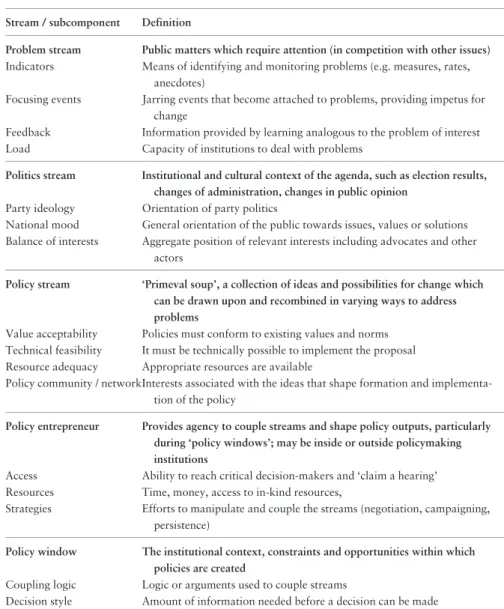
As noted above, the core elements of the multiple streams approach include three streams: ‘problems’, ‘politics’ and ‘policy’, which exist independently, but can be coupled during ‘policy windows’ to effect change. These key elements are listed byJones and others (2016: 15) alongside a number of subcomponents which operationalize the concept and
provide helpful ‘hooks’, which can be linked to aspects of policy development and imple-mentation (set out inTable 1, alongside brief definitions).
Working through the subcomponents one by one, we can examine how they relate to modern slavery. For example, looking for indicators, or evidence, relating to modern slav-ery highlights a problematic issue, as there is debate over the accuracy of national-level measures of prevalence and very limited information at a local level. This matters because, asCairney (2013)points out, problems get attention based on ‘how they are framed or de-fined by participants who compete for attention—using evidence to get attention and per-suasion to address ambiguity’. ‘Focusing events’—typically newsworthy scandals—can also impact on attention at a national and local level: from the Morecambe Bay tragedy which first brought forced labour to the UK’s national attention in 2004,1to more localized cases such as ‘Operation Angelstoke’ which prompted coordinated partnership action against modern slavery in West Yorkshire (Leeds City Council 2015). ‘Feedback’ is significant be-cause in times of constrained resources, actors have been shown to use processes of ‘institu-tional remembering’ to understand and interpret problems and construct a ‘bricolage’ response (Lowndes and McCaughie 2013). ‘Load’, or the capacity of individual partners, is an important issue for public services in the wake of the UK’s austerity agenda, which has seen unprecedented public spending cuts since 2010 (Gardner 2017a;Bailey et al. 2015). Streams and their subcomponents are therefore valuable for empirical analysis, and will be explored in relation to our case studies below.
Although the streams all have significance, and the convergence or ‘coupling’ of multiple streams is a key tenet of the framework’s explanatory power, some studies (e.g.Boswell and Rodrigues 2016;Guldbrandsson and Fossum 2009) focus on particular elements of the approach. Boswell and Rodrigues’ (2016) work concentrates mainly on implementation of policies from the UK’s central government, but their comparative study is particularly inter-esting for a multilayer analysis as it takes policy as a ‘constant’, instead looking at the ways in which variable political support and ‘problem fit’ (the acceptability to key actors and institutions) affect implementation (seeTable 2). They argue that strong political support coupled with a strong problem fit will lead to consensual implementation of policy, whereas a strong problem fit with weak political support will result in attempts at bottom-up implementation from interest grobottom-ups and entrepreneurs. In contrast, a weak problem fit combined with strong political support is likely to lead to coercive attempts at top-down implementation, while issues that have both weak problem fit and weak political support will not be implemented. This is a useful insight that can help in comparing the implemen-tation of a single policy across different layers of governance.
To summarize, the multiple streams approach offers a varied toolkit for analysing the multilevel implementation of modern slavery policy, which can take account of the ‘wicked’ nature of the policy problem, is readily operationalized through attention to subcomponents of the streams, and applicable to a multilayer governance system. With this in mind the arti-cle will now move on to consider the specific case of implementation of modern slavery pol-icy in the UK using a two-stage process. First, the article will demonstrate how the multiple streams framework provides insights into the implementation of policies on modern slavery at both local and national level. This argument will draw upon documentary analysis of poli-cies, strategies, research and inspection reports, as well as collaborative survey-based 1 Twenty-three Chinese labourers were drowned at Morecambe Bay in 2004 while collecting
shell-fish (seeBBC News (2014a)for further details).
research undertaken in 2017 with the UK Independent Anti-Slavery Commissioner’s Office to map the development of modern slavery partnerships. Second, those insights will be ap-plied to interpret a 2017 map of local anti-slavery partnership work across the UK.
Implementation of the UK’s 2015 Modern Slavery Act: understanding
national and local responses in the UK using insights from the
multiple streams framework
We have an increasing variety of secondary source documentation to assist us in under-standing how modern slavery policy implementation is developing across the UK. Table 1.Summary of multiple streams and subcomponents (afterKingdon 1984 andJones et al. 2016)
Stream / subcomponent Definition
Problem stream Public matters which require attention (in competition with other issues)
Indicators Means of identifying and monitoring problems (e.g. measures, rates, anecdotes)
Focusing events Jarring events that become attached to problems, providing impetus for change
Feedback Information provided by learning analogous to the problem of interest Load Capacity of institutions to deal with problems
Politics stream Institutional and cultural context of the agenda, such as election results, changes of administration, changes in public opinion
Party ideology Orientation of party politics
National mood General orientation of the public towards issues, values or solutions Balance of interests Aggregate position of relevant interests including advocates and other
actors
Policy stream ‘Primeval soup’, a collection of ideas and possibilities for change which can be drawn upon and recombined in varying ways to address problems
Value acceptability Policies must conform to existing values and norms Technical feasibility It must be technically possible to implement the proposal Resource adequacy Appropriate resources are available
Policy community / networkInterests associated with the ideas that shape formation and implementa-tion of the policy
Policy entrepreneur Provides agency to couple streams and shape policy outputs, particularly during ‘policy windows’; may be inside or outside policymaking institutions
Access Ability to reach critical decision-makers and ‘claim a hearing’ Resources Time, money, access to in-kind resources,
Strategies Efforts to manipulate and couple the streams (negotiation, campaigning, persistence)
Policy window The institutional context, constraints and opportunities within which policies are created
Coupling logic Logic or arguments used to couple streams
Decision style Amount of information needed before a decision can be made
Quarterly figures are published by the National Crime Agency (NCA) on referrals to the UK National Referral Mechanism (the central support framework for victims of modern slavery), and external assessments are made by the European Group of Experts on Action against Trafficking in Human Beings (e.g.GRETA 2016). National inspection reports in-clude ‘Stolen Freedom’ (HMICFRS 2017) which focuses on the UK policing response to modern slavery, and ‘Reducing Modern Slavery’ (NAO 2017), which considers progress on implementation of the Government’s 2014 Modern Slavery Strategy (HM Government 2014). The Local Government Association, working with the office of the Independent Anti-Slavery Commissioner (IASC), has also published a guide to modern slavery which includes some case studies of local authority action (Local Government Association and Independent Anti-Slavery Commissioner 2017).
In addition, this author undertook survey and interview-based research in 2017, in col-laboration with the IASC, to map the development of multi-agency anti-slavery partner-ships. The existence (or not) of such partnerships provides a useful proxy for understanding local and regional-level engagement with anti-slavery policies, as there is no national guid-ance stipulating partnership engagement, partnerships are non-statutory and rely on resour-ces provided voluntarily by local actors. The research was conducted in two phases. In Phase 1, a short questionnaire was designed for completion by multi-agency partnership leads, and emailed out to partnerships via police modern slavery SPOCs (single points of contact) in April 2017. Announcements were also made via social media, asking UK mod-ern slavery partnerships to come forward with contact details. The questionnaire asked for basic details about local anti-slavery partnership work, defining partnerships of interest as being multi-agency (engaging both statutory and non-statutory partners) and strategic, that is, having a role in developing or coordinating service delivery, rather than being solely con-sultative or focused on fundraising. Questions included basic questions about membership, leadership and coordination, as well as activities, governance and funding. Respondents were also asked to reflect on what would make partnership work more effective, together with existing gaps and challenges to collaboration.
Fifty-one responses were received from police, local authorities, NGOs and faith-based organizations across 40 of the 45 territorial police force areas identifying 42 examples of in-dividual partnerships or multilayer networks dealing with modern slavery. Emerging themes were sense-checked through presentations at practitioner networks and conferences. Phase 2 consisted of study visits and telephone interviews with nine partnership leads and coordinators selected to provide a cross-section of different styles of partnership structure and leadership, including government leadership, NGO leadership, and local authority leadership. This sample was relatively small, partly due to the tight time frame for the re-search, but also reflected the fact that there were relatively few mature partnerships at that point who were able to reflect on their experience across an extended period of activity. Table 2.The relationship between problem fit and political support (Boswell and Rodrigues 2016)
Political support
Strong Weak
Problem fit Strong Consensual implementation Bottom-up implementation
Weak Coercive implementation Non-implementation
Although this sample could not be seen as representative, they did help in testing themes emerging from the wider survey.
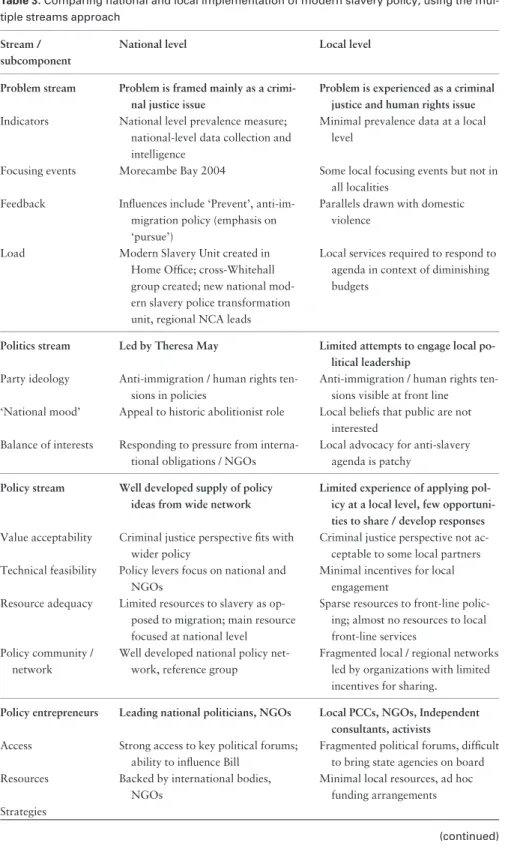
Drawing on these data sources, alongside wider academic literature, it is possible to compare national and local implementation of the modern slavery policy, using the princi-pal streams and subcomponents of the multiple streams approach. A summary setting out key observations is provided inTable 3below.
National-level responses to modern slavery
When we consider the UK’s national-level response to modern slavery, a key aspect influencing implementation is the framing of the problem as a criminal justice, immigration and enforcement issue, with an emphasis on action at a national level. Although there had been scandals prompting sporadic reforms and legislative responses—notably the 2004 Morecambe Bay disaster which prompted the founding of the Gangmasters Licensing Agency (GLA)—the UK initially made a piecemeal legislative response to international anti-slavery initiatives such as the UN’s 2000 Palermo Protocol and the 2005 Council of Europe Convention on Trafficking in Human Beings (GRETA 2012: 7). However, a key opportunity for policy entrepreneurs arrived in the form of sponsorship by Theresa May MP, first during her time as Secretary of State at the Home Office where she oversaw the passage of the 2015 Modern Slavery Act, and after 2016, as a flagship objective in her role as Prime Minister (May 2016).
The adoption and championing of this policy had a number of potential benefits for May in terms of coupling the policy problem of slavery with politically attractive solutions. First there was the need to respond to increasing pressure for action from international and national advocacy networks of politicians, NGOs and academics, whose cause was sup-ported by a growing understanding of the nature and extent of modern slavery (Craig 2015,2014). Second, in the context of rising concerns about immigration, a focus on mod-ern slavery provided an opportunity to pursue humanitarian goals while also directing resources against flows of immigrant labour (anti-immigration policy has concurrently been tightened through the 2016 Immigration Act). Action against modern slavery also appealed to a heroic nationalist framing of the historic British role in the abolition of trans-atlantic slavery, with frequent references to the legacy of William Wilberforce and Britain’s global influence (a discourse which became increasingly potent after the referendum vote in 2016 for the UK to leave the European Union) (Moody 2017: 16). Thus the three policy streams of problem, solution and political support effectively combined at this point to en-able passage of the Modern Slavery Bill, which after extensive scrutiny and revision, was passed by the UK Parliament in 2015. Although it included some provisions to support vic-tims, as well as requiring larger businesses to make a modern slavery statement with regard to their supply chains, the principal focus of the Act was on enabling enforcement of a crinal justice response (Local Government Association 2017: 11). Policy development and im-plementation was subsequently led by the Home Office. Leadership of law enforcement, together with monitoring and publication of intelligence from the National Referral Mechanism, was given to the National Crime Agency, with support from the regional orga-nized crime units (ROCUs).
However, although passing of the Modern Slavery Act was politically feasible, there was little attention directed to ‘technical’ feasibility of implementing a comprehensive anti-slavery response, even with the critical ‘first responder’ organizations, including local
Table 3.Comparing national and local implementation of modern slavery policy, using the mul-tiple streams approach
Stream / subcomponent
National level Local level
Problem stream Problem is framed mainly as a crimi-nal justice issue
Problem is experienced as a criminal justice and human rights issue
Indicators National level prevalence measure; national-level data collection and intelligence
Minimal prevalence data at a local level
Focusing events Morecambe Bay 2004 Some local focusing events but not in all localities
Feedback Influences include ‘Prevent’, anti-im-migration policy (emphasis on ‘pursue’)
Parallels drawn with domestic violence
Load Modern Slavery Unit created in
Home Office; cross-Whitehall group created; new national mod-ern slavery police transformation unit, regional NCA leads
Local services required to respond to agenda in context of diminishing budgets
Politics stream Led by Theresa May Limited attempts to engage local po-litical leadership
Party ideology Anti-immigration / human rights ten-sions in policies
Anti-immigration / human rights ten-sions visible at front line ‘National mood’ Appeal to historic abolitionist role Local beliefs that public are not
interested Balance of interests Responding to pressure from
interna-tional obligations / NGOs
Local advocacy for anti-slavery agenda is patchy
Policy stream Well developed supply of policy ideas from wide network
Limited experience of applying pol-icy at a local level, few opportuni-ties to share / develop responses
Value acceptability Criminal justice perspective fits with wider policy
Criminal justice perspective not ac-ceptable to some local partners Technical feasibility Policy levers focus on national and
NGOs
Minimal incentives for local engagement
Resource adequacy Limited resources to slavery as op-posed to migration; main resource focused at national level
Sparse resources to front-line polic-ing; almost no resources to local front-line services
Policy community / network
Well developed national policy net-work, reference group
Fragmented local / regional networks led by organizations with limited incentives for sharing.
Policy entrepreneurs Leading national politicians, NGOs Local PCCs, NGOs, Independent consultants, activists
Access Strong access to key political forums; ability to influence Bill
Fragmented political forums, difficult to bring state agencies on board Resources Backed by international bodies,
NGOs
Minimal local resources, ad hoc funding arrangements Strategies
(continued)
government and the police, that had principal responsibility for identifying victims. There was an interdepartmental group on modern slavery from 2011; this only reported annually until the Prime Minister formed a new ‘cross-Whitehall’ taskforce in 2016 (NAO 2017: 17). A multi-agency ‘Modern Slavery Strategy and Implementation Group’ also existed to pro-vide advice on implementation, but focused principally on collaboration between central government, NGOs and businesses, rather than across different levels of government. Identifiable spending on modern slavery was also principally split between victim care (pro-vided by national and regional NGOs) and national-level law enforcement, including funds for a modern slavery police transformation unit and expanded Gangmasters Licensing Authority, which became the Gangmasters and Labour Abuse Authority (GLAA) in 2017 (GLAA 2017;NAO 2017: 20). The National Audit Office notes that the full extent of spend-ing on modern slavery across wider government agencies is unknown (NAO 2017: 20).
The modern slavery strategy published by the Home Office in 2014 was structured against the national ‘4Ps’ framework (Pursue, Prevent, Protect, and Prepare). This echoed a pre-existing 3Ps international framework (Sun-Suon 2015: 23) but also duplicated the 4Ps framework already used for serious organized crime and counter-terrorism operations, in-cluding a strong emphasis on ‘pursue’. Evidence of the problem was also collated at a na-tional level. This included a nana-tional estimate of prevalence published by the Home Office in 2014 (Bales et al. 2015;Silverman 2014); data on those entering the National Referral Mechanism; and from 2016 onwards, data to inform the cross-Whitehall task force, which focused on measures such as potential victims identified; police recorded crimes; crimes resulting in charges or summons; operations; and prosecutions and convictions (NAO 2017: 18). Again, this data gave a perspective on the problem which could not always be broken down to a local level, and was strongly focused on criminal justice responses.
Support for victims was also focused at a national level. Decision-making on whether individuals could be recognized as victims of modern slavery and human trafficking was initially connected to immigration status, divided between the National Crime Agency (for European Economic Area nationals) and UK Visas and Immigration (UKVI) for all other cases. Practical support was arranged through a national contract awarded to the Salvation Army from 2011 onwards, working with a consortium of regional NGOs. This use of NGOs for delivery of services that might have formerly been part of the local welfare state was consistent with the Conservative Party’s public service reform ideology of ‘open public Table 3.(Continued)
Stream / subcomponent
National level Local level
Policy mainly driven top-down via levers relating to Home Office
Policymaking generally ad hoc according to local resources and circumstances
Policy window Policy window opened through Theresa May’s leadership
Local policy windows sometimes opened through focusing events
Coupling logic Human rights / criminal justice argu-ment; fit with anti-immigration policy
Human rights / criminal justice arguments
Decision style Sufficient international / national level information to promote action
Sparse local data to inform multiple decision-making forums with varying interests
services’, whereby services were commissioned on a contract basis rather than offered through state-based providers (Cabinet Office 2013).
In summary, the modern slavery ‘problem’ that was framed in the UK focused mainly on criminal justice aspects of the problem, prompting a focus on national-level solutions, backed by a policy environment and community that included few voices relating to local aspects of policy delivery. The impact of this approach on implementation will now be ex-amined in more detail.
Local-level responses to modern slavery
In contrast to the attention paid to national action, local implementation of policy sur-rounding the Modern Slavery Act has until recently received little support or resources. This is a problem because action at a local level contributes to the prevention of slavery, the discovery of victims, supporting recovery, and creating communities that are sustainably re-silient against slavery (Gardner 2017b). Yet to date, local action in the UK has been sub-stantially dependent on the proactive efforts of local policy entrepreneurs. The multiple streams approach helps us in analysing why this is the case.
First, information to frame the problem at a local level was limited. The national preva-lence data produced by the Home Office could not be broken down to a local level due partly to a lack of understanding regarding the distribution of slavery. National Crime Agency data was sometimes not shared in a timely fashion with local police forces, and there was ‘a general absence of analytical support to help forces understand modern slavery and human trafficking’ (HMICFRS 2017: 38). As a consequence the police inspectorate raised concerns about ‘the number of front-line officers, in both urban and rural areas, who did not view modern slavery and trafficking as a matter for their force’ (ibid: 43). In some areas local cases had galvanized political support and action. For example the Darrell Simester case in Wales,2and Operation Angelstoke, which rescued 70 vulnerable individu-als in West Yorkshire, were both cited by interviewees as catalysts for deeper engagement with the modern slavery agenda (author interview 1, partnership coordinator (government); author interview 2, partnership coordinator (NGO);Leeds City Council 2015). However, in other forces there was evidence that senior police officers were unwilling to proactively ‘turn over the stone’ and look for modern slavery offences (HMICFRS 2017: 10).
Second, the framing of the issue as being concerned with criminal justice and enforce-ment was not a good fit with the partnership response required at the front line, which reflected wider practical concerns with ‘safeguarding’ victims of modern slavery and pro-tecting their human rights, as well as broader societal responses to the problem of slavery. Conversations with front-line practitioners revealed that policy inspiration for addressing the needs of survivors was often drawn from learning about handling domestic violence, for instance, rather than experience in tackling serious organized crime. Within policing, Her Majesty’s Inspectorate of Constabulary and Fire and Rescue Services (HMICFRS) rec-ognized that ‘a mixture of both the serious organized crime and the protecting vulnerable people approaches is needed’ and that investigations could be compromised by a focus on the immigration status of victims (2017: 12, 45). This tension was even more pronounced in local partnerships, where building trust and a common agenda between statutory and 2 Darrell Simester was a vulnerable adult who was held in conditions of forced labour for 13 years
(BBC News 2014b).
voluntary partners was critical. Here immigration targets could be particularly divisive, with one partnership lead recalling that ‘the guy from immigration turned up in uniform, [and] destroyed what we were trying to do’ (author interview 3, partnership founder (statu-tory agency)).
Third, despite an emphasis on partnership from the Home Office’s modern slavery strat-egy, (HM Government 2014) there was no attention to the existing ‘load’ of local statutory and voluntary sector services, many of which had been subjected to extensive spending cuts since 2010 (see e.g.NAO 2014;Lowndes and Gardner 2016). In contrast to the estimated 100 million pounds allocated at a national level to addressing modern slavery (NAO 2017), minimal funding was allocated to local police forces for additional investigatory resources, no provision was made for training partner agencies, and until recently3no central funds were offered to local authorities or local voluntary sector partners to assist in creating responses to the problem. This was a mistake, as these partners were critical to local multi-agency strategies for preventing and discovering slavery, as well as delivering effective sup-port to victims, before and after entry to the National Referral Mechanism.
This failure to articulate the policy problem in locally relevant terms was exacerbated by a lack of attention to local politics. There was no attempt by central government to en-gage political leaders in local government in the issue. A modern slavery network was estab-lished for Police and Crime Commissioners (PCCs) in 2016, but the impetus for this network came from Mark Burns Williamson, PCC for West Yorkshire, who had been par-ticularly proactive around the agenda. Our UK survey conducted in February to April 2017 revealed only three anti-slavery partnerships chaired by PCCs. Despite a 2.18 million pound (national) public awareness campaign in 2014 that claimed to reach 93 per cent of UK adults (Home Office 2015), there was also a widespread perception that the public were not supportive of action to address modern slavery. Police officers were quoted saying that ‘the public were not interested in this issue, did not want to understand it and were to a de-gree in denial about it’ and ‘the public view is, they are not our girls’ (HMICFRS 2017: 76). Local policy responses were further hampered by lack of both practical policy advice and examples of promising practice. Policy communities working at a local level were frag-mented, with regional and subregional networks led by NGOs and consultants who were sometimes in competition with each other. The Home Office resisted being directive on forms of partnership working (author interview 4 with partnership lead, NGO), but this left a vacuum, in which local practitioners frequently found themselves ‘reinventing the wheel’. Some resources have recently been centralized—for example the website GOV.UK has recently published an overview of training and information resources, while a guide de-tailing the varied contribution of local authorities to addressing modern slavery has been published by the Local Government Association and Independent Anti-Slavery Commissioner (2017). However, identification of good practice remains difficult due to the lack of local prevalence data and longer-term monitoring of effective partnership activity.
Given this dearth of attention to effectively defining the local aspects of the problem, en-gaging with politics and resource challenges, or sharing effective policy approaches, one might hypothesize that little or no local anti-slavery policy implementation would be 3 In December 2017 local authorities were invited by the Home Office and the Department for Communities and Local Government to bid for funds to test ‘transition pathways’ for adult victims leaving centrally provided support. Six local authorities were successful in obtaining funds for one–year pilot schemes (UK Parliament 2018).
expected. However, when we mapped multi-agency partnership activity in 2017, we were surprised to find that many areas professed to have some form of multi-agency anti-slavery partnership work in place. In fact, asFigure 1illustrates, 42 partnerships or multilayer part-nership networks were identified by our survey, but the extent and maturity of partpart-nership work varied considerably. This finding can be attributed to the presence or absence of local political support and accompanying institutional influence, local ‘problem fit’ and local policy entrepreneurs, which will be explored in more detail below, with reference to the work ofBoswell and Rodrigues (2016).
Explaining patterns of partnership activity using the multiple streams
approach
When we looked at patterns of multi-agency anti-slavery partnership work across the UK we found a patchwork of partnership arrangements, organized on differing principles across the UK, and in layers of varying complexity.
Partnerships were constructed on national, regional, subregional and local boundaries, which sometimes overlapped or led to multiple layers of activity. The most developed net-work arrangements were to be found in Wales where six national partnerships covered functions including leadership, operations, casework and training, and three regional part-nerships focused on operational matters. Some regions of England, including the South West and East and West Midlands, also had regional-level networks in place (seefig. 1). These regional networks were progressively being underpinned by county or unitary local authority level partnerships for developing local operational responses. Regional partner-ships were led by diverse actors (including NGOs, independent consultants, councils and the police) and varied in terms of their scope and the types of activity undertaken.
Some subregional partnerships stretched across police force or administrative bound-aries, for instance, Kent and Essex. However, the majority worked on county or police force boundaries, such as West Yorkshire, the pan-Sussex network, and Nottinghamshire. In a few cases, multi-agency partnerships had been initiated at local level independently of wider subregional arrangements—for instance in Bedfordshire and Croydon. In some cases, other types of liaison arrangement were in place—for instance Northumbria reported using multiple bilateral arrangements in place of a single anti-slavery partnership. Finally, a num-ber of areas did not report any anti-slavery partnership activity.
There was evidence for partnerships changing form and structure over time as they gained maturity. Newer partnerships often took the form of an informal group or network. More mature partnerships exhibited a mix of wider network meetings and more operationally-focused subgroups which were either organized by area (for example on a lo-cal authority boundary) or function (such as joint operations or intelligence sharing).
In a number of cases partnership work to address modern slavery was aligned to existing multi-agency partnership structures, such as local safeguarding boards, ‘Preventing Violence against Vulnerable People’ (PVVP) boards, or multi-agency safeguarding hubs (MASH). Some interviewees were concerned that alignment with existing structures diluted the focus on modern slavery (author interview 5 (police)), but others pointed to a risk of du-plication and lack of ownership if responsibilities were not aligned to existing structures, al-though survey respondents acknowledged that there was no single natural fit.
Analysing this pattern through the lens of the multiple streams approach and particu-larly Boswell and Rodrigues’ (2016) insights into implementation set out inTable 2, it is
Figure 1.All multi-agency anti-slavery partnerships in the UK, Spring 2017, by police force area.
possible to see the influence of problem fit, political support, and the role of policy entre-preneurs on local partnership construction, but also a crucial role for institutions and insti-tutional power.
For example, the areas with some of the most highly developed partnership network arrangements showed evidence of a strong problem fit (often with links to an initial focus-ing event), strong local political support, and active anti-slavery policy entrepreneurs who were able to couple that environment with local policy levers and resources. Wales provides an example of this type ofconsensual implementation. Here there had been political sup-port from the Welsh Government for an anti-slavery coordinator role from 2011 onwards, but the partnership structure had particularly developed from 2013 onwards. This was mainly through the proactive work of two local policy entrepreneurs from the Welsh Government and the Crown Prosecution Service. These individuals used their institutional position and influence to couple resources and policy solutions as a means of addressing slavery, commenting ‘we are able to do that because we are government’. Their work also coincided with some shocking local ‘focusing’ events such as the Darrell Simester case, which helped in raising awareness of the local problem, and building further scope to en-gage partners and extend partnership activity.
Similarly, in West Yorkshire, Operation Angelstoke was highlighted as a factor in rais-ing local awareness of modern slavery, with political support for the agenda comrais-ing from the Police and Crime Commissioner. This, in turn, helped to unlock resources to engage lo-cal partners, build a dedicated lolo-cal police team, and initiate a national PCC network. At the same time, the NGO ‘Hope for Justice’ have acted as policy entrepreneurs in West Yorkshire, contributing policy solutions, expertise and staff coordination resources into po-lice operations and partnership building.
In areas where local political support was not present, however, partnership work often took longer to establish and depended on long-term commitment of policy entrepreneurs. While agencies were often prepared to engage in information sharing on an informal basis, some partnerships described extended journeys to secure formal institutional support. Policy entrepreneurs could still make progress, bringing about ‘bottom-up’ implementation of anti-slavery action, but securing resources or integration with wider institutional programmes could take longer. An example of this type of partnership journey can be found, for example in the story of the regional West Midlands Anti-Slavery Network, which began in 2008 as an NGO-funded initiative (the Regional Anti-Trafficking (RAT) Network) (Scarlett 2015). After a long period of development, supported by active policy entrepreneurship, the network has recently connected formally into regional institutional partnership frameworks around ‘preventing vio-lence against vulnerable people’. This connection creates a governance framework to move to-wards sustained implementation of anti-slavery policy and action by statutory agencies.
Other areas did not have either strong political support for local anti-slavery activity, or active local policy entrepreneurs. In multiple cases our survey indicated that the police were initiating local partnership work (albeit sometimes by identifying internal entrepreneurs who were effective in connecting with community partners, as in the case of Kent and Essex Police). However, a number of research respondents expressed their concerns that the po-lice were not best placed to lead wider engagement: as one individual put it: ‘the popo-lice tend to take the lead in organizing this, however onus on the organization should be passed round to get a better buy in from all’.
We were also interested to find that although some areas reported examples of partner-ship work to the initial survey in 2017, further inquiries established that these appeared to
be inactive or at a very formative stage. This was potentially a sign ofcoercive implementa-tion, whereby local police forces perceiving rising scrutiny of their anti-slavery activity were associating themselves with partnership arrangements that were at best tentative, in an ef-fort to ‘look busy’ in the shadow of a possible ef-forthcoming HMICFRS inspection. Finally, there were also a number of examples of non-implementation, where neither local police forces nor any other body had initiated any anti-slavery partnership work in their area. This coincided with the observations in the 2017 HMICFRS report that some forces were yet to accept modern slavery as a local problem.
In summary, from these cases we can tentatively suggest that even though national anti-slavery policy was implemented with minimal attention to feasibility, when local policy entrepreneurs acted to connect problems, politics and policy, local implementation of cen-trally driven anti-slavery policy did occur, even in an otherwise fragmented and resource-constrained context. However, the extent to which implementation influenced existing stat-utory services and programmes appeared to vary according to the presence or absence of lo-cal politilo-cal support, as well as connections to institutional influence and resources. Policy entrepreneurship by individuals or NGOs is therefore valuable in coordinating local action, but to maximize impact it needs to be coupled with local political recognition and institu-tional engagement. This analysis is, however, currently limited by our study’s narrow focus on a small number of in-depth case studies—principally of areas where partnership activity was already in place. Further research on the development (and non-development) of mod-ern slavery partnership action, and factors influencing the effectiveness of that action, is necessary to better understand the difference these elements make in achieving policy goals.
Discussion and conclusions
This has been an account of implementation of a contested policy in a fragmented gover-nance system. Such problems might be seen as routine in the current post-marketization context, but it is worth recalling that just ten years ago, shared national and local policy priorities would have been implemented very differently in the UK. Under the process known as ‘Local Area Agreements’ which lasted from 2007 until 2010, new policy initia-tives were pump-primed with financial resources for local actors, and clear leadership was allocated at a local level, alongside rigorous performance management. While there were many shortcomings with this framework (not least bureaucracy and central government dominance) they were judged to be ‘helpful as a tool to help partners make choices and translate “big picture” ambitions into more tangible and realisable priorities’ (DCLG 2011: 17). Yet most of the underpinning architecture of that system was swept away in post-2010 austerity deregulation, and local authorities, in particular, while experiencing less central direction, have been substantially weakened (Crewe 2016). The patchwork implementation of modern slavery policy is symptomatic of the costs and wider implications of this change.
This article’s contribution is principally empirical and theoretical, with significance for the anti-slavery movement (in the UK and internationally), policy practitioners and scholars with an interest in the multiple streams approach.
For the anti-slavery movement, it demonstrates that the multiple streams approach pro-vides a helpful framework for assessing where implementation gaps exist in policies to ad-dress modern slavery. Although political and institutional arrangements in the UK are distinctive, elements of the UK’s governance arrangements are reflected in multiple interna-tional settings, particularly in Commonwealth nations, many of which are considering their
own anti-slavery legislation. By demonstrating how the UK’s case can be linked to the mul-tiple streams approach, the article provides a basis for future comparison and diagnosis of challenges in other social and political contexts.
For the UK anti-slavery movement and policy practitioners, this article enables the iden-tification of gaps in existing policy and points to potential remedies. In particular this analysis suggests that policy entrepreneurs have played an important role in initiating and coordinating anti-slavery action at a local level. However, it is clear from the patchwork of implementation that the existence of those entrepreneurs is not guaranteed, and that their ability to engage local institutions and resources can vary. More attention needs to be addressed by national government to reframing the problem so that it has greater resonance for powerful local stakeholders, and promoting local leadership and coordination for anti-slavery activity.
Attention also needs to be paid to the existing load of service delivery partners, clarify-ing where modern slavery sits amongst their competclarify-ing priorities, and identifyclarify-ing or realigning resources where necessary. The engagement of local politicians is crucial to this process and has been a missed opportunity to date, possibly slowing access to institutional influence and assets. Although awareness is rising (and publications like the Local Government Association’s recent Council Guide will assist) more engagement needs to be pursued to provide a mandate for local statutory services to engage in anti-slavery activities. Local political leadership would also be valuable in helping to secure wider public aware-ness and ultimately greater public support for pursuing anti-slavery policy.
Given the reliance on partner engagement and co-production at a local level, it is also important to recognize the different motivations partners have in engaging in anti-slavery activity, above and beyond enforcement and prosecution. This includes addressing the pol-icy contradictions that lead to tensions at the front line, for instance between victim care and immigration enforcement. Future policies could more proactively support the growth of local policy networks and communities to share promising practices at a local level, and encourage the emergence of policy entrepreneurs in localities that have not yet progressed their anti-slavery work. They might also more proactively embrace different conceptions of the policy problem, looking for instance at the role of communities in encouraging respon-sible business practices and trade, or supporting survivors. The place-focused ‘slavery-free community’ approach currently being tested in Nottinghamshire, and faith-based action through the Church of England’s anti-slavery Clewer Initiative (https://www.theclewerini tiative.org/about-us), provide examples of how such a produced approach to co-ordination might be initiated.
For public policy scholars, this analysis demonstrates both the value of a multilayer analysis based on a multiple streams approach and some of its limitations. In particular, the observations in relation to local partnership working demonstrate the value of considering additional factors, such as institutional power and resources, in supporting policy imple-mentation. There is also a difference between promoting the dissemination and acceptance of policy ideas, and the achievement of material changes within institutions. Gardner (2017a) highlights that if institutions are conceived as collections of rules, practices and narratives that structure behaviour (Lowndes and Roberts 2013), then narratives can some-times change before informal practices and formal rules. This is particularly important to issues such as the care and support of victims, where structures and practices within organi-zations need to change, in addition to the acceptance of an ethos of victim or survivor-centred services.
There are also wider structural issues hinted at in this analysis which need to be ex-plored in greater depth, including the impact of increased marketization and fragmentation of public services and the effect this has on vertical policy implementation. These wider fac-tors are essential to the long-term pursuit of an anti-slavery agenda. Within the UK we are currently experiencing a policy window for anti-slavery activity, but we can expect that window to be time limited. The steps outlined above will go some way to embedding policy change, but structural and institutional factors are also crucial to address in order to ensure that anti-slavery action is sustained beyond the current policy window.
Acknowledgements
This paper draws on data compiled as part of a collaborative project with the Office of the Independent Anti-Slavery Commissioner in 2017. Thanks are due to Juergen Amann and Dr Mike Gardner for their research assistance with compiling research statistics and producing Figure 1. Thanks also go to Professor Zoe Trodd, Dr David Walsh and two anonymous reviewers for their helpful feedback on an earlier draft of this paper.
Funding
This work was supported by the University of Nottingham’s ‘Rights Lab’ as part of a wider pro-gramme of research examining how we create ‘slavery-free communities’. We are grateful to the Office of the Independent Anti-Slavery Commissioner for practical assistance and advice in de-signing and distributing the survey and feedback on results.
References
Alliance 8.7. 2017. Global Estimates of Modern Slavery and Child Labour. http://www.alliance87.org (referenced 6 January 2018).
Bailey, N., G. Bramley, and A. Hastings. 2015. Symposium Introduction: Local Responses to ‘Austerity’.Local Government Studies41(4): 571–81.
Bales, K., O. Hesketh, and B. Silverman. 2015. Modern Slavery In the UK: How Many Victims?
Significance12(3): 16–21.
Baumgartner, F., and B. Jones (eds). 2002.Policy Dynamics. University of Chicago Press. BBC News. 2014a. Morecambe Bay Cockling Disaster’s Lasting Impact. 3 February. ———. 2014b. Newport ‘Slavery’ Victim Darrell Simester Speaks of Ordeal. 4 November. Be´land, D. 2015. Kingdon Reconsidered: Ideas, Interests and Institutions in Comparative Policy
Analysis.Journal of Comparative Policy Analysis18(3): 228–42.
Boswell, C., and E. Rodrigues. 2016. Policies, Politics and Organisational Problems: Multiple Streams and the Implementation of Targets in UK Government. Policy and Politics44(4): 507–24.
Cabinet Office. 2013. Open Public Services. https://www.gov.uk/government/collections/open-public-services (referenced 5 January 2018).
Cairney, P. 2013. Policy Concepts in 1000 Words: Multiple Streams Analysis. Paul Cairney: Politics and Public Policy. https://paulcairney.wordpress.com/2013/10/31 (referenced 5 January 2018). Cairney, P., and M. D. Jones. 2016. Kingdon’s Multiple Streams Approach: What is the Empirical
Impact of this Universal Theory?Policy Studies Journal44(1): 37–58.
Cooper, C., O. Hesketh, N. Ellis, and A. Fair. 2017. A Typology of Modern Slavery Offences in the UK. Home Office Research Report 93.
Council of Europe Convention on Action against Trafficking in Human Beings, 16 May 2005 (en-tered into force 1 February 2008).
Craig, G. 2014. Modern Slavery in the UK: The Contribution of Research.Journal of Poverty and
Social Justice22(2): 159–64.
———. 2015. Human Trafficking and the UK Modern Slavery Bill.Social Inclusion3(1): 136–9. Crewe, T. 2016. The Strange Death of Municipal England.London Review of Books38(24): 6–10. Davidson, J. O’C. 2010. New Slavery, Old Binaries: Human Trafficking and the Borders of
‘Freedom’.Global Networks10(2): 244–61.
DCLG (Department for Communities and Local Government). 2011. Long Term Evaluation of Local Area Agreements and Local Strategic Partnerships: 2007–2010 Final Report.
De Felice, D., and A. Graf. 2015. The Potential of National Action Plans to Implement Human Rights Norms: An Early Assessment with Respect to the UN Guiding Principles on Business and Human Rights.Journal of Human Rights Practice7(1): 40–71.
Frymann Rouch, A. 2017. Queen Backs Action against Modern Slavery in all Commonwealth Nations.The Guardian. 11 October.
Gardner, A. 2017a. Big Change, Little Change? Punctuation, Increments and Multi-Layer Institutional Change for English Local Authorities under Austerity.Local Government Studies
43(2): 150–69.
———. 2017b. Thinking Globally, Acting Locally: Is Local Public Policy Anti-Slavery’s Missing Link? UoN Blogs. http://blogs.nottingham.ac.uk/rights/2017/03/23/walkfree2 (referenced 14 January 2018).
GLAA (Gangmasters and Labour Abuse Authority). 2017. GLAA Powers under the Police and Criminal Evidence Act (PACE) 1984. GLAA Brief Issue 53. July. http://www.gla.gov.uk/media/ 3120/gla-powers-under-pace.pdf (referenced 7 January 2018).
Gould, S. J., and N. Eldredge. 1993. Punctuated Equilibrium Comes of Age. Nature 366: 223–27.
GRETA (Group of Experts on Action against Trafficking in Human Beings). 2012. Report Concerning the Implementation of the Council of Europe Convention on Action against Trafficking in Human Beings by the United Kingdom. First Evaluation Round. GRETA(2012)6. Council of Europe. https://rm.coe.int/CoERMPublicCommonSearchServices/DisplayDCTM Content?documentId¼090000168067a080 (referenced 18 September 2018).
GRETA (Group of Experts on Action against Trafficking in Human Beings). 2016. Report Concerning the Implementation of the Council of Europe Convention on Action against Trafficking in Human Beings by the United Kingdom. Second Evaluation Round. GRETA(2016)21. Council of Europe. https://rm.coe.int/16806abcdc (referenced 7 January 2018). Guldbrandsson, K., and B. Fossum. 2009. An Exploration of the Theoretical Concepts Policy Windows and Policy Entrepreneurs at the Swedish Public Health Arena.Health Promotion
International24(4): 434–44.
Hafner-Burton, E. M., and K. Tsutsui. 2005. Human Rights in a Globalizing World: The Paradox of Empty Promises.American Journal of Sociology110(5): 1373–411.
Henstra, D. 2010. Explaining Local Policy Choices: A Multiple Streams Analysis of Municipal Emergency Management.Canadian Public Administration53(2): 241–58.
HM Government. 2014. Modern Slavery Strategy. https://www.gov.uk/government/uploads/sys tem/uploads/attachment_data/file/383764/Modern_Slavery_Strategy_FINAL_DEC2015.pdf (referenced 7 January 2018).
HMICFRS (Her Majesty’s Inspectorate of Constabulary and Fire and Rescue Services). 2017. Stolen Freedom: The Policing Response to Modern Slavery and Human Trafficking. https://www.justiceinspectorates.gov.uk/hmicfrs/wp-content/uploads/stolen-freedom-the-policing-response-to-modern-slavery-and-human-trafficking.pdf (referenced 7 January 2018).
Home Office. 2015. Modern Slavery Marketing Campaign Evaluation Report. https://www.gov. uk/government/publications/modern-slavery-marketing-campaign-evaluation-report (refer-enced 7 January 2018).
———. 2017. Modern Slavery Victims to Receive Longer Period of Support. https://www.gov.uk/ government/news/modern-slavery-victims-to-receive-longer-period-of-support (referenced 4 January 2018).
House of Commons Work and Pensions Committee. 2017. Victims of Modern Slavery Inquiry. https://www.parliament.uk/business/committees/committees-a-z/commons-select/work-and-pensions-committee/inquiries/parliament-2015/victims-of-modern-slavery-16-17/publications (referenced 7 January 2018).
International Covenant on Civil and Political Rights, 16 December 1966 (entered into force 23 March 1976).
Jones, M. D., H. L. Peterson, J. J. Pierce, N. Herweg. et al. 2016. A River Runs Through It: A Multiple Streams Meta Review.Policy Studies Journal44(1): 13–36.
Kingdon, J. 1984.Agendas, Alternatives and Public Policies. New York: Harper Collins. Landman, T. 2018. Out of the Shadows: Trans-Disciplinary Research on Modern Slavery.Peace
Human Rights Governance2(2): 143–62.
Leeds City Council. 2015. Combating Modern Day Slavery in Leeds: A Strategy. February. http:// www.leeds.gov.uk/docs/LCC Modern Slavery Strategy.pdf (referenced 7 January 2018). Local Government Association and Independent Anti-Slavery Commissioner. 2017. Tackling
Modern Slavery: A Council Guide. https://www.local.gov.uk/modern-slavery-council-guide (referenced 29 July 2018).
Lowndes, V., and A. Gardner. 2016. Local Governance under the Conservatives: Super-Austerity, Devolution and the ‘Smarter State’.Local Government Studies42(3): 357–75.
Lowndes, V., and K. McCaughie. 2013. Weathering the Perfect Storm? Austerity and Institutional Resilience in English Local Governance.Policy and Politics41(4): 533–49.
Lowndes, V., and M. Roberts. 2013.Why Institutions Matter: The New Institutionalism in
Political Science. Palgrave Macmillan.
May, T. 2016. My Government will Lead the Way in Defeating Modern Slavery.The Telegraph. 30 July. http://www.telegraph.co.uk/news/2016/07/30/we-will-lead-the-way-in-defeating-mod ern-slavery (referenced 7 January 2018).
Moody, J. 2017. Remembering the Imperial Context of Emancipation Commemoration in the Former British Slave-Port Cities of Bristol and Liverpool, 1933 –1934.Slavery and Abolition39(1): 1–21. NAO (National Audit Office). 2014. Financial Sustainability of Local Authorities 2014. http://www.
nao.org.uk/report/financial-sustainability-of-local-authorities-2014 (referenced 7 January 2018). NAO (National Audit Office). 2017. Reducing Modern Slavery. https://www.nao.org.uk/wp-con
tent/uploads/2017/12/Reducing-Modern-Slavery.pdf (referenced 7 January 2018).
Neumayer, E. 2005. Do International Human Rights Treaties Improve Respect for Human Rights?Journal of Conflict Resolution49(6): 925–53.
Protocol to Prevent, Suppress and Punish Trafficking in Persons Especially Women and Children, supplementing the United Nations Convention against Transnational Organized Crime (Palermo Protocol), 15 November 2000 (entered into force 25 December 2003).
Rittel, H. W. J., and M. M. Webber. 1973. Dilemmas in a General Theory of Planning.Policy
Sciences4(2): 155–69.
Rome Statute of the International Criminal Court, 17 July 1998 (entered into force 1 July 2002). Scarlett, K. 2015. Our History: How the West Midlands Anti Slavery Network Developed. West
Midlands Anti Slavery Network. http://www.westmidlandsantislavery.org/about/our-history (referenced 10 January 2018).
Silverman, B. 2014. Modern Slavery: An Application of Multiple Systems Estimation. https:// www.gov.uk/government/uploads/system/uploads/attachment_data/file/386841/Modern_ Slavery_an_application_of_MSE_revised.pdf (referenced 7 January 2018).
Srivastava, R. 2018. India Rights Panel to Probe Failure to Support Rescued Slave Workers. Thomson Reuters Foundation. http://news.trust.org/item/20180105080541-4ymj9 (referenced 6 January 2018).
Sun-Suon, M. 2015. Human Trafficking and the Role of Local Governments. United Nations Institute for Training and Research (UNITAR). https://www.unitar.org/dcp/sites/unitar.org. dcp/files/uploads/newcoverhuman_trafficking_final.compressed.compressed.pdf (referenced 7 January 2018).
UK Parliament. 2018. Human Trafficking: Written question 139966. Parliamentary Business: Written Questions and Answers. https://www.parliament.uk/business/publications/written-ques tions-answers-statements/written-question/Commons/2018-05-01/139966 (referenced 18 September 2018).
List of interviews
Author interview 1 partnership coordinator (government) Author interview 2 partnership coordinator (NGO) Author interview 3 partnership founder (statutory agency) Author interview 4 partnership lead (NGO)
Author interview 5 (police)