University of New Orleans University of New Orleans
ScholarWorks@UNO
ScholarWorks@UNO
Planning and Urban Studies Reports and
Presentations Department of Planning and Urban Studies
Spring 5-1-2014
Fighting Blight Through Innovative Financing
Fighting Blight Through Innovative Financing
Department of Planning and Urban Studies, University of New Orleans
Follow this and additional works at: https://scholarworks.uno.edu/plus_rpts Part of the Urban Studies and Planning Commons
Recommended Citation Recommended Citation
Department of Planning and Urban Studies, University of New Orleans, "Fighting Blight Through Innovative Financing" (2014). Planning and Urban Studies Reports and Presentations. Paper 28.
https://scholarworks.uno.edu/plus_rpts/28
This Capstone Report is brought to you for free and open access by the Department of Planning and Urban Studies at ScholarWorks@UNO. It has been accepted for inclusion in Planning and Urban Studies Reports and
Presentations by an authorized administrator of ScholarWorks@UNO. For more information, please contact [email protected].
University of New Orleans
Planning and Urban Studies
Community Development Finance Capstone
Spring 2014
FIGHTING BLIGHT THROUGH
INNOVATIVE FINANCING
An Examination of
Tierra Anthony Rachael Bauer Bryant Dixon Jessica Fisch Benjamin Griffin Joseph Legaux Jr. Alison Maulhardt Ava Monnet Emily Oliver Rene Pastorek Brooke Perry Courtney Smith Karl Tear
SUPERVISED BY:
Marla Nelson, PhD, AICP Associate Professor
UNO-PLUS Kristyna N. Jones Managing Partner K. Jones Advisors
SPECIAL THANKS TO:
The New Orleans Redevelopment Authority The Greater New Orleans Foundation
UNIVERSITY OF NEW ORLEANS
STUDY TEAM:
INQUIRIES:
Marla Nelson [email protected]
FIGHTING BLIGHT THROUGH INNOVATIVE FINANCING:
An Examination of Social Impact Bonds
Executive Summary
In spring 2014, The New Orleans Redevelopment Authority (NORA) requested that the UNO-PLUS Community Development Finance Capstone Study Team research creative funding mechanisms to finance the upfront investments required for large-scale blight reduction efforts. Specifically, NORA tasked the study team with identifying mechanisms to finance the title clearance services necessary for property disposition and the infrastructure investments required to implement cost-reducing alternative land management strategies for 310 properties. Our analysis found that of these 310 properties, NORA acquired 295 through expropriation and 15 through adjudication.
This report presents NORA with four distinct strategies for the effective dispo-sition of these 310 properties, two of which involve the use of a relatively new financial instrument known as a Social Impact Bond (SIB). SIBs are not tra-ditional, fixed-rate-and-term security bonds such as municipal bonds; rather, SIBs more closely resemble a rigorous, performance-based contract between multiple parties, that combines aspects of both debt and equity. Unlike perfor-mance-based contracts, SIBs use private investment to fund the upfront costs, and reduce the burden placed on taxpayers, of preventative services that de-liver long-term cost savings. Although SIBs have been used for people-based programs, our research suggests that the model’s flexibility potentially allows for its application to place-based programs such as blight remediation. After conducting a spatial analysis of the characteristics of NORA’s lots, we divided these 310 properties into groups based on their physical features and the market conditions of the neighborhoods in which they are located. We present the following four strategies for the sale or effective transfer of these lots from NORA to private entities:
Strategy I – Title Clearance for Sale at Auction
The purpose of this strategy is to clear titles to properties in relatively strong markets, so that NORA can sell these properties at auction. We identified this strategy as appropriate for 43 expropriated properties in census blocks with relatively strong market demand. Through an analysis of blight remediation efforts in other cities and conversations with local title attorneys, we estimate
that title clearance costs for expropriated properties will generally average $17,000. SIB financing is not suitable to fund the upfront title clearance costs in this particular strategy, given the limited social benefit of returning blighted properties in relatively strong real estate markets to private individuals; we therefore recommend that NORA consider using a performance-based con-tract to finance this strategy. Through this financing model, NORA could pay the title agency responsible for clearing the titles to these lots with the income that the sale of these properties generates. This strategy will result in pro-grammatic income for NORA as well as long term cost savings, while also contributing to NORA’s mission of neighborhood revitalization.
Strategy II –Clustered Redevelopment
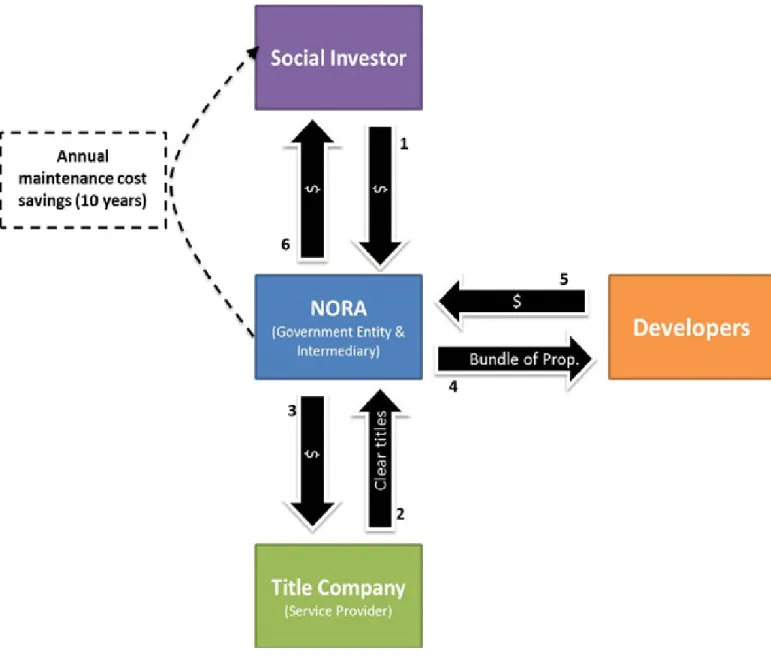
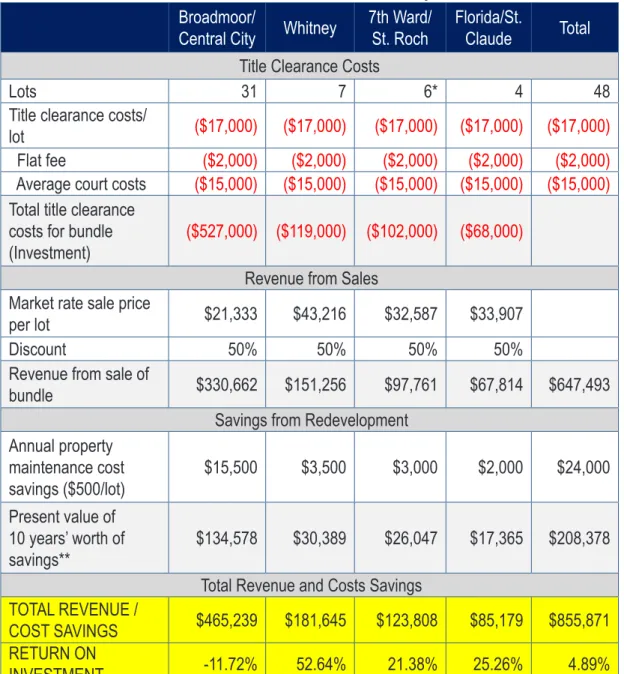
Although SIB-financing is not appropriate for title clearance alone, our re-search and analysis indicates NORA could potentially use SIB funding to finance catalytic redevelopment projects in transitional markets. This strat-egy, clustered redevelopment, is best suited for concentrations of expropri-ated properties in markets where there is not enough demand for NORA to reasonably expect to auction off the properties on a piecemeal basis, even if they had clear titles, but where a strategically-placed development could spur neighborhood revitalization. We identified 48 properties in four distinct clus-ters (located in the Broadmoor/Central City, Algiers/Whitney, Desire/St. Roch, and Florida/St. Claude neighborhoods) as appropriate for this strategy. These clusters also overlap with the City of New Orleans’s current place-based redevelopment efforts. The sale of these properties at a discounted rate to a development partner would cover the title clearance costs of these properties while also providing a social investor with an estimated return on investment of almost 5%.
Strategy III – Stormwater Management
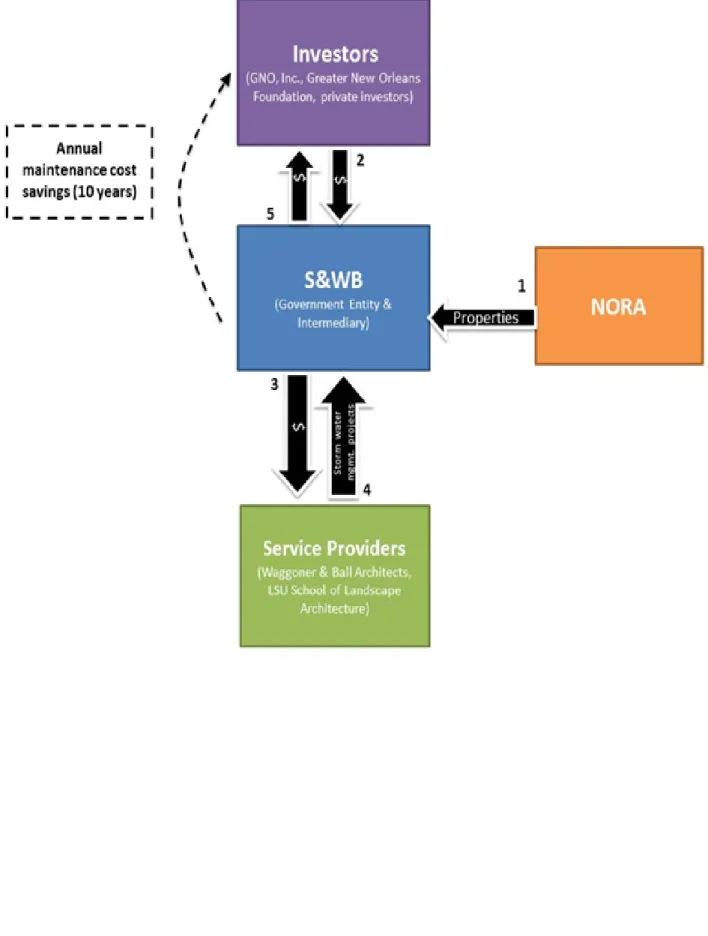
Stormwater management calls for a partnership between NORA and the Sew-erage and Water Board (S&WB), in which NORA transfers 43 expropriated vacant properties in areas with a high risk of flooding to the S&WB. Through a SIB, the S&WB and private investors would finance the construction of storm-water infrastructure on these lots. The S&WB is currently operating under an Environmental Protection Agency (EPA) consent decree requiring it to spend
$2 million to improve water quality. This spending requirement, in addition to the long term cost savings generated through stormwater management, serves as the S&WB’s incentive for program participation. A SIB partnership between NORA and the S&WB could provide the opportunity for NORA to reduce its maintenance responsibility for vacant properties and for the S&WB to meet the goals mandated in the consent decree.
Strategy IV – Lot Leasing
The final strategy calls for the expansion of NORA’s Growing Green program, by incentivising the green intermediary to expand the scale of the program. By allowing the green intermediary to share in the income and cost savings generated by lot leasing, NORA can take the Growing Green program to scale and reduce the agency’s maintenance costs. We identified 157 proper-ties suitable for lot leasing, clustered in the Lower Ninth Ward/ Holy Cross neighborhoods and the McDonough neighborhood. As in Strategy I, NORA can finance this program through a performance-based model in which NORA pays the green intermediary group a percentage of the revenues and cost savings generated by shifting the land banking and maintenance respon-sibility for these lots to community groups. We estimate that over 10 years this strategy could produce over $800,000 in net savings and income for the agency, whereas NORA’s current practice of maintaining and insuring these lots is projected to cost almost $900,000 during the same period.
Table of Contents
Introduction...10
Social Impact Bonds...14
Case Study One: Fighting Adolescent Recidivism at Rikers Island...19
Social Impact Bonds and Blight...26
Case Study Two: Restoring People & Properties Through SIBs. Bristol Together, United Kingdom...33
Analysis...36
Title Clearance Strategies...42
Strategy I: Title Clearance for Sale at Auction...43
Strategy II: Clustered Redevelopment...46
Alternative Land Management Strategies...56
Strategy III: Stormwater Management...56
Strategy IV: Lot Leasing...62
Next Steps...68
Figure 1: Standard Social Impact Bond Structure...15
Table 1: Best Practices Framework for SIB Project Selection (1)...22
Table 2: Summary of Blight Remediation’s Ability to Meet SIB Selection Criteria....32
Map 1: Strategy I - Title Clearance for Sale at Auction...44
Map 2: Strategy II - Clustered Redevelopment...48
Figure 2: Clustered Redevelopment SIB Financing Model...50
Table 3: Potential Revenue from Redevelopment Clusters...53
Map 3: Strategy III - Stormwater Management...59
Figure 3: Stormwater Management SIB Financing Model...61
Map 4: Strategy IV - Lot Leasing...63
Table 4: Potential Revenue and Cost Savings From Lot Leasing...66
Map 5: Complete Overview of Strategies...69
Fighting Blight Through Innovative Financing: An Examination of Social Impact Bonds 10
Introduction
In 2012, the City of New Orleans possessed almost 36,000 vacant or blighted properties, making it one of the most blighted cities in the nation.1 While
public officials, community groups, developers, and other stakeholders have made substantial progress in returning blighted properties to the private real estate market, many New Orleans neighborhoods remain littered with blighted homes and vacant lots. The New Orleans Redevelopment Authority (NORA), charged with the maintenance and redevelopment of approximately 2,600 vacant or blighted properties, plays a substantial role in the revitalization of the city. NORA, a quasi-governmental agency that relies primarily on federal grant funding to finance its operations, has some powers typically associated with government agencies including the authority to issue bonds and expropriate properties. While its quasi-governmental status provides NORA with some insulation from the electoral politics and special interests that can interfere with public blight remediation strategies, it also places NORA in a precarious funding situation relative to public agencies that receive a dedicated millage in the city’s property tax system. With federal disaster recovery funds dwindling, NORA is now seeking new and innovative strategies to fund neighborhood revitalization and blight elimination.
NORA has requested that the UNO-PLUS Community Development Finance Capstone Study Team (to be referred to as the study team) research creative funding mechanisms to finance the upfront investments required for large-scale blight reduction efforts. Specifically, NORA has tasked the study team with identifying mechanisms to finance the title clearance services necessary for property disposition and the infrastructure investments required to
implement cost-reducing alternative land management strategies for 310 properties. These properties are distinct from other lots in NORA’s inventory in that NORA did not acquire them through the Road Home Program via the Louisiana Land Trust (LLT)—a non-profit organization formed to manage the properties purchased by the state under the Road Home Program.2 These
non-Louisiana Land Trust (non-LLT) properties present some challenges— most notably, with regard to the status of their titles—the LLT properties do not.
1 Plyer, A., & Ortiz, E. (2012). Benchmarks for blight: How much blight does New Or-leans have? Accessed, March 3rd, 2014. Available: http://www.datacenterresearch.org/
reports_analysis/benchmarks-for-blight
2 Louisiana Land Trust. Accessed, May 3rd, 2014. Available: from http://www.lalandtrust.
11
Fighting Blight Through Innovative Financing: An Examination of Social Impact Bonds
Introduction
NORA requested specific analysis on a relatively new financial instrument known as a Social Impact Bond (SIB). SIBs are not traditional, fixed-rate-and-term security bonds such as municipal bonds; rather, SIBs more closely resemble a “rigorous, performance-based contract between multiple parties,” that combine aspects of both debt and equity.3 SIBs use private
investment, whereas performance-based contracts use public investment, to fund programs that produce measurable social benefits and quantifiable cost savings to government agencies. If the program meets pre-determined, standardized outcomes, the investors receive a return on their investment from the cost savings to the government. The private investment in SIBs makes them more attractive to municipalities since, unlike performance-based contracts, less burden is placed on taxpayers. To date, SIBs have been used solely for people-based programs, such as recidivism reduction services and preschool education. The use of SIBs to finance blight remediation is currently untested in the United States. This report will provide an overview of the possible operations of such a program.
Over the past few months, the study team performed literature reviews, interviews, legislative analyses, and mapping analyses to inform our
recommendations. We looked at other communities facing similar problems, such as Detroit, Baltimore, and Cleveland, to identify best-practice strategies to combat blight. The study team also contacted agencies, organizations, and individuals involved in SIB-financing to obtain an in-depth understanding of how this innovative new tool could be used to combat blight and to assist NORA, specifically. (An inventory of SIB-financed projects is available in Appendix A).
Armed with the knowledge acquired during this research and analysis, we developed four distinct cost-reduction strategies. These strategies fall into two categories—disposition strategies and alternative land management strategies. Disposition strategies include title clearance for auction, and clustered redevelopment, while alternative land management strategies include stormwater management and lot leasing. The study team has established specific criteria, and utilized Geographic Information System (GIS) mapping software to determine which NORA-owned properties were appropriate for each strategy. Finally, we determined financing mechanisms through which NORA could implement each approach.
3 Shah, S., & Costa, K. (2013). Social finance: A primer - understanding innovation
funds, impact bonds, and impact investing. Washington, DC: Center for American Progress. p. 12
Fighting Blight Through Innovative Financing: An Examination of Social Impact Bonds 14
Social Impact Bonds
In recent years, government budget deficits and shifting political priorities have resulted in policy makers either cutting or consolidating publicly-funded social services such as public housing, healthcare, and education.4
Foundations and other charitable organizations have a long history of providing the public with social services when government resources are stretched to capacity. In our current era of public fiscal austerity, however, private for-profit entities and investors have become involved in the social service sector to an unprecedented degree.5 The influx of investor capital into
traditionally public or philanthropically-funded social services is often called impact investing. The “rise of the social or impact investor – where funders are interested in results and returns, both social and financial, on their capital,” has been well documented.6 The most recent trend in impact investing is an
innovative finance mechanism called the Social Impact Bond (SIB).
SIBs leverage private investment to finance the delivery of preventive social services for which public agencies are unable to obtain adequate start-up capital, or for which current budgetary allocations do not provide the funding necessary to take an existing, proven program to scale.7 Again, SIBs are
not traditional, fixed-rate-and-term security bonds such as municipal bonds; rather, SIBs more closely resemble a “rigorous, performance based contract between multiple parties,” that combines aspects of both debt and equity.8
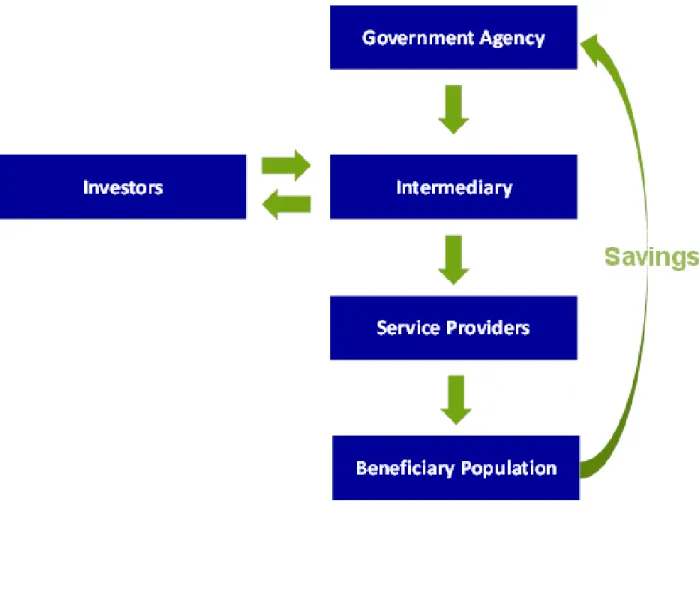
In the most common SIB model, a government entity identifies a costly social problem and then enters into a contract with a private intermediary that works to attract investments and procure social service providers.9
Since the government only pays for the projects after the program meets pre-determined, quantifiable outcomes, the intermediary obtains its initial operating budget—the funds that are used to pay the social service
providers—from socially-minded private investors.10 If the program is indeed
successful, it should result in public cost savings or revenue that the
4 Roman, J., & Walsh, K. (2013). Social Impact Bonds: Committee of the Whole Council of the District of Columbia. Washington, DC: Urban Institute.
5 Clark, C. H., Massarsky, C., Raben, T., & Worsham, E. (2012). Scaling Social Impact: A Literature Toolkit for Investors. Growth Philanthropy Network and Duke University. 6 Ibid.
7 Liebman, J. & Sellman, A. (2013). Social Impact Bonds: A Guide for State and Local Governments. Harvard Kennedy School.
8 Shah, S., & Costa, K. (2013). Social finance: A primer - understanding innovation
funds, impact bonds, and impact investing. Washington, DC: Center for American Progress. p. 12
9 Liebman, J. & Sellman, A. (2013). Social Impact Bonds: A Guide for State and Local Governments. Harvard Kennedy School.
15
Fighting Blight Through Innovative Financing: An Examination of Social Impact Bonds
Social Impact Bonds
government entity uses to pay back the intermediary. The intermediary then provides the private investors with a return on their investment.11
We describe how a SIB model functions below, through a discussion of the first SIB-funded program in the U.S.—an anti-recidivism program on Rikers Island referred to as the Adolescent Behavioral Learning Experience (ABLE). The full description of the ABLE case study, Case Study 1, is on page 19.
Social Impact Bond Structure
The diagram of the SIB model in Figure 1 illustrates how a SIB is used to finance a social program. This section reviews the role that each entity plays in the model.
Figure 1: Standard Social Impact Bond Structure
Fighting Blight Through Innovative Financing: An Examination of Social Impact Bonds 16
Social Impact Bonds
Government
Generally, the SIB process begins when a government agency identifies a social service or program that, if taken to scale, could result in measurable cost savings or revenue generation within a reasonable timeframe.12 In the
ABLE case study, Case Study 1, for instance, the New York City’s Department of Health and Human Services (DHHS)—the government entity—sought to expand the scale of an existing and effective program—the ABLE program.13
While relatively costly, ABLE had been demonstrably effective at reducing recidivism rates and public penal expenditures on a per prisoner basis. DHHS and Mayor Bloomberg’s administration decided to pursue SIB financing in order to secure additional, upfront funding for the program. The goal was to increase the magnitude of its social and fiscal benefits, generating net savings over the course of just a few years.
Generally, governments are attracted to this method of financing because it allows them to bring proven programs to scale, and reduces the obstacles to funding financially-sound but politically difficult expenditures—such as a multi-million dollar investment in incarcerated people. More specifically, if the program fails to produce the desired impact, the government entity is not required to repay the investors. As such, the model insures that local governments do not use public funds to finance ineffective programs, while also providing much needed funding to support expensive but effective policies.
Intermediary
In the traditional SIB model, the government entity does not approach investors itself. Rather, it enters into a performance-based contract with an intermediary. The government entity identifies its goals and desired
outcomes, and the intermediary is responsible for achieving those outcomes. It is therefore the intermediary that is responsible for identifying investors and obtaining the upfront investment necessary to fund programmatic
operations. The intermediary acts as a middleman, setting performance-based
12 Ibid.
13 The City of New York Office of the Mayor. (2012, August 2). Mayor Bloomberg,
Deputy Mayor Gibbs, and Corrections Commissioner Schriro Announce Nation’s First Social Impact Bond Program. Accessed, February 12th, 2014. Available: http://www.
goldmansachs.com/what-we-do/investing-and-lending/urban-investments/case- studies/social-impact-bond-pdf.pdf
17
Fighting Blight Through Innovative Financing: An Examination of Social Impact Bonds
Social Impact Bonds
measurements, securing and accepting initial investments from the private sector, hiring and managing the service providers, and, eventually, receiving savings-generated payments that are returned to the private funders.
Investors
Once the government entity engages an intermediary, the intermediary
identifies an investor or investors to provide the necessary upfront financing.14
Investment funds may come from a bank, a high net worth individual, a foundation, or a combination of several of these entities.15 As discussed
previously, investors in SIBs tend to have dual motivations. While they expect their investment to produce monetary returns, they are often willing to accept relatively high risks and low yields, in order to finance a program that has a positive social impact.1617
The risk inherent in a SIB investment is greater than most investments, because the equity partner will lose his or her entire contribution if the program is unsuccessful. In the ABLE example, Goldman Sachs invested $9.6 million in the prisoner rehabilitation program. Unless the program
successfully reduces recidivism by 10% over a 4-year period, Goldman Sachs will not receive its full investment. It is important to note, however, Bloomberg Philanthropies guaranteed $7.2 million of Goldman Sachs’ investment via a grant in the program. In this way, the SIB model allows the City of New York to leverage additional private financing using Bloomberg’s philanthropic investment.
From the perspective of a foundational investor, the SIB model is highly attractive because the same grant can be used multiple times to leverage private financing and provide multiple rounds of social services. If the ABLE program succeeds, Goldman Sachs will receive a return on its investment and Bloomberg Philanthropies can reinvest its $7.2 million in another round of the program or another social program.18
14 Shah & Costa
15 McKinsey & Company (2012). From action to potential: Bringing Social Impact Bonds to the US. Washington, DC: McKinsey and Company.
16 Ibid.
17 Clark, Massarsky, Raben, & Worsham
Fighting Blight Through Innovative Financing: An Examination of Social Impact Bonds 18
Social Impact Bonds
Service Providers
Service providers are hired by intermediaries with investor funds to implement the social program.19 With the initial investment capital provided by private
funders, service providers are tasked with managing programs or projects that contribute to the greater social good. These programs realize savings to the government agency that initiated the SIB.
Social service providers are attracted to this model because they can develop working partnerships with government agencies, and because the program provides them with substantial upfront funding with which to implement their work.20 The type of service provider is dependent on the nature of the
program. For instance, service providers in the New York example included youth counseling and workforce training organizations.21 The upfront funding
from Goldman Sachs allows counseling and training methods proven to reduce recidivism to be brought to scale.
Evaluators
The evaluator is an independent entity that measures the success of the project. The government agency determines measurable goals at the outset of the contract that to be evaluated by the evaluator. Intermediaries are then paid by their ability to achieve or surpass these goals. The evaluator measures the goals of the program by comparing the outcomes of the social service relative to the outcomes of a comparison or control group without the services.22
19 Liebman, J. & Sellman, A. (2013). Social Impact Bonds: A Guide for State and Local Governments. Harvard Kennedy School.
20 Ibid.
21 The City of New York Office of the Mayor
22 Liebman, J. & Sellman, A. (2013). Social Impact Bonds: A Guide for State and Local Governments. Harvard Kennedy School.
19
Fighting Blight Through Innovative Financing: An Examination of Social Impact Bonds
Social Impact Bonds
Case Study 1:
Fighting Adolescent
Recidvism at Rikers Island
New York City is paving the way for SIBs in the U.S. In August 2012, the city launched the coun-try’s first SIB with the goal of lowering the recidivism rate among adolescents at Rikers Island, the city’s main prison complex. The bond was initiated by the City of New York. Goldman Sachs structured a $9.6 million loan to MDRC, a social policy research organization, which acts as the intermediary. Bloomberg Philanthropies backed $7.2 million of that loan, reducing Goldman’s investment risk. MDRC hired the Osborne Association and Friends of Island Academy, two groups with proven track records of helping incarcerated youth, as the primary service providers and the Vera Institute of Justice to serve as the independent evaluator.Partnership Roles
Initiator: The City of New York
Service Providers: The Osborne Association, Friends of Island Academy Intermediary: MDRC
Evaluator: The Vera Institute of Justice
Investors: Goldman Sachs, Bloomberg Philanthropies
Strategy
The program, officially called the Adolescent Behavioral Learning Experience (ABLE) Program, seeks to reduce recidivism among adolescents by 10% over a four year period. An initial invest-ment, provided by Goldman Sachs, will fund the service providers. Once the service providers succeed in reducing the recidivism rate by 10%, the City of New York, with a newly realized stream of savings, makes payments to MRDC. MRDC, acting as intermediary, then returns these profits to Goldman Sachs. As a Community Redevelopment Act (CRA) financial institu-tion, Goldman Sachs receives a CRA credit boost for operating within its own community.
Current Status
The SIB is in its second full year of the loan period. Initial results are still forthcoming.
Relevance to New Orleans Redevelopment Authority
This case study is relevant to NORA because it illustrates a typical, yet complex, SIB financial structure. The contract took two years to finalize and is an example of how a SIB financing structure can be very intricate and involve several partners. As the first SIB to be adopted in the U.S., the success of the program is crucial for the future of this unique financing model.
Fighting Blight Through Innovative Financing: An Examination of Social Impact Bonds 20
Social Impact Bonds
Strengths of The Social Impact Bond Model
The SIB model improves upon existing governmental budgeting and evaluation processes for social programs by addressing several key
weaknesses in the current model. First, governments often lack the upfront funds necessary to provide preventative services on a large scale, even if these services have demonstrated social and fiscal benefits. SIB programs help solve this problem by using private investment to fund the initial program costs and then using the cost-savings generated by the program to refund the original investment.
Second, government programs and their evaluation metrics are often task-oriented rather than outcome-oriented. In other words, programs are evaluated in terms of people served or money spent, rather than how effective the public investment was at producing the desired outcome.23 This is largely
due to the nature of the electoral cycle and the timeframe considered during the budgeting process. “Most budgets are built around funding the same things that were funded the previous year…and fear of public scrutiny makes it hard to take the risks associated with trying new things and then rigorously evaluating them.”24 Because the SIB model relies on private investors, the
risk of failure—and thus the burden of quantifying success—shifts from the public sector to the private sector. In this way, the SIB model has the dual effect of allowing the public sector to pursue more innovative social service mechanisms, while also insuring only proven programs receive public funding.
Limitations of Social Impact Bonds
The SIB model is not without limitations. First, the pool of potential investors is relatively limited. The private equity partner in the SIB model may lose its entire investment. Given this level of risk, the potential investor return is relatively modest.25 As such, only philanthropically minded investors, or
those whose investments are backed by a philanthropic donation—such as Goldman Sachs in the Rikers example—have expressed substantial interest in SIBs, to date.
23 Liebman & Sellman 6 24 Ibid. 7
25 Fernandes, D. (2014, January 29). Goldman Sachs Buys ‘Social Impact’ Bonds. The Boston Globe.
21
Fighting Blight Through Innovative Financing: An Examination of Social Impact Bonds
Social Impact Bonds
Second, compared to the direct provision of public services, or a two-party contract between a government and a service provider, the SIB model is relatively complex. This complexity, as explained in an interview with Sebastian Chaskel of the Harvard Kennedy School, makes SIBs approximately 30% more expensive than more traditional forms of bond financing. SIBs present additional temporal costs and burdens as well. The Rikers Island contract, according to Chaskel, took approximately two years from inception to closing.
Third, although SIBs have been heralded as facilitating innovation in the public sector,26 the extent to which SIBs incentivize risk-taking is highly
limited. In order to mitigate risks, SIBs are generally used for programs with a proven track record. As such, they are highly constrained in the type of social programs they can finance. Furthermore, private investors—not the public or elected officials—ultimately decide which programs are worthy of funding; this private influence over public spending also limits the type of programs SIBs can finance.
Finally, with the first U.S. SIB only halfway through the service provision phase, the SIB model’s most obvious weakness is that it is still relatively untested.27 Although there are European programs that have finished their
first performance evaluation cycle, even these programs are still relatively nascent. In this sense, there exists significant leeway within the SIB model for mistakes—and for opportunities.
Best Practices In Social Impact Bond Financing
SIBs can be modeled in several different ways, depending on program goals and the specific problems a government agency faces in its work. Appendix A of this report provides an inventory of existing SIB programs that identifies the entities involved under their respective contracts. As indicated by the diverse set of SIB programs in the appendix, there is room for innovation within the SIB model. Because a SIB is merely a contract for services, government agencies have significant flexibility in the financing structure they choose to implement.
26 Liebman & Sellman 6
Fighting Blight Through Innovative Financing: An Examination of Social Impact Bonds 22
Social Impact Bonds
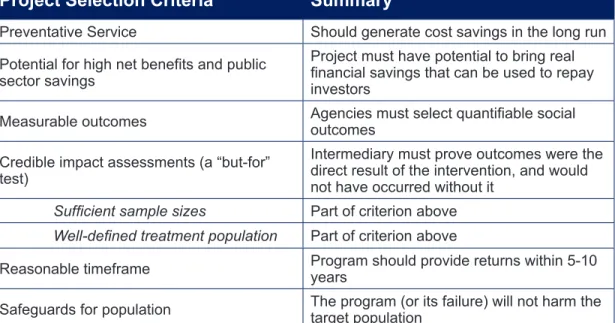
However, there are several criteria that can help to determine if SIB financing will help meet program goals (Table 1). Despite the SIB model’s novelty, researchers and practitioners have constructed a loosely conceptualized framework of best practices in SIB financing to date.
Table 1: Best Practices Framework for SIB Project Selection
SIB-financing works best for programs that deliver a preventative service— one that may carry significant upfront costs, but delivers even greater future cost savings.28 It’s important, however, that future cost savings are high
relative to initial costs. The transaction costs in a SIB-model represent approximately 30% of the program’s costs. As such, only programs that generate high net benefits and public sector savings are suitable for
SIB-financing.29 An equally essential criterion is that the program or social service
being funded produces measurable outcomes.
The extent to which a program or service can deliver measurable outcomes is essential to the feasibility of SIB-financing. Programmatic success must
be quantifiable to be relevant to investors.30 Furthermore, one of the primary
benefits of the SIB model is its rigorous performance evaluation of social programs. Rather than defining success as the number of people serviced by 28 Liebman & Sellman
29 Shah & Costa 30 Ibid.
Project Selection Criteria Summary
Preventative Service Should generate cost savings in the long run
Potential for high net benefits and public
sector savings
Project must have potential to bring real
financial savings that can be used to repay
investors
Measurable outcomes Agencies must select quantifiable social outcomes Credible impact assessments (a “but-for”
test)
Intermediary must prove outcomes were the direct result of the intervention, and would not have occurred without it
Sufficient sample sizes Part of criterion above Well-defined treatment population Part of criterion above
Reasonable timeframe Program should provide returns within 5-10 years Safeguards for population The program (or its failure) will not harm the target population
23
Fighting Blight Through Innovative Financing: An Examination of Social Impact Bonds
Social Impact Bonds
a program—as many current social programs do—a SIB-financed program will define success by its outcomes. In order to do so in a reliable way, these outcomes must be objective and quantifiable.
To date, SIB structures in the U.S. have sought to emulate an experimental set-up.31 In this model, programmatic success is measured in terms of
whether or not the target group demonstrates statistically significant rates of success relative to a control group.32 There are several mutually supportive
criteria that must fit together for this quasi-experimental model to work. First, such a model requires a well-defined treatment population. The idea here is that the outcomes of the target group should be compared to the outcomes of a control group when evaluating the success of the SIB. For this to work, the treatment population needs to be comparable, but distinct, from a non-treatment population. While this has proven relatively simple with recidivism-based programs (in which a random selection of prisoners can go through the program, while another randomly selected group of prisoners does not), it can become more complicated with more nuanced SIB-programs, such as the Bristol Together and Midlands Together models discussed in Case Study 2. The other sub-component of this criterion is that of sample size. In the U.S., SIB-financed programs have used target populations of a large enough sample size to establish causality. The Harvard Kennedy School’s best practices handbook on SIB financing indicates that people-based programs should have a minimum of 200 participants.33
The fifth primary criterion requires the program’s benefits accrue over a reasonable time frame. While socially motivated investors may be willing to wait for a longer period of time to receive their returns or evaluate
programmatic impacts than other types of investors, most experts agree SIB programs should structure their benefits to accrue within a five-year time frame.34
Finally, if the service provider is delivering a vital service—such as essential health care, there need to be safeguards for the population. In such
programs, if the program fails, individual citizens within the target population will suffer real harm.
31 Chaskel, S. Harvard Kennedy School – Social Impact Bond Financing Lab. February 26th, 2014. Phone interview. Interviewed by Karl Tear.
32 Liebman & Sellman 33 Ibid.
SOCIAL IMPACT BONDS
AND BLIGHT
Fighting Blight Through Innovative Financing: An Examination of Social Impact Bonds 26
SIBs and Blight
To date, Social Impact Bonds (SIBs) have been used exclusively for people-based programs in the U.S. There is, however, growing interest among local governments, consultants, and community development experts in
using SIB financing to fund place-based programs.35, SIBs are an innovative
but relatively untested method of providing governments with funding, and the application of SIBs to blight remediation programs creates additional uncertainty, not least because the combination is unprecedented.
A strong case can be made for using SIBs to fund blight reduction programs. As this section will discuss, SIBs have garnered modest but growing levels of attention among real estate-focused community development professionals in the U.S. Moreover, at least one program in the United Kingdom (U.K.), called Bristol Together (detailed in Case Study 2), has successfully implemented an ongoing SIB-funded program that targets both people and places.36
The Bristol Together model, which is also now in use in the Midlands, U.K., combines the costs and benefits of workforce training for formerly incarcerated people with those of blight remediation.37
This section explores the feasibility of using SIBs for place-based programs, and finds that there is room within the SIB framework for blight remediation. These discussions lay the groundwork for identifying the means through which NORA, specifically, could use SIB financing to achieve its goals.
The Cost of Blight
Blight is most often identified with rust-belt cities such as Detroit, but even Sunbelt cities such as Phoenix and Orlando are home to a growing inventory of vacant lots and abandoned properties following the foreclosure crisis of the mid-2000s.38 In a 2010 Brookings Institute survey of 60 mid-size to large
cities, two in every 1,000 properties were reported as vacant.39 Across the
country, blight places serious social and fiscal burdens on metropolitan areas.
35 Muchin, K. (2013, June 14). Response to Illinois Request for Information: Social Impact Bonds - Community revitalization and blight remediation. Evanston, IL: BriCK
Partners, LLC; Rogers, R. (2014, March 7). Richmond to explore new plan to fix blighted housing stock. Contra Costa Times; Roman, J. (2013, November 6). Social Impact Bonds: A new model to reduce blight. The Huffington Post.
36 Bristol Together Community Interest Company. (2013). Bristol Together: Job creation for ex-offenders. Retrieved March 20, 2014, from http://www.bristoltogether.co.uk/ aboutus.htm
37 Ibid.
38 Hollander, J. (2011). Sunburnt cities: The Great Recession, depopulation, and urban planning in the American Sunbelt. New York, NY: Routledge.
39 Pagano, M.A. & O’Bowman. (2010). Vacant land in cities: An urban resource. Washington, DC: Brookings Institution Center On Urban and Metropolitan Policy. p. 6.
27
Fighting Blight Through Innovative Financing: An Examination of Social Impact Bonds
SIBs and Blight
Foreclosed upon or otherwise abandoned properties fall into disrepair, and the presence of these unsightly and potentially unsafe lots or buildings leads to diminished demand for real estate in the surrounding area. This process is often self-reinforcing; blight leads to lower property values and less demand, which in turn causes property-owners to abandon or neglect their property, creating additional blight. Vacant lots can harbor crime and the presence of visibly neglected properties can undermine a community’s social cohesion and character. There are also several significant direct costs associated with blight. Blight’s fiscal costs include:
• The reduction in property tax revenue due to high rates of tax delinquency among owners of abandoned or vacant lots.
• The reduction in the property tax revenue generated by properties proximate to blight, which typically experience a decline in their property values and often fall into blighted conditions themselves.
• The complete loss of property tax revenue from blighted properties that fall into municipal ownership.
• The property maintenance costs that must be borne by the municipality for city-owned lots.40
The non-profit advocacy organization Smart Growth America summarizes these costs, stating that “managing vacant properties ties up the time of municipal employees and the resources of municipal taxpayers. At the same time, these properties depress the value of other properties and generate little or no tax revenue themselves.” 41
The Cost of Blight Remediation
Unfortunately, reducing blight is costly and successful outcomes are elusive. Cities that own properties acquired through adjudication or due to code-violations face multiple obstacles to putting the properties back into commerce, including solving costly title problems and liens. But it can also be difficult for municipalities to even consider investing in disposition or
40 Smart Growth America. (2005). Vacant properties: The true cost to communities. Washington, DC: National Vacant Properties Campaign. Accessed March 10, 2014. Available: http://www.smartgrowthamerica.org/documents/true-costs.pdf
Fighting Blight Through Innovative Financing: An Examination of Social Impact Bonds 28
SIBs and Blight
redevelopment strategies when there is an immediate need to budget for the maintenance costs necessary to keep vacant lots up to code.
The costs of blight remediation fall into two broad categories. The first category—redevelopment costs—consists of the costs associated with returning blighted properties to commerce. This is a particularly significant challenge in weak markets, which, almost by definition, are the types of markets or neighborhoods in which blight tends to be most prevalent. These costs include the time and money spent on clearing clouded titles, as well as the marketing or subsidy costs required to encourage people or organizations to purchase the properties once a clear title has been established.42
The second category consists of maintenance related costs. These include property maintenance expenditures such as grass mowing and insurance. This category can also include upfront investments in low-maintenance vegetation or other alternative land management strategies that will save the municipality money in the long run.
In the sense that these upfront costs deliver long-term benefits, blight remediation appears to be a feasible target for SIB financing. But certain characteristics of the SIB model, as it has been implemented to date, do not intuitively conform to the funding needs of blight redevelopment or creative land maintenance strategies. The next section of this report explores the potential use of SIBs for blight remediation in greater detail.
Blight Remediation as a SIB-financed Project
While the practicality of using SIBs for blight remediation depends largely on the blight remediation program itself, blight reduction inherently presents both obstacles and opportunities for incorporation into the SIB model. Indeed, some experts have expressed doubts regarding the viability of this combination.43 Concerns stem largely from the challenges associated with
defining a treatment population and a control group—as one would do in a people-based program—and the associated problems with establishing causality. Other experts, however, have suggested that the power of SIB financing lies in its flexibility, not in the extent to which it mimics a controlled
42 United States Conference of Mayors. (2008). Vacant and abandoned properties: Sur -vey and best practices. Washington, DC: City Policy Associates.
43 Chaskel, S. Harvard Kennedy School – Social Impact Bond Financing Lab. February 26th, 2014. Phone interview. Interviewed by Karl Tear.
29
Fighting Blight Through Innovative Financing: An Examination of Social Impact Bonds
SIBs and Blight
experiment. As one researcher knowledgeable on the subject stated, “SIBs
are not a noun; they are a concept.”44
The limiting factor for any project that relies on private funding is investor willingness. Despite their novelty, SIBs are no exception to this rule. This section explores how blight fits into the program-selection framework
described in the previous section. It reveals that the opportunities associated with the natural overlap between real estate investment and bond-financing potentially offset the challenges associated with scale and measurement.
Is it a preventative service?
Conceptually, blight remediation is a preventative service in that the upfront costs associated with returning a blighted property to market or installing maintenance-cost reducing infrastructure can result in even greater cost savings over time. Furthermore, since the costs of rehabilitating blighted buildings increase over time, redeveloping a property sooner rather than later generally leads to greater cost-savings in the long run.
Is there potential for high net benefits and public sector
savings?
For blight, revenue generating potential depends largely on the number of lots in the target geography, and more specifically, on the estimate of property tax revenues, maintenance cost savings, or other revenue streams that could be generated following the provision of the SIB-funded service. Programs that involve many lots or one large project that presents the potential for a high return through revenue generation could be excellent candidates for SIB financing.
The case study on the aforementioned Bristol Together (Case Study 2), provides an example of a blight remediation program—albeit one delivered via an anti-recidivism workforce training program—that generated enough revenue to fund a second service delivery cycle and provide financiers with a 4-6% return on their investment. This suggests that blight remediation can in fact provide a significant enough return to be an attractive investment for SIB-financiers.
44 Roman, J. (2014, March 7). Senior Associate, Urban Institute - Justice Policy Center. (K. Tear, Interviewer)
Fighting Blight Through Innovative Financing: An Examination of Social Impact Bonds 30
SIBs and Blight
Are there measurable outcomes?
A primary programmatic criterion for SIB compatibility is identifying a performance metric that is both reliably measurable, and highly indicative
of both programmatic success and financial returns.45 Some experts have
expressed concern over SIB compatibility with blight reduction specifically
because the outcomes can be difficult to measure.46 While the cost-savings
presented by maintenance cost reduction or increases in property tax revenues are intrinsically tied to the success of the program, they can be challenging to measure systematically. For instance, property tax revenues enter a municipality’s general fund, but maintenance cost savings may accrue to a different government entity. One expert has suggested that in the case of blight remediation, a simpler metric may be desirable.47 Simple metrics, from
an investor’s perspective, could include the number of lots that the city sells, or the square acreage of ground upon which cost-reducing native species are planted. So long as the government entity can guarantee the investor a return on their funding if the agreed upon standards are met, these simple metrics could prove to be satisfactory to both government and investor. But blight is inherently difficult to develop, and alternative land management strategies are not particularly lucrative. Guaranteeing the investor a return, particularly given the additional transaction costs that the SIB model presents, is the challenging aspect of using SIB-financing for blight remediation.
Is the sample size sufficient and treatment population defined
enough to establish credible impact assessments?
Blight remediation strategies inherently conflict with this criterion for several reasons. Blight-remediation, like many place-based strategies, often works best when public policies are targeted towards groups that are either
geographically, physically, or otherwise similar, establishing a control group that also exhibits these characteristics but is not a part of the program is highly challenging.
For instance, in March 2014, the city of Richmond in California passed a resolution directing city staff to work towards the implementation of a
SIB-45 Ibid; Galloway, I. (2013). Funding holistic community development with pay for success. Washington, DC: Nonprofit Finance Fund.
46 Chaskel, S. Harvard Kennedy School – Social Impact Bond Financing Lab. February 26th, 2014. Phone interview. Interviewed by Karl Tear.
47 Roman, J. (2014, March 7). Senior Associate, Urban Institute - Justice Policy Center. (K. Tear, Interviewer)
31
Fighting Blight Through Innovative Financing: An Examination of Social Impact Bonds
SIBs and Blight
funded Distressed Housing Rehabilitation Program.48 The resolution states
that the “initial target properties would likely be the ‘worst of the worst,’ in terms of condition.”49 From a public policy perspective, it makes sense to
focus on (or perhaps triage) particularly problematic groups. But for Richmond to do so undermines the pseudo-experimental structure that some SIB
experts believe a SIB-funded program must have. Obtaining a large enough sample size to meet this requirement is also a challenge.
Again, this criterion assumes that investors will want, more or less, to see statistical significance, but the extent to which this criterion is even applicable to blight remediation is unclear. Bristol Together (Case Study 2), and its follow up program, Midlands Together, prove that investors may be amenable to less scientifically rigorous forms of evaluation, so long as the potential risks and returns of the investment are clear.
Do the program’s benefits accrue over a reasonable
time-frame?
There are many blight-remediation programs that produce cost savings or revenue generation within five to ten years. The reduction of maintenance costs for city-owned properties can produce immediate savings, for instance, as can returning city-owned lots to the private property market and property tax roll. Of course, in the long-term, savings and revenue may be even more significant, as blight reduction creates a domino effect, slowly facilitating the long-term appreciation of a property values.
Are there safeguards for the target population?
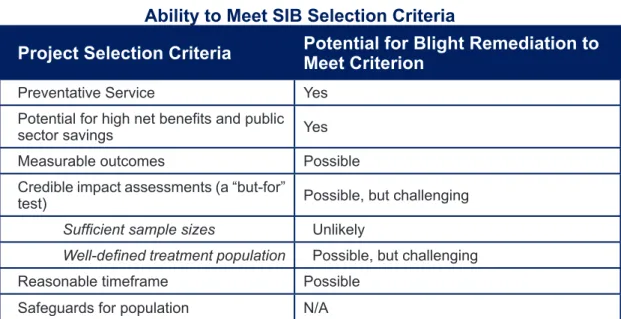
Reducing blight benefits the municipality and its general population, but failing to do so does not cause explicit harm to the public. Blight reduction is an elective not an essential public service and individual residents do not stand to lose if the program does not succeed. Table 2 summarizes the discussion regarding the applicability of SIB-financing to blight-remediation programs.
48 Richmond City Council. (2014). Resolution 20G-4. City of Richmond. 49 Ibid. p. 4
Fighting Blight Through Innovative Financing: An Examination of Social Impact Bonds 32
SIBs and Blight
Project Selection Criteria Potential for Blight Remediation to Meet Criterion
Preventative Service Yes
Potential for high net benefits and public
sector savings Yes
Measurable outcomes Possible
Credible impact assessments (a “but-for”
test) Possible, but challenging
Sufficient sample sizes Unlikely
Well-defined treatment population Possible, but challenging
Reasonable timeframe Possible
Safeguards for population N/A
Source: UNO-PLUS Community Development Finance Capstone Study Team Analysis
Our research indicates that the primary challenge associated with applying SIBs to blight remediation strategies is not their incompatibility with
experimental set-ups or the presence of confounding variables. Rather, it is simply identifying blight remediation strategies that will reliably produce enough revenue to cover their costs in a reasonable amount of time. Bristol Together and Midlands Together have been able to successfully fund their intervention services--both people based and place-based through renovated-property sales alone, because the sale price outweighed the renovation costs. In weaker real estate markets, additional subsidy--such as donated materials or discounted labor, as indicated in the City of Richmond’s RFP--may be required for the model to function.
What constitutes an effective strategy will depend largely on the local market, municipal capacity, and the nature of the municipality’s blight problem.
Municipalities that are comfortable taking on the role of the developer, for instance, are at an advantage because programmatic costs need not include a developer’s marginal profits. Likewise, municipalities in which blight
manifests itself predominantly in large blocks of vacant land or brownfield sites will have another advantage in that such sites lend themselves to large-scale redevelopment. Despite the high upfront costs and significant uncertainty associated with blight remediation programs, using SIBs to finance these strategies is possible--it simply requires an efficient, more streamlined version of the SIB model. The next section of this report returns to the discussion of New Orleans’s blight problem, and the creative financing strategies through which this problem can be addressed.
Table 2: Summary of Blight Remediation’s Ability to Meet SIB Selection Criteria
33
Fighting Blight Through Innovative Financing: An Examination of Social Impact Bonds
SIBs and Blight
Case Study Two:
Restoring People & Properties
Through SIBs. Bristol Together,
United Kingdom
Source: Bristol Together
With Triodos Bank, Bristol Together was able to obtain £1.6 million from private investors in-cluding the Ese’em Fairbairn Foundation and Barrow Cadbury Trust. Bristol Together and Trio-dos Bank act as the intermediary; Aspire Bristol and Restore Trust are the service providers.
Partnership Roles
Initiator: Bristol Together
Service Providers: Aspire Bristol, Restore Trust Intermediary: Bristol Together, Triodos Bank
Investors: Ese’em Fairbairn Foundation, Barrow Cadbury Trust, and private investors
Strategy
Bristol Together purchases vacant properties and employs ex-offenders to repair and refurbish them. Once complete, the properties are sold and surplus revenue is reinvested into the orga-nization and used to pay off investors. The program allows investors to choose between two investment options: Series A bonds, with a 4% fixed annual interest rate; and Series B bonds, with a 6% fixed annual interest rate. Investors who select the higher risk Series B option qualify for tax relief through the Community Investment Tax Relief (CITR) program. The CITR program seeks to stimulate the flow of private capital to support enterprise in the UK’s deprived commu-nities.
Current Status
The SIB is in its third full year of the loan period. Out of the initial 200 program participants that were recruited in October 2011, 80% are have maintained employment with Bristol Together or another company. The recidivism rate is less than 5%.
Relevance to New Orleans Redevelopment Authority
This case is relevant to NORA because it demonstrates that the SIB model can be utilized in the redevelopment of blighted and vacant property.
Bristol Together, a U.K. based social enterprise,
launched an innovative workforce development initiative that seeks to provide employment to ex-offenders and reduce recidivism while battling blight. Bristol Together purchases vacant properties and, with their partners, provides construction job training and employment to program participants.
Fighting Blight Through Innovative Financing: An Examination of Social Impact Bonds 36
Analysis
In total, NORA has 2,593 properties in its inventory. Of these, NORA acquired 2,283 through the LLT. NORA acquired the remaining 310 properties through expropriation or adjudication. The study team only included the 310 non-LLT properties in this analysis. We focused on these properties because they likely had serious title defects; as such, the cost of returning these properties to commerce is higher than the cost of returning many LLT properties to the private market. Moreover, many of these lots are in neighborhoods of historic disinvestment and NORA may need to land bank them for many years due to a lack of market demand. These conditions make the disposition of NORA’s 310 non-LLT lots difficult to finance; these lots are therefore good candidates for disposition or alternative land management through creative financing mechanisms. Furthermore, because NORA did not acquire these properties through a federally-funded program like the Road Home, the income NORA could receive from their sale would not have use restrictions. Therefore, the non-LLT properties are most appropriate for SIB or alternative financing strategies. If these strategies are successful, they can be applied to NORA’s larger inventory.
NORA provided the team with an inventory of its properties. This included non-LLT properties and LLT properties. Using information provided by NORA and the Orleans Parish Assessor’s Office, we determined which non-LLT properties NORA acquired through expropriation—received from the city through eminent domain—and which properties the agency acquired through adjudication—received from the city through tax foreclosure. Appendix D delineates which properties were expropriated as opposed to adjudicated as determined by the study team.
The majority of NORA’s parcels are LLT properties and do not have title issues. NORA’s 310 non-LLT properties, however, likely have serious title defects. Of these 310 properties, the obstacles NORA faces in returning the 295 expropriated properties to the private market are distinct from the challenges it faces in returning the 15 adjudicated properties to the private market. Specifically, although a title attorney can clear the title to an expropriated property through a relatively straightforward, albeit costly, process, NORA can only sell its adjudicated properties through a tax sale. Even then, the buyer will not have a clear title to the adjudicated lot, making these properties poor candidates for disposition.
37
Fighting Blight Through Innovative Financing: An Examination of Social Impact Bonds
Analysis
Clearing expropriated property titles in New Orleans is a straightforward and well-defined process. A due process violation should not arise if after reviewing the title abstract, the representation of all absentees by a curator was ensured. If a curator did not represent all absentees, corrective action will need to be taken. The title clearance of NORA’s adjudicated properties is a more difficult process necessitating individual, case-by-case evaluation. It would be safe for NORA to assume that all of its 15 adjudicated properties have due process issues, and that one, in perpetuity, may make a claim to the title. Therefore, to discharge these properties, NORA must determine what its minimum threshold is for selling these properties (e.g. a percentage of current appraised value). A potential avenue for discharging its adjudicated properties, NORA may cluster adjudicated properties with cleared title properties for sale and development. This may cause the adjudicated property to be viewed as less of a risk to the developer.
Based on our research, we developed four strategies for NORA’s non-LLT properties: title clearance for sale at auction, clustered redevelopment, stormwater management, and lot leasing. The objective of our Geographic Information Systems (GIS) analysis was to identify which properties were the most appropriate candidates for each strategy. We gathered data on Orleans Parish’s real estate market and physical conditions and developed criteria for each strategy. Utilizing GIS software, we identified the ideal properties for each strategy.
To understand the potential demand for properties in each neighborhood, we used the New Orleans Market Value Analysis (MVA). NORA commissioned the community development finance organization, The Reinvestment Fund, to complete the MVA in March 2013. The MVA is a “tool designed to assist the private market and government officials to identify and…precisely craft intervention strategies in weak markets and support sustainable growth in stronger market segments.”50
The MVA looked at several different factors such as median residential sales price, the foreclosure rate, the number of vacant units and other factors to identify census blocks with strong market potential. With this information, the MVA classified each census block with an alphabetical ranking of A through H to determine the strength of that census block’s real estate market. For
50 The City of New Orleans. 2013. New Orleans market value analysis – final report
3.25.2013. Accessed April 20th, 2014. Available: https://data.nola.gov/Geographic-
Fighting Blight Through Innovative Financing: An Examination of Social Impact Bonds 38
Analysis
the purpose of this analysis, we grouped these classifications into three categories of strong, transitional, and weak markets. Census blocks with an MVA classification of A, B, or C were considered “strong markets,” census blocks with an MVA classification of D or E were considered “transitional markets,” and census blocks with an MVA classification of F, G, or H were considered “weak markets.” We also looked at the current zoning, future land use, and proposed zoning for Orleans Parish to determine what uses were allowed on NORA-owned properties. We found that almost all non-LLT properties were zoned residential.
We also considered the properties’ physical conditions, including whether the property contained a structure or whether it was vacant, and its flood risk. Unfortunately, the current Flood Insurance Rate Maps for Orleans Parish are unavailable due to ongoing legal contestation. We therefore used the advisory base flood elevation data developed by FEMA after Hurricane Katrina. With help from the University of New Orleans’ Center for Hazards, Assessment, Response and Technology (CHART) we classified which areas had higher, moderate, and lower flood risk.
Using this data, we developed criteria for each strategy. The following sections detail the criteria needed to qualify for each strategy.
Strategy I: Title Clearance for Sale at Auction
The purpose of this strategy is to clear titles to properties in relatively strong markets, so that NORA can sell these properties at auction. Properties included in this category are located in census blocks with stronger resale potential as defined by the MVA. These census blocks include MVA
classifications of A, B, and C. In addition to the MVA criteria, we only included expropriated properties in this analysis. Since the goal of this strategy is to sell properties at auction, we excluded adjudicated properties due to the lengthy legal process required to clear the title to such properties.
39
Fighting Blight Through Innovative Financing: An Examination of Social Impact Bonds
Analysis
Strategy II: Clustered Redevelopment
The purpose of this strategy is to create catalytic redevelopment projects in transitional markets by incentivizing the sale and redevelopment of clusters of properties in transitional neighborhoods. The rationale here is that the redevelopment of multiple, geographically proximate, properties could spur neighborhood revitalization; furthermore, by clustering properties together and actively engaging with a developer, NORA could incentivize the sale and redevelopment of properties in transitional neighborhoods in which developers might otherwise be reluctant to work. In identifying clusters appropriate for this strategy, we excluded the properties identified as appropriate for Strategy I: Title Clearance for Auction. We did, however, include adjudicated properties. Although these properties are highly
challenging to sell, NORA could potentially transfer an adjudicated lot to the developer or entity purchasing a bundle of nearby expropriated properties through a tax sale.51 In order to increase the number of clusters for potential
redevelopment, we gave priority to expropriated and adjudicated properties adjacent to one another and expropriated and adjudicated properties within 200 meters of a property received from the LLT.
Strategy III: Stormwater Management
Properties included in this strategy are not included in the strategies related to title clearance and clustered redevelopment. Stormwater management activities on vacant lots contribute to flood control efforts, so we only included properties with high flood risk in this strategy. We excluded adjudicated properties from this strategy. Given the significant capital expenditures required for the installation of stormwater management infrastructure, we decided it would be best to eliminate the risk of ownership claims completely, by limiting this strategy to expropriated properties. In order to reduce the costs associated with the installation of stormwater management infrastructure, we only included vacant properties in this strategy. Additionally, since properties
51 Although there is no guarantee that a developer would necessarily want to purchase an adjudicated property, NORA can present developers with several reasons why they should consider purchasing one as part of a larger bundle of properties. The devel-oper would have site control over the adjudicated prdevel-operty, and could use it as green space during the 10-year period that it takes to acquire a clear title to such a property. Moreover, over the course of the 10-years the property would likely appreciate in value due to the developer’s and NORA’s work.
Fighting Blight Through Innovative Financing: An Examination of Social Impact Bonds 40
Analysis
in stronger market areas are more suited to sale at auction, only properties located in MVA classifications of F, G, or H are included in the stormwater management strategy.
Strategy IV: Lot Leasing
The primary goal of this strategy is to reduce NORA’s long-term expenses related to maintenance and insurance of properties. By leasing vacant lots to community groups or individuals, NORA can shift maintenance and insurance costs to these entities. We excluded properties identified for title clearance, clustered redevelopment, or stormwater management from this strategy. As in the stormwater management criteria, properties appropriate for lot leasing are located in census blocks with MVA classifications of F, G, or H. We only included vacant properties in this strategy, since a blighted structure limits a property’s potential uses and increases NORA’s liability risk. Also, since community groups and individuals will use these lots, the study team excluded properties with high flood risk from the lot leasing strategy.