and their modifiability
vioral and Cognitive Neurosciences (BCN) research school, Groningen, and has been part of the pionier project Algorithms for Linguistic Processing
supported by grant number 220-70-001 from the Netherlands Organization for Scientific Research (nwo).
Groningen Dissertations in Linguistics 52 ISSN 0928-0030
Document prepared with LATEX 2
ε
Data-driven identification of fixed expressions and their
modifiability
Proefschrift
ter verkrijging van het doctoraat in de Letteren
aan de Rijksuniversiteit Groningen op gezag van de
Rector Magnificus, dr. F. Zwarts, in het openbaar te verdedigen op
donderdag 24 maart 2005 om 13.15 uur
door
Mar´ıa Bego˜
na Villada Moir´
on
geboren op 11 juli 1972 te Riotorto, Spain
Copromotores: Dr. G. van Noord Dr. G. Bouma
Beoordelingscommissie: Prof. J. Hoeksema Prof. J. Odijk Prof. I. Sag
During the years that I spent as a PhD student at the Alfa-Informatica department I met many people to whom I am truly grateful and who had a major impact on my thesis, my life, or both.
This thesis would never have come into being without the invaluable advice, guidance and support of my two supervisors: Gosse Bouma and Gertjan van Noord. They always found time to listen to the many difficulties I encountered along the way and discuss solutions. From countless discussions with them, I learnt a lot about scientific research, statistics, computational linguistics and (aghhh, I even have to mention them in the preface!) fixed expressions. Thank you both for your crucial input and the many corrections of former drafts. And, thank you for letting me work at my own pace and pushing me when necessary.
I owe a heavy debt to my promotor John Nerbonne whose wisdom and suggestions jotted down in numerous drafts I tried to adopt, although not always succeeding in covering them all. Throughout the whole project, John helped me with the statistics; he also read drafts amazingly quickly and returned insightful feedback, as well as corrected my English writing. Of course, thank you for providing extra financial support when needed and for maintaining a healthy research environment.
To the list of colleagues deserving of gratitude, I’d like to add Leonoor van der Beek who always agreed to read my writings and returned criticism and interesting suggestions for improvement. Leonoor always found a place in her agenda to discuss my work and the so much needed linguistic data. I also owe her for the Dutch translation of the thesis summary. Thanks also to Lonneke van der Plas for her contribution.
Being a non-native and clumsy Dutch speaker posed difficulties to evalu-ate the output of my experiments. Without hesitation, Gosse Bouma, Ger-tjan van Noord, and Leonoor van der Beek, stoically assessed long lists of (sometimes nonsensical) expressions and always gave me constructive feed-back. I’m also grateful to Robbert Prins, Henny Klein, Jack Hoeksema, Bart Hollebrandse and Dirk-Bart den Ouden for assessing and discussing the
specific language data.
I am also indebted to the members of my reading committee: Jack Hoek-sema, Jan Odijk and Ivan Sag. They corrected various mistakes in a previous manuscript and made detailed and helpful suggestions for improvement that (to some extent) were incorporated in this book. None of the above is of course responsible for how the thesis turned out in the end; the remaining mistakes or inaccuracies are entirely my own responsibility.
Many other people also helped me in many ways. I would like to ac-knowledge the members of the pionier project Algorithms for Linguistic Processing for all their instruction and discussions, in particular its former members Tanja Gaustad, Jan Daciuk and Rob Malouf. My work also be-nefited from the input of many colleagues who participated in various reading groups and contributed to many fruitful exchanges. In addition, I am grateful to my (through-various-years) office mates: Rob Malouf, Stasinos Konstan-topoulos, Susanne Schoof, Holger Hopp and J¨org Tiedemann for their assist-ance with a variety of technical matters, thought-provoking discussions, or simply, their occasional interruptions to remind me to take a coffee break. Stas deserves separate mention for creating the rug thesis style file. A big thanks to Mark-Jan Nederhoff for sharing his substantial knowledge of LA
TEX and book typesetting. I also would like to acknowledge the encouragement and support of my colleagues in Alfa-Informatica who make the department such a stimulating and enjoyable environment for research. Last but not least, I thank the fourth floor secretarial staff for their assistance with the day-to-day issues and our system administrators for their computer support. Among those less directly related to this work, I am grateful to Carl Vogel who encouraged me to continue doing research in computational linguistics, even if that meant abandoning the at-the-time ‘dreadful’clitics. Also, thanks to the Hungarian members of theotka-nwoprojectFinding and Processing Multi-word Lexemes for testing my methods on a totally different language, with different settings and application, as well as for many hours involved in e-discussions.
Extra special thanks to Leonoor van der Beek and Francisco Borges who kindly agreed to be my ‘paranimfs’.
Como sempre, agradezo inmensamente a axuda da mi˜na familia e ´e unha honra que poidan asistir ´a mi˜na defensa de doutoramento. Finally I owe my greatest debt to Michiel for his help, support and willingness to be distracted from his own studies and work by talk of statistics and linguistics.
1 Introduction 1
1.1 Background . . . 1
1.1.1 Chapter overview . . . 1
1.1.2 What arefixed expressions? . . . 2
1.1.3 Regularity, semi-regularity and exceptions in the gram-mar and lexicon . . . 3
1.2 Research questions . . . 8
1.2.1 Aims and objectives . . . 9
1.2.2 Practical motivation . . . 10
1.3 Linguistics, Corpora and Statistics . . . 10
1.3.1 Previous linguistic descriptions . . . 11
1.3.2 Corpus-based approaches . . . 12
1.4 This thesis . . . 15
1.4.1 Characteristics of fixed expressions . . . 15
1.4.2 Identification of fixed expressions . . . 17
1.4.3 Exploring variation and modifiability . . . 18
1.5 Applications . . . 19
1.6 Chapter summaries . . . 21
2 On fixed expressions 23 2.1 Introduction . . . 23
2.2 Semantic properties of fixed expressions . . . 24
2.2.1 Denoting and non-denoting words . . . 25
2.2.2 Opacity and conventionality . . . 26
2.2.3 Decomposability . . . 31
2.3 Lexical and morphological properties . . . 34
2.3.1 Selectional restrictions and lexical fixedness . . . 34
2.3.2 Idiom families . . . 35
2.3.3 Restricted morphological operations . . . 36
2.4 Syntactic properties . . . 38
2.4.1 Sense syntax asymmetry . . . 43
2.4.2 Syntactic versatility . . . 44
2.5 Summary . . . 47
3 Automatic extraction methods 49 3.1 Introduction . . . 49
3.1.1 Overview of identification models . . . 49
3.1.2 Purely statistical approach . . . 50
3.1.3 Hybrid approaches: linguistics and statistics . . . 52
3.2 Pre-processing extraction data . . . 53
3.2.1 Extraction data . . . 53
3.2.2 Annotation tools for Dutch . . . 54
3.2.3 Sampling and representation . . . 54
3.3 Collocation statistics . . . 56 3.3.1 Contingency table . . . 56 3.3.2 Association measures . . . 57 3.3.3 Hypothesis testing . . . 61 3.4 Loglinear models . . . 62 3.5 Evaluation methodology . . . 63 3.5.1 Validation data . . . 64 3.5.2 Quantitative evaluation . . . 65
3.6 Choosing the best approach . . . 65
4 Identification of Collocational Prepositional Phrases 69 4.1 Introduction . . . 69
4.2 Linguistic properties . . . 71
4.2.1 Idiosyncratic features . . . 72
4.2.2 Discussion . . . 76
4.3 Extracting cpps from a corpus . . . 76
4.3.1 Resources . . . 76
4.3.2 Dataset extraction . . . 77
4.4 Collocation statistical tests . . . 78
4.4.1 Bigram model . . . 78
4.4.2 Trigram model . . . 80
4.5 Evaluation and results . . . 81
4.5.1 Methodology . . . 81
4.5.2 Bigrams results . . . 83
4.5.3 Trigrams results . . . 84
4.6 Discussion . . . 84
4.6.1 Identifying the best association measure . . . 85
4.6.2 Error analysis . . . 87
4.7 Summary . . . 90
5 Identification of Support Verb Constructions 91 5.1 Introduction . . . 91
5.1.1 Support verb constructions . . . 92
5.1.2 Aims and overview . . . 94
5.2 Candidate extraction from corpora . . . 95
5.2.1 Preprocessing . . . 95
5.2.2 Building datasets . . . 97
5.3 Identification process and evaluation . . . 101
5.3.1 Bigram model . . . 101
5.3.2 Imposing a frequency cutoff . . . 102
5.3.3 Evaluation methodology . . . 102
5.4 Quantitative results . . . 105
5.4.1 Bare models . . . 106
5.4.2 Adding a frequency cutoff: pros and cons . . . 107
5.4.3 A few remarks on the loglinear model’s performance . . 114
5.4.4 Experiment’s validation: other support verbs . . . 114
5.4.5 Discussion . . . 117
5.5 Qualitative results . . . 119
5.5.1 Qualitative divergence between best tests . . . 120
5.5.2 Error analysis . . . 120
5.5.3 Updating gold-standards . . . 122
5.5.4 Discussion . . . 122
5.6 Conclusions . . . 122
6 Additional Linguistic Diagnostics 125 6.1 Introduction . . . 125
6.1.1 Sources of noise in nbest list . . . 126
6.1.2 Overview . . . 127
6.2 Diagnostics and evidence . . . 127
6.2.1 NP pronominalization . . . 127
6.2.2 Scrambling . . . 128
6.2.3 pp over verb and nominalization . . . 129
6.2.4 Coordination . . . 131
6.2.5 Some additional remarks . . . 132
6.3 Applying diagnostics semi-automatically . . . 132
6.3.1 Data resources and tools . . . 132
6.3.2 Method . . . 135
6.3.3 Preliminary results . . . 137
6.4.1 Methodology . . . 138
6.4.2 Results . . . 138
6.5 Discussion . . . 139
6.5.1 Efficacy of the linguistic diagnostics . . . 139
6.5.2 Annotated data, search queries and evidence . . . 141
6.6 Conclusions . . . 145
7 Variation within Support Verb Constructions 147 7.1 Introduction . . . 147
7.1.1 Mining linguistic descriptions from corpora . . . 149
7.1.2 Overview . . . 150
7.2 Modification and variation types . . . 150
7.2.1 Evidence we seek . . . 151
7.3 A corpus-based method . . . 155
7.3.1 Settings . . . 155
7.3.2 The extraction process . . . 157
7.3.3 The evidence retrieved . . . 159
7.3.4 Evaluation . . . 161
7.3.5 Summary . . . 163
7.4 Assessing modifiability . . . 164
7.4.1 Trends in extracted evidence . . . 166
7.4.2 Informative determiner changes . . . 170
7.4.3 Underlying semantic structure . . . 171
7.5 Summary . . . 173
8 Conclusions and Future directions 175 8.1 Future directions . . . 178
Bibliography 181
A Validation data 191
B Dutch fixed expressions in text 195
Samenvatting 199
Introduction
Data-driven identification of fixed expressions and their modifiabilityexplores methodological and empirical issues that the computational linguist encoun-ters when attempting to extend a computational grammar with fixed expres-sions. This thesis investigates two properties of fixed expressions: automatic identification and the establishment of their potential for internal modifica-tion (and other sorts of variamodifica-tion). These two issues are pertinent to building and updating computational lexica and also to augmenting grammars in the process of expanding the coverage of a computational parser. We have in mind wide-coverage parsers; thus, we investigate which data-driven methods are useful and how adequate they are in tackling the issues just mentioned. The experimental work applies to Dutch fixed expressions, in particular col-locational prepositional phrases and support verb constructions.
1.1
Background
1.1.1
Chapter overview
This section (1.1) gives the theoretical and practical motivation for exploring automatic methods to expand a lexicon of fixed expressions; it also motivates the need to determine the potential for variation and modification of fixed expressions before a formalization of these expressions in a lexicalist gram-mar is attempted. Our formulation of the object of this study, specific aims and objectives are given in section 1.2. Section 1.3 introduces the theoretical framework that informed the design, development and evaluation of the data-driven models. Since the purpose of exploring and developing data-data-driven models is to build lexica offixed expressions, we first review work on theoret-ical and descriptive linguistics trying to find out which expressions qualify as
fixed expressions and the characteristic features of these expressions. Next, an overview of data-driven models used in the past to acquire statistically significant word combinations follows. Section 1.4 describes the core part of the thesis. The section unfolds the approach we pursued to attempt to reach our objectives. Some applications of this research are described in sec-tion 1.5. Secsec-tion 1.6 provides an overview summarizing the contents of all chapters.
1.1.2
What are
fixed expressions
?
The term fixed expression has been used to refer to a variety of linguistic expressions; among these are idioms, collocations, metaphors, support verb constructions, phrasal verbs, institutionalized phrases, sayings, proverbs and formulaic expressions. Examples of fixed expressions are the English expres-sions in (1):
(1) a. spill the beans,shoot the breeze (idiom)
b. the eye of a needle, the evening falls (metaphor) c. dogs bark,sound asleep (collocation)
d. make progress,take a bath (support verb construction)
e. Don’t count your chicks before they hatch, Curiosity killed the cat
(proverb, saying)
f. The X-er, the Y-er e.g. The more, the merrier (construction) g. to cost an arm and a leg, listen like a police officer (simile) h. at school,by and large (institutionalized phrase or set phrase) Some of these expressions are by no means fixedsequences of words, thus researchers adopted other terms like multi-word units, multi-word lexemes,
multi-word expressions (Sag et al., 2001),phrasal lexical items(Everaert and Kuiper, 1996) or phrasal lexical entries(Sailer, 2000).
A satisfactory definition of fixed expression is difficult due to the var-ied and idiosyncratic nature of the data. Aiming at a definition of fixed expression to be adopted by lexicographers, Everaert (1993) proposed the following:
‘A combination of two or more words that must at least satisfy the (a) condition and perhaps, but not necessarily, condition (b) and/or (c):
(a) the word combination is fixed;
(b) the combination as a whole has a non-compositional or par-tially compositional meaning;
and/or its parts is not to be expected given the syntactic/morphologic behavior of the individual words or the combination as a whole (Everaert, 1993, pg. 18).’
Everaert’s definition emphasizes one necessary feature, that is, the lexical fixedness between the words inside the expression, allowing potential idio-syncrasies in the morpho-syntax and/or semantics. We interpret lexical fix-edness as the requirement that (at least) two lexemes co-occur bearing a syntagmatic relationship. We use the term fixed expression in the sense por-trayed in the above definition.
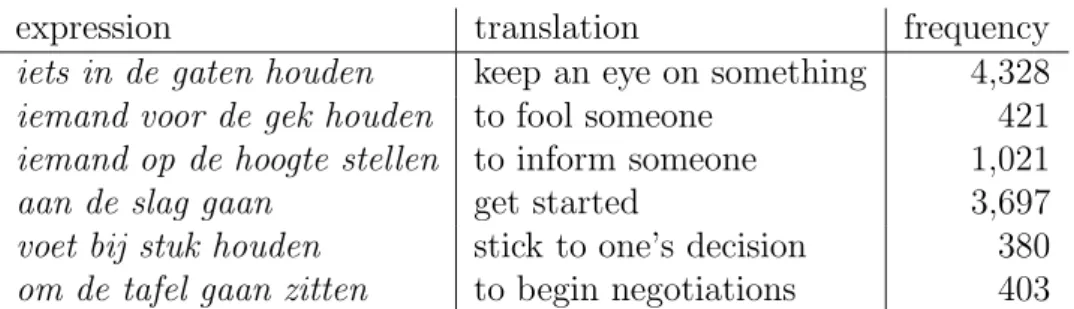
Fixed expressions constitute a non-negligible portion of the language in use, perhaps because of the various types of phenomena covered by the term. For illustration, the non-exhaustiveVan Dale Idioom Woordenboek(Van Dale Dictionary of Idioms) (1999) consists of ca. 10,000 Dutch idioms and other fixed expressions. In addition, frequency figures reveal that many fixed ex-pressions are too frequent to be left untreated in a computational grammar. Table 1.1 gives a few examples of Dutch support verb constructions found in the 300 million word Twente Nieuws Corpus (twnc) (Ordelman, 2002). Next, we motivate why fixed expressions deserve special attention and the reasons why they require a different treatment in a computational grammar.1
expression translation frequency
iets in de gaten houden keep an eye on something 4,328
iemand voor de gek houden to fool someone 421
iemand op de hoogte stellen to inform someone 1,021
aan de slag gaan get started 3,697
voet bij stuk houden stick to one’s decision 380
om de tafel gaan zitten to begin negotiations 403 Table 1.1: Some Dutch support verb constructions in the 300 million word
Twente Nieuws Corpus and their frequency.
1.1.3
Regularity, semi-regularity and exceptions in the
grammar and lexicon
Generally speaking, fixed expressions may exhibit idiosyncrasies in their morphosyntactic and/or semantic behavior. Consequently, it is not easy to
1
Throughout the thesis, each Dutch fixed expression used in the text is followed by its (approximate) translation in English. Appendix B provides a list of all these expressions with their word-to-word glosses and translations.
predict which lexemes within the expression undergo productive morphology, whether the expression undergoes passivization, topicalization, insertion of modification, ‘it-cleft’, extraction, etc. The former observation supports the argument that fixed expressions cannot always be built by regular grammar rules (Sailer, 2000; Riehemann, 2001). To illustrate this, consider an example of the fixed expression iets in petto hebben ‘to have something in store’:
(2) Ze they hebben have weer again een a nieuwe new machinatie plot in petto in store ‘Once again, they have a surprising new plot in store.’
Without further specifications in the lexicon, a robust computational parser would, probably, return the syntactic representation in (3) assuming an underlying regular structure:
(3) s np Ze vp v hebben advp weer np
een nieuwe machinatie
pp p in
? petto The verb hebben typically shows a transitive subcategorization frame [npnom
npacc], therefore, the parser considers Ze the grammatical subject agreeing
with the tensed verb,een nieuwe machinatiethe direct object andinthe head of a pp functioning as an event modifier. In this context, the lexeme hebben
is part of the lexicalized expression iets in petto hebben. To distinguish this peculiar phrase from the individual lexeme hebben, extended subcategoriza-tion requirements and lexical restricsubcategoriza-tions such as [npnom npacc ppin petto] are
specified. However, these restrictions encounter a problem.
Parsing could fail due to missing lexical entries. With the exception of the expressions in petto hebben and in petto houden ‘to keep in reserve’, the Italian loanword petto ‘pocket, sack; (fig) heart’ does not occur in other expressions in the language. Petto needs to be included in the lexicon. It is unclear what word category should be assigned to petto. Since pettoseems to be the complement of the preposition in, let us assume thatpetto is a noun. This ad hoc decision would make the wrong predictions about the behavior of pettoand the phrasein pettoin syntax. The insertion of a nominal lexeme
petto would wrongly predict that the word is free to appear in slots where a noun is expected. Petto shows no modification, no plural morphemes nor determiners:
(4) *Ze they hebben have weer again een a nieuwe new machinatie plot in in veilig safe petto/in store/in pettos/in stores/in een a petto store
Existing formalizations of fixed expressions propose instead to treat com-plement-like phrases selected by the verbal head as a fixed unit (Krenn and Erbach, 1994). To capture this, some language engineering proposals enter the fixed complement as a multi-word lexeme selected by the verb in the lexicon (Breidt et al., 1996). For the sake of the argument, we adopt this solution and label in petto as a special fixed phrase selected by the verb
hebben. The updated subcategorization requirements of this use of the verb
hebbenare [npnomnpacc fixed phrasein petto]. The resulting syntactic analysis
of (2) is given in (5): (5) s np Ze vp v hebben advp weer np
een nieuwe machinatie
fixed phrase in petto The addition of a lexical category fixed phrase has also consequences in the grammar. Additional grammar rules that only apply to fixed phrase
units are needed. Such grammar rules license a fixed expression provided a fixed phrase chunk combines with a selecting verb and all the verb’s subcategorization requirements are met. At the same time, the component lexemes within fixed phrases do not participate in regular morphological and syntactic operations.
Fixed arguments show strong preferences for a particular location in cer-tain clause types. In petto may occur at the end of a matrix clause (6-a). In subordinate clauses (in Dutch, verb final is required), in petto occurs in preverbal position (6-b): (6) a. De the carri`ere career van of Faneyte Faneyte had had nog yet veel much moois nice aspects in in petto. store ‘Faneyte’s career still promised many future highlights.’ b. (. . . ) . . . omdat because niemand nobody weet knows wat what voor for maatregelen measures Mahathir Mahathir nog yet in petto in store heeft has
‘(. . . ) because nobody still knows what sort of measures Ma-hathir has in store.’
Whereas complement pps may allow extraposition in Dutch (7), no in-stances of an extraposed in petto were found in the twnc corpus. In petto
behaves differently from regular complements in that it appears before the verbal cluster in subordinate clauses, allowing only auxiliaries or modals be-fore its selecting verb.2 To control this, additional rules need to state where
a fixed phrase3 may occur within the clause. Irregularity thus has to be introduced in the lexicon and in the grammar itself.
(7) Vanaf From 1 1 januari January moet must de the luchthaven airport zich itself houden hold aan de regels. on to the rules ‘From January 1st, the airport must adhere to the rules.’
Whereas the fixed phrase approach may be accurate for totally fixed arguments, other arguments that allow internal variation among specifiers or modifiers cannot be handled this way. In the expression in je maag zitten met
‘be troubled with’, the noun maagallows a definite (de) (8-a) or a possessive determiner (zijn, haar) that shares agreement features with the subject (8-b):
(8) a. . . .zit . . . sits duidelijk clearly met with de the kwestie issue in in de the maag stomach ‘. . . (someone) is clearly troubled by the issue.’
b. Van Van Nieuwenhuyzei Nieuwenhuyze zit sits lelijk ugly in in haari her maag stomach met with de the affaire. affair ‘Van Nieuwenhuyze is worried about the affair.’
In these expressions, arguments require internal syntactic structure; at the same time, lexical affinities between the verb (zitten), the preposition (in) and the head noun (maag) need to be specified. Provided the lexical restrictions are ensured, the structure in (9) could be suitable.
2
The same domain preferences apply to other pp and np arguments in many Dutch lexicalized expressions (p.c. Jack Hoeksema).
3
Alternatively, the phrasein pettocan be treated as appthat declares a feature [fixed]. The feature [fixed] ensures that extraposition and extraction do not regularly apply to this lexicalizedpp.
(9) s np Van N. vp v zit advp lelijk pp p in np det haar n maag pp met de affaire
A last piece of evidence suggests the need of further constraints. In the expression het niet in je kouwe kleren gaan zitten ‘sth. leaves its mark on you’, the specifier may be realized by a definite or a possessive determiner and, the nounklerenhas to be modified by the adjectivekouweorkoude‘cold’ (within the pp). This shows that in addition to categorical constraints, fine-grained conditions on the realization of the internal modification may be needed.
Many fixed expressions also exhibit irregularities in their semantics. A fixed expression consists of two or more lexemes that may denote a different meaning from the meaning the individual lexeme has when it occurs on its own. In Dutch, poetsen ‘to polish’ no longer maintains the same meaning in the context of the expressionde plaat poetsen(lit. the plate polish) ‘to depart unnoticed’. The figurative meaning is only present if all three lexemes de plaat poetsenco-occur. Due to the lexical affinities and the peculiar meaning of the combination, the expression de plaat poetsen is conceived as a lexical item and not as a phrase built up from independent lexemes.
If one tries to replace a lexeme by a (near-)synonym or insert an adject-ive modifier that is semantically plausible in a fixed expression, the semantic irregularity becomes apparent. De plaat poetsen neither allows synonym re-placement (10-a) nor insertion of adjective modifiers (10-b):
(10) a. Bell Bell poetste/*maakte polished/*made de the plaat plate *schoon *clean en and La La Primavera Primavera werd became een a hotel. hotel
‘Bell left unnoticed and La Primavera became a hotel.’ b. Bell Bell poetste cleaned de the (*onopgemerkte) unnoticed plaat plate en and La La Primavera Primavera werd became een a hotel. hotel
However, the degree of irregularity varies across the expressions. Whereas synonym replacement is often impossible, insertion of modifiers is sometimes feasible. The np argument headed by gevolg ‘consequence’ allows modifica-tion in gevolg geven aan ‘to carry out’:
(11) Daarmee with that zou will men men een a logisch logic gevolg consequence geven give aan on de the onzinnige absurd bezuinigingen cutbacks . . . . . .
‘With that, men will logically carry out the absurd cuts . . . ’
Although the idiosyncratic semantics of fixed expressions might not dir-ectly pose a problem for a parser, it may play a role in accounting for their a priori unpredictable syntactic versatility (Nunberg et al., 1994); in particu-lar, the underlying semantics might explain why some fixed expressions allow (limited) modification (11) and others do not (10-b).
The lexical status of component words, lexical and morphological restric-tions, subcategorization requirements, location of fixed arguments in certain clauses, variation affecting specifiers and adjectival modification vary from expression to expression. In order to capture the idiosyncratic behavior, fixed expressions are treated as phrasal lexical entries i.e. described in the lexicon (Everaert and Kuiper, 1996; Sailer, 2000; Riehemann, 2001).
1.2
Research questions
A lexicalist constraint-based grammar describes well-formed phrases in a given language capturing regular and productive syntactic operations. Such phrases are made up of individual lexemes that may have undergone mor-phological operations by the time they enter syntax. The evidence discussed in section 1.1.3 supports the claim that fixed expressions cannot always be formalized with regular grammar rules (Sailer, 2000; Riehemann, 2001).
Fixed expressions belong to the lexicon-grammar interface. With regard to their semantics, meaning is assigned to the expression as a unit; this can be captured by treating the whole expression as a phrasal lexical item. Limited variation shows that word formation rules including morphological rules, do not regularly apply to the individual words; their restricted syn-tactic flexibility (phrase internal and sentential) hints at a certain frozen nature. However, some expressions seem to be partially lexicalized because they exhibit alternation of specifiers or insertion of modifiers.
how to encode them in the grammar, one first needs to find out which ex-pressions qualify as fixed exex-pressions and secondly, to characterize the in-ternal structure and morphosyntactic restrictions shown by the lexemes or component phrases. Some of the problems we face are: how to identify com-binations that behave as fixed expressions, which features or tests tell us that an expression requires special encoding in a grammar, how to establish which are the minimum required lexemes, what slots are fixed and which parts are variable within a fixed expression. Our aim is to develop methods for expanding the lexicon with fixed expressions. We also want to gather evidence of morphosyntactic variation and modification which is relevant for the linguistic description of these expressions in a lexicalist constraint-based grammar.4
The research questions we will investigate here are the following:
• Can data-driven methods identify which fixed expressions require special lexical mention?
• To what extent can we determine the potential for modification of fixed expressions using a corpus-based approach?
To find an answer, this work focuses on two types of Dutch fixed ex-pressions, namely collocational prepositional phrases and support verb con-structions. However, we are interested in the general applicability of this research.
1.2.1
Aims and objectives
The main goals are the following. First, we investigate and develop a data-driven model to automatically extract fixed expressions. We concentrate on Dutchcollocational prepositional phrases and support verb constructions. Secondly, we investigate a corpus-based method to infer the variation and modification potential ofsupport verb constructions. As a derivative issue, we establish whether variation and modification potential pinpoint underlying semantic structure insupport verb constructions.
The main objectives are a hybrid model to perform automatic identific-ation of fixed expressions in corpora and evaluidentific-ation of its performance. We also aim at a corpus-based method to extract evidence of variation and modi-fication withinsupport verb constructionswith as little human intervention as possible. Evaluation of the corpus-based method provides positive input for future investigations. As by-products, we expect a characterization of two
4
types of fixed expressions, namely, collocational prepositional phrases and
support verb constructions and a report on the variation and modification potential within support verb constructions.
Both, the characterization of two types of fixed expressions and the de-velopment of the data-driven models that identify such expressions in large corpora can contribute valuable insights towards a better understanding of these idiosyncratic expressions. Data-driven models can retrieve thousands of examples of the linguistic behavior of fixed expressions from open domain corpora. Knowledge concerning the linguistic behavior contributes the ne-cessary empirical evidence to develop a theory of fixed expressions. Further-more, existing grammatical theories have to face the challenge of describing and accounting for the idiosyncratic nature of fixed expressions.
1.2.2
Practical motivation
The Pionier program Algorithms for Linguistic Processing aims at develop-ing a wide-coverage lexicalist grammar and parser for Dutch.5
Wide-coverage parsing ought to provide a syntactic analysis of any sentence in a language. Hence, the grammar needs to include appropriate linguistic descriptions of any syntactic construction considered to be well-formed. Furthermore, the lexicon (dictionary) should be updated and expanded as the vocabulary growth requires it. The ultimate goal of this work is to understand the grammar of Dutch fixed expressions in particular their potential for modific-ation thus, contributing to an efficient processing of these expressions by a Dutch parser.
1.3
Linguistics, Corpora and Statistics
Past work on theoretical and descriptive linguistics reports detailed charac-terizations of idioms and other types of fixed expressions. A set of features that distinguish fixed expressions from regular expressions does not exist; idiosyncrasies vary across expressions. Large corpora provide a potentially rich source of fixed expressions and an invaluable collection of their linguistic behavior. Former corpus-based approaches are described to find out if they are suitable to pursue our goals.
5
A description of the research program is available at http://www.let.rug.nl/ ~vannoord/alp.
1.3.1
Previous linguistic descriptions
The theoretical and descriptive linguistics literature suggests that more and more types of linguistic expressions fall under the phenomenon of fixed ex-pressions. Earlier work focuses on the archetype (Moon, 1998) of fixed expres-sions, that is, idioms.6
Recent corpus-based research7
investigates expressions such as English verb-particle combinations (Baldwin and Villavicencio, 2002), determinerlesspps (in English and Dutch) (Baldwin et al., to appear), varied expressions such as adjective-noun-verb combinations (Zinsmeister and Heid, 2003), cranberry words (Richter and Sailer, 2003) and complex prepositions (Trawinski, 2003) in German as well as Dutch adjective-verb, noun-verb, adverb-verb and preposition-noun-verb combinations (Hoeksema, 2004).
Let us review what features characterize the prototype of a fixed expres-sion. Idioms do not exhibit a specific form or morphosyntactic structure (Fernando and Flavell, 1981; Everaert and Kuiper, 1996). Idioms have been described as showing defective morpho-syntax and irregular semantics. One line of research maintains that idioms are expressions with non-compositional meaning, that is, the meaning of the whole idiom cannot be regularly derived from the meaning of its parts (Fernando and Flavell, 1981; Schenk, 1994; Abeill´e, 1995; Everaert and Kuiper, 1996). This view also maintains that internal adjectival modification if present, modifies the meaning of the whole idiom. Other instances of adjectival modification are ‘word play’ and con-sidered as marginal. An alternative line of research, the one we follow, argued for the existence of both non-decomposable (non-compositional) and decom-posable idioms (Nunberg et al., 1994; Moon, 1998). This view maintains that some (decomposable) idioms have internal semantic structure which is reflected in their syntactic flexibility (Nunberg et al., 1994). Furthermore, such idioms allow internal modification (Nicolas, 1995) that may affect only the meaning of an idiom’s constituent. Corpus-based studies corroborated Nunberg et al’s (1994) views, not only with regards to the existence of two types of idioms differing in their semantic structure but also with regards to their internal flexibility (Moon, 1998; Riehemann, 2001; Sag et al., 2001). Riehemann’s findings further support Nunberg et al.’s claims (1994) that syntactic flexibility (modification, passivization, topicalization, etc.) is more likely to be found among semantically decomposable idioms.
6
Below two different views on idioms are described. This work uses a more inclusive concept along the lines of Nunberg et al. (1994) and Moon (1998). Section 2.2.3 briefly discusses the use of the termidiomin the literature.
7
Recently, international workshops have hosted numerous presentations on various as-pects of collocations and fixed expressions cross-linguistically. To cite a few: the series of acl workshops on multiword expressions held in 2003 and 2004, sessions on collocation and multi-word expression extraction atlrec’04, euralex’02 and ’04, etc.
Due to the difficulty of gathering a set of sufficient features that identify fixed expressions, a set of linguistic diagnostics that show distinctions between regular phrases and idiosyncratic ones can be helpful. Fernando and Flavell (1981) and Sailer (2000) propose some diagnostics to detect syntactic and semantic irregularities in English verb np idiomatic expressions. Among others, the diagnostics comprise synonym replacement, insertion of adjectival modification, passivization, pronominalization and topicalization. Diagnostics that are specific to Dutch syntax and to the two types of expressions stud-ied in this work (Dutch collocational prepositional phrases and support verb constructions) have been proposed by Paardekooper (1962, 1973) and Holl-ebrandse (1993). Such diagnostics are described in chapters 4 and 6.
To our knowledge, recent studies have not specifically investigated in-ternal morphosyntactic variation and modification, or at least not systemat-ically. Exceptions are Moon’s (1998) and Riehemann’s (2001) corpus-based investigations. These two authors explored the variation in a pre-compiled list of idioms, collocations and other fixed expressions found in English cor-pora. Riehemann (2001) extracted evidence that show changes involving specifiers (e.g. quantifiers), adjectival modifiers, number morpheme, passiviz-ation, extraction, relative clauses andof-prepositional phrases, among others. Before Riehemann’s study, researchers often accepted the idea that instances of variation and internal modification in idioms were rare. Riehemann’s study revealed that 25% of the occurrences of decomposable idioms and 3% of non-decomposable v np randomly selected idioms exhibit some sort of variation (Riehemann, 2001, p. 131). These findings suggest that morphosyntactic variation is a non-negligible feature.
1.3.2
Corpus-based approaches
Corpus linguistics is a branch of descriptive linguistics that aims at extract-ing generalizations about language patterns by automatically explorextract-ing large collections of texts (corpora). This empiricist approach to linguistic analysis and exploration rests on the assumption that the knowledge speakers have of their language can be inferred from the linguistic evidence found in corpora. Large corpora have been found to be a valuable resource that can provide the descriptive linguist with all sorts of linguistic information: lexical word co-occurrence information, word frequency, distribution of linguistic structures and phenomena, etc.
A branch of corpus-based research aims at automatically identifying col-locations in corpora. Most studies adopt the following definition ofcollocation
‘statements of the habitual or customary places of that word (. . . ). The collocation of a word or a ‘piece’ is not to be re-garded as mere juxtaposition, it is an order of mutual expectancy
(Firth, 1957, p. 181).’
Firth’s view of collocation captures the fact that the component lexemes mutually expect each other. Although this criterion applies to interesting collocations s.a. dogs bark and sound asleep, it also applies to combinations such as eat apple, in the and doctor nurse which happen to cooccur in the same context very frequently. We use Firth’s statistical definition of colloc-ation as an empirical notion to identify fixed expressions. Firth’s concept of
collocation partially overlaps with fixed expression, but collocation refers to a broader phenomenon (cf. van der Wouden (1994); Sag et al. (2001)).8
Early collocation extraction models were built on the assumption that the lexical affinities between the words in a collocation can be approxim-ated by a strong statistical dependence between the words. These purely statistical models collect all possible patterns (word sequences) of various lengths from a textual corpus. Descriptive and inferential statistics meas-ure the degree of dependence between the component lexemes. The simplest method sorts candidates according to their raw frequency. Other common statistical measures are: mutual information and log-likelihood. The models expect that word combinations showing a strong statistical dependence are good collocations (Damerau, 1993). If the collocations consist of words that occur non-adjacently, a purely statistical approach allows too much noise (Dias et al., 1999). Another drawback is that if one aims at collocations that involve a function word (e.g. prepositions) highly frequent combinations of a content word and a preposition or a determiner will show a strong statistical dependence, even though the combination is fully regular (e.g. beginning of,
sing in, in the). Finally, manual evaluation of the retrieved lists is required due to the mixed types of the retrieved collocation candidates.
Later work on identification of collocations assumes a more restricted notion of collocation. This notion can be found, for instance, in Fontenelle’s work:
‘The termcollocationrefers to the idiosyncratic syntagmatic
com-8
To the best of our knowledge, existing grammatical theories have not yet introduced a linguistic entitycollocation. Recenthpsg-grammar proposals have postulated a ‘colloc-ational module’. This module is an analytical device that allows a lexeme to declare the distributional context within which its collocates may occur. Such device has been shown to license idiomatic expressions (Sailer, 2000), certain collocations and negative polarity items (Sailer and Richter, 2002; Richter and Sailer, 2003).
bination of lexical items and is independent of word class or syn-tactic structure (Fontenelle, 1992, p. 222)’
This view of collocation introduces some fundamental features: (1) arbit-rariness in the combination and (2) a lexico-syntactic relationship between the component lexemes. In addition, this view sets no restrictions on the component words nor on the form of the combination. Let us now explain how more recent approaches model this notion of collocation.
With improvements in part-of-speech tagging, phrase chunking and full parsing, data which is automatically annotated with linguistic information has become available; these developments in natural language processing has enabled identification models that extract only collocation candidates that satisfy certain morphosyntactic requirements (verb–object, adj–noun, verb–
pp, etc.). Known as hybrid models, they make use of linguistic information and statistics and they are the preferred models nowadays (Pearce, 2002; Ker-mes and Heid, 2003; Spranger, 2004). Decisions concerning the annotation of the extraction data, extraction of candidate datasets, choice of statistical measure and evaluation metrics, all contribute to differing views on the suc-cess of these models. Richly annotated data is preferred to part-of-speech tagged data, since it facilitates collecting candidates whose constituents are non-adjacent and bear a syntagmatic relation. Since candidates show similar morphosyntactic structure, evaluation can be fully automatic provided one has access to machine readable dictionaries or a lexical database.
Two problems faced by all models are: the identification of collocations among low-frequency data and the size of the candidate expressions. Unless one has a large amount of data, statistical measures will produce unreliable scores for low-frequency data. A measure that produces reasonable scores even among lower-frequency data is log-likelihood. Most collocation statistics can only be applied on bigrams (two word candidates), thus they pose an important restriction. When candidate expressions have a size of n ≥ 3, statistical measures are not easy to adjust. More complex models, among them a loglinear model implemented by Blaheta and Johnson (2001), by-pass the size problem, allowing candidates of any length.
In order to compile a computational lexicon of fixed expressions, one could collect the data from existing monolingual (or bilingual) dictionaries. We decided against this approach for several reasons. Existing dictionaries and glossaries are static resources, often covering a limited proportion of the existing data. Due to the lack of a sound definition offixed expression, these expressions are not consistently annotated in dictionaries (Everaert, 1993). Further, compiling a list from existing dictionaries is not easy because some fixed expressions are listed as special phrases of a word entry and other
expressions are cited in examples. Finally, morphosyntactic constraints are not yet available in most dictionaries. Therefore, we decided to investigate data-driven methods for automatically identifying fixed expressions.
Besides providing the raw data for collocation identification models, cor-pus evidence shows preferences and restrictions, and it shows that ‘variation (within fixed expressions) is much more common than some models suggest (Moon, 1998)’. Concordances and unix tools (grep, sort, etc.) have been proven useful to collect evidence of how much variation and morphosyntactic flexibility is found among a pre-compiled list of fixed expressions (Moon, 1998; Riehemann, 2001). Although the results are satisfactory, these meth-ods require intensive manual work. We aim at a corpus-based method that extracts relevant evidence with as little manual inspection as possible.
1.4
This thesis
The accuracy of the representation and linguistic description of fixed expres-sions in a lexicalist constraint-based grammar is crucial for improving parsing coverage and accuracy. The work described in this thesis aims at facilitat-ing the expansion of a lexicalist constraint-based grammar for Dutch. Fixed expressions exhibit idiosyncrasies at different linguistic levels; and these idio-syncrasies are not always found in existing Dutch dictionaries. Therefore, we explore their behavior in large corpora and from such evidence infer the re-quired morphosyntactic constraints. First, we attempt to build lexica of fixed expressions found in large corpora and second, we seek to extract evidence of variation and modification in such expressions from a corpus. On the basis of the extracted evidence, a grammar writer decides the lexical representation of a fixed expression, especially the necessary lexical and morphosyntactic constraints. In addition to investigating data-driven methods for acquiring a lexicon of fixed expressions, we also seek to establish the variation and modification potential of required arguments within fixed expressions.
1.4.1
Characteristics of fixed expressions
A general characterization of the idiosyncratic lexical, morphological, syn-tactic, and semantic features of fixed expressions is necessary for two reas-ons: (1) the need to identify which properties of fixed expressions introduce requirements to be captured by the identification models and (2) the import-ance of assessing the quality of the output of the identification models.
Among the properties involved, there are lexical (e.g. nonce words, lexical restrictions), morphological (e.g. archaic forms, compounding and
deriva-tion), syntactic (e.g. ill-formed structures, unexpected syntactic constituency of a verbal lexeme, internal modification, word order, etc.) and semantic ones (e.g. non-compositional meaning). More concretely, the required lexemes in fixed expressions show strong lexical affinities among them; these lexemes may be adjacent to each other or they may allow intervening elements. Reg-ular morphological and syntactic rules may apply to some constituents in fixed expressions. Consequently, the degree of lexicalization varies, showing a continuum from expressions that are totally fixed (ad hoc) to rather flexible expressions that allow adjectival modification (spill the royal beans).
General properties of fixed expressions and more specific features of Dutch
collocational prepositional phrasesandsupport verb constructionsimpose cer-tain constraints on identification models. Fixed expressions that consist of unknown words, archaic words and non-productive morphological variants (case marking remnants), ill-formed structures or verbal lexemes with un-expected syntactic constituency, could be ignored by hybrid identification models. We explain how this can happen.
Identification models extract candidate expressions from automatically annotated data. If the knowledge resources (lexicon and grammar) lack a description of fixed expressions, the annotation tools (parser) may, for in-stance, fail to label a dependency between a verb and one of its dependents containing an unknown word. The consequence is that actual fixed expres-sions could be missed during extraction of candidate datasets even though they occur in the extraction corpus. A robust parser, like the Alpino parser (section 3.2.2), that uses heuristics to guess the part-of-speech of unknown words partially solves the problem. In the task of identifying support verb constructions, our solution was to not rely fully on the dependencies proposed by the parser; instead we make use of lexical and phrasal chunks information during the extraction of candidate expressions. The more of these properties that are neglected by the annotation tools, the less linguistic information is available.
Identification models output a ranked list of candidate expressions. Next, the researcher assesses which expressions are valid fixed expressions. Altern-atively, human judges (native speakers) are given guidelines and asked to identify those candidates in the extracted lists that satisfy one or more dis-tinguishing features of fixed expressions. Besides factors that affect fixed expressions in general, specific characteristics of Dutch collocational prepos-itional phrases and support verb constructions are taken into account during the qualitative evaluation of the output. In this thesis, evaluation of the identification models involved assessment by human judges; our informants commented on the difficulty of making a decision sometimes; we attribute this difficulty to the lack of a good definition of the phenomena.
1.4.2
Identification of fixed expressions
Fixed expressions differ in their external form, internal structure and their behavior. Different linguistic behavior of the data we seek could make data-driven extraction methods unsuitable.9
We investigate data-driven methods with two different types of expressions to see the problems the methods encounter. We start with expressions that we consider rather fixed – colloc-ational prepositional phrases – and move on to more complex expressions. Based on the limitations of the first model, we design other models and test them on the task of identifying support verb constructions in corpora. The identification task proceeds in various steps: pre-processing extraction data, building candidate datasets, ranking candidates with statistical scores and evaluation.
We pursue identification models that provide a list of fixed expressions in addition to relevant evidence for a linguistic description. During pre-processing, we used part-of-speech tagged data and automatically parsed data. Part-of-speech tagged data can be useful for models that aim at fixed expressions whose component lexemes are adjacent to each other. Syntactic patterns defined over part-of-speech tags can extract interesting expressions from a part-of-speech tagged corpora. Chapter 4 describes identification of Dutch collocational pps in a part-of-speech tagged corpus. Fully parsed data offer multiple possibilities e.g. searching for patterns whose component lexemes bear a dependency relation and occur separately from each other. For example, if we want to extract collocations like een vergadering sluiten
‘to adjourn a meeting’, we collect all instances of the pattern ‘verb objectnp
’ found in the corpus. Using treebank query tools, syntactic patterns with varied external form and internal structure can be retrieved. Extraction of support verb constructions used fully parsed data. To avoid potential parser mistakes, we used phrasal chunks collected from a full parse during the extraction of candidate datasets.
Variation of the internal structure (due to e.g. the insertion of modific-ation) has an effect on the length of the candidate expression. The length of the candidate can be a problem for applying certain statistical measures. Such measures are typically applied on bigrams (candidates that consist of two words). Target fixed expressions often involve three or more words (e.g.
in de gaten houden). In our experiments, pre-nominal specifiers and adject-ives are ignored, thus, a candidate expression is representend by a triple (verb, preposition, noun). Chapters 4 and 5 report how we applied the bi-gram statistics on triples and a loglinear model that sets no restrictions on
9
A long term goal is to design a model that identifies any type of fixed expression in corpora.
candidate size.
Some statistical tests are highly sensitive to low frequency data. A fre-quency cutoff is a common technique to avoid unreliable scores. Although many fixed expressions are very frequent in corpora, some others are not. A large number of fixed expressions show low frequency, which means that applying a frequency cutoff would discard them. We decided against using a cutoff. In the absence of a large gold standard list, we prefer to ignore the impact of a frequency cutoff. To avoid unreliable scores, two association measures that are less sensitive to low-frequent counts and therefore less de-pendent on a frequency cutoff were identified – log-likelihood and salience. The salience measure was the most successful in the support verb construc-tion experiments. Given that our validaconstruc-tion data was rather limited, we do not use standard precision and recall; instead, the various statistics are evaluated with accuracy graphs and a non-standard measure: uninterpolated average precision(also used in information retrieval). The advantage of this measure is that it indirectly measures the recall.
Among the candidates retrieved by the best statistical tests, noise surfaces among the top scores. Systematic errors made by the support verb construc-tion identificaconstruc-tion model involve adjuncts and regular complements of verbs. Chapter 6 presents a theory-informed and data-driven identification method that exploits the syntactic idiosyncrasies of the expressions. Hollebrandse (1993) proposed linguistic diagnostics that distinguish Dutch support verb constructions from regular verb phrases. Tests such as extraposition, scram-bling, nominalization patterns and coordination draw a distinction between regular verb phrases and support verb constructions. On the basis of these diagnostics, we designed an automatic method that discards a substantial percentage of the errors. The diagnostics are applied as a post-identification filter. To the best of our knowledge, this type of approach to error reduction has not been tried before.
1.4.3
Exploring variation and modifiability
Eventually fixed expressions need to be described in a lexicalist constraint-based grammar. Thus, it seemed appropriate to attempt a characterization of fixed expressions that studies observable linguistic knowledge, namely, lexical, morphological and syntactic features. Our second goal is to establish the modification potential in support verb constructions (svcs). We aim at extracting relevant morphosyntactic features from corpora and based on these features, we predict the potential of modification of each expression.
Chapter 7 describes the results of some experiments on establishing modi-fication potential. Alternation of specifiers, morphological productivity and
adjectival modification in support verb constructions show a continuum; at one end, we find totally fixed expressions and at the other end, expressions that allow specifier variation, limited morphological productivity and ad-jectival modification. Nevertheless, these findings need to be interpreted care-fully; the fact that no evidence of variation or modification has been found in our corpus does not mean that none is possible. Inspired by Fellbaum (1993), we study the correlation between determiner changes and adjectival modific-ation in the evidence extracted from the corpus. In a sample of more than 100 svcs, we established that if noun phrases within required arguments in
svcs show alternation between eitherzero, definite and possessive de-terminer or, either indefiniteordemonstrative or aquantifierand one or more other determiner types, then the noun phrase also shows adjectival modification. Therefore, we expect that arguments within svcs for which we found such determiner alternations are likely to allow adjectival modific-ation. The underlying intuition is that fixed expressions that allow variation and internal modification are likely to be semantically decomposable also. This introduces an often controversial property of fixed expressions: whether fixed expressions have semantic structure, that is, whether the meaning of the whole expression may be split among its constituents. Nunberg et al. (1994) argued that the fact that certain English idioms are semantically de-composable shows up in their syntactic flexibility. Internal modification is a manifestation of syntactic flexibility. We take Nunberg et al’s observation and assess its validity concerning Dutch support verb constructions. Chapter 7 reports that no clear-cut correlation exists between morphosyntactic flex-ibility and internal semantic structure in support verb constructions.
1.5
Applications
Lexicon update, grammar development and parsing An immediate application is lexicon updating and grammar development foreseeing a pos-itive effect on parsing accuracy and coverage. Lexical acquisition methods provide a quick means of compiling a collection of expressions that satisfy pre-specified (morpho-)syntactic requirements. The lexical acquisition model used to extractsupport verb constructionscan be easily modified for extract-ing any syntactic pattern shown by fixed expressions. Such patterns may be collocations, support verb constructions, idiomatic expressions, verb-particle combinations, etc. With this model, the existing lexicon can be expanded with new types of fixed expressions.
After the compilation of a computational lexicon, one can explore the syntactic distribution and behavior of the lexical items in corpora. Such
findings motivate certain decisions in grammar development and implement-ation. The corpus-based method described in chapter 7 extracts evidence of alternations that involve determiners, quantifiers, etc., morphological pro-ductivity and adjectival modification. From this evidence, one can infer morphosyntactic restrictions of a given fixed expressionthat the lexicon and the grammar ought to capture.
Improvements in the lexicon and in the grammar ought to be reflected in parsing accuracy. Access to a lexicon of prepositional support verb construc-tions and idiomatic expressions has been shown to improve pp–attachment disambiguation decisions made by a parser (Volk, 2002).
Linguistic exploration The methods described extract valuable empirical evidence of actual language use. This evidence can be very helpful to test, revise and improve existing linguistic theories of idiomaticity.
Computational Lexicography In recent years, a growing interest has led researchers to compile databases of idioms, collocations and other figurative expressions to be integrated in natural language processing systems as well as for linguistic exploration. Examples are: a German database of verbal idioms called Phraseo-Lex (Dormeyer et al., 1998), a collection of German collocations by Krenn (2000b), SAID – a Syntactically Annotated Idiom Dataset of English idioms produced by the Linguistic Data Consortium (ldc) and a database of Dutch fixed expressions involving prepositions by Loonen (2003), to name a few. In addition, large dictionaries of fixed expressions and sayings exist in many languages: the Cambridge International Dictionary of Idioms(1998) and Collins Cobuild Dictionary of Idioms(2002) with English idioms,Van Dale Idioom Woordenboek(1999) with circa 10,000 Dutch idioms, etc. Recently, machine readable dictionaries and/or printed dictionaries have started to include morphosyntactic preferences of the lexemes and phrases inside fixed expressions.
Gaps in existing dictionaries (printed and electronic ones) are well-known to lexicographers; lexicographic projects could profit from a hybrid identi-fication model that automatically extracts thousands of patterns from large corpora to update and extend existing dictionaries. Hybrid models have been successfully applied in English and German lexicographic projects. After applying filtering techniques (informed by linguistic diagnostics), a lexicographer would need to manually inspect the extracted lists. Further, morphosyntactic constraints that affect the internal phrasal structure in fixed expressions can be helpful to language learners, natural language generation systems, parsing, etc. Automatic extraction of these constraints facilitates a
lexicographer’s work.
Information Retrieval and Machine Translation In cross-lingual in-formation retrieval, a glossary or index of fixed expressions (or domain spe-cific multi-word terms) is needed in source and possibly target languages because concepts are often expressed as multi-word terms (Thurmair, 2004). A word by word translation of the original multi-word term is likely to des-troy the original meaning of the source term. In open domains, one would also expect that a list of fixed expressions can be helpful in both applications. Similar collocation identification methods have been applied to acquire multi-word lexemes from specialized corpora. Attempts to extract noun case marker verb multi-word lexemes from a Hungarian corpus have produced reasonable results (Kis et al., 2004). Extracted lists are used in machine translation.
1.6
Chapter summaries
Chapter 2 provides a general characterization of fixed expressions from a de-scriptive linguistics perspective. Lexical, morphological, semantic and syn-tactic properties and irregularities of fixed expressions are discussed. Prop-erties of fixed expressions are taken into account during the design of the corpus-based identification models. An awareness of these properties is cru-cial for assessing the results of the identification models as well as the limit-ations encountered while exploring the modification potential.
Chapter 3 describes data-driven methods previously applied in the iden-tification of collocations. We describe hybrid approaches that combine lin-guistic information with probabilistic techniques and contrast them with purely statistical approaches. The chapter describes lexical resources used, methods adopted and evaluation methodology. Furthermore, we also com-ment on the success of hybrid approaches.
Chapter 4 reports on the performance of a hybrid approach in identifying Dutch collocational prepositional phrases in a corpus. Collocational preposi-tional phrases are rather fixed preposition noun preposition combina-tions. For this case study, we used a part-of-speech tagged corpus. Various statistical association measures are compared.
Chapter 5 aims at establishing how useful a hybrid approach is in identi-fying support verb constructions in corpora. The required constituents in a support verb construction may be separate from each other. Therefore, we use automatically parsed data. We compare the accuracy of standard association measures such as log-likelihood and χ2 to a log-linear model.
Chapter 6 investigates whether linguistic diagnostics are helpful for the task of discarding noise from automatically extracted lists of support verb constructions. Various linguistic properties introduce distinctions between regular phrases and fixed expressions. We rely on such distinctions to improve the output of identification models.
Chapter 7 describes a corpus-based method to extract relevant informa-tion from corpora and investigate whether the method is useful to determine modification and variation potential within one class of Dutch fixed expres-sions, that is, support verb constructions that require app argument.
Chapter 8 enumerates our conclusions and briefly establishes future dir-ections.
On fixed expressions
‘In investigating the properties of lexical items one is looking at the inmates of a prison (the lexicon) who have in common only the fact of their lawlessness (Di Sciullo and Williams, 1987).’
2.1
Introduction
Fixed expressionsdepart in their behavior from regular and productive phrases. Bearing in mind Di Sciullo and William’s (1987) analogy, this chapter aims at identifying the irregularities observed in fixed expressions. We mainly study the lexical, semantic and syntactic properties of these expressions that distinguish them from regular and productive phrases.
The goal of the characterization is mainly descriptive, namely to identify features of fixed expressions that ought to be captured or approximated by the data-driven methods explored in the chapters to follow, and indirectly, to find features offixed expressionsthat need to be specified in a computational grammar. Some features apply to any type of fixed expressions and some others describe specific aspects of fixed expressions with a verbal phrase structure.
The characterization that follows is partly based on descriptive work on fixed and idiomatic expressions by Everaert (1993), Everaert and Kuiper (1996) and Moon (1998) as well as formal proposals of their treatment and representation in various grammar formalisms (Katz (1973); Gazdar et al. (1985); Erbach (1992); Krenn and Erbach (1994); Sailer (2000); Riehemann
(2001); Sag et al. (2001) among others). Detailed descriptions of idioms have contributed a great deal of insight and structure to the contents in this chapter (Fernando and Flavell (1981), Verstraten (1989), Schenk (1994), Nunberg et al. (1994) and Abeill´e (1995)). The works cited studied fixed expressions in languages such as English, French, Dutch and German. The evidence supporting the description is taken either from the literature con-sulted or from the output of the research presented in later chapters. The Dutch data is extracted from the Twente Nieuws Corpus (twnc) (Ordelman, 2002), unless explicitly cited otherwise. The Twente Nieuws Corpus (twnc) is made up of newspaper text and some television news reports.
2.2
Semantic properties of fixed expressions
When a language user encounters a fixed expression, (s)he may notice its non-literalness. The literal meaning of the component words when they are used independently plays no role in the meaning of the fixed expression. It is the
defining context that allows speakers to identify the adequate interpretation (literal or idiomatic) of homonymous expressions such as iets in ´e´en hand houden‘done under one’s person/institution’s responsibility’; it is the context that triggers the idiomatic or the literal meaning. The lexical context triggers only a literal interpretation in (1) but a figurative interpretation in (2):
(1) Nog still in in zijn his schooljaren school years bleek seemed het the houten wooden racket racket voor hem for him te too zwaar heavy om to in ´e´en hand in one hand te to houden. hold
‘When still in his school years, the wooden racket seemed to be very heavy for him to hold in one hand.’
(2) Voorlichting, Information, onderzoek investigation ´en and controle control moet must je you in ´e´en hand in one hand houden. hold
‘One must keep information, investigation and control together.’ A mismatch between the literal sense of the individual lexemes, the lin-guistic context and the discourse marks out the idiosyncratic expression and triggers the idiomatic interpretation. In some expressions, the lexical re-strictions and syntactic constituency are sufficient to determine the intended interpretation. The syntactic dependents of zitten ‘sit’ (typically intransit-ive) as well as their lexical realization differ significantly in the context of the
figurative expression iemand iets in het bloed zitten ‘to be in s.o.’s blood’: (3) Maar but schaatsen skating zit sits ons us in het in the bloed, blood, zegt says Karlstad. Karlstad ‘But skating is in our blood, says Karlstad.’
Nevertheless, some fixed expressions have a (partially) literal meaning. In the examples in (4), zoen ‘kiss’ refers to the kissing event, still denoting a literal meaning; school and hospital show the literal meaning they denote in other contexts, even while the syntax of the expressions in (4-b) unexpectedly requires no determiner for the singular count nouns.
(4) a. een zoen geven ‘to give a kiss’ b. by car,at school, in hospital
Words that denote literal meaning in fixed expressions could in prin-ciple have the status of ordinary individual lexemes. However, their morpho-syntactic behavior in the context of the fixed expression may show irregular-ity.
2.2.1
Denoting and non-denoting words
Words in fixed expressions may be denoting or non-denoting. A ‘denoting’ word refers to a concrete entity or an abstract concept. A ‘non-denoting’ word bears no meaning assignment. Among denoting words some are poly-semous, thus showing a literal and a non-literal meaning. The individual words laatste, handand leggen(‘last’, ‘hand’ and ‘lay’, respectively) outside the expression de laatste hand aan iets leggen show a literal meaning. In the context of the fixed expression they show a non-literal meaning, thus they qualify as polysemous (5-a). Verbal lexemes sometimes show semantic bleaching or a defective meaning. So-calledlight verbs found insupport verb constructions (svc) have a literal meaning outside the svc; that meaning is ‘bleached’ in its svc use. For example, geven ‘to give’ in the expression een zoen geven ‘to kiss’. Denoting words may only have a literal meaning, the one present in the fixed expression also. The literal meaning ofsluiten‘close’ remains present in the context of een vergadering sluitenin (5-b).
(5) a. de laatste hand
the last hand
aan on iets something leggen lay
‘to put the finishing touches on something’ b. een a vergadering meeting sluiten close
‘to adjourn a meeting’
Some words (in fixed expressions) qualify as non-denoting. Although the words have a literal meaning outside the expression, no meaning can be attributed to them in the context of the fixed expression (e.g. plaat ‘plate’ and poetsen ‘clean’ in de plaat poetsen (6-a)).1 In other cases, non-denoting
words are nonce words i.e. words that exclusively occur in fixed expressions.
Petto (6-b) is a nonce word in Dutch.
(6) a. de the plaat plate poetsen polish ‘to depart unnoticed’ b. in petto
in store
hebben/houden
have/keep ‘to reserve’
Everaert (1993) also mentions loer in the expression een loer draaien ‘play a nasty trick on s.o.’. Native speakers maintain that the word loer has no existence on its own nowadays. In English, the word dint only occurs in by dint of, amok (a loanword from Malay) in run amok ‘in a violently raging manner’ and lieu (French loanword) in in (the) lieu of ‘instead of’; these expressions make up a subtype of cranberry words(Moon, 1998; Richter and Sailer, 2003).
Two tests help identify denoting phrases insidefixed expressions; the first one checks if the lexeme(s) exhibit the same meaning outside the fixed ex-pression and the second, checks if a pronoun somewhere else in the discourse can refer to an np part of a fixed expression. Sailer (2000) (among others) used these tests to find out irregularities in the semantics of verbal idio-matic expressions. Riehemann (2001) provides evidence of pronominal ref-erence found in ‘decomposable’2
idioms in English. Experiments described in chapter 6 confirm that pronominalization also distinguishes certain ar-guments in support verb constructions from complements in regular verb phrases.
2.2.2
Opacity and conventionality
Non-literalness introduces unpredictability. The literal meaning denoted by the lexemes in a fixed expression does not always motivate the peculiar mean-ing of the whole expression. Whereas the idiomatic meanmean-ing of the
expres-1
An equivalent example in English isshoot the breeze‘to talk’.
2