The Open University’s repository of research publications
and other research outputs
Designing Activities for Collaboration at Classroom
Scale Using Shared Technology
Thesis
How to cite:
Kreitmayer, Stefan (2015). Designing Activities for Collaboration at Classroom Scale Using Shared Technology. PhD thesis The Open University.
For guidance on citations see FAQs.
c
2015 Stefan Kreitmayer Version: Version of Record
Copyright and Moral Rights for the articles on this site are retained by the individual authors and/or other copyright owners. For more information on Open Research Online’s data policy on reuse of materials please consult the policies page.
Technology
Stefan Kreitmayer
A thesis submitted to The Open University
for the degree of Doctor of Philosophy in Computing
30th September 2014
Department of Computing
Faculty of Mathematics, Computing and Technology The Open University Milton Keynes, UK
Declaration
Abstract
Although researchers, teachers and policy makers broadly agree on the benefits of collaborative learning, there appears to be less clarity regarding how effective collaboration can be realised at classroom scale.
Research in Computer-Supported Collaborative Learning (CSCL), Human-Computer Interaction (HCI), simulation-based learning and related fields has produced a considerable range of applications that aim to support collaboration in classrooms. Grounded in well-established theories of how humans learn, many such applications have shown promising results within the context of small research studies. However, most of those research-driven applications never matured beyond the prototype stage and few are available today as products that schools can easily use and adopt. Many systems lack flexibility or require too much time, hard-ware, technical skills or other resources to be effectively implemented. Furthermore, teachers can be overwhelmed by managing large groups of students engaged in complex, computer-supported tasks.
This thesis investigates how forms of whole-classroom activity can be supported by combining shareable technologies with simulation, team play and orchestration. New designs are explored to help large groups engage and discuss at multiple scales (from pairs and small groups to the entire classroom) in ways that effectively include each student and use
the teacher’s limited resources efficiently. Moreover, this research aims to devise and validate a conceptual framework that can guide future design, orchestration and evaluation of such activities. Three in-situ studies were conducted to address these goals.
The first study involved the design of a climate change simulation to support a professional training course. Iterative design and video analysis resulted in the formulation of the Collaborative Learning Orchestration for Verbal Engagement and Reflection (CLOVER) framework. This framework comprises a suite of conceptual tools and recommendations that aim to help designers and teachers create, orchestrate and evaluate decision-based simulations for whole-classroom use.
Two follow-up studies were conducted to validate the usability and usefulness of CLOVER. One of them aimed to replicate the previous findings in a similar context and resulted in the design of a sustainable, whole-classroom simulation for students to discuss finance decisions. The other used CLOVER to expand an existing desktop application (a language comprehension task for children) to classroom scale.
In sum, the three studies provide substantial empirical evidence, suggest-ing that CLOVER-based applications can effectively reconcile learnsuggest-ing needs (collaboration) and technological affordances (shareable devices) with the inherent benefits and constraints of teacher-driven, co-located environments. Furthermore, the findings contribute to a better under-standing of what it means to design for sustainability in this context.
Preface
Some of the materials in this dissertation also appear in the following conference papers: 1. Kreitmayer, Stefan; Rogers, Yvonne; Laney, Robin and Peake, Stephen. UniPad: Orchestrating Collaborative Activities Through Shared Tablets and An Integrated Wall Display. In: Proceedings of the 2013 ACM Conference on Ubiquitous Computing (UbiComp ’13), ACM, 2013, Zurich, Switzerland.
2. Kreitmayer, Stefan; Laney, Robin; Peake, Stephen and Rogers, Yvonne. Sharing Bubbles: Reflections on Offline Multi-Surface Scenarios. In: Proceedings of the 2013 ACM Conference on Ubiquitous Computing (UbiComp ’13), Contribution to the SOFTec workshop, ACM, 2013, Zurich, Switzerland.
3. Kreitmayer, Stefan; Rogers, Yvonne; Laney, Robin and Peake, Stephen. From participatory to contributory simulations: changing the game in the classroom. In:
Proceedings of the 2012 ACM annual conference on Human Factors in Computing Systems (CHI ’12), pp. 49-58. ACM, 2012, Austin, Texas, USA.
4. Kreitmayer, Stefan; Peake, Stephen; Laney, Robin and Rogers, Yvonne (2011). Designing a Large Multi-Player Simulation Game to Encourage Reflection and Critical Debate. In: Proceedings of the 5th European Conference on Game Based Learning (ECGBL ’11), 20-21 Oct 2011, Athens, Greece.
Acknowledgements
This PhD research would not have possible without the help of other people to whom I am greatly indebted.
The three studies reported in this thesis were collaborative projects, including teachers and other researchers. The 4Decades climate simulation would not have been possible without Stephen Peake (The Open University) who deserves credit as initiator, teacher and designer of the mathematics behind the simulation. Jörn Ketelsen programmed parts of the server application and the tablet interfaces. Vaiva Kalnikait˙e contributed field notes during the first in-situ evaluation. Warm thanks to Richard Hearne (video) and Melissa Sutcliffe (photos) for their excellent camera work that supported my analysis. Ideas and support came from The University of Cambridge Institute for Sustainability Leadership (CISL) who hosted 4Decades at some of their professional training courses. The UniPad simulation was designed in collaboration with Mike Mompi, Sharan Jaswal and other experts at MyBnk who contributed material, time and inspiration.
Nicola Yuill (University of Sussex) directed the preliminary evaluation of the Comfy Birds application at the ChaTLab and in schools. She and her students have been a constant source of wisdom, comfort and challenging questions.
Eternal gratitude goes to all the good people inside and outside of academia who have supported my personal transformation from being an idiot to being an idiot who wanted a PhD. Thank you all for helping me stay on the difficult path at times when easier paths were tempting.
Thanks to supervisors, mentors, proof readers, reviewers, role models, random folks, former teachers, friends and fellow PhD students and the fine people at The Open University, UCLIC (University College London), London Knowledge Lab and ChaTLab (University of Sussex).
Thanks to my parents for nature, nurture and the whole mess in between. Also, thanks to animals.
1. Introduction 3
1.1. Motivation . . . 4
1.2. Background . . . 4
1.2.1. Rethinking classroom configurations . . . 5
1.2.2. Can shared technologies extend collaboration to the whole classroom? 6 1.2.3. Realistic demands on the teacher . . . 7
1.3. Research questions and aims . . . 8
1.4. Approach . . . 8
1.4.1. Dealing with constraints: Towards feasibility in the wild . . . 10
1.4.2. Understanding classroom needs by aiming for adoption . . . 10
1.4.3. Transfer from professional training to classrooms . . . 11
1.4.4. Designing for sustainability . . . 12
1.5. Thesis outcomes . . . 14
1.6. Definitions . . . 16
1.6.1. Classroom . . . 16
1.6.2. Students / Learners / Participants . . . 16
1.6.3. Orchestration . . . 17
1.6.4. Classroom activity . . . 17
1.6.5. Teaching . . . 17
1.6.6. Simulation . . . 18
1.6.7. Models, simulations and games . . . 18
1.7. Thesis Structure . . . 19
2. Literature Review 21 2.1. Introduction . . . 21
2.1.1. Aims of this chapter . . . 22
2.1.2. Overall strategy . . . 22
2.1.3. Chapter structure . . . 24
2.2. Part one: Theories of learning . . . 26
2.2.1. Higher level learning: Bloom’s taxonomy . . . 26
2.2.2. Constructivist theories . . . 30
2.3. Part two: Simulation-based learning . . . 35
2.3.1. Common assumptions . . . 35
2.3.2. Relevant approaches . . . 44
2.3.3. First outcome: A lean pedagogy for applying theory in practice . 54 2.4. Part three: Computer-Supported Collaborative Learning . . . 57
2.4.1. Trends in the field . . . 57
2.4.2. Collaborative whole-class pedagogies . . . 59
2.4.3. What obstacles impede whole-class collaborative activities? . . . . 60
2.4.4. Classroom orchestration . . . 61
2.4.5. Second Outcome: Roles of the teacher and technology . . . 65
2.5. Part four: Human-Computer Interaction . . . 67
2.5.1. New technologies . . . 67
2.5.2. The rise of touch-screen technologies in classrooms . . . 68
2.5.3. Extending from small-group HCI to large groups . . . 69
2.5.4. Problems with isolated sub-groups . . . 70
2.5.6. Third outcome: Starting points for interaction design . . . 73
2.6. Summary and conclusion . . . 74
3. Methodology 75 3.1. Design-based research approach . . . 75
3.1.1. From concrete design to abstract concepts and back . . . 76
3.1.2. Design layers: The “Triple-i” Hierarchy . . . 78
3.1.3. Teachers taking part in the design . . . 79
3.1.4. Iterative design and prototyping . . . 80
3.2. Analytical focus . . . 82
3.2.1. Engaging, enjoyable, usable and useful . . . 82
3.2.2. Relevant metrics . . . 83
3.2.3. Why not use pre and post tests? . . . 83
3.2.4. Why not use control groups? . . . 85
3.3. Data collection . . . 86
3.3.1. Types of data . . . 86
3.3.2. Amount of data . . . 88
3.3.3. Lab tests versus in-situ evaluation . . . 88
3.3.4. Choice of settings: From professionals to schools . . . 90
3.4. Qualitative analysis . . . 93
3.4.1. Overview . . . 93
3.4.2. Scope . . . 94
3.5. Summary . . . 96
4. Designing a participatory simulation on climate change 97 4.1. Overview . . . 97
4.1.1. Research question and aims . . . 100
4.2. Study context and approach . . . 100
4.2.1. Executive training courses . . . 101
4.2.2. Addressing a concrete learning need . . . 101
4.2.3. Research in practice: co-operation with the course committee . . 101
4.2.4. Whole-activity testing in the lab . . . 102
4.2.5. The teacher’s role in the design . . . 103
4.2.6. Time Frame . . . 104
4.3. Study setting: The CLP course series . . . 104
4.3.1. Motivation for active learning . . . 104
4.3.2. Participants’ educational backgrounds and needs . . . 106
4.3.3. Previous efforts towards applying theory in practice . . . 106
4.3.4. Ethnographical investigation . . . 107
4.4. Design method . . . 111
4.4.1. Gameplay Objectives . . . 111
4.4.2. Choice of topics . . . 112
4.4.3. Choice of evaluation strategies . . . 113
4.4.4. Devising an activity structure . . . 113
4.4.5. Choice of technology . . . 115
4.5. Introducing the three sketches . . . 115
4.6. First sketch: “Table of leaders” . . . 116
4.6.1. Design . . . 116
4.6.2. Evaluation . . . 118
4.6.3. Discussion . . . 120
4.6.4. Summary . . . 124
4.7. Second sketch: “Parallel futures” . . . 125
4.7.1. Design . . . 125
4.7.3. Discussion . . . 131
4.7.4. Summary . . . 132
4.8. Third sketch: “Four equal regions” . . . 133
4.8.1. Design . . . 133
4.8.2. Evaluation . . . 141
4.8.3. Discussion and changes . . . 147
4.8.4. Summary . . . 154
4.9. Overall discussion of the lab-based design . . . 154
4.9.1. Reflections on iterative design and evaluation . . . 154
4.9.2. Ecology of devices . . . 157
4.9.3. Suggested use qualities for ambient displays . . . 159
4.9.4. Ready for the wild? . . . 159
4.10. Chapter summary and conclusion . . . 161
5. Analysis 1: In-situ feasibility of the 4Decades simulation 163 5.1. Overview of Chapters 5-7 . . . 163
5.1.1. Three analyses, four sessions, one study . . . 165
5.1.2. Research aims and method . . . 166
5.1.3. Setting . . . 166
5.1.4. Technical implementation . . . 167
5.2. Analysis 1: Overall feasibility . . . 169
5.2.1. Method . . . 170
5.2.2. Session structure . . . 170
5.2.3. Introduction and practice match . . . 173
5.2.4. Findings . . . 178
5.2.5. Discussion . . . 193
6. Analysis 2: Changing simulation rules 201
6.1. Question and aims . . . 202
6.2. Benefits of Rule-Changing . . . 202
6.3. Design iteration . . . 203
6.4. Design objectives: adapted from Gameplay . . . 204
6.4.1. Providing relevant choices of scenarios and winning conditions . . 204
6.4.2. Devising adequate representations . . . 206
6.4.3. Giving participants a sense of the model author’s perspective . . . 206
6.4.4. Reusing tablets and ambient displays . . . 206
6.5. Changes to the application . . . 207
6.5.1. Tablet interfaces for rule changing . . . 207
6.5.2. An additional ambient display for the rules . . . 209
6.5.3. Changes to the team display . . . 211
6.6. Integrating rule-changing into the whole activity . . . 212
6.7. Lab testing . . . 212
6.8. Rejected ideas for the tablet interface . . . 212
6.9. Evaluation in the wild . . . 214
6.10. Method . . . 214
6.11. Setting . . . 215
6.12. Room layout and participant roles . . . 215
6.13. Procedure . . . 216
6.14. Findings . . . 216
6.14.1. Chosen rules . . . 217
6.14.2. Participants’ reflections on the chosen rules . . . 218
6.14.3. Large groups sharing one tablet . . . 219
6.14.4. Dialogue during rule-changing . . . 220
6.14.6. Participants’ overall ratings of the activity . . . 222
6.14.7. Comments in the debriefing . . . 222
6.14.8. The teacher’s actions . . . 223
6.14.9. The teacher’s reflections on rule-changing . . . 223
6.15. Discussion . . . 224
6.16. Reflections on the design objectives . . . 224
6.17. Reflections on the Benefits of Rule-Changing . . . 226
6.18. Usability . . . 228
6.19. Usefulness . . . 230
6.20. Desirability . . . 231
6.21. Conclusions from Analysis 2 . . . 232
7. Analysis 3: Continuous and equitable accessibility 235 7.1. Overview . . . 235
7.2. Question and aims . . . 236
7.3. Method . . . 236 7.4. Findings . . . 237 7.5. Overview . . . 237 7.6. Session 1 . . . 239 7.6.1. Designed Layout . . . 239 7.6.2. Appropriation . . . 239 7.6.3. Issues . . . 239 7.7. Session 2 . . . 240 7.7.1. Designed layout . . . 241 7.7.2. Appropriation . . . 241 7.7.3. Issues . . . 241 7.8. Session 3 . . . 243 7.8.1. Designed Layout . . . 243
7.8.2. Both teams: Problematic Corner-L formations . . . 243
7.8.3. Transformation in team A . . . 246
7.8.4. Implications for team A . . . 247
7.8.5. Transformation in team B . . . 248
7.8.6. Implications for team B . . . 249
7.8.7. Impact on participant experience . . . 250
7.8.8. Summary of session 3 . . . 252
7.9. Session 4 . . . 252
7.9.1. Designed Layout . . . 252
7.9.2. Appropriation . . . 253
7.9.3. High overall satisfaction . . . 253
7.10. Full overview of appropriation . . . 255
7.11. Discussion . . . 257
7.12. Effects of group formations on mechanisms of collaboration . . . 257
7.12.1. Implications of small-group formations . . . 257
7.12.2. Implications of large-group formations . . . 257
7.13. Recommendations for design and orchestration . . . 258
7.14. Explaining severe issues that caused exclusion . . . 260
7.15. Learning about inclusion by studying exclusion . . . 261
7.16. The Three Bubbles model . . . 263
7.16.1. Relation to proxemics . . . 265
7.16.2. Use in evaluation . . . 265
7.16.3. Use as a design template . . . 266
7.16.4. Use as a metaphor for shared user experience . . . 267
7.17. Summary of the third analysis . . . 268
7.18. Overall discussion of the three analyses . . . 268
8. The CLOVER framework 273
8.1. Overview . . . 273 8.1.1. Research questions . . . 273 8.1.2. Research aims . . . 273 8.1.3. Chapter structure . . . 275 8.1.4. Why call it a framework? . . . 275 8.2. The CLOVER Suite . . . 275 8.2.1. Tools . . . 277 8.2.2. Recommendations . . . 288 8.3. Conclusion . . . 292
9. Validating the framework in the wild 293
9.1. Overview . . . 293 9.2. Questions and aims . . . 295 9.3. Chapter structure . . . 296 9.4. Method . . . 296 9.4.1. Assessing feasibility . . . 296 9.4.2. Assessing sustainability . . . 297 9.4.3. Assessing the use of CLOVER . . . 297 9.5. Overview of validation studies . . . 298 9.6. The UniPad study . . . 302 9.6.1. Background . . . 303 9.6.2. Aim of this study . . . 303 9.6.3. Setting . . . 303 9.6.4. Approach to design and evaluation . . . 303 9.6.5. The application . . . 304 9.6.6. CLOVER-based design process . . . 309 9.6.7. In-situ feasibility . . . 313
9.6.8. Discussion . . . 320 9.6.9. Conclusions from the UniPad study . . . 328 9.7. The ComfyBirds study . . . 330 9.7.1. Aim of this study . . . 330 9.7.2. Method and setting . . . 330 9.7.3. Overview of the design and analysis . . . 331 9.7.4. The learning task: Joking riddles . . . 331 9.7.5. CLOVER-based design rationale and objectives . . . 334 9.7.6. Classroom prototype . . . 338 9.7.7. Evaluation . . . 343 9.7.8. Potential for design iterations . . . 347 9.7.9. Overall sustainability . . . 348 9.7.10. Reflecting on CLOVER . . . 349 9.7.11. Conclusions from the ComfyBirds study . . . 349 9.8. Discussion . . . 350 9.8.1. Multi-Plane Groupwork tends to surprise . . . 350 9.8.2. Varieties of Three Bubbles . . . 351 9.8.3. Potential for extending CLOVER . . . 351 9.9. Conclusion . . . 353
A. 4Decades rule-changing discussions 355
B. How to use CLOVER 361
B.1. Letting CLOVER guide a new design . . . 361 B.2. Other ways to use CLOVER . . . 368
Introduction
This thesis investigates new ways of supporting collaborative learning at classroom scale through the use of shared technology. It integrates perspectives from multiple areas of literature; most importantly collaborative learning, games and simulations, and human-computer interaction (HCI). The main contribution is a conceptual framework titled Collaborative Learning Orchestration for Verbal Engagement and Reflection (CLOVER). CLOVER aims to provide conceptual tools and recommendations that can guide the design and evaluation of whole-class, collaborative activities. Although CLOVER’s primary focus is on simulations, some parts of it are generic to a wider range of activity structures. Indeed, out of the three empirical studies described here that underpin the framework, two are simulations and one is not. Since CLOVER is essentially aset of independent components, rather than a monolithic framework, it is possible to apply parts of CLOVER selectively, using only the elements that are relevant to a particular case.
Moreover, some of CLOVER’s elements (namely the conceptual tools) come in a particular order, starting with fundamental definitions and moving towards more specific and optional features. When used to guide a new design from scratch, this sequence is intended to help designers ask the right questions at the right time. The example in Appendix B demonstrates how this can be used in practice.
This first chapter introduces the motivation, background, research questions, aims and overall approach. Key terms are defined and the structure of this thesis is outlined at the end of the chapter.
1.1. Motivation
It is widely accepted that collaborating with peers offers unique benefits for learning. Relevant social interactions - such as explaining, disagreement and mutual regulation - can trigger additional cognitive mechanisms, including knowledge elicitation, internalisation, and reduced cognitive load (Dillenbourg 1999, p.5).
These benefits have been shown repeatedly in lab-based studies with pairs or triplets using computer simulations together and discussing (e.g. Stahl 2006). However, what works well in small and isolated settings does not always transfer easily to real situations with larger groups, such as typical classrooms and professional training. Recent work has found that some, but not all teachers are confident in designing and orchestrating collaborative activities with large groups (De Hei et al. 2014; Moher et al. 2005). While some digital tools can facilitate collaboration in principle, they often demand too many resources to be used broadly under real conditions (Sharples 2013). Besides the obvious hardware and software requirements (which can be prohibitive per se) studies have emphasised that teachers have limited time for preparation and maintenance (Faria and Wellington 2004) and a limited capacity for dividing their attention between collaborating teams (Alavi et al. 2009; Kharrufa et al. 2013).
Recent progress has been made in understanding what these constraints and their implications are (Dillenbourg and Jermann 2010). Nevertheless, transforming this knowledge into practical approaches remains a big challenge for research and design. The approach described in this thesis focuses on whole-class simulation and discussion. It aims to be practically feasible and sustainable in real settings.
1.2. Background
Recent research in collaborative learning has aimed to improve learning through active engagement, participation in groups, frequent interaction and feedback, and connections to real-world contexts (Roschelle et al. 2000). Toward this goal, established theories of collaborative learning have been taken out of the lab and applied in the design of new tools that are evaluated in real-life classrooms. Using this approach of educational research in the wild, a considerable body of tools and empirical evidence has been produced (e.g. Dillenbourg et al. 2012).
1.2.1. Rethinking classroom configurations
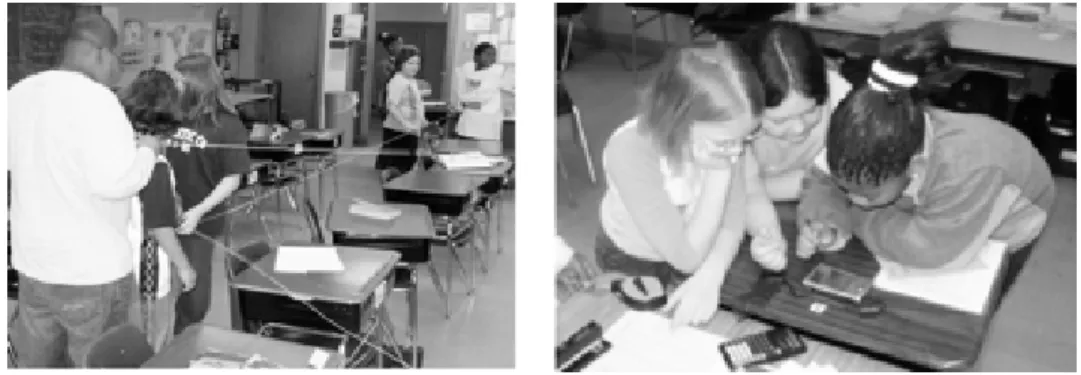
Tom Moher’s RoomQuake simulation for secondary science classrooms (Moher et al. 2005) demonstrates how collaborative learning can be conducted in classrooms by carefully reconfiguring the roles of students, teachers and technology (Figure 1.1). Using a mix of digital and non-digital materials and authentic scientific methods, students measure and analyse seismic events that are simulated within the space of the classroom. Similar simulations have been designed around various science topics under the umbrella term of Embedded Phenomena (Moher 2006).
Figure 1.1.: Children working together in a science class, using the RoomQuake application.
By encouraging the whole class to walk around in the whole room, talk and share devices in groups, and regroup opportunistically, Moher’s work proposes a different approach of using technology in schools. It is in many ways contrary to the typical school’s computer lab that offers little support for face-to-face collaboration, as it is configured more or less like a call centre, where students are largely isolated (Fig. 1.2).
1.2.2. Can shared technologies extend collaboration to the
whole classroom?
Alternative classroom set-ups have been proposed, such as the SynergyNet classroom (AlAgha et al. 2010) that capitalises on shareable technologies to encourage collaboration among students. As Figure 1.3 shows, SynergyNet features a network of multi-touch tables and interactive whiteboards to help students work together in groups, whist allowing the teacher to interact easily with the groups. Large displays provide integrated information to the teacher and the whole class. Prototypical evaluations within controlled settings have shown that such multi-surface systems can support small-group collaboration, flexible sharing between groups and the teacher’s ability to orchestrate the interaction (Higgins et al. 2011).
Figure 1.3.: SynergyNet: (a) Up to four students can collaborate at each table. (b) The teacher can monitor and control the students’ tables. (c) The table contents can be shared on a vertical screen for discussion among the whole class.
Such promising findings give rise to the question whether systems like SynergyNet will be feasible in the wild. So far they have been conducted largely in lab-based studies, providing new insights into aspects of collaborative learning. However, are such systems practically ready for large-scale adoption in schools? Hardware cost and maintainability are obvious concerns in this respect. Aggravating factors include potential problems of legibility and coordination at each tabletop (Morris 2005), especially when the horizontal screens are approached from different angles (Wigdor and Balakrishnan 2005). These issues are typical for tabletop systems. Further obstacles exist that are generic to classroom tools and pedagogies.
1.2.3. Realistic demands on the teacher
When teachers ponder the adoption of new technologies in classroom, they are confronted with realistic questions about resources feasibility. For example, would the planned activity require the teacher to:
• set up a server, network or other advanced computing infrastructure?
• use any non-standard hardware or software?
• install new software on school computers?
• learn new ICT skills?
• obtain or produce any physical or digital materials?
• assist students with using the interface of an application?
• prepare the room for the activity?
• etc.
If the answer to any of those questions is yes - as is the case with many prototypical designs for whole-classroom collaboration, including participatory simulations (Wilensky and Stroup 1999; Colella 2000) and Embedded Phenomena (Moher 2006) - then there may be significant implications for time demand, logistical effort, getting permissions, etc. The sum of such barriers can make an activity less feasible in the wild and potentially hamper its progression from prototype stage into large-scale use.
1.3. Research questions and aims
The goal of this thesis is to determine how practically feasible forms of whole-classroom activity can be supported by combining shareable technologies with simulation, team play and orchestration. To address this, the following research questions are asked:
Q1. How can whole-classroom activities be designed that use shared technology to facilitate large groups’ problem solving and debate in a face-to-face setting?
Q2. What factors are instrumental in orchestrating such activities in the wild?
Q3. What abstractions can we identify that would form a helpful conceptual framework for activity design and orchestration?
Q4. Can this framework generally support the design of sustainable classroom activities?
The two overarching aims of this dissertation are:
1. to investigate new ways of promoting large-groups’ collaborative learning, by design-ing and evaluatdesign-ing classroom-scale activities. The focus is on enabldesign-ing, encouragdesign-ing and facilitating joint exploration of problem spaces, debate and reflection.
2. to devise and validate a generalisable framework that can guide future design, orchestration and evaluation of whole-class collaborative activities.
1.4. Approach
The research questions were addressed through an iterative approach, including the development and validation of a conceptual framework (Fig. 1.4). The first study addressed Q1 by exploring how shareable technologies can support collaborative learning goals in a whole-class simulation (blue). Professional training workshops were chosen as a setting for this initial study, to allow multiple consecutive deployments in real situations. This is where Q2 was addressed. The findings led to the formulation of a conceptual framework to guide the design, orchestration and evaluation of similar whole-class activities, in response to Q3. This framework was tested and refined in two further studies (green) to evaluate whether teachers and researchers find the framework useful, and to test how sustainable the approach is in restricted settings. These final studies addressed Q4 and provided additional support for Q1, Q2 and Q3.
1.4.1. Dealing with constraints: Towards feasibility in the wild
In preparation to the main studies, a literature was conducted to identify (a) what factors have so far hampered advancement of collaborative pedagogies in classroom settings, and (b) where potential exists for technology to improve the situation.
A variety of relevant obstacles were revealed through the literature review, including practi-cal, theoretipracti-cal, cultural, politipracti-cal, economic and organisational factors. Classroom-typical constraints include time, assessment, curriculum, energy, space and safety (Dillenbourg and Jermann 2010). Collaborative tools and activities, in order to be practically feasibil-ity, must be flexible enough for the average teacher to use within these constraints in real time Dillenbourg et al. (2012).
The review further revealed potential for design in the areas of shared interfaces, team-based role play, and an integrated pedagogy involving traditional lecture, simulation and discussion.
1.4.2. Understanding classroom needs by aiming for adoption
This PhD project identifies with a contemporary movement in Technology-Enhanced Learning (TEL) that has aimed to create tools that are feasible in the wild, i.e., outside experimental settings:
“Many innovators [. . . ] want to move beyond doing good science that merely promises later application; [they] now find educational needs (and not just related scientific problems) to be truly motivating and want to create materials and tools with impacts that can be realized in their lifetimes in practical educational settings at scale.” (Roschelle
et al. 2013)
“[. . . ] reflects a rethinking of the relationship between research and practice, seeking ways to design learning tools so that they are theoretically motivated, practically usable and useful, and designed for the realistic classroom contingencies that require flexible adaptations by teachers.” (Dillenbourg et al. 2012)
For instance, Tom Moher’s research group, having published extensively in learning sci-ences as well as Human-Computer Interaction (Moher 2006; Moher et al. 2010), has gone to considerable trouble to make their RoomQuake classroom simulation accessible to teach-ers everywhere. This included the software as well as detailed instructions for teachteach-ers that were carefully prepared and offered for download: http://dkilb8.wix.com/roomquake
(Accessed on 14 April 2011.) These materials demonstrate a sincere commitment to en-gaging with teachers’ needs on all levels, taking the very mundane technical and logistical details as seriously as the high-level pedagogical intentions. Several PhD students in the group are currently dedicated to making Embedded Phenomena more accessible to the public.
1.4.3. Transfer from professional training to classrooms
The conceptual framework was initially developed in professional training settings and later transferred to school settings where it was refined. The motivation for doing it in this order, rather than the other way round, is detailed in the methodology (Chapter 3). It can be summarised as follows:
Firstly, professional training settings are supported by a wealth of previous literature in the area of simulation-based and team-based learning. Being able to build on well-established assumptions and “good practices” in this area promised to be a good starting point.
Secondly, the chosen professional training setting enabled a more “agile” and exploratory approach to activity design than is normally possible in a school setting. Key benefits included plenty of preparation time, multiple evaluations per year and a fundamental, organisation-wide commitment to collaborative learning. These benefits would allow the design to focus on participants’ essential learning experience, rather than peripheral restrictions.
Thirdly, demographics played an important role in the choice of settings. Participants in the first study were mature and likely to be already skilled in collaborative working. To gradually explore the boundaries of the CLOVER approach with regard to demographics, the second study involved pre-university students and the third study involved children with learning difficulties.
To summarise, the main reasons concerned the available literature as well as methodolog-ical considerations. In both respects, the transition to school settings implied an increase of difficulty, due to (a) less previous work to build on and (b) a stricter set of practical constraints. Hence, the second and third study can be seen as more ambitious than the first study - for the above reasons and also because the latter studies aimed to create, not just afeasible but a sustainable approach (see Figure 1.5 further below).
1.4.4. Designing for sustainability
The research strategy was to evaluate the designed activities by conducting themrepeatedly
in real settings. In contrast to the common practice of one-off evaluation (e.g. Moher et al. 2005), this strategy goes beyond testing the usability, usefulness and desirability of a pedagogical approach; it furthermore aims to test its sustainability. To be considered sustainable, an approach needs to have the potential for sustained use under everyday conditions, i.e., requiring only the amount of commitment that a teacher is ready to summon up on a regular basis. This amount is assumed to be less than the special efforts that teachers may be willing to make at the special occasion of a scientific experiment involving some exciting new technology.
The goal of sustainability imposes an additional layer of rigour on the test conditions. Particularly, the observation that an approach “worked well” once under the guidance of researchers is not enough. Rather, there should be evidence of teachers (or institutions) being able to apply the approach repeatedly on their own, under everyday conditions.
The total effort a teacher may invest (preparation work, time to provide feedback, etc) is limited. If we design for heroes, we lose scalability (there are few heroes) and sustainability (heroes get tired). (Dillenbourg et al. 2012)
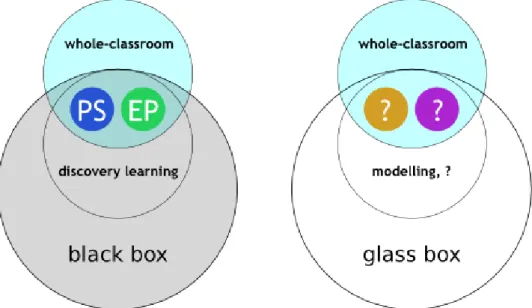
A distinction is made between sustainability andadoption (i.e. actual sustained use), since the latter may depend on further constraints, such as institutional strategy, politics and management. Figure 1.5 illustrates these concepts as a hierarchy, whereby the concepts near the bottom represent requirements for those further above.
1.5. Thesis outcomes
This dissertation proposes a new approach to engaging a whole class in joint problem solving and debate. It describes how to design whole-class, face-to-face activities that any teacher can set up within a few minutes and facilitate independently of external help (particularly that of researchers). This is achieved by the following main outcomes:
1. Three case studies demonstrating the feasibility and sustainability of the approach; 2. The Collaborative Learning Orchestration for Verbal Engagement and Reflection
(CLOVER) conceptual framework that was developed and validated as a result of these studies.
While the case studies contribute empirical knowledge regarding what works and what doesn’t in the wild, the framework comprises a set of abstractions (conceptual tools and recommendations) to make this knowledge accessible in new design situations. Particu-larly, CLOVER aims to support the design and evaluation of large-group, collaborative activities for use in any “classroom-like” setting, including school classrooms, university seminars and professional training workshops.
The proposed approach aims to be generally applicable to a broad range of pedagogical contexts, topics and learner populations. The three empirical studies illustrate this range.
1. The 4Decades simulation of future climate change that adult participants can critique and modify in situ;
2. The UniPad simulation for pre-university students that any teacher can rapidly set up and orchestrate within the last 15-25 minutes of a lesson;
3. The ComfyBirds whole-classroom activity to support reading comprehension by discussing ambiguous words in joking riddles.
All three applications were shown to encourage remarkable instances of collaborative learning - including joint problem solving, critical debate and peer teaching - thus enabling participants to instantly apply theory in practice. This is achieved through six core design principles that emerged from the iterative process.
• Practical choices of available technology: shared tablets and projectors;
• Simple tablet interfaces that do not require assistance or time to learn;
• Fluid constraints on group interaction via familiar social mechanisms, such as sharing, team play and social comparison;
• Appropriate interaction techniques to limit the teacher’s workload during the activity;
• Browser-based client software that is platform independent and easy to access - no native software installation or special hardware required.
The success of these applications and the shown generalisability of CLOVER indicate wider potential for future design in many areas of formal education and informal learning.
1.6. Definitions
This dissertation relies on a number of key concepts which are defined below.
1.6.1. Classroom
The word “classroom” is used here in an overarching sense, referring to any co-located situation where “a person (teacher, teaching assistant, parent, workplace supervisor, etc.) has the responsibility to bring other persons to reach learning goals” (Dillenbourg et al. 2011). This definition includes the typical school classroom as well as many professional training settings and university seminars. Furthermore, the studies described here emphasise large-group settings, with typically 20 to 30 learners per teacher, as is common for schools in the UK and North America (Blatchford et al. 2011).
1.6.2. Students / Learners / Participants
The words “student” and “participant” are used interchangeably in this dissertation. Strictly speaking, it would be most accurate to use “participant” throughout, since the focus of analysis in all studies was people’s participation in learning activities. The pedagogical approach described here does not distinguish as to whether participants have formal student status, whether they are in higher education, employment, and so on. Indeed, it is based on studies that have considered pre-university students (Kreitmayer et al. 2013b) as well as adults in professional and postgraduate training (Kreitmayer et al. 2012) and children in special education (Yuill et al. 2014). Sometimes I say “student” rather than “participant” simply to avoid repetition or to emphasise aspects that concern an individual (or group) at a wider scope, beyond a specific learning activity.
Similarly, the word “learner” appears occasionally when “student” would sound too specific. This is the case, e.g., when discussing learning theories that are framed more universally and not limited to the context of formal education (e.g. Vygotsky 1978; Lave and Wenger 1991; Stahl 2006). This wider notion ofpeople engaged in learning is useful sometimes, since it includes students, professionals and others. However, on the flipside there is a high risk of ambiguity, since the “learner” label theoretically applies to any living person. To avoid confusion between participants’ learning and what researchers, designers and teachers learned in the context of the studies, this dissertation mostly uses the word “learner” sparingly and only when the meaning is unambiguous.
1.6.3. Orchestration
The term “orchestration” has emerged in the wider context of classroom research as a metaphor for good instructional design and lesson enactment in real classrooms (Looi and Toh 2014). Research under this label is characterised by an analytical focus on the classroom as a whole - rather than, e.g., mental processes of the individual learner, and being amenable to the complexities entailed by collaboration and interactive technologies. Dillenbourg et al. (2011) speak of classroom orchestration as “a question of usability in which the classroom is the user”.
1.6.4. Classroom activity
The research focus of this thesis is on face-to-face activities that aim to engage a whole class simultaneously. This excludes activities that are predominantly remote, screen based and/or asynchronous, such as homework, virtual learning environments (VLEs), single-user games and virtual worlds.
1.6.5. Teaching
Teaching is conceptualised here essentially as learning facilitation within a co-located lesson, by integrating collaborative activities effectively with lectures. Two fundamental assumptions underlie all of the studies described here:
1. People tend to learn better when given the opportunity to apply their knowledge in practice, for instance through argumentation (Jonassen and Kim 2010) or problem solving (Gardner 1991; Gee 2003).
2. People can practice more effectively if some instrumental background knowledge has been established previously, e.g., through introductory lectures (Silvia 2012). Engaging collaboratively with specific problems through discussion and shared problem solving was defined as the primary learning objective for participants. Helping them achieve this was seen as the overall goal of design and orchestration.
1.6.6. Simulation
A simulation is any attempt to mimic a real or imaginary environment or system (Rieber 1996).
In adult education, role-play and simulations are commonly used across fields as diverse as medicine (Fanning and Gaba 2007), business (Faria et al. 2009) international relations (Morgan 2003), aviation, military, crisis management and many others. Simulations can be useful teaching tools because they allow real problem solving and collaboration in safe (simulated) environments. For this purpose, numerous simulations are available as products that can be bought or hired. Some offers include specially trained facilitators travelling to the training site.
By contrast, in school classrooms simulations are the exception. To explore possible reasons and remedies, this dissertation reviews a variety of approaches, learning goals and practical challenges in both school and adult education.
1.6.7. Models, simulations and games
Eykhoff (1974) defines a model as “a representation of the essential aspects of an existing system (or a system to be constructed) which presents knowledge of that system in usable form”. By emphasising “the essential aspects”, this definition implies that a model is always a reduced version of the real thing.
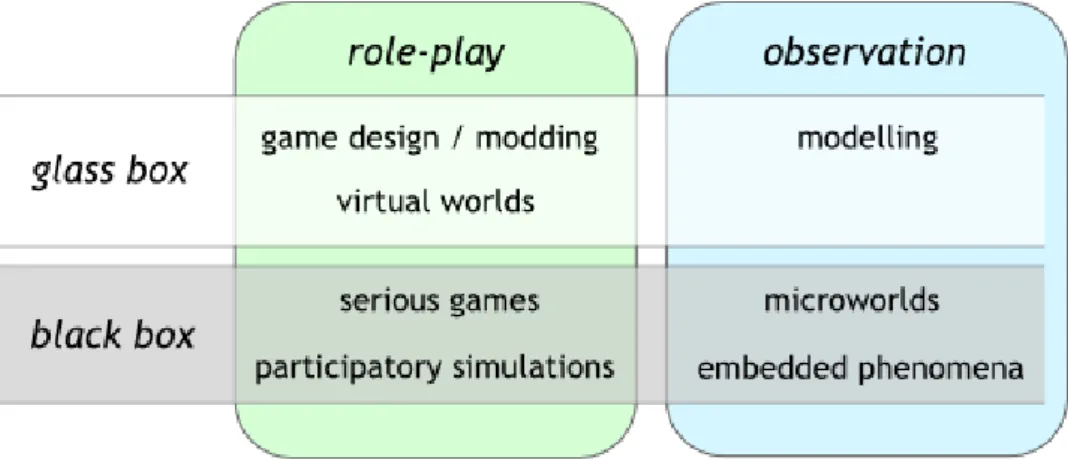
Whereas a model can be represented in a static form, e.g., mathematical equations or source code, a simulation can be thought of as the execution of a model over time. The execution may be interactive or non-interactive (such as, e.g., an animated weather map). If a simulation involves human interaction and a winning condition then it can also be referred to as a gameby common definitions (Juul 2003) - regardless of the notion that some games are not simulations. These concepts are illustrated in Figure 1.6.
1.7. Thesis Structure
Chapter 2 is the literature review and Chapter 3 explains the methodology. Chapter 4 addresses the first research question based on iterative prototyping in the lab. Chapters 5-7 cover the in-situ evaluations of 4Decades. The resulting framework is presented and validated in Chapters 8 and 9. The last two chapters are discussion and conclusion.
Chapter 4: Designing a participatory simulation on climate change. This chapter details the iterative design of the 4Decades simulation for use in professional training courses. The design process is described, involving several sketches, prototypes and lab tests.
Chapters 5-7: In-situ evaluation of the climate simulation. Three chapters are dedicated to the in-situ evaluation of the 4Decades simulation in professional training workshops. Three stages of qualitative analysis were conducted in order to (1) verify the overall feasibility of the approach, (2) explore potential for groups to make informed changes to the simulation and (3) examine the impact of spatial configurations (of peers and technology) on equitable participation among the group.
Chapter 8: Developing a conceptual framework. This chapter introduces the Collaborative Learning Orchestration for Verbal Engagement and Reflection (CLOVER) framework. It emerged out of the 4Decades empirical studies and aims to provide a suite of useful abstractions (conceptual tools and recommendations) to inform future design, orchestration and evaluation.
Chapter 9: Validating the framework in the wild. This chapter describes two more studies that provide empirical support for the usability and usefulness of CLOVER different design situations where the aim was sustainable use in classrooms. The first study was a new design from scratch - the UniPad finance simulation. The second study involved a different design challenge whereby an existing desktop application was transformed into the ComfyBirds whole-class activity.
Chapter 10: Discussion. This chapter discusses the overall research findings within the context of the literature.
Chapter 11: Conclusions and future work. This chapter summarises the research contributions, considers limitations of this research, discusses work in progress and suggests perspectives for future research.
Literature Review
2.1. Introduction
The work described in this dissertation is grounded in multiple threads of related research. Besides foundational theories of learning, the main influences came from the following three areas of applied research:
• research on learning with simulations and games, including computer simulations
• the field of Computer-Supported Collaborative Learning (CSCL)
• the field of Human-Computer Interaction (HCI)
Each of these fields bears a range of theories, research methods and empirical work relevant to the design, orchestration and evaluation of classroom-scale, face-to-face collaboration. Relevant insights from each of these fields are discussed in this chapter.
2.1.1. Aims of this chapter
The aims of this chapter are:
• to survey common assumptions regarding how simulations and collaboration can support learning and teaching;
• to identify which of these assumptions are potentially relevant to classroom contexts;
• to devise a well-informed pedagogical approach for classrooms based on these assumptions;
• to review previous classroom-based approaches that involve simulation and collabo-ration and evaluate those approaches in regard to their feasibility and sustainability in typical, classroom-type settings;
• to highlight research and design challenges, practical obstacles, pitfalls, good prac-tices and promising strategies;
• to devise useful starting points for instructional design, interaction design, interface design and evaluation of simulation-based, whole-classroom collaboration.
2.1.2. Overall strategy
To approach these aims, four main fields of literature were investigated: (1) general theories of human learning, (2) learning with simulations, including computer simulations and games, (3) computer-supported collaborative learning and (4) human-computer interaction.
Figure 2.1 illustrates these four fields and foreshadows the sequence in which they will be introduced in this chapter. This sequence is supported by a series of key questions that are associated with these areas. The logical order of these questions describes an overall transition from abstract (theoretical) to concrete (practical) considerations. Indeed, this is a deliberate strategy, guided by the overarching goal of this dissertation to devise practical solutions that are grounded in theory. Starting with theoretical foundations of learning, the discussion will continue to address practical aspects of teaching (involving simulations and collaboration) and eventually go into detail regarding design and technology.
Figure 2.1.: Overview of the four parts of the literature review (Sections 2.2 - 2.5 in this chapter)
2.1.3. Chapter structure
Following the above logic, the remainder of this chapter is sectioned into four main parts, each focussing on one of the research areas:
• Part 1: Learning theories (Section 2.2)
• Part 2: Simulation-based learning (Section 2.3)
• Part 3: Computer-supported collaborative learning (Section 2.4)
• Part 4: Human-computer interaction (Section 2.5)
Each of these sections finishes with a set of preliminary conclusions that are summarised in the final conclusion section at the end of this chapter.
Needless to say, the fields are densely interrelated, rather than cut and dried. Consequently, some of the key guiding questions relate to more than one field and it is only realistic that the review will make many cross-references.
Part 1: Theories of learning (Section 2.2)This section sets the scene by introducing some general theories of “active” learning, based on research in education and cognitive science. The main ideas are (a) Bloom’s distinction between “higher level” and “lower level” learning objectives and (b) a variety of constructivist learning models, including Kolb’s experiential learning cycle and collaborative learning theories.
Part 2: Simulation-based learning (Section 2.3)The second part focuses on the use of simulations to support learning goals, such as engagement, conceptual understanding, productive discourse, skill development and literacy. Common assumptions about these learning goals are discussed in relation to classroom settings, resulting in a tentative proposal for how to effectively integrate traditional lectures, simulation and discussion in the context of a lesson or seminar. The proposal is formulated as a generic model to help instructors link together the benefits of each component (e.g., the benefit of simulations to trigger productive discourse). It does, however, not provide any concrete explanations about how these benefits can be achieved, e.g., how to design a simulation that can engage a whole classroom, what kinds of technology are appropriate or how to go about facilitation and debriefing.
Part 3: Computer-supported collaborative learning (Section 2.4) In the third part of the review, the CSCL literature is consulted to explore more concretely how the proposed approach can be realised in actual classrooms. Focusing on aspects of orchestration, this part of the review investigates what the specific capacities of technology
and a single human teacher are in managing large-group collaborative learning under real-life classroom conditions. Selected approaches are discussed critically, leading to a number of tentative conclusions regarding how design can effectively reduce the teacher’s orchestration load, rather than making things more complicated. The result is a clearer picture of what the roles of the teacher and technology should be and how they can complement each other. However, questions remain as to which technologies to use and how to design activities and interfaces. These questions are addressed in the next section.
Part 4: Human-Computer Interaction (Section 2.5) The fourth and final part takes a step back from the education-centred tradition of CSCL and assumes a more generic, HCI-centred perspective, focusing on how groups of people can engage with peers and technology. Relevant studies are revisited with regard to choices of technology, social mechanisms and interaction types. The goal is to explore potential for more engaging, portable and scalable designs. One of the main conclusions from this section is that am-bient displays and shareable touch-screens bear much potential for innovative interaction design, by allowing participants to walk around and interact opportunistically with the technology and peers. Tentative design recommendations are outlined regarding how to effectively constrain information, control and awareness to support fluid collaboration in the whole group.
Summary and conclusion (Section 2.6) summarises the conclusions from the previ-ous sections, resulting in a set of working assumptions that provide the foundation for the design-based research studies reported in the subsequent chapters.
2.2. Part one: Theories of learning
There are many theories of learning. The ones discussed here have been selected due to their significance to this work. All of them emphasise “active” learning and some focus specifically on collaboration.
2.2.1. Higher level learning: Bloom’s taxonomy
Bloom’s well-known “taxonomy of educational objectives” (1956) proposes a hierarchy of six categories to describe a comprehensive spectrum of educational goals: (1) Knowledge, (2) Comprehension, (3) Application, (4) Analysis, (5) Synthesis and (6) Evaluation. Bloom refers to the first two categories (1) and (2) are as “lower level”, and (3-6) as “higher level” learning objectives.
This model has been widely cited and translated. According to Krathwohl (2002), it deserves credit for directing awareness to a wider range of learning objectives in a landscape of formal education that had previously been (and arguably still is) overly focused on the lower levels.
2.2.1.1. The revised version of Bloom’s taxonomy
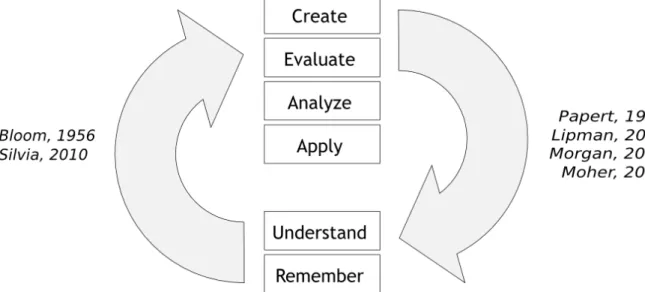
The revised version of the taxonomy differs in significant ways. Most strikingly, the names of the six categories were changed from nouns to verbs (e.g., “knowledge” was changed to “remember”; “comprehension” was changed to “understand”, and so on). Moreover, the two highest categories were swapped and renamed, and a second dimension was added to differentiate between different types of knowledge: factual, conceptual, procedural and metacognitive (Figure 2.2).
Several aspects of the original taxonomy have been criticised and were changed as part of the revision. Most significantly, Bloom’s original claim that each category requires each lower category was somewhat relaxed in the revised version due to (a) lack of empirical support and (b) the concession that teaching practices may vary. To paraphrase Krathwohl (2002), while the six categories on the whole describe a spectrum from simpler to more complex cognitive processes, there is much overlap and ambiguity between some of the categories, especially neighbouring ones. Indeed, two neighbouring categories were swapped in the revised version, which further indicates that the hierarchical dependencies are really not as clear and strict as originally postulated.
Figure 2.2.: The revised version of Bloom’s taxonomy (Krathwohl 2002)
Despite these modifications, the general distinction betweenlower level and higher level
cognitive processes was preserved in the revised version and has been widely accepted among scholars. This dichotomy has appeared in various flavours across the literature, such as rote learning versusmeaningful learning (Mayer 2002) or content learning versus
higher-level learning (Fellenz 2004). These are essentially synonyms or variants with slightly different connotations. Many authors agree that the higher level objectives are important goals of education (Krathwohl 2002). However, there is much debate regarding how to apply the taxonomy in pedagogical practice - for instance, whether instruction should first focus on the lower levels before addressing the higher levels, or vice versa (Wegerif 2006).
Although Bloom’s taxonomy is not in itself specific to collaborative learning, some of its key ideas are still being discussed in collaborative learning research (e.g. Wegerif 2006; Echeverría et al. 2011). From within this discourse, this dissertation adopts two key assumptions:
1. It is useful to distinguish between high and low level learning.
2. Some teaching methods tend to support the high-level cognitive processes better than others. For instance, active learning techniques (such as simulations) are well suited to the higher levels, whereas lectures and reading assignments may be preferable for supporting the lower levels (Silvia 2012).
2.2.1.2. Challenging the taxonomy’s directionality
Bloom’s proposition that any idea must be sufficiently understood in order to be applied productively (Bloom and Krathwohl 1956) is plausible at least to the extent that deficits in low-level knowledge and comprehension are likely to propagate into the higher level processes, e.g., learners applying ideas incorrectly or not knowing how to apply them (or to analyse, evaluate, create, respectively). This seems plausible for all of the knowledge types considered in the revised taxonomy (factual, conceptual, procedural and metacognitive) and thus supports the suggestion that lectures should precede active learning, such as simulations (Silvia 2012).
This argument seems to contradict the popular stance that learning should start with hands-on exploration (Papert and Harel 1991a; Lipman 2003) and that active learning (e.g., using simulations) is useful in the service of - among other things - the lower-level learning objectives, i.e., comprehension (Moher 2006; Keller et al. 2007) and retention (Morgan 2003). Indeed, both positions have been supported in empirical studies with simulation-based teaching in formal education. This suggests that lower and higher level learning can mutually benefit each other (Figure 2.3).
Figure 2.3.: Lower-level learning supports higher-level learning, and vice versa.
2.2.1.3. A circular interpretation
Considering the strong empirical evidence for active learning to support lower-level objectives (Morgan 2003; Moher 2006; Keller et al. 2007), must we dismiss Bloom’s
opposing view, or can the two be somehow reconciled? The following paragraphs make an attempt to resolve the apparent conflict.
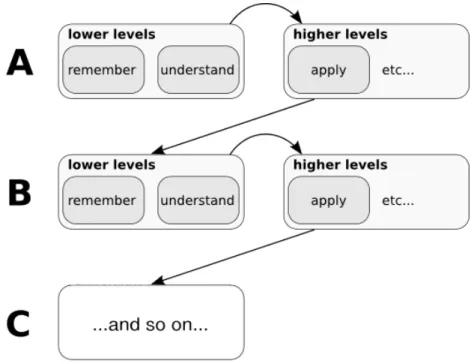
Arguably, Bloom’s learning hierarchy applies to how a learner processes an individual
piece of knowledge (a single fact, concept, etc.), whereas support for the opposite position comes from learners engaging withnetworks of knowledge, such as complex simulations. In the latter context it is plausible that having successfully applied one idea will help a learner grasprelated aspects more easily. Therefore, perhaps the above diagram should be revised as shown in Figure 2.4 - with A and B representing either two related ideas (facts, processes, etc.) or two related aspects of the same idea:
Figure 2.4.: An iterative variation of the above model, emphasising that applying one idea (A) helps learners understand a related idea (B).
This interpretation resolves the ostensible conflict and explains the success of active learning techniques for exploring complex knowledge networks, such as simulations (see Section 2.3.1.3). Furthermore, it supports a pedagogical approach of exploring knowledge domains in a cyclical fashion, by alternating between lower and higher level cognitive processes. This interpretation reconciles Bloom’s key idea with other models of learning that stress the importance of iteration. This includes Kolb’s experiential learning cycle (see Section 2.2.2.2 further below), which is a constructivist model and has explicit relevance to simulation-based learning research. This and other constructivist perspectives - including collaborative learning - are discussed below.
2.2.2. Constructivist theories
Constructivist theories have been instrumental to much significant research in active, collaborative and inquiry-based learning. In contrast to Bloom’s taxonomy, which essentially derives from an analysis of practice in the formal education system, the following theories are mostly grounded in developmental psychology and cognitive science.
2.2.2.1. Overview
Based on the general hypothesis that knowledge and meaning are generated through experience with the world and other people, a number of ideas have been formulated that are fundamental to many contemporary approaches. These ideas include
• the idea that humans learn through experience and reflection on experience (Dewey 1933);
• the “zone of proximal development”, i.e., the difference between what learners can achieve in a collaborative situation versus on their own (Vygotsky 1978);
• “Internalisation”, i.e., social speech being transformed into inner speech (Vygotsky 1978);
• “Scaffolding” (Bruner 2009), i.e., contingent instruction, whereby a tutor gradually removes support in response to a learner becoming more autonomous. The premise is that responsibility for learning starts with the tutor and shifts gradually and at the right pace to the learner;
• Piaget’s (1969) view that social interaction provides a catalyst for individual change. Taking different angles on these basic ideas, a variety of approaches have focused specifi-cally on collaboration as a way of learning. Three foundational theoretical positions were reviewed by Dillenbourg et al. (1996): socio-constructivist, socio-cultural and shared (or distributed) cognition. This list overlaps to some extent with the list that Stahl (2006) identified more recently, namely neo-Piagetian conflict theory, cultural-historical activity theory, social practice theory, Deweyan trans-actional inquiry and Bakhtinian dialogicality theory.
Although neither of these lists should be seen as definitive or exhaustive - even the labels may vary across discourses - together they provide a useful, rough overview of relevant movements in the context of CSCL. The list could be expanded with newer constructivist
concepts that emphasise peer dialogue, such as group cognition (Stahl 2006) and the social brain (Mercer 2013).
Constructivism is commonly contrasted with a prevalent stance in formal education that Jonassen (1991) calls “objectivism”. Similarly, constructivist teaching methods (e.g. discovery-based, problem-based, experiential or inquiry-based) are seen as contrary to “direct instruction” (Kirschner et al. 2006). The term instructionism was proposed by Papert to distinguish traditional teaching from his pedagogy ofconstructionism, which is based on constructivist principles (Papert and Harel 1991b).
2.2.2.2. Experiential learning: Kolb’s learning cycle
Kolb and Others (1984) conceptualises learning as a repeated cycle consisting of four parts: concrete experience, reflective observation, abstract conceptualisation and active experimentation (Figure 2.5).
The model has gained much popularity in many areas of instructional practice. A Google image search for “Kolb cycle” colourfully illustrates this through countless examples of the model being adapted and reinterpreted in different contexts. Its emphasis on active learning has made Kolb’s model one of the most frequently used models in the academic discourse on game-based and simulation-based learning, along with activity theory (Kuutti 1996) and constructivist theories (De Freitas and Oliver 2006; Lainema 2009).
Kolb’s model has a certain pragmatic vibe to it. More so than Bloom’s taxonomy, it proposes a specific rhythm in which to go about structuring learning-centred activities. Various flavours of the model can be found in guidelines and descriptions of professional practice today. Remarkably, this is not limited to purely instructional practice, such as professional training, but also includes design and engineering approaches that consider reflection and sense-making as instrumental parts of productive work.
It is worth noting that the cognitive process categories (i.e., plan, do, reflect, conceptualise) have been applied to individuals as well as to synchronised teams (Kayes et al. 2005). This emphasises the notion that groups can, to some extent, think and act collectively -quasi as a single cognitive agent engaged in a defined process of learning and productivity. Lainema (2009) identified experiential learning as one of the most influential approaches in the (somewhat industry-oriented) simulation and gaming literature.
Complementary to this top-down perspective on constructivist learning are other con-structivist theories that focus on the complex, micro-level details of social interaction with peers and / or the mediating role of teachers and technology.
2.2.2.3. Learning through conflict and argumentation
Particularly relevant to CSCL are constructivists theories that emphasise the role of explicit verbal interaction between learners, and particularly the role of argumentation. Relevant psychological perspectives were reviewed by Nussbaum (2008), particularly sociocognitive conflict theory and cognitive elaboration theory. Nussbaum concludes that engaging in collaborative discourse and argumentation might have long-term effects in consolidating concrete learning gains. Jonassen and Kim (2010) agree with this view and further emphasise the general importance of argumentation as a problem-solving skill. Much research has been concerned with assessing argumentation-based learning. Two broad categories are:
1. measuring the effects of argumentation on content retention and understanding, using pre and post tests;
2. assessing the quality of the constructed arguments themselves, e.g., how accurately students support their claims with evidence. A range of computer-supported methods have been proposed (Jonassen and Kim 2010). However, these methods require time-consuming post-hoc analysis of written arguments, making them impractical for daily teaching. There is a lack of formal methods for quickly assessing spoken, face-to-face argumentation on the fly, especially with regard to large groups.
2.2.2.4. Constructivism and teacher guidance
Although constructivism is a widely accepted stance among learning scholars, there are also critical voices. For instance, Kirschner et al. (2006) argue that discovery-based, problem-based, experiential, inquiry-based and constructivist teaching methods imply (quasi by definition) that students are given insufficient guidance, which necessarily results in inefficient learning. It is an ambitious claim that suffers - among other things - from an essential lack of clarity about what “guidance” entails. Short of a precise definition, the word appears in various meanings, including prior information and scaffolding during a task.
The apparent need for clarification in this matter is addressed in Dillenbourg and Jermann’s (2010) comprehensive account of a teacher’s guiding functions during classroom orchestration. The insinuation that active and collaborative learning are necessarily unguided, is strongly refuted by these authors. Nevertheless, the question whether teachers are generally able to deliver the appropriate kind and amount of guidance is still a legitimate concern, especially in the face of large group sizes, divided groups and real-world contingencies.
Another common criticism made against constructivist learning is that direct instruction is more time efficient. This argument, on the one hand, boils down to the uncontroversial observation that working out solutions tends to take more time than simply reading or being told the answers. On the other hand, proponents of direct instruction (including Kirschner et al., 2006) typically focus on lower-level learning, i.e., recall and comprehen-sion, whilst disregarding higher-level learning gains as either irrelevant or impractical to measure.
2.3. Part two: Simulation-based learning
Simulations and role play have been used for teaching in many areas of education and training. Common reasons to use simulations instead of real settings involve cost, danger, inaccessibility and time (Rieber 1996).
The enormous variety of instructional goals, challenges, techniques, settings and learner populations is reflected in a diverse research landscape, with contributions from psychology, cognitive science, cultural studies, sociology, computing, economics, political science, education, and other disciplines. Several decades of research have produced knowledge that is potentially relevant to new designs, practice and research.
This section investigates pedagogical approaches based on collaborative simulations. Many of the cited studies follow a tradition of research and practice that is driven by concrete educational needs, rather than technical innovations or interfaces. Hence, the majority of best-practice knowledge in this area is predicated on old-school PC applications and non-digital (face-to-face) teaching of the kind that receives little attention in the contemporary HCI/CSCL literature.
However, the strong relevance of some of the work in this field to authentic professional practice is rarely found in HCI/CSCL studies. Therefore, one can find much potential for new insights by drawing new connections between these fields. This section surveys a number of common assumptions and approaches in simulation-based learning. A selection of these constitute the foundation for a newly devised pedagogical approach that is grounded in theory and applicable across topics and learner groups.
2.3.1. Common assumptions
There exists a wide range of assumptions regarding effective learning and teaching via role-play and computer simulations. Some of the most relevant assumptions are summarised in the table below (Table 2.1).