NAIST-IS-DD0761015
Doctoral Dissertation
Graph-Theoretic Approaches to
Minimally-Supervised Natural Language Learning
Mamoru Komachi
March 17, 2010
Department of Information Processing Graduate School of Information Science Nara Institute of Science and Technology
A Doctoral Dissertation
submitted to Graduate School of Information Science, Nara Institute of Science and Technology
in partial fulfillment of the requirements for the degree of Doctor of ENGINEERING
Mamoru Komachi Thesis Committee:
Professor Yuji Matsumoto (Supervisor) Professor Hiroyuki Seki (Co-supervisor) Associate Professor Kentaro Inui (Co-supervisor) Assistant Professor Masashi Shimbo (Co-supervisor)
Graph-Theoretic Approaches to
Minimally-Supervised Natural Language Learning
∗Mamoru Komachi
Abstract
Bootstrapping is a minimally supervised machine learning algorithm used in natural language processing (NLP) to reduce the cost of human annotation. It starts from a small set of seed instances (e.g., (cat, animal) for learning is-a relation) to extract context patterns (e.g., “X such as Y”) from a corpus. The extracted patterns are used to extract other target instances which co-occur with the patterns, and the extracted instances are then used for inducing other context patterns. By applying these steps iteratively, one can easily multiply the number of seed instances with minimal human annotation cost. The idea of bootstrapping has been adopted to many NLP tasks such as relation extrac-tion and named entity recogniextrac-tion. However, bootstrapping has a tendency, calledsemantic drift, to select instances unrelated to the seed instances as the iteration proceeds.
The main contribution of this thesis is to demonstrate the semantic drift of bootstrapping has the same root as the topic drift of Kleinberg’s HITS, using a simplified graph-based reformulation of bootstrapping. We confirm that two graph-based algorithms, the von Neumann kernels and the regularized Laplacian, can reduce semantic drift in various natural language processing tasks. Proposed algorithms achieve superior performance to Espresso, even though the proposed algorithms have less parameters than Espresso and are easy to calibrate.
In this thesis, we first overview bootstrapping algorithms including state-of-the-art bootstrapping algorithm called Espresso with experimental results. We show that Espresso outperforms previous bootstrapping methods, and ap-ply three modifications to the Espresso algorithm to induce a new Espresso-style algorithm called Tchai. Then we present a graph-based analysis of ∗Doctoral Dissertation, Department of Information Processing, Graduate School of Infor-mation Science, Nara Institute of Science and Technology, NAIST-IS-DD0761015, March 17, 2010.
Espresso-style bootstrapping algorithms to show the parallel between topic drift and semantic drift, and propose two graph-based algorithms. Finally, we apply the proposed algorithms to three NLP tasks: word sense disambigua-tion, bilingual dictionary construction and semantic category acquisition. Ex-perimental results show that the regularized Laplacian, one of the proposed algorithms, is comparable to Espresso, yet the former is easy to calibrate and scalable to large scale data.
Keywords:
natural language processing, bootstrapping, link analysis, semi-supervised learning
グラフ理論的観点からの
自然言語処理における弱教師あり学習
∗小町 守
内容梗概 自然言語処理におけるブートストラッピング手法は,人手による資源作成の コストを減らすための弱教師あり学習の一つである.ブートストラッピング手法 は,獲得対象となるクラス,たとえばis-a 関係の少量のインスタンス(例 (cat, animal))をシードとして与え,コーパスからインスタンスと共起するパターン (例 “X such as Y”)を抽出する.抽出された共起パターンは,そのパターンと 共起する別のインスタンスを獲得するために用いられる.このようなステップを 反復的に適用することで,人手による介入を最小限にシードインスタンスの数を 簡単に増やすことができる.ブートストラッピング手法の考え方は関係抽出や固 有表現認識などさまざまな自然言語処理のタスクに応用されている.しかしなが ら,ブートストラッピング手法には,反復が進むにつれシードインスタンスとは 無関係なインスタンスを抽出してしまう,意味ドリフトと呼ばれる傾向がある. 本研究の主な貢献は,Espresso型のブートストラッピング手法における意味 ドリフト現象が,KleinbergのHITS と同じ原因によって引き起こされているの だという事実を,グラフ理論を用いて定式化し,単純化されたブートストラッピ ング手法を用いて解析的に示したことである.また,グラフ理論に基づく2つの アルゴリズム(von Neumannカーネルと正則化ラプラシアン)が意味ドリフト の影響を軽減することを,いくつかの自然言語処理タスクによって検証した.提 案手法はEspressoより高い精度を達成し,さらに,先行研究より設定するべき パラメータ数が少ないため,調整が容易である. 本論文ではまずブートストラッピング手法について概観する.Espresso と いう最新のブートストラッピング手法について詳述し,実験的な性能を評価す る.Espressoは他のブートストラッピング手法より高い性能であることを示し, Espresso に対して3つの修正を行なうことでさらに性能が高い Tchai という Espresso型の新しいアルゴリズムを導く.そしてEspresso型のブートストラッ ピングアルゴリズムに対してグラフ理論に基づく分析を行ない,トピックドリフ ∗奈良先端科学技術大学院大学 情報科学研究科 情報処理学専攻 博士論文, NAIST-IS-DD0761015, 2010年3月17日. iiiトと意味ドリフトの関係について示し,2つのグラフに基づく手法を提案する.最 後に提案手法を3つの自然言語処理タスクに適用した結果について報告する:語 義曖昧性解消,対訳辞書構築,そして意味カテゴリ学習である.実験結果によっ て,提案手法の一つである正則化ラプラシアンはEspressoと同等の性能を持ち, 調整が簡単で,大規模データにもスケーラブルであることを示す. キーワード 自然言語処理,ブートストラッピング,リンク解析,半教師あり学習
Acknowledgements
I am especially fortunate to have been co-supervised by Dr. Patrick Pantel (Yahoo! Labs / University of Southern California). I devoted my disserta-tion to giving theoretical and empirical analysis of his famous bootstrapping algorithm, called Espresso. The work in this thesis was shaped by his great insights. I am very happy to have numerous discussions with him.
(For the rest of the acknowledgement I use Japanese to express my grati-tude.) まず修士から博士まで5年間指導してくださった松本裕治先生に感謝いたし ます.あちこちインターンシップや共同研究で飛び回っている自分に小言の一つ も言わず,自由に研究させてくださり,研究者としての幅を広げることができま した.それでも松本先生ほど懐の広い研究者になるにはまだまだかかりそうです. いつの日か松本先生のようになるのが自分の夢です. 次に博士に進学してからずっとお世話になった新保仁さんにお礼申し上げま す.毎回論文をチェックしてもらう度に真っ赤になって返ってきて,20往復くら いしてようやく投稿にこぎ着けるまで,長い道のりでしたがとても勉強になりま した.「もうこれ以上よくならないだろう」と思うところからさらに真っ赤になる ので,研究の奥深さを知りました.今後ともどうぞよろしくお願いします. また,修士論文を根気強く指導してくださった乾健太郎先生からは,自然言 語処理の研究のイロハを教えてくださいました.博士の研究にも毎回本質的なコ メントをいただき,世界トップレベルの研究をするにはどう発想するべきか学び ました.これからの自然言語処理を盛り立てていきたいと思います. そして関浩之先生はお忙しい中博士論文の審査を引き受けてくださいました. 中間審査で本研究がおもしろいと言ってくださったのが初めて分野外の人から研 究をおもしろいと言ってもらった経験であり,それがこれまで研究を続ける原動 v
力になったと言っても過言ではありません.博士論文も丁寧に見てくださり,ど うもありがとうございました. Microsoft Researchの鈴木久美さんには,世界最高峰の研究環境の中で,コ ンスタントにハイレベルな研究をするためにはどうすればいいのか,教わりまし た.初めてのアメリカ生活,研究漬けの環境もカルチャーショックでした.検索 クエリログという,生のデータを使ってみる,というところから,博士論文につ ながる研究テーマを見出すことができました.帰国してから初めての論文誌にも 投稿し,研究者として生きていけるという自信にもつながりました.研究者の卵 として接してくださって,ありがとうございます. Google の工藤拓さんには,公私ともに計り知れないほどお世話になりまし た.論文を書くというのはどのようにすればいいのか,初めて書き方を教えてく ださったときは,「こうすればいいのか!」と鳥肌が立ちました.まだまだ未熟な ので至らないところはあるかと思いますが,今後とも叱咤してくださるとありが たいです. Yahoo! JAPAN研究所の颯々野学さんは,六本木の東京ミッドタウンでの3ヶ 月間の共同研究に招いてくださり,大企業の中で研究を仕事にするというのはど ういうことかについて,丁寧に教えてくださって,とても勉強になりました.将 来どのようなキャリアを辿るか,一生でいちばん考えた時期だと思います.共同 研究を手伝ってくれた内海慶さんと牧本慎平くんにも大変感謝しています.どう もお世話になりました. NTT研究所の永田昌明さんには,修士のころから数えるとほぼ大学院生活全 部に渡ってお世話になりっぱなしで,博士の研究にストーリーを持たせることの 重要性,そして研究の作法についてたくさん教えてくださいました.どうもあり がとうございました.今後ともどうぞよろしくお願いします. ひとつの研究テーマにはなりませんでしたが,奈良先端大の支援を受けて大 規模なウェブデータを用いた統計的かな漢字変換エンジンの開発に取り組めたの は大きな経験になりました.メンターを引き受けてくださった浅原正幸助教,一 緒に議論・開発してくださった徳永拓之さん,森信介さん,アドバイスをくださっ た高岡一馬さん,中川哲治さん,どうもありがとうございました.そして,Apple Inc. でのインターンシップを通じて,いかに世界最高水準のプロダクトを作って いくか,という姿を教えてくれた木田泰夫さんにも感謝しております.シリコン バレーでの生活は,長い博士の3年間における心のオアシスでした. 松本研の卒業生の方々にもお世話になりました.山下達雄さん,高村大也さ ん,持橋大地さん,乾孝司さん,藤田篤さん,鈴木潤さん,賀沢秀人さん,飯田 龍さん,伊藤敬彦さん,小林のぞみさん,平野徹さん,鄭育昌さん,お名前を挙 げるときりがないですが,研究者としてどのようにあるべきかアドバイスをいた だいたり,励ましていただいたので,ともすれば孤独になりがちな博士の学生生 活を乗り切ることができました.どうもありがとうございます.
歴代の研究室秘書の方々,大川基子さんと北川祐子さんには,物品の購入や 出張手続きなど煩雑な処理を一手に引き受けてくださって,非常に助かりました. 特に北川さんは博士後期課程の2年目から,日本学術振興会特別研究員の手続き や研究費の処理でたくさんの仕事をお願いし,本当に頭が上がりません.研究の ことに集中できたのも,大川さんと北川さんが事務手続きに留まらず,休みの日 の過ごし方や将来のことまで親身になって相談に乗ってくださったおかげだと思 います.素敵な方々に囲まれた生活ができてとても幸せでした. 在学生の方々にも大変お世話になっていますが,特に同時に博士を取得する Eric Nichols さん,阿部修也さん,渡邉陽太郎くん,木村学くんに感謝します. ひとりだったら乗り切れなかったと思います.今年みんなで一緒に卒業できてと ても嬉しいです. そして,大学こそ違いますが,岡野原大輔くんと萩原正人さんにも感謝の気 持ちを伝えたいです.同世代でこれだけ優れた人たちと一緒に仕事ができるとい うのは,とても刺激的でした.今後とも「若手」の力を存分に発揮して,分野や 大学,そして国の壁を越えて活躍しましょう. 最後になりますが,30年間に渡る学生生活を支えてくれた両親の寛,久美江, 兄弟の順,学,進に感謝します.のんびり学生でいさせてくれたおかげで,こう やって今の自分があるのだと思います. また,妻の美由紀には遠距離恋愛・遠距離結婚でとてもつらい思いをさせて しまい,申し訳ないです.でも,奈良で一緒に生活した1年,人生でいちばん楽 しかったです.一生の宝物だと思っています.愛しているよ.またふたりで生駒 に来ようね. vii
Contents
Acknowledgements v
1 Introduction 1
2 Overview of Bootstrapping Algorithms 5
2.1. Hearst (1992) Algorithm . . . 7
2.2. Yarowsky (1995) Algorithm . . . 7
2.3. Collins and Singer (1999) Algorithm . . . 8
2.4. The Basilisk Algorithm (Thelen and Riloff 2002) . . . 8
2.5. Bilingual Bootstrapping (Li and Li 2004) . . . 8
2.6. Mutual Exclusion Bootstrapping (Curran et al. 2007) . . . 9
2.7. Sekine and Suzuki (2007) Algorithm . . . 9
3 Espresso-style Bootstrapping Algorithms 11 3.1. The Espresso Algorithm . . . 11
3.2. The Tchai Algorithm . . . 13
3.2.1 Segmentation of Query Logs . . . 13
3.2.2 Filtering Ambiguous Instances and Patterns . . . 13
3.2.3 Scaling Factor in Reliability Scores . . . 14
3.2.4 Performance Improvements . . . 15
3.3. Experiment . . . 15
3.3.1 Introduction . . . 16
3.3.2 Experimental Setup . . . 16
3.3.3 Results of the Tchai Algorithm . . . 18 ix
3.3.4 Comparison with Basilisk and Espresso . . . 20
3.3.5 Contributions of Tchai Components . . . 22
3.4. Discussion . . . 23
4 Graph-based Analysis of Espresso-style Bootstrapping Algorithms 27 4.1. Analysis of an Espresso-like Bootstrapping Algorithm . . . 28
4.1.1 Simplified Espresso . . . 28
4.1.2 Simplified Espresso as Link Analysis . . . 29
4.1.3 Convergence Process of Espresso . . . 30
4.2. Two Graph-based Algorithms to Reduce Semantic Drift . . . . 33
4.2.1 Von Neumann Kernel . . . 34
4.2.2 Regularized Laplacian Kernel . . . 35
4.2.3 Connection to Label Propagation . . . 36
4.3. Discussion . . . 40
5 Word Sense Disambiguation 41 5.1. Common Experimental Settings . . . 42
5.2. Experiment 1: Reducing Semantic Drift . . . 43
5.3. Experiment 2: WSD Benchmark Data . . . 44
5.4. Experiment 3: Sensitivity to a Different Diffusion Factor . . . . 45
5.5. Discussion . . . 46
6 Bilingual Dictionary Construction 49 6.1. Extraction of Domain Specific Bilingual Lexicon . . . 50
6.2. Experiment . . . 53
6.2.1 Corpus and Tools . . . 53
6.2.2 Preprocessing and Evaluation . . . 54
6.2.3 Bilingual Lexicon Extraction . . . 54
6.2.4 Results . . . 55
6.3. Discussion . . . 57
7 Learning Semantic Categories 59 7.1. Quetchup Algorithm . . . 61
7.1.1 Reducing Data Size . . . 62
7.1.2 Approximating Label Propagation . . . 62
7.2. Experiments with Web Search Logs . . . 63
7.2.1 Experimental Settings . . . 63
7.2.2 Results . . . 67
7.2.4 Extracted Instances and Patterns . . . 68
7.2.5 Comparison between Data Size . . . 72
7.2.6 Performance with Varying Diffusion Factor . . . 73
7.3. Discussion . . . 74
8 Conclusion 75
References 77
List of Publications 85
List of Figures
1.1 Corpus-based extraction of semantic knowledge . . . 2
1.2 Semantic drift is the central problem of bootstrapping . . . 3
2.1 Two phases of bootstrapping: pattern and instance extraction. . 6
3.1 Precision for each system: Travel . . . 20
3.2 Precision for each system: Finance . . . 21
3.3 Effect of modification to pattern extraction step . . . 24
3.4 Precision ofTchai in Travel Category . . . 24
4.1 A simple bootstrapping algorithm . . . 29
4.2 Accuracy of Simplified Espresso and Espresso . . . 33
4.3 Recall of Espresso on the instances having “bank of the river” and other senses . . . 34
4.4 Labels of seeds are propagated to unlabeled nodes. . . 37
4.5 Simple label propagation algorithm . . . 38
4.6 The Laplacian label propagation algorithm . . . 39
5.1 Excerpt from S3LS dataset for an instance ofbank . . . 42
5.2 Accuracy of the von Neumann kernels with a different diffu-sion factorα on S3LS WSD task . . . 46
5.3 Accuracy of the regularized Laplacian with a different diffusion factorα on S3LS WSD task . . . 47
LIST OF FIGURES
6.1 Overview of extraction of a bilingual lexicon of a target domain
from Wikipedia . . . 51
6.2 Bipartite graph from Wikipedia link structure . . . 52
7.1 Precision of Travel domain . . . 65
7.2 Precision of Finance domain . . . 65
7.3 Relative recall of Travel domain . . . 66
7.4 Relative recall of Finance domain . . . 66
7.5 Precision of Quetchup with various Click:Query ratio . . . 69
7.6 Recall of Quetchup with various Click:Query ratio . . . 69
7.7 Effect of corpus size to precision . . . 72
List of Tables
3.1 Algorithms for relation extraction . . . 17
3.2 Seed instances for each category . . . 18
3.3 Comparison with manual classification (10K list):Travel Category 18 3.4 Comparison with manual classification (10K list): Finance Cat-egory . . . 18
3.5 Sample of extracted instances . . . 19
3.6 Relative recall: Travel . . . 22
3.7 Relative recall: Finance . . . 22
3.8 Sample of extracted patterns for each algorithm . . . 23
5.1 Recall of predicted labels ofbank . . . 43
5.2 Accuracy of WSD algorithms . . . 44
6.1 Sample seed translation pairs . . . 55
6.2 Samples of the extracted bilingual lexicon from Wikipedia . . . 56
6.3 BLEU score for Patent Translation Task at NTCIR-7 . . . 57
7.1 Seed terms for each category . . . 63
7.2 Extracted Instances and Patterns with Top 10 Highest Scores . 70 7.3 Random samples from extracted instances . . . 71
1
Introduction
In recent years machine learning techniques have become widely used in nat-ural language processing (NLP). These techniques offer various ways to ex-ploit large corpora and are known to perform well in many tasks. However, these techniques often require tagged corpora, which are not readily available to many languages. Reducing the cost of human annotation is one of the im-portant factors for building NLP systems. Consequently, extraction of lexical knowledge from a large collection of text data with minimal supervision has been an active area of research recently.To mitigate the problem of hand-tagging resources, semi(or minimally)-supervised and unminimally)-supervised techniques have been actively studied. Auto-matic extraction of relations by exploiting recurring patterns in text was pi-oneered by Hearst (1992)[23], who describes a bootstrapping procedure for extracting words in the hyponym (is-a) relation, starting with three manually given lexico-syntactic patterns. Bootstrapping algorithms can easily multi-ply the number of tagged instances with minimal human annotation cost, by iteratively applying pattern extraction and instance extraction.
This idea of learning with a minimally supervised bootstrapping method was subsequently adopted for many tasks, including word sense disambigua-tion [61], reladisambigua-tion extracdisambigua-tion [9, 47, 42] and named entity recognidisambigua-tion [14, 20].
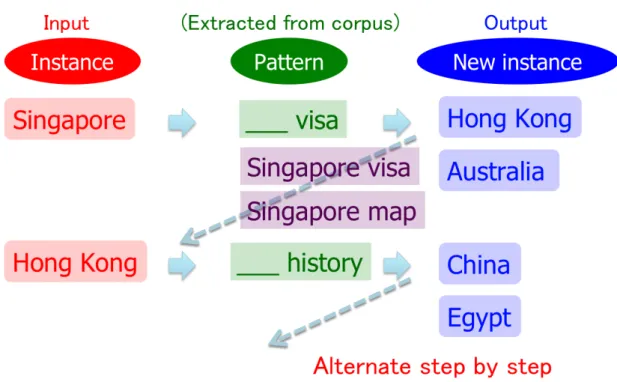
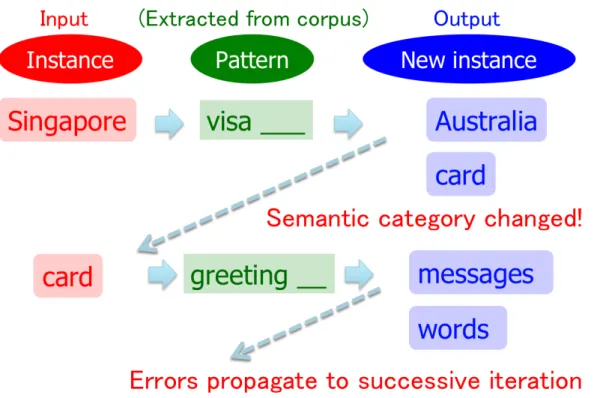
However, it is known that bootstrapping often acquires instances not re-lated to seed instances. For example, consider the task of collecting the names of common tourist sites from web corpora. Given words like “Geneva” and “Bali” as seed instances, bootstrapping would eventually learn generic pat-ternssuch as “pictures” and “photos,” which also co-occur with many other unrelated instances. The subsequent iterations would likely acquire frequent
CHAPTER 1. INTRODUCTION
Figure 1.1. Corpus-based extraction of semantic knowledge
words that co-occur with these generic patterns, such as “Britney Spears.” This phenomenon is calledsemantic drift [16].
A straightforward approach to avoid semantic drift is to terminate itera-tions before hitting generic patterns, but the optimal number of iteraitera-tions is task-dependent and is hard to come by. The state-of-the-art bootstrapping algorithm Espresso [42] incorporates sophisticated scoring functions to cope with generic patterns, but Espresso still shows semantic drift unless iterations are terminated appropriately.
Previously proposed bootstrapping algorithms differ in how they deal with the problem of semantic drift. Also, there is an issue of generic pat-terns which deteriorates the quality of acquired instances. We will take the Espresso algorithm [42] as the example to explain common configuration for bootstrapping.
Another major drawback of bootstrapping is the lack of principled method for selecting optimal parameter values [36, 5]. It makes it hard to apply boot-strapping algorithms in practical settings.
In this work, we present a graph-theoretic analysis of Espresso-like boot-strapping algorithms. We argue that semantic drift is inherent in these
Figure 1.2. Semantic drift is the central problem of bootstrapping rithms, and propose to use two graph-based algorithms that are theoretically less prone to semantic drift, as an alternative to bootstrapping.
The rest of this thesis is organized as follows. We overview the common setting of bootstrapping algorithms and compare various kinds of bootstrap-ping algorithms in Chapter 2. We will describe the Espresso algorithm in Chapter 3. We conducted an experiment to compare Espresso algorithm with other bootstrapping algorithms. In Chapter 4, we present a simplified version of Espresso to show the root of semantic drift, and apply two graph-based algorithms used in link analysis community to compute relatedness between instances. We then evaluate the algorithms in three NLP tasks: the results are reported in Chapters 5, 6 and 7.
2
Overview of Bootstrapping Algorithms
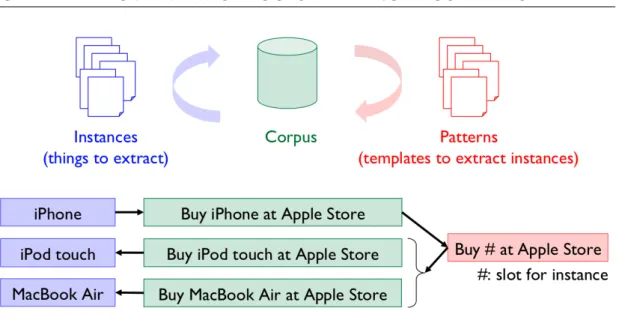
Bootstrapping (or self-training) is a general framework for reducing the re-quirement of manual annotation. The idea of learning with a bootstrapping method was adopted for many tasks. The goal of these algorithms is to learn target instances, which are the words belonging to certain categories (e.g., cat for the Animal class), or in the case of relation extraction, the pairs of words standing in a particular relationship (e.g., pasta::food for is-a relationship), given the context patterns for the categories or relation types found in source data. We will first describe the common setting of bootstrapping algorithms, and then explain the difference of various kinds of bootstrapping algorithms. The first step toward the acquisition of instances is to extract context pat-terns. In previous work, these are surface text patterns, e.g., X such as Y, for extracting words in an is-a relation. The extracted context patterns must then be assigned a score reflecting their usefulness in extracting the instances of a desired type. Frequency is a poor metric here, because frequent patterns may be extremely generic, appearing across multiple categories. Previously proposed methods differ in how to assign the desirability scores to the pat-terns they find and in using the score to extract instances, as well as in the treatment of generic patterns, whose precision is low but whose recall is high. Espresso and other bootstrapping methods [61, 1, 42, 16] alternate two phases: pattern extraction and instance extraction. For example, suppose we would like to learn hyponym (X is-a Y) relations. In pattern extraction phase, patterns like “Y such as X” which co-occur frequently with a seed such as (cat, animal) will be selected from a corpus. In instance extraction phase, on the other hand, new instances like (sparrow, bird) which co-occur with the patterns will be acquired and used for the next iteration.CHAPTER 2. OVERVIEW OF BOOTSTRAPPING ALGORITHMS
Figure 2.1. Two phases of bootstrapping: pattern and instance extraction. We describe these phases below, along with the parameters that control each phase.
Phase 1. Pattern Extraction Induce patterns from a corpus given seed in-stances. Patterns may be surface text patterns, lexico-syntactic patterns, and/or just features. Confidence score is assigned to each pattern depending on co-occurrence strength to seed instances. Only top highestkpatterns are selected (We call this processpattern extraction). It is necessary to assign low scores to generic patterns and high scores to patterns with high relatedness to the seed instances.
Phase 2. Instance Extraction Enumerate instances that co-occur with the patterns extracted in the pattern extraction phase. Compute confidence scores of enumerated instances and select high-confidence instances to add to the seed instance set. This process is called instance extraction. It is desirable to keep only high-confidence instances at this phase, as they are used as seed instances for the next iteration. Bootstrapping algorithms differ in the way to achieve this goal, i.e. whether (a) to output learned instances as acquired instanceson each iteration to retain highly relevant instances learned in early iterations or (b) to output high-confidence instances on the last iteration in-stead of learning instances on each round.
Bootstrapping algorithms have parameters (i)pattern reliability scoring met-rics and (ii) the number of patterns to use for extraction of instances for pattern
extraction phase; and (iii)instance reliability scoring metrics, (iv) the number of instances to pass to the next iteration. Also (v) stopping criterion is another pa-rameter to control when to stop iterations.
Bootstrapping iterates the above two phases several times until stopping criteria are met. Acquired instances tend to become noisy as the iteration proceeds, so it is important to terminate before semantic drift occurs.
One of the major deficiencies in bootstrapping algorithms is that there is no principled manner to select optimal parameters and configurations [36]. How to cope with the problem of semantic drift differs from methods to meth-ods, and it depends on tasks and domains.
2.1. Hearst (1992) Algorithm
Hearst (1992) [23] described a bootstrapping procedure for extracting words in hyponym (X is-aY) relation, starting with manually given lexico-syntactic patterns. For example, a pattern “Y such as X” as in “... works by such authors as Herrick, Goldsmith, and Shakespeare.” indicates that “Herick,” “Goldsmith” and “Shakespeare” are hyponyms of “author.” She then uses these terms to find new patters like “Y including X” as in “All common-law countries, including Canada and England ...” and repeats the process.
2.2. Yarowsky (1995) Algorithm
Yarowsky (1995) [61] presented an unsupervised word sense disambiguation (WSD) system which rivals supervised techniques. He exploits the “one sense per collocation” and “one sense per discourse” properties of natural language and incrementally learns a decision list with a few seed instances. His al-gorithm augments sense tagged data by iteratively training an intermediate classifier on classified data, using the resulting classifier to classify unlabeled data, and keeping the most confidently tagged instances for classified data to use on next iteration.
Although Yarowsky’s original paper lacks theoretical justification of his algorithm, Abney [1] presented a thorough discussion on the Yarowsky al-gorithm. He extended the original Yarowsky algorithm to a new family of bootstrapping algorithms that are mathematically well understood.
CHAPTER 2. OVERVIEW OF BOOTSTRAPPING ALGORITHMS
2.3. Collins and Singer (1999) Algorithm
Collins and Singer (1999) [14] presented a new algorithm which combines Yarowsky’s algorithm and co-training [8]. They induced a decision list for named entity classification starting from a few seed instances, by iteratively learning a spelling decision list and a decision list of contextual rules. They also presented a more general framework than the decision-list learning algo-rithm.
2.4. The Basilisk Algorithm (Thelen and Riloff 2002)
Thelen and Riloff (2002) [56] presented a framework called Basilisk, which extracts semantic lexicons for multiple categories. It starts with a small set of seed words and finds all patterns that match these seed words in the corpus. The bootstrapping process begins by selecting a subset of the patterns by theRlogF metric [46]:
RlogF(patterni) = Fi
Nilog2(Fi) (2.1)
where Fi is the number of category members extracted by patterni and Ni is the total number of instances extracted bypatterni. It then identifies instances by these patterns and scores each instance by the following formula:
AvgLog(wordi) = ∑
Pi
j=1log2(Fj+1)
Pi
(2.2) where Pi is the number of patterns that extract wordi. They used the aver-age logarithm to select instances to balance the recall and precision of generic patterns. They added five best instances to the lexicon according to this for-mula, and the bootstrapping process starts again. Instances are cumulatively collected across iterations, while patterns are discarded at the end of each iteration.
2.5. Bilingual Bootstrapping (Li and Li 2004)
Li and Li (2004) [31] proposed a method called Bilingual Bootstrapping. It makes use of a translation dictionary and a comparable corpus to help dis-ambiguate word senses in the source language, by exploiting the asymmetric many-to-many sense mapping relationship between words in two languages.
2.6. Mutual Exclusion Bootstrapping (Curran et al.
2007)
Curran et al. (2007) [16] presented an algorithm calledMutual Exclusion Boot-strapping, which minimizes semantic drift using mutual exclusion between semantic classes of learned instances. They prepared a list of so-called stop classessimilar to a stop word list used in information retrieval to help bound the semantic classes. Stop classes are sets of terms known to cause semantic drift in particular semantic classes. However, stop classes vary from task to task and domain to domain, and human intervention is essential to create an effective list of stop classes.
2.7. Sekine and Suzuki (2007) Algorithm
For the purpose of choosing the set of context patterns that best character-izes the categories, Sekine and Suzuki (2007) [51] reported that none of the conventional co-occurrence metrics such as tf.idf, mutual information and chi-squared tests achieved good results on their task, and proposed a new mea-sure, which is based on the number of different instances of the category a contextcco-occurs with, normalized by its token frequency for all categories:
Score(c) = ftypelog2
g(c)
C (2.3)
g(c) = ftype(c)/Finst(c) (2.4)
C = ftype(ctop1000)
Finst(ctop1000) (2.5)
where ftype is the type frequency of instance terms that c co-occurs with in the category, Finst is the token frequency of context c in the entire data and
ctop1000 is the 1000 most frequent contexts. Since they started with a large and reliable named entity dictionary, and therefore used several hundred seed terms, they simply took the top-k highest-scoring contexts and extracted new named entities once and for all, without iteration. Generic patterns receive low scores, and are therefore ignored by this algorithm.
3
Espresso-style Bootstrapping Algorithms
In this chapter, we propose a new bootstrapping algorithm, called Tchai. We first discuss the Espresso framework [42] in some detail because Tchai is based on it. It is a general-purpose, minimally supervised bootstrapping algorithm that takes a few seed instances as input and iteratively learns surface pat-terns to extract more instances. The key to Espresso lies in its use of generic patterns: it assumes that correct instances captured by a generic pattern will also be instantiated by some reliable patterns, which mean high precision and low recall patterns. We then explain three modifications to the Espresso algorithm to further improve precision. We name the new Espresso-style algorithm Tchai. We experimentally show that the Espresso algorithm out-performs a bootstrapping algorithm called Basilisk described in the previous chapter. Thanks to the performance improvements from the modifications, the Tchai algorithm is more scalable than the Espresso algorithm. The Tchai algorithm achieves constantly higher precision than the Espresso algorithm, while keeping comparable recall.3.1. The Espresso Algorithm
Pantel and Pennacchiotti [42] proposed a bootstrapping algorithm called Espresso to learn binary semantic relations such asis-aandpart-of from a corpus. What distinguishes Espresso from other bootstrapping algorithms is that it benefits from generic patterns by using a principled measure of instance and pattern reliability. Previous methods use several tens of reliable patterns for instance extraction, excluding generic patterns to prevent semantic drift. However,
CHAPTER 3. ESPRESSO-STYLE BOOTSTRAPPING ALGORITHMS
filtering generic patterns may harm coverage of the instance extraction and result in dropping recall. Espresso, on the other hand, defines sophisticated scoring functions to reduce the effect of semantic drift and compute a relia-bility score of an instance from all the patterns with small weight. This proce-dure improves recall and drastically increases the number of overall acquired instances.
Espresso starts from a small set of seed instances of a binary relation, finds a set of surface patternsP, selects the top-kpatterns, extracts the highest scoring m instances, and repeats the process. Espresso ranks all patterns in P according to reliability rπ, and retains the top-k patterns for instance
extraction. The value ofk is increased by one after each iteration.
The key idea of Espresso is recursive definition of pattern-instance scoring metrics. They use pointwise mutual information (pmi) and define the relia-bility of a pattern p as its average strength of association across each input instanceiin the set of instances I, weighted by the reliability of each instance
i. The reliability scores of pattern p and instance i, denoted respectively as
rπ(p)and rι(i), are given as follows:
rπ(p) = ∑i∈I pmi(i,p) max pmirι(i) |I| (3.1) rι(i) = ∑p∈P pmi(i,p) max pmirπ(p) |P| (3.2)
where P and I are sets of patterns and instances, and |P| and |I| are the numbers of patterns and instances, respectively. The pmi between instance
i={x,y}and pattern p is estimated by:
pmi(i,p) =log |x,p,y|
|x,∗,y||∗,p,∗| (3.3) where |x,p,y| is the frequency of pattern p instantiated with terms x and y
(recall that Espresso is targeted at extracting binary relations) and where the asterisk represents a wildcard. They multiplied pmi(i,p) with the discount-ing factor suggested in [43] to alleviate a bias towards infrequent events. In addition, max pmi is a maximum value of the pointwise mutual information over all instances and patterns.
The intuition behind these definitions is that a reliable pattern co-occurs with many reliable instances, and a reliable instance co-occurs with many reliable patterns.
Espresso uses Equations (3.1) for a pattern scoring function and (3.2) for an instance scoring function, respectively (see Chapter 2 for the meaning of these parameters), whereas other parameters rely on the tasks and need calibration. Unlike other bootstrapping algorithms, Espresso not only uses top-k ranked instances and patterns, but also all the instances and patterns with their confi-dence scores as weights, and thus it drastically improves recall while keeping precision high.
3.2. The Tchai Algorithm
In this section, we describe the modifications we made to Espresso to de-rive a new Espresso-style algorithm called Tchai, dedicated to learn semantic categories from web search query logs.
3.2.1 Segmentation of Query Logs
Bootstrapping methods often use some heuristics for finding the pattern bound-aries in text. As we use query logs as the source of knowledge, we simply use everything but the instance string in a query as the pattern for the instance, in a manner similar to [41]. For example, the seed word JAL in the query “JAL+flight_schedule” yields the pattern “#+flight_schedule” 1 Note that we perform no word segmentation or boundary detection heuristics in identify-ing these patterns, which makes our approach fast and robust, as the segmen-tation errors introduce noise in extracted patterns, especially when the source data contains many out of vocabulary items.
3.2.2 Filtering Ambiguous Instances and Patterns
As mentioned above, the treatment of high-recall, low-precision generic pat-terns (e.g., #+map, #+animation) present a challenge to minimally supervised learning algorithms due to their ambiguity. In the case of semantic category acquisition, the problem of ambiguity is exacerbated, because not only the ac-quired patterns, but also the instances can be highly ambiguous. For example, once we learn an ambiguous instance such as Pokemon, it will start collecting
1]indicates where the instance occurs in the query string, and + indicates a white space in
the original Japanese query. The underscore symbol (_) means there was originally no white space; it is used merely to make the translation in English more readable.
CHAPTER 3. ESPRESSO-STYLE BOOTSTRAPPING ALGORITHMS
patterns for multiple categories (e.g., Game, Animation and Movie), which is not desirable.
In order to control the negative effect of the generic patterns, Espresso introduces a confidence metric, which is similar to but different from the reli-ability score, and uses it to filter out the generic patterns falling below a con-fidence threshold. In our experiments, however, this metric did not produce a score that was substantially different from the reliability score. Therefore, we did not use a confidence metric, and instead opted for not filtering ambigu-ous instances and patterns, where we define ambiguambigu-ous instance as one that induces more than 1.5 times the number of patterns of previously accepted re-liable instances, and ambiguous (or generic) pattern as one that extracts more than twice the number of instances of previously accepted reliable patterns. As we will see in Section 3.3.5, this modification improves the precision of the extracted instances, especially in the early stages of iteration.
3.2.3 Scaling Factor in Reliability Scores
We made another modification to the Espresso algorithm to reduce the power of generic patterns. Espresso normalizes max pmiin terms of either instances or patterns instead of all instances and patterns as follows.
rι(i) = ∑p∈P pmi (i,p) maxp∈P pmirπ(p) |P| (3.4) rπ(p) = ∑i∈I pmi(i,p) maxi∈I pmirι(i) |I| (3.5)
Since pmi ranges [−∞,+∞], the point of dividing pmi(i,p) by max pmi in Espresso is to normalize the reliability to[−1, 1]. However, usingpmidirectly to estimate the reliability of a pattern when calculating the reliability of an instance may lead to unexpected results because the absolute value of pmiis highly variable across instances and patterns. We define the localmax pmi
of the reliability of an instance to be the absolute value of the maximumpmi
for a given instance, as opposed to taking the maximum for all instances in a given iteration. Localmax pmi of the reliability of a pattern is defined in the same way.
This modification to Tchai increases the reliability of middle-frequent in-stances and patterns from Espresso. Typical bootstrapping algorithms use
only few patterns on each iteration, and thus ambiguous patterns affect preci-sion especially in the early stages. Therefore, it is preferable to learn middle-frequent instances rather than inmiddle-frequent but specific instances in order to find patterns related to the target category (these patterns cover middle frequent instances similar to the seed instances). As we will see in the next section, this modification has a large impact on the effectiveness of our algorithm.
Here, we modify Equation (3.3) to deal with unary pattern instead of bi-nary relation. Thus,
pmi(i,p) = log2 |i,p|
|i,∗||∗,p| (3.6)
is pointwise mutual information between i and p2, |i,∗| and |∗,p| are the frequencies of pattern p and instance i in a given corpus, respectively, and
|i,p|is the frequency of pattern p which co-occurs with instancei.
3.2.4 Performance Improvements
Tchai, unlike Espresso, does not perform the pattern induction step between iterations; rather, it simply recomputes the reliability of the patterns induced at the beginning. Our assumption is that fairly reliable patterns will occur with at least one of the seed instances if they occur frequently enough in query logs. Since pattern induction is computationally expensive, this modification reduces the computation time by a factor of 400.
3.3. Experiment
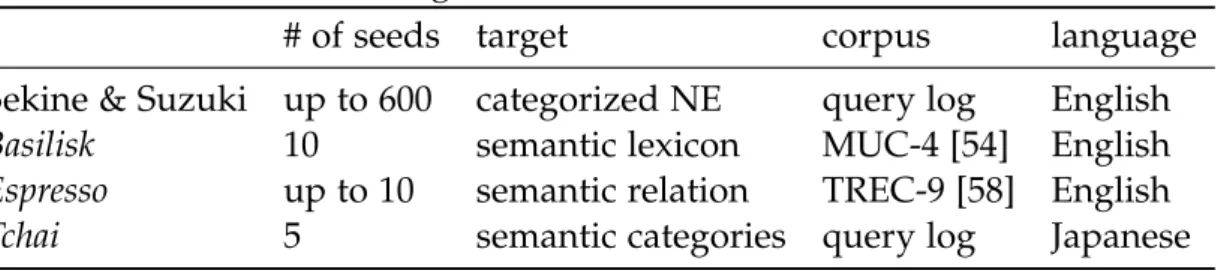
In this section, we present an empirical comparison of Tchai with other sys-tems such as Espresso and Basilisk [56]. These algorithms are summarized in Table 3.1.
2Although pointwise mutual information is usually defined as log 2
P(i,p)
P(i)P(p), Pantel and
Pennacchiotti [42] have to approximate it using above equation because the true corpus size is not known (they used search engine hit counts from Google). However, we computed pointwise mutual information as usual, because we were able to estimate our corpus size correctly.
CHAPTER 3. ESPRESSO-STYLE BOOTSTRAPPING ALGORITHMS
3.3.1 Introduction
Our method is based on the Espresso algorithm [42] for extracting binary lexical relations, improving it to work well on learning unary relations from query logs. The use of query data as a source of knowledge extraction offers some unique advantages over using regular text.
• Web search queries capture the interest of search users directly, while the distribution of the Web documents do not necessarily reflect the distribution of what people search [52]. The word categories acquired from query logs are thus expected to be more useful for the tasks related to search.
• Though user-generated queries are often very short, the words that ap-pear in queries are generally highly relevant for the purpose of word classification.
• Many search queries consist of keywords, which means that the queries include word segmentation specified by users. This is a great source of knowledge for learning word boundaries for those languages whose regularly written text does not indicate word boundaries, such as Chi-nese and JapaChi-nese.
Although our work naturally fits into the larger goal of building knowl-edge bases automatically from text, to our knowlknowl-edge we are the first to ex-plore the use of Japanese query logs for the purpose of minimally supervised semantic category acquisition. Our work is similar to [51], whose goal is to augment a manually created dictionary of named entities by finding contex-tual patterns from English query logs. Our work is different in that it does not require a full-scale list of categorized named entities but a small number of seed words, and iterates over the data to extract more patterns and instances. Recent work by [38, 39] also uses English query logs to extract lexical knowl-edge, but their focus is on learning attributes for named entities, a different focus from ours.
3.3.2 Experimental Setup
Query logs: The data source for instance extraction is an anonymized col-lection of query logs submitted to Live Search from January to February 2007, taking the top 1 million unique queries. Queries with garbage characters are
Table 3.1. Algorithms for relation extraction
# of seeds target corpus language
Sekine & Suzuki up to 600 categorized NE query log English
Basilisk 10 semantic lexicon MUC-4 [54] English
Espresso up to 10 semantic relation TREC-9 [58] English
Tchai 5 semantic categories query log Japanese
removed. Almost all queries are in Japanese, and are accompanied by their frequency within the logs.
Target categories: Our task is to learn word categories that closely reflect the interest of web search users. We believe that a useful categorization of words is task-specific, therefore we did not start with any externally available ontology, but chose to start with a small number of seed words. For our task, we were given a list of 23 categories relevant for web search, with a manual classification of the 10,000 most frequent search words in the log of December 2006 (which we henceforth refer to as the 10K list) into one of these categories.3 For evaluation, we chose two of the categories, Travel and Financial Services: Travel is the largest category containing 712 words of the 10K list (as all the location names are classified into this category), while Financial Services was the smallest, containing 240 words.
Systems: We compared three different systems that implement an iterative algorithm for lexical learning. They are briefly summarized in Table 3.1.
Basilisk The algorithm by Thelen and Riloff (2002) [56]
Espresso The algorithm by Pantel and Pennacchiotti (2006) [42]
Tchai The proposed algorithm described in this chapter.
For each system, we gave the same seed instances. The seed instances are the 5 most frequent words belonging to these categories in the 10K list; they
3The manual classification assigns only one category per word, which is not optimal given
how ambiguous the category memberships are. However, it is also very difficult to reliably perform a multi-class categorization by hand.
CHAPTER 3. ESPRESSO-STYLE BOOTSTRAPPING ALGORITHMS
Table 3.2. Seed instances for each category Category Seeds
Travel jal, ana, jr,じゃらん(jalan), his
Finance みずほ銀行 (Mizuho Bank), 三井住友銀行 (Sumitomo Mitsui
Bank Corporation), jcb,新生銀行(Shinsei Bank),野村證券
(No-mura Securities)
Table 3.3. Comparison with manual classification (10K list):Travel Category Manual classification
Not in the 10K list Travel Not Travel
Tchai Travel 280 17 251
Not Travel 0 7 125
Table 3.4. Comparison with manual classification (10K list): Finance Category Manual classification
Not in the 10K list Finance Not Finance
Tchai Finance 41 30 30
Not Finance 0 5 99
are given in Table 3.2. For the Travel category, “jal” and “ana” are airline com-panies, “jr” stands for Japan Railways, “jalan” is an online travel information site, and “his” is a travel agency. In the Finance category, three of them are banks, and the other two are a securities company and a credit card firm. Basilisk starts by extracting 20 patterns, and adds 100 instances per iteration. Espresso and Tchai start by extracting 5 patterns and add 200 instances per iteration. Basilisk and Tchai iterated 20 times, while Espresso iterated only 5 times due to computation time.
3.3.3 Results of the Tchai Algorithm
Tables 3.3 and 3.4 present the results of the Tchai algorithm compared to the manual classification. The figures “in the 10K list” show precision of the algo-rithm; whereas the figures “not in the 10K list” show whether the algorithm finds infrequent instances in web search query logs. Table 3.3 shows the re-sults for the Travel category. The precision of Tchai is very high: out of the
Table 3.5. Sample of extracted instances
Type Instance
Location トルコ(Turkey),ラスベガス (Las Vegas),バリ島(Bali Island)
Travel agencies jtb,トクー (http://www.tocoo.jp/), yahoo (Yahoo! Travel),
net cruiser
Attractions ディズニーランド(Disneyland), usj (Universal Studio Japan) Hotels 帝国ホテル(Imperial Hotel),リッツ(Ritz)
Transportation 京浜急行(Keihin Express), 奈良交通(Nara Kotsu Bus Lines)
297 words classified into the Travel category that were also in the 10K list, 280 (92.1%) were learned correctly. As the 10K list contained 712 words in the Travel category, the recall against that list is fairly low (ca.40%). The primary reason for this is that all location names are classified as Travel in the 10K list, and 20 iterations are not enough to enumerate all frequent location names. Another reason is that the 10K list consists of queries but our algorithm ex-tracts instances. This sometimes causes a mismatch, e.g.,Tchai exex-tracts “Ritz” but the 10K list contains “Ritz Hotel”.
It turned out that the 17 instances that represent the precision error were due to the ambiguity of hand labeling, as in “Tokyo Disneyland” which is a popular travel destination, but is classified as Entertainment in the manual annotation. We were also able to correctly learn 251 words that were not in the 10K list according to manual verification; we also harvested 125 new words incorrectly into the Travel category, but these words include common nouns related to Travel, such as “fishing” and “rental car”.
On the other hand, Table 3.4 shows the results for the Finance category. It exhibits a similar trend with the Travel category, but fewer instances are extracted. This is because the Finance category is a closed category which does not have many named entities such as location names. It is one of the future work to mine infrequent instances from query logs.
Sample instances harvested by our algorithm are given in Table 3.5. It includes subclasses of travel-related terms, for some of which no seed words were given (such as Hotels and Attractions). We also note that segmentation errors are entirely absent from the collected terms, demonstrating that query logs are in fact excellently suited for acquiring new words for languages with no explicit word segmentation in text.
CHAPTER 3. ESPRESSO-STYLE BOOTSTRAPPING ALGORITHMS
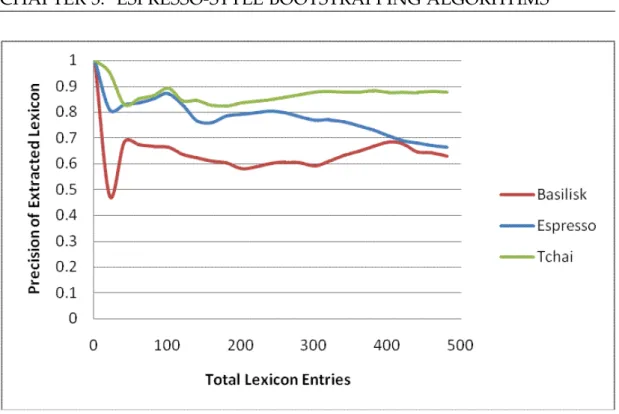
Figure 3.1. Precision for each system: Travel
3.3.4 Comparison with Basilisk and Espresso
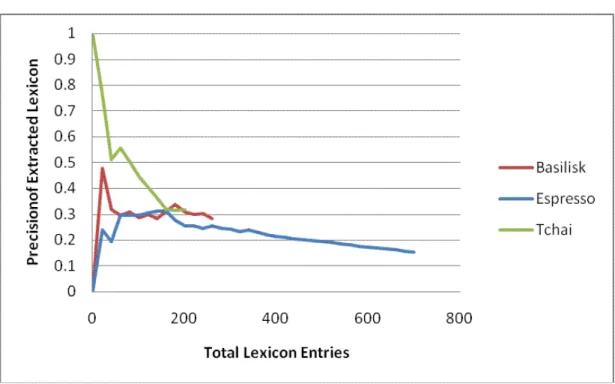
Figures 3.1 and 3.2 show the precision results comparing Tchai with Basilisk and Espresso for the Travel and Finance categories. Tchai outperforms Basilisk and Espresso for both categories: its precision is constantly higher for the Travel category, and it achieves excellent precision for the Finance category, especially in early iterations. The differences in behavior between these two categories are due to the inherent size of these categories. For the smaller Fi-nance category, Basilisk and Espresso both suffered from the effect of generic patterns such as “#ホームページ” (homepage) and “#カード” (card) in early
iterations, whereas Tchai did not select these patterns. The more patterns used for instance extraction, the more likely bootstrapping algorithms tend to select generic patterns. Thus, it is necessary to investigate a way to calibrate parameters for each algorithm and category.
Comparing these algorithms in terms of recall is more difficult, as the complete set of words for each category is not known. However, we can estimate the relative recall given the recall of another system. Pantel and
Figure 3.2. Precision for each system: Finance Ravichandran (2004) [43] defined relative recall as:
RA|B = RA RB = CA/C CB/C = CA CB = PA× |A| PB× |B| (3.7) where RA|B is the relative recall of system A given system B, CA and CB are the number of correct instances of each system, and C is the number of true correct instances. CA andCB can be calculated by using the precision, PA and
PB, and the number of instances from each system. Using this formula, we estimated the relative recall of each system relative to Espresso.
Tables 3.6 and 3.7 show that Tchai achieved the best results in both pre-cision and relative recall in the Travel category. In the Finance category, Espresso received the highest relative call but the lowest precision. This is because Tchai uses a filtering method so as not to select generic patterns and instances. The use of generic patterns did not improve as much as [42] re-ported even in the Finance category, therefore it is safe to say that our simple filtering of the Tchai algorithm is enough to filter generic patterns.
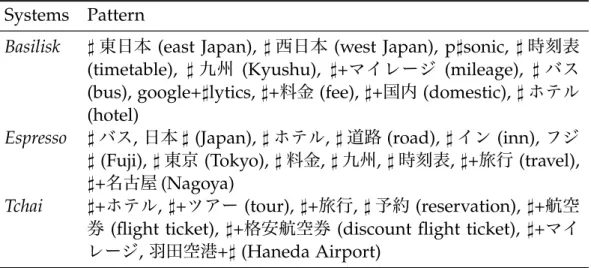
Table 3.8 shows the context patterns acquired by different systems after 4 iterations for the Travel category.4The patterns extracted by Basilisk are not
in-CHAPTER 3. ESPRESSO-STYLE BOOTSTRAPPING ALGORITHMS
Table 3.6. Relative recall: Travel
Systems # of instances Precision Relative recall
Basilisk 651 63.4% 1.26
Espresso 500 65.6% 1.00
Tchai 680 80.6% 1.67
Table 3.7. Relative recall: Finance
Systems # of instances Precision Relative recall
Basilisk 278 27.3% 0.70
Espresso 704 15.2% 1.00
Tchai 223 35.0% 0.73
entirely characteristic of the Travel category. For example, “p#sonic” and “google+#lytics” only match the seed word “ana”, and are clearly irrelevant to the category. Basilisk uses token count to estimate the score of a pattern, which may explain the extraction of these patterns. Both Basilisk and Espresso identify location names as context patterns (e.g., “#東京” (Tokyo), “#九州” (Kyushu)), which may be too generic to be characteristic of the category. In contrast, Tchai finds context patterns that are highly characteristic, including terms related to transportation (“#+格安航空券” (discount plane ticket), “#マ イレージ” (mileage)) and accommodation (“#+ホテル” (hotel)).
3.3.5 Contributions of Tchai Components
In this section, we examine the contribution of each modification to the Espresso algorithm we made in Tchai.
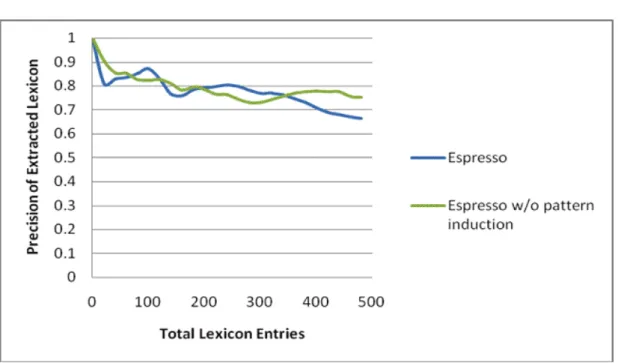
Figure 3.3 compares the original Espresso algorithm and the modified Espresso algorithm which performs the pattern induction step only at the be-ginning of the bootstrapping process, as described in Section 3.2.4. Although there is no significant difference in precision between the two systems, this modification greatly improves the computation time and enables efficient ex-traction of instances. We believe that our choice of the seed instances to be the most frequent words in the category produces sufficient patterns for ex-stances, and are not interested in the patterns per se. However, they can be quite useful in characterizing the semantic categories they are acquired for, so we chose to compare them here.
Table 3.8. Sample of extracted patterns for each algorithm Systems Pattern
Basilisk ]東日本 (east Japan), ]西日本 (west Japan), p]sonic, ]時刻表
(timetable), ]九州 (Kyushu), ]+マイレージ (mileage), ]バス
(bus), google+]lytics, ]+料金(fee),]+国内(domestic), ]ホテル
(hotel)
Espresso ]バス, 日本] (Japan), ]ホテル, ]道路(road), ]イン(inn),フジ
] (Fuji),]東京 (Tokyo),]料金, ]九州, ]時刻表, ]+旅行 (travel),
]+名古屋(Nagoya)
Tchai ]+ホテル, ]+ツアー (tour), ]+旅行, ]予約(reservation), ]+航空
券 (flight ticket), ]+格安航空券 (discount flight ticket), ]+マイ レージ, 羽田空港+] (Haneda Airport)
tracting new instances.
Figure 3.4 illustrates the effect of each modification proposed in Sections 3.2.2 and 3.2.3 for the Tchai algorithm on the Travel category. Each line in the graph corresponds to the Tchai algorithm with and without the modification. It shows that the modification to the max pmi function (purple; –noscaling) contributes most significantly to the improved accuracy of our system. The filtering of generic patterns (green; –nofilter) does not show a large effect in the precision of the acquired instances for this category, but produces steadily better results than the system without it.
3.4. Discussion
We propose a minimally supervised bootstrapping algorithm called Tchai. The main contribution of this work is to adapt the general-purpose Espresso algorithm to work well on the task of learning semantic categories of words from query logs. The proposed method not only has a superior performance in the precision of the acquired words into semantic categories, but is faster and collects more meaningful context patterns for characterizing the cate-gories than the unmodified Espresso algorithm. We have also shown that the proposed method requires no pre-segmentation of the source text for the purpose of knowledge acquisition.
Bootstrapping algorithms, however, often have many parameters to opti-mize and hence are difficult to use in practice. We will see in the next chapter
CHAPTER 3. ESPRESSO-STYLE BOOTSTRAPPING ALGORITHMS
Figure 3.3. Effect of modification to pattern extraction step
Figure 3.4. Precision ofTchaiin Travel Category
that parameter tuning is crucial for Espresso-style bootstrapping algorithms to achieve the best performance. Also, we present a graph-based analysis of Espresso-style bootstrapping algorithms to elicit the cause of semantic drift of bootstrapping algorithms. We will see that semantic drift is persistent across NLP tasks such as semantic category acquisition and word sense disambigua-tion in Chapters 4, 5 and 7, and that proposed methods overcome the problem of semantic drift in Chapters 5, 6 and 7.
4
Graph-based Analysis of Espresso-style
Bootstrapping Algorithms
A major drawback of bootstrapping is the lack of principled method for se-lecting optimal parameter values [36, 5]. Also, there is an issue of generic patterns which deteriorates the quality of acquired instances. Previously pro-posed bootstrapping algorithms differ in how they deal with the problem of semantic drift. We have taken recently proposed Espresso algorithm as the example to explain common configuration for bootstrapping.It is known that bootstrapping often acquires instances not related to seed instances. For example, consider the task of collecting the names of common tourist sites from web corpora. Given words like “Geneva” and “Bali” as seed instances, bootstrapping would eventually learn generic patterns such as “pictures” and “photos,” which also co-occur with many other unrelated in-stances. The subsequent iterations would likely acquire frequent words that co-occur with these generic patterns, such as “Britney Spears.” This phe-nomenon is calledsemantic drift[16].
A straightforward approach to avoid semantic drift is to terminate itera-tions before hitting generic patterns, but the optimal number of iteraitera-tions is task dependent and is hard to come by. The recently proposedEspresso[42] al-gorithm described in Chapter 3 incorporates sophisticated scoring functions to cope with generic patterns, but as we have pointed out in the previous chapter, Espresso still shows semantic drift unless iterations are terminated appropriately.
Another deficiency in bootstrapping is its sensitivity to many parameters such as the number of seed instances, the stopping criterion of iteration, the number of instances and patterns selected on each iteration, and so forth.
CHAPTER 4. GRAPH-BASED ANALYSIS OF ESPRESSO-STYLE BOOTSTRAPPING ALGORITHMS
These parameters also need to be calibrated for each task.
In this chapter, we present a graph-theoretic analysis of Espresso-like boot-strapping algorithms. We argue that semantic drift is inherent in these al-gorithms, and apply two graph-based algorithms that are theoretically less prone to semantic drift, as an alternative to bootstrapping.
First, we analyze in Section 4.1 a bootstrapping algorithm (Simplified Espresso) which can be thought of as a degenerate version of Espresso. Simplified Espresso is simple enough to allow an algebraic treatment, and its equiva-lence to Kleinberg’s HITS algorithm [27] is shown. An implication of this equivalence is that semantic drift in this bootstrapping algorithm is essen-tially the same phenomenon as topic drift observed in link analysis. Another implication is that semantic drift is inevitable in Simplified Espresso as it con-verges to the same score vector regardless of seed instances.
The original Espresso also suffers from the same problem as its simplified version does. It incorporates heuristics not present in Simplified Espresso to reduce semantic drift, but these heuristics have limited effect as we demon-strate in Section 4.1.3.
In Section 4.2, we propose two graph-based algorithms to reduce semantic drift. These algorithms are used in link analysis community to reduce the effect of topic drift. In Section 4.2.3, we show connection between label prop-agation approach and the proposed graph-based methods. In Chapter 5 we apply them to the task of word sense disambiguation (WSD) on Senseval-3 Lexical Sample Task and verify that they indeed reduce semantic drift. In Chapter 6 we explore the task of bilingual dictionary construction and se-mantic category acquisition to apply the proposed algorithms in Chapter 7.
4.1. Analysis of an Espresso-like Bootstrapping
Al-gorithm
4.1.1 Simplified Espresso
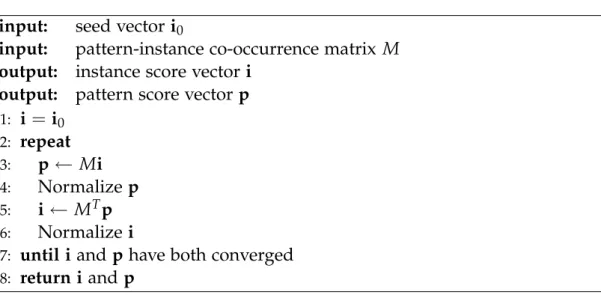
Let us consider a simple bootstrapping algorithm illustrated in Figure 4.1, in order to elucidate the cause of semantic drift.
As before, let |I| and |P| be the numbers of instances and patterns, re-spectively. The algorithm takes a seed vector i0, and a pattern-instance co-occurrence matrix M as input. i0 is a |I|-dimensional vector with 1 at the position of seed instances, and 0 elsewhere. M is a |P| × |I|-matrix whose
input: seed vectori0
input: pattern-instance co-occurrence matrix M
output: instance score vectori output: pattern score vectorp
1: i =i0 2: repeat 3: p ←Mi 4: Normalizep 5: i ←MTp 6: Normalizei
7: until i andp have both converged 8: return iand p
Figure 4.1. A simple bootstrapping algorithm
(p,i)-element[M]piholds the (possibly re-weighted) number of co-occurrence of pattern p and instancei in the corpus. If both iand p have converged, the algorithm returns the pair ofiand pas output.
This algorithm, though simple, can encode Espresso’s update formulae (3.1) and (3.2) as Steps 3 through 6 if we pose
[M]pi = pmi(i,p)
maxpmi, (4.1)
and normalizepand i in Steps 4 and 6 by
p← p/|I| and i ←i/|P|, (4.2) respectively.
This specific instance of the algorithm of Figure 4.1 obtained by special-ization through Equations (4.1) and (4.2), will be henceforth referred to as
Simplified Espresso. Indeed, it is an instance of the original Espresso in which the iteration is not terminated until convergence, all instances are carried over to the next iteration, and instances are not cumulatively learned.
4.1.2 Simplified Espresso as Link Analysis
Let n denote the number of times Steps 2–8 are iterated. Plugging (4.1) and (4.2) into Steps 3–6, we see that the score vector of instances after the nth
CHAPTER 4. GRAPH-BASED ANALYSIS OF ESPRESSO-STYLE BOOTSTRAPPING ALGORITHMS iteration is in = Ani0 (4.3) where A= 1 |I||P|M TM. (4.4)
Suppose matrix A is irreducible; i.e., the graph induced by taking A as the adjacency matrix is connected. If n is increased and in is normalized on each iteration, in tends to the principal eigenvector of A. This implies that no matter what seed instances are input, the algorithm will end up with the same ranking of instances, if it is run until convergence. Because A = M| TM
I||P|,
the principal eigenvector of Ais identical to the authority vector of HITS [27] algorithm run on the graph induced byM.1 This similarity of Equations (3.1), (3.2) and HITS is not discussed in [42].
As a consequence of the above discussion, semantic drift in simplified Espresso seems to be inevitable as the iteration proceeds, since the principal eigenvector of A need not resemble seed vectori0. A similar phenomenon is reported for HITS and is known astopic drift, in which pages of the dominant topic are ranked high regardless of the given query. [6]
Unlike HITS and Simplified Espresso, however, Espresso and other boot-strapping algorithms [61, 47], incorporate heuristics so that only patterns and instances with high confidence score are carried over to the next iteration. We denote this heuristics asfiltering and experiment the effect of the heuristics in the next section.
4.1.3 Convergence Process of Espresso
To investigate the effect of semantic drift on Espresso with and without the heuristics of selecting the most confident instances on each iteration (i.e., the original Espresso and Simplified Espresso of Section 4.1.2), we apply them to the task of word sense disambiguation.
The task of WSD is to correctly predict the senses of test instances whose true sense is hidden from the system, using training data and their true senses.
1As long as the relative magnitude of the components of vectori
n is preserved, the vector
can be normalized in any way on each iteration. Hence HITS and Simplified Espresso both converge to the principal eigenvector ofA, even though use different normalization.