Washington University in St. Louis
Washington University Open Scholarship
Engineering and Applied Science Theses &Dissertations McKelvey School of Engineering
Summer 8-15-2017
Parallel Real-Time Scheduling for Latency-Critical
Applications
Jing Li
Washington University in St. Louis
Follow this and additional works at:https://openscholarship.wustl.edu/eng_etds Part of theComputer Engineering Commons
This Dissertation is brought to you for free and open access by the McKelvey School of Engineering at Washington University Open Scholarship. It has been accepted for inclusion in Engineering and Applied Science Theses & Dissertations by an authorized administrator of Washington University Open Scholarship. For more information, please [email protected].
Recommended Citation
Li, Jing, "Parallel Real-Time Scheduling for Latency-Critical Applications" (2017).Engineering and Applied Science Theses & Dissertations. 302.
WASHINGTON UNIVERSITY IN ST. LOUIS School of Engineering and Applied Science Department of Computer Science and Engineering
Dissertation Examination Committee: Chenyang Lu, Chair
Kunal Agrawal, Co-Chair Sameh Elnikety Christopher Gill Roch Gu´erin I-Ting Angelina Lee
Parallel Real-Time Scheduling for Latency-Critical Applications by
Jing Li
A dissertation presented to The Graduate School of Washington University in
partial fulfillment of the requirements for the degree
of Doctor of Philosophy
August 2017 St. Louis, Missouri
Table of Contents
List of Tables... vii
List of Figures... viii
Acknowledgments... xv
Abstract ...xviii
Chapter 1: Introduction... 1
1.1 Systems with Latency-Critical Applications... 3
1.2 Parallel Scheduling for Applications... 5
1.3 Thesis Statement... 7
1.4 Thesis Contributions ... 8
Chapter 2: Preliminaries and Notation... 13
2.1 Parallel Job Model... 13
2.2 Scheduling Parallel Jobs... 15
2.2.1 Centralized Greedy Schedulers... 16
2.2.2 Randomized Work-Stealing Schedulers... 17
2.3 Parallel Languages and Runtime Systems... 18
2.4 Classic Static Real-Time System Model... 19
2.5 Classic Online Scheduling Model... 22
Part I Static Real-Time Systems for Parallel Tasks with Deadlines ... 25
Chapter 3: Global Scheduling for Parallel Real-Time Tasks... 29
3.1 Related Work on Hard Real-Time Systems... 30
3.2 Canonical Form of a DAG Task... 33
3.3 Capacity Augmentation Bound of Global EDF... 40
3.3.1 Upper Bound on Capacity Augmentation of GEDF... 40
3.3.2 Lower Bound on Capacity Augmentation of GEDF... 42
3.4 Capacity Augmentation of Global RM... 44
3.5.1 Background ... 47
3.5.2 PGEDF Programming Interface... 50
3.5.3 PGEDF Operation... 52
Chapter 4: Federated Scheduling for Parallel Real-Time Tasks... 56
4.1 Federated Scheduling Algorithm... 57
4.2 Capacity Augmentation Bound of 2 for Federated Scheduling... 58
4.3 Lower Bound on Capacity Augmentation of Any Scheduler for Parallel Tasks.... 62
4.4 Practical Considerations... 62
4.5 Implementation of a Federated Scheduling Platform... 64
4.6 Empirical Comparison Between PGEDF and RTCG... 66
4.6.1 Task Generation... 67
4.6.2 Baseline Platform... 68
4.6.3 Experimental Results... 70
Chapter 5: Mixed-Criticality Federated Scheduling... 72
5.1 System Model and Background... 74
5.1.1 Mixed-Criticality Parallel Real-Time Tasks Model... 74
5.1.2 System Model for Dual-Criticality System... 75
5.1.3 Schedulability Conditions for Dual-Criticality Systems... 76
5.1.4 Dual-Criticality Capacity Augmentation Bound ... 77
5.1.5 Background ... 77
5.2 Related Work on Mixed-Criticality Scheduling... 80
5.3 Scheduling Dual-Criticality High-Utilization Tasks ... 81
5.3.1 Mapping Algorithm... 82
5.3.2 Schedulability Conditions of MCFS ... 83
5.3.3 MCFS Runtime Execution... 84
5.4 Proof of Correctness and Capacity Augmentation Bound ... 85
5.4.1 LH tasks under MCFS... 85
5.4.2 HVH tasks under MCFS... 86
5.4.3 HMH tasks under MCFS... 89
5.4.4 Proof of Correctness... 93
5.4.6 Lower Bound on Capacity Augmentation for High-Utilization Tasks... 97
5.5 MCFS for Multi-Criticality Systems... 98
5.5.1 Multi-Criticality System Model... 98
5.5.2 Multi-Criticality MCFS Algorithm and Bound...100
5.6 Improve MCFS Algorithm for High-Utilization Tasks ... 104
5.7 General Case for Dual-Criticality MCFS... 109
5.8 Implementation of a MCFS Runtime System... 112
5.9 Numerical Evaluation ... 119
5.10 Empirical Evaluation... 130
Chapter 6: Federated Scheduling for Stochastic Parallel Real-time Tasks ....135
6.1 Related Work on Soft Real-Time Scheduling... 136
6.2 System Model for Stochastic Parallel Real-Time Tasks... 137
6.3 Stochastic Federated Scheduling Guarantees Bounded Tardiness... 139
6.3.1 Stochastic Federated Scheduling Strategy...139
6.3.2 Mapping Algorithms Guarantee Bounded Tardiness...140
6.3.3 Calculating Expected Tardiness...142
6.3.4 A Mapping Algorithm for Stochastic Federated Scheduling...144
6.3.5 BASIC Federated Mapping Algorithm...144
6.3.6 FAIR Federated Mapping Algorithm...146
6.3.7 ILP-Based Federated Mapping Algorithm...147
6.4 Stochastic Capacity Augmentation of 2 for Stochastic Federated Scheduling... 151
6.4.1 Stochastic Capacity Augmentation Bound for BASIC...151
6.4.2 Stochastic Capacity Augmentation Bound for FAIR...153
6.5 Numerical Evaluation ... 154
6.5.1 Task Sets Generation and Experimental Setup...154
6.5.2 Experiment Results...155
Chapter 7: Work Stealing for Large Scale Soft Real-time Systems...159
7.1 The Case for Randomized Work Stealing for Soft Real-Time Tasks... 161
7.1.1 Scalability Comparison...161
7.2 Adaptation to Federated Scheduling using Work Stealing... 168
7.2.1 Federated Scheduling for Parallel Real-Time Tasks ...168
7.2.2 Incorporating Work Stealing Overhead into Federated Scheduling...169
7.3 RTWS Platform ... 172
7.4 Platform Evaluation... 174
7.4.1 Benchmark Task Sets Generation...174
7.4.2 Evaluation Results ...175
Part II Online Systems with Parallel Latency-Critical Jobs...180
Chapter 8: Scheduling Parallel Jobs Online to Meet Target Latency...184
8.1 Background and Terminology... 187
8.1.1 Terminology...187
8.1.2 Characteristics of Interactive Services...187
8.2 Intuitions for Tail-Control... 188
8.3 Tail-Control Scheduler ... 193
8.3.1 The Threshold-Calculation Algorithm...193
8.3.2 Extending Work-Stealing with Tail-Control...201
8.4 Experimental Evaluation... 206
8.4.1 Different Work Distributions ...208
8.4.2 Different Arrival Distributions...211
8.4.3 Request with Sub-Linear Speedup...212
8.4.4 Inaccurate Input Work Distribution...213
8.4.5 Increased System Capacity...215
8.4.6 Comparison with Additional Algorithms...216
8.4.7 The Inner Workings of Tail-Control...218
Chapter 9: Scheduling Parallel Jobs Online to Maximize Profit ...220
9.1 Preliminaries... 224
9.2 Maximizing Profit of Jobs with Deadlines... 225
9.2.1 Scheduler S for Maximizing Profit of Jobs with Deadlines...226
9.2.2 Properties of the Scheduler S ...229
9.2.4 Bounding the Profit of Jobs Completed by OPT...233
9.3 Maximizing Profit of Jobs with General Profit Functions... 238
9.3.1 Scheduler S0 for Maximizing General Profit...238
9.3.2 Properties of the Scheduler S0...239
9.3.3 Bounding the Profit of Jobs Completed by S0 ...240
9.3.4 Bounding the Profit of Jobs Completed by OPT...243
9.4 Lower Bound Examples... 246
Chapter 10: Scheduling Parallel Jobs Online to Minimize Max Flow Time..248
10.1 Preliminaries... 251
10.2 Unweighted Maximum Flow Time using FIFO... 253
10.3 Unweighted Maximum Flow Time using Work Stealing... 256
10.4 Work Stealing Lower Bound for Maximum Flow Time... 267
10.5 Experimental Results for Unweighted Maximum Flow Time... 268
10.6 Maximum Weighted Flow Time using Biggest-Weight-First ... 270
Chapter 11: Scheduling Parallel Jobs Online to Minimize Average Flow Time277 11.1 Preliminaries... 282
11.2 Algorithm: LAPS ... 284
11.3 Algorithm: SJF... 289
11.3.1 Analysis of SJF for Fractional Flow Time...289
11.3.2 SJF Falls Behind with Resource Augmentation...295
11.3.3 From Fractional to Integral...300
Chapter 12: A Distributed Scheduler for Minimizing Average Flow Time...307
12.1 Preliminaries... 312
12.2 DREP: A New Sequential Algorithm... 314
12.3 DREP: A New Parallel Algorithm and Analysis... 315
12.3.1 DREP Algorithm for Parallel Jobs...316
12.3.2 Probability of Working on a Job under DREP...316
12.3.3 Potential Function Analysis for DREP...318
Chapter 13: Conclusion...323
List of Tables
4.1 Task Set Characteristics... 67
5.1 Table of Notations in Chapter 5... 82
5.2 High-Utilization Task Classification... 82
5.3 High-Utilization Task Virtual Deadline and Core Assignment... 83
5.4 Tasks’ Per-Criticality Work, Critical-Path Length and Core Assignment of a 3-Criticality System... 99
5.5 High-Utilization Task Classification of a 3-Criticality System... 100
5.6 High-Utilization Tasks’ Assignments of a 3-Criticality System ... 100
5.7 Task Set Parameters... 133
7.1 Median, maximum, and 99th percentile execution times of synchronous tasks for OpenMP and Cilk Plus implementations (in milliseconds) and the ratios of the maximum execution times of Cilk Plus over OpenMP implementations. 162 7.2 Median, maximum, and 99th percentile execution times of Cholesky, LU, and Heat for OpenMP and Cilk Plus implementations (in seconds) and the ratio of the maximum execution times of Cilk Plus over OpenMP implementations. 166 8.1 Notation Table in Chapter 8... 195
9.1 Notations and definitions throughout Chapter 9 ... 225
9.2 Notations and definitions specific to jobs with deadlines... 226
9.3 Notations and definitions specific to jobs with general profit functions... 226
List of Figures
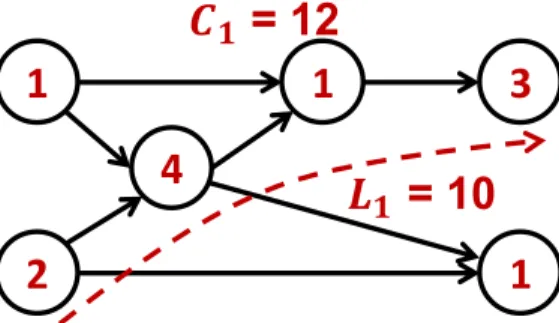
2.1 A directed acyclic graph (DAG) job J1 with six nodes. The execution time
of each node is annotated in the center of the node. The total work C1 is
the sum of the execution times of all nodes, which is 12. The critical-path, i.e., the longest path in the DAG, is annotated using the dashed line. The
critical-path length L1 is 10... 14
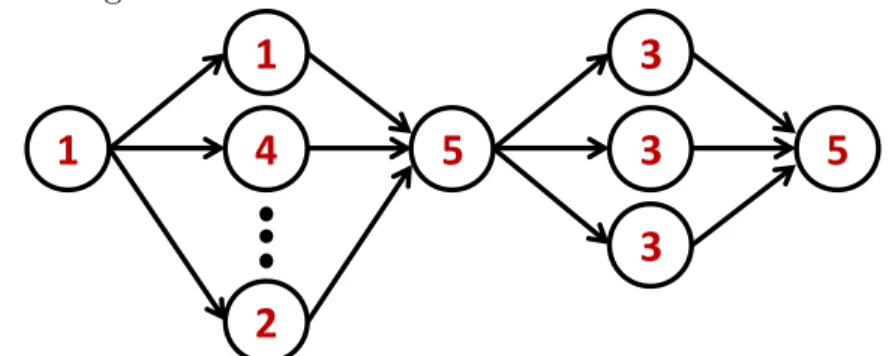
2.2 A synchronous task with two parallel-for loops. The execution time of each node is annotated in the center of the node. The second segment contains 20 nodes... 15
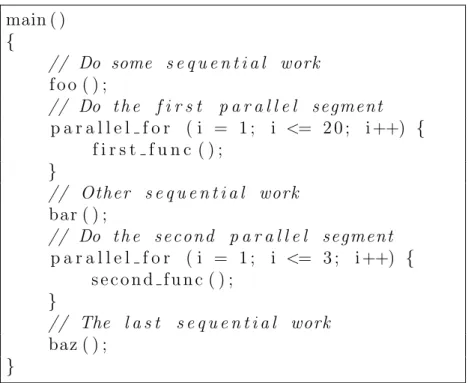
2.3 Example of a synchronous program... 16
2.4 Examples of centralized scheduling and work stealing ... 17
3.1 A high-utilization DAG task τi with Li = 12, Ci = 20, Ti = Di = 16, and ui = 1.25 and its canonical form, where the number in each node is its execution time... 34
3.2 q∗i(t, α),qi(t, α),worki∗(t, α) andworki(t, α) for the high-utilization taskτi in Figure 3.1... 36
3.3 The required speedup of GEDF under different settings... 41
3.4 The upper bound of GEDF provided in Theorem 5 and the lower bound in Theorem 8 with respect to the capacity augmentation bound. ... 44
3.5 The required speedup of GRM when m is sufficiently large and UL = 0 (i.e. UP =U H)... 45
3.6 Task Program Format... 51
3.7 Format of the Configuration File... 52
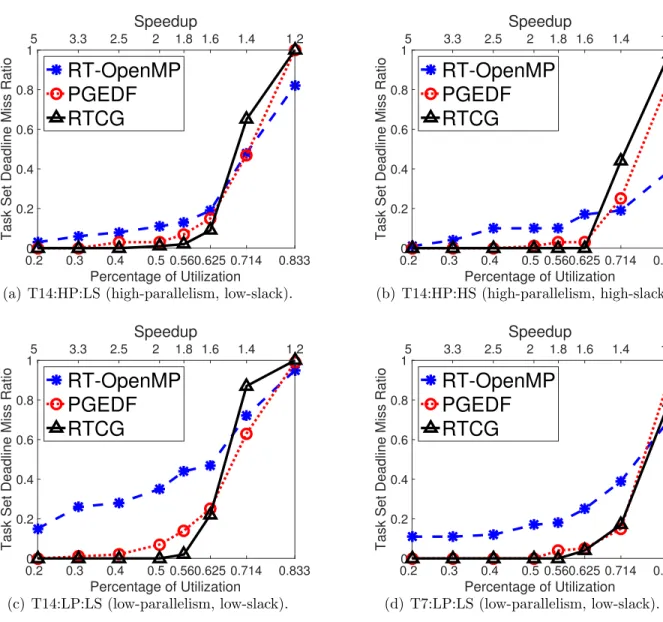
4.1 Task Set Deadline Miss ratio of RTCG vs. PGEDF vs. RT-OpenMP with different types of task sets with varying percentages of utilization on 14 and 7 cores... 69
5.1 MCFS-Improve mapping algorithm and schedulability test (initialization step) 105 5.2 MCFS-Improve mapping algorithm and schedulability test (adjustment step). 106 5.3 Periodic Task Invocation Psuedocode... 116 5.4 Mode Aware Barrier Psuedocode... 117
5.5 Fraction of schedulable task sets of Bound vs. MCFS vs.
MCFS-Improve on 32 cores setting with pmax = 1b.5. From (a) to (f), figures show the results for total nominal utilizations ranging from [12.5%m, 25%m, 37.5%m, 50%m, 62.5%m, 75%m], respectively. Each figure shows the results for increasing total overload utilizations. ... 122
5.6 Fraction of schedulable task sets of Bound vs. MCFS vs.
MCFS-Improve on 32 cores setting with pmax = 1b.5. From (a) to (f), figures show the results for total overload utilizations ranging from [12.5%m, 25%m, 37.5%m, 50%m, 62.5%m, 75%m], respectively. Each figure shows the results for increasing total nominal utilizations. ... 123 5.7 Fraction of schedulable task sets of MCFS (labeled “M.”) vs. MCFS-Improve
(labeled “M.-Imp.”) on 16 cores (labeled “16-core”) vs. 64 cores (labeled “64-core”) withpmax = 1b.5. From (a) to (f), figures show the results for vary-ing totaloverload utilizations. Each figure shows the results for increasing total nominal utilizations. ... 124 5.8 Fraction of schedulable task sets of MCFS (labeled “M.”) vs. MCFS-Improve
(labeled “M.-Imp.”) on 16 cores (labeled “16-core”) vs. 64 cores (labeled “64-core”) withpmax = 1b.5. From (a) to (f), figures show the results for vary-ing totalnominal utilizations. Each figure shows the results for increasing total overload utilizations. ... 125
5.9 Fraction of schedulable task sets of MCFS (dotted line) vs. MCFS-Improve (solid line) with varying number of cores. Each data point in each figure shows the average fraction of schedulable task sets of all the different settings (varying nominal and overload utilizations), givenmand maximum ratiopmax
of critical-path length over period. ... 127 5.10 Fraction of schedulable task sets of MCFS (labeled “M.”) vs. MCFS-Improve
(labeled “M.-Imp.”) on128 cores withpmax = 0.b75 (labeled “p=0.75/b”) vs.
pmax = 2.b25 (labeled “p=2.25/b”). From (a) to (f), figures show the results for varying total overload utilizations. Each figure shows the results for increasing total nominal utilizations. ... 128 5.11 Fraction of schedulable task sets of MCFS (labeled “M.”) vs. MCFS-Improve
(labeled “M.-Imp.”) on128 cores withpmax = 0.b75 (labeled “p=0.75/b”) vs.
pmax = 2.b25 (labeled “p=2.25/b”). From (a) to (f), figures show the results for varying total nominal utilizations. Each figure shows the results for increasing total overload utilizations. ... 129 5.12 Fraction of tasks with no deadline miss, for the sets of tasks with high- and
low-criticality, respectively, when increasing the number of high-criticality tasks that overrun their nominal parameters... 132 5.13 One hyper-period of the experimental task system where Task 1 only requires
5ms of computational time... 133 5.14 One hyper-period of the experimental task system where Task 1 requires 20ms
of computational time, necessitating a transition to critical-state... 134
6.1 Task set utilization vs. schedulability ratio (in percentages) for different num-ber of cores. ... 156 6.2 Maximum, mean and minimum tardiness for parameters with small and large
variances. ... 156
7.1 Speedup of synchronous tasks in OpenMP and Cilk Plus implementations ... 164 7.2 Speedup of benchmark programs in OpenMP and Cilk Plus implementations . 167
7.3 Deadline miss ratio of different task sets (Cholesky, Heat, LU and Mixed task sets) with increasing total utilization under RTWS (providing federated scheduling service integrated with a randomized work-stealing scheduler in GNU Cilk Plus) and RTCG (providing federated scheduling service integrated with a centralized greedy scheduler in GNU OpenMP). In these experiments, RTWS and RTCG use the same core assignment. ... 176 7.4 Average relative response time of different task sets (Cholesky, Heat, LU and
Mixed task sets) with increasing total utilization under RTWS and RTCG. In these experiments, RTWS and RTCG use the same core assignment. ... 177 7.5 Required number of cores of different task sets (Cholesky, Heat, LU and Mixed
task sets) with increasing total utilization under RTWS and RTCG. In these experiments, we increase the number of cores for each task under RTCG until it misses no more than 60% of deadlines. ... 178
8.1 Work distribution of two interactive services: Bing search server [97] and an option pricing finance server [135]. Note that in Bing search server the probabilities of requests with work between 55ms to 200ms are small but larger than zero and total probability of these requests is around 3.5%... 188 8.2 Neither steal-first nor admit-first always performs best. Each bar plots a
target latency and the ratio (on a log scale) of requests that miss the target latency under admit-first over those that miss the target latency under steal-first. When the bar is above 1, steal-first is better. Below 1, admit-first is better. ... 191 8.3 Algorithm for calculating large request threshold table... 194 8.4 Example large request threshold tables output by threshold-calculation with
input of the same work distribution and rps, but three different target laten-cies. The x-axis is the number of active requests, and the y-axis is the large request threshold. Each curve plots the output threshold table for a given latency... 201
8.5 The pseudo code for the main loop of tail-control in a work-stealing runtime system. Tail-control adds only the bold lines and the functioncheck pileup phase
to steal-first. ... 202 8.6 The pseudo code for the helper routines of tail-control in a work-stealing
run-time system. Tail-control adds only the bold lines and the functioncheck pileup phase
to steal-first. ... 203 8.7 Results for the Bing workload with three different load settings and Poisson
arrival. The x-axis shows different target latencies from shorter to longer from left to right. The y-axis shows the target latency miss ratio. The table below each figure shows tail-control’s relative improvement over steal-first and admit-first for a given latency... 209 8.8 The finance workload results with the same figure and table configuration as
in Figure 8.7... 209 8.9 The log-normal workload results with the same figure and table configuration
as in Figure 8.7... 210 8.10 Results for the log-normal workload and a log-normal arrival distribution with
1200 rps; Figure and table configurations are similar as in Figure 8.9. ... 212 8.11 Results for the Bing workload and a Poisson arrival distribution with 1200
rps for requests with sub-linear speedup; Figure and table configurations are similar as in Figure 8.7. ... 213 8.12 Results for the log-normal workload a and Poisson arrival distribution with
1200 rps and a target latency of 28ms. We compare tail-control when using inaccurate input distributions with smaller to larger standard deviation from left to right... 214 8.13 The Bing workload results. Tail-control increases system capacity for different
target latencies compared to steal-first and admit-first... 215 8.14 The Bing workload results. The figure is the same as Figure 8.7(c), except it
8.15 The log-normal workload results. The figure is the same as Figure 8.9(c), except it adds default-TBB and TC-Clairvoyant... 217 8.16 Number of active requests (lower part) and request latency (upper part) traces
of the same workload under steal-first and tail-control in a 0.8 second window (Bing workload)... 219
10.1 An example execution trace of work-stealing identifying jobs’ release and com-pletion times. ... 261 10.2 Experimental results comparing the maximum flow time running on three
work distributions with three different load settings and scheduled using sim-ulated OPT, steal-k-first, and admit-first (from left to right). Note that the scale of the y-axis for the figures differ. From all different settings, OPT has the smallest max flow time, while admit-first has the largest max flow time.... 269
11.1 An example schedule of slow and fast SJF on 6 processors... 296 11.2 An example schedule of slow and fast SJF for m processors... 298
Acknowledgments
During my graduate study, I have received enormous help and support from many people, and this thesis would not have been possible without all of them.
First and foremost, I would like to thank my advisors, Dr. Chenyang Lu and Dr. Kunal Agrawal, who are my dearest academic father and mother. They taught me every aspect of research, from technical knowledge, basic research skills, to big picture and research taste. They always believe in me, help me to get through difficulties and encourage me to reach for the stars. I have learned from them more than just research. All of these would benefit me for my academic career and the rest of life.
I was fortunate to have worked closely with many brilliant collaborators. I would like to express my thanks and appreciation to Dr. Christopher Gill, Dr. Benjamin Moseley, Dr. I-Ting Angelina Lee and Dr. Jian-Jia Chen for always sparking inspiring ideas about research and providing generous help to my work. The collaborative work with all of them has become important parts of my dissertation. I am also grateful to Dr. Sameh Elnikety, Dr. Yuxiong He and Dr. Kathryn S. McKinley for supervising my internship at Microsoft Research in 2014, stimulating interesting research directions and giving valuable comments on my work. I especially want to thank Sameh for his support during my job search.
I am thankful for my fellow collaborators who made this thesis possible: Abusayeed Saifullah, David Ferry, Kefu Lu, Son Dinh, Shaurya Ahuja, Kevin Kieselbach and Zheng Luo, with whom I have enjoyed debugging codes, solving math and writing papers together. I extend my thanks to the students in the Parallel Computing Technology Group that I sadly did not have the chance to write papers with: Robert Utterback, Jordyn Maglalang, James Orr, and Ramsay Shuck. Many thanks also to the great collaborators from Purdue University: Dr. Shirley Dyke and Dr. Arun Prakash, Gregory Bunting and Amin Maghareh. My heartiest gratitude also goes to all the past and current members of the Cyber-Physical Systems Laboratory (CPSL): Sisu Xi, Mo Sha, Chengjie Wu, Bo Li, Lanshun Nie,
Rahav Dor, Chong Li, Dolvara Gunatilaka, Chao Wang, Yao Yuan, Yehan Ma, Haoran Li and Xin Hu. I have spent countless joyful hours with them, discussing research and enjoying wonderful times together. Special thanks to Bo Li, who helps me restore confidence and gives me critical suggestions whenever I struggle in life. Also thanks to my friends in WashU and many other friends outside school, including Ming Yin, Hao Yan, Xin Chen, Meng Xu, Hongxing Liu, Han Lu, Shenmeng Xu, Hanyang Chen and Zihang Xiao.
I would like to take this opportunity to express my gratitude to the Department of Com-puter Science and Engineering at Washington University in St. Louis. I have greatly enjoyed my graduate study here and received all kinds of help from the friendly department staff and faculty members. I especially want to thank our Department Chair and my committee member, Dr. Roch Gu´erin, for passionately making our department a wonderful place for study and research, and for being extremely supportive to my graduate study over the years. Last but not the least, I am grateful to my parents for giving me endless love and for always being there whenever I need them. Special thank to my husband Mo Yu, for accompanying me across the continent during my entire graduate study and for making my life full of pleasure. I could not have become who I am now without all of you.
Jing Li
Washington University in St. LouisABSTRACT OF THE DISSERTATION
Parallel Real-Time Scheduling for Latency-Critical Applications by
Jing Li
Doctor of Philosophy in Computer Science Washington University in St. Louis, 2017
Professor Chenyang Lu, Chair Professor Kunal Agrawal, Co-Chair
In order to provide safety guarantees or quality of service guarantees, many of today’s sys-tems consist of latency-critical applications, e.g. applications with timing constraints. The problem of scheduling multiple latency-critical jobs on a multiprocessor or multicore machine has been extensively studied for sequential (non-parallizable) jobs and different system mod-els and different objectives have been considered. However, the computational requirement of a single job is still limited by the capacity of a single core. To provide increasingly complex functionalities of applications and to complete their higher computational demands within the same or even more stringent timing constraints, we must exploit the internal parallelism of jobs, where individual jobs are parallel programs and can potentially utilize more than one core in parallel. However, there is little work considering scheduling multiple parallel jobs that are latency-critical.
This dissertation focuses on developing new scheduling strategies, analysis tools, and practical platform design techniques to enable efficient and scalable parallel real-time schedul-ing for latency-critical applications on multicore systems. In particular, the research is fo-cused on two types of systems: (1) static real-time systems for tasks with deadlines where the temporal properties of the tasks that need to execute is known a priori and the goal is to guarantee the temporal correctness of the tasks prior to their executions; and (2) online systems for latency-critical jobs where multiple jobs arrive over time and the goal to optimize for a performance objective of jobs during the execution.
For static real-time systems for parallel tasks, several scheduling strategies, including global earliest deadline first, global rate monotonic and a novel federated scheduling, are proposed, analyzed and implemented. These scheduling strategies have the best known the-oretical performance for parallel real-time tasks under any global strategy, any fixed priority scheduling and any scheduling strategy, respectively. In addition, federated scheduling is generalized to systems with multiple criticality levels and systems with stochastic tasks. Both numerical and empirical experiments show that federated scheduling and its variations have good schedulability performance and are efficient in practice.
For online systems with multiple latency-critical jobs, different online scheduling strate-gies are proposed and analyzed for different objectives, including maximizing the number of jobs meeting a target latency, maximizing the profit of jobs, minimizing the maximum latency and minimizing the average latency. For example, a simple First-In-First-Out sched-uler is proven to be scalable for minimizing the maximum latency. Based on this theoretical intuition, a more practical work-stealing scheduler is developed, analyzed and implemented. Empirical evaluations indicate that, on both real world and synthetic workloads, this work-stealing implementation performs almost as well as an optimal scheduler.
Chapter 1
Introduction
In order to provide safety guarantees or quality of service guarantees, many of today’s systems consist of latency-critical applications. For example, in cyber-physical systems, such as autonomous vehicles [96], avionic systems [127] and hybrid structural testing [120], computers interact with humans or the physical environment. To guarantee safety and stability of such systems, the computation of an application must complete by a specific deadline. In interactive cloud services, such as web search, stock trading, ads, and online gaming, the services with the most fluid and seamless responsiveness incur a substantial competitive advantage in attracting and captivating users over less responsive systems [56, 57, 83, 155]. Therefore, these systems strive to minimize latency. With the growing number of application domains where these kinds of guarantees are needed, there is an increasing need for systems that can run complex applications with timing constraints.
In addition, today all computing platforms, from cellphones to desktops to clouds, are parallel machines. The imperatives to reduce power consumptions as well as assembly and production costs are pushing system deployment toward combining multiple applications onto a common platform. Examples span from clouds where multiple clients submit their applications to consolidated Electronic Control Units on modern cars that host multiple applications with diverse functionalities from brake control to infotainment. As this inte-gration continues, we face challenges in designing platforms which can provide appropriate timing guarantees to each application while preserving scalability.
The problem of scheduling multiple latency-critical applications (jobs) on a multiproces-sor or multicore machine has been extensively studied for sequential (non-parallizable) jobs and different system models and different objectives have been considered [3, 5, 7, 10, 14, 17,
19, 27–30, 40, 49, 50, 54, 74, 76, 105, 109, 117, 144, 149]. In this case, since jobs can only be executed sequentially and use one core at a time, the system can only exploit parallelism by running multiple jobs simultaneously on a multicore system. Therefore, increasing the number of cores allows us to increase the number of jobs the system can schedule, but the computational requirement of a single job is still limited by the capacity of a single core.
Since the processor speed in today’s hardware platforms has stagnated and systems are only becoming more parallel, there has been a continually increasing interest in how to har-ness multicore more effectively. Moreover, to provide increasingly complex functionalities of applications, the computational demand of each individual job increases significantly. To complete higher computational demands within the same or even more stringent timing con-straints, we must exploit the internal parallelism of jobs, where individual jobs are parallel programs and can potentially utilize more than one core in parallel. Many languages and libraries, such as such as Cilk [32], Intel Cilk Plus [89], Threading Building Blocks [134], OpenMP [125], Microsoft’s Task Parallel Library [107], IBM X10 [147], have been designed to allow programmers to write parallel programs. In these languages, the programmer ex-presses algorithmic parallelism, through linguistic constructs such as “spawn” and “sync,” or parallel-for loops.
While researchers have looked at how to schedule multiple sequential jobs with various timing constraints and latency-related objectives, there is little work considering how to schedule multiple parallel jobs. In order to exploit the untapped efficiencies in the multicore platforms and improve the quality of service guarantees to applications,this thesis focuses on developing theoretical foundations and practical implementations of parallel real-time systems
for latency-critical applications. For different types of real-time systems with different timing
requirements, this thesis develops new scheduling strategies, analysis tools, and practical platform design techniques in particular to applications that are parallel programs.
In the remainder of this chapter, Section1.1first classifies real-time systems with latency-critical applications into two types and discusses the challenges encountered when exploiting
internal parallelism of applications. Section1.2introduces how to model and schedule parallel programs. The thesis statement is presented in Section1.3, followed by the contribution and organization of the thesis in Section 1.4.
1.1
Systems with Latency-Critical Applications
This thesis designs and implements provably good and practically efficient scheduling strate-gies for executing multiple latency-critical applications. Latency-critical applications arise in many real-world systems, where computation processes interact with humans and/or the physical environment. In this thesis, based on the types of timing constraints and models of the systems, we classify these systems into two types.
Static real-time systems for tasks with deadlines: These systems are time-critical and have a high cost of failure. For instance, in earthquake engineering, a hybrid-testing framework studies the dynamic response of the physical structure. This framework connects the physical specimen within a closed loop through sensors and actuators to an intensive numerical simulation of the large remaining structure. In order to guarantee system safety and stability, the computation must be completed by a specific deadline. Therefore, the goal of these systems is to guarantee the temporal correctness of the applications prior to their executions, which is crucial for keeping the systems stable and safe.
To provide such timing guarantees, these systems are usually modeled statically, where the temporal properties of the tasks that are known a priori. Specifically, the arrival pat-terns and computational demands of jobs are known in advance and modeled as reoccurring
real-time tasks. In these systems, a real-time scheduler must determine the schedulability
(in terms of meeting deadlines) for a given task set at design time. While guaranteeing schedulability, the scheduler can optimize for higher utilization of the system. The static real-time system model characterizes many embedded systems and cyber-physical systems, such as those in autonomous vehicles, avionics and robotic.
For static real-time systems, Part I in this thesis for the first time considers scheduling general parallel tasks that are programs written in parallel languages. This creates new challenges to the design, analysis and implementation of platforms. Techniques for designing and analyzing schedulers for sequential jobs do not generalize to parallel tasks due to three reasons. (1) Unlike a sequential job, a parallel job has internal structure that dictates when its sub-computations can be executed. (2) The internal scheduling of each job interacts with the scheduling between jobs. (3) This internal structure may be unknown beforehand.
Part Idevelops theoretical techniques for analyzing parallel tasks and proved bounds for different real-time schedulers. To compare the performance between different schedulers for parallel real-time tasks, this thesis proposes a capacity augmentation bound, which directly tells us how many resources a scheduler needs. Roughly speaking, a scheduler with a capacity bound of b can handle a load about 1/b of the capacity (with an additional constraint on the parallel tasks critical-path lengths).
Online real-time systems for latency-critical jobs: In many application environ-ments such as clouds, grids and shared servers, clients send jobs to be processed on a server and the server scheduler decides when to process them. The goal of the scheduler is both to use the resources efficiently and to provide a good quality of service to jobs. In these systems, jobs arrive over time and the systems do not know the existence of jobs until they arrive. Instead of guaranteeing schedulability prior to execution (which would be impossible), online schedulers try to optimize some application-specific performance objectives.
In interactive services on cloud, the response time (latency, flow time) determines the service experience of a single user. For example, in an online search service users send search requests to servers in the cloud and the service needs to respond within 100ms for users to find the service responsive. With multiple users to serve, system administers optimize an objective of the accumulated performance over all users. The specific objective depends on the scenario. For instance, to provide good average quality of service among all users,
the system can optimize over its average latency. In contrast, to make sure that even the worst-case latency any user experienced is still acceptable, the scheduler can minimize the maximum latency.
While online scheduling has been well-studied for sequential jobs, there is little work on parallel jobs. Scheduling parallel jobs online presents unique challenges, because parallel jobs can behave in counter-intuitive ways. For instance, intuitively, if we run the same set of jobs using the same scheduler on a faster and a slower machine, the faster machine should perform better. This intuition is correct for sequential jobs and standard techniques for analyzing online algorithms rely on this fact. Surprisingly, this intuition does not hold for parallel jobs. In particular, a greedy scheduler may actually fall behind in the aggregate amount of work processed, when compared to the same scheduler with less speed. Therefore, to analyze parallel jobs, we had to develop new techniques since standard techniques do not directly apply.
Part II presents the first nontrivial results considering scheduling parallel jobs online for different objectives. To compare the theoretical performance of different schedulers, we define that a scheduler A is s-speed c-competitive, if A is c-competitive when executed on a s-speed machine while the optimal offline algorithm is on a unit speed machine. We say that a scheduler is scalable, if it only needs the minimum possible extra speed augmentation to have constant competitiveness compared to the optimal scheduler.
1.2
Parallel Scheduling for Applications
During the last decade, the performance increase of processor chips has come primarily from increasing numbers of cores. This has led to extensive work on developing parallel languages and runtime systems for applications to utilize multiple cores at the same time. Examples include Intel Cilk Plus [89], Threading Building Blocks [134] and OpenMP [125], etc. Using these languages, the programmers only need to express algorithmic parallelism, but do not
need to provide any mapping from sub-computations to cores — it is the job of the parallel runtime systems to execute the work of each job onto multiple cores efficiently. Parallel programs under this approach are also known as dynamic multithreaded programs. A single parallel job (an execution of a parallel program) can be represented as a directed acyclic
graph (DAG) where each node represents a sequence of instructions (thread) and each edge
represents a dependency between nodes.
Scheduling a single parallel job has been studied extensively in the parallel computing literature. Parallel runtime systems generally use work-stealing as a scheduler since it is known to be an efficient scheduler for such programs both theoretically and in practice [33,75]. A single parallel job havingW work — the running time on 1 processor, andP critical-path
length — the length of the critical path (the longest path in the program), can be executed in
O(W/m+P) (expected) time on mprocessors (or workers) using a work-stealing scheduler. This running time is asymptotically optimal and guarantees linear speedup for programs with sufficient parallelism.
However, the problem of how to schedule these parallel programs in multiprogrammed environments where a quality of service guarantee must be provided is not well studied. For static real-time systems, there have been some prior work that are based on task decompo-sition [103, 123, 137, 138], which first decomposes each parallel task into a set of sequential subtasks with assigned intermediate release times and deadlines, and then schedules these sequential subtasks using a known multiprocessor scheduling algorithm. Decomposition tech-niques require a thorough knowledge of the structure of tasks as well as the individual worst case execution time of each subtask prior to execution. Such knowledge is expensive to acquire and may be inaccurate, pessimistic or even unavailable when tasks from different vendors are integrated on a common computing platform. Moreover, decomposition intro-duces implementation complexities in real systems.
For online systems with multiple parallel DAG jobs, there has been some prior work on how to allocate processors to programs in a fair and efficient manner [2, 84], but none of the
work considers how to optimize for latency-related objectives. For online system optimizing for latency-related objectives, a parallelism model, called arbitrary speed-up curve model, has been considered. In this model, each jobiis associated with a sequence of phases, where each phase is associated with a function that specifies the processing rate of the phase on a given number of cores. The speed-up curve model was first introduced by [63] and used later in [12, 46–48, 65, 73, 80, 81]. While the speed-up curve model is a theoretically elegant model, most languages and libraries generate parallel programs that are more accurately modeled using DAGs. The speed-up curve model also cannot be simulated using the DAG model. For example, in the speed-up curve model one could have a speed-up curve with a processing rate of √m, when given m cores. In the DAG setting, a job’s parallelizability is linear up to the number of nodes ready to be scheduled and thus it is unclear how to simulate this speed-up curve.
1.3
Thesis Statement
This thesis designs and implementsprovably good and practically efficient scheduling strate-gies for executing multiple parallel latency-critical applications. For both types of systems described in Section 1.1, different scheduling strategies are designed and proved to have the best known theoretical performance for the respective scheduling problems. Significant attention is paid to both the theoretical performance and the practicality of the proposed scheduling strategies. Therefore, many of the strategies are improved to be more efficient and scalable, and are implemented in middleware platforms to provide scheduling service to applications written in widely used parallel languages. The new scheduling strategies, analysis tools, and practical platform design techniques presented in this thesis supports the following statement.
Thesis Statement: By appropriately leveraging the internal parallelism of latency-critical applications, static and online real-time systems are able to exploit the untapped efficien-cies in the multicore platforms to drastically improve the quality of service guarantees of applications with increasing computational demands.
1.4
Thesis Contributions
In this section, we briefly summarize the organization and contributions of this thesis. The results of this thesis is from the collaboration with many co-authors: Kunal Agrawal, Shaurya Ahuja, Jian-Jia Chen, Sameh Elnikety, David Ferry, Christopher Gill, Yuxiong He, Kevin Kieselbach, I-Ting Angelina Lee, Chenyang Lu, Kefu Lu, Mahesh Mahadevan, Benjamin Moseley, Kathryn S. McKinley.
Part I of the thesis focuses on the time scheduling problems for tasks in static real-time systems requiring different guarantees. The contributions of this part include:
Scheduling parallel tasks with hard real-time constraints:
• The well known global earliest-deadline-first scheduling (GEDF) is applied to schedule parallel tasks with hard real-time constraints and is proved to have a capacity augmen-tation bound of 2.618, which is the best known bound for parallel DAG tasks under any global strategy (Chapter 3).
•
• The widely used global rate-monotonic scheduling is applied to parallel real-time tasks and is proved to have a capacity augmentation bound of 3.732, which is the best known bound for parallel DAG tasks under any fixed priority scheduling (Chapter3).
• A lower bound on the capacity augmentation of GEDF is presented showing that the bound of 2.618 is tight when the number of cores is sufficiently large (Chapter 3).
• A novel scheduling strategy, namely federated scheduling, is proposed for parallel real-time tasks and is proved to have the best capacity augmentation bound of 2 under any strategy, which is shown via a lower bound example (Chapter 4).
• A PGEDF platform is developed, which provide GEDF scheduling service to parallel programs written in the widely used OpenMP language (Chapter 3).
• A RTCG platform is developed, which provide federated scheduling service to parallel programs written in OpenMP (Chapter3).
• Empirical experiments on randomly generated task sets show that RTCG generally has better schedulability in practice (Chapter 3).
Scheduling parallel tasks in mixed-criticality real-time systems:
• Federated scheduling strategy is generalized to real-time systems with two criticality levels, named MCFS, and is proved to have a capacity augmentation bound of 3.67 for large number of cores, which to our knowledge is the first such performance bound for parallel mixed-criticality tasks (Chapter 5).
•
• For tasks with utilization at least one, MCFS is applied to both dual-criticality and multi-criticality systems and is proved to have capacity augmentation bounds of 3.41 and 3.62 , respectively (Chapter 5).
• An implementation of an MCFS runtime system in Linux is presented, which supports parallel programs written in OpenMP, and is evaluated through empirical experiments to demonstrate the practicality of MCFS (Chapter 5).
Scheduling parallel tasks with soft real-time constraints:
• A federated scheduling strategy that addresses average-case workloads is proposed and is proved to have a stochastic capacity augmentation bound of 2, which is the first known result for stochastic parallel tasks with soft real-time constraints (Chapter 6).
•
• To support scalable soft real-time computing, a Real-Time Work-Stealing platform (RTWS) is developed, which is a real-time extension to the widely used Cilk Plus concurrency platform (Chapter 7).
• For large scale soft real-time systems, experimental evaluations show that RTWS out-performs RTCG in term of deadline miss ratio, relative response time and resource efficiency (Chapter 7).
PartIIof the thesis focuses on the online scheduling problems for parallel latency-critical jobs that optimize different latency-related objectives. The contributions of this part include:
Online Scheduling of parallel jobs to maximize profit:
• For maximizing the number of jobs that meet a single target latency during an execu-tion, a new adaptive work stealing policy, called tail-control, is designed, which utilizes instantaneous job progress and system load to choose when to parallelize job by steal-ing, when to admit new jobs, and when to limit parallelism of large jobs (Chapter 8).
•
• Tail-control is implemented in the Intel Threading Building Blocks (TBB) library and is shown to significantly outperforms three baseline work-stealing schedulers (steal-first, admit-(steal-first, and default TBB) on real-world workloads, achieving up to a 58% reduction in the number of jobs that exceed the target latency (Chapter8).
• For maximizing the profit of finishing jobs by their individual deadlines during an exe-cution, the first non-trivial results is presented, showing anO(1)-competitive algorithm using resource augmentation (Chapter 9).
• For maximizing the profit of jobs with general profit functions, an algorithm that is O(1)-competitive using resource augmentation is presented (Chapter 9).
• The simple First-In-First-Out scheduler is analyzed and proved to be (1 +)-speed O(1)-competitive for any >0, which the first known non-trivial results for maximum flow time in the DAG model (Chapter 10).
•
• A more practical work-stealing scheduler is proposed and shown to have a maximum flow time ofO(12 max{OPT,ln(n)}) fornjobs, with (1 +)-speed, which is essentially
tight as a lower bound of Ω(log(n)) for work-stealing is presented (Chapter 10).
• The proposed work-stealing scheduler for minimizing maximum flow time is imple-mented in Thread Building Block and is shown to have comparable performance com-pared to a simulated optimal scheduler on realistic and synthetic workloads (Chap-ter 10).
• For the case where jobs have weights (typically representing priorities) and the objective is minimizing the maximum weighted flow time, a non-clairvoyant algorithm Biggest-Weight-First (BWF) is proposed and shown to be (1 +)-speed O(12)-competitive for
any >0, which is essentially the best positive result that can be shown in the online setting for the weighted case due to strong lower bounds without resource augmentation (Chapter 10).
Online Scheduling of parallel tasks to minimize average flow time:
• The Latest-Arrival-Processor-Sharing (LAPS) algorithm is proved to be scalable which is (1 +)-speed O(13)-competitive for any >0 (Chapter 11).
•
• The first greedy algorithm is presented, which is a generalization of the shortest jobs first algorithm, and is proved to be (2 +)-speed O(14)-competitive for any > 0
• A non-clairvoyant distributed scheduling algorithm Distributed Random Equi-Partition (DREP), which requires minimal synchronization and a small bounded number of pre-emptions, is proposed and proved to be (2 +)-speed O(13)-competitive (Chapter 12).
Chapter 2
Preliminaries and Notation
This chapter provides an introduction to parallel job model, static real-time system model and online real-time system model that are used throughout this thesis.
2.1
Parallel Job Model
We first describe the types of parallel jobs considered in this thesis. Specifically, we are interested in parallel programs that can be generated using parallel languages and libraries, such as Cilk [32], Intel Cilk Plus [89], Threading Building Blocks [134], OpenMP [125], Mi-crosoft’s Task Parallel Library [107], IBM X10 [147], etc. In these languages, the programmer expresses algorithmic parallelism, through linguistic constructs such as “spawn” and “sync,” “fork” and “join,” or parallel-for loops.
These programs can be modeled using directed acyclic graphs (DAGs). Each node (subtask) in the DAG represents a sequence of instructions (a strand) and each edge repre-sents a dependency between nodes. A node (subtask) is ready to be executed when all its predecessors have been executed. Multiple ready nodes for the same job can be scheduled simultaneously, but each core can only execute one node at a time. A job is completed only once all of the nodes in its DAG have been completely processed. We assume the scheduler knows the ready nodes for a job at a point in time, but does not know the DAG structure a priori; the DAG unfolds dynamically as the job executes. Figure 2.1 shows an example of DAG job with 6 nodes.
2
1
4
3
1
1
𝑪
𝟏= 12
𝑳
𝟏= 10
Figure 2.1: A directed acyclic graph (DAG) jobJ1 with six nodes. The execution time
of each node is annotated in the center of the node. The total work C1 is the sum of
the execution times of all nodes, which is 12. The critical-path, i.e., the longest path in the DAG, is annotated using the dashed line. The critical-path length L1 is 10.
Throughout this thesis, it is not necessary to build the analysis based on specific structure of the DAG. Instead, only two parameters related to the execution pattern of job Ji are
defined:
• total execution time (or work) Ci of job Ji: This is the summation of the execution
times of all the subtasks of task τi.
• critical-path length (or span) Li of job Ji: This is the length of the critical-path in
the given DAG. Critical-path length is the execution time of the job on an infinite number of cores.
Note that by this definition, critical-path length of a sequential job is equal to its work. Figure 2.1 shows an example of DAG task with the critical-path annotated following the dashed line.
Both the work and critical-path length of a task can be measured by profiling tools. For example, both parameters of a Cilk Plus program can be measured using Cilkview [85] or Cilkprof [139].
In general, parallel programs can have arbitrary DAG structures. In real-time scheduling, researchers have given special consideration to a subset of DAG tasks, where the programs
only use the parallel-for construct and do not nest these parallel-for loops. This restriction generates a special type of DAG, which we call synchronous DAG. Each parallel for-loop is represented by a segment — a segment contains a set of nodes (iterations) that can be
executed in parallel with each other. The end of each segment is a synchronization point and the next segment can begin only after all iterations of the current segment complete. A sequential region of code is simply a segment with 1 iteration. Each synchronous task is a sequence of such segments. Synchronous tasks are also called as Fork/Join tasks in some publications. Figure 2.2 shows an example of a synchronous task with five segments; two of them are parallel segments, and the remaining three are sequential segments. This synchronous structure can be generated from a simple program shown in Figure 2.3, where parallel for constructs can be Cilk Plus’ cilk forconstructs or OpenMP’s omp for directives.
Theoretically, there is no difference between scheduling the general DAG and synchronous task. However, in practice, they are usually implemented using different parallel program-ming constructs. For example, in Cilk Plus a node in a DAG is generated by cilk spawnand the synchronization point is realized by cilk sync. Similarly, in OpenMP they are generated byomp taskandomp taskwait. As comparison, segments of synchronous tasks are supported by many different parallel languages like OpenMP and Cilk Plus in the form of the high-level parallel for programming construct.
1
4
1
2
3
3
3
5
5
Figure 2.2: A synchronous task with two parallel-for loops. The execution time of each node is annotated in the center of the node. The second segment contains 20 nodes.
2.2
Scheduling Parallel Jobs
Most parallel languages and libraries, including those mentioned above, provide a runtime system that is responsible for scheduling the DAG on the available cores, i.e., dynamically
main ( ) { // Do some s e q u e n t i a l work f o o ( ) ; // Do t h e f i r s t p a r a l l e l segment p a r a l l e l f o r ( i = 1 ; i <= 2 0 ; i ++) { f i r s t f u n c ( ) ; } // Other s e q u e n t i a l work bar ( ) ; // Do t h e s e c o n d p a r a l l e l segment p a r a l l e l f o r ( i = 1 ; i <= 3 ; i ++) { s e c o n d f u n c ( ) ; } // The l a s t s e q u e n t i a l work baz ( ) ; }
Figure 2.3: Example of a synchronous program.
dispatch the nodes of the DAG to these cores as the nodes become ready to execute. At a high-level, two types of scheduling strategies are often used: centralized scheduling and randomized work-stealing.
2.2.1
Centralized Greedy Schedulers
The system maintains a centralized data structure (such as a queue) of ready nodes that is shared by all the cores in a work sharing manner. There are a couple of possible instantiations of this strategy. In push schedulers, there is a master thread that dispatches work to other threads as they need this work. In pull schedulers, worker threads access this data structure themselves to grab work (ready nodes) as they need them. For example, the scheduler in the runtime system of GNU OpenMP is a pull scheduler, as in Figure 2.4(a).
Work-sharing schedulers have the nice property that they aregreedyorwork-conserving
often have high overheads due to constant synchronizations. In particular, in a push sched-uler, the master thread can only send work to cores one at a time. In a pull schedsched-uler, the centralized queue must be protected by a lock and often incurs high overheads due to this.
worker
threads
centralized
queue
(protected
by a lock)
(a) A pull scheduler
worker
threads
deques
local
steal
push
pop
(b) A work-stealing scheduler
Figure 2.4: Examples of centralized scheduling and work stealing
2.2.2
Randomized Work-Stealing Schedulers
In a randomized work-stealing scheduler, there is no centralized queue and the work dis-patching is done in a distributed manner [32]. If a job is assigned ni cores, the runtime
system creates ni worker threads for it. Each worker thread maintains a local double-ended
queue (a deque), as shown in Figure 2.4(b). When a worker generates new work (enables a ready node from the job’s DAG), it pushes the node onto the bottom of its deque. When a worker finishes its current node, it pops a ready node from the bottom of its deque. If the local deque is empty, the worker thread becomes a thief and randomly picks a victim thread among the other workers working on the same task and tries to steal work from the top of the victim’s deque. For example, the third worker thread’s deque is empty in Figure2.4(b), so it randomly picks the second worker thread and steals work.
Given a single job, randomized work-stealing attains asymptotically optimal and scalable performance with high probability [8, 33]. It is also very efficient in practice and the amount of scheduling and synchronization overhead is small. In contrast to centralized schedulers
where the threads synchronize frequently, very little synchronization is needed in work-stealing schedulers since (1) workers work off their own deques most of the time and don’t need to communicate with each other at all and (2) even when a worker runs out of work and steals occur, the thief and the victim generally look at the opposite ends of the deque and don’t conflict unless the deque has only 1 node on it. In addition, work-stealing often has good cache performance, again since workers work on their own deques.
However, because of this randomized and distributed characteristic, work-stealing is not strictly greedy (work conserving). In principle, workers can spend a large amount of time stealing, even if some other worker has a lot of ready nodes available on its deque. On the other hand, work-stealing provides strong probabilistic guarantee of linear speedup (“near-greediness”) [148]. Moreover, it is much more efficient than centralized schedulers in practice. Therefore, variants of work stealing are the default strategies in many parallel runtime sys-tems such as Cilk, Cilk Plus, TBB, X10, and TPL [32, 89, 107, 134, 147]. Thus, for soft real-time systems where occasional deadline misses are allowed, work stealing can be more resource efficient than a strictly greedy scheduler.
2.3
Parallel Languages and Runtime Systems
OpenMP is a programming interface standard [125] for C, C++, and FORTRAN that al-lows a programmer to specify where parallelism can be exploited, and the GNU OpenMP runtime library in GCC is one of implementations of the OpenMP standard. OpenMP al-lows programmers to express parallelism using compiler directives. In particular, parallel for loops are expressed by #pragma omp parallel for, a parallel node in a DAG is expressed by #pragma omp task and synchronization between omp tasks is expressed by #pragma omp taskwait. While the details of scheduling are somewhat complex, and vary between omp parallel for loops and omp tasks, at a high level, GNU OpenMP provides an instantiation of a centralized pull scheduler. Available parallel work of a program is kept in a centralized
queue protected by a global lock. Whenever a worker thread generates nodes of omp tasks or iterations in a parallel for loop, it has to get the global lock and places these nodes in the queue. When it finishes its current work, it again has to grab the lock to get more work from the queue.
Cilk Plus is a language extension to C++ for parallel programs and its runtime system schedules parallel programs using randomized work stealing. All Cilk Plus features are supported by GCC. Potential parallelism can be expressed using three keywords in the Cilk Plus language: a parallel node in a DAG is generated bycilk spawnand the synchronization point is realized by cilk sync; additionally, parallel for-loops are supported using a cilk for programming construct. Note that in the underlying Cilk Plus runtime system, cilk for is expanded intocilk spawnandcilk syncin a divide and conquer manner. Therefore, there is no fundamental difference between executing parallel DAGs or synchronous tasks in Cilk Plus. The Cilk Plus runtime system implements a version of randomized work stealing. When a function spawns another function, the child function is executed and the parent is placed on the bottom of the worker’s deque. A worker always works off the bottom of its own deque. When its deque becomes empty, it picks a random victim and steals from the top of that victim’s deque.
2.4
Classic Static Real-Time System Model
In a classic static real-time system, the temporal correctness (i.e. schedulability) of applica-tions must be guaranteed prior to their execuapplica-tions. Therefore, a priori (static) knowledge of jobs in the system described using a real-time task model is necessary. In this section, we describe the classic real-time task model and the theoretical performance bounds considered in this thesis.
Real-time task model: We consider a set τ of n independent sporadic real-time tasks {τ1, τ2, . . . , τn}. A task τi represents an infinite sequence of arrivals and executions of task
instances (also called jobs). We consider the sporadic task model [26] where, for a task τi, the minimum inter-arrival time (or period)Ti represents the time between consecutive
arrivals of task instances, and the relative deadlineDi represents the temporal constraint
for executing the job. If a task instance of τi arrives at time t, the execution of this instance
must be finished no later than theabsolute deadlinet+Di and the release of the next instance
of task τi must be no earlier than t plus the minimum inter-arrival time, i.e. t+Ti. We
consider implicit deadline tasks where each task τi’s relative deadline Di is equal to its
minimum inter-arrival time Ti; that is, Ti =Di. We consider the schedulability of this task
set on a uniform multicore system consisting of m identical cores.
Each task τi ∈τ is a DAG program or a synchronous program — in principle, each job
may have different internal structure. A taskτiis characterised by its workCiandLi
critical-path length. For systems with different temporal constraints, the specific definition for work and critical-path length varies. In particular, for systems with hard real-time constraints, i.e., all deadlines of all tasks must be met throughout the system execution, both parameters are the worst-case values. In other words, the work (critical-path length) of a task τi is
the maximum work (critical-path length) of all its job instances. In contrast, for systems with soft real-time constraints, we can model the work (critical-path length) as a random variable. For systems with multiple criticality levels, we use two estimates of work (critical-path length): nominal work (critical-(critical-path length) representing the average computation of the task and the overload work (critical-path length) bounding the worst-case computation of the task.
Using the work and period of a task τi, we can calculate its utilization ui = CTii = DCii for
implicit deadlines. The total utilization of the task set is UP = P
τi∈τui, which indicates
the load of the task set. According to whether a task must run in parallel to meet its deadline, we classify tasks using their utilizations: task τi is a low-utilization task if ui =
Ci/Di ≤ 1 (and hence Ci ≤ Di); or it is a high-utilization task, if τi’s utilization ui >1.
sequentially, while a high-utilization task needs at least two cores in order to complete its computation by this deadline.
Theoretical bounds for real-time schedulers: One can generally derive two types of performance bounds for real-time schedulers. The traditional bound is called a resource augmentation bound (also called a processor speed-up factor). A scheduler S provides a resource augmentation bound of b ≥ 1 if it can successfully schedule any task set τ on m cores of speed b as long as the ideal scheduler can schedule τ on m cores of speed 1. A resource augmentation bound provides a good notion of how close a scheduler is to the optimal schedule, but it has a drawback. Note that theideal scheduler is only a hypothetical scheduler, meaning that it always finds a feasible schedule if one exists. Unfortunately, since we often cannot tell whether the ideal scheduler can schedule a given task set on unit-speed cores, a resource augmentation bound may not provide a schedulability test.
Another bound that is commonly used for sequential tasks is a utilization bound. A schedulerS provides a utilization bound ofbif it can successfully schedule any task set which has total utilization at mostm/bonmcores.1 A utilization bound provides more information than a resource augmentation bound; any scheduler that guarantees a utilization bound of b automatically guarantees a resource augmentation bound of b as well. In addition, it acts as a very simple schedulability test in itself, since the total utilization of the task set can be calculated in linear time and compared to m/b. Finally, a utilization bound gives an indication of how much load a system can handle; allowing us to estimate how much over-provisioning may be necessary when designing a platform. Unfortunately, it is often impossible to prove a utilization bound for parallel systems due to Dhall’s effect; often, we can construct pathological task sets with utilization arbitrarily close to 1, but which cannot be scheduled on m cores.
1A utilization bound is often stated in terms of 1/b; we adopt this notation in order to be consistent with
Therefore, for parallel systems this thesis defined a concept of capacity augmentation bound which is similar to the utilization bound, but adds a new condition.
Definition 1 Given a task set τ with total utilization of UP, a scheduling algorithm S with
capacity augmentation bound b can always schedule this task set on m cores of speed b
as long as τ satisfies the following conditions on unit speed cores.
Utilization does not exceed total cores, X
τi∈τ
ui ≤m (2.1)
For each task τi ∈τ,the critical path Li ≤Di (2.2)
Note that no scheduler can schedule a task setτ onmunit speed cores unless Conditions (2.1) and (2.2) are met. This definition can be equivalently stated (without reference to the speedup factor) as follows: Condition (2.1) says that the total utilization UP is at most
m/band Condition (2.2) says that the critical-path length of each task is at most 1/b of its relative deadline, that is, Li ≤ Di/b. Note that a scheduler with a smaller b is better than
another with a larger b.
A capacity augmentation bound is quite similar to a utilization bound: it also provides more information than a resource augmentation bound does; any scheduler that guarantees a capacity augmentation bound ofb automatically guarantees a resource augmentation bound of b as well. It also acts as a very simple schedulability test. Finally, it can also provide an estimation of the load a system is expected to handle.
2.5
Classic Online Scheduling Model
In the online scheduling problem of multiple jobs, n jobs arrive over time and are scheduled on m identical processors (cores). In the online setting, the scheduler is only aware of the job at the time it arrives in the system. Hence, each job Ji has an arrival time (release time) ri, which is the first time an online scheduler is aware of the job. Once a request
arrives, it is active until its completion. A request is admitted once the system starts working on it. An active request is thus either executing or waiting. The time when job Ji
completes under an online schedulerA is denoted ascompletion timeci. Throughout this
thesis, we consider the setting where each individual job is a parallel job represented by a Directed-Acyclic-Graph (DAG).
In today’s systems, latency (response time) is often a very important measure of per-formance. The latency (response time or flow time) Fi of an job is the time elapsed
between the time when the job arrives in the system and the time when the request com-pletes, i.e.,Fi =ci−ri. In an online scheduling problem, there are many different
optimiza-tion objectives, most of which relate to the latency of jobs. For instance, to optimize for the responsiveness of an interactive service, the scheduler can be designed to minimize the maximum latency experienced by a job. If the completion of a job is only useful when its flow time is below a (single) target latency, then the scheduler must optimize the number of jobs that can meet the target latency. The target latency can be generalized to jobs with different deadlines and the scheduler tries to maximize the number of jobs that can meet their individual deadlines. This can be further generalized to system where jobs have differ-ent importances characterized as weight wi — the weight is usually known to the scheduler
when the job arrives and may not be correlated to the work of the job. For the unweighted setting, wi = 1 for all jobs.
The online scheduling problem is well-studied theoretically for the case where each job is sequential, i.e. can only use one processor (core) at a time. For most online scheduling problems where the scheduler is only given partial knowledge of the arriving jobs during an execution, no online algorithm can be optimal for all the execution instances. Therefore, to evaluate the theoretical performance of an online scheduler, we compare the performance of the scheduler A with the performancef(O, I) of an optimal offline algorithmO that knows the entire knowledge of the jobs in an execution instanceI in advance. We say that an online scheduler A isc-competitive, if f(A, I)≤cf(O, I) +b, where b is a fixed constant.
For different objectives, such as maximum weighted flow time and average flow time, there exist strong lower bounds showing that no schedule can achieve constant competitiveness on multiprocessor systems. Therefore, previous work has considered a resource augmenta-tion analysis where the algorithm is given extra speed over the optimal scheduler [93]. We say that a scheduler A is s-speed c-competitive, if A is c-competitive when executed on a s-speed machine while the optimal schedule is on a unit speed machine. In particular, if a scheduler is (1 +)-speed O(f())-competitive for any > 0 where f() is some function that only depends on , we say that it is scalable and this is the best positive result one can show for problems that have strong lower bounds on the competitive ratio.