Northumbria Research Link
Citation: Chen, Xuewen, Yu, Yonghong, Jiang, Fengyixin, Zhang, Li, Gao, Rong and Gao, Haiyan (2020) Graph Neural Networks Boosted Personalized Tag Recommendation Algorithm. In: 2020 International Joint Conference on Neural Networks (IJCNN). IEEE, Piscataway, NJ. ISBN 9781728169279 ; 9781728169262
Published by: IEEE
URL: http://dx.doi.org/10.1109/IJCNN48605.2020.9207610
<http://dx.doi.org/10.1109/IJCNN48605.2020.9207610>
This version was downloaded from Northumbria Research Link:
http://nrl.northumbria.ac.uk/id/eprint/44475/
Northumbria University has developed Northumbria Research Link (NRL) to enable users to access the University’s research output. Copyright © and moral rights for items on NRL are retained by the individual author(s) and/or other copyright owners. Single copies of full items can be reproduced, displayed or performed, and given to third parties in any format or medium for personal research or study, educational, or not-for-profit purposes without prior permission or charge, provided the authors, title and full bibliographic details are given, as well as a hyperlink and/or URL to the original metadata page. The content must not be changed in any way. Full items must not be sold commercially in any format or medium without formal permission of the copyright holder. The full policy is available online:
http://nrl.northumbria.ac.uk/pol i cies.html
This document may differ from the final, published version of the research and has been made available online in accordance with publisher policies. To read and/or cite from the published version of the research, please visit the publisher’s website (a subscription may be required.)
Graph Neural Networks Boosted Personalized Tag
Recommendation Algorithm
Xuewen Chen
∗, Yonghong Yu
∗, Fengyixin Jiang
∗Li Zhang
†, Rong Gao
‡, Haiyan Gao
∗ ∗Tongda CollegeNanjing University of Posts and Telecommunications, China Email: [email protected]
†Department of Computer and Information Sciences
Northumbria University, Newcastle, UK Email: [email protected]
‡School of Computer Science
Hubei University of Technology, China Email: [email protected]
Abstract—Personalized tag recommender systems recommend a set of tags for items based on users’ historical behaviors, and play an important role in the collaborative tagging systems. However, traditional personalized tag recommendation methods cannot guarantee that the collaborative signal hidden in the interactions among entities is effectively encoded in the process of learning the representations of entities, resulting in insuffi-cient expressive capacity for characterizing the preferences or attributes of entities. In this paper, we proposed a graph neu-ral networks boosted personalized tag recommendation model, which integrates the graph neural networks into the pairwise interaction tensor factorization model. Specifically, we consider two types of interaction graph (i.e. the user-tag interaction graph and the item-tag interaction graph) that is derived from the tag assignments. For each interaction graph, we exploit the graph neural networks to capture the collaborative signal that is encoded in the interaction graph and integrate the collaborative signal into the learning of representations of entities by transmitting and assembling the representations of entity neighbors along the interaction graphs. In this way, we explicitly capture the collaborative signal, resulting in rich and meaningful representations of entities. Experimental results on real world datasets show that our proposed graph neural networks boosted personalized tag recommendation model outperforms the tradi-tional tag recommendation models.
I. INTRODUCTION
With the rapidly increasing of available information on Internet, the problem of information overload has become a big issue that hinders users to quickly find related information from massive data. Recommendation systems [1] have become essential intelligent components in application platforms such as e-commerce, movie websites and online news. Recom-mendation system mainly mines users’ implicit preferences based on historical user data (including browsing, clicking, or buying), providing users with personalized recommendation services. Thereby, recommender systems can effectively alle-viate the problem of information overload, and have become a research hotspot in both the academia and industry.
As a branch of the recommendation systems, tag recom-mendation systems automatically recommend a list of tags for users to annotate an item. Collaborative tagging systems [2],
[3] allow users to upload items (e.g. photos, songs, movies and websites) and annotate them with keywords, so-called tags. In the collaborative tagging systems, besides being used to describe the multiple facets of items, tags are beneficial to these systems for efficiently managing and searching related items. Tag recommendation can be roughly divided into non-personalized and non-personalized tag recommendation according to whether the users’ personalized preferences are consid-ered when making tag recommendation. Differ from non-personalized tag recommendation systems [4]–[7] that provide all users with the same tags for a certain item, personalized tag recommendation systems [2], [3], [8], [9] provide personalized tag recommendation for each user by taking users’ tagging preferences into account, which makes personalized tag rec-ommendation more challenging than non-personalized tag recommendation. Due to users’ unique personality and habits, different users usually assign different tags for a given item. Hence, personalized tag recommendation is more meaningful and practical for real-world tag recommendation scenarios. The most popular personalized tag recommendation models are PITF [9] and NLTF [10]. PITF uses pairwise interactions between users, items, and tags modeling user preferences, and adopting BPR [11] optimization criteria improves the performance of tag recommendation. Different from the linear model PITF, NLTF is a personalized tag recommendation algorithm based on Gaussian kernel for non-linear tensor factor factorization, and uses the Gaussian distribution to extend tag recommendations to a non-linear space.
Recently, deep learning techniques have shown great po-tential in various fields, such as natural language processing and computer vision. Among them, the graph neural networks (GNNs) [12] is an effective graph representation learning framework, which learns the representations of node or sub-graph that preserve the structure of target sub-graphs. In the field of recommendation systems, some researcher incorporate the GNN technique into traditional recommendation models to improve the recommendation performance [13]–[16]. For example, in [13], Qian et al. proposed a news recommendation
978-1-7281-6926-2/20/$31.00 ©2020 IEEE
model, called IGNN, which integrates a user-item interactions graph and a knowledge graph into the news recommendation model. Fan et al. [14] presented a graph neural network framework, named GraphRec, for social recommendation. In [15], Wu et al. proposed a novel method for session-based recommendation with graph neural networks, called SR-GNN. Wang et al. [16] proposed a recommendation model based on graph neural networks, which exploits the user-item graph structure by propagating embeddings on it. As shown in the above works, graph neural networks could provide great potential to advance the item recommendation models. However, few works have employed the GNNs techniques to boost the personalized tag recommendation. In addition, traditional personalized tag recommendation methods can not guarantee that the collaborative signal hidden in the interaction information, which can be viewed as the behaviorial similarity between interacted entities, is explicitly encoded in the process of learning the representations of entities (i.e., users, items and tags), resulting in insufficient expressive capacity for charac-terizing the preferences or attributes of entities. Intuitively, it is beneficial for personalized tag recommendation models to integrate the collaborative signal into the process of learning the representations of entities in an explicit manner.
In this paper, inspired by [16], we proposed a graph neural networks boosted personalized tag recommendation model (GNN-PTR), which integrates the graph neural networks into the classic pairwise interaction tensor factorization model. Specifically, we consider two bipartite interactions derived from the item-tag assignment information, i.e. the user-tag interactions and item-user-tag interactions. Then, for each type of interactions, we exploit the graph neural networks to enrich the representations of entities by aggregating the messages of their neighbors, which is propagated over the corresponding interaction graph. In this way, we explicitly injects the col-laborative signal that is encoded in the structure of interaction graphs into the process of learning representations of entities. Finally, we adopt the Bayesian personalized ranking (BPR) optimization criterion [11] to optimize the model parameters of GNN-PTR.
The key contributions of our work are summarized as follows:
• We proposed a graph neural networks boosted
personal-ized tag recommendation model, which boosts the classic pairwise interaction tensor factorization model by utiliz-ing the graph neural networks.
• For the task of personalized tag recommendation, we propose to take two types of interactions into account, i.e. the user-tag interactions and the item-tag interactions, and integrate the collaborative signal that is encoded in the entity interaction graphs into the process of learning representations of entities by leveraging the embedding propagation layers.
• We conduct comprehensive experiments on real world datasets to evaluate the effectiveness of our proposed graph-neural-networks-based personalized tag recom-mendation model. Experimental results show that our
proposed method outperforms the state-of-the-art person-alized tag recommendation methods.
II. RELATEDWORK
In this section, we review the major related work, including the personalized tag recommendation methods and the graph neural-network-based item recommendation algorithms. A. Personalized Tag Recommendation Methods
Personalized tag recommendation is still an emerging re-search area and the literature concerning personalized tag recommendation is sparse. Typical representative personalized tag recommendation methods include HOSVD [8], RTF [17], PITF [9] etc.
The tagging information naturally can be represented by a 3-order tensor since the tagging information encodes the ternary relationships between users, items and tags. Hence, most of existing personalized tag recommendation methods are built on tensor factorization techniques, especially the Tucker Decomposition (TD) model. For instance, in [8], Symeonidis et al. developed a unified framework to model three types of entities (i.e. users, items and tags), and applied the Higher Order Singular Value Decomposition (HOSVD) technique [18] to reveal the latent semantic associations between users, items and tags. Cai et al. [19] proposed the lower-order tensor decomposition (LOTD) for tag recommendation. The LOTD utilizes low-order polynomials to enhance statistics among users, items and tags. Both the HOSVD [8] and LOTD [19] basically adopts the point-wise regression method to learn the factorization model from observed tagging data. By contrast, Rendle et al. [17] proposed the Ranking with Tensor Factor-ization (RTF), which learns personalized ranking of user pref-erences for tags by optimizing the ranking statistic AUC (area under the ROC-curve) rather than optimizing the square-loss. The computation cost of Tucker Decomposition model used in both HOSVD and RTF makes them infeasible for large-scale personalized tag recommender systems since the model equation of Tucker Decomposition results in a cubic runtime in the factorization dimension. In [9], Rendle et al. proposed the Pairwise Interaction Tensor Factorization (PITF) model, which explicitly models the pairwise interactions between users, items and tags. To increase the capacity of personalized recommendation model, Fang et al. [10] proposed a non-linear tensor factorization method, named NLTF. NLTF also enhances PITF by exploiting the Gaussian radial basis function to capture the complex relations between users, items and tags. In [20], Yuan et al. proposed an attention-based method, called ABNT, which utilizes the multi-layer perceptron to model the non-linearities of interactions between users, items and tags. B. The Graph Neural-Network-based Item Recommendation Methods
Typical graph-neural-networks-based item recommendation algorithms include GraphRec [14], IGNN [13], SR-GNN [15], NGCF [16] and so on.
In [13], Qian et al. proposed a news recommendation model, called IGNN, which integrates a user-item interaction graph and a knowledge graph into the news recommendation model. Specially, IGNN utilizes the knowledge-aware convolutional neural networks to extract the knowledge-level information from the knowledge graph. Meanwhile, it leverage a graph neural network to fuse the high-order collaborative signals in the process of learning users and news representations. Fan et al. [14] presented a graph neural network framework, named GraphRec, for social recommendation. The GraphRec coher-ently models the user-user social graph, the user-item interact graph as well as the heterogeneous strengths. In [15], Wu et al. proposed a novel method for session-based recommendation with graph neural networks, called SR-GNN. The SR-GNN models separated session sequences into graph structure data and utilizes graph neural networks to capture complex item transitions. Wang et al. [16] proposed a recommendation model based on graph neural network, which exploits the user-item graph structure by propagating embeddings on it. Ying et al. [21] developed a graph convolutional network algorithm, called PinSage, which combines random walks and graph convolutions to generate embeddings of nodes that incorporate both graph structure as well as node feature information. In [22], Berg et al. proposed a graph auto-encoder framework for matrix completion. The graph auto-encoder products latent features of user and item node through a form of message pass-ing on the bipartite user-item interaction graph. Wu et al. [23] proposed a graph convolutional neural network based social recommendation model, which utilizes the graph convolutional networks to capture how users’ preferences are influenced by the social diffusion process in social networks. Despite the considerable progress made by the GNN in the field of item recommendation, few studies have been conducted to exploit the GNNs to advance the personalized tag recommendation. Different from the above existing studies, in this paper, we leverage the GNNs technique to deal with the problem of personalized tag recommendation.
III. PRELIMINARIES
A. Problem Description
Differ from traditional item recommendation systems with two types of entities, i.e. users and items, personalized tag recommender systems usually consists of three types of en-tities: the set of users U, the set of items I and the set of tags T. The interaction information between user, item and tag is represented as S ⊆U×I×T. A ternary (u, i, t)∈S
indicates that the useruhas annotate the itemiwith the tagt. In addition, we call a user-item pair(u, i)as a post following the common used scheme in [9], [17]. The set of observed user-item pairs PS inS is defined as:
PS ={(u, i)|∃t∈T : (u, i, t)∈S} (1)
From the ternary relation setS, personalized tag recommen-dation methods, especially tensor factorization-based methods,
usually deduce a three-order tensorY ∈R|U|×|I|×|T|, whose
element yu,i,t is defines as: yu,i,t=
(
1, (u, i, t)∈S
0, otherwise, (2)
The interpretation scheme forY is similar to the scheme that is used in one-class collaborative filtering [24], [25], i.e.,yu,i,t= 1 indicates a positive instance, and the remaining data is the mixture of negative instances and missing values.
Personalized tag recommender systems aim at recommend-ing a ranked list of tags to users for annotatrecommend-ing an item. Formally, the ranked list of Top-N tags given the user-item pair(u, i)is defined as,
T op(u, i, N) =argmaxN t∈T b
yu,i,t (3)
whereN denotes the number of recommended tags. Andbyu,i,t
indicates the probability of the useruannotates the itemiwith the tagt.
B. Pairwise Interaction Tensor Factorization
Based on the three-order tensorY, PITF learns latent feature matrices: U ∈ R|U|×d,I ∈ R|I|×d,TU ∈ R|T|×d,TI ∈ R|T|×d (dis the factorization dimension), which corresponds
the latent user feature matrix, the latent item feature matrix, the latent user-specific tag feature matrix and the latent item-specific tag feature matrix, respectively. PITF explicitly mod-els the pairwise interactions between users, items and tags by using the following score functionbyu,i,t, formally,
b yu,i,tP IT F = d X f=1 Uu,fTUt,f+ d X f=1 Ii,fTIt,f (4)
The first part of equation (4) models the interaction between users and tags, and the second part models the item-tag interaction. In addition, PITF assumes that users prefer the observed tag t over the unobserved tag t0. In other words, given a user-item pair(u, i), byu,i,t>ybu,i,t0 if the user uhas
annotated the item i with the tag t instead of using the tag
t0. In this paper, we use t to represent the positive tag, i.e. the observed tag, and t0 to denote the negative tag, i.e. the unobserved tag. Hence, the training set DS (i.e., the set of
quadruple (u, i, t, t0)) with the pairwise constraint is defined as:
DS ={(u, i, t, t0)|(u, i, t)∈S∧(u, i, t0)∈/ S} (5)
Then, PITF adopts the Bayesian Personalized Ranking (BPR) optimization criterion [11] to estimate model parame-tersΘ={U,I,TU,TI}, and the objective function of PITF is: LP IT F = min U,I,TU,TI X (u,i,t,t0)∈D S −lnσ(ybu,i,t,t0) +λΘ||Θ||2F (6) whereybu,i,t,t0 = b yP IT F u,i,t −by P IT F
u,i,t0 is a real value function that
captures the relationship between the user u, the itemi, the tags t and t0. σ(x) is the sigmoid function 1+1e−x. And λΘ
denotes the regularization parameter.
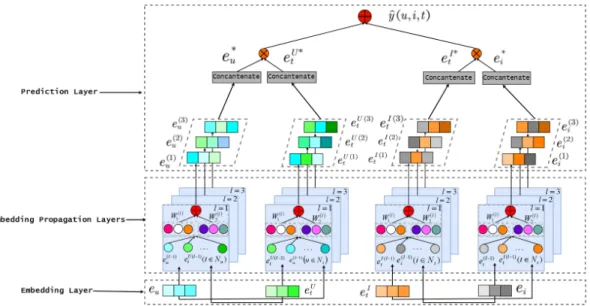
Fig. 1. The framework of our proposed personalized tag recommendation algorithm
IV. THEGRAPHNEURALNETWORKSBOOSTED
PERSONALIZEDTAGRECOMMENDATIONMODEL
In this section, we present the details of our proposed graph neural networks based personalized tag recommendation model.
A. The Framework of Personalized Tag Recommendation Method Based on GNNs
Figure 1 presents the architecture of our proposed model, which mainly consists of three layers: the embedding layer, the embedding propagation layer and the prediction layer. The main function of each layer described as follows: (1) the embedding layer obtains the embedding representations of users, items and tags based on their IDs; (2) the em-bedding propagation layer implements messages propagation and messages aggregation; (3) the prediction layer ensembles multiple representations for each type of entities and outputs the predicted score for a (user, item, tag) triplet. In the following sections, we describe the details of each component. 1) Embedding Layer: In the embedding layer, we project users, items and tags into a low-dimensional space according to their IDs. Specifically, a training instance is a quadruple
(u, i, t, t0), where u and i denote the indexes of user uand item i, respectively. t and t0 are the corresponding positive and negative tag indexes with respect to the post (u, i), respectively. We get the embedded representations of the user
u, the itemi, the positive tagt and the negative tagt0 by the lookup operation over the embedding matrices. Formally,
eu=U.onehot(u), ei=I.onehot(i),
eUt =TU.onehot(t), eUt0 =TU.onehot(t0),
eIt =TI.onehot(t), eIt0 =TI.onehot(t0),
(7)
whereonehot(.)denotes the one-hot encoding operation.
2) Embedding Propagation Layers: The goal of embedding propagation layers is to capture the collaborative signal and enrich the representations of users, items and tags. The collab-orative signal is not explicit, which is latent in the interaction among users, items and tags. In the embedding propagation layers, we mainly exploit the GNNs to explicitly capture the collaborative signal among interacted entities.
Generally, in personalized tag recommendation systems, there are three types of interactions, i.e. user-tag interactions, item-tag interactions and user-item interactions. Similar to [9], in this paper, we only consider user-tag interactions and item-tag interactions. For each type of interactions, we employ the message-passing mechanism to capture collaborative signal along the corresponding bipartite, which is derived from their interaction information. In each type of interactions, there are two types of messages that transmit along the interaction graph. Take the user-tag interaction as an example, the propa-gated messages include the information that propagates from tag node to user node as well as information that propagates from user node to tag node.
Given a user-tag pair (u, t), the propagated messages be-tween the user uand the tagt are defined as follows:
mu←t=put W1eUt +W2 eueUt
mt←u=ptu W1eu+W2 eUt eu
(8)
where mu←t and mt←u indicate the messages that transmit
from the tagt to the useruand from the useruto the tagt, respectively. And indicates the element-wise product. The
put and ptu are decay factors that are used to control each
message propagation. Formally,putandptuare defined as the
Laplacian norm √ 1
|Nu||Nt|
, where Nu and Nt represent the
first-hop neighbors of the useruand tag t, respectively. The
W1, W2∈Rd 0×d
are training weight matrices, whered0 is the transformation size.
Given the definition of propagation messages as well as the neighborhood structure of one node, we can aggregate the mes-sages to form a new representation for nodes, which explicitly encodes the first-order connectivity between interacted entities. Formally, by assembling the messages that are transmitted by the direct neighbors, the assembled representations for the user
uand the tagt are as follows:
e(1)u =LeakyReLU mu←u+ X t∈Nu mu←t ! eUt (1) =LeakyReLU mt←t+ X u∈Nt mt←u ! (9)
whereLeakyReLU is an activation function [26], which non-linearly transforms the propagated messages. And the mu←u
andmt←tconsider the self-connections of the useruand the
tag t, respectively.
By assembling the messages propagated from the direct neighbors, the assembled representations e(1)u and eUt
(1)
ex-plicitly consider the first-order connectivity information. In order to further enrich the representations, we inject the high-order connectivity information into the embedded represen-tations of nodes by stacking more embedding propagation layers. In other words, we assemble the messages from high-hop neighbors to generate the representations of users, items and tags. Specifically, with l embedding propagation layers, the assembled representations of the user uand the tagt are formulated as: e(ul)=LeakyReLU m(ul←)u+ X t∈Nu m(ul←)t ! eUt(l)=LeakyReLU m(t←l)t+ X u∈Nt m(tl←)u ! (10)
wherem(∗←l)?denotes the message that is propagated from their
corresponding l-hop neighbors. Formally, ( m(ul←)t=put W1(l)eU t (l−1) +W2(l)e(ul−1)eUt (l−1) m(ul←)u=W (l) 1 e (l−1) u ( m(tl←)u=put W1(l)eUt(l−1)+W2(l)e(ul−1)eUt (l−1) m(tl←)t=W1(l)eU t (l−1) (11) where W1(l), W2(l) ∈ Rdl×dl−1 are the weight transformation matrices, and the dl is transformation size. The e
(l−1)
u and
eUt(l−1) are the embedded representations that are obtained at the (l−1)th embedding propagation layer.
So far, we have described how to stack multiple embedding propagation layers to capture the collaborative signal between users and tags. Similarly, we adopt the similar architecture to deal with the item-tag interaction information, and capture the collaborative signal between items and tags by propagating and assembling embedded representations of neighbors of items or tags. In this way, we enrich the representations of items and
tags by exploiting the connectivity information encoded in the item-tag interactions.
3) Prediction Layer: By stacking multiple embedding prop-agation layers, we obtain the set of embedded representations of users, items and tags:
n e(1)u , e(2)u ,· · · , e(ul) o n e(1)i , e(2)i ,· · · , e(il)o n eUt(1), eUt(2),· · · , eUt(l)o n eIt(1), eIt(2),· · ·, eIt(l)o (12)
For each entity, the element e(∗l) is the output of embedding
propagation layer that assembles messages propagated from the l-hop neighbors. Hence, different element of one set focuses on different order of connectivity information, and characterizes different aspect of users’ preferences, items’ and tags’ characteristics. For each entity, since each element has contributions to the embedded representations of the entity, we concatenate all elements to get the final representation for the entity, e∗u=e(1)u ||e(2)u || · · · ||e(ul−1)||e(ul) e∗i =e(1)i ||e(2)i || · · · ||e(il−1)||e(il) eUt∗=eUt(1)||eUt(2)|| · · · ||eUt(l−1)||eUt(l) eIt∗=eIt(1)||eIt(2)|| · · · ||eIt(l−1)||eIt(l) (13)
where||is the concatenation operation.
In the way, the final representations of entities is endowed with rich semantics, which include both low-order and high-order connectivity information and capture the collaborative signal among interacted entities. Hence, the final represen-tation scheme could increase the expressiveness of entity embeddings.
Based on the final representations of users, items and tags, we also explicitly model the pairwise interaction between users, items and tags, which is similar to the PITF [9]. Given a triplet(u, i, t), the predicted scoreyˆu,i,t is computed as:
ˆ yu,i,t= X k e∗u,f ·eUt,f∗+X k e∗i,f·eIt,f∗ (14)
where k is the dimension of the final representations of entities.
B. Model Parameters Learning
We adopt the widely used ranking optimization criterion, i.e. the bayesian personalized ranking [11], to learn the model parameters of our proposed graph neural networks boosted tag recommendation model. The objective function of our proposed method is defined as follows:
L= min Φ X (u,i,t,t0)∈D S −lnσ(ybu,i,t−ybu,i,t0) +λΦ||Φ|| 2 F (15)
where (u, i, t, t0) is the training data, which include two in-stances, i.e. a positive instance(u, i, t)and a negative instance
(u, i, t0). AndΦ={U,I,TU,TI, W(i) 1 , W
(i)
2 , i= 1,2, ..., l}
is the model parameters.λΦdenotes regularization coefficient
that controls the effect of the regularization terms. In addition, we adopt the mini-batch Adam optimizer to optimize the objective function L.
V. EMPIRICALANALYSIS
In this section, we conduct several groups of experiments on two real-world datasets to compare the performance of our proposed personalized tag recommendation method with other state-of-the-art methods.
A. Dataset
In our experiments, we choose two public available datasets, i.e. Last.fm and ML10M1, to evaluate the performance of our proposed tag recommendation algorithm. Similar to [9], [17], we preprocess each dataset to get their corresponding p-core, which is the largest subset with the property that every user, every item and every tag has to occur at least p times. In our experiments, all datasets are 5-core and 10-core. The general statistics of datasets are summarized in Table I.
TABLE I DESCRIPTION OFDATASETS
Dataset #Users #Items #Tags lastfm-core5 1348 6927 2132 lastfm-core10 966 3870 1024 ml-10m-core5 990 3247 2566 ml-10m-core10 469 1524 1017
B. Evaluation Metrics
We adopt the common evaluation protocol, which is widely used in [9], [17]. Specifically, for each user, we randomly select one post and remove the triples that related to the selected post from S toStest. The remaining observed
user-item-tag triples are the training setStrain :=S\Stest. Similar
to the classic item recommendation problem, the personalized tag recommendation provides a top-N highest ranked list of tags for a (user, item) pair. Hence, we employ two widely used ranking metrics to measure the tag recommendation performance of all compared methods, i.e., Precision@N
and Recall@N, where N denotes the length of ranked tag recommendation list. Formally,
P rec@N:= 1 |PStest| X (u,i)∈PStest |T op(u, i, N)∩ {t|(u, i, t)∈Stest}| N Rec@N:= 1 |PStest| X (u,i)∈PStest |T op(u, i, N)∩ {t|(u, i, t)∈Stest}| |{t|(u, i, t)∈Stest}| where |PStest| is the number of posts then are included in
the test set Stest. For both metrics, we setN = 3,5,10,20to
evaluate the performance in our experiments.
1Two datasets can be found in https://grouplens.org/datasets/hetrec-2011/
C. Experimental Settings
We choose the following traditional tag recommendation algorithms as baselines:
• PITF: PITF [9] was proposed by Rendle and Steffen. It
explicitly models the pairwise interaction between users, items and tags, and is a strong competitor in the field of personalized tag recommendation.
• NLTF: NLTF [10] was proposed by Fang et al. It is a non-linear tensor factorization model, which enhances the PITF by exploiting the Gaussian radial basis function to capture the non-linear interaction relations among users, items and tags.
• ABNT: ABNT [20] was proposed by Yuan et al. It utilizes the multi-layer perceptron to model the non-linearities of interactions between users, items and tags.
To make a fair comparison, we set the parameters of each model based on respective references or based on our experiments, such that the recommendation performance of the compared models is optimal under these parameters. For all compared methods, the dimension of latent factor vector dis tuned amongst{8,16,32,64,128,256}. The mini-batch size is selected from{512,1024,2048}and the learning rate is tuned amongst {0.001,0.005,0.01}. The regularization coefficient is chosen from {0.001,0.005,0.01,0.05}. All latent factor vectors and parameters are randomly initialized using the Gaussian distribution with mean of 0 and standard deviation of 0.01. For most datasets and baselines, we empirically set the dimension of latent factor vector d with 64, the number of batch is 512, the learning rate is set to 0.001, and the regularization coefficient is0.01. For the ABNT, the structure of multi-layer perceptron follows the tower structure, i.e. the dimension of hidden layer is half of that of the previous hidden layer. For our proposed method, we set the number of embedding propagation layersl= 3.
D. Performance Comparison
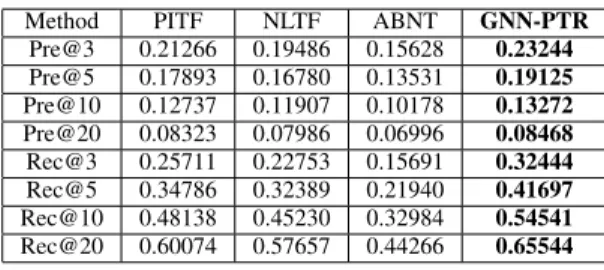
Tables II, III, IV, V report the tag recommendation quality of all compared methods on four datasets.
TABLE II
PERFORMANCECOMPARISONS ON LASTFM-CORE5 Method PITF NLTF ABNT GNN-PTR
Pre@3 0.21266 0.19486 0.15628 0.23244 Pre@5 0.17893 0.16780 0.13531 0.19125 Pre@10 0.12737 0.11907 0.10178 0.13272 Pre@20 0.08323 0.07986 0.06996 0.08468 Rec@3 0.25711 0.22753 0.15691 0.32444 Rec@5 0.34786 0.32389 0.21940 0.41697 Rec@10 0.48138 0.45230 0.32984 0.54541 Rec@20 0.60074 0.57657 0.44266 0.65544
From Table II to Table V, we have the following obser-vations: (1) On four datasets, PITF achieves a better per-formance than NTLF and ABNT, which demonstrates the strong competitiveness of PITF model. On the other hand, the observation also indicates that integrating the multi-layer
perceptron into PITF framework cannot guarantee improve-ments of tag recommendation quality, although ABNT is built upon the PITF. One possible reason is that the ABNT involves more trainable parameters, whereas train data available is insufficient for learning its model parameters. (2) For each compared method, its recommendation performance is better on the core-10 datasets than that on the corresponding core-5 datasets. This observation indicates that increasing the density of datasets could boost the tag recommendation performance. (3) Our proposed graph neural networks based personalized tag recommendation method consistently outperforms other methods, which demonstrates the effectiveness of our proposed method. In terms of precision@3, our proposed GNN-PTR model improves the PITF by 9.3% and 4.1% on last.fm-core5 and ml-10m-core5, respectively. In terms of precision@5, the improvements of GNN-PTR over PITF are 2.7% and 18.6% on last.fm-core10 and ml-10-core10, respectively. To some extent, the improvements are considerable. Hence, this observation confirms that integrating the collaborative signal into the learning of embeddings in an explicitly manner is beneficial for the personalized tag recommendation model.
TABLE III
PERFORMANCECOMPARISONS ON LASTFM-CORE10 Method PITF NLTF ABNT GNN-PTR
Pre@3 0.25132 0.24431 0.16406 0.26467 Pre@5 0.20875 0.20624 0.13665 0.21429 Pre@10 0.14577 0.12493 0.09413 0.14617 Pre@20 0.08931 0.08205 0.06796 0.09224 Rec@3 0.32035 0.28448 0.15792 0.34791 Rec@5 0.41583 0.40170 0.21895 0.45288 Rec@10 0.56539 0.55412 0.30336 0.58738 Rec@20 0.69311 0.68562 0.45190 0.71441 TABLE IV
PERFORMANCECOMPARISONS ON ML-10M-CORE5 Method PITF NLTF ABNT GNN-PTR
Pre@3 0.13976 0.13232 0.08215 0.14545 Pre@5 0.10206 0.09717 0.06283 0.10545 Pre@10 0.06414 0.05960 0.04000 0.06717 Pre@20 0.03768 0.03667 0.02470 0.04046 Rec@3 0.32077 0.29738 0.20888 0.33312 Rec@5 0.39096 0.35602 0.25378 0.39653 Rec@10 0.46230 0.42697 0.30388 0.48516 Rec@20 0.52332 0.51305 0.36596 0.57213 TABLE V
PERFORMANCECOMPARISONS ON ML-10M-CORE10 Method PITF NLTF ABNT GNN-PTR
Pre@3 0.16986 0.14357 0.08955 0.19332 Pre@5 0.11725 0.11429 0.07591 0.13902 Pre@10 0.07443 0.07143 0.05011 0.08422 Pre@20 0.04479 0.04382 0.03369 0.04989 Rec@3 0.37704 0.33881 0.22100 0.46023 Rec@5 0.45230 0.43344 0.30147 0.54606 Rec@10 0.52050 0.53408 0.38579 0.63980 Rec@20 0.60167 0.63966 0.50586 0.73557
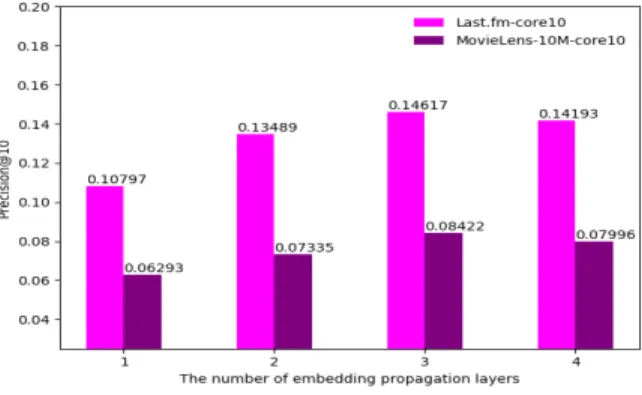
E. Impact of The Number of Embeddings Propagation Layers In our proposed method, the number of embedding propa-gation layers l is an important parameter that affects the tag recommendation performance of our proposed model. In this section, we conduct a group of experiments to explore the effect of l on tag recommendation performance by varying the value of l from 1 to 4. Other parameters keep the same settings as described in Section V-C. The experimental results in terms of precision@10 on lastfm-core10 and ml-10-core10 are shown in Figure 2.
Fig. 2. Impact of the number of embedding propagation layers
As shown in Fig. 2, our proposed tag recommendation model is sensitive to the value of l. With the number of embedding propagation layers increases, theP rescision@10
of GNN-PTR firstly increases. Then, if the number of embed-ding propagation layers continues to increase and surpasses a threshold value, the performance of the proposed model begins to degrade. The possible reason is that: a large value oflmakes our proposed method leverage the collaborative signal that is propagated from the relative distant neighbors. Intuitively, the collaborative signal of the distant neighbors may not be helpful for enriching the representation of target entities since the correlations between entity and their distant neighbors are weak. When the number of embedding propagation layers
l= 3, our proposed personalized tag recommendation method achieves the best performance.
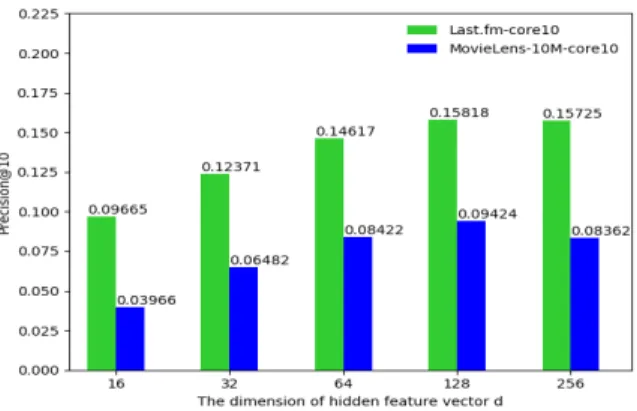
F. Impact of The Dimension of Latent Feature Vectors In this section, we vary the dimension of the hidden feature vectors d in [16, 32, 64, 128, 256] , and investigate the impact of parameterd on tag recommendation quality. Other parameters remain unchanged. We only plot the precision@10 of GNN-PTR on lastfm-core10 and ml-10m-core10 in Fig. 3. Other metrics show similar trends.
As we can see, the dimension of latent feature vectors d
also affects the recommendation performance of GNN-PTR. In the early stage, the recommendation performance of GNN-PTR is constantly improving as the value ofdincreases. Then, when the value ofdreaches to 128, the curve of precision@10 remains stable and the tag recommendation performance does not further improve as we further increase the value ofd. This is because that if the latent feature vectors can capture the
Fig. 3. Impact of parameterd.
interacted entities’ preferences or characteristics effectively, further increasing the value of d could not enhance the representation capacity of our proposed model. Our proposed recommendation method achieves its best performance when
dis equal to 128.
VI. CONCLUSION
Traditional personalized tag recommendation methods ig-nore the collaborative signal in the process of learning repre-sentation of entities, leading to the lack of expressive ability for characterizing the preferences or attributes of entities. In this paper, we proposed a graph neural networks boosted personalized tag recommendation model, which integrates the graph neural networks into the pairwise interaction tensor factorization model. Based on the user-item-tag interaction triples, we consider two types of interactions, i.e. the user-tag interactions and the item-tag interactions. We exploit the graph neural networks to capture the collaborative signal between interacted entities as well as integrate the collaborative signal into the learning of representations of entities by performing messages propagation over the entity interaction graphs. Ex-perimental results show that our proposed method outperforms the state-of-the-art personalized tag recommendation methods.
ACKNOWLEDGMENTS
This work is supported in part by the Natural Science Foundation of the Higher Education Institutions of Jiangsu Province (Grant No. 17KJB520028 ), NUPTSF (Grant No. NY217114), Tongda College of Nanjing University of Posts and Telecommunications (Grant No. XK203XZ18002), Sci-entific Research Foundation for Advanced Talents of Hubei University of technology (Grant No. BSQD2019026) and Qing Lan Project of Jiangsu Province.
REFERENCES
[1] G. Adomavicius and A. Tuzhilin, “Toward the next generation of recommender systems: A survey of the state-of-the-art and possible extensions,”TKDE, no. 6, pp. 734–749, 2005.
[2] A. Hotho, R. J¨aschke, C. Schmitz, and G. Stumme, “Information retrieval in folksonomies: Search and ranking,” inEuropean Semantic Web Conference. Springer, 2006, pp. 411–426.
[3] R. J¨aschke, L. Marinho, A. Hotho, L. Schmidt-Thieme, and G. Stumme, “Tag recommendations in folksonomies,” in European Conference on Principles of Data Mining and Knowledge Discovery. Springer, 2007, pp. 506–514.
[4] R. Krestel, P. Fankhauser, and W. Nejdl, “Latent dirichlet allocation for tag recommendation,” inRecSys. ACM, 2009, pp. 61–68.
[5] Y. Wu, Y. Yao, F. Xu, H. Tong, and J. Lu, “Tag2word: Using tags to generate words for content based tag recommendation,” in CIKM. ACM, 2016, pp. 2287–2292.
[6] S. Tang, Y. Yao, S. Zhang, F. Xu, T. Gu, H. Tong, X. Yan, and J. Lu, “An integral tag recommendation model for textual content,” inProceedings of the AAAI Conference on Artificial Intelligence, vol. 33, 2019, pp. 5109–5116.
[7] B. Sun, Y. Zhu, Y. Xiao, R. Xiao, and Y. Wei, “Automatic question tagging with deep neural networks,” IEEE Transactions on Learning Technologies, vol. 12, no. 1, pp. 29–43, 2018.
[8] P. Symeonidis, A. Nanopoulos, and Y. Manolopoulos, “Tag recommen-dations based on tensor dimensionality reduction,” inRecSys. ACM, 2008, pp. 43–50.
[9] S. Rendle and L. Schmidt-Thieme, “Pairwise interaction tensor factor-ization for personalized tag recommendation,” inWSDM. ACM, 2010, pp. 81–90.
[10] X. Fang, R. Pan, G. Cao, X. He, and W. Dai, “Personalized tag recommendation through nonlinear tensor factorization using gaussian kernel,” inAAAI, 2015.
[11] S. Rendle, C. Freudenthaler, Z. Gantner, and L. Schmidt-Thieme, “Bpr: Bayesian personalized ranking from implicit feedback,” inUAI, 2009, pp. 452–461.
[12] J. Zhou, G. Cui, Z. Zhang, C. Yang, Z. Liu, and M. Sun, “Graph neural networks: A review of methods and applications,”ArXiv, 2018. [13] Y. Qian, P. Zhao, Z. Li, J. Fang, L. Zhao, V. S. Sheng, and Z. Cui,
“Interaction graph neural network for news recommendation,” inWISE. Springer, 2019, pp. 599–614.
[14] W. Fan, Y. Ma, Q. Li, Y. He, E. Zhao, J. Tang, and D. Yin, “Graph neural networks for social recommendation,” inWWW. ACM, 2019, pp. 417–426.
[15] S. Wu, Y. Tang, Y. Zhu, L. Wang, X. Xie, and T. Tan, “Session-based recommendation with graph neural networks,” inAAAI, vol. 33, 2019, pp. 346–353.
[16] X. Wang, X. He, M. Wang, F. Feng, and T.-S. Chua, “Neural graph collaborative filtering,” inSIGIR, 2019, pp. 165–174.
[17] S. Rendle, L. Balby Marinho, A. Nanopoulos, and L. Schmidt-Thieme, “Learning optimal ranking with tensor factorization for tag recommen-dation,” inKDD. ACM, 2009, pp. 727–736.
[18] L. De Lathauwer, B. De Moor, and J. Vandewalle, “A multilinear singular value decomposition,” SIAM journal on Matrix Analysis and Applications, vol. 21, no. 4, pp. 1253–1278, 2000.
[19] Y. Cai, M. Zhang, D. Luo, C. Ding, and S. Chakravarthy, “Low-order tensor decompositions for social tagging recommendation,” inWSDM. ACM, 2011, pp. 695–704.
[20] J. Yuan, Y. Jin, W. Liu, and X. Wang, “Attention-based neural tag recommendation,” inInternational Conference on Database Systems for Advanced Applications. Springer, 2019, pp. 350–365.
[21] R. Ying, R. He, K. Chen, P. Eksombatchai, W. L. Hamilton, and J. Leskovec, “Graph convolutional neural networks for web-scale rec-ommender systems,” inKDD. ACM, 2018, pp. 974–983.
[22] R. van den Berg, T. Kipf, and M. Welling, “Graph convolutional matrix completion,”ArXiv, 2017.
[23] L. Wu, P. Sun, R. Hong, Y. Fu, X. Wang, and M. Wang, “Socialgcn: An efficient graph convolutional network based model for social recom-mendation,”ArXiv, 2018.
[24] R. Pan, Y. Zhou, B. Cao, N. N. Liu, R. Lukose, M. Scholz, and Q. Yang, “One-class collaborative filtering,” inICDM. IEEE, 2008, pp. 502–511. [25] Y. Hu, Y. Koren, and C. Volinsky, “Collaborative filtering for implicit
feedback datasets,” inICDM. IEEE, 2008, pp. 263–272.
[26] P. Velickovic, G. Cucurull, A. Casanova, A. Romero, P. Li`o, and Y. Bengio, “Graph attention networks,”ArXiv, 2017.