Database Server Workload Characterization in an E-commerce Environment
A Thesis Submitted to the College of
Graduate Studies and Research
in Partial Fulfillment of the Requirements
For the Degree of Master of Science
in the Department of Computer Science
University of Saskatchewan
Saskatoon, Saskatchewan
by
Fujian Liu
c
Permission To Use
In presenting this thesis in partial fulfillment of the requirements for a Post-graduate degree from the University of Saskatchewan, I agree that the Libraries of this University may make it freely available for inspection. I further agree that per-mission for copying of this thesis in any manner, in whole or in part, for scholarly purposes may be granted by the professor or professors who supervised my thesis work or, in their absence, by the Head of the Department or the Dean of the College in which my thesis work was done. It is understood that any copying or publication or use of this thesis or parts thereof for financial gain shall not be allowed without my written permission. It is also understood that due recognition shall be given to me and to the University of Saskatchewan in any scholarly use which may be made of any material in my thesis.
Requests for permission to copy or to make other use of material in this thesis in whole or part should be addressed to:
Head of the Department of Computer Science University of Saskatchewan
Saskatoon, Saskatchewan, Canada S7N 5C9
Abstract
A typical E-commerce system that is deployed on the Internet has multiple layers that include Web users, Web servers, application servers, and a database server. As the system use and user request frequency increase, Web/application servers can be scaled up by replication. A load balancing proxy can be used to route user requests to individual machines that perform the same functionality.
To address the increasing workload while avoiding replicating the database server, various dynamic caching policies have been proposed to reduce the database workload in E-commerce systems. However, the nature of the changes seen by the database server as a result of dynamic caching remains unknown. A good understanding of this change is fundamental for tuning a database server to get better performance.
In this study, the TPC-W (a transactional Web E-commerce benchmark) work-loads on a database server are characterized under two different dynamic caching mechanisms, which are generalized and implemented as query-result cache and table cache. The characterization focuses on response time, CPU computation, buffer pool references, disk I/O references, and workload classification.
This thesis combines a variety of analysis techniques: simulation, real time mea-surement and data mining. The experimental results in this thesis reveal some inter-esting effects that the dynamic caching has on the database server workload charac-teristics. The main observations include: (a) dynamic cache can considerably reduce the CPU usage of the database server and the number of database page references when it is heavily loaded; (b) dynamic cache can also reduce the database reference locality, but to a smaller degree than that reported in file servers. The data classifi-cation results in this thesis show that with dynamic cache, the database server sees TPC-W profiles more like on-line transaction processing workloads.
Acknowledgements
I would like to extend my sincere gratitude to all those who gave me the pos-sibility to complete this thesis. First, I am deeply indebted to my supervisor, Dr. Dwight Makaroff, for his constant encouragement and valuable suggestions during all the time of research and writing of this thesis. In particular, I highly appreciate the great amount of time he spent for my program and his high availability to stu-dents. I have learned a lot from his overly dedication and enthusiasm to research. Besides of being an excellent supervisor, Dwight is as close as a great friend to me. I am really glad that I have come to get know Dwight in my life.
My thanks also go to Dr. David Klymyshyn (external), Dr. Nadeem Jamali, and Dr. Derek Eager for serving as members of my thesis defense committee. Their insightful comments and suggestions have gone a long way to improve the quality of the thesis.
Thanks to Brian Gallaway (System Administrator) for providing technical sup-port whenever I needed it. Thanks to Jan Thompson (Graduate Correspondent) for her effective administrative helps. Thanks to my fellow graduate students for making my time in the program memorable.
This thesis could not have been accomplished without Huan Liang, my wife who is always with me no matter how dubious my decision were. She always gives me incredible support and love in every situation. I believe I owe deepest thanks to all people in my entire family who have supported me since I came to Canada.
Table Of Contents
Permission To Use i
Abstract ii
Acknowledgements iii
Table Of Contents iv
List of Tables vii
List of Figures viii
List of Acronyms x
1 Introduction 1
1.1 E-commerce System and Their Challenges . . . 1
1.2 Definitions . . . 3
1.3 A Typical Three-tier E-commerce System . . . 4
1.4 General Caching . . . 7
1.5 Dynamic Caching in E-commerce Systems . . . 7
1.6 Thesis Statement . . . 9
1.7 Contributions . . . 10
1.8 Thesis Overview . . . 10
2 Background 11 2.1 DBMS . . . 11
2.1.1 DBMS Components and Buffer Pool Management . . . 12
2.1.2 Parallel DBMS and Distributed DBMS . . . 14
2.2 Caching in E-commerce System . . . 16 2.3 TPC-W: An E-commerce Benchmark . . . 18 2.3.1 TPC-W Database . . . 18 2.3.2 TPC-W Workload Profiles . . . 19 2.4 Summary . . . 20 3 Related Work 22 3.1 Caching Effects . . . 22
3.2 Dynamic Caching Mechanisms . . . 23
3.3 DBMS Buffer Pool and Workload Studies . . . 25
3.3.1 DBMS Buffer Pool Replacement Algorithms . . . 25
3.3.2 Database Buffer Pool Simulation . . . 26
3.3.3 DBMS Workload Studies . . . 27
3.4 Summary . . . 28
4 Methodology and Experimental Setup 30 4.1 Methodology . . . 30
4.1.1 Simulation of Dynamic Caching . . . 30
4.1.2 Workload Characterization . . . 31
4.1.3 TPC-W Profile Classification under Caching . . . 32
4.2 Experiment Design . . . 33
4.2.1 Experimental Architecture . . . 33
4.2.2 Metrics for Workload Characterization . . . 34
4.2.3 Metrics and Procedure for TPC-W Profile Classification . . . 37
4.3 Experiment Configuration . . . 39
4.3.1 Dynamic Caching Simulation . . . 39
4.3.2 TPC-W Workload Configuration . . . 40
4.3.3 Buffer Pool Trace Collection and Description . . . 41
4.3.4 Snapshot Description and Collection . . . 43
4.4 Experiment Parameters. . . 44
4.4.2 TPC-W Running Parameters . . . 45
4.4.3 Buffer Pool Simulator and Classifier Parameters . . . 46
5 Workload Characterization 48 5.1 Response Time . . . 48
5.2 Cache Hit Ratio . . . 50
5.3 CPU Utilization . . . 51
5.4 Reference Characteristics . . . 52
5.4.1 Working Set Size . . . 55
5.4.2 Temporal Locality . . . 57
5.4.3 Physical I/O Operations . . . 60
5.4.4 Spatial Locality . . . 63
5.5 Buffer Pool Replacement Algorithms . . . 64
5.6 Summary . . . 69
6 Workload Classification 70 6.1 Attributes Without Caching . . . 70
6.2 Attributes Under Caching . . . 73
6.3 Classification Under Caching . . . 83
6.4 Summary . . . 84
7 Conclusions and Future Work 85 7.1 Conclusions . . . 85
7.2 Future Work . . . 86
List of Tables
2.1 TPC-W Database Scaling Rules with Example Table Sizes . . . 19
2.2 TPC-W Workload Profiles . . . 20
4.1 Database Size . . . 41
4.2 TPC-W Database Indexes . . . 42
4.3 Buffer Pool Trace Fields . . . 42
4.4 DB2 Default Settings . . . 45
4.5 TPC-W (tpcw.rbe) Running Parameters . . . 45
4.6 Buffer Pool Simulator (bps) Parameters . . . 47
4.7 Profile Classifier (weka.classifiers.trees.J48) Parameters . . . 47
5.1 Timeout Threshold (1,800 EBs) . . . 51
5.2 Reductions in the CPU Utilization of DBMS . . . 51
List of Figures
1.1 Three-tiered E-commerce Architecture . . . 5
4.1 The Experiment Architecture . . . 34
4.2 The Metrics and Corresponding Experiments . . . 35
4.3 The Classfication of the TPC-W Profiles . . . 38
4.4 ARFF File . . . 43
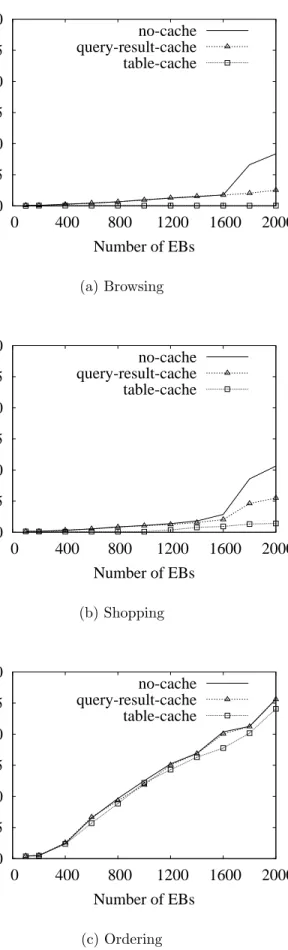
5.1 Response Time . . . 49
5.2 Database Page References . . . 54
5.3 Working Set Size . . . 56
5.4 Buffer Pool Overall Miss Ratio (LRU) . . . 58
5.5 Buffer Pool Write Miss Ratio (LRU) . . . 61
5.6 Number of Disk I/Os . . . 62
5.7 Run Length of Database Page References . . . 65
5.8 Buffer Pool Overall Miss Ratio (Shopping) . . . 66
5.9 Buffer Pool Overall Miss Ratio (Browsing) . . . 67
5.10 Buffer Pool Overall Miss Ratio (Ordering) . . . 68
6.1 Snapshot Attributes . . . 71
6.2 Attributes for Browsing, Shopping, and Ordering without Caching . . 72
6.3 Attributes for Browsing and Ordering with Query-Result Cache . . . 74
6.4 Attributes for Browsing and Ordering with Table Cache . . . 75
6.5 Pages Read Cumulative Distributions . . . 77
6.6 Rows Selected Cumulative Distributions . . . 78
6.7 Queries Proportion Cumulative Distributions . . . 79
6.8 Number of Sorts Cumulative Distributions . . . 80
6.9 Index Ratio Cumulative Distributions . . . 81
List of Acronyms
2Q – Two Queue (buffer pool replacement algorithm) ACID – Atomicity, Consistency, Isolation, and Durability ARC – Adaptive Replacement Cache
CLOCK – Clock (buffer pool replacement algorithm) CPU– Central Processing Unit
DBMS – DataBase Management System DCA – Dynamic Content Accelerator DSS– Decision Support System EB– Emulated Browser
E-commerce – Electronic commerce FBR – Frequency Based Replacement FIFO – First-In First-Out
HTML – HyperText Mark-up Language HTTP– HyperText Transfer Protocol
IRR– Inter-Reference Recency (buffer pool replacement algorithm) JDBC– Java DataBase Connectivity
KB – Kilo Bytes (210
bytes) LFU – Least Frequently Used
LIRS– Low Inter-reference Recency Set LRU – Least Recently Used
MP – Multiple Processors MRU – Most Recently Used
OLAP – On-Line Analytical Processing OLTP – On-Line Transaction Processing PGE– Payment Gateway Emulator QoS – Quality of Service
RAM – Random Access Memory RPM – Revolutions Per Minute
SCSI – Small Computer Systems Interface SQL – Structured Query Language
SSL– Secure Sockets Layer
TPC – Transaction Processing Performance Council TPC-C– TPC benchmark C
TPC-D– TPC benchmark D TPC-H– TPC benchmark H TPC-W – TPC benchmark W UDB – Universal DataBase UID – Update/Insert/Delete URL– Uniform Resource Locator WIPS – Web Interactions Per Second
Chapter 1
Introduction
1.1
E-commerce System and Their Challenges
The use of computer networks to conduct commercial activities has shown a steady increase and is an important component of the retail industry. The term E-commerce is used to describe many forms of such activity, from business to consumer, business to business and consumer to consumer. Different researchers and business people use the term in different contexts. In one report published by US Census Bureau1
, the E-commerce sales reached 21 billion dollars in the third quarter of 2005, which accounted for 2.2% of total retail sales; compared with the same quarter in the previous year, the E-commerce sales increased by 26.5% at an annual rate on average for every quarter from the first quarter of 2001 to the third quarter of 2005.
Also, Statistics Canada2
reports that the E-commerce sales in Canada increased by a high annual rate of 51.4% on average from the year of 2000 to the year of 2004. More interestingly, it shows that in Canada, private sector firms accounted for an overwhelming majority of the E-commerce sales, and that business to business sales played an important role in E-commerce activities. For example in 2004, private companies contributed 93% of the total E-commerce sales, and business to business sales represented 75% of total E-commerce sales by private firms.
E-commerce provides Web users the convenience of shopping online. If Web users experience long response time however, the results to an E-commerce business
1
http://www.census.gov/mrts/www/data/html/05Q3table4.html
2
provider can be detrimental. Previous study [25] has shown that users abandon Web sites at the rate of 2% when the response times are less than 7 seconds, while this rate goes dramatically up to 30% with response times around 8 seconds, and jumps to 70% if response times are more than 12 seconds. Slow processing of the online transactions caused about 420 million USD in lost revenues in 1999 [42]. A response time is composed of client processing time, network delay and server processing time, and it has been found that server-side latency accounts for 40% of the Web page delay experienced by the Web users [21].
The database server in E-commerce systems can become the performance bottle-neck when the request frequency increases due to the increase of the number of Web users. Zhang et al. [53] have shown that the database server response time increases dramatically when the number of concurrent users increases. All the database re-sponse times are less than 5 seconds when there are 128 concurrent users. However, 5% of the database response times are more than 5 seconds when there are 256 concurrent users, and the percentage goes up to 20% when there are 512 concurrent users.
To reduce the delay at the server side, a database server in an E-commerce system can be upgraded to a machine with a faster CPU, more memory, and faster disks. This is an expensive solution, however, and such a server will become the bottleneck again due to the continuous increase of database size and the request frequency.
Fortunately, there are two alternative solutions addressing the challenge [26]. The first one is to extend the traditional database to a parallel database or dis-tributed database to achieve the scalability. The second solution is to use caching to store frequently accessed items in higher speed storage locations either near clients or near the server.
Database workloads in E-commerce tend to be split into 2 separate activi-ties/categories. Some of the data is mainly read-only data, for example the address of a customer. Other data is updated very often, such as prices and quantities in stock. As well, the order table is updated on every order transaction. Parallel/distributed
databases do not explicitly consider this processing characteristic and instead try to optimize performance for a general database workload [37]. Therefore, the ap-proach in this thesis will focus on caching techniques which permit the separation of data items according to their usage characteristics. In such techniques, managing read-only data at a cache can reduce the load on a database server, while updates are still served by the database server.
Caching can affect the characteristics of the E-commerce workloads seen by the database server. Understanding the effects that caching has on E-commerce work-loads is crucial for the design and tuning of database servers in E-commerce systems. This thesis studies the effects that caching has on the database workloads in an E-commerce environment.
1.2
Definitions
Some words/terms used in this thesis have their word context in general use, but they are restricted for the purpose of this thesis. These terms include “E-commerce”, “response time”, and ”transaction”.
E-commerce: E-commerce can be generally defined as electronically conduct-ing any form of business, such as buyconduct-ing, sellconduct-ing, marketconduct-ing, and negotiatconduct-ing over computer networks [5]. In this thesis, E-commerce is more narrowly referred to as the business model of purchasing and selling products and/or services electronically over the Internet. Particularly, the focus is on a Web commerce model. In a Web commerce system, a consumer treats a company’s Web site as a virtual store where the consumer can browse around or buy products/services and pay with a credit card [36].
Response time: In this thesis, response time is used in two different contexts. The response time of a Web user request is a significant metric which has been used to measure the performance of an E-commerce system [41]. It refers to the time elapsed from when a user requests a Web interaction until when the user receives the resultant Web page. The response time of a database server refers to the time
elapsed from an application requesting a database transaction until the transaction is completed and the feedback is sent to the application.
Transaction: This term is generally used in this thesis to refer to a complete data exchange process between a Web user and the related servers of an enterprise computer system3
. The enterprise servers usually include Web servers, application servers, and a database server. From a database point of view, a transaction is also defined as an atomic database management system (DBMS) interaction [41]. It is guaranteed either to complete successfully or not at all. If a transaction completes successfully, database changes are said to be committed; if not, changes are rolled back. The meaning of “transaction” in this thesis depends on the context. It refers to the first process if associated with an entire enterprise server system, while it refers to the latter activity if used with respect to a database server only.
1.3
A Typical Three-tier E-commerce System
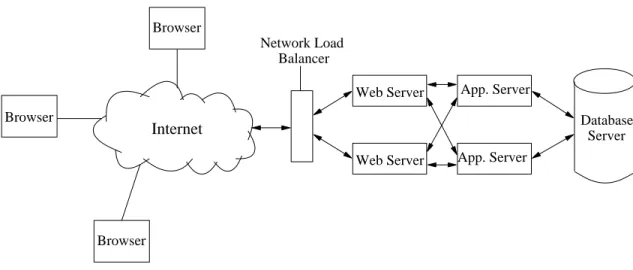
There are at least three types of E-commerce applications: business to business, business to consumer, and consumer to consumer [9]. The focus of this study is the business to consumer model. A representative business to consumer enterprise E-commerce system includes three tiers (as shown in Figure 1.1): Web servers, application servers, and a database server that host the functions of presentation logic, business logic, and data management respectively [31].
In the three-tier E-commerce system architecture shown in Figure 1.1, each Web/application server can run on the same machine or separate ones. Running on separate machines introduces network latency between the Web server and the application server. Using one machine removes the network latency, but adds some requirements on the hardware, such as memory, due to the resource competition between the Web server and the application server programs. In a typical system, instead of sharing one machine with Web/application servers, a dedicated machine with a fast CPU running a traditional centralized database server is generally
de-3
Browser Browser Browser Balancer Network Load Internet Web Server
Web Server App. Server
App. Server
Database Server
Figure 1.1: Three-tiered E-commerce Architecture
ployed [18, 25] to get better system performance, such as good response time. Users in this type of a system (as in Figure1.1) interact with the system through a Web interface and the system executes business logic at application servers. The business logic typically responds to requests from the Web servers, and may access the database server to complete the requests, and build response pages in order to do so. Application servers also keep track of user sessions to manage the shopping cart and provide page personalization. The database server stores business information, for example the price of a product. The database server also processes queries from the application server, for example selecting the top ten best sellers from the product table.
When a user accesses an E-commerce Web site, an outgoing request from the user is received by a Web server. An example of such a request is “get product details”. Next, the Web server takes out the associated parameters from the request and routes the parameters to an application server. The application server identifies the requested data and sends queries to the database server. The database server processes the queries and sends the results back to the application server. Then, the application server uses the results to assemble a page and sends it to the Web server for final transmission to the user. Finally, the response Web page is displayed in the user’s Web browser.
In a typical Web E-commerce system, the data objects stored at Web/application servers, such as images and scripts, are static. To achieve a high degree of scalability, Web servers and application servers can be scaled up by adding more machines using current network load balancing technology [26]. It is cost-effective to use many low-end commodity machines as Web/application servers. The system administrators can use multiple similarly configured machines to execute the functionality and im-plement a proxy machine to route the initial requests to individual Web/application servers. On the other hand, the database server stores some data, such as product quantities, that is updated frequently by transactions. It is very difficult and costly to replicate the database server while maintaining data consistency efficiently in E-commerce systems [25, 40].
Suppose several replicated databases are grouped together to serve queries via a standalone load-balancing machine. Assume a dedicated master database broadcasts any update, such as a new on sale price, to all other databases when it comes to the database group. An update is completed only after a transaction is committed across all the databases to ensure data consistency [40]. The relevant data items have to be locked until the final commit is performed on all the databases, before the fresh data is available to the incoming queries that depend on the updated data. This synchronization would be very costly, since the transaction data at an E-commerce site is usually updated with a high frequency, sometimes in a burst mode.
The single database server can use up its computing resources however to process queries from application servers with a high user request frequency. It then becomes the bottleneck of E-commerce systems, and the time spent at the database server will dominate the response time perceived by the Web users [26, 29, 53].
Caching is used in E-commerce systems for the following reasons. First, a parallel DBMS or distributed DBMS is still expensive, while cache servers can use cheap machines. The database server is often the most expensive component in the system. For example in the xSeries 440 system, the price of the database server is about the same as that of the sixty-two front-end servers (27 Web servers, 21 image servers, and 14 Web caches). Second, by holding the cached content on a separate server and
moving it closer to users, caching can achieve additional gains on the challenges of availability and performance via reduced network latency and other related factors as well as reducing the cost of the database server. These factors are not explicitly considered in this thesis, but are part of future work.
1.4
General Caching
Caching is a fundamental technique used to improve the performance of a com-puter system. It is widely used in operating systems, database systems, and Web servers/proxies. The objective of caches is to reduce the relative number of accesses to storage devices which have longer access times. Caching mechanisms store some portion of the data from the device with longer access time in the device that has shorter access time [35]. The resources saved could be memory access (for CPU cache), disk I/O (for file client cache and server cache), and network bandwidth (for Web browser cache and proxy cache).
Caching is often used at different levels of a system. Furthermore, it is common to have multi-level caches. A storage system has I/O controller cache and disk cache. A file system has client cache, server cache, in addition to the underlying storage caches. A Web site has browser cache, one or more proxy caches, Web server cache, in addition to the cache hierarchies of the underlying file and storage system. A database system has buffer pool cache in addition to the cache hierarchies of the underlying storage system.
1.5
Dynamic Caching in E-commerce Systems
To reduce the load on the database server and reduce the user response time, a variety ofdynamic caching approaches have been proposed for E-commerce systems. The dynamic cache can be placed in the infrastructure of an enterprise E-commerce system or over the Internet between users and an enterprise E-commerce system.
some queries can be filtered out before they reach the database server. A query result cache stores query results and serves subsequent identical queries using these results. A table-cache server runs on a separate machine and replicates infrequently-updated tables. The table cache server processes queries that involve the replicated tables so as to reduce the load on the database server.
In this thesis, a single cache is used. For query result cache, a timeout value (30 seconds) is set for all the cache results. After the timeout, a cached result becomes invalid, and the corresponding query must be forwarded to the database server. Before a cached result becomes invalid, the related data at the database server might change. For example the “best seller” might change during the timeout period. This possible misrepresentation during the 30 seconds of timeout period will not cause an inconsistency at the database server since the query result cache does not store any result from “update” queries, for example “customer registration”. Therefore, data maybe obsolete, but it is never inconsistent.
For table cache, the changes on the cached table are propagated from the database server to the cache periodically. Some cached tables rarely change, for example the table of the names of countries. Some cached tables are not frequently updated, for example the table of the addresses of customers. There could be a misrepresen-tation at the table cache before changes on the cached tables are propagated from the database server to the table cache. This possible misrepresentation at the ta-ble cache will not cause data conflicts at the database server since all the updating queries are forwarded to the database server and the periodical data updating only happens in one direction: from the database server to the table cache.
In this thesis, the single query result cache or table cache is assumed being placed in the infrastructure of an E-commerce system instead of over the Internet. Further implications of these assumptions are discussed in Chapter4. Multiple query result caches or table caches can be duplicated over the Internet to further reduce the user response time. Multiple query result caches or table caches can also be deployed as a content distribution network to serve Web user requests. However, the duplication or distribution of caches does not introduce data contention between the cache since
all the updating queries are forwarded to the database server. This thesis focuses on the effect that caching has on the database server workload. Duplication or distribution of caches over the Internet can reduce user response time and network bandwidth utilization more than a single cache sitting in the infrastructure of an E-commerce system, but it does not make much difference at the workload seen by the database server. A detailed description of cache duplication and content distribution network is beyond the scope of this thesis.
1.6
Thesis Statement
The presence of dynamic caching mechanisms may significantly affect the workload characteristics of the database server. Understanding the workload characteristics of the database server is a prerequisite for studying its performance. As new dynamic caching techniques emerge, understanding the effect of the dynamic caching on the database server workload is of paramount importance to the design, configuration, and tuning of the database server. Unfortunately, this issue has not been well addressed by previous research.
Although different dynamic caching policies have been proposed, the details of their effect on database workloads remains unknown. The design and tuning of a database server depends on the changes of workload characteristics after deploying dynamic caching. In this thesis, the database server workloads are characterized in an E-commerce environment with the presence of various dynamic caching mecha-nisms by using a benchmark workload specifically designed to provide performance results for E-commerce systems.
In this thesis, two generalized dynamic caching policies, query result cache and table cache, are emulated. The TPC-W4
benchmark is configured to drive a real database server under the three different dynamic caching policies. TPC-W is a Web E-commerce benchmark from transaction processing performance council. It simulates a breadth of activities of a retail store, specifically an on-line bookstore.
4
A trace tool in the DBMS is implemented and traces of database page references to the buffer pool (an in-memory buffer that caches database pages) are collected. Traces are then analyzed in terms of a variety of system characteristics. For example, the sequentiality of the requests is studied to examine how the database server can benefit from prefetching. Three TPC-W workload profiles are also examined under caching to investigate if caching changes the classification of these profiles.
1.7
Contributions
This thesis combines a variety of analysis techniques: simulation, real time mea-surement and data mining. This thesis also reveals some interesting effects that the dynamic caching has on the database server workload characteristics. The main observations include: (a) dynamic cache can considerably reduce the response time of the database server and the number of database page references when it is heavily loaded; (b) dynamic cache can also reduce the database reference locality; (c) table cache does a better job than query result cache in reducing the database server load. The data classification in this thesis shows that with dynamic cache, the database server sees different categories of workload profiles from those under no-cache con-figuration.
1.8
Thesis Overview
The remainder of this thesis is organized as follows. Chapter2gives the background of this study. Chapter 3 presents the related work. Chapter 4 describes the exper-imental parameters and methodology used to conduct this study. Chapter 5 and Chapter 6 present the experimental results concerning different dynamic caching approaches and their influence on database server workloads with respect to general workload characterization and workload classification. The conclusions and future work are presented in Chapter7.
Chapter 2
Background
Several components of background material are presented in this chapter. An out-line of DBMS components, buffer pool management, and workload characterization methodologies is presented in Section 2.1. A discussion of caching in E-commerce systems is presented in Section 2.2. An overview of the TPC-W benchmark used in this study is presented in Section 2.3.
2.1
DBMS
The database server machine in E-commerce systems is a specially designed com-puter that holds the actual data and runs only the database management system (DBMS) and related software. A DBMS [37] is designed to facilitate the storage, access, and management of the data, such as achieving efficient data access, data integrity, concurrent access, and recovery from crashes. The most typical DBMS is a relational DBMS. In a relational database system, the data is placed on disk(s) in the form of tables. A table consists of a set of fields and any number of rows. Certain fields are defined as keys to facilitate linking records of related tables. Applications create, update, extract, and administer the data via the DBMS. The Structured Query Language (SQL) is generally used as a standard programming language for the communication between applications and the DBMS.
2.1.1
DBMS Components and Buffer Pool Management
A relational DBMS usually consists of several core components: application in-terface, query processing, storage management, concurrency control, and recovery management [37]. The application interface passes the requests from normal users or the database administrator to the query processing component, which parses the requests, optimizes and converts them to logical read/write requests upon the ta-ble/index files stored on disks. The storage management component receives the logical read/write requests, and translates them into physical read/write operations if necessary. When a logical/physical read/write is performed, concurrency control mechanisms and recovery management techniques are used to achieve data shar-ing and transaction processshar-ing properties of atomicity, consistency, isolation, and durability (ACID) [37].Storage management is essential to the performance of a DBMS, and it is the component of interest in this study. A DBMS manages the reading and writing of data pages to and from disk, called disk input/output (I/O), and a special memory area, named buffer pool. Although its function is similar to that of the file system cache in operating systems, the database buffer pool is maintained as a separate cache by the DBMS to reduce the performance overhead of the file system cache and facilitate crash recovery in a database environment [39]. Data pages from disks are held, read, and modified in the buffer pool to improve the database performance by allowing data to be accessed from memory instead of from disks, since disk access is of several magnitude slower than memory access.
Upon a data page reference, if the page is already in the buffer pool (called a buffer hit), no disk access is required; otherwise a buffer miss occurs and the disk device must be accessed. The buffer hit ratio is the ratio of the number of buffer hits to the number of total references (# of buffer hits + # of buffer misses), and the buffer miss ratio is the ratio of the number of buffer misses to the number of total references (1−hit ratio). A buffered page is accessed much faster than if it had to be read from disk.
It is ideal to keep all the data pages in the buffer pool to get a buffer hit. In many database systems however, the buffer size is much smaller than the database size. A small buffer size is cost effective since memory is more expensive than disks. Moreover, a much smaller buffer pool than the database size can still keep a very low buffer miss ratio due to the locality of data references [35]. In such systems, the buffer pool management policy maintains the buffer pool to minimize buffer misses. The buffer pool management policy depends on three fundamental techniques: page replacement, page cleaning, and page prefetching, to score more buffer hits.
Page Replacement. If the buffer pool is already full and a new page needs to be buffered, the page replacement algorithm kicks a target page out of the buffer pool to make room for the new page based on its policy. The DBMS page replacement algorithms are similar to the general buffer replacement approaches that have been used in virtual memory, file system, and CPU cache management. The goal of buffer pool replacement algorithms is to maximize the buffer hit ratio so as to minimize the physical I/Os for a given buffer size.
Three basic buffer page replacement algorithms are the following: in first-out (FIFO), least recently used (LRU), and least frequently used (LFU). When a new page requests buffer space and the buffer pool is already full, FIFO evicts the page that has stayed in the buffer for the longest time, while LRU selects the page that has not been referenced for the longest time, and LFU kicks out the one that has lowest reference frequency.
The FIFO algorithm is easy to implement and has low overhead, but it does not perform well since it cannot recognize any locality or frequency characteristics of the workload references. Although the LRU algorithm is simple and shows good performance for many workloads, it has many disadvantages. It is unable to capture the frequency feature of a workload and its performance can degenerate dramatically upon a big scan, which is a sequence of successive page requests with only one-time use. On every page reference, the LRU algorithm needs to update its most recently used position. This updating work may cause unacceptably high contention in a multiple threads environment [10]. The LFU algorithm may never replace some
buffered pages with high reference frequency even though those pages will not be referenced in the future.
The DBMS uses a special FIX-UNFIX mechanism to prevent unexpected re-placement [14]. If any page in the buffer pool is requested, a FIX operation is performed on the page, and an UNFIX is performed on the page after the request. During the FIX-UNFIX interval, that page cannot be replaced from the buffer pool. This mechanism guarantees the page is addressable for the duration of a query.
Page Cleaning. The data pages that have been modified after being fetched into the buffer pool are called dirty pages. If a dirty page is the target replacement page, the buffer pool manager first writes that dirty page back to the disk (calledpage cleaning) before it is evicted from the buffer pool. An asynchronous page cleaning mechanism is generally deployed to reduce the waiting time of writing back the dirty pages. It writes back the dirty pages before they become target replacement pages. Page Prefetching. To further reduce the time spent waiting for disk I/Os to complete, the buffer pool manager also prefetches some pages into the buffer pool before they are requested. For example, if a scan through large volumes of data pages is predicted, the page prefetching policy will prefetch the corresponding pages to the buffer pool before the actual references arrive. An effective page prefetching policy depends on accurately anticipating the application’s data referencing patterns.
2.1.2
Parallel DBMS and Distributed DBMS
As the amount of data and the number of concurrent users handled by a DBMS increase, the scalability of traditional DBMS that resides on a single powerful ma-chine becomes a challenge. It is hard for a traditional DBMS to meet the response time requirement while searching terabytes of data and processing queries from tens of thousands of simultaneous users. A traditional DBMS can be replaced with two types of extended DBMSs to address the scalability challenge: parallel DBMS and distributed DBMS. Although a detailed investigation of parallel DBMS and dis-tributed DBMS is beyond the scope of this study, a brief description of these two
techniques is presented in this section to make this thesis self-contained.
Parallel DBMS. A parallel DBMS is a DBMS implemented on a tightly coupled multiprocessor [34]. The system architecture for a parallel DBMS can range among shared-memory, shared-disk, and shared-nothing architectures, based on how a processor shares the memory and disks among its peers. Multiple processors share memory and disks via fast interconnects in the shared-memory architecture. This architecture is used in this study for experiments. In the shared-disk architecture, each processor shares disks, but has its own protected memory. In the shared-nothing architecture, each processor has its own memory and disks, which makes this architecture highly scalable. For a shared-nothing architecture model, a parallel DBMS is quite similar to a distributed DBMS. The only possible distinction is that a distributed DBMS supposes each processor runs its own operating system while all the processors run on a single operating system in a parallel DBMS environment [34]. Distributed DBMS. A distributed DBMS is a DBMS implementation that manages a collection of multiple, logically interrelated databases distributed over a computer network [34]. For a distributed DBMS, the data is partitioned hori-zontally and/or vertically to fragments across geographically distributed data sites. Such systems usually involve heterogeneous hardware/software. Data can also be replicated at a number of sites to make it close to applications.
To provide applications with transparent functionalities as a centralized DBMS does, parallel and distributed DBMSs face many challenges, such as query opti-mization and concurrency control [34]. Due to the parallel processing and/or the distribution of the data, these challenges are more difficult to attack than in a cen-tralized DBMS. Further discussions on the open issues about parallel DBMS and distributed DBMS are beyond the scope of this study.
2.1.3
DBMS Workload Characterization
A DBMS needs to be tuned to handle its workloads with a good performance [15, 19,37]. Knowing what kind of workload a DBMS must support can provide insights
for database administrators and guide their decisions on configuring a DBMS to get good performance. For example, workload characterization can help to determine how much computing power is required for a DBMS and identify the relationship between the workload and the Quality of Service (QoS) a DBMS can provide [31].
2.2
Caching in E-commerce System
For E-commerce systems, two general caching mechanisms exist: traditional static caching and dynamic caching. These two caching techniques are introduced in this section.
Static Caching. The traditional static caching technique stores one entire Web page as a data object, including the query results from the database server [43]. The query results are generated from the database server when a user performs a Web interaction by sending out a request to the Web server, such as requesting the homepage of a Web site. If a subsequent request is exactly the same as the previous one, the stored page will be served instead of repeatedly sending the request to the server.
Static caching is not a practical caching method for an E-commerce system, since it has many drawbacks. Static caching identifies cached content (static objects and dynamic generated data from database server) by the corresponding URL, but even for the same URL, the dynamically generated Web pages may not be the same because of different HTTP request headers. Static caching may also produce much redundant data since the contents associated with different URLs can share many components. In addition, to make the cached content consistent, static caching needs to refresh one entire document at the highest update frequency among all of its components. This incurs much overhead. Consequently, static caching is not further discussed in this thesis.
Dynamic Caching. Dynamic caching, on the other hand, is widely used in E-commerce systems, aiming at reducing the load on the database server and the Web user response time. It stores the query results from the database server or duplicates
some database tables at the cache for later use [32]. Dynamic caching policies can be roughly divided into two categories from the point of view of the database server: query result caching and table caching1
. The following overview explores how these two dynamic caching mechanisms work in an E-commerce system. It describes what a certain dynamic caching mechanism will cache while a common user performs Web interactions, and what are the advantages and disadvantages of this dynamic caching mechanism.
For query result caching, the query results from the database server are cached. These cached results can be reused if identical queries (URL and corresponding query parameters) are sent to the dynamic cache again. These cached results become invalid after a certain time or they can be invalidated explicitly when the data generating these results change. The query result cache can be very simple since it does not involve the DBMS. The query result cache can save much computation at the database server on a cache hit when the queries are expensive. Only exactly repeated queries can be found and served in the cache.
A table cache is a DBMS with replicated tables from the database server. The database server periodically propagates changes to these tables to the table cache. Only infrequently changed tables are suitable cache candidates so that the update propagation costs do not dwarf the benefits of caching. Since the table cache has its own DBMS, it can answer arbitrary queries involving its cached tables. Queries partially involving the cached data can also be rewritten so that part of the query is performed at the table cache. Compared with query result cache, however, table cache cannot save expensive computation, and the query processing capacity of table cache requires more computing power than query result cache.
1
To make it clear, caching is used to refer to the policies in this study, whilecache is used to refer to the software/hardware components that implement/hold the data stored by caching policies.
2.3
TPC-W: An E-commerce Benchmark
TPC-W [41] is a widely used benchmark to measure and compare the performance of a transactional E-commerce Web site. It provides various system performance metrics under different loads and hardware/software deployment platforms. The metrics are examined to determine how the configuration of a system should change to correspond to changes in system workload.
The TPC-W workload simulates a breadth of activities of a retail store, specif-ically an on-line bookstore. Customers visit the bookstore Web site, browsing through pages, looking for some books, placing an order, checking the status of an existing order, or canceling an order. Administrations of the Web site (for example updating a product price) are also integrated into the workload model.
2.3.1
TPC-W Database
The TPC-W database includes eight tables listed below:
• CUSTOMER: Customer personal and session data.
• ADDRESS: Customer shipping address information.
• ORDERS: Order information, including total amount and shipping data.
• ORDER LINE: One order line data per order.
• CC XACTS: Credit card transaction data.
• ITEM: Description of each item (book) in the inventory.
• AUTHOR: Author data, including first name and last name.
• COUNTRY: Country name and exchange rate.
According to the TPC-W specification, additional tables can be included in the implementation to facilitate the execution of TPC-W workloads. A typical example is theSHOPPING CART for the shopping cart Web interaction, which is generally
implemented in the database to help to meet the TPC-W durability requirement [41], so the system can preserve the effects of any committed database transaction after recovery from any single point of failure. A customer can add a new item to his/her shopping cart or update existing items in his/her shopping cart.
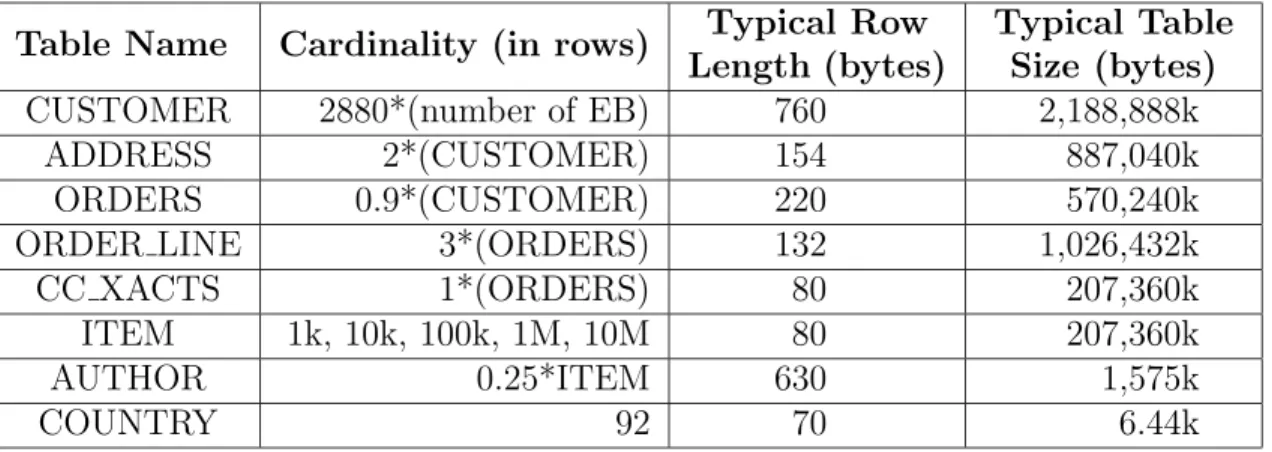
Table 2.1: TPC-W Database Scaling Rules with Example Table Sizes
Table Name Cardinality (in rows) Typical Row Length (bytes)
Typical Table Size (bytes)
CUSTOMER 2880*(number of EB) 760 2,188,888k
ADDRESS 2*(CUSTOMER) 154 887,040k
ORDERS 0.9*(CUSTOMER) 220 570,240k
ORDER LINE 3*(ORDERS) 132 1,026,432k
CC XACTS 1*(ORDERS) 80 207,360k
ITEM 1k, 10k, 100k, 1M, 10M 80 207,360k
AUTHOR 0.25*ITEM 630 1,575k
COUNTRY 92 70 6.44k
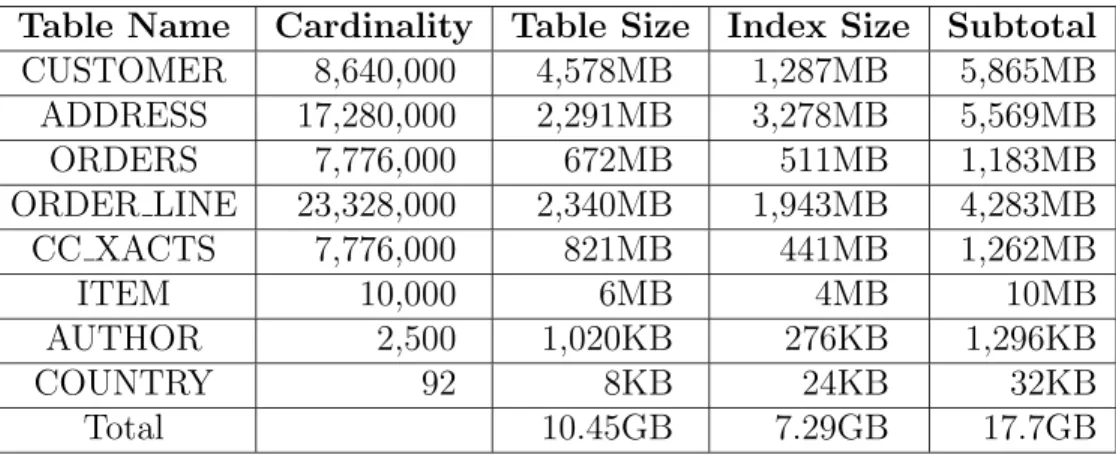
The store size is expressed by the number of items in the ITEM table and the number of emulated browsers (EBs), which emulate users using Web browsers to interact with an E-commerce Web site. The database scaling for TPC-W is defined by the size of the supported customers and the cardinality (number of rows) of the ITEM table [41]. The scaling rules are illustrated in Table 2.1, along with typical row lengths and table size estimates for 10,000 items and 1,000 EBs.
2.3.2
TPC-W Workload Profiles
Based on the user traversal probabilities defined in TPC-W [41], an emulated browser goes through one or more of 14 Web interactions to communicate with the E-commerce Web site. A Web interaction is a complete cycle of communication be-tween the EB and the E-commerce system. It starts when the EB requests a Web page and finishes when the last byte of data from the response page has been received by the EB. The 14 Web interactions defined in TPC-W are: Home, New Products, Product Detail, Best Sellers, Search Request, Search Results, Customer Registration, Shopping Cart, Order Inquiry, Order Display, Buy Request, Buy Confirm, Admin
Request, and Admin Confirm.
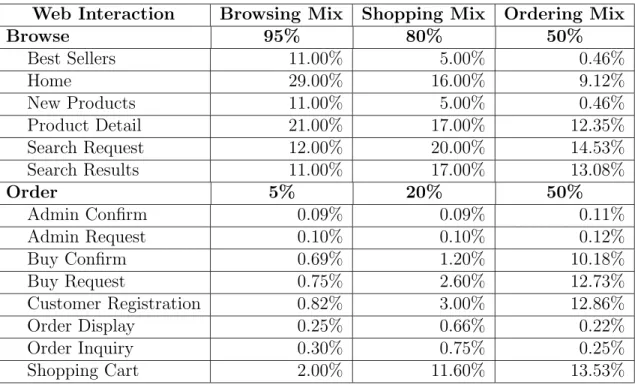
Table 2.2: TPC-W Workload Profiles
Web Interaction Browsing Mix Shopping Mix Ordering Mix
Browse 95% 80% 50% Best Sellers 11.00% 5.00% 0.46% Home 29.00% 16.00% 9.12% New Products 11.00% 5.00% 0.46% Product Detail 21.00% 17.00% 12.35% Search Request 12.00% 20.00% 14.53% Search Results 11.00% 17.00% 13.08% Order 5% 20% 50% Admin Confirm 0.09% 0.09% 0.11% Admin Request 0.10% 0.10% 0.12% Buy Confirm 0.69% 1.20% 10.18% Buy Request 0.75% 2.60% 12.73% Customer Registration 0.82% 3.00% 12.86% Order Display 0.25% 0.66% 0.22% Order Inquiry 0.30% 0.75% 0.25% Shopping Cart 2.00% 11.60% 13.53%
TPC-W classifies the 14 Web interactions into two groups: browse and or-der. The browse Web interactions involve browsing the Web site and searching the database (e.g., querying new products, best sellers, and product details). The order Web interactions update the database, e.g., loading shopping carts, and reg-istering customers. By varying the ratio of the browse to order Web interactions, TPC-W simulates three kinds of workloads: browsing,shopping, andordering, which have been shown to be common Web use profiles [44]. Table2.2 summarizes the ex-act Web interex-actions frequencies in each type of workload. The performance metric reported by TPC-W is the number of Web interactions per second (WIPS).
2.4
Summary
In this chapter, some DBMS related issues are discussed: DBMS components, paral-lel DBMS and distributed DBMS, and DBMS workload characterization. A general description of static caching and dynamic caching in E-commerce systems is also
presented, and dynamic caching is shown as a suitable solution to E-commerce sys-tems. The widely used TPC-W benchmark is introduced in the last section from both database point of view and workload point of view.
Chapter 3
Related Work
This chapter covers the related work of this study. First, caching effects in the con-text of file systems, Web systems, and storage systems are presented in Section 3.1. The previous research in dynamic caching mechanisms in E-commerce systems is then presented in Section 3.2. Third, the related studies in DBMS buffer pool and workload are given in in Section3.3. Finally, the questions that remain unanswered with the previous research are listed.
3.1
Caching Effects
It has been shown that caching is an effective technique to reduce client access delays and network load as well as CPU utilization at the server side in a distributed file system [33]. Similarly, traditional static Web caching is designed to reduce Web latency, network traffic, and Web server load [43]. Previous studies have found that Web caching mechanisms can alter the Web workload characteristics, such as request arrival rate [4], object concentration [28], and object popularity [48]. This is because only the requests that cannot be served by a Web cache are forwarded to its server-side systems.
Further research [13, 16] has found that Web caching mechanisms reduce the temporal locality of workloads. Similar effects of reducing the temporal locality of workloads have also been found in the context of distributed file systems [17] and CPU caching systems [47]. Some studies [49, 54] have found that a higher level
cache makes the LRU cache replacement algorithm inappropriate for the lower level cache system. As a result, the designers of lower level caching mechanisms for Web systems [7] and storage systems [8,51,55] must keep the caching effects of the higher level caching in mind.
This study is similar to the above research with respect to investigating the effects of caching. It examines how various caching mechanisms change the workload. It also analyzes what degree the workload should influence the design and tuning of the lower system. However, it differs from the above research in two ways. First, the caching under investigation in this study is dynamic caching, instead of traditional static caching. Second, the underlying system under study is a database server, instead of file servers, Web servers, or storage systems.
3.2
Dynamic Caching Mechanisms
Various dynamic caching mechanisms have been proposed to reduce Web user re-sponse time, network bandwidth load, and Web/application/database server load [32]. This section gives a brief overview of the recently proposed dynamic caching poli-cies and classifies them into two general categories: query result caching and table caching. In this study, these two types of dynamic caching approaches are emulated based on their respective characteristics.
A query result cache stores Web page layout fragments and content components from database server independently [3,11,12,27]. The cached content components can be shared among different layout fragments. Upon receiving a request, the re-lated layout fragments and content components are built together to form a full Web page. Query result caches require simple computation and avoid re-computation for the repeated queries at the database server. A materialized view can also be cached to speed up query processing [52]. A view is a virtual table that consists of data that is pulled out of one or more existing tables by a query. If stored as a file, a view is called a materialized view.
this thesis because it works in a similar way by caching content components [52]. Upon receiving a request, the table cache mechanism checks whether the request refers to the tables it has cached. The query result cache mechanism checks whether the corresponding object has been cached. If the request cannot be served by the caching mechanism, it will be forwarded to the database server.
Query result caching mechanisms can significantly reduce the user response time by 20% to 50% [11,27, 52]. If the cache is located near the Web users, query result caching can save network bandwidth by about 30% when the cache hit ratio is about 40% [12]. Also, query result caching can save up to 90% of the computation at the E-commerce site [3].
Table caching mechanisms usually store infrequently updated but frequently used tables or even subsets of the tables from the database server [1, 40]. A table cache demands powerful computation since it needs to analyze and answer a query in the way as an actual DBMS does. A table cache can be implemented as either a simplified in-memory database [40] or a full-fledged commercial DBMS [1]. Table caching is shown effective at reducing user response time up to 100% and increase the Web interaction throughput of the E-commerce site up to 200% [1,2, 32].
A dynamic cache can be deployed at a proxy outside the E-commerce site infras-tructure [3, 11, 12, 27] to move the content much closer to Web users; it can also be implemented in the E-commerce site infrastructure [1, 40, 52] to ease the work of maintaining the cached content. Cache location makes no difference however, on how a dynamic caching mechanism reduces the load seen by the database server.
The concern of this thesis is the impact that dynamic caching mechanisms have on the database server instead of the network load. In this thesis, the locations of dynamic caches are not distinguished in the simulation of dynamic caching mecha-nisms.
3.3
DBMS Buffer Pool and Workload Studies
Dynamic caching mechanisms can affect the workload on the database server and the tuning/design of the database server in many ways. In this study, the locality of the requests, the I/O activities of the database server, the buffer pool replacement algorithms, and the classification of the workload are considered. This section briefly outlines the related studies on these topics.3.3.1
DBMS Buffer Pool Replacement Algorithms
In addition to the simple buffer pool replacement algorithms such as LRU, LFU, and FIFO, more complex algorithms have been proposed in recent work in this area. Two representative algorithms are low inter-reference recency set (LIRS) [23] and adaptive replacement cache (ARC) [30]. These algorithms are briefly explained in this section.
The LIRS strategy [23] keeps track of both the reference recency and the inter-reference recency (IRR) for each buffered page. The IRR is defined as the number of references to other pages between the last two consecutive references to the page. The recency is the difference between the time of the last reference and the current time. In LIRS strategy, the buffer is divided to a large buffer known as Llirs and a small buffer known as Lhirs. Pages with low IRR are registered in Llirs, and those with high IRR are registered in Lhirs. The registration status of a buffered page is switched when a page reference changes the IRR of the buffered pages to a certain threshold level. The pages registered in Lhirs are evicted from the buffer based on the FIFO policy.
The ARC algorithm [30] automatically balances the recency and frequency of the page references by maintaining two LRU lists: L1 and L2. L1 contains the pages that have been referenced only once recently, while L2 contains the pages that have been referenced more than once recently. The p most recent pages at the top of L1 and c-p most recent pages at the top of L2 are kept in the buffer, where c is the buffer size andp is a tunable parameter in the algorithm. The victim page is picked
from either L1 or L2, which is based on the tunable parameter p, the number of pages in the buffer from L1, and the number of pages in the buffer from L2. The pages at the bottom of L1 and L2 are maintained in the buffer directory but not in the buffer.
The performance of the proposed buffer pool replacement algorithms for some traditional workloads is already studied in the literature. However, how they perform for the E-commerce workloads in the presence of dynamic caching mechanisms is not addressed. This study aims at answering the question.
3.3.2
Database Buffer Pool Simulation
Wang and Bunt [45] built a DB2 buffer pool management simulator to study buffer pool management algorithm performance under a variety of system parameters. The simulator includes four components: client agent, buffer pool manager, page cleaner, and disk I/O handler. Based on the trace files it reads, the client agent sends out page requests to the buffer pool. The buffer pool manager is responsible for placing and replacing the buffer pool pages and requesting disk I/O. Dirty pages are cleaned by the page cleaner, and disk I/O requests are processed by the disk I/O handler.
The TPC-C benchmark was used as the input to DB2. The page requests of FIX/UNFIX at the database buffer pool were recorded. Comparisons of performance metrics between the trace-driven simulation results and the real system experimen-tal results verified the buffer pool simulator. The results show that the simulator provides a good match with the real system. One of the example evaluations was the buffer pool hit ratio difference between the measured result and the simulated result. The difference reported by Wang and Bunt [45] is about 0.1%.
This simulator provides a good tool for the study of database server workload characteristics under caching. An extended version of the simulator obtains the information about the number of page requests, working set size, buffer pool miss ratio, and the number of disk I/Os from the traces collected in this study.
3.3.3
DBMS Workload Studies
Hsu et al. [19] implemented a light-weight tracing utility for DB2 at the buffer pool level to record the requests from the buffer pool manager. Traces from ten real production database workloads and TPC benchmarks (TPC-C and TPC-D) are comprehensively analyzed. TPC-C simulates a complete environment where a large number of users executes transactions against a database, while TPC-D represents a broad range of decision support applications that require complex, long running queries against a database1
. TPC-C and TPC-D complement each other since they represent different kinds of workloads. However, they still cannot reflect some aspects of the real production database workloads, for example the burst of I/O bandwidth. The tracing utility developed by Hsuet al.[19] is used in this thesis to collect the buffer pool level traces.
Hsu et al. also studied the logical level I/O reference behaviors of production database workloads and TPC benchmarks [20]. They investigated workloads under different I/O optimization techniques: caching, prefetching, and write buffering. Hsu found that the buffer pool miss ratio is approximately the inverse square root of the ratio of buffer pool size to data size, and that TPC-C does not present any significant sequentiality. The logical level I/O reference behaviors of TPC-W, especially under different caching mechanisms, remain unknown. The experiments in this study will investigate the I/O reference characteristics of TPC-W and evaluate whether the observations in Hsu et al.’s research apply to TPC-W.
Elnaffar [15] presented a classification model to automatically categorize a DBMS workload to be an OLTP workload or an OLAP workload. TPC-C, TPC-H, and the TPC-WBrowsing profile and the Ordering profile were used to train the classi-fiers. The system performance snapshots that are taken during the execution of the workloads, were used as the data objects to build the classifier. Elnaffar chose the TPC-W Browsing profile and the Ordering profile to represent OLAP and OLTP workloads respectively [15]. Wasserman et al. [46] revealed there are four different
1
groups of queries in a typical OLAP workload. The first group contains queries which have trivial complexity, short run times, and high CPU utilization. The second group is identified by simple-complexity queries that involve intensive I/O activities. The third group is characterized by medium-complexity queries that de-mand moderate CPU and I/O usage. The fourth group is identified by large and complex queries that show high sequentiality and random I/O usage. Unfortunately, dynamic caching was not considered in either study. Dynamic caching may change the E-commerce workload profiles (Browsing, Shopping, and Ordering) as it can filter out a large portion of queries.
3.4
Summary
In a typical E-commerce system, various dynamic caching mechanisms have been proposed to reduce database server load and/or the network latency. The database server scalability and better response time are achieved in the challenging environ-ment that the database server is becoming the performance bottleneck due to the increasing number of Web users. Related DBMS studies are also presented. How-ever, new questions arise:
• Do the proposed dynamic caching mechanisms change the workload charac-terization seen by the database server? If so, how? Specifically, does the reference locality of the workload change? Among the buffer pool replacement algorithms mentioned in this chapter, which one has the best performance under dynamic caching? How are the I/Os affected?
• After dynamic caching, how can one classify the E-commerce workloads? Do they behave more like OLTP?
• If the proposed dynamic caching mechanisms do change the workload charac-terization and/or classification seen by the database server, does this have a impact on system tuning, configuration, and design of the DBMS?
Although a good understanding of these questions is a prerequisite for design-ing and tundesign-ing the database server, the questions are not widely addressed in the literature.
Chapter 4
Methodology and Experimental Setup
This chapter contains the methods used in this study to characterize and classify the TPC-W profiles under dynamic caching. The experimental setup for the evaluation experiments is also described in detail.
4.1
Methodology
In this study, dynamic caching mechanisms are simulated. For the first set of exper-iments, database traces are collected during the running of TPC-W profiles. Also, system performance parameters are measured, such as response time and CPU uti-lization. Then, the workload characterizations are carried out using trace-driven simulation. For the second set of experiments, database snapshots are recorded during the running of TPC-W profiles. The snapshots are then used as profile classification objects.
4.1.1
Simulation of Dynamic Caching
Dynamic caching mechanisms are simulated instead of being implemented in a full-featured dynamic cache, since the performance of the database server is the focus of this study. This greatly simplifies the design of the dynamic cache without affect-ing the actual workloads reachaffect-ing the database server. The simulation of dynamic caching mechanisms is implemented to represent their caching functionality.
Two dynamic caching policies are simulated: query-result cache and table cache. They are simulated in the Java implementation of TPC-W kit [6]. Some query results from the database server are stored at the simulated query-result cache, and some tables from the database server are stored at the simulated table cache.
For the simulated query-result cache, a query from the Emulated Browser is checked to see whether a corresponding result is resident in the cache before being sent to the database server. If a valid stored result for the query exists in the simulated cache, the cache serves the query with the result; otherwise, the query is forwarded to the database server.
For the simulatedtable cache, a query from the Emulated Browser is checked to see if it requires the stored tables before being sent to the database server. If the query requires the cached tables, the cache serves the query by performing the query on the related tables; otherwise, the query is forwarded to the database server. A query is rewritten so that only parts of the query are performed on the database server, if it involves both cached tables and un-cached tables.
4.1.2
Workload Characterization
Trace-driven simulation is used in this study to examine the effects that dynamic caching mechanisms have on database server workload. A trace-driven simulation consists of two main stages: trace collection and trace processing. In the first stage, relevant information about a system is collected while the system executes the workload of interest, which is achieved either by using hardware probes or by instrumenting the software. In the second stage, the resulting trace of the system is played back to a model of the system under study. More discussions of this technique and its strengths and weaknesses can be found in Jain [22].
In this study, the TPC-W Browsing, Shopping, and Ordering profiles under dy-namic caching are used as workloads on a real database server, and the resulting DBMS traces are collected. Then the traces are analyzed by feeding them to a simulator. Although a benchmark E-commerce system is used rather than a real
system, the analysis methodology employed in this study is general. The bench-mark system provides a controlled environment to emulate most key features that affect the performance of real E-commerce systems. It can be used to study general characteristics that are not restricted to any specific system.
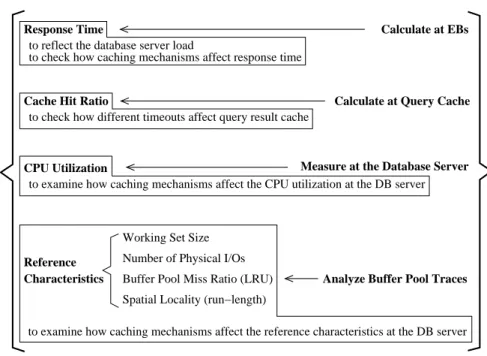
Some performance measurements are conducted during the running of TPC-W profiles. The response time is measured at the emulated browsers. The cache hit ratio is calculated at the simulated query-result cache. The CPU utilization of database server is also recorded. Details are given later in this chapter.
4.1.3
TPC-W Profile Classification under Caching
A set of experiments are also performed to investigate the classification of TPC-W profiles under dynamic caching. Classification is a common machine learning and data mining task. Given “classified” cases, a classification model can build its rules to predict new “unclassified” cases. Decision tree models are one of the most common classification methods. A decision tree model can extract the clas-sification rules easily and enables the user to understand and justify the results in a more straightforward manner in comparison with other techniques such as neural networks [50].
A decision tree model is built by analyzing training data and then the model is used to classify target data. The decision tree is constructed in a top-down fashion by choosing the most appropriate attribute each time. In a decision tree model, an internal node is a test on an attribute of a case. A branch represents an outcome of the test, and a leaf node represents a class label, i.e. a prediction result. When it is trained with “classified” cases, a decision tree model chooses one attribute at each internal node to split the training cases into the labelled classes. Then the trained decision tree model classify target cases by following a matching path to a leaf node. The classification of DBMS workloads can be viewed as a data mining process using decision tree models [15]. The process includes two steps: training a decision tree model using “classified” cases and applying it to target classification candidates
to predict. Database snapshots collected during the execution of TPC-W profiles without caching are used as data objects to train the classification model in this study. Snapshotsunder caching are then used as inputs to the trained classifier for prediction.
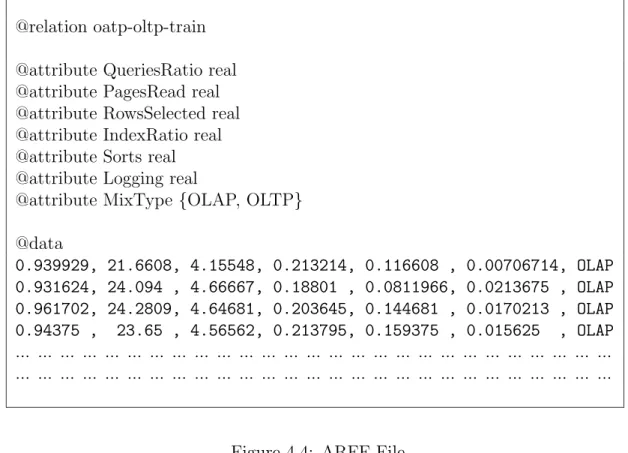
A database snapshot includes important performance statistics of a database server. It records the running state of the database environment, such as queries proportion, pages read, and rows selected. Each snapshot can be viewed as a vector whose dimensions are the attributes that summarize the activities in the system during the execution. More details are provided in the latter portions of this chapter.
4.2
Experiment Design
4.2.1
Experimental Architecture
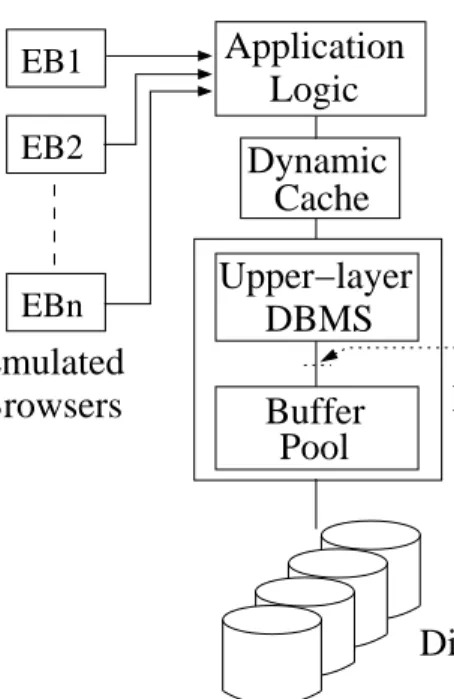
Figure 4.1 shows the experimental architecture of this study. It is composed of Emulated Browsers (EBs), application logic, dynamic cache, and database server. The Emulated Browsers are implemented in Java and can emulate many browsers performing Web interactions. The application logic converts Web requests to SQL queries. The dynamic cache serves queries or forward them to the database server. In the original implementation of the system [6], the application logic was de-veloped as servlets that run on a real Web server (specifically Jigsaw 2.2.2). All inventory images were stored on the Web server, while only their names were stored in the database. In this study, the Web server is removed and the application logic is implemented as a set of procedures called directly by EBs. The EBs do not request inventory images nor HTML pages. The purpose of these modifications is to remove the overhead incurred by the Web/application server and to be able to focus on the performance of the database server alone.
Two sets of experiments are conducted in this study. The first set investi-gates how dynamic caching mechanisms change the TPC-W workloads seen by the database server in terms of various performance metrics. The second set examines