9HSTF
MG*afe
jbj+
ISBN 978-952-60-5491-9 ISBN 978-952-60-5492-6 (pdf) ISSN-L 1799-4934 ISSN 1799-4934 ISSN 1799-4942 (pdf) Aalto University School of Electrical Engineering Department of Communications and Networking www.aalto.fi BUSINESS + ECONOMY ART + DESIGN + ARCHITECTURE SCIENCE + TECHNOLOGY CROSSOVER A alto -DD 2 11 /2 013 Re nau d-A lex an dr e P ita val Co din g o n F lag Mani fo ld s f or L im ite d F ee db ac k MI MO S ys tem s A alt o U n iv er sit Department of Communications and NetworkingCoding on Flag Manifolds
for Limited Feedback
MIMO Systems
R
e
na
ud
-
A
l
e
x
a
nd
r
e
P
i
t
a
v
a
l
Aalto University publication series
DOCTORAL DISSERTATIONS 211/2013
Coding on Flag Manifolds for Limited
Feedback MIMO Systems
Renaud-Alexandre Pitaval
A doctoral dissertation completed for the degree of Doctor of Science in Technology to be defended, with the permission of the Aalto University School of Electrical Engineering, at a public examination held at the lecture hall S1 of the school on 31 January 2014 at 12 noon.
Aalto University
Supervising professor
Prof. Olav Tirkkonen
Thesis advisor
Prof. Olav Tirkkonen
Preliminary examiners
Prof. David J. Love, Purdue University, USA Dos. Jyrki Lahtonen, University of Turku, Finland
Opponent
Prof. Robert Calderbank, Duke University, USA
Aalto University publication series
DOCTORAL DISSERTATIONS 211/2013 © Renaud-Alexandre Pitaval ISBN 978-952-60-5491-9 ISBN 978-952-60-5492-6 (pdf) ISSN-L 1799-4934 ISSN 1799-4934 (printed) ISSN 1799-4942 (pdf) http://urn.fi/URN:ISBN:978-952-60-5492-6 Unigrafia Oy Helsinki 2013
Abstract
Aalto University, P.O. Box 11000, FI-00076 Aalto www.aalto.fiAuthor
Renaud-Alexandre Pitaval
Name of the doctoral dissertation
Coding on Flag Manifolds for Limited Feedback MIMO Systems
Publisher School of Electrical Engineering
Unit Department of Communications and Networking
Series Aalto University publication series DOCTORAL DISSERTATIONS 211/2013
Field of research Information Theory
Manuscript submitted 14 June 2013 Date of the defence 31 January 2014
Permission to publish granted (date) 2 September 2013 Language English
Monograph Article dissertation (summary + original articles)
Abstract
The efficiency of the physical layer in modern communication systems using multi-input multi-output (MIMO) techniques is largely based on the availability of channel state
information (CSI) at the transmitter. In many practical systems, CSI needs to be quantized at the receiver side before transmission through a limited rate feedback channel. This is typically done using a codebook-based precoding transmission, where the receiver transmits the index of a codeword from a pre-designed codebook shared with the transmitter. To construct such codes one has to discretize complex flag manifolds. For single-user MIMO with a maximum likelihood receiver, the spaces of interest are Grassmann manifolds. With a linear receiver and network MIMO, the codebook design is related to discretization of Stiefel manifolds and more general flag manifolds.
In this thesis, coding in flag manifolds is studied. In a first part, flag manifolds are defined as metric spaces corresponding to subsurfaces of hyperspheres. The choice of distance defines the geometry of the space and impacts clustering and averaging (centroid computation) in vector quantization, as well as coding theoretical packing bounds and optimum constructions. For two transmitter antenna systems, the problem reduces to designing spherical codes. A simple isomorphism enables to analytically derive closed-form codebooks with inherent low-implementation complexity. For more antennas, the concept of orbits of symmetry groups is investigated. Optimum codebooks, having desirable implementation properties as described in industry standardization, can be obtained using orbits of specific groups.
For large antenna systems and base station cooperation, a product codebook strategy is also considered. Such a design requires to jointly discretize the Grassmann and Stiefel manifolds. A vector quantization algorithm for joint Grassmann-Stiefel quantization is proposed. Finally, the pertinence of flag codebook design is illustrated for a MIMO system with linear receiver.
Keywords MIMO systems; quantization; coding; flag, Stiefel, Grassmann, manifolds
ISBN (printed) 978-952-60-5491-9 ISBN (pdf) 978-952-60-5492-6
ISSN-L 1799-4934 ISSN (printed) 1799-4934 ISSN (pdf) 1799-4942
Location of publisher Helsinki Location of printing Helsinki Year 2013
Preface
The research work for this doctoral thesis has been carried out at the department of Communications and Networking of Aalto University. The work was funded by the Finnish Funding Agency for Technology and Inno-vation, the Academy of Finland, Nokia Foundation, and HPY Foundation. First and foremost, I wish to express my gratitude to my supervisor Prof. Olav Tirkkonen for his support and guidance. Working with Prof. Tirkko-nen was a great pleasure and a continuous journey of learning through many enlightening discussions.
Part of this work was also done at the Image Processing and Commu-nications Laboratory, Queen’s University, Canada, during 2009-2010. I would like to sincerely thank Prof. Steven D. Blostein for his kindness and support during my stay at Queen’s. I wish also to thank Lect. Wei Dai for welcoming me in his group at Imperial College London for a re-search visit in Spring 2013.
I am thankful to the co-authors of the papers included in this thesis, Karol Schober, Prof. Risto Wichman, and Ashivin Srinivasan, and espe-cially Dr. Helka Määttänen for valuable instructions when I started at the department. I would like also to thank the thesis preliminary exam-iners, Prof. David J. Love and Dos. Jyrki Lahtonen, for their constructive comments; and Prof. Robert Calderbank for accepting to be the defence opponent.
I am grateful to all nice friends and colleagues I have met during these past years in Finland, Canada, and UK. Mes remerciements les plus sincères sont destinés à ma chère et tendre épouse, Viet-Anh, pour son amour, son soutien, et son illustration plein d’humour de ce manuscrit.
Helsinki, November 28, 2013,
Contents
Preface i Contents iii List of Publications v 1. Introduction 1 1.1 Background . . . 11.2 Objective and Scope . . . 3
1.3 Contribution and Structure of the Thesis . . . 3
1.4 Summary of Publications . . . 5
2. System Model 9 2.1 Signal and Channel Model . . . 9
2.2 Base Station Cooperation . . . 10
2.3 Codebook-Based Precoding . . . 11
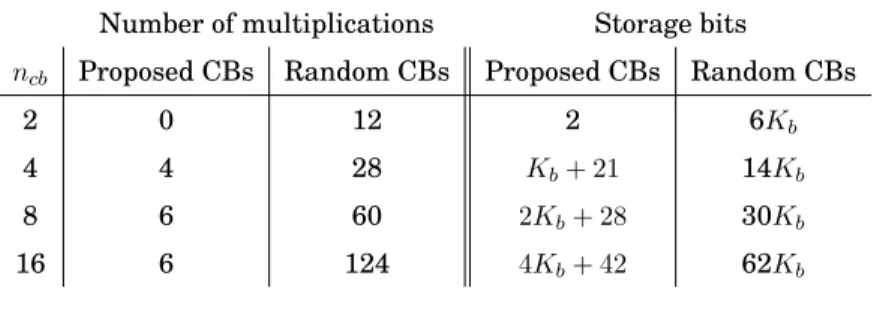
2.4 Low-Complexity Constraints . . . 11
3. Flag Manifolds: Code Designs and Geometry 13 3.1 Flag Manifolds . . . 13
3.2 Spherical Embeddings and Chordal Distances . . . 15
3.3 Codebook Designs . . . 16
3.4 Lloyd’s Algorithm and Centroids . . . 17
3.5 Density and Packing Bounds . . . 18
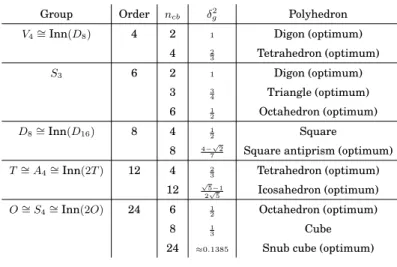
4. Grassmannian Pakings for 2-Tx MIMO 23 4.1 Grassmannian Codebooks from Spherical Arrangements . . 23
4.2 Low Implementation-Complexity Codes . . . 26
4.3 Quantization Error Analysis . . . 28
Contents
5.1 Orbits of Projective Group Representations . . . 31
5.2 Extraspecial Group Code Constructions . . . 35
5.3 Expansion to Stiefel Codes . . . 38
6. Joint Grassmann-Stiefel Codes for Product Codebooks 41 6.1 Product Codebook-Based Precoding . . . 41
6.2 Joint Grassmann-Stiefel Codebooks . . . 43
6.3 Lloyd-type Algorithm for Joint Grassmann-Stiefel Codebook 46 6.4 Codeword Selections . . . 47
7. Flag Codebooks for MIMO Systems with Linear Receiver 51 7.1 Achievable Information Rates . . . 52
7.2 Linear Receiver versus ML Receiver . . . 52
7.3 Codebook Designs . . . 53 7.4 Simulations . . . 54 8. Conclusions 57 Bibliography 61 Errata 67 Publications 71
List of Publications
This thesis consists of an overview and of the following publications which are referred to in the text by their Roman numerals.
IR.-A. Pitaval, O. Tirkkonen and S. D. Blostein. Density and Bounds for Grassmannian Codes with Chordal Distance. InProceedings of the IEEE International Symposium on Information Theory (ISIT), Saint Pe-tersburg, Russia, pp. 2298-2302, Aug. 2011.
II R.-A. Pitaval and O. Tirkkonen. Volume of Ball and Hamming-type Bounds for Stiefel Manifold with Euclidean Distance. InProceedings of the 46th Annual Asilomar Conference on Signals, Systems, and Comput-ers (ACSSC), Pacific Grove, California, pp. 483-487, Nov. 2012.
III R.-A. Pitaval, H.-L. Määttänen, K. Schober, O. Tirkkonen, and R. Wichman. Beamforming Codebooks for Two Transmit Antenna Systems based on Optimum Grassmannian Packings.IEEE Transactions on In-formation Theory, vol.57, no.10, pp. 6591-6602, Oct. 2011.
IVR.-A. Pitaval, O. Tirkkonen and S. D. Blostein. Low Complexity MIMO Precoding Codebooks from Orthoplex Packings. In Proceedings of the IEEE International Conference on Communications (ICC), Kyoto, Japan, pp. 1-5, June 2011.
V R.-A. Pitaval and O. Tirkkonen. Grassmannian Packings from Orbits of Projective Group Representations. InProceedings of the 46th Annual Asilomar Conference on Signals, Systems, and Computers (ACSSC),
Pa-List of Publications
cific Grove, California, pp. 478-482, Nov. 2012.
VIR.-A. Pitaval and O. Tirkkonen. Flag Orbit Codes and Their Expan-sion to Stiefel Codes. InProceedings of the IEEE Information Theory Workshop (ITW), Seville, Spain, pp. 360-364, Sep. 2013.
VIIR.-A. Pitaval and O. Tirkkonen. Joint Grassmann-Stiefel Quantiza-tion for MIMO Product Codebooks. Accepted for publicaQuantiza-tion inIEEE Transactions on Wireless Communications, 13 pp., Oct. 2013.
VIIIR.-A. Pitaval, A. Srinivasan and O. Tirkkonen. Codebooks in Flag Manifolds for Limited Feedback MIMO Precoding. In Proceedings of the 9th International ITG Conference on Systems, Communications and Coding (SCC), Munich, Germany, pp. 1-5, Jan. 2013.
Author’s Contribution
The author has had a leading role in writing all the publications. The author has had a leading role in the planning and the analysis of Publi-cations [I, II, IV, VII]. The author has participated in theoretical mod-eling and design of experiments in Publications [III, V, VI, VIII]. The author has conducted the performance simulations for all publications ex-cept Publication VIII.
List of abbreviations and symbols
Abbreviations 2D two dimension 3D three dimension 4D four dimension 4G 4thgeneration systems BS base station CB codebookCoMP coordinated multi-points CSI channel state information dB decibel
EP Equal transmit-power per-antenna FDD frequency-division duplexing HB Hamming bound
i.i.d independent and identically distributed LTE long-term evolution
MIMO multiple-input multiple-output ML maximum likelihood
MMSE minimum mean square error
MS-MUB maximal set of mutually unbiased bases MU multi-user
MUB mutually unbiased bases pdf probability density function SISO single-input single-output SNR signal-to-noise ratio SU single-user
Rx receive antenna ZF zero forcing
List of abbreviations and symbols
Symbols
C complex field
CP1 complex projective line
C codebook
Ck border of thekthspherical cap
ck kthspherical codeword Ck kthcodeword
Cpr product codebook dc chordal distance df flag chordal distance dg Grassmann chordal distance dmu MUness flag distance
dp permutation-invariant flag chordal distance ds Stiefel chordal distance
D dimension of embedding sphere
DM(C) average squared distortion of codebookCon manifoldM
D diagonal matrix
det determinant
E[·] mathematical expectation
F part of linear receiver
fd2g pdf of squared Grassmann distortion
FlCnt;s
1,...,sr nt-by-ns complex flag manifold with equivalence under r
unitary groups of sizesi
FlCnt;s1,...,sr nt-by-ns complex flag manifold with equivalence under r
unitary groups of sizesiand permutation of thergroups of substreams
FC
nt,ns nt-by-nscomplex flag manifold with equivalence underns
phase rotation
FC
nt,s1,...,sr nt-by-nscomplex flag manifold with equivalence underns
phase rotation and permutation of thenscolumns g an abstract group element
G an abstract group
G large-scale path gain matrix
GC
nt,ns complexnt-by-nsGrassmann manifold H fading channel
List of abbreviations and symbols
Hk fading channel fromkthBS Hls large-scale fading channel Hss small-scale fading channel I average information rate
Ilr information rate with linear receiver
Iml information rate with ML receiver
Inm maximum achievable rate without transmission rank
con-straint
Ins maximum achievable rate withnsstreams Int nt-by-ntidentity matrix
Int,ns nt-by-nsidentity matrix
Kb number of bits to represent a real number
log2 binary logarithm
M manifold
n noise vector
nbs number of BSs ncb size of codebook
nr number of receive antennas
ns number of streams
nt number of transmit antennas Ng Grassmann codebook cardinality Ns Stiefel codebook cardinality P permutation matrix
PUnt projective unitary group of sizent
qC abstract quantization map associated withC q∗ optimum quantization map using information rate
qc quantization map using chordal distance
qg quantization map using Grassmann chordal distance r number of subgroups of streams
R radius of embedding sphere
Rk kthVoronoi cell R real field
sk kthgroup of substreams Sr symmetric group of degreer
SD(R) D-sphere of radiusR
SOnt special orthogonal group of sizent
u(ns) vector space of skew-Hermitianns-by-ns matrices, Lie
List of abbreviations and symbols
Unt unitary group of sizent U unitary matrix
Ui unitary matrix of sizesi
VC
nt,ns complexnt-by-nsStiefel manifold
V random source on Stiefel manifold
v point on sphere
vk kthcolumn ofV V nt-by-nsStiefel matrix
Vk nt-by-skStiefel submatrix ofV
Vls ns-largest right singular vectors ofWls Vss ns-largest right singular vectors ofWss w precoding vector
W precoding matrix
Wls large-scale precoder Wss small-scale precoder x transmitted symbol vector
y received signal
yk kthcolumn ofY Y nt-by-nsStiefel matrix
Yk nt-by-skStiefel submatrix ofY Z(G) center of groupG
Zk centroid ofkthVoronoi cell αk large-scale path gain fromkthBS
δM(C) minimum chordal distance of codebookCon manifoldM
δg minimum Grassmann chordal distance
δs minimum Stiefel chordal distance γ snr per-stream
γk post-processing SINR of thekthdata stream λk kthsingular value ofHeff
θ angle
φ angle
ϕ angle
μ(B(rn)) normalized volume of a ball of radiusrn σ permutation
σk kthsingular value ofH
1. Introduction
1.1 Background
Multi-input multi-output (MIMO) techniques are key technologies to en-hance spectrum efficiency of wireless systems. Performance heavily de-pends on the channel state information (CSI) available at the transmitter. MIMO using linear precoding have been shown to achieve large capac-ity gains over traditional single-input-single-output (SISO) systems [32, 87]. Linear precoding for single and multiple stream transmission, a.k.a. beamforming and multiple beamforming, has been intensely investigated for point-to-point communications [75, 89]. Without channel reciprocity, e.g. in frequency-division duplex systems, the only way to acquire CSI is through a limited feedback channel. Fortunately, few bits is usually enough to fill most of the gap between open-loop and closed-loop capac-ity [55]. A widely applied method is to use codebook-based precoding in which the receiver selects a precoding codeword from a predefined code-book and feeds back the index to the transmitter. Since it is more impor-tant to feed back the channel direction than the channel beam gain [23], the quantization of the channel is often done with a rectangular unitary code.
In point-to-point communications with maximum likelihood receiver, the performance of a unitary precoding codebook is related to its interpreta-tion as a discretizainterpreta-tion of the Grassmann manifold [22, 23, 53, 55, 56, 61]. Codebook design criteria are based on extremization of average distortion metrics [22, 59, 63, 71, 72, 95]. The information rate is approximately a function of the distortion rate of the codebook associated with Grassmann chordal distance as a quantization map [22,23]. In [56, 61] the beamform-ing codebook design problem for uncorrelated channel was linked to a
Introduction
suboptimal approach, the Grassmannian line packing problem, i.e. max-imizing the minimum distance of the codebook. Extension to correlated channel through codebook rotation is then provided in [54, 95].
Grassmann packing, originally a mathematical problem of independent interest [18], was thus retained as a method for codebook design. Ex-tensive tables of real Grassmannian codes could be found in the liter-ature [83]. For the complex Grassmannian, fewer results were avail-able [15, 79, 85]. Complex Grassmann code construction was hence ad-dressed in [24, 56, 64, 72, 76, 95, 96], codes being generated by computer searched by either directly minimizing the distortion of the codebook us-ing vector quantization algorithms such as Lloyd-type algorithms [64, 72, 95]; or maximizing its minimum distance with brute-force search [56], modified Lloyd’s algorithm [96], alternating projection algorithm [24], and expansion-compression algorithm [76]. Analytical constructions were pre-sented in [2, 4–6, 96] with application also to non-coherent MIMO space-time coding [97], and low-complexity implementation codebooks for pre-coding [44, 51, 60].
While Grassmann precoding has attracted much attention, other trans-mission scenarios or constraints may lead to the need of designing code-books in other spaces. Practical codecode-books in industry standards have been designed according to power and implementation-complexity con-straints [51]. With an MMSE or ZF receiver, the set of non-equivalent pre-coding matrices is not a Grassmann manifold anymore [57]. In [57], the proper space of quantization is presented along with some optimum ana-lytical packings for 2 transmit antenna systems. For bit-interleaved mul-tiple beamforming, it is shown in [77] that the optimum precoder is only invariant under a diagonal unitary transform, a corresponding Lloyd’s al-gorithm is presented.
Further development of MIMO techniques towards network-level pro-cessing are expected to bring performance enhancements. In MIMO broad-casting, unitary codebook-based precoding has been well-investigated in a multi-user (MU) setting with one-stream transmission per-user [43, 47, 90, 91]. In [47], codebook design on a different Riemannian manifold than the Grassmann manifold is considered, and accordingly, a systematic con-struction of structured codebook is presented. While considering different system models, the manifolds discussed in [47] and [57] are the same, and the proposed distance metrics are equivalent up to a scaling factor. Similar equivalence classes are described in [90, 91]. To deal with the
Introduction
specific features of base stations cooperation or coordinated multi-points (CoMP) [46, 48, 88], a product codebook quantization strategy was pro-posed in [16].
Interpreting all those designs in a unified manner, the spaces of dis-cretization to consider are quotient spaces of unitary groups, and although not recognized as such, so-calledflag manifolds. Literature on flag mani-folds can be found in quantum theory context, e.g. in [62, 68, 98].
1.2 Objective and Scope
The goal of the thesis is to design low-implementation complexity precod-ing codebooks with analytic and algebraic methods. Findprecod-ing optimal pre-coding codebooks is equivalent to the problem of discretizing a manifold. Manifold discretization is a generic mathematical problem covering for example the particular case of spherical arrangements or real Grassman-nian discretization which have been addressed due to their relevance to many fields of science such as chemistry, biology and physics. While there is an increased interest in manifold discretization from communications engineers, there are few results from the mathematical literature. An-alytical discretization of complex manifolds yields mathematically struc-tured codebooks which are amenable for implementation. In this work, we concentrate on discretization techniques for quotient spaces of unitary groups, so-called flag manifolds, including Stiefel and Grassmann mani-folds.
1.3 Contribution and Structure of the Thesis
This dissertation contributes to the field of coding theory for unitary man-ifolds and codebook design for MIMO precoding.
We address several codebook constructions in the literature as a unified mathematical problem of discretization of flag manifolds. The Conway-Hardin-Sloane spherical embedding of the Grassmann manifold with chor-dal distance is generalized to other flag manifolds, and modified for equal-power per-antenna codebooks. The spherical embeddings allow leverag-ing results from the mathematical literature. For Lloyd’s algorithms, we leverage a result on centroid computation on Euclidean embedded sur-faces applicable to manifolds equipped with a chordal distance. In
par-Introduction
ticular, we derive a closed-form centroid computation in the Stiefel mani-fold. The spherical embeddings induce also coding bounds from the sphere packing literature.
A fundamental problem of coding theory is to establish the maximum cardinality of a code for a given distance. The well-known Hamming bound partially answers this question. We have investigated the density of packings in the complex Grassmann and Stiefel manifolds equipped with chordal distance. We have computed the exact volume of the Grass-mann and Stiefel manifold induced by their chordal distance. This has application in the evaluation of the volume of a small metric ball which is critical to derive Hamming-type bounds. We provide a refinement of the Hamming bound for Grassmannian codes and a generalization of a bound on minimum distance previously proven only for line packings. This result is later generalized to all manifolds with a metric induced by an embed-ding in a Euclidean hypersphere. For these manifolds, of which the Stiefel manifold, this provides results generalizing previously known bounds on codes in the unitary group.
We then investigate explicit analytical code constructions, looking for codebooks having their entries in a limited set of complex numbers. For the special case of two antenna precoding codebooks, the 2x1 complex Grassmannian is isometric to a real sphere, so that designing 2x1 complex Grassmannian packing is equivalent to the real sphere packing problem. Based on the extensive literature on this topic, we have derived optimal closed-form codebooks using a simple isomorphism. Using the simple ge-ometry of some of these codebooks, we also derived closed-form expres-sion of the corresponding SNR gain due to beamforming. Additionally, we investigate codebooks based on other spherical arrangements, such as solutions maximizing the harmonic mean of the mutual distances among the codewords. We found that in most of cases, Grassmannian codebooks based on these other spherical arrangements outperform codebooks from Grassmannian packings. The reason is that the mean distance provides a better approximation of the average distortion than the minimal distance. Next, to address the problem of manifold discretization in more general manner we use the concept of an orbit of a symmetry group. We general-ize the concept of spherical orbit codes to flag orbit codes and derive ba-sic properties. For flag codes, projective unitary representations of finite group are of specific interests. We consider some finite groups having ap-propriate representations and find apap-propriate initial points heuristically.
Introduction
We give explicit codes in Grassmann and other simple flag manifolds in 2D and 4D. Using a construction related to representation theory, fami-lies of packings are obtained for any dimension of a power of a prime. We prove that some of these packings are optimal in relation with a power per-antenna constraint. We also investigate Stiefel orbit codes arising from the linear representation of the projective group considered. By do-ing so, one obtains expansions of the Grassmann orbit codes to the Stiefel manifold.
Then, we discuss codebook designs for two different transmission sce-narios. For a base station cooperation system, we consider a product codebook strategy where a single small codebook is implemented at the receiver. We show that near optimal performance can be reached with an appropriate choice of Stiefel representatives of Grassmann codes. Ac-cordingly, we propose a novel joint Grassmann-Stiefel codebook design aiming at good quantization of Grassmann and Stiefel manifolds with a single codebook. A Lloyd-type algorithm generating a Stiefel codebook conditioned on a fixed Grassmannian codebook is presented. Further-more, concrete examples of analytical joint Grassmann-Stiefel packings are also given. We also discuss low-complexity suboptimal codeword se-lection methods.
Finally, the codebook design problem for MIMO with a linear receiver is related to a discretization problem of generalized flag manifolds. With a linear receiver, we show that the spaces of equivalent precoders are simple permutation-invariant flag manifolds. We describe a Lloyd-type algorithm for these spaces and compare the achievable rate with the gen-erated codebooks by simulation. When the number of streams, and the number of receive and transmit antennas are the same, the simulations show that the marginal gain from precoding is relatively small with few feedback bits for more than two transmit antennas. This differs from low-rank transmission with optimum receivers, where a small number of feedback bits allows near-optimal channel adaptation.
1.4 Summary of Publications
This thesis consists of an introductory part and eight original publica-tions.
The first two papers are discussing coding theoretical problems on the Grassmann and Stiefel manifolds.
Introduction
In Publication I, the density of Grassmann codes with the chordal dis-tance is investigated. From the observation that the kissing radius can-not be determined solely from the minimum distance, upper and lower bounds are provided, along with the corresponding bounds on the den-sity. This leads to a refinement of the Hamming bound for Grassmannian codes. Finally, we provide explicit bounds on code cardinality and mini-mum distance, notably a generalization of a bound on minimini-mum distance previously proven only for line packings.
In Publication II, the density of Stiefel codes is investigated. We com-pute the volume of the Stiefel manifold induced by the chordal distance. This has a direct application for evaluating the volume of a small metric ball critical to derive Hamming-type bounds. Using a spherical embed-ding argument, we provide results generalizing previously known bounds on codes in the Grassmann manifold and the unitary group.
The following four papers deal with explicit code constructions.
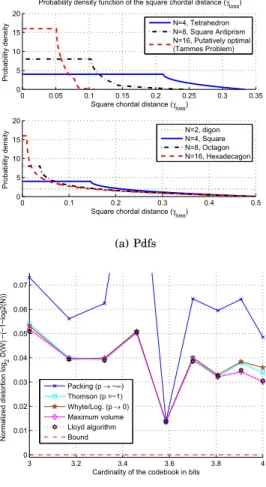
In Publication III, we construct Grassmann beamforming codebooks for two transmit antenna systems. Using an isometry, we show that the dis-cretization problems are directly solved by corresponding spherical codes. Notably, the Grassmannian line packing problem is equivalent to the Tammes problem on the real sphere, so that optimum spherical packings give optimum Grassmannian packings. Moreover, a simple isomorphism enables to analytically derive simple codebooks in closed-form having low implementation complexity. Using the simple geometry of some of these codebooks, we derive closed-form expressions of the probability density function (pdf) of the squared quantization error. We also investigate code-books based on other spherical arrangements, such as solutions maximiz-ing the harmonic mean of the mutual distances among the codewords, which is known as the Thomson problem. We find that in most of the cases, Grassmannian codebooks based on these other spherical arrange-ments outperform codebooks from Grassmannian packing.
In Publication IV, a construction of Grassmannian packings related to representation theory is applied to build implementation-friendly MIMO precoding codebooks when the number of transmit antennas is a power of a prime number. Using chordal distance as a metric, some of the cor-responding packings are optimal by meeting the orthoplex bound. In ad-dition, by using only some of the codewords, smaller packings satisfying an equal-power per antenna constraint can be constructed. Optimality with reference to this constraint is shown by modifying
Conway-Hardin-Introduction
Sloane’s spherical embedding of the Grassmann manifold for equal-power per-antenna codebooks.
In Publications V and VI, we discuss group orbits to construct codes in Grassmann and flag manifolds, respectively.
In Publications V, to generate Grassmann orbit codes, we look for projec-tive unitary representations of finite groups. Following this principle, we derive basic properties and describe explicit constructions of group orbits leading to some optimum packings in 2 and 4 dimensions.
In Publication VI, we define distances that embed flag manifolds into Euclidean hyperspheres, providing a generalization of the spherical em-bedding of Grassmann manifolds equipped with the so-called chordal dis-tance. For code construction, the center of a finite unitary group has no effect, and thus it is sufficient to consider its inner automorphism group. Accordingly, some explicit constructions from projective unitary represen-tations of finite groups in 2 and 4 dimensions are described. We also give examples of codes on the Stiefel manifold constructed as orbits of the lin-ear representation of the projective groups, leading to codes that are ex-pansions of the flag codes considered.
The last two papers investigate scenarios where Grassmann codebook design is not optimal, and a larger manifold has to be considered.
In Publication VII, we focus on product codebook design with application to cooperative MIMO transmission. We show that the Stiefel representa-tives which are used to realize a Grassmann codebook impact the perfor-mance of product codebooks. We propose a novel joint Grassmann-Stiefel codebook design aiming at good discretization of Grassmann and Stiefel manifolds with a single codebook. The resulting product codebooks show performance comparable with global Grassmann quantization. To find low-distortion codebooks, we present a vector quantizer to generate Stiefel codebooks conditioned on a fixed Grassmann codebook. For this purpose, we provide an exact solution for computing centroids in the Stiefel mani-fold with chordal distance. Furthermore, concrete examples of analytical joint Grassmann-Stiefel packings are given. Additionnally, we discuss low-complexity codeword selection methods.
Publication VIII interpretes unitary codebook design problems for var-ious precoded MIMO scenarios as generalized discretization problems of flag manifolds. As a concrete example, we consider codebooks for MIMO transmission with linear receivers. In this case, the problem reduces to discretizing permutation-invariant flag manifolds. A corresponding
Introduction
Lloyd’s algorithm is given, providing low-distortion codebooks. We found that a full-rank MIMO system with the same number of transmit and re-ceive antennas, the gain of precoding with linear rere-ceiver is small. This differs from the behavior of low-rank transmissions, where it is known that a small number of feedback bits allows near-optimal channel adap-tation.
2. System Model
This chapter presents the system model of codebook-based MIMO pre-coding [51, 55]. For point-to-point MIMO, we consider a uncorrelated flat Rayleigh MIMO channel. Extension to base station cooperation is mod-eled by integrating large-scale path gain imbalance between the trans-mitters, similarly than in [16]. The system model motivates the prime interest of the thesis which is on code design and construction.
2.1 Signal and Channel Model
Consider a MIMO system withnttransmit andnrreceive antennas. After
unitary precoding withW∈Cnt×ns, a vectorx∈Cns×1ofn
s≤min(nt, nr)
multiplexed streams is transmitted through a fading channelH∈Cnr×nt.
The received signal is
y = HWx+n, (2.1)
= Heffx+n, (2.2)
n ∈ Cnr×1 denote the noise, and Heff = HWthe effective channel. We
assume that the transmitted signal and the noise are Gaussian with co-variancesExxH=γI
ns andE
nnH=I
nr, whereγ is the per-stream
SNR. We assume the entries of the channelHare independent and identi-cally distributed (i.i.d) complex normal variables with zero mean and unit variance.
We concentrate on the properties ofW related to steering the trans-mitted energy to the signal subspace of the receiver and increasing the capacity. Here, power allocation is considered to be out of scope of precod-ing and instead form a part of the design ofx. We thus have the following contraints onW: the total transmit power isns, which is equally shared
among the symbols such thatWHW=I
func-System Model
tion of the received feedback bits, is used for channel adaptation in order to increase to maximum achievable information rate of the system given by
I=Elog2detI+γHHeffHeff. (2.3)
2.2 Base Station Cooperation
In Chapter 6, we consider cooperative transmission from several base sta-tions to the same user. Then, we define a(nbs×nt)×ns MIMO system
asnbs base stations (BSs) each equipped with ntantennas transmitting
cooperatively ns-data streams. It is assumed that the BSs are able to
instantaneously share the feedback information, e.g. via high speed back-hauls. The effective channel becomes
Heff=HlsWls, (2.4)
whereWlsis annbsnt×nsaggregate precoding matrix and
Hls= [α1H1, . . . , αnbsHnbs] =HssG (2.5)
is the aggregate channel matrix where the channels from the BSs to the receiver are concatenated, and large scale path losses are explicitly taken into account. The average path gain from theithBS to the receiver isα
i,
incorporating distance-dependent path loss and shadowing. Small-scale path gains are characterized by the matricesHi∈ Cnr×ntwhose entries
are assumed to be i.i.d. flat Rayleigh distributed with unit variance. The aggregate small-scale path gain matrix is denoted Hss = [H1, . . . ,Hnbs]
and the large scale path gains byG = diag(α1Int, . . . , αnbsInt). Forα1 =
· · ·=αnbs, the model reduces to a classicalnbsnt×nsi.i.d. point-to-point
MIMO system. We denote by Vls and Vss ∈ VnCbsnt,ns the left singular
vectors associated with thens-largest singular values ofHHls andHHss,
re-spectively.
It is assumed that the BSs know the large scale path gains of the chan-nels contained inGand the precoder is constructed in two steps. The BSs first construct a small-scale precoding matrixWss. Then the large-scale
precoding matrix applied isWls =
√n
tnbs
G GWssfollowing the principle of
adaptive precoding for correlated MIMO [54,95]. The normalization guar-antees that the total transmit power per-stream is one.
System Model
2.3 Codebook-Based Precoding
The channel coefficients are assumed to be perfectly known at the receiver and unknown at the transmitters. We assume that the BS has access to CSI only through an error-free, zero delay, and limited feedback chan-nel. The precoding matrix W ∈ Cnt×ns is designed for channel
adapta-tion according to the informaadapta-tion fed back by the receiver. To acquire CSI through a limited feedback channel, we consider codebook-based pre-coding where the receiver and transmitter share a predefined codebook
C = {C1, . . . ,Cncb}. Elements in the codebook are Stiefel matrices, i.e. CH
i Ci=I∀i, which are used to quantize the eigendirections of the signal
subspace at the receiver.
The receiver selects a codeword following a quantization rule that ap-proximates the channel by using the codebook,
qC: {H} → {i: 1≤i≤ncb}, (2.6)
and feeds back the indexk= qC(H)to the transmitter. Then, the trans-mitter constructs a precoding matrix based on the CSI received, i.e.Wis a function ofCi. Especially for point-to-point MIMO, a simplified version
is to assume that the transmitter directly picks the precoding matrix from the shared codebook:W=Ck.
In this setting, there is typically an infinity of precoding vectors lead-ing to the same performance, and the possible precodlead-ing vectors can be grouped into equivalence classes. It follows that the set of equivalence classes of precoding matrices is a quotient space of the Stiefel manifold. In order to have non-equivalent codewords, the codebook should be de-signed as a discretization of this space of equivalence classes of precoding matrices. A Stiefel precoding codebook is then generated by taking any representative in the equivalence classes.
2.4 Low-Complexity Constraints
Practical codebooks in industry standards have been designed according to additional constraints of interest. In our code construction, we try to address those constraints. Low implementation-complexity codebooks are typically characterized through three design constraints [51]:
System Model
power balanced manner and their average transmit power is kept at the same level. This constrains the rows in the precoding matrix to have squared norm equal tons/nt.
2. Constrained alphabet. The alphabet of the codebook elements is re-stricted to a small finite alphabet in order to limit the number of mul-tiplications and storage requirements at the receiver. Often, the alpha-bet is limited to the unit circle, which is also known for beamforming as equal gain transmission [52, 63]. This guaranties the EP constraint above. Restricting the alphabet to{1,−1, i,−i}, i = √−1further re-duces complexity by enabling matrix multiplications to be performed only by conjugations and additions [44, 60].
3. Nested property. A lower rank precoding matrix is a submatrix of a higher rank precoding matrix.
In the current 3GPP LTE-Advanced industry standard, the number of antennas at the base station may be two, four, or eight. The 2Tx code-book can be seen as an example of extraspecial group code constructions described in Chapter 5, cf. codebook B in Table I from Publication IV. For 4Tx, the LTE codebooks were designed based on Householder reflections. The resulting codebooks have similar distance properties as the codebooks of Publication IV (codebook C in Table 5.4) and thus perform equivalently in term of spectral efficiency. As discussed in [1] the implementation ben-efit from the Householder construction was accidental and valid only for 4Tx; it is also noted that discrete Fourier transform (DFT) codebooks fail to be a valid design for 8Tx systems. To overcome this issue, the 8Tx code-book in LTE-Advanced is constructed by concatenating the same 4TX DFT codeword twice and using a cophasing factor [80]. The resulting codebook has a structure resembling the product codebooks considered in Publica-tion VII.
3. Flag Manifolds: Code Designs and
Geometry
The codebooks addressed have orthonormal columns, and can be inter-preted as elements in a flag manifold with representative in a Stiefel manifold. A manifold is roughly speaking a curved space which locally resembles the Euclidean space. To investigate coding problems, we need to define a notion of distance. Depending of the application and conve-nience, several non-equivalent distances has been considered on these spaces [28]. We focus onchordal distancescorresponding to natural Eu-clidean distances from spherical embeddings. There are two motivations for this choice. First, we are interested in computable distance functions consistent with the rectangular unitary matrix representation. Second, the considered chordal distances for Stiefel, Grassmann, and some simple flag manifolds have been shown to be related to performance of space-time codes and precoding codebooks in SU and MU-MIMO [22, 35, 47, 56]. This choice of distances enforces treatment of the manifolds as subsurfaces of hyperspheres, and implies that flag codes are a subclass of spherical codes.
3.1 Flag Manifolds
The complex Stiefel manifoldVC
nt,nsis defined as the space of orthonormal
rectangular matrices (withns≤nt),
VC nt,ns= Y∈Cnt×ns | YHY=I ns . (3.1) The unitary groupUnt=VnCt,ntis a specific case of Stiefel manifold.
The flag manifold [11, 29]
FlCnt;s1,...,sr = VnCt,ns/(Us1× · · · × Usr) (3.2)
where ns = ri=1si, is the set of equivalence class ofnt-by-ns Stiefel
se-Flag Manifolds: Code Designs and Geometry W W U1 U2 U3 nt ns s1 s2 s3 ns ns
(a) Unitary-rotations equivalence (b) Permutation equivalence
Figure 3.1.Illutration of the equivalence relationship considered.
quence of unitary matrices(U1, . . . ,Ur)∈(Us1× · · · × Usr)exist such that V=Ydiag(U1, . . . ,Ur).
The caser= 1ands1=nsdefines the Grassmann manifold
GC nt,ns Fl C nt;ns=V C nt,ns/Uns, (3.3)
which is isomorphically the set of allns-dimensional subspaces ofCnt.
According to (3.2), the Stiefel manifoldVC
nt,ns is not strictly speaking a
flag manifold, but it is also a homogeneous space of the unitary group
VC
nt,ns∼=Unt/Unt−nsand can be seen as an extreme case in (3.2) by setting
r= 1ands1= 0.
Another case of interest is s1 = . . . = sr = 1, for which we use the
notation FC nt,nsFl C n;1, . . . ,1 ns =VnCt,ns/(U1)ns. (3.4)
We finally consider an additional equivalence relationship inFlCn;s 1,...,sr
when sk = ns/r for all k. GivenV,Y ∈ VnCt,ns, one may group their
columns in sub-matrices asV= (V1,V2, . . . ,Vr)andY= (Y1,Y2, . . . ,Yr),
such that Vk,Yk ∈ VnCt,sk. Then, we consider them equivalent if they
only differ by a permutation of their r-submatrices, i.e. there exists a permutationσ such thatV = (Yσ(1),Yσ(2), . . . ,Yσ(r)). The permutation
corresponds to an orientation-invariance of the elements. We denote the corresponding space by FlCnt;s 1,...,sr Fl C nt;s1,...,sr/Sr (3.5)
whereSris the symmetric group whose elements are all the permutations of thersymbols.
Similarly for the specific cases1=. . .=sr= 1, we defined
FC
nt,ns F
C
Flag Manifolds: Code Designs and Geometry
3.2 Spherical Embeddings and Chordal Distances
We treat the manifolds of interest as submanifolds of hyperspheres. The spherical embeddings of the Stiefel manifold and the flag manifolds are of different natures. The Stiefel manifold has a canonical spherical em-bedding from the vector representation of rectangular unitary matrices. The spherical embeddings of the Grassmann manifolds with correspond-ing chordal distance is obtained from a projector representation [18]. In Publication VI, we show that all flag manifolds can be understood as sub-manifolds of the same sphere. Roughly speaking, a(n2t−2)-dimensional hypersphere can be decomposed, except for a zero-measure set, so that it consists of a “fibration” of flag manifoldsFC
nt,ntover a(nt−2)-dimensional
hypersphere with some singular submanifolds removed. The remaining of the sphere, the singularities, correspond to other flagsFlCnt;s1,···srwhich in-cludes the Grassmann manifoldsGC
nt,ns as special cases. To generalize the
notion of Grassmann distance to more general flag manifolds, we embed them into a direct product of Grassmann manifolds and take the corre-sponding chordal distance. This results in embedding into a larger space than the(n2t −2)-sphere. Finally, inspired by the literature in quantum information science on mutually unbiased bases (MUB) [27], we consider an alternative distance on simple permutation-invariant flag manifolds.
We have the following isometric embeddings
(M, dc)→ SD−1(R) (3.7)
whereSD−1(R)⊂RDis a(D−1)-sphere of radiusR, with
M dc D R2 VC nt,ns ds 2ntns ns GC nt,ns dg n 2 t−1 ns(nt−ns) 2nt FlCnt;s 1,...,sr df r(n2t−1) nsnt−ri=1s2i 2nt FlCnt;s 1,...,sr dp r(n2t−1) nsnt−ri=1s2i 2nt FC nt,ns dmu n2t 2 −1 (ns−1)(n2t−ns) n2t−1
and the chordal distances, defined for Y, Z ∈ VC
Flag Manifolds: Code Designs and Geometry
their respective equivalence class, are
ds(V,Y) = V−Y F, (3.8) dg(V,Y) = √1 2 VV H−YYH F, (3.9) df(V,Y) = r i=1 d2g(Vi,Yi), (3.10) dp(V,Y) = min P∈Sp df(V,YP), (3.11) dmu(V,Y) = ns− ns i,j=1 |vH i yj|4. (3.12) (3.13) The decompositions of the matrices in column-blocks are given byV = (V1, . . . ,Vr) = (v1, . . . ,vns)andY = (Y1, . . . ,Yr) = (y1, . . . ,yns). Here
df is the metric on the flag manifold interpreted as a sequence of
Gras-mannians, anddpis the permutation-invariant version. The metricdmuis
considered in the literature on mutually unbiased bases [27].
In Publication IV, we show also that constraining the Grassmann man-ifold to satisfy the EP constraint reduces the dimensionality of the spher-ical embedding fromn2t−1ton2t−nt.
3.3 Codebook Designs
Several criteria have been investigated in the literature to design good MIMO precoding codebooks. With i.i.d Rayleigh fading, the right eigen-vectors of the channel are uniformly distributed over the Stiefel manifold according to the Haar measure [45, 53]. As the set of eigenvectors forms a representative in a flag manifold, the set of equivalence class is also Haar distributed over this flag manifold. The main idea is to target uni-form codebooks over the manifold. For this we need to define a notion of uniformity. Several mathematically non-equivalent standard criteria exist. From the point of view of precoding performance metric such as in-formation rate, they however are almost optimal, and thus roughly equiv-alent [23, 56, 71, 72, 95]. For uniformity, we will consider both distortion and discrete arrangement criteria.
Consider a codebookC={C1, . . . ,Cncb} ⊂ VnCt,ns. Depending on the
dis-tancedcconsidered, the codebook is treated as a discretization of the
Flag Manifolds: Code Designs and Geometry
and define the associated quantization map
qc(V) = arg min 1≤i≤ncb
dc(V,Ci). (3.14)
In quantization theory, a standard criterion is to minimize the average distortion of a codebook, i.e. the average squared quantization error,
DM(C) =Ed2c(V,Cqc(V)). (3.15)
Here, we only consider uniformly distributed source, but this criterion is adaptable for other distributions as well.
In discrete mathematics, the classical approach is to look at the prop-erties of codebooks as point sets on the respective manifolds. The most studied criterion is maximizing the minimum distance [19, 74]
δM(C) = arg min
1≤i,j≤ncb
dc(Cj,Ci). (3.16)
This problem is often referred as a packing problem and is related to Tammes problem on the sphere.
A generalization of the packing problem is the Thomson problem where one has to maximize thep-mean distance [74]:
Mp(C) = ⎛ ⎝ 2 ncb(ncb−1) 1≤j<k≤ncb dc(Cj,Ck)p ⎞ ⎠ 1/p . (3.17)
Typical values of interest arep=−1and−2.
3.4 Lloyd’s Algorithm and Centroids
Lloyd’s algorithm aims to construct a codebook with minimum average distortion. It comprises two key steps:
Nearest Neighbor rule: Partitioning of the manifold according to the codebook inncbVoronoi cells{R1, . . . ,Rncb}defined by
Rk={V∈ M |k= qc(V)}. (3.18)
Centroid Computation: Finding the centroids of each Voronoi cellRk
given by Zk= arg min V∈ME d2c(V,V)|V ∈ Rk . (3.19) The algorithm consists of iterating these two steps where the former code-book is replaced by the set of computed centroids.
Generally, the centroid of a Voronoi cell is approximated through ex-haustive search. Meanwhile, due to the treatment of the manifolds as
Flag Manifolds: Code Designs and Geometry
subspaces of Euclidean hyperspheres with canonical extrinsic distances, the centroids may also be computed in closed-form. As the manifolds are closed continuous surfaces in an Euclidean space, a centroid of a Voronoi region is obtained from the orthogonal projection onto the manifold of its center of mass in the ambient space [26]. Accordingly, we provide an exact centroid computation for the Stiefel manifold in Publication VII, where an orthogonal projection of any complex matrix to the Stiefel manifold is given by the polar decomposition following [31,41]. A closed-form solution was already known for centroids in the Grassmann manifold [58]. While the closed-form Grassmannian centroid computation is usually proven differently in the literature, it could also be derived using the argument in [26]. The centroid corresponds to the closest projection matrix of a given rank to the center of mass in the ambient space of Hermitian ma-trices. For deriving centroids in other flag manifolds, the main difficulty lies in expressing the orthogonal projection. In Publication VIII, the cen-troid for simple permutation-invariant flag manifolds was approximated through projection in the embedding space of direct product of Grassman-nians, a similar approach can be found in [77]. We conjecture that this is the true centroid.
3.5 Density and Packing Bounds
In the last decade, basic coding-theoretic results estimating the relation-ship between the cardinality and the minimum distance of codes in Grass-mann and Stiefel manifolds have been widely studied [7–10, 21, 22, 36, 40, 49, 50]. The Hamming bound, a standard coding bound, is related to the notion of density of codes. In Publications I and II, we discuss the density of codes in Grassmann and Stiefel manifolds equipped with a chordal dis-tance. There are two main difficulties in evaluating the density of codes in these spaces: 1) evaluating the (normalized) volume of a ball 2) estimating the kissing radius of codes.
1) Volumes: The authors of [22] were able to derive closed-form expres-sion on the volume of a small ball in Grassmannians under the chordal distance. A more general approach was used in [49, 50] where a power series expansion of the (unnormalized) volume of small ball valid for any Riemann manifold [33] was leveraged. This provides a powerful tool—in order to obtain a normalized volume expansion, it suffices to divide by the overall volume of the manifold. The volume of the manifold depends of
Flag Manifolds: Code Designs and Geometry 100 10−10 10−8 10−6 10−4 10−2 100 chordal distance volume Unitary group Unt Simulation Theory nt=1 nt=2 nt=3 nt=4 nt=5
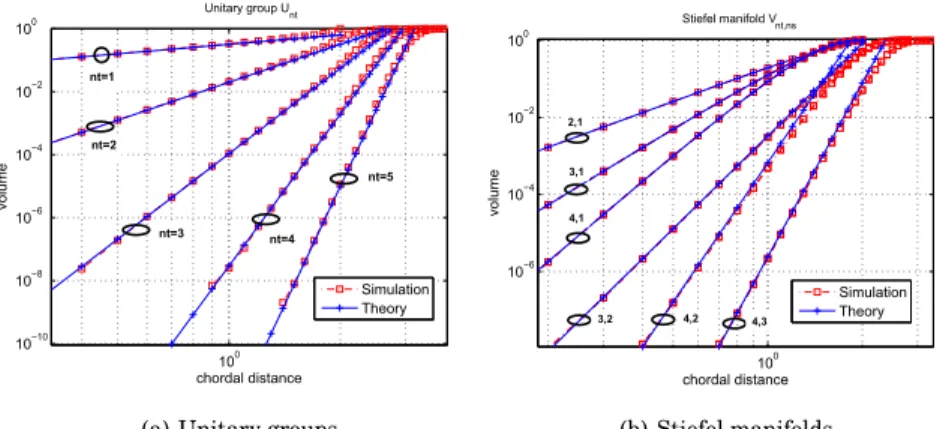
(a) Unitary groups
100 10−6 10−4 10−2 100 chordal distance volume Stiefel manifold Vnt,ns Simulation Theory 2,1 3,1 4,1 4,2 3,2 4,3 (b) Stiefel manifolds
Figure 3.2.Volume approximation of balls in Stiefel manifolds and unitary groups com-pared to simulation.
the Riemannian metric defining the notion of distance. There is an equiv-alent intrinsic Riemannian metric corresponding to the extrinsic chordal distance. In fact, from the Nash embedding theorem, every Riemannian metric can be seen as being induced by an appropriate Euclidean embed-ding [65]. For the case of the Stiefel manifold, two non-equivalent Rie-mannian metrics are often considered [28], one realized from the space of rectangular unitary matrices and the other from the interpretation of the manifold as a quotient space of the unitary group embedded in the space of square unitary matrices. It appears that in the majority of the literature, the volumes of the manifolds do not correspond to any of these two met-rics. Indeed, the volume element is unique up to a non-vanishing scaling factor which is often dismissed, as it can be absorbed in the overall nor-malization. Here, the volume expansion imposes the scaling of the metric and volume element. For accurate normalization of the expansion of [33], the volume of the manifold should be calculated with the same metric. A discussion and clarification of different conventional normalizations of the volume of the unitary group is provided in [98]. In [49] the volume of the complex Stiefel manifold is computed for the geodesic distance induced by the quotient geometry. In Publication II, we address the problem when considering the typical chordal distance induced by the rectangular ma-trix embedding, which leads to an expression of the volume differing from the ones previously derived in [49] or [40]. The exact volume of the Grass-mann manifold with chordal distance is also computed. A corresponding volume computation and mindmap is presented in Fig. 3.3. The exactness of the volume is illustrated in the estimation of volume of small ball for the Stiefel manifolds and unitary groups in Fig. 3.2.
Flag Manifolds: Code Designs and Geometry
Flag Manifolds: Code Designs and Geometry
2) Kissing Radius: As we are considering extrinsic distances, there is room for improvement of the standard Hamming bound [9, 36] through the notion of density. We address this problem for the Grassmann mani-fold in Publication I and for any spherically-embedded manimani-fold in Publi-cation II. The density of a code is defined as the fraction of the manifold covered by ‘kissing’ balls of equal radius centered around the codewords. The kissing radius problem addresses the following question: if two points are at chordal distanceδ, how far is the midpoint from the extremities. For a geodesic distance, the answer is simplyδ/2; with an extrinsic distance, this is greater thanδ/2. While there is a unique and exact answer to this question on a sphere, this is not the case for flag and Stiefel manifolds with chordal distances, because in general these spaces are not two-point homogeneous. For these, the kissing radius cannot be determined solely from the minimum distance. We provide upper and lower bounds on the kissing radius as a function of minimum distance for the Grassmann and Stiefel manifold in Publications I and II.
3) Packing Bounds: Bounds on the kissing radius leads to a refine-ment of the standard Hamming bound for flag and Stiefel codes. Based on this, Publication I provides new bounds on the minimum Grassmann distance. In Publication II, we provide a similar bound for any spherically-embedded manifold generalizing previously known bounds on codes in the unitary group [36] to the Stiefel manifold:
Given a code of cardinalityncband minimum chordal distanceδMin a
manifoldMisometrically embedded inSD−1(R), we have δ2M≤4r2n−r
4 n
R2, (3.20) wherernis solution ofμ(B(rn)) = n1
cb andμ(B(rn))is the normalized
vol-ume of a ball of radiusrn.
Applying this result to the unitary group leads to the bound [36, Theo-rem 2.4]. A tighter bound is provided for a small range of large distances by [36, Corollary 2.9]. In Publication I, for Grassmann manifolds, we were able to improve the bound by
δ2g≤4rn2−r 4 n ns
, (3.21)
which is a generalization of the bound in [96] valid only for line packing (ns= 1).
The Hamming bound is rather loose especially for small codes. For low cardinality, Rankin bounds [70] related to the spherical embeddings
Flag Manifolds: Code Designs and Geometry
are known to be tight when applied to Grassmann codes [18]. In aD -dimensional sphere, the optimum packings for up toD+ 1points corre-sponds to simplices. FromD+ 2to2Dpoints, the optimal configurations are subsets of an orthoplex. They are thus referred as simplex and ortho-plex bounds, respectively [18].
As discussed in Publication IV, the smaller embedding provided for EP codebooks leads to a modification of the range of the Rankin bounds. The corresponding EP orthoplex bound is used for proving the optimality of some of the packings presented in Publication IV.
4. Grassmannian Pakings for 2-Tx
MIMO
The lowest dimensional flag manifolds (nt= 2) are very specific cases. We
have FC
2,2 ∼= F2,1C ∼= G2,1C , which further reduces to the real unit sphere
FC
2,2∼=S2. It follows that designing codebooks inF2C,2∼=G2C,1 is equivalent
to designing spherical codes. In this chapter, we discuss explicit represen-tation of spherical codes in 2-by-1 vector form for coding inGC
2,1; equivalent
2-by-2 matrix codes forF2C,2can be obtained by pairing an orthogonal
com-plement of each codeword. In addition, a2×2unitary matrix generating a point in FC
2,2 can be seen as two ordered antipodal points, or
equiva-lently an oriented line. It follows thatFC
2,2is the set of spherical antipodal
points, or equivalently the set of lines in 3D, also known as the real Grass-mannianGR
3,1 ∼=F2C,2 [18]. Codebooks inF2C,2 can thus be constructed by
leveraging results from known antipodal spherical codes [57].
4.1 Grassmannian Codebooks from Spherical Arrangements
The Grassmann manifoldG2C,1 is by definition thecomplex projective line CP1. From the Hopf fibration of the unit3-sphere as a circle bundle over
CP1[12, Ex.17.23], we have
GC
2,1=CP1∼=S 3
S1 =S2. (4.1)
For the explicit form of the isomorphism we parameterize the unit vector
w, a generator of the equivalence class[w]∈ G2,1C , as
w(θ, φ) = ⎛ ⎝ cosθ eiφsinθ ⎞ ⎠. (4.2)
By setting the range ofθandφto[0;π2]and[0; 2π], respectively, we fully describe the Grassmannian. Interpreting(θ, φ)directly as spherical coor-dinates, these would describe a hemisphere. A simple morphism from a
Grassmannian Pakings for 2-Tx MIMO
Figure 4.1.The real GrassmannianGR
2,1is the set of lines inR2, or equivalently the set of
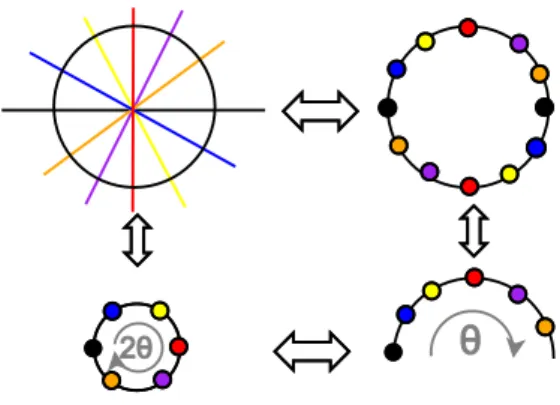
antipodal points on the unit circle. Taking only representatives on the upper hemisphere, an isometry to a circle is obtained by doubling the parametric angleθand reducing the radius to one half.
hemisphere to the whole sphere can be obtained by doubling the angleθ. The irrelevance ofφforθ= 0and π
2 in (4.2) leads to the isomorphism.
Moreover, with the chordal distance considered,GC
2,1is isometric to the
real sphere (of radius one half). Isometry implies that discretization prob-lems on(GC2,1, dg)can be addressed on the the real sphereS2. Any
spheri-cal code can be transformed to a Grassmannian codebook by applying the corresponding simple change of variables. Cartesian coordinates are first converted to spherical coordinates(ϑ, φ)and the latitude is divided by two
(θ = ϑ2, φ). A generator of the corresponding Grassmannian line is then obtained by using(θ, φ)in (4.2). As a result, the chordal distance between two Grassmannian lines is half the distance between the respective spher-ical codewords. We illustrate this isometry forφ= 0which corresponds to the real GrassmannianGR
2,1∼=S1isomorphic to a circle in Fig. 4.1.
The problem of distributing a certain number of points uniformly over the surface of a sphere has been thoroughly studied [74]. Different criteria on the mutual distances among the codewords have been extremized in the literature, with motivation often arising from chemistry, biology and physics [19, 74, 92]. For convenience, solutions are often described as the vertices of a convex polyhedron.
TheTammes problem is the problem of placingncb points on a sphere
so as to maximize the minimum distance, also referred to as spherical packing, is a specific case of spherical arrangements [74]. It follows that Grassmannian line packing inGC
2,1is equivalent to the Tammes problem.
In Publication III, we have thus construct codebooks and leverage existing results from the spherical code literature by using the isometry.
Grassmannian Pakings for 2-Tx MIMO 0 5 10 15 20 25 30 35 0.1 0.2 0.3 0.4 0.5 0.6 0.7 0.8 0.9 1 Number of points
Squared minimum chordal distance
Squared minimum distance for packing in GC 2,1
Simplex bound Orthoplex bound Fejes Toth bound Hamming−type bound (3.21) Optimal packings (proven) Best known packings Modified Lloyd algorithm [88] Brute−force search [53]
Figure 4.2.Best known squared minimal chordal distance for packings inGC 2,1.
The Rankin bounds [70] and the Fejes Tóth bound [30] applies to the minimum distance of packings in G2C,1. The Fejes Tóth bound is specific
for the 2-sphere. It is tighter than the Hamming-type bound (3.21) which in this case reduces to the bound in [96]. These bounds lead to proof of optimality of some packings. Optimum packings ofncbpoints on a sphere
have been found forncb≤12andncb= 24[17, 30], with optimality proven
geometrically. Forncbup to130, the best known sphere packings are
avail-able at Sloane’s webpage [84]. Fig. 4.2 shows the achieved minimum dis-tances of the corresponding Grassmannian packings along with bounds, compared to numerical results from [94,96] where a modified Lloyd search algorithm was used and to results from [56] using brute-force computer search.
The problem of maximizing the generalizedp-mean of the mutual dis-tances among the codewords can be called thegeneralized Thomson prob-lem. It is the counterpart of a spherical arrangement problem which, due to its relevance to physics, is often formulated as the minimization prob-lem of the Rieszs-energy fors >0. It is remarked in [74] that onS2this problem is only interesting forp <2.
Some values ofphave attracted special interest. The casep=−1 (some-times alsop =−2) is known as the (standard)Thomson problem. Solu-tions referred to asFekete pointshave been found forncb=2–4, 6, 12 [25].
Another distinguished problem is the problem of maximizing the product of the distances, known asWhyte’s problem. This occurs whenp→0and can be restated equivalently as minimizing the logarithmic energy.