Author(s) Flanagan, Brendan; Ogata, Hiroaki
Citation Companion Proceedings 8th International Conference onLearning Analytics & Knowledge (LAK18) (2018)
Issue Date 2018
URL http://hdl.handle.net/2433/233071
Right
This work is published under the terms of the Creative Commons Attribution- Noncommercial-ShareAlike 3.0 Australia Licence. Under this Licence you are free to: Share -copy and redistribute the material in any medium or format.
Type Conference Paper
Learning Analytics Infrastructure for Seamless Learning
Brendan Flanagan
Academic Center for Computing and Media Studies, Kyoto University, Japan [email protected]
Hiroaki Ogata
Academic Center for Computing and Media Studies, Kyoto University, Japan [email protected]
ABSTRACT: Seamless learning offers the opportunity to learn in different environments regardless of location or time. It can also provide insights for teachers into how learning is being conducted in informal situations outside the classroom. Previous work into the analysis of seamless learning has mainly focused on purpose build specialized systems that provide an environment for a specific task. However, as the field of learning analytics matures, we are increasingly seeing the development of modular systems that can be linked together by standards based protocols. This paper proposes the integration of the SCROLL system into a wider modular system to increase the possibilities of seamless learning analytics to inform blended learning design. The proposed system addresses fundamental problems, such as the protection of user privacy and authentication while increasing the availability of data for analysis from other learning systems. Data is collected and stored centrally in a unified form that provides the ability to analyze and visualize learning across numerous environments and contexts.
Keywords: Seamless learning, formal/informal learning analytics
1 INTRODUCTION
Seamless learning offers the opportunity to learn in different environments regardless of location or time. Previous work into the analysis of seamless learning has mainly focused on purpose built specialized systems that provide an environment for a specific task (Mouri, 2017). However, as the field of learning analytics matures, we are increasingly seeing the development of modular systems that can be linked together by standards based protocols. This paper outlines the integration of a seamless learning system called SCROLL into a modular learning analytics platform with the purpose of providing seamless learning analytics spanning numerous learning environments and contexts. We anticipate that seamless learning analytics will be able to provide greater insight into how learning occurs in different contexts and help learners and teachers “connect the dots” between when and in what context students have learnt, revisited, and reflected on knowledge. This paper will focus on the learning of vocabulary as it is the main target of the SCROLL system, however there is potential for the same system and analysis to be applied
2 OVERVIEW OF THE PROPOSED INTEGRATED SYSTEMS
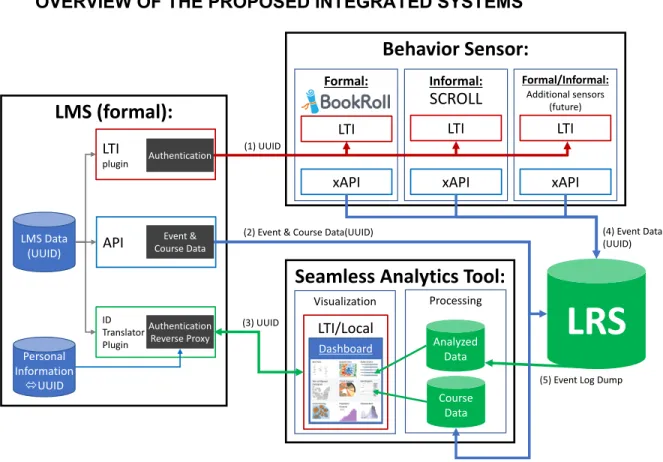
Figure 1: An overview of the proposed learning analytics system.
2.1 Learning Management System
In recent years, several interfaces have been proposed to allow the seamless and secure integration of external tools to augment existing LMS experiences. Some of these interfaces have been proprietary and thus limited the tools that can be integrated. IMS Global Learning Consortium (2016) published the Learning Tools Interoperability (LTI) standard for defining the process of connecting two systems, and how users will transition across these systems without having to authenticate once again with the destination system. During the LTI transition process, information about the user and the context in which the external tool was launched can be transferred from the source system to the target system. Most modern LMS utilize an internal universal unique identifier (UUID) to which personal information, such as: real name and email address are attributed. As shown in Figure 1, we propose that (1) UUID should be transferred to external systems to reduce personal information (a requirement of some education institutions). External tools will then attribute learner events with the LMS's internal UUID that is sent during the LTI launch process, and (4) Event data from behavior sensors and (2) course and event data from the LMS is collected in the LRS (Learning Record Store).
Behavior Sensor:
Formal: Informal: SCROLLLMS (formal):
Personal Information óUUID LMS Data (UUID) LTI plugin API ID Translator PluginLRS
Authentication Event & Course Data xAPI xAPI (4) Event Data (UUID) (2) Event & Course Data(UUID)Seamless Analytics Tool:
Processing Visualization Analyzed Data LTI LTI/Local
(5) Event Log Dump (1) UUID Dashboard LTI Course Data Authentication Reverse Proxy Formal/Informal: Additional sensors (future) xAPI LTI (3) UUID
2.2 Behavior Sensors
In the proposed system, user behavior events will be captured by specialist tools that are linked to the LMS by LTI authentication. The behaviors and actions of learners will be sent by an xAPI interface and collected in a central independent LRS.
2.2.1 BookRoll
Digitized learning materials are a core part of modern formal education, making it an increasingly important data collection source in learning analytics. The reading behavior of students has previously been used to visualize class preparation and review patterns by Ogata et al. (2017). The digital learning material reader can be used to not only log the actions of students reading reference materials, such as textbooks, but also to distribute lecture slides, etc. Contents data can also be exported to the LRS for later analysis.
2.2.2 Informal Learning System(s)
In addition to collecting data on user behavior in formal learning situations, we also plan to deploy the SCROLL ubiquitous learning log system that was reported in Ogata et al. (2011) to collect data on user behavior in informal learning environments. SCROLL can be used to support the sharing and reuse of ubiquitous learning logs that are collected in the context of language learning. The addition of behavior sensors that capture event information outside traditional formal classroom contexts enables the support of research into seamless learning analytics of language learners. As the proposed system will collect data from both formal and informal learning environments, this will enable linking of knowledge learnt in either context in addition to information from the LMS, and could be analyzed to predict and extract behaviors of overachieving and underachieving language learners.
Additional integration of specialized language learning tools, such as: testing and exercise systems for the four major skills: listening, speaking, reading, and writing, into the proposed system would provide further opportunities to analyze in detail the behavior of language learners, however at the time of writing this is beyond the scope of this paper and should be addressed in future work.
2.3 Learning Record Store (LRS)
The LRS is an integral part of the proposed system as it will be a central independent point to collect all event data from both the LMS system and behavior sensors. While we have chosen to adopt xAPI as the mode of transporting events data from other systems to the LRS, this is not a strict limitation. We have decided to deploy the latest version of Apereo Foundation's OpenLRS (Apereo Foundation, 2017), which has the ability to support the storing and querying of event data from both xAPI and Global Learning Consortium's Caliper Analytics API (2015). Data from both interfaces are stored in a unified format within the LRS. The collection of data in an LRS also reduces information silos were data is only stored locally in a number of different modular
2.4 Connecting the Dots with Seamless Analytics Tool
The Seamless Analytics Tool will have two main functions within the proposed system: the aggregation and processing of data stored in the LRS from disparate systems (LMS, Behavior sensors, etc), and the linking of this data into a visualization in which a learner can see how they have learnt a skill. As the SCROLL system focuses on the learning of vocabulary in informal situations, the example used in this paper will focus on how this could be implemented across formal/informal learning environments.
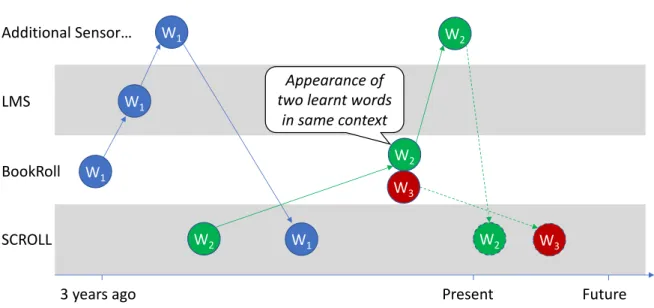
Figure 2: Visualization showing the relation between learnt vocabulary at a personal level. A mockup of a proposed visualization to inform learners about the relationship between contexts in which they learnt vocabulary is shown in Figure 2. A learner can see that they first learnt the word w1 while reading a textbook in BookRoll. The same word was also in a quiz they took later
on a LMS, and then encounter the word again using an additional sensor system, such as watching a video with transcripts/subtitles in a behavior logging video player. Finally, they encounter and note the word in a real-world context using SCROLL. Aggregated data from other students with similar experiences will be analyzed to predict possible future encounters with known or additional words.
It is proposed that students and teachers will access the portal via a plugin within an LMS that will provide both authentication of the user and also translate the UUIDs that are displayed in the portal into their corresponding real identities depending on their role in the LMS. Teachers who are in charge of a class will be able to view all the student identities of students within that specific class. However, students will only be able to view their own identity, and the identities of their peers will remain anonymous in the results of the analysis. The UUIDs that are displayed in the portal will be marked up with tags to enable quick and effective parsing and translation to real identities by a plugin within the LMS system.
W1
3 years ago Present Future
SCROLL BookRoll LMS Additional Sensor… W1 W1 W1 W2 W2 W2 W2 W3 W3 Appearance of two learnt words
The practice of “connecting the dots” between formal and informal learning is an important part of the language learning process as vocabulary are learnt and reinforced through context (Uosaki et al. 2017). It is anticipated that the use of the propose system will enhance students understanding of knowledge and skills acquired formally by showing related situations that occur in informal learning. A particular example in language learning would be that students can use the system to reflect on the vocabulary learnt in the classroom and how it is being applied in context, location and at what time across disparate learning systems.
3 APPLICATION IN LEARNING DESIGN
The integration of the SCROLL system with a wider variety of learning systems will enable the investigation of learning that occurs across disparate systems that are used in formal and informal contexts. It is anticipated that the proposed system can be used to inform the blended learning design framework. The use of this system could be effective in flipped classrooms, where students can learn formally from learning materials and try to apply the knowledge that they have learnt in an informal context before coming to the class. Experiences of informal learning and application of knowledge can be shared during class time, focusing on reflecting and refining the skills that were acquired before class. This also offers teachers with a unique opportunity to see where and what contexts students are using knowledge and skills. This could then be used to inform the revision of both learning resources and task activities based on use by students outside the classroom.
As the system relies on informal activities being conducted in various location-based contexts, we propose that the system should be assessed on the analysis of prepared pre-class data. In the workshop we would like to evaluate the effectiveness of using the system to inform a flipped class scenario for language learning, and in particular vocabulary in context.
4 CONCLUSIONS
In this paper, we propose the integration of the seamless learning system SCROLL with disparate systems that are currently in use within education institutes, with the purpose of providing a seamless analytics of event data across formal and informal learning contexts. We anticipate this will help learners reflect and “connect the dots” on knowledge they have learnt in various contexts to reinforce their understanding.
REFERENCES
Apereo Foundation. (2017). Apereo Learning Analytics Initiative: Open LRS. (2017). Retrieved September 1, 2017 from http://www.apereo.org/projects/openlrs
IMS Global Learning Consortium. (2015). Caliper analytics. (2015). Retrieved September 1, 2017 from http://www.imsglobal.org/activity/caliper
Mouri, K., Ogata, H., Uosaki, N. (2017). Learning analytics in a seamless learning environment. In Proceedings of the Seventh International Learning Analytics & Knowledge Conference. ACM, 348–357.
Ogata, H., Li, M., Hou, B., Uosaki, N., M El-Bishouty, M., Yano, Y. (2011). SCROLL: Supporting to share and reuse ubiquitous learning log in the context of language learning. Research & Practice in Technology Enhanced Learning 6(2), 69–82.
Ogata, H., Oi, M., Mouri, K., Okubo, F., Shimada, A., Yamada, M., Wang, J., Hirokawa, S. (2017). Learning Analytics for E-Book-Based Educational Big Data in Higher Education. In Smart Sensors at the IoT Frontier. Springer, 327–350.
Uosaki, N., Ogata, H., Mouri, K., Choyekh, M. (2017). Implementing Sustainable Mobile Learning Initiatives for Ubiquitous Learning Log System Called SCROLL. In Mobile Learning in Higher Education in the Asia-Pacific Region. Springer, 89-114.